skip to main |
skip to sidebar
On 23rd June 2021, I made a short journey (very short) on the Cambrian Line. I was shocked to discover that this was the first time I'd been on a train (apart from a couple of steam driving turns and a few diesel multiple unit turns on the Battlefield Line) for over a year, such has been the impact of the Covid-19 Pandemic. My previous rail journey, I discovered, had been Wolverhampton to Hawarden Bridge on 9th June 2020, which didn't result in a blog post but did produce the usual crop of not-very-good photographs which are in the album here. Although that journey is not described in the blog, there are a couple of posts on an earlier expedition along that route in 2014 to Liverpool starting here.
I'd initially planned to make my June 2021 journey to Central Wales by train but was shocked to discover that, at that time, Rail Replacement Buses provided the only service between Shrewsbury and Machynlleth, presumably because of emergency Covid-19 timetabling. The remainder of the Cambrian was being operated as an isolated railway with services from Machynlleth to Aberystwyth and Machynlleth to Pwllheli. This was feasible because Machynlleth has a maintenance depot for the Diesel Multiple Units working on the line and a diesel refuelling point.
The Cambrian Line is single with passing loops so is a good illustration of the problems of safely and effectively working a long-distance route where trains in opposite directions must be timetabled to pass where loops are provided. Track Diagrams of the modern Cambrian Line can be found in book reference [1]. Alternately, the Railcam.UK site offers access to simplified track diagram with real-time information on train movements. There's a brief introduction to the Railcam.UK site in my post here.
The Aberystwyth service shares the single line from Machynlleth as far as Dovey Junction where a loop is provided allowing Up and Down services on the Aberystwyth branch to pass when required. Passing loops are provided on the Pwllheli line at Porthmadog, Harlech, Barmouth, and Tywyn. Intrigued, I put together a working timetable of the Monday to Friday service being offered. It's rough and incomplete, I'm afraid, but I hope gives some idea of the service provided.

Cambrian Line 2021: Machynlleth - Aberystwyth Train Times: Mon-Fri June
(Click for larger view)

Cambrian Line 2021: Aberystwyth - Machynlleth Train Times: Mon-Fri June
(Click for larger view)

Cambrian Line 2021: Machynlleth - Pwllheli Train Times & Pwllheli - Machynlleth Train Times (Mon-Fri, June)
(Click for larger view)
The way in which the timetable is arranged to allow up and down trains to pass at loops is, I hope, made clearer by a train graph, shown below. Again, this is rough and incomplete and I haven't corrected errors where trains don't quite meet in the right location but should illustrate the difficulties timetable planners face in constructing single-line timetables. Time is plotted horizontally left to right, starting at midnight. Mileage (in miles and chains) is plotted vertically, based on a reference point at Whitchurch measured via a long-gone railway!

Cambrian Line 2021: Train Graph Machynlleth - Pwllheli (Mon-Fri, June)
(Click for larger view)
All of the stations on the Cambrian Line have been modernised and drastically simplified, are generally unstaffed and many are request stops. To board at a request stop, you have to handsignal the approaching train (like catching a bus). To alight at a request stop, you must inform the conductor on boarding who, in turn, alerts the driver.
When we set off from home by road the weather was benign but, as we travelled further into Wales, the weather deteriorated so most of the time at my destination in the Harlech area suffered either patchy or heavy rain. Study of the temporary railway timetable suggested that it should be possible to board a Pwllheli-Machynlleth service at Talsarnau station, travel 3 miles 30 chains south to Harlech station and almost immediately catch a northbound service to return to Talsarnau. And the plan worked!
Talsarnau, which had a population of 550 in the 2011 census, now has a station featuring a small car park, a single platform (raised in the centre section to facilitate boarding), electronic passenger information system, public address and 'bus shelter'. The original station building is now in private ownership.

Cambrian Line: Talsarnau Station, looking north
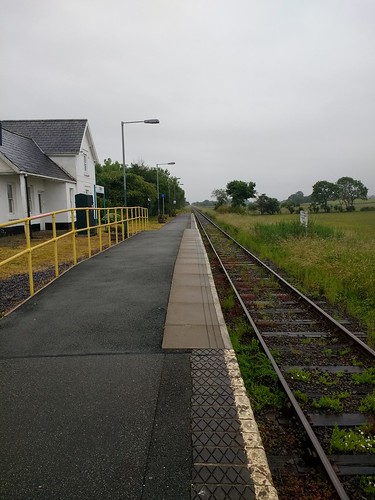
Cambrian Line: Talsarnau Station, looking south with the original station building on the left.
The southbound train, a 2-car Class 158 in Transport for Wales livery, arrived just a few minutes late and I was surprised at how full it was. Face coverings were required by law on the train and, to ensure Social Distancing, some seating was marked out of use. Because Wales now has its own Devolved Government, law and guidance differs in some respects from that elsewhere in the United Kingdom. The train made good time on the short journey to Harlech.
Retaining its passing loop and Up and Down platforms linked by an elderly footbridge, Harlech station still hints at its origins. Once again, the station buildings on the Down platform are now in private ownership and unattractive modern shelters are provided for current travellers.
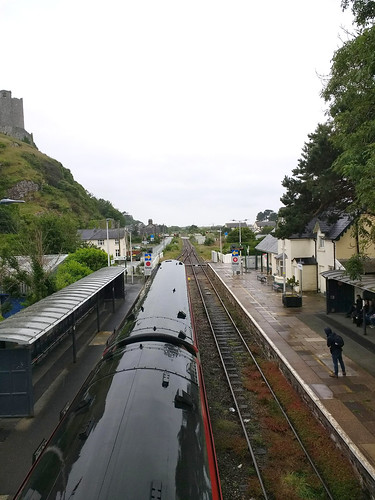
Cambrian Line: Harlech Station in the rain looking south, with southbound Machynlleth train waiting to cross an approaching Pwllheli service. On the left, Harlech Castle looms over the scene.

Cambrian Line: Harlech Station in the rain looking north, with southbound Machynlleth train waiting to cross an approaching Pwllheli service.
The northbound service arrived, another a 2-car Class 158 in Transport for Wales livery and quickly took us back to Talsarnau. Again, the service was well-patronised.
There is one intermediate station between Harlech and Talsarnau called Tygwyn but this station was not in use at the time of my visit. The National Rail website explains:-
There are no trains at Tygwyn until further notice. In order to maintain a safe distance between the conductor and customers, Transport for Wales need to be able to operate two train doors. Unfortunately due to the short platform length at this station, this is not possible.
Tygwyn station is adjacent to the A496 level crossing, so I was able to visit this location by car.

Cambrian Line: A496 Level Crossing at Tygwyn Station (currently closed), looking south. Note the Equipment Room on the left for the Automatic Barrier Crossing and, beyond, GSM-R mast and equipment room.

Cambrian Line: A496 Automatic Barrier Crossing at Tygwyn, looking north.
Signalling on the Cambrian Line
The Cambrian was always a single-line route and, like all single-line railways, required suitable signalling for the safety of trains. There's a brief article on operating single-lines in my blog here. In the steam era, Cambrian Railways made widespread use of Electric Token Systems or similar for single-line control. Used correctly, such systems have an excellent safety record and remain in use today. But in 1921, Cambrian Railways suffered a notorious head-on collision between two trains near Abermule resulting in 17 fatalities and 36 injuries, not due to equipment failure but due to a combination of negligence, confusion, poor staff training and inadequate supervision involving various staff members in different roles.
The Railway Archive is a marvellous internet resource which makes detailed information on thousands of railway accidents available and you can read the Inspector's full accident report on the Abermule collision here.
Because of the UK's membership of the European Union at the time, the government committed to European Union directives regarding railways, so as to implement the European Rail Traffic Management system in the UK known as ERTMS. The main elements of ERTMS are the European Train Control System (ETCS) and the Global System for Mobile Communications - Railway (GSM-R).
In 2012 the Cambrian Line from Shrewsbury to Aberystwyth and Pwllheli was chosen as the pilot UK scheme for ERTMS and signalling throughout the line is now provided by ETCS Level 2, controlled from the Signalling Centre at Machynlleth.
Book references
[1] ‘Railway Track Diagrams Book 3: Western & Wales’ (TRACKmaps: 6th edition) ISBN 978-1-9996271-0-2.
[2] 'A Regional History of the Railways of Great Britain: Volume 11 North and Mid Wales by Peter E Baughan, published by David & Charles ISBN 0-9153-7850-3.
Related articles on other sites
Wikipedia article on the Cambrian Railways
ERTMS
ETCS
GSM-R
Related posts on this site
Watching The Trains Go By
Railway Signalling in Britain: Part 11 - Single Line Railways
My pictures
Pictures in this post can be viewed uncropped, where necessary, by clicking on the image. Selecting from the album below allows viewing or downloading in various resolutions:-
Cambrian Line
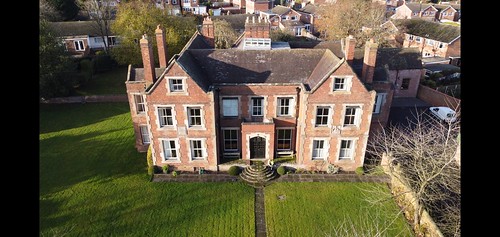
Brewood Hall: View showing the Lantern Roof (taken by drone)
Brewood Hall is topped by an elborate, wooden-framed, glazed skylight which, because of its raised design, we've always called the Lantern Roof. This is not thought to be an original feature of the design; rather I've always considered it to most likely date from 19th century alterations. It provides natural light to part of the attics on the second floor otherwise without daylight. Formerly, the light was shared between two rather modest rooms which were assumed had served as servant bedrooms. The need for servant bedrooms having lapsed, I decided that the space would make a tranquil library and the studwork partition between the two rooms was removed to give a convenient area, albeit nested into the sloping roof at the front of the Hall.
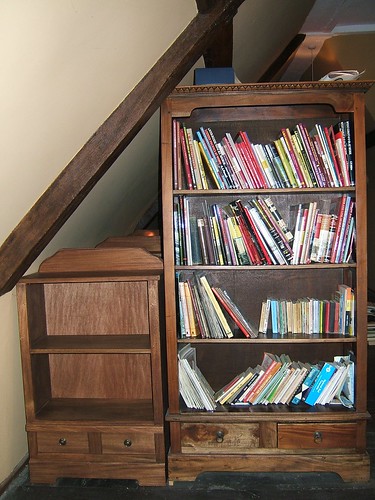
Part of Brewood Hall Library: The low-level units make use of the restricted headroom under the sloping roof
The exposed location of the lantern roof hastened its deterioration and a copy the original design was made and fitted. Unfortunately, this copy used a soft wood which resulted in a rather short life. By 2006, I was faced with replacing the structure for the second time.

View showing deterioration to the earlier lantern roof in 2006, prior to its replacement.
This time, I made sure that a hard wood (Idigbo from Africa, I think) was used in the construction. Once the custom joinery was complete, it was shipped to Brewood and the major task of raising it into position was undertaken, purely using manpower.

My dog Tai inspects the replacement lantern roof on its arrival in 2007
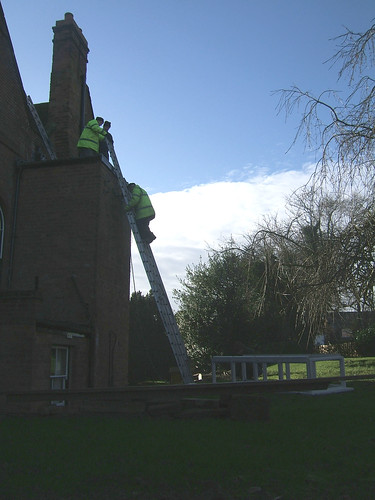
Preparations are made to lift the new lantern roof.
By the end of 2007 the new lantern roof was fitted, glazed and undercoated. Because of poor weather, the final painting, inside and out, was deferred until Summer 2008.

Dave paints the inside of the new lantern roof, whist John paints the outside.
As early as 2011 the need for further restorative care was noted but not provided in a timely manner. Consequently, in 2019 water ingress was occuring in the library. Dean volunteered to make an inspection and we were disappointed to confirm that, although the timber was surviving well, the paint film had deteriorated and much of the putty in the glazing had dried out. Some wooden flashing at the base of the lantern roof had completely detached. Dean carried out emergency repairs to carry us through the winter.

Brewood Hall Lantern Roof: deterioration prior to emergency repairs in 2020
With the better weather in Spring 2021, Jim carried out full repairs and outside repainting.

"All scraped and sanded down and loose putty removed, ready for primer" on 21st April 2021

Brewood Hall: Lantern Roof on completion of repairs
All that remains to be done is lantern roof internal repainting (oh, and finishing cataloguing and organising the library itself).
My posts about Brewood Hall
You can find all my posts about Brewood Hall here (in reverse date-of-posting order), with links to albums of pictures.
Pictures of Brewood Hall Lantern Roof
Brewood Hall Lantern Roof
Since I became involved in the management of Ty Gwyn Woodland, the most noticeable alterations have been the addition of a forest road system, the harvesting/replanting of trees and the creation of a small 'amenity' pool. My partner Daemon and I planned the creation of the pool many years ago but the work didn't happen until after his death in 1999 so it now serves as a memorial. The pool was created, near the eastern end of the northern road, by damming a small, perennial stream which runs across the site. At that time, the southern edge of the pool was fringed by mature spruce trees. In 2015, harvesting these trees changed the appearance of the pool area but, slowly, natural regeneration and growth by the sitka planting is restoring the original pool setting.
Visit on 12th June 2021
It had always been my intention to have an inflatable boat for the pool. Some years ago now, Daemon and I enjoyed a memorable touring holiday around Cornwall, made special for me by acquiring an inflatable dinghy. Well, that dinghy was not to be found so I'd never actually 'taken to the water' on the pool at Ty Gwyn (although I'd managed to get fairly wet a few times attempting to walk around the pool on the shore). Ann and Dean decided that my ambition needed some assistance and determined to surprise me during a visit to the forest in June 2021. When we arrived at Ty Gwyn's pool, Dean removed a brand-new 2-man inflatable boat from the boot and set about assembling and inflating it. I was surprised and delighted in equal measure.

Ty Gwyn 2021: Ann watches as Dean inflates the boat
Once the boat was ready, Dean carefully 'launched' it and helped me to board. This was easier said than done as the shore-line is not well-defined and the land changes from 'fairly dry weeds' to 'fairly wet weeds' unexpectedly. With my added weight, the boat became rather wedged in the weeds and it took me a few minutes, kneeling and facing the intended direction of travel, to paddle and haul my craft into clear water. Exhausted by that modest effort, I spent the rest of the voyage lying on my back with my head comfortably cradled near the bow, alternately rowing backwards or forwards depending on which method seemed more effective at the time. The lie-flat rowing position was not ideal for making an effective stroke with the oars which frequently became enmeshed with weeds, slowing progress.

Ty Gwyn 2021 (Photo: D Mould)
It was a very warm afternoon so for much of the time I was happy to just lie back and enjoy the peace but I did reach the tiny island, just big enough for one multi-stemmed tree. The channel on the south side of the island had become completely fouled by weeds so I had to abandon the idea of circumnavigating the island.
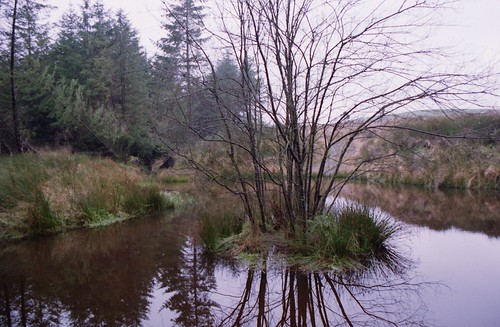
Ty Gwyn THEN: The appearance of the island in 2011 (looking west from the dam)

Ty Gwyn NOW: The appearance of the island in 2021, looking east (Photo: D Mould)
Nor was I able to inspect the dam which controls the level of water in the pool. When first built, it was possible to walk around the pool to the dam, a simple affair of rocks and mud incorporating two large plastic drainage tubes to direct the outfall into the stream leaving the woodland. Since then, tree growth has made the land approach impassable and the weeds prevented me from manoeuvring the boat close to the dam.

Ty Gwyn: Dam outfall pipes in 2006
The high ground to the north of the pool was originally fairly bare (as shown in the 2006 picture immediately below). Best forestry practice encourages increasing the proportion of broadleaved trees in plantations so this area was chosen for introducing more broadleaves. The planting has been very successful and the second picture shows the remarkably changed appearance created by careful planting combined with natural regeneration.

Ty Gwyn THEN: The high ground to the north of the pool in 2006 ( with the pool visible on the right) showing Jan checking the progress of the mixed broadleaves planting.

Ty Gwyn NOW: Jan inspecting the mixed broadleaves on the high ground to the north of the pool in 2021 (Photo: D Mould)
Visit on 15th July 2021
A few weeks later, I made another visit to Ty Gwyn with my friend Geoff. Once again, the weather was excellent although insect bites were rather problematic. The otherwise good conditions encouraged me to walk the length of the western arms of both the north and south roads. Both sides of the western end of the north road were re-planted around 2010, following harvesting of the earlier crop. Growth rates on this upland site with plenty of water are very good. Rosebay willowherb was flowering in the margins. Having grown-up in England after World War II, I always think of it as "the bombsite flower".

Ty Gwyn 2021: Western arm of north road, looking north, showing gaps between stands of trees currently around 12 years old. Rosebay willowherb flowering in the foreground.
The roads have been periodically flailed, to inhibit the growth of self-set plants and trees which otherwise ultimately render the roads impassable. As a result, we found the roads carpeted a profusion of attractive yellow wild flowers.

Ty Gwyn 2021: End of western arm of north road, looking west with 2010 planting on both sides of road.

Ty Gwyn 2021: View from link road looking east, showing growth in the 2015 planting. Note windfarm in distance.

Ty Gwyn 2021: View from western arm of south road, looking north, with 2015 planting in the foreground
Part of the site lies west of the western end of the south road but it was not practical to examine this area as the undergrowth is fairly impenetrable, so we finished the trip by driving along part of the track outside the plantation, to check the integrity of the fence. The grassland surrounding the woodland is used for sheep grazing, making sound fencing important as otherwise animals getting into the woodland may be unable to find their way out again.

Ty Gwyn 2021: Geoff looking north from the south road
My posts about Ty Gwyn
You can find all my posts about Ty Gwyn here (in reverse date-of-posting order), with links to albums of pictures.
Pictures of Ty Gwyn
Pictures in this post can be viewed uncropped, where necessary, by clicking on the image. Selecting from the full 2021 album below allows viewing or downloading in various resolutions:-
Ty Gwyn 2021
You can find all my albums of pictures of Ty Gwyn here.
The year started with snow, as described in the post Christmas in Brewood 2020. It continued cold and wet delaying Springtime this year and adding to the gloom resulting from the government lockdown in the UK as we struggled with the effects of the Covid-19 global pandemic.
The view below shows the ancient and rather compromised solitary apple tree and the row of bare oak trees in early April 2021. These trees had been grown from acorns by my Uncle, long passed on, and as saplings about four feet tall were planted by me on the Upper Lawn. It was only in April that signs of new growth became apparent.

The ancient and rather compromised solitary apple tree (left) and the row of bare oak trees in April 2021
The copper beech on the front lawn was equally late to bud in 2021.

A visiting cock pheasant struts self-importantly past the still-bare copper beech tree on the front lawn
Adjacent to the upper lawn, there's a very small area of woodland, mainly holly but with a few cherry and birch trees. I have recently decided to call my tiny wood 'Little Wood', as an affectionate tribute to a far more substantial wood called 'Big Wood' some three miles to the south west on the Chillington Hall Estate. At a little under 200 square metres, the name is at least accurate.

View of Little Wood from the Upper Lawn
Little Wood is home to an annual display of bluebells which, year by year is spreading in area.

Brewood Hall Garden 2021: Bluebells in Little Wood in April
There is also one isolated small enclave of bluebells on the Upper Lawn, near a hawthorn tree adjacent to a holly.

Bluebells on the upper lawn (Brewood Hall Garden 2021)
Cherry blossom time appeared, a little late and not quite as impressive as in previous years,

Cherry trees in blossom on the front lawn (Brewood Hall Garden 2021)
During spring, the weather was an odd mixture of bright sun, heavy rain and high winds which seemed to confuse plant-life. There was an unexpected early appearance of fungi on the Front Lawn.

An unexpected early appearance of fungi in May (Brewood Hall Garden 2021)
The Weeping Ash on the Upper lawn shed numerous dead branches during the high winds and showed no sign of life until May and, even then, at first budding appeared only in isolated branches, suggesting that this venerable tree might be failing.

Welcome signs of life in the Weeping Ash in May (Brewood Hall Garden 2021)
And yet, during the following weeks, the tree managed to adorn itself with the usual luxuriant foliage,although becoming noticeably lop-sided.

Brewood Hall Garden 2021: The Weeping Ash, becoming rather lop-sided
During 2020 Foxglove appeared for the first time, as recorded in the post here. In 2021, they became almost rampant, colonising numerous spots around the garden, with a particularly sturdy example near the front wall.

Brewood Hall Garden 2021: Foxglove adjacent to the front wall
In the UK, inoculation programmes using the Astrazeneca and Pfizer vaccines starting early in 2021 gave cause for hope and the government targeted June 2021 for the lifting of restrictions. These hopes were dashed at the last moment as Covid-19 infections from the so-called 'Delta Variant' proliferated and July 19th was then announced as the "terminus date" for legally-imposed restrictions.
My pictures
Pictures in this post can be viewed uncropped, where necessary, by clicking on the image. Selecting from the full 2021 album below allows viewing or downloading in various resolutions:-
Brewood Hall garden 2021
The year 2020 was dominated by the destruction caused by the global pandemic of Covid-19. Nature, of course, followed her normal cycle of the seasons.
In April 2020, post here, talked about Springtime in the garden of Brewood Hall, when the country was under government-mandated full lockdown. This was a return to a theme I'd first touched on in 2011 with a very short post Blossom Time at Brewood
By the start of June 2020, the garden was a riot of colour, from the vivid purple of the delphiniums planted the previous year to the rich red of roses. There was also the first flowering of the Hollyhock, also planted the previous year.

Delphinums (Brewood Hall garden 2020)

Roses (Brewood Hall garden 2020)

Hollyhock (Brewood Hall garden 2020)
A group of foxglove plants, both purple and white, were unexpected, but welcome, arrivals around the stump of the tree which had been removed in 2018 because of its dangerous condition. The removal of the tree is mentioned in the post More Brewood Hall Tree Maintenance.
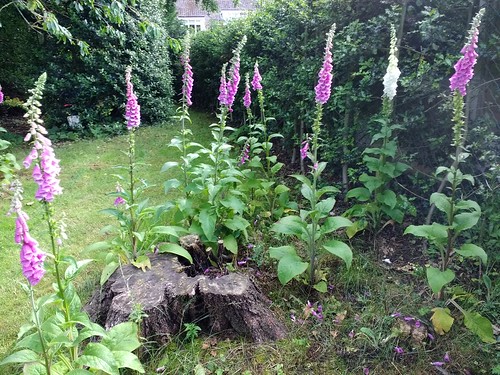
Foxgloves (Brewood Hall garden 2020)
The two flower troughs at the front of the Hall, built by Rick Evans, continued to add colour until late in the year.

Flower trough at the front of the Hall (Brewood Hall garden 2020)
In 2020 the single rather ancient apple tree with its whitened, hollowed trunk surprised by giving a copious supply of fruit which, although tart, for the first time could almost be classed as eating apples. A number of apple pies resulted (not baked by the writer).

The single apple tree produced a good crop (Brewood Hall garden 2020)
My favourite tree remains the solitary Yew on the front lawn, which seems to grow wider every year. I see this as the sole remaining connection with the once-famous topiary at Brewood Hall, long removed, which I mentioned in the section 'Gardens and Orchards' of the post Notes on the History of Brewood Hall.

The Yew Tree (Brewood Hall garden 2020)
Following a summer of only slightly-relaxed 'social distancing' regulations, Autumn brought full lockdown again. The colourful displays around the garden persisted until late in the year but eventually the deciduous trees produced their crop of fruit, the leaves turned brown and dropped. On the large Barn, the Virginia Creeper turned from green to an attractive red-brown before it, too, lost its leaves.

Oak tree in October, showing acorn (Brewood Hall garden, 2020)

Virginia Creeper on Barn, October: Leaves starting to change colour and fall (Brewood Hall garden, 2020)
Right at the end of the year, after a Christmas holiday reduced by the Government to one day of restricted celebration in an attempt to control transmission of the Coronavirus, we had snow. There's more about this odd period in the post here.
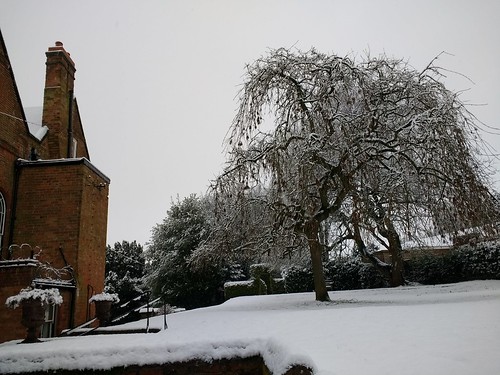 Snow at Brewood Hall, 28th Dec 2020
People throughout the world live in hope of less traumatic year in 2021.
My pictures
Pictures in this post can be viewed uncropped, where necessary, by clicking on the image. Selecting from the full 2020 album below allows viewing or downloading in various resolutions:-
Brewood Hall garden 2020




