skip to main |
skip to sidebar
At the end of 2001, I made my first Round the World Trip, cryptically referred to as 'RTW1'. I started blogging at the end of 2006 and produced a very short post on 'RTW1' which you can find here. My pictures from that trip existed as prints which I intended to scan but work has proceeded very slowly. In 2020, I finally scanned the pictures from my trip to Rangitoto Island when I was in Auckland back in 2001 and decided to add the following description.
I was staying in the Heritage Hotel, Auckland, a conversion of Farmers Department Store built in the 1930s which appealed to me. Farmers are still trading but in a different location in Auckland. My room had a view of Auckland Harbour Bridge which I would have found impressive, had I not a couple of days earlier completed the Sydney Harbour Bridge Climb experience.
 View of Auckland Harbour Bridge from The Heritage Hotel (Auckland, 2002)
But what I had found impressive was the brooding presence of Rangitoto Island, with its symmetrical, conical volcano rising 260 metres above the sea, around 10 km away. Rangitoto erupted 600 years ago and is regarded as 'dormant'. Before 9.00 a.m., I was aboard a modern, catamaran Fullers ferry in the shadow of Auckland's Ferry Building for the 30 minute trip to the Wharf on Rangitoto Island to get a closer view.

Ferry Building and HSBC building: Rangitoto and Motuihe Islands by ferry (Auckland, 2002)
As the ferry powered away from the dock, it started to rain, quite seriously. I was travelling on the upper, open deck so I sheltered under the section with a canvas sun roof above, but cold rain was sluicing in from the sides. This was not quite how I had imagined Auckland.
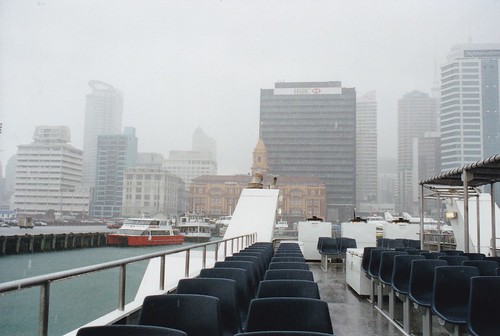
Auckland in the rain: Rangitoto and Motuihe Islands by ferry (Auckland, 2002)
We called briefly at Devonport Pier and then continued to the wharf at Rangitoto. The rain ceased as quickly as it had started, so I felt quite cheerful as I disembarked.
I followed the single track away from the wharf to a junction, where a signpost pointed inland to a 'Summit Track'. With no obvious alternatives and nowhere to make enquiries, I set off to the summit on a decent track which ascended through lush, green bush. Periodically, I'd turn to check the view towards the mainland. The skies over the mainland still looked troubled but I was dry and the cooler temperature was helpful as I continued upwards. Eventually I reached a viewpoint, with a neat boardwalk, seats and fences around a central, wooden pylon. There was also a derelict, blockwork hut which might have once been a shop but had been daubed 'Danger - Keep Out'. The area clearly allowed for a number of visitors to take their ease, but I was quite alone (the camera's self timer allowed me to record my first volcano ascent).

Jan at summit of Rangitoto: Rangitoto and Motuihe Islands by ferry (Auckland, 2002)

View of Cheltenham and Auckland from summit of Rangitoto: Rangitoto and Motuihe Islands by ferry (Auckland, 2002)
The crater rim path led me all around the top of the volcano before I started to descend. A sign to 'Lava Caves' led to a a different path bringing me to a series of fissures in the volcanic rock but I didn't explore far into the darkness within.

Crater rim path, Rangitoto summit: Rangitoto and Motuihe Islands by ferry (Auckland, 2002)

Lava Caves, Rangitoto: Rangitoto and Motuihe Islands by ferry (Auckland, 2002)
I completed my descent the area near the wharf and found the 'Rangitoto Volcanic Explorer' - a tractor hauling a passenger coach which gets visitors near the summit. It was not running during my visit but might have run later. I was happy that I'd made the ascent unaided.

The Rangitoto Volcanic Explorer was not running during my visit: Rangitoto and Motuihe Islands by ferry (Auckland, 2002)
There seemed nothing further to detain me on the island so I decided to board the next ferry to arrive and travel on to Motuihe Island. Before we departed, I managed to snatch a picture of the bridge.

Bridge of modern catamaran ferry: Rangitoto and Motuihe Islands by ferry (Auckland, 2002)
As we sailed around Rangitoto to reach Motuihe, I proudly surveyed my achievement from afar.

Rangitoto Volcano viewed from ferry: Rangitoto and Motuihe Islands by ferry (Auckland, 2002)
Motuihe is a small island (179 hectares in area). It was first settled by the Maori, then farmed by Europeans for a century before becoming a quarantine station for Auckland in 1872. In the first World War it became a prisoner of war camp, in the second World War it was used as a naval training base. Boasting some of the finest beaches in the area, it is now a recreation reserve for day trips or camping controlled by the Department of Conservation.

Arriving astern at Motuihe Wharf: Rangitoto and Motuihe Islands by ferry (Auckland, 2002)
The ferry was booked to wait for a while at Motuihe before returning to Auckland so I decided to just explore the beach nearby and then rejoin the same ferry, rather than spending some hours on the island before catching a later ferry. The sun was strong and all signs of the morning rain had disappeared.

Ferry waiting at Rangitoto Wharf: Rangitoto and Motuihe Islands by ferry (Auckland, 2002)
On the return journey, we stopped at Devonport Pier and I was able to admire the preserved steam tug 'William C Daldy'. There's more information on their website here.

Devonport Pier with preserved steam tug 'William C Daldy': Rangitoto and Motuihe Islands by ferry (Auckland, 2002)
As we left the pier, we passed a large catamaran ferry arriving.

Leaving Devonport Pier for Auckland, showing a catamaran ferry arriving: Rangitoto and Motuihe Islands by ferry (Auckland, 2002)
Within ten minutes, we were docking at Auckland, after a marvellous trip.
 Arriving back at Auckland's ferry terminal: Rangitoto and Motuihe Islands by ferry (Auckland, 2002)
Related posts on this website
Selecting label 'RTW1' or clicking here displays all the posts on this trip in reverse date-of-posting order.
My pictures
Rangitoto and Motuihe Islands by ferry, 2002
Evening Departures on 16th April 2020
At the time of writing, the world is suffering from the serious, new respiratory disease Covid-19 and the U.K. is currently in 'Lockdown'. Only essential travel is permitted, resulting in train passenger numbers collapsing and revised timetables.
In the post Watching The Trains Go By I outlined how you can remotely monitor train movements in real time and, using the network of cameras operated by Railcam UK, actually see live views at selected locations.
There's another site called Open Train Times which offers similar timetable and signalling diagram information (without the cameras) which I've found excellent. Whereas Railcam UK works well on a 'Smartphone' or a larger display, Open Train Times really needs a decent-sized display. In complex areas, some detail is lost using Railcam UK but the signalling diagrams in Open Train Times make fewer concessions and include 'route set' data, where available from Network Rail, and will appeal to signalling enthusiasts. Open Train Times also allows you to customise the presentation by separately toggling on and off data showing signal numbers, signal symbols and unoccupied train describer berths.
On Thursday evening 16th April 2020, I decided to use Railcam UK 'app' on my 'Smartphone' to see what long-distance expresses were running out of Euston that evening. This was the day the U.K. Government announced that the lockdown would continue for at least another three weeks and television was showing the usual fare of repeats.
At about 8.15 p.m. I made a list of the trains scheduled to leave Euston in the next hour, recording the platform, the train reporting number displayed for the departure, the final destination, the time due to arrive at that destination, a reference to my explanatory note, the ATOC code for the Train Operating Company (TOC) and, finally, the reporting number in the arrival 'berth' (usually indicating the previous journey undertaken by the unit). I didn't include the various local services and the d.c. electrics, except for one typical example of a Northampton service (2N62). I also ignored the various multiple units displaying a train reporting number starting with '5' indicating 'Empty Stock'.
| Plat |
Nbr |
Dep |
Destination |
Arr |
Note |
TOC |
In |
| 2 |
1P07 |
20:30 |
Crewe |
23:00 |
#2 |
VT |
1M15 |
| 4 |
9G45 |
20:40 |
Wolverhampton |
22.33 |
#1 |
VT |
1B57 |
| 5 |
1F28 |
21:03 |
Liverpool |
23:33 |
#3 |
VT |
1A60 |
| 11 |
2N63 |
20:45 |
Northampton |
22:05 |
#4 |
LM |
- |
| 15 |
1S25 |
21:16 |
Inverness |
|
#6 |
CS |
- |
| 14 |
1P09 |
21:10 |
Preston |
23.59 |
#5 |
VT |
1A62 |
During the evening, I'd periodically return to the Railcam UK signalling diagram screen to see how well things were going. Every so often, I'd also check the Railcam U.K. camera on the main lines at Camden to confirm there really were trains going by, but it was getting dark so the pictures weren't terribly exciting on the small screen I was using (particularly for a steam enthusiast). Then, I made some notes on each train, in the order of departure which appear below.
#1: 9G45
This Wolverhampton service by an Avanti West Coast Class 390 (with a train reporting number starting with '9') made a right-time departure with booked stops at Watford, Milton Keynes, Rugby, Coventry, Birmingham International, Birmingham New Street, Sandwell & Dudley. At Wolverhampton the empty stock would make the short journey to Oxley Sidings where Alstom, the builders of the Class 390, have a Traincare Depot'. I noted that the ATOC code for Avanti remains 'VT' because, until recently, these trains were operated by Virgin Trains. There's a Wikipedia article on the Class 390 here.
#2: 1P07
This Avanti West Coast Class 390 'Pendolino' should have left at 20:30 but was 14 minutes late departing for an unknown reason. It was booked via the Trent Valley Line calling at Tamworth, Lichfield, Stafford, Crewe, Warrington, Wigan and, finally, Preston.
#3: 1F28
Avanti West Coast Class 390 also serve Liverpool. This train was booked to stop at Watford, Milton Keynes, Nuneaton, Crewe, Runcorn and Liverpool Lime Street. Alstom also have a Traincare Depot at Edge Hill, Liverpool.
#4: 2N63
Northampton is served by a regular stopping service operated by West Midland Trains, ATOC code 'LM' (because the franchise was formerly operated by London Midland). The homely-sounding 'West Midland Trains' is, in fact, a joint venture between Abellio (part of Dutch National Railways), East Japan Railway and Mitsui Group. These services are normally routed on the Slow lines to Roade Junction as they generally stop everywhere and most of the stations only have platform access to the slow lines
#5: 1P09
This Avanti West Coast Class 390 'Pendolino' left on time and was booked via the Trent Valley Line calling at Tamworth, Lichfield, Stafford, Crewe, Warrington, Wigan and, finally, Preston.
#5: 1S25
Almost all movements at Euston are Electric Multiple Units (EMU). The notable exception is the locomotive-hauled Caledonian Sleeper, operated by Serco with traction provided by GB Railfreight (GBRf). The rolling stock for this service, a 16-coach rake, was fairly recently renewed at enormous expense and initially suffered a number of technical problems but seems to have settled down. Due to Covid-19, a temporary timetable is in use. After departure at 21:16, stops were scheduled at Watford Junction, Brinklow on the Trent Valley Line (Brinklow?), Crewe, Preston, Carlisle, Lockerbie and Edinburgh Waverley (where I assume diesel traction replaces electric). The train then continues, with intermediate stops, to Inverness arriving at 08:40 on Friday. The timetable information showed Class 92 'Voltaire' (92038) hauling the train, which is limited to 80 m.p.h.
There's a Wikipedia article on the Class 92 here. I've had an interest in the design which can develop 6,760 horse power since being involved in design work and testing on one of the safety systems some years ago. My short post Crewe International Electric Maintenance Depot has links to detail pictures of the Class 92.
Earlier in the evening, the Empty Stock for the Caledonian Sleeper had been brought from Wembley Carriage Sidings by a locomotive currently 'trapped' at the buffer stop end of platform 15, showing on the Railcam UK signallingdisplay as 0A95 (the '0' signifying Light Engine). The Caledonian Sleeper set of on its long journey and, shortly afterwards, 0A95 followed slowly up Camden bank.
I logged onto the Railcam U.K. camera on the main lines at Camden to watch '1S25' pass. There was certainly a Class 92 on the front, followed by 16-coaches in the distinctive Caledonian Sleeper livery. Then I kept watching for the light engine which eventually appeared on the camera at 21:31 travelling slowly - a diesel-electric (Class 66 perhaps) with the big 'GBRf' logo on the side. I realised that a freight train from Camden Road direction has been 'turned out' onto the down slow. Railcam UK showed that the train was 4M92, operated by Freightliner and being worked by locomotive 66555, which had left Felixstowe at 18:12 and was due to arrive at Lawley Street (Birmingham) at 00:06 on Friday. Its route was via Rugby and Nuneaton, from where it would reach Lawley Street by branching onto the former Midland Railway line to Birmingham.
I continued to use the Railcam UK signalling display to see the Freightliner train making rapid progress on the Down Slow and the light locomotive diverged onto the Down Carriage Line before 'dropping out of sight' as it continued onto uncontrolled lines in Wembley Carriage Sidings.
We may be under 'lockdown' but it's still possible to 'Watch the Trains go by!
My pictures
My pictures taken before we were in 'Lockdown' can be selected, viewed or downloaded, in various sizes, from the albums below:-
London: Euston Station.
London & Birmingham Railway (showing the line approaching Euston).
Today (Easter Monday 2020) is a public holiday in the UK but this is an Easter like no other I have lived through. Whilst some people (health workers, care workers, retail, transport and other workers in essential services) are heroically risking their lives to continue working, the remainder of the population must remain at home by law (apart from limited exercise outside or obtaining essential shopping). Even Churches and other places of Worship are locked. This is because of the virulence and lethality of the new disease Covid-19 which has disrupted the whole world, causing myriad deaths and untold misery, against which 'social distancing' is currently our defence.
I am very fortunate as I have a garden I can spend time in. The cherry blossom just now would delight any Japanese and there are signs of new life everywhere. The sun is shining today but the wind is strong, keeping the temperature at 8 degrees Celsius here, although a couple of days ago it was a balmy 16 degrees.
A few pictures below are intended to give hope for the future in these unprecedented times. There are more pictures in the album here.

Cherry Blossom, Upper Lawn (Brewood Hall Garden 2020)

Cherry Blossom, Easter 2020: Brewood Hall Garden

New Growth, Easter 2020: Brewood Hall Garden

New Growth on the Weeping Ash, Easter 2020: Brewood Hall Garden
Keep safe!
My pictures
Pictures in this post can be viewed uncropped, where necessary, by clicking on the image. Selecting from the full 2020 album below allows viewing or downloading in various resolutions:-
Brewood Hall garden 2020
This is the 15th post describing an 'Expedition Cruise' with Noble Caledonia in 2020 under the title 'Across the Tropic of Capricorn'.
Events of Friday 28th February 2020
I awoke reasonably refreshed at the Hilton Hotel in Cairns, dressed and went downstairs for buffet breakfast in the large restaurant on the ground floor which overlooked Chinaman Creek. Bright sunshine had replaced the rain I'd experienced the previous evening. Some of my fellow-passengers from 'Caledonian Sky' drifted in and one asked if I'd seen the cruise ship 'Queen Elizabeth' arrive. I had not, but I decided that a morning walk towards the Cruise Terminal was indicated. I've seen 'Queen Elizabeth' in a number of ports around the world during my travels, but I only discovered during my post-trip research that the ship's arrival that morning was the very first time such a large, 'Vista' class cruise ship had berthed in Cairns following a project to widen and deepen the shipping channel. There's an outline of the project on the Ports North website here, with a video of 'Queen Elizabeth's' arrival here.
I left the hotel, joined the Foreshore Walk and headed south towards the cruise terminal. Although the whole area has been landscaped and a modern, concrete sea wall constructed, the many abandoned wooden piles standing in the creek were enough to indicate that this had been the original commercial port.

Hilton Hotel and Foreshore Walk viewed from the modern fishing pier, Cairns.
A little further on, this was confirmed on passing a small, modern cafe named 'Wharf One'.

Chinaman Creek, Cairns, looking north towards the sea with 'Wharf One' cafe on the left and Marlin Wharf and Marina in the background.
The transit sheds for Wharf 2 and Wharf 3 have been retained but 're-purposed'. 'Shed 2' is now Hemingway's Brewery ("a waterfront gastro-brewpub that showcases local provenance in a vibrant setting" according to their website here). 'Shed 3' has become 'Cairns Cruise Liner Terminal' but as I approached, the terminal was dwarfed by the massive bulk of 'Queen Elizabeth'.

'Queen Elizabeth' docked at Cairns Cruise Liner Terminal.
The road in front of the terminal carried signs saying 'CLOSED ON SHIP DAYS' and this was enforced by rising bollards in the raised position, a heavy-duty barrier, also raised, and a lady security guard. I had to research the barrier, as I wasn't sure of the correct name for this type of product - it's a 'Hostile Vehicle Mitigation Product'! The one in my picture was supplied by Australian firm AVS-elli and their website confirmed it was a LW7 Folding Block Barrier, the heaviest in their range - in fact, their website showed a picture of the very installation at Cairns! I also noticed, with interest, the remains of an early 3 foot 6 inch gauge siding leading to the transit shed inset into the road surface not using tramway rail but conventional rail and double check rails.

Cairns Cruise Liner Terminal, showing railway siding, raised road barriers and various coaches awaiting the cruise passengers.
As I walked back north, a large, modern catamaran called 'Tropic Sunbird' operated by 'Sunlover Reef Cruises' headed into Chinaman Creek, to give the passengers a chance to see (and photograph) the cruise ship. The catamaran slowly turned through 180 degrees, then returned north at speed.

'Queen Elizabeth' viewed from Wharf One, as a 'Tropic Sunbird' inspects the cruise ship.
In the above picture, you can also see overhead conveyors and loading gantries in the background. I was intrigued but lacked time to find out more until I returned home when I found out that almost all the sugar grown in Australia comes from Queensland and that over 80% is exported. Queensland Sugar Limited (often referred to simply as 'QSL') is a not-for-profit organisation owned by the Queensland sugar industry. The conveyors I'd seen were part of Cairns Sugar Terminal which has a storage capacity of around 250,000 tonnes of raw sugar. The terminal is owned by Sugar Terminals Limited (STL) and managed by QSL under an operating agreement.
The tug 'Gulf Explorer', operated by Tim North Marine was moored at the Fishing Jetty, with the three crew relaxing on the jetty in the shade of the superstructure. I assumed she'd assisted 'Queen Elizabeth' to the berth.

Tug moored at the Fishing Jetty, Chinaman Creek, Cairns. 'Gulf Explorer', 25m long 8m beam 30 ton bollard, was built in 1972 by Carrington Slipways, Newcastle, Australia.
I'd toyed with the idea of walking to Cairns railway station but it's modern and buried under the car park of Cairns Central Shopping Centre a few blocks away so I knew I'd be disappointed. Now, if the original station on McCloud Street had survived, that would have been different.

Cairns Railway Station around 1890, from a glass negative in John Oxley Library, Queensland (Public Domain)
Queensland Rail now operates two contrasting rail services from Cairns: the 'Spirit of Queensland' diesel-electric Tilt Train makes five trips each week between Cairns and Brisbane, covering the 1,681 km distance in 24 hours whilst two services a day serve tourists on the 37 km long Kuranda Scenic Railway. There's a short history of the Kuranda line on the railway's website here.
Instead, I returned to my hotel to complete my packing and have a few minutes on the balcony of my room looking out over the city.

View from my room at the Hilton Hotel, Cairns, looking across Trinity Bay to the airport.
I was puzzled by the glazed domes on top of a modern building to my left. Only later did I find out that Cairns Zoom and Wildlife Dome is a rather odd synthesis of Zip Line experience and wildlife park perched on top of a Casino. I'm afraid I approve of neither the gambling nor the creatures in captivity (no matter how well looked after) but (alhough I haven't tried it) the zip lining sounds fun.
I was booked to leave Cairns for home on the noon flight to Melbourne. Most of the Noble Caledonia passengers were travelling later that afternoon but a few, with different flight arrangements, were leaving earlier so a transfer to the airport had been arranged for 09:45 which I joined.
To avoid the ongoing road works, the coach drove to the airport using a route partly different from that used on our arrival the previous afternoon, offering some different views of Cairns - white-painted Cairns City Library with its columned frontage followed by Cairns Aquarium. Then, a block with St. Monica's High School, the modern St. Monica's Cathedral and the Dioscese of Cairns offices. Next, we passed through an area filled with modern apartment blocks followed by Cairns Hospital.

Cairns, Australia: view from Abbott Street showing Florence Street with Cairns Aquarium on left (City to Airport)

St. Monica's High School, Cairns, Australia (City to Airport)

Dioscese of Cairns offices, Cairns, Australia (City to Airport)
There were brief "good byes" as we were dropped-off outside Departures then I had a brief struggle to get my luggage to the right check-in queue. Fortunately, it didn't take long to complete the fomalities and then, with plenty of time in hand, I made my way to the Quantas Lounge to await my flight at the end of my very brief, but interesting, visit to Cairns.
Related posts on this website
This post is in the series labelled 'Tropic of Capricorn’. The first post is here.
Clicking on the 'Next report' link will display the post describing the next events. In this way, you may read about the trip in sequence.
Next report
Alternately, clicking on the 'All my Tropic of Capricorn reports' link displays all the posts on this trip in reverse date-of-posting order.
All my Tropic of Capricorn reports
My pictures
Cairns Airport, Australia
Cairns, Queensland, Australia
Hilton Hotel, Cairns, Australia
[Link to 'Next Report' added 5-Nov-2020]
This is the 14th post describing an 'Expedition Cruise' with Noble Caledonia in 2020 under the title 'Across the Tropic of Capricorn'.
Events of Thursday 27th February 2020
My previous post in this series here describes leaving the ship 'Caledonian Sky' on the morning of 27th February, transferring to Port Moresby's airport on taking a Charter Flight to Cairns by Air Niuguini Boeing 737.
I'd not previously visited Cairns, so I arrived with a sense of anticipation (although I was still very tired). The airport staff were friendly and helpful. Immigration was via automatic gates, reading my passport. I 'fluffed' it the first time, because they'd added a couple of on-screen questions to the process about prior travel, because of Coronavirus (Covid-19) but I got it right the second time. My checked bag arrive promptly and Customs was straightforward, so I was soon in the Arrivals Hall where we were directed outside to a series of modern tour buses where the driver helped to load baggage into the hold. We soon set off for our one night stop in Cairns, at the Hilton Hotel, with both public address and air conditioning working in the coach. The shortest route to the city was only around 7 km, but we took a rather longer route because of congestion caused by road works.
Cairns is green, modern and well laid out. Our journey to the hotel gave us glimpses of Cairn's facilities - the Tobruk Memorial Pool, sports grounds, schools, the Night Market and upmarket retail outlets, like Bulgari.

Cairns, Australia (View from Coach travelling from Airport to City). Note rainwater gulley in the kerbing.
After our driver had a bit of a struggle turning the huge coach out of Marlin Drive into the steeply-graded access road outside the Hilton, we disembarked and this time porters whisked away the heavy cases. A representative from the local tour company directed us to reception where, within seconds, we were furnished with keycards to our pre-allocated rooms and assured that our bags would be taken to our rooms shortly.
The Hilton is large, formed by two serpentine wings back-to-back, each a mirror image of the other, leaving an airy, green atrium-like space in between. The east wing has unobstructed views of Chinaman Creek (and Cairns Cruise Line Terminal) whilst the west wing, in which I was housed, offered views of the city and north-west across the bay to the airport (although the nearby Sebel Cairns Harbour Lights Hotel was an obstructive presence limiting sightlines to the north). The room was large and well equipped, if rather clinical but the large balcony allowed the views to be enjoyed.

Hilton Hotel, Cairns
Despite feeling tired following a frustrating day of travel, I determined to go for a late afternoon walk. The nearby marina area seemed an obvious initial destination and I set off, in tee shirt and slacks, with the temperature around 30 degrees Celsius but with the earlier bright sun turning to overcast. Then, it started to rain.
"Oh", I thought cheerfully, "It'll just be a tropical shower and will soon stop".
In the Marlin Wharf area of the marina I discovered a fleet of modern catamaran ferries of various sizes which were involved in Great Barrier Reef tours. I'd not realised that Cairns regards itself as the best base for visiting the Great Barrier Reef - the faster boats take only 35 minutes to whisk passengers to waters for exploring the Great Barrier Reef by snorkelling, scuba diving and local boat trips. I only found out afterwards that there are also regular ferries to two nearby islands - Fitzroy Island (interesting website here and Green Island (more information here.

Marlin Marina, Cairns, Queensland.
As the rain increased, I watched a rather bedraggled group of passengers disembarking from a ferry which had just arrived, no better dressed for the rain than I was.

Marlin Marina Cairns, with passengers disembarking in the rain.
As I fumbled in the rain to take the picture above, a large landing craft quietly passed, heading purposefully into Chinaman Creek. It was green-hulled, with a massive yellow-painted deck crane and stacked with 20-foot shipping containers loaded transversely in the load space. When I returned home, the distinctive configuration of the vessel allowed me to identify it as the LCT 'Albatross Bay' (more information at here), operated by Sea Swift. This company provides various marine services, particularly scheduled general cargo, up and down the east coast of Australia, through the Torres Strait, Cape York Peninsula, and Northern Territory. I think 'Albatross Bay' is normally on the service between Cairns and Weipa but I was intrigued to learn that Sea Swift also have the last cargo and passenger vessel in Australia, the MV 'Trinity Bay' which operates regularly from Cairns to Thursday Island, which I visited in 2015. My visit to Thursday Island is described here.

LCT 'Albatross Bay' 64m by 15m 1551 DWT built 2014 arriving at Cairns
The rain showed no sign of abating, so I went into the adjacent modern shopping mall called The Pier, described as an "Upscale complex of boutiques, wellness clinics, restaurants, cafes & bars next to the Marlin Marina". It was very quiet partly, no doubt, because it was late afternoon and raining.

The Pier shopping mall, Cairns.
Unimpressed, I walked through the complex to the entrance nearer to my hotel. A number of local people were waiting by the doors for the rain to ease but after a few minutes I joined the more adventurous young people who had decided to just get wet. I'd noticed the kerbs with broad rainwater gullies on the way in from the airport but I'd failed to realise their significance. Only afterwards did I discover that February is one of the wettest months in Cairns which, with an annual rainfall of 39 inches, is around one third wetter than my home county!
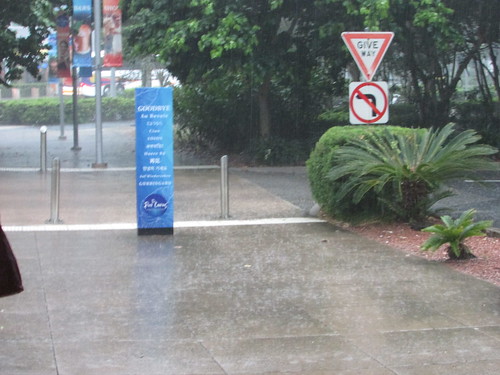
View from the Pier Complex, Cairns as the rain bounces off the pavement.
I hurried across the path through a wooded area and entered the Reef Fleet Terminal, with its much-admired modern architecture which, with rain streaming down my face, I failed to notice. Inside, the building was laid out as a series of shops and sales counters, each serving one of the tour and ferry operators.
Reef Fleet Terminal
There were not many people in here, either, but one shop still open selling tours and souvenirs also had a good range of snacks so I made some purchases to serve as my evening meal. The very friendly lady assistant supplied a stout paper carrier bag and I braved the rain again, dashing back to the hotel and hastening through reception to the bank of lifts and my room. I wasted no time in running a hot bath and I ended up happily backing-up the day's photographs to my laptop computer whilst enjoying my snacks before slipping between the sheets of the huge bed.
Related posts on this website
This post is in the series labelled 'Tropic of Capricorn’. The first post is here.
Clicking on the 'Next report' link will display the post describing the next events. In this way, you may read about the trip in sequence.
Next report
Alternately, clicking on the 'All my Tropic of Capricorn reports' link displays all the posts on this trip in reverse date-of-posting order.
All my Tropic of Capricorn reports
My pictures
Cairns Airport, Australia
Cairns, Queensland, Australia
Hilton Hotel, Cairns, Australia
[Text on Sea Swift added 28-Mar-2020]
This is the 13th post describing an 'Expedition Cruise' with Noble Caledonia in 2020 under the title 'Across the Tropic of Capricorn'.
Events of Thursday 27th February 2020
I'd been to Port Moresby once before, in 2015, on my first trip aboard 'Caledonian Sky' under the title 'From the Coral Sea to the South China Sea'. All my posts on that trip (in reverse order of posting) can be found here.
In 2020, We sailed into the broad, natural harbour at Port Moresby, the capital of Papua New Guinea, on a warm, sunny morning. After the disappointments of failing to visit any of the Solomon Islands and then being refused entry by the Provincial Authorities in Rabaul we were quite relieved to finally dock. The quay we moored at was a large, barren concrete expanse (with a number of apparently new road vehicles in store).

The quay we moored at was a large, barren concrete expanse (Port Moresby's Docks 2020)
At a nearby jetty was the 'SMS Tangguh'. A bit of research later revealed that this Landing Craft, 50m long 12m beam Indonesian-built in 2007, was one of the smallest ships operated by Wintermar Offshore Shipping based in Indonesia, which serves the offshore oil and gas industry in Asia.

Landing Craft 'SMS Tangguh', 50m long, 12m beam, Indonesian-built in 2007 (Port Moresby's Docks 2020)
In the opposite direction, another jetty was the home of three similar landing craft, in military grey.

Three Landing Craft in military grey, with new construction in the background extending the city (Port Moresby's Docks 2020)
I was initially surprised at the lack of on-shore activity, until I discovered that, in 2018, the international cargo terminal had been relocated further into Port Moresby Harbour, about 10 km away, at Mokutea Island. The safe waters of the harbour still provide an anchorage for ships awaiting berths, so I recorded what I could see.

General cargo vessel 'Vimaru Pearl' 101m long, 20m beam 8,889 Summer DWT, built Nishi Shipbuilding, Japan, operated by Eastern Dragon Shipping in Vietnam (Port Moresby's Docks 2020)
'Kmarin Jasmine' (with prominent external hawse pipes through which the anchor chains pass) is a bulk carrier operated by Kmarin Group in South Korea. The KMarin fleet of 66 vessels includes 10 Gas Carriers, 15 Tankers, 38 Bulk Carriers and 3 Container Ships.

Bulk Carrier 'Kmarin Jasmine' 180m long, 30m beam 37,430 DWT, built by Hyundai Vietnam in 2014 (Port Moresby's Docks 2020)
'Kumul Arrow' is a hard-working open hatch gantry crane vessel operated by Gearbulk which I first saw during my 2015 trip. It's 187m long, 29m beam, 41,619 DWT and was built by Hyundai Heavy Industries in 1985. The two gantry cranes probably each have a capacity of 40 tonnes with 13 cubic metre grabs. The view below of her starboard side shows how the grabs discharge over the side via conveyors. She appears to be a regular on the China-Port Moresby run.

'Kumul Arrow' in 2020 - an open hatch gantry crane vessel operated by Gearbulk. 187m long with 29m beam and 41,619 DWT it was built by Hyundai Heavy Industries in 1985. The two gantry cranes probably each have a capacity of 40 tonnes with 13 cu. metre grabs. This view of starboard side shows how the grabs discharge via conveyors. (Port Moresby's Docks)
Careful study afterwards showed that the vessel in the background (black hull, yellow funnel) is an oil/chemical tanker operated by Turkish K Tankering and Ship Management, part of the Kaptanoglu Group which, among other activities, builds ships. I found the brief family history here interesting. Further study suggested that this tanker is berthed on the opposite side of Port Moresby Harbour at an oil terminal forming part of the small Napa Napa oil refinery operated by Puma Energy. There's a Wikipedia article on Puma Energy here
Looking to the north, I could see the Poreporena Villages, built out over the waters of the harbour on stilts.

Poreporena Villages (Port Moresby's Docks 2020)
I'm afraid it was little consolation that the national government in Port Moresby had confirmed that the actions of the provincial authority in Rabaul in preventing our landing was not lawful. The expedition team displayed copies of correspondence between the Governor of the East New Britain Provincial Government and the Hon. Jelta Wong MP, Minister for Health and HIV/AIDS based in the National Capital District of Port Moresby on the ship's notice board. The Minister's letter is below:-

Minister's reply to Governor, page 1
Click for larger size

Minister's reply to Governor, page 2
Click for larger size
The additional sailing time from Rabaul to Port Moresby meant that all the passengers were being transferred directly to Port Moresby Airport to catch the charter flight to Cairns which had been part of the original programme. There was time for breakfast on board, although not quite in the leisurely fashion we'd previously enjoyed, before a convoy of, I think, three rather run-down coaches arrived to collect us all. After we'd confirmed that our heavy luggage was on the dock, it was bundled into the luggage hold of the appropriate bus and we clambered aboard for the drive to the airport. I found a seat near the back of my bus and after a few extra checks that we had everybody, the buses set off. We had two local guides on the bus who told us a little about the city but with a noisy engine, windows open for ventilation (there was no air conditioning and the electric fans weren't working) and no public address system, their commentary was completely inaudible beyond the first few rows of seats.

Our bus to the airport: Port Moresby, Papua New Guinea, 2020
Our route to the airport took us by a modern dual carriageway through undulating terrain and suburban sprawl.

View from bus to the airport: Port Moresby, Papua New Guinea, 2020
On arrival at Jacksons International Airport, each guest had to retrieve their heavy luggage from the hold and drag it into the airport terminal. A check-in desk was opened to deal with our charter and I found myself near the end of a queue with my fellow guests. The first two passengers were quickly checked-in and issued with boarding passes, allowing them to take the escalator up to Departures. Check-in continued, with heavy luggage taken away by conveyor, but no more board passes were printed, so as each passenger was dealt with, they were asked to wait nearby. There weren't many seats in the check-in hall but, fearing a protracted wait, I secured one. Nothing happened for some time, except that the building became much busier as passengers arrived for other flights, were issued with boarding passes and continued to departures. Then, one of the Expedition Crew travelling with us announced that the problem had been sorted. We'd supposed to have caught an aircraft at Rabaul on the original schedule and transited through Port Moresby. Apparently, the airline had not cancelled the bookings for the Rabaul-Port Moresby leg, so the airline computer would not issue boarding passes for Port Moresby-Cairns because we'd not checked in a Rabaul. If that was the case, I wondered, why had two boarding passes been printed and why were we able to check-in our heavy baggage? However, I waited as patiently as I could and, eventually, about six named printed boarding passes arrived and were distributed to the lucky passengers. Thereafter, every five or ten minutes, further small batches of boarding passes appeared until there were just three of us, including the writer, disconsolately waiting for boarding passes. Finally, these arrived and at least security and immigration were fairly painless. The airport's Duty Free was very modest by modern standards and I found my fellow passengers waiting in the restaurant and bar area. By this time, I'm afraid, I was just keen to board the aircraft - I'd found the transfer from the ship particularly tedious.
At last, we boarded the Air Niuguini Boeing 737 which took us the 522 miles to Cairns in around 1 hour 35 minutes. Simple, but welcome, refreshments were served during the flight.
Related posts on this website
This post is in the series labelled 'Tropic of Capricorn’. The first post is here.
Clicking on the 'Next report' link will display the post describing the next events. In this way, you may read about the trip in sequence.
Next report
Alternately, clicking on the 'All my Tropic of Capricorn reports' link displays all the posts on this trip in reverse date-of-posting order.
All my Tropic of Capricorn reports
I'd made an earlier visit to Papua New Guinea in 2015. The short time I was in Port Moresby during that trip is described here.
My pictures
'Caledonian Sky' 2020
'Caledonian Sky' Bridge 2020
Port Moresby's Docks (2015 and 2020).
Port Moresby, Papua New Guinea (2015 and 2020).
On Saturday 14th March 2020, I made a brief trip to Liverpool by train, no doubt encouraged by using the internet a few days earlier for 'remote ship viewing' of the Mersey.
Remote Ship Viewing
I've talked about the possibilities for remote ship viewing in the post Watching The Ships Go By. Prior to my trip on 14th March, I'd looked at the webcams operated by 'www.wirralcam.org' and spotted an MSC container ship berthed at the deepwater quay 'Liverpool 1'. A few moments on the excellent ShipAIS site confirmed the ship's identity as 'MSC Santhya'. At the same time, I'd noted the ships which ShipAIS indicated at Cammell Laird's shipyard in Birkenhead - a couple of Royal Fleet Auxiliaries and RMS 'St. Helena'. The RMS 'St. Helena' was the vessel I'd sailed on in 2011 (my posts on this memorable voyage are here).
As I've explained in earlier posts, Liverpool has fascinated me since my first visit as a child, so periodically I'm drawn back. I usually visit the Museum of Liverpool to inspect 'Lion', the first locomotive I ever drove before she was finally 'stuffed and mounted', take a trip on the Mersey Ferry which still delights me, and look for changes on the railways to and around Liverpool.
Getting there
I caught the 09:22 from Wolverhampton to Liverpool Lime Street, armed with the Railcam.UK 'app' on my mobile phone (which is briefly described in my post Watching The Trains Go By) to provide live signalling information. West Midland Trains were operating the service with an 8-car train formed from two 4-car Electric Multiple Units, resulting in only the front four coaches being alongside the platform at certain stations, like Penkridge. Before arriving at these stations, the Guard (using the public address) advised passengers wishing to alight to move forward to the front four coaches and, of course, he selectively opened the doors. After our Stafford stop, we took the Fast Line to Crewe, where we arrived at platform 11. The very smart-looking 'Statesman Rail' set of coaches (all in Pullman-style livery with each coach named after a British mountain) stood in the adjacent platform 12, headed by an unidentified 'vintage main line diesel'. A few moments on the internet showed that this train was the 'SETTLE & CARLISLE LUNCHEON CIRCULAR'.
We left Crewe, routed on the Down Fast, made our scheduled stops at Winsford, Hartford, Acton Bridge, Runcorn and Liverpool South Parkway, and completed our journey, unusually, in platform 10 at Lime Street.
Around Liverpool
As usual, I purchased a 'Saveaway' day ticket and descended to the Merseyrail underground platform at Lime Street, taking the train to the next-but-one stop at James Street. When I emerged at street level, the weather was overcast with a fair breeze coming from the river but I enjoyed the walk to the Museum of Liverpool to check on their railway exhibit 'Lion', the exhibits relating to the long-defunct Liverpool Overhead Railway (which I travelled on as a child) and the new 'Liverpool on Wheels' exhibition.

'Lion'
I then walked to the modern Mersey Ferry building on the Waterfront, which vies in architectural awfulness with the nearby 'dented shoebox' design of the Museum of Liverpool. I obtained a 'boarding pass' to Birkenhead Woodside for the ferry with my 'Saveaway' and boarded 'Royal Iris of the Mersey'. This ferry, built in 1959, was originally 'Mountwood' but was rebuilt in 2001 with Wartsila twin diesel engines and renamed 'Royal Iris of the Mersey' to perpetuate the famous name of another Mersey Ferry named 'Royal Iris' now lying derelict on the Thames. Wikipedia has articles on both Royal Iris of the Mersey and Royal Iris.
The electronic chimes in the famous Liver Building struck noon, but I was disappointed to see that the huge, 25-foot diameter clock face visible from the river displayed the wrong time. There's a Wikipedia article on the Liver Building here.

The Liver Building, Liverpool, in 2017
After waiting for a few tardy passengers to join the ferry, the hydraulic gangway was raised and the mooring ropes released a few minutes late. The Mersey has a very wide tidal range and strong currents so good seamanship is needed by the ferry 'skipper'. With the tide coming in, the ferry had moored with the bow towards the sea. When the tide is going out, they moor bow upstream. Presumably, more positive rudder effect is obtained in this way. Certainly, the water between the hull and the pier pushed the bow out and, with black smoke from the hard-working engine, we powered towards the sea whilst the familiar recorded commentary outlined the various landmarks on the Liverpool side. We seemed to turn 'cross river' earlier than I remember - perhaps as well, since I normally prefer to travel on the open upper fore deck and the the wind was quite strong and only a few hardy souls were with me out of the 111 who had boarded. It also started to rain, but I continued to brave it out. Visibility was poor, so only the outlines of the huge Chinese-built container cranes at the deepwater quay called 'Liverpool 1' could be seen, with a moored container ship marked 'MSC' which I knew to be 'MSC Santhya', as described in 'Remote Ship Viewing' above. In the days after my trip, I checked the internet to note that 'MSC Santhya' left Liverpool two days after I saw her, bound for Antwerp.

View from Mersey Ferry in the rain, showing Liverpool 1 Quay with MSC 'Santhya' and container cranes (Return to Liverpool, 14-Mar-2020)
I watched our approach to Seacombe before noticing that chemical tanker 'Amethyst' had slipped past, on her way to the Irish Sea.

Unibaltic chemical tanker 'Amethyst' bound for Fawley heads towards the Irish Sea (Return to Liverpool, 14-Mar-2020)
We approached the Landing Stage at Seacombe from upstream, using power to move against the current and very delicately coming closer, slowly turning to port until the hull near the bow gently squeezed against the massive tractor tyres chained to the face of the landing stage, producing a squeal of protest as the tyres distorted. The crewman near the bow tossed a thin 'messenger line' to the shoreman, who picked up the end and hauled first the messenger line then, attached to it, a loop of the heavy mooring line which was slipped across a suitable bollard on the landing stage. The crewman on the ferry then tightened the loop of mooring line and made it fast, so that the ferry was pivoting on the mooring line. The 'skipper' then brought the stern towards the landing stage until a crewman at the stern was able to toss a similar line ashore so that the stern could be secured. The heavy, sliding gate in the gunwhale near the stern was slid open as the shoreman rotated the gangway to line-up with the aperture. The shoreman then used his bodyweight to tip the counterbalanced gangway from the 'upright' to the 'landing' position (there's no hydraulics at Seacombe or Woodside) and, within seconds, passengers were leaving the ferry, before 'joining' passengers were allowed onto the ferry. More exertions by the shoreman raised the gangway, the crewman at the stern closed the sliding door and retrieved the stern line. The shoreman moved along the landing stage to release the mooring line at the bow and, with a surge of power, the ferry moved away from the landing stage and executed a 180 degree turn to starboard until we were heading upriver, largely carried by the incoming tide.
'Royal Iris' passed the two berths at Twelve Quays, both unoccupied, but I noticed that, since my last visit a year earlier, the upriver berth had acquired a new, higher-level vehicle loading ramp served by a new access lane. Back home, a bit of research showed that this was to serve a new class of ferry, called 'E-Flex', introduced in 2020 by Swedish-operator Stena Line on the Belfast service. 'Stena Edda', built in China, is 215m long, 28m beam with a gross tonnage around 42,400. Capacity is 1,000 passengers, 120 cars and around 210 freight vehicles. More information can be found here, on the excellent site for ferry enthusiasts 'NI Ferry'.
The method of arriving at Birkenhead Woodside Landing Stage was similar to that adopted at Seacombe. We made a 180 degree starboard turn so that we faced the incoming tidal current and used power to creep towards the landing stage, finally mooring as described for Seacombe. Seeing a crowd of passengers waiting by the port side bow gate, I initially joined them, temporarily forgetting that unloading would be via the port side stern gate. We all had a brief scramble through the saloon following the realisation that passengers were already disembarking at the stern!
Fortunately, the rain had stopped, so I set off cheerfully on the walk past the remains of Birkenhead Woodside railway station on my left and the modern, windswept bus terminus on my right towards Hamilton Square underground station. My temptation is always to 'go to the seaside' at New Brighton but I decided, instead, on a shorter journey just two stops to Green Lane, to clarify the station construction. The railway is below ground level with a tunnel to the north leading towards Birkenhead Central and a short tunnel to the south, leading towards Rock Ferry. The station is set in a rectangular excavation which we'd now call a 'station box' but the retaining walls forming the 'box' are not concrete but beautifully-executed stonework. A series of plate girders span the station and the spaces between these girders are partially infilled by brick arcading but only above the southbound track, giving the station a rather 'lopsided' appearance. I presume this was to support features associated with the long-gone LNWR/GWR Joint Line from Chester to Birkenhead Woodside which ran slightly to one side of Green Lane above ground level. The track leading north, towards Birkenhead Central, is more exposed to the weather so a practical, but ugly, modern canopy has been erected on that platform only.

Green Lane station, Merseyrail, showing footbridge and tunnel towards Birkenhead Central.

Green Lane station, Merseyrail, showing stonework, overhead plate girders, partially infilled by brick arcading, and short tunnel at south end towards Rock Ferry.
I didn't spend long at Green Lane because I'd decided to return to Woodside Ferry Landing Stage in time to catch the next ferry back to Liverpool. Leaving Woodside for Pierhead offers reasonable views of the vessels in the dry docks and wet basins at the Cammell Laird shipyard on the Birkenhead side.
I took the next train back to Hamilton Square, travelled back to the surface in one of the huge electric lifts and walked back to Woodside Landing Stage. As I neared the Ferry Terminal, I noticed a tug 'hovering' nearby and wondered if it was about to begin a 'towage job' . I was curious because tugs I'd seen at Liverpool were normally black-hulled with cream superstructure, but this one was red-hulled with white superstructure. Once on the landing stage, I saw that a Chemical/Oil Tanker had emerged from the docks on the Liverpool side and the waiting tug moved quickly to assist in the manoeuvring. After my visit, a little detective work revealed that the red-hulled tug was the 'Donau'. The off-centre name on the stern gave the clue that she had previously been the 'Smit Donau' and that led to the realisation that the the red and white livery is that of the Boluda Towage Group. Their interesting 'Heritage' page here charts the various amalgamations back to the Alexandra Towing Company formed in 1887, with a picture of a steam tug of the pattern I remember from childhood. Alexandra Towing had been acquired by Adstream and became part of Smit in 2010. Smit joined with Kotug in 2016 and, as recently as August 2019, Kotug Smit Towage became part of Boluda Towage Europe.

Having emerged from Liverpool Docks, Chemical/Oil Tanker 'Habip Bayrack' is assisted by a tug before setting off for Rotterdam (Return to Liverpool, 14-Mar-2020)
'Royal Iris of the Mersey' approached from Seacombe, making a 180 degree starboard turn and using power against the current to move towards the landing stage.

After executing a rapid 180 degree to starboard. 'Royal Iris' powers towards Woodside Landing Stage against the tide (Return to Liverpool, 14-Mar-2020)
The familiar routine saw the ferry dock, the gangway lowered, passengers disembark, joining passengers (including the writer) board and in minutes the ferry was on its way, turning to starboard again to head briefly up-river and our closest approach to the Cammell Laird shipyard.
Cammell Laird shipyard
The picture below gives an idea of the present extent of this famous shipyard.

Aerial view of dry docks and wet basin at Birkenhead (Photo: Cammell Laird Ltd)
Two of the Royal Fleet Auxiliary 'Tide' class tankers, 'Tidesurge' A138 and 'Tiderace' A137, were in the wet basin, together with floating crane 'Lara 1' (which I'd previously seen in Canada Branch Dock No. 3 in Liverpool socks. There's a little about 'Lara 1' in the post here).

Two of the four 'Tide' class Royal Fleet Auxiliary tankers in Cammell Laird's wet basin, left 'Tidesurge' A138, right 'Tiderace' A137, with (Return to Liverpool, 14-Mar-2020)
The following picture is rather cluttered (but there are similar views in the album here taken from other angles as the ferry made its crossing to Pierhead). On the left is the grey-painted bulk of RFA 'Tiderace' with the raised jib of floating crane 'Lara 1' just to the right. In front are the twin red-painted funnels of a Caledonian McBrayne Ro-Ro ferry which from its configuration appears to be the Polish-built MV 'Finlaggan', formerly operating the service to Islay (but the AIS return claims to be the 'Hebrides'). Next is the distinctive, yellow funnel of RMS St. Helena. After decommissioning from its role as the lifeline to the island of St. Helena, the ship (less its 'RMS' prefix which denoted a Royal Mail Ship) served for a time as a Vessel Based Armoury (VBA) supporting anti-piracy activity in the Gulf of Oman before being sold and appearing in London for the launch of 'Extreme E', a new 'electric SUV' concept for motor racing. The Extreme E website has links to their Facebook and Twitter pages, but I didn't find confirmation that the work at Cammell Laird is in support of the proposed use of 'St. Helena' as a 'mobile race headquarters'. There's a Wikipedia article on the ship here. Dominating the scene is the massive superstructure of the new polar research vessel 'Sir David Attenborough' still being fitted-out. Wikipedia have an article here about this ship.

Cammell-Laird shipyard, L-R: RFA 'Tiderace', MV 'Finlaggan', RMS 'St. Helena', RRS 'Sir David Attenborough' (Return to Liverpool, 14-Mar-2020)
A little further upstream, at Tranmere Oil Terminal, the shuttle tanker 'Karen Knutsen' was berthed. Following my previous visit to Liverpool in March 2019 (see report here), I'd found out a little about Knutsen NYK Offshore Tankers. There were three tugs were 'nudged' against the tanker's port side, so I assumed she was about to sail, empty, to collect another consignment of offshore oil. Incidentally, all three tugs were still in the 'old' livery of the former Smit fleet - black hull and cream superstructure. I discovered that the ship's destination was the Jubilee Offshore Field in Ghana. There's a map of this field here.

Shuttle Tanker 'Karen Knutsen' at Tranmere Oil Terminal with 3 tugs in attendance to assist her departure for the Jubilee Offshore Oilfield in Ghana (Return to Liverpool, 14-Mar-2020)
The ferry crossed towards the Liverpool shore and sailed downstream towards Pierhead landing stage as Chemical/Oil Tanker 'Amur Star' overtook us heading downstream from Stanlow at the start of its next journey to Antwerp.
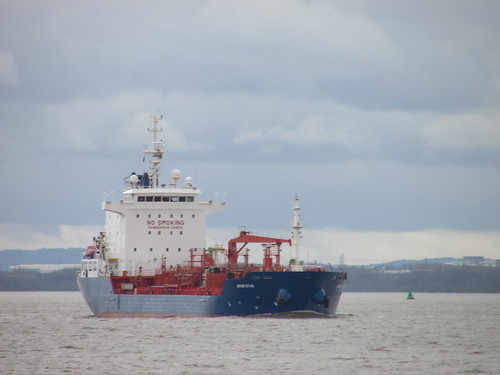
Chemical/Oil Tanker 'Amur Star' heads downstream from Stanlow at the start of its next journey to Antwerp (Return to Liverpool, 14-Mar-2020)
Happy with what I'd seen, I walked to James Street Merseyrail Station and descended to the platform. Two stops took me to Lime Street Station, where I took the next service back to Wolverhampton after a short, but enjoyable, trip.
Related Posts on this Website
There's a 'Label' to find everything I've written relating to Merseyside (there are over 40 posts at the time of writing). Your can display all these posts, in reverse date-of-posting order, by selecting Label 'Merseyside' (or click here).
The following post describes my most recent prior visit:-
New Brighton by Rail.
My pictures
Where necessary, clicking on an image above will display an 'uncropped' view or, alternately, pictures may be selected, viewed or downloaded, in various sizes, from the albums below:-
In making my (often quite poor) pictures available on the internet, I have divided them into various albums each covering a roughly-defined geographical area. Within each album, photographs are normally arranged by date taken. Thus, by searching through the appropriate album, you can find changes through time. So, this trip to Liverpool added pictures to a number of albums as I moved through various areas.
The journey:
West Midland Railways (Wolverhampton).
Stafford Area rail.
Crewe Area rail.
Liverpool area rail.
Merseyrail.
The destination:
Museum of Liverpool.
Liverpool.
The Wirral (pictures from previous visits).

