skip to main |
skip to sidebar
Events of Monday, 16th October 2017
After a good nights sleep and a relaxing breakfast in the comfortable Belmond Governor's Residence, I felt somewhat restored. I'd had an e-mail from Sule Shangri-La Hotel saying they'd found something I'd left behind, discreetly not explaining what it was. I have a history of leaving a trail of possessions behind in hotels so, still unsure what they'd found, I decided to go there to recover it.
At reception, they called a taxi for me and I was fascinated as the concierge tracked its approach on his smartphone. I was about to sample my first 'Uber' taxi. A small, clean saloon arrived and made good time to the centre of Yangon and the Sule Shangri-La Hotel. The fare was less than half the 'normal' taxi fare. The concierge at the Sule Shangri-La Hotel was helpful but regretted that it would take a little while for housekeeping to bring whatever they'd found to the lobby. I'd already a plan in mind, so I said I'd call back a little later in the morning and I set off, through the rapidly-warming streets, to Yangon Central Station to observe movements in this always-busy station.
The Carriage Department Staff were kept busy that morning. Whilst I was at the station, two trains had problems releasing the train brakes, requiring repairs to be carried out on the coaches before the trains could leave.

Yangon Central Station, Monday 16-Oct-2017: The Locomotive Driver (right) squats patiently whist four men from the Carriage Depot replace a defective vacuum brake hose ('ABS Hose') between two coaches on Platform 7.
The temperature was only around 32 degrees Celsius but, after about an hour of walking up and down the suburban platforms recording the scene with my camera, I was ready to return to Sule Shangri-La Hotel to see what they'd found. What they'd found was the credit card I'd mislaid during my stay. The card was no longer valid because I'd reported the card missing as soon as I discovered the loss. Fortunately, I had another card available for use. Another 'Uber' taxi then returned me to the Belmond Governor's Residence, where I'd arranged an afternoon meeting with Eddie Teh, Belmond's General Manager in Myanmar, for further discussions on the charitable work of the Belmond Myanmar Foundation.
The rest of the day was spent uploading pictures to the internet and catching up on e-mail correspondence.
Related posts on this website
This is one of a series of posts describing my 12th visit to Myanmar. The post Starting out is the first post in the series.
Clicking on the 'Next report' link displays the post describing the next events. In this way, you may read about the trip in sequence.
Next report
Alternately, clicking on the 'All my Burma-2017(2) reports' link displays all the posts on this trip in reverse date-of-posting order.
All my Burma-2017(2) reports.
My photograph albums
Where necessary, clicking on an image above will display an 'uncropped' view or, alternately, pictures may be selected, viewed or downloaded, in various sizes, from the albums listed:-
The Governor's Residence Hotel, Yangon.
Yangon Central Station (3).
Hand-operated Cranes
In 2017, I spotted a couple of small wagon-mounted hand cranes laid aside at Myitnge, but I wasn't able to take a photograph.
Steam Cranes
During my tour of Insein Locomotive Works in May 2015, I paid a brief visit to the 'scrap line' and made a hasty record of two steam cranes lying there.
The first vehicle was a 30-ton steam crane made by Cowans Sheldon and Company Limited in Carlisle in 1933. The cast-iron worksplate gives the works number as 5373 but the top line reads R.S.R. - Burma Railways, suggesting that the same design was shipped to both Thailand and Burma. The crane carried a second cast-iron plate which I assumed was the Burma Railways running number '30TSC 9878'. The crane was paired with a match- or runner-wagon bearing a cast running number plate marked 'J 4886'.
The other crane was also a Cowans Sheldon product but rated at 35 tons, works number 8628 built 1945. A cast-iron plate gave the running number as '35TSC 9887'. In this case, the match wagon was built by Hurst, Nelson and Company Limited in Motherwell and carried a cast-iron plate giving the running number as 'J 9817'.
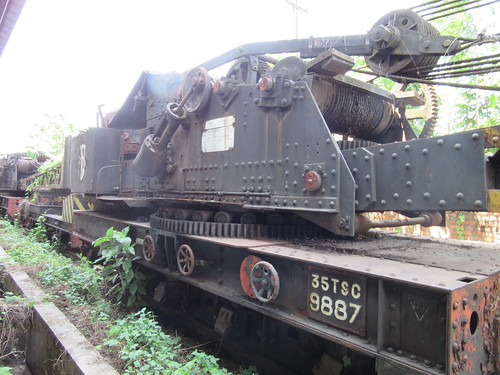
The 35-ton crane with the older, 30-ton crane in the background.
Diesel Cranes
I saw a 60 ton diesel crane in Insein Works, painted canary yellow and labelled 'QIQIHAR CHINA' and 'N603-102'. This was supplied to Myanmar in 1995 by the CNR Qiqihar Railway Rolling Stock (Group) Company Limited. The company's website here. I believe other exports to Myanmar were Depressed container wagons, Brake Vans and Covered Wagons (all with a 12.5 ton axle-load). Qiqihar is a large industrial city in north-east China. Oddly, this city is called 'The City of Cranes' because it is the habitat of Red-crowned Cranes.
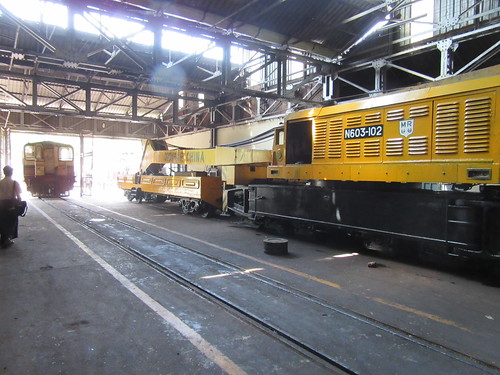
Qiqihar 60-ton crane inside Insein Locomotive Works, Yangon.
At Mahlwagon Diesel Depot I found an Orton McCullough 45 ton diesel crane bearing the painted running number '45.T.DC 9892'. I didn't know this manufacturer but, according to the Historical Construction Equipment Association based in the U.S.A.:-
"Orton & Steinbrenner Company was apparently founded in Chicago, Illinois, in 1906. It was renamed Orton Crane & Shovel in 1922, then Orton Crane Company. It discontinued cable cranes in 1945 to focus on locomotive cranes. John F. McCullough purchased the company in 1972 and renamed it Orton-McCullough Crane Company. Orton-McCullough relocated to Huntington, Indiana, and apparently ceased operations by January 2012".
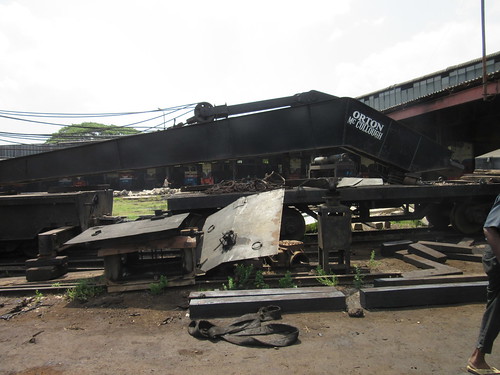
Jib of Orton McCullough 45 tone crane.
Related posts on this website
This is one of a series of posts describing railways in Myanmar. Clicking on the 'All my Myanma-Railways reports' link displays all the posts in reverse date-of-posting order.
All my Myanma-Railways reports
My photograph albums
Where necessary, clicking on an image above will display an 'uncropped' view or, alternately, pictures may be selected, viewed or downloaded, in various sizes, from the albums listed:-
Rail-mounted Cranes in Myanmar.
[Qiqihar website updated, 6-Dec-2019]
I've come across a number of plinthed and laid-aside steam locomotives in Myanmar. This is an index to the photographs I've managed to take so far of the survivors.
Plinthed Dubs 2-4-0T at Naypyitaw
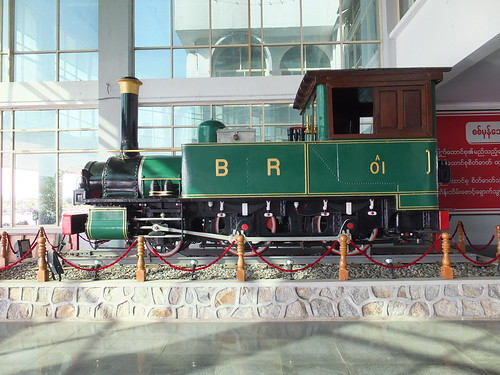
Reputed to be the first steam locomotive to run in Burma, this Dubs is plinthed in the entrance to Naypyitaw station.
More pictures
There’s a large oil painting depicting the inaugural train hauled by the Dubs in the Myanma Railway Museum which I discovered on my visit in 2013 (described here: My pictures around the museum are in an album here).
2-6-4 Tank Locomotives in Burma
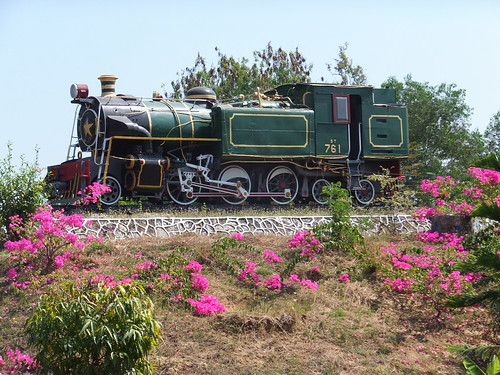
The 'ST' Class formerly worked the intensive suburban services on Yangon's Circle Line.
More pictures
4-6-4 Tank Locomotive in Burma
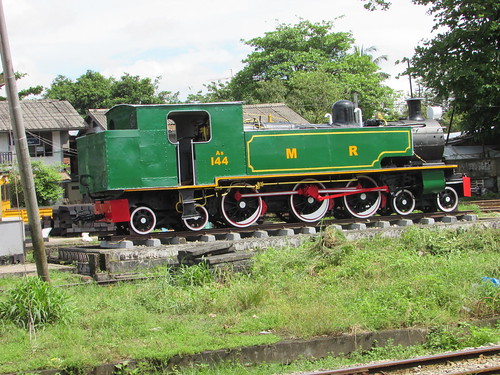
This impressive 'Baltic' tank, As144, is now plinthed at Yangon Central Station.
More pictures
4-6-2 Steam Locomotives in Burma
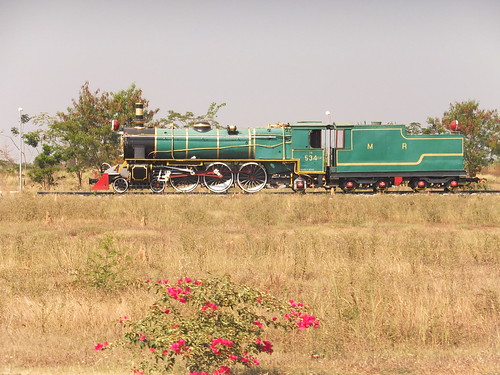
Oil-fired 'Pacific' YB 534 is displayed outside the station at Naypyitaw. Coal-fired 'Pacific' YC 628 with rocking grate was reasonably complete when seen at Mahlwagon Diesel Depot. Oil fired YC 627 at Insein was in poor condition, as were other unidentified 'Pacifics' at Insein.
More pictures
Burma Railways GC 833 Beyer Garratt at Thazi
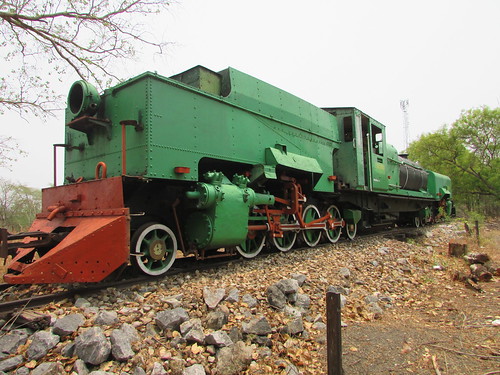
In 2016, I was surprised to find a Beyer Garratt laid aside at Thazi. Externally, she looked reasonable but the cab had been gutted.
More pictures.
Two other albums have some technical information about Beyer Garratts:-
Burma Railways Beyer Garratts.
Burma's Beyer Garratts.
Plinthed 0-6-0T at Thazi Diesel Depot
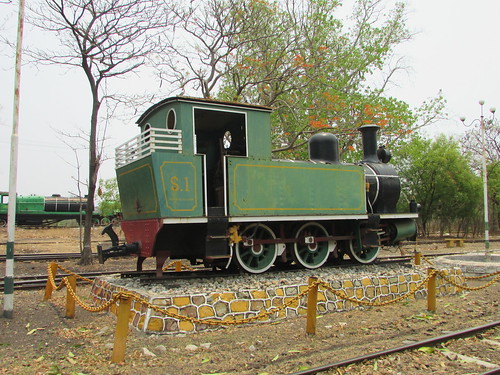
The 0-6-0 side tank plinthed at Thazi Diesel Depot is numbered S.1.
Album
Plinthed 0-6-0T at Insein Locomotive Works
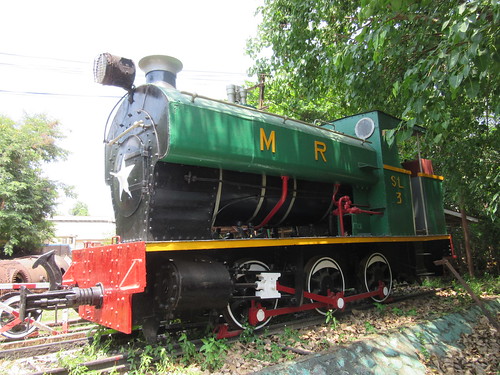
The 0-6-0 saddle tank plinthed at Insein is numbered SL 3.
More pictures
C56 plinthed at Thanbyuzayat
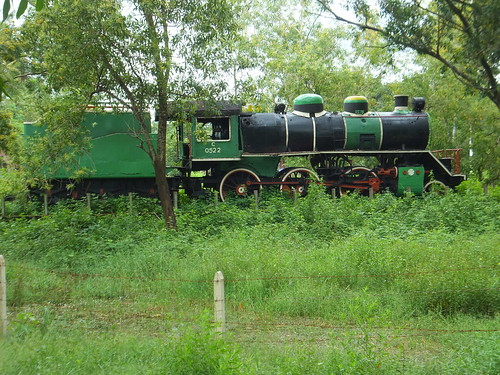
Preserved Japanese-built 'Mogul' C 0522 a few hundred yards from Thanbyuzayat War Cemetery. It is claimed to be the first locomotive to run on the completed 'Death Railway' linking Thailand with Thanbyuzayat.
More pictures
Plinthed Narrow Gauge Kerr-Stuart at Mahlwagon
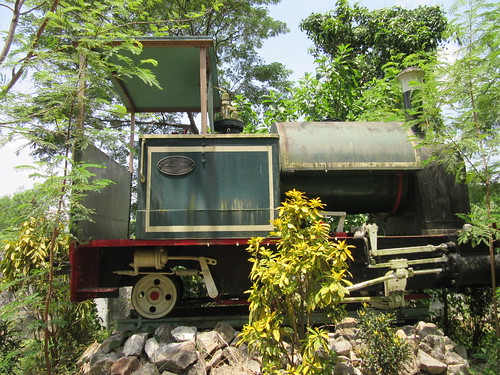
Although I spotted this locomotive, half-hidden in the trees, on my first visit to Myanmar in 2008, it was not until 2015 that I was able to take a closer look.
More pictures
Plinthed Orenstein and Koppel Narrow Gauge Locomotive at Mandalay Diesel Depot
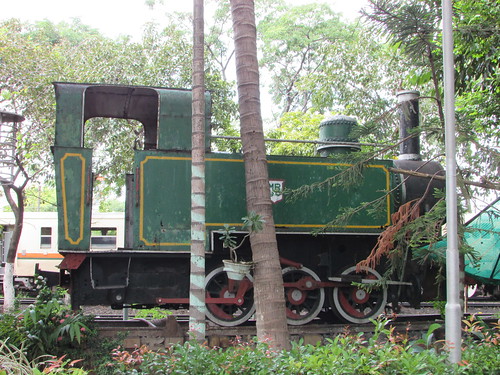
It was not until October 2017 that I spotted this locomotive plinthed at the Diesel Depot in Mandalay.
Album
2-8-2 Steam Locomotives
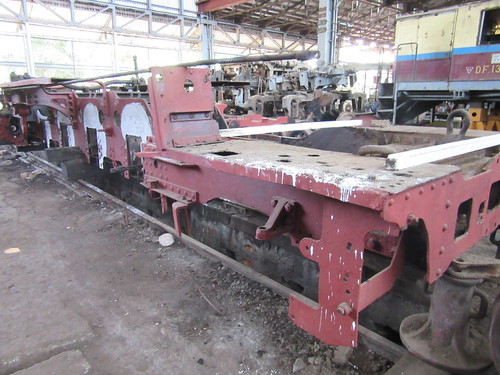
I haven't tracked down any YD class so far, apart from stripped-down examples under restoration at Insein but there are two or three working locomotives. See FarRail's Trip Reports at https://www.farrail.com/
Restoration pictures
[C56 added: 15-Nov-2017]
Events of Sunday, 15th October 2017
A number of guests were leaving the ship on Sunday morning, being ferried ashore at different times, depending upon their onward travel arrangements. As I made my way to the restaurant for breakfast around seven o'clock, I said "good-bye" to one group.
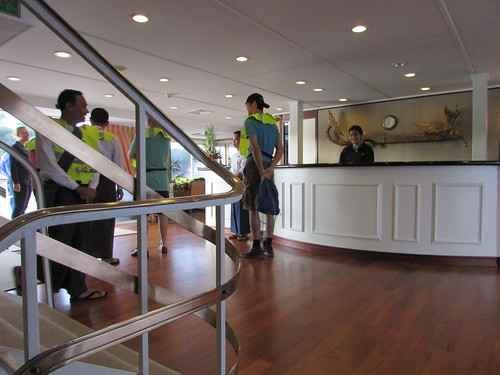
'Road to Mandalay' at Bagan and final leaving.
My own pleasant sojourn on 'Road to Mandalay' was coming to an end and I was to travel back to Yangon, where I'd been invited to spend the last two nights of my trip at the 'Belmond Governor's Residence'. An American guest who was remaining on the ship as she sailed north back to Mandalay had expressed interest in visiting Bagan Medical Clinic. It had been arranged that the guide Pyae Pyae would take him ashore around 8.00 a.m. for a brief tour and I decided to go ashore with them. Doctor Hla Tun had gone ashore much earlier in order to finish his 'list' before the ship sailed a little after nine.
Bagan Medical Clinic opens each week, apart from a break around the New Year. But, for around 8 months in each year, Doctor Hla Tun's duties as Belmond's Chief Medical Officer mean that he is aboard 'Road to Mandalay'. So the Clinic's opening on Friday, Saturday and part of Sunday are tied to the sailing schedule of the ship, which normally arrives at Bagan around 9.00 a.m. every Friday and remains at anchor until Sunday morning. On this trip, when the guests went ashore on Friday at 9.30 a.m., Doctor Hla Tun went straight to the clinic, staying until about 11.00 p.m. On Saturday, he went ashore with guests at 8.30 a.m., again working at the clinic until 11.00 p.m. Finally, he made an early start on Sunday at around 6.00 a.m. in order to 'clear' his list before returning to the ship around 9.00 a.m. This punishing and voluntary schedule is then carried out each week.
What about the 'closed' season embracing the hottest part of the year when 'Road to Mandalay' does not sail? Doctor Hla Tun manages charitable initiatives elsewhere - most notably around Yangon and the Orphans and Vulnerable Children (OVC) Project in Mon State. During this period, each week, the Doctor makes his way to Bagan to carry out consultations on Friday, Saturday and Sunday. Occasionally, the Clinic is opened for additional days. My last visit to Myanmar in May 2017 was during the 'closed' season when I accompanied the Doctor to Mon State and then on to the Bagan Clinic. That trip is described in a series of posts here.
Before going ashore with Pyae Pyae and the guest, I'd said my final "good-byes" to the ship's hotel staff and my luggage went ashore too. The Clinic was unusually quiet as almost all the patients had been dealt with. A few patients were still readying themselves for their journey back to their home and Clinic staff were tidying-up after a hectic few days. Pyae Pyae, the guest and I went from building to building whilst I explained a little of the history of the Clinic. We spoke briefly to Doctor Hla Tun who was preparing to finish then walked back to the Belmond landing stage where Pyae Pyae and the guest boarded the motor boat waiting to return to the ship. At ten past nine, Doctor Hla Tun came running down the steps and jumped aboard the motor boat.
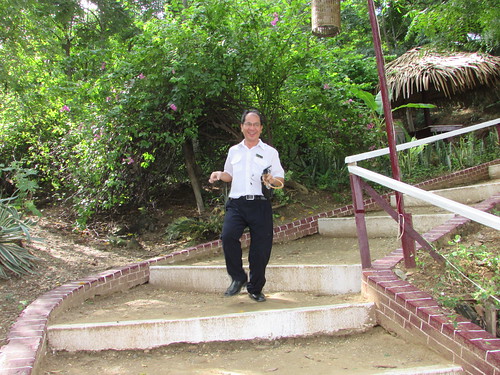
Bagan Medical Clinic Sunday: Doctor Hla Tun running to catch the last motor boat back to the ship.
Within moments, the motor boat was roaring away from the bank to deliver its three passengers back to 'Road to Mandalay' and I was left on the shore waving to my friends.
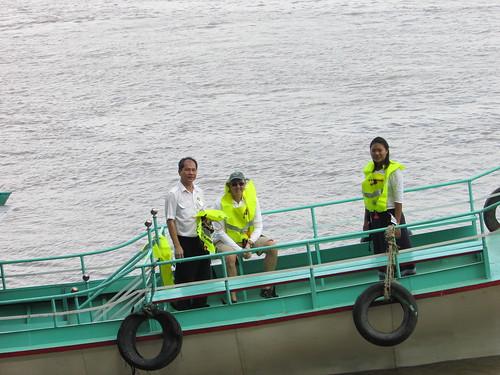
Bagan Medical Clinic Sunday: Dr. Hla Tun, the Guest and Pyae Pyae returning to 'Road to Mandalay'.
Before leaving myself, I had a quiet walk around the Clinic, thinking about the changes I'd seen since the first, small clinic building was opened in 2011. You can find all my posts charting these changes in a series of posts here. It had been arranged that the Monastery Car would take me to Nyaung Oo Airport for my flight to Yangon so, having said farewell to the remarkable staff and the Abbott of the Monastery who, with Doctor Hla Tun, is responsible for the Clinic, I was whisked to the airport.
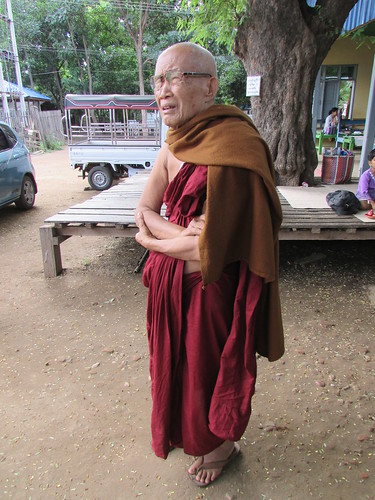
Bagan Medical Clinic Sunday: The Abbott
As we made our way past the temples of the Bagan Plain, we kept passing groups of young people, in orange tee-shirts and blue hard-hats. It's apparently an initiative by volunteers to improve the appearance of the area, presumably to aid tourism. Bravo!
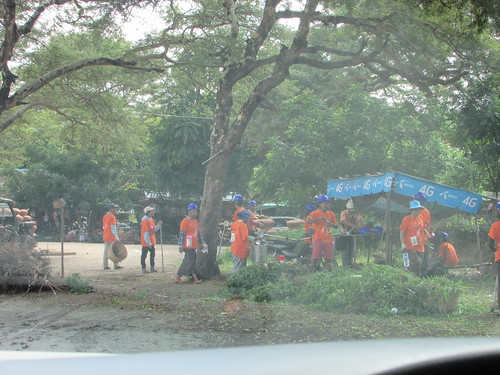
Volunteers litter-picking and grass-cutting around the temples of Bagan.
We'd made good time on the way to Nyaung Oo Airport so I had a fair wait for my flight but, for once, I was relaxed about the enforced inactivity.
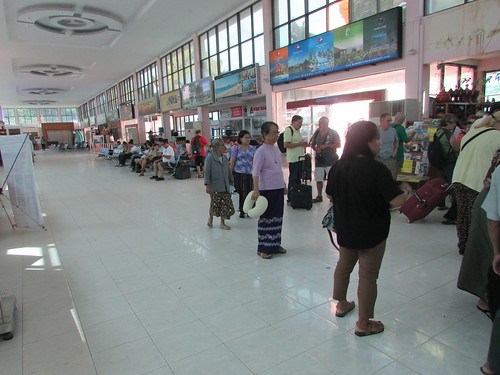 Nyaung Oo Airport.
Regular readers may remember that in Tasmania earlier in 2017, I'd been surprised to discover God's Car Parking Space (that's described in the post here). I was similarly nonplussed when, waiting to board the aircraft at Nyaung Oo, a man walked across the tarmac in a lemon high visibility jacket marked 'AIR KBZ G O D'. After a short reflection, I decided he was probably the Ground Operations Director.
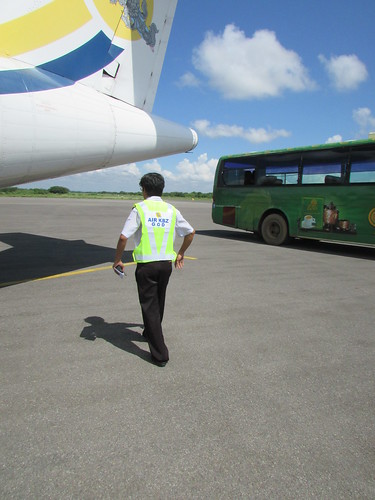
Nyaung Oo Airport.
We touched-down in Yangon just before 12.30 p.m. and parked in a line with similar KBZ aircraft, from where a transfer bus took us to the Domestic Terminal.
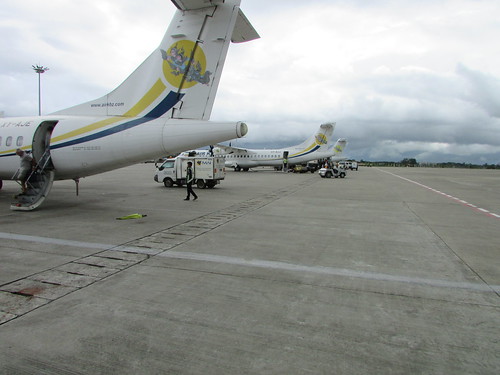
AIR KBZ aircraft lined up at Yangon.
There is now an impressive baggage hall with multiple luggage carousels. Unfortunately, it now seems to take much longer for bags to arrive than in the 'old days' when they'd dump bags just inside the terminal building and let the passengers tussle to extract the right bag. Once re-united with my case, I quickly found the smartly turned out driver with the smartly turned out car who was waiting to take me to my hotel. By two o'clock, I was in my airy, comfortable room at the Belmond Governor's Residence. The combination of the availability of fast internet and my exhaustion from the activities of the previous few days meant that I didn't leave the hotel on Sunday but concentrated on uploading pictures, writing to the blog and catching up on e-mails.
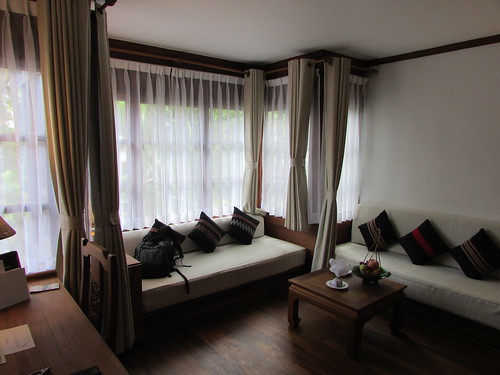
Belmond Governor's Residence, Yangon: Sunday 15-Oct-2017
Related posts on this website
This is one of a series of posts describing my 12th visit to Myanmar. The post Starting out is the first post in the series.
Clicking on the 'Next report' link displays the post describing the next events. In this way, you may read about the trip in sequence.
Next report
Alternately, clicking on the 'All my Burma-2017(2) reports' link displays all the posts on this trip in reverse date-of-posting order.
All my Burma-2017(2) reports.
My photograph albums
Where necessary, clicking on an image above will display an 'uncropped' view or, alternately, pictures may be selected, viewed or downloaded, in various sizes, from the albums listed:-
'Road to Mandalay': October 2017.
Bagan Medical Clinic, Sunday.
Bagan - Yangon by road and air.
The Governor's Residence Hotel, Yangon.
Events of Saturday, 14th October 2017
Various trips were offered to the guests on Saturday and Doctor Hla Tun had suggested that I take the all-day trip to Mount Popa, home of the 37 Nats (spirits).
I had first visited Mount Popa in 2009, described here. Impressed, I returned in 2011, this time staying at Mount Popa Resort. That visit is described in two posts here and here. Then, in 2015, during a visit to schools in Bagan area, we went to Mount Popa village for lunch and views of Taung Kalat, as described here.
We set off in a small coach, travelling first to Nyaung Oo and then taking the main road towards Mount Popa. After about half an hour, we stopped at the same toddy palm plantation I'd first visited in 2009, but it was clear that they'd scaled-up the tourist facilities since that visit. A good-tempered ox was still demonstrating how peanuts are ground in an oversize pestle and mortar to extract the oil, leaving behind a biscuit-like solid. This is a treat for the ox, apparently, and I was handed a piece to give to the animal which very gently took it from my fingers with obvious relish.
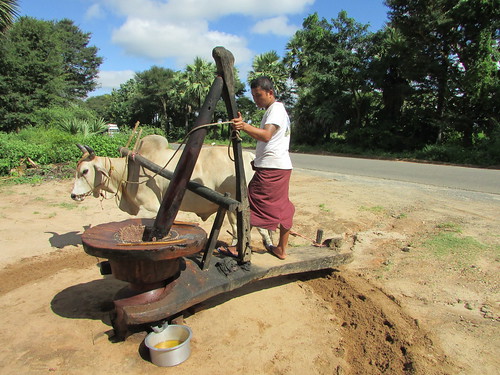 Trip to Mount Popa: Grinding peanuts for oil.
The oil is processed by heating in a large shallow pan (like a wok) whilst continuously stirring. Heat is provided by a simple brick oven fired by bamboo waste and ending in a brick chimney. The oven accommodates a number of pans which are progressively moved towards the chimney as evaporation takes place. Finally, the pan nearest the chimney holds a paste which is carried to a nearby low table to be formed, by hand, into a variety of sweetmeats. Once the pans are moved up, another pan of unprocessed oil can be placed on the oven.
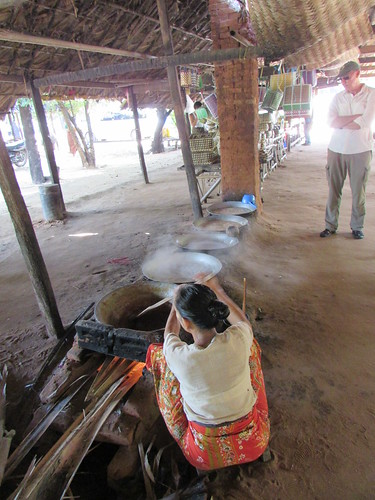
Trip to Mount Popa: Evaporating peanut oil.
Next, a man demonstrated how the toddy palms are climbed once or twice a day, using a simple bamboo ladder lashed to the trunk. A large knife is used to score the tree so that the sap runs into a series of small earthenware pots attached to the tree. On the next visit, the pots containing sap are collected and replaced with empty pots.
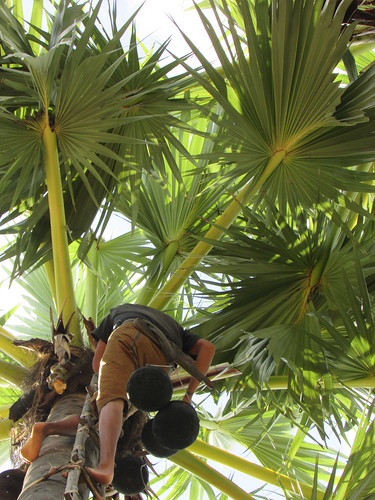
Trip to Mount Popa: Sap collection by exchanging earthenware pots at the top of a toddy palm.
The toddy sap is also taken to the large bamboo shelter where simple stills are used to produce a popular alcoholic drink. The sap is processed by heating in a modified earthenware pot mounted on a simple brick oven fired by bamboo waste and ending in a brick chimney. The oven typically accommodates three pots.
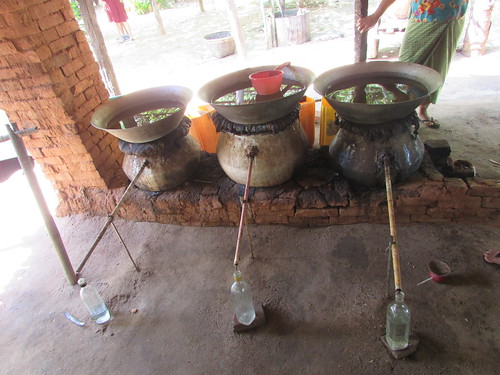
Trip to Mount Popa: Toddy Still.
Each pot is modified by being fitted internally with a metal scoop connected to a long, inclined delivery tube passing through a hole in the side of the pot which is then sealed. The top of the pot is provided with a flexible ring so that, when a large pan of cool water is placed on top of the ring, vapour does not escape.
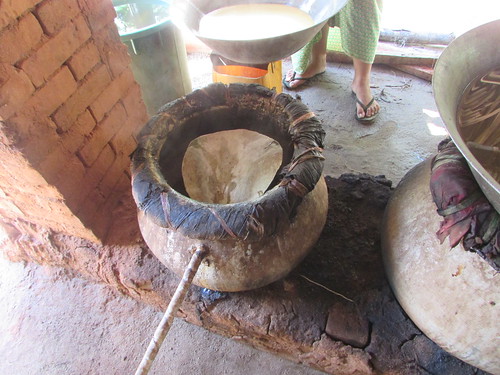
Trip to Mount Popa: Construction of toddy still.
In use, the sap is evaporated by heating but when the vapour strikes the cool underside of the large pan of cool water, the alcohol condenses, droplets fall into the metal scoop and are led away by the inclined tube to a waiting bottle.
All this sweet making and distilling activity requires an army of women fetching and carrying, stirring, firing the ovens, all the time watched by tourists. While we were there, a large coach arrived with a party of tourists from the Australian APT Company, each wearing professional badges showing their first name.
After a fascinating visit, we carried on to Mount Popa, passing through a remote country area where, as I've noted before, many poor and elderly people choose to beg for alms apparently as a way of life, relying upon the Burmese tradition of charitable giving. We parked near the centre of the always-busy town of Mount Popa and walked to the Temple of the Nats, which was oddly quiet when we entered but quickly filled with pilgrims and tourists.
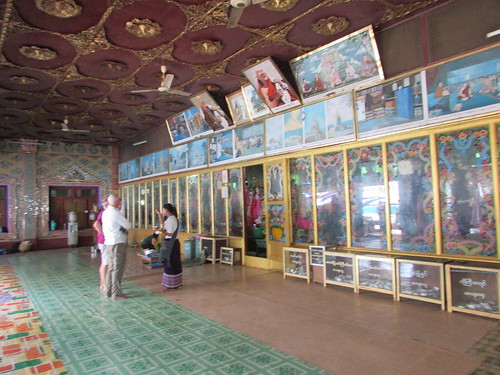
Trip to Mount Popa: The Temple of the Nats.
Images of the 37 Nats are displayed along one long wall of the temple, separated from the main area by a glazed partition which was open for visitors, allowing pilgrims to make donations of money or fresh fruit.
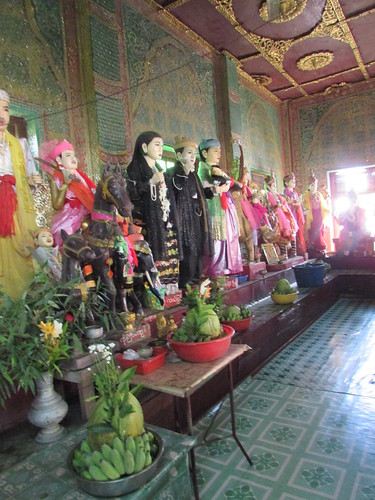
Trip to Mount Popa: Images of the 37 Nats.
The entrance to Taung Kalat, the remarkable series of shrines 777 steps up an improbable-looking rock outcrop populated by hordes of mischievous monkeys was nearby. Having been to the top at least twice, I excused myself as the rest of our party ascended to the summit, instead confining myself to exploring the lower levels occupied by numerous small traders, accompanied by our guide Pyae Pyae. When the party was together again, our coach took the road acending Mount Popa leading to Mount Popa Resort. Pyae Pyae and I started a leisurely lunch on the open air dining deck which offered stunning views of Taung Kalat.
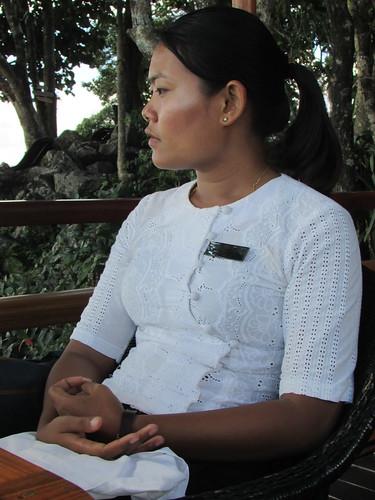
Trip to Mount Popa: Our guide, Pyae Pyae, displaying the natural grace of Myanmar people.
The rest of our party elected to swim in the resort's infinity pool before taking lunch.
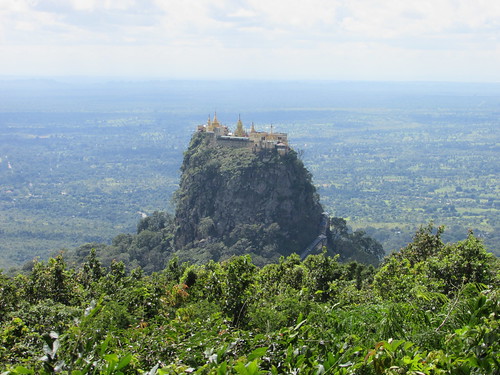
Trip to Mount Popa: Taung Kalat, viewed from Mount Popa Resort.
After lunch, we climbed back into our coach for the return journey. Brian and Shannon had already left 'Road to Mandalay' and were continuing their exploration of Bagan using the Royal Bagan Hotel in Nyaung Oo as their base. So, we dropped them at their hotel before saying "good bye" and returning to Bagan.
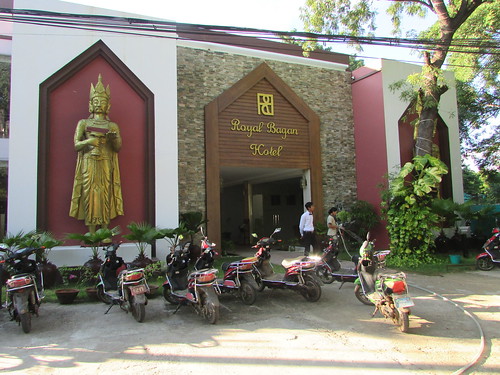
Trip to Mount Popa: Royal Bagan Hotel, Nyaung Oo. Note the waiting 'e-bikes'.
I walked to the Bagan Clinic and, of course, Doctor Hla Tun was still busy with consultations. I was surprised that the open area between a number of the clinic buildings had been provided during the day with a roof of woven plastic netting which I'm sure was appreciated by waiting patients.
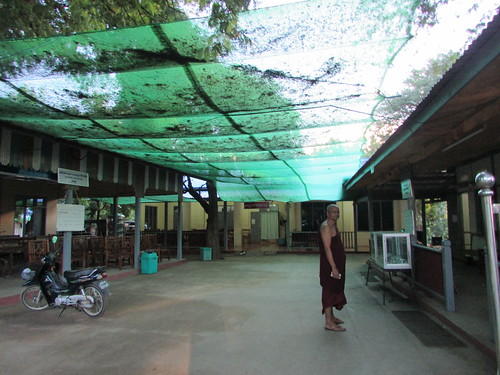
Bagan Medical Clinic Saturday: The Monk beneath the just-installed green netting.
Before I returned to the comfort of 'Road to Mandalay', there was one more experience for me. For some years, I had admired the Irrawaddy Paddle Steamer laid-up at the river bank just below the Clinic and wondered how much of the original machinery survived. Well, Doctor Hla Tun told me that the monk from the Clinic had arranged a visit for me so, armed with my camera, the monk and I descended to the mooring before the light was completely lost. Boarding required negotiation of the long, rather narrow, unsupported gangplank above the brown waters of the Irrawaddy, which task I completed safely but not without some trepidation. Once aboard and seeing that the triple-expansion steam engine and all the associated equipment was intact (if dusty and cobweb bestrewn), I immediately started scurrying up and down companionways with the energy (and lack of grace) of the mountain buffaloes I'd seen in Kachin State lest they should attempt to dissuade me, collecting as many pictures as possible for later study. In due course, there will no doubt be a more technical post on this 1948 Yarrow-built survivor.
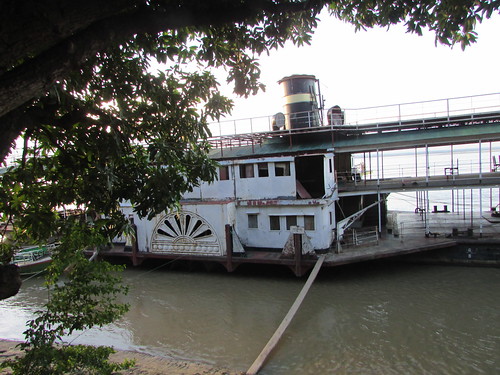
Paddle Steamer 'Minthamee', Bagan 2017: Boarding the Paddle Steamer required negotiation of the long, rather narrow, unsupported gangplank.
Related posts on this website
This is one of a series of posts describing my 12th visit to Myanmar. The post Starting out is the first post in the series.
Clicking on the 'Next report' link displays the post describing the next events. In this way, you may read about the trip in sequence.
Next report.
Alternately, clicking on the 'All my Burma-2017(2) reports' link displays all the posts on this trip in reverse date-of-posting order.
All my Burma-2017(2) reports.
My photograph albums
Where necessary, clicking on an image above will display an 'uncropped' view or, alternately, pictures may be selected, viewed or downloaded, in various sizes, from the albums listed:-
'Road to Mandalay': October 2017.
Trip to Mount Popa.
Paddle Steamer 'Minthamee', Bagan..
Events of Friday, 13th October 2017
Early in the morning, 'Road to Mandalay' slipped away from her overnight anchorage and continued down stream to Bagan. After an enjoyable breakfast, I watched as the mysterious silhouette of Mount Popa slipped by on our port side. Mount Popa is an extinct volcano with a collapsed caldera, famous as the home of the 37 Nats, spirits widely believed in by both Buddhists and non-Buddhists. There's a brief introduction to Nats in Wikipedia here.
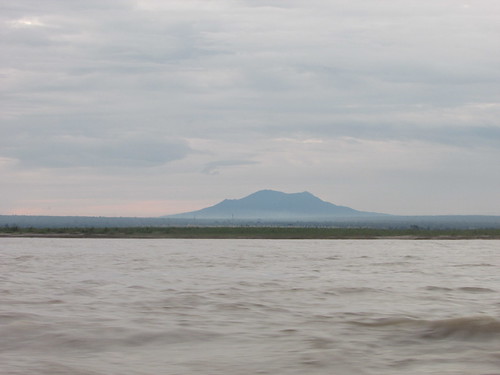
Cruising to Bagan: Mount Popa, viewed from the Ayeyarwaddy.
By nine o'clock, the ship was once again anchoring mid-stream, opposite the private 'Belmond' landing stage at Bagan. Logistics staff and a motor boat were waiting to bring the guests ashore at 9.30 a.m.
Once on land, we were faced with the steep, zig-zag climb up to the 'Belmond' car park.
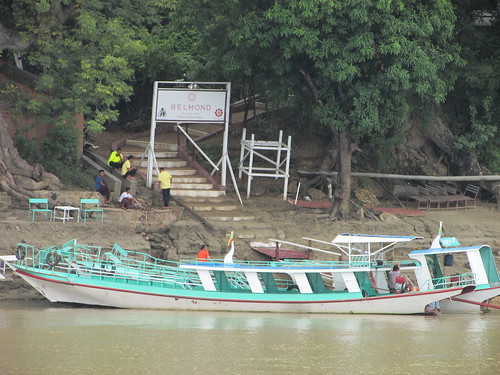
The private 'Belmond' landing stage at Bagan.
Guests had four choices for the morning tour. Two small coaches and a car were ready to take three of the groups and a series of modern mountain bicyles (with safety helmets) were waiting for the 'Bagan by Bicycle' guests. A far cry from my first bicycle ride at Bagan, back in 2008, which I described in the post here. That bike ride serves as an example of how trivial events can have long-term effects. A minor incident at the beginning of that ride (I fell off) introduced me to Doctor Hla Tun and, as a result, I have ever since tried to support the educational and charitable work he organises in Myanmar.
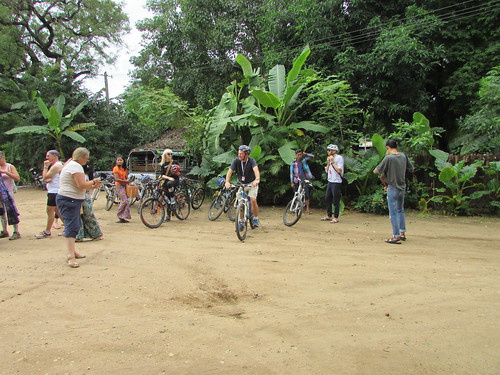
The 'Bagan by Bicycle' guests about to set off.
Doctor Hla Tun had come ashore with the guests but he immediately set off on the short walk to the adjacent Bagan Medical Clinic where he would start his consultations which would continue until 11.0 p.m. Once I'd watched the various groups of guests depart to explore Bagan, I followed Doctor Hla Tun to the Clinic. Both the Belmond car park and the Bagan Medical Clinic are within the Compound of Bagan Monastery.
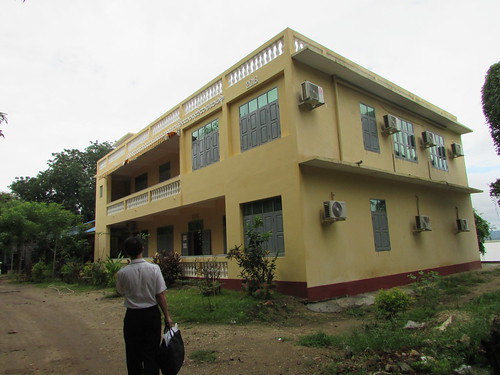
Bagan Medical Clinic, Friday: Doctor Hla Tun passes the 2-storey clinic building on his way to his consulting room.
The original clinic building, opened in 2011 is still the 'centre of operations' as it houses patient registration and the dispensary, in addition to consulting rooms and 'messing' facilities for the staff. The monk who has supervised the activities of the clinic since its opening greeted me and showed me the patient registrations so far - 188.
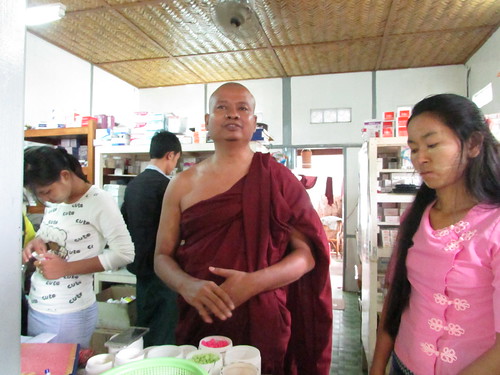
Bagan Medical Clinic, Friday: The monk who has supervised the activities of the clinic since its opening.
Doctor Hla Tun appeared and it was decided that it was an appropriate moment for a 'group shot' with the staff present.

Bagan Medical Clinic, Friday: The 'group shot'.
I then accompanied Doctor Hla Tun to his consulting room where I met Doctor Jyn Aung Thet, a charming, Burmese-born doctor from Wisconsin, U.S.A. who, now retired, returns to Burma and frequently carries out consultations at the clinic.
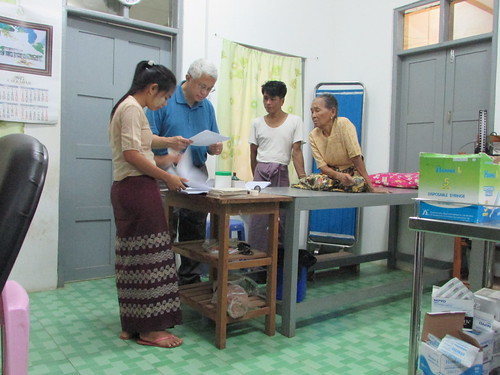
Bagan Medical Clinic, Friday: Doctor Jyn Aung Thet carries out a consultation.
Doctor Jyn Aung Thet was accompanied by his cousin, a radiologist, and she was studying the Fukuda UF-850XTD full digital Ultrasound System, recently-installed in the 2-storey building.
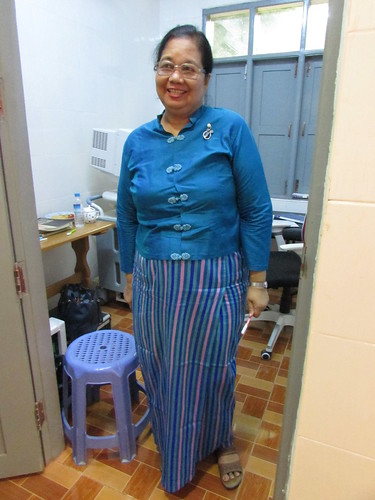
Bagan Medical Clinic, Friday: Doctor Jyn Aung Thet's cousin
I then carried out my customary tour of the now-extensive clinic site, looking for developments since my last visit in April 2017 (which was described in the post here). The Dentist's room on the ground floor of the 2-storey building was much as I'd seen it in April.
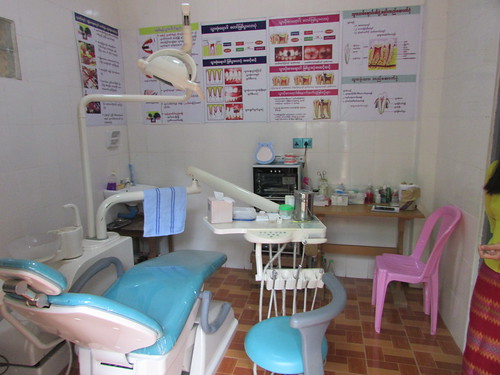
Bagan Medical Clinic, Friday: The well-equipped Dentist's room in the 2-storey building.
The 2-storey building has rooms for two Operating Theatres on the upper floor. The first room now has the specialist equipment installed but staff training and Government approval has to be completed before it can be brought into use.
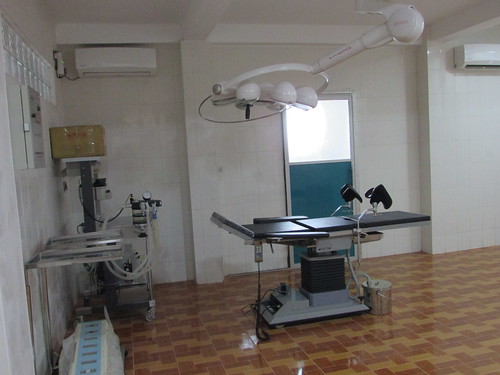
Bagan Medical Clinic, Friday: Equipped Operating Theatre in the 2-storey building.
Nearby is a the essential Large Medical Autoclave. This allows equipment used in surgical operations to be sterilised. There's a Wikipedia article on autoclaves here.
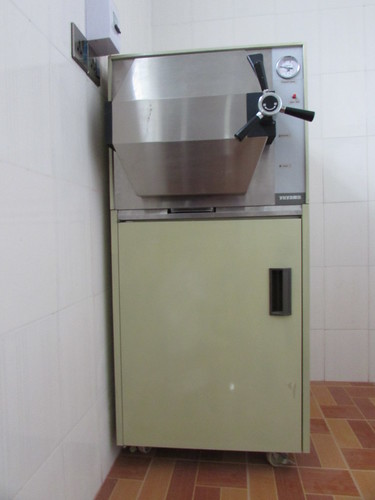
Bagan Medical Clinic, Friday: Large Medical Autoclave.
The mobile X-ray equipment I noted on my last visit was still awaiting the delivery of associated equipment prior to commissioning.
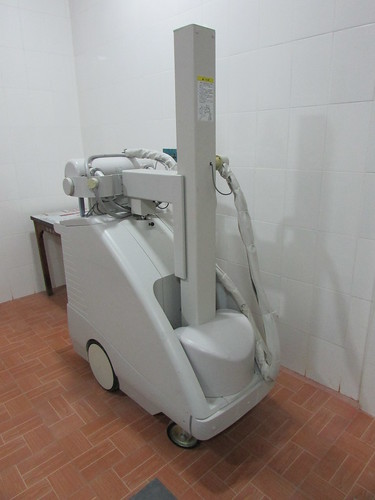
Bagan Medical Clinic, Friday: Toshiba Mobile X-ray Machine.
I moved to the nearby Hospital Building which had been very much a building site on my previous visit. The upper floor is now structurally complete with railings on the balcony.
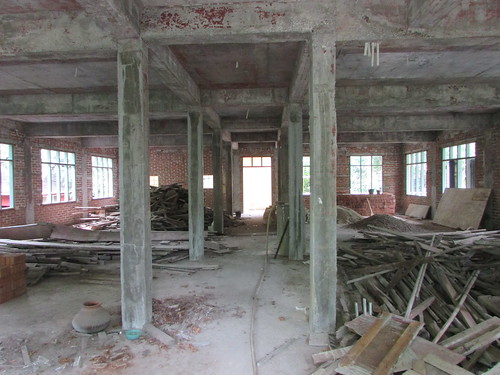
Bagan Medical Clinic, Friday: The upper floor of the Hospital Building is now structurally complete.
The building is now painted outside and the two wards on the ground floor have had tiled floors and walls finished. Most electrics, including oscillating ceiling fans, are complete. White-painted patient beds are temporarily stored in the wards.
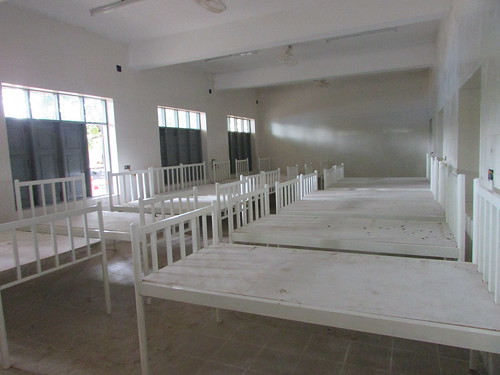
Bagan Medical Clinic, Friday: One of two wards in the Hospital Building almost complete and temporarily storing beds.
Next, I examined the new standby generator - a Caterpillar DE65E0 packaged unit which has been provided with a smart-looking building with a blue roof. This is another addition since my previous visit just a few months earlier.
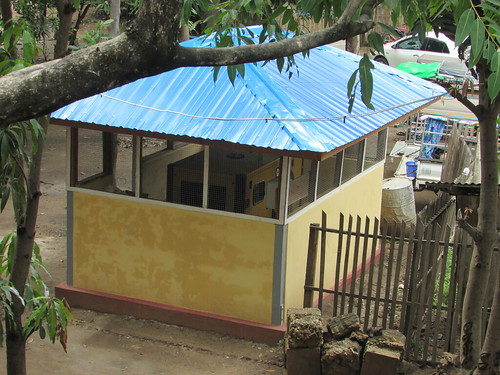
Bagan Medical Clinic, Friday: The Standby Electricity Generator in its blue-roofed building.
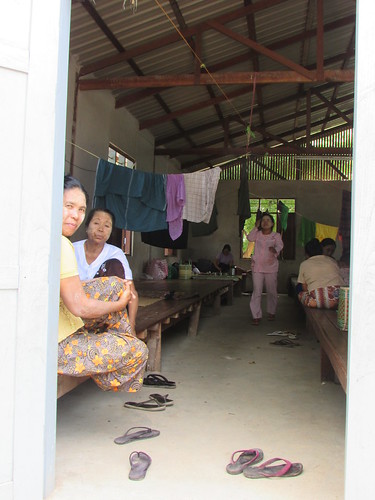
Bagan Medical Clinic, Friday: Waiting patients in the Dormitory Building.
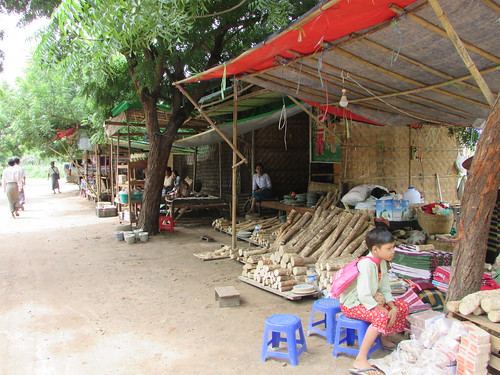
Bagan Medical Clinic, Friday: On a 'Clinic Day' all the stalls lining the approach to the Clinic are open for business.
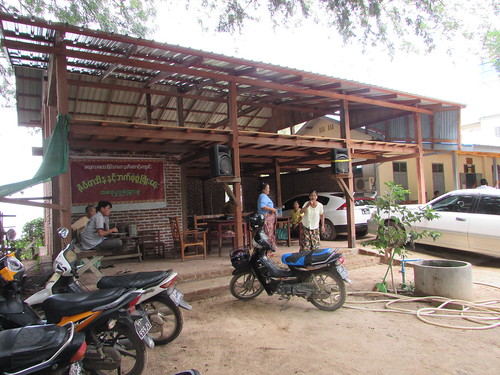
Bagan Medical Clinic, Friday: Another substantial building is under construction in between the First Clinic Building and Doctor Hla Tun's consulting room.
All the clinic buildings are on monastery land and operate under the authority of the Abbott of the monastery. The monastery and monastic school operate from a series of fairly recent buildings dotted around the compound. But there is an older, wooden monastery building on the site, no longer in regular use. This is Nat Taung Kyaung, around 200 years old and quite famous for its carving. Since 2008, I've admired the building without studying it closely so I determined to make a photographic record of the outside at least. Being well away from the main tourist routes through Bagan, this building has become something of a 'hidden gem', although it has an extensive review in the scholarly publication 'Splendour in Wood'.
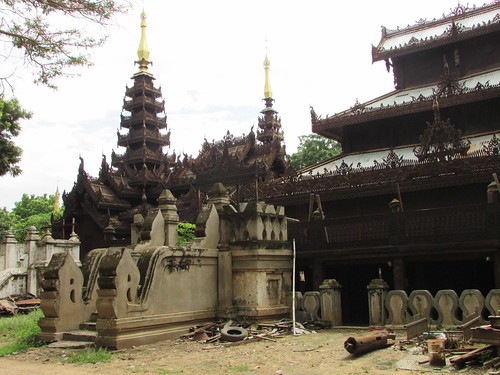
Nat-Taung Kyaung Monastery, Bagan
The detail of the carving remains impressive and compares with better-known Yoke-Sone-Kyaung at Salay, described in my post here.
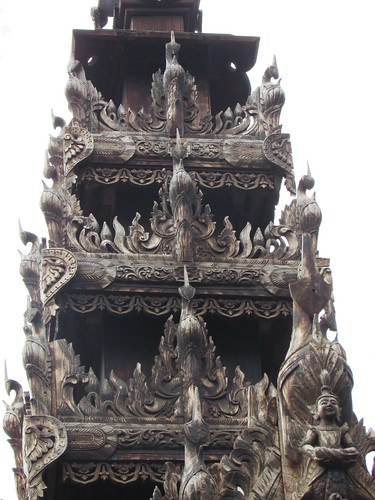
Nat-Taung Kyaung Monastery, Bagan: Detail of wood carving.
The temperature had risen during the morning to around 32 Celsius - enough to leave me dripping with perspiration and exhausted. Knowing that the guests from the ship would have completed their morning tour and be returning to the ship for lunch, I made my way to the Belmond landing place and was quickly returned to the cool quiet of 'Road to Mandalay' where I enjoyed a splendid lunch. The guests went ashore again a 3.30 p.m. for a second exploration in "wonderful Bagan".
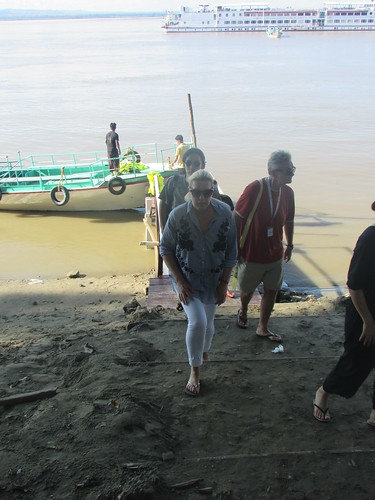
B-RTM: Bagan, Second trip ashore 15:30 Friday.
I accompanied the guests on the boat and then rejoined Doctor Hla Tun in Bagan Medical Clinic. Later in the afternoon, Doctor Hla Tun received some training in the interpretation of ultrsound images. Whilst the Doctor continued with his consultations until the last boat back to the ship at 11.0 p.m., I returned in time for a relaxed dinner, followed by a traditional marionette show in the lounge. I managed to do a little work on my computer before retiring.
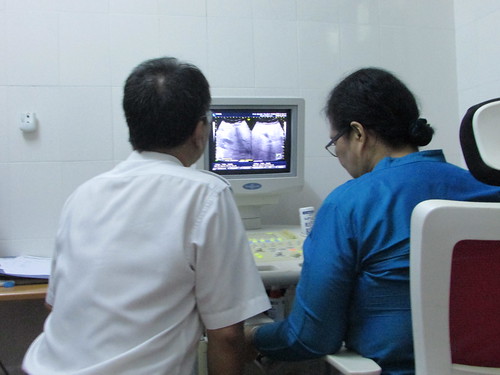
Bagan Medical Clinic, Friday: Doctor Hla Tun examining images on the Ultrasound equipment.
Related posts on this website
This is one of a series of posts describing my 12th visit to Myanmar. The post Starting out is the first post in the series.
Clicking on the 'Next report' link displays the post describing the next events. In this way, you may read about the trip in sequence.
Next report
Alternately, clicking on the 'All my Burma-2017(2) reports' link displays all the posts on this trip in reverse date-of-posting order.
All my Burma-2017(2) reports.
My photograph albums
Where necessary, clicking on an image above will display an 'uncropped' view or, alternately, pictures may be selected, viewed or downloaded, in various sizes, from the albums listed:-
'Road to Mandalay': October 2017.
B-RTM: Cruising to Bagan.
Bagan Medical Clinic, Friday.
Nat-Taung Kyaung Monastery, Bagan.

