skip to main |
skip to sidebar
Events of Saturday 7th October 2017
Indawgyi Lake is the largest lake in Myanmar and one of the largest in South-East Asia, about 8 miles wide and 15 miles North to South with 20 villages (mainly Shan or Kachin) around the shore. Its isolated location means that it is unspoiled and it has been designated a UNESCO Biosphere Reserve. The best-known feature of the lake is probably the Shwe Myitzu Pagoda, actually built in the lake and accessible by causeway during the dry season but requiring a boat trip when I visited
I’d slept well on the raised but hard bed at the IndawMaHar Guest House which is built on piles at the edge of the lake and stood about two feet above the lake level when I visited in the rainy season. Near the shore, green weed grows all around, so it wasn’t particularly obvious that you were over water until you used the short wooden 'gangplank' linking the main building to the separate wooden bathroom.

Indawgyi Lake (part 1): IndawMaHar Guest House.
At about 7.30 a.m., July and I walked across the road from our Guest House to a tea shop. We passed chickens foraging for food near the road outside one house whilst a large pig was stretched out in front of another, enjoying the early morning sun. We looked at a very overloaded motor cycle festooned with various bags. This, it transpired, was the mobile shop and the lady proprietor seemed to be doing reasonable business.

Indawgyi Lake (part 1): Lonton, the Mobile Shop.
At the tea shop, the choices appeared to be Shan Noodle Soup or Shan Noodle Soup. Although I was assured that there were only vegetables in mine, I found generous lumps of chicken. But they managed a fairly cold Coca Cola.

Indawgyi Lake (part 1): Breakfast at a tea shop in Lonton.
Having finished our breakfast, we walked back to the Guest House, where a young girl was perched on one of the wooden walkways next to the building washing clothes, using a stick to beat water through the fibres of the fabric.

Indawgyi Lake (part 1): Laundry work at IndawMaHar Guest House.
Having collected what we needed for the day, July and I walked the few yards to the Inn Chit Tha Building. Inn Chit Tha are a local not-for-profit eco-tourism group set up in 2013. Their office was crammed with bicycles for hire but we’d booked a boat trip. Alongside the Inn Chit Tha building there was a small creek, filled with weed and motor boats similar in design to those used on Inle lake. A rickety single-plank wide gangway ran along one side. This appeared to be what served as the Jetty. A boatman was putting diesel in one of the engines and then he pushed the boat to a position where we could board. July and I were both equipped with lifejackets (which we discarded later in the day as being hot and uncomfortable – I saw no other person wearing one during the day). When we were aboard, the boatman extricated our craft from the weeds and the adjacent boats by a combination of pulling against the other boats and, once there was space to insert his long bamboo pole, poling.

Indawgyi Lake (part 1): Leaving Lonton by boat.
The motive power was the usual sort of Chinese-made single-cylinder diesel engine developing around 25 horse power which required hand-cranking to start. Whatever exhaust system has once been provided, it was long gone, and the engine block discharged directly upwards producing a noise that was, to say the least, raucous.
At about 9.00 a.m. we left Lonton, which is fairly near the southern end of Lake Indawgyi on the west shore. We headed slightly east of north at a good speed. I expected us to call at the Shwe Myitzu Pagoda, shimmering in the sun but we kept going and July explained that our destination was to be a series of pagodas at Shwe Taung built on Golden Mountain. This is near the northern end of the lake towards the east, where the Indawgyi River discharges into the lake.
So it was around 10.00 a.m. when we arrived at the foot of Golden Mountain where a steep, sandy hillside sloped into the water near a painted Buddha image next to a building housing a shrine. A herd of mountain buffalo were ambling across the hillside, apparently making for the water. There seemed to be no facilities for landing – the boatman simply pointed the prow at the bank and cut the engine. Scrambling ashore was easier than expected, but the buffalo were still on the track leading to the Buddha image.

Indawgyi Lake (part 1): Mountain buffalo at Golden Mountain).
Buffalo are very watchful creatures and their apparently intelligent eyes hold you in their gaze. Despite their size and strength, they are easily spooked by any sudden movement. Even when they are almost completely submerged in water, their eyes remain focused on you. I was reminded of the similar behaviour of hippopotamus I’d seen in Africa (mantioned in the post Savuti (2)).
From near the Buddha image, a way led up the hill to the first pagoda. I say ‘way’: it was more a trench cut by water now (mostly) dry, rather than a track, probably very suitable for mountain buffalo but not ideal for wobbly elderly foreigners. I set off well enough but on a tricky bend I lost my balance and fell on my backside. I only suffered minor abrasions on one arm and loss of what little dignity remains but I’d found a spot that was still a little muddy. You would have hoped I’d have learnt my lesson on Nightingale Island (for more details see my post Nightingale and Inaccessible Islands). July was horrified but, of course, I elected to carry on, with welcome help from July on subsequent tricky corners. But by the time we reached the first pagoda, the heat and the exertion had 'winded' me. Near the pagoda was a building with a shrine and a single young monk in residence. He was quite happy for me to sit in the shade of his building whilst July checked out an alternative route.

Indawgyi Lake (part 1): The young monk on Golden Mountain.
I must have happily rested there for three quarters of an hour and meanwhile July reported that carrying on uphill through woodland to the monastery would offer an alternative, perhaps easier, way down. Well, I agreed but the rest didn't seem to have restored me much and, even with July's willing help, I was stopping frequently for a 'breather', although the track through the woods appeared not that hard. I was quite pleased when our boatman joined us and, with the combined help of July and the boatman, I completed the climb to the monastery. We sat on seats overlooking the lake and I was surprised at our elevation. Later, July presented me with a bowl of apple slices which I slowly ate and enjoyed. Then we went into the monastery where the head monk said foreigners often sleep there and, offering a blanket and pillow,invited me to sleep. There were two cats nearby, also resting, so I followed their example and lay, perfectly content, for almost an hour. Although my visit didn't work out quite as planned, I'd had a really special time on Golden Mountain.

Indawgyi Lake (part 1): With our boatman and July, relaxing in the monastery on Golden Mountain.
We'd had the offer from the monk of a motor bike ride for me downhill to the alternative landing place and I was all in favour but July wouldn't countenance it until she'd done it herself to assess risk which involved her going down and back to rejoin me. Even then, it was only reluctantly that she let the young driver bring me down. The track was certainly steep and with some tricky spots but I enjoyed the run and we were soon back on our boat and underway for the short transit to Nyaung Bin.
Related posts on other websites
There's a useful description of the Indawgyi Lake area on the Go-Myanmar site here.
Related posts on this website
This is one of a series of posts describing my 12th visit to Myanmar. The post Starting out is the first post in the series.
Clicking on the 'Next report' link displays the post describing the next events. In this way, you may read about the trip in sequence.
Next report on this trip.
Alternately, clicking on the 'All my Burma-2017(2) reports' link displays all the posts on this trip in reverse date-of-posting order.
All my Burma-2017(2) reports.
My photograph albums
Where necessary, clicking on an image above will display an 'uncropped' view or, alternately, pictures may be selected, viewed or downloaded, in various sizes, from the albums listed:-
Indawgyi Lake (part 1).
[Link to pictures added, 16-Oct-2017: Pictures added 4-Jan-2018]
Events of Friday 6th October 2017
I started the day at the Palm Spring Resort Hotel in Myitkyina with a walk around the well-tended gardens fronting on the river then took breakfast in the large dining room. They opened at seven and clearly concentrated on providing for the Myanmar guests first – there was a range of Myanmar dishes, coffee and chilled water already laid out. Orange juice arrived a little later and a toaster for the white sliced bread much later. Despite the language problems, I managed to get two fried eggs, 'sunny side'.

Palm Springs Resort, Myitkyina.
On the previous day, I'd carefully explained to July my interest in railways so our first destination was the railway station. To my surprise, there was a train waiting to depart - the 8.00 a.m. to Mandalay headed by a sparkling reconditioned YDM4 "with fuel-efficient engine" only recently arrived in Myanmar. I took pictures as the crowded train left then studied other features of the track and signalling equipment before locating the Station Master. The Station Master's Office usually has a track diagram of the station and, once July explained my interest, he was happy to let me take pictures.

MR: Myitkyina: DF 1363 ready to depart for Mandalay.
Having discovered that there was a State Museum in Myitkyina, I was keen to visit it (although it was not on my pre-arranged programme). We agreed to see if it was open although that seemed unlikely since the day was what they call a 'Gazetted Holiday' (presumably a legacy of British Rule). The main gates were closed but July walked in through a side gate to make enquiries and before long returned to beckon the car in. By the time we'd driven round the building to the parking area, the front door of the modern building was being opened so I was able to spend a pleasant hour in the well-presented museum.

Kachin State Museum, Myitkyina: Display of ethnic costumes.
At a level crossing leaving the city, I spotted a nice example of a lattice post outer home signal so we stopped for pictures. The signal was 'off' and a couple of minutes later a long passenger train rumbled past, at the end of its journey to Myitkyina.
We then continued south with a slight delay at the roadside immigration desk when the officer couldn't find the entry stamp in my passport. July sorted it out and we carried on to Mogaung where we stopped for lunch at a Chinese-style restaurant, served by a young boy waiter about ten years old (but going on 28). The meal was accompanied by a xylophone and drum band in a three-wheel motor cycle taxi parked outside the restaurant, apparently connected with celebrations at a monastery along the side street. Their music didn't seem terribly good and was punctuated by celebratory firecrackers. These were periodically set off by a young lad in the taxi who each time, having lit and tossed the firework, covered both ears with his hands.
Before leaving Mogaung, we paid a brief visit to the station where, again, the Station master let me take pictures. He was clearly amused that I understood the principles of trapped key interlocking as he followed my simplified explanations to July.

MR: Mogaung: Trapped Key locking box.
We carried on to Hopin and here we made a pleasant visit to July's sister's and her three children.

Hopin: July with her Sister and Children.
Leaving Hopin, our route took us high into the mountains on a winding, difficult road across Nantmoon Mountain. When we stopped at a viewpoint to look back at the plain we'd left, just where we'd parked there was a large patch of the fascinating Sensitive Plant whose fern-like leaves fold up in self-defence when touched. There's more about this plant on Wikipedia here.
A little further on we came to the summit, this time with a viewpoint showing the hair-raising descent we were about to undertake leading us down to the plain on the Indawgyi Lake side of the Nantmoon Mountain. A crowd of happy Myanmar tourists were taking pictures around the large sign, in Myanmar language and English, reading 'Indawgyi Biosphere Reserve'.

Myitkyina - Lonton by road: A photocall at the sign for Indawgyi Biosphere Reserve.
The ground fell away from the viewpoint quite steeply but a small herd of mountain buffalo traversed the steep hillside with remarkable assurance for their size. Our 4x4 descended safely around the twists and turns to the plain but it was best not to look too closely at just how deep the drop was at the side of the road.
Passing through Nawn Ting Village on the plain, we came across what was clearly important football match between two village teams - Natgyikhone and Latpansayt. There were hundreds of motor cycles parked, some passenger-carrying pick-up trucks and a good selection of traders selling food. What the players lacked in talent was more than compensated for by their enthusiasm and the spectators whooped and jumped up and down at every pass. We watched the last ten minutes of the game as I found the atmosphere infectious. The local mothers all seemed to carry their young babies on their backs in a simple cloth 'sling'. One woman spectator was so excited, jumping up and down and shouting, I was sure her baby would be ejected from the sling! At the final whistle, the result was a win for Latpansayt 2-1 , the pitch was invaded by spectators, and some players took off their shirts and threw them high into the air. After this entertainment, we continued our journey together with large numbers of motor cycles taking spectators home.

Myitkyina - Lonton by road: Natgyikhone playing Latpansayt.
Finally, we arrived at the lakeside village of Lonton and our Guest House for the night. The description I'd been given of 'Very Basic' was accurate but, after a cold shower in the shared-use wooden bathroom provided with a western-style water closet, I slept soundly.
I first published a brief trip report once I'd arrived back in Mandalay, but I'm afraid putting my pictures on 'Flickr' had to await a better internet connection back in Yangon. I didn't catch up with 'embedding' a few pictures until January, 2018.
Related posts on this website
This is one of a series of posts describing my 12th visit to Myanmar. The post Starting out is the first post in the series.
Clicking on the 'Next report' link displays the post describing the next events. In this way, you may read about the trip in sequence.
Next report on this trip.
Alternately, clicking on the 'All my Burma-2017(2) reports' link displays all the posts on this trip in reverse date-of-posting order.
All my Burma-2017(2) reports.
My photograph albums
Where necessary, clicking on an image above will display an 'uncropped' view or, alternately, pictures may be selected, viewed or downloaded, in various sizes, from the albums listed:-
Palm Springs Resort, Myitkyina.
Kachin State Museum, Myitkyina.
Myitkyina - Lonton by road.
MR: Myitkyina.
MR: Mogaung.
[Minor changes and links to pictures added 16-Oct-2017: Pictures added 4-Jan-2018]
Events of Thursday 5th October 2017
It was raining again when I got up. Google insisted on telling me the outside temperature (though I hadn’t asked). Only two trains passed below me as I took breakfast in the Horizon Club Lounge, then I returned to my room to work on the computer and complete my final packing. Having checked-out, I was picked up on time for my transfer to the smart new domestic terminal at Mingalardon Airport.
All luggage and possessions have to be X-Rayed and passengers have to pass through a Metal Detector Arch and are then scanned by a hand-held ‘wand’. There are two low boxes on the floor which you are asked to stand on, one for men, one for women. A lady officer checks the female passengers, a man the male passengers. You are asked to hold your arms out sideways, so that they can check underarms. On my little podium, I felt like an orchestra conductor about to launch the music. But the Burmese are always so polite and smiling, it’s the one place I don’t get ‘rattled’ by security. KBZ, the airline I was flying with to Myitkyina, have introduced a Common Check-in for all flights where you can wait in any queue you choose. I chose what looked like the shortest queue but got it wrong. A young Western couple ahead of me with two young children who, as I waited in the queue, proved to be rather disobedient had brought an amazing amount of luggage which kept appearing a case at a time. Their check-in required the attention of about six airline staff. I don’t know whether they really were moving house, but they could have been. Then my queue was down to one innocent looking young Burmese girl who suddenly flashed seven passports. With horror, I realised that she was the guide with a group of seven European tourists I’d spotted nonchalantly chatting a little way off. Eventually, it was my turn and check-in was completed with the customary smiling courtesy. An escalator took me to the departure hall where, since my last trip, they have introduced a second security station to X-ray carry-on baggage and repeat the passenger checks, just like at the entrance to the building. There are now glossy shops for pastry, various café options (including a KFC!) and up-market watches.

Yangon, flying to Myitkyina.
My flight was called and I hurried to Boarding Gate 32. As I expected, the rather smart Airbridge discharged us onto metal stairs leading to a transfer bus. Fortunately, the stairs had been provided with a roof, for it was still raining hard. Although the bus had parked close to the exit from the stairs, a smiling man from the airline was ready with a large umbrella to protect passengers from the rain and this process was repeated when we reached the aircraft and had to board the ATR 72-500/600 via its ‘Airstairs’. We did some high speed taxiing and were airborne just after 1.00 p.m., climbing to 18,000 feet for our journey of about an hour and a quarter to our first stop at Mandalay International Airport. Mandalay passengers were collected by a transfer bus whilst a large fuel bowser topped up our fuel.

Yangon-Myitkyina: As we re-fuel at Mandalay, the ground crew shelter from the sun in the wing's shadow.
I knew that my lady guide from Mandalay would board the flight and I spotted her as soon as she came on board and introductions were quickly made. Her name is July Win. The flight was not full so she was able to sit next to me for the Mandalay to Myitkyina ‘leg’.
On arrival at Myitkyina, the local Agent had also turned up to make sure everything had worked out. Immigration logged my entry into Kachin state whilst we waited for my checked bag to arrive, then I met the local driver and the Mitsubishi 4x4 'Pajero' provided for the trip.
First we went to the Reclining Buddha Image. On the second day of the holiday, it was crowded with pilgrims and volunteers were handing out plastic glasses of orange juice containing small pieces of black jelly.

Myitkyina Reclining Buddha: Volunteers were handing out plastic glasses of orange juice containing small pieces of black jelly.
We then walked across to the associated pagoda, undergoing repairs, where more volunteers were laying out 1,000 clay candle holders for the Festival of Light Ceremony that evening. We next looked an astrology stall, where the result is already written in cards laid on a table. The correct card is selected from tossing seven small shells combined with your Birth Sign (there are 8 in Myanmar Astrology). Whilst we waited for our car to pick us up, I tried rice cakes, fried over a fire of wooden sticks.
Myitkyina is the capital of Kachin State which is home, I think, to 25 ethnic minorities so we visited the National Playground where ethnic ceremonies are performed.

Kachin State National Playground, Myitkyina.
By the time we reached the Palm Spring Resort Hotel, it was dark. I’d been given room 2001 on the first floor at the head of a very grand wooden staircase.

Palm Springs Resort, Myitkyina.
The room was very well-appointed and, although there was supposed to be Wi-Fi, I didn’t succeed in connecting to either of the routers my computer detected. I explored the grounds in the dark, found the dining room but decided I’d enough food with me for the evening so returned to my room, worked on the computer a little and then slept well in the large bed although the mattress was rather hard.
Related posts on this website
This is one of a series of posts describing my 12th visit to Myanmar. The post Starting out is the first post in the series.
Clicking on the 'Next report' link displays the post describing the next events. In this way, you may read about the trip in sequence.
Next report on this trip.
Alternately, clicking on the 'All my Burma-2017(2) reports' link displays all the posts on this trip in reverse date-of-posting order.
All my Burma-2017(2) reports.
My photograph albums
Where necessary, clicking on an image above will display an 'uncropped' view or, alternately, pictures may be selected, viewed or downloaded, in various sizes, from the albums listed:-
Yangon around and about.
Sule Shangri-La Hotel, Yangon.
Yangon Airport (This and earlier trips).
Yangon to Myitkyina by Air.
Myitkyina, around and about.
Palm Springs Resort, Myitkyina.
[Links to albums added, 16-Oct-2017: Pictures added 4-Jan-2018]
Events of Wednesday, 4th October 2017
During the night of Tuesday/Wednesday, I was woken by a bright, flashing light. I realised that the sky was full of sheet lightning and I could hear subdued thunder. Yangon was receiving torrential, tropical rain. After a while, the thunderstorm ceased but the heavy rain continued and I found it difficult to return to sleep afterwards.
My friend Myo Lwin had arranged that we would visit Zalun Pyidawpyan Pagoda near Daunggyi in the Delta region on Wednesday. I'd never been anywhere in the Ayeyarwaddy Delta area before and I'd only made one return crossing of the Yangon River when, in 2009, I took the ferry to Dalla (that trip is described here).
I had to get up at 4.00 a.m. to allow us to set off at 5.00 a.m. Google advised me that the distance by road from my hotel to the pagoda was 144 k.m. and that, in normal conditions, it would take just over three hours.
However, the day of our journey was the first of three consecutive days of official Public Holidays to mark the Full Moon Day of Thadingyut (End of Buddhist Lent), so road conditions were not normal. Myo Lwin had suggested we set off at five o'clock in the hope of avoiding the worst of the traffic. My hotel had provided me with a comprehensive 'Breakfast Box' to take with me and we set off on time, in heavy rain.
The roads were already crowded as we made our way north through the city towards Insein. Before reaching Insein, we turned west onto Thamine Train Station Road and then crossed the Yangon River on a multi-span steel girder truss bridge which, I later discovered, was the Bayint Naung Bridge 2. Another bridge a few yards downsteam carrying traffic into the city was barely visible through the rain and the darkness. Our route took us generally north-west through an industrial area. Traffic slowed to a crawl and, as we approached a large traffic-light controlled junction, we stopped and remained stopped. White-coated traffic police could do little to resolve the tangle of vehicles.

White-coated traffic police could do little to resolve the tangle of vehicles.
With agonising slowless, we inched forward every so often. Eventually, we traversed that junction but, very soon, had another congested junction to negotiate. It was some hours before we were moving fairly freely and decided to stop for breakfast at a large roadside restaurant offering a Chinese-style menu.

Breakfast at a large, roadside restaurant.
Near Nyaungdon, we crossed the Ayeyarwaddy River on a multi-span steel girder truss bridge carrying both road and a single railway line.

Crossing the Ayeyarwaddy River.
It took us almost 8 hours to reach the pagoda. There was no rain and it was pleasant to walk in the pagoda compound.

Zalun Pyidawpyan Pagoda, applying gold leaf to the Buddha image.
We set off on our return journey and the nearby town of Daunggyi was thronged with people, many of them making their way to or from the local pagoda.

By Road to the Delta 4-Oct-2017: Daunggyi.
We decided to visit the pagoda, crowded with pilgrims and with a very jolly holiday atmosphere. The pagoda was under restoration so parts from the Hti which tops the spire had been brought down for restoration and were on display. I found it interesting and enjoyable.

Daunggyi, pagoda under restoration
For dinner, we stopped at the same roadside restaurant as on the outward journey - they'd been so busy during the day, the menu was becoming severely limited. Our journey back, partly in darkness, was much quicker than the outward trip but I still wasn't back in the hotel until after 8.00 p.m., tired but happy.
Related posts on this website
This is one of a series of posts describing my 12th visit to Myanmar. The post Starting out is the first post in the series.
Clicking on the 'Next report' link displays the post describing the next events. In this way, you may read about the trip in sequence.
Next report on this trip.
Alternately, clicking on the 'All my Burma-2017(2) reports' link displays all the posts on this trip in reverse date-of-posting order.
All my Burma-2017(2) reports.
My photograph albums
Where necessary, clicking on an image above will display an 'uncropped' view or, alternately, pictures may be selected, viewed or downloaded, in various sizes, from the albums listed:-
Yangon around and about.
Sule Shangri-La Hotel, Yangon.
By Road to the Delta.
[Text and pictures added, 21-Oct-2017]
Events of Tuesday, 3rd October 2017
The Horizon Club Lounge at the Sule Shangri-La Hotel has a good elevated view of Yangon's famous landmark, the Shwedagon.

Yangon around and about: The Shwedagon viewed from the 21st floor of the Sule Shangri-La Hotel.
The Lounge also offers a view of the western approaches to Yangon Central railway station. Although the western end is noticeably quieter than the eastern end, I made notes about train movements covering a period of about an hour whilst I took a leisurely breakfast.
I'd arranged to meet Eddie Teh, Belmond's General Manager in Myanmar at their distinctive hotel in Yangon 'The Governor's Residence Hotel'. After wide-ranging discussions in the morning, I stayed for a light lunch before being driven back to the Sule Shangri-La Hotel, where I worked on my laptop computer for a time.
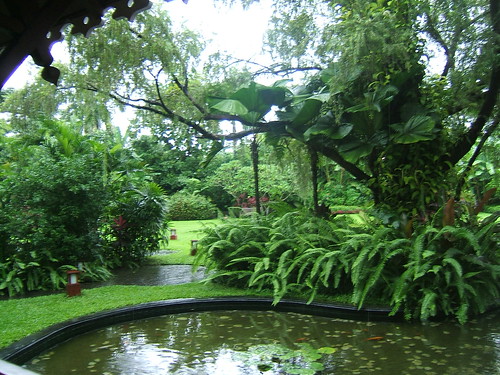
The Governor's Residence, Yangon: The manicured gardens viewed from the Garden Terrace.
In the late afternoon, I decided to walk to the station to have another period of train movement watching during the afternoon 'rush', taking photographs for later study. I carried on until it was too dark for even half-satisfactory pictures.
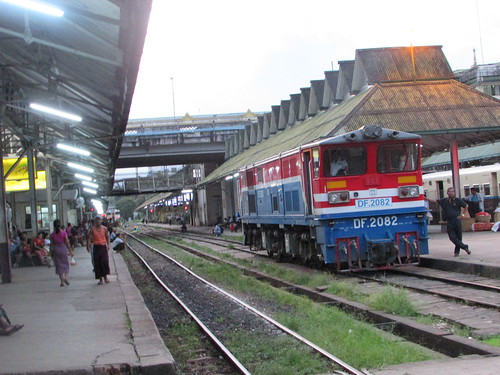
Yangon Central Station 3-Oct-2017: Recent acquisition, Chinese-built DF.2082 in platform 3, waiting to work an express train. On left, note second-hand Japanese DMU in platform 4.
Related posts on this website
This is one of a series of posts describing my 12th visit to Myanmar. The post Starting out is the first post in the series.
Clicking on the 'Next report' link displays the post describing the next events. In this way, you may read about the trip in sequence.
Next report on this trip.
Alternately, clicking on the 'All my Burma-2017(2) reports' link displays all the posts on this trip in reverse date-of-posting order.
All my Burma-2017(2) reports.
My photograph albums
Where necessary, clicking on an image above will display an 'uncropped' view or, alternately, pictures may be selected, viewed or downloaded, in various sizes, from the albums listed:-
Yangon around and about.
Yangon Central Station.
Sule Shangri-La Hotel, Yangon.
The Governor's Residence Hotel, Yangon.
[Related posts updated, 21-Oct-2017]
Events of Monday, 2nd October 2017
Late on Sunday, I'd managed to make contact with my friend, Captain Myo Lwin. He'd been unwell on Sunday but offered to visit on Monday morning so, at eight o'clock, the Captain, his wife and Aye Yi Wah arrived at my hotel and we spent a pleasant couple of hours discussing a wide variety of topics. Aye Yi Wah had to leave us and so the Captain, his wife and I walked to the multi-storey car park to retrieve the Captain's car. I was invited to join them for lunch at the splendid 'Signature Fine Dining' restaurant in the beautiful Kandawgyi Lake zone of Yangon. The restaurant's website is here. We enjoyed a splendid meal in the elegant, purpose-built restaurant.
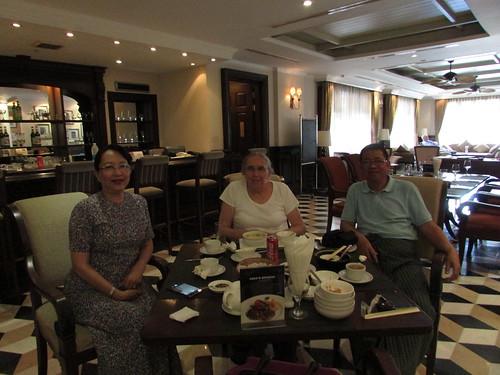
Lunch in Yangon's 'Signature' Restaurant.
I was then asked to decide on a destination for the afternoon. Eventually, I suggested Botahtaung Pagoda because, whilst I've passed it many times, I'd never actually visited (for instance, see the post Relaxing at the Strand Hotel from 2014). Although the site is ancient and still houses very important Buddhist relics, the pagoda itself had to be rebuilt after the Second World War since the original had been destroyed by British bombing raids which attempted to prevent the important port facilities being used by the occupying Japanese forces.
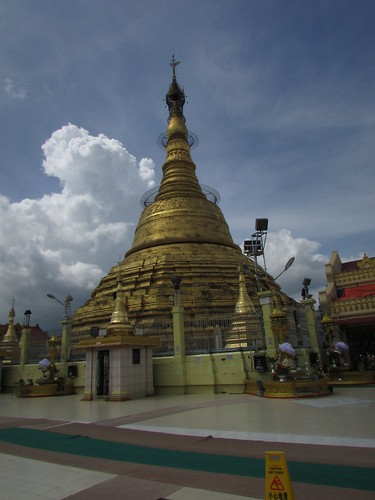
Botataung Pagoda.
The rebuilt pagoda is hollow inside, divided into a series of wedge-shaped rooms, all gilded and was packed with pilgrims. Adjacent to the pagoda itself, there's an artificial lake, crowded with turtles. I joined the other visitors in throwing chopped vegetables to the turtles: a most interesting visit. I was then returned to my hotel after a very enjoyable day.
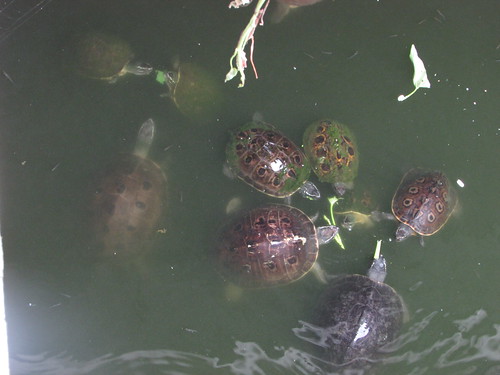
Botataung Pagoda: The Turtles.
In the late afternoon, I decided to walk to the station where I observed the train movements during the afternoon 'rush' for around an hour and took many more pictures for later study. One of the station staff recognised me from my signal box tour earlier in the year (described here), so we had to make the obligatory photograph with him and his colleague.
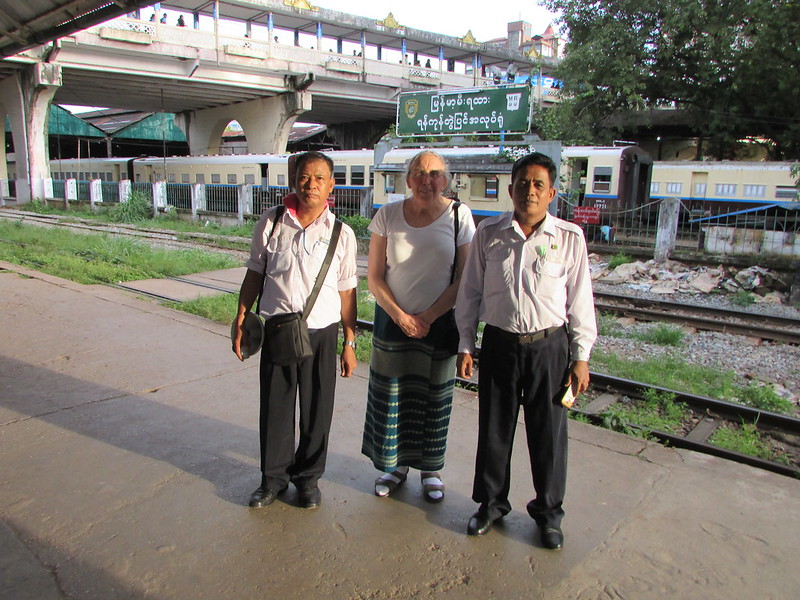
Yangon Central Station.
Related posts on this website
This is one of a series of posts describing my 12th visit to Myanmar. The post Starting out is the first post in the series.
Clicking on the 'Next report' link displays the post describing the next events. In this way, you may read about the trip in sequence.
Next report on this trip.
Alternately, clicking on the 'All my Burma-2017(2) reports' link displays all the posts on this trip in reverse date-of-posting order.
All my Burma-2017(2) reports.
My photograph albums
Where necessary, clicking on an image above will display an 'uncropped' view or, alternately, pictures may be selected, viewed or downloaded, in various sizes, from the albums listed:-
Yangon around and about.
Botahtaung Pagoda.
Yangon Central Station.
Sule Shangri-La Hotel, Yangon.
[Related posts updated, 21-Oct-2017]
Events of Sunday, 1st October 2017
My room on the 21st floor at the Sule Shangri-La Hotel was a 'Horizon Club' room. These rooms have access to a separate restaurant/meeting area where light refreshments are available throughout the day and generally provide an enhanced level of service often preferred by business or private travellers who may be more demanding. I slept well in the huge bed but awoke to a rather dull, drizzly morning. I took a fairly light breakfast and then worked on the computer as I had expected a friend to visit in the morning. In addition, I didn't feel particularly energetic. I don't seem to suffer from 'jet-lag', it's just that I get more tired as I've grown older.
The weather improved during the morning and by the time I was satisfied my friend wasn't coming, I was suffering guilt at being in a hotel room when I could see a bustling world outside. What really did it, I think, was the bird's eye view from my room of Yangon Central Railway Station. This busy station has fascinated me since my first visit in March 2008 (visiting the station is described in the post Round the World Five - Day 2 (Fri, 7 Mar). So I thought, nothing too strenuous, just a gentle stroll to the station to see how the Japanese re-signalling project is proceeding.

Yangon Central Station 1-Oct-2017: The tantalising view from my hotel room.
I'd had the room air conditioning set to do as little as possible (I'd turned it 'off' but there's often residual cooling, I've found). I've always believed in trying to accommodate to a high temperature outside. But, of course, public areas in these hotels are always set more frigid than I would choose. When the automatic glass doors of reception opened to let me outside, the heat was like a physical blow and I reeled for a moment. I set off towards the railway station and found that I was walking even slower than normal. Any sort of speed seemed out of the question in the searing heat. A digital thermometer on one of the buildings reported the temperature as 31 degrees Celsius - certainly warm but not extreme. I seemed to be 'wobbling' more than normal, as well. Yangon is notorious for its crumbling pavements and unbarricaded excavations but surely, I thought, it can't have deteriorated that much since my last visit? After a while, I managed to develop some sort of rhythm (albeit a rather slow one) and came to the road bridge which passes over the approach to Yangon Central Station from the west, offering good views of the station 'throat'. The road is now dual carriageway and I'm not sure that I'd previously realised that the southbound lanes (to the west) were carried on a elderly bowstring truss bridge which was, most likely, the original bridge carrying all traffic, whilst the northbound lanes, carried on reinforced concrete spans are a later addition.
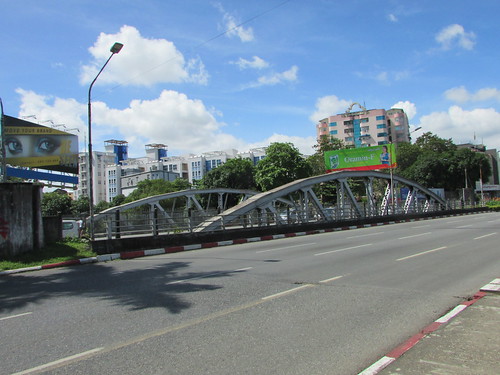
Yangon Central Station 1-Oct-2017. Left: bowstring girder bridge, right: reinforced concrete bridge.
My attention was then drawn to an 8-car (I think) diesel multiple unit setting off west from platform 4.
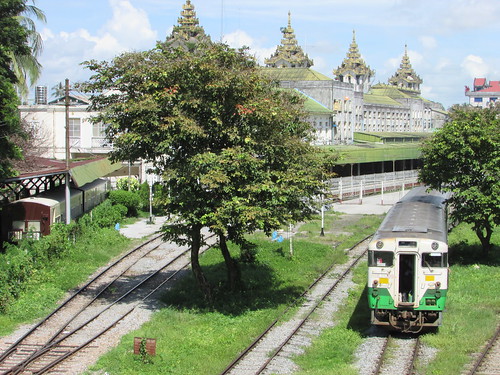
Yangon Central Station 1-Oct-2017: Second-hand Japanese DMU leaves platform 4 heading west with the post-war 'Burmese-style' station building in the rear.
The views from the bridge also revealed that some of the old electric point machines had already been replaced by very solid-looking new Japanese equipment and there were other signs of progress - concrete foundations for signal equipment, colour light signal posts, location cases and what appeared to be termination housings.
I carried on to the station approach which, being on the north side of the station, is often regarded as having been built on the 'wrong' side since the heart of the city lies to the south. The post-war 'Burmese-style' station building is still impressive but overdue for routine maintenance.
"Yangon Central Station 1-Oct-2017: The post-war 'Burmese-style' station building is still impressive but overdue for routine maintenance".
I explored the station for about an hour, watching the station movements and taking pictures of more new point machines with a.c. induction motors and magnetic clutches. Most readers will probably be relieved that a detailed log of the train movements I watched is not included there.
Thoroughly exhausted by this admittedly modest exercise, I returned to my hotel and didn't venture out again.
Related posts on this website
This is one of a series of posts describing my 12th visit to Myanmar. The post Starting out is the first post in the series.
Clicking on the 'Next report' link displays the post describing the next events. In this way, you may read about the trip in sequence.
Next report on this trip.
Alternately, clicking on the 'All my Burma-2017(2) reports' link displays all the posts on this trip in reverse date-of-posting order.
All my Burma-2017(2) reports.
My photograph albums
Where necessary, clicking on an image above will display an 'uncropped' view or, alternately, pictures may be selected, viewed or downloaded, in various sizes, from the albums listed:-
Yangon Central Station.
Sule Shangri-La Hotel, Yangon.
[Related posts updated, 21-Oct-2017]
Events of Saturday, 30th September 2017
After a pleasant interlude in the 'Emirates' lounge at Birmingham (described here) we boarded the huge A380 right time. They offered a very decent lunch about an hour into the seven-hour journey and the entertainment system worked correctly, although I think a degree in Information Technology is really necessary to master the intricacies. Well, I watched 'Wonder Woman' and 'Churchill', both interesting in different ways and found time to see the first episode of the television serial 'The Bridge' (which I'd somehow managed to miss when it was on terrestrial television). The combined effect of our aircraft heading east at Mach 0.93 and the earth rotating away from us [not, as I first wrote when tired, towards us] at around one revolution per day meant that our 7 hour journey appeared to have taken over ten hours as we'd moved through various Time Zones. A journey like this does rather convince you that the Earth is round (oh, alright, it's more an 'oblate spheroid').
We'd entered Dubai Terminal B using Air Bridges so we left the air conditioned cocoon of the A380 for the air-conditioned comfort of the terminal without sampling the desert heat outside. After some searching, I worked out that my flight onwards from Dubai to Yangon on EK.388 left from Terminal A. This meant descending to a subterranean level in one of a number of over-sized lifts and catching the next rubber-tyred, driverless train which transferred me to Terminal A with a choice of lifts or escalators to get to the departure level and the inevitable security re-check.
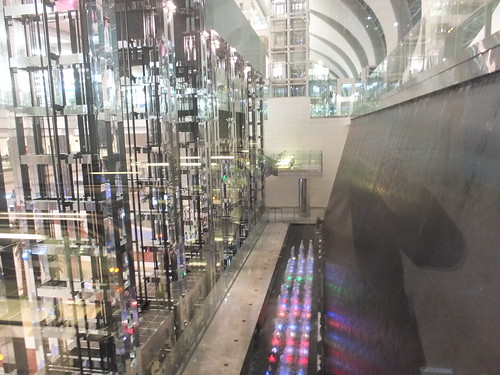
Dubai Airport: Left: Bank of over-size lifts, right: Impressive 'wall of water' feature.
I still had a walk of around 15 minutes to reach the gate where the crush of passengers seemed to be creating some problems in the smooth boarding of the aircraft. But the harrassed staff remained friendly so, after a delay, I boarded one of a number of transfer buses which were to take us to the remote Boeing 777. That journey took around 20 minutes, following a convoluted route around the perimeter of the airport, occasionally pausing for permission to cross various taxiways. By the time I was seated, I was exhausted from the sheer effort of transferring from one flight to another. We had a wait of over an hour whilst more of our passengers made the same tortuous journey to the aircraft and then whilst Air Traffic Control found a 'slot' for our departure in the apparently continuous stream of flights leaving Dubai. The cabin crew did a splendid job of keeping everybody happy during the wait. A lunch was served during 5-hour flight to Yangon but I wasn't very hungry, although I did manage to watch more episodes of 'The Bridge'. I'm afraid the entertainment system would occasionally execute an undemanded function (electrical noise, I assumed). I noticed that my seat position wasn't the only one so effected.
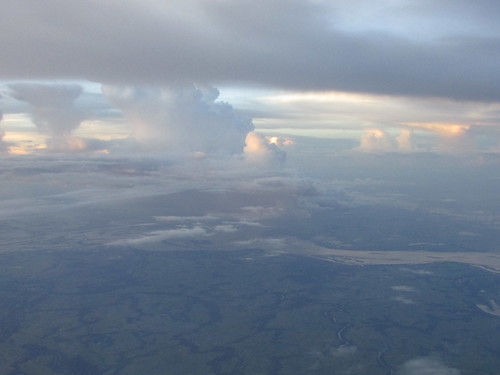
Burma from Above 30-Sep-2017: Approaching Yangon as the sun sets.
Our late departure from Dubai was reflected in a late arrival at Mingalardon Airport, Yangon where it was already dark. Unfortunately, the delays in Immigration were longer than I've previously experienced at Yangon. Despite the extra time this gave the baggage handlers to offload the luggage, having successfully negotiated Immigration, I was then faced with a worrying wait until, at last, my checked bag appeared on the conveyor.
Customs was quick and friendly (they X-ray hand baggage but not hold bags) and I was relieved to see my name being held up by my driver in the Arrivals Hall. I'm fraid that, matching the minor difficulties I'd experienced throughout, the journey to the 'Sule Shangri-La Hotel' (which was still the more evocative-sounding 'Traders Hotel' the last time I had a room there) took well over an hour.
I wasn't unhappy with the day - just very tired. I still find it almost incredible that such a journey is possible so quickly. In the days of sailing ships, it could take weeks, if not months, to achieve the same and in significantly less comfort than I had enjoyed.
Related posts on this website
This is one of a series of posts describing my 12th visit to Myanmar. The post Starting out is the first post in the series.
Clicking on the 'Next report' link displays the post describing the next events. In this way, you may read about the trip in sequence.
Next report on this trip.
Alternately, clicking on the 'All my Burma-2017(2) reports' link displays all the posts on this trip in reverse date-of-posting order.
All my Burma-2017(2) reports.
My photograph albums
Where necessary, clicking on an image above will display an 'uncropped' view or, alternately, pictures from may be selected, viewed or downloaded, in various sizes, from the albums listed:-
Dubai Airport, U.A.E..
Burma from Above.
Yangon Airport.
Sule Shangri-La Hotel, Yangon.
Events of Friday, 29th September 2017
I'm starting out on another long-distance trip and, once again, the destination is Myanmar (as Burma is now called). When I travelled to Burma for the first time, back in 2008, I little realised the spell this country, and its remarkable people, would weave, resulting in my returning time after time.
That first visit to Burma was part of a breathless, round-the-world affair described in a series of posts here and I've discussed my curious reaction to Myanmar in the post Myanmar, Serendipity and Jan.
This journey just starting will form my twelfth visit to Burma. Apart from now having a number of firm friends in Burma, I find it a most fascinating country, different in so many ways from my own country. Very slowly, I am finding out a little more about the place although, as I commented in the post Myanmar, Railways and Jan when talking about the limited research I'm attempting about the railway system in Burma, "In Myanmar, there always seem to be more questions than answers".
Although I love exploring different places, the process of travelling to them can become a little tedious. On the afternoon of my departure from home the sky was blue and the sun shone bravely, making it harder to tear myself away when the car arrived to pick me up at 5.30 p.m.
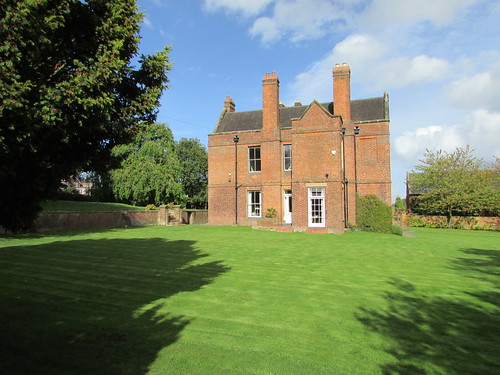
Brewood Hall Garden on 29th September.
So, I find myself writing this in the agreeable 'Emirates' lounge at Birmingham Airport at 8.30 p.m. whilst waiting to board flight EK.038 to Dubai.
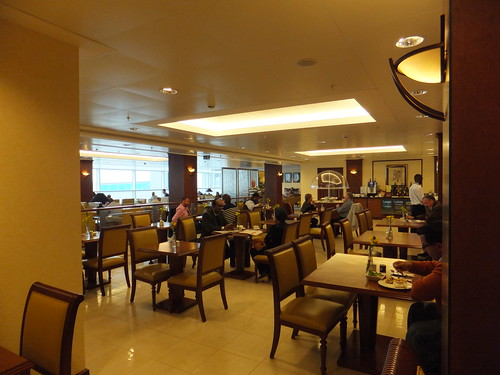
Birmingham Airport: The Emirates Lounge.
This flight is to be operated by an Airbus A380 (Wikipedia has an article here) and Emirates now have 100 of these monsters. I'm afraid I'm not a great fan of the aircraft, despite its impressive technical credentials. My flight onwards from Dubai to Yangon on EK.388 should be handled by a Boeing 777.
Related posts on this website
Next report on this trip.
All my Burma-2017(2) posts.
My photograph albums
Where necessary, clicking on an image above will display an 'uncropped' view or, alternately, pictures from may be selected, viewed or downloaded, in various sizes, from the albums listed:-
Brewood Hall Garden 2017.
Birmingham Airport, England.
In a post here, I talked about the locomotive designer Dugald Drummond and the genesis of his 'T9' 4-4-0, introduced in 1899, for the London and South Western Railway. Brought up in the Midlands in the time of post-war Nationalised railways, the former Southern Railway was very much a 'foreign railway' to me, as were its constituent railways, including the London and South Western Railway. I've written a short post about the London and South Western Railway here and the railway's important London terminus, Waterloo, is described here.
The 'T9' were nicknamed "Greyhounds" for their speed and free running. They had a long life, albeit with various modifications and, when the last of the class was withdrawn in 1963, it became part of the National Collection managed by National Railway Museum.
I'd always admired the class and when I had an invitation, around 1990, to visit Swanage to drive the preserved locomotive (then in LSWR livery and carrying the original number 120), I leapt at the chance. Sadly, when I arrived at Swanage I found out the engine had been 'stopped' for a hot axlebox on the 8-wheel tender. I still got my couple of days driving there but on the Johnson 'Half-Cab' 0-6-0 side tank, which I found a charming locomotive and surprisingly powerful.
Many years later, in 2013, the 'T9' visited the Battlefield Line. This time, it was British Railways lined black 'mixed traffic' livery and sporting the number 30120 which corresponded better with its modified appearance with extended smokebox and stovepipe chimney. Sadly, I wasn't rostered on the 'T9' during its visit but working on the diminuitive Beattie Well Tank alternating departures with the 'T9' was a special experience (described in the post here).
The 'T9' returned to Shackerstone for the 2015 'Santa' trains, alternating departures with 'Austerity' tank 'Cumbria'. Although I was originally rostered on the 'T9' on two of the 'Santa' days, they both were swopped to the 'Austerity' as described here. The 'T9' remained at the Battlefield Line for the start of the 2017 season but when my booked turn on the 'T9' in March was cancelled, I began to think that I was fated never to team-up with Drummond's classic.
However, on Saturday 8th April 2017, I finally got to drive 30120 at the Battlefield Line with Adrian L. acting as fireman and Graham L. cleaner.

Drummond 'T9': 30120 during preparation on 8th April 2017.
I had a second turn on Easter Sunday, 16th April 2017, this time with Jamie W. as fireman. My brief assessment of the locomotive? "Proper Job".

Drummond 'T9': 30120 during preparation on 16th April 2017.
Preparing the 'T9'
When the modernisation of British Railways in the 1950s introduced more complex diesel and electric traction, specific training of drivers and (where provided) secondmen for the different classes of motive power was regarded as essential. But earlier, in the steam era, once footplatemen were 'passed out', they were normally expected to sort out for themselves how to prepare, fire and drive whatever class of engine came along. Originally, I thought this must have been a daunting task but, over the years, I've learned to appreciate the challenge. Despite the variety of designs, the basic principles of steam locomotives have remained remarkably unchanged since the early days and intelligent observation, sometimes coupled with tips from other crews, can solve most queries. So, I enjoyed clambering over the 'T9' and finding out how Drummond had produced his 'masterpiece'.
During his time on Scottish railways, Drummond had learnt the value of rugged, reliable construction and the 'T9' fully embodied these principles. I was impressed by the 1-inch thick steel frames, the robust castings and forgings, the generous bearing areas and the overall simplicity of construction.
The Motion Plate supports the rear of the slide bars and must provide a rigid anchorage, as shown in the picture below. Stephenson Link motion was employed (the increasing popularity of Walschaert's motion in England came rather later). However, well-designed Link motion serves most needs and Drummond's arrangement was considered very successful. The picture below also shows the curved Expansion links which allow alteration of cut-off and direction of travel, in the case of the 'T9' under the control of steam reversing gear.
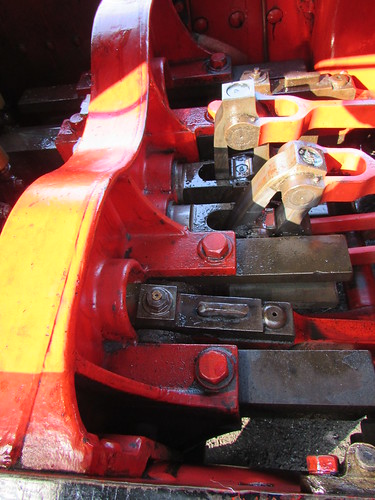
Drummond 'T9': View between frames from left side, showing rear of Motion Plate and Expansion Links.

Drummond 'T9': View between the frames, looking rearwards. L-R: Hornguide for right driving wheel, Right crank (on back dead centre), Four eccentric rods and eccentric sheaves, Left crank (on bottom quarter), Hornguide for left driving wheel.
I was impressed by the compact design of the two-cylinder steam reversing gear, with the cylinders mounted vertically in-line inside the left main frame, just ahead of the left driving axlebox.
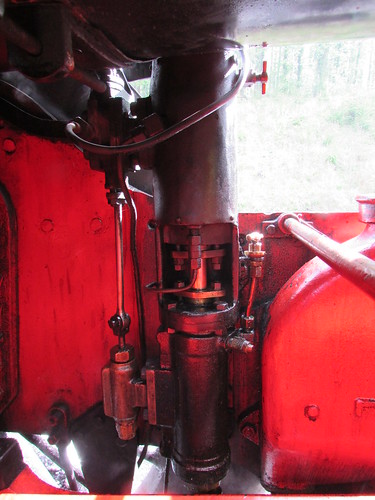
Drummond 'T9': Steam Reverser, mounted inside left main frame.
30120 has the earlier-pattern 'narrow' cab which could be described as 'cosy'. The splashers of the trailing coupled wheels protrude into the cab on both sides and these are extended rearwards to form small toolboxes with a wooden seat on top.

Drummond 'T9': 30120 has the earlier-pattern 'narrow' cab.
The Driver's duties
On most early steam locomotives, the driver's position was on the right of the footplate. Industrial locomotives were usually (but not invariably) right-hand drive. The Great Western Railway stayed with right-hand drive to the end (and beyond - prior to Nationalisation in 1948, the Great Western Railway placed an order with private contractors for 200 of the '94XX' class 'Pannier' tank, leaving British Railways to pick up the bill, as I mention in the article here).
But, on double-track railways in Britain, we drive 'on the left' and, as a consequence, the most convenient position for signals is further to the left. Generally, the driver will have a better view of signals on the left of the track if he is on the left of the footplate. Over time, modern locomotives in Britain became left-hand drive. Some had originally been right-hand drive and were rebuilt as left-hand drive. The iconic 'Flying Scotsman', proudly exhibited at the British Empire Exhibition in 1924, was built as right hand drive, as you can see from the drawing in the article 'Flying Scotsman'. 'Flying Scotsman' had been rebuilt with left-hand drive many years before I first got my hands on her at Birmingham Railway Museum in 1992 (described here).
The 'T9' is left-hand drive so the main driving controls are on the left of the cab - Reverser, Regulator and Vacuum Brake.
Reverser
Steam-operated power reversing gear is fitted, controlled by a short lever painted red which stands vertical except when changes to setting are required.
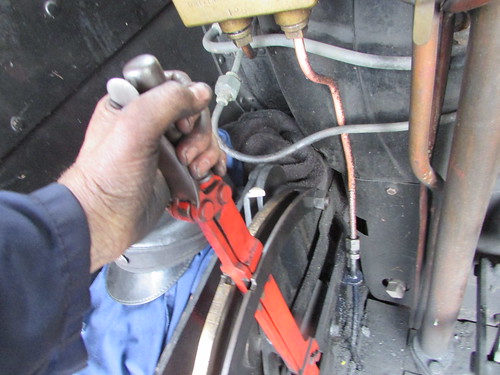
Cab Reversing Lever being placed in 'neutral', having just 'Linked-Up' the gear in 'Forward' to the position indicated by the white-painted pointer which moves over the engraved, brass cut-off indicator scale.
I'm afraid I found a tendency for the gear to 'creep' towards full gear when travelling forwards but reverse gear was better-behaved.
Regulator
The regulator is closed in the 'seven o'clock' position. It is progressively opened 'underarm' as the lever is pushed towards 'four o'clock' (the only other engine I can remember driving with an 'underarm' regulator was the 'B12', which was right hand drive - this is mentioned in the post Locomotive Regulators (part 2)).
Vacuum Brake
A combined fitting provides small ejector, large ejector, driver's brake application valve, vacuum relief valve and release valve together with a horizontally mounted handwheel on the shut-off cock. Vacuum brake cylinders are provided on both locomotive and tender. The tender brakes can also be applied from a handwheel.
Blower Valve
The Blower Valve Handwheel is tucked in the front left corner of the cab, only accessible to the driver. More modern practice favours a position accessible to both driver and fireman. The actual blower valve is located adjacent to the smokebox, operated by a rod passing through the left handrail.
The Fireman's duties
As commented above, early steam locomotives tended to be right-hand drive, meaning the fireman normally worked from the left side of the footplate, favouring right-handed firing. But on the 'T9' and many other designs (later LMS, LNER, SR and BR locomotives) the fireman is on the right, favouring left handed firing. Some fireman were happy either way round, others permanently grumbled if forced to fire the 'wrong' way. Drivers could get bad-tempered if they felt that their fireman was 'invading their space' and there are many tales of drivers drawing a chalk line down the middle of the footplate - I recount one of these in the post A Day on the Footplate (2).
There's a (still incomplete) introduction to firing steam locomotives at MIC - Firing Steam Locomotives (1).
The position of the coal supply in the bunker or tender also varies between designs, sometimes being delivered at footplate level, requiring the fireman to bend, sometimes appearing at a raised shovelling plate (often called the "married men's tender").

Drummond 'T9': Watercart tender, showing raised shovelling plate, tender handbrake and large toolbox.
The coal then has to be fed through the firehole which, according to locomotive class, varies in shape, size and height above the footplate and can be equipped with different patterns of firedoor requiring some adaptability on the part of the fireman. The 'T9'has a top-hung, inward-hinging cast firedoor which can be held open at various angles by the use of a ratchet, controlling the amount of 'secondary' or 'top' air admitted to the firebox. The top-hinging means that a separate Baffle Plate is not required - when open, the door acts its own baffle. This design was quite widely used in this country (certainly by the L.N.W.R and Lancashire and Yorkshire Railway) and also overseas. The cast door can be a little heavy to work frequently but a hinging half-flap is provided which, when raised, may allow the firedoor to remain open.
Great Western firemen became adept at winding the chain from a similar flap-plate around the operating handle of the main, sliding firedoors. A 'pull' on the chain would then 'flip' the flap-plate open or shut with very little effort, leaving the main firedoors open. If the steaming rate demanded was not too high, they would leave the flap-plate shut and fire 'over the top', which required accurate shovel-work.
Stanier engines for the L.M.S. had a similar flap-plate, allowing a similar technique to be adopted.
The Great Northern Railway (later the L.N.E.R.) used a 'Trap-Door' design of firedoor, very convenient in use, once the technique was mastered. There's an introduction to this firedoor in the article Firing a 'B1'.
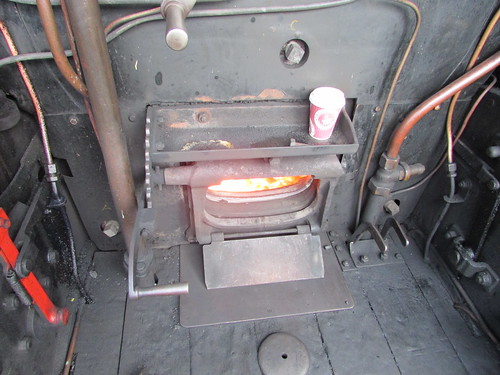
Drummond 'T9': Firehole with top-hung, inward-hinging firedoor. Note Flap Plate.
Different designs of firebox then require different firing techniques to produce steam economically. The 'T9' has a reasonably long 'box', almost 7 feet long front to back inside (nowhere near the length of, say, a Great Western 'King') with a sloping grate. If the fireman is lucky, when 'on the road', he can feed coal to the back the firebox (nearest the footplate) and the motion of the engine will trickle it forward to the front.
The 'T9' Tender
The preserved 'T9' has the distinctive 8-wheel 'Watercart' tender, giving a coal capacity of 5 tons and a water capacity of 4,000 gallons. Unusually, the two 4-wheel bogies are provided with inside axleboxes. Although tenders carried on eight wheels are very common overseas, I can only recall designs with outside axleboxes. A locomotive depends upon its supply of water as discussed in the post Water, water, everywhere. This was particularly important for the L.S.W.R. (later Southern) lines as they stretched far west into the territory of the Great Western Railway but, alone amongst major British railways, no water troughs were ever installed. On the West of England services, changing engines was frequently undertaken at Salisbury and, of course, water was available at major stations and yards.

Drummond 'T9': The 8-wheel 'Watercart' tender is provided with inside axleboxes.
Passage of Water from Tender to Boiler
Water from the tender is fed by gravity via two water cocks set in the wooden floor of the cab to two live steam injectors, one on either side of the firebox.
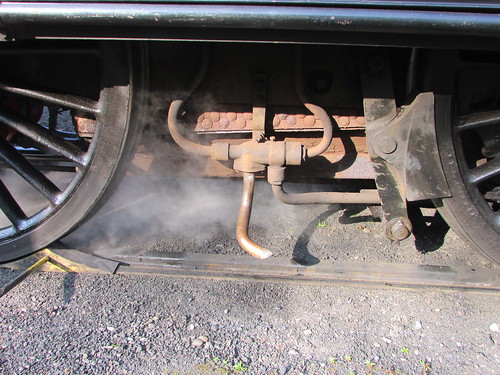
Drummond 'T9': Driver's side Live Steam Injector, suspended on a simple bracket alongside the firebox. The connections are (L-R): Delivery to boiler, Overflow, Cold water, Steam.
The injector uses steam from the boiler to pressurise the water to greater than boiler pressure (a feat of apparent magic possible due to the work of mathematician Bernoulli and engineer Henri de Giffard), allowing the water to feed the boiler through a one-way valve called a Clack Valve (there's a little more about the Clack Valve in a post here). In this way, water boiled into steam and converted into motion in the cylinders could be replenished. The steam for the injectors is taken from the top of the firebox and controlled from the cab by the Injector Steam Valves.
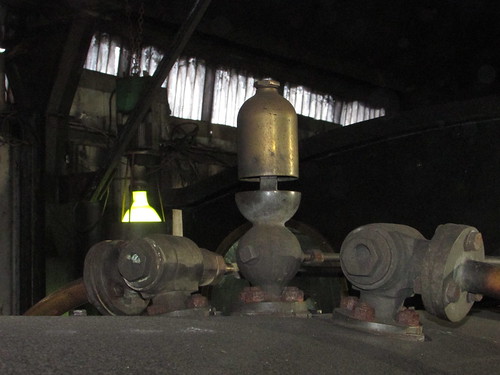
Drummond 'T9': View showing top of firebox with whistle and, left and right, Injector Steam Valves controlled by long rods extending to handwheels in the cab.
The pressurised water from the injectors is fed into the boiler via clack valves on the horizontal centre line of the front ring of the boiler shell on both sides. This was the 'classic' position for introducing feed water into locomotive boilers until the advantages of 'top feed' were understood in the 20th century.
 Drummond 'T9': 30120 being prepared at Shackerstone, showing the position of the Driver's Side Clack on the 'front ring' of the boiler shell.
Related posts on other sites
Brief data on 30120 and 'T9' (Rail UK Site).
Related posts on this site
Dugald Drummond and the 'T9' - Historical Background.
My Pictures
Where necessary, clicking on an image above will display an 'uncropped' view or, alternately, pictures may be selected, viewed or downloaded, in various sizes, from the album listed:-
Drummond 'T9'.

