skip to main |
skip to sidebar
Leaving Toli Toli, Sulawesi: Sunday, 8th February 2015
At around 6.00 p.m. we left Toli Toli for Sandakan, a distance of 366 nautical miles. By the time I'd enjoyed the usual excellent dinner, I was ready to retire to my cabin.
Cruising to Sandakan, Sabah: Monday, 9th February 2015
We were at sea for the whole of Monday, with various talks and diversions laid on. On a cruise like this one, periods of frenetic activity when ashore are interspersed with periods of relative inactivity as the ship moves to the next port of call. The ship had a well-equipped gymnasium but I didn't find the need to trouble those facilities. However, I remained in a fairly constant state of movement around the ship and between the various decks. Throughout the cruise, I refrained from using the lift. The restaurants on Deck 2 (inside) and Deck 5 (outside) provided breakfast, lunch and dinner. Afternoon tea was provided each day in the Lounge on Deck 3. Throughout the day, passengers could make beverages in both the Lounge on Deck 3 or the Panorama Lounge on Deck 6 and Bars in the two lounges were either staffed or operated on an Honesty Basis (where you completed a 'chit' for drinks). The Panorama Lounge had a fairly well-equipped library and two PC computers connected to the ship's satellite internet (although apparently at a low priority which caused most users some frustration). The open deck area forward of the Panorama Lounge had various cane chairs and loungers for taking the sun.
Review of the trip (so far)
A day at sea gives an excellent opportunity to review the areas you've passed through:-
We'd started our adventures on the 'Caledonian Sky' in Port Moresby, Papua New Guinea (see Part 7). The island of New Guinea is divided between the independent state of Papua New Guinea and Indonesia. Taking the two areas together, the island of New Guinea is reckoned the second largest island in the world. We then crossed the Torres Strait to visit Australia's tiny Thursday Island (see Part 8). On leaving Thursday Island, we crossed the Arafura Sea and travelled west to meet the Asmat people who live around Syuru on the south coast of West New Guinea, now part of Indonesia (see Part 9 and Part 10). We anchored overnight off Syuru, allowing us a Zodiac cruise of the mangrove forests before 'Caledonian Sky' continued west, arriving at Triton Bay, still on the south coast of West New Guinea, the following day. We enjoyed a Zodiac cruise around the limestone islands and, in the afternoon, a Zodiac landing on a beach offering the possibility of snorkelling, swimming and walking. Then, we set off west again, cruising overnight (see Part 11). The next day, we arrived in the vicinity of Kokas. We viewed the cliff paintings of Andamatta by Zodiac, then the 'Caledonian Sky' was moved closer to Kokas whilst we had lunch, after which Zodiacs took us ashore for a programme with the friendly residents (see Part 13). Another overnight cruise took us to the Boo Peninsula. Anchored of Torobi Island, we had the option of snorkelling from a Zodiac platform or a Zodiac Nature Cruise. Whilst we had lunch, the 'Caledonian Sky' repositioned to the small island of Pulau Boo, where we all landed by Zodiac. Sea conditions meant that the activities ashore were curtailed and the ship was under way again by 4.00 p.m. (see Part 14). We had finally reached our last destination on the western extremity of West New Guinea and our overnight voyage would take us across the Ceram Sea to 'the Spice Islands' which the English often call the Moluccas but are now better known as the Maluku Islands. These islands are now part of Indonesia. Around noon, we arrived at the port of Ternate and spent a fascinating afternoon ashore (see Part 15). Overnight, we sailed west again, crossing the Molucca Sea to the oddly-shaped island now called Sulawesi and also part of Indonesia. Sulawesi is reckoned the 11th largest island in the world. We docked at Bitung and enjoyed a city tour and village visit in the morning then, fortified by lunch on the ship, visited the Tangkoko Nature Reserve where we saw the rare Spectral Tarsier (see Part 16). After a leisurely overnight cruise, we'd moved to the important Bunaken Marine Reserve. The morning was occupied by Zodiac Nature Cruises or snorkelling for the enthusiasts (see Part 17) and then we set off on the long cruise to our final port on Sulawesi at Toli Toli. Around noon the next day, we berthed at Toli Toli and spent the next few hours enjoying a very special shore visit (see Part 18 and Part 19). We left Toli Toli in Sulawesi heading towards to the next land mass to the west of Sulawesi - Borneo. Borneo is the third largest island in the world (Australia doesn't rate a place in the 'largest islands table' because it's a Continent). The political division of Borneo is rather complex. The southern (larger) section is part of Indonesia. The northern section is part of Malaysia but divided into two states, Sarawak to the west and Sabah to the east. There's also a small enclave in the north coast of Burneo forming the independent state of Brunei. To reach our destination, Sandakan in Sabah from Toli Toli, we were cruising a little west of due north.
The Map View
Rather than show the usual Mercator Projection map of the area we were cruising, the picture below shows part of a (rather battered) family globe from the 1930s. We'd started at Port Moresby (around 9 degrees south of the equator and 147 degrees east of Greenwich). On the globe, this area is coloured 'British pink' although Australia had administered the territory from 1905. West Guinea is shown on the globe as Dutch - it was annexed by Indonesia as recently as 1975. As we continued west, we crossed into the northern hemisphere before arriving at Ternate in the Moluccas (just 47 minutes north of the equator). The British, the Dutch and other countries had interests in the Spice Islands over the years but it was the Dutch who finally allowed the area to become part of Indonesia as 'Maluku'. Westward again to Sulawesi, shown on the globe by its Portuguese name of 'Celebes'. Once again, after a chequered history it was the Dutch who passed the territory to Indonesia. Finally, we were travelling west to Borneo. On the globe, the northern part is coloured 'British pink' and what is now called 'Sabah' carries its earlier name 'British North Borneo'. These pink areas are now part of Malaysia. The larger, southern part of Borneo is another Dutch possession transferred to Indonesia. We would finally leave the ship at Sandakan (around 5 degrees north of the equator and 118 degrees east of Greenwich).
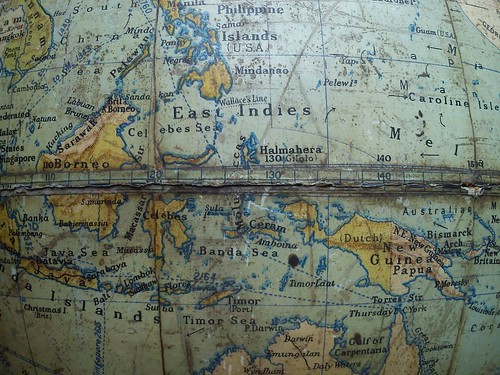 Click for larger version.
From the Coral Sea to the South China Sea as it appears on a 1930s globe.
When I look at maps of the world, I'm always reminded of the early explorers who set off in tiny sailing ships with little in the way of charts and only very basic tools for navigation who opened up our world to global trade (despite some major misapprehensions about what was there).
On the Bridge
During daylight and when the ship was not "manoeuvring in confined waters" there was an Open Bridge Policy, so I made fairly frequent visits. We were crossing the Celebes Sea; further north lay the Philippines and, beyond, Hong Kong. Further south, the sea between Borneo and Sulawesi is called the Makassar Strait and provides a route to the important Indonesian island of Java and beyond so, for once, were seeing other ships.
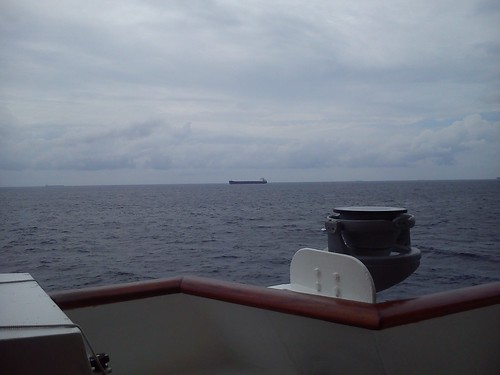 Passing a southbound oil tanker.
When I was on the Bridge on Monday afternoon, the ECDIS (Electronic Chart Display and Information System) showed our heading was 342 degrees and, west of our track, details of four other ships (obtained from a system called AIS which supplements radar and the need to keep a good lookout).
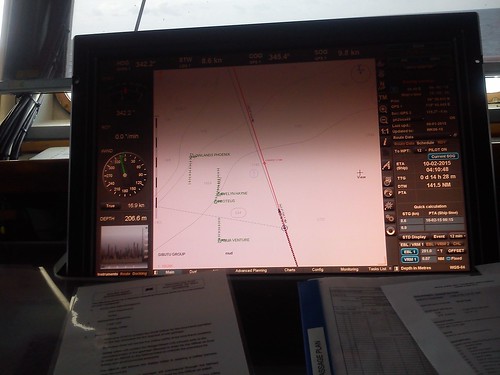 ECDIS (Electronic Chart Display and Information System) showing our track and other ships in range.
In the Engine Control Room
Health and Safety considerations determined that Engine Room visits were not possible but, with a few other passengers, I made a visit to the cramped Engine Control Room (E.C.R.) to find out more about the ship's systems. There's a album of pictures taken in the E.C.R. here and a post about the ship and its systems here.

The Engine Control Room on 'Caledonian Sky'.
I'll describe our arrival at Sandakan in a later post. You can find all the posts on this trip here.
My pictures
Sailing to Sandakan on 'Caledonian Sky'.
Engine Control Room, 'Caledonian Sky'.
Toli Toli, Sulawesi, Indonesia: Sunday, 8th February 2015 (continued)
Our rather surprising journey by Police Convoy delivered us to the site for the promised traditional cultural performance. The location had been described as a 'traditional house' but appeared to be the former palace of a local sultan, now preserved as a museum. Once again, we were mobbed by smiling local people, anxious to shake our hands, have their picture taken or take our picture.
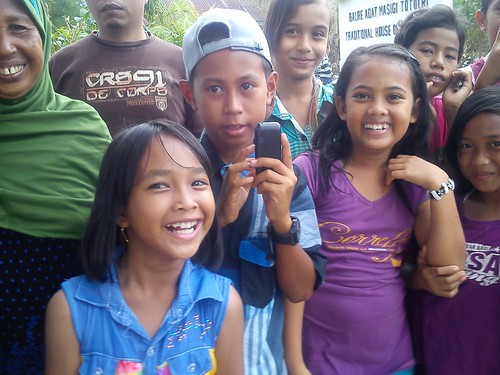 A warm welcome in Toli Toli.
We slowly made our way through the crush to a courtyard at the rear of the building. A large modern tent, lavishly decorated, had been erected at one side of the courtyard and this was already occupied by what were clearly local dignitaries. The Mayor, the Chief of Police and the Head of the Prison Service were certainly there.
 The V.I.P. Tent.
a row of similar tents, with rows of chairs, had been erected on the second side of the courtyard and this, with a smaller tent along the third side of the courtyard accommodated the passengers from 'Caledonian Sky'.
 One of the tents for 'Caledonian Sky' passengers.
The fourth side of the courtyard was formed by the rear wall of the museum building. A low stage had been built and a number of local ladies were seated here. Two ladies from the ship were invited to join the local ladies on stage. The band from the passenger terminal at the jetty had set up next to the stage, re-inforced by an additional drummer.
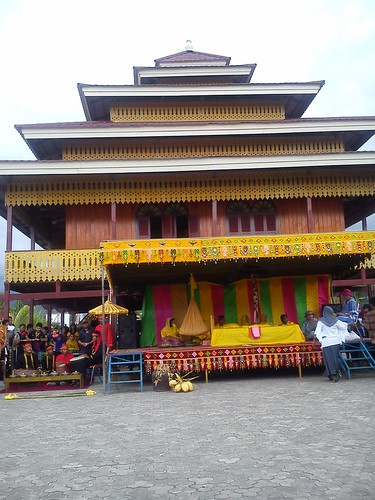
The stage, with the band on the left and the museum building in the background.
A group of dancers (three boys and three girls in another traditional dress featuring black shorts for the boys and red 'pantaloons' for the girls) performed a dance for us.
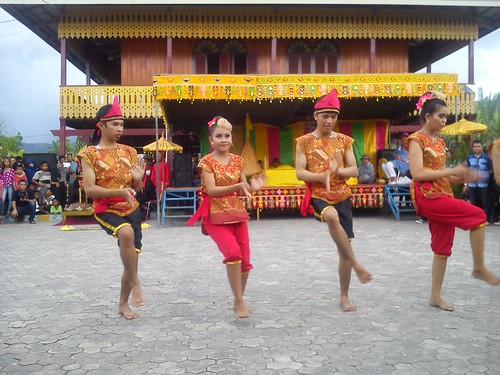 Part of the dance troupe.
For the next dance, four of the dancers carried wooden poles. After a variation of 'ring-a-ring-of-roses', the poles were used for a variation of the pole dance we'd seen at Kokas (described here. At Kokas, only two parallel poles were used first separated then ‘clacked’ together. At Toli Toli, two more poles at right angles to the first two were deployed, making it harder for the two remaining dancers to dance without getting trapped. Afterwards, our good-natured Expedition Leader, Jane, agreed to attempt the dance, with predictable results.
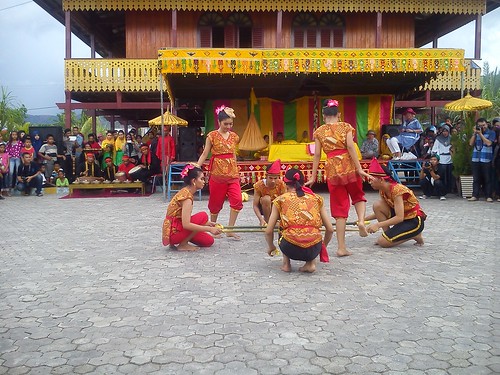 The Toli Toli Four Pole Dance.
Attention now turned to the stage, where a 'Seven Months Pregnant' ceremony took place. Most of the passengers (including me) were rather unfamilar with this ritual, at least in the form we saw at Toli Toli. The Indian parentree site says "Most cultures the world over, have ceremonies/celebrations before a baby is born. Mostly, all over the world these are celebrated in the 7th month of pregnancy (Usually the odd numbered months – 7th or 9th for good luck - but the 9th month might be too late)." In Java, the mitoni ritual is practised. In Toli Toli, a bed covered with a yellow sheet had a number of coloured scarves placed across before a young pregnant woman in yellow 'pyjamas' lay on the bed. One of the local ladies on stage then declaimed the ritual, culminating in the removal of the uppermost of the scarves which was tossed into the courtyard in a theatrical manner. In turn, the other local ladies on stage each removed a scarf, followed by the two ladies selected from the ship. Finally, another local lady, presumably the oldest or most senior, removed the seventh scarf which was white.
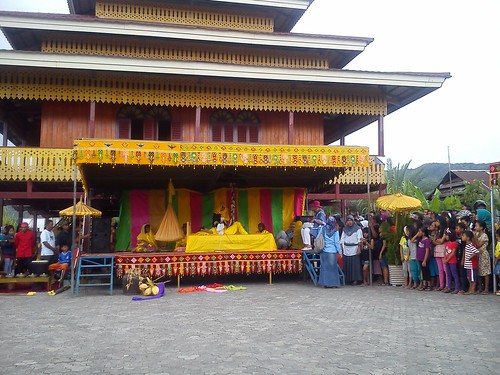 Removal of the seventh (white) scarf.
The young pregnant woman left the stage and stood in the courtyard, where she was joined by her husband, also in yellow pyjamas. I'm afraid they both looked rather miserable. I don't think I'd have enjoyed being the focus of such a public ceremony and, apart from all the photographs being taken by the ship's passengers and the various local people, there was a group of local men with high-specification cameras prowling the courtyard in a good imitation of paparazzi. As far as I could see, the husband was then required to chop the top off a coconut with a vicious-looking machete and present it to his wife. I suppose the final part of the ritual was predictable - the couple were liberally doused with water (giving a literal meaning to "baby shower").
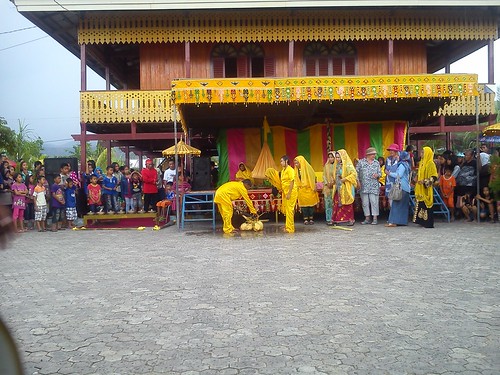 The bedraggled couple after the ceremony.
It was only afterwards I was told that the orange sheet arranged as a sling which had been suspended from the roof of the stage throughout the ceremony was a crib and had contained a four-week old baby, presumably to symbolise a happy delivery for the expectant mother. The Expedition Guide gave various presents to the young couple who perhaps then looked a little less glum. A few of the passengers were then selected to be honoured by Toli Toli - they were each presented with a decorated scarf and hat.
With the formal business completed, we were invited to look around the 'Museum'. At ground level, there were just timbers supporting the accommodation on what the English call the 'First' floor (but which Americans and much of the world call the 'Second' floor). A long flight of wooden steps lead up to the accommodation where the lighting was a bit difficult for photography but I've included a picture of a rather nice bed.
 The Bed in the Museum.
An open walkway ran around the outside of the accommodation and the local children were having great fun scooting around this whilst the opportunity presented.
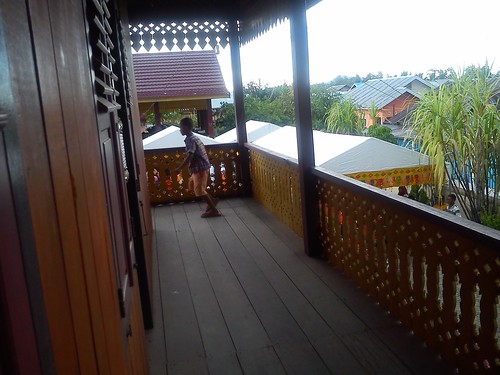 "... the local children were having great fun scooting around ...".
"The Mayor has invited you to visit his Premises" we were told, so we said goodbye to all our new friends and piled back onto the buses.
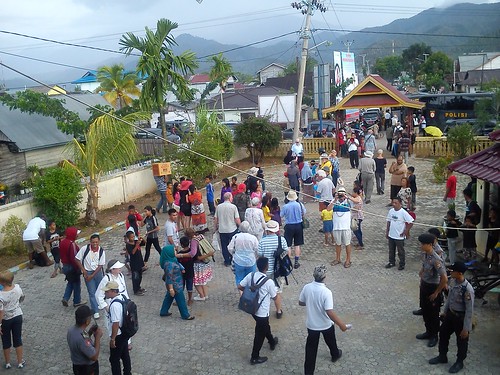 The 'Caledonian Sky' passengers making their way back to the buses.
Once again, we travelled in convoy with the police pick-up truck leading the way. We made our way across town whilst it rained quite heavily. By the time we arrived, the rain had virtually stopped. The 'premises' appeared to be a large cafe with a roofed but open-sided area, plus a number of modern plastic tents to accommodate the 'overspill'. Once again, lots of local people were curious to watch the event. There was a permanent open-air stage with microphones, large loudspeakers and a 'Yamaha' keyboard. The back wall of the stage sported a computer-printed banner reading:-
WELCOME TO D' CAFE UMBASAN
THE PASSANGERS OF CALEDONIAN SKY
"We Are Proud To Serve You"
Soft drinks and beer were served together with a liberal supply of a sort of pancake, with chocolate sauce. The vocalist regaled us with various 'Western' standards and, before long, passengers from the ship were joining in enthusiastically. Once again, it did seem a little surreal.
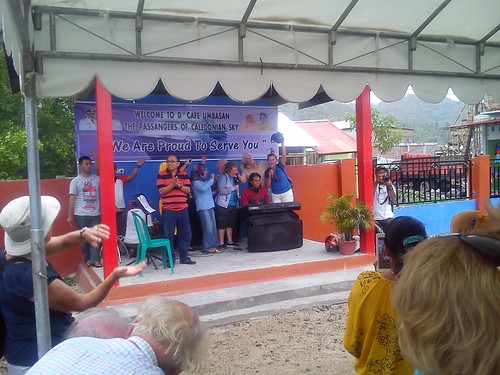 Sing-a-long, Toli Toli style.
But the best bit, for me, was the 'Bamboo Band'. This was like a Brass Band, but with the instruments made out of bamboo. Unbelievable! The melody was carried by bamboo 'piccolos', held transversely and played by using fingers to 'stop' holes, rather than keys. There were bamboo trumpets but without valves. I think there were 'stop' holes to allow some range. The other instruments seemed to be in the style of a marching band, with forward-facing bells similar to the mellophone and the sousaphone. Again, there were no valves and I'm not sure which instruments had 'stop' holes to give some variation but the combined effect provided a splendid 'oom-pah' sound, even if a mite limited musically.
 The 'Bamboo Band' - 'trumpets' in the first row, 'piccolos' in the second, 'sousaphones' behind.

The 'Bamboo Band' - variations on the 'sousaphone'.
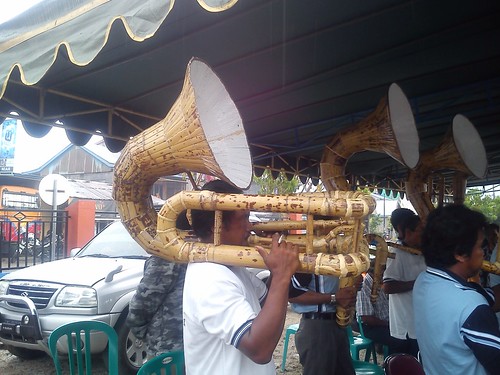 The 'Bamboo Band' - I've dubbed this splendid variation the 'toli-toli-phone'.
With this entertainment over, it was back onto the buses to be returned to our ship after a memorable afternoon in Toli-Toli. It was drizzling slightly as we made our way through the passenger terminal and across the jetty to the gangway of our waiting ship. I noticed a yellow road tanker parked near the stern of the ship, apparently having replenished our Fresh Water Tanks.
 Returning to our ship at Toli Toli.
At around 6.00 p.m., we left Toli Toli for Sandakan, a distance of 366 nautical miles.
You can find all the posts on this trip here.
My pictures
Sailing to Toli Toli, Sulawesi.
Toli Toli, Sulawesi.
On to Toli Toli: Saturday, 7th February 2015/Sunday, 8th February 2015
Around 1.00 p.m. on Saturday, we left Bunaken for Toli Toli, a journey of 266 nautical miles. Our course took us west, through the Celebes Sea, broadly paralleling the coast of Northern Sulawesi on our port side.
By breakfast time on Sunday, we were turning to port to head almost due south, following the coastline to reach Toli Toli.
 View of the coast of Northern Sulawesi from the bridge of 'Caledonian Sky' on Sunday morning.
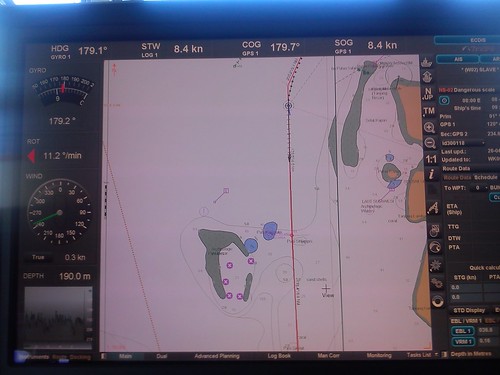 The ECDIS (Electronic Chart Display and Information System) shows us heading south to Toli Toli.
The final approach to a port is always an interesting time. Both the Captain and the Chief Engineer came onto the bridge and the autopilot was disconnected, allowing the helmsman to steer the ship using the small 'conning wheel' forming part of the Anschute equipment. Unfortunately, for safety reasons, that's also the time when the bridge is closed to passengers, although the Captain allowed passengers to remain on the outside bridge.
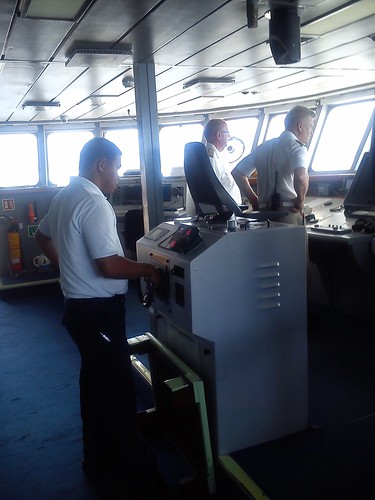
The Bridge of 'Caledonian Sky' approaching Toli Toli.
L-R: The Helmsman, the Chief Engineer, the Captain.
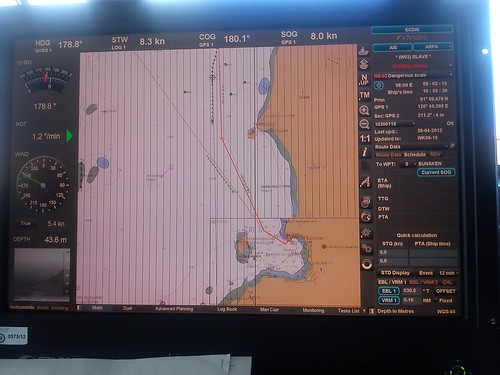 The ECDIS shows the planned track (in red) to approach the jetty at Toli Toli.
We gently approached the jetty at Toli Toli. The jetty was a reinforced concrete 'raft' suspended on a mass of concrete piles, as we'd seen elswhere. This was apparently where the inter-island passenger ferries berthed because a modern passenger terminal building faced us on the landward side. To our left was a village, partly built over the sea, with a host of canoes and small boats. There were a number of small outrigger canoes where the outriggers were supported by what appeared to be welded alloy tubes, giving them a very modern appearance. To our right was a second jetty, occupied by a fairly small container ship with a stacking ground for shipping containers on the landward side.
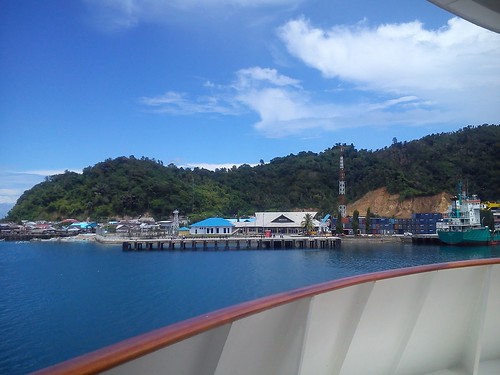 View of the jetty at Toli Toli.
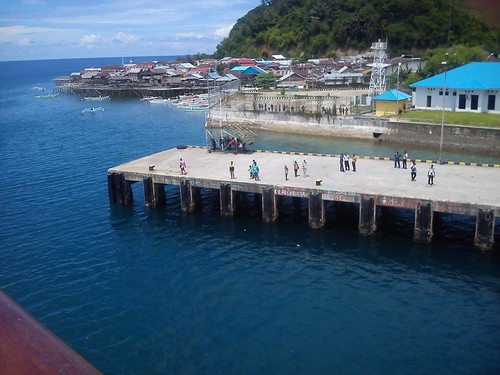 Approaching the jetty at Toli Toli, showing the village and small, modern outrigger canoes.
Toli Toli, Sulawesi, Indonesia: Sunday, 8th February 2015
It was around noon when we tied-up. All the passengers were keen to go ashore. We walked to the nearby passenger terminal, where the seating had been re-arranged around a central arena, allowing three young ladies in traditional dress to perform an elegant Welcome Dance.
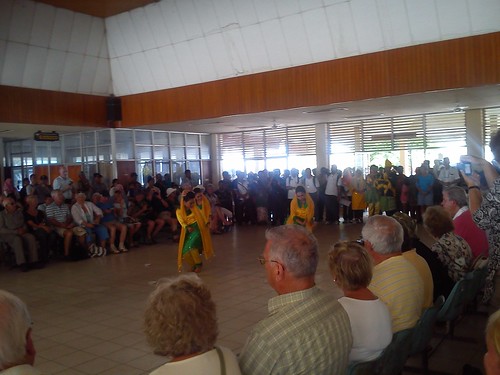 The Welcome Dance.
Music was provided by four musicians playing two drums, a set of seven small gongs mounted in a wooden frame and a large gong to 'keep the beat'. I was reminded of my experiences with similar instruments at the Longhouse Rumah Nyuka at Bayong in Sarawak (described here).
 The Musicians.
The Captain and Jane, the Expedition Leader, were each presented with floral garlands. There were lots of local people in attendance and they all seemed keen to have their photograph taken with the visitors. Many of them had their own camera/phones to record the event.
As we'd docked, I'd seen that the main part of the town was further round the bay and I wondered how we would be transported there. After the welcoming ceremony, we went outside and discovered lots and lots of tricycle rickshaws waiting to take us to the town. There was a fair amount of pandamonium as we each got allocated to a rickshaw but soon we were bowling along the level road around the bay, cheered on by the locals. Two policemen on a motor cycle pulled alongside my rickshaw and engaged me in conversation for a short while ("where do you come from?" is the most common enquiry). One of our taller passengers was unable to fold himself into the limited passenger space, so he sportingly swopped places with the 'Driver' and pedalled to town!
We passed a number of outrigger fishing vessels larger than I'd ever seen. They were about 80 feet in length, with a beam (over the outriggers) of 80 feet. This required complex bracing on the outrigger booms and an elaborate system of cable supports to support the weight of the outriggers from two masts on the main hull. Their massive bulk suggested some sort of pre-historic flying boat to me.
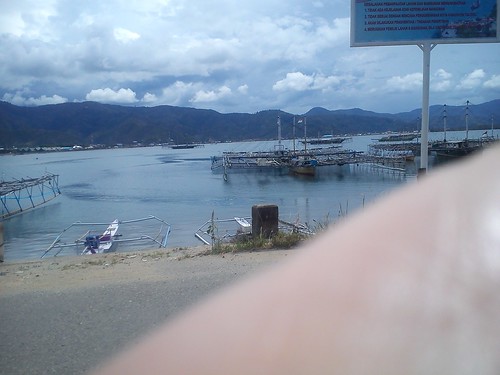 The massive outrigger craft at Toli Toli.
All the tricycle rickshaws pulled into a parking area in front of a large building which, we soon discovered, was Toli Toli market. I took a picture of my smiling 'Driver' on his steed. One feature I'd not seen elsewhere was a horizontal rod extending from the frame supporting the saddle a couple of feet to the rear. The extremity of this rod had a clamp to which was attached a silver-painted rubber tyre perhaps 9 inches diameter. This was presumably to discourage following vehicles from 'rear-ending' by giving an indication of just how far back the trailing wheel was set.
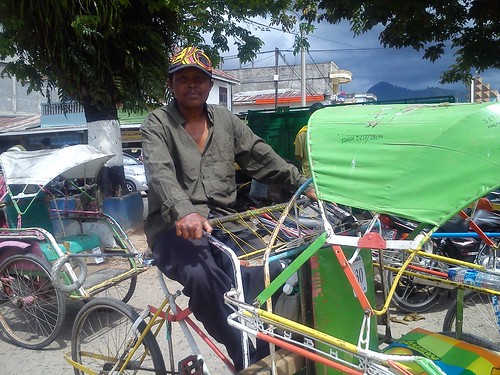 The tricycle rickshaw which took me to the market hall.
Although some stallholders appeared to have packed up for the day and some were happily sleeping, plenty of stalls were still operating and everybody seemed pleased to see us. I was surprised to see how many stalls had television sets, presumably to distract the stallholders during quiet spells.
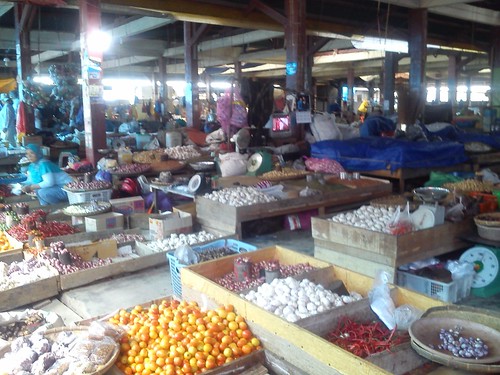 Toli Toli Market Hall.
After we'd wandered around the traditional market, we congregated in a paved area outside which seemed very modern. In the background, there was what looked like a temporary stage for a pop concert. Admission to the area in front of the stage was via a large, red, inflatable arch next to a number of modern plastic tents. Nearby, a large computer-printed sign gave a clue: in English it read "TOLITOLI TIGER MOTOR CLUB: 7th Anniversary, 7-8 February 2015". The event appeared to be over but a couple of dozen motorcycles remained with their riders chatting. All the riders appeared to be obediently wearing crash helmets.
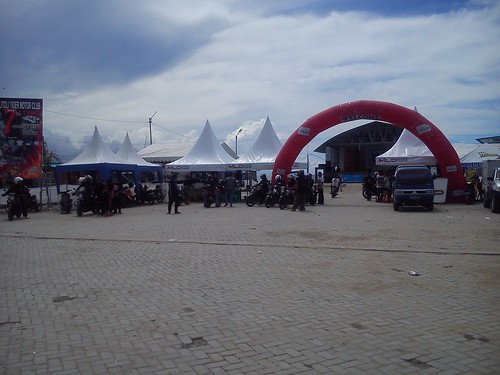
After I returned home, I found a Bali Motor Tiger Club page referring to the event and to the Honda Tiger Club Indonesia here. You can't fault Honda's marketing - I was reminded of the Honda Goldwing Rally in Llandudno I'd seen in 2014 (described here). This was only one of the rather odd experiences we had in Toli Toli which induced one of the passengers to describe our time there, appropriately, as "surreal". The next odd happening followed immediately. Buses were to take us to a traditional cultural performance, but there were apparently insufficient buses to move all the passengers, so Toli Toli Police had lent two modern police coaches with drivers. I was allocated to the first police bus and our procession was preceded by a Police pick-up truck with red and blue lights flashing. At most junctions, our driver added a "whoop" from his siren as we made our way through the town to our destination.
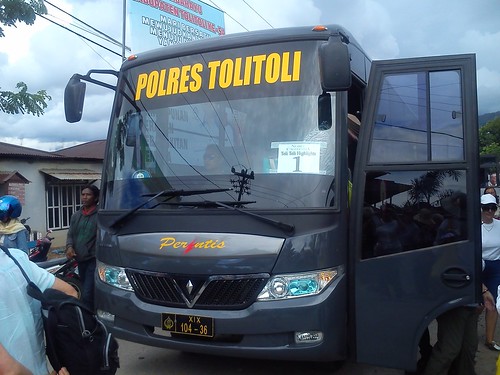 Disembarking from our (rather smart) Police Bus.
You can find all the posts on this trip here.
My pictures
Sailing to Toli Toli, Sulawesi.
Toli Toli, Sulawesi.
Bunaken Marine Reserve, Sulawesi, Indonesia: Saturday, 7th February 2015
Arriving by sea
After a leisurely overnight cruise from Bitung, ‘Caledonian Sky’ arrived off Bunaken Island around 8.00 a.m. where she held station ‘adrift’. Bunaken Island lies at the north eastern tip of Sulawesi, but on the western side of the promontory. Looking towards the mainland, we could see the city of Manado. By road, we could have travelled from Bitung to Manado City in a little over an hour!
Exploring the Marine Reserve
The Marine Reserve at Bunaken is one of the most important sites in the world. There's a little about the area on the Official Indonesian Tourist Site here and on Wikipedia here.
On our arrival, members of the expedition team left the ship by Zodiac to scout a suitable area for snorkelling (using a Zodiac as a ‘snorkel platform’) and a separate area for Zodiac Cruises for passengers who were not snorkelling. Surveys complete, Zodiacs took the snorkellers off the ship first and then remaining passengers were divided into groups of ten for the Zodiac Cruise.
 Simon's Zodiac returning to the Marina Deck with a earlier group of passengers.
I was in Simon’s Zodiac and, to my delight, we found that coral was remarkably visible even from a Zodiac. With the outboard engine idling, the view was a little distorted by surface ripples but, from time to time, Simon stopped the engine and the views were splendid.
 The world beneath the surface (1).
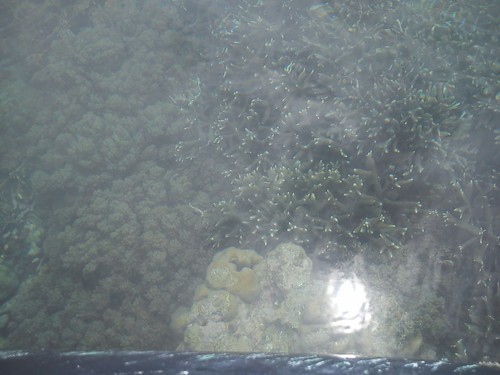 The world beneath the surface (2).
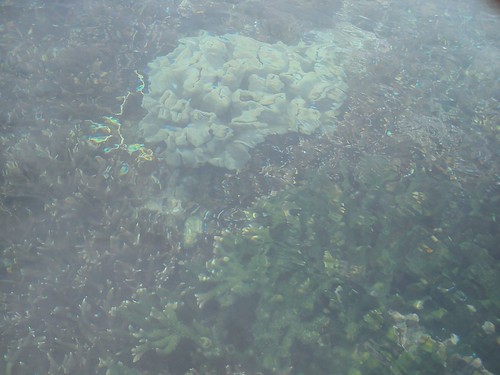 The world beneath the surface (3).
 The world beneath the surface (4).
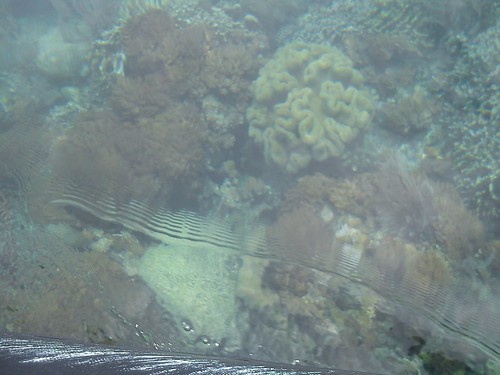 The world beneath the surface (5).
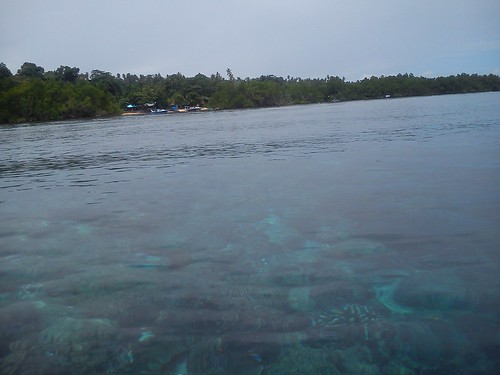 Looking towards Bunaken Island from the Zodiac, with the coral clearly visible in the foreground.
 The world beneath the surface (6).
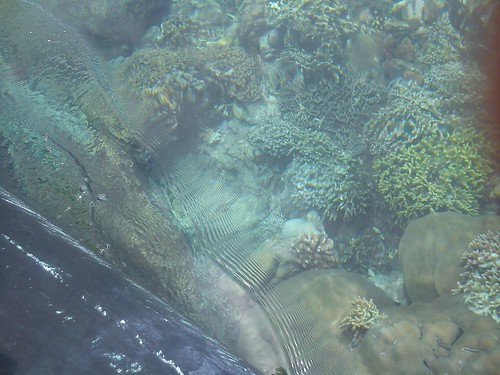 The world beneath the surface (7).
We spent a happy hour pootling around over the coral reef. Bunaken is supposed to offer some of the finest snorkelling in the world. Viewed from above the surface, I think the colours are somewhat attenuated but a wonderful impression is obtained of how just varied and prolific the coral is.
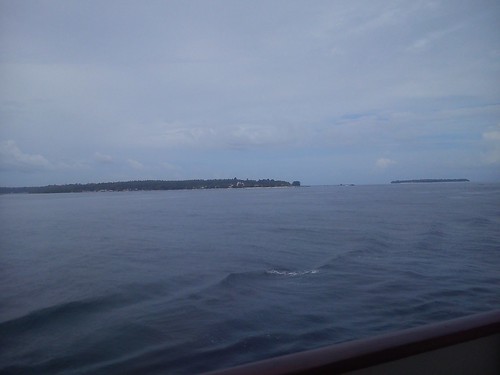 Most visitors arrive at Bunaken Island (left) by motor boat from Manado at a long pier, just visible extending to the right of the island.
On to Toli Toli
Around 1.00 p.m. we sailed for Toli Toli, our final port call before the end of the cruise in Sandakan. Toli Toli was 266 nautical miles away from Bunaken and we expected to dock around noon the following day, Sunday.
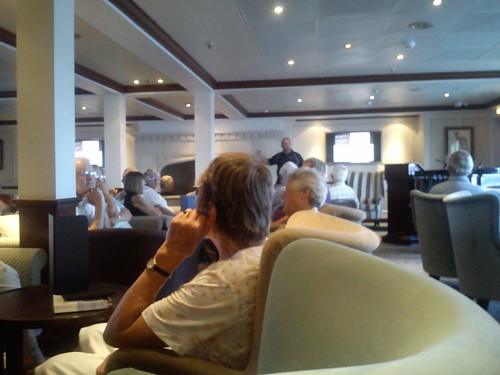 Later in the afternoon, Danny gave a talk in the Lounge.
I’ll describe that visit later but we had an absorbing Sunday afternoon in Toli Toli.
You can find all the posts on this trip here.
My pictures
Bunaken Marine Reserve, Sulawesi.
Sailing to Toli Toli, Sulawesi.
[Scope of text revised, pictures and links added 2-Mar-2015, 5-Mar-2015]
Bitung, Sulawesi, Indonesia: Friday, 6th February 2015
After our delayed departure from Ternate (described in the previous post) 'Caledonian Sky' had sailed overnight towards the improbably-shaped island of Sulawesi, previously called 'Celebes' by the Portuguese explorers. Wikipedia has a brief 'primer' here with an interesting relief map.

Relief Map of Sulawesi (Wikipedia).
Arriving by sea
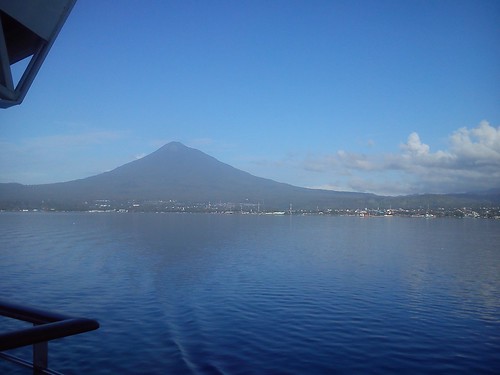 Bitung, viwed from 'Caledonian Sky'.
By half past six in the morning, we were approaching Bitung. Bitung lies at the north eastern tip of Sulawesi, on the eastern side of the promontory (see map above). The usual cone-shaped mountain lay in the background, this time with a second collapsed-cone mountain nearer the city. Clearly, Bitung was a location of some significance. Its population (I discovered later) was around 200,000. I believe Bitung became more important as a port after problems occured with silting at the port of Manado. Quays and the associated industries stretched along the shoreline for at least two miles. A Pilot boat delivered the Port Pilot to our ship for the final docking manoeuvres.
 Picking up the Pilot.
As at Ternate, on our way in we passed numerous ships at anchor, some surprisingly large. As we neared the dock, we passed a couple of bulk carriers moored at the quay on our left. One had an electric crane mounted on a gantry on deck to make it self-unloading. Next, we passed a fair-sized passenger ferry, ‘Sabuk Nusantara 51’ with a crane on its foredeck for handling shipping containers. The next berth, opposite a passenger terminal building, was ours and ‘Caledonian Sky’ was gently docked.
Morning: City Tour and Sawangan Village
Outside the passenger terminal, a fleet of air conditioned coaches was waiting for us. First stopping point was only a few minutes away at the Fish Dock. First, there was an area where the nets were being repaired – a task which has been going on for thousands of years. Next, we walked along the quays looking at the large fleet of fishing vessels. The hull profile of these boats seemed quite different from similar craft we’d seen earlier in the trip. The large fleet at Bitung featured sinuous curves and a very high prow. A small wheelhouse was provided near the stern. Usually, there were two or three short masts which supported a fabric roof, tent-fashion, which seemed to provide home for complete families. There was usually a small dinghy on the after-deck – a tiny affair looking more like a child’s perambulator than a boat, with a very high seating position and a fitting at the stern to accept an outboard motor. But, most noticeable on the deck of the main hull, was a rectangular wooden framework supporting two outriggers giving a rather ‘Heath Robinson’ look to the whole affair.
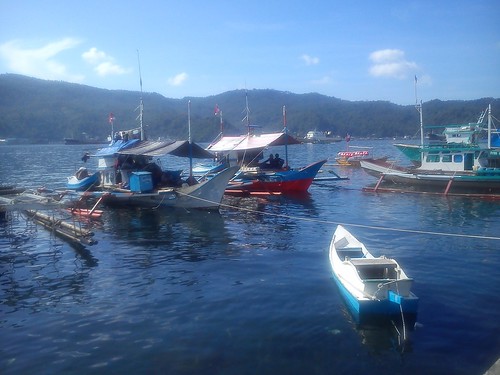 Small, outrigger fishing vessels at Bitung.
Nearby, one of these ungainly-looking craft was partly sunk with serious damage to the bow. Further along a similar boat had completely sunk in the shallow water and turned onto its side. The wreck was being broken up as watched. Parked at the edge of the quay was a flatbed lorry with a ‘Ferrari 717’ crane together with a high-sided lorry to receive the smaller debris. This was the extent of the automation. Otherwise, there was a cheerful group of men and women working away at the removal process. Most of the men were wearing pale blue polo shirts embroidered ‘OCEANIC FISHING PORT OF BITUNG’. Half of the men were standing chest-deep in the water and wearing face masks, occasionally disappearing underwater to attach a rope or break off some smaller part. One man had a small round net attached to a long pole and he was ‘fishing’ for smaller debris from the quay. Periodically, the group of laughing women would use handbrushes and pans to remove the small pieces that had fallen onto the quay. Fascinated by this good-natured operation, I returned to the bus rather reluctantly as the retrieval crew were using the lorry crane to rip-off a large section of the wheelhouse.
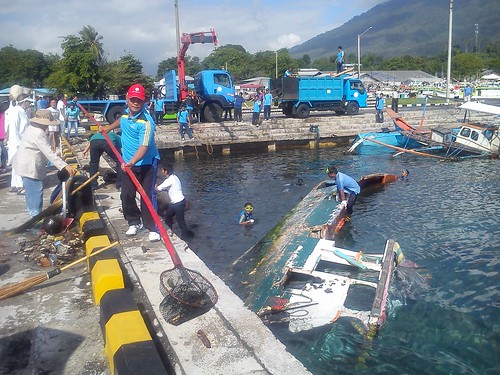 Recovering a wrecked boat.
I hadn’t noticed before that the logo on the side of our coaches read ‘Visit Indonesia – Visit the Land of Smilling People’ (stet). Their English is still much better than my Indonesian. As we left the docks, we passed the fleet of large, steel ocean-going trawlers and saw the separate facility for handling container ships.
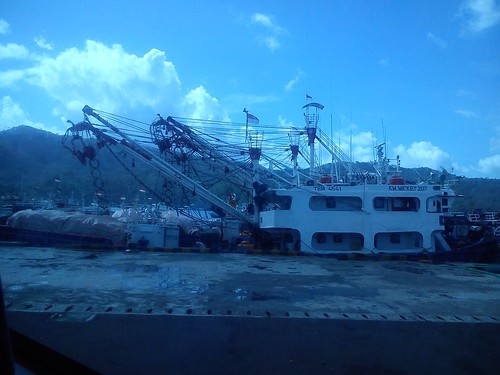 Deep-sea fishing vessels at Bitung.
The roads in Bitung were very busy and it took us some time to reach the local market we were to visit. It took a few minutes for all the buses to find places where they could park off the carriageway without stopping all the traffic whilst we walked through a network of side streets with shops and market stalls on both sides of the road. Large numbers of Honda mopeds slowly pushed their way through the crowds of shoppers. Our arrival created great interest but, as elsewhere, all the people were very friendly.
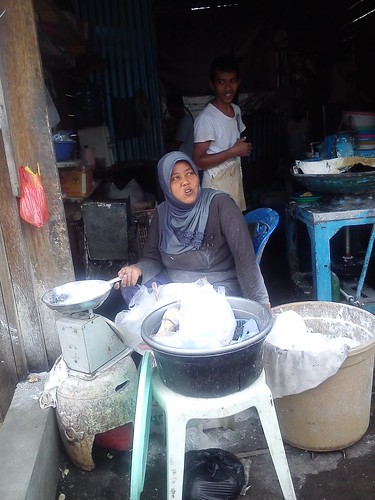
A glimpse of Bitung Market.
We continued out of the city but speeds did not improve much since there were a few places where the road was flooded. After travelling on smaller roads for a time, we reached our destination, the village of Sawangan. It took a while to manoeuvre our coaches through the gates of the Christian school we’d come to see. A large choir of boys and girls were waiting on the steps of the main building and, conducted by their headmistress, they delighted us with their singing. Afterwards, the passengers distributed ‘goody bags’ provided by the ship to the children.
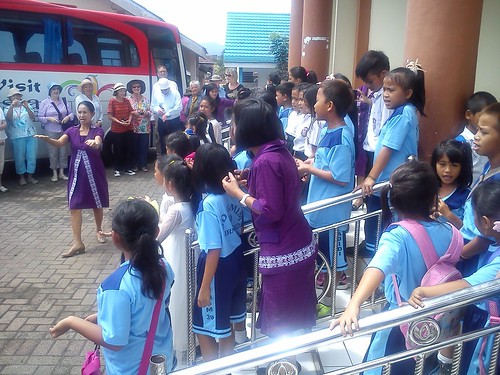 At Sawangan Christian School, the children sang for us.
We then walked through the village to a covered performance area with seats with an ancient water cistern on one side and a ‘graveyard’ on the other. Five musicians in traditional dress played wooden xylophones and later a pretty young woman sang. Then a group of young men and young women dancers performed for us.
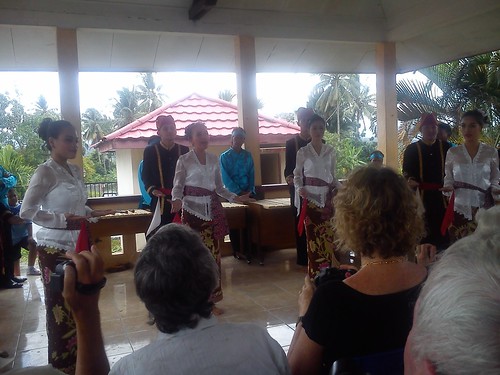 Dancers in traditional dress performing for the passengers.
The large number of ‘Destination Asia’ staff in attendance distributed refreshments to us whilst the dancers changed into modern dress – colourful ballroom dresses for the girls and vaguely ‘Toreador’ style for the boys. After they had danced, they invited passengers to join in the performance. All these activities were keenly watched by a number of local people, especially the children.
We then walked around the ‘graveyard’ where the bodies are placed in Waruga stone sarcophagi standing on the ground, not buried. Here, we were joined by a large number of young people, in jeans and blue polo shirts, apparently part of a tourism initiative. Most of them had mobile phones/cameras and were keen to be photographed with the foreigners and, as always, there was a lot of smiling. By this time, our coaches had moved to a nearby street where we re-boarded for the journey back to Bitung and lunch on the ship.
 The covered performance area viewed from the 'graveyard'.
Afternoon: Tangkoko Nature Reserve
A little after 2.00 p.m. we joined our coaches for our excursion to Tangkoko Nature Reserve (see more about the Reserve here). We were to be taken on a forest trek by the Nature Reserve Rangers with the hope of seeing the rare Spectral Tarsier (Tarsius Tarsier) monkey. We made the usual slow progress out of the city using the road we’d already traversed twice going to and from Sawangan. Then we made a right turn onto a narrow road leading up into the hills. As well as narrow, the road was very twisting and steep, usually climbing but sometimes swooping down again, giving a rather edge-of-seat ride. For most of the journey it was also raining. In general, we were passing through rainforest but, occasionally, plots had been cleared for dwellings or small palm plantations.
 Rainforest with a clearing near the road.
After around an hour, the coaches suddenly stopped. We disembarked and walked to the entrance of the Nature Park. Inside, we were distributed amongst a number of cars and people carriers (all carefully carrying ‘Noble Caledonia’ labels inside the front window) for the journey into the park. This road was unsurfaced, twisting and turning through ancient trees and splashing through flooded sections. It made the coach ride across the hills earlier seem quite tame by comparison. I was quite relieved when we stopped and were able to get out. We’d stopped in a small turning/loading area near a building marked as a Research Station. We could hear the sea nearby but not see it. After a short delay, we were divided into groups of ten, each with a Ranger in the lead and an assistant in the rear, and set off into the forest.
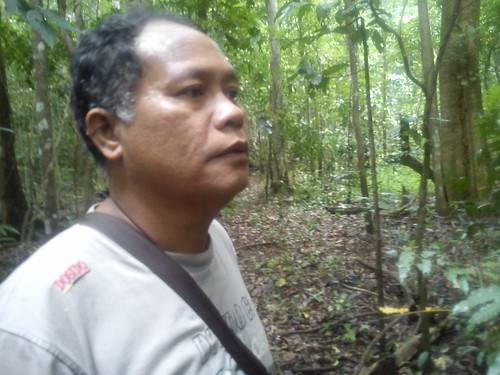 Our Ranger.
The trail was marked with coloured fabric ties on saplings every few yards. We weaved our way uphill amongst the venerable trees up to 200 years old, small roots threatening to trip-up the unwary.
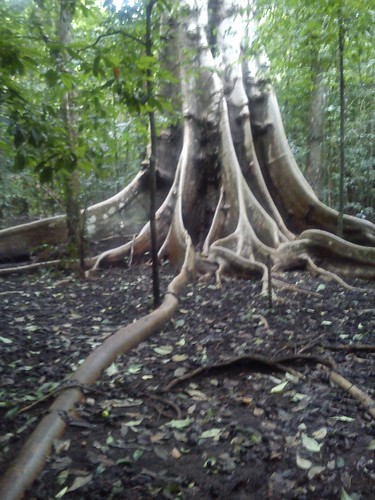
"... amongst the venerable trees up to 200 years old ..."
Our arrival had been timed to be near dusk, because the Tarsius Tarsier monkey we hoped to see is a nocturnal creature and only appears as it becomes dark, to hunt for food – typically insects like grasshoppers. There were a few sightings of other wildlife as we made our way to a massive, old hollow tree known to be occupied by the creature we hoped to see. It seemed a bit unkind to shine lights into the hollow tree, followed by a series of bright camera flashes as everybody tried to secure their own picture, but we all saw one or more of the attractive primates, with their huge eyes staring apparently unconcernedly at the intruders.

My rather inadequate shot of a Spectral Tarsier inside the hollow tree.
.jpg) The same Spectral Tarsier (Photo: Lea McQuillan).
The same Spectral Tarsier (Photo: Lea McQuillan).
We trekked back to the Research Station where snacks and cold drinks had been laid out for us. Some of us walked the few yards to the beach to watch the sea in the gathering gloom.
 The beach adjacent to the Research Station.
The vehicles we’d arrived in had to make more than one round trip to the main gate to return everybody to the coaches, so there was a bit of waiting around. By the time we were all back on the coaches, I was very tired and I slept fitfully as we made our way back along the winding road. Once on the main road back to Bitung, we made better time as the evening traffic was lighter than during the day. Back at the port, I staggered up the gangway of 'Caledonian Sky' and hastily showered. Revived somewhat, I enjoyed an excellent dinner in the restaurant after a very memorable day.
On to Bunaken
A little before 10.00 p.m. we cast off on our overnight journey to Bunaken, just 57 nautical miles away. I’ll tell you a little about our visit to Bunaken next time.
You can find all the posts on this trip here.
My pictures
Arriving at Bitung, Sulawesi.
Bitung, Sulawesi - City Tour & Sawangan Village.
Tangkoko Nature Reserve, Sulawesi.
[Minor revisions, pictures and links added 2-Mar-2015, 3-Mar-2015]


.jpg)

