skip to main |
skip to sidebar
Llandudno on the North Wales Coast has always been one of my favourite destinations since my first visit (over 60 years ago - gulp!) as it's a 'proper' seaside resort. An earlier visit I made on 26th November 2011 is described here and the railway journey itself is described here.
Saturday, 30th August 2014
I travelled by road with my niece Ann and her partner Dean to Llandudno. It was the first visit for both Ann and Dean. We had mixed weather on the journey to Llandudno and when we arrived it was overcast and not too warm. We worked our way along Mostyn Street visiting various shops before having a late fish and chip lunch outside a busy restaurant which was provided, like many of Llandudno's buildings, with an attractive verandah. The verandah proved its usefulness when it started to rain as we enjoyed our meal. We then checked into our accommodation at the Imperial Hotel before going onto the promenade to see more.
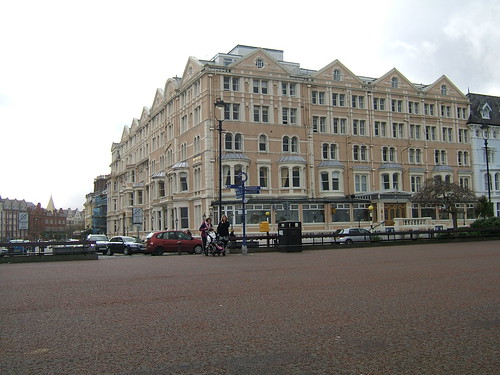 Imperial Hotel, Llandudno, North Wales, viewed from the promenade.
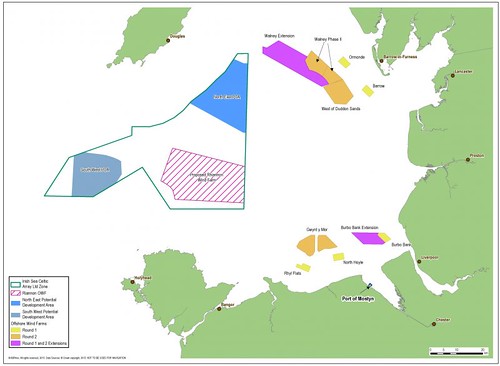
The sea views have been completely changed by the construction of offshore wind farms. When I visited in 2011 the seascape included views of the Rhyl Flats wind farm with 25 turbines but now, further offshore, the 160 turbines of the Gwynt y Mor array completed installation in June 2014 and are due to be commissioned by the end of 2014. As the rain held off, the promenade and beach was crowded but by the time we reached the lifeboat slipway it was raining quite hard.
Llandudno's Lifeboat
Uniquely, the boathouse for the lifeboat is in the town so that the lifeboat can be towed to and launched from either of Llandudno's two beaches. A special tractor hauls the lifeboat, on its own tracked trailer, to the slipway. The lifeboat and amphibious tractor were on display at the slipway to remind visitors of its role and seek donations. It's amazing and encouraging that the Royal National Lifeboat Institution (RNLI) is funded by charitable donations and most lifeboat crew are unpaid volunteers. There are Wikipedia articles on the RNLI, the Mersey class lifeboat, the Lifeboat Station and the amphibious tractor.
 Llandudno's Amphibious Tractor and Mersey class lifeboat on display.
Honda Goldwing Meeting
We didn't find out until we arrived that the Honda Goldwing motorcycle meet (which I understand is called a 'WingDing') and Light Parade was in progress. Last year, there were around 150 machines present and they raised over four thousand pounds for the Lions and the Lifeboat. We spent some time admiring the 2-wheel and 3-wheel machines, many towing a trailer but we didn't see the evening Light Parade. The coverage of the event in the 'North Wales Pioneer' is here.
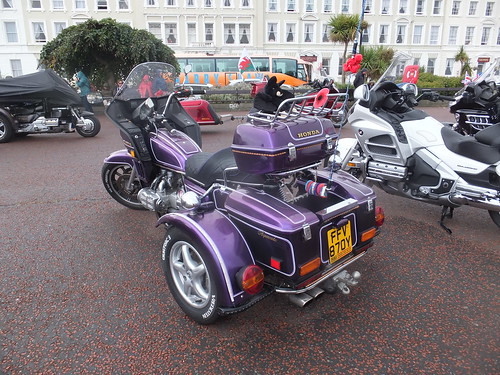 Just a few of the Honda Goldwing motorcycles on display on the Promenade.
Saturday, 30th August 2014, late afternoon/evening
We visited more shops in the town, including the 'Sweet Emporium' with probably the broadest range of confectionery I've seen, before returning to the hotel for an evening meal.
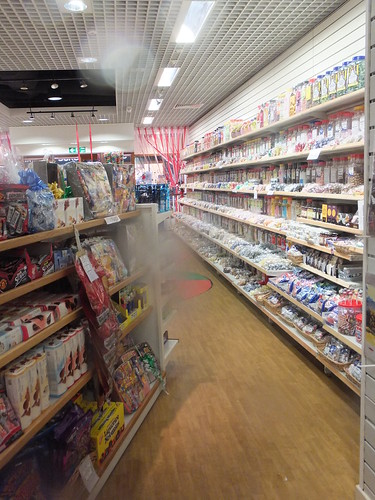
'Sweet Emporium'.
Once it was dark, looking out to sea from the hotel, a long chain of lights was visible on the horizon. We eventually decided that each of the wind turbines carried white lights low down on the mast and at least some carried red warning beacons at the top of the mast. In places, there were concentrations of lights suggesting offshore platforms.
Sunday, 31st August 2014
After a good night's sleep, I went for an early morning walk around the town before joining Ann and Dean for the very comprehensive 'Welsh Breakfast' served by the hotel.
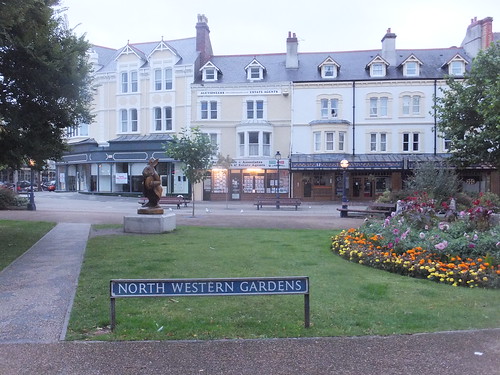 The gardens at the end of Mostyn Street. Note the White Rabbit wood carving.
A rather odd-looking vessel had moored in the bay. It appeared to be an offshore support vessel (both fore- and after-decks were loaded with containers) and was operated by James Fisher and Sons plc. Afterwards, I identified it as Fisher's Supacat Offshore Support Vessel.
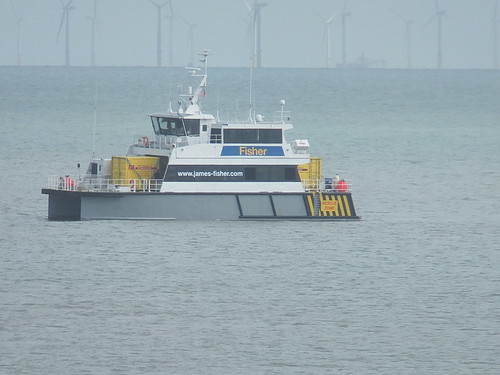 Fisher Supacat Offshore Support Vessel
There was no rain and the day was warming up nicely so Ann, Dean and I went along the promenade to the War Memorial, then continued along the length of the splendid pier. There were lots of people around enjoying the sunshine. Returning to the town, the famous Punch and Judy show was giving a performance. Then we visited more shops before checking out of the hotel.
 Llandudno's Pier
We set off in the car along the Marine Drive around the Great Orme, giving splendid sea views. To reach the Summit, there's a rather narrow, zig-zagging road which passes St. Tudno's Church.
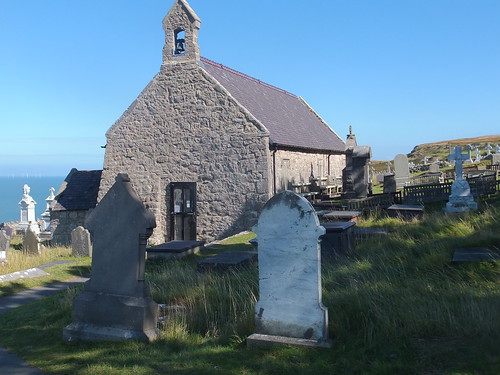 St. Tudno's Church, Great Orme.
After Dean and I had explored the Church and Churchyard, we carried on to the Summit where there's a cafe, bar, various shops and a Visitor Centre. Both the Great Orme Tramway and the Cable Cars terminate here. Once again, there were lots of visitors. By now it was late afternoon so we took a snack in the cafe then spent some time in the Visitor Centre before enjoying the views of the North Wales Coast, Puffin Island and Anglesey. We descended the zig-zag road to rejoin Marine Drive, which is one-way. We completed our trip around the Great Orme, passing the former Lighthouse (now a Bed and Breakfast) and the 'Rest and be Thankful' cafe. This took us to Llandudno's second, quieter beach, the West Shore. Gloddaeth Avenue then led us back to the town and, reluctantly, we left Llandudno after a very enjoyable break, this time taking the A470 road up the Conwy Valley through LLanrwst to Betws-y-Coed. Here, we joined the A5 from Holyhead for the journey home.
Alice in Wonderland
Alice Liddell was believed to be the inspiration for Lewis Carroll's famous book 'Alice in Wonderland'. It is known that she stayed with her family in Llandudno when she was eight. There was an Alice in Wonderland museum in Llandudno for some years until the lady owner decided to retire. Conwy County Borough Council commissioned the wood sculptor Simon Hedger to produce four (later increased to six) wooden statues to form a trail around Llandudno. A local businessman is attempting to establish a fully digital 'Alice Trail' but this has met with some opposition. During my early-morning walk I found statues of Alice (in oak), the Mad Hatter (oak), the White Rabbit (oak) and the Queen of Hearts (cedar). There are pictures of the statues in my Llandudno Album. I didn't see Tweedledum and Tweedledee (oak) or the Cheshire Cat (cedar) although I believe they are in place.
Offshore Wind Turbines
The seabed is controlled by the Crown Estate and permits have been issued in a series of 'Rounds'.

Map of the Celtic Array Wind Farms.
There's a PDF version of the map here.
Round 1: Rhyl Flats
A mass of technical information on this 25-turbine array can be found here.
Round 2: Gwynt y Mor
Further offshore is the Gwynt y Mor array, comprising another 160 turbines completed installation in June 2014 and are due to be fully operational at a cost of around two billion pounds at the end of 2014. A mass of technical information on this can be found here.
Round 3: Celtic Array
This is divided into Celtic Array North East and Celtic Array South West. However, Centrica and its partner, Dong Energy, have recently abandoned the project, as described here.
Support for these wind farms is provided by the Port of Mostyn. My earlier post Trip to Holyhead (Part 1: Crewe to Llandudno) has more information and links regarding Mostyn.
Oil and Gas
In my earlier post Trip to Holyhead (Part 1: Crewe to Llandudno), I described how the gas from the Liverpool Bay Field is used by Connah's Quay Power Station, having come ashore at Point of Ayr Gas Terminal.
A little research showed that the large offshore platform we'd seen from Llandudno was actually the three-platform manned Douglas Complex - the "nerve centre of the Liverpool Bay Oil and Gas Fields" which receives the output from three unmanned satellite platforms - Lennox, Hamilton and Hamilton North. The Liverpool Bay Oil and Gas Fields are described here.
There's a fascinating map on the ShipAIS site showing the Douglas Complex, its satellites and undersea pipelines plus real-time information on all the vessels in the area here.
My pictures
Llandudno.
Introduction
I'd been intending to re-visit Southport for some time. It's a place my partner Daemon and I visited by road when the 'Steamport' steam museum was located in the former locomotive depot there. 'Steamport' has now relocated to Preston Dock as Ribble Steam Railway. When I discovered that my friend Keith in Australia once lived in Southport, I decided to expedite my trip.
My trip on Saturday 9th August 2014
Recently, we'd experienced hot weather alternating with rainstorms but I judged (accurately, as it happens) that Saturday the ninth might offer fine weather. It was sunny and hot all day. I decided to take a Virgin 'Pendolino' to Wigan, changing to the former Lancashire and Yorkshire Railway line to Southport. The 'Pendolino' leaving Wolverhampton at 07:37 is allowed just one hour to Wigan, stopping at Crewe and Warrington (Bank Quay). We also observed what seems to be becoming a mandatory signal check at Crewe South Junction but still were 'right time' at Wigan.
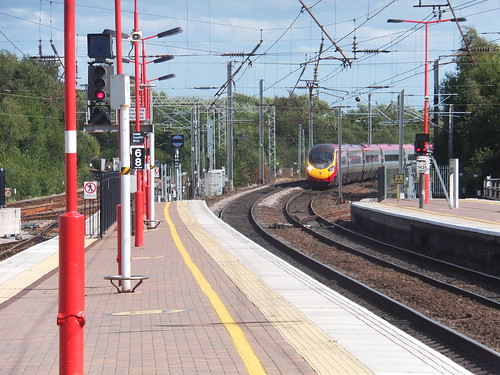 A 'Pendolino' arriving at Wigan North Western with a Down express.
Wigan North Western Station
It always delights me that the Wigan station on the West Coast Main Line is named after a railway (the London and North Western Railway) that ceased to exist over 90 years ago. The architecture of the station is less delightful. Rebuilt in 1972 in what has been described as 'contemporary functional style' I find it nondescript. With access to the two island platforms via a subway at street level, the need for rather featureless painted brick passageways is perhaps inevitable but, on leaving the platforms, you are faced with the choice of either taking a "dog's leg" through another gloomy passage flanked with toilets (which, on my visit, offered poor availability) eventually leading to the expected but rather cramped ticket hall or passing through concertina doors (apparently once intended for long-withdrawn parcels traffic) which unexpectedly dump the arriving passenger in the car park. There's a Wikipedia article on the station here.
Whilst the 'Departures' screen in the ticket hall was working, the screen next to it (probably the one which normally shows patronising messages about security and not leaving luggage unattended) showed a blue screen with the error messages "modVision Screen Designer 3 has encountered a problem and needs to close. We are sorry for the inconvenience" before continuing, in a chatty manner presumably aimed at a programmer rather than the travelling public, "If you were in the middle of something, the information you were working on might be lost". I think computers are wonderful.
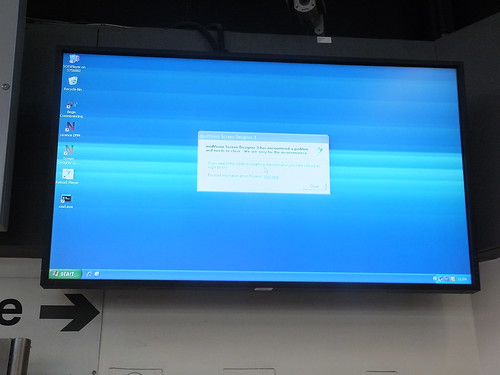 "I think computers are wonderful".
Wigan Wallgate Station
Wigan Wallgate station is just 100 yards from Wigan North Western, on the opposite side of the street called Wallgate. The pleasing street level station buildings, built in 1896, survive although modernised. Steps lead down to the platform (and there is now also a lift). The Lancashire and Yorkshire Railway had a fondness for island platforms, rather than one platform each side as often found on double track. This arrangement not only avoids the need to duplicate facilities like waiting rooms and toilets but also potentially leads to staff savings. The buildings and canopies at platform level date from a 1978 rebuilding. There's a Wikipedia article here.
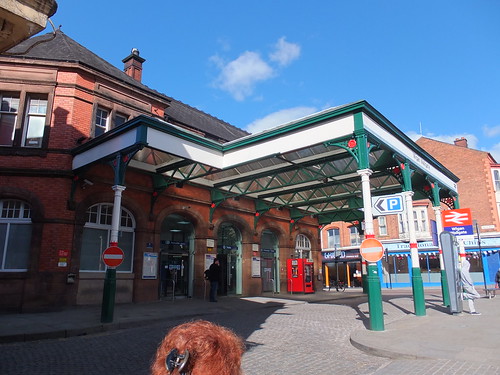 The street entrance to Wigan Wallgate station.
Wigan to Southport
My 2-car diesel multiple unit arrived on time and we set off, taking the right hand route at the junction passing the now-modernised A.R.P. signal box at Wigan Wallgate on our left. After two and a half miles we stopped at Gathurst then passed under the M6 Motorway through a pretty area of rolling hills with the Leeds and Liverpool Canal and the River Douglas keeping us company on our left. Beyond Appley Bridge, we came under the control of Parbold signal box. I spotted his semaphore Down Distant 'off', mounted under the 'off' Stop signal worked by the crossing keeper at Chapel Lane, which still has manually controlled gates. Parbold has a lifting barrier crossing, watched over by 'The Railway' public house.
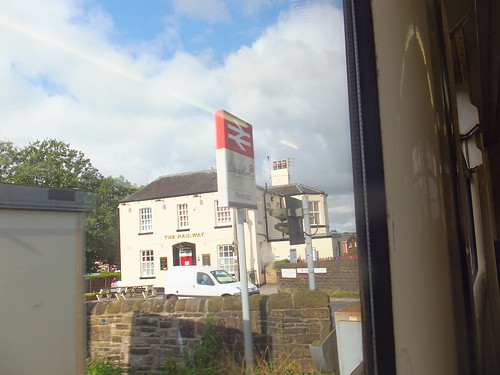 'The Railway' public house adjacent to the level crossing at Parbold.
In the next three miles to Burscough Bridge there are six level crossings, user-worked, user-worked with red and green lights and automatic half-barrier. Burscough Bridge sports a modern station building on the Down side. The original range of stone buildings on the Up side remain, presumably no longer used by the railway. The train is now running on the coastal plain and large, ripe wheat fields stretch out on both sides of the line. There's a further six level crossings in the next five miles through New Lane and Bescar Lane then, near Pool Hey Automatic Half Barrier level crossing, the line suddenly swings to the right.
Until 1965 there was a direct line to Southport in a straight line but after closure of the direct line, we now take what was a loop line. After the curve, Butts Lane Junction used to stand where a line from Aintree once trailed into our route. Beyond the site of Butts Lane Junction, Meols Cop station with its island platform remains but reduced to a basic form. Fortunately, the reliable 'Disused Stations' site has an article on Meols Cop station here (in their 'Station still open but included for completeness' section). Immediately after Meols Cop, the line bends left. This was one side of a triangle of lines and the route of the other two triangle lines (which joined to head north-east to Preston), although abandoned around 1968, can still be made out, but it's hard to believe that the electric car repair sheds were once located here. Once again, the 'Disused Stations' site offers an excellent impression of how the area once appeared here.
I afterwards discovered that Meols Cop was near the site of Southport Gas Works.

Southport Gas Works, Blowick in 1938.
There's an interesting article describing shunting locomotives used at Southport Gas Works here and there's a little more information on Peckett 1999 of 1941 here.
As our train swings right again, a now unnecessarily long lattice footbridge marks the site of Southport St. Lukes where the direct line from Pool Hey once joined. St. Lukes had platforms on both the direct and loop lines together with Excursion platforms, the Motive Power Depot with its 60-foot turntable and Kensington Road Goods Depot. Now, the area is the Asda Southport Superstore. The 'Disused Stations' site describes St. Lukes here. And so, we arrived at Southport station.
Before exploring the town, I decided to walk through the adjacent car park to take some pictures of the station 'throat'. I think the car park has obliterated all trace of Southport Central station. This was opened by the West Lancashire Railway in 1882 to serve the line to Preston. It closed to passengers in 1901 but survived as a Goods Depot until 1973. The 'Disused Stations' article is here. Once I'd taken my pictures of what could still be seen of the railway approaches to Southport, I headed for the town.
Around Southport
There was still a rather 'hushed' air around the town when I set off along pedestrianised Chapel Street. It's part of a modern development which includes the station entrance. The Visit Southport site says "For high street brands and national names start at Chapel Street" but there's too much grey concrete for my taste. I found the World War I Memorial (modified for later conflicts) quite dignified - a simple stone obelisk flanked by two colonnades. I later discovered that, appropriately, it's listed Grade II*. There's a good description in Wikipedia here.
 The obelisk forming part of Southport's War Memorial.
I then made my way along Lord Street: with its older buildings and verandas outside shops it hasn't yet lost its more genteel feel, although some of the shops I passed reminded me that at least part of Southport seeks to attract daytrippers - fish and chips and fast food cafes together with souvenir shops and ice cream parlours.
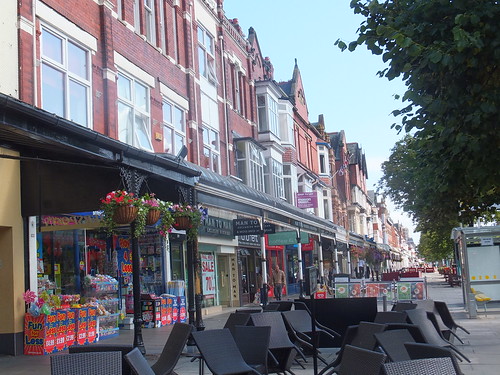 Shops in Lord Street.
Neville Street leading to the Promenade is now pedestrianised and includes a statue of Queen Victoria (which has been relocated twice). The Promenade is not quite what you might expect, as it's six hundred yards from the start of the beach. The intervening space is gardens, a boating lake and in recent times Ocean Plaza. Southport's Pier, the second longest in the country (after Southend) starts at the Promenade, adjacent to Silcock's Amusement Arcade and a rather nice Merry-go-round which looks a little odd under its modern protective roof. There are Wikipedia articles on Southport Pier here and a general description of Merry-go-rounds here.
The first half of the pier carries you over the gardens and boating lake. Parallel to the pier, there's now a road (which wasn't there when I was young) similarly carried above the gardens and marine lake on a modern, cable-stayed bridge. I was puzzled briefly to see all the cars rushing lemming-like towards the sea. Then I realised that the new road delivered cars to the Marine Drive which is at the head of the beach where you'd expect the promenade to be. The Marine Drive then disgorges the cars into the large car park adjacent to Ocean Plaza - a big sheds offering the same sort of shopping and entertainment possibilities which had previously depressed me on visits to Fleetwood, Morecambe and New Brighton.
My elevated view of the gardens revealed Southport Skatepark and a 15-inch gauge miniature railway, the Lakeside Miniature Railway. According to the railway's website, the locomotives are diesel-electric (except the diesel hydraulic 2-6-2T 'Jenny'): some are steam outline. Sadly, I gather that the railway has suffered vandalism recently.
Continuing my walk along the second half of the pier, I was now over the beach. On some earlier visits, I'd been rather disappointed to find that the beach extended almost to the end of the pier but, this time, it was almost high tide so I was over the sea for most of the second half of the pier. I was surprised at how clear a view I had of Blackpool with its Tower and Roller Coaster.
 Blackpool and its famous Tower viewed from Southport Pier.
A single set of tramlines runs along Southport's pier. I found the modern 2-coach tram stabled at the seaward end of the pier, with its batteries being charged. Wikipedia describes the tramway here. The 2-car tram is 3 foot 6 inch gauge, battery-powered and was built by UK Loco Limited. Although the tram hadn't started operating, there was a 'road train' nearby loading passengers but I decided I'd rather walk back to the town.
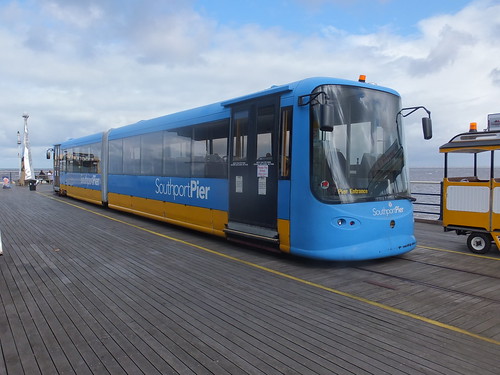 Southport Pier Tram.
Walking back to Lord Street, I spotted what looked like the glazed dome of a traditional shopping arcade. In Lord Street, I found the very modest entrance to a well-restored charming Victorian arcade. There's more about the Wayfarers Arcade on Wikipedia here.
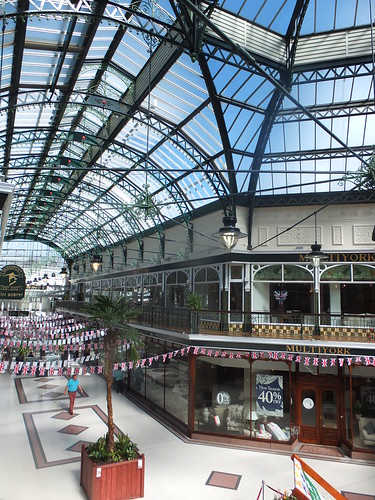
Wayfarers Arcade, Southport.
I popped into the imposing stone-fronted HSBC Bank to draw some cash. The lobby houses cash machines but the banking hall itself was open - a reminder of more elegant days.
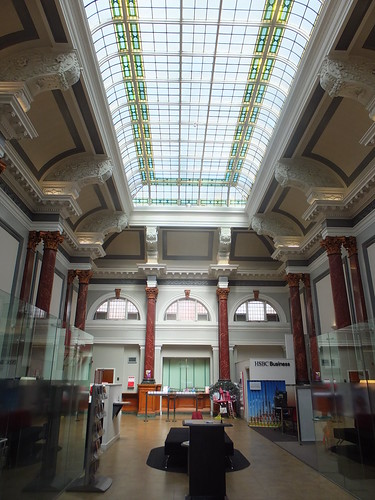
HSBC Bank, Southport. Now that's what I call a banking hall.
My walk continued past the Scarisbrick Hotel, where my partner Daemon and I would take luncheon when in Southport. I'm afraid it seems to be catering for a somewhat different clientele now. Nearby, the most imposing building in stone was not, as I imagined, the Town Hall but the Free Library and Art Gallery gifted by William Atkinson in 1878, now described as "an £18 million multi art-form venue set in a grade II listed building in the heart of Southport" and with a suitably modern website here. The dignified but less imposing Town Hall stands next door.
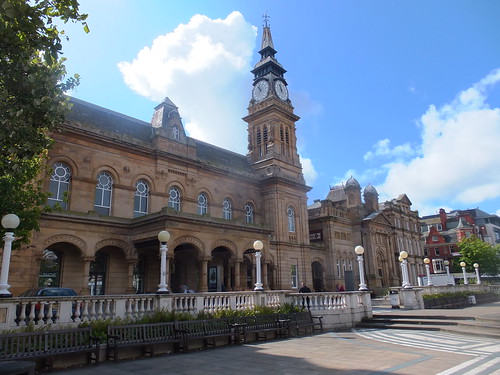 'The Atkinson', Southport.
After this brief but enjoyable visit, I returned to the railway station with Liverpool as my next destination. There's more about Southport in the Wikipedia article here.
The rest of my travels that day are described here.
Pre-grouping railways in West Lancashire
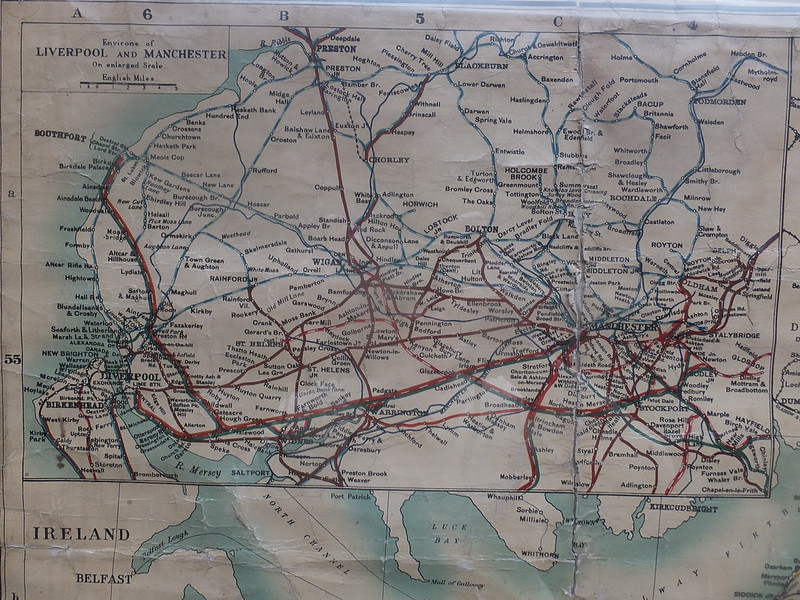 Click for larger view.
My journey north to Wigan was on the former LNWR line (brown). From Wigan, I headed north-west on the former Lancashire and Yorkshire line (blue/white) to Southport (formerly Southport Chapel Street), diverting through Meols Cop. The next stage would take the former Lancashire and Yorkshire line (blue/white) south to Liverpool on what is now part of the Merseyrail network. Many of the railways on this map no longer exist.
Railway Books
[1] 'Railway Stations in the North West' by Gordon Biddle, published by Dalesman Publishing Co. Ltd. (ISBN: 0 85206 644 9).
[2] 'Lost Railways of Lancashire' by Gordon Suggitt, published by Countryside Books (ISBN: 9 781853 068010).
My pictures
General pictures:
Southport.
Railway pictures:
Wigan Wallgate.
Lancashire & Yorkshire Railway in West Lancs.
Southport's Railways.
[Additional references to Books and 'Disused Stations' site added. Notes on Southport Gas Works added: 24-Sep-2014]
I've had a number of 'turns' this year on the Diesel Railcar which operates the Mid-weeks services at the Battlefield Line. I was there on Wednesday 13th August 2014 and again on Wednesday 27th August 2014. On each day we carried out four round trips from Platform 1 at Shackerstone to Shenton, stopping at Market Bosworth, leaving Shackerstone at 11:00, 12:30, 14:00 and 15:30.
Wednesday 13th August 2014
It wasn't a particularly busy day so the single-car railcar (the 'Bubblecar') provided plenty of capacity. Had we run out of space, one car of the 2-car railcar was available on the DMU siding and could have been used to provide more seating. As I've commented before, the other 'half' of the 2-car railcar is 'out of traffic' receiving various body and related repairs.
At Shackerstone, with the coaches for the locomotive-hauled train stabled in Platform 2, when the diesel railcar is in platform 1 awaiting its next trip nothing else can move. After our third round trip, Adrian said he wanted to do a shunting move and could we move up to the section signal out of the way for a few minutes? The Guard and I immediately agreed, arrangements were made with the Signalman and I took our empty railcar up to the section signal. This allowed Simon to drive the diesel shunter through the now-empty Platform 1 to the DMU Siding and onto one car of the 2-car railcar and, behind it, a 'Lowmac' wagon which is what they were really after. Once Adrian had coupled up and released the handbrakes, Simon drew down clear of the crossover and, when the Signalman had reversed the crossover and cleared the signal, propelled the wagon and Railcar towards the 'Bubblecar'. The 'Lowmac' was 'tied down' by applying its handbrake and uncoupled from the railcar. Simon then put the railcar back where he found it.
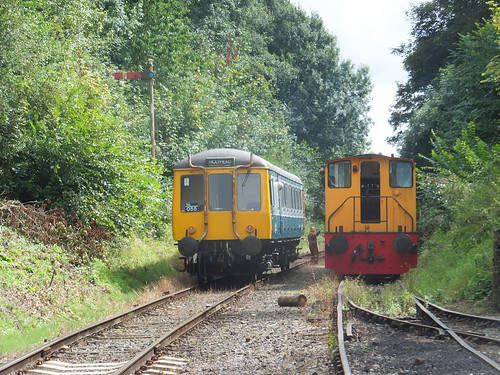 With the 'Bubblecar' standing at the Section Signal, the Guard looks on as Adrian and Simon 'park' the railcar back in the DMU Siding.
The code 'Lomac' is a Low Machinery wagon. The depression or 'well' in the chassis allows taller loads to be carried without exceeding the loading gauge. The vehicle was originally vacuum braked. The vertical brake cylinder and horizontal vacuum reservoir are visible in the picture below, but the flexible brake hose has been removed.
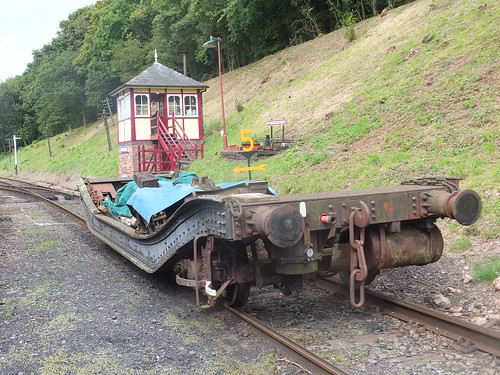 Detail of the 'Lowmac' with the handbrake applied. The coupling is an 'Instanter'.
The diesel shunter then picked up the 'Lowmac' and returned to the north end, freeing Platform 1 so that the 'Bubblecar' could pick up the passengers for the last trip of the day.
Wednesday 27th August 2014
Two days previously (the August Bank Holiday Monday), I'd been driver of the steam train at the Battlefield Line when it rained most of the day, so I wasn't sure what to expect. I'd taken my heavy woollen overcoat, just in case, but the sun came out and it was a very pleasant day. The sun seemed to attract the passengers because the 'Bubblecar' was quite well loaded throughout the day.
 The 'Bubblecar' simmers in the sun at Shenton.
On a steam locomotive, you're a little isolated from your passengers and you're busy all the time but, with a diesel railcar, there's more time to talk to passengers. At one end of the 'Bubblecar', the cab is separated from the passenger compartment only by a glass panel. When I was young and British Railways first introduced these diesel railcars, I always tried to get a seat immediately behind the driver. Not only did it offer excellent views down the track ahead, but you could watch exactly how the driver operated the controls. I never thought then I'd one day drive myself.
If a person shows a particular interest, I often allow them to travel on the 'jump seat' in the cab, although I'm reluctant to converse except in stations - it's an awesome responsibility driving the public, requiring concentration. In stations, children are often welcomed into the cab. During the day, lots of our passengers visited the cab - young people, mature people and some of our volunteers.
Preserved railways are totally dependent upon their volunteers and the 'Wednesday Gang' were on site carrying out some of the myriad tasks needed to keep the railway running. I noticed creosoting, fence repairing, platform white line painting being carried out amongst other tasks including running shops, providing refreshments, dealing with tickets and, of course, operating the railway.
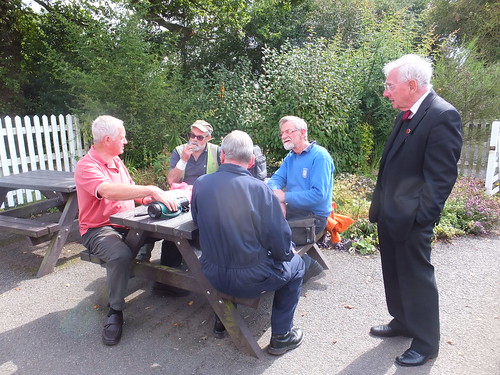 Members of the 'Wednesday Gang' enjoy lunch in the sun at Shenton, watched by volunteer Bernard.
Many passengers reported that they'd enjoyed their trip, making it all worthwhile and I certainly enjoyed the day.
Related posts in this blog
All my posts on the Battlefield Line (with links to pictures) can be found here.
My pictures
The Battlefield Line, 2014.
On Saturday, 16th August 2014, I was at Peak Rail driving 'Lord Phil' with Dave as fireman and Jacob as Cleaner.
Before the Service Train started running, we went Light Engine to Darley Dale to pick up a 'Driving Experience' candidate who was able to drive the line between Darley Dale and Matlock (Riverside) a few times and try his hand at firing. I was not surprised to learn that
he was a 'Park and Ride' bus driver because his control of the locomotive, particularly when braking, was above average. I've noticed many times with our trainees that, whilst car drivers used to high-performance brakes and responsive engines can often be a little heavy-handed, drivers with experience of lorries or buses grasp the problems of controlling a steam engine more quickly.
At 10:45, we re-united our trainee with his family at Darley Dale and then scuttled up to Rowsley to pick up our train. We were back to the 'standard arrangement' with the steam locomotive on the south end of the train, 'top-and-tailing' with a diesel locomotive on the north end. The load was six coaches.
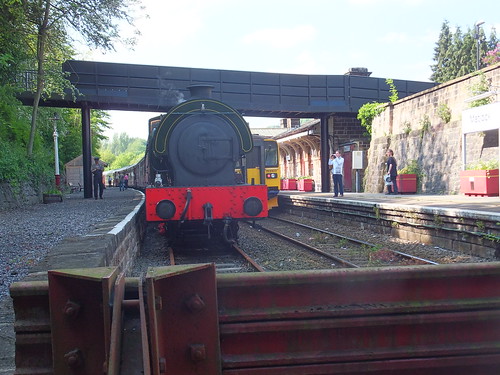 'Lord Phil at Matlock (Town) in an earlier meeting with a Class 153 on 18-May-2014.
This time, Peter Bridden's Class 14 was on the north end. We made five round trips during the day without experiencing problems.
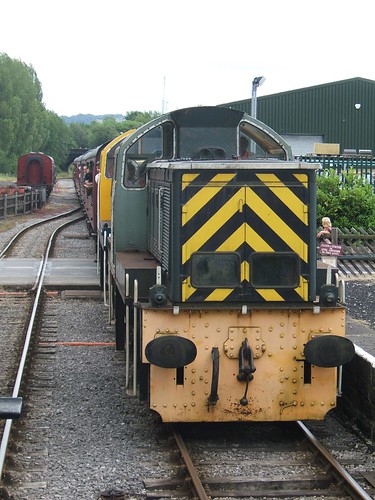
The Class 14 brings a Down train into Darley Dale on 10-Jul-2010.
Being a Saturday, at Matlock (Town) we frequently met an East Midland Trains Class 153 on the Matlock - Nottingham service. As we pulled into Matlock (Town) on the fourth trip, there was a Class 153 already arrived at the other platform. In surprise, Jacob called out "It's got a nameplate!". Intrigued, we walked back along our platform until we were level with the DMU and clambered into our train to check out the nameplate.
Sure enough - the nameplate read "X24 EXPEDiTiOUS". I correctly guessed it was a Naval reference, but I'd forgotten that the 'X-boats' were mini-submarines. Wikipedia has information here. The actual submarine survives and is on display in the Royal Navy Submarine Museum, Gosport.
The East Midland Trains website has a report on the naming ceremony here and 'Navy News' has more.
As I described in an earlier post Timber Extraction at Ty Gwyn, about 10 hectares or the Ty Gwyn woodland is being harvested. I made a progress visit to the site with Rob on 18th August 2014. The Harvester had earlier suffered a failure and the delay obtaining the necessary spare meant that progress since our visit on the 24th July was less than planned. The Harvester was out of action again for most of the day with a failed hydraulic hose, requiring a spare to be collected from Bala, but we found a Forwarder working and timber being taken away by the road haulier.
 Harvester (left) awaiting hydraulic pipe; Forwarder (right) collecting logs already felled by the Harvester.
The Forwarder was a 'Timberjack' 1410D. According to the Wikipedia article here, Timberjack has been owned by John Deere since 2000. Although I knew John Deere for agricultural machines and mowers, I'd not realised their prominence in forestry. The John Deere Forestry website here claims that the company is "the worlds leading designer, manufacturer and distributor of forest machines". The 1410D Forwarder is no longer part of the current range but there's a detailed data sheet on this model here.
The Forwarder comprises two chassis sections or 'frames' each carried on a four-wheel patented balanced bogie. The 'frames' are joined by an articulated 'middle joint'. The design offers remarkable flexibility when working on uneven ground. The wheels are rubber-tyred but, where necessary, heavy chains can be fitted on each bogie, effectively producing a tracked vehicle.
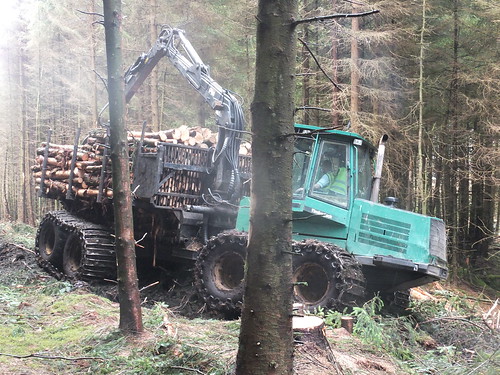 The 'Timberjack' 1410D Forwarder at work.
The area being felled at Ty Gwyn has parts which are soft and peaty, using the characteristics of the Forwarder to the full. Being situated on high ground in Wales, the Ty Gwyn woodland is generally wet, encouraging high growth rates but with the disadvantage that the trees tend to establish only shallow root systems, making them more prone to 'windblow' - uprooting by the wind.
 A tree brought down by 'windblow', showing the shallow 'rootplate'.
When I visited, the road haulier was using two 'rigs' to carry out the timber, both classed as "six wheel and drag". The 'six wheel' part has one steerable axle at the front and a double axle at the rear, based (I think) on a Scania truck chassis. This part has the cab, diesel engine, compartment for carrying logs and, at the rear, a crane for loading and unloading. The 'drag' is a three-axle trailer semi-permanently coupled to the front part with a further compartment for logs. To minimise the tare weight, the framework forming the load carrying compartments are made of aluminium by Alucar. The manufacturer's website is here. The crane I saw was a very smart 'Epsilon' Forest Crane. There are more details here. Once the driver is in the crane cab, it is raised hydraulically, giving the driver a better view of the loading and unloading process.
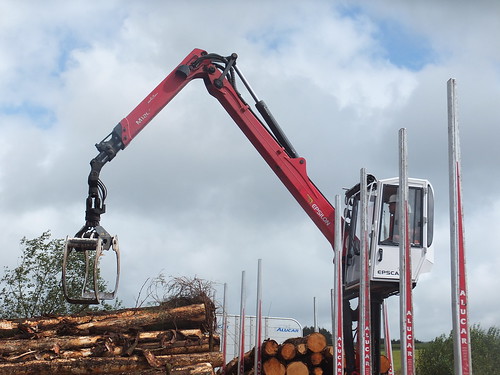 With the crane cab in the raised position, the driver had a good view of the loading process.
It was recognised some years ago that lowering the pressure of pneumatic tyres increases the contact area between tyre and surface, improving handling on soft surfaces and reducing road damage. One of the two 'rigs' hauling from Ty Gwyn has a Central Tyre Inflation system ('CTI') enabling the driver to select the appropriate pressure for the work in hand from pushbuttons in the cab. Whilst I'd heard of the system, I hadn't realised the potential importance to the logging industry. You can read more:-
on Wikipedia,
on How Stuff Works and
in a report on tests in 2006.
Some of the timber is being taken directly to Kronospan in Chirk either to make pallets or to be used in the making of wood panel products like MDF, (as described here), but the larger logs are being shipped to a different sawmill.
 Large logs (left) are being taken to a sawmill, smaller logs (right) go directly to Kronospan.
Related articles on this site
Timber Extraction at Ty Gwyn.
All my Ty Gwyn posts.
The Manufacture of MDF (Describes a visit to Kronospan, Chirk).
My pictures
Harvesting (2) 2014 - this visit.
Harvesting (1) 2014 - previous visit.
All my Ty Gwyn pictures.
On Saturday, 26th July 2014, I travelled to Shrewsbury, took the slow train on what's now marketed as the 'Heart of Wales Line' to Swansea then headed to Cardiff and Newport before returning to Wolverhampton via Hereford and Shrewsbury.
In the post A trip to South Wales (Part 1) I described the journey as far as my arrival in Swansea.
Swansea
It remained a warm, sunny day as I left the station to explore a little of the town. The pleasing 1930s stone facade of the station building built by the Great Western Railway was echoed by the Grand Hotel which faces it. Neon signs atop the hotel read 'Croeso i Abertawe' and, for the benefit of non-Welsh speakers, 'Welcome to Swansea'.
 Swansea Railway Station.
 The Grand Hotel, Swansea.
It appears Swansea is both a city and a county, with a total population around a quarter of a million. I continued along the High Street which has some decent buildings but much of the area was devastated during World War II air raids. The remains of Swansea Castle face Castle Square with its fountains and "Swansea's Big Screen". I continued along Wind Street which is largely given over to Bars and Restaurants to reach the dual carriageway of Quay Parade.
This marks the start of the 'Maritime Quarter'. I could see the neo-classical Swansea Museum built in 1841 and also the more modern National Waterfront Museum. It was only on my return home I read that the National Waterfront Museum
"is housed in a magnificent building that elegantly combines old and new architecture. A Grade II listed former dockside warehouse (formerly the Swansea Industrial & Maritime Museum) built in 1902, contrasts with a spectacular new glass and slate structure designed exactly a century later, by Stirling Prize-winning architects Wilkinson Eyre".
I wasn't in the mood for culture and even eschewed the former docks which now appear to be a marina for pleasure craft. In addition, on the grass outside the museum there was some sort of "Meet the Emergency Services" exhibition and the air was rent with almost continuous screeching and wailing as the various types of audible warning used by emergency vehicles were demonstrated. I decided to return to the railway station and continue to Cardiff.
On to Cardiff
I took a few more pictures around the 4-platform terminus at Swansea, whilst waiting for the next Cardiff service, from platform 1.
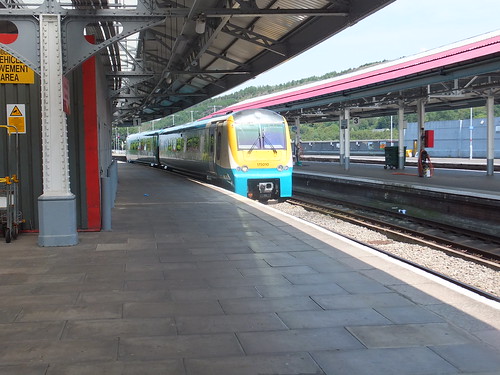 DMU 175010 arriving at platform 1, Swansea.
This was a 2-car Class 175 which changed direction at Swansea at Swansea so as to leave the station on the Up Main, passing Landore Depot on our left (where the First Great Western HS125 trains serving Swansea are serviced).
 Landore Depot, Swansea.
Eight miles brought us to our first stop at Neath, just under six more miles took us to our second stop at Port Talbot Parkway (where the Signalling Centre controlling the area is located). Beyond Port Talbot, the extensive Tata Plant (formerly Corus, formerly British Steelat Margam lay on our right, with its two remaining blast furnaces (numbers 4 and 5), Basic Oxygen Steel Plant and the hot and cold rolling mills. There's a Wikipedia article about the site here and an excellent Visitor Guide produced by Tata here. Part of Port Talbot's output is shipped to Shotton for coating - there's a little about the Shotton plant in my earlier post By rail to Liverpool (Part 1).
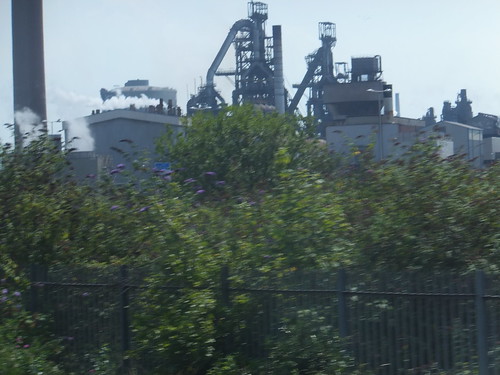 A glimpse of the surviving blast furnaces at Margam.
There are still extensive sidings serving the steelworks at Margam Knuckle Yard, then the aspect is less industrial. Our next stop was at Bridgend where, in addition to the two through platforms, there are two bays. Bay 1A on the Down side serves the double-track line to Barry whilst Bay 4 on the Up side serves the single line to Maesteg. Then we ran non-stop the 20 miles to Cardiff Central (the last 14 of which were under the control of Cardiff Signalling Centre). Our journey from Swansea had taken just over 50 minutes.
Cardiff Central
In the 1930s, the Great Western Railway provided Cardiff Central with a handsome set of station buildings in Portland stone which continue to distinguish this important station. I took a few pictures around the main line platforms and located the Signalling Centre on the Down side at the western end of the station. I took a lousy picture against the sun which also features Brains Brewery. Steps and lifts take passengers from platform level to two subways running across the station to the main building on the north side. Automatic ticket gates give access to an airy booking hall with three wide entrances leading to a pedestrian plaza and the city. The station buildings are listed Grade II. The weather was still hot and I was starting to wilt a little so I decided to stay in the vicinity of the station, rather than exploring the city.
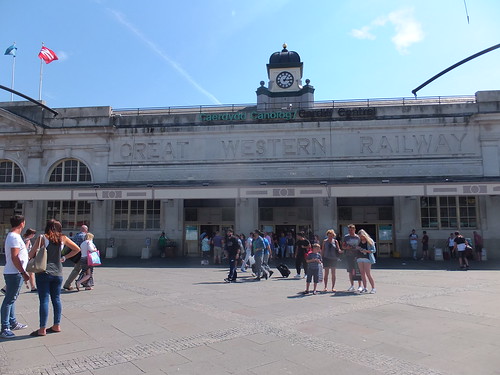 Cardiff Central Station viewed from the pedestrian plaza.
The name of the original station owner, 'GREAT WESTERN RAILWAY' is proudly incised into the stone in large letters and is clearly visible. In contrast, the modern sign above reading 'Caerdydd Canalog/Cardiff Central' was almost invisible in the bright sunshine. I think the sign is internally lit so matters may be improved at night.
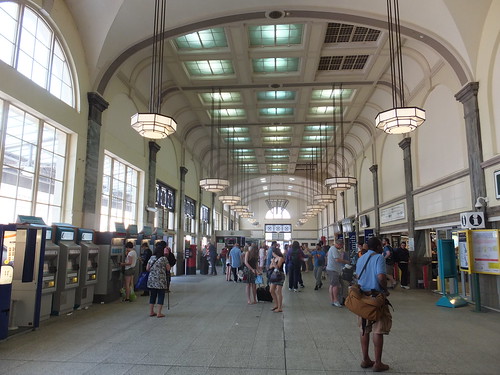 The Booking Hall.
The Booking Hall with its Art Deco fittings is still relatively uncluttered, although I didn't find the modern signage (in English and Welsh) very informative, particularly when I tried to find platform 0. Platform 0 is a fairly recent creation and falls outside the system of automatic ticket barriers.
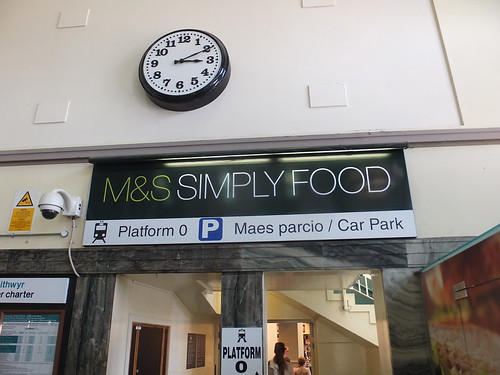 'M & S Simply Food'.
It took me a few moments to realise that the approach to 'M & S Simply Food' also gave access to the car park and, at a higher level, platform 0 for trains to Ebbw Vale. Whereas the original station has fairly extensive platform canopies, platform 0 is equipped with a series of 'bus shelters' distributed along its length.
I decided I'd press on to Newport, so I caught the next service east. Approaching Newport, on our right we passed the siding connections leading to the Celsa Steel UK plant at Tremorfa. Their website here gives an introduction to their processes and products including reinforcing products ('rebar'), wire rod, bars and light sections.
Newport
My last visit to Newport was in 2012 when OLCO held 'Lionsmeet 2012' there (report here) and on that occasion I travelled by train and took a few pictures around Newport station. On the present trip, I added a few more railway pictures and had a brief walk outside the station but I was starting to flag a little so I was soon back on the station awaiting my train back to Shrewsbury.
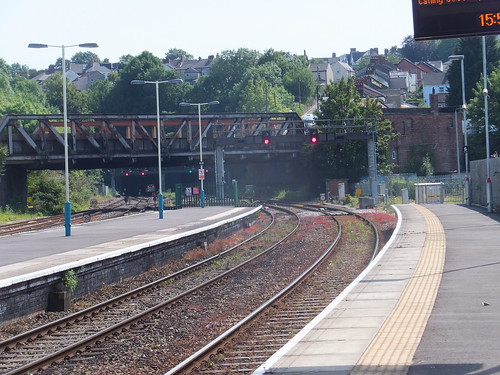 Newport: View looking west from platform 4 showing the girder road bridge and, beyond, Newport Old Tunnel (L) and Newport New Tunnel (R).
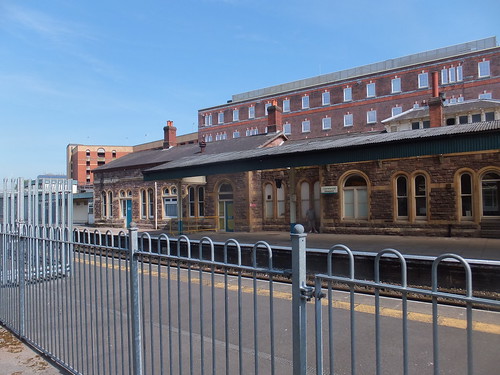 Newport: North Elevation of station buildings on platform 3 viewed from the footpath adjacent to platform 4.
Shrewsbury-Hereford-Newport Line
This line has been heavily 'rationalised' so there's not so much of railway interest. There are a number of stations and, for the most part, signalling is Absolute Block with semaphore signals (Western Region style). Pontypool is reduced to an island platform and little else. Abergavenny retains its signal box and a smattering of sidings.
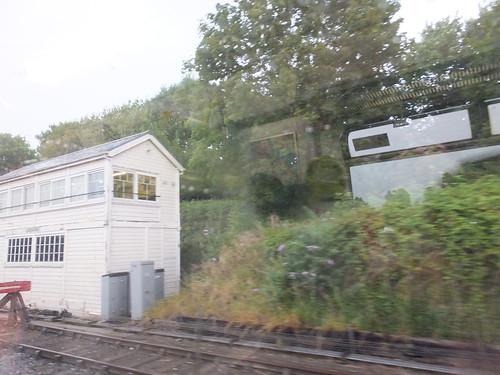 Abergavenny signal box.
Between Abergavenny and the remote Tram Inn signal box there are still fifteen accommodation level crossings.
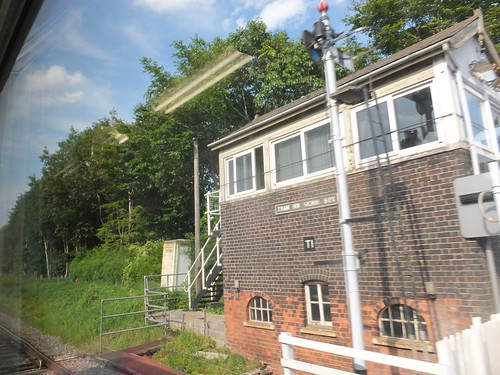 Tram Inn signal box.
Six miles further on we paused at Hereford. There were once four railways fighting for access, with a complex of lines and junctions. But now, one signal box controls the area. Originally called 'Ayleston Hill', it is now simply 'Hereford'. This brick structure has been fitted with uPVC window units. Local points remain mechanically operated: more remote connections are power operated. Running signals seem to be multiple aspect colour light.
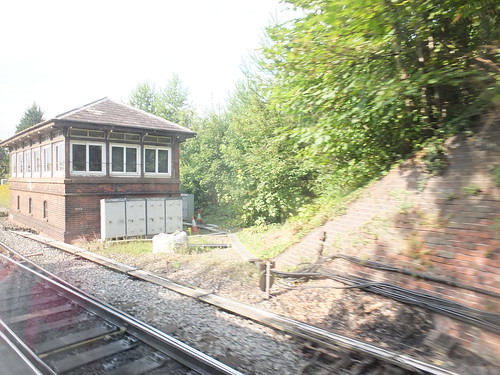 Hereford Signal Box.
Similarly, the station which was once styled 'Hereford (Barr's Court)' is now simply 'Hereford'.
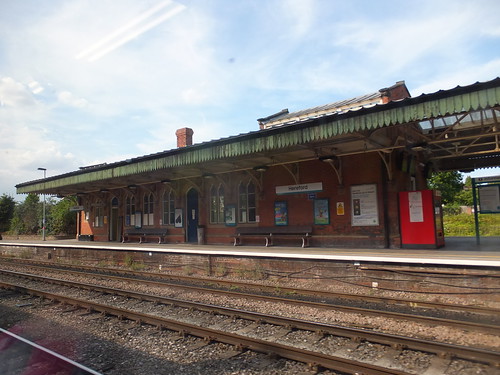 Hereford: Station building on Down Main Platform.
Five miles beyond Hereford, we passed Moreton-on-Lugg signal box with its barrier crossing and connections to sidings which originally served a Royal Army Ordnance Corps Depot.
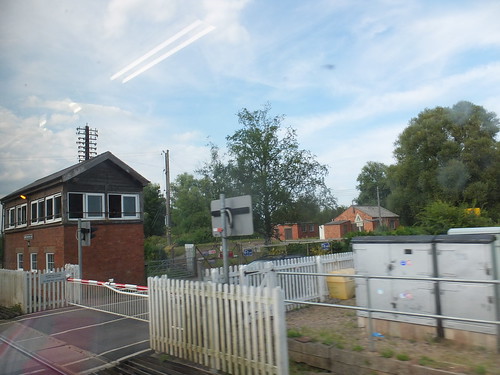 Moreton-on-Lugg signal box.
Three miles further on, we passed through Dinmore Tunnel (1054 yards long). There are two single-bore tunnels and the Down Line tunnel is a few yards away from our tunnel and at a slightly lower level. The Down Line tunnel dates from 1853 and the Up Line tunnel from 1891.
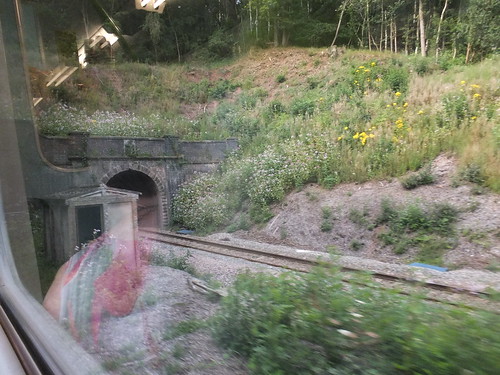 Dinmore Tunnel: The southern tunnel mouth on the Down Line.
Another five miles took us to Leominster with its big, squat signal box.
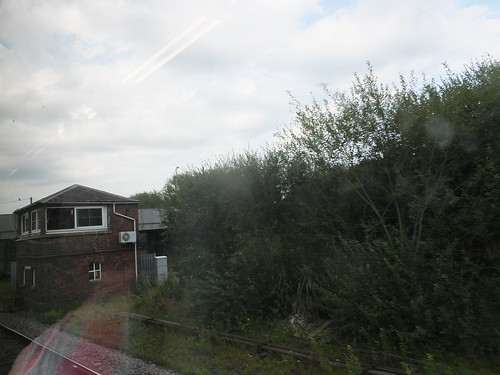 Leominster signal box.
There are nineteen level crossings between Leominster and Craven Arms - mostly minor and user-worked but with some automatic with barriers on busier roads. I managed to get a shot of timeless Stokesay Castle as we sped by.
 Stokesay Castle.
I also took a shot of Dorrington signal box but then I relaxed on the last few miles to Shrewsbury.
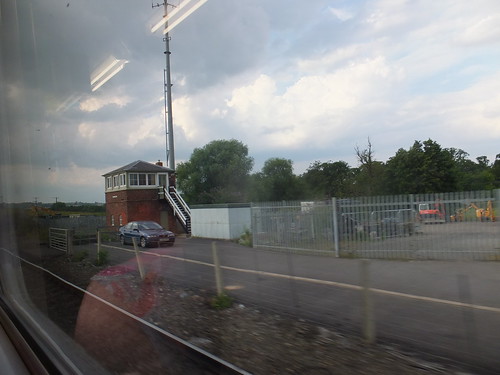 Dorrington signal box.
At Shrewsbury, I changed to a Wolverhampton train and made my weary way home after an interesting, if tiring, day.
Well, that's an impression of how it is now. As time permits, I hope to add some notes on how it was, pre-Grouping and pre-Beeching.
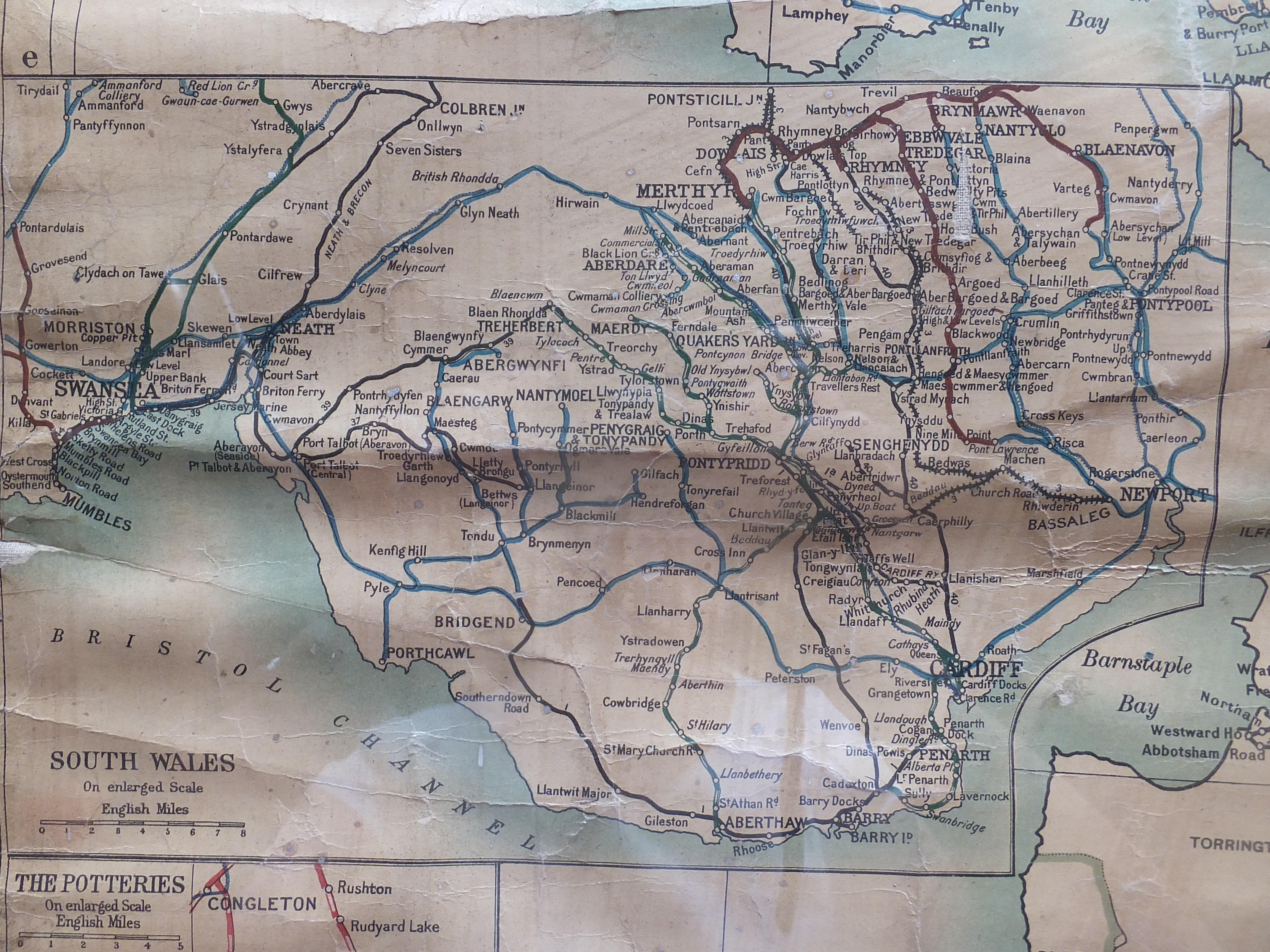
Map of Railways described above in Pre-grouping period
Up until the Railways Act 1921 which grouped railway companies into the 'Big Four', there was a plethora of independent railways. The three map fragments below show South Wales, Newport to Leominster and Leominster to Shrewsbury and are taken from the 'Railway Map of England & Wales, 11th Edition', published W. & A. K. Johnston. The explanation of the colours or numbers on these map fragments is shown in the table below.
| Colour or number |
Railway |
| Blue |
Great Western |
| Brown |
London & North Western |
| Green |
Midland |
| Green/white |
Taff Vale |
| 1 |
Barry |
| 3 |
Brecon & Merthyr |
| 37 |
Port Talbot |
| 39 |
Rhonnda & Swansea Bay |
| 40 |
Rhymney |
| (named) |
Neath & Brecon |
Map of Pre-grouping Railways in South Wales
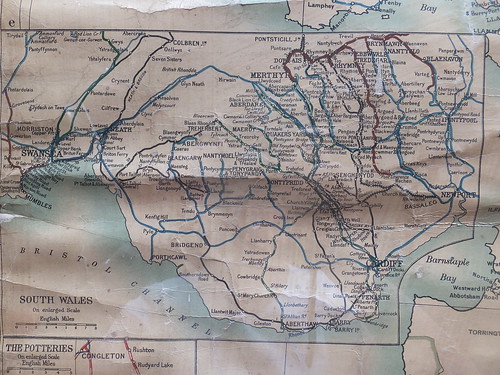
Click for larger image.
Pre-grouping railways in South Wales.
Map of Pre-grouping railways from Newport to Leominster

Click for larger image.
Pre-grouping railways from Newport to Leominster.
Map of Pre-grouping railways from Leominster to Shrewsbury
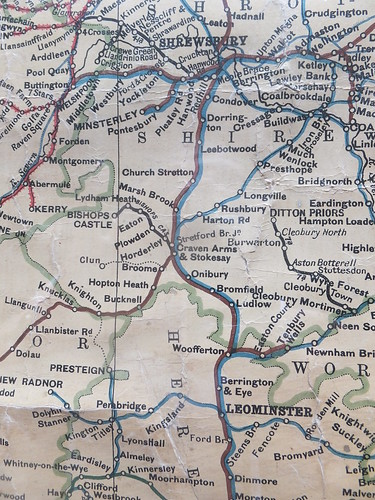
Click for larger image.
Pre-grouping railways from Leominster to Shrewsbury.
Some time after the trip, I assembled some historical and other data which you can find in Part 3.
Book References
[1] 'A Regional History of the Railways of Great Britain: Volume 12 South Wales by D. S. M. Barrie, published by David & Charles (ISBN 0-7153-7970-4).
Track Diagrams
[1] 'Track Layout Diagrams of the GWR and BR WR: Section 38 Newport' by R. A. Cooke, published by R. A. Cooke 1980.
[2] 'Railway Track Diagrams Book 3: Western', published by Trackmaps (ISBN: 0-9549866-1-X).
[3] 'Track Layout Diagrams of the GWR and BR WR: Section 38 Newport' by R. A. Cooke, published by R. A. Cooke 1980.
Related articles on other sites
Cardiff Central Railway Station (Wikipedia).
Cardiff Central Station (National Rail).
Related articles on this site
Part 1.
Part 3.
My pictures
General:
Swansea.
Newport, Gwent.
Railway pictures:
Swansea area railways.
Cardiff's railways.
Newport Station, Gwent.
Shrewsbury-Hereford-Newport line.