Tuesday, 12 November 2013

'Planet' in Perspective

A little background

When the Liverpool and Manchester Railway was being built following authorisation by the Parliamentary Act of 1826, the decision regarding propulsion had not been made. The options were cable haulage, using a series of stationary steam engines along the line, or the use of self-propelled 'locomotive engines'. The Directors of the Liverpool and Manchester Railway decided upon a competition, with a £500 prize to the winner, to find the best steam locomotive design before finally deciding upon the method of traction for their line. In 1929, the Rainhill Trials were held, amid massive public interest, and 'Rocket' was the winner. There's a brief description of this period in the post Early Locomotive Design.
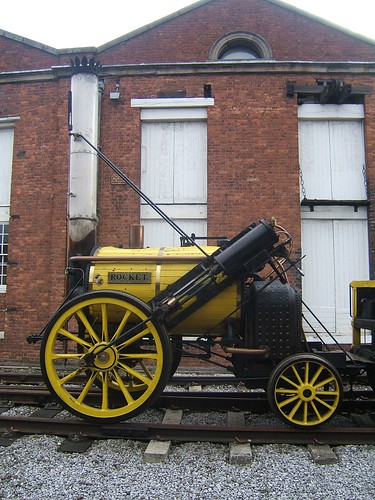

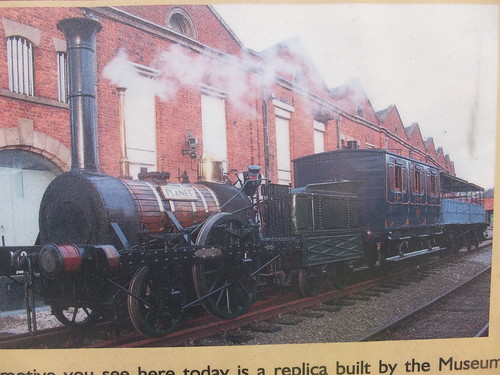
The National Railway Museum 'Rocket' replica.

For the opening of the Liverpool and Manchester Railway, a number of locomotives fairly similar to 'Rocket' were built by the Robert Stephenson works.

Experience with the 'Rocket' class suggested a number of technical improvements which were incorporated in the very successful 'Planet' class. The Stephenson works produced four 'Planet' class locomotives by the end of 1830, with a further four in 1831, supplemented by two very similar locomotives manufactured by Fenton, Murray and Company. The design of the 'Planet' class was so successful that, for a number of years, locomotives were essentially derivatives or enlarged versions of 'Planet'.
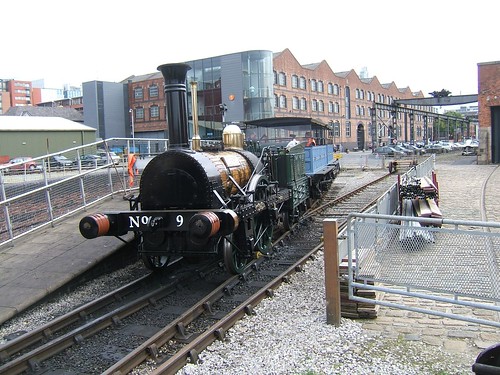
The 'Planet' replica (with shortened chimney).

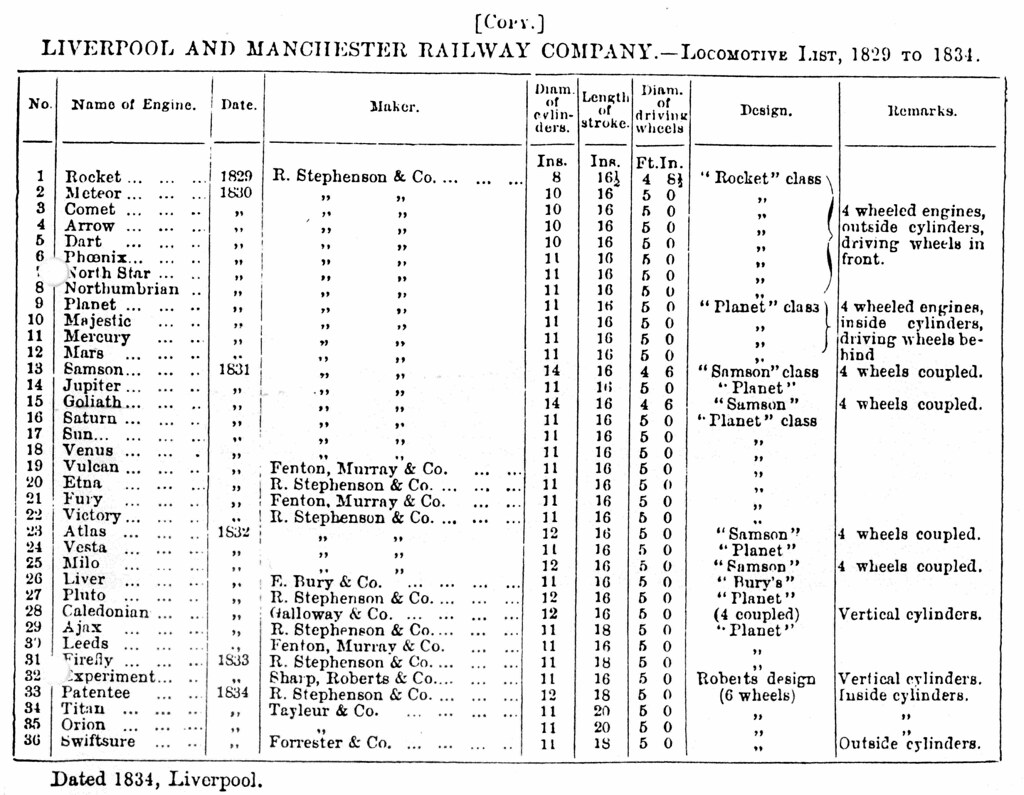
Liverpool & Manchester Railway company - Locomotive List, 1829-1834
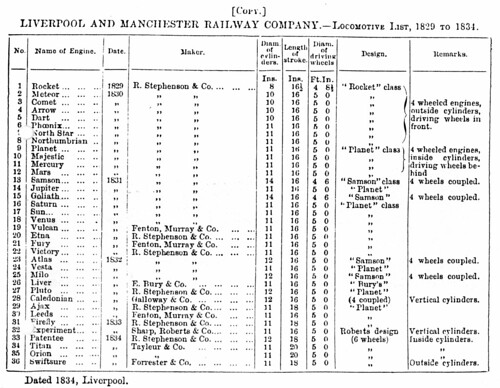
Click here for larger view.

The above list, produced after a few years operation of the Liverpool and Manchester Railway, is worth studying in detail. It is taken from the book by Clement E. Stretton [reference 1]. The success of the railway is clear from the fact that no less than 36 locomotives appear on the list, headed by No. 1 'Rocket', built in 1929.

The 'Rocket' class

The cylinders on 'Rocket' were 8 inches in diameter, with a 16.5 inch stroke and the driving wheels were 4 feet 8.5 inches diameter. A further seven locomotives (No. 2 - No. 8) were built in 1830 to inaugurate the service. Although the list shows them as 'Rocket' class, there were a number of changes Compared with 'Rocket', the cylinder diameter was increased to 10 inches (on the first four locomotives) and again to 11 inches (on the final three locomotives). There was a small reduction in stroke to 16 inches and the driving wheel diameter was increased to 5 feet. The first four locomotives had a larger number of smaller diameter smoke tubes and a chimney similar to 'Rocket', swelled at the base to join onto the front of the boiler but, thereafter, the chimney was carried on a recognisable 'smokebox'. Note that the cylinders have been lowered from the steeply-inclined position of the original 'Rocket' to an almost-horizontal position to reduce impact on the track. 'Rocket' itself had the same cylinder position modification at some stage. On the last of the 'Rocket' class, No 8 'Northumbrian', illustrated in the Shaw print below, the mature form of the 'Stephensonian' boiler appears with a larger water-jacket firebox integrated with the boiler (which now has 132 smoke tubes of 1 and 5/8 inch diameter).
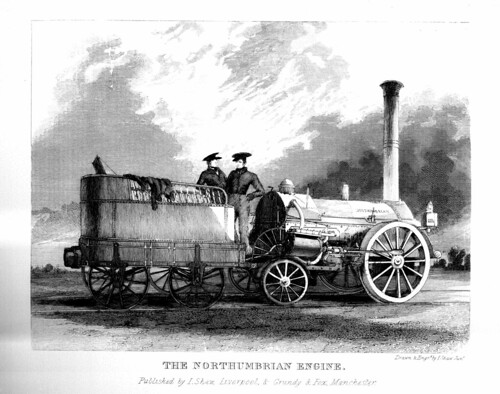
Shaw: Plate IV The Northumbrian Engine.

The 'Planet' class

The 'Planet' class quickly followed and the Robert Stephenson and Company works produced the first four class members in 1830 - 'Planet', 'Majestic', 'Mercury' and 'Mars' (No. 9 to No. 12). The 11 inch by 16 inch cylinders of the later 'Rocket' class engines were retained, as were the 5 foot diameter driving wheels but the configuration of the class was completely revised from an 0-2-2 to a 2-2-0, as described in the post The Planet Replica.

The diagram below shows the design of the cylinders for the 'Planet' class. Note that both front and rear covers were cast separately from the cylinder. Also note that the steam valve was split into two sections. This arrangement created extra wear and was not perpetuated.
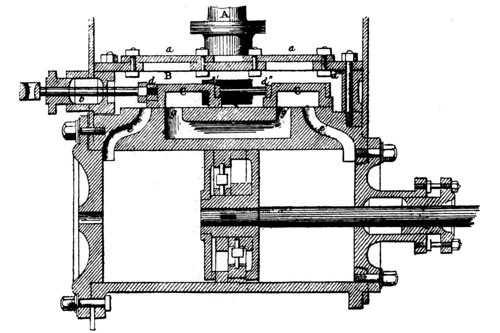
Diagram of 'Planet' class cylinder (from Ahrons book [reference 2], drawing originally published in "The Engineer").

In 1831 the Stephenson works turned out another six 'Planet' engines - 'Jupiter', 'Saturn', 'Sun', 'Venus', 'Etna' and 'Victory'. In the same year Fenton, Murray and Company produced two 'Planet' class locomotives on the recommendation of Robert Stephenson & Co. (using Stephenson drawings), which were given the names 'Vulcan' and 'Fury'. Robert Stephenson & Co. also produced the first 4-coupled engines of the 'Samson' class, described below.

In 1832, another six 'Planet' locomotives were acquired by the Liverpool and Manchester Railway. Robert Stephenson & Co. produced 'Atlas', 'Vesta', Milo, Pluto and 'Ajax', whilst Fenton, Murray and Company built 'Leeds'. Of these six locomotives, only 'Vesta' and 'Leeds' had 11 inch by 16 inch cylinders - 'Atlas', 'Milo' and 'Pluto' had 12 inch by 16 inch cylinders and 'Ajax' was equipped wit 11 inch by 18 inch cylinders! In the same year 'Liver' was supplied by Bury and Galloway & Co. provided 'Caledonian' - something of a 'throwback' with vertical cylinders.

In 1833, Robert Stephenson & Co. supplied another 'Planet' class, 'Firefly', with the 11 inch by 18 inch cylinders which had first appeared on 'Ajax'. But more significant was the supply of a 2-2-2 locomotive - 'Patentee', the first of a new class, described below.

The 'Samson' class

A significant development in 1831 was the emergence of a 4-coupled version of 'Planet', intended for goods and banking duties. Cylinder size was enlarged to 12 x 16 inches. By having four equal-sized wheels and coupling them together, all the weight of the locomotive became adhesive. The crank pins on the trailing wheels were ball joints, to provide flexibility (like 'Rocket') whereas the crank pins on the leading wheels were parallel-sided. The drawing below shows the arrangement. Note that the elevation shows the front of the locomotive to the right, whereas on the plan, the front of the locomotive was on the left.

Elevation and Plan of 'Samson' class (from Ahrons book [reference 2], drawing originally published in "The Engineer").

The 'Patentee' class

Partly to improve riding and partly to facilitate the design of ever-larger locomotives, Robert Stephenson & Co. added a pair of carrying wheels at the rear of the locomotive. In a single-driver (like the 'Planet' class), this produced a 2-2-2, in a four-coupled design (like the 'Samson' class), this produced an 0-4-2. Cylinder size was enlarged to 12 x 18 inches. The design flexibility that this change offered meant that, for some years, locomotive design could be based on 'ringing the changes' on the 'Patentee' configuration.

Related posts in this blog

Early Locomotive Design.
The Planet Replica.
'Planet' at MOSI - The First 21 Years.

Book References

[1] 'The Development of the Locomotive - A Popular History 1803 - 1896' by Clement E. Stretton.
[2] 'The British Steam Railway Locomotive 1825 - 1925' by E. L. Ahrons, reprinted Bracken Books 1987 (ISBN 1 85170 103 6).
[3] 'A Century of Locomotive Building by Robert Stephenson & Co. 1823 - 1923' by J. G. H. Warren, reprinted David & Charles (7153 4378 5).

Winter Timetable at Peak Rail

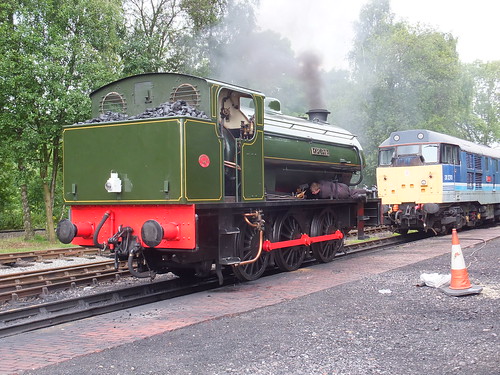
I was rostered as driver at Peak Rail on Saturday 2nd November 2013, with Dave as fireman. On arrival at Rowsley, I found that our locomotive, 'Lord Phil', had been turned and the chimney was at the north end, presumably to introduce some variety. I briefly wondered whether I'd remember the proper 'stop' marks at the different stations for the engine this way round. I think the last time I'd had 'Lord Phil' facing north was on the Peak Rail 1940s Weekend earlier in the year, but on that occasion we were running to Matlock (Town) and top-and-tailing.

'Lord Phil' being prepared on the outside pit at Rowsley for the 1940s Weekend earlier in the year.

The 2nd November was the first day of the Winter Timetable and trains were running only as far as Matlock Riverside. In a further change, we were not 'Top and Tailing' but would work the train unaided, requiring us to run-round the train each time we arrived at both Matlock Riverside and Rowsley stations. For many years, running round was part of the standard operation but since the extension of our line to Matlock (Town) in 2011, described here, we've rather got out of practice and Dave and I were to find it hard work. We were quite grateful that the timetable only called for four round trips in the day, rather than the five we operate in the Summer timetable. The weather can most kindly be described as 'mixed'. There was sunshine during the day but it also rained heavily periodically. To add to our woes, the grey water tank at the north end of the platform at Rowsley, which we had expected to use to replenish the locomotive saddle tank during the day, was unserviceable. We had to use the brown water tank at the south end of the station. The arrangement here is, ahem, less than ideal, involving dragging a long length of firehose to the engine and manhandling it onto the top of the saddle tank each time we took water. However, there were plenty of passengers during the day and, at the finish after disposal, Dave and I agreed we'd had an enjoyable, although tiring, day.

Former arrangements at Matlock Riverside

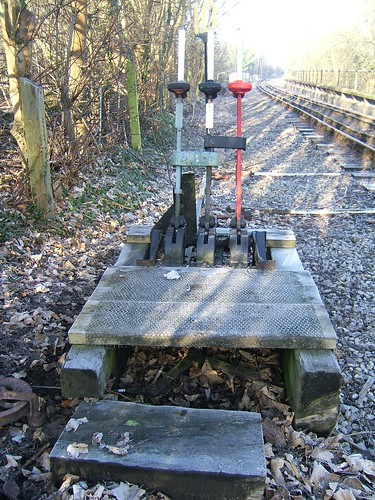
Previously, the operation of the points when running round at Matlock Riverside was carried out by the engine crew. The points at the Darley Dale end of the station were operated by the Fireman from a 3-lever ground frame released by the Single Line Staff.


The 3-lever Ground Frame at the Darley Dale end of Matlock Riverside before the Matlock Riverside Re-signalling Project.

The points at the other end of the run-round loop, near the A6, were operated from a hand lever.


The hand points near the A6 Matlock Riverside before the Matlock Riverside Re-signalling Project.

Matlock Riverside Re-signalling Project

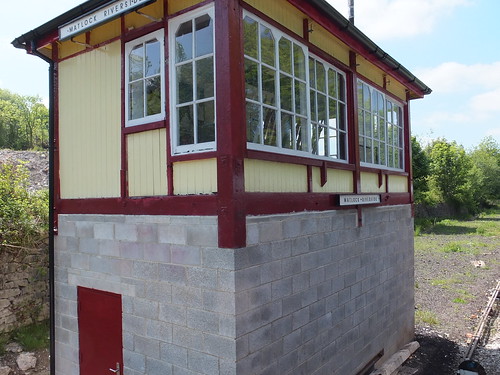
Since the running line was extended to Matlock (Town), a new signal box has been built at Matlock Riverside to control the run round and the connection to the extension to Matlock (Town).
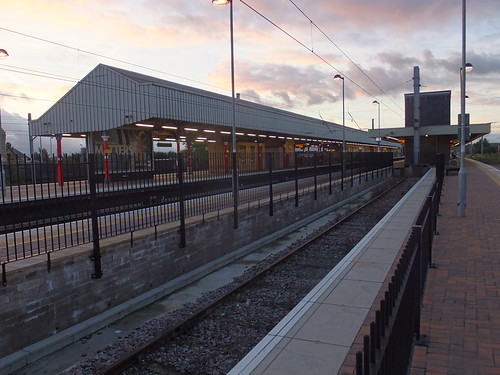
Work on this ambitious signalling project is almost complete so it had been arranged that, with the start of the winter timetable, Signal & Telegraph Department staff would be in attendance to operate the points from the signal box, under the supervision of Dominic. The various new fixed signals remain fitted with a white 'X' indicating that they are not yet in use and all movements took place under the authority of Hand Signals (red and yellow flags). This arrangement also provided an opportunity for Signalmen to receive training in the operation of the new signal box before commissioning takes place.
The new signal box at Matlock Riverside.

Winter Camp

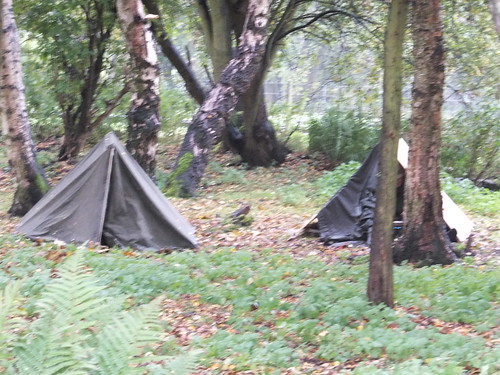
The Peak Rail 1940s Weekend is held in August and I described this year's event in the post here. But there's also a smaller event under the title 'Winter Camp' which this year was on the 2nd and 3rd November. There were a few tents pitched in the woods at Rowsley but the re-enactors need to be dedicated to camp out in November.

Peak Rail: 2nd/3rd November 2013: 'Winter Camp' commemorating the Battle of the Bulge.

My pictures

Resignalling at Matlock Riverside.
'Lord Phil'.

Thursday, 7 November 2013

Jan Ford's Travels

After my partner, Daemon, passed away in 1999 I decided it was time I saw a little more of the world, before age, infirmity or poverty precluded such jaunts.

I've finally got around to listing these overseas trips in date order, with links to the blog posts which give a little more detail. Generally, each blog post has links to sets of photographs relevant to that post.

Earlier trips overseas are listed in a separate post Jan Ford's Travels - The early trips.

There's also a post Jan Ford's Travels: Around the World in pictures with a list of counties visited and links to a list of collections of pictures for each country.

As an alternative, you can also find photographs of my trips by going to the list of collections here, where collections for each country visited are listed in alphabetical order (followed by 'special interest' collections on railways, charitable initiatives and similar).

Round the World 1 (December 2001)

Thailand (Bangkok), Australia (Sydney), New Zealand (Auckland), Fiji (Nadi), United States (San Francisco). There's a short report here.

Republic of Ireland (2002)

I visited Galway to spend some time with my friend Rita who was examining students.

China (2002)

I visited Beijing, Xian, Chungking, then took a Yangtse Cruise. There's an incomplete report here.

Germany, Poland (September 2003)

I made a trip Wolsztyn with my friend Mike Edwards (now, alas, passed on) to take the Wolsztyn locomotive driving experience. We spent a fascinating day in Berlin on the way. There's a short report here. My pictures are here.

Hong Kong, China, Macau (2004)

I made a trip to Hong Kong in late 2004, meeting up with my friend Rita who was examining students. We managed a day trip to Macau and a day trip to Guangzhou in southern China. There's a short post here. My pictures are here.

Canada (July 2004)

My trip to Canada (Toronto) is described here.

Round the World 2 (January 2005)

Brazil (Rio de Janeiro), Peru (Cuzco, Machu Picchu, Lima), United States (Los Angeles, Hawaii), New Zealand (Christchurch, Greymouth, Franz Josef), Singapore (Raffles Hotel), Egypt (Giza). There's a report here.

Far East 1 (June 2005)

Vietnam (Ho Chi Min City and Mekong Delta), Cambodia (Siem Reap, Angkor Wat), Thailand (Bangkok, Ayutthaya), Taiwan (Tai Pei, Hualien, Taroko Gorge). One report here describes this trip.

Ukraine (2005)

In late 2005, I joined Mike again for another steam driving experience at Kolomiya. There's a short report here.

Round the World 3 (February 2006)

Mexico (Mexico City, Tlaxcala), Ecuador (Quito, Galapagos), Chile (Santiago), French Polanesia (Papeete), Australia (Melbourne, Perth), Hong Kong, India (Delhi, Udaipur, Shimla). There's a more detailed report here.

Round the World 4 (February 2007)

United States (New York), Argentina (Buenos Aires, Ushuaia), Antarctic Peninsula ('Antarctic Dream' cruise), Chile (Santiago), New Zealand (Auckland), Australia (Perth), South Africa (Johannesburg, Cape Town). A total of 31 reports describe this trip. Click here to select them all.

Japan (September 2007)

Japan (Tokyo, Nagoya, Kyoto, Miyajima). A total of 16 reports describe this trip. Click here to select them all.

Round the World 5 (March 2008)

Union of Myanmar (Yangon,'Road to Mandalay'), Thailand (Bangkok), United States (Las Vegas), Mexico (Chichen Itza), Cuba (Havana, Trinidad), Panama (Panama City) A total of 29 reports describe this trip. Click here to select them all.

Far East 2 (September 2008)

Thailand (Bangkok, Golden Triangle), Myanmar (Yangon, Mandalay, Inle Lake, Kakku), Laos (Luang Say Cruise, Luang Prabang, Vientiane), Dubai (Al Maha). A total of 22 reports describe this trip. Click here to select them all.

Germany (2009)

I visited Frankfurt and Mannheim in January 2009. My pictures are here.

Middle East 1 (March 2009)

Egypt (Cairo, 'Zahra' Nile cruise, Abu Simbel), Jordan (Amman, Dead Sea, Petra, Aqaba). A total of 21 reports describe this trip. Click here to select them all.

Far East 3 (August 2009)

Thailand via Mumbai (Bangkok), Myanmar (Yangon, 'Road to Mandalay' cruise), India (Kolkata), Bhutan (Thimphu, Gangtey, Punakha, Paro). A total of 27 reports describe this trip. Click here to select them all.

Far East 4 (March 2010)

Indonesia, Java (Borobudur, Yogjakarta), Indonesia, Bali (Sanur), Malaysia, Sarawak (Kuching, 'Orient Pandaw' cruise), Malaysia, Sabah (Kota Kinabalu), Malaysia (Kuala Lumpur). A total of 25 reports describe this trip. Click here to select them all.

Norway and the Arctic (August 2010)

Norway ('Prince Albert II' cruise). A total of 13 reports describe this trip. Click here to select them all.

Far East 5 (August 2010)

Myanmar ('Road to Mandalay' Bhamo cruise, Yangon), Thailand (Bangkok). A total of 12 reports describe this trip. Click here to select them all.

Trip to St. Helena (April 2011)

South Africa (Capetown), cruise to St. Helena, cruise to Ascension. A total of 7 reports describe this trip. Click here to select them all.

Trip to Russia (July 2011)

Russia ('AMA Katerina' Moscow - St. Petersburg cruise). A total of 19 reports describe this trip. Click here to select them all.

Trip to Burma (October 2011)

Myanmar (Yangon, Mount Popa, 'Road to Mandalay' cruise), Thailand (Bangkok). A total of 11 reports describe this trip. Click here to select them all.

Safari (February 2012)

South Africa (Johannesburg), Zambia (Livingstone), Zimbabwe, Botswana, Namibia ('Zambesi Queen' cruise), Botswana (Duba Plains, Savuti, King's Pool, Vumbura Plains, Maun). A total of 28 reports describe this trip. Click here to select them all.

Trans-Siberian (July 2012)

Mongolia (Ulaan Baatar), Russia ('Golden Eagle' private train). A total of 17 reports describe this trip. Click here to select them all.

Burma (September 2012)

Myanmar (Yangon, Mawlamyine, Pa-An, Mount Popa, 'Road to Mandalay' Bhamo cruise), Thailand (Bangkok). A total of 21 reports describe this trip. Click here to select them all.

Malta (November 2012)

Malta (Radisson BLU Resort & Spa, Golden Sands). A total of 8 reports describe this trip. Click here to select them all.

Far East 6 (January 2013)

Vietnam (Ho Chi Min City Airport, Hoi An, Hue, Hanoi, 'Indochina Sails' Halong Bay cruise), Australia (Perth), Thailand (Bangkok Airport), Myanmar (Yangon, Old Bagan, Mandalay, Naypyidaw). A total of 25 reports describe this trip. Click here to select them all.

China and Tibet (July 2013)

China (Xining, QingHai-Tibet Railway, Lhasa, Shigatse, Gyangtse, Shanghai). A total of 17 reports describe this trip. Click here to select them all.

Trip to Burma (April-May 2014)

Burma (Yangon, Mawlamyine, Ko Dut, Bagan, Mandalay, Mrauk U)
Qatar (Doha)
A total of 21 reports describe this trip. Click here to select them all.

Trip to Vienna (November 2014)

Austria (Vienna)
Four reports describe this trip. The first report is here, with links to subsequent reports.

Trip to Singapore, Papua New Guinea, Indonesia, Malaysia (January-February 2015)

A cruise on 'Caledonian Sky' "from the Coral Sea to the South China Sea". A total of 22 reports describe this trip. Click here to select them all.

Trip to Burma (April-May 2015)

Burma (Yangon, Mawlamyine, Ko Dut, Setse Beach, Bagan, Mandalay, Putao)
A total of 20 reports describe this trip. Click here to select them all.

South Atlantic Voyage (February-March 2016)

Argentina (Buenos Aires, Ushuaia), Falklands (Steeple Jason Island, West Point Island,East Falkland), South Georgia, Tristan da Cunha (Tristan, Nightingale Island), South Africa (Cape Town, Robben Island).
A total of 19 reports describe this trip. Click here to select them all.

Trip to Burma (April-May 2016)

Burma (Yangon, Mawlamyine, Ko Dut, Bagan, Thazi, Kalaw, Kawthaung, Mergui Archipelago)
A total of 25 reports describe this trip. Click here to select them all.

Chilean Fjords and Antarctic Peninsula Cruise (November-December 2016)

Chile (Santiago, Valparaiso, Valdivia, Punta Arenas, Cape Horn, Antarctica (South Shetland Islands, Antarctic Peninsula), Argentina (Ushuaia, Buenos Aires), Brazil (Iguazzu).
A total of 22 reports describe this trip. Click here to select them all.

Burma and Australia (April-May 2017)

Burma (Yangon, Dawei, Ko-Dut, Mawlamyine, Bagan Medical Clinic, Loikaw, Kalaw, Inle Lake)
A total of 24 reports describe this trip. Click here to select them all.

Australia (Perth, Melbourne, Hobart) A total of 10 reports describe this trip. Click here to select them all.

Burma (September-October 2017)

Burma (Yangon, Myitkyina, Lonton, Mandalay, 'Road to Mandalay')
A total of 20 reports describe this trip. Click here to select them all.

Burma and Nepal (April-May 2018)

Burma (Yangon, Ko-Dut, Mawlamyine, Bagan Medical Clinic, Sel-Taw-Oo Monastery, Rith Lake, Kalay, Pyin Oo Lwin)
A total of 23 reports describe this trip. Click here to select them all.

Nepal (Kathmandu, Pokhara)
A total of 6 reports describe this trip. Click here to select them all.

Caspian Odyssey (September 2018)

Armenia (Yerevan, Geogard, Garni, Lake Sevan, Dilijan), Georgia (Tbilisi, Kakheti, Signagi, Gori, Uplistsikhe,Mtskheta), Azerbaijan (Baku) by train
A total of 11 reports describe this trip. Click here to select them all.

Turkey (September 2018)

Istanbul
A total of 4 reports describe this trip. Click here to select them all.

Burma (May 2019)

Burma (Yangon, Mon State, Kayin State, Bagan, Kayah State, Shan State, Mandalay, Pyin Oo Lwin)
A total of 16 reports describe this trip. Click here to select them all.

Tropic of Capricorn (February 2020)

New Zealand, Norfolk Island, Vanuatu, Papua New Guinea, Australia
A total of 17 reports describe this trip. Click here to select them all.

[Additional trips added 10-Dec-2013: Trips in 2014 added 26-Dec-2014: Trips in 2015 and link to 'Around the world in pictures' post added 12-Oct-2015: 2016 Trips added 16-Jan-2017: 2017 trips added 28-Nov-2017: Burma-2018 and Nepal added 19-Jun-2018: Caspian Odyssey and Istanbul trips added 19-Jan-2020: Tropic of Capricorn added 30-Decc-2020]

Tuesday, 29 October 2013

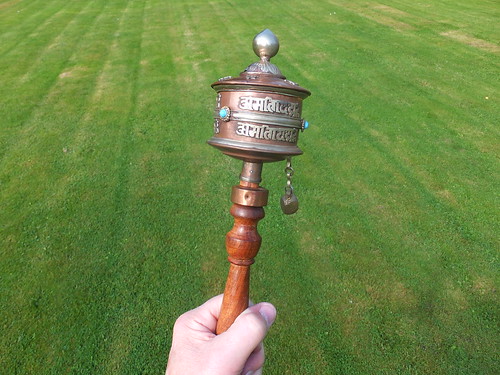
The Prayer Wheel

Some Buddhist sects use the Prayer Wheel. It's often described as a physical means of sending a supplicant's prayers to Heaven, but I understand that's an over-simplification of the beliefs.

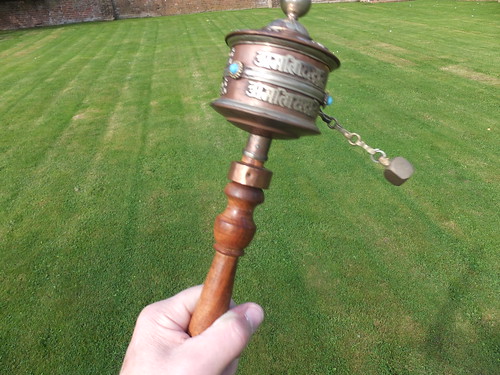
The picture above shows a hand-held Tibetan Prayer Wheel (which I actually purchased in Toronto during my visit in 2004 described here). The metal drum houses prayers inscribed on a coil of paper.

A weight attached to a chain assists the supplicant in rotating the drum continuously, always in a clockwise direction, by repeated movement of the wrist.

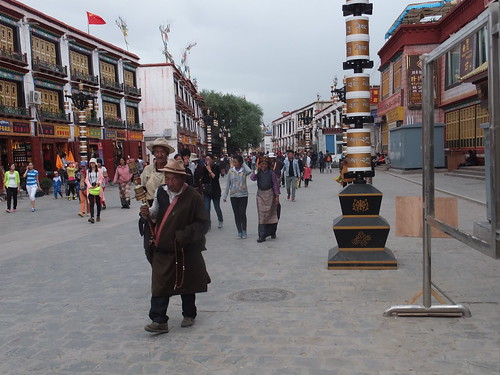
In Tibet, I've seen larger versions of the hand held prayer wheel, where the supplicant wears a leather shoulder strap with a pouch at the bottom to locate the end of the wooden handle, rather like a Standard Bearer might use.

Perambulating clockwise around the outside of the Jokhang Temple in Lhasa, the Tibetan gentleman in the foreground has a larger prayer wheel.

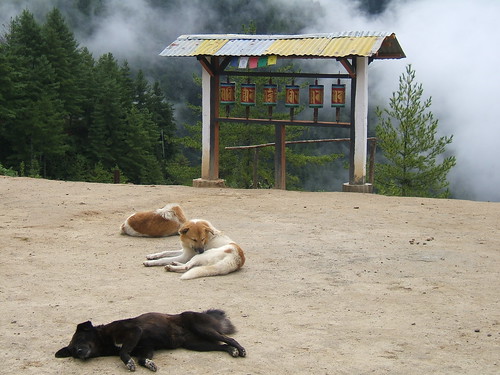
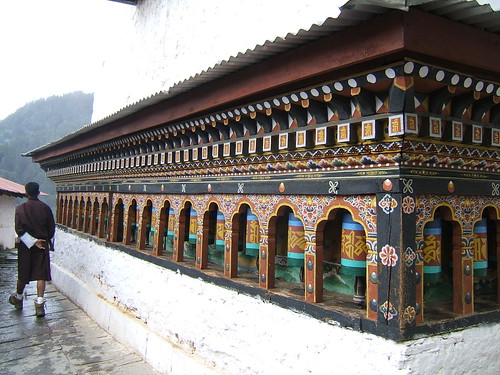
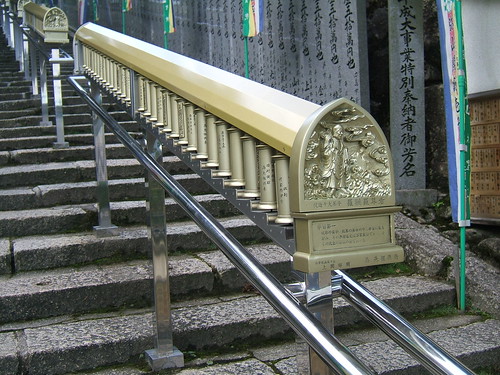
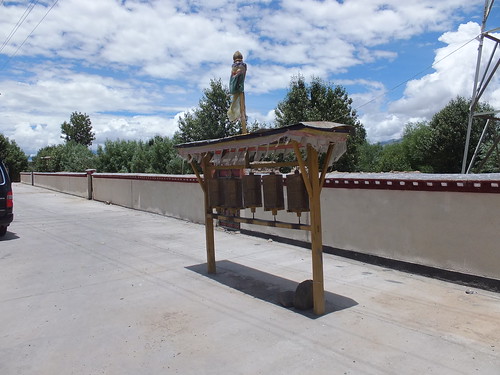
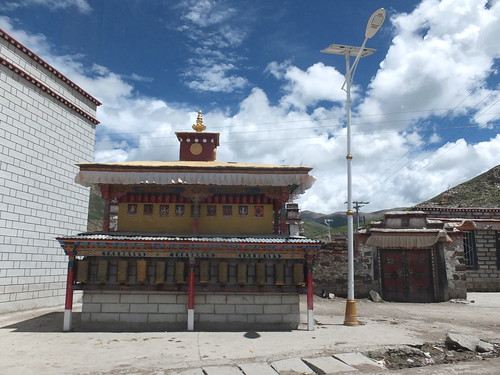
Sometimes, the rotating drum of the Prayer Wheel is mounted in a fixed supporting frame, and examples may be found singly or in groups.

A group of six Prayer Wheels on the way to the Tiger's Nest Monastery, Bhutan.

A large group of Prayer Wheels, Cheri Goemba, Bhutan.

Prayer Wheels on temple steps, Miyajima, Japan.

Roadside Prayer Wheels on Lhasa - Shigatse Road, Tibet.

Roadside Prayer Wheels, Nangartse, Tibet.

Once the rotating drum of the Prayer Wheel is mounted in a fixed supporting frame, the drum can become much larger, turned by handles or ropes attached to the drum.

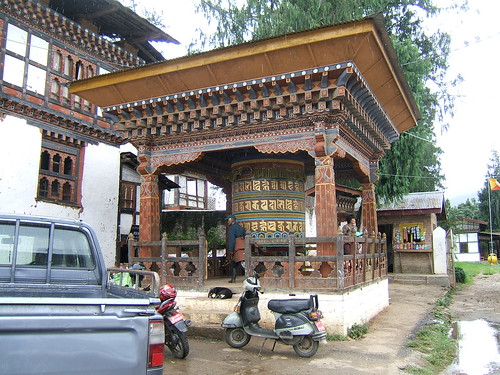
A LARGE Prayer Wheel in the town of Whangdue Phodrang, Bhutan.

The Water Powered Prayer Wheel

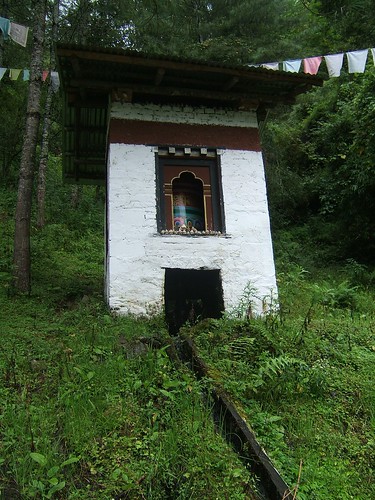
In Tibet and Bhutan there are water-powered Prayer Wheels, where a stream is arranged to turn a wooden paddle wheel. The rotating drum often carries an arm which strikes a small bell on each revolution, producing a tinkling sound.


A Water-Powered Prayer Wheel, Bhutan.

The Solar Powered Prayer Wheel

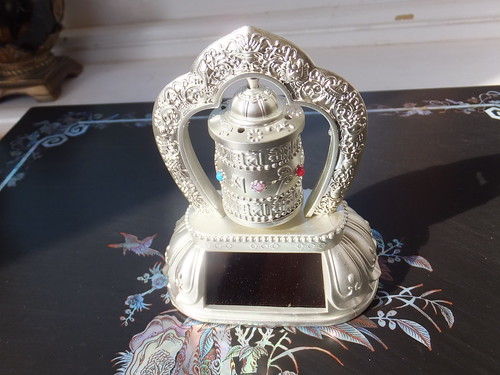
I think I first saw the solar powered prayer wheel in Mongolia (described in the post Leaving Ulaan Baatar - The Reality). Deposited on a cairn of stones (called an 'Ovoo') was a miniature prayer wheel happily spinning on its own, electrically-driven from a small photo-voltaic panel in the base. Later, I saw the same thing mounted on the dashboard of cars. I was intrigued by the conjunction of ancient belief and modern technology. My visit to Tibet in 2013 described here finally gave me the opportunity to purchase an example. The shop in Lhasa had dozens of different sizes, colours and decorative styles on offer. The very inexpensive models were not solar powered but required a battery to spin the miniature prayer wheel.

A solar-powered Prayer Wheel.

Other types of Prayer Wheel

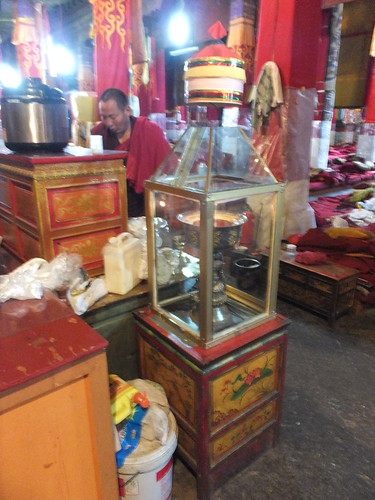
I've only spotted one butter lamp powered Prayer Wheel. This was at the Drepung Monastery in Lhasa. A small butter lamp is placed under a glass case and the rising warm air turns a fan attached to a lightweight prayer wheel suspended above.


Butter lamp powered Prayer Wheel, Drepung Monastery, Lhasa, Tibet.

I believe there are wind powered Prayer Wheels but I've not spotted one, I'm afraid.

My pictures

The Prayer Wheel

Stationery Distribution in Pauk Myaing Village

Inwa (also called Ava) is an ancient city, situated on the east bank of the Ayeyarwaddy River, around 11 miles south of Mandalay. Pauk Myaing Village is about four miles from Ava. Most of the villagers in Pauk Myaing keep cattle to produce cow's milk. Maize grows well and supports both the villagers and their cattle.

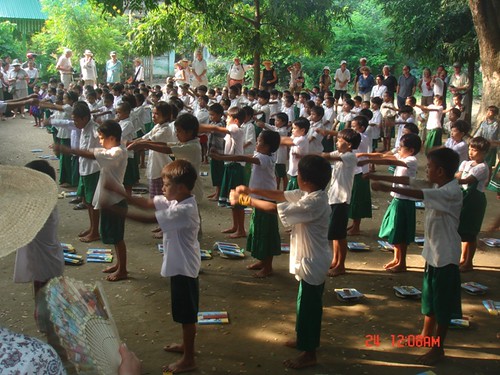
The Primary school in Pauk Myaing has 187 students and, on 15th October 2013, Dr. Hla Tun visited the school with a party of Guests from the 'Road to Mandalay' to donate stationery.

Students demonstrating physical exercises in the school compound.

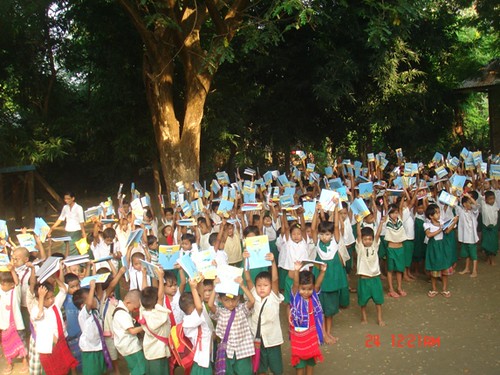
Each student received 3 exercise books, 6 pencils and a ruler. In addition, 30 dozen ball pens, one and half dozen note books, 2 dozen pencil sharpeners and 25 dozen crayons were donated to the Headmaster. Each of the eight teachers was given a green longyi, which forms the teachers' 'uniform'.

Students displaying their donated stationery.

Finally, one of the 'Road to Mandalay Guests donated funds to allow the Headmaster to replace the old school roof. Roofing typically lasts for 25 years.

Bagan Medical Clinic: September 2013

This report is based on information from Doctor Hla Tun, who also supplied the photographs.

The Bagan Clinic treated 4,826 patients in September 2013, bringing the total number of treatments since the Clinic opened on 6th August 2011 to 80,055.

Treatment Summary

The table below summarises the number of treatments per month and the total number of treatments since the clinic started.

Month Patients treated Total treatments
August 2011 355 355
September 2011 784 1,139
October 2011 1,434 2,573
November 2011 1,723 4,296
December 2011 2,013 6,309
January 2012 1,605 7,889
February 2012 2,464 10,353
March 2012 4,603 14,956
April 2012 2,043 16,999
May 2012 - Jan 2013 To be added To be added
February 2013 2,713 49,850
March 2013 2,713 49,850
April 2013 2,061 54,924
May 2013 3,303 58,227
June 2013 5,586 63,813
July 2013 6,079 69,892
August 2013 5,337 75,229
September 2013 4,826 80,055

Monthly notes

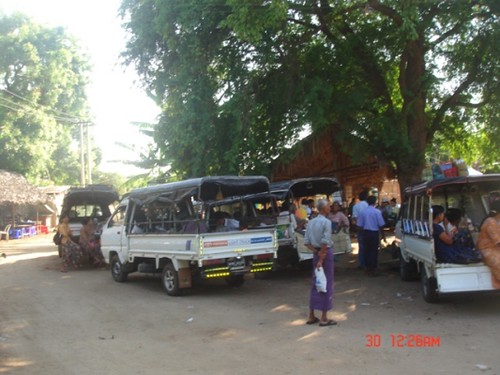
The picture below shows between 8 and 12 white trucks waiting in front of the clinic. Patients from longer distances reduce travel costs to the clinic by sharing the cost of hiring a truck. They bring food in a lunch box together with pillows, mats, cups, blankets and extra cloths in a basket, knowing that they will have to sleep in the Monastery compound for 1 or even 2 nights.

White trucks which have transported patients long distances to reach the clinic.

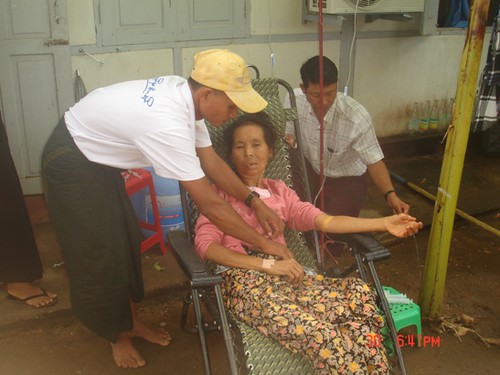
A sad story: On 21st September, a 68-year old lady, with her husband and son, travelled to the clinic from PaDung Village which is situated between MinBu Town and Unn Town in Magwe Division, Rakhine State - a distance of 250 km from the Bagan Clinic! The husband had been suffering hemiplegia for a month and the wife also hoped to receive treatment for her hypertension so they booked transport with a light truck which they found out collected patients from MinBu Town (about 32 km from their home village) on 21st September. During the five and a half hour journey from MinBu, the lady suffered a right-sided hemiplegia following a cerebral haemorrhage. The transport arrived at Bagan about 18:30 but, for some reason, the husband, wife and son failed to make contact with clinic staff, although the clinic remained open until 23:40 dealing with the large number of patients. As soon as clinic staff were aware of the situation when the clinic opened at 07:45 on the following day (22nd September), the lady was immediately admitted for treatment. The photograph below shows the son (in a yellow cap) with his mother. The son is now sad and depressed because both his parents suffer from hemiplegia and need care but he is an only child.

The lady who suffered hemiplegia on the way from Rakhine State.

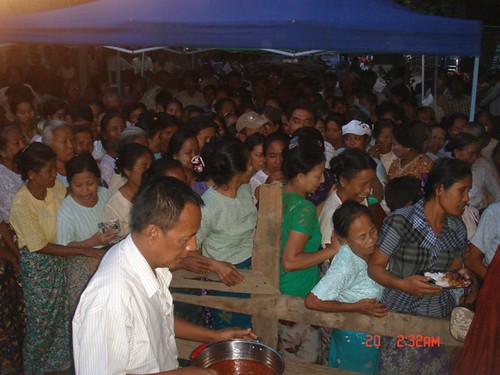
A free lunch is served to waiting patients on clinic days (Friday, Saturday, Sunday). Sometimes, a free dinner is also served, as shown in the photograph below.

A free dinner being served at around 18:15 on 11th October 2013.

Clinic photographs in 2013

Bagan Medical Clinic (2013).

Related posts in this blog

You can find all the posts about the Bagan Medical Clinic here.

Donations to Schools at Katha and Naba

The following brief report is based on information from Doctor Hla Tun, who also supplied the photographs.

One of the attractions during the 'Road to Mandalay' Bhamo cruises is normally a trip by private train from Katha to Naba. In 2013, cruises 1 and 2 made the train journey on the Sabbath day, when schools were closed. But on cruise 3, the train journey took place on Tuesday, 17th September, allowing donations to students at the Monastic Secondary School in Katha where there are 352 students and the High School in Naba which has 703 students.

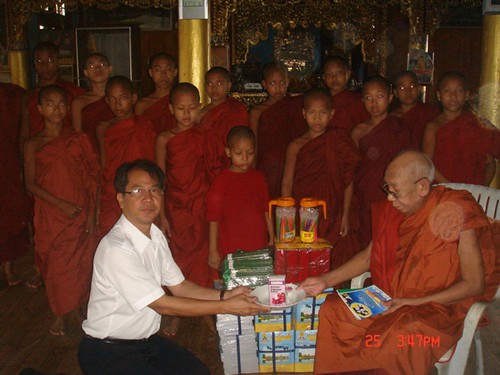
Donation of stationery to the 80 year old abbot who is a founder of the Monastic Secondary School. He has to provide the teachers’ salary himself but, for the first time this year, the Government are providing around 60% of the cost.

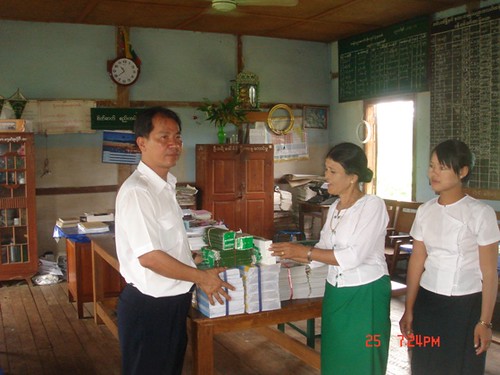
Donation of stationery to the headmistress of NaBa High School

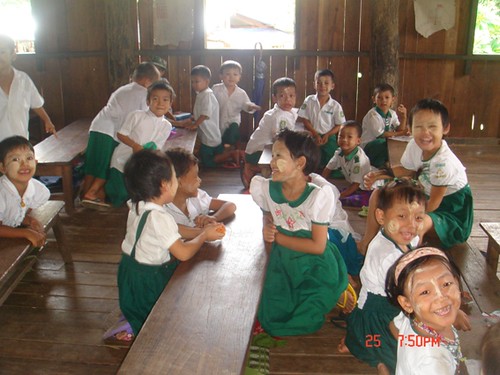
Smiling Grade 1 students in their classroom at Naba High School.

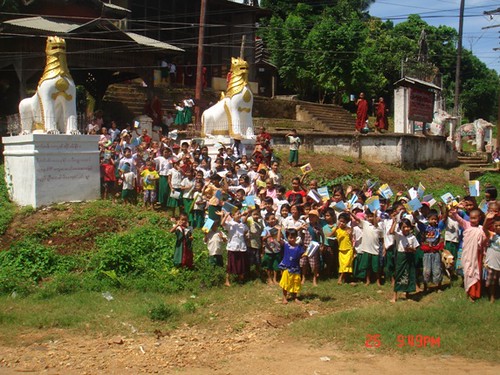
Grateful primary students from the Monastic Secondary school in Katha wave their donated stationery to the passing private train as it passes the Monastery compound on the return journey to Katha.

I first travelled on the private train myself in 2010, riding in the locomotive cab, and that journey is described here (with links to pictures and more technical descrptions of the journey). I made the trip again in 2012 and that trip is described here.

Monday, 21 October 2013

'Planet' at MOSI - The First 21 Years

Introduction

The 'Planet' Replica official "launch" (not sure that's the right word for a locomotive) took place at the Museum of Science and Industry (MOSI) in Manchester on 2nd October 1992. For the first few steamings, 'Planet' conveyed only Invited Guests from the project sponsor, British Engine Insurance, but Public Steamings commenced at the end of October 1992.

The ambition to build a working 'Planet' goes back to at least 1984 when Doctor Richard Hills, talking about the replica 1830 coaches, told 'Railway World' said "One day, if finances allow, the dream might be realised of building a replica locomotive of the same period to go with the coaches".

By the time I became a working volunteer in 1988, the Museum was running steam train rides using steam locomotive 'Agecroft Number 3' or fireless steam locomotive 'Lord Ashfield'. The profits from these rides all went into the 'Planet Fund' and, with the support of British Engine Insurance, completion of the 'Planet' replica was assured.

Designing the Replica

Creating a copy of an 1830 locomotive is an ambitious task, carried out by Michael Bailey, as Planet Project Leader, heading a small design team. Modern Health and Safety requirements meant that the design could not be an accurate copy of the original and various compromises had to be introduced although the design sought to reproduce the appearance and performance of the original.

The original boiler was wrought iron of riveted construction with a working pressure around 50 pounds per square inch. It was decided to substitute a modern welded steel boiler. In the original 'Planet', feed water to the boiler was provided via a crosshead-driven water pump (briefly described in the post The Clack Valve). Since this type of pump can only be used when the locomotive is moving, it was decided to add an injector to the replica (anachronistic, as the injector was not invented until 30 years after 'Planet' was built). To ensure reliable operation of the injector, the working pressure of the replica was raised to 100 p.s.i. The increased steam pressure then determined that the cylinder dimensions be scaled down, to produce a similar tractive effort to the original 'Planet'.

The importance of brake power had not been fully appreciated when the original 'Planet' was built and only handbrakes on the tender were provided. Fitted with wooden brake blocks, they were of limited usefulness. To be acceptable for hauling passenger trains today, the 'Planet' replica was equipped with brakes using the British Rail 2-pipe air brake system and disc brakes (one disc on the driving axle and one on each of the two tender axles).

Building the Replica

The Museum was very different then - the Great Western Warehouse building had a large workshop with an overhead travelling crane. As much as possible of the production was carried out in this workshop by a mixture of paid staff and volunteers but specialist tasks, such as manufacture of castings or building the boiler, were sub-contracted to outside firms.

'Planet' was 'erected' on a short length of track in the workshop area. I wasn't much involved in the erection, although I remember balancing precariously on top of the boiler with another volunteer as the overhead crane lifted the chimney, the bottom of which we had to thread into the 'collar' on top of the smokebox.

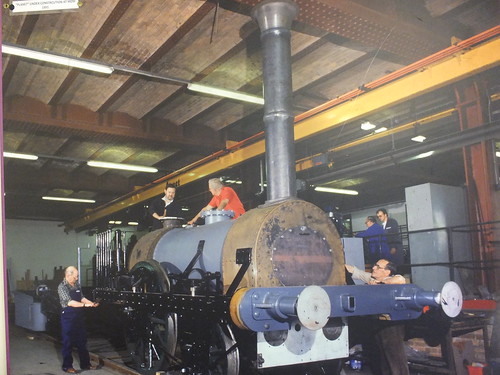
'Planet' replica under construction (Photo: MOSI).

Testing the Replica

The 'Planet' team were keen to carry out trials to see just what the locomotive was capable of and I was involved in two sets of early trials - the first at the Great Central Railway, the second at the East Lancashire Railway.

At the Great Central, trials started on 15th February 1993. 'Planet' hauled the two reproduction 1830 coaches and, on at least some trips, a brake van. The leading compartment of the coach next to the locomotive carried a portable air compressor driven from a petrol engine to charge the air brake system. The engine pulled the train from Loughborough to Rothley and then coasted downhill back to Loughborough. I think a speed limit of 15 m.p.h. was imposed. The trials were not without incident. Grease lubrication on the tender axleboxes gave some trouble and required attention. On another run uphill, just before Swithland Reservoir, a welded bracket in the valve gear on one cylinder gave way. Having stopped the train, everybody on the train formed a search party scanning the line we'd just passed over looking for the missing parts. Once these had been retrieved, 'Planet' limped back to Loughborough on one cylinder and urgent repairs were carried out so that the tests could continue. Later in the month, 'Planet' gave short, demonstration trips carrying the public. There were also passenger carrying runs from Loughborough to Rothley, two for the sponsor, British Engine Insurance and a 'Newcomen Society Special' when Michael Bailey and I were on the footplate. Our Newcomen Society passengers returned to Loughborough on a service train hauled by 'Clun Castle' and we followed 'empty stock'. There was an illustrated report on these trials in the May 1993 edition of 'Railway World' and other reports in 'Steam Railway News', 'Steam Railway (and other titles as well, no doubt).

Most of the test runs at the East Lancashire Railway were between Bury and Ramsbottom, but I think some of the runs were beyond Ramsbottom. Once again, the leading compartment of the coach carried the portable air compressor. I remember a Great Western 'Toad' brakevan being hung on the back for at least some of the tests. Some of the trips were speed trials. My favorite trip was uphill with Stuart Mulliner where we were running in what seemed like the teeth of a gale and heavy rain. I was wearing a borrowed railway mackintosh which was whipped by the wind, eyes stinging in the rain, but 'Planet' just seemed to want to go. With no weather protection on the open footplate, I really felt we were learning how tough the early enginemen were. During the trials, I appeared in a newspaper (probably Manchester Evening News) but they insisted on calling me 'John Ford' (and made a rather curious reference to an "international service" - they probably meant 'inter-city') .

Article showing 'Planet' during the trials on the East Lancashire Railway.

In service at Manchester

At Manchester, the Museum's 'main line' originally divided into three sidings in the Upper Yard. The siding nearest the Power Hall had the inspection pit and was used for engine preparation. The next line was fenced to form the running line. The third siding was in the public area and rarely used, although (soon after I became involved) I remember a preserved tram converted for battery operation giving rides along this siding on special occasions. There was an island platform in between the inspection pit siding and the running line, equipped with a rather nice umbrella roof. Clearances didn't allow both lines to be used for passenger trains so the end of the inspection pit siding stabled a converted coach as a cafe run by volunteers with the name 'Chuffers'. The picture below of 'Planet' also shows the converted coach and the platform roof - both features now gone.

'Planet' (and a younger Jan) at the original platform at Manchester some time in the early 1990s (Photo: L. Walker, Wigan).

'Planet' settled into her role giving public rides in the Museum. Her appearance certainly caught the imagination of the visitors, although they were sometimes reluctant to believe that she was newly-built and not the original locomotive restored. For drivers, the slip eccentric valve gear could prove frustrating when it came to changing direction. A modern innovation was a valve gear indicator on the footplate to assist drivers. However, being chain driven, the indications could not be relied on and were best ignored (I was reminded of the comment about the indicator for the steam reverser on some Bulleid engines - "The biggest liar on the footplate"). Over the years, a number of alterations have been introduced to improve reliability.

Usually, 'Planet' runs with the two reproduction semi-open coaches but, occasionally, there's a little variety. When the replica was first commissioned, the handsome M.S. & L. 'tricomposite' coach was available. Later, the restored London and Birmingham Railway coach was used on very special occasions, as shown on the picture below.

'Planet' with a train including the restored London & Birmingham coach (Original Photo: MOSI).

The railway facilities were changed when the Museum decided that further parking facilities were needed in the Upper Yard. The third siding and platform were lost and the running line was shortened so as to terminate on the Water Street side of the power Hall. A new platform was constructed on the 'stub' of the third siding. The picture below shows the revised arrangements which had the effect of making the railway operation rather remote from the core of the Museum.


'Planet' at the now-abandoned platform on the shortened running line.

The trackwork was altered in the vicinity to the 1830 Warehouse, to provide a loop on the running line and an additional siding. These facilities were intended to allow greater operational flexibility, particularly on special occasions.

In 2005, 175 years after the opening of the Liverpool and Manchester Railway, the Museum of Science and Industry celebrated with the 'Riot of Steam' event, featuring replicas of contenders from the Rainhill Trials, together with the 'Planet' replica and, sadly not in steam, the veteran 'Lion'. The additional track facilities were fully utilised for this event. My pictures of 'Riot of Steam' are here.

'Riot of Steam' showing (L to R) 'Lion', 'Sans Pareil', 'Planet', 'Rocket' and 'Novelty'.

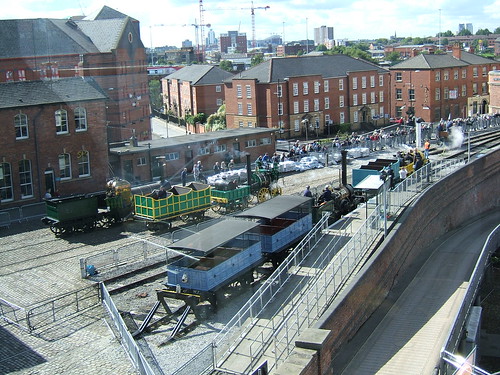
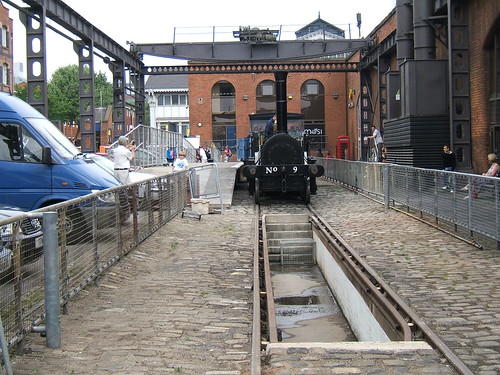
In 2009, it was decided to re-instate the running line to its original length. The original running line and the third siding had been lost during the car park extensions but the siding nearest the Power Hall (with the all-important Inspection Pit) remained. A new single platform was built on the car park side of the remaining siding, as shown below.

'Planet' standing at the platform now in use, with the Inspection Pit in the foreground.

In August 2009, 'Planet' welcomed a number of visiting locomotives during the 'Transport Festival'. There's a report hete

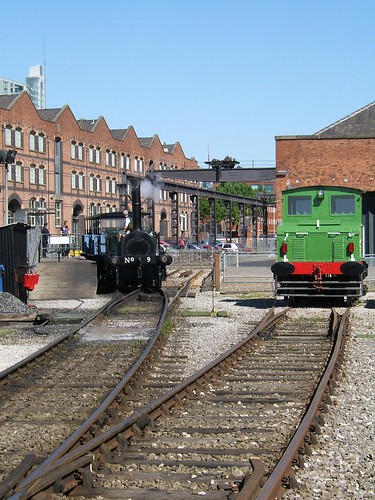
During the Transport Festival, 'Planet' hauls the passenger train, passing the 1879-built Beyer Peacock works shunter.

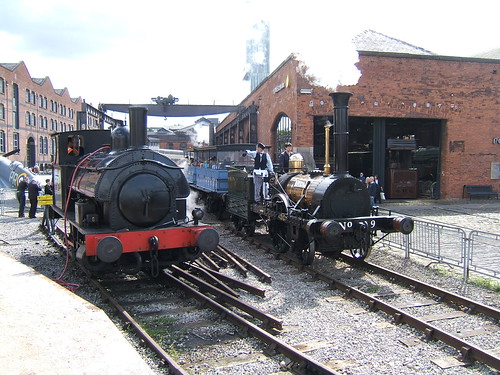
In 2010, a somewhat less-ambitious gala, featuring the 'Planet' replica and National Railway Museum's 'Rocket' replica, commemorated 180 years of the Liverpool and Manchester Railway. See my set of photographs titled Liverpool & Manchester 180th.

The 'Rocket' and 'Planet' replicas celebrate the Liverpool and Manchester Railway's 180th Birthday.

Out and about

Over the years, 'Planet' has made a number of visits to other sites, including Llangollen, Locomotion, Beamish, Great Central and National Railway Museum York. The only visit I was personally involved with was to York, which was great fun.

Still going strong

Any steam locomotive requires quite a lot of maintenance but, given that attention, a locomotive can have a long life. We look forward to 'Planet' continuing to thrill people with the "magic of steam" for a long time to come.

'Planet' on the 'Pineapple Line'.

Related posts in this blog

Early Locomotive Design.
The Planet Replica.

My Pictures

'Planet'.
Museum of Science and Industry, Manchester.
Liverpool & Manchester 175th.
Liverpool & Manchester 180th.
2009 Transport Festival.

Saturday, 12 October 2013

Another Saturday in Manchester

In the earlier post A Saturday in Manchester I briefly described working on the steam railway at the Museum Of Science and Industry (MOSI) in Manchester on 8th June 2013. There are also later posts describing working on 27th July (A Busy Week) and on 10th August (Manchester Mini Maker Faire 2013). I was back again on Saturday 5th October 2013, rostered as the 'Planet' driver.

Alan took me to Wolverhampton station in time for the direct 'Voyager' service to Manchester at 06:49 operated by Cross Country. However, when the earlier 06:37 Edinburgh service operated by Virgin arrived, I decided to take it as far as Warrington (Bank Quay), changing there to an Arriva Trains Wales train to Manchester (Oxford Road). The last time I took this route was on 27th July 2013 (A Busy Week) when the Edinburgh train was operated by a 'Pendolino' but in October a 'Voyager' had been substituted, presumably because we'd entered the 'Low Season'.

Waiting on Platform 4 at Warrington (Bank Quay) for the Manchester service.

The Arriva Trains Wales service was a few minutes late at Warrington, but that time was recovered on the way to Manchester. In fact, as often happens, we were brought to a stand in the platform at Deansgate, waiting for the signal to clear allowing us to proceed to Platform 4 at Oxford Road. This was slightly galling, because Deansgate is the nearest station to the Museum but, not being booked to stop at Deansgate, the train doors remained closed. Despite the signal check, our arrival at Manchester (Oxford Road) was 'right time', so I walked to the adjacent bay platform (Platform 5) and caught the 08:15 'Pacer' service to Liverpool which carried me back to Deansgate.

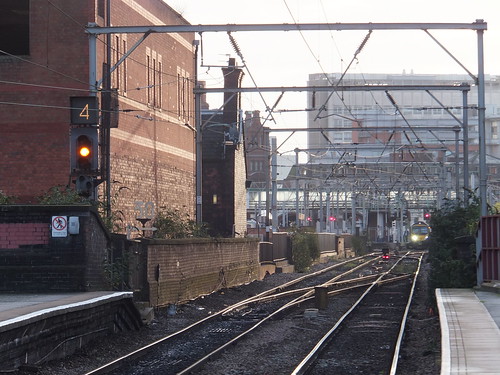
On alighting at Deansgate, this was the view looking back towards Oxford Road.

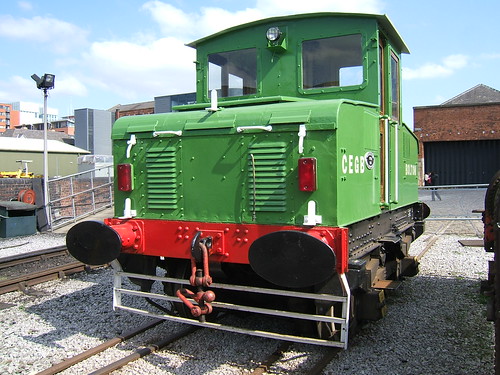
We always have four volunteers rostered to run the live steam operation - on this occasion it was Peter (Operating Officer), Jan (Driver), Mike (Fireman) and Adrian (Guard). We started off by retrieving 'Planet' and its two 1830 coaches from the Power Hall and positioned them temporarily on the running line next to the oil store using the Battery Electric Shunter (my pictures of the Battery Electric Shunter are here) so that we could start 'Preparation' of the locomotive. Once I'd collected the oil supply and Mike had done his initial checks and lit-up, we propelled the locomotive and coaches to the platform, with the back coach adjacent to the platform (to assist the Guard) and the locomotive over the pit (to assist the driver). Then Peter moved the Battery Electric to the Power Hall road, but inside the railway 'compound' which is fenced-off from the public areas, and 'tied it down' until it was required again at the end of the day.

The Battery Electric Shunter secured inside the railway compound until the final shunt at the end of the day.

Mike polished the engine whilst carefully building up his fire, I 'oiled round' and carried out the Daily Examination and Peter carried out his track inspection, including the 'Pineapple Line' (which forms a 'Y' with our 'Main Line') and 'Clipped, locked and scotched' all the hand points on our route.

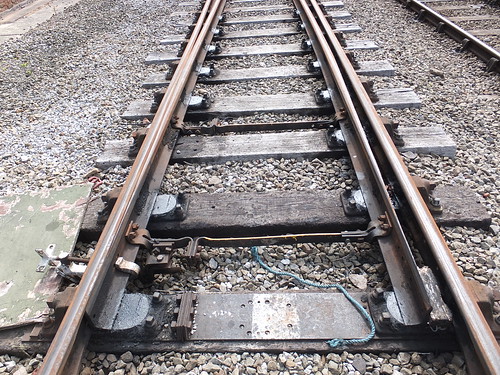
A set hand points 'Clipped, locked and scotched'. The white-painted clip (a bit like a G-clamp) and lock are on the left, the wooden scotch is on the right. These particular points use flat-bottom rail, but older points at MOSI use bull-head rail.


Once Mike had produced working pressure, we carried out a test run, without passengers, to make sure everything was satisfactory. 'Planet' can be relied upon to eject copious amounts of dirty water from the chimney during this trip (another reason to make the run without passengers). Mike had 'Planet' in steam nice and early, allowing us to carry out the first run with passengers before noon (our advertised starting time). The day was dry and there were plenty of passengers keen to make the trip.

The only set of points we'd need to alter during the day was the turnout at the Ground Frame giving access to the Pineapple Line. The 2-lever Ground Frame (labelled 'Ordsall Lane No. 1, in commemoration of the signal box which once stood nearby) is released by an Annett's Key forming part of the Single Line Train Staff (usually just referred to as the 'Staff'). When carried on the engine, the Staff is the driver's authority to move and the Ground Frame points cannot be moved. During the day, each time the train arrives at the Ground Frame (with the whole train clear of the Pineapple Line points), the fireman leaves the engine with the Staff, releases the Ground Frame and changes the points as required, before locking the Ground Frame and returning to the footplate with the Staff. Only when the Staff and the Fireman are back on the footplate and the Guard has given a 'Rightaway' is the train allowed to move.


The Ground Frame: The Train Staff has been inserted into the lock behind the blue lever, allowing the blue facing point lock lever to be pushed back to the 'Normal' position. This has released the black point lever which has been pulled to the 'Reverse' position, setting the points towards the Pineapple Line. Next, the blue lever will be pulled 'Reverse', locking the points and allowing the Staff to be removed.

On each trip we left the platform and passed through the Museum, always watched keenly by Museum visitors safely outside the railway compound. The line runs between the 1830 Warehouse and the Coaching Shed, then passes the 1830 Booking Offices and Stationmaster's House, crosses over Water Street on a bridge, and continues over Stephenson's original Irwell Bridge to the Ground Frame. Once the train had come to a stand at the Ground Frame next to the Network Rail line, the fireman reversed the points as described above, allowing 'Planet' to propel its train onto the Pineapple Line which curves around the back of the 1830 Warehouse, supervised by the Guard in the rearmost compartment. 'Planet' then drew its train forward to the Ground Frame, the fireman restored the points to the 'Main Line' and the coaches were propelled back to the platform where the passengers disembarked. Our last trip was the 14th of the day and we set off, as advertised, at 4.00 p.m.

Our remaining task was 'Disposal'. Having unloaded the train, we drew forward to the Disposal Point, near the oil store. Mike used a fire-iron to 'Knock-out' the remains of the fire through the gaps in between the fire-bars into the ashpan, whilst I opened the ashpan door and raked out the ash, with the aid of a hose to control the dust. Meanwhile, Peter had attended to the various railway gates, unlocked the hand points giving access to the Power Hall sidings and shunted the Battery Electric locomotive onto 'Planet'. I then took over the Battery Electric, draw the train back clear of the Power Hall points and, once Mike had changed the points, propelled the lot gingerly into the Power Hall for the night, supervised by Peter 'on the floor'. Mike used the remaining steam to fill the boiler using the injector and, after carrying out the various end-of-service checks, the job was done.

Preparation and Disposal

All locomotives require getting ready prior to entering traffic ('Preparation') and placing in a safe state at the end of traffic ('Disposal'). Although the same principles apply, detailed procedures vary from locomotive to locomotive. There are descriptions of Preparation of more modern steam locomotives in the posts Driving Turn at Peak Rail - Part One: Preparation, Preparation of Locomotive 'Sapper' and Disposal is outlined in the post MIC - Disposal.

Happy Birthday Planet!

I found it hard to believe that the 'Planet' replica has now been in operation for 21 years. The official launch by the Lord Mayor of Manchester, Councillor William Egerton took place on 2nd October 1992! There's more about the 'Planet' replica and the design of the original 1830 locomotive here.

The Future

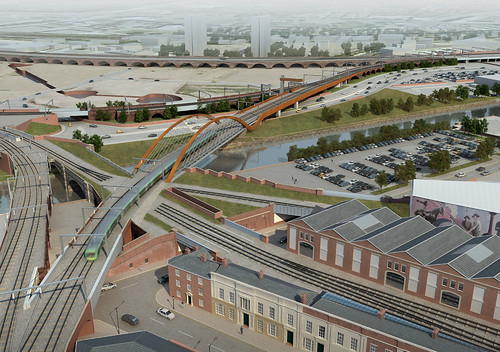
In the post A Saturday in Manchester I mentioned two threats to the future of the railway MOSI - Network Rail's proposed Ordsall Chord and the Science Museum Group finances.

Although the Museum has formally registered objections to the Network Rail proposals, the threat is undiminished. The Draft of the Statutory Instrument to authorise the work is available as a PDF here. Network Rail have also 'refined' their Computer Generated Image of the proposal.

Original Computer Generated Image of the proposal.

'Refined' Computer Generated Image of the proposal.

The immediate threat of closure of the Museum has diminished but, as re-organisation continues, it's sad to report that a number of members of paid Museum staff have lost their jobs.

External websites

Ordsall Chord (Network Rail).
Ordsall Chord (Wikipedia).

Pictures

Warrington Area rail
Manchester Area Rail
'Planet'
Museum of Science and Industry

Thursday, 10 October 2013

The Planet Replica

Introduction

The 'Rocket' (built 1829) is the locomotive which everyone has heard of but the 'Planet' class, which followed less than a year later, represented a significant maturing of the principles first brought together in the winner of the Rainhill Trials.

On 2nd October 1992 the Museum of Science and Industry in Manchester brought into service its 'Planet' replica, at an official launch by the Lord Mayor of Manchester, Councillor William Egerton.

'Planet' with M.S.& L. 'Tri-composite' and replica 1830 coach after the official launch (Picture: Steam Railway News).

A number of private steamings for the Sponsor, British Engine Insurance, followed. The 'Planet' replica entered public revenue service for the 'Railway Weekend' on 31st October and 1st November 1992.

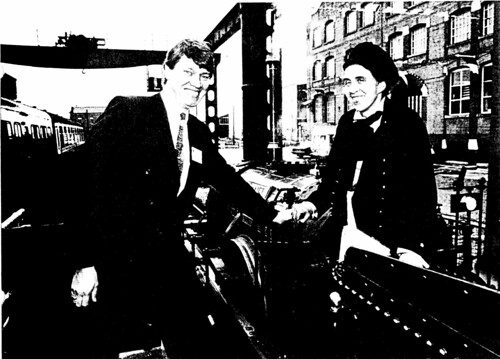
The 'Planet' replica during a private steaming for the Sponsor, British Engine Insurance, October 1992. On the left, the Public Relations Manager for British Engine Insurance, on the right, Jan Ford.

To celebrate the achievement, the January 1993 edition of 'Lionsheart' [see Note 2] included the article "Planet Steams Again" under the nom-de-plume '41901'. This post is based on that article, with minor changes to accommodate placing on the Internet.

"Planet Steams Again"

Dr. Richard Hills, former curator at Liverpool Road Station, Manchester is quoted in the July 1984 'Railway World', when talking about the building of replica 1830 coaches, as adding "One day, if finances allow, the dream might be realised of building a replica locomotive of the same period to go with the coaches".

The Liverpool Road site has now become the Museum of Science and Industry in Manchester - one of Europe's premier science museums - and, with the assistance of the Museum Friends, British Engine Insurance and others, that dream has now been realised.

The direct descendant of 'Rocket' was the 'Northumbrian', illustrated in the Shaw print below [see Note 1].

Shaw: Plate IV The Northumbrian Engine.

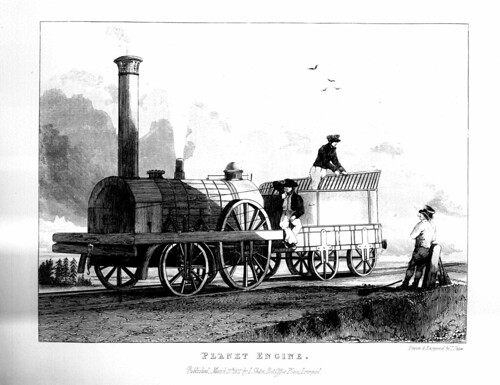
But the Shaw print of 'Planet' below [see Note 1] shows the new direction upon which locomotive design embarked.

Shaw: Plate VIII Planet Engine.

The single driving axle was retained (and this remained a feature of fast, free-running engines for many years) but the outside cylinders were moved inside. The position of the cylinders was also moved from the rear of the locomotive to the front, so the 0-2-2 wheel arrangement of 'Rocket' and 'Northumbrian' became 2-2-0 in 'Planet' Probably the strongest motive for this change was the increased efficiency possible through enclosing the cylinders within the smokebox, enabling the cylinders to be kept warm. A consequence of the inside cylinders was the need for a cranked driving axle and, with 1830s technology, this presented serious manufacturing problems. Broken crank axles plagued railways for years to come.

The crank axle on 'Planet' was provided with inside bearings but, for the first time, a substantial wooden frame appeared, allowing the use of outside bearings as well on the driving axle.

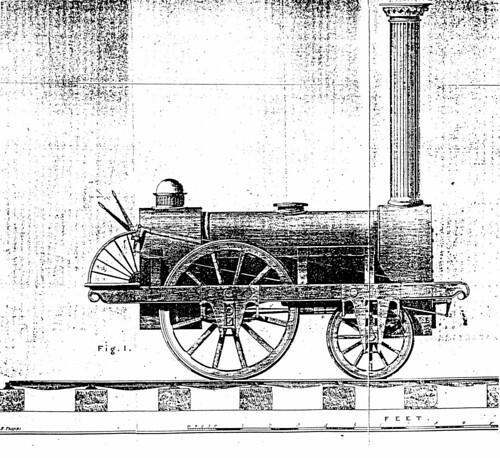
Care is necessary when studying early reports and illustrations. Many misunderstandings arose, particularly when artists who were unfamiliar with railway equipment attempted to represent these novel inventions. The attractive, but perhaps imaginative view of 'Planet' reproduced below forms the frontispiece to the second edition of 'A Practical Treatise on Railroads' by Nicholas Wood, published in 1832. However, in another context, Zerah Colburn sharply comments, in his own work 'Locomotive Engineering and the Mechanism of Railways', "It is of course possible too, as was the case with nearly all the illustrations of Mr. Wood's book that ...(it)... was not accurately drawn".

'Planet' from the frontispiece to the second edition of 'A Practical Treatise on Railroads' by Nicholas Wood, published in 1832.

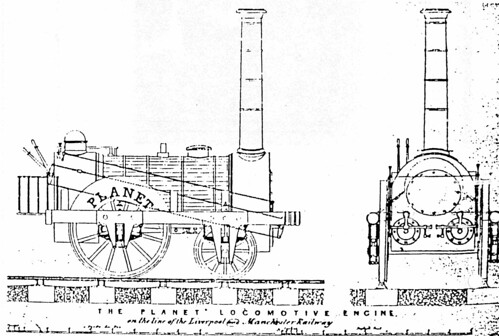
The undated lithograph of 'Planet' below gives a good overall impression of 'Planet'. In this diagram, 'Planet' has a splasher displaying the locomotive name.

'Planet' from an undated lithograph of published by Geo. Smith, Liverpool, now in the Liverpool Public Library.

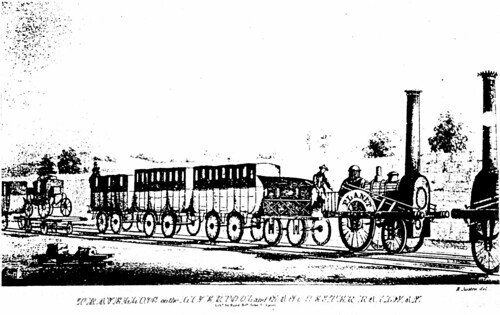
The splasher is also shown in the contemporary lithograph below (which appears in 'The British Railway Locomotive 1803 - 1853, published by the Science Museum).

Stephenson's 'Planet' 2-2-0 i.c. locomotive, Liverpool and Manchester Railway, 1830. From a contemporary lithograph by H. Austen.

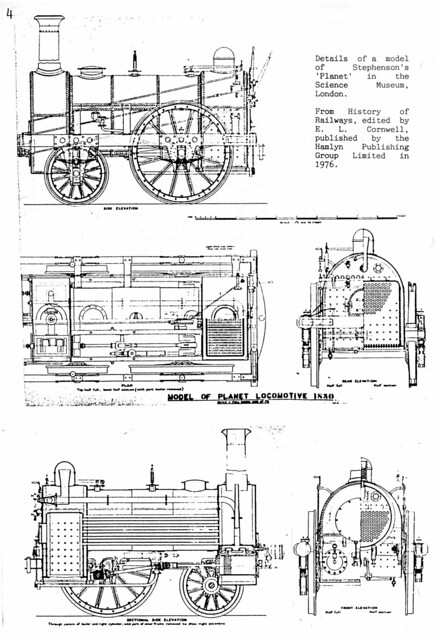
I believe that the model of 'Planet' at the Science Museum also features the splasher, although they are not shown on the drawing below which purports to show the Science Museum model. With part sectional views, there's plenty of constructional detail to be studied.

Details of a model of Stephenson's 'Planet' in the Science Museum, London. From 'History of Railways', edited by E. L. Cornwell, published by the Hamlyn Publishing Group Limited in 1976.

In general, other sources do not show 'Planet' with splashers. It has to be understood that locomotives of this period could vary in appearance during their lifetime. When a locomotive went in for 'shopping', it was taken down to its constituent parts, many of which might be replaced. Different ideas might be tried out, changing the appearance of the locomotive. Only partial records remain of all this work and it is difficult to be certain of the detailed history of locomotives of the period. This is certainly the case with 'Lion', first built in 1838. Debate still exists about the age of the various parts!

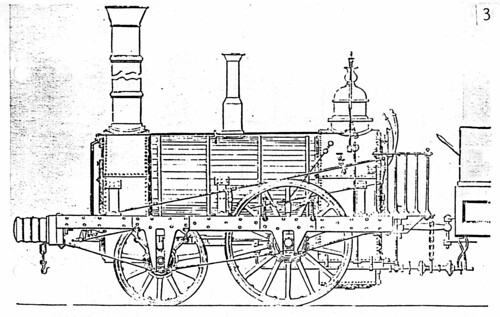
The diagram below is from Zerah Colburn's book [Reference 4]. This shows one of the later 'Planet' class locomotives built by Fenton, Murray and Jackson in 1834. The 'Planet' replica at the Museum of Science and Industry is quite similar, but there are detail differences.

Passenger locomotive by Fenton, Murray and Jackson, 1834. General type of the 'Planet' class.

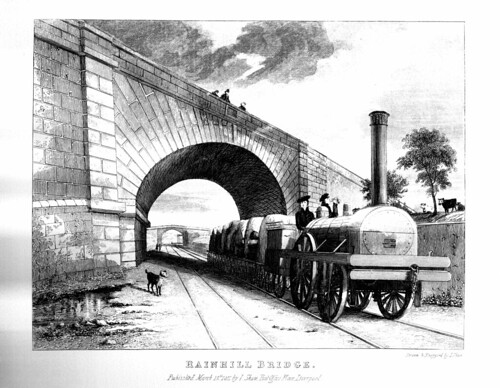
Below is another Shaw print [see Note 1] depicting 'Planet' passing the famous Skew Bridge at Rainhill.

Shaw: Plate VII Rainhill Bridge.

One curious detail on both of Shaw's 'Planet' views is the small, hinged door on the smokebox front. Artistic license? Certainly, with about 12 bolts securing what is quite a heavy smokebox front, regular removal of smokebox char is hardly encouraged!

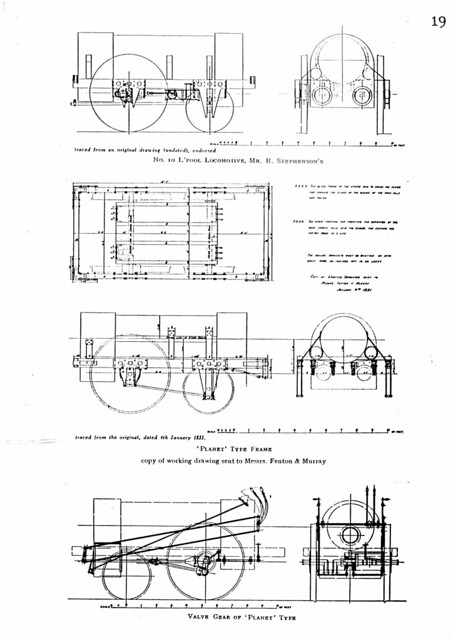
J.G.H. Warren's book [Reference 2] has some fascinating details of the design of 'Planet'. With his access to the manufacturer's records, these are probably the most accurate source we have and three pages of diagrams taken from Warren's work follow.

Page marked '16': This has overall views and sections. The original 'Planet' boiler was very satisfactory and the construction is made clear in the diagrams which were derived from the earlier publication 'Treatise on Locomotive Engines' by De Pambour published in 1836. The 'Planet' replica is generally similar in appearance.


Page marked '19': This shows, at the top, a tracing of the original drawing in the records of the manufacturer. Below are plan and elevation of the 'PLANET' TYPE FRAME. The driving axle had six bearings - two on the outside frames and four on the inside frames. The diagram at the bottom of this page shows the 'Planet' motion. There were slip eccentrics to control the valve on each cylinder. By operating a foot treadle, the driver could set the eccentrics for forward or backward motion. This rather inconvenient arrangement has been described in 'Lionsheart [Reference 1]


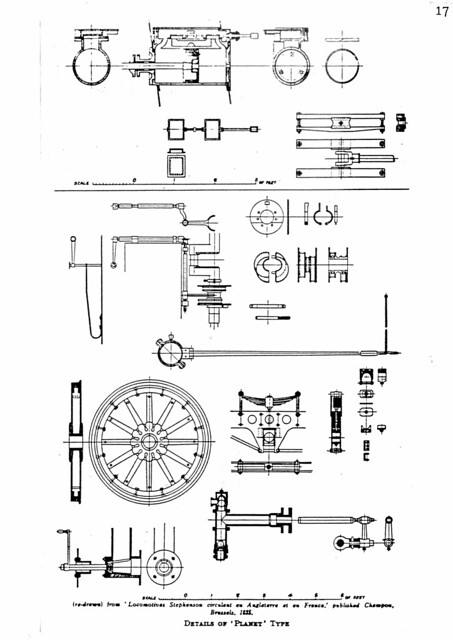
Page marked '17': This page has a feast of details. In this case, Warren drew on 'Locomotives Stephenson circulant en Angleterre et en France' by Champon, published in Brussels in 1835. At the top of the page is the detail of the cylinder, with the slide valves working horizontally above the cylinder. Immediately below are details of the valves, valve rod, slide bars and crosshead.

The two slip eccentrics are shown towards the middle of the page, together with the linkage from the foot treadle on the footplate which slides the eccentrics across the crank axle so as to engage in either the forward or backward position. Underneath is shown one of the two eccentric straps, hinged at its point of attachment to the eccentric rod. The vertical lifting link attached to the right of the eccentric rod is used to disengage the eccentric rod from the valve rod, allowing the valves to be set by hand for starting.

Lower down is the detail of a wheel, showing the bolted-on type. Next to the wheel are shown details of the axlebox and its method of attachment to the frames via the laminated spring.

The simple regulator valve is shown bottom left. This view can be usefully compared with a somewhat later type shown in 'Lionsheart' [Reference 5].

Finally, the crosshead-driven force pump used for the boiler feed is shown bottom right. Water at the bottom connection of the pumps is drawn into the chamber via the lower ball valve when the piston moves to the right. When the piston moves left, the lower ball valve closes and the upper ball valve is unseated, allowing the water out of the upper pump connection and into the boiler.


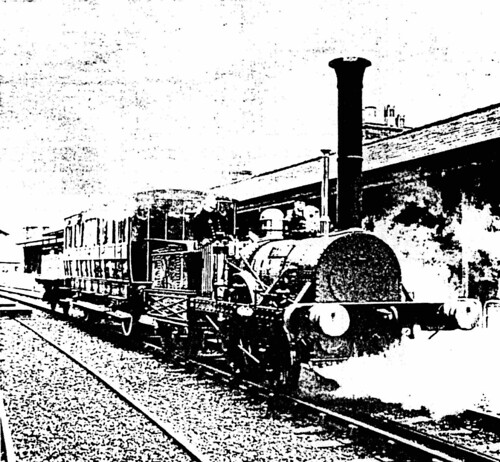
'Planet' class locomotives were exported. The ancient photograph below (from 'The Pictorial Encyclopedia of Railways' by Hamilton Ellis, published by Paul Hamlyn, 1968) shows the 'Pioneer' of the Bangor & Piscataquis Railroad, U.S.A., built by Robert Stephenson in 1836. This is possibly the only photograph ever taken of this type in service. The smokestack, whistle on the dome and bell were doubtless later American additions.

'Pioneer' of the Bangor & Piscataquis Railroad, U.S.A., built by Robert Stephenson in 1836.

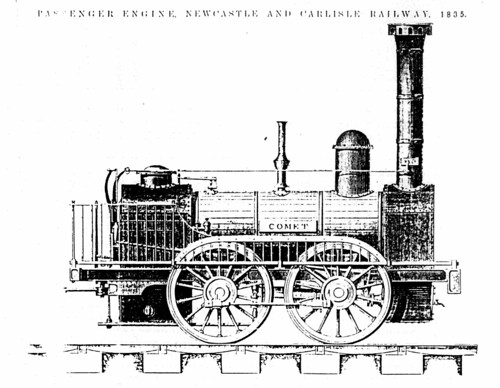
Adhesion is frequently the limiting factor on a locomotive. With a single driving axle, not all of the locomotive weight can be adhesive. In the case of the 'Northumbrian' class, there was about 4 tons on the driving axle. The 'Planet Class pushed this figure up to about 5 tons, with about 3 tons on the carrying axle. For freight and banking purposes, it was desirable to make all the weight adhesive. Thus a four-coupled version of 'Planet' appeared in 1831, starting with 'Samson' (which gave its name to the class) and 'Goliath'. More four-coupled locomotives followed. The drawing below shows the four-coupled 'Comet', produced in 1835 by Messrs. R & W. Hawthorn of Newcastle-upon-Tyne for the Newcastle and Carlisle Railway.

Passenger Engine, Newcastle and Carlisle Railway, 1835.

Any four-wheeled locomotive will have a rather uncertain gait when at speed and so it was logical that the effect of carrying wheels at the reat of the locomotive should be tried. In a single-driver, this produced a 2-2-2, in a four-coupled design, an 0-4-2 (like the 1838 'Lion'). The improved riding was very favourably received and greater design flexibility resulted as engines became larger and power increased. The iconic 'Patentee' class had been born. On some designs, the wheels on the centre axle lost their flanges to facilitate rounding curves but attention to correct end-play of wheel sets in the frames allowed designs which could negotiate curves whilst retaining flanges on all wheels.

The development of locomotive design has been dealt with by a host of authors. The works of Ahrons are best known but Clement Stretton's book [Reference 3] is also worth reading. However, this last author published the notorious drawing of 'Planet' in her supposed original condition, with a low-slung outside frame passing underneath the driving axlebox. Warren discounts this arrangement, believing it to stem from early proposals never implemented. Caution is needed in assessing the accuracy of different sources.

But, beyond any doubt, the 'Planet' class marks a very important phase in locomotive history and we welcome the Manchester replica as filling the slot between 'Rocket' and 'Lion'.

Notes

[Note 1] The Shaw Prints, together with the Ackermann Prints are two of the best sources of contemporary images of the Liverpool and Manchester in its early days. Photography was only just emerging from the experimental stage so artists produced drawings on site which were then turned into engravings which could be printed and sold to an interested public. The Shaw Prints in this article are taken from a splendid facsimile published in 1980 by Hugh Broadbent, Oldham, to celebrate 150 years of the Liverpool and Manchester.

[Note 2] 'Lionsheart' is the Occasional Newsletter of the Old Locomotive Committee, also called 'OLCO' the "Supporters' Club" for the 1838 locomotive 'Lion'. There are an number of posts about 'Lion' and 'OLCO' in this blog - you can find them all here. 'OLCO' also has its own website here.

References

[1] 'Valve Motions', LIONSHEART, May 1992.
[2] 'A Century of Locomotive building by Robert Stephenson & Co. 1823 - 1923' by J.G.H. Warren.
[3] 'The Development of the Locomotive - A Popular History 1803 - 1896 by Clement E. Stretton.
[4] 'Locomotive Engineering and the Mechanism of Railways A Treatise on the principles and construction of the locomotive engine, railway carriages and railway plant' by Zerah Colburn.
[5] 'LION The Questionable Origin of her Boiler', reprinted in LIONSHEART, September 1992.

Drawings and Pictures

'Planet'
Museum of Science and Industry (includes pictures of 'Planet').
Liverpool & Manchester 175th (includes pictures of 'Planet').
Liverpool & Manchester 180th (includes pictures of 'Planet').
'Planet' Drawings
Shaw: Views of the Liverpool & Manchester Railway