Wednesday, 28 August 2013

A Heavy Load

I was steam driver on 'Lord Phil' at Peak Rail on Saturday, 17th August 2013, with Dave as fireman. The day started with a two-hour 'Driving Experience' course, running light engine between Darley Dale and Matlock river bridge. There's an earlier post here which gives an idea of the format of a 'Driving Experience'. Our trainee seemed well pleased when we left him on the down platform at Darley Dale at 10.45 a.m. and scuttled light engine up to Rowsley to pick up our train.

A couple of weeks before, I'd been driver on one of the days of the '1940s Weekend' (described here) when we were at the north end of a 7-coach train top-and-tailing with 'Penyghent' at the south end.

On the 17th August, we were again working a 7-coach train with 'Penyghent', but the locomotives had resumed their customary positions with 'Lord Phil' at the south end hauling the train to Matlock (Town) and 'Penyghent at the north end taking us back to Rowsley.

The weather was fairly good, with the occasional shower of rain, and there seemed to be plenty of passengers.

During the day, we were informed that the 'Class 31' was required to haul the train on a test run, presumably following repairs. One possibility was for the 'Class 31' to deputise for 'Lord Phil' on the last round trip (giving the steam crew an 'early bath'). However, the solution adopted was to couple the '31' on top of 'Penyghent' for the 3.00 p.m. departure from Rowsley, allowing the '31' to work the train back from Matlock (Town) to Rowsley. This meant that 'Lord Phil' had to first take the train (comprising seven coaches, 'Penyghent' and the '31') from Rowsley to Matlock (Town).

The Guard gave the load which 'Lord Phil' had to shift as 486 tons - heavier than normal but well within the capability of an 'Austerity' tank. The 'Austerities' are powerful locomotives capable of shifting well over 1,000 tons. What I was not quite sure about was whether we'd be able to keep to time. Well, we actually arrived at Matlock (Town) one and a half minutes early.

The 3.00 p.m. from Rowsley passes through Matlock Riverside, showing the two diesel-electric locomotives hanging on the back.

The '31' took the train back to Rowsley without incident and then uncoupled and returned to shed, leaving 'Lord Phil' and 'Penyghent' to do the final round trip of the day.

The 'Class 31' entering Matlock Riverside, on its test run back to Rowsley.

We brought the engine on shed for disposal and, immediately, the heavens opened so that we had driving rain to add to the normal problems of disposal. There's a post describing disposal here. As often happens, once we were wringing wet, the rain stopped.

Tuesday, 20 August 2013

Travelling on the Qinghai - Tibet Railway

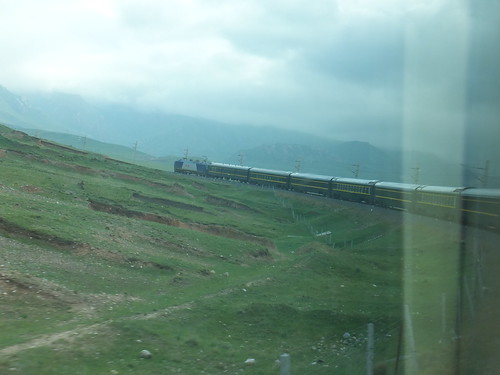
On 11th July 2013, I boarded a train at Xining West in China to travel to Lhasa (arriving the next day). I've already described the first part of the journey in a post here and the final part of the journey (the following day) here. In this post, I'll add information of a more technical nature. All my pictures taken on the journey are in the set QingHai - Tibet Railway.

The train I travelled on was the K917 which had left Lanzhou, 228 km east of Xining, at 12:08.

The timetable for this train is given below. We also made brief stops at a few stations not shown in the timetable.

Station Distance* Arrive Depart
Xining West - 14:44 15:04
Delingha 509 20:49 20:55
Golmud 818 00:19 00:39
Anduo 1512 08:39 08:41
Naqu 1638 09:59 10:05
Dangxiong 1796 11:54 11:56
Lhasa 1960 14:35 -

* Distance (in km) from Xining West.

Summary

Putting aside political considerations, it must be said that the railway to Tibet is a remarkable engineering achievement. To construct a railway in such an inhospitable area required great determination. The electrified section from Xining to Golmud was completed in 1984 (and it's double-track as far as Tempung) but the single-track non-electrified extension from Golmud to Lhasa was only finished in 2006. Almost half the length of line between Golmud and Lhasa is laid on Permafrost. In general, the line speed limit is 120 km/hr (75 m.p.h.) but this is reduced to 100 km/hr on the permafrost sections. The railway appears well-engineered and fairly carefully executed.

At Tanggula, the railway is at the highest elevation of any railway in the world at a little over 5,000 metres. In fact, 80% of the line from Golmud to Lhasa is above 4,000 metres, significantly reducing oxygen levels and, for this reason, the passenger coaches are fully sealed and oxygen is carried. There's an interesting (if frightening) article about altitude sickness here.

The route required a number of tunnels and Fenghuoshan Tunnel (1,338 metres long) at an elevation of 4,905 metres is the highest railway tunnel in the world.

The People's Republic of China and the Soviet Union co-operated quite closely following World War II, so it's unsurprising that the railways in China show many similarities with Russia's railways, which I had an opportunity of studying during my trip on the 'Golden Eagle' private train (described here).

At the end of this post, there are some sites linked which give a little more information about railways in China and Tibet. Tibetan place names along the railway are now generally rendered in Chinese characters. When these characters are converted into English letters, a variety of spellings can result so I'm still rather confused about the identity of some of the places I passed through.

Electric Locomotives

I wasn't able to go onto the platform at Xining West until the train had already arrived and I didn't have an opportunity to confirm the motive power before we departed. After about three hours, when our route executed sharp curves, I finally could see that, as anticipated, we had electric haulage by one of the modern 'Harmony' HX-series Co-Co 25kV a.c. locomotives. These locomotives are either imported or built in China under technology transfer agreements. The other trains we passed were hauled by similar 'Harmony' locomotives or the earlier 'Shaoshan' SS-series locomotives.

The 'Harmony' HX-series electric locomotivewhich hauled my train to Golmud.

There's more information about electric locomotives in China here.

Diesel-Electric Locomotives

Chinese-built

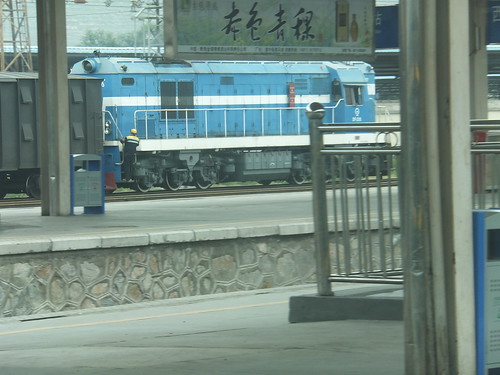
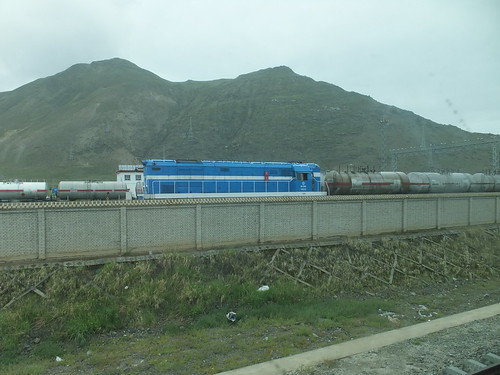
There's more information about diesel-electric locomotives built in China here.

Co-Co diesel-electric locomotive shunting at Xining West.

Co-Co diesel-electric locomotive DF_1309 near Lhasa.

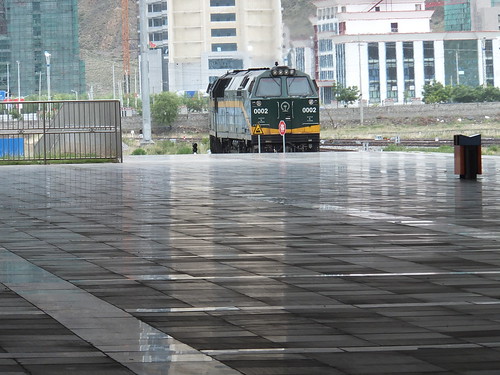
Imported NJ2

The NJ2 diesel-electric locomotives used on the Golmud-Lhasa section were built by GE-Transportation in the United State, as their type C38AChe. The 78 units have running numbers NJ2 0001 to NJ2 0078. A driving cab is provided at one end only and the units are intended to operate as 38 2-section locomotives.

An NJ2 unit weighs-in at 136 tons so, even using a Co-Co layout with two six-wheel trucks, axle loading is 23-tons. Since GE locomotives normally use four wheel trucks, the bogies for the NJ2 locomotives were made by United Gonivan in New South Wales, using a well-established design with a fabricated (rather than cast) frame.

The engine is a variant of the successful four-stroke turbo-charged 7FDL16 diesel engine (arranged 8+8 cylinder V-formation) as used in the GE 'DASH' series. The engine brochure gives a maximum engine power of 3355 kW although other sources quote 3,800 kW for the NJ2 power plant. Of course, reduction of air supply at high altitude affects diesels (as well as people) - high-output diesel engines depend on the turbo-charger even at low altitudes to provide sufficient combustion air.

A scale model of a single NJ2 unit on display in Shanghai Railway Museum.

On arrival at Lhasa, I walked to the front of the train hoping to get a picture of our motive power but the twin-unit was already uncoupled and moving off down the headshunt.

The pair of NJ2 locomotives which hauled my train to Lhasa.

Civil Engineering Works

Even with the benefit of modern machinery, the constructional problems must have been daunting. Embankments, cuttings, bridges and tunnels were required, together with stations and other buildings required by the railway. Later in my trip, I saw something of the work in progress building the new railway from Lhasa to Shigatse, which is presenting similar problems. This gave me a better insight into the building of the line I travelled on to Lhasa.

The railway is fenced. On the Xining - Golmud section, this was generally a series of concrete posts with metal sections fixed between each pair of posts. Each metal section comprised a rectangular frame of welded tubes supporting a panel of steel mesh. The whole metal section was then painted green. In the mountain section, I saw some simpler post and wire fencing. Beyond Golmud, instead of the metal sections, a pre-cast concrete panel, also mesh-covered, is used.

Metal section fencing near Lake Qinghai.

Beyond Golmud, instead of the metal sections, a pre-cast concrete panel, also mesh-covered, is used.

Concrete section fencing beyond Golmud.

Overhead 25 kV a.c. Electrification

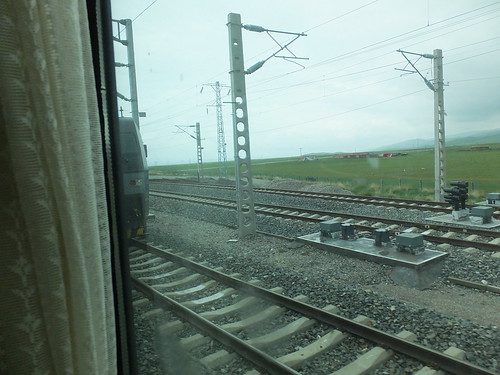
On 'plain line', pre-cast concrete masts are commonly used.

Reinforced Concrete Masts supporting the Overhead Line.

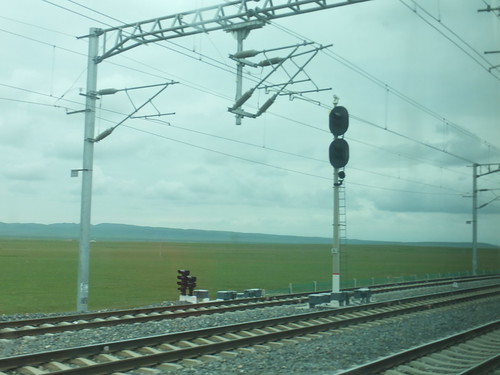
In the vicinity of stations and where there are additional running lines, steel portal structures of various designs are used. Some have rectangular fabricated masts and rectangular trusses but there are also types with tubular masts and triangular trusses.

Portal Structure featuring tubular mast and triangular truss.

Traction substations are conventional in appearance and appear to take in power from the National Grid.

Traction Substation

Permanent Way

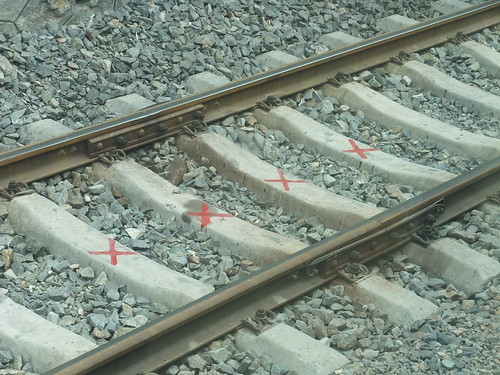
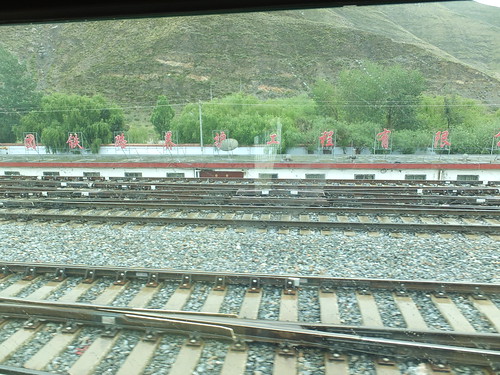
Flat-bottom rail, pre-cast concrete sleepers and modern rail fixings are set in deep ballast giving an excellent ride. Continuous Welded Rail is generally used on 'plain line' (certainly Xining West to Tempung) and 6-hole fishplates on jointed track. Turnouts are of substantial construction and cast crossings are employed with heavy-duty check rails.


Concrete sleepers, flat-bottom rail, modern rail fixings and 6-hole fishplates (Xining West).

Cast Crossing and Heavy-duty Check Rails (approaches to Lhasa).

Distance and Gradient Markers

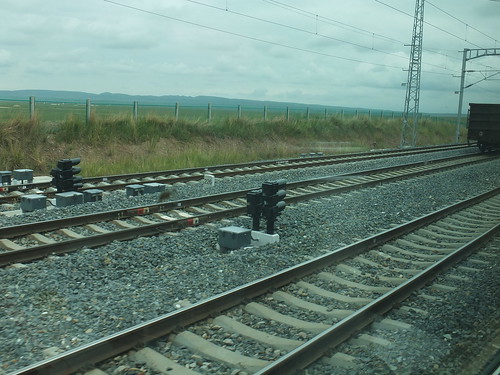
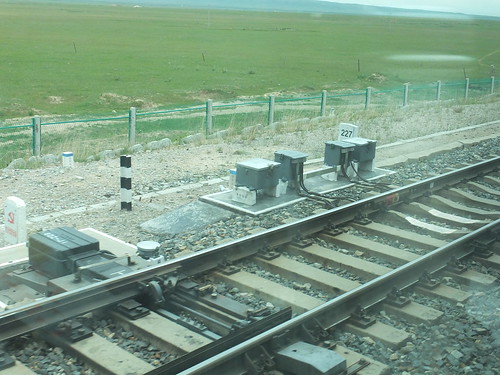
These markers are pre-cast tablets. Distance markers show distance in kilometres from Xining West. Intermediate 100 metre markers are also seen. Gradient markers are also tablets, with an arrow to indicate 'Up' or 'Down' and a figure which I believe represents 'rise or fall per thousand'. There are pictures showing the Kilometre Markers for kilometres 226 and 227 in the section below on signalling equipment.

Signalling Equipment

I was impressed (as I was in Russia) at the neatness of the layout of the signalling equipment. Electric point machines (of a very compact design) are used for point operation. Track circuits appear to be generally used for train detection. Running and shunting signals are all colour light. A standardised rectangular signalling equipment room is widely used (often to be seen at each end of a station near the points and signals controlling entry to a number of passing loops). I believe some form of Centralised Traffic Control is in use, possibly based in Xining.

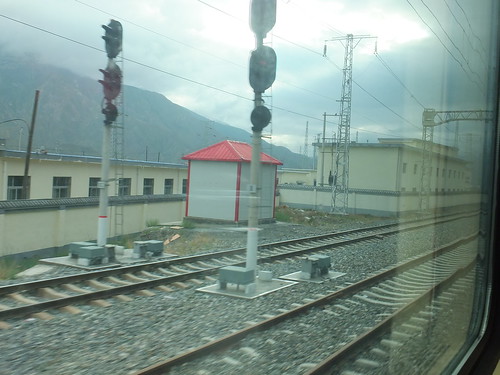
In the section above on 'Overhead 25 kV a.c. Electrification', there is a picture showing a 3-aspect ground signal (apparently with a smaller subsidiary aspect below) and a high-level signal comprising two 2-aspect signal heads with a subsidiary aspect below.

Signalling equipment at east end of Niao Dao, showing colour light ground signals, housings for signalling and track circuit equipment and insulated rail joints. Kilometre Marker '226' is also visible.

Signalling equipment at west end of Niao Dao, showing point machine, housings for track circuit equipment and insulated rail joint. Kilometre Marker '227' visible on right. Marker with red lettering on left (possibly a cable marker).

Picture showing two high-level signals. The red-roofed building is a standard signalling equipment room. Traction Sub-station on the right.

The railways of 25 countries are members of OSShD - the Organisation for the Combined Operations of Railways. This seeks to standardise practices in member countries and affects about one third of the railway route mileage in the world. Since Russia, China (and Vietnam) are members, similar methods of signalling are used in each of these countries.

References

Rail transport in China (Wikipedia).
List of railway lines in China (Wikipedia).
Qinghai–Tibet Railway (Wikipedia).
List of stations on Qinghai–Tibet Railway (Wikipedia).
Lhasa–Shigatse Railway (Wikipedia).
China Railways Map.
China Tibet Train (with map).
China Train Guide (Travel agency).

Locomotives in China

List of locomotives in China (Wikipedia).
Chinese diesel locomotives (Railways of China).
Chinese electric locomotives (Railways of China).

Railway Signalling in China

Signals at China Rail (Hans Schaefer).
Chinese Railway Signals (refers to Hans Schaefer site).
OSShD Signals.

Tuesday, 13 August 2013

Manchester Mini Maker Faire 2013

The second Manchester Mini Maker Faire was held at MOSI on Saturday 10th and Sunday 11th August 2013. 'Maker Faires' are events created by Make magazine in the United States to "celebrate arts, crafts, engineering, science projects and the Do-It-Yourself mindset". Independently organised Faires (like the one in Manchester) are called 'Mini Maker Faires'. There's a (very brief) report on the first Mini Maker Faire at MOSI in 2012 here.


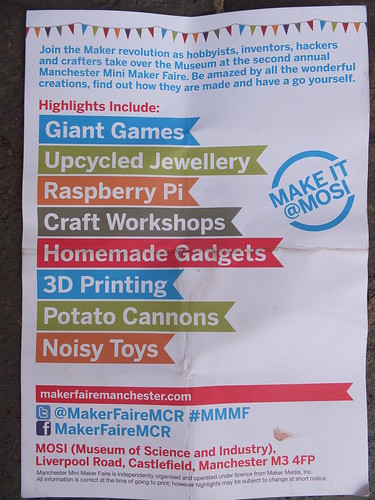
The 'flyer' for the 2013 Manchester Mini Maker Faire.

On both days, the railway at MOSI was operating, using the 'Planet' replica and two blue coaches. On Saturday, I was Operating Officer with Ray as Driver, Mike as Fireman and Richard as Guard. The train was 'in traffic' well before noon and, by that time, visitors were really streaming onto the site. We had no let-up all afternoon and most trains were loaded to capacity. I drove for a while to give Ray a break.

'Planet' and a well-loaded train on the 'Pineapple Line' with the 1830 warehouse in the background.

In 2013, over 50 'Makers' were booked to attend the Manchester event. I was able to make a quick tour of the site during the day and take a few pictures which are here, but I only saw some of the many activities taking place.

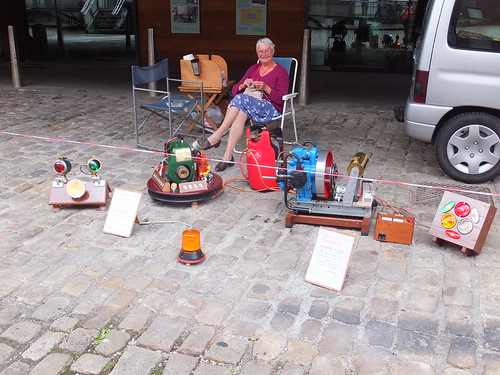
There was a restored Norman T-300 engine driving a Ducellier alternator and a restored Villiers MK12-2-HS engine driving a bicycle dynamo, both running on gas.

Restored Villiers and Norman engines, each producing electricity.

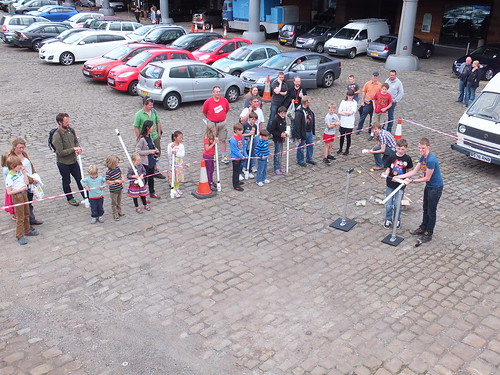
In the 1830 Warehouse there was an activity involving a number of sewing machines and another advertising 'Build your own Retro-Computer'. Also in the 1830 Warehouse, there was a workshop building Potato Cannons. Later in the day, these cannons were tested in the Lower Yard.

Testing Potato Cannons in the Lower Yard.

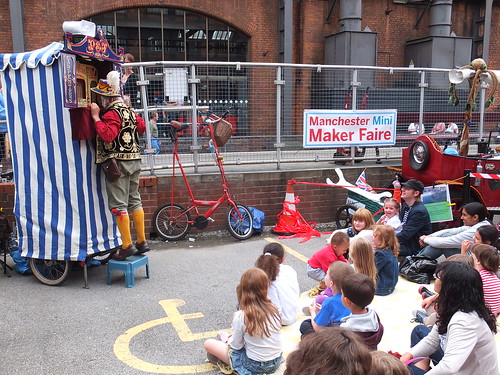
Professor Screwtop was a magnet for children in the Upper Yard. He had a very tall bicycle, a comedy car (which produced the most terrifying explosions from time to time) and a traditional Punch and Judy show. Sometimes, he just sat on the floor telling stories to his enthralled audience.

Professor Screwtop and the Punch and Judy Show.

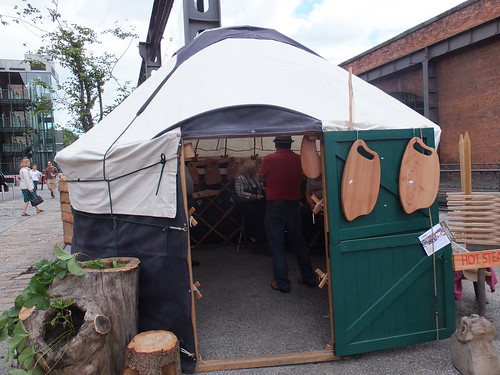
Also in the Upper Yard, there were a group of exhibitors featuring wood and wood products. TreeStation is 'a unique social enterprise' providing arboricultural services' and a number of forestry machines were on display, including Firewood Processors from Maaselän Kone Oy in Finland (more details here). The TreeStation website is here. 'Start in Salford' is a 'creative arts and wellbeing charity' started in 1993. A pole lathe was being used to fashion turned wooden parts but I was particularly taken with the idea of their Yurts made in Salford. The 'Start in Salford' website is here.

A Yurt, made in Salford.

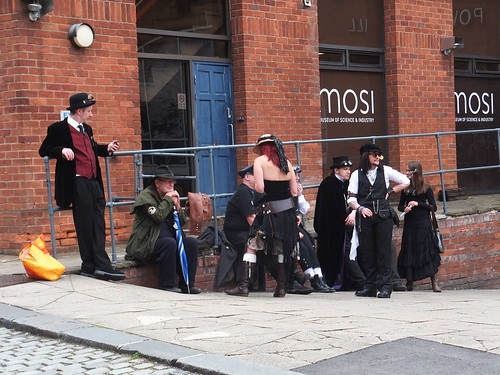
As a further example of the eclectic mix, members of Manchester's Cottonopolis Coglective Steampunk Society were touring the site in their distinctive costumes (corsets and cogs feature heavily) and they took a trip on the train.

Members of Manchester's Cottonopolis Coglective Steampunk Society.

All-in-all, a very interesting day.

Friday, 9 August 2013

Midweek at the Battlefield Line

In the earlier post A Busy Week, I briefly described running the Wednesday diesel railcar service on 24th July. On 7th August 2013, I was back again, driving the single unit diesel railcar.

Unusually, the railcar had been left on Platform 2 and the four coaches for the 'Main Train' were on platform 1. Once again, the weather was kind and there seemed to be lots of passengers. In fact, Bernard believed that we carried more passengers on our four trips down the line to Shenton on the 7th than on any previous mid-week day he remembers. We operated in and out of platform 2 throughout the day, except for the last arrival from Shenton, when we were routed into the southern end of platform 1 where there was just room to unload our passengers. I then stabled the railcar in the DMU Siding.

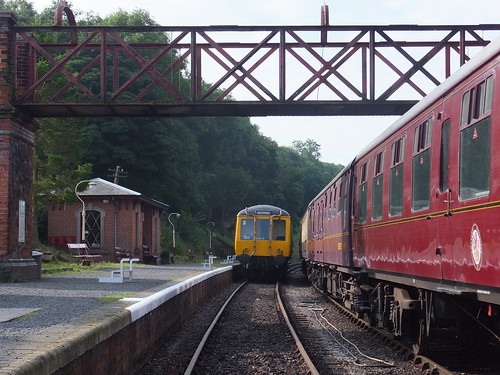
The diesel railcar in platform 2 at Shackerstone.

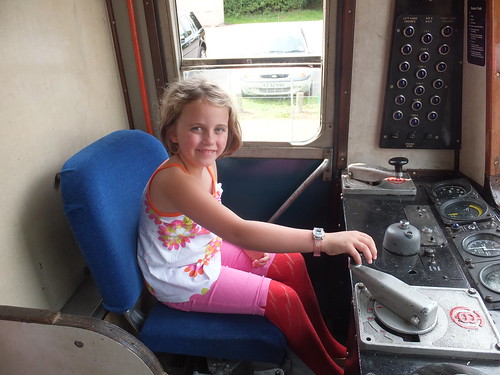
One pleasant aspect of railcar operation is that it's fairly relaxed. There's time to talk to the passengers and try to answer the many questions about operating a preserved railway or the more technical questions about the diesel railcar. Whilst the train was standing at Shackerstone or Shenton, it was possible to let interested passengers visit the driving cab in safety - I had a number of children and adults as visitors during the day.

A young visitor in the cab of the diesel railcar.

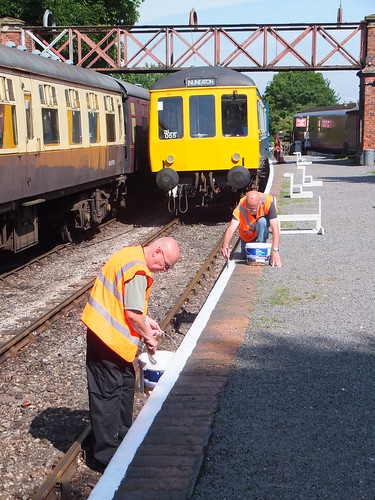
It takes a minimum of four staff to operate the railcar service - Driver, Guard, Signalman at Shackerstone and Ticket Inspector. But there are an awful lot of other jobs that need doing to keep the railway operating and Wednesday is a popular day for volunteers to come to the railway, forming the "Wednesday Gang". I counted 18 people signed-on at Shackerstone. The coaches in platform 1 were being cleaned externally whilst another group was repainting white lines on the platforms at Shackerstone.


Repainting white lines at Shackerstone.

Yet another group was 'up the cutting' at Shackerstone, hacking away at the undergrowth. Where there are signal wires or point rodding trackside, the signalman's job becomes much harder if weed growth is left unchecked.

View looking towards the signal box from platform 2 at Shackerstone, showing the improved appearance following weed removal.

Another enjoyable day!

All my articles on the Battlefield Line can be found here.

My Pictures

(Includes pictures taken on previous occasions).

Midweek DMU Service (24th July 2013).
Midweek at the Battlefield Line (7th August 2013).
All my Battlefield Line pictures.

Peak Rail 1940s Weekend

Peak Rail has run a 1940s Weekend for a number of years (the ones I've been involved in are listed near the end of this post).

In 2013, the event was held on Saturday 3rd August and Sunday 4th August. There was plenty of sunshine on both days. I was rostered as steam driver on the Sunday, using our current serviceable steam locomotive, 'Lord Phil'. Adam was fireman. We were to operate a 7-coach train top-and-tail with D8 'Penyghent'. When I arrived at Rowsley, I discovered that the locomotive had been turned, so that the chimney was at the north end. I concluded that, in a reversal of normal practice, we were going on the north end of the stock and 'Penyghent' would be at the south end. This would make a refreshing change (provided you can remember the 'stop' marks, particularly coming into Rowsley where it's only possible to take water without a lot of messing about if you stop pretty accurately). Adam had not only got the locomotive 'fizzing' nicely but he'd oiled all round, so I only had to do an examination (and sample check the oiling).
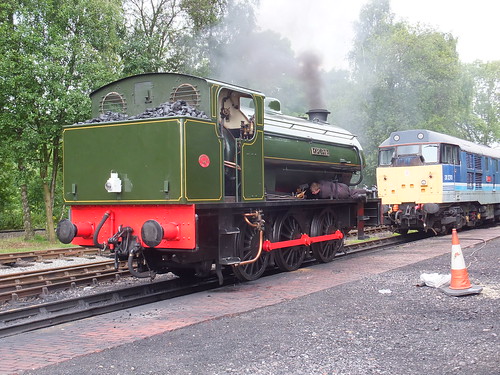
A very smart-looking 'Lord Phil' being prepared on the outside pit at Rowsley. Adam can be seen lying down on the foot framing completing the oiling of the inside motion.

A new arrival

I was told that Cheddleton's 'Derby Four' (B.R. running number 44422) was in the shed awaiting boiler work so, before we went into traffic, I had a look round the locomotive and took a few pictures. Over 500 of the Fowler 4F were built between 1923 and 1928 for the L.M.S. They were based on the design of the Midland Railway 3835 class and had the rather inadequate axleboxes common to most Midland designs (I mentioned this 'Achilles Heel' of Midland locomotives in the post Stanier '8F' inauguration at Peak Rail).
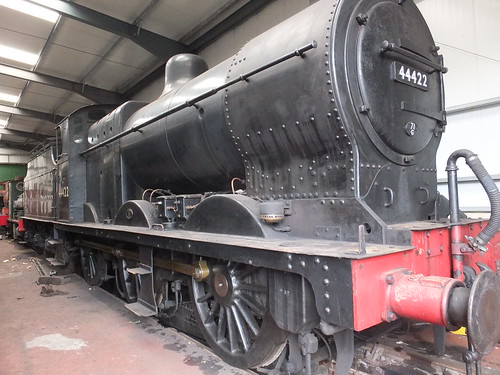
A glimpse of the Fowler '4F' in the shed at Rowsley.

Running the service

We came off-shed nice and early, moved across to the north end of the train and 'tied-on'. 'Penyghent' followed us and attached to the southern end of the train. The 2-coaches of the 'Palatine' restaurant set were next to 'Penyghent', followed by five more coaches including the Buffet Car and the Brake Composite with the Guard's accommodation.

The Guard gave us an estimate of the nett train weight. The ends of each coach usually have a cast plate recording the weight of each vehicle which the Guard adds-up to give a total to the driver. We were also hauling 'Penyghent', another 135 Imperial tons (about 133 Metric tonnes if you prefer). To get the gross train weight, you have to add the weight of the passengers. Since we don't weigh passengers, this has to be an estimate (years ago, when I flew in an 'Islander' aircraft to the Isles of Arran, I was amused to find that each passenger was weighed and seats allocated so as to put the Centre of Gravity of the loaded aircraft where the pilot wanted it). A fair guess is that fifteen passengers make one Imperial Ton. I was amazed at the number of people entering the site and the platform became very crowded. All the available seats were taken and the corridors quickly filled up with passengers as well before our first departure, so our passenger load was the equivalent of at least one more coach.

'Penyghent' took the first train to Matlock (Town), with 'Lord Phil' just hanging on the back of the train. On arrival, I collected the Single Line Staff from 'Penyghent' ready for the return journey (Peak Rail rules require the leading engine to carry the Staff), Adam made sure the boiler was steaming well because we then had the task of returning the train to Rowsley. Most of the line from Matlock to Darley Dale and then from Church Lane to Rowsley is rising at a gradient of around 1 in 400 - perfectly reasonable for a main line railway.

Gradient Diagram Ambergate - Bakewell

Reasonable gradient or not, we certainly knew we'd got a 'big train' on our way back. 'Lord Phil' had no problem shifting our load of 400 tons or so but it was noticeable that full 'First Valve' on the regulator ('First Valve' is explained in the article Locomotive Regulators) with the reverser 'linked up' the usual three notches did not produce quite the customary result, so I adjusted the reverser to cut-off steam later in the piston travel, developing a little more power.

It's quite common for the early part of the day to produce a somewhat less lively performance. One factor (particularly in cold weather) is that the rolling resistance of a train will tend to be higher after the rolling stock has been stationary for some time. Once you start moving, this resistance tends to reduce as oil in the various axleboxes warms up and oil spreads around the bearing surfaces. As far as the locomotive is concerned, there will be greater condensation losses in the cylinders and the steam circuit initially, until everything gets nicely warmed-through. Temperatures around the boiler will not achieve their maximum values until steam has been supplied for a while. Once the locomotive stops working, temperatures will slowly tend to fall somewhat. With top-and-tail working, the steam locomotive is only providing effort half the time but the impression I formed was that our performances later in the day seemed more potent - certainly we had no trouble in getting from Matlock (Town) to Darley Dale and arriving a minute or two early. By the time we got back to Rowsley, we were usually 'right time' or a few seconds late. It's quite difficult to depart Darley Dale, observe all the speed restrictions and still arrive at Rowsley on time

During the day we completed the five round trips to Matlock (Town) without fuss and sticking very closely to time.
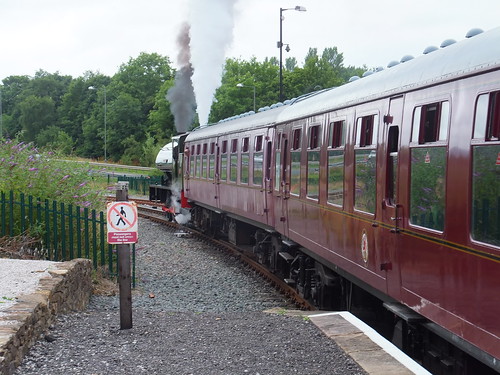
'Lord Phil' at Matlock (Town) ready to set off for Rowsley.

Special Activities

There's an awful lot of preparation and planning involved in the lead-up to the 1940s Weekend. In the large marquee there was 1940s-themed entertainment (and an all-day bar!). In the woods opposite Rowsley platform, there were elaborate military encampments.
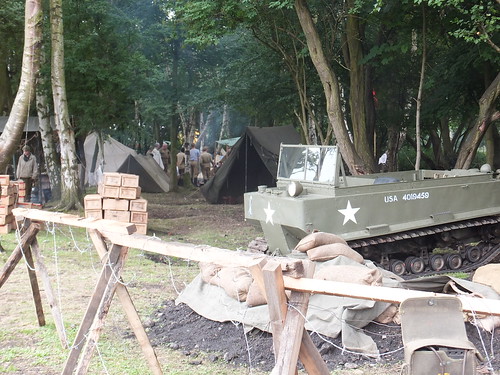
Military encampments in the woods at Rowsley.

A variety of military and civilian vehicles were on display. The Peak Park area had a number of stalls selling memorabilia of the period. Pricipally, there were the re-enactors, either in a wide variety of military uniforms or in civilian clothing of the 1940s. My own minor contribution was my 'Tin Helmet' which I periodically wore and my respirator which I carried from time-to-time (but which I decline to don).

Of course, working on the train means that you don't get much of an opportunity of looking around the extensive activities at Rowsley, but I did snatch a few photographs. At 3.00 p.m. each day, there was a battle re-enactment opposite the platform at Rowsley, but this only took place once the train had departed for Matlock and it was all over well before we returned.
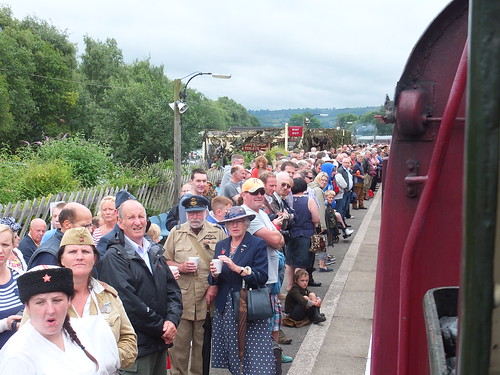
Crowds line the platform at Rowsley.

The event in 2013 seemed particularly well-attended helped, no doubt, by the good weather (although there were a couple of light showers during the day).

Previous 1940s Weekends

I've participated in a number of earlier 1940s events at Peak Rail:-

2012 event (article and pictures).
2009 event (article and pictures).
2008 event (article and pictures).
2007 event (pictures only).
2006 event (pictures only).

The Battlefield Line has also started to run 1940s Weekends - I've participated as a diesel railcar driver:-

Battlefield Line 1940s Weekend (June 2013).
Battlefield Line 1940s Weekend (June 2012).

My Pictures

A 'Derby Four'.
Peak Rail 1940s Weekend 2013.
Monday, 5 August 2013

A Busy Week

After a fairly tiring couple of weeks overseas, it might have been nice to have a quiet week, but it was not to be. After arriving at 9.00 p.m. on Sunday 21st July 2013, I slept well in my own bed and was in the office early on Monday.

Monday 22rd July 2013

I love travelling but I love being home, too, and Monday dawned a bright, warm day. I managed to work in between walking in the garden to re-acquaint myself with what we sometimes call "The Magic of Brewood". During Monday night, we had terrible thunderstorms followed by torrential rain. I hoped that this didn't mark the end of our Summer.

Tuesday 23rd July 2013

The rain had stopped by the time I got up on Tuesday. It was another bright day but distinctly cooler. I had an afternoon meeting in London so I caught the bus to Wolverhampton with a view to catching a Virgin 'Pendolino' service to London. There was no London service showing on the departure board but I didn't worry. In general, there's a departure to London every hour but additional trains start from Birmingham so I'm used to catching the first available service to Birmingham and picking up a London train starting from there. I caught a crowded Arriva Trains Wales diesel multiple unit which necessitated standing in a packed vestibule throughout the journey.

At Birmingham, I started to worry - the first London train was shown as 'Cancelled' and a message over the public address was talking about delays to all trains in the vicinity of Birmingham International. If I heard correctly, there were problems with the overhead catenary. In disgust, I decided to walk to Birmingham Moor Street and see what the options were with Chiltern Mainline to London Marylebone. It had been a few years since I'd used the Chiltern service and it had been accelerated. Some of the London trains remain multiple-unit operated, but the better ones comprise refurbished coaches operated by a Class 67 diesel-electric in push-pull with a Driving Van Trailer (DVT) on the other end. I was lucky and, within a few minutes, I was aboard a locomotive-operated service.

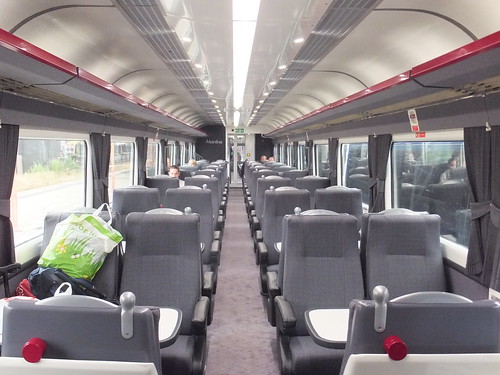
I'm not too familiar with more modern motive power but there's a useful article on the Class 67 here. The DVTs were originally used on routes like Wolverhampton - Birmingham - Euston when they were locomotive hauled push-pull. I once travelled with a friendly guard in a DVT at the back of a Euston - Wolverhampton train - at full line speed, it was quite impressive. I found the refurbished coaches on my Marylebone train very satisfactory with good quality seats and excellent soundproofing. Once again, I was struck with just how much more pleasant full-size coaches are, compared with the cramped profile of the 'Pendolino' stock.

The spacious accommodation on my lightly-loaded service to Marylebone.

I took the usual lousy pictures from the speeding train and arrived at Marylebone feeling fairly relaxed and in plenty of time for my afternoon appointment.

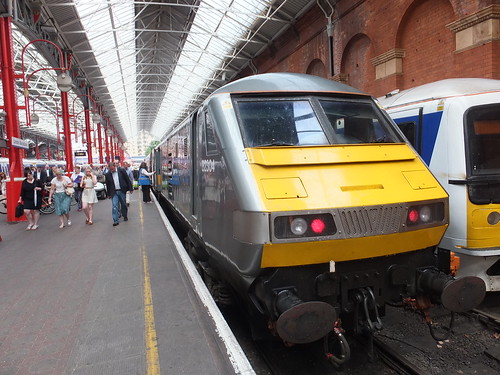
The DVT of the Chiltern Mainline train on arrival at Marylebone.

I managed to grab a few pictures of Marylebone station and some additional shots of the S.E.C.R. side of Victoria Station on the way to my meeting in Victoria Station House. Incidentally, there's an article about Victoria Station here. After the meeting, I decided to return via Marylebone. This time, the first available service was a heavily-loaded multiple unit but it got me back to Birmingham Moor Street safely, then I walked across to the (half-modernised) New Street for a train back to Wolverhampton and then a bus home.

Wednesday 24th July 2013

On Wednesday, I had a gentle day driving the single-unit diesel railcar at Shackerstone. Locomotive 3803 had just arrived by low-loader, following repairs (the tender had returned to Shackerstone separately some weeks previously). My earlier article Summer Saturday with a '2884' has some technical information and history on this class.


An unusual cab view of 3803, prior to being re-united with its tender.

The weather was fine, passenger numbers were quite good and I enjoyed the day, making four round trips from Shackerstone to Shenton with an intermediate stop in each direction at the increasingly-popular Market Bosworth Station.

There's an article about the diesel railcars at the Battlefield Line here. All my articles about the Battlefield Line can be found here.

The attractive station building at Shenton was originally at Leicester (Humberstone Road).

Saturday 27th July 2013

I was rostered to drive the 'Planet' replica at the Museum of Science and Industry (MOSI) on Saturday and it was another warm, sunny day. Alan took me to Wolverhampton station in time for the direct train to Manchester at 6.49 a.m. However, I decided to take the slightly-earlier Virgin 'Pendolino' Edinburgh service as far as to Warrington (Bank Quay), changing there to an Arriva Trains Wales train to Manchester (Oxford Road).

My train from Warrington pauses at Manchester (Oxford Road), where I got off.

A short walk took me to the Museum (taking a few pictures of Manchester's varied architectural heritage on the way). Together with Richard, Stuart and Lauren we ran the normal service with 'Planet' and the two blue coaches. The weather remained hot and we were kept busy right up to 4.00 p.m., after which we carried out disposal and used the Battery Electric locomotive to position 'Planet' and the two coaches back in the Power Hall. All my articles on MOSI can be found here.

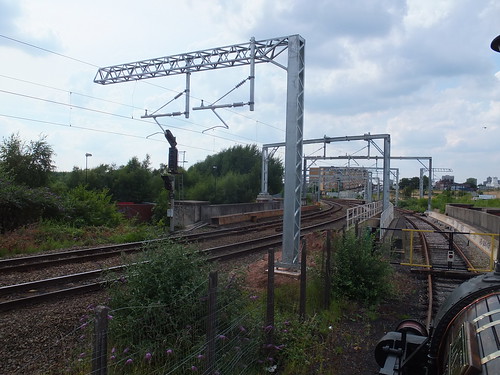
At long last, the Liverpool and Manchester route, the 'first Inter-City railway in the world' is being electrified. To carry the overhead conductors, a bewildering variety of structures has been erected next to the Museum's demonstration line and 'wiring' is now in progress, as the photograph below shows.

Driver's view at the limit of our demonstration line.

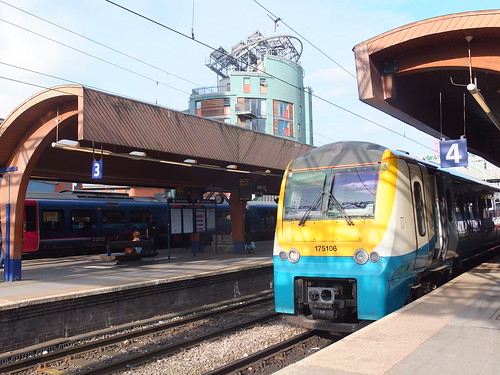
On leaving the Museum, I walked to the nearest 'Metrolink' tram station, Deansgate. Quite a complex network is now operated, as you can see from the route map here. On arrival at Piccadilly, I found that I'd just missed the Arriva Cross-Country 'Voyager' service to Bournemouth which I sometimes catch. Instead, I boarded the Arriva Trains Wales 3-coach Class 175 diesel multiple unit to Cardiff. This service travelled via Wilmslow and Crewe, where I changed to a London Midland 4-coach Class 350 Electric Multiple Unit operating from Liverpool to Birmingham.

South end of Crewe, viewed from Platform 5: The Class 175 which I'd travelled on from Manchester is departing on the Shrewsbury line, passing a Virgin 'Pendolino' arriving on platform 5 before continuing to Manchester.

My Pictures

(Includes pictures taken on previous occasions).

Chiltern Mainline to Marylebone.
London: Marylebone Station.
London: Victoria Station.
Midweek DMU Service.
Shenton Station Building.
Stafford Area rail.
Crewe Area rail.
Warrington Area rail.
Manchester Area Rail.
Manchester.

Sunday, 21 July 2013

Back to England

Events of Sunday, 21st July 2013

At 8.15 a.m., the car came to collect me from the Yangtse Hotel to transfer me to Shanghai's Pudong Airport. On a Sunday morning, the traffic was the lightest I'd experienced in Shanghai and we had no delays as we crossed the river and headed north to the airport.

Crossing the river on the way to the airport.

The driver dropped me at the entrance to the terminal and, after a bit of walking, I checked in and obtained directions to the lounge. Security was thorough but good-natured and I found the Cathay-Pacific lounge (used by British Airways passengers) without incident.

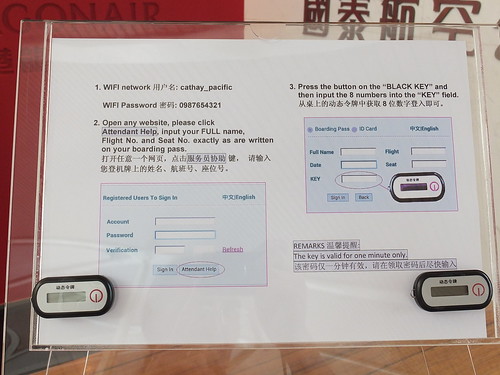
The lounge was quite extensive, with a neat area of cubicles provided with PCs. I decided to try to access the web and carefully followed the printed instructions for logging on, involving entering the network name and password followed by passenger name, flight number and seat number ("exactly as are written on your boarding pass"). Well, I think I managed that, but the next instruction stumped me - "Pick up an access KEY from the long wooden table in customer area". There was lots of furniture in the form of tables, but I wasn't sure which qualified as the 'long wooden table' so I finally went back to the entrance to the lounge and enquired. I was directed to a couple of tables with perspex sign holders, with the printed log-on instructions I'd followed plus actual key generator units glued on (similar to those used in connection with some internet bank accounts). Pressing the button on the key generator displayed an 8-digit number and, apparently, you had one minute to enter this number before it became invalid.

The log-on instructions, plus two glued-on key generator units.

I borrowed pencil and paper to copy down the number and dashed back to where I'd started logging-in. The whole thing seemed rather like an intelligence test but I actually managed to complete the log-on procedure. However, I found the system response was so lousy that I gave up after a few minutes.

I allowed plenty of time to get to the Boarding Gate and we boarded on time. After a while, the Captain announced that there would be an air traffic delay of just over an hour before we could 'Push-Back' but that he hoped to make up the lost time during the journey. Whilst waiting, I diverted myself with on-demand films (although I've no recollection of what I watched then or during the long flight home). When we finally pushed-back, it took a further thirty minutes of taxiing to reach our runway and actually get airborne.

They served a reasonable lunch and then we were expected to go to sleep but, in the middle of the day Shanghai time (and much earlier back home) I couldn't settle. I don't remember much about the journey but as we came over Europe I took a few pictures of the coast. Then we were over southern England. The pilot had, indeed, made up time for our late departure from Shanghai but, sadly, Heathrow were not ready for us and we followed a 'racetrack' holding pattern somewhere over Essex (I think) for a few minutes before continuing past London and well out to the west. I can't resist taking aerial photographs (although they're often not very good) so there's another set here. Finally, we turned to head east and landed at Heathrow.

We taxied to Terminal 5 Satellite 'B', where we found our stand alongside other British Airways jets.

British Airways aircraft at Terminal 5 Satellite 'B', in the evening sun.

Then it was off the aircraft, take the 'guided system' to Terminal 5 main building and stooge around for the luggage. This time, I'd checked two pieces in. One appeared promptly, the other did not appear. Eventually, I reported the missing bag and a simple computer enquiry revealed that it had been delivered to the wrong carousel so another walk re-united me with my missing bag. I met up with Alan in the arrivals hall and he drove me home, arriving about 9.00 p.m. Another wonderful trip was over.

My pictures

Shanghai, China.
Shanghai (Pudong) Airport.
Southern England from the Air.
Heathrow Airport.

Saturday, 20 July 2013

A Trip to Suzhou

Events of Saturday, 20th July 2013

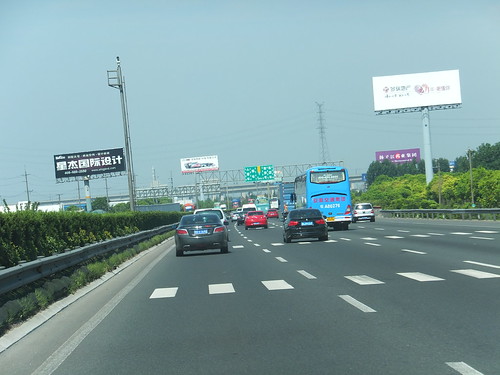
I was picked up from my hotel at 9.00 a.m. for a road trip to Suzhou which is a little over 60 miles west of Shanghai. The English originally called it 'Suchow', never being very good at mimicking local pronunciation. It's said something like 'Sue-joe'. We made the initial slow progress through the crowded city roads before picking up the Jiasong Highway where speed increased. As you might expect, the corridor between Shanghai and Suzhou is heavily industrialised with a many large factories and tall apartment blocks.

On the Expressway from Shanghai to Suzhou.

We eventually left the highway and made our way towards Suzhou through a fairly nondescript area. The famous Tiger Hill Pagoda was pointed out on our left but we did not make a visit. The driver dropped Michelle and I near some shops and we walked down a side road until we came to a waterway.

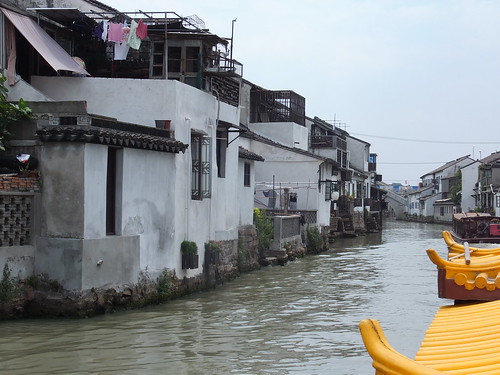
One or two 'trip boats' were moored so this was clearly the Grand Canal. We boarded one waiting boat and, with a crew of two, Michelle and I we set off. We started in a fairly modern environment with six-storey apartment blocks on either side but then the canal narrowed and the houses became older and smaller, built right up to the water's edge and generally having entrances straight onto the canal. We had a fairly intimate view of life next to the Grand Canal!

Houses are built right up to the Grand Canal and most have entrances onto the waterway.

We passed under railway bridges - two single-line steel girder bridges which I assumed was the 'original' railway and next a modern concrete railway bridge which I was pretty sure served a High Speed Line. We occasionally passed other tourist boats, passed under pedestrian bridges of the distinctive Chinese pattern with a round arch approached by steep steps on either side or passed restaurants gaily decorated with paper lanterns presumably for the tourists. The canal broadened and we were at a major junction. A large crane mounted on a flat boat appeared to be dredging at the junction. Our boat turned round and we retraced our route back to our boarding point. I confirmed my thoughts about the High Speed railway line - a train passed just as we were about to pass under the bridge but I wasn't able to get a picture. All too soon, we berthed and rejoined our car.

Nearby, we visited a very grand silk embroidery showroom. The workmanship was very impressive but I didn't find the artistic results very satisfactory. The prices were fairly astronomic and I'm sure that the ladies we saw actually embroidering receive only a small share of these prices. They didn't allow photography.

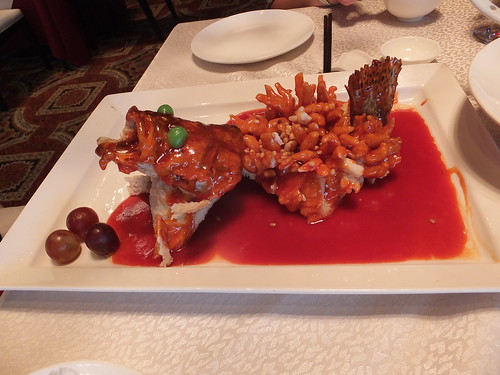
We next drove to the city centre. Michelle had changed the proposed restaurant, partly to improve the chances of there being fish on the menu for me, partly to avoid a lot of driving around the city. We ate at the Holiday Inn which was very satisfactory. After my usual soup, Michelle ordered fish - and what a fish! Even between us, we couldn't finish it but it was very tasty.

Fish at the Holiday Inn.

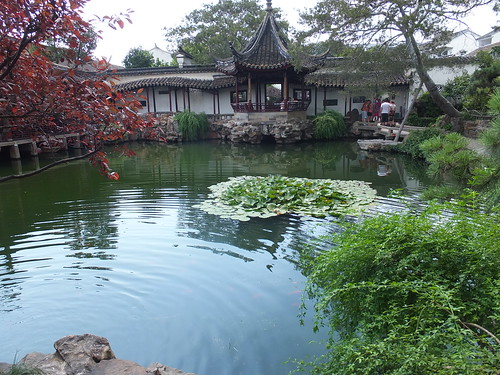
We met the car and drove through the town to the famous Net Master Garden. This is a private house and garden laid out in accordance with Chinese principles and I was very taken with the place.


The lake in the Net Master Garden.

Then, it was back to the car for the return journey to Shanghai. The girl in the Toll Booth at the entrance to the highway told the driver that there were delays on the Jiasong Highway due to an accident. After passing the toll, we were able to elect for an alternative highway back to Shanghai - a little longer, I think, but at least we'd be moving, so that's what we did.

Shanghai has Outer, Middle and Inner Ring Roads. We dropped Michelle at the intersection with the Middle Ring Road, fairly near her home and we said our 'goodbyes' as she was not intending to go to the airport with me the following morning when I returned to England. The driver then carried on into the city and dropped me at my hotel.

So, how was I to spend my last evening in Shanghai? Take the Metro to visit the two main railway stations, of course. I walked to the nearest metro station, People's Square, and used the ticket machine to buy a ticket to the northern station. When I arrived, I took a few pictures of the modern station but didn't explore - I was starting to tire. Nonetheless, I decided to carry out my plan to look at the other main station. Going back into the Metro, I couldn't find any automatic ticket machines, only a busy staffed ticket office. Armed with my map, I showed the girl my destination. Total puzzlement. First she seemed to suggest I needed Line 6, then she had a conversation with her colleague, then she took my map in through the ticket window and studied it seriously for a while. Then she issued a ticket for 4 Yuan without comment.

Well, the 4 Yuan ticket worked fine and the journey gave me plenty of time for discreet 'people watching'. The southern railway station was very modern and huge. There appeared to be two stations side-by-side - the 'conventional' one and one for the High Speed Services. And there were lots of people. By this time, I was definitely starting to 'fade', so I made my way back to the Metro for the trip back to People's Square Station. I managed to exit the Metro by the correct entrance (number 14 - People's Square is a very big Metro station) so I only had a few minutes walk to my hotel. I detoured to buy a bottle of Coca-Cola and some sweets at a convenience store before returning to the hotel, completing my packing and finally 'crashing-out'.

It had been a fascinating and varied day.

My Pictures

Suzhou.
Cruise on the Grand Canal, Suzhou.
Net Master Garden.
Shanghai Metro.
Railways around Shanghai.

A Day in Shanghai - Friday, 19th July 2013

Michelle and the driver picked me up at 9.30 a.m. and we made our way through Shanghai's always-heavy traffic to the Shanghai Railway Museum. It was almost deserted when we arrived but I didn't realise that it was school holidays and very soon two coachloads of extremely noisy schoolchildren arrived on a holiday visit. It became very crowded but I managed to record most of the stuff I wanted. I was quite impressed with their 'Cab Ride Simulator'.

We had some trouble extricating ourselves from the car park at the railway museum because of the coaches. They opened the rear gate and the driver patiently manoeuvred until he could reverse through this gate. We were now in the yard of the head office of the local railway company and soon we were back on the main road, tangling with the traffic.

Our next visit was to the famous Jade Buddha Temple. Although there were worshippers, both young and old, the place seemed devoid of any sense of spirituality with every room crammed with sales counters and crowds of foreign tourists swarming through (yes, I know, I'm a foreign tourist too).

Then we moved onto what I think was called the South Sea Center (they use American spelling). I had no idea what this was but it turned out to be a small demonstration of artificial pearl culture attached to a huge showroom of pearl products. There were quite a few tour groups looking round and they seemed to be buying, too. I left as soon as possible.

Next, we drove to the French Concession area which is now a fashionable place to lunch. Whilst most of Shanghai is modern and very tall, some of the older structures in the concession area have been retained and adapted. Our lunch was at the Zen Restaurant which features Chinese Cuisine. With help from my guide, Michelle, I chose a vegetable soup followed by what appeared to be sago with pieces of mango.

After a pleasant, relaxing lunch, our driver took us to the Shanghai Museum in People's Square. At Michelle's suggestion, I went round with an audio guide whilst she waited for me in the Tea Shop. The Museum has some very interesting exhibits and I spent well over an hour and a half going round the four floors of exhibits. It was rather crowded but well worth the visit.

We then headed for the river, where we visited the 'Silk Museum'. This is actually another big showroom but in this case they demonstrate the life of the silkworm and show how a silk thread for weaving is produced on a clattering, elderly machine. There were looms on show but they weren't weaving. What they did demonstrate, which I found fascinating, was how they make a silk 'felt', used in upmarket duvets and padded jackets. In contrast with the pearl museum, I enjoyed this visit.

We continued to the famous 'Bund'. This refers to the section of the western river embankment passing through the various 'Concessions' and it enjoys a similar iconic status to the London Embankment. It's been totally modernised but remains a magnet to visitors and local people alike. The original rather grand Concession buildings on the west bank have been retained and are now protected by Heritage legislation. These buildings now face the new, towering office blocks on the east bank. Michelle and I walked along a section of the 'Bund'.

I was then dropped off at my hotel and handed a ticket to the Shanghai Acrobatic show for that evening. At 6.45 p.m., the car picked me up and took me to the theatre in plenty of time for the 7.30 p.m. performance. The 90-minute show was a rather odd combination of acts – tumblers, balancing acts, juggling, comedy knife throwing, plate spinning (21 plates), slack wire walking, aerial ballet. They asked us not to take pictures of the show, so I didn't (although a number of members of the audience took both photographs and video). The 20-strong cast were each the best I have seen in their  various fields.

At 9.00 p.m. the show was over and we all came out into the brightly-lit street where about seven coaches were waiting to pick up some of the audience. But I'd agreed with Michelle that I'd make my own way back so I walked to the nearest Metro station. The ticket machines work in Chinese or English so the only problem was that the touch screens seem a bit erratic. Talking to Michelle afterwards (and by observation) it seems I'm by no means alone in having that difficulty. Armed with a plastic credit card ticket which works in a similar fashion to London's 'Oystercard', I made the journey without incident but got a bit muddled emerging from the station and headed in the wrong direction before I realised my mistake.

As promised by Michelle, I found the 'Bund' magical by night with the buildings illuminated and probably thousands of people, Chinese and foreign, milling about in good humour. Eventually, I made my way back to my hotel on foot, looking at more Heritage buildings on the way. Incidentally, my hotel is, itself, one of the Heritage buildings.

My Pictures

My pictures of Shanghai are here.
My pictures of Shanghai Railway Museum are here.
My pictures of the Jade Buddha Temple are here.
Pictures at the Shanghai Museum are here.
Pictures at the Silk Museum are here.
My pictures of Shanghai Metro are here.

Friday, 19 July 2013

Stop Press - Friday, 19th July 2013

I couldn't upload any pictures to my 'Flickr' site from Tibet but now I'm in Shanghai, I've made a start.

My pictures of Tibet are here.

My pictures in and around Shanghai are included in my 'China' collection here.

Specialist pictures (airports, hotels, railways and similar) can be found in the relevant Collections.

Leaving Tibet - Thursday, 18th July 2013

I'm afraid I spent my last morning in Tibet in the hotel getting ready for my flight to Shanghai. My guide, Tse Dol Kar, came to pick me up at 11.00 a.m. but with the different car and driver. We drove through the city and to the dual carriageway highway we'd used both when we left on our trip to the west and on our return from Gyangtse the previous day. At the end of the highway, the road divides, the northern route leading directly to Shigatse, the southern to Gyangtse and, via a spur, to the airport.

When the driver moved into the lane for the northern route, I was a bit worried. At the last moment, he realised his mistake and moved across to the correct lane, earning loud horn blowing from other vehicles. I thought it strange that I knew the route better than the local driver. Tse Dol Kar managed to snooze through the excitement. I watched very carefully when we came to the junction for the spur to the airport, but he managed to get that right. A few kilometres took us through a small town and I knew there must be a left turn somewhere for the airport. The driver seemed as uncertain as I was but, travelling very slowly, he found the correct turn and we approached the usual sort of modern terminal building with a car park at the front. Gongga Airport was all on a reasonably small scale, befitting a regional airport which, in political terms, is what it is. My guide checked me in for my domestic flight to Shanghai on MU2260 operated by China Eastern and we said goodbye.

The escalator to departure took me to the usual slow-moving queues for security. When I finally got to the front of the queue, my luggage and I received quite a thorough going-over, including shoe X-ray, but it was all done with lots of smiling so it wasn't unpleasant (British airports please note). When I reached Gate 5 (of 9) they were already boarding and the airbridge led me to seat 6L, which turned out to be the front row in a small business class cabin with four rows of 2+2 and only three passengers.

The aircraft was a smart-looking A330-200 and the pretty Chinese cabin attendants, who all spoke good English, were very attentive. The four hour flight passed quite pleasantly. We approached Pudong airport over the centre of the city, which gave a good idea of just how large Shanghai is. I think the population is 23 million. There was a little wait in the baggage hall – three flights were discharging bags on carousel 3 and we were the third. I quickly found my guide, Michelle, and we went to the car. Because of traffic, it was well over an hour before we reached my hotel but I was expected so I had an evening working on the computer before sleeping soundly in the large bed.

Thursday, 18 July 2013

Return to Lhasa - Wednesday, 17th July 2013

I slept until 4.00 a.m., then went back to sleep until the alarm sounded at 6.00 a.m. Today, we were to return to Lhasa. Our route would take us on the 'Southern Friendship Highway' through Nangartse and around the shore of Yamdrok Yumtso Lake.

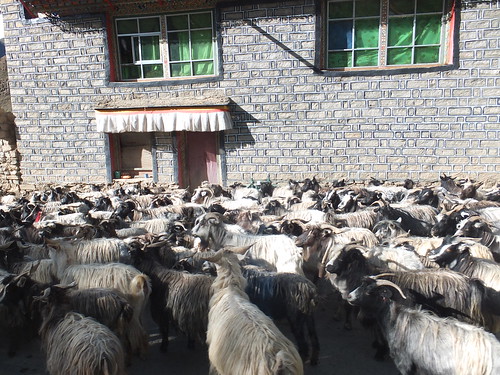
The hotel provided a buffet breakfast and we were loaded and on the way soon after 9.00 a.m. We registered at the control point just outside the town and passed through similar country to that on yesterday's arrival – a series of rural villages set in a fertile valley with mountains on each side of the valley. We negotiated our way past a couple of large flocks of goats being moved, then the valley closed in and the terrain became significantly more mountainous.
"We negotiated our way past a couple of large flocks of goats being moved".

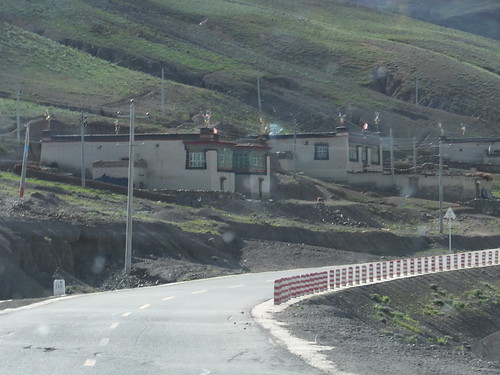
The road twisted and turned clinging to the increasingly rocky hillside as we climbed. A lake appeared on our right and a little later we passed a hydro-electric generating station. A large flock of goats was spread out across the opposite hillside, foraging for grass. Over the next few minutes, we saw a number of flocks. One was strung-out single file, led by the herdsman, aiming for higher ground where the grass appeared more lush. We emerged onto an upland plain where we found horses, cows and goats grazing. We passed through villages of varying sizes where all the dwellings followed the basic Tibetan design – rectangular, flat roofed with a square pillar at each corner projecting above the roof, each pillar festooned with sticks or branches entwined with prayer flags. According to the district (and perhaps age of the dwelling) the main building material could be shaped stone, mud bricks or concrete building blocks.

Tibetan-style dwellings.

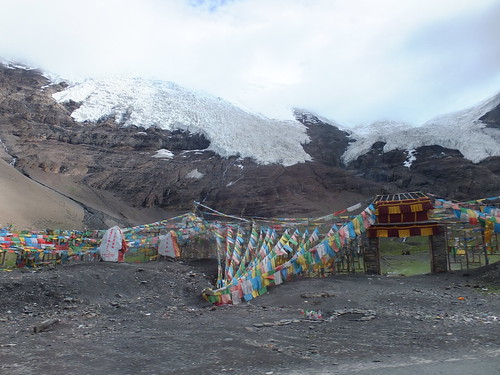
A glacier came into view on a mountain ahead of us. Because of the time of year, the glacier didn't descend to lower altitudes but it becomes larger in winter. Our road was now well over 4,000 metres above sea level and the mountains we were looking at have elevations of six to seven thousand metres. We passed a prayer flag pole with prayer flags radiating in all directions looking a little like an English Maypole. There were four cairns at the base of the pole. Each cairn was topped with a set of yak horns and the surface of the cairns was covered with religious images. A pair of yaks were grazing nearby unconcernedly. Further on, we found other poles with prayer flags strung out and we saw other mountains which were still snow-clad at the higher altitudes. There was a group of buildings at one place which seemed to form a stopping place for travellers and there were quite elaborate displays of prayer flags here.

Snow-capped mountains and Prayer Flags.

At another place, the road passed through a short rock canyon. Hundreds of prayer flags had been stretched across the canyon, forming a colourful canopy. There was a large tent nearby which I think may have been offering souvenirs. And while all this natural grandeur was passing by, what did the driver decide to do? Use a dongle to receive streaming video of 'Gangnam Style'!

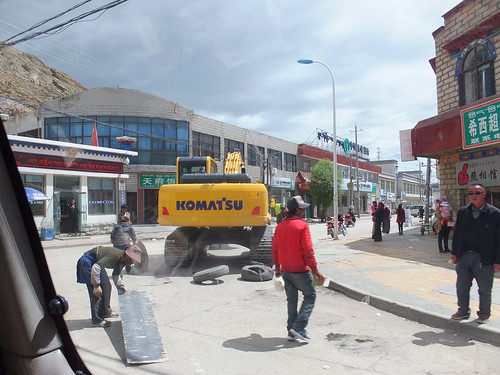
We arrived at a fairly large, modern town of Nangartse. At the entrance to the town, a large, tracked Komatsu PC210 excavator was being driven into town. These tracked vehicles are normally moved on a low loader to avoid damage to the road surface. In this case, the driver was assisted by four helpers with four motor tyres and a couple of large boards. The excavator was attempting to drive over tyres or boards. As the machine moved forwards, the released tyres and boards were carried to the front to be used again.

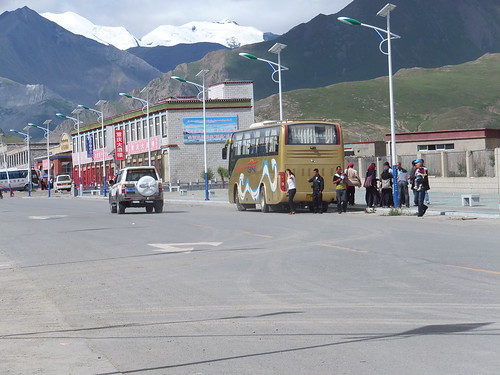
We passed the excavator, turned left and parked outside the Lhasa Restaurant. As it was still only about 11.30 a.m., my guide asked if I'd like to take a walk before lunch. After being thrown about on the mountain roads, I was glad to accept the offer. I walked back to the main road, just as a bus arrived. A number of local people got off and most headed for the nearest barley field, presumably to attend to 'personal needs'.

I watched a group of four men mixing concrete on the ground. They'd made a large heap of the materials on the ground and dry mixed them using long-handled shovels. What really intrigued me was the supervisor using a metal bowl to scoop water from a large puddle to a plastic container. When he judged he'd the right amount, mixing continued as normal practice.

A second bus arrived, going in the opposite direction. A few people got off, and a number of passengers suddenly appeared and boarded.

Nangartse - the arrival of a second bus.

The first bus had parked near an overflowing skip. An old man carrying a plastic sack wandered up to the skip and spent a few minutes rooting through the contents. Having added one or two items to his sack, he slowly crossed the road and disappeared.

I walked back up the side street to the Lhasa Restaurant and took a simple lunch of vegetable soup and sweet tea (it was still quite early for lunch). After a leisurely meal, we set off again, passing the Komatsu PC210 excavator still making its laborious way through the town.

The Komatsu excavator in Nangartse town.

On the outskirts of the town, we came to the police check point. The existing office was being extended and a wooden framework was almost complete. I watched a carpenter cutting a length of timber with an electric power saw while we obtained the paperwork for the next part of the journey.
We were now adjacent to Yamdrok Yumtso lake. The grassy margin between the road and the water's edge was being peacefully shared by a number of cows and horses.

Further along, we encountered another road work site where a gang were casting the rectangular concrete blocks set at the side of the carriageway to discourage drivers from going over the edge. Once dried out, the blocks are painted red with white stripes or chevrons. A simpler solution we found elsewhere was to place a rounded rock at the side of the road and paint it red.

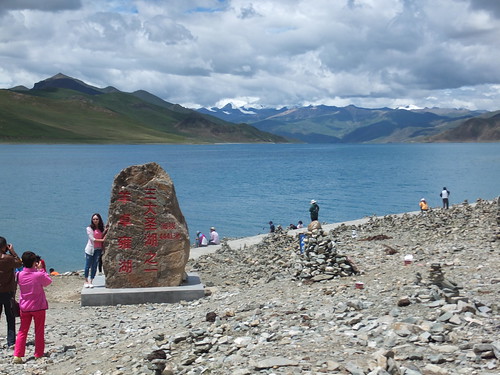
We passed a viewpoint where a number of cars had parked and the occupants crossed a rocky foreshore to reach the lake margin. The rock-strewn margin was covered with small cairns built from the ample supply of rocks. A little further on, there was an 'official' viewpoint with perhaps 100 tourists. The elevation was given as 4,441 meters. This viewpoint was equipped with a car park,  toilets, a small cafĂ©, and various souvenir stalls on the landward side of the road. On the lake side of the road, a set of concrete steps led down to a proper concrete viewing platform. Either side of the platform on the rocky foreshore, visitors spread out to get close to the water and, again, there were lots of rock cairns. A huge, white Tibetan dog wandered around the steps for a while and then relaxed in the hot sun under a broken-down billiard table pressed into use as a souvenir display. Before I left, a local woman came to fill her plastic water container from the lake just next to me, before slowly making her way back to her home.
This viewpoint on Yamdrok Yumtso lake is popular with tourists.

The road climbed again, twisting and turning to gain height. We reached another high-level viewpoint. Here, there was an amazing display of prayer flags plus a large souvenir tent. Nearby, a brown Tibetan dog watched the visitors whilst a yak, decorated in full traditional regalia, totally ignored the visitors and concentrated on the serious business of resting.

A dog, a yak and prayer flags.

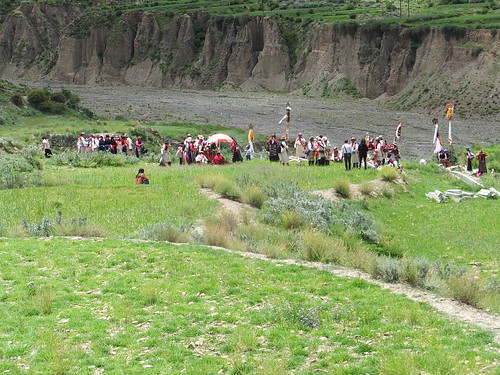
Further on we stopped where a complete village, traditionally dressed and carrying banners and a conch shell horn were carrying out a once-a-year ceremony. They go from field to field in an age-old ritual to secure good crops. The horn is supposed to ward off hail, which can be devastating to growing crops.

The ceremony to ensure healthy crops.

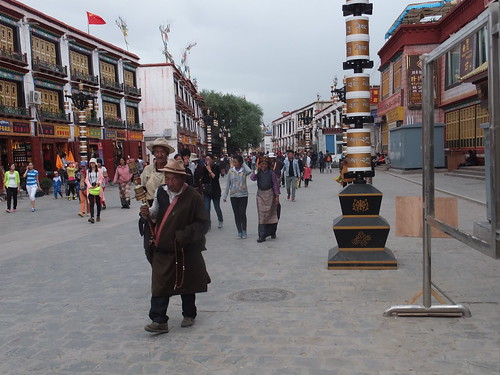
For the last lap back to Lhasa, we took the dual carriageway airport road. Back at the St. Regis, I was given the same room as before – 1611. Finally, I went for a walk in the rabbit's warren of a city. Lots of people were perambulating around the outside of the Jokhang Temple, many with prayer wheels. Tourists were still going into the temple and nearby a dozen or so Tibetan people were prostrating themselves outside the temple.

Perambulating clockwise around the outside of the Jokhang Temple.

The following day, I was to leave Tibet and fly to Shanghai for the last part of my trip.

My Pictures

Gyangtse - Nangartse by road
Nangartse, Tibet
Nangartse - Lhasa by road
Lhasa, Tibet St. Regis Hotel, Lhasa, Tibet

[Pictures inserted and links to pictures added 23-Aug-2013].