'Slotting' is a technique employed in semaphore signalling which gives two signal boxes control over one signal arm and was commonly used where signal boxes were close together.
Co-located Stop/Distant Signal Slotting
A frequent requirement for slotting occurred where a distant signal controlled by one signal box was mounted on the same post but below a stop signal controlled by the signal box in the rear. The 'slot' prevented the distant arm from coming 'off' until the stop signal arm above it was also 'off'.
The picture below shows the stop signal/distant signal slot on a Western Region pattern lower quadrant signal, with both signals 'on'. The weight bar nearest the camera (with two counterweights) is for the distant, the weight bar with the single counterweight is for the 'stop' signal. With no tension in the signal wires, the weightbars are held in the position shown by the counterweights. Two 'L' cranks at the bottom of the post transfer the horizontal 'pull' on the signal wires to a vertical 'pull' via two short signal wires to the ends of the two pivoted weightbars. A push-rod is attached to the stop signal weightbar, on the counterweight side of the pivot, so that, when the stop signal wire is pulled, the counterweight rises and the push rod is pushed upwards to move the signal arm to the 'off' position. A second push-rod is provided to operate the distant signal arm but this push rod is attached not to the distant weight bar, but to a third weight bar placed in between the other two. This third weight bar is provided with a smaller weight and it also has two projecting lugs which sit on top of the other two weight bars all on the other side of the pivot from the first two weightbars. With both signals 'on' the smaller weight on the third weightbar is lifted by the other two weightbars pushing up against the lugs. The weights are arranged so that if either the stop signal or distant signal wire is pulled, the remaining lug pushing up on the third weight bar keeps the smaller weight lifted.
 View other sizes.
View from front of signal with neither signal wire 'pulled' - both Stop and Distant signal arms 'On'.
The picture below (taken from the other side of the signal) shows the situation if both signal wires are pulled. The tension in the stop signal wire holds the counterweight lifted and the pushrod lifted upwards to move the stop signal arm to the 'off' position. The tension in the distant signal wire holds the two distant counterweights lifted. With neither of the two weightbars pushing on the lugs of the third weightbar, the smaller weight falls under gravity, pivoting the third weightbar and lifting the distant pushrod to move the distant signal arm to the 'off' position.
 View other sizes.
View from rear of signal with both signal wires 'pulled' - both Stop and Distant signal arms 'Off'.
Stop Signal Slotted by Two Signal Boxes
There were instances where it was considered unsafe for one signal box to have total control of a stop signal and co-operation between two adjacent boxes was enforced by clearing the signal only when both boxes had operated their 'slot' levers. The actual slotting mechanism at the signal was similar to that described above for Stop/Distant Signal Slotting.
Sedgeley Junction signal box had an example. If you look at the sketch signal box diagram in the post Sedgeley Junction (again) you can see that lever 35 'slotted' Dudley East's Down Starter. This was to provide protection for a train on the Down at Coneygree. This particular instance was a bit odd because the slot stood 'off' - you only pulled the lever when you wanted to ensure that Dudley East's Down Starter remained 'on' - the lever was 'normal' most of the time, giving Dudley East sole control of the signal.
The Up and Down Goods between Deepfields and Spring Vale was another example. My Deepfields signal box diagram in the post Railway signalling: Deepfields shows the slot on signal 38 (but omits the ones on 23, 28 and 29, although I did record the complexity of the stop/distant slotting on the down: to get Spring Vales's Distant signal mounted underneath the stop arm controlled by Deepfields lever 2 to show 'off', four weight bars had to be 'off' - one pulled by Spring Vale, one each pulled by Deepfields levers 2, 3 and 4). My signal box diagram of Spring Vale in the post Railway Signalling: Spring Vale Sidings Box does show the slots on Deepfields 23, 28 and 29.
Certainly in London and North Western Railway Signal Boxes, it was common to give the signalman an indication of whether the slot operated by the other box was 'off'. This was achieved by providing 'Face Disks' behind the frame, operated by signal wire. These normally sat horizontal but, when pulled vertical by the other box, displayed 'SLOT OFF'. The excellent book 'A Pictorial Record of L.N.W.R. Signalling' by Richard D. Foster, published by Oxford Publishing Company in 1982 (SBN: 86093 147 1) has more details.
Maintenance of this mechanical complexity must have been a problem and I think there was a policy of eliminating it where possible. I'm sure it's the sort of thing to appeal to A.F. Bound (the LMS Chief Signal and Telecommunications Engineer from 1929). Increasing provision of track circuits, Block Control and electric lever locks would provide justification in some instances for the elimination of mechanical slotting. Another technique was 'Distant Indicator Working' which is briefly described in section 8 of the post Railway Signalling: Tipton (Part 2) and I believe the signalmans' regulations applying where Distant Indicators were provided probably lessened the need for traditional slotting.
Go to Part 4 - Semaphore Signal Aspects by Night.
Friday, 3 May 2013
Railway Signalling in Britain: Part 3 - Slotting

Railway Signalling in Britain: Part 2 - Semaphore Signals
Part 1 described the evolution of fixed signals. After a long period of development, the 'modern' form of 2-aspect semaphore signalling emerged (but is now being rapidly eliminated by Network Rail).
Types of Fixed Signals
There are two principal classes of fixed signal:-
'Stop' signals - these are mandatory and an approaching driver must stop if the signal displays a 'stop' aspect.Signals comprise a vertical post (of wood, steel tube, steel lattice or occasionally reinforced concrete) on which is mounted one or more 'stop' or 'distant' signal arms each comprising a rectangular 'blade' (of wood or steel) mounted on a pivot so as to extend to the left of the signal post (viewed from an approaching train to which the signal applies) at a height to facilitate observation by the driver of an approaching train.
'Distant' signals - these are warning and an approaching driver may pass the signal displaying a caution or restrictive aspect but be prepared to stop at the following 'stop' signal.
The two types of signal arm are distinguished by day as follows:-
'Stop' signals - Arm is square-ended. Front of arm is RED with a WHITE vertical band near the end, rear is WHITE with a BLACK vertical band near the end.The two types of signal are distinguished by night by providing a lamp (usually paraffin), in front of which two coloured filter glasses connected to the signal arm are moved:-
View other sizes.
Upper quadrant 'Stop' signal displaying 'STOP' indication (Shackerstone Outer Home).
'Distant' signals - Arm is 'V'-ended. Front of arm is YELLOW with a BLACK chevron near the end, rear is WHITE with a BLACK chevron near the end.
View other sizes.
Darley Dale Down (fixed) Distant Signal. The black and white painting of the post indicates an 'Independent' Distant - one not co-located with a 'Stop' Signal.


'Stop' signals - Display either a RED or GREEN light.Aspects
'Distant' signals - Display either a YELLOW or GREEN light.
Both types of signal have two valid aspects, according to the position of the signal arm (which controls the colour of the lamp shown at night):-
Arm is horizontal ('ON' Aspect): 'STOP' (if a stop signal), 'Proceed with Caution' (if a distant signal).If the arm is raised by 45 degrees to indicate 'PROCEED', signal is termed 'UPPER QUADRANT' or, if lowered by 45 degrees to indicate 'PROCEED', signal is termed 'LOWER QUADRANT'.
At night, the indications are Red light: 'STOP'(if a stop signal), Yellow light: 'Proceed with Caution' (if a distant signal).
Arm is raised or lowered by 45 degrees ('OFF' Aspect): 'PROCEED'.
At night, the indications are Green light: 'PROCEED'.
Subsidiary signals
For special purposes (such as shunting), there are various types of 'Subsidiary signal'. These are 'Stop' signals but provided with smaller arms than 'main' signals and often mounted on the same 'doll' as a main signal.
 An elderly Great Western signal. The signal arms are wooden, as is the 'doll' (vertical post) mounting the arms. The lower arm is smaller and the 'S' indicates that it authorises a shunting movement past the signal.
Diverging routes
'Stop' signals are often situated in advance of turnouts (points) where two (or more) routes diverge. Railways in Britain provide 'Route Signalling' where, at diverging lines, there is a separate signal arm for each route. Originally, these arms were placed on a single post, one above the other, with the topmost arm referring to the leftmost route. Particularly where there were more than two routes, this was judged harder for an approaching driver to correctly interpret at speed so this arrangement persisted only on slower lines, such as Goods Lines.
On main lines, individual signal arms are placed on separate, secondary signal posts carried side-by-side on a bracket from a single main signal post. Where a large number of routes are to be signalled, a gantry (or 'signal bridge') carried by two or more posts or supports can be provided. On bracket signals or gantries, the secondary posts are called 'dolls'. The leftmost 'doll' applies to leftmost route and so on.
'Stepping' relates to the relative height above ground of the arms. The highest arm is the highest speed route and so on. Two routes with the same speed limit have the corresponding signal arms 'stepped' to the same height. Note that no absolute speed is implied, requiring the driver to have a detailed route knowledge. [Foreign railways (unless under British influence) developed a system of Speed Signalling where the driver didn't know what route he was to take, only a safe speed to run at. Different signal aspects implied different absolute permitted speeds. It can be argued that this means drivers do not need such detailed route knowledge].
 View other sizes.
Lower quadrant Two-doll bracket 'Stop' signal at Tyseley viewed from the rear. This is a standard Western Region pattern. Each 'doll' (post) carries a main arm and a subsidiary (calling-on) arm and is topped with a 'ball and spike' finial.
Positioning of Fixed Signals
Signals are provided to allow each signalman to control trains in his area. On normal double track lines, 'STOP' signals implement the 'Block System'. Each signalman became responsible for the line on which trains approach extending from the previous signalman to his own location. This was called the 'Block Section'. Only one train is allowed in each 'block section' at a time so as to avoid collisions. Each signalman communicated with the signalmen on either side using special electric telegraph instruments called 'Block Signalling Instruments'. There's a little more about 'Block Signalling Instruments' (particularly those produced by the London and North Western Railway) here.
The first 'STOP' signal at each signal box is called the 'Home Signal'. The last 'STOP' signal at each signal box is called the 'Starting Signal' (or 'Starter'). The term 'Section Signal' is increasingly used as an alternative (since the signal controls admission of trains to the Block Section for the next signal box).
Depending upon the location, a 'Starting' signal may not be provided and the 'Home' signal may also serve as the 'Section' signal. Conversely, a signal box may control additional stop signals and there may be more than one 'Home' signal on the approach to the signal box and there may be more than one 'Starting' signal.
To give an approaching driver advance warning of the aspect showing on the 'Home' and 'Starting' signals at the next signal box, a 'Distant' signal is placed in the rear of the 'Home' signal at a distance which, if the 'Distant' is 'On', will allow the driver to bring his train to a stand at the 'Home' signal bearing in mind the maximum permitted speed, the prevailing gradient and the braking characteristics of trains using the route. This distance may be a mile or more. Interlocking of the levers in the signal box is arranged so that the 'Distant' signal can only be cleared to 'Off' if the levers for all the 'Stop'signals on the signalled route have been operated.
Where signal boxes are fairly close together, the requirement to place the 'Distant' signal at a sufficient distance from the 'Home' may result in the 'Distant' signal arm being placed on the same post (and underneath) the last 'Stop' signal of the box in the rear, as shown in the picture below. In some cases, the position of the co-located 'Stop' and 'Distant' signal arms may still not offer sufficient braking distance, in which case a 'Distant' signal arm will also be fitted below a previous 'Stop' signal.
 View other sizes.
Darley Dale's Down Home Signal - a tubular post upper quadrant signal with fixed distant for the next signal box (Church Lane) mounted below. Note the Ground Disc signal and Signal Post Telephone mounted at the bottom of the post.
Signal Sighting
It's important that a driver will be able to see a signal at the earliest possible opportunity and great care is taken in the positioning of each signal. Signal posts may be short (where an overbridge before a signal limits the driver's view), tall (where it is desired to 'lift' the arm above a visually confusing background) or cantilevered left or right to improve the driver's ability to 'sight' the signal.
 View other sizes.
Church Lane Down Outer Home is a single doll mounted on a right-hand bracket. The 'White Diamond' sign mounted underneath the signal arm was introduced where track circuiting indicated the position of a train detained at the signal in the signal box, relieving the Fireman of the need to report to the signal box to carry out what was originally 'Rule 55'.
Mechanical Operation of Signals by Wire
Operation of the lever in the signal box (from the 'NORMAL' position to the 'REVERSE' position) pulls a stranded steel wire which is carried on a series of pulleys to the signal location where the 'pull' is used to change the signal aspect. A counterweight at the signal ensures that, if the signal wire breaks, the signal arm is returned to the 'On' aspect. The counterweight also assists in returning the arm to 'ON' if excessive friction along the signal wire route tends to prevent the signal wire moving back to the original position when the lever in the signal box is replaced to 'NORMAL'.
 View other sizes.
Single signal wire carried on a 2-way alloy signal pulley. The pulley is mounted on a vertical post driven into the ground (in this case a length of U-channel point rodding).
Where signal wires need to change direction (for instance, to cross to the other side of running lines), the change of direction is made on horizontal pulley wheels. A length of chain is interposed into the signal wire in the vicinity of the pulley to provide sufficient flexibility to accommodate 90 degree changes of direction. Depending upon the complexity of the layout, one or more pulley wheels may be fitted to a cast iron carrying frame which is fixed to a wood or concrete 'bed' set into the ground. These pulleys are normally referred to as 'Chain Wheels'.
 View other sizes.
Single chain wheel providing around 90 degree change of direction to the signal wire. The frame of the chain wheel is bolted to a concrete 'bed'.
 View other sizes.
A more complex run of signal wires (just to the left of the temporary fencing) at Tyseley. In this case, the pulleys are carried on flat steel spikes driven into the ground and a 4-way signal pulley is fitted back-to-back with a 3-way pulley.
There's an article on semaphore signalling on the London and North Western Railway here.
Go to Part 3 - Slotting.
Sunday, 28 April 2013
Railway Signalling in Britain: Part 1: Introduction
I've been interested in railway signalling from a fairly tender age. 'Visiting Signalboxes' talks about this interest and links to recollections of a number of signalboxes. Railway Signalling is a massive subject and I can't hope to offer a comprehensive guide but I will attempt to outline some of the principles involved in a (no doubt erratic) series of articles. This series is confined to 'Britain'. British methods were exported to many parts of the world (particularly former British Empire countries) but quite different techniques evolved elsewhere.
 The 131-lever frame of Exeter West, preserved at Crewe Heritage Centre, represents the final stage of the development of mechanical signalling aided by electrical controls and track circuits for the detection of trains.
Early railways used hand signals to communicate with trains. On the Stockton and Darlington Railway, it's said that at night they placed a candle in the window if they wanted a train to stop. The problems of correctly interpreting such casual indications led to the creation of 'fixed signals'. This is a post, fixed in a given location, on which some sort of signal can be displayed, to provide a more effective method of signalling to trains. Different railways initially used an amazing variety of Fixed Signals with Disks, Square boards, Crossbars, Balls, Arms, even a 'Curtain' in a frame which could be displayed or furled away. These 'targets' could be raised, lowered, twisted on edge, pivoted or even taken away.

A crucial shortcoming of the early hand signals was that whilst various displays with arms raised were given to signal 'Caution' or 'Stop', 'All Right' was usually given by standing at 'Attention' with arms lowered. In other words, if you couldn't see arms, that meant 'All Right'. At first, fixed signals has the same weakness. For instance, a vertically-pivoted disc could be twisted on edge to be invisible to the approaching train. Thus, if a driver couldn't see a signal, he assumed it was 'All Right'.
Gradually, signals evolved into the form we recognise with a flat blade or arm extending from the post and pivotted to it, rather like the mechanical semaphores then used for telegraph purposes. The word 'semaphore' is also used to describe this class of railway signals.
But the idea of 'hiding' the arm for 'All Right' persisted in designs where the arm could be lowered until it hung down vertically in a slot in the signal post.

The idea that a signal should always give a positive indication was not fully adopted until after the Abbots Ripton accident in 1876 where a signalman attempted to place signals at 'Danger' but, with previously-lowered arms frozen in the slot, 'All Clear' continued to be displayed (There's an excellent Wikipedia article describing this accident).
Double-track railways
Back in 1830, the Liverpool & Manchester Railway adopted a 'Time Interval' system, suitable for a double-track railway where trains were only allowed to travel in one direction on each line. In Britain, double-track railways, like roads, adopted left-hand running. There were initially no 'fixed signals' but 'Railway Policeman', stationed at strategic places along the railway, would give different hand signals to an approaching train, according to the time which had elapsed since the previous train had passed. The 'Time Interval' system was a fairly rough-and-ready approach which failed to ensure that trains maintained a safe separation.
It was eventually realised that a 'Space Interval' system was required. The invention of the Electric Telegraph allowed the Block System to be developed. The 'Railway Policeman' became the 'Signalman' (although railway slang still refers to a signalman as 'Bobby' for the same reason that civil police may be called 'Bobbies' - in commemoration of the creation of the Police Force by Sir Robert Peel).
Each signalman became responsible for the line on which trains approach extending from the previous signalman to his own location. This was called the 'Block Section'. Each signalman communicated with the signalmen on either side using special electric telegraph instruments called 'Block Signalling Instruments'. There's a post with more information on the Block Signalling Instruments used by the London and North Western Railway here.
Single-track railways
Single-line railways needed a different approach as there was not only the danger of one train catching up with another but the possibility of two trains meeting head-on. Single-line control eventually benefitted from the use of electricity allowing communication from one end of a single line section to the other.
Go to Part 2 - Semaphore Signals.
Wednesday, 24 April 2013
The British Pullman
Venice Simplon Orient Express (VSOE) operate a number of exclusive luxury train services, re-creating the glamour of rail travel in the 1920s and 1930s. In Britain, they operate the 'Northern Belle' (formed from converted 'Mark 2' coaches) and the 'British Pullman' (formed from restored 'Pullman' coaches).
Many of the 'British Pullman' trains operate from London's Victoria station and VSOE have their carriage workshops nearby at Stewarts Lane. On 11th April 2013, I was shown around the workshops by Julian, the Fleet Maintenance Manager.
The site is shared with Southern and Gatwick Express and, on entering the site, the modern Carriage Servicing and Inspection shed used by the Southern and Gatwick Express trains dominates the view. Julian led me under two railway bridges to reach the former Carriage and Wagon Shed now occupied by VSOE. After looking at carriage restoration work in progress, we moved on to the adjacent building, the former Electric Locomotive Running Shed, now used as a base for preserved Bulleid 'Pacific' 35078 'Clan Line', which is a regular performer on steam-hauled 'British Pullman' trains.
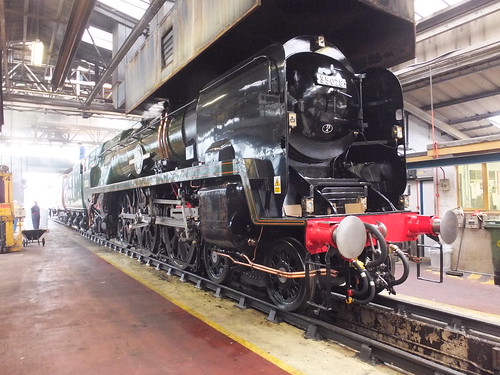 35078 'Clan Line' being prepared to haul the 'British Pullman' the following day.
We then made our way to the modern Carriage Servicing and Inspection shed, where the 'British Pullman' train is normally stabled. Julian and I climbed into the Support Coach at the south end of the rake, walked the length of the train (with me taking photographs) then retraced our route to the Support Coach.
Support Coach:
The Support Coach is a Brake/Composite with the normal Guard's Compartment, seating for staff and space for comprehensive spares.
ZENA:

ZENA was built in 1928 and, after working on Ocean Liner services to Plymouth and the 'Torbay Pullman' for the Great Western, she moved to the Southern, working Southampton Boat Trains and the 'Bournemouth Belle'. After World Warr II, she variously worked on the 'Queen of Scots', the 'Yorkshire Pullman', the 'Tees-Tyne Pullman' and the 'South Wales Pullman'. In 1965 she formed part of the final 'Tees-Tyne Pullman' before being taken out of service. She was initially acquired by Terry Robinson, then sold to VSOE in 1979.
VERA:
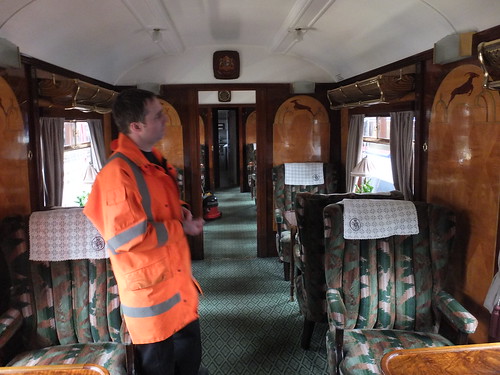
VERA entered service as a First Class Kitchen Car on the 'Southern Belle' electric train in 1932. During World War II, she suffered serious bomb damage at Victoria Station. Following rebuilding, she joined the 'Brighton Belle' in 1947. After withdrawal, she served as a 'Garden House' before being bought by VSOE for restoration in 1985. The decorative panelling is sandalwood with a mahogany border and the marquetry features gazelles and palm trees. Substantial changes to the chassis and couplings were necessary to make this vehicle suitable for running in a locomotive-hauled train.
GWEN:
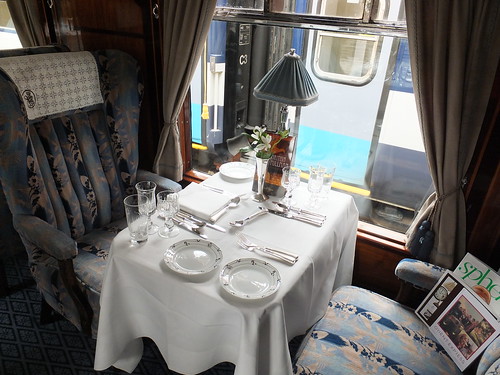
'Gwen', built in 1932 for the 'Brighton Belle', was withdrawn in 1972. After serving as a restaurant in Essex, she was displayed at the Colne Valley Railway and finally acquired by VSOE in 1988. After a long period of restoration, she joined the 'British Pullman' in 1999.
PERSEUS:
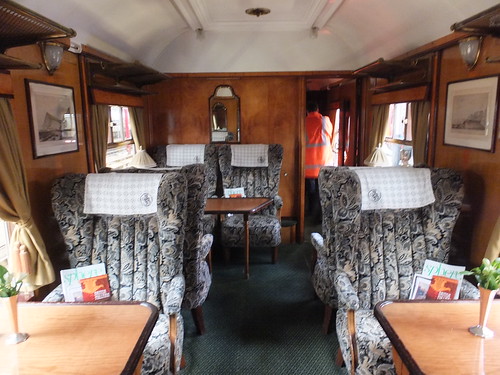
Although construction started in 1938, the war delayed completion until 1951 when 'Perseus' joined the new 'Golden Arrow' which formed part of the Festival of Britain celebrations. The car continued on the 'Golden Arrow' until the last-ever run on 30th September 1972, after which it was preserved on the North Yorkshire Moors Railway prior to being bought by VSOE in 1977. It is panelled in ash and decorated with old prints.
PHOENIX:
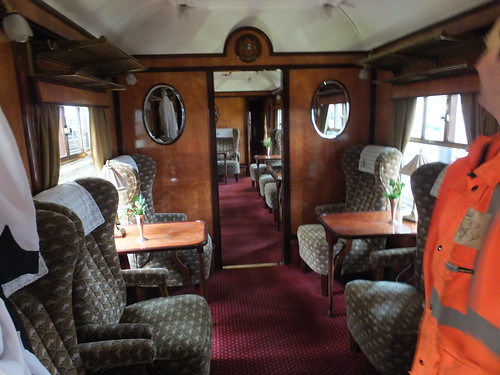
Built in 1927, this First Class Parlour Car was originally named 'RAINBOW'. Destroyed by fire in 1936, the chassis was stored until 1952 when it was rebuilt for service on the 'Golden Arrow' and renamed 'Phoenix'. Following withdrawal, 'Phoenix' initially became a restaurant near Lyon, France, before being bought by VSOE in 1980. Present decoration incorporates oval frames with marquetry flowers using American cherry wood.
MINERVA:
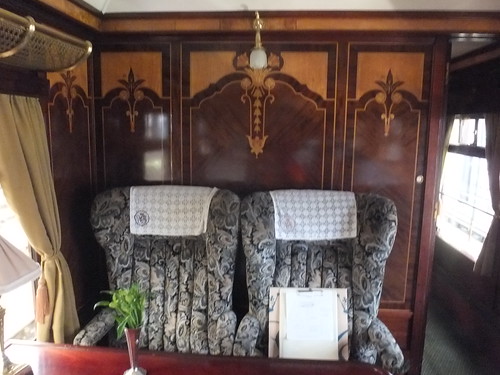
Built in 1927 and featuring delicate Edwardian-style marquetry, 'Minerva' worked various Southern Railway 'Pullman' routes before being stored during World War II. In 1947, she joined the 'Devon Belle' then, in 1951, she was refurbished (as a First Class Parlour Car with Guard's Compartment) before joining the 'Golden Arrow'. Upon withdrawal in 1961, she was preserved at the Lytham Railway Museum before being acquired by VSOE in 1981.
IBIS:
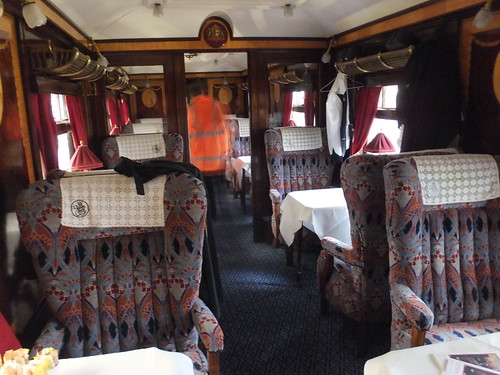
Built in 1925, 'Ibis' is the oldest car in the British Pullman. It was sold to the Wagon-Lits company and operated in Italy and France before returning to England. Following rebuilding, it operated from 1930 to 1952 on the 'Golden Arrow' then from 1952 to 1963 on the Cunard Boat Trains between London Victoria and Southampton. 'Ibis' was initially preserved at the Dart Valley Railway then at the Standard Gauge Steam Trust before being acquired by VSOE. Internal decoration includes a number of oval medallions in marquetry showing a Greek dancing girl.
AUDREY:
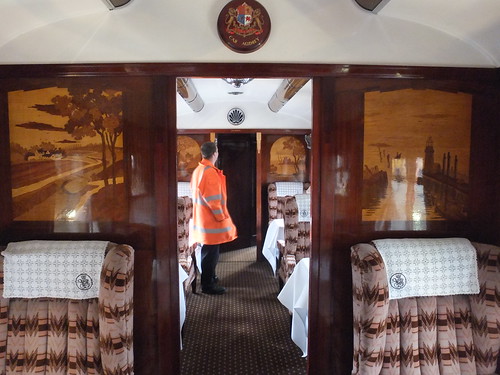
'Audrey' was built in 1932 as a First Class Kitchen Car for the electric 'Southern Belle'. The distinctive decor features twelve different marquetry landscapes. During World War II, 'Audrey' (along with 'Vera') suffered bomb damage at Victoria Station. She operated on the 'Brighton Belle' until 1972, when the train was withdrawn. 'Audrey' was bought by David Lowther and, in 1980, she took part in the 'Cavalcade' at Rainhill celebrating the 150th Anniversary of the opening of the Liverpool and Manchester Railway.
LUCILLE:
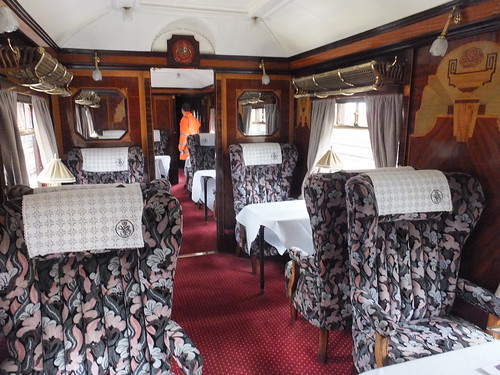
'Lucille' was built in 1928 as a First Class Parlour Car for the 'Queen of Scots', moving to the Southern Region in 1963 to form part of the 'Bournemouth Belle'. She was bought in 1967 by Mr. Lewis-Evans as his accomodation at the South Eastern Steam Centre in Ashford. When the Steam Centre was sold-off, VSOE acquired 'Lucille' for restoration. The interior features marquetry panels using dyed green holly wood depicting Grecian urns.
Generator Car:
The 'British Pullman' is fitted with Electric Train Heating (ETH) supplied from an engine-generator set mounted in a noise-reducing housing in the Generator Car.
My thanks go to VSOE and the Fleet Maintenance Manager for making this visit possible.
Since I wrote this post, the 'VSOE' brand has been discontinued and these services are operated by Belmond. For more details of the railway trips offered in Britain by the 'Northern Belle' and the 'British Pullman, go to the Belmond site.
My Pictures
The British Pullman.
[Updated to show operator as Belmond 28-Feb-2019]
Friday, 19 April 2013
The 'Peak Forester'
Following the success of the Steam Charter to Peak Rail operated by 'Oliver Cromwell' on the 27th May 2012, a similar tour visited Peak Rail on 14th April 2013.
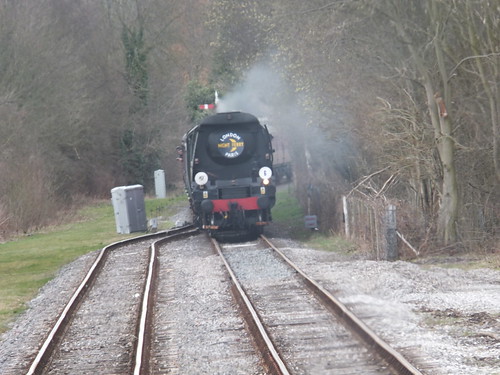
In 2013, the 'Peak Forester' was operated by unrebuilt 'Battle of Britain' Class 'Tangmere', named after RAF Tangmere. This famous RAF Station, near Chichester, played an important role during the Battle of Britain (see the Wikipedia article here).
On the day of the charter, Peak Rail ran a modified service between Rowsley and Matlock Town, with a 7-coach train top-and-tailed by a steam locomotive 'Lord Phil' at the north end and a Class 31 diesel electric locomotive at the south end. I was the driver on 'Lord Phil' and Phil was the fireman.
The passing loop at Darley Dale was used to allow the steam charter to pass the Peak Rail service. When the 'Peak Forester' arrived, the Peak Rail passenger train waited in the Up platform at Darley Dale. At Rowsley, 'Tangmere' was watered, coaled, turned and serviced. With the stock for the charter shunted to the loop, the Peak Rail service was able to use the single platform at Rowsley. To allow the 'Peak Forester' to return to Network Rail, the Peak Rail service ran Empty Coaching Stock (ECS) to Darley Dale, drew onto the single line to clear the loop points. A preserved Fire Tender with around 400 gallons of water then topped-up the saddle tank on 'Lord Phil'. The ECS was then signalled into the Down platform to await the passage of the charter. Once the charter has disappeared towards Matlock, the ECS was able to continue to Rowsley before forming the last passenger service of the day to Matlock Town and back.
My Pictures
'Peak Forester' 2013.
Crewe South Junction (1940) Signal Box

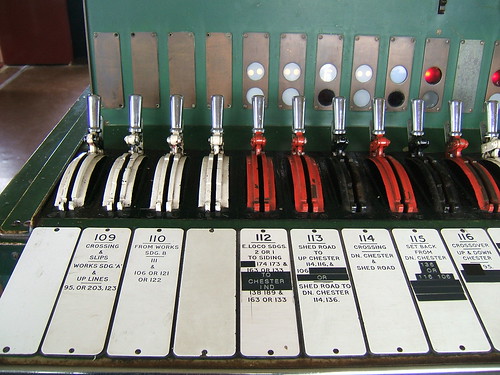
Crewe South Junction Signal Box controlled movements at the south end of Crewe Station from 1940 to 1985. The structure of the signal box survives in a semi-derelict form. This 'ARP' box, with a Westinghouse Style 'L' Power Frame, is the last-but-one in a series of signal boxes which have controlled the important junctions at the south end of Crewe Station.
In 1938, with the threat of war and aerial attack looming, it was decided that certain strategic signal boxes should be replaced by an 'ARP' ('Air Raid Precautions') design, better able to withstand blast damage. Accordingly, Crewe North Junction and Crewe South Junction signal boxes were rebuilt, replacing the earlier 1907 signal boxes which used the 'Crewe' All Electric System. New point machines were provided and the electrically-operated semaphore signals were replaced by colour light signals.
Westinghouse Brake and Signal Company had been supplying the Style 'L' miniature lever frame since 1929 so it was a 'safe' choice. The L.M.S. order for Crewe South Junction (together with a second for Crewe North Junction and a third 'Standby' frame) was placed in March 1939.
The Crewe South Junction lever frame order called for 227 levers made up of 72 point levers, 127 signal levers, 8 'special' levers, 7 spare levers and 13 spare spaces. These levers were supplied as 19 off 12-way sections which were mounted in-line to form one large frame.
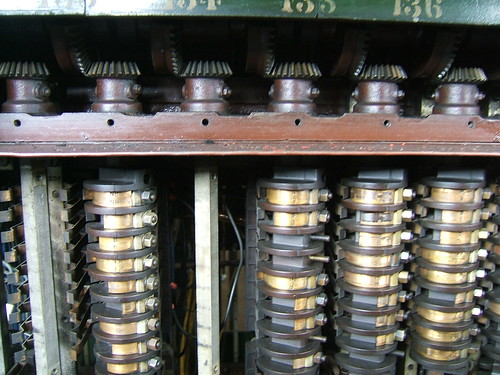
Movement of each lever drives a vertical shaft via bevel gears. The vertical shaft carries the electrical contacts used for control and interlocking.
The associated relays which provided the electrical interlocking were mounted on steel shelves in a large Relay Room on the ground floor. 'Shelf' relays were used, interwired on site.
When I was young, I thought it a curious-looking box but, for me, it didn't quite have the air of mystery which Crewe North Junction possessed. I went inside Crewe South Junction once in the 1970s when my firm had started supplying telecommunication equipment to the railways but, sadly, I didn't take any pictures.
The Crewe North Junction (1940) Signal Box is briefly described here.
In 1985 control of the Crewe area was transferred to Crewe Signalling Centre, built on part of the site of the famous Crewe North Shed.
References
'The Style L Power Frame' written and published by J. D. Francis 1989 (ISBN 0 9514636 0 8).
External Links
Crewe South Junction by Mark Adlington.
My Pictures
Crewe Area.
Easter at Peak Rail

The 6-coach top-and-tailed train (Drawn by Charlie Baulkham.)
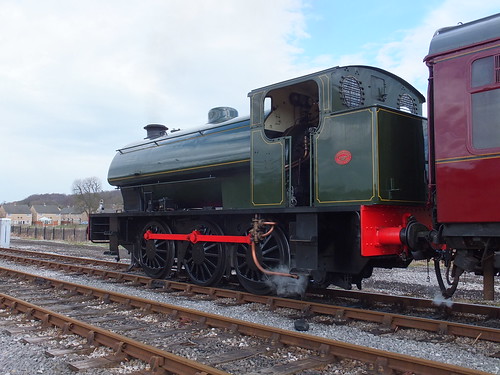
I was driver at Peak Rail on Easter Sunday, 31st March 2013. We ran the normal Sunday Service of five round trips between Rowsley and Matlock Town, top-and-tailed by a steam locomotive at the south end and a diesel electric locomotive at the north end.
Following the swan-song of 'Royal Pioneer' at the recent Blazing Saddles event, this locomotive has retired from traffic pending heavy repairs. 'Lord Phil' is now the regular steam locomotive. On Easter Sunday, Phil was Fireman and Dave was Cleaner. We had a good day, although it was rather cold.
I didn't take any photographs on the day but my young friend Charlie Baulkham produced a splendid panorama of our train, shown above.
Tuesday, 9 April 2013
Easter Week at the Museum of Science and Industry
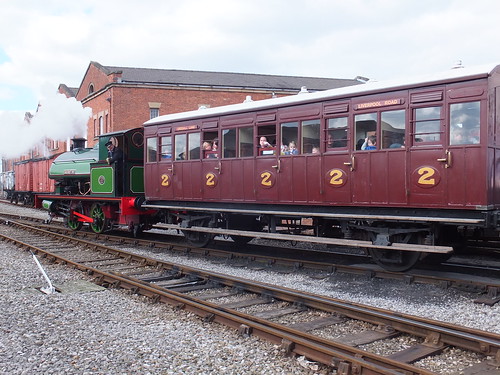
The Museum of Science and Industry in Manchester (MOSI) normally operates a steam train on Saturdays and Sundays. But, during school holidays, it attempts to run more frequently. Over Easter 2013, volunteers were arranged to work on 17 consecutive days.
I was the driver on Friday, 5th April 2013. Earlier in the week, the service had been operated by the 'Planet' replica with the two blue coaches. However, on the Friday we used 'Agecroft Number 1' so that 'Planet' could be readied for its imminent visit to Beamish, The Living Museum of the North, as part of their 'Great North Steam Fair'.
The previous week, I'd been Operating Officer when we'd also used 'Agecroft Number 1', paired with a restored, elderly 4-wheel North London Railway 2nd Class Coach currently on loan from the Furness Railway Trust. On that occasion, we'd completed the train with a 20-ton Brake Van.
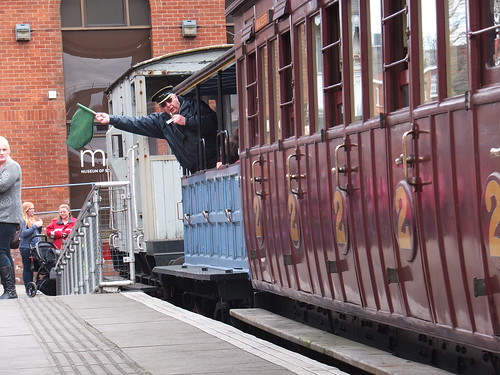
On the 5th April, we again used the North London Railway coach but, this time, with one of MOSI's 'semi-open' blue coaches which gave us extra seats for passengers. Vince was fireman, David was Guard and Peter carried out the Operating Officer duty. The weather was dry but cold. I was surprised at how many visitors were keen to ride the train, despite the cold, and we were kept busy all day.
My Pictures
Easter 2013 Trains at MOSI.
Easter at Shackerstone, 2013
Over the Easter holiday in 2013, the Battlefield Line operated both the visiting locomotives - the 'T9' on the main train alternating with the Beattie Well Tank 30585 on a 2-coach train with a 4-wheel van.
Events of Monday, 1st April 2013
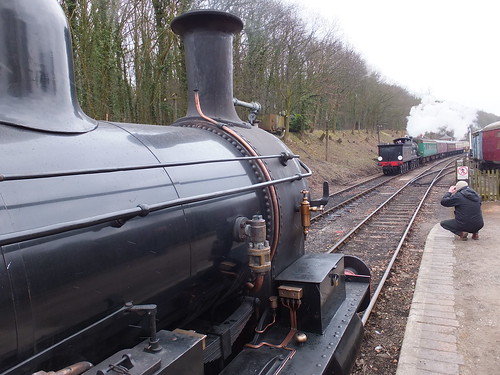
On Easter Monday, I was driver on the Beattie Well Tank and Carl was on the 'T9'. Both locomotives were lit-up in the shed. The 'T9', 30120, was nearest the door so, once in steam, Carl was able to move her outside. There was not going to be time for us to fill the coal bunker before we entered traffic, so we hand-coaled until Danny was happy we'd enough for the first trip. We had to wait inside the shed until the 'T9' came off shed, picked up our train (which had been stabled on the long siding next to the shed) and drew it into platform 1. We could then come onto the head of our train and couple up.
Although steam heating has been added to the locomotive in preservation, the box van at the head of our train had no steam heat connections so we were unable to warm the carriages (had we had a 'Banana' van, they were provided with steam heat to allow the bananas to be ripened in transit). Matters would be no better on our return trips from Shenton because, although we were then coupled next to our coaches, the locomotive had no steam heat connection on the front!
We were booked to leave with the first train of the day at 10.30 a.m. but I'm afraid we were late away. The locomotive was a willing performer although she tended to roll a bit (I think there's some sort of transverse compensating beam on the trailing coupled axle but I didn't have a chance to confirm).
Because of the engine's limited water capacity, our white milk tank had been positioned in the headshunt at Shenton, (with water, not milk) and we took a portable pump with us. So each time we arrived at Shenton, we uncoupled, drew forward onto the tank wagon and replenished the tank.
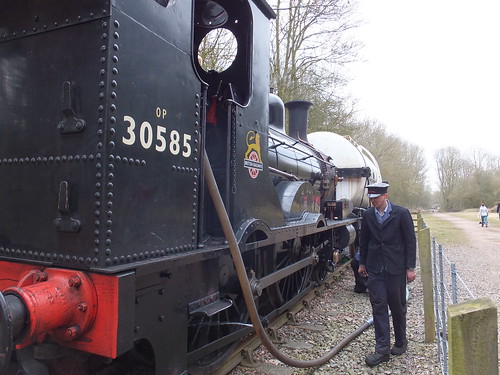
By the time we arrived back at Shackerstone in platform 1, the 'T9' was ready to leave with the (slightly delayed) 11.45 a.m. departure. Once he'd left, we trundled down to the coal bunker at the north end to be coaled by the bucket loader. We filled our water tank once again and had a breather in platform 1 until the 'T9' returned. We were a little late away on our 12.45 p.m. departure and made our second foray to Shenton. On our return, we watered but needed no more coal and, again, had a little time to ourselves before departing with the 3.00 p.m. train.
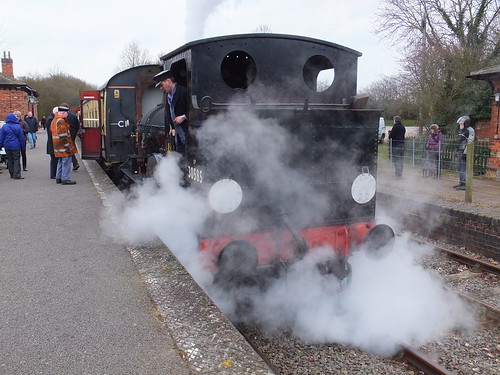
We were back a little after 4.00 p.m. but the last train, the 4.25 p.m. was supposed to be hauled by both engines so it was clear we'd probably be late away.
First, we had to get rid of our train. The signalman set the road for the long siding and, with someone riding in the front of the stock, we propelled our train into the siding, tied it down, uncoupled and shunted light engine to couple on ahead of the T9. We agreed it woud be prudent to take water but, coupled in front of the 'T9' and a 5-coach train, we were nowhere near the water column. Once preparations had been made, the Guard called us back and I gently reversed the whole train until we could get water. This was all done quite promptly and soon we had the 'rightaway' and happily bowled through the country to Shenton. We tried to fill our water tank one last time, but the portable pump seemed to be struggling. We assumed the tank wagon itself was nearing empty, so we gave up, finished the run round and took our place in front of the 'T9' for the return journey.
There wasn't too much fire left when we arrived back at Shackerstone and the instruction was to go light engine to the north end for immediate loading on the low loader. Sure enough, temporary rails had been laid and the lorry driver invited me to drive onto the low loader. Well, I made two attempts but didn't quite make it onto the trailer. The pressure was quite low and Danny was worried about the water level in the boiler but I suspect I was more worried about being able to stop once on the trailer since I'd found the engine brakes rather 'soft' during the day. The lorry driver attached a steel cable to the locomotive and the front of his tractor unit and towed us onto the low loader. There was enough steam (and water) to fill the boiler whilst the load was being secured then the low loader reversed along our drive before driving to Buckinghamshire Railway Centre. A very enjoyable day.
Events of Tuesday, 2st April 2013
I was back at Shackerstone on Tuesday to drive the diesel railcar. The low loader returned to take away the 'T9' but I was a bit pre-occupied with the diesel railcar and wasn't able to get any pictures of the 'T9' as I'd hoped.
We were running with the single unit 'Bubble Car' attached to half of the 2-car set. There had been a mechanical problem on one of the engines on the 'Bubble Car' so this had been isolated, leaving a more-than-adequate three engines. With the very cold weather, I had some problems getting the engines started but eventually had all three engines running. I started a heater in the 'Bubble Car', but failed to get either heater in the other coach to run. Only two starting attempts are allowed on each heater, after which I had no alternative but to write them up on the Defect List.
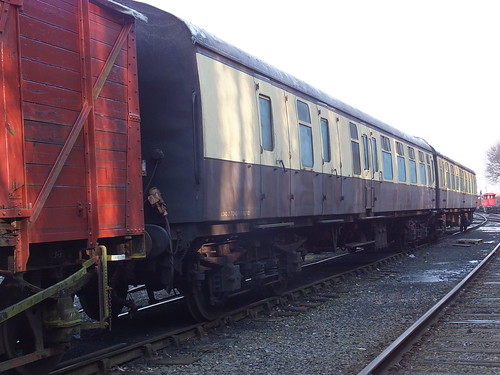
There was one remaining problem - the diesel railcar was 'boxed in' by the two 'blood and custard' coaches plus a van of the 'Local Set' which I'd shunted there myself the previous day. By this time, Martin the Guard had arrived, so we agreed on the shunt. I would bring the railcar up to the 'Local Set', couple on and, with Martin keeping a lookout from the end of the coaches, propel the stock to the north end of platform 1 and 'tie it down'. Once uncoupled, the railcar would use the south end of the platform for the rest of the day. I coupled the railcar to the stock and attempted to attach the vacuum hoses but the hoses on the railcar and boxvan were in very difficult positions so I decided to do the move without vacuum brakes on the 'Local Set'. We completed the move, I uncoupled the railcar and Martin placed a tail lamp on the end of the boxvan for protection.

The timetable called for four round trips to Shenton, stopping at Market Bosworth and we ran to time all day. It was another cold day but we attracted reasonable numbers of passengers. At the end of service, the Guard and I secured the doors and made sure all windows were closed, I drove the set to the Long Siding, shut down the engines, isolated the batteries and checked that all lamps were off. Finally, I walked around at ground level making sure there were no problems (overheating, leaks). Another pleasant day.
Brief History of the Beattie Well Tanks
By 1850, the L.S.W.R. were operating an intensive suburban passenger service around London. When additional motive power was required, a design for a small tank locomotive was started. Joseph Hamilton Beattie constructed a number of prototypes with different proportions before settling on a final design. The majority of the class was built by Beyer Peacock in Manchester with the first delivery in 1863. By the time the final order was delivered in 1875, the class numbered 85.
The Beattie Well tanks were great survivors. Amazingly, three of the class (admittedly fairly well rebuilt over the years) passed into British Railways stock. They carried the numbers 30585, 30586 and 30587 and were used on the Bodmin and Wenford branch until withdrawal in 1962. 30585, which we used over Easter, is from the 1874 batch and she can usually be seen at Buckinghamshire Railway Centre. I was reminded of another well tank I've driven - the 0-6-0WT 'Bellerophon', also built in 1874, but that's another story.
There's one other Beattie Well Tank preserved, 30587. It's owned by National Railway Museum and normally based on the Bodmin and Wenford Railway. Some years ago, I drove this locomotive on the Demonstration Line at N.R.M. but that, too, another story.

30587 (Photo: N.R.M.)
The remaining member of the Southern Railway Trio didn't make it into preservation.
Construction of the Beattie Well Tank 30585
The Beattie 2-4-0 Well Tank has 5'6" coupled wheels and two outside cylinders 15" x 20". There's a rectangular water tank mounted low between the frames which stops ahead of the driving axle and is supplemented by a second tank occupying the lower part of the rear bunker, giving a rather miserly total water capacity of 550 gallons. The upper part of the bunker holds around one ton of coal which is delivered at a fairly convenient height to the footplate through two sliding coal doors in the back sheet of the cab. The feed to the boiler was originally provided by crosshead pumps, but these were long ago replaced by injectors. Because the trailing coupled axle lies under the cab, the curved splashers for the associated wheels pass right across the cab floor on both driver's and fireman's side.
The vacuum ejector currently fitted was added at some point - it appears to be a modified version of a Gresham and Craven product. The locomotive itself is only fitted with co-acting steam and hand brakes but the steam brake valve is a 'combination' type which can be operated by vacuum. Inconveniently, the steam brake valve and latch is fitted on the fireman's side of the cab.
The leading carrying wheels are provided with both inside and outside axleboxes. Most of the weight is carried on the inside axleboxes via the overhung springs. Further control is provided by the brass outside axleboxes via the underhung springs which are suspended from the lower slide bars. The driving wheels have inside axleboxes with underhung springs.
The rear coupled wheels have inside axleboxes and there are two pairs of fairly small coil springs visible in the cab. I think there's some sort of transverse compensating beam but I haven't yet been able to confirm this.
The 'Wikipedia' reference below and the listed books all have additional information on the Beattie Well Tanks. My set of pictures 'Easter at Shackerstone' linked below gives further information on the construction and layout of the locomotive.
References
LSWR 0298 Class (Wikipedia).
Books
[1] 'A Pictorial Record of Southern Locomotives' by J.H. Russell: 1991 edition published by BCA.
[2] 'The London & South Western Railway' O.S. Nock: published by Ian Allen.
[3] 'Locomotives of the London and South Western Railway Part 1' by D.L. Bradley: published 1965 by RCTS.
[4] 'The South Western Railway' by Hamilton Ellis: published 1956 by George Allen and Unwin.
My Pictures
Easter at Shackerstone.
Wednesday, 3 April 2013
Freight Rolling Stock in Burma
This is a rather informal listing of types of vehicles I've come across. Originally, 'Chopper' couplers were used throughout Burma and, where required, vacuum brakes. On more recent equipment, 'Automatic' couplers (similar to the British 'Buckeye') are fitted with single-pipe air brakes.
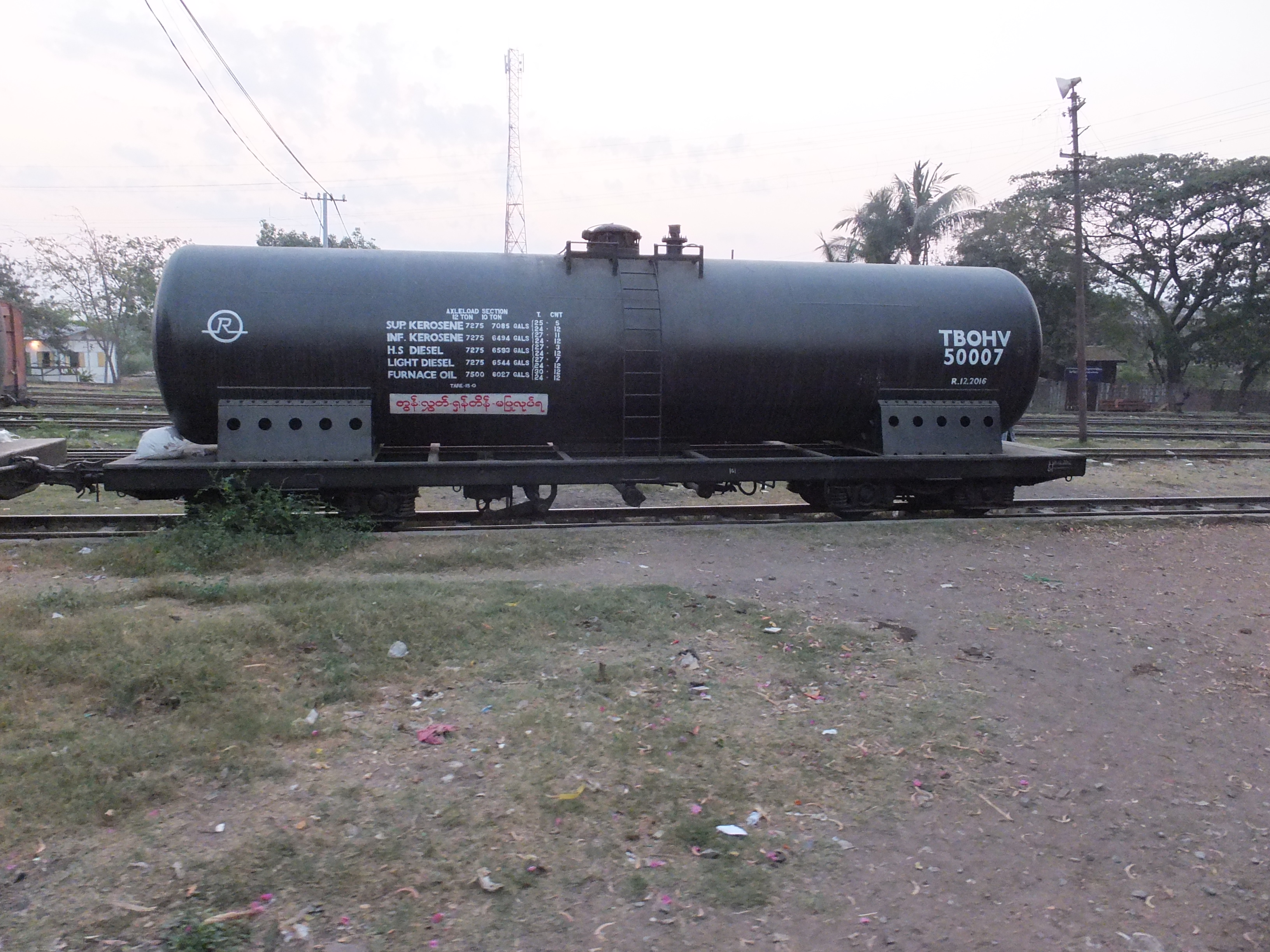
Tank, Bogie, Oil code TBOHV
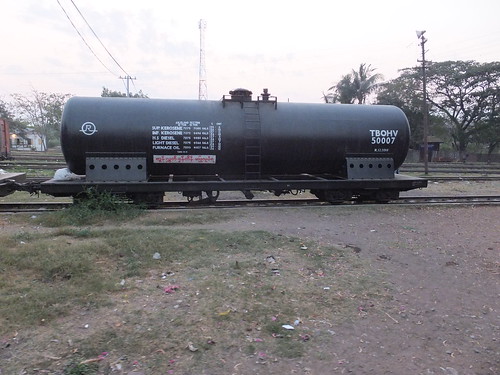
Original size.
The standard tank wagon for oil is seen with 'Chopper' couplings. Vacuum Brakes are fitted.
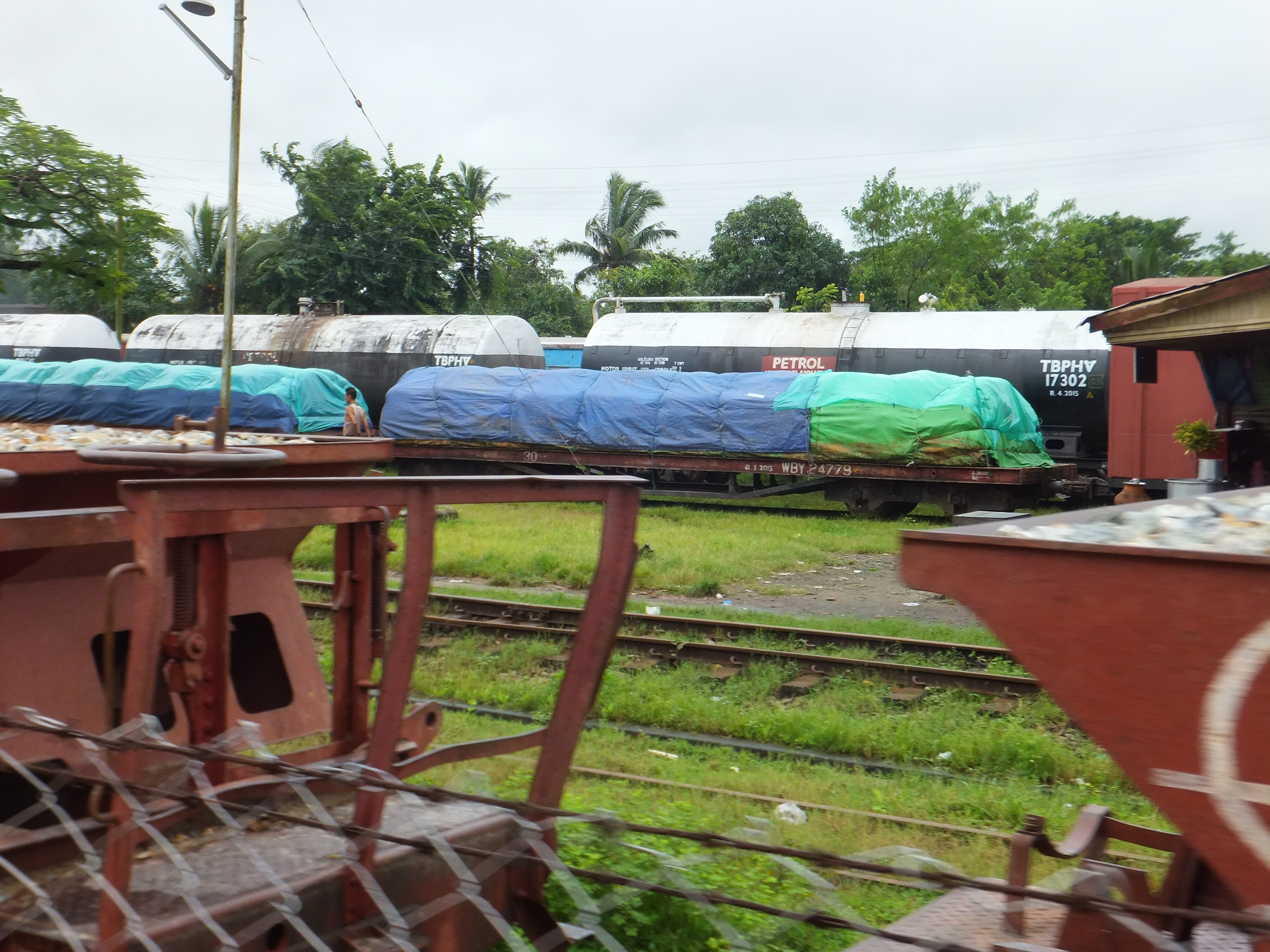
Tank, Bogie, Petrol code TBPHV
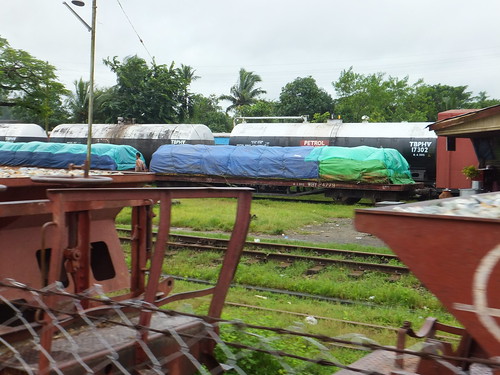
Original size.
Three Tank wagons for petrol can be seen in the background of this picture.
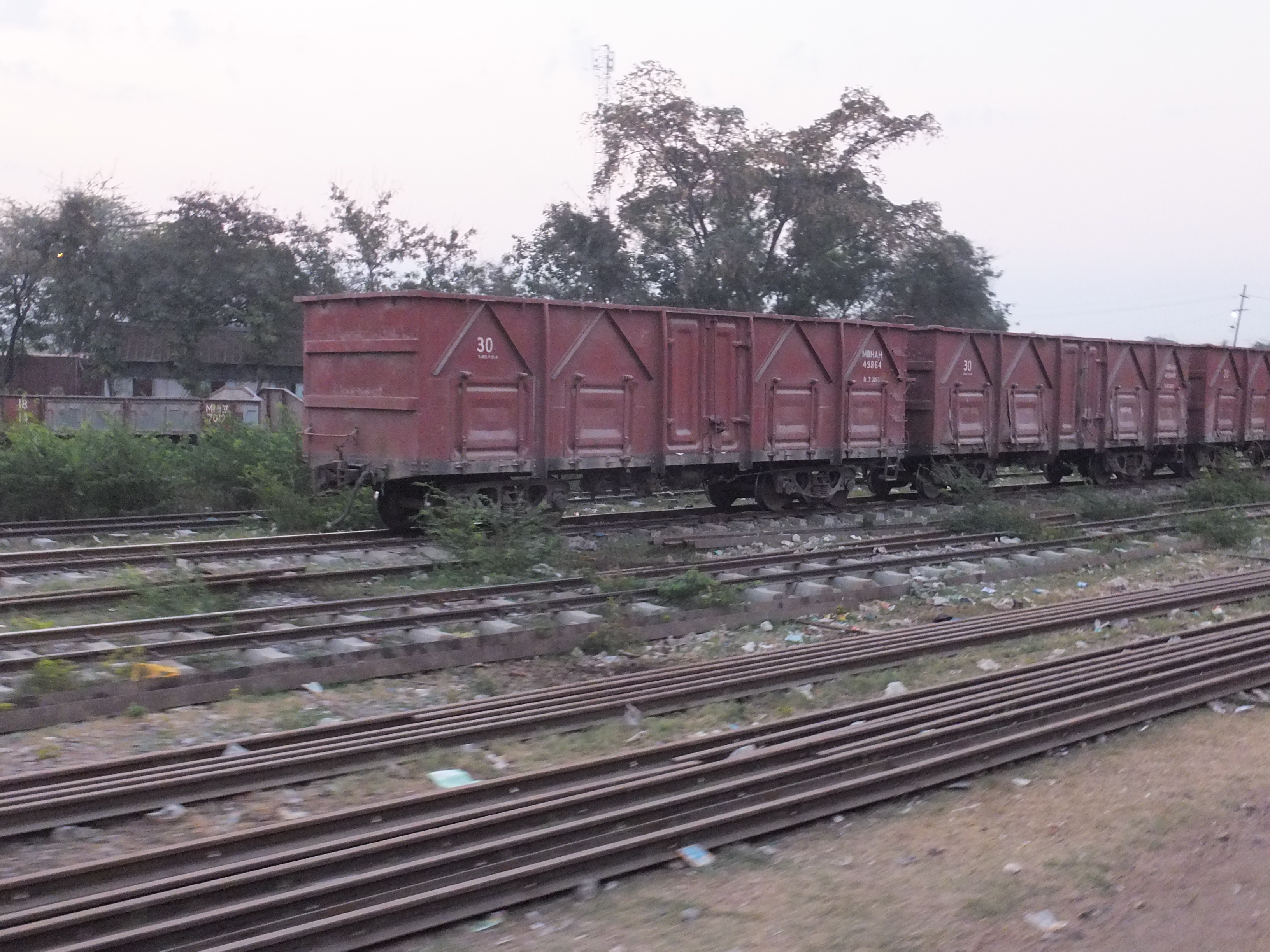
Mineral, Bogie code MBHAH
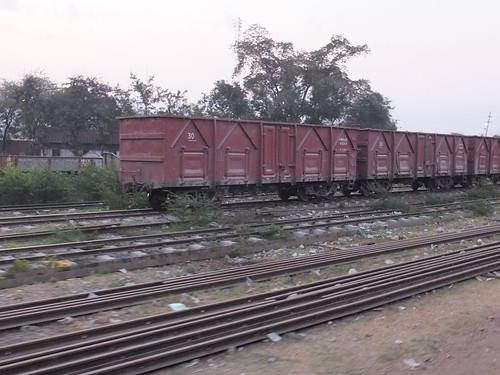
Original size.
Bogie Mineral Wagon, 30 ton capacity fitted with automatic couplers and air brakes.
There's also a 4-wheel long-wheelbase version coded 'MHV' with 18-ton capacity (not illustrated).
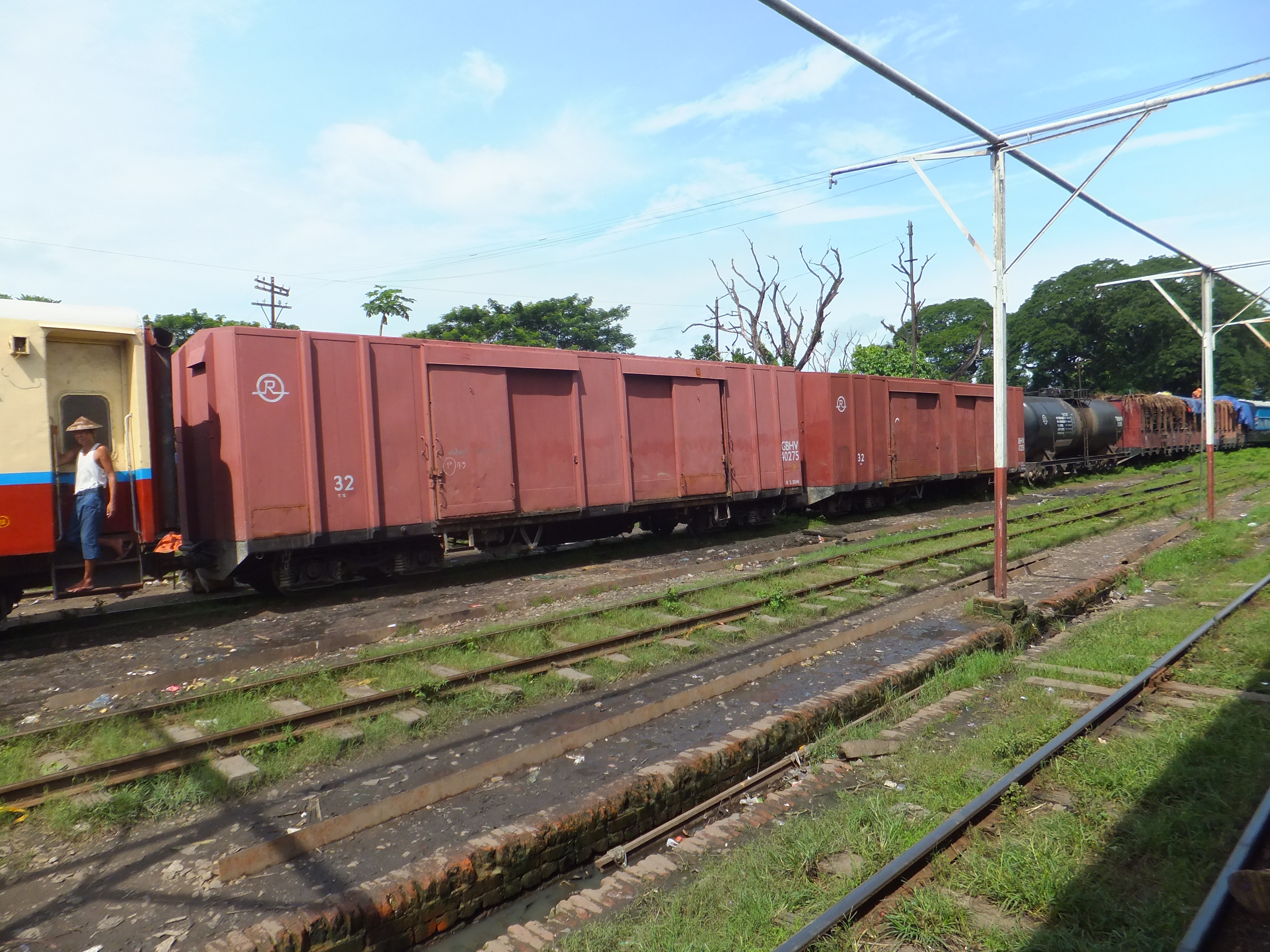
Bogie Goods Van code GBHV
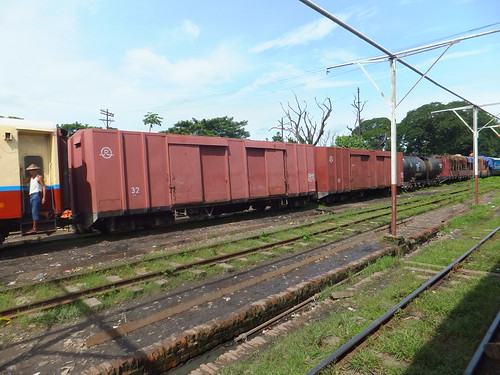 Original size.
Bogie Goods Vehicle. The examples shown are marked with capacities of 33 tons and 32 tons. Other examples, of a slightly different construction, are marked 36 ton capacity. They are fitted with two doors on each side. Each door is either sliding or, in some cases, made with two vertically hinged leaves with a third horizontally hinged section at the bottom. A similar-looking vehicle is coded 'PBHV'.
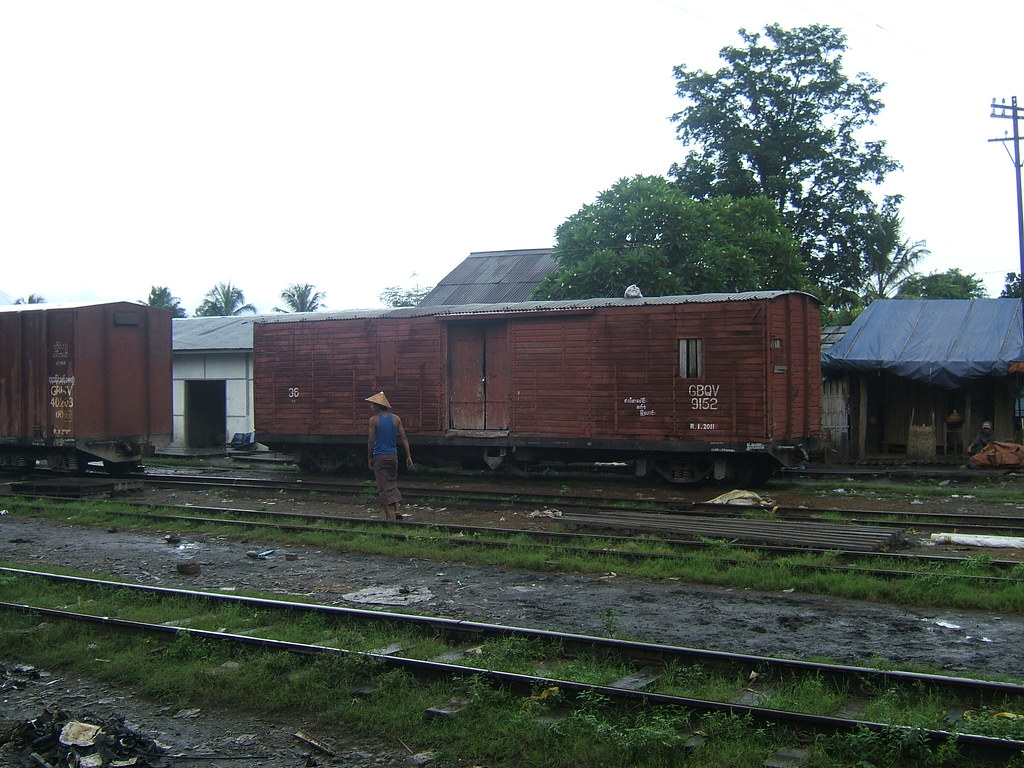
Bogie Goods Van code GBQV
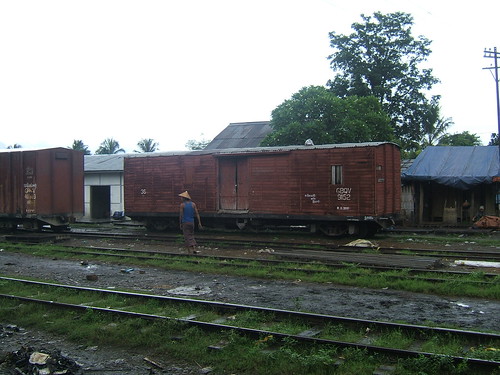 Original size.
Early boxvan retained for storage.
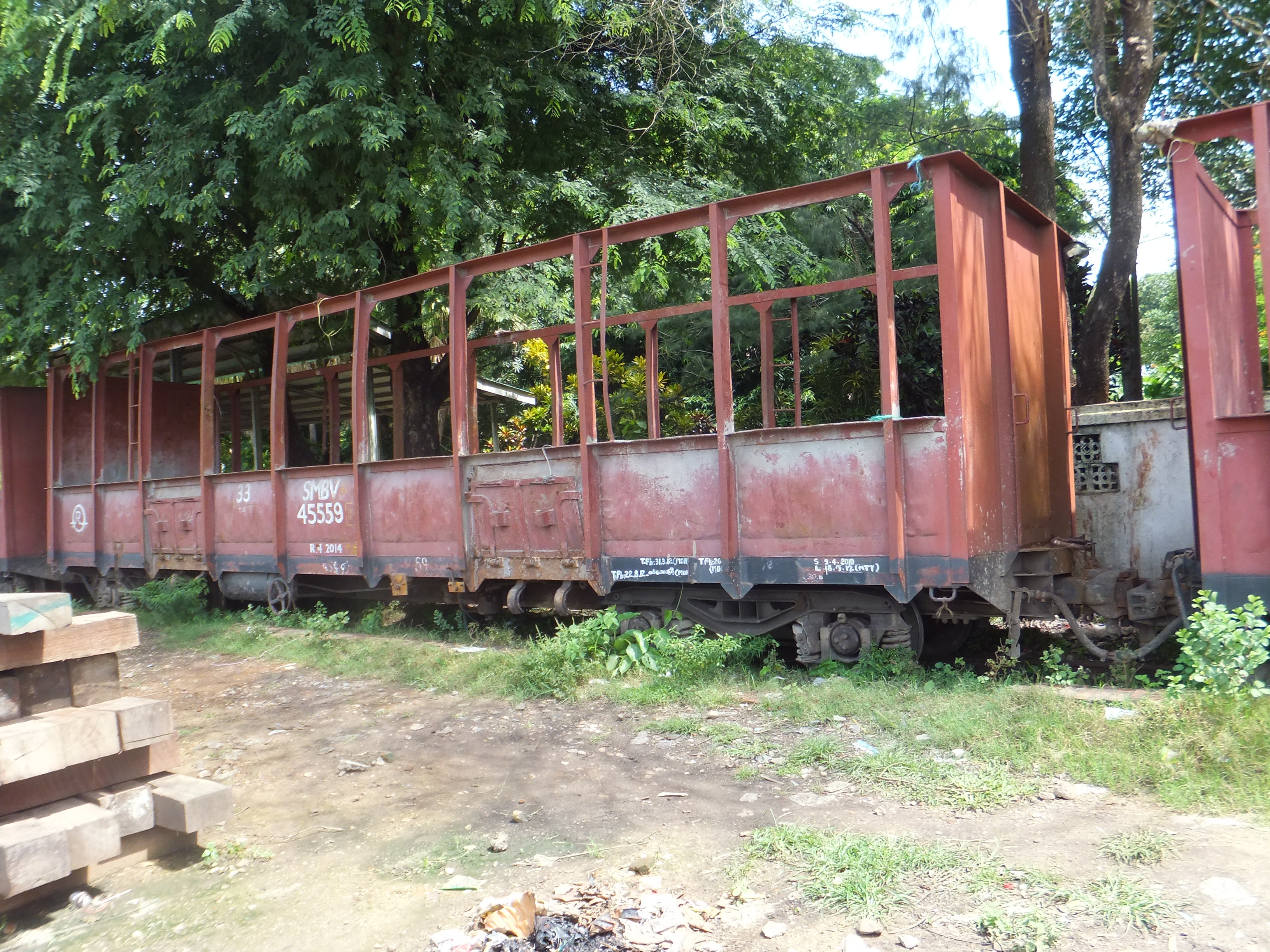
Livestock Wagon code SMBV
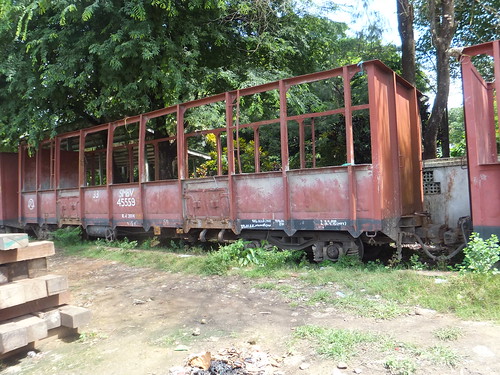
Original size.
Open wagon with framework allowing load to be sheeted, where required. The wagon shown has automatic couplers and air brakes.
Bogie Flat Wagon code WBY
Original size.
Two examples of this type, with the loads sheeted over, can be seen in this picture. They are marked as 30 ton capacity and fitted with chopper couplings.
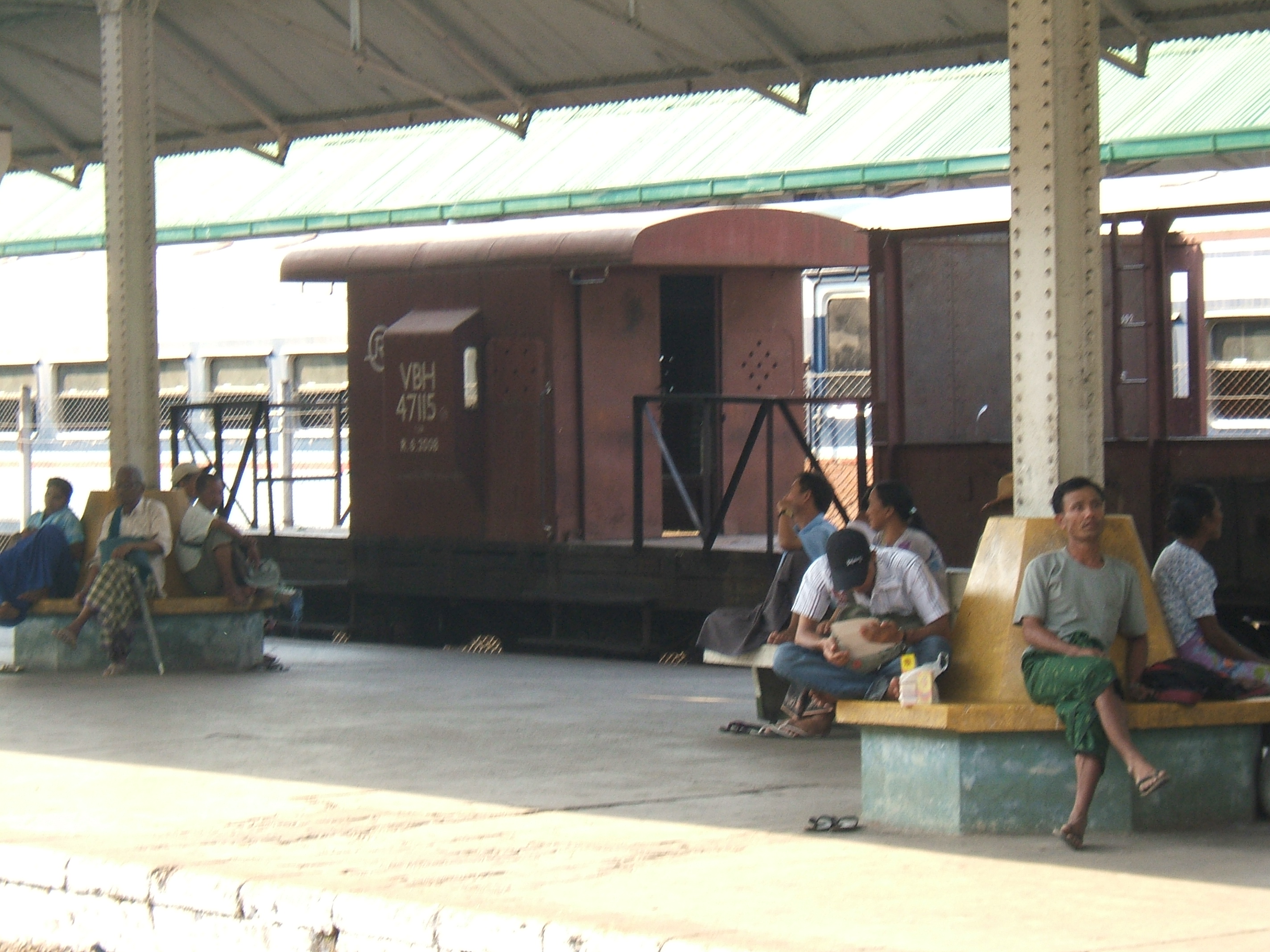
Brake Van code VBH
>
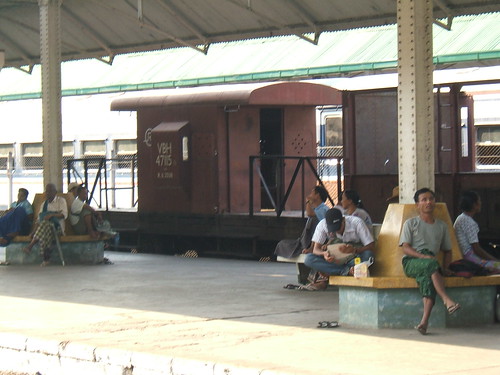
Original size.
Bogie long-wheelbase Freight Brake Van.
Passenger Rolling Stock in Burma
This is a rather informal listing of types of passenger vehicle I've come across. Originally, 'Chopper' couplers and vacuum brakes were used throughout Burma. On more recent equipment, 'Automatic' couplers (similar to the British 'Buckeye') are fitted with single-pipe air brakes.
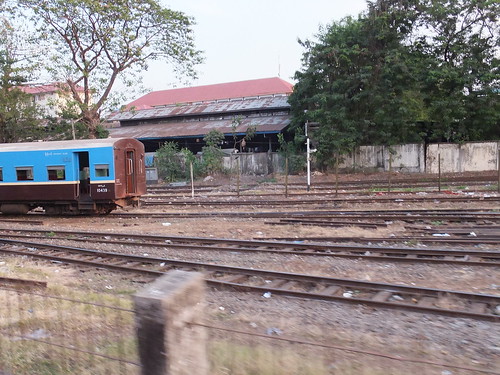
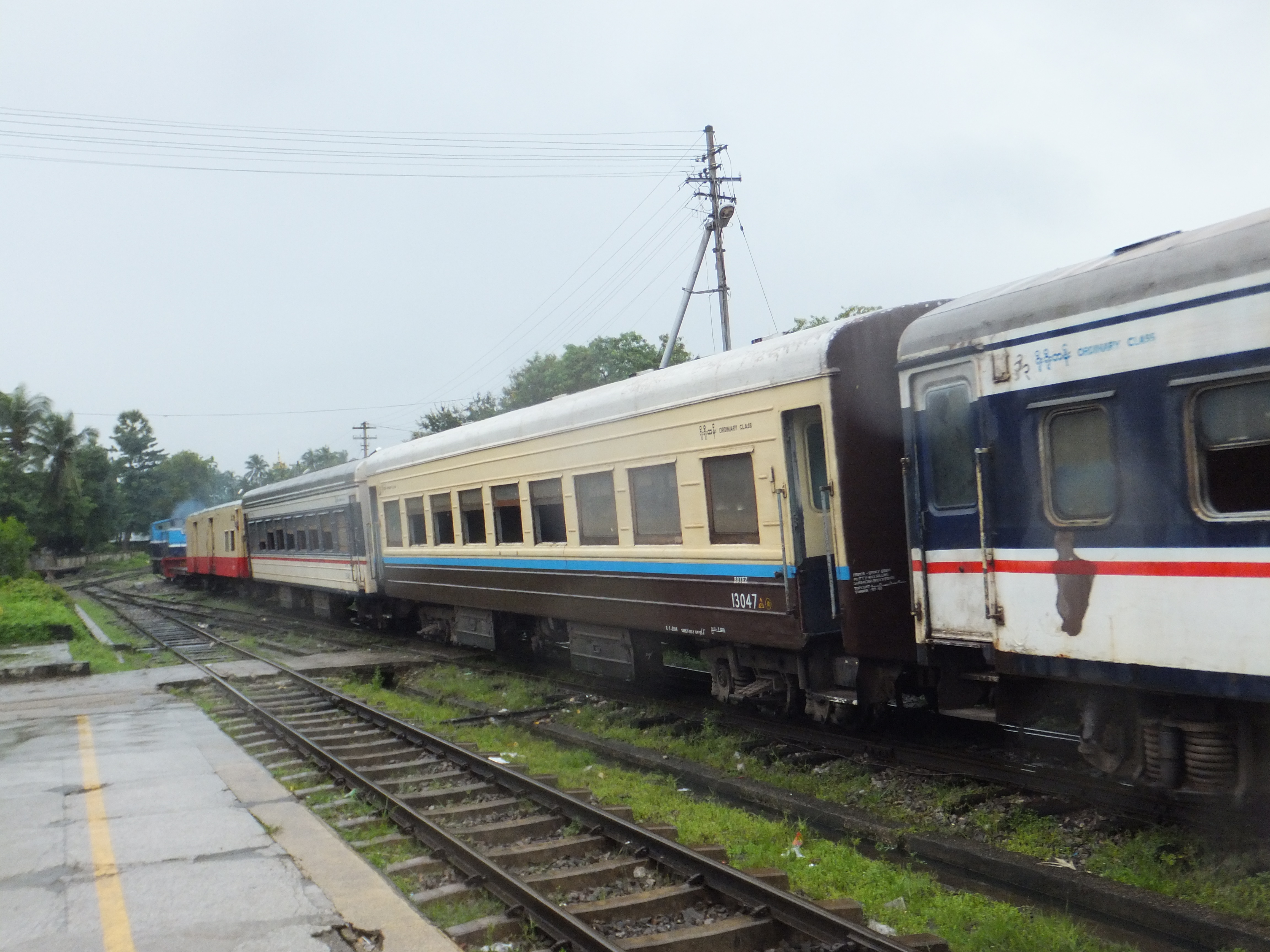
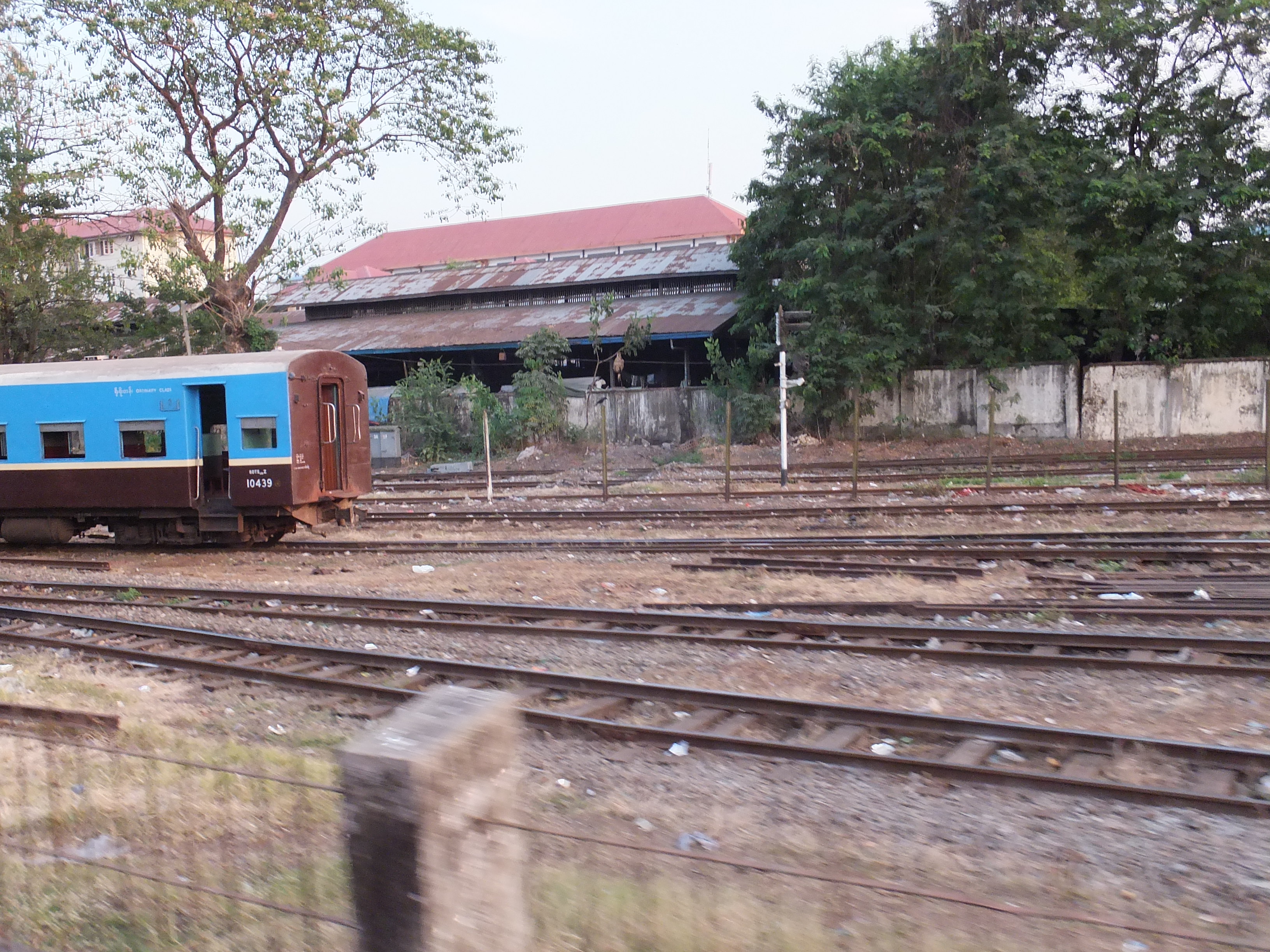
Ordinary Class Bogie Daycoach code BDT)

Ordinary Class Bogie Daycoach, cream and brown with a blue waistline. A modified version has been seen in blue and white with a red waistline.
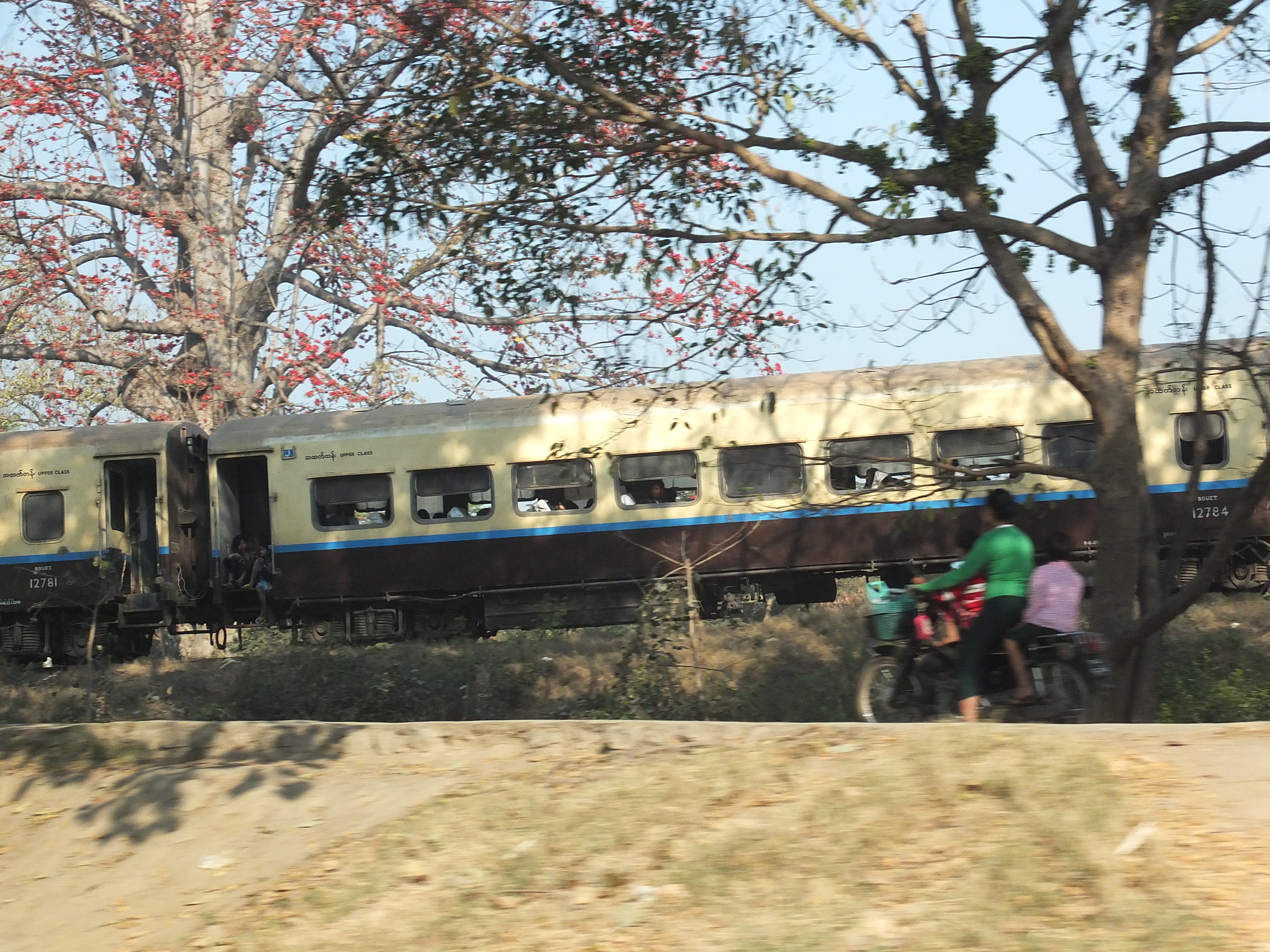
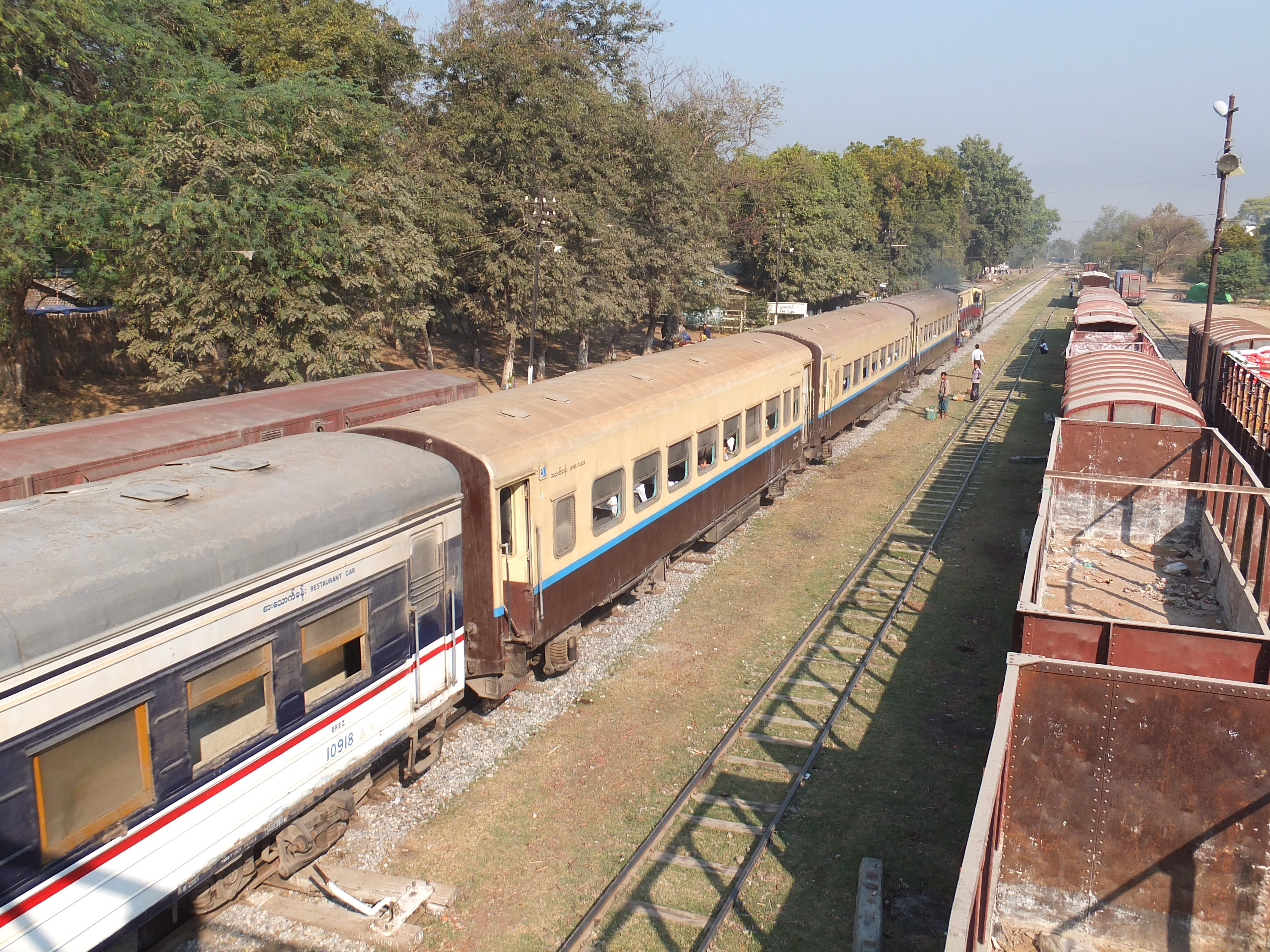
Upper Class Bogie Daycoach code BDUEZ
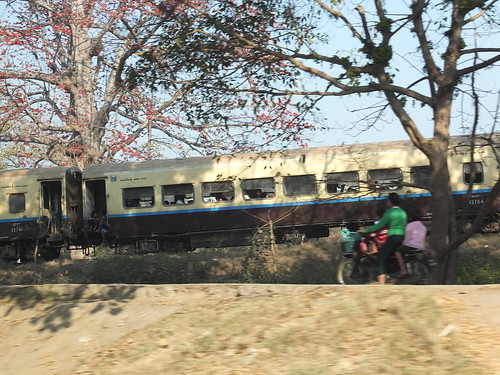
Upper Class Bogie Daycoach, cream and brown with a blue waistline.
Ordinary Class Bogie Daycoach code BDTE(subscript LED)Z
Original size
Ordinary Class Bogie Daycoach fitted with chopper couplings. No brakes on this example. The 'LED' presumably indicates that the original roof lighting fittings have been replaced by panels of white light emitting diodes.
Restaurant Car code BREZ
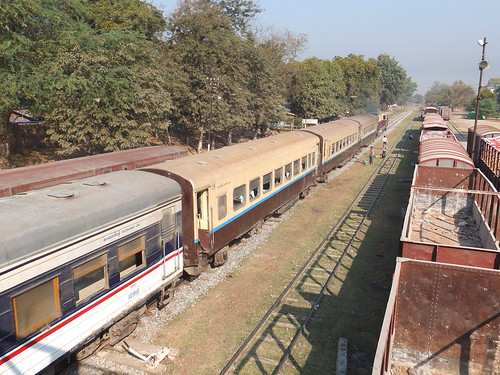
The coach on the left is a Restaurant Car, painted blue and white with a red waistline.
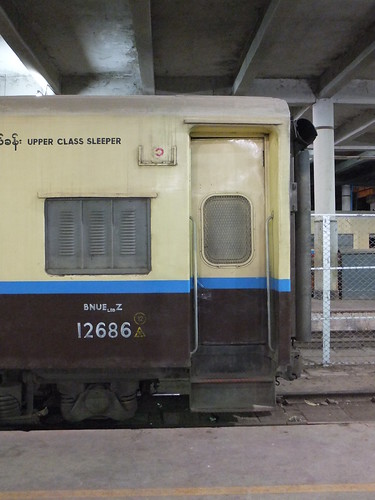
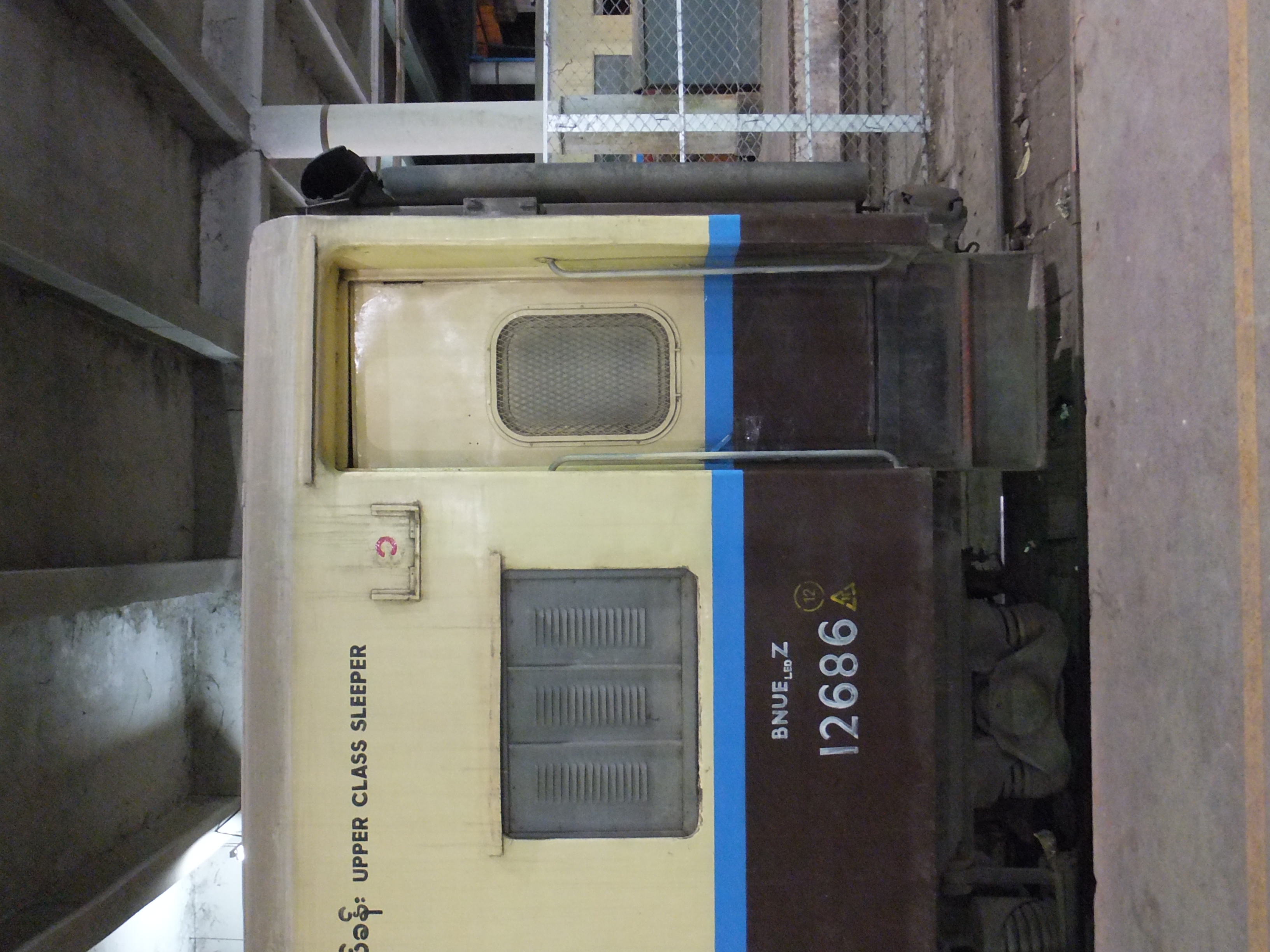
Upper Class Bogie Sleeper code BNUE(subscript LED)Z
Original size
Upper Class Bogie Sleeper fitted with automatic couplings and improved corridor connections.
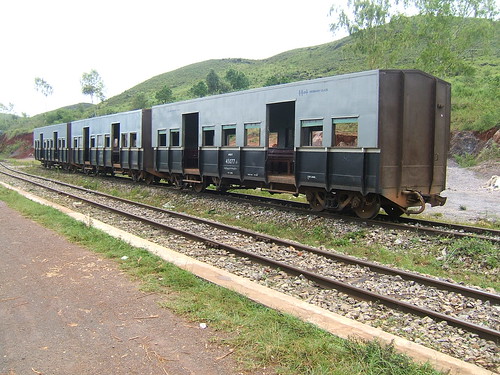
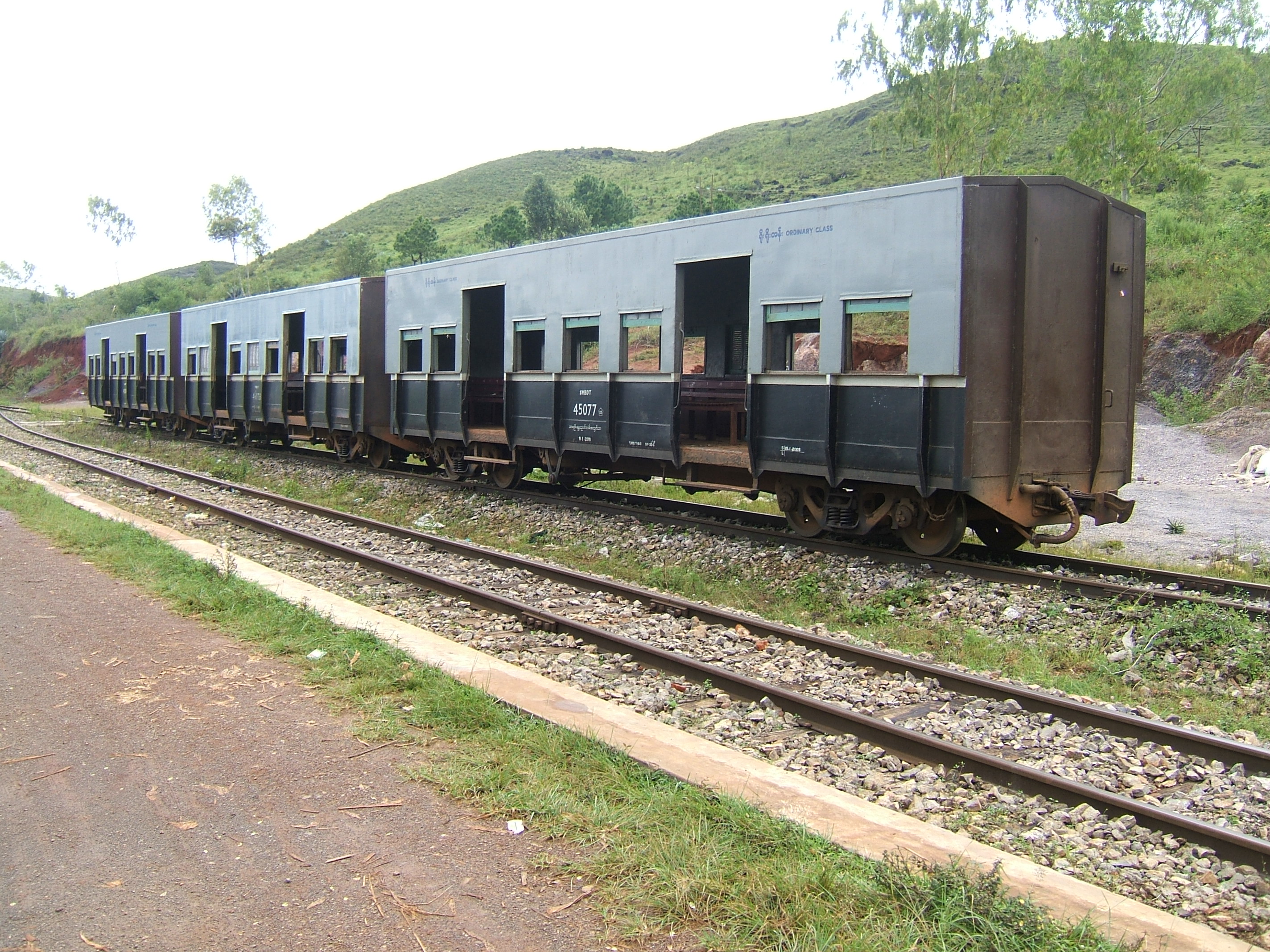
Ordinary Class Bogie Coach code SMBDT
Original size
Ordinary Class Bogie Coach fitted with chopper couplings and vacuum brakes. Grey and dark blue with a white waistline.
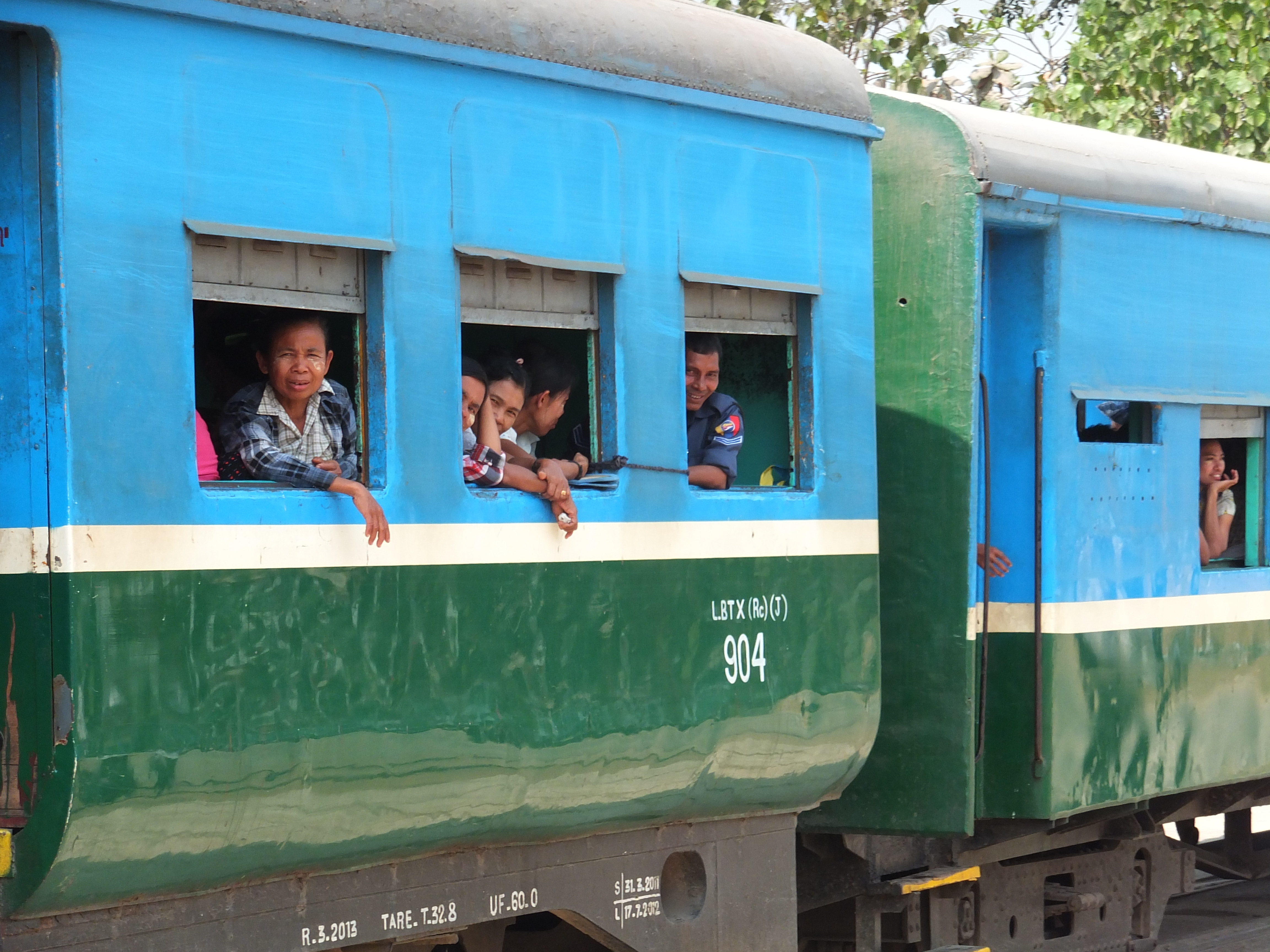
Ordinary Class Bogie Coach code LBTX(RC)(J)
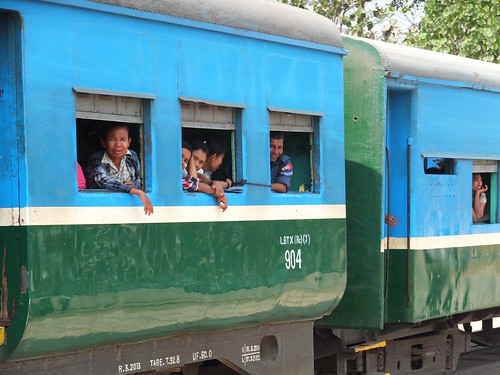
Ordinary Class Bogie Coach painted blue and green.
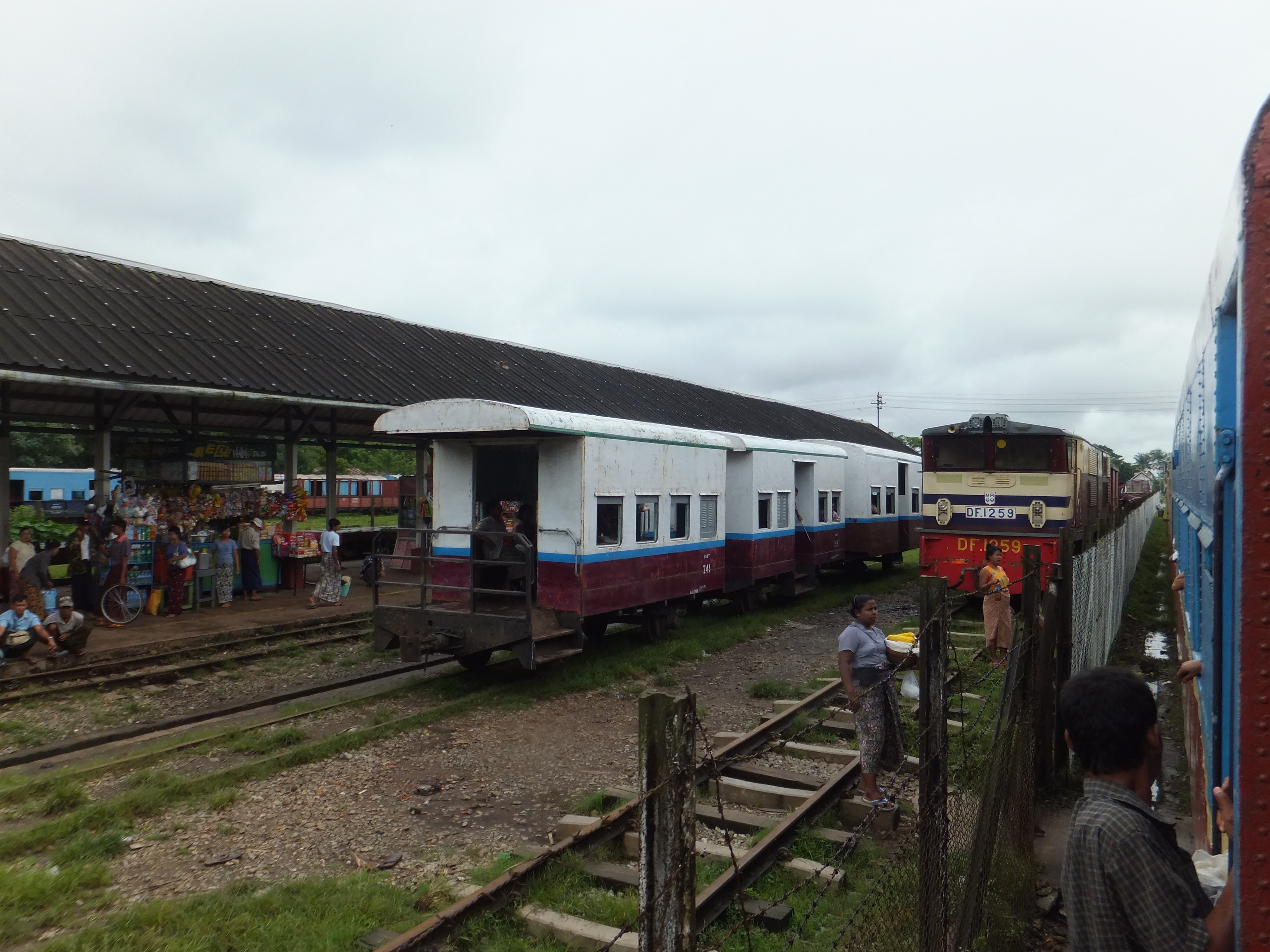
Four-wheel Passenger Coach code LZBT
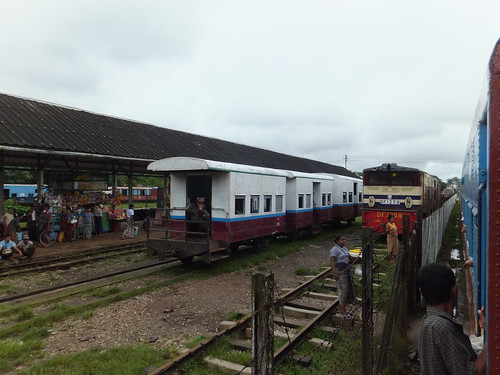
Four-wheel passenger coaches with chopper couplings and no continuous brake pictured at Bago. Livery: white and brown with a blue waistline.
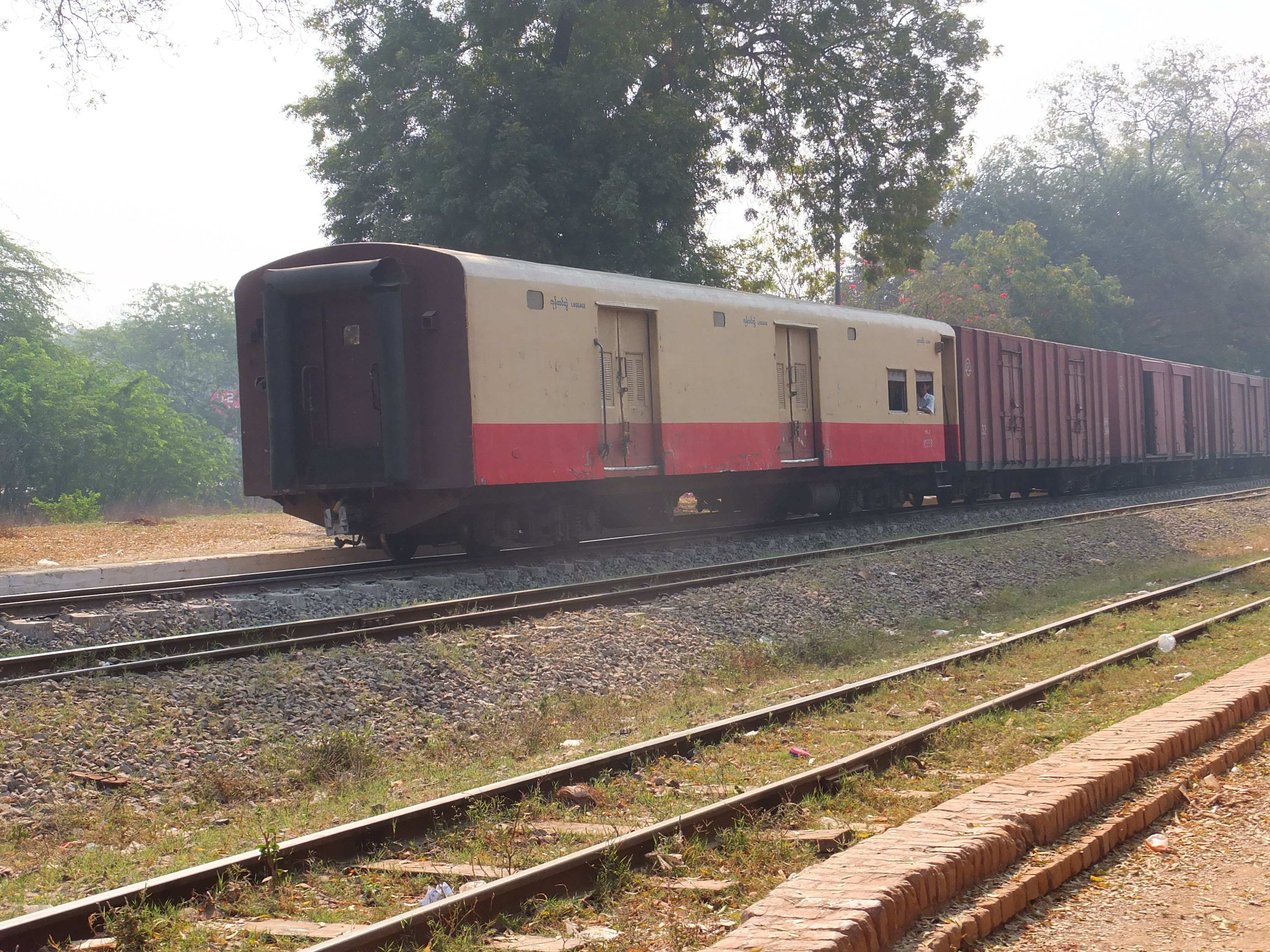
Bogie Guard's/Luggage Van
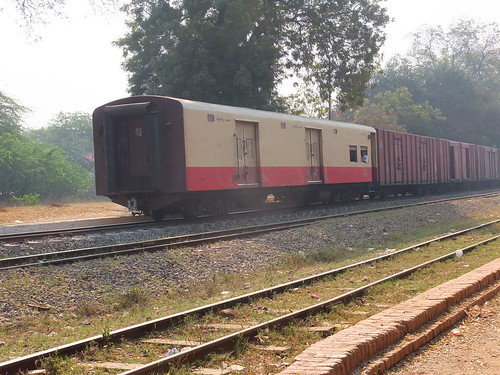
Bogie Guard's/Luggage van. Chopper coupling, originally vacuum braked. Livery: cream and red.
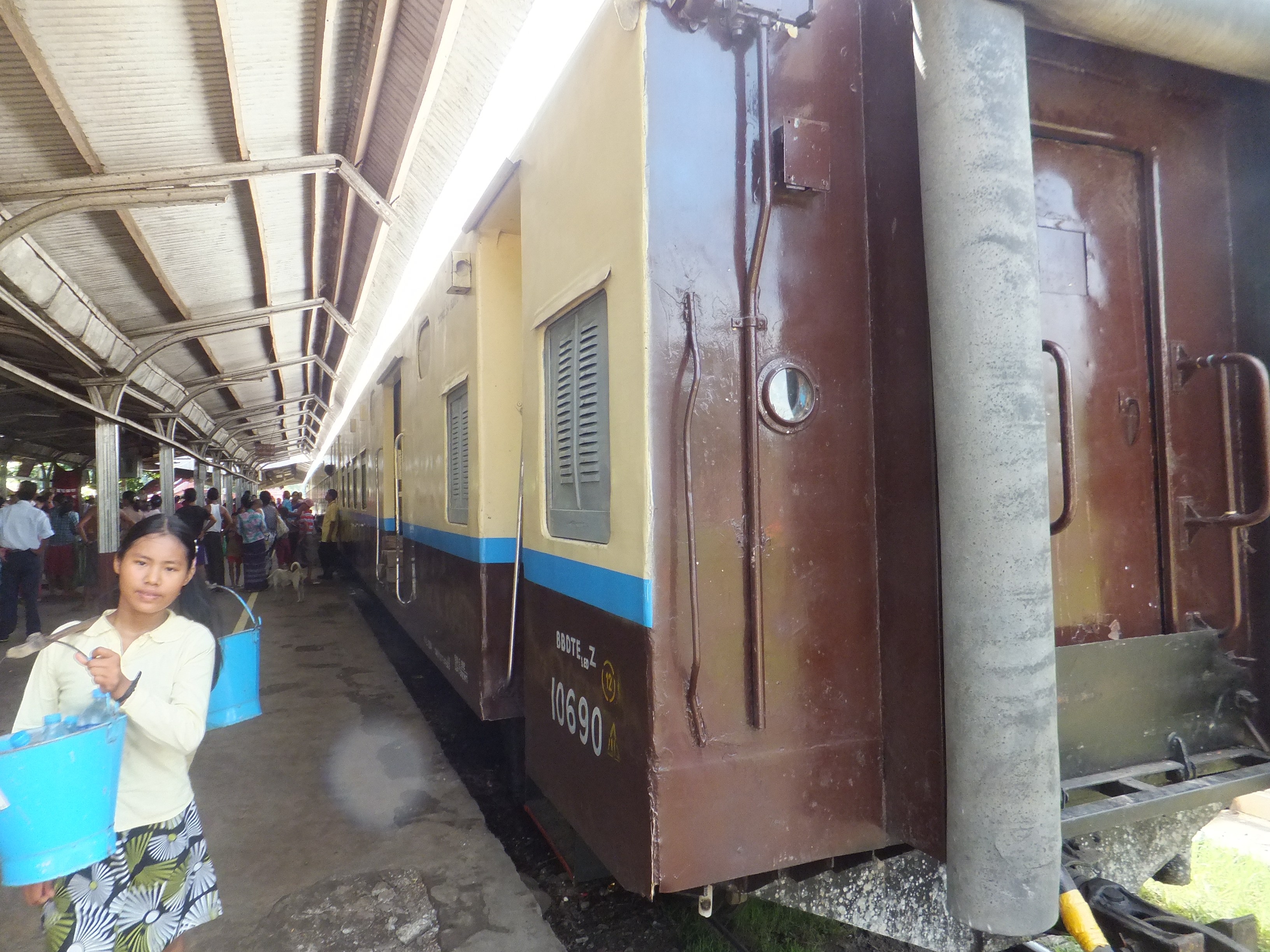
Bogie Guard's/Luggage Van/Ordinary composite code BBDTE(subscript LED)Z
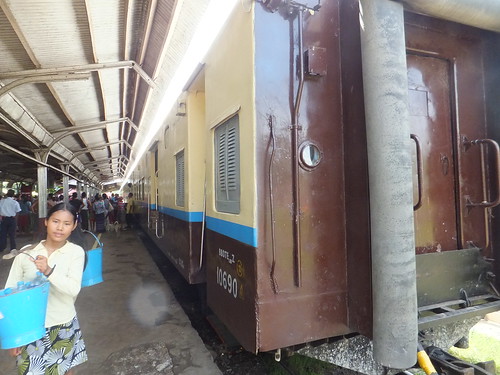
Bogie Guard's/Luggage/Ordinary composite. Chopper coupling, vacuum braked, improved corridor connections. Livery: cream and brown with a blue waistline.
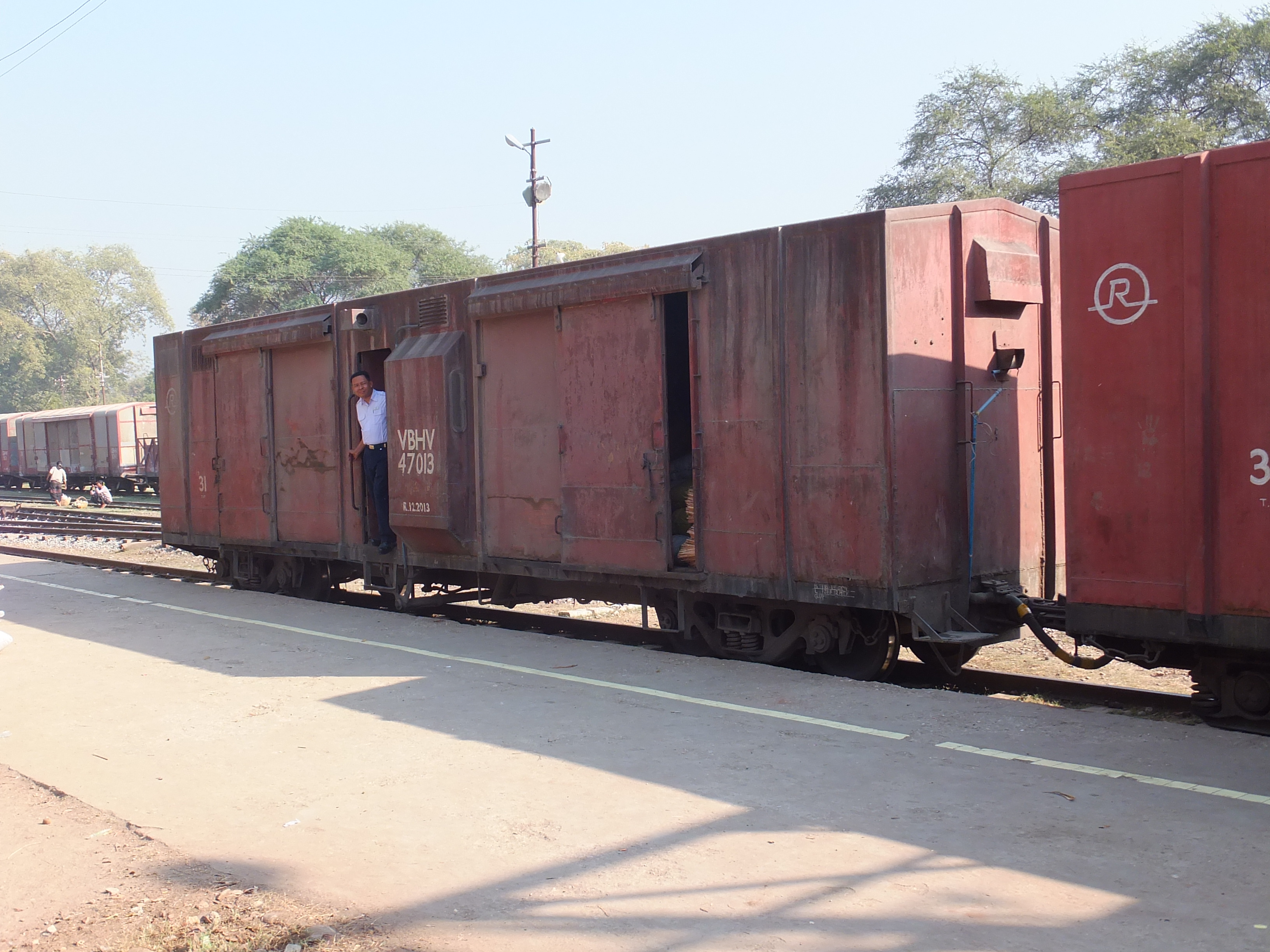
Bogie Guard's/Goods Van code VBHV
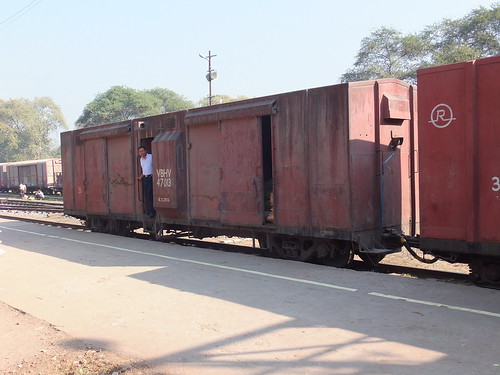
Bogie Guard's/Goods van with two sliding freight doors, Guard's door and ducket on each side. Shunter's step on end. Chopper coupling, originally vacuum braked. Capacity marked as 31 tons. Versions exist with 3-leaf hinged freight doors. Included with passenger vehicles as often seen on passenger trains.
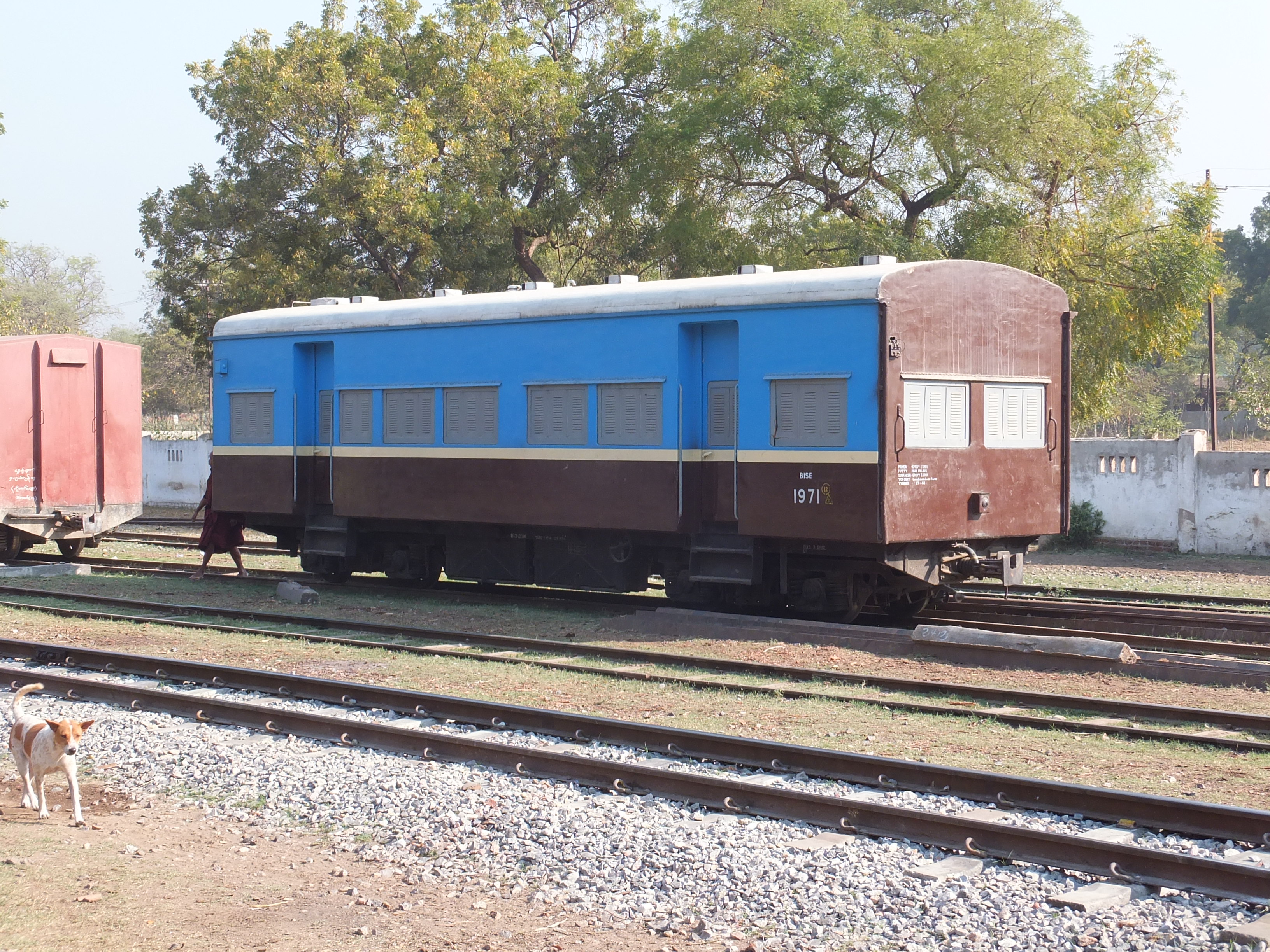
Bogie Coach code BISE
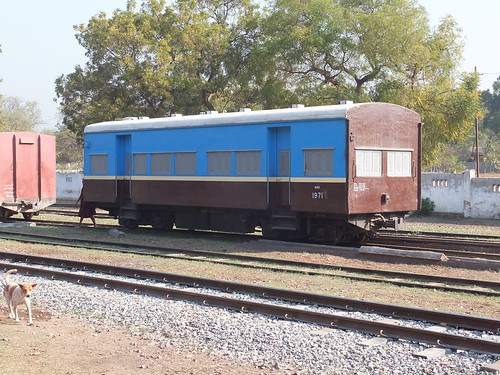
Appears to be a passenger design. Note end incorporates a tail lamp. Fitted with chopper couplings. Originally fitted with vacuum brakes, now removed. Livery: blue and brown with cream waistline.
[BBDTE(LED)Z added and minor changes 4-Apr-2013]