Monday, 20 August 2012

The Bear's Story

A Guest Writer takes over for this Post.

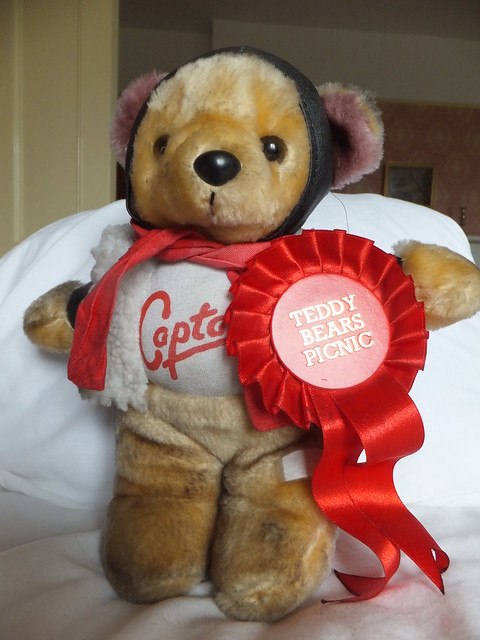
Captain Chocolate, after a day on the Footplate.

Hello. My name is Captain Chocolate. My name does not indicate a fondness for confectionery although, like most bears, I have a sweet tooth. Rather, it alludes (is that the right word?) to my frequent call to the Ground Crew of "Chocks away!" when I was a Celebrated Pilot.

I no longer fly and now enjoy an agreeable, if quiet, life with my Mistress. However, understanding my interest in all Bear-related matters, my Mistress occasionally takes me to Teddy Bears' Picnics which some Preserved Railways operate.

The first one I attended was some years ago at Peak Rail (I am quite an elderly bear) and, since then, I have attended a number of these Events.

The latest such Event was at the Battlefield Line on Saturday, 18th August 2012.

I should explain that, rather unusually, my Mistress drives Steam Locomotives so, when I accompany her to these events, I spend most of my time riding around on the engine, waving to the other Bears and the young children that Bears invariably bring with them. I must say that speeding through the countryside with the wind in your Fur is the next best thing to flying and I've become quite an enthusiast for Steam Trains myself.

The one problem is that the Coal Dust which gets everywhere on Steam Locomotives does rather darken the Fur and I periodically have to suffer the indignity of the Washing Machine. The result is, however, very satisfactory. As you can see from my portrait above, I have found it helpful to retain my old Flying Helmet although I no longer wear the Goggles.

My Mistress has explained that in another country which she calls France, Engine Drivers frequently wore Goggles but, for some reason, the fashion was never widely adopted in this Country. My Mistress is always happy to talk about anything to do with Railways, usually at great length. I've heard people say she can Bore for Britain but I'm not quite sure what that means.

Going back to my own name, you probably know that 'Chocks' are the triangular blocks which are used to prevent an aircraft from moving whilst the Pilot runs-up the engine. Something similar is used to prevent railway vehicles from moving by accident. When people, quite reasonably in my opinion, refer to these railway devices as 'Chocks', my Mistress growls (she can do quite a reasonable Bear Growl) and says "Aircraft have 'Chocks' - Railways have 'Scotches'!". She seems to find the distinction very important. Personally, I agree with Humpty Dumpty (I am, you see, a particularly well-read Bear) that "When I use a word, it means precisely what I want it to mean - No more, No less".

So, what about the Teddy Bears' Picnic on the 18th August?

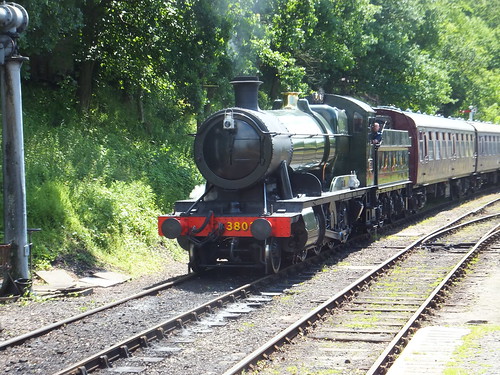
Well, we arrived a Shackerstone about 07:00 hours and I met the Fireman called Sam, the Trainee Fireman called Jason and a Big Green Engine which didn't appear to have a proper name but was known as "The Thirty Eight". A steam Engine seems to be a Big Kettle which needs a large coal fire to boil the Kettle. The steam is then used to make the Engine move. While the Kettle was being boiled, my Mistress went through a strange ritual which I don't altogether understand which she called "Oiling Round". This seemed to involve climbing around the nether regions of the Locomotive and liberally coating herself with Oil, to the frequent accompaniment of Not-Very-Nice Words which I thought Ladies did not use.

My Mistress took this picture of "The Thirty Eight" on an earlier occasion.

Eventually, the Kettle was boiling and we moved the engine to find some Coaches. Once attached to the Coaches and with the Bears, children and grown-ups on board, we started running up and down the line between Shackerstone and Shenton, stopping at a halfway station called Market Bosworth where the Teddy Bears' Picnic was actually being held. Since I had to look after my Mistress, I didn't attend the Picnic myself but I was happy to play my part in the festivities. It was a good day out and my Mistress and I arrived home tired, grubby but very happy.

My Mistress has asked me to tell you that you can find everything she has written about the Battlefield Line here.

Goodbye for now!
Captain Chocolate.

Friday, 17 August 2012

Loco-profile 2: Russian 'YeA' Class

Having been brought up with a multitude of steam locomotive designs in England, it was a surprise when I discovered how few different designs the Soviet Union produced. But those few designs were produced in massive numbers. Because designs were used over a long period, sub-classes did arise as technical improvements were introduced but, in general, having adopted a configuration, they would stick with it.

I was even more surprised to discover that thousands of steam locomotives were, in fact imported into Russia. Having grown up during the Cold War, I found it very odd to learn that America and Canada supplied freight locomotives to Russia. During the First World War, the motive power situation in Russia became critical and Baldwin, Alco and the Canadian Locomotive Company supplied a 2-10-0 for heavy freight. Then, during WWII, Alco and Baldwin supplied over 2,000 locomotives of a very similar design via the USA Transportation Corps as part of Lend-Lease.

This class became known (in Romanised form) as the 'YeA', where the 'A' stands for 'Amerikanski'. The WWII locomotives had a number of changes compared with the original locomotives including an improved chassis design and changes to the cab, chimney and steam dome. In addition, the railings around the foot-framing, so characteristic of many Russian locomotives, were omitted. There were at least two sub-classes: 'YeM' ('M' for 'Modernised' with an improved piston design) and 'YeMV' with a feed water heater. For technical specifications, refer to Reference 1.

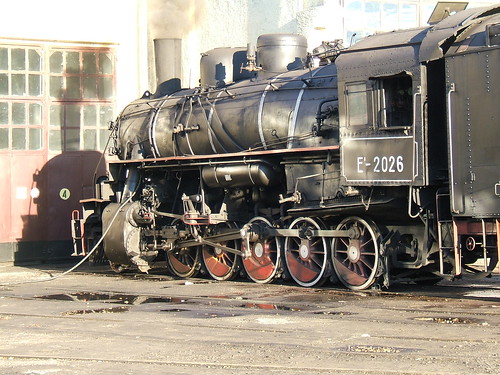
I saw my first 'YeA', number 2027, in Ukraine in 2005 when I went with my friend Mike on a steam driving holiday which is briefly described here and with a set of pictures (including the 'YeA') here. The plan was that we should drive the 'YeA' and the shed staff at Kolomiya had carried out an urgent re-tubing to bring the locomotive back into service. Sadly, following this work, the shed staff couldn't cure a leaking tube problem in time and I only saw the engine in light steam. The shed staff were almost in tears at their inability to complete the work in time.

YeA-2026 in light steam at Kolomiya in 2005.

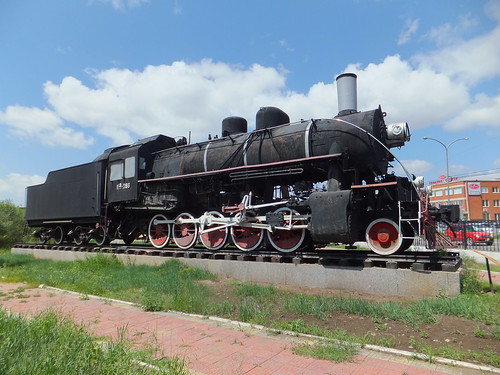
It was to be 2012 and my Trans-Siberian trip before I found another 'YeA', this time 'plinthed' in Ulaan Baatar Train Museum in Mongolia. My pictures of this Museum and its 'YeA' are here.

This Russian 'YeA' Class 2-10-0 in the Ulaan Baatar Train Museum is marked 'YeL-256', perhaps its Mongolian Railway designation.

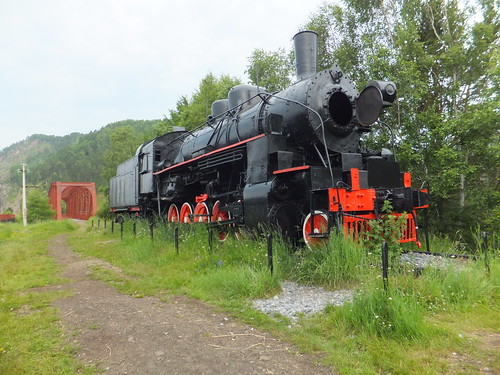
Later in that trip, I found another 'YeA' (without a running number) at Polovina on Lake Baikal. There's a small collection of photographs here.

'Alco' built 'YeA' Class 2-10-0 preserved at Polyvina on Lake Baikal. No running number is carried.

Finally, in the Rolling Stock Museum at Novosibirsk, I found 'YeA' number 3078. Pictures of this locomotive are included in the set here.

'YeA' Class 2-10-0 No. 3078, built by Baldwin in 1944, on display in the Rolling Stock Museum at Novosibirsk.

References:

Reference 1: 'Soviet Locomotive Types - The Union Legacy' by A J Heywood & I D C Button (Frank Stenvalls Forlag) ISBN 0-9525202-0-6.

Thursday, 16 August 2012

Lionsmeet 2012

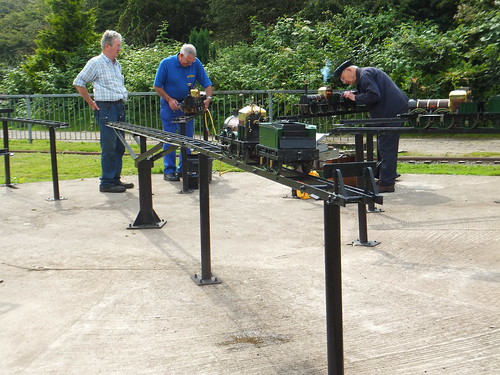
The Steaming Bays on the raised circuit at Newport: Philip and David concentrate on the serious business of preparing their models.

'Lionsmeet' is the long-established annual day out where owners of live-steam 'Lion' models can compare notes and engage in a not-too-serious competition to see which model can perform the greatest 'work done' in ten minutes. Each year, 'Lionsmeet' is staged at a different location and, in 2012, the Newport (Gwent) model engineering club were our hosts on Saturday, 11th August 2012. The weather was excellent.

The club are still developing facilities at the site but an amazing amount of work has been done. There is an elevated dual-gauge (3.5"/5") circuit of modest length which was used for the 5" competition. In addition, there is a long ground level circuit which accommodates 5" and 7.25" models.

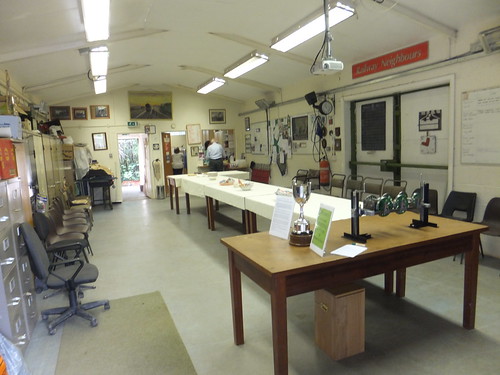
The Club House at the Newport track.

Alan Bibby, who had organised the event with Newport club, made sure the arrangements ran smoothly but, sadly, this year OLCO Chairman John Brandrick was unable to attend. 'Lionsheart' editor John Hawley was on hand taking photographs and making copious notes. 'Lionsheart', of course, is the excellent magazine on all things 'Lion' related circulated to OLCO members. The morning was spent in preparing locomotives, trial running and earnest discussions. Jon Swindlehurst displayed his 7.25" gauge 'Lion' under construction and Alan Bibby had arranged a display of second-hand superheaters of different patterns. Barrie Larke's meticulous 'Lion' model was much admired.

Barrie Larke with his 'Lion' model.

After Alan's briefing to competitors at 12 noon, the host club provided a splendid buffet lunch in the clubhouse. The competitions started around 1.0 p.m.

This year, there were two 7.25" 'Lion' models in steam and they performed on the ground level track, but without benefit of a dynamometer car. For this part of the event, judges determined the winner.

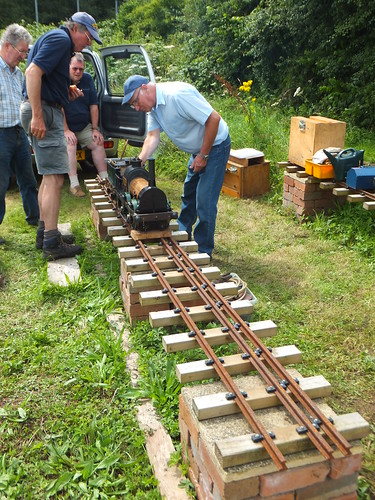
Harrye preparing his model prior to running on the ground level circuit at Newport.

On the elevated circuit, we had four entrants to the competition, driving three different models. Last year, at Chelmsford, David Neish demonstrated his 'LIONsPOWER' measuring system. Having perfected the design, at Newport David allowed us to use his measuring system as the official dynamometer device. A small measuring unit (somewhat analogous to a spring balance) replaces the drawlink between locomotive and driving truck. The extension of the springs in the measuring unit is measured electronically and a cable extends this information to a small battery-powered processing unit which is carried on the front of the passenger truck and displays work done to the Observer. David has also instrumented the driving truck to display instantaneous speed and total mileage to the Observer.

In recent years, Jan always seems to get press-ganged into being the Observer, which role she is pleased to call the 'Dynamometrix'. It's not as much fun as it sounds and this year Jan sustained a hole burnt in jeans (and a little hole burnt in leg) from a particularly aggressive bout of 'fire-throwing' by Jon's engine. I suppose this is to be expected from a locomotive where the prototype was absorbed into the stock of the London and North Western Railway. The L.N.W.R. (with its small engines and heavy trains) had a reputation for throwing half the fire straight out of the chimney.

Each competitor was allowed an untimed lap to 'warm-through' the engine and determine what load he wished to carry on the single bogie passenger truck coupled behind the driving truck. Members of the Newport club and John Hawley volunteered, as required, to be passengers during the competition (I'm told the technical term is "self-loading ballast").

As last years winner, Jon ran first, followed by David Neish, Andrew Neish (driving David's engine) and, finally, Philip Pritchard from Newport club. Jon took the Dynamometrix plus three passengers but David only took the Dynamometrix plus one because of adhesion problems. Andrew split the difference taking the Dynamometrix plus two. Philip completed his trial lap but experienced difficulties filling the boiler prior to his competition run and was forced to retire because of a defective locomotive.

The performances are summarised below:-

Name Work done (ft./lb.) Position
Jon Swindlehurst 55756 1
David Neish 40200 2
Andrew Neish 36675 3
Philip Pritchard 0 4 (retired)

Although there was a slight reservation over Andrew's 'work done' because of a cable connection working loose, it was concluded that (once again) Jon was the undisputed winner. The award was presented to Jon by Philip.

Philip Pritchard presenting the Mike Parrot Memorial Cup to Jon Swindlehurst.

The 7.25" gauge award went to Harrye Frowen for the fanatical fidelity of his model to the prototype.

Alan Bibby announcing the winner of the 7.25" gauge competition and thanking our hosts for a wonderful day.

More pictures at Newport are here.

All my posts about the Old Locomotive Committee (OLCO) are here.

Peak Rail 1940s Weekend 2012

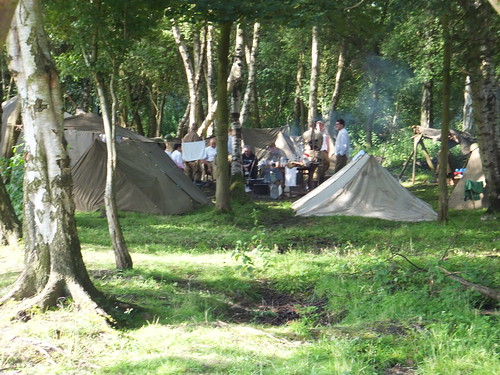
Re-enactors demonstrate the rigours of life under canvas on the battlefield.

In 2012, Peak Rail held its annual 1940s Weekend on Saturday and Sunday the 4th and 5th of August. I was the steam locomotive driver on the Sunday. The actual railway operation was very similar to most weekends although, to cater for demand, we were operating with a 7-coach train. Because trains now operate between Rowsley and Matlock (Town), operation was 'top and tailed' with 'Austerity' 0-6-0T at the south end of the train hauling the train in an Up direction and a 'Class 31' diesel-electric bringing the train back to Rowsley.

I was very aware that our train was a very poor representation of a wartime service. Whilst the steam locomotive was (just) a 'wartime baby', being built in 1944, she is currently turned out in British Railways black, numbered 68013 and carries the later-period British Railways logo. The British Railways 'Mark 2' passenger stock is wrong and, again, the maroon livery is incorrect, although it is very similar to the L.M.S. style. As for the Class 31, these weren't introduced until 1957 and the livery carried is much later. But, compromises must be made in re-creations and I think I'm in the minority in finding these anachronisms a little jarring. I don't think you'd find many lady engine drivers around in World War 2 (except in Russia) so I can't really complain.

My own concessions to the period were a 'tin helmet' (worn from time-to-time - they are actually steel, of course, and quite heavy) and a Respirator (which I carry around, but decline to wear).

When you work on the train, you miss a lot of the action but I took a number of photographs to give an impression of the scene, which you can find here.

Andrew Briddon's Drewry/Vulcan diesel mechanical WD72229 in 'olive drab' certainly looked the part.

WD72229, a jackshaft-drive diesel mechanical.

A 'Bofors' anti-arcraft gun on a 'LOWMAC' on the turntable made an impressive display.

The 'Bofors' gun wagon-mounted on the turntable.

Paul Harper, Marina Mae and Paul Casper provided ENSA entertainment in a large marquee. The marquee also featured Dove Holes Brass Band, Punch and Judy shows and a licensed bar.

During the day, there were lectures on military topics, demonstrations of firepower and a mock battle. In additions to military encampments and foxholes, there were field kitchens and mobile hospitals, together with displays explaining the role of civilians in wartime. Both military and civil vehicles were on display and, of course, lots of re-enactors in the uniforms of various countries.

The weather was kind and the event was very well attended.

Wednesday, 15 August 2012

MOSI Mini Maker Faire

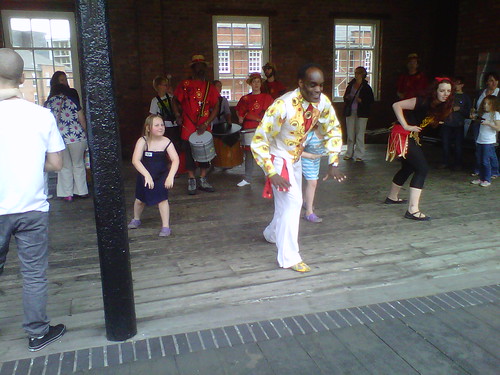
On the weekend of the 28th and 29th July 2012, the Museum of Science and Industry in Manchester held a Mini Maker Faire. This curiously-titled event seemed to be a celebration of things people can do, from hand-making paper to Samba dancing and from building a model railway to building an electronic flashing brooch.

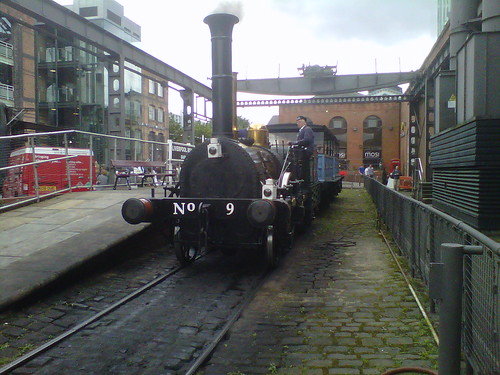
Stuart readying 'Planet' for giving rides.

I was there on the Saturday, as Operating Officer for the railway (operating a steam railway is something you can do!) and we were quite busy. The booked driver, Stuart, generously shared the driving with me but I also managed to grab a few pictures of some of the activities which are here.

Samba dancing lessons in the Coaching Shed.

Tuesday, 7 August 2012

The Completion of the Trans-Siberian Railway

The first public railway in Russia was the Tsarskoye Selo Railway which ran a modest 27 km from Saint Petersburg to Pavlovsk. It opened in 1837 using a mixture of steam locomotives built in England (Stephenson 'Patentee' class) and Belgium. See the Wikipedia article.

The sheer size of the Russian Empire meant that travel from the centres of power in Moscow and St. Petersburg to remote lands like Siberia was difficult and time-consuming in the 19th century. The construction of railways to link these remote areas seemed essential and, in 1891, work on the 9,000 km long Trans-Siberian Railway linking Moscow and Vladivostok was authorised by Tsar Alexander III. The heir to the throne, Nikolai Alexandrovich, inaugurated the project in Vladivostok and building proceeded simultaneously at both ends of the line. Over 66,000 men were employed on the herculanean task.

In 1898 the first train arrived in Irkutsk, having travelled around 5,000 km from Moscow. However, beyond Irkutsk, the area around Lake Baikal presented a problem. One possible route from Irkutsk to the southern side of Lake Baikal and the line to Vladivostok would require a climbing route averaging a gradient of 1 in 75 for 30 km. This was regarded as beyond the capabilities of the available locomotives. The second possible route followed the west bank of the Angara River upsteam to the Lake, then continued south west, hugging the shoreline of Lake Baikal to reach the southern side of Lake Baikal and the line to Vladivostok.

The second of these routes, called the 'Circum-Baikal Railway' was adopted. The line from Irkutsk to the Lake near the village of Baikal was completed without much difficulty but the 90 km of construction along the shoreline of the Lake caused significant delays because of the large number of tunnels, galleries and bridges required. In order to commence through services, it was decided to bring trains from Irkutsk to the temporary terminus at Baikal and use ferries to tranship passengers and cargo to the southern shore of the Lake at Mysovaya.

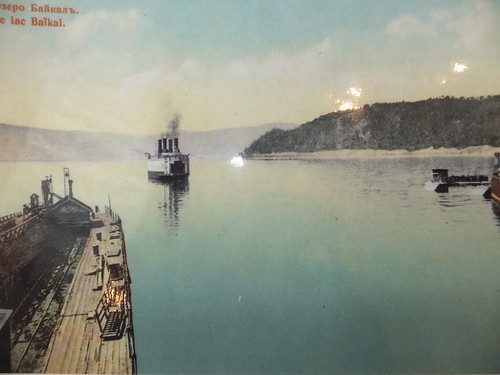
Two icebreaking ferries were ordered from Armstrong Whitworth in England. They arrived part-built and were commissioned in Russia. The first, 'Baikal', was a train ferry, that is to say passenger and freight cars could be run onto special tracks on her deck and transported intact across the Lake to the other section of the Trans-Siberian Railway.

An old postcard showing the Train Ferry 'Baikal'.

The second ferry, 'Angara', was a passenger and cargo ferry without the facility for carrying railway wagons. To accommodate these vessels, special docks were built, largely in wood, on either side of the Lake at Baikal (which became Port Baikal) on the northern shore and Mysovaya (now called Tankhoy) on the southern shore. These services commenced in 1900.

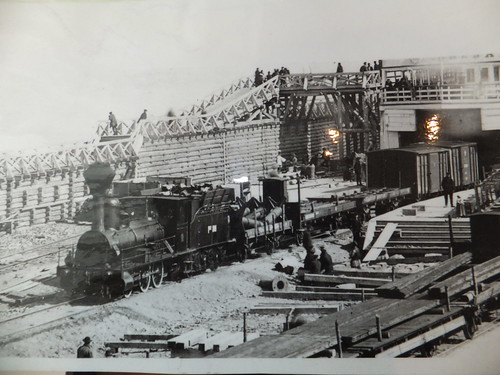
Old photograph showing wagons being shunted on and off the 'Baikal' at Port Baikal.

Lake Baikal is almost 400 miles long, up to 50 miles wide, prone to sudden storms and freezing in winter so the ferries were no soft option. Both ships had specially-shaped hulls which could bear down on ice and crack it, allowing the ship through. When the ice became too thick for the ferries, the expedient of laying a temporary railway track across the ice was tried but with only limited success. At least one locomotive is supposed to have disappeared through the ice.

Meanwhile, construction of the first track of the Circum-Baikal Railway forged ahead. Originally scheduled for completion in 1905, the railway was operational by September 1904 because of the Japanese threats which preceded the Russo-Japanese War of 1905. Completion of 'the Golden Buckle of the Russian Steel Belt' (as the Circum-Baikal Railway has been poetically described) gave an important advantage in moving men and materiel. To increase the capacity of the railway, work continued on adding a second track which was brought into service in October 1915.

Once the Circum-Baikal Railway was complete, the ferries were withdrawn. However, 'Angara' made a new career as a general ferry criss-crossing between the various small ports around the Lake, surviving long enough to be taken into preservation.

Between 1947 to 1949 a new railway was built broadly on the climbing route between Irkusk and the southern side of Lake Baikal which was originally rejected. Much more powerful locomotives were available and the new line is electrified at 25 kV a.c. and now carries all the through traffic on the East Siberian Railway section of the Trans-Siberian route.

Another project in 1956 provided hydro-electric power to the Irkutsk region by damming the Angara River between Lake Baikal and Irkutsk. This resulted in the original railway line between Irkutsk and Port Baikal being flooded, breaking the original 'Golden Buckle'. The remaining part of the Circum-Baikal Railway from Port Baikal to the southern side of Lake Baikal has been singled and retained, providing a spectacular tourist route.

The remaining part of the Circum-Baikal Railway gives spectacular views.

Photographs:-

Slyudianka Station, East Siberian Railway.
The Circum-Baikal Railway.
Port Baikal.
Circum-Baikal Railway Museum, Port Baikal.

References:-

'The Circum-Baikal Railway: A Concise Guide Book (3rd edition)' by A.K. Chertilov translated Ye. Luganskaya (Artizdat, Irkutsk) ISBN 978-5-93765-044-3.

Saturday, 4 August 2012

Moscow

Saturday, 21st July 2012

Vekovka station building.

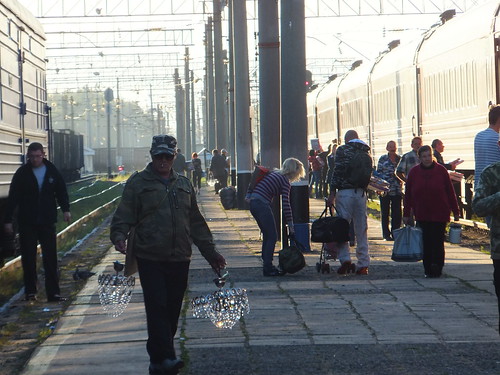
Early on Saturday morning, we arrived at Vekovka, where we paused for a couple of hours. I noticed a flock of birds wheeling over the station in the early morning sun. While we waited, various other trains came and went, served by a number of station sellers offering passengers a last chance to buy presents. I found it very curious that a vendor would be hawking chandeliers on a railway station at six o'clock in the morning.

Vekovka Station, early morning. Anyone want to buy a chandelier?

At Vekovka, we left the Gorky Railway with its 25 kV a.c. electrification and made our final dash for Moscow via the Moscow Railway with its earlier electrification system operating at 3.3 kV d.c. As we neared Moscow, we passed a multitude of junctions and other railways criss-crossed. Around 'right time' we pulled into Kandinskiy Street Station at the end of our marathon rail journey from Mongolia.

The end of our rail journey from Ulaan Baatar - Kazanskiy Street Station, Moscow.

Most of the 'Golden Eagle' guests were going on a City Tour of Moscow but Tatiana had arranged a taxi to take me to the Moscow Railway Museum. The museum in its present form only opened at the beginning of 2012. It's in a modern building set in quiet, manicured gardens contrasting with the hubbub of Richskiy Station next door. To add to the chaos, major civil engineering work is under way in Rizhskaya Square in front of the station.

I spent a pleasant hour pottering around the museum taking pictures (I'd bought a photographic permit) then had a quick look at Richskiy Station. I met up with my taxi driver who took me to the restaurant where my fellow-travellers were taking lunch after their morning city tour before departing in various directions. After a final meal together, it was time to say 'goodbye' to my new friends, then my taxi driver delivered me to Sheremetyevo Airport in plenty of time for my flight to Schiphol, then home to Birmingham Airport.

General Photographs:-

The 'Golden Eagle' train.
Moscow (2012 pictures added to 2011 set).

Railway Photographs:-

Vekovka - Moscow Kazanskiy Street.
Kazanskiy Street Station.
Moscow Railway Museum.
Richskiy Station, Moscow.
Sheremetyevo Airport Line, Moscow.

References:-

'Moscow Railway Map' (The Quail Map Company) ISBN: 1 898319 28 6.

Friday, 3 August 2012

Kazan

Friday 20th July 2012

The Trans-Siberian is not one route, but many. When trains first ran from Yekaterinburg to Moscow, they did so via Yaroslavl which had been connected to Moscow by railway in 1870. I visited Yaroslavl in 2011 (during a river and canal cruise) and there's a description with pictures here. Later, a cut-off branched from the Yaroslavl route at Kotelnich directly to Moscow, avoiding Yaroslavl. But when our train left Yekaterinburg, we took yet another route which would take us to Moscow via Tartarstan.

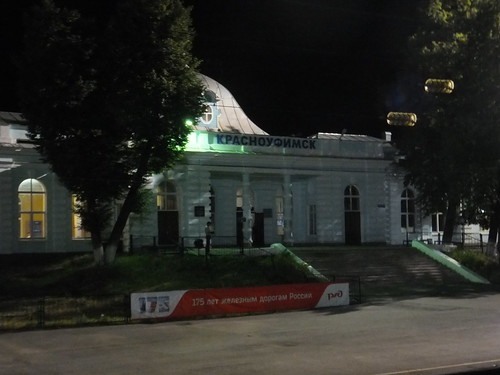
Tartarstan (often spelt Tatarstan) is an Independent Republic forming part of the Russian Federation so there were no immigration formalities as we entered the territory. However, I did wake up briefly in the night when we made our scheduled stop at Krasnoufimsk. Here, we left the 3.3 kV d.c. electrification of the Sverdlovsk Railway and entered the 25 kV a.c. system of the Gorky Railway (I assume named after the Russian author Maxim Gorky).

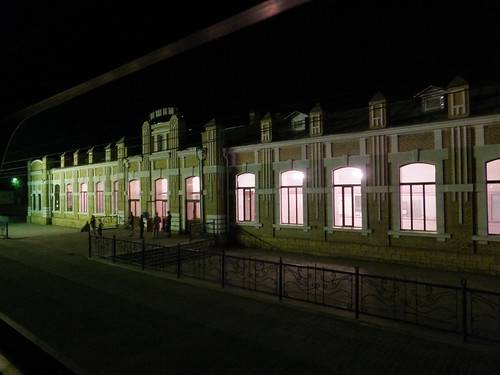
Krasnoufimsk station by night.

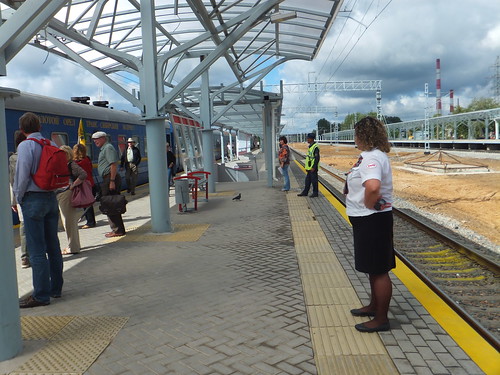
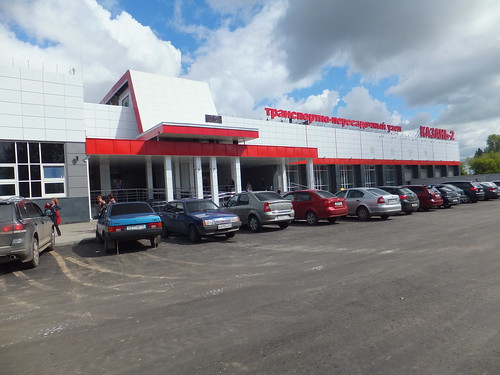
I was awake again fairly early when we made our brief stop at Agriz but it was another five hours of travelling before we arrived at the capital of Tartarstan, Kazan. The main railway station is currently closed for reconstruction so our train arrived at a new station in the suburbs called Vosstaniye. Tartarstan has established itself as a host for various events and I think the rebuilding we encountered was part of the preparations for the world university games.

'Golden Eagle' passengers assemble near the guide's yellow flag at the not-quite-complete station at Vosstaniye, under the watchful eye of station staff.

No expense has been spared in this new station to present a modern image but, unfortunately, the work is not yet finished and there were builders and building materials everywhere. Nonetheless, with typical Russian pragmatism, the station is in use so we carefully picked our way through the various hazards and the streams of bewildered Russian passengers to board a very modern coach waiting for us outside the station.

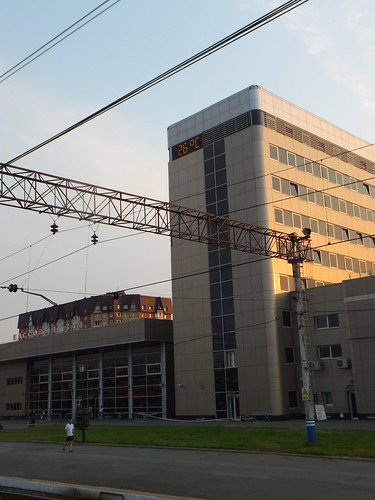
The new station at Kazan (Vosstaniye) viewed from the road side. The signage suggests it will become known as 'Kazan 2'.

Of course, a new station needs a new approach road and, whilst there were proper tarmac parking areas immediately outside the station buildings, the new road to get to the existing road network was still in the hands of the roadbuilders and their machines. We lurched through the potholes and threaded our way through various road building machines to finally emerge on a wide dual carriageway flanked by large blocks of flats. As we neared the city centre, large blocks of offices and luxury apartments reared up and my heart sank – not another modern city of soul-less buildings?

Modern architecture in Kazan.

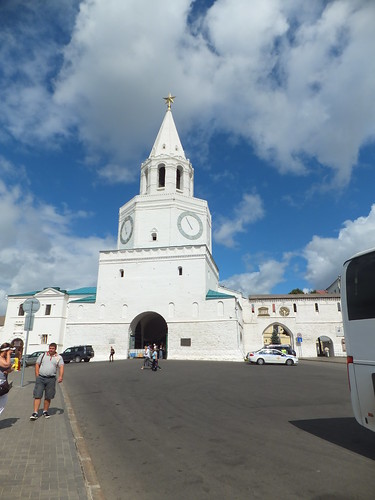
But then we came to the older part of the town and the architecture changed. Some of the buildings were not that old but they were constructed along classical lines or in the French style so they were easier on the eye. Then we arrived at the Kremlin where the walls and watchtowers are genuinely old and, like the Kremlin in Moscow, the buildings within the walls are impressive. We disembarked from the coach just outside the main gate of the Kremlin. A girl in a local costume presented us with the traditional food of greeting – a Tartarstan version of honey-coated ‘Sugar Puffs’ you eat with your fingers.

The Spassky Tower - entrance to the Kremlin in Kazan.

The Kremlin was built in a defensible position on high ground overlooking the river. Entering the main gate, we started to walk along the wide, cobbled main thoroughfare with Government Offices, University Departments and Museums occupying the buildings on either side. We turned down a side road leading to another gatehouse then turned to our right to enter a large plaza tiled in the colours of the Tartarstan flag.

Facing us was a towering, modern mosque. Tartarstan has a sizeable Moslem community which has similar rights to Orthodox Christians and unbelievers alike. The construction of this impressive mosque a few years ago within the Kremlin not far from its Orthodox counterpart was intended to signal this tolerance.

The modern Kul-Sharif Mosque within the Kremlin at Kazan symbolises religious tolerance in Tartarstan.

To my surprise, the mosque featured a visitors gallery, reached by 74 steps from the ground floor. From this lofty position, we could look down on the women’s gallery (bordered by pierced screens allowing women to watch the prayers below without being seen) and the carpeted ground floor used by men. There was a small, raised ‘pulpit’, presumably for the Iman, and markers to show the direction of Mecca.

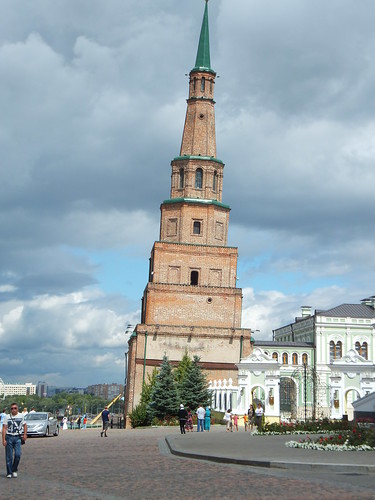
Next, we walked to look at the outside of the ‘Leaning Tower of Kazan’, a brick-built tower which has subsided to be 1.92m out of true at the top.

The 'Leaning Tower of Kazan' (within the Kremlin) is 1.92 m out of true at the top.

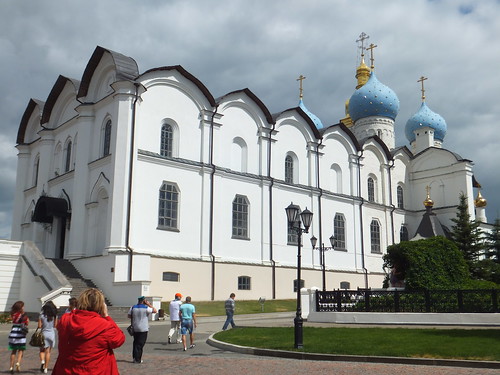
Finally, we visited the impressive Russian Orthodox Annunciation Cathedral. In all Russian Orthodox Churches, the congregation stand and singing is unaccompanied by musical instruments (A cappella). Whilst women cover their heads in church, men go bare-headed. Photography is not allowed.

The Russian Orthodox Annunciation Cathedral within the Kremlin at Kazan.

We then slowly walked back to the main gate and waited in the gardens outside for our bus to return. The bus ferried us to a hotel in the city where we had a relaxing lunch in a large restaurant decorated in Islamic style. The hotel was situated on a long pedestrian street and, after the meal, we were given some free time to wander around on our own. We were to meet up by the old brick bell tower next to the Chaliapin Hotel.

I had a brisk walk around a few blocks of the city, taking pictures of examples of the varied architecture.

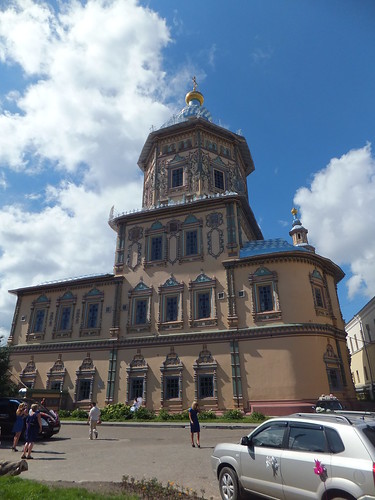
A city-centre church in rather exuberant style. A bride is posed against the church for photographs, explaining the car decorations.

Near the end of Pedestrian Bauman Street, I came across a 'Kentucky Fried Chicken' with builders in occupation. I suppose the delights of 'KFC' are shortly to be offered to the impatiently-waiting Tartars. Across the busy street, I was puzzled by a large ring suspended above the building frontage. It was only afterwards I discovered that the 'Ring' is an entertainment complex incorporating a Multiplex Cinema, Restaurants and the like. A pedestrian underpass carried a 'Metro' sign, so I descended into a bewildering array of underground passages, shops and kiosks. However, I couldn't find any sign for a Metro Station. It took a bit of wandering around before I realised that an anonymous set of doors which could have been to a Department Store in fact led, via a long passage, to a Ticket Hall.

Hidden behind the magnificent Bell Tower in Pedestrian Bauman Street is the white-painted Bell Tower Church of the Epiphany.

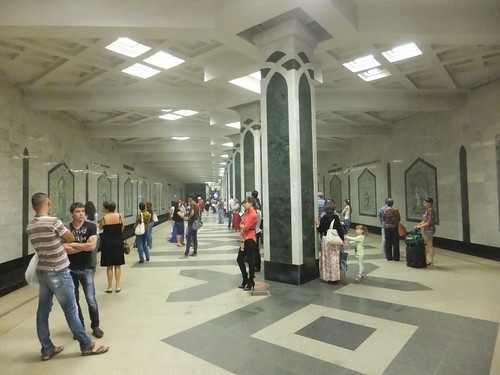
I purchased a token without incident and (with a bit of assistance from the lady manning the automatic barrier) successfully negotiated the barrier and made my way onto the island platform. Although there were plenty of passengers waiting for trains in both directions, minutes passed without a train and I reluctantly concluded that I wouldn't have time to travel to an adjacent station and back in time to meet up at the Chaliapin Hotel. So, contenting myself with taking a few pictures of the station and the modern trains which finally arrived, I left the station.

Kazan Metro.

I took a picture of the statue of Mullanur Vakhitov and afterwards discovered that he was a Tartar Revolutionary active at the time of the Russian Revolution. In the defence of Kazan against the Czech forces in 1918, he was captured and hung. According to the Wikipedia Article, his name is also Romanised as 'Waxitov'.

Another statue stands outside the Chaliapin Hotel. This, of course, is of Fyodor Ivanovitch Chaliapin, the opera singer and perhaps Kazan's most famous son, born 1873 and died in 1938 (of leukemia, in Paris). For a brief biography, see the Wikipedia Article.

This statue of Chaliapin stands outside the Chaliapin Hotel in Kazan.

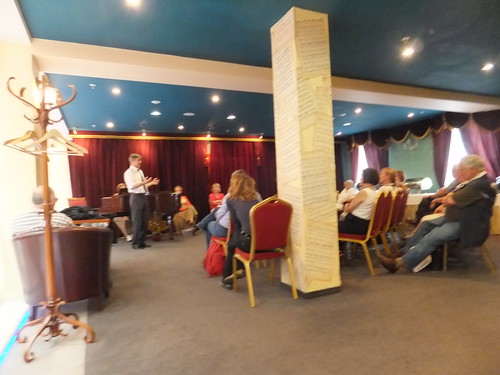
A private concert had been arranged for guests from the 'Golden Eagle'. The hotel restaurant is situated in the atrium of the hotel and, at one side, there was an area of seating facing a grand piano. The soloist was a bass singer in the Russian tradition. I was impressed with his rendering - with twinkling eyes and a mouth set in an almost perpetual smile he reminded me very much of pictures I've seen of Chaliapin. I also like his 'no nonsense' shirtsleeves appearance. I'm ashamed to say that, for the first part of the concert, I divided my attention between the singing and the hotel's Wi-Fi which allowed me to dash off a few e-mails but, once that was done, I concentrated fully on the concert.

A private concert for guests from the 'Golden Eagle' in the Chaliapin Hotel, Kazan.

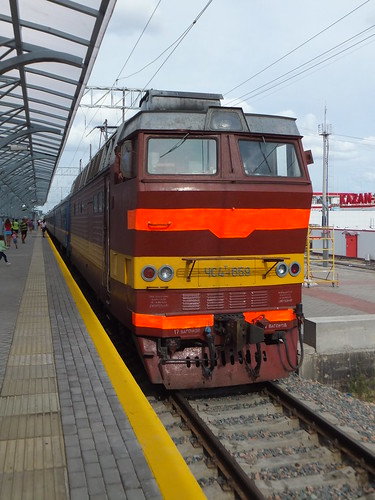
After the concert, we re-joined our coach and were taken back to our waiting train at Vosstaniye, once again running the gauntlet of the builders constructing the station approach road. By common consent, our time in Kazan was regarded as a great success. At about 7.25 p.m. our train departed with (I think) the same locomotive which brought us in - Class ChS4T Co-Co number 659 in brown livery.

Our locomotive (Class ChS4T Co-Co number 659) ready to leave Kazan (Vosstaniye).

This was our last evening on board so we had our Farewell Dinner at 8.00 p.m., followed by various entertainments in the Bar Car. The impromptu choir I was in gave their first (and certainly last) public performance of 'Kalinka' in Russian and then various other guests were persuaded to do their 'party pieces'.

Of course, I was somewhat distracted by the passing railway infrastructure. I was very impressed by large marshalling yards we passed (at Kanash, I think).

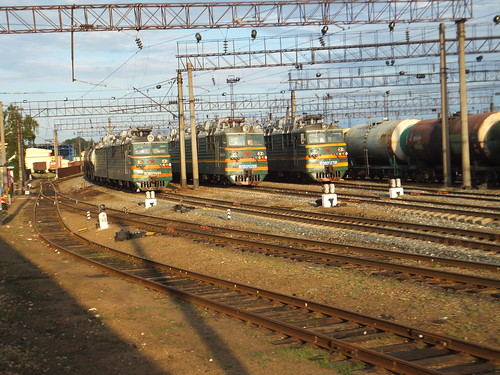
Westbound freight trains awaiting their turn in the late evening sun at the large marshalling yards we passed (Kanash?).

I eventually retired to my cabin to complete my re-packing and get some sleep as our train inexorably continued towards Moscow.

General Photographs:-

The 'Golden Eagle' train.
Kazan.
Concert in Kazan.

Railway Photographs:-

Yekaterinburg - Kazan.
Kazan Metro.
Leaving Kazan

References:-

'Russian and English Kazan' published 2011 (full colour bi-lingual guide book available within the Kremlin at Kazan).

[First published on 22nd July 2012, revisions 3rd August 2012 and 15th August 2012]
Yekaterinburg

Thursday, 19th July 2012

Ishtim Station by night.

We stopped at Ishim in the middle of the night and I woke up long enough to take a picture of the attractive station building before going back to sleep until morning. By now the early morning pattern of arise, let the cabin attendant fold away the bed and order morning tea (which always came with an assortment of Russian biscuits) was well-established.

Large groups of sidings appeared on both sides of the route and we eventually arrived at Tyumen'. We were still on railway electrified at 3.3 kV d.c., but we had now left the West Siberian Railway and were on the Sverdlovsk Railway.

The modern station building at Tyumen'.

After about twenty minutes, during which the coach water tanks were once again refilled, we set off again, passing extensive sidings which, after some minutes, gave way to more rural views.

We had another 300 km to travel before we reached Yekaterinburg, leaving time for a leisurely breakfast followed by the showing of a documentary film about Tsar Nicholas II which I skipped. Lunch was at 12.30 p.m. which unfortunately clashed with our passing the lengthy sidings and increasingly industrial panorama which heralded our arrival in Yekaterinburg. We came to a stand whilst lunch was still in progress but, by skipping dessert and my usual cup of tea, I was able to leave the train and prowl up and down the platform taking photographs before we all met up at two o'clock for our coach tour of the city.

The station frontage at Yekaterinburg. Although it had rained en route, by the time we disembarked at Ekaterinburg, the sun was out.

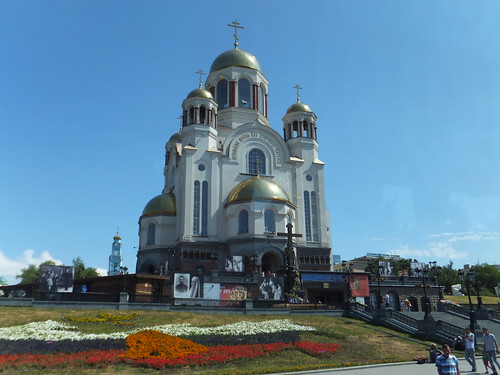
We set off through the largely modern, high-rise city to make our first stop at the Church on the Blood. Like many of the Orthodox Churches in Russia, this building is modern although built in a traditional style. The Soviet era made a pretty thorough job of either demolishing religious buildings or converting them for some non-religious purpose. Yekaterinburg's claim to fame seems to be that it's the city where the last Tsar and his family were killed (although, by that time, the Tsar had abdicated. The house where the Romanov family were killed has gone but the Church on the Blood has been erected on the site, making it an important place of pilgrimage for worshippers. In the gloomy crypt, there is a re-creation of the room where the Romanovs were killed, bathed in red light to emphasise the deeds. The floor above is laid out as a conventional Orthodox Church and, in contrast with the crypt, light floods in through the large windows. Outside the church, there is a statue depicting the Romanov family.

The Church on the Blood, Yekaterinburg.

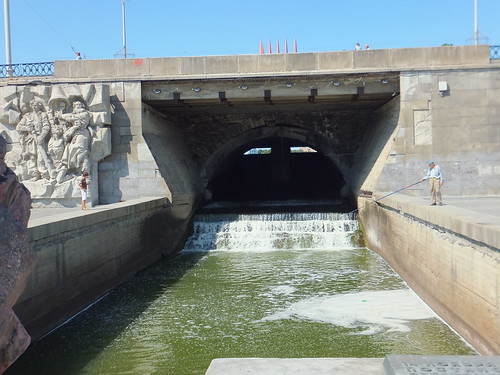
From the church we walked through fairly quiet streets to reach the River Iset and its attractive lake. We walked along the broad promenade bordering the lakeside, together with happy crowds of mainly local people enjoying the warm afternoon sunshine. Yekaterinburg's second claim to fame is that former Premier Boris Yeltsin was brought up here and was Mayor for some time. His house on the opposite side of the lake was carefully pointed out to us. The River Iset continues from the lake by passing under a major street and cascading over a small dam into a channel which passes through formal gardens.

The dam on the Iset.

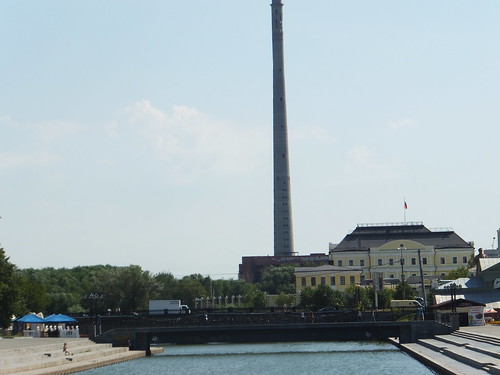
The view of the formal gardens is dominated by a concrete television tower at the far end. The city made the mistake of planning the tower to be taller than the Moscow Television Tower. When Central Government became aware of this, they forced a halt to the work and it has never been restarted, leaving the city with a useless eyesore.

The River Iset and the incomplete television tower.

The guests from the 'Golden Eagle' then split into one group which would visit the Europe/Asia border west of the city and a second group who would be taken to the country for a bicycle ride. Bearing in mind my role as Honourary Secretary of the Bagan Cycling Club (earlier reports here and here), I joined the group who were to bicycle.

We drove to the outskirts of the city and turned off the main road onto a minor road which wound through pine forest before arriving at a large clearing with a number of modern buildings forming a resort for outdoor pursuits. Here, we were allocated to a number of smart mountain bikes. Although provided with 'Shimano' Derailleur Gears, the frame was proudly marked (in English) 'Engineered and Produced in Russia'. After a bit of saddle adjustment and practising, we set off on a mainly tarmac track uphill into the forest. I had the usual problem finding a gear ratio which was generally suitable and then matters proceeded rather better, particularly since I was persuaded to walk up the stiffer sections - a sensible compromise. The day remained sunny and warm but the mature trees provided welcome shade. The air was scented with pine sap and the ride was most enjoyable (particularly the downhill bits). I think we'd done about 5 km by the time we were back at the resort where Tatiana treated us to a fruit drink in the cafe.

Jan, during a short 'breather'.

We then all piled back into the People Carrier for the journey back to the city and the railway station. We were all back on the train in time for Dinner at 7.30 p.m. and our train departed at 9.12 p.m.

General Photographs:-

The 'Golden Eagle' train.
Yekaterinburg.
Bike Ride in Yekaterinburg.

Railway Photographs:-

Omsk - Yekaterinburg.
Yekaterinburg Station.

[Revised 13th August 2012, 15th August 2012]

Thursday, 2 August 2012

Novosibirsk

Wednesday, 18th July 2012

During the night, our train had carried us from Krasnoyarsk to Novosibirsk, a distance of 762 km. En route, we'd been booked to stop at Bogotol and Mariinsk but I didn't wake for either stop. At Mariinsk, we left the Krasnoyarsk Railway and entered the West Siberian Railway. We also left the 25 kV a.c. electrified area because the earlier date of the electrification of the West Siberian Railway means that it operates at 3.3 kV d.c. I started the day with an early morning cup of tea in my cabin followed by my usual breakfast in the Restaurant Car. We rolled into the huge station at Novosibirsk a little before 9.00 a.m. and our group met up on the platform for our sightseeing trip.

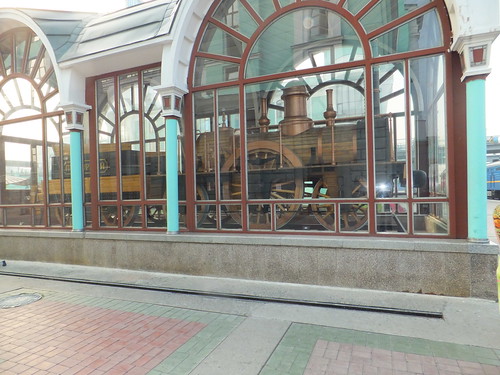
On the platform, we found an interesting building with windows all round displaying a full-size wooden replica of an early steam locomotive built in 1836 and used in Russia. It was clearly a Stephenson 'Patentee' 2-2-2 (although the Russians count axles, not wheels, so they call it a '1-1-1'). The model was very nicely executed and was in close accord with known drawings of 'Patentees', except that this one was presumably for 5 foot gauge.

Wooden model of a Stephenson locomotive displayed on Novosibirsk Station.

Outside the station, we were then divided into two groups - a coach would take one group around the city and visit the famous Opera and Ballet House whilst a smaller vehicle would take three of us with our charming lady guide around the city and then to the railway museum. I would have loved to have visited the Opera and Ballet House but, of course, there was too much to learn at the West Siberian Railway Rolling Stock Museum.

Novosibirsk, which was only founded in 1893 with the building of the Trans-Siberian Railway, is the fourth largest city in Russia with a population now exceeding 1.6 million, so you may not be surprised that I found much of the city nondescript, although I was surprised to find some log cabins near the centre.

Novosibirsk City.

The nine spans of the original railway bridge across the River Ob have been replaced but one of the nineteenth century spans has been preserved in a small park on the river bank, just to the south of the bridge. We stopped to have a look at this before carrying on to the Railway Rolling Stock Museum.

The preserved span from the original railway bridge over the River Ob at Novosibirsk. The present bridge is in the background.

Next, we took the dual carriageway south towards Akademgorodok. This is the university and scientific centre set up in the 1950s to ensure that the Soviet Union developed the resources of Siberia and stayed ahead in the arms race. I was sorry that we didn't have time to visit Akademgorodok which I gather is not quite so elite now, but still a pleasant area. Certainly, the urban handscape gave way to wooden houses and then pine forest. We passed the entrance to Young Pioneer Camps, set in the forest, which aimed to provide summer holidays for young people. In the Soviet era, the costs were often sponsored by the State because of the parents' employment but our guide suggested that today they were just expensive.

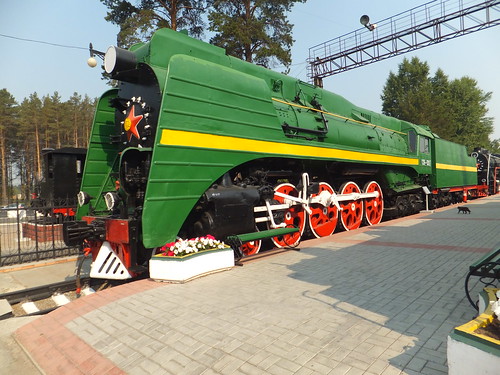
Our destination lay just to one side of the dual carriageway near Seyatel Railway Station. The West Siberian Railway Rolling Stock Museum is an open-air museum so we were fortunate that the day was warm and sunny. The exhibits were displayed on a series of parallel sidings with wide, concrete footpaths between the tracks. The contrast with the abandoned appearance of the Ulaan Baatar museum (described here) was complete. Our lady guide said we'd less than an hour at the museum, for we'd a fair journey back to the city and our train was due to leave at 12.12 p.m. I knew I'd not be able to do a photographic survey of all the exhibits in that time but I set off on my own, at the trot, to do the best I could.

P36 0097: The Connecting Rods and Eccentric Rods have been removed. Note the museum cat.

My aim was to get information 'in the can' (a bit of a misnomer in these days of digital photography) for study later. Just under an hour later, we met up and made our way back to our waiting vehicle, pausing only for me to purchase the limited information on offer at the ticket office.

Our driver made a splendid run back to the city. Traffic speeds in Russia are not very high (the condition of many roads does not permit it) and legal limits of 80 km/h may be posted on even the better roads. We parked for a few minutes for photographs in Lenin Square, near the Opera House and the famous statues, including one of Lenin with coat tails flying in the Siberian winds.

Lenin Square, showing the rear view of the statues. The building in the left background is on fire, smoke is visible and a number of fire appliances are in attendance. Note the wedding party on the right.

The driver had to change his planned route back to the station because one main street had been closed near a building on fire. It looked serious and I counted five fire appliances as we made our way to the station.

Here's the conventional 'pretty' view of the Opera and Ballet House.

Despite the detour, we arrived at the station in good time and made our way to the 'Golden Eagle' after a fairly packed morning. Soon, our train was moving out of the city. We crossed the wide River Ob, where we could see the preserved span of the old bridge which we'd visited earlier in the day and continued we continued west as lunch was served. After lunch, George gave a lecture on the Russian Orthodox Church.

When we stopped at Barabinsk in the late afternoon we were allowed off the train, so I scooted round making my usual photographic record.

Co-Co locomotive EP2K - 071 at the head of our train in Barabinsk.

On the move again, I carried on taking photographs for a while before joining the Russian Class in the Bar Car to learn a Russian Song. At 7.30 p.m., we enjoyed another Dinner in the Restaurant Car. As we came nearer to Omsk, there seemed to be interesting things outside, so I kept taking pictures, right up to our arrival in Omsk.

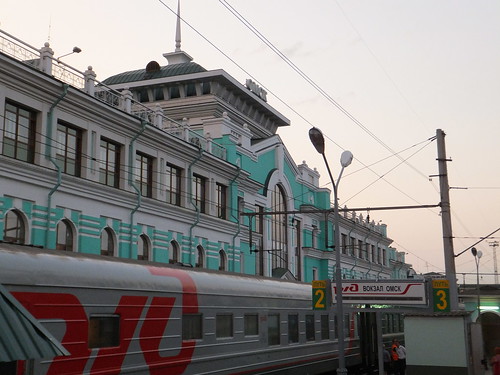
The impressive station building at Omsk.

After a brief stop at Omsk for water, we were off again but, this time, I'd had enough (anyhow, there wasn't enough light for photographs) so I went to bed.

Photographs:-

The 'Golden Eagle' train.
Novosibirsk Station.
Novosibirsk City.
Rolling Stock Museum, Novosibirsk.
Barabinsk Station.
Barabinsk - Omsk.

References:-

'West Siberian Railway Rolling Stock Museum' (colour pamphlet in English).
Set of 30 colour postcards of exhibits at the West Siberian Railway Rolling Stock Museum (text in Russian).
(The pamphlet and postcards are available at the Rolling Stock Museum).