Monday, 16 July 2012

Lake Baikal

Sunday, 15th July 2012

My initial, very brief post, was made on 16th July 2012:-

During Saturday night we’d arrived at Slyudyanka station where we’d remained until morning. So I awoke to find a rather handsome stone built station building on one side and four or five sidings with waiting freight trains on the other side. A diesel locomotive had replaced the electric traction which had brought us from Ulan Ude.

Well, there's a lot more to tell you, and a lot of pictures to post but that will have to wait.

Incidentally, I'm posting this from a restaurant in Irkutsk.

That's all I had time for but I'll try to expand a little now. The 'handsome stone built station building' at Slyudyanka should have alerted me to the importance of this area in the history of the Trans-Siberian Railway but I'm afraid I was completely ignorant of the significance of the Lake Baikal area.

The handsome station building, in pink and white marble, at Slyudyanka.

Lake Baikal is the oldest lake in the world (over 25 million years old), the deepest (5,387 feet) and one of the clearest. It's 395 miles long and 49 miles wide at its widest. It holds 20% of the world's unfrozen fresh water. It's rich in plantlife and animals, many of which are only found around Lake Baikal and is a World Heritage Site. In addition to a Wikipedia article here, there's an interesting site here and UNESCO's site here. Whilst over 330 rivers and streams flow into Lake Baikal, it is drained only by the Angara River which flows north through Irkutsk. In the 1960s, this river was dammed to provide hydro-electric power to the Irkutsk area.

It was only on my return that I learned a little about the construction of this part of the Trans-Siberian, known as the 'Circum-Baikal Railway'. I've written a brief description in The Completion of the Trans-Siberian Railway.

Around 7.00 a.m. our diesel locomotive set off from Slyudyanka with the the ten coaches of the 'Golden Eagle'. We proceeded along the main line past more sidings to Kultuk, where we diverged onto the 'Circum-Baikal Railway' for our journey of around 90 km to what is now the end of the line at Port Baikal. The sun was just rising above Lake Baikal on our right.
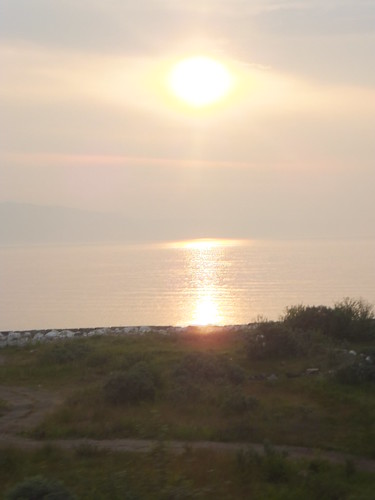
Sunrise over Lake Baikal.

Signs of industry fell behind us and we passed through attractive 'Alpine' scenery - pine trees, steep, rocky hillsides on our left and the placid waters of the Lake extending as far as we could see to our right.

Most of the time, the train was snaking on a rocky outcrop raised above the shore. From time to time, our route would take us slightly inland, leaving space for attractive wooden buildings next to the shore. One group of buildings at Sharyzhalgai was neatly painted in brown and yellow and labelled as a 'Resort House for the East Siberian Railway'. Near the buildings, there were usually a number of people, seriously attired for country pursuits. The shores of Lake Baikal are becoming popular with campers and holidaymakers. The variety of wild flowers we could spot from our train confirmed the richness of the flora around the Lake.

There are 39 tunnels on the way to Port Baikal, Galleries and numerous bridges either stone, steel girder or, inplaces, concrete. A variety of designs of tunnel portal are used, all in stone, and tunnel linings are also stone. I believe Italian stonemasons were recruited for this work.
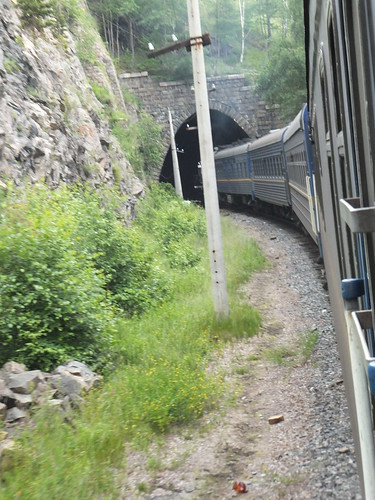
The 'Golden Eagle' entering one of the tunnels.

After we'd been travelling for around two and a half hours, we passed through a very short tunnel (Number 13, 29.8 m), crossed a broad river and came to a stop near a small village, Polovina (sometimes written Polovinny). The only 'platform' was a short section of pre-cast concrete and the train had halted with the front door of passenger coach 1 aligned with this 'platform'. We were only allowed off by walking through the train and exiting at this door.

As soon as we came to a stand, I spotted a member of the train staff jumping off the train with a fishing rod. Later, I saw him return to the train, carrying a decent-sized fish. I don't know what it was, but Lake Baikal is famous for its Omul fish.

As we'd arrived, we'd passed a preserved 'Ea' class locomotive standing on what would have been the second track, before the line was singled. My first task was to survey this. This was one of the American-built locomotives supplied to Russia.

To reach the small beach, we had to cross the line in front of our locomotive. It had been suggested that we might wish to swim at this location but a simple test of the water temperature meant that I immediately abandoned this idea, although a few of the younger passengers did brave the waters. They did confirm that it was very, very cold. Not to be completely thwarted, I paddled in the Lake, and was joined by a couple of our passengers. The water was incredibly clear and, for some hours afterwards, I had a pleasant 'tingling' sensation in my feet.
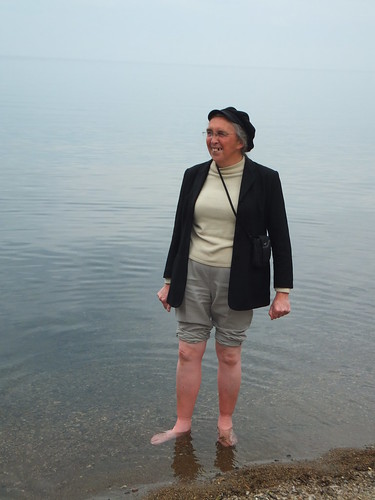
Jan braves the waters of Lake Baikal.

When we first stopped, I'd spotted a woman emerging from a 'bender' tent on the beach. There was something very business-like about her, so I was not surprised to see that she had set up a little souvenir stall next to the train. This is where I purchased the excellent guide book on the Circum-Baikal Railway referenced below.

There was still time for me to take a walk through the village - very quiet except for the clucking of a number of hens running free. The track led down to the bank of the Polovinnaya River we'd crossed on our arrival. On my way back, I exchanged greetings with an elderly man walking through the village.

It was now time to leave Polovina and continue to Port Baikal. With the 'switcher' design of locomotive, there's a catwalk, provided with a handrail, either side of the engine compartment. Interested guests were to be allowed to ride on the catwalk facing the Lake for a short while. We all clambered up enthusiastically and the train set off. As soon as we left Polovina, the train entered tunnel number 12. At 778.4 m in length, this is the longest tunnel on the line and, unusually, it is completely straight. Although it was rather noisy next to the engine compartment, I found it delightful with unobstructed views of the Lake. I wasn't worried when it started to rain but, all too soon, the train came to a stop and we were invited to rejoin the passenger coaches. A fascinating interlude.
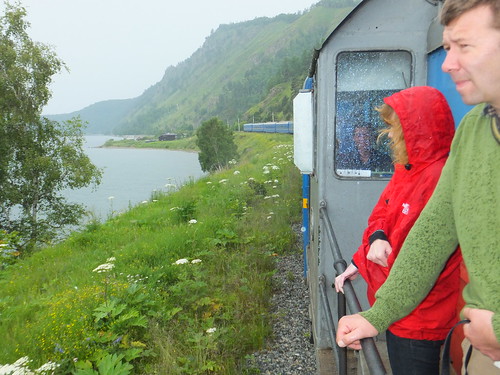
Looking back along the train from our vantage point on the locomotive.

Next, we took lunch in the Restaurant Car and, after another enjoyable meal, we arrived at Port Baikal about half past one, where we had a little free time to explore. I was pleased to find a preserved water crane (from the era of steam traction), complete with its lamp housing which indicated to an approaching train when the crane had been swung so as to obstruct the line. There was also a preserved 'L' class 2-10-0 locomotive. But I had to rush back to the restored station building for an opportunity to look inside the Circum-Baikal Railway Museum. I would have happily spent longer in this small museum but Tatiana was anxious to get us all to the chartered ferry which would take us to Listvyanka at 2.30 p.m.

A model of Port Baikal around 1900, on display in the Circum-Baikal Railway Museum at Port Baikal. The Train Ferry 'Baikal' is in the foreground and the funnels of 'Angara' can just be seen behind.

Just a short walk from the restored station building, a sturdy-looking blue and white ferry was tied-up at the quay. Once the 'Golden Eagle' guests were all on board, the ferry headed out of the harbour. Almost all the wood of the original construction has gone, but the general layout of the jetties remains as built for the 'Baikal' and the 'Angara'. Our destination, Listvyana, lay on the other side of the broad Angara River but we cruised the long way round. As the shore receded and the swell increased, it was difficult to remember that we were on a lake, not the sea. As we approached our destination, we passed a Kometa 15 Hydrofoil (but not moving fast enough to left up properly on the 'Foils'). I gather this is a service between Irkutsk and Lake Baikal. BaikalNature have placed a video showing this craft here. Regular readers may remember that on my trip to Saint Petersburg last year, I became quite used to travelling around on Russian hydrofoils (my posts on that trip are here).

As we approached the quay, it seemed clear that Listvyanka is a resort destination and there were quite a few people around. There was a cafe on the shingle beach, a wandering singer playing the guitar and one young couple, well wrapped up against the wind off the Lake, determing to set on the shingle.
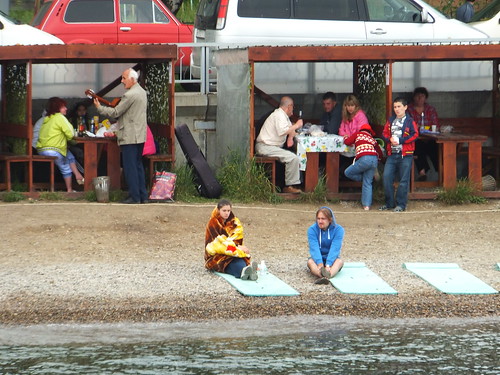
Listvyanka Beach.

A coach was waiting for us and we were soon taken to the nearby Lake Baikal Museum. Anna took us round the exhibits and explained just how special Lake Baikal is. There was also a large aquarium and captive Baikal freshwater seals which I'm no longer happy with. I realise such places are the only opportunity for most people to see these creatures but, nonetheless, it worries me.

The 'Golden Eagle' guests then split into two groups - one visited the open-air Museum of Wooden Architecture but, despite my interest in architecture, I went with the smaller group for a short hike up Chersky Mount. It was an easy hike and, although we couldn't see long distances, we had a splendid view of Port Baikal and our waiting train.
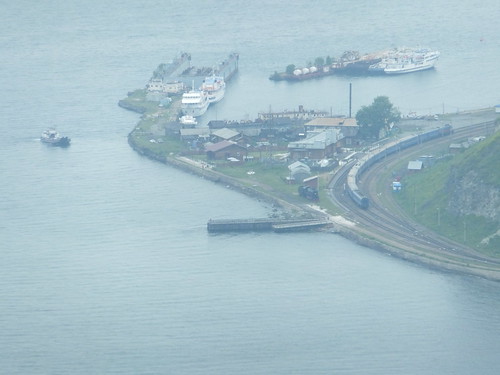
Port Baikal, viewed from Chersky Mount, on the opposite bank of the Angara River.

Although, being summer, there was no snow, the ski-lift was nevertheless running so most of us decided, for variety, to descend using the ski-lift. By the time we were back in our People Carrier, it had started to rain so we were not sure what would happen to the advertised Barbeque Dinner.

The location was a resort village in wooded country quite near the Angara River. Although food, including the local Omul fish, was being cooked outside, we ate in a large wooden conservatory with a long table and benches to sit on. The Omul, related to salmon, is only found in Lake Baikal and I found its delicate flavour preferable to salmon.

It was a very jolly meal but Tatiana had one more surprise for us. On our last evening in Mongolia we had missed the advertised folk performance in Ulaan Baatar through being stuck in a traffic jam. So she had engaged a Buryat man and woman in traditional dress to sing and play for us. Both artists were good but I think the versatility of the man (pipe, fiddle, jaw's harp and 'mouth music') 'blew us away'.
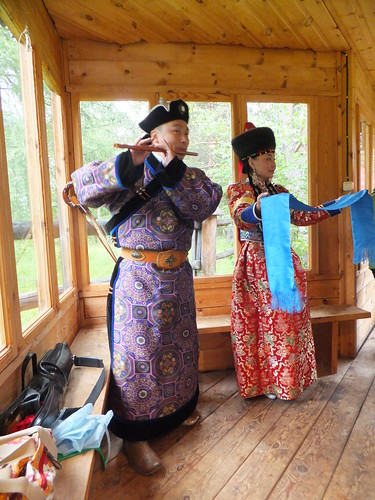
The musical concert at Listvyanka finished a splendid meal.

In a very mellow mood, we rejoined the road transport for the short journey to the nearest ferry jetty, where our ferry was waiting to take us back to Port Baikal. As we approached the quay, we had the welcome sight of the familiar blue coaches of the 'Golden Eagle'.
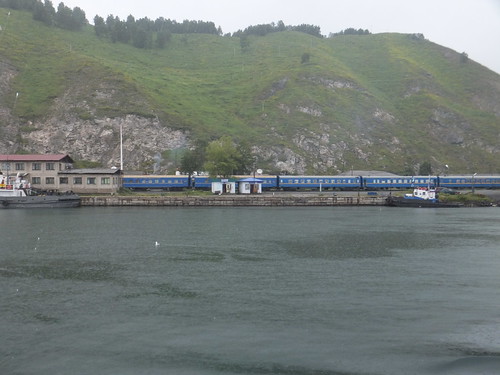
Port Baikal, with the 'Golden Eagle' waiting to take us back along the Circum-Baikal Line to Slyudyanka.

As I re-joined our train, I noticed a modern diesel multiple unit waiting on the adjacent line, presumably part of the limited tourist service along this very special line. During the night, our train returned us to Slyudyanka after a very special day around Lake Baikal.

Photographs:-

The 'Golden Eagle' train.
Slyudianka Station, East Siberian Railway.
The Circum-Baikal Railway.
Plinthed 'Ea' Class at Polovina.
Port Baikal.
Circum-Baikal Railway Museum, Port Baikal.
Listvyanka, Lake Baikal.
Concert in Listvyanka.

References:-

'The Circum-Baikal Railway: A Concise Guide Book (3rd edition)' by A.K. Chertilov translated Ye. Luganskaya (Artizdat, Irkutsk) ISBN 978-5-93765-044-3.

[Additional material added 1st August 2012, 8th August 2012].

Into Russia

Saturday, 14th July 2012

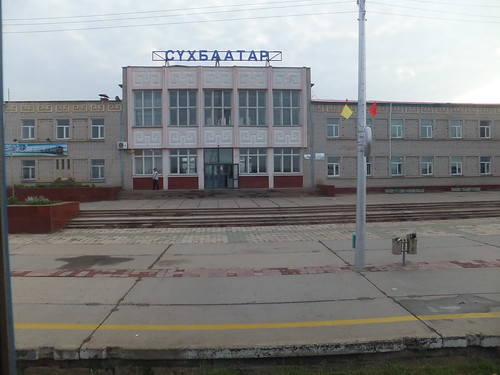
The rather austere station building at Sukhe Baatar.

Despite being late to bed last night and losing an hour through changing time zones, it was an early start for we were asked to have our documents ready for inspection by the Mongolian authorities at 7.0 a.m. I got up and dressed just after six and ordered black tea with milk and sugar which arrived with an assortment of biscuits. We arrived at Sukhe Baatar around right time, having travelled 380 km from Ulaan Bataar overnight. We had made various stops stops at passing loops to allow trains travelling in the opposite direction to pass. The cabin attendant had collected my Mongolian Customs form and a pleasant uniformed girl from immigration collected my passport and Departure Card.

Once formalities had been completed, we were invited to the restaurant car for breakfast. In addition to a cold buffet, there were a number of hot items cooked to order. I selected porridge and a plain omelette, accompanied by more black tea with milk and sugar and a glass of orange juice. During the meal, a heavy ‘thump’ seemed to indicate that we were changing engines (the Russian autocoupler requires reasonable force to engage correctly). After a short delay, the train moved off, with a number of soldiers and railway staff dotted along the platform standing rigidly at the salute.

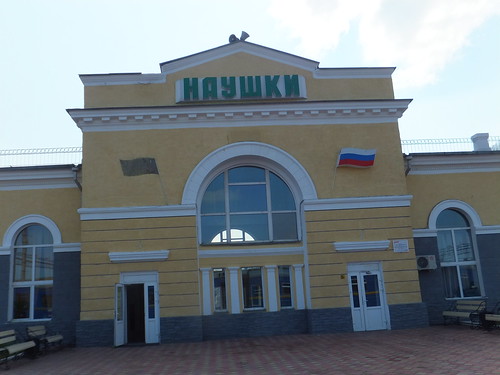
The impressive station building at Naushki.

We covered another 23 km to the first Russian station, Nauski. This time, my passport was collected by a uniformed male immigration officer. After a delay, the stamped passports were returned to the Cabin Attendant and we were then allowed to wander on the platform. By the time I emerged into the sunshine on the wide platform, the locomotive which had brought us into the station was long gone and it was some time before a large diesel electric locomotive (half of a twin-section design) backed onto the train to take us forward towards Ulan Ude. Shortly after we set off, lunch was served in the restaurant car and the pattern of travel on the 'Golden Eagle' started to become established. After the meal there was a lecture by our expert speaker Professor George Munro.

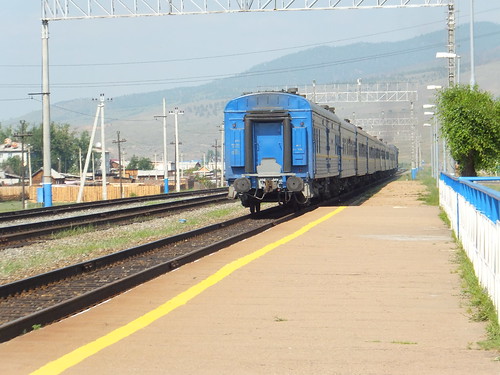
The 'Golden Eagle' train leaves Shaluty.

About 200 km beyond Naushki, we stopped at the wayside station of Shaluty, where we were to disembark for a coach trip. I found it a little disconcerting to watch our train (with all our possessions) depart for Ulan Ude without us. We boarded a modern coach and drove through a mainly rural area to the 'Old Believers' village. The Russian Orthodox Church suffered a schism around 1666 when Patriarch Nikon attempted to introduce certain liturgical changes. Those who renounced these changes became 'Old Believers' ('Torbogatai') and they retain their separate identity today. There's a useful 'Wikipedia' article on the 'Old Believers' here.

The 'Old Believers' village we arrived at had a long main street lined with gaily-painted wooden dwellings decorated with fretwork. We were met by one of the villagers in the colourful traditional dress and introduced to a similarly-attired elderly lady who invited us to look around her house and garden. I'm always a bit self-conscious in these situations poking around peoples' houses and taking pictures but it's invariably interesting.

This 'Old Believer' invited us into her home.

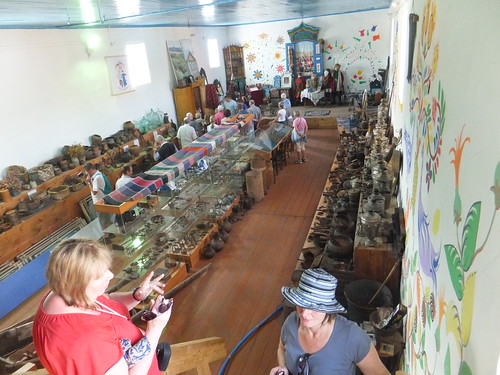
Next, we walked a short distance to a museum housed in a former schoolroom which is seeking to preserve artefacts from the traditional lifestyle which is increasingly threatened by modern developments. They've amassed a wonderful collection of objects which jostle for space and kept us intrigued for some time as the Priest's son explained a little about the objects in Russian which was then translated into English for our benefit.

The museum was crowded with exhibits.

We crossed the road to visit the village church where the twinkle-eyed bearded priest described some of the history of the 'Old Believers' including that during the Communist era, again in Russian with translation.

With plenty to ponder, we were led back across the road to a community centre or church hall where a splendid meal had been laid out on long tables for us. After the meal, we were entertained by singing and then a couple from our party, Kari and Ed, were 'volunteered' for a marriage celebration. It was all very good-natured and we were sorry to say goodbye to our hosts and board our waiting coach.

Villagers entertained us with their singing.

The coach then drove us to Ulan Ude where we hoped our train would be waiting. We paused biefly in the Central Square to see some of the municipal buildings and a huge bust of Lenin before driving to the railway station where our train was obediently waiting in the late evening sun. Within an hour, we were on the move, travelling west, for a leg of 338 km whilst we slept.

Photographs:-

The 'Golden Eagle' train.
Sukhe Baatar Station.
Naushki station.
Shaluty station.
'Old Believers' Village.
Ulan Ude.
Ulan Ude station.

Additional material added 1st August 2012.

Leaving Ulaan Baatar - The Reality

Friday, 13th July 2012

Before losing my internet connection, I gave a brief note of what was to happen.:-

“I suspect I may be out of touch after this post, so I'll briefly tell you what we're doing today, our last day in Ulaan Baatar. We should visit the Gandantegchinlen Khiil, a Buddhist Monastery then tour the Museum of Mongolian National History. Next, we travel out of the city to Terelj National Pak where we should have lunch. On our return to the city, we may have some free time (it all depends upon the traffic) before our final meal in Ulaaqn Baatar at the 'Square' Restaurant where a Folk Performance is offered. Later this evening we will board our 'Golden Eagle' train for Moscow and travel towards the Russian border overnight”.

Not being very superstitious, I hadn’t given serious thought to the date being Friday the thirteenth. Oh well.

The day started well enough with breakfast at the Kempinsky. Tatiana, the Tour Manager, had suggested we took a reasonable breakfast as we were unlikely to get lunch until around 2.0 p.m. Our main luggage was being taken straight to our train so I just had with me a small rucksack with my computer and the usual bits and pieces.

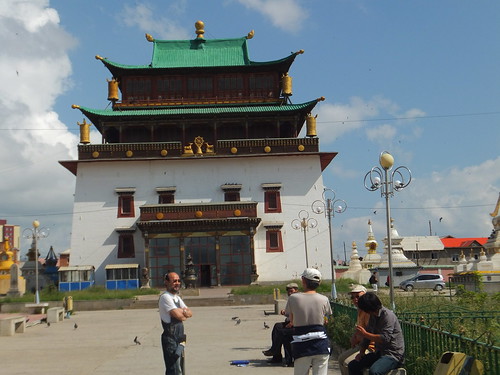
The Main Temple at the Gandantegchinlen Khiil Monastery

We drove through the city to visit the large Buddhist Monastery called Gandantegchinlen Khiid. The Tibetan form of Buddhism was introduced into Mongolia in past times, largely for political reasons by the rulers. In the last century, when Mongolia became a Socialist State, religion was ruthlessly crushed. Monasteries and temples were razed to the ground and tens of thousands of religious people were killed. It is only since the peaceful revolution in the 1990s that freedom of religion has been restored. A survey found that 53% of the population claimed to be Buddhist and most of the rest had no religious belief. All other religions make up just a few per cent of the total. Looking at the number of Mongolians visiting the Monastery to worship confirmed that Buddhism is still an important force. There are prayer wheels everywhere around the site and in the main temple, large and small but, in general, they were not built to the high standard I’d admired in Bhutan. The architecture is generally traditional Chinese Style, similar to the Bogd Khaan Palace Museum we’d visited the day before.

Most of the buildings were of wooden construction but the main temple had massive main walls of brick, similar to buildings I’d seen in China. The huge Buddha figure in the main temple is a replacement for the earlier one destroyed by the Communists. The walls of the Main Temple were crammed with tall shelving carrying perhaps thousands of individual Buddha figures. I went into the teaching room where a number of young monks were chanting religious texts. Large bookcases held important books in the old style of rectangular pages with the text hand-written.

A huge new temple is under construction. I would have happily spent longer in the precincts of the Monastery but we moved on by bus to the Museum of Mongolian National History where we spent a little over an hour. There was still a festival atmosphere in the adjacent Shukhe Baatar Square and a brass band was playing outside the Museum for a time.

View of Shukhe Baatar Square from the steps of the Museum of Mongolian National History.

We set off again in the bus to leave the city and drive to the Terelj National Park. In normal circumstances, the journey would have taken 90 minutes but it was clear that these were not normal circumstance. We moved very slowly for kilometre after kilometre until we feared we’d never get to our destination. We did arrive, but almost two hours late and, by this time, the weather had turned wet. Near the entrance to the National Park there were lots of holiday chalets and people just camping on the banks of the river, either in tents or rather smart-looking camper vans.

Holiday chalets near the entrance to Terelj National Park.

A few kilometres further on, we turned onto a dirt road with signs advertising a number of holiday camps at various distances from the junction. The first camp was a number of holiday chalets with steeply-pitched roofs, reminiscent of those I’d seen in the Carpathian Mountains during my trip to the Ukraine.

The second camp had a number of almost-traditional Ger structures. I say almost-traditional because they were rather well-appointed to suit tourist tastes, built on a flat concrete base with fairly elaborate doors and a glazed ‘lantern roof’ to admit more light. Our driver parked the bus on the wet grass(it had been raining earlier but had virtually stopped by the time we trooped off the bus) and we made our way first to a modern toilet block and then to a very large Ger which was arranged as a restaurant. There was a table for 10, a table for 8 and two tables set for 4 diners. A number of tables remained unused so they can cater for larger groups when necessary. Each table had a white tablecloth with cutlery and glasses laid out and the high-backed chairs had white covers. The wooden structure supporting the large tent cover was extensively carved and elegant (electric) chandeliers hung from the roof. Once our group had settled into our impressive surroundings, an enjoyable meal was served by the friendly staff.

We had lunch in this large, well-appointed Ger.

By the time we emerged from the Ger to board the bus, the rain had stopped, but it remained overcast. Next, we were to visit the traditional Ger of one of the nomadic farmers. We drove to a semi-permant village with a number of Ger and wooden stockades forming a series of yards. Baggi got off the bus to enquire the whereabouts of the farmer we were to visit, to be told by one of the villagers that he’d moved. Having obtained directions, we moved about 1 km to an isolated Ger with a number of horses nearby. The horses were either ‘hobbled’ on the front legs by the head rope or the headrope was ‘hitched’ to a wire run between two vertical posts.

The farmer emerged from the Ger, wearing his traditional hat, and invited us inside. Various seating units which can double as beds were arranged against the curved tent wall, alternating with various storage chests, all decorated in traditional, painted designs. The ground was covered by a series of carpets (this Ger was erected directly onto the grass, as is traditional) and the effect was spacious and inviting. We were offered the traditional drink – mare’s milk encouraged to ferment. The alcohol level depends on the type of grass and Baggi suggested that, at that time of year, it would only be around 3% but could be over twice that strength. The drink looked like milk and was served in bowls (made in China). It had a slightly sour taste with a slight ‘kick’ and, to my surprise, I emptied my bowl. Some of our group declined.

The farmer offered us 'Kumis' (fermented mare's milk).

After discussing the nomadic life of these people, continually moving to new pastures to feed the horse, sheep and goats that they tend (with Baggi translating), we moved outside to admire the horses and some of us elected for horse riding.

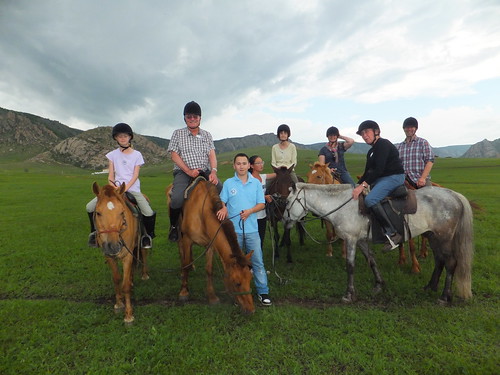
I was quite surprised that we were provided with riding hats and gaiters before being allocated to our mounts. I had a grey. Mongolian horses are quite small but, as we saw in the Naadam horse racing, can be fast. I’m afraid our hosts led us on foot by the headropes so we didn’t have a chance to ‘explore the envelope’ but all the horses were sure-footed and willing so we had a very enjoyable ride back to the Camp where we’d taken lunch.

Our group of riders about to set off.

I’d have been happy to spend much longer here but, after a chance to visit the Camp washroom, we were back on the bus and headed off towards Ulaan Baatar.

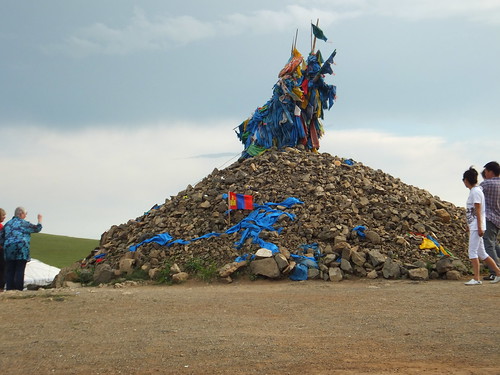
We paused at one of the stone ‘cairns’ we’d seen in various places around Mongolia, called 'Ovoo'. A vertical wooden pole is provided, which you walk round three times in a clockwise direction, throwing a small stone towards the pole, producing the cairn effect. Various flags and pieces of fabric were tied to the pole and other offerings had been added to the stone heap. I was intrigued by a miniature prayer wheel happily spinning on its own, electrically-driven probably from a small photo-voltaic panel in the base. Later, I saw the same thing mounted on the dashboard of cars. I was reminded of the water-driven prayer wheels in Bhutan.

Before leaving the National Park, we stopped at this 'Ovoo'.

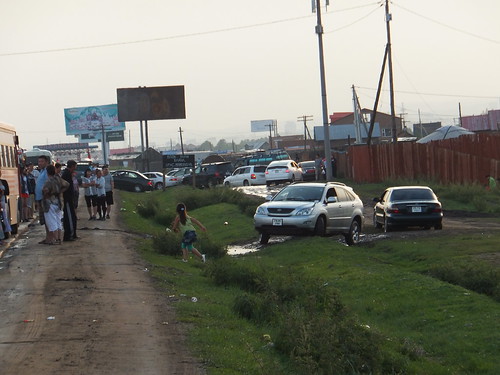
As we continued, the traffic became heavier and by the time we were about 20 km from the city, it stopped completely. A few drivers continued happily using the wrong side of the road, others drove along the verge and the more adventurous just headed off across the adjacent fields, either picking out existing tracksw or starting new ones. Whilst there were some ‘off-road’ vehicles, most of the cars attempting these manoeuvres were standard saloons. We’d come to a standstill on a bridge over a fairly wide stream so vehicles attempting to by-pass the jam had the problem of crossing the stream which they solved by driving down a steep bank, fording the stream and powering up the opposite bank before bumping out of sight ahead of us.

When roads become gridlocked, Mongolian drivers are quite happy to go 'off-road'.

Our problem was that we had no information about when we would move. A few police cars had come from behind us with their red and blue lights on and overtaken us on the wrong side of the road but they were never seen again. Our 50-seater coach was too large to attempt any off-road driving so we just sat there, devoid of information. As time went on, we became more anxious. We'd been promised dinner in Ulaan Baatar before joining the 'Golden Eagle' train for our epic journey, but that clearly would not happen. Baggi walked to a shop to provide some snacks for us and we already had plenty of bottled water.

Fortunately, Tatiana, the Tour Leader, had a working mobile and, in conjunction with the Ground Handling Agents in Ulaan Baatar, they came up with a solution. Two 'people carriers' were despatched from the city by a different route on the other side of the railway which ran parallel to us. They couldn't meet up with us because, although there was a road, it passed under the railway by a bridge too small for the people carriers (and, of course, far too small for the bus). The driver managed a fairly spectacular U-turn to reach the 'road' (more of a track) leading to this bridge and he managed to get within a couple of hundred yards of the bridge. By now it was dark and, following the earlier heavy rain, the track was partially flooded. But nobody complained as we trekked on foot to the bridge, illuminated by the headlights of the waiting 'people carriers' on the other side. We were divided up between the two vehicles and set off in convoy at speed on a twisting minor road which led us back to the city. We arrived at Ulaan Baatar station and, with some sadness, said goodbye to Baggi and our Mongolian friends.

Tatiana, of course, travelled on the train with us. Once we'd located our cabins, we were invited to the Restaurant Car for a rather belated dinner, in lieu of the meal which had been planned to take place in the city hours before. To our amazement, the train was able to depart on time at 22:50 local time. And so, our interesting time in Ulaan Baatar came to an end, with rather more of an adventure than we had expected.

Photographs:

Gandantegchinlen Khiil Buddhist Monastery
Pictures of Ulaan Baatar
Pictures around Ulaan Baatar
Terelj National Park

References:

'Guidebook to locales connected with the life of Zanabazar, First Bogd Gegeen of Mongolia' by Don Croner, Polar Star Press (ISBN 0-9779553-0-3). This book has a section on the Gandantegchinlen Khiil Monastery.
'History of Mongolia' by Baabar, Nepko Publishing.

Friday, 13 July 2012

Leaving Ulaan Baatar

Friday, 13th July 2012

I suspect I may be out of touch after this post, so I'll briefly tell you what we're doing today, our last day in Ulaan Baatar.

We should visit the Gandantegchinlen Khiil, a Buddhist Monastery then tour the Museum of Mongolian National History.

Next, we travel out of the city to Terelj National Pak where we should have lunch.

On our return to the city, we may have some free time (it all depends upon the traffic) before our final meal in Ulaaqn Baatar at the 'Square' Restaurant where a Folk Performance is offered.

Later this evening we will board our 'Golden Eagle' train for Moscow and travel towards the Russian border overnight.

I'll tell you more when I'm able.

Naadam Festival 2012 - Second Day

Thursday 12th July 2012

At 09:30 we left the hotel by coach to once again struggle through the traffic to the Central Stadium where the Naadam sporting events continued. First we went to the Shagai Shooting Terrace where the improbable Ankle Bone Shooting Events take place.

I know "Ankle Bone Shooting" sounds like an inferior form of "Kneecapping" (geddit?) but the actual explanation is very improbable and it took us all some time to get our heads around what we'd been watching. For now, I'll leave you with the pictures.

The two white ankle bones form the target in Ankle Bone Shooting. Link to more photographs below.

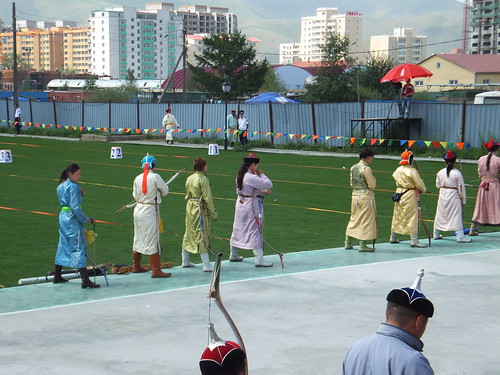
Next, we visited the Archery Range. This sport has now admitted women, the men shooting from 75 yards and the women, in separate events, from 60 yards.

The Ladies' Archery Event.

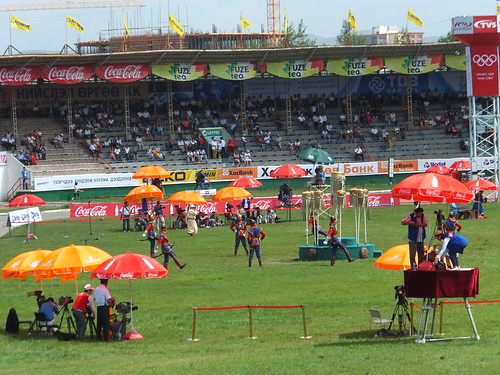
As time was pressing, we then moved onto the Main Stadium, where we saw the changing of the guard on the State Nine White Banners.

Changing the guard on the State Nine White Banners.

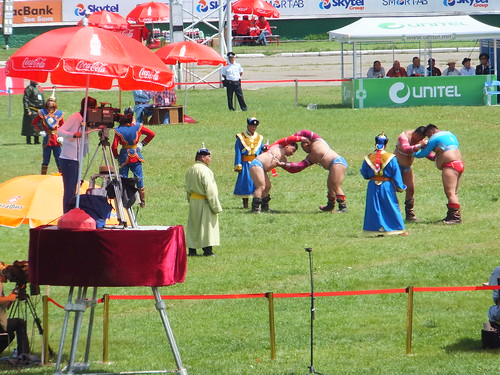
After some delay, we saw part of the Fourth Round of the Wrestling for Seniors and Juniors. All the wrestlers are on the field at the same time and, with the complication of all the referees and each wrestler having an Esquire also on the field, I found the event hard to follow.

All the wrestling bouts are closely observed by television cameras.

Our coach then took us to the Mongolian BBQ restaurant. I was tempted by the Mongolian Soup - a tasty lamb broth exactly like my Grandmother used to make.

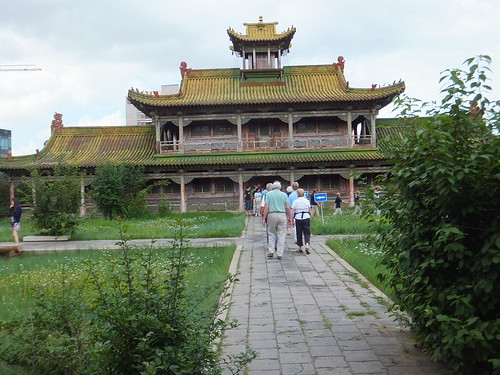
In the afternoon we visited the Bogd Khaan Palace Museum which I found fascinating.

One of the buildings in the Bogd Khaan Palace Museum. Most buildings are in the Chinese style.

Some of us took up the offer of shopping for an hour at the State Department Store - not the bleak and probably half-empty Communist affair the name conjures up but a bright, modern store on six levels with everything you might expect in the west.

The coach returned to pick up the shoppers, giving us a little time in the hotel before being taken to Shukhe Baatar Square. After a while mingling with the holiday crowds in Shukhe Baatar Square, we went for a splendid meal in the 17th-floor Monet Restaurant.

Mongolians enjoying the holiday in Sukhe Baatar Square with Government House in the background.

We were lucky enough to get a bird's eye view of the State Nine White Banners in procession being returned to Government House at the end of the Naadam Festival.

Soldiers on foot carry the State Nine White Banners into Government House, watched by the massive statue of Ghengis Khan.

Photographs:

Ulaan Baatar (Pictures added).
Naadam Festival 2012 - Second Day.
Bogd Khaan Palace Museum.
The End of Naadam, 2012.

References:

'The Guide Book of Bogd Khaan Palace Museum' by D. Altannavch, published by Bogd Khaan Palace Museum.
'Guidebook to locales connected with the life of Zanabazar, First Bogd Gegeen of Mongolia' by Don Croner, Polar Star Press (ISBN 0-9779553-0-3). This book has a section on the Bogd Khaan Palace Museum.
'History of Mongolia' by Baabar, Nepko Publishing.

Material added 26-July-2012.

Thursday, 12 July 2012

Nadaam Festival

Wednesday, 11th July 2012

The 11th of July is the Mongolian National Day celebrating the overthrow of Chinese rule (91 years ago this year). It is also the day the Naadam Festival opens and one of the most important holidays in the year. 2012 is the 806th Naadam Festival celebrating the three 'manly arts' of wrestling, archery and horsemanship. I've seen this national sporting festival described as 'the second oldest Olympics in the world' (although, as 'the other Olympics' is a Victorian re-creation, perhaps Naadam should carry the 'oldest' accolade). It's certainly a very important event for Mongolian people and we were to be present for the opening ceremony.

Our coach threads its way though the crowds making their way to the Central Stadium for the Naadam Opening Ceremony.

The 'Golden Eagle' party left the hotel by coach at 9 o'clock, leaving two full hours before the ceremony started at the Central Stadium, just a few miles away. The traffic in Ulaan Baatar seems pretty bad at the best of times. A decrepit road system combines with a certain lack of road discipline to provide an ideal formula for hold-ups. It seemed that everyone wanted to reach the Central Stadium. We slowly inched towards the stadium site where there's parking quite inadequate for the once-a-year demand of Naadam.

A series of fields outside the stadium had been pressed into use for parking but manoevreing was difficult due to the pressure of crowds on foot and the large number of traders selling the usual assortment of Chinese-made favours. The Mongolian National flag was being sold all over the place in sizes from 'small' to 'hazard to other traffic when attached to your car'. But it all seemed very good natured and the Mongolians were often in National Costume or (particularly in the case of young women) dressed for a disco.

We'd reserved seating in the stadium so our party entered through gate 4 and ascended the crumbling concrete steps into the covered stand. Seating comprised a slatted wooden affair fixed to the raked concrete stand. By the time we were seated, the stadium was around half full with about three quarters of an hour to go but already there was an expectant atmosphere. The oval arena was grassed in the centre, with a running track around the outside. To our left, we could see the 'VIP' stand. There were an awful lot of tourists in the area where we were. We had quite a good view, impaired only by the large number of television cameras on various raised platforms. A large-screen television was placed opposite opposite the 'V.I.P.' stand and this carried a mixture of pre-recorded and live pictures. The public address system was relaying Mongolian singing. All sorts of preparations were going on with police, performers, contestants and television crews coming and going. I found it quite diverting.

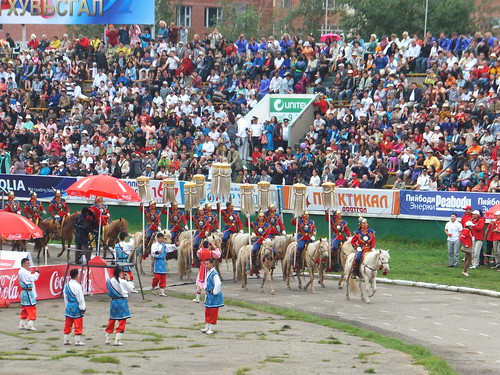
The 'Nine Banners' symbolising power in Mongolia enter the stadium carried by horsemen.

A large grey-uniformed band lined up on the field with at least 15 minutes to go and, shortly after eleven o'clock, the band struck up a stirring rhythm as a line of mounted soldiers in traditional uniform entered the stadium. The first nine horseman were bearing the Mongolian symbols of power - nine ceremonial banners in the form of parasols decorated with horses' tails. These are normally kept in Government House in Shukhe Baatar Square except for one excursion each year to the Naadam Stadium where they are mounted on a podium and treated with great reverence. Throughout the Festival, these parasols are guarded by four soldiers standing in a rather curious pose, one hand on sword handle, one hand on hip. I was relieved to learn that these sentries are changed every three hours.

I'll describe the actual ceremony later but the photographs give some impression of the event. At the end of the ceremony, opened by His Excellency Tsakhia Elbegdorf, President of Mongolia, we walked back through the crowds to our coach.

It was as hard for our coach to extricate itself from the parking area as it had been to park in the first place and the public roads were still congested. We made our way over the river (Selbe gol running at just a trickle) and the railway line using the Peace Bridge and turned into the National Culture and Recreation Park (which didn't appear very park-like where we were). We got out of our coach at the 'Seoul' Korean restaurant where we enjoyed an excellent buffet lunch offering both Korean and European cooking.

Then, it was back on the coach to drive initially west and then north west for around 27 km to witness the finish of the Ikh Nas horse race for 7-year old horses at Khui Doloon Khudag. Getting there proved something of a nightmare but when we finally arrived, it was an amazing spectacle.

Horses are very close to the Mongolian soul. Remember, it was a nomadic culture with very little infrastructure so horses were vital and horsemanship is probably regarded as the highest of the 'three manly skills'. Certainly, a lot of Mongolians had made the journey to the impromptu track to witness the important result.

The 2012 finish was on grassy downs which would normally have been open country but had been converted temporarily into a small town with tents and Ger (the Mongolian round tent). Two stands had been erected close to the finish - a covered one for foreign visitors and an open stand for the locals. There was another stand actually at the finish line. Hundreds of cars which had brought the spectators were scattered around, with a few coaches which appeared to be foreign visitors.

Everybody was in high spirits and a number of Mongolian families were flying kites (it was quite windy at the elevated location). A number of horses were providing rides, mainly for children. A public address system was presumably relaying details of the approaching horses although the numerous police, with their walkie-talkies, seemed to provide a better source of information to Baggi, our guide.

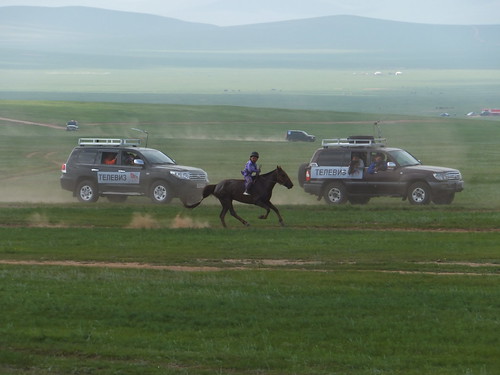
The races are cross-country affairs of around 20 km. Anything up to 400 horses enter each race. Eventually, we could make out a number of approaching vehicles and a cloud of dust. As they got closer, we could make out a number of horses going flat-out, being enthusiastically whipped by their riders. The leading horse was well separated from from the group of runners-up. We must have seen about 200 horses complete the course. A few riderless horses came past.

The ultimate winner passing our stand just 200 yards from the finish, pursued by television crews.

Sadly, one horse collapsed just short of the finish, throwing the rider. An ambulance drove onto the course to attend to the rider but did not appear to be needed. A vet drove up to check the horse and administer the violent-looking equine version of C.P.R. but the horse could not be revived. I was told that it's not unusual for horses to perish in what amounts to an endurance race.

We rejoined our coach which then faced slow progress on the crowded roads leading back to Ulaan Baatar and our hotel.

Photographs:

Ulaan Baatar.
Naadam Festival Opening Ceremony.
Around Ulaan Baatar.
Ikh Nas Horse Racing.

Wednesday, 11 July 2012

Ulaan Baatar

Tuesday, 10th July 2012

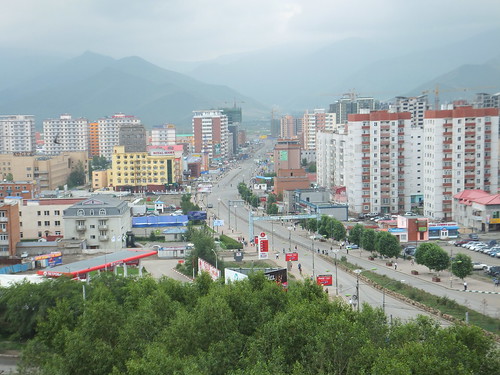
View of Ulaan Baatar from my hotel room.

After a shower, change and breakfast, I decided to see some of the city. Our guide Baggi, who had met me at the airport, said we'd be visiting various places later in the tour so I decided to head for the Railway Museum (surprise!). I located the 'Train Museum' next to the railway on the tourist map I'd picked up on my way through the airport and explained to the hotel reception staff what I wanted to do, showing them the map. They phoned to check that the museum would be open because of the holiday surrounding the Mongolian National Day on 11th July 2012. "It's open 8 'till 5 today" they assured me so I asked them to book a taxi to take me there. I afterwards wondered who they could have spoken to.

In the taxi, I followed the route on my map as best I could but I thought the driver was heading too far west and was probably heading for the Railway Station itself. However, he pulled up at a building that could have been a museum and it certainly had a model of a steam locomotive outside so I paid the agreed fare and the taxi sped off. Well, it was a museum but it was locked and a cleaner working around the outside of the building assured me it was closed for the Naadam holiday.

On re-inspection of my tourist map, I found I'd been delivered to the Museum of Railway History (which I didn't even know about). Since the railway station was only a few hundred yards away, I thought I'd have a look there before deciding what to do next.

Heavy road traffic outside Ulaan Baatar railway station.

I was amazed at just how busy the roads around the station were. With the National Day and Naadam the next day, it seemed that everyone wanted to be somewhere else. I took pictures around the impressive station and photographed a passenger train arriving from Russia. As it approached, I realised it was the Eastbound 'Golden Eagle' - the train I was to board in a couple of days. I went through the subway to Platform 3 to have a look at the train and watch some of the passengers alighting.

After watching a couple of freight trains and a diesel-electric 'switcher' shunting around the station, I decided to return to the road and walk to the Open Air Railway Museum I'd been aiming for. The railway side of the road was lined with warehouses and lots of people were coming and going, transferring eggs, bottled water and all kinds of fresh vegetables and fruit between the warehouses and various vehicles parked at the kerbside. Further along, a dirt road on my right led to more warehouses and vehicles were gridlocked either trying to enter or leave the limited space. There was a lot of horn blowing, manoevring in odd directions and numerous near-misses which I eventually realised is the normal way of driving in Mongolia. A stream of pedestrians, some loaded down with purchases, were making their way to a footbridge over the railway so I decided to take some photographs from the vantage point. The bridge also carried a couple of massive steam mains across the railway. Ulaan Baatar, like much of Russia, uses District Heating schemes to distribute steam for heating from the network of generally elderly coal-fired power stations.

I continued along the road in the hot sun until I came to what looked like a locomotive depot. A line of rusting diesel locomotives stood outside. Not being sure what to expect, I wandered up to a small gatehouse thinking that an abandoned depot had been appropriated for the museum. After a few seconds of mutual incomprehension with the young security guard, I realised that the rather beat-up premises were, in fact, the diesel depot still in use and that my destination must lie further along the road.

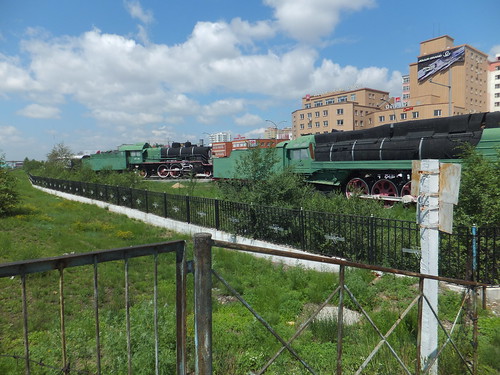
Tramping further, I was rewarded with the sight of a narrow gauge steam locomotive out in the open. This time, I was in the right place. A fenced compound held a number of locomotives but it looked rather neglected and there was nobody around. I walked past the exhibits to where some roadworks looked similarly abandoned. There were piles of sandy soil and a section of steel pipe. To facilitate whatever work had been in progress, they'd taken down the museum fence at that end of the site. By climbing over the spoil, there was unrestricted access to the locomotives.

Ulaan Baatar Train Museum.

I spent a happy half hour photographing the exhibits and then started to wonder how I'd get back to the hotel. I'd harboured ideas of getting a taxi but, as I'd walked from the railway station to the museum, I'd passed people about every 50 yards, standing in the gutter with their arm raised, trying to hail a taxi. They didn't seem very successful so I didn't rate my chances. It seemed that on the day before Naadam, everybody wanted taxis. I didn't know how far I was from my hotel - I guessed three miles - and I was rather hot and bothered. However, you see so much more on foot so I thought I'd give it a shot and see how far I got.

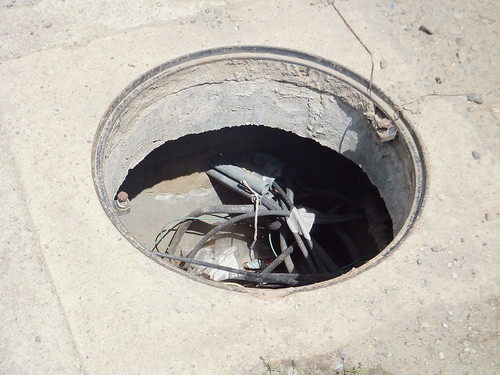
A missing manhole cover in Ulaan Baatar.

Walking in Ulaan Baatar is not for the timid. Every step provides some sort of trap for the unwary, changes in level, unseen steps, potholes. I found a manhole near the middle of the city with a missing cover. Oddly, the two bolts and washers intended to secure the cover had been carefully replaced. I think it took me about 90 minutes to get back to the hotel, pleased that I'd seen so much of the city.

The day concluded with dinner at the Khar Khorum Restaurant in the hotel an an opportunity to meet Tatiana, the Tour Manager, and my fellow-travellers.

Pictures:

Ulaan Baatar.
Railways around Ulaan Baatar.
Ulaan Baatar Train Museum.

Additions made 24-Jul-2012.

Arriving in Mongolia

Tuesday, 10th July 2012

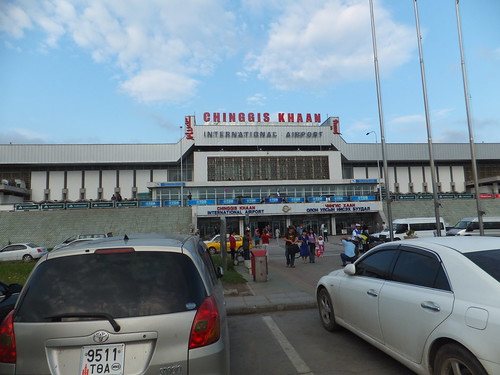
''Land Side' view of Chinggis Khaan International Airport Terminal.

We landed at Chinggis Khaan International Airport about right time. As soon as we'd turned off the runway we stopped on the taxiway, which revealed signs of extensive cracks that had been repaired. This reminded me that Mongolia is not a rich country. A high-wing two-engine turbo-prop was cleared onto the runway we'd vacated and he took off, in the opposite direction from our landing (the black and white windsocks indicated no surface wind). But we remained halted until a small 4-engine jet (a BAe 146, I think) followed the turbo-prop onto the runway. Then we were allowed to taxi to the terminal, passing an 'elephant's graveyard' of stored aircraft. I spotted two elderly-looking single-engine biplanes and at least three Russian-looking helicopters in their typical "sit up and beg" attitude when parked.

The airbridge was attached and we all piled off the aircraft. It was hot! Ulaan Baatar enjoys the distinction of being the capital city with the lowest average temperature in the world. There is a summer when it can be hot but the season is quite short. It didn't take long to pass through Immigration, manned exclusively by young ladies, but at Customs, the Green Lane was barriered-off. All the passengers were being directed through the Red Channel, which was being ignored by the group of Customs officials standing around.

In the Arrivals Hall, there was the usual group of 'Meeters and Greeters', most with signs. I quickly spotted my name and met Mr. Baggi, our guide, and the car driver. We waited for one other arrival for the 'Golden Eagle' tour who'd travelled on my flight (an Israeli gentleman who's a Civil Engineer) and then went out to the car for the journey of around 18 km into the city and our hotel - the Kempinski Khan Palace.

As we'd flown into Mongolia, I'd seen tall, inhospitable mountains and much of the plains where we landed looked barren with little cultivation. The view from the car was of a rather bleak, industrial landscape. Although hot, it was overcast. I could see what looked like the headworks of small mining operations dotted around. With the mountains forming a backdrop, I was reminded of Longyearbyen which I'd visited on my Arctic Adventure.

Mongolia is rich in a number of minerals, including copper and gold but this doesn't seem to have translated into prosperity as yet. The roads were badly maintained and, since our car seemed to lack effective shock absorbers, the journey wasn't too comfortable. We passed three or four small power stations, apparently coal-fired. Mr. Baggi confirmed my guess that they were Russian design. Mongolia is the second-largest landlocked country in the world but its population is only around 2.8 million. Almost half of that population lives in Ulaan Baatur. There were plenty of the characteristic round tents called 'ger' visible ('yurt' is the Russian term) in evidence but we also passed massive building projects producing long apartment blocks a few stories high, rather reminiscent of the Russian style. I'm told they're currently building around 100,000 new homes!

As we made our way through the city, various building styles could be seen, mainly modern, with a lot of tower blocks up to about ten stories in height and construction cranes everywhere towering over new projects. We passed a few buildings struggling to be 'iconic' - the 'Blue Sky Tower' clad in blue-tinted glass was probably the most successful, but not really to my taste.

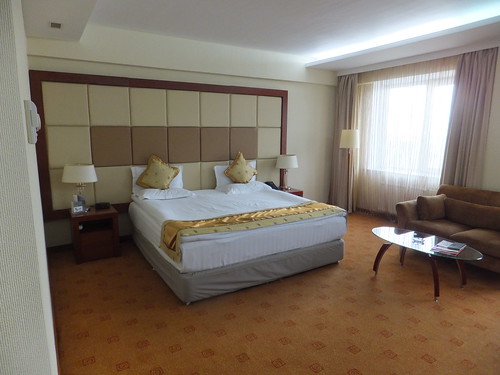
My room at the Kempinski Khan Palace Hotel.

The Kempinski Khan Palace is housed in a fairly undistinguished modern block but, even though it was not yet 7 a.m. we were made welcome and I was given the credit-card sized electronic key to a spacious 9th floor room and an invitation to take breakfast. The room had both Wi-Fi and a physical network connection so I was quite content. After a shower and putting on fresh clothes, I enjoyed a leisurely breakfast. Then, I had to decide whether to catch up on my sleep or explore the city. Regular readers will have no trouble guessing my decision.

My room commanded a good view of an important intersection controlled by traffic lights. Cars, diesel buses and trolley buses streamed past. The, as I was getting ready, I noticed that the traffic had come to a standstill and numerous police cars had appeared. Footpolic lined up on both sides of the street opposite, spaced about every twenty yards. Silence reigned for about 15 minutes (punctuated only by the horns sounded by increasingly impatient motorists). Then, a convoy of about twenty vehicles swept by along the closed street, including a number of police cars with blue and red lights flashing. After this interruption, the traffic started to flow again. I afterwards learned that the convoy was for Hillary Clinton, paying a very brief visit to Mongolia on her way to Laos.

Miscellaneous aircraft pictures (like the one of the terminal building above) are in the set Up, Up and Away.

Pictures of the Kempinski Khan Palace are here.

Pictures around Ulaan Batuur are here.

Tuesday, 10 July 2012

Aeroflot to Mongolia

I usually avoid departures from Heathrow, if I can. It seems to be on many people's 'most hated airports' list but Tim from my travel firm had worked out that the necessary change at Moscow would be easiest if I flew Aeroflot from Terminal 4 at Heathrow.

It's some time since I flew from Terminal 4 but check-in was painless and I was quite happy in the 'Sky Team' lounge. At the appointed time I made my way to Gate 14 and here the terminal is showing its age.

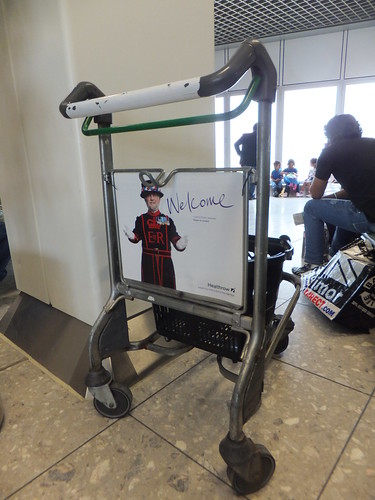
I sat down next to an abandoned luggage trolley which somehow seemed symptomatic of the malaise.

A luggage trolley - handle chipped, greasy dirt around the wheels and with a rusting frame.

The push handle was badly chipped, there was greasy dirt around the wheels and parts of the tubular frame were rusted. But rather than fix those details, what looks like a new poster has been stuck on featuring a Beefeater (Crawford Burton) saying 'Welcome' and there's the risible tag 'Heathrow - Making every journey better'.

The area around the gate seemed cramped and noisy and I didn't think the signage was very good. There were plenty of people waiting for my flight but the boarding gate was without staff so I anticipated a delayed departure. I looked through the window to see an Aeroflot arrival taxiing by which seemed likely to be our aircraft getting in late. Eventually a message over the public address apologised for our late departure "due to the late aircraft arrival".

Waiting is not my strong point but, eventually, passengers started to board. I waited for the 'scrum' to clear but, as soon as they opened a separate boarding pass check for Business Class, I took advantage of it and was on the aircraft in short order.

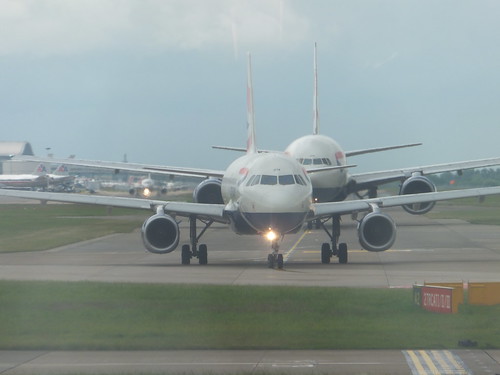
It was my first trip with Aeroflot, who now seem to trade as 'Aeroflot Russian Airlines'. The aircraft was a rather basic Airbus A320 with 2+2 seating in the front section, but the cabin crew were friendly and attentive. Of course, setting off late meant that we'd lost our 'slot' and the Captain announced a 20-minute delay as we worked our way up the queue of departing aircraft. We were to use Two Seven Right (arrivals were using 27 Left) and aircraft from three different taxiways (including one massive Airbus A380) were being fed to the take-off runway.


Part of the queue for 27R.

Eventually, our turn came and we were soon airborne and above the clouds. They served a decent Lunch (with proper napkins and knives of steel, not ridiculous plastic). They offered a portable DVD Player but I amused myself reading during the rest of the flight.

My First trip to Russia last year (posts are here) took me to Domodedevo, so arrival at Sheremetyevo Airport was a new experience. We didn't get to our stand at the modern Terminal 'D' until about 19:10 and, by the time I was walking through the terminal, I was starting to worry about my connection to Aeroflot flight SU330 to Ulaan Baatar. Fortunately, the signage was plentiful and in English and Russian so I found the Transfer Desk and was soon on my way, knowing the Gate number. I was slightly thrown by a Passport Check, but this was a friendly and cursory affair. A separate lady checked my boarding card again, and this merited another rubber stamp. It was a fair walk to the Departure Gate and there were lots of people milling around when I arrived. Boarding started after a few minutes and I was soon ensconced in my window seat on the starboard side. This time, the equipment was a 767 with lots of room and a seat 'almost flat' when reclined.

We took off close to the scheduled time of 20:00. I snatched a picture of one of a pair of aircraft I didn't know - two top-of-wing mounted engines and massive anhedral on the wings (the American 'Phantom' had anhedral on its tailplane).


The odd-looking aircraft.

Again, the staff were very friendly and they provided another excellent meal. This time, I accepted the offer of the 'Panasonic' A330 DVD Player. Because they run off a rechargeable battery, they're surprisingly heavy and they've a memory module with a wide range of programming. I watched 'Sherlock Holmes: A Game of Shadows' to the end but I wasn't that struck. I think there was more CGI than Live Action. I was puzzled by what appeared to be Didcot Railway Centre posing as a Munitions Factory. Then, I put the seat flat and tried to get a bit of sleep. When we arrived it would have been late evening London time, but it was six o'clock in the morning (the next day) when we landed at Ulaan Baatar.

My pictures of Heathrow are here.

Miscellaneous aircraft pictures (like the one above) are in the set Up, Up and Away.

Monday, 9 July 2012

Trans-Siberian

I had booked (and paid) for a trip to Tibet in June 2012. A few weeks before departure, the Chinese Authorities decided to stop issuing Tourist Visas and so, at short notice, Tim from my Travel Firm and I were faced with salvaging what we could and making alternative arrangements, incurring the least possible financial loss.

"Mongolia" I suggested and that's where I'm off to, by air, for a very brief stay. Tim suggested coming back, by train, on part of the Trans-Siberian Railway. Now, people who know about my interest in railways have assumed that I'd be keen to make such a journey but I've never been sure I want to spend a week on a train (Kiev to Ivano Frankovsk overnight in Ukraine proved quite sufficient as I describe briefly in Ukraine 2005). But Tim suggested using the 'Golden Eagle' private train which offered a service back from Ulaan Baatar in Mongolia to Moscow around the time we were looking at and that's what I'm about to do.

So, here I am in the 'Sky Team' lounge at Heathrow's Terminal 4, waiting to depart at 11:50 to Moscow's Sheremetyevo Airport on Aeroflot flight SU2571 where I hope to make a connection to Aeroflot flight SU330 to Ulaan Baatar.

I've three nights in Ulaan Baatar before boarding the train for Moscow. This will be my second trip to Russia - only last year I made a trip by river and canal from Moscow to St. Petersburg which is described in a series of posts labelled Trip to Russia.

As usual, I don't know what access I'll find to the Internet so I may go quiet for a bit but I have my Notebook Computer with me and hope to be recording some of my thoughts as I go, even if I can't post them until later.

Wednesday, 4 July 2012

The Brewood Buddha Statue

When I first visited Mandalay in Myanmar (formerly Burma) in March 2008, I found the city as exotic as it had always sounded.

I was taken to see the 'Street of the Marble Carvers' where craftsmen produce marble statues depicting Buddha and other subjects. I thought that it would be good to support the work by bringing an example of their work back to Brewood but, on that trip, there was insufficient time to purchase a statue and make arrangements for its transportation.

This introduction to Mandalay was just one stage in a trip I call 'Round the World Five (RTW5) where I transited Bangkok before spending a night in Yangon prior to a River Trip on the 'Road to Mandalay'. Then, it was back through Bangkok and across the Pacific to transit Los Angeles on the way to Las Vegas. After tours to the Grand Canyon and Hoover Dam, I flew to Cancun, Mexico to see the ruins at Chichen Itza. Then, it was on again for a few days in Cuba and Panama before making a long journey home transiting Mexico City and Frankfurt. All the posts describing this trip can be found here.

On my return to Mandalay in August 2008, I determined to allow sufficient time to select a suitable statue and organise its transportation. There's a post here which covers my second visit to the 'Street of the Marble Carvers' and there are a few pictures here.. I made the purchase and also arranged for it to be shipped to the U.K.

This visit to Mandalay was part of a longer trip I call 'Far East Two' (FE2) where I had a brief stay in Bangkok before visiting Yangon, Mandalay and Shan State. On leaving Burma, I stayed in northern Thailand in the 'Golden Triangle' area before sailing down the Mekong to Luang Prabang in Laos. After moving on to the capital of Laos, Vientiane, I returned home via Bangkok and Dubai (where I spent a couple of nights in the desert resort of Al Maha). All the posts describing this trip can be found here.

After various 'alarms and excursions' and the exchange of a number of e-mails extending over a period of about three months, the statue finally arrived safely in December 2008. A location had been chosen in the garden and the statue was moved temporarily into position - no simple matter when the statue weighs half a ton and a 'Geda' hoist had to be hired to raise the statue from the lower part of the garden to the upper section.

I decided that construction of the permanent shelter should await better weather so, in the meantime, Ann and Dean helped me to erect a six-sided 'gazebo' tent over the statue. Even this was not completely straightforward because we discovered that one of the plastic parts supplied as part of the assembly was the wrong type. Fortunately, Ann was able to arrange a replacement with the U.K. distributors. There matters remained until June 2010 when my builders were instructed to go-ahead with a brick structure.

It's hard to exaggerate the visual impact of more than 2,000 temples and stupas scattered across the Central Plain of Bagan in Burma. My pictures on my first trip are here and here. The buildings are of brick, originally with elaborate stucco work. However, the passage of time has resulted in most of the structures in Burma losing most, or all, of their stucco. Donors have restored or rebuilt many of the monuments in Burma which are normally left as simple brick structures.

So brick seemed the right choice for the shelter at Brewood. The shelter had to be tiny and much simplified compared with even the smallest monuments in Bagan and the characteristic 'spire' had to be omitted. Each time I've returned to Burma, I've added to my collection of pictures of the Buddhist monuments, giving me plenty of inspiration for the effect I hoped to achieve. I was lucky that my friend Charlie had agreed to carry out this rather unusual building project which he completed in August 2010, after which he took a well-deserved retirement.

As you may imagine, the Brewood Buddha has created considerable interest with visitors and it forms a physical link with the charitable work carried out by the 'Road to Mandalay' in Burma in which I've become interested. The posts describing the 'Road to Mandalay' initiatives can be found here.

For more pictures of the arrival of the statue, the tent and the construction of the brick structure, Click here.

Friday, 29 June 2012

Russian Railways

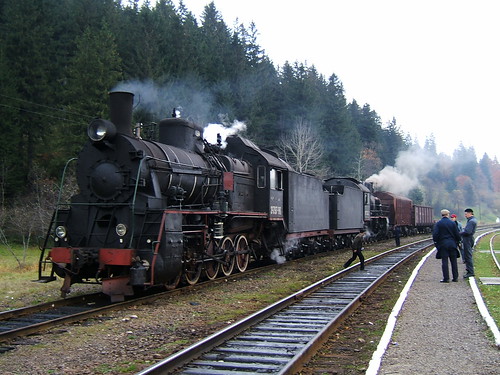
Locomotives Er 797-86 and Em 735-72 stand at Mikulichin, Ukraine.

My introduction to Russian railways was in 2005 when I went to the Ukraine with my friend Mike (now, alas, passed on) for a steam driving experience. With the dissolution of the Soviet Union in 1991, the Ukraine became an independent country. Part of its legacy from the Soviet era was a railway system built to the "Russian Gauge" of five feet using Russian-designed equipment. That trip is described in an earlier post titled Ukraine 2005.

At the time of my visit, this Siemens locomotive was the most modern in the Ukraine.

In addition to the steam trains, I experienced overnight rail journeys from Kiev to Ivano-Francovsk and back and we made fascinating visits to two railway works which overhaul diesel and electric locomotives. In addition, Kiev has a Soviet-built metro system which I also tried out.

Then, in 2011, I travelled from Moscow to Saint Petersburg by ship, using rivers and canals. That trip is described in a series of posts titled Trip to Russia. As you can imagine, railway photographic opportunities were limited but I grabbed what pictures I could and they are linked below in 'Russian Railways'. In Moscow, I was accompanied with other guests from the ship for a couple of rides on the famous Metro system but in Saint Petersburg I made a number of trips on the Metro on my own which are described here. I also spent some time looking round the terminal station for Moscow-bound trains in Saint Petersburg.

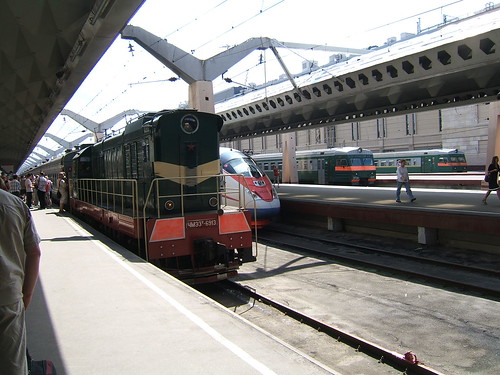
St. Petersburg: The station for Moscow-bound trains. Left to right, the 'CHME3T' has brought in 18-coaches to form a Moscow train, the glimpse of a High Speed train and Electric Multiple Units in the local platforms.

The class 'CHME3T' Co-Co diesel-electric was first introduced in 1964 and over 7,000 units were built. The 'T' indicates rheostatic braking. This uses a 4-stroke 6-cylinder engine, CKD type K6S310DR producing 993 kW to power six 134 kW CKD type TE-006 electric motors.

There matters remained until mid-2012 when, at short notice, I had to cancel a trip to Tibet because the Chinese suddenly stopped issuing visitors' visas. As an alternative, I suggested Mongolia and my travel people came up with the idea of travelling back from Mongolia on the 'Golden Eagle' private train on its 'Trans-Mongolian Express' service to Moscow. This train joins the Trans-Siberian Railway at Ulan Ude and travels 5,507 km to Moscow (the full distance from Vladivostok to Moscow is 9,157 km). My travel posts on my journey in July 2012 can be found here.

The present Russian Railway Company (RZD) emerged from a re-organisation in 2003, producing a state-owned company that is profitable. The structural reform was designed to preserve the unity of the railway network and separate the functions of state regulation from operational management. Would that my country had shown such wisdom! RZD has a comprehensive website here. RZD now brands everything with a smart red logo that looks more like 'pid' to English eyes.

This baggage car (photographed in sidings at Irkutsk) bears the new Russian Railways (RZD) logo, which looks more like 'pid' to English eyes.

Railway Photographs (not including the 2012 trip):

Ukraine Steam.
Ukraine Modern Image.
Chernovtsy Motive Power Depot, Ukraine.
Signalling at Mikulichin, Ukraine.
Kiev Locomotive Works (Passenger).
Kiev Locomotive Works (Freight).
Russian Railways.
Moscow Metro.
Saint Petersburg Metro.

Railway Photographs (2012 trip):

Russian Railways - The Trans-Siberian Railway (collection).
Ulaan Baatar Train Museum.
Plinthed 'Yea' Class at Polovina, Russia.
Circum-Baikal Railway Museum, Port Baikal, Russia.
Rolling Stock Museum, Novosibirsk.
Moscow Railway Museum

References:

This is an informal, incomplete listing of books to hand with at least some relevance to Russian Railways.

'Soviet Locomotive Types - The Union Legacy' by A J Heywood & I D C Button (Frank Stenvalls Forlag) ISBN 0-9525202-0-6.
'Trans-Siberian Handbook Sixth Edition' by Bryn Thomas (Trailblazer Publications) ISBN 1-873756-70-4.
'The Trans-Siberian Railway - A Traveller's Anthology' Edited by Deborah Manley (Century Hutchinson) ISBN 0-7216-2255-1.
'Moscow Railway Map' (Quail Map Company) ISBN 1 898319 28 6.

The Heywood and Button book listed above is the standard English work on Russian steam, diesel and electric locomotives. I also have a splendid 564-page encyclopedia obtained some years ago from Motor Books covering steam, diesel and electric locomotive types in Russia from 1845 to 1955. It's entirely in Russian Cyrillic characters which I find completely inscrutable but is a useful source because it contains a mass of drawings and photographs.

[Reference to 2012 trip added 10-Aug-2012, links to more pictures added 1-Jan-2013]