Thursday, 12 July 2012

Nadaam Festival

Wednesday, 11th July 2012

The 11th of July is the Mongolian National Day celebrating the overthrow of Chinese rule (91 years ago this year). It is also the day the Naadam Festival opens and one of the most important holidays in the year. 2012 is the 806th Naadam Festival celebrating the three 'manly arts' of wrestling, archery and horsemanship. I've seen this national sporting festival described as 'the second oldest Olympics in the world' (although, as 'the other Olympics' is a Victorian re-creation, perhaps Naadam should carry the 'oldest' accolade). It's certainly a very important event for Mongolian people and we were to be present for the opening ceremony.

Our coach threads its way though the crowds making their way to the Central Stadium for the Naadam Opening Ceremony.

The 'Golden Eagle' party left the hotel by coach at 9 o'clock, leaving two full hours before the ceremony started at the Central Stadium, just a few miles away. The traffic in Ulaan Baatar seems pretty bad at the best of times. A decrepit road system combines with a certain lack of road discipline to provide an ideal formula for hold-ups. It seemed that everyone wanted to reach the Central Stadium. We slowly inched towards the stadium site where there's parking quite inadequate for the once-a-year demand of Naadam.

A series of fields outside the stadium had been pressed into use for parking but manoevreing was difficult due to the pressure of crowds on foot and the large number of traders selling the usual assortment of Chinese-made favours. The Mongolian National flag was being sold all over the place in sizes from 'small' to 'hazard to other traffic when attached to your car'. But it all seemed very good natured and the Mongolians were often in National Costume or (particularly in the case of young women) dressed for a disco.

We'd reserved seating in the stadium so our party entered through gate 4 and ascended the crumbling concrete steps into the covered stand. Seating comprised a slatted wooden affair fixed to the raked concrete stand. By the time we were seated, the stadium was around half full with about three quarters of an hour to go but already there was an expectant atmosphere. The oval arena was grassed in the centre, with a running track around the outside. To our left, we could see the 'VIP' stand. There were an awful lot of tourists in the area where we were. We had quite a good view, impaired only by the large number of television cameras on various raised platforms. A large-screen television was placed opposite opposite the 'V.I.P.' stand and this carried a mixture of pre-recorded and live pictures. The public address system was relaying Mongolian singing. All sorts of preparations were going on with police, performers, contestants and television crews coming and going. I found it quite diverting.

The 'Nine Banners' symbolising power in Mongolia enter the stadium carried by horsemen.

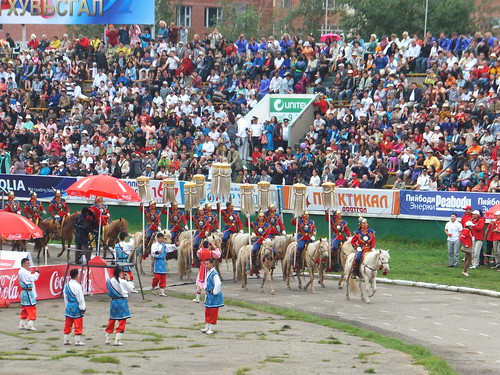
A large grey-uniformed band lined up on the field with at least 15 minutes to go and, shortly after eleven o'clock, the band struck up a stirring rhythm as a line of mounted soldiers in traditional uniform entered the stadium. The first nine horseman were bearing the Mongolian symbols of power - nine ceremonial banners in the form of parasols decorated with horses' tails. These are normally kept in Government House in Shukhe Baatar Square except for one excursion each year to the Naadam Stadium where they are mounted on a podium and treated with great reverence. Throughout the Festival, these parasols are guarded by four soldiers standing in a rather curious pose, one hand on sword handle, one hand on hip. I was relieved to learn that these sentries are changed every three hours.

I'll describe the actual ceremony later but the photographs give some impression of the event. At the end of the ceremony, opened by His Excellency Tsakhia Elbegdorf, President of Mongolia, we walked back through the crowds to our coach.

It was as hard for our coach to extricate itself from the parking area as it had been to park in the first place and the public roads were still congested. We made our way over the river (Selbe gol running at just a trickle) and the railway line using the Peace Bridge and turned into the National Culture and Recreation Park (which didn't appear very park-like where we were). We got out of our coach at the 'Seoul' Korean restaurant where we enjoyed an excellent buffet lunch offering both Korean and European cooking.

Then, it was back on the coach to drive initially west and then north west for around 27 km to witness the finish of the Ikh Nas horse race for 7-year old horses at Khui Doloon Khudag. Getting there proved something of a nightmare but when we finally arrived, it was an amazing spectacle.

Horses are very close to the Mongolian soul. Remember, it was a nomadic culture with very little infrastructure so horses were vital and horsemanship is probably regarded as the highest of the 'three manly skills'. Certainly, a lot of Mongolians had made the journey to the impromptu track to witness the important result.

The 2012 finish was on grassy downs which would normally have been open country but had been converted temporarily into a small town with tents and Ger (the Mongolian round tent). Two stands had been erected close to the finish - a covered one for foreign visitors and an open stand for the locals. There was another stand actually at the finish line. Hundreds of cars which had brought the spectators were scattered around, with a few coaches which appeared to be foreign visitors.

Everybody was in high spirits and a number of Mongolian families were flying kites (it was quite windy at the elevated location). A number of horses were providing rides, mainly for children. A public address system was presumably relaying details of the approaching horses although the numerous police, with their walkie-talkies, seemed to provide a better source of information to Baggi, our guide.

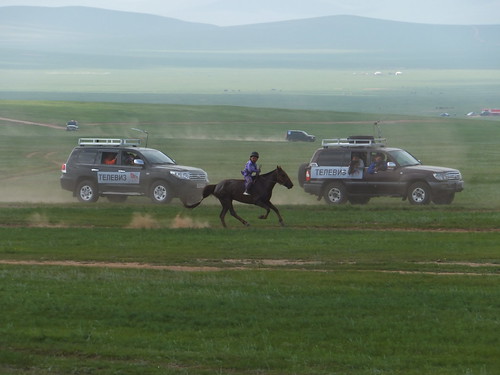
The races are cross-country affairs of around 20 km. Anything up to 400 horses enter each race. Eventually, we could make out a number of approaching vehicles and a cloud of dust. As they got closer, we could make out a number of horses going flat-out, being enthusiastically whipped by their riders. The leading horse was well separated from from the group of runners-up. We must have seen about 200 horses complete the course. A few riderless horses came past.

The ultimate winner passing our stand just 200 yards from the finish, pursued by television crews.

Sadly, one horse collapsed just short of the finish, throwing the rider. An ambulance drove onto the course to attend to the rider but did not appear to be needed. A vet drove up to check the horse and administer the violent-looking equine version of C.P.R. but the horse could not be revived. I was told that it's not unusual for horses to perish in what amounts to an endurance race.

We rejoined our coach which then faced slow progress on the crowded roads leading back to Ulaan Baatar and our hotel.

Photographs:

Ulaan Baatar.
Naadam Festival Opening Ceremony.
Around Ulaan Baatar.
Ikh Nas Horse Racing.

Wednesday, 11 July 2012

Ulaan Baatar

Tuesday, 10th July 2012

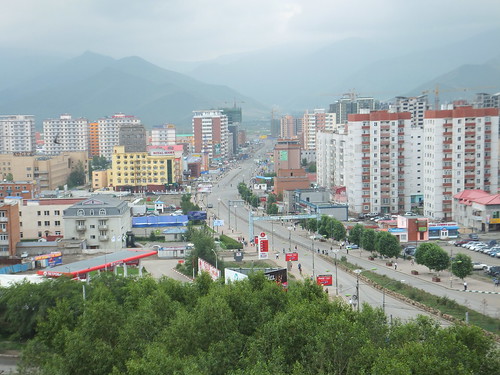
View of Ulaan Baatar from my hotel room.

After a shower, change and breakfast, I decided to see some of the city. Our guide Baggi, who had met me at the airport, said we'd be visiting various places later in the tour so I decided to head for the Railway Museum (surprise!). I located the 'Train Museum' next to the railway on the tourist map I'd picked up on my way through the airport and explained to the hotel reception staff what I wanted to do, showing them the map. They phoned to check that the museum would be open because of the holiday surrounding the Mongolian National Day on 11th July 2012. "It's open 8 'till 5 today" they assured me so I asked them to book a taxi to take me there. I afterwards wondered who they could have spoken to.

In the taxi, I followed the route on my map as best I could but I thought the driver was heading too far west and was probably heading for the Railway Station itself. However, he pulled up at a building that could have been a museum and it certainly had a model of a steam locomotive outside so I paid the agreed fare and the taxi sped off. Well, it was a museum but it was locked and a cleaner working around the outside of the building assured me it was closed for the Naadam holiday.

On re-inspection of my tourist map, I found I'd been delivered to the Museum of Railway History (which I didn't even know about). Since the railway station was only a few hundred yards away, I thought I'd have a look there before deciding what to do next.

Heavy road traffic outside Ulaan Baatar railway station.

I was amazed at just how busy the roads around the station were. With the National Day and Naadam the next day, it seemed that everyone wanted to be somewhere else. I took pictures around the impressive station and photographed a passenger train arriving from Russia. As it approached, I realised it was the Eastbound 'Golden Eagle' - the train I was to board in a couple of days. I went through the subway to Platform 3 to have a look at the train and watch some of the passengers alighting.

After watching a couple of freight trains and a diesel-electric 'switcher' shunting around the station, I decided to return to the road and walk to the Open Air Railway Museum I'd been aiming for. The railway side of the road was lined with warehouses and lots of people were coming and going, transferring eggs, bottled water and all kinds of fresh vegetables and fruit between the warehouses and various vehicles parked at the kerbside. Further along, a dirt road on my right led to more warehouses and vehicles were gridlocked either trying to enter or leave the limited space. There was a lot of horn blowing, manoevring in odd directions and numerous near-misses which I eventually realised is the normal way of driving in Mongolia. A stream of pedestrians, some loaded down with purchases, were making their way to a footbridge over the railway so I decided to take some photographs from the vantage point. The bridge also carried a couple of massive steam mains across the railway. Ulaan Baatar, like much of Russia, uses District Heating schemes to distribute steam for heating from the network of generally elderly coal-fired power stations.

I continued along the road in the hot sun until I came to what looked like a locomotive depot. A line of rusting diesel locomotives stood outside. Not being sure what to expect, I wandered up to a small gatehouse thinking that an abandoned depot had been appropriated for the museum. After a few seconds of mutual incomprehension with the young security guard, I realised that the rather beat-up premises were, in fact, the diesel depot still in use and that my destination must lie further along the road.

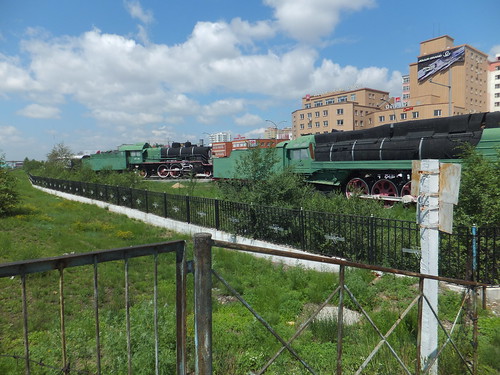
Tramping further, I was rewarded with the sight of a narrow gauge steam locomotive out in the open. This time, I was in the right place. A fenced compound held a number of locomotives but it looked rather neglected and there was nobody around. I walked past the exhibits to where some roadworks looked similarly abandoned. There were piles of sandy soil and a section of steel pipe. To facilitate whatever work had been in progress, they'd taken down the museum fence at that end of the site. By climbing over the spoil, there was unrestricted access to the locomotives.

Ulaan Baatar Train Museum.

I spent a happy half hour photographing the exhibits and then started to wonder how I'd get back to the hotel. I'd harboured ideas of getting a taxi but, as I'd walked from the railway station to the museum, I'd passed people about every 50 yards, standing in the gutter with their arm raised, trying to hail a taxi. They didn't seem very successful so I didn't rate my chances. It seemed that on the day before Naadam, everybody wanted taxis. I didn't know how far I was from my hotel - I guessed three miles - and I was rather hot and bothered. However, you see so much more on foot so I thought I'd give it a shot and see how far I got.

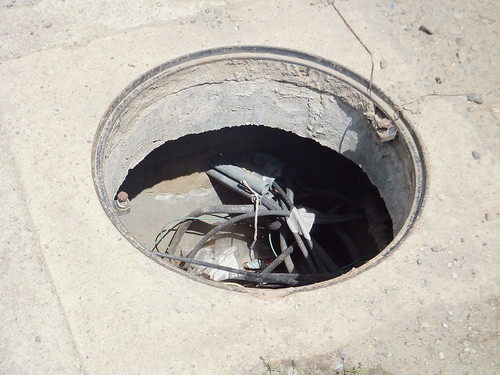
A missing manhole cover in Ulaan Baatar.

Walking in Ulaan Baatar is not for the timid. Every step provides some sort of trap for the unwary, changes in level, unseen steps, potholes. I found a manhole near the middle of the city with a missing cover. Oddly, the two bolts and washers intended to secure the cover had been carefully replaced. I think it took me about 90 minutes to get back to the hotel, pleased that I'd seen so much of the city.

The day concluded with dinner at the Khar Khorum Restaurant in the hotel an an opportunity to meet Tatiana, the Tour Manager, and my fellow-travellers.

Pictures:

Ulaan Baatar.
Railways around Ulaan Baatar.
Ulaan Baatar Train Museum.

Additions made 24-Jul-2012.

Arriving in Mongolia

Tuesday, 10th July 2012

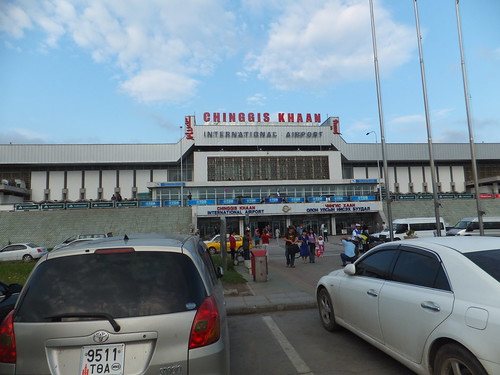
''Land Side' view of Chinggis Khaan International Airport Terminal.

We landed at Chinggis Khaan International Airport about right time. As soon as we'd turned off the runway we stopped on the taxiway, which revealed signs of extensive cracks that had been repaired. This reminded me that Mongolia is not a rich country. A high-wing two-engine turbo-prop was cleared onto the runway we'd vacated and he took off, in the opposite direction from our landing (the black and white windsocks indicated no surface wind). But we remained halted until a small 4-engine jet (a BAe 146, I think) followed the turbo-prop onto the runway. Then we were allowed to taxi to the terminal, passing an 'elephant's graveyard' of stored aircraft. I spotted two elderly-looking single-engine biplanes and at least three Russian-looking helicopters in their typical "sit up and beg" attitude when parked.

The airbridge was attached and we all piled off the aircraft. It was hot! Ulaan Baatar enjoys the distinction of being the capital city with the lowest average temperature in the world. There is a summer when it can be hot but the season is quite short. It didn't take long to pass through Immigration, manned exclusively by young ladies, but at Customs, the Green Lane was barriered-off. All the passengers were being directed through the Red Channel, which was being ignored by the group of Customs officials standing around.

In the Arrivals Hall, there was the usual group of 'Meeters and Greeters', most with signs. I quickly spotted my name and met Mr. Baggi, our guide, and the car driver. We waited for one other arrival for the 'Golden Eagle' tour who'd travelled on my flight (an Israeli gentleman who's a Civil Engineer) and then went out to the car for the journey of around 18 km into the city and our hotel - the Kempinski Khan Palace.

As we'd flown into Mongolia, I'd seen tall, inhospitable mountains and much of the plains where we landed looked barren with little cultivation. The view from the car was of a rather bleak, industrial landscape. Although hot, it was overcast. I could see what looked like the headworks of small mining operations dotted around. With the mountains forming a backdrop, I was reminded of Longyearbyen which I'd visited on my Arctic Adventure.

Mongolia is rich in a number of minerals, including copper and gold but this doesn't seem to have translated into prosperity as yet. The roads were badly maintained and, since our car seemed to lack effective shock absorbers, the journey wasn't too comfortable. We passed three or four small power stations, apparently coal-fired. Mr. Baggi confirmed my guess that they were Russian design. Mongolia is the second-largest landlocked country in the world but its population is only around 2.8 million. Almost half of that population lives in Ulaan Baatur. There were plenty of the characteristic round tents called 'ger' visible ('yurt' is the Russian term) in evidence but we also passed massive building projects producing long apartment blocks a few stories high, rather reminiscent of the Russian style. I'm told they're currently building around 100,000 new homes!

As we made our way through the city, various building styles could be seen, mainly modern, with a lot of tower blocks up to about ten stories in height and construction cranes everywhere towering over new projects. We passed a few buildings struggling to be 'iconic' - the 'Blue Sky Tower' clad in blue-tinted glass was probably the most successful, but not really to my taste.

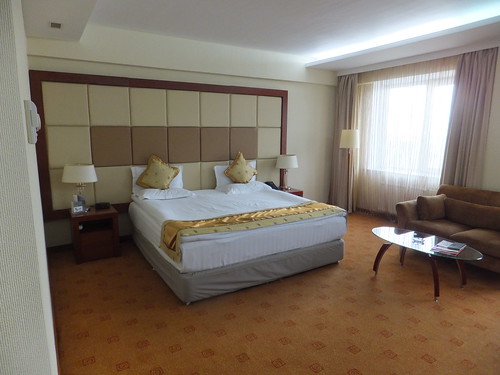
My room at the Kempinski Khan Palace Hotel.

The Kempinski Khan Palace is housed in a fairly undistinguished modern block but, even though it was not yet 7 a.m. we were made welcome and I was given the credit-card sized electronic key to a spacious 9th floor room and an invitation to take breakfast. The room had both Wi-Fi and a physical network connection so I was quite content. After a shower and putting on fresh clothes, I enjoyed a leisurely breakfast. Then, I had to decide whether to catch up on my sleep or explore the city. Regular readers will have no trouble guessing my decision.

My room commanded a good view of an important intersection controlled by traffic lights. Cars, diesel buses and trolley buses streamed past. The, as I was getting ready, I noticed that the traffic had come to a standstill and numerous police cars had appeared. Footpolic lined up on both sides of the street opposite, spaced about every twenty yards. Silence reigned for about 15 minutes (punctuated only by the horns sounded by increasingly impatient motorists). Then, a convoy of about twenty vehicles swept by along the closed street, including a number of police cars with blue and red lights flashing. After this interruption, the traffic started to flow again. I afterwards learned that the convoy was for Hillary Clinton, paying a very brief visit to Mongolia on her way to Laos.

Miscellaneous aircraft pictures (like the one of the terminal building above) are in the set Up, Up and Away.

Pictures of the Kempinski Khan Palace are here.

Pictures around Ulaan Batuur are here.

Tuesday, 10 July 2012

Aeroflot to Mongolia

I usually avoid departures from Heathrow, if I can. It seems to be on many people's 'most hated airports' list but Tim from my travel firm had worked out that the necessary change at Moscow would be easiest if I flew Aeroflot from Terminal 4 at Heathrow.

It's some time since I flew from Terminal 4 but check-in was painless and I was quite happy in the 'Sky Team' lounge. At the appointed time I made my way to Gate 14 and here the terminal is showing its age.

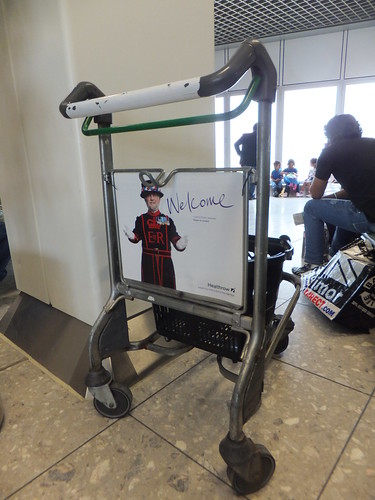
I sat down next to an abandoned luggage trolley which somehow seemed symptomatic of the malaise.

A luggage trolley - handle chipped, greasy dirt around the wheels and with a rusting frame.

The push handle was badly chipped, there was greasy dirt around the wheels and parts of the tubular frame were rusted. But rather than fix those details, what looks like a new poster has been stuck on featuring a Beefeater (Crawford Burton) saying 'Welcome' and there's the risible tag 'Heathrow - Making every journey better'.

The area around the gate seemed cramped and noisy and I didn't think the signage was very good. There were plenty of people waiting for my flight but the boarding gate was without staff so I anticipated a delayed departure. I looked through the window to see an Aeroflot arrival taxiing by which seemed likely to be our aircraft getting in late. Eventually a message over the public address apologised for our late departure "due to the late aircraft arrival".

Waiting is not my strong point but, eventually, passengers started to board. I waited for the 'scrum' to clear but, as soon as they opened a separate boarding pass check for Business Class, I took advantage of it and was on the aircraft in short order.

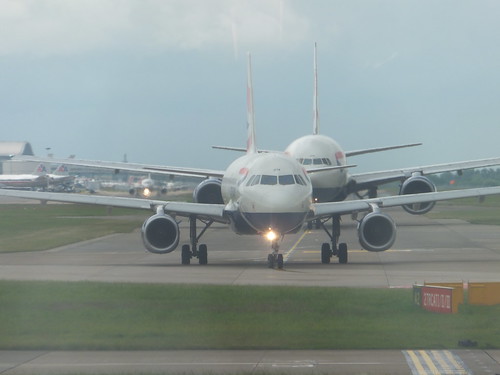
It was my first trip with Aeroflot, who now seem to trade as 'Aeroflot Russian Airlines'. The aircraft was a rather basic Airbus A320 with 2+2 seating in the front section, but the cabin crew were friendly and attentive. Of course, setting off late meant that we'd lost our 'slot' and the Captain announced a 20-minute delay as we worked our way up the queue of departing aircraft. We were to use Two Seven Right (arrivals were using 27 Left) and aircraft from three different taxiways (including one massive Airbus A380) were being fed to the take-off runway.


Part of the queue for 27R.

Eventually, our turn came and we were soon airborne and above the clouds. They served a decent Lunch (with proper napkins and knives of steel, not ridiculous plastic). They offered a portable DVD Player but I amused myself reading during the rest of the flight.

My First trip to Russia last year (posts are here) took me to Domodedevo, so arrival at Sheremetyevo Airport was a new experience. We didn't get to our stand at the modern Terminal 'D' until about 19:10 and, by the time I was walking through the terminal, I was starting to worry about my connection to Aeroflot flight SU330 to Ulaan Baatar. Fortunately, the signage was plentiful and in English and Russian so I found the Transfer Desk and was soon on my way, knowing the Gate number. I was slightly thrown by a Passport Check, but this was a friendly and cursory affair. A separate lady checked my boarding card again, and this merited another rubber stamp. It was a fair walk to the Departure Gate and there were lots of people milling around when I arrived. Boarding started after a few minutes and I was soon ensconced in my window seat on the starboard side. This time, the equipment was a 767 with lots of room and a seat 'almost flat' when reclined.

We took off close to the scheduled time of 20:00. I snatched a picture of one of a pair of aircraft I didn't know - two top-of-wing mounted engines and massive anhedral on the wings (the American 'Phantom' had anhedral on its tailplane).


The odd-looking aircraft.

Again, the staff were very friendly and they provided another excellent meal. This time, I accepted the offer of the 'Panasonic' A330 DVD Player. Because they run off a rechargeable battery, they're surprisingly heavy and they've a memory module with a wide range of programming. I watched 'Sherlock Holmes: A Game of Shadows' to the end but I wasn't that struck. I think there was more CGI than Live Action. I was puzzled by what appeared to be Didcot Railway Centre posing as a Munitions Factory. Then, I put the seat flat and tried to get a bit of sleep. When we arrived it would have been late evening London time, but it was six o'clock in the morning (the next day) when we landed at Ulaan Baatar.

My pictures of Heathrow are here.

Miscellaneous aircraft pictures (like the one above) are in the set Up, Up and Away.

Monday, 9 July 2012

Trans-Siberian

I had booked (and paid) for a trip to Tibet in June 2012. A few weeks before departure, the Chinese Authorities decided to stop issuing Tourist Visas and so, at short notice, Tim from my Travel Firm and I were faced with salvaging what we could and making alternative arrangements, incurring the least possible financial loss.

"Mongolia" I suggested and that's where I'm off to, by air, for a very brief stay. Tim suggested coming back, by train, on part of the Trans-Siberian Railway. Now, people who know about my interest in railways have assumed that I'd be keen to make such a journey but I've never been sure I want to spend a week on a train (Kiev to Ivano Frankovsk overnight in Ukraine proved quite sufficient as I describe briefly in Ukraine 2005). But Tim suggested using the 'Golden Eagle' private train which offered a service back from Ulaan Baatar in Mongolia to Moscow around the time we were looking at and that's what I'm about to do.

So, here I am in the 'Sky Team' lounge at Heathrow's Terminal 4, waiting to depart at 11:50 to Moscow's Sheremetyevo Airport on Aeroflot flight SU2571 where I hope to make a connection to Aeroflot flight SU330 to Ulaan Baatar.

I've three nights in Ulaan Baatar before boarding the train for Moscow. This will be my second trip to Russia - only last year I made a trip by river and canal from Moscow to St. Petersburg which is described in a series of posts labelled Trip to Russia.

As usual, I don't know what access I'll find to the Internet so I may go quiet for a bit but I have my Notebook Computer with me and hope to be recording some of my thoughts as I go, even if I can't post them until later.

Wednesday, 4 July 2012

The Brewood Buddha Statue

When I first visited Mandalay in Myanmar (formerly Burma) in March 2008, I found the city as exotic as it had always sounded.

I was taken to see the 'Street of the Marble Carvers' where craftsmen produce marble statues depicting Buddha and other subjects. I thought that it would be good to support the work by bringing an example of their work back to Brewood but, on that trip, there was insufficient time to purchase a statue and make arrangements for its transportation.

This introduction to Mandalay was just one stage in a trip I call 'Round the World Five (RTW5) where I transited Bangkok before spending a night in Yangon prior to a River Trip on the 'Road to Mandalay'. Then, it was back through Bangkok and across the Pacific to transit Los Angeles on the way to Las Vegas. After tours to the Grand Canyon and Hoover Dam, I flew to Cancun, Mexico to see the ruins at Chichen Itza. Then, it was on again for a few days in Cuba and Panama before making a long journey home transiting Mexico City and Frankfurt. All the posts describing this trip can be found here.

On my return to Mandalay in August 2008, I determined to allow sufficient time to select a suitable statue and organise its transportation. There's a post here which covers my second visit to the 'Street of the Marble Carvers' and there are a few pictures here.. I made the purchase and also arranged for it to be shipped to the U.K.

This visit to Mandalay was part of a longer trip I call 'Far East Two' (FE2) where I had a brief stay in Bangkok before visiting Yangon, Mandalay and Shan State. On leaving Burma, I stayed in northern Thailand in the 'Golden Triangle' area before sailing down the Mekong to Luang Prabang in Laos. After moving on to the capital of Laos, Vientiane, I returned home via Bangkok and Dubai (where I spent a couple of nights in the desert resort of Al Maha). All the posts describing this trip can be found here.

After various 'alarms and excursions' and the exchange of a number of e-mails extending over a period of about three months, the statue finally arrived safely in December 2008. A location had been chosen in the garden and the statue was moved temporarily into position - no simple matter when the statue weighs half a ton and a 'Geda' hoist had to be hired to raise the statue from the lower part of the garden to the upper section.

I decided that construction of the permanent shelter should await better weather so, in the meantime, Ann and Dean helped me to erect a six-sided 'gazebo' tent over the statue. Even this was not completely straightforward because we discovered that one of the plastic parts supplied as part of the assembly was the wrong type. Fortunately, Ann was able to arrange a replacement with the U.K. distributors. There matters remained until June 2010 when my builders were instructed to go-ahead with a brick structure.

It's hard to exaggerate the visual impact of more than 2,000 temples and stupas scattered across the Central Plain of Bagan in Burma. My pictures on my first trip are here and here. The buildings are of brick, originally with elaborate stucco work. However, the passage of time has resulted in most of the structures in Burma losing most, or all, of their stucco. Donors have restored or rebuilt many of the monuments in Burma which are normally left as simple brick structures.

So brick seemed the right choice for the shelter at Brewood. The shelter had to be tiny and much simplified compared with even the smallest monuments in Bagan and the characteristic 'spire' had to be omitted. Each time I've returned to Burma, I've added to my collection of pictures of the Buddhist monuments, giving me plenty of inspiration for the effect I hoped to achieve. I was lucky that my friend Charlie had agreed to carry out this rather unusual building project which he completed in August 2010, after which he took a well-deserved retirement.

As you may imagine, the Brewood Buddha has created considerable interest with visitors and it forms a physical link with the charitable work carried out by the 'Road to Mandalay' in Burma in which I've become interested. The posts describing the 'Road to Mandalay' initiatives can be found here.

For more pictures of the arrival of the statue, the tent and the construction of the brick structure, Click here.

Friday, 29 June 2012

Russian Railways

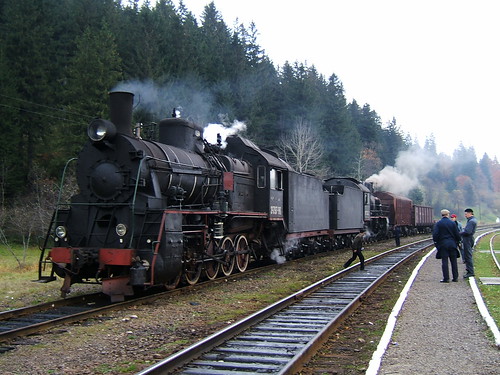
Locomotives Er 797-86 and Em 735-72 stand at Mikulichin, Ukraine.

My introduction to Russian railways was in 2005 when I went to the Ukraine with my friend Mike (now, alas, passed on) for a steam driving experience. With the dissolution of the Soviet Union in 1991, the Ukraine became an independent country. Part of its legacy from the Soviet era was a railway system built to the "Russian Gauge" of five feet using Russian-designed equipment. That trip is described in an earlier post titled Ukraine 2005.

At the time of my visit, this Siemens locomotive was the most modern in the Ukraine.

In addition to the steam trains, I experienced overnight rail journeys from Kiev to Ivano-Francovsk and back and we made fascinating visits to two railway works which overhaul diesel and electric locomotives. In addition, Kiev has a Soviet-built metro system which I also tried out.

Then, in 2011, I travelled from Moscow to Saint Petersburg by ship, using rivers and canals. That trip is described in a series of posts titled Trip to Russia. As you can imagine, railway photographic opportunities were limited but I grabbed what pictures I could and they are linked below in 'Russian Railways'. In Moscow, I was accompanied with other guests from the ship for a couple of rides on the famous Metro system but in Saint Petersburg I made a number of trips on the Metro on my own which are described here. I also spent some time looking round the terminal station for Moscow-bound trains in Saint Petersburg.

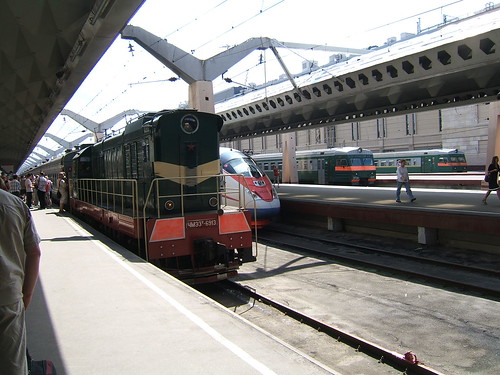
St. Petersburg: The station for Moscow-bound trains. Left to right, the 'CHME3T' has brought in 18-coaches to form a Moscow train, the glimpse of a High Speed train and Electric Multiple Units in the local platforms.

The class 'CHME3T' Co-Co diesel-electric was first introduced in 1964 and over 7,000 units were built. The 'T' indicates rheostatic braking. This uses a 4-stroke 6-cylinder engine, CKD type K6S310DR producing 993 kW to power six 134 kW CKD type TE-006 electric motors.

There matters remained until mid-2012 when, at short notice, I had to cancel a trip to Tibet because the Chinese suddenly stopped issuing visitors' visas. As an alternative, I suggested Mongolia and my travel people came up with the idea of travelling back from Mongolia on the 'Golden Eagle' private train on its 'Trans-Mongolian Express' service to Moscow. This train joins the Trans-Siberian Railway at Ulan Ude and travels 5,507 km to Moscow (the full distance from Vladivostok to Moscow is 9,157 km). My travel posts on my journey in July 2012 can be found here.

The present Russian Railway Company (RZD) emerged from a re-organisation in 2003, producing a state-owned company that is profitable. The structural reform was designed to preserve the unity of the railway network and separate the functions of state regulation from operational management. Would that my country had shown such wisdom! RZD has a comprehensive website here. RZD now brands everything with a smart red logo that looks more like 'pid' to English eyes.

This baggage car (photographed in sidings at Irkutsk) bears the new Russian Railways (RZD) logo, which looks more like 'pid' to English eyes.

Railway Photographs (not including the 2012 trip):

Ukraine Steam.
Ukraine Modern Image.
Chernovtsy Motive Power Depot, Ukraine.
Signalling at Mikulichin, Ukraine.
Kiev Locomotive Works (Passenger).
Kiev Locomotive Works (Freight).
Russian Railways.
Moscow Metro.
Saint Petersburg Metro.

Railway Photographs (2012 trip):

Russian Railways - The Trans-Siberian Railway (collection).
Ulaan Baatar Train Museum.
Plinthed 'Yea' Class at Polovina, Russia.
Circum-Baikal Railway Museum, Port Baikal, Russia.
Rolling Stock Museum, Novosibirsk.
Moscow Railway Museum

References:

This is an informal, incomplete listing of books to hand with at least some relevance to Russian Railways.

'Soviet Locomotive Types - The Union Legacy' by A J Heywood & I D C Button (Frank Stenvalls Forlag) ISBN 0-9525202-0-6.
'Trans-Siberian Handbook Sixth Edition' by Bryn Thomas (Trailblazer Publications) ISBN 1-873756-70-4.
'The Trans-Siberian Railway - A Traveller's Anthology' Edited by Deborah Manley (Century Hutchinson) ISBN 0-7216-2255-1.
'Moscow Railway Map' (Quail Map Company) ISBN 1 898319 28 6.

The Heywood and Button book listed above is the standard English work on Russian steam, diesel and electric locomotives. I also have a splendid 564-page encyclopedia obtained some years ago from Motor Books covering steam, diesel and electric locomotive types in Russia from 1845 to 1955. It's entirely in Russian Cyrillic characters which I find completely inscrutable but is a useful source because it contains a mass of drawings and photographs.

[Reference to 2012 trip added 10-Aug-2012, links to more pictures added 1-Jan-2013]

Wednesday, 27 June 2012

West Midland Railways

Wolverhampton High Level Station as I remember it.

When I was young, Wolverhampton had two adjacent stations near the town centre. The former L.M.S. station was nearest to and built on the same level as the town centre. Since the town centre was partly on a hill, the lines approaching the L.M.S. station were raised on embankments or viaducts. The former G.W.R. station was parallel to the L.M.S. station but at a lower level. The Great Western line from the south reached the station through two single line tunnels whilst that to the north was more-or-less at ground level until Stafford Road Works, after which it crossed a valley on a viaduct to reach Oxley and the route to Shrewsbury.

With admirable logic, the two stations were called 'High Level' and 'Low Level'. To cater for passengers interchanging between stations, a combination of steps, a subway and a ramp allowed pedestrians to walk between the stations. The main passages remain (as a listed structure, I think) although the original purpose was lost with the closure of the Low Level Station. The passages still provide a useful short-cut to those on foot between the Wednesfield Road and the present station frontage.

The Stour Valley Line was an important route linking Wolverhampton High Level with Birmingham New Street via the exotic-sounding Dudley Port. This was the route most passenger trains took, although it was possible to reach Birmingham through a connection to the 'Old Road' via Bescot, actually part of the former Grand Junction Railway opened in 1837 long before the Stour Valley and only the third main line railway to be planned in England (after the Liverpool and Manchester and London and Birmingham). I got to know the Stour Valley well, particularly when I started visiting signal boxes along that route (see 'Visiting Signalboxes'). But the 'Old Road', with its major marshalling yards and motive power depot at Bescot, retained its fascination, as I described in the article '9:17 a.m. to Birmingham'.

More on Wolverhampton High Level.

References:

This is an informal, incomplete listing of books to hand with at least some relevance to West Midland Railways.

[ 1] 'Wolverhampton Railway Album Volume 1' by Simon Dewey & Ned Williams (Uralia Press) ISBN 0 9500533 2 5.
[ 2] 'Wolverhampton Railway Album Volume 2' by Simon Dewey & Ned Williams (Uralia Press) ISBN 0 9500533 3 3.
[ 3] 'Rail Centres: Wolverhampton' by Paul Collins (originally published in 1990 by Ian Allen, reprinted by Booklaw Publications in 2008) ISBN 1-901945-23-5.
[ 4] 'Staffordshire Railways' by Mike Hitches (Allan Sutton Publishing) ISBN 0-7509-0869-6.
[ 5] 'Lost Railways of Birmingham & The West Midlands' by Terry Moors (Countryside Books) ISBN 978 1 84674 109 8.
[ 6] 'D. J. Norton's pictorial survey of Railways in the West Midlands Part 1' by R. J. Essery (Wild Swan Publications) ISBN 978 1 902184 50 7.
[ 7] 'Pre-grouping in the West Midlands' by P. B. Whitehouse (Oxford Publishing Co.) ISBN 0-86093-328-8
[ 8] 'Black Country Railways' by Ned Williams (Alan Sutton Publishing) ISBN 0-7509-0934-X.
[ 9] 'Birminghham Railways in Old Photographs' by Mike Hitches (Alan Sutton Publishing) ISBN 0-7509-0027-X.
[10] 'Birmingham Railway Scene' by C. C. Dorman (Town & Country Press).
[11] 'The Railways of Dudley' by Ned Williams (Uralia Press) ISBN 1 898 528 02 0.
[12] 'Branch Line Byways - The West Midlands' by G. F. Bannister (Atlantic Transport Publishers) ISBN 0 906899 23 0.
[13] 'Tipton - A Third Selection' by Keith Hodgkins & John Brimble (Sutton Publishing) ISBN 978-0-7509-2832-8.
[14] 'New Street Remembered' by Donald J. Smith (Barbryn Press Limited) ISBN 0 906160 05 7.
[15] 'Birmingham New Street - Background and Beginnings' by Richard Foster (Wild Swan Publications) ISBN 0 906867 78 9.
[16] 'Birmingham New Street - Expansion & Improvement' by Richard Foster (Wild Swan Publications) ISBN 0 906867 79 7.
[17] 'Monument Lane Loco Shed' by Tony Higgs (Brewin Books) ISBN: 978-1-85858-435-5.
[18] 'Wolverhampton to Stafford' by Vic Mitchell (Middleton press) ISBN: 978 1 908174 79 6.
[19] 'West Midlands' by J. B. Bucknall (Ian Allen Publishing) ISBN 0 7110 2250 X.

[Book References 18,19 added 15-Sep-2015]

Tuesday, 26 June 2012

Battlefield Line 1940s Weekend (June 2012)

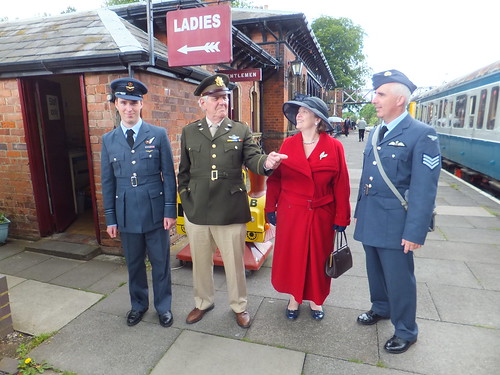
Re-enactors on the platform at Shackerstone.

Many preserved railways in the U.K. organise a 1940s Weekend. For instance, it has been an important feature of the Peak Rail calendar for a number of years - you can find my stuff about the Peak Rail events I've participated in here:-

2009 event (article and pictures).
2008 event (article and pictures).
2007 event (pictures only).
2006 event (pictures only).

But the 23rd and 24th June 2012 was the first time that the Battlefield Line had held such an event. I was present on Sunday 24th June 2012 when I drove the diesel railcar. I'd taken a knapsack, respirator and tin helmet. I didn't use the respirator but displayed it in the cab and I only wore the tin hat from time to time.

The diesel railcar at Market Bosworth.

I'm afraid a 1960s DMU is the wrong period for a 1940s Weekend but nobody seemed to mind too much. The only type of diesel railcar in regular service in the UK then was the futuristic-looking G.W.R. railcars dubbed 'flying bananas' (see Wikipedia article for brief information or the detailed information in the 'GWR Railcars' section of the splendid site The Great Western Archive).

The intermediate station of Market Bosworth was where the main displays were held but I'm afraid I didn't get to see them because the DMU had a very quick turn-around each time it was at Market Bosworth because of the rather ingenious timetable.

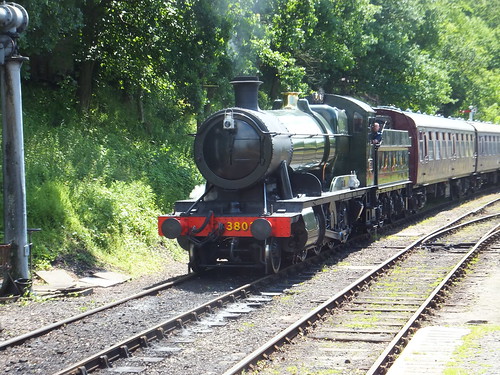
'3803' (described in an earlier article) operated the 4-coach service train, providing five round trips between Shackerstone and Shenton, stopping at Market Bosworth each way. Departures from Shackerstone were timed for 10.30 a.m., 12.00 noon, 1.30 p.m., 3.00 p.m. and 4.30 p.m. This meant that on arrival at Shackerstone, the train engine had 35 minutes to run round and, if necessary, take water. This also meant that the single line section was available for 35 minutes, allowing the DMU to make a quick foray up the single line to Market Bosworth and back. During the 1940s weekend, the timing of the main train allowed the DMU to provide five round trips between Shackerstone and Market Bosworth, departing Shackerstone at 10.00 a.m., 11.30 a.m., 1.00 p.m. 2.30 p.m. and 4.00 p.m.. Hence, Market Bosworth enjoyed 5 departures each day to Shenton and 10 departures to Shackerstone.

'3803' looks handsome running into Shackerstone 'right time'.

A similar 'main train plus DMU' timetable has been used on recent 'Thomas' events. We've usually been sending the DMU as far as Headley's Crossing and back, providing a 'Daisy Shuttle' (or, sometimes, a 'Thomas and Daisy Shuttle'). In 2011, when the 'Thomas' main train was being top-and-tailed (see (see 'Thomas' article) 'Daisy' was allowed to go all the way to Market Bosworth during the June event but during the October event the DMU was only going to the "second bridge out". The April 2012 'Thomas' event saw 'Daisy', once again, terminating at Headley's Crossing.

For the 1940s weekend, the activities at Market Bosworth were arranged by Bob Matthews and the Tommy Atkins Society. Advertised attractions included fire-power demonstrations, battle re-enactments, a field kitchen, Home Guard display and weapons, vehicles, equipment and uniforms.

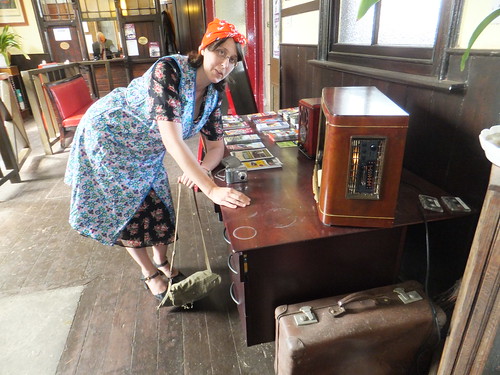
In addition to the normal attractions at Shackerstone, there were old radios playing wartime programmes and a display of wind-up gramophones playing 78 r.p.m. records of the period.

Jo, in WW11 housewife attire, listens to the radio.

The day started showery but improved and I certainly had a good day. I hope everybody else did, too.

There are a few pictures of the day here.

Monday, 25 June 2012

A Day on the Footplate (2)

Sunday 10th June 2012
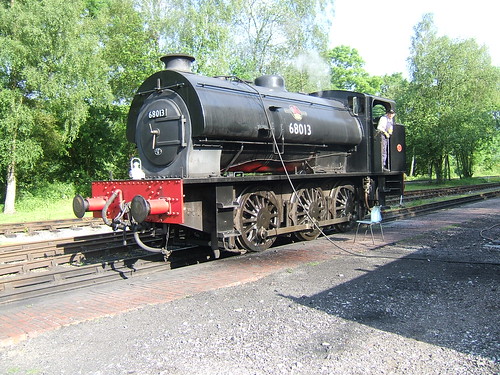
68013 standing on the outside pit at Rowsley during preparation.

I was rostered as the steam driver at Peak Rail on Sunday 10th June 2012. I'd had a fairly demanding turn at the Battlefield Line the previous day (described here) so I was almost grateful that we'd only be doing half the work, since we'd be top-and-tailing with 'Penyghent' on the service train.

I arrived at Rowsley Shed before 7.00 a.m. to find 68013, Peak Rail's regular performer, on the outside pit. Phil, the booked fireman, had steam raising well in hand. We'd been advised that the Fireman's side injector was unserviceable and that we'd have to manage with the Driver's side injector.
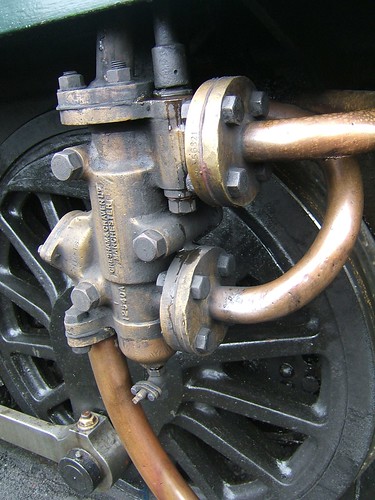

The Fireman's side injector.

The 'Austerity' tank engine is fitted with two Gresham & Craven under cab floor mounted vertical injectors. It's a pretty reliable arrangement but, because of the importance of the injector, two are fitted to the engine. However, Phil and I were quite confident about having only one available during the day. The only drawback is that the water cock and steam cock for the serviceable injector were on the driver's side. Most of the time, the driver can work the injector to the fireman's instruction but, if the driver's busy, in the middle of braking for instance, the fireman may have to reach round the driver to operate the controls himself.

I busied myself oiling round and examining the locomotive. I was almost grateful (again) that I'd only six wheels to worry about, compared with sixteen the previous day.

The various duties of the driver and fireman in getting a locomotive ready for traffic are referred to as 'Preparation' and I've described them in more detail in an earlier post here. Although this article features the same locomotive and the same railway, at that time the locomotive was known as 'Royal Pioneer' and preparation took place at Darley Dale, not Rowsley.

Oiling round and examining a locomotive means that the driver has to get 'Up Close and Personal' with all the various bits. There's a set of photographs here showing an 'Austerity' tank in some detail.

There's a bit more about Preparation in other posts such as On the Footplate (Part 1).

Just after 8.00 a.m. Rob presented us with the Train Staff for the Rowsley - Church Lane single line section, allowing us to come off shed light engine and make our way down to Church Lane. Rob had gone ahead of us by road so, as we approached, he opened the level crossing gates and called us across. I surrendered the Train Staff to Rob and we carried on to the Up Platform at Darley Dale to await our driving experience trainee.

Our trainee soon appeared and was keen to begin. Rob had travelled to Darley Dale by road and he opened the Darley Dale level crossing for rail traffic and called us across. This time, we collected the Train Staff for the Darley Dale - Matlock section and this authorised us to occupy the single line on which our trainee would operate. I've previously written about driving experience courses at Peak Rail here. On the 10th June we spent two hours pottering up and down between Darley Dale and the Derwent bridge on the approach to Matlock Riverside (currently the southern limit of driving experience running). Most of the time was spent by the trainee actually driving but there was time for explanations about the features of locomotive design of interest to the trainee and a session learning about (and practising) firing.

At about 10.45 a.m., the signalman at Darley Dale opened the gates and 'gave us the road' so that our trainee could drive into the Down platform, where his family were waiting to congratulate him. We said goodbye to our trainee and, with Church Lane's Outer Home 'Off' we carried on to Church Lane. The Inner Home came 'Off' and I collected the single line staff for Church Lane - Rowsley from the Signalman as we passed the box. We continued up the bank to Rowsley and our six-coach train.

As we approached the coaching stock, I could see that the train tail lamp was 'on the floor' with the red lens pointing towards us, meaning that I had to stop short and wait for the Guard to call us on. It looked as if the Guard was still at the other end of the train, supervising the coupling-on of 'Penyghent'. After a minute of two, the Guard returned, turned the lamp away and called us on with a handsignal. Phil 'tied us on' and we also topped-up our water tank.
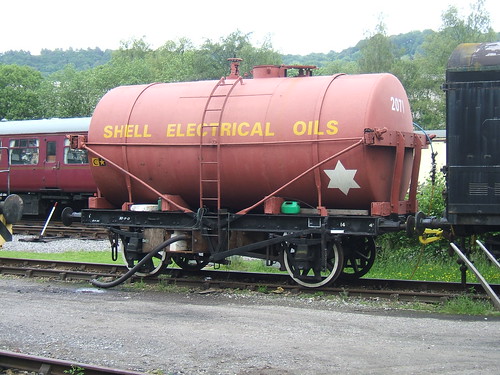
The nicely-restored 'Shell Electrical Oils' tank wagon used as a water tank at the south end of Rowsley station.

There's no permanent locomotive watering facility at the south end of Rowsley, so the nicely-restored 'Shell Electrical Oils' tank wagon has been adapted as a water tanker and positioned opposite the point where the steam locomotive normally comes to a stop. A small-diameter water main feeds the tank through a ball valve and a portable petrol-engined water pump is used to feed the fire hose which delivers water to the locomotive.

We'd agreed that Phil would drive the first round trip so I busied myself preparing the fire for departure. This involved thickening the firebed a little (without causing black smoke at the chimney) and bringing the boiler pressure up to near the blowing-off point without actually blowing off. Judicious use of the driver's side injector brought the water level in the gauge glass near the top, with a little space left in case (as often happens) departure was not quite on time.

Once I'd relayed the Guard's 'Rightaway' to the driver, I looked ahead to confirm that the line was clear on my side and relayed that to the driver. There's always a temptation to fire at this point but it should be resisted. In the first place, until the exhaust steam blast effect has raised the firebox temperature, adding coal just has a chilling effect. Secondly, with Slam Door stock there is no central locking and passengers are sometimes foolish enough to try to board or alight from the moving train. With the platform on the fireman's side at Rowsley, I prefer the fireman to be looking back for possible trouble. The Guard should also be checking the platform at this stage, so the driver should keep an eye on the Train Pipe Vacuum - a sudden loss of vacuum may mean that the Guard has 'put the Setter in' (opened his brake valve).

When 'Penyghent' on the rear of our train had passed clear of the platform ramp, I reported "Clear of the Platform" to the driver and checked the line ahead. Leaving Rowsley, there's a foot crossing which should be checked and, provided there's nothing untoward, a "Crossing Clear" report given to the driver before picking up the shovel and repairing some of the damage that our departure may have caused to the fire. With the regulator open, thre's plenty of air being drawn through the fire so extra coal will not have to much chilling effect and the increased combustion rate will prevent black smoke.

Alerted to our approach by telephone immediately prior to our departure from Rowsley, the signalman has to leave the signal box, operate four gates from the ground (as traffic permits), bolt the gates and return to the box to clear the signal. Both driver and fireman should now be looking for Church Lane's Up Home Signal. The rapid re-growth of foliage at this time of year means that, even with a regular programme of 'cutting back', the signal may be hard to sight. Even with a clear signal, the driver has to reduce speed to comply with the restriction over the level crossing. The more modest demand for steam may allow the fireman to start an injector at this point to replenish some of the water used in leaving Rowsley.

The Single Line Staff for the Church Lane - Rowsley section has to be surrendered to the signalman as we pass the box. At Church Lane, the signalman comes onto the narrow landing at the front of the box (principally intended to facilitate window cleaning) to receive the staff. For this section, the staff is placed in a pouch attached to a ring or hoop. Either the driver or the fireman may perform the exchange, but it's important that the hoop is held square to the signalman, at a height the signalman can reach and without the hoop wavering about. Similarly, the signalman should not attempt to 'pluck' the hoop from the engineman using fingers - that's an invitation for a broken finger. Rather, a clenched fist and extended arm should 'spear' through the centre of the hoop, allowing the hoop to travel up the arm towards the shoulder.

The timetable only allows 5 minutes for the Rowsley - Darley Dale section, so the driver will need to use steam once past Church Lane Box. The driver needs to control the approach to the platform at Darley Dale quite carefully to be able to stop in the right place without jerking the train, using the Vacuum Brake Application Valve to partially destroy the Train Pipe Vacuum.

I put the injector on again, whilst the driver was not using steam, and made a light firing as we stood in the station, closing the damper to discourage 'blowing off'. Once station duties were complete, the Stationmaster "gave the tip" to the waiting signalman who opened the two long level crossing gates and 'pulled off' our signal - an upper-quadrant wooden bracket actually mounted on the platform. The Guard gave the 'Rightaway' which I passed on to the driver, together with my confirmation that I'd checked both ahead and back along the train (it's not unknown for the 'Rightaway' to be given when there's still a door open) then I opened the back damper to allow the steam blast to draw more air through the fire to increase the steaming rate. Although the line is virtually level here, it needed a fair bit of steam to get our trailing load of around 350 tons rolling.

I usually salute any waiting motorists to acknowledge their having had to wait for us. A few drivers scowl in response at the enforced delay but most give a friendly wave in reply. The single line staff for the Darley Dale - Matlock section has to be collected from the Darley Dale signalman. Here, the signal box is at ground level so the signalman stands on the crossing holding up the staff which either the driver or fireman collects by reaching down and scooping up the hoop. This staff doesn't have pouch - the staff is attached to the hoop by a short chain.

With the platform on the fireman's side, like Rowsley, I like the fireman to be checking the train as we leave. Of course, if the engine is operating the other way round (which is possible now we have a turntable) or if we're using different motive power which is left hand drive rather than right, either the driver has to check back for himself or, if the driver wants to keep his attention on the line ahead, the fireman has to move across to the driver's side to keep a lookout.

In the old days, it was often said that the only time a fireman was allowed to stand on the driver's side of the cab was when keeping a lookout leaving a platform on the driver's side. Tales abound of drivers taking a piece of chalk and drawing a line down the middle of the cab and instructing their fireman with a curt "That's your side of the cab - this is mine". An old Newton Heath driver I knew insists he cured such a driver in this way:-

"One week, I was marked to fire to a real curmugeon of a driver on a diagram covering a Fast from Manchester Victoria to Leeds with a '5X'. This driver would hardly say a word the whole shift except to rebuke me and he wouldn't allow the fireman to even stand on his side of the footplate. Well, after three miserable days like this, I'd had enough. On the fourth day, I got a really good fire on before we left Victoria, then I perched myself on the little tip-up seat on my side of the cab. He was working the engine quite hard so, after a few minutes, the pressure started to creep back from the red line, but I just stayed on my little seat. I could see my driver keep looking at the pressure gauge and he didn't look happy but he didn't say anything so I stayed on my seat. As the pressure continued to fall, eventually my driver had to speak and, not in the politest language, asked me what I thought I was playing at. Looking as innocent as possible, I got up, opened the firedoors and studied the fire before announcing 'My side of the fire's alright. It must be your side'. The driver treated me to an evil look but said nothing, so I picked up my shovel and set about making matters right. Do you know, I never had any more trouble with that driver after that?"

Having watched our train clear of Darley Dale crossing, I reported "All following" and turned my attention to the fire, adding a reasonable 'charge' now there was a reasonable steam blast through the firebed. I'd finished firing in time to look ahead to the first foot crossing in Redhouse Cutting. There's a Whistle Board here (a white 'W' on a black rectangular sign). I usually wait for the driver to whistle before calling out "Crossing Clear" although if I'd spotted people who might be at risk, I'd alert the driver as soon as I'd sighted them.

Gradient Diagram Ambergate - Bakewell

There's a temporary speed restriction going 'down the bank' to Matlock so the regulator was closed before long to allow the train to roll. With steam not being used, the boiler pressure tends to rise so we put on the driver's side injector to prevent blowing off. We passed another three Whistle Boards and I provided a 'second pair of eyes' at each one. There's a fixed distant signal on the approach to Matlock Riverside which originally was a reminder that the driver was approaching the end of the Peak Rail line. Now, of course, we normally run through the former run round loop at Riverside and continue to Matlock Town.

I tend to use the distant as a reminder to get another decent 'charge' on the fire to give it a chance to burn through before we tackle the final gradient into Matlock Town. At the approach to Riverside, we cross the River Derwent and the gradient changes from downhill to adverse requiring the use of steam so there's usually sufficient blast to prevent black smoke. Because of the signalling work in progress in connection with the construction of the new Matlock Riverside signal box, the speed is limited to 5 m.p.h. over the former run round. Once clear of the 5 m.p.h. 'slack' there's the final assault (where 10 m.p.h. is permitted) up the 1 in 170 gradient into our platform at Matlock Town. The boiler pressure held up well and, as we came to a stand, the injector went on again.

The new Peak Rail rules call for the single line staff to be carried on the leading engine if the train is worked by more than one so, in preparation for the return leg, I walked down the platform to surrender the staff to the secondman on 'Penyghent' who'd walked to meet me halfway.

Meanwhile, Phil had 'set the lamp right'. We'd travelled to Matlock with one lamp on the chimney for an 'Ordinary Passenger Train' - a Class 2 (or, when I was young before the 4-character headcodes were introduced, a Class B). Phil had moved this lamp to the right buffer and inserted the red shade since proper locomotive lamps have a removeable red filter so as to be able to do duty as either head lamp or tail lamp. There's a bit more about lamps here.

'Penyghent' was going to do all the work going back to Rowsley so a few shovelfulls spread across the grate stopped the fire getting too thin. Later in the journey, I made another light firing and added a drop of water to the boiler to keep the level up. We arrived back at Rowsley in fairly good shape. We didn't need to take water - with top-and-tail working we generally take water every second trip.

We made another four uneventful round trips during the day, with Phil firing and me driving. At the end of the day, both 'Penyghent' and 68013 uncoupled from the train and made their way across to the shed. Phil and I agreed we'd had a good day.

I was back at Peak Rail on Wednesday, 20th June 2012 again paired with Phil but this time with the 'Class 31' on the other end of the train. All went according to plan and this time I took a few pictures which are here.

Friday, 22 June 2012

'Road to Mandalay' co-operation with other organisations

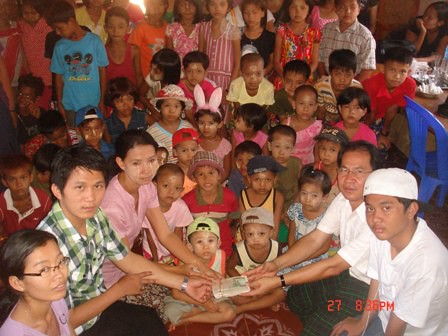
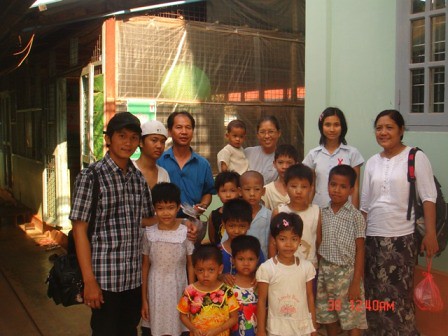
Donation to La Mine - Kod Dut Village NGO in Drop In Centre on 19-Apr-2012 (Photo: RTM).

The 'Road to Mandalay' Social Initiative in Myanmar directly organises most of the charitable assistance which it provides to the people of Myanmar. This work has been going on for a number of years. My own reports on this work in the Jan Ford's World Blog only cover the period since my first visit to Myanmar early in 2008. My reports can be found here.
This directly-organised assistance can be divided into two main areas - Medical and Educational. However, where appropriate, the 'Road to Mandalay' Social Initiative co-operates with other organisations. Unfortunately, here we tend to descend into a world of jargon and 'TLAs' (Three Letter Acronyms).

These other organisations are often called 'NGOs' (Non-Governmental Organisations) and taken together are called the 'Third Sector', as opposed to the 'Public Sector' (Government bodies) and the 'Private Sector' (businesses run for profit). Various other terms may be used to describe the 'Third Sector' but such bodies are normally charitable, voluntary and not-for-profit.

As far as help for Orphans and Vulnerable Children ('OVC') is concerned, the United Nations Childrens Fund ('UNICEF') has been involved in this field for many years (see the UNICEF website or the Wikipedia article). Since around 2003, UNICEF has provided funding to International NGOs supporting education, health, nutrition, psychological support, social inclusion programmes and training programmes in Myanmar. This work has promoted Self Help Groups ('SHG'), Management Committees ('MC'), Community Organising Groups ('COG') and People Living with HIV and AIDS initiatives ('PLHA') through local Drop In Centres ('DIC').

However, UNICEF stopped OVC support for Myanmar in April 2011. Local NGOs have managed to continue the work using existing funds or volunteer fund raising initiatives but the new academic year which started 1st June 2012 presented a particular challenge in meeting the demand for enrollment fees, stationery support and school uniforms.

Germany has a Foundation providing help for HIV affected children. In December 2011 a senior member from the Foundation visited Myanmar and Dr. Hla Tun arranged meetings with nine local NGOs involved in taking care of HIV Orphans and Vulnerable Children. As a result, the German Foundation is now supporting orphanages and community-based OVC projects in Yangon and Mon State with local assistance from the 'Road To Mandalay'.

Myittar Kyae Mone HIV/AIDS Care Centre in Kyaik Kha Mee Township, Mon State, 21-Apr-2012 (Photo: RTM).

This assistance has comprised visits by Dr. Hla Tun to various organisations on behalf of the German Foundation and other donors, first in Yangon and then in Mon State as outlined below:-

10th April 2012: Donation to the Myanmar Council of Churches, the Phoenix NGO and Kho Ner Yar NGO who are continuing the OVC project in Yangon and supporting around 170 students for the 2012/2013 academic year.

11th April 2012: Donation to Dr. Su Htar of the Thu Kha Yeik Myon Orphanage in Yangon where 78 HIV-positive children are cared for.

19th April 2012: Donation to the NGO in La Mine - Kod Dut, Mon State.

20th April 2012: Donation to the NGO in Maw La Myaing, Mon State.

21st April 2012: Donation to the NGO in Mu Don, Mon State where a Drop In Centre is operated in Kot Kha Pon Village.

21st April 2012: Donation to the Myittar Kyae Mone HIV/AIDS Care Centre in Kyaik Kha Mee Township, Mon State where Sister Martha takes care of 14 orphans, some HIV-infected and helps with nutrition of very poor children. Accommodation is also provided for HIV-infected patients registering for Anti Retroviral Treatment ('ART').

The donations described above will help around 150 OVC students in Yangon and about 400 OVC students in Mon State.

More pictures.

Monday, 18 June 2012

Donation to Syriam Nunnery, Than Lyin, Myanmar

Children, Nuns and the Nuns who look after children at the Syriam Nunnery, February 2012 (Photo: RTM).

On 28th February 2012, Dr. Hla Tun made a visit to the Syriam Nunnery located in the Southern part of Yangon. Five nuns look after around 146 students in the Monastic School, providing food, accommodation and education.

Most of the students are nuns but there are a few children. The young people have lost one or both parents or, in some cases, still have both parents who, through poverty, are unable to send the children for study.

Ethnically, Myanmar is very diverse. The children at the Syriam Nunnery are from Shan State, Yakhaing and the Irrawaddy Division.

Donations were made, on behalf of the Road to Mandalay Social Initiative, to support the Monastic School at Syriam Nunnery.

Teachers' English Refresher Course, Bagan, Myanmar

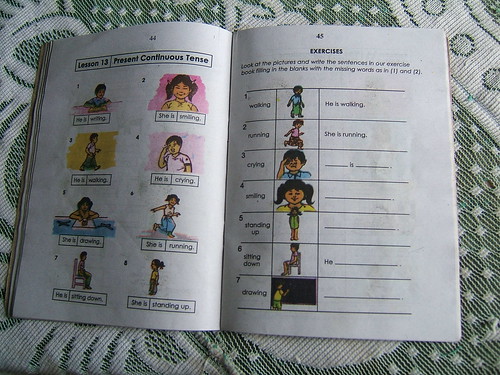
In Myanmar, many subjects at school are partly taught in English, using textbooks in English.

A lesson from a Grade 3 Reader textbook in use in Myanmar.

As part of the Road to Mandalay Social Initiative, a 3-week English Refresher Course for teachers took place in March/April 2012. The Head Monk in Bagan gave permission for classes to be held in the Monastery and for accommodation in the Monastery to be provided to the teachers attending the course.

Two English Teachers and their class of Teachers at work in the Monastery compound in Bagan, March 2012 (Photo: RTM).

19 teachers took part in the course. They came from 7 different schools in the Bagan - Kyauk Pa Daung - Mount Popa area. The course started on 26th March 2012 and finished on 11th April 2012.

Stationery Distribution at Bagan Post Primary School

January 2012

In January 2012, exercise books and pencils were distributed at Bagan Post-Primary School to 324 students. In addition, prizes were awarded to 27 Outstanding Students. The stationery and prizes had been donated by Orient Express staff and the wider 'Family' who support the RTM Social Contribution initiatives.

Afterwards, the students performed a School Concert in front of the school building for the visitors from 'Road to Mandalay'.

There are more pictures of this visit to the school (and earlier visits) in the set Bagan School, Myanmar. These pictures are included in the collection 'Educational Support in Myanmar' which you can find here. All the blog posts on educational support in Myanmar can be found here.
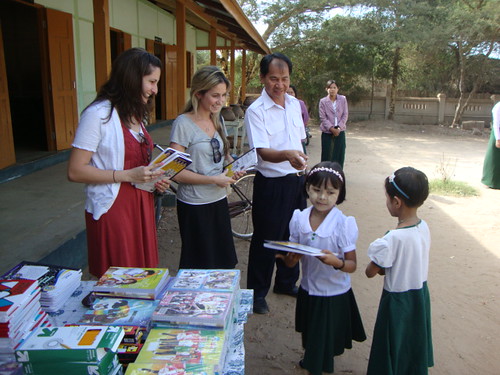
Distribution of Pens and Pencils at Wet Lu School

14th February 2012

On Tuesday, 14th February 2012, ball point pens and pencils were distributed at Wet Lu School to 290 students. This distribution was just before their final examination.

The above picture is included in the picture collection 'Educational Support in Myanmar' which you can find here. All the blog posts on educational support in Myanmar can be found here.
Friday, 15 June 2012

Free Clinic in Bagan (Part 3)

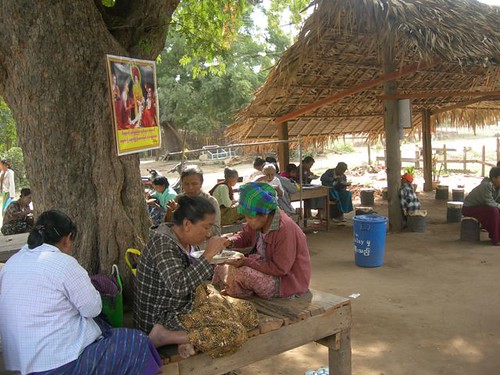
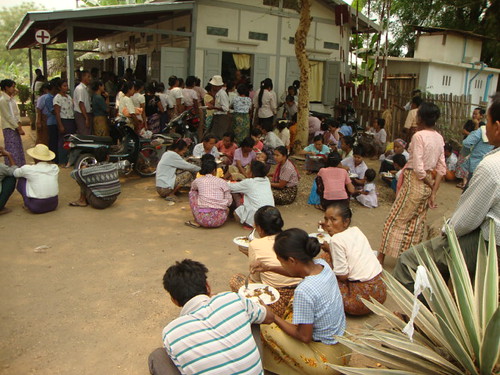
Because of long waiting times at the Free Clinic, lunch is served to waiting patients, January 2012 (Photo: RTM).
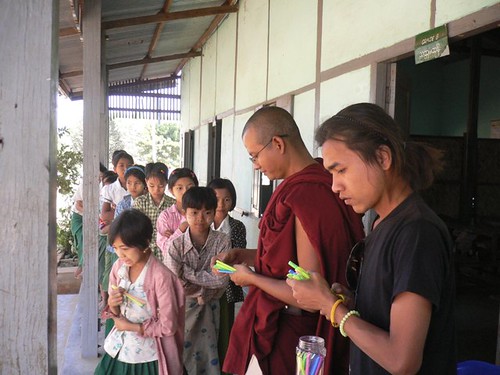
The 'Road to Mandalay' charity opened a Free Medical Clinic in Bagan on 6th August 2011. Details about the early months can be found in earlier posts: Part 1 and Part 2.

January 2012

The Clinic was open on 13 days during January, treating a total of 1,605 patients during the month. The Clinic is normally opened on Friday, Saturday and Sunday each week, with both a morning and an afternoon clinic each day.

During January, the Ananda Temple Festival is held. This lasts for 7 to 10 days and is the largest in Bagan. Schools are normally closed and thousands of worshippers accompanied by their children come from remote villages, often travelling by ox cart and staying in temporary tents. This meant that the Clinic was seeing patients from different villages during the Festival. Because of the long waiting times to see a doctor, the Clinic serves lunch to patients, where possible.


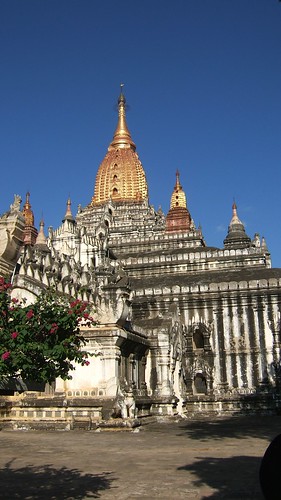
The Ananda Temple, Bagan.

February 2012

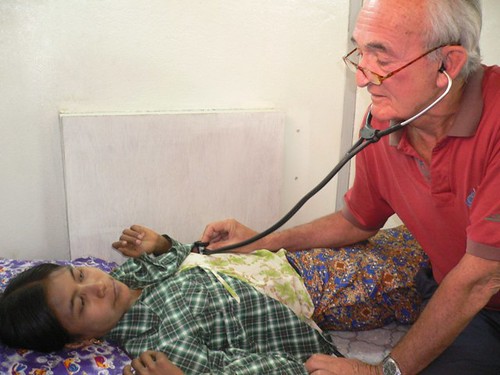
A patient with Mitral Stenosis is examined by Cardiac Surgeon Professor Doctor Daniel, February 2012 (Photo: RTM).

Cardiac Surgeon Professor Doctor Daniel from France came to the Clinic on 26th February, at the invitation of Orient Express's Managing Director Asia. He examined three cardiac patients. During February, the Clinic treated a total of 2,464 patients.

March 2012

Waiting patients having lunch with the Clinic in the background. Note the large sun awning which has been added to the front of the building (Photo: RTM).

The Clinic treated an amazing total of 4,603 patients during the month. Brief details of four of these are given below.

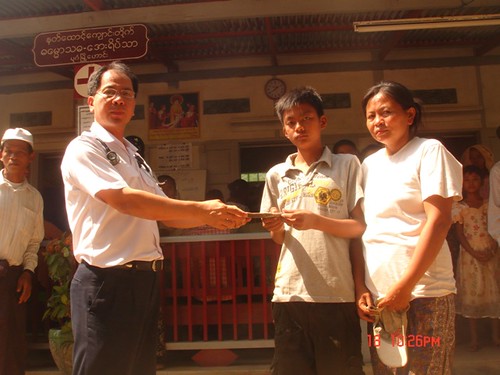
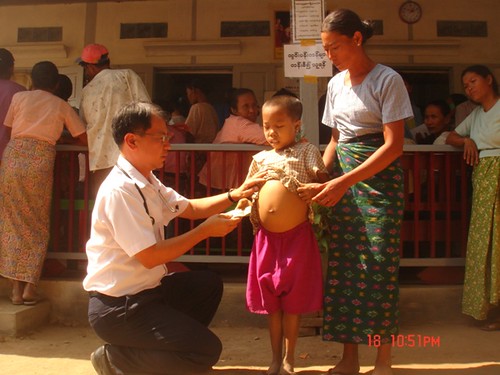
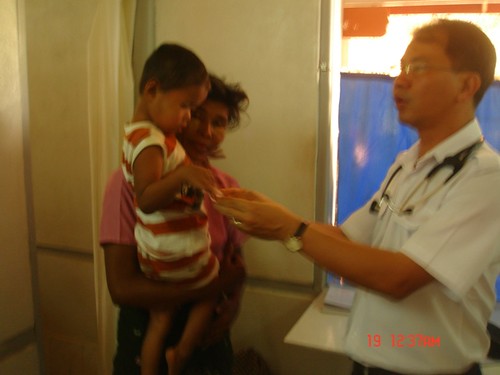
This boy of 6 has thalassemia and splenomegaly requiring a monthly blood transfusion. A donation has been received to pay for a splenectomy. After surgery, the need for blood transfusions will reduce.

This boy of 14 has mitral stenosis and will require replacement of a heart valve.

This girl of 12 has splenomegaly, requires an urgent blood transfusion, for which a donation has been received.

This boy of 5 cannot walk unaided. A donation has been received for the purchase of a walking aid.

Dr. Hla Tun admitted that he, and all the doctors and staff working at the Clinic, found the month very tiring. However, he commented that many of the patients were not from the local area of Bagan and Nyaung Oo but from areas up to 120 km distant. These patients had had to get up at 3 or 4 o'clock in the morning to travel to the Clinic in order to register from 5 o'clock onwards. The staff felt they could not turn such patients away without providing treatment.

April 2012

The Clinic was closed for two weeks during the important Water Festival and Myanmar New Year which were celebrated in April. None-the-less, a further 2,043 patients were treated during the remainder of April.

This 70 year old lady from Chaing seen during April had suffered a dislocated hip for 3 months. The Clinic provided support to allow her to go to hospital for further treatment.

At the end of April, the 'Road to Mandalay' cruise season finished, to resume on the 14th July 2012. Of course, the Clinic will continue to open, staffed by two local doctors with periodic assistance from Dr. Hla Tun.

More Photographs

Free Clinic in Bagan
Around the Bagan Free Clinic.

Treatments

The table below summarises the number of treatments per month and the total number of treatments since the clinic started.

Month Patients treated Total treatments
August 2011 355 355
September 2011 784 1,139
October 2011 1,434 2,573
November 2011 1,723 4,296
December 2011 2,013 6,309
January 2012 1,605 7,889
February 2012 2,464 10,353
March 2012 4,603 14,956
April 2012 2,043 16,999

Three New School Buildings

In October 2010, Dr. Hla Hun surveyed various sites for possible new school buildings, as described in the earlier report Surveying for new School Buildings.

In December 2010, a distribution of stationery was made at Kyoon Khing Gyi. This is described in the earlier report Stationery Distribution at Kyoon Khing Gyi School. On that visit, the foundations of a new school building at In Chaung were also photographed.

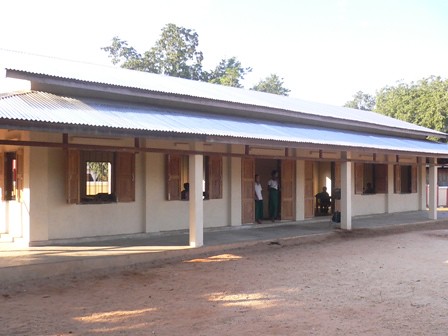
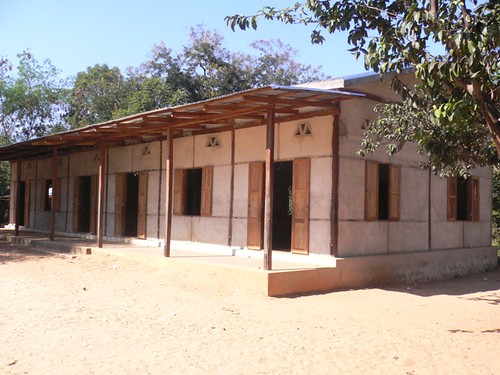
Photographs taken in January 2012 show the progress at three school sites in Bagan.

Kyaung Nyo

Kyoon Khing Gyi

In Chaung

More pictures at these locations are here.