Wednesday, 23 November 2011

Traffic Movements at Tipton Curve, 1965

There's an introduction to Tipton Curve box here.

Tipton Curve, Saturday 10th July 1965

All the signalling staff in the area have received redundancy notices and Wolverhampton Power Box is scheduled for commissioning on August 13th and 14th.

At 06:50 hours (the 24-hour clock was introduced with the summer timetables) I board the London in Platform 3 at Wolverhampton High Level. We depart on time and make a good start. We pass the new Monmore Green freight yard, with its access to both LM and GW routes, and slow for the slack at Catchem's. The remaining crossover and the Tip Siding is coming out tomorrow and most of the ballast is already removed in preparation. Spring Vales's new motor distant is 'on' but his mechanical distant is well 'off' and we roar past Stewarts and Lloyds. No freights in Spring Vale yet this morning. A burst of speed past Deepfields followed by a brief stop at Coseley station. A swift run down the bank to Bloomfield, passing under the colour light gantry, and we are soon slowing for Tipton. The signals show that the Curve box is open, and Tom is at the top of the box steps to wave in recognition.

I leave the station and take a brisk walk round to the Curve. A freight stands at the down home and the young fireman is just making his way to the box to sign the book. But the train has a long wait: by the time Hawkin Davies at Bloomfield takes him, the freight has chalked up 50 minutes standing time. The train was wired as Spring Vale but as 5288 finally blasts past, the driver mouths "Bloomfield" and he has a dozen loaded stone wagons at the front of his train. Bloomfield is advised and fortunately he has a margin to shunt the train, otherwise it would have been embarrassing. The train is shown as '55' but I think this is wrong. All the trip numbers have been altered again but trips are no longer shown in the Freight Book [Working Timetable of Freight Trains] but only in the Local Trip Notice, which I have only just got hold of. People seem to be using a mixture of old and new numbers.

We close the box and return to Tipton station by car. Tom wants his breakfast but hardly has he started to make arrangements than it's "Round the Curve". So I am presented with the key while Tom makes food arrangements. I take a gentle walk round to Tipton Curve box, being passed by 1D25. I notice the diesel had a cab door open at the rear - getting to be a habit! When I give a '1' to Bloomfield, prior to opening, he's so anxious, he immediately slaps a '4-1'. Apparently, Deepfields has turned out '37' in front of the up local! The freight makes rather painful progress towards me, 5090 tender first with a grim-faced driver and a long train of ore empties and coke empties. The up local is delayed - oh well! A telephone conversation confirms that there's nothing else about, so I close, check with Princes End that they're tested through and walk back to Tipton Station.

Before we can finish the bacon sandwiches Tom's obtained, George Lewis (at Tipton signal box) gives three rings on the station bell and tells Tom "Round the Curve". I walk out onto the platform and '23' is just going down to Bloomfield. Des leads on his brake van and he confirms that he's going round the curve. The 350 h.p. diesel grinds past - no tail lamp - oh well.

Tom and I walk round the Curve and find that '23' is the only reason for our curtailed refreshments. In due course, '23' comes round from Bloomfield - D3089, cab leading, very dirty and still carrying the old lion-astride-a-mangle-wheel motif (no headlamp, of course), 5 minerals, a loaded sludge tender, 1 mineral and the B.R. brake. The driver stops a bit sharp and the brake van, which has been cut loose by Des working from the van footboard, stops well outside the home signal. The rest of the train is drawn forward and reversed into the Tip Siding. All the mineral wagons are empty, apparently, and we have no idea what they are for. "Engine and Brake Princes End then back to Bloomfield" calls Des. I get the road and pull off, deliberately pulling the starter before the home. Tipton Curve is unusual in lacking the sophistication of sequential locking. As the train pulls rapidly away, Tom says "I think I'll have a ride to Princes End". He dashes down the steps and leaps onto the speeding brake van, much to the amusement of Des.

After '23' has departed, I forget to 'knock out' [give 'Train out of Section'] to Bloomfield, who comes on the phone rather concerned and very confused. When I 'clear back', he offers a '4-1' and I realise he's got '55' which he wants to clear before the express. 'T23' returns from Princes End and comes to a stand at our home because Bloomfield won't take the E&B. '55' storms past with his usual train from Ettingshall Road, after pausing at a very poor branch starter at Bloomfield. Bloomfield manipulates the starter for some time before putting it back and pulling off up the main - he's apparently in some trouble, one way and another. He's already stopped most down trains at his home, for some reason. At last, Bloomfield accepts '23' and he scoots off. As soon as Bloomfield gives 'Train Out Of Section', we close the box.

A copy of the Train Register enties is below:-

DOWN

UP

For variety, we walk round to Bloomfield Junction, rather than back to Tipton. '23' has finished whatever he was doing there and is ready to return to Watery Lane, so we 'blag' a lift. On arrival, Watery Lane puts us 'inside' on the Up. There's a large bridge girder on wagons stabled there, awaiting installation (I don't know where) so we take the opportunity to clamber over it, examining its construction.

Then, it's a short walk to a friendly reception at Tipton Station box, where I spend a few hours working the box. But that's another story.

[Text and Train Register entries added 5-Jan-2012].

Tuesday, 22 November 2011

Death of the Dudley Line

I started to write this article back in June 1964, using a typewriter. For some reason, I never finished it but below I reproduce what exists, without change and under the original title.

Dudley is to lose its final rail services. Two short years after the closure of the Wolverhampton (Low Level) to Dudley line, the remaining services are withdrawn. The Dudley to Birmingham (Snow Hill) finishes on Saturday June 13th 1964; the Walsall service, originally to close on the same day, is now reprieved for a month. And so, a round trip is arranged to tour the sentenced lines and on Wednesday June 10th I set out, bright and early, with the following itinerary carefully arranged:-

Station arr. dep.
Wolverhampton H.L. ... 5.58 am
Dudleyport 6.11-1/2 6.34-1/2
Dudley 6.39 6.44
Walsall 7.00 7.14
Dudley 7.31 7.50
Dudleyport 7.53 8.08
Dudley 8.11-1/2 9.00
Birmingham S.H. 9.25 9.55
Dudleyport 10.16 10.20-1/2
and hence to Wolverhampton

Wolverhampton (High Level) station was in a state of quiet disorder, owing to the ensuing Modernisation. Alrteady boxes No. 1 and No. 3 had disappeared and Platform 1 had just been brought back into use after a confusing period when down trains used platform 2 and up trains platform 3. The 5.58 local was in platform 2 and, after 1M16 type 4 hauled and running early pulled up in 3, we got the road and left for Dudleyport. The run was uneventful but the new concrete cable troughing and the well-advanced Track Section Cabins at Deepfields, Bloomfield's down starter and Tipton point to the changes overtaking the main line.

The friendly booking clerk at Dudleyport seemed quite unruffled at supplying a return Walsall, a return Snow Hill and three returns to Dudley at 6.15 in the morning and so I was soon down the Low Level, awaiting the first connection. The diesel twin arrived on time from Walsall and rumbled off up the 1 in 39, past Sedgeley Jn. where Quiyum was on duty. The driver kept up a reasonable speed over the junctions, past Conygree Siding, onto the straight section which crosses the New Road and up to Dudley East's home, which remained resolutely on until we had come to a stand, when the subsidiary aspect cleared. Once in the platform, the train quickly emptied of its few passengers and drew down to Dudley South, to be crossed to the up side and Platform 4.

6.44 and the train left for the quick trip to Walsall. We run down to Dudleyport at a cracking pace, then gingerly descend through the cuttings, past the fairy-tale box at Horsley Fields which hides coyly in the recess in the cutting and into Great Bridge, an utterly squalid collection of huts hiding at the rear of a dirt platform. In the yard, the diesel-electric shunter positions steel coil wagons, which are in circuit working to Great Bridge and are another sign of the present attitudes to bulk freightage and the like. Fully fitted wagons too! The train starts away, past the goods shed and past Eagle Crossing. A bus waits reluctantly for us to pass and the hand-worked crossing gates hang at an angle, adding to the general appearance of decrepitude which is only offset by the new paintwork of the box. We rattle past a few wagons left on the Long Siding and pass Gols Hill Crossing. The box was burnt down a few months ago but has been rebuilt in the original (L.N.W.) pattern and repainted. A pity this course was not adopted at Tipton Curve when the Pigeon Loft was erected!

As we approach Wednesbury, we enter a thick pall of smoke from the neighbouring industries. On the left, the Princes End line can be seen rising uphill and disappearing under the roadbridge near the Ocker Hill cooling towers. T55, with a Class 8 at the head end, is just starting up the bank, with the diesel-electric shunter from Wednesbury giving assistance. Wednesbury station already looks derelict. Part of the station is already out of use, with doors boarded up and windows smashed. After a brief pause, the train starts away and the signalman in No. 2 rises from his register to give "section". The train accelerates through the cutting, past No. 2's starter, still an L.N.W. lower quadrant but now shored up by a sleeper. The line levels out past the tiny box at Mestycroft and we speed on towards Bescot Curve. Just past the junction, the line is shrouded by the massive columns of a flyover under construction, to take the M6 southwards. We soon rattle over the crossings at Pleck, where the box now stands side by side with the shell of the massive new Walsall power box.

Walsall environs are busy at 7.00 am. Two light engines stand by the P. Way Frame, awaiting duty, a Brit. pauses with stock in the carriage sidings and a 2-6-0 shunts the Midland yard. Nearer the station, a diesel shunter groans in the down sidings and another 2-6-0 contemplates a parcels turn. We pull under the massive gantry at No. 2 and stop in platform one. A diesel parcels unit draws out of the adjacent bay and then our twinset pulls out to reach platform 2. The over-anxious signalman offers a '3-1' then, realsing his mistake, cancels and offers stock. Meanwhile, a Birmingham multiple unit rolls into No. 4 and quite a crowd of passengers entrain. But the Dudley train, with so little time left, commands a sizeable patronage and by the time I board for the return journey, it is uncomfortably crowded.

And there, I'm afraid, the article stops.

Riding the Brake

These are the notes I made at the time of a brake van ride from Tipton Curve to Wednesbury and back. There's more about Tipton Curve here and a description of Princes End here.

Saturday 12th December 1964

It's usually a fairly quiet day for the 'Porter Bobby' at Tipton Curve Junction, but today I am lucky enough to arrange a trip to see '23' shunt Austin's. '61' used to come down as a '2-2-3' ('Train requiring to Work in Section') and spend an hour working at the siding but the work is now done by '23'. The Second Man for the diesel shunter arrives at Tipton after 10.0 a.m. and, waiting at Tipton Station, I watch '23' grind away up the bank to Bloomfield with Bolsters and Open Wagons. This is the cue for Tom and I to get round 'The Curve' and wait for '23'.

After 1G05 and 1G06 have passed on the Up Main, '23' heads round the sharp curve from Bloomfield with the 350 h.p. diesel electric, cab leading, two All-Steel Open Wagons and a S.R. 20-ton Brake. The train is brought almost to a stand and then allowed forward, so that the writer can make a rather undignified leap onto the footboard of the brake van, as the train accelerates away for Princes End.

The brake van is provided with two padded seats and duckets, diagonally opposite one another. I am soom installed in one of them, facing the friendly Guard, Des Jones ('Jonah'). The permanent furniture is completed by the brakewheel and the diminuitive stove. There is also a metal locker which doubles as a footrest and a shunting pole is propped in one corner.

We are soon approaching Princes End: the crossing gates open as we near and the 'pegs' come off. The train passes the L.& N. W. lower quadrant Starter and we commence the descent to Wednesbury.

The Guard comments favourably on his brake, S56240 - "It's nice and snug, rides well, brakes evenly and got lamp brackets on the wall" (the last feature prevents accidents to spare lamps when the van is jerked). He decides to keep it as the 'Residential Brake'.

We are coming down the bank past Wednesbury Number 1's fixed distant. The Guard comments on what a "wicked bank" it is to descend with a load on. He recalls seeing a 'Class 8' and a train of coke run out of control, right through Wednesbury station, whistle 'popping', finally stopping halfway up the bank to Mestycroft with the coupled wheels locked. The engine ended up with half inch flats on the tyres and a frightening 'rattle-thump-rattle-thump" as he moved!

We pass through the so-called Princes End Tunnel, an elongated road bridge, and emerge in the shadow of a cooling tower at Ocker Hill Power Station. Our train draws up to Wednesbury's Outer Home (or is it Home 1?) which remains stubbornly 'on'. Des points out the sidings.

On the left, protected by the signal at which we're standing, are Bagnall's Sidings. This is a steel stockyard, with three curving sidings (2 loaded, 1 empty) populated by BBCs. The freight is steel bars.

On the right are the sidings to Ocker Hill Power Station. The facing lead from near the junction fans, after a short neck, into six roads. At the other end of the yard these lines, plus a short Cripple Siding, converge into a single line which splits up into the Power Station. Number 1 siding (nearest to us) in the Empty Road, the remainder are Inwards Sidings, crammed with loads of slack. As we watch, a 'Class 8', facing the Power Station, backs from the bottleneck onto a train of Empties and subsequently sets back onto his Brake Van waiting in the Neck. Des confirms from Chris, the Bushbury Guard with the empties, that it's a train of 'Pools' for Littleton's and he admires the neatness of the move, which he has not seen before. He also correctly surmises that the train will set back onto the Down Line, in front of us, since the signal to leave the Neck only reads to the Down. Setting back onto the Up, although sometimes done, requires a hand signal.

We patiently wait while the train of empties backs clear of the connection to the Power Station and sets off bravely up the bank to Princes End. In a few minutes, the engine blasts past, working hard, slipping momentarily just as he draws level. While I watch the wagons rumble by, there is an awesome jerk and we are on the move.

'23' stops just short of the 'Western' bridge (where the Wolverhampton Low Level to Birmingham Snow Hill main line crosses over the South Stafford line). The handbrake is partially screwed down, to hold the Brake Van as the engine and two wagons are uncoupled and draw away, clear of the connections to the Down Sidings. The Wednesbury Shunters crowd round and uncouple the two wagons from the diesel. The diesel gives the wagons a 'shove' and then stands by the signal box as the wagons roll sedately into the sidings, rumble like thunder passing under the bridge and contact sharply with the wagons we have come to pick up which are standing on the 'Front' road. Throughout these operations, the Wednesbury shunt engine (a 'Class 8') stands obediently clear on another siding. Our diesel returns and, without much ceremony, buffers up to the Brake (and its passenger). Once attached, the engine and brake are drawn forward, clear of the points, and propelled over the rough trackwork onto our train. Our train is now twelve wagons strong: the original two wagons loaded with spoil and lumps of iron now augmented by ten 16-ton mineral wagons. The diesel draws the whole collection into the Down platform and the Guard calls for "Full Brake". The engine is unhitched and draws away to Wednesbury Number 2 box, where he is turned onto the Middle Road. The diesel creeps past his train as a long freight rolls through the station on the Up and out on the Great Bridge Line. Our engine is soon coupled onto the train and draws out of the station, holding up the road traffic waiting at the level crossing a minute longer.

We head back up the bank to Princes End. On emerging from the tunnel, I am amazed to see an express approaching from the other direction! It turns out to be the S.L.S. Special 1Z65, touring the Midlands with the last two 'Super Ds' in service. 49340 and 49361 are impeccably turned out and both cabs sport the yellow cab diagonals (not to work under overhead lines south of Crewe). Even the coaching stock, which sprouts heads and arms along its length, is clean. The passenger train slows as it enters the tunnel and the engines whistle in chorus to signal their approach. Nostalgia apart, the train was not shown in the 'W1' Weekly Notices or the Supplement so it had earlier been brought to a stand at Watery Lane because nobody knew what it was! We proceed about our mundane busines and are soon drawing up to Princes End crossing, with assistance from the van brake. The Secondman goes to 'Sign the Book' and the Guard goes to explain what he's about. This gives me about ten minutes of quiet in the van to contemplate the lonely life of a freight guard then the train draws over the crossing and stops with the Brake opposite the box. The van brake goes on hard and the engine and wagons draw away with the Annett's Key required to get into Austin's. Within a quarter of an hour, the engine is back and coupled up, the Annett's Key is returned to the box and we are whining back to Tipton Curve.

There's time to complete the Guard's Journal:

Wednesbury arr. 11.15 (that is, commence shunting)
det. 2 att. 12 (note that the two all-steel count twice)
Wednesbury dep. 11.25
P. End arr. 11.50 det. 12
P. End dep. 12.5

When we get back to Tipton Curve, Tom keeps the home signal 'on', to allow me to drop off and then the engine, now facing Tipton, rumbles back to Owen Street with his Southern Region Brake. Incidentally, the '4-armer' home signal was recently moved further away from the junction as, in its original position, it was starting to slip down the embankment, presumably due to the underground fire in the embankment.

The 'Express & Star' carried this report of the S.L.S. Special.

Monday, 21 November 2011

Traffic Movements at Deepfields, 1964 (Part 2)

There's an introduction to Deepfields box (with a signalling diagram) here and more detail here.

Deepfields, Saturday 24th October 1964

It's a cold morning with frost on the ground as Deepfields is opened up. We exchange the '5-5-5' with Bloomfield and Spring Vale and then try to replace the signals. Both the Up Distant Weight Bars are frozen 'off': Down Home 2 and Down Starter signals are also frozen off. The levers are banged around for a bit and the slack adjusters are let out but it's to no avail. So we walk to Down Home 2 and physically pull the weight bar 'on'. The Down Starter is freed-up by pulling on the signal wire at a number of places. Back in the box, the Up Inner Distant is restored by working the lever a few more times and then, with the railway brought to a standstill, we start work.

The Down Local is accepted normally but we now have a Block Failure on the Up to Spring Vale since, without our distants being proved 'on', we're unable to give a 'Line Clear'. We also have to 'Double Block' on the Up because our distant may not be correctly 'on' to warn an approaching driver (this is a rather technical point because, without a 'Line Clear' to Spring Vale to release his Up Starter, neither of our Up Distant signals should be 'off', even if the associated weight bars are 'off'. Enos, the signalman at Spring Vale, warns the Up Crewe past his starter and the driver steams past, trying to recover from his stop at Spring Vale. His train is five coaches, a 6-wheel van and the Palethorpes' van.

37's engine, rather late, coasts down to 'The Vale' to pick up his train - 4837 chimney-leading. Within 40 minutes, he is ready with his train and gingerly approaching our Up Loop Home tender first. We have to work the levers to-and-fro a few times to get the signal detectors correctly lined up to enable the signal arm to be cleared. His train is coke, coal and limestone empties (including one fitted hopper wagon marked 'HOUSE CONCENTRATION COAL' - an interesting title.

There is one Excursion today - 1Z66 to Blackpool. A 'Black 5' heads this train away from a brief stop at Coseley station and, on this cold day, I almost feel sorry for the passengers!. However, as encouragement, the sun comes out and the frost clears, although the day is still cool.

The Outer Distant on the Up can now be persuaded to go back 'on' (you can't pull it 'off', but that's hardly unusual) and so Enos is informed that normal working can be resumed.The next train is stopped at Spring Vale to pick up the official 'BLOCK RESTORATION' form for us and the train coasts towards us, a 'Type 4' with about 12 on. Tom is 'on the floor' to catch the note but the driver lets go prematurely and the form flutters away in a gentle breeze, to be retrieved by Tom. Each coach has its complement of passengers leaning out, curious at this second virtual stop in half a mile.

Another 'Type 4' heads the 'Stockport' downhill with a 'BG' and two rattling vans, passing 92111 light engine, scurrying uphill to collect the Albion tanks. By now, '55' is ready and he approaches up the Loop for Bescot. Thanks to the sun, the signal detectors do not foul on this occasion and 8007 blasts up the bank tender first with a long train of mixed empties. '61' is offered on the Down at the same time as the Up diesel parcels unit. Wise from last week, we loose the parcels only as far a as Coseley station platform which would allow us to cross '61' onto the Loop. But when the freight train hoves into view, it looks suspiciously short and Spring Vale refuses it down the Loop. He then informs us that it's actually '41' for Bushbury so all our planning was to no avail. Enos accepts the freight 'Under the Warning' down the Main, allowing me to loose the freight past the Home and put out a green flag to indicate he's 'Under the Warning'. Immediately, Spring Vale sends the '3-3-5' (now accepted under the 'Clear'. So as not to confuse the driver, I leave the flag out for a moment and wait for the cab to draw level, when I give the 'Rightaway' (hand held vertically and wrist turned left and right a few times rapidly). But the train stops and the driver starts talking animatedly. It seems that he was hit in the face by a branch of a tree overhanging the Down Main between Deepfields station and the Bridge. The freight then departs with half a dozen on.

We decide to leave the Up Starter 'on' against the Parcels, so that they will come to the Starter Telephone and we can get them to raise the station staff to carry out an investigation (the station staff never answer the box-to-box telephone as previously stated). Bloomfield has already loosed a train of Empty Stock down to his starter and he waits for the trainmen to come on his signal telephone, so that he can advise them. So nothing moves and two boxes wait for the phone. Eventually, our Parcels comes on the 'phone and the Guard agrees to get the station staff on the Box-to-Box 'phone. My faith in Guards is rather shaken when he says "Who are you?", apparently not knowing what box he's speaking to. The Parcels is allowed to proceed and the down Empty Stock is 'taken on'. Not being sure whether the Empty Stock was warned by Bloomfield, I loose him down to the box and stop him with a red 'un. The Driver and Guard are sitting in the front cab with a panoramic view of the track. "Seen any overhanging branches?" we enquire. The Guard is definite "Nothing at all" so we let the train proceed. Next, the coloured guard from Coseley station comes on the 'phone "I can see nothing at all: instruct the driver to proceed cautiously" (I don't know what driver, the Parcels was halfway to Birmingham by this time).

But Tom and I are not satisfied. Even a small branch can be quite lethal when hit at speed and the offending branch may not be obvious: it could have been knocked to one side by the last train and could swing back again. A number of morbid jokes circulate about Diesel Multiple Units speeding through Wolverhampton headed north with a decapitated driver and the Deadman's Handle jammed down! So Tom decides that we should close the box and have a walk up to see for ourselves. We didn't find anything, though.

Traffic Movements at Deepfields, 1964 (Part 1)

There's an introduction to Deepfields box (with a signalling diagram) here and more detail here.

Deepfields, Saturday 17th October 1964

Back to Deepfields and it's clear this box cannot survive for much longer. The satellite interlocking Relay Room was structurally complete some months ago but now Point Machines are being fitted to the Loop points and a two-lever Ground Frame is being erected by outside contractors to control the crossover road. However, we open up as normal and take on our first train - the Up Crewe. The Sulzer-hauled train drifts by with the driver leaning out, interested in the activity, a 5-coach rake with the Palethorpes' vans which are now serviced at Birmingham. I notice the rear cab door is swinging open so we send 'Stop and Examine' to Bloomfield.

The train stops at Coseley & Deepfields station and, apparently, the door is shut there. When stopped at Bloomfield, the Guard is irate - "Why didn't yer stop us at Coseley?". But Coseley station has a well-observed tradition of not answering the telephone. Until recently, the question of a diesel locomotive door open and whether this required the use of the 'Stop and Examine' was in some doubt. My friend Tom raised this question with the Signalmans' Inspectors and, because of the danger of a member of the engine crew having fallen out, a memorandum was issued confirming that the use of the '7' was correct.

After this brief excitement, we settle down to the day's work. About three gangs of men are working outside, each with their attendant 'Look Out' and it gets quite noisy. Without a word, the signal wire to the Down Line Detonator Machine is severed with two sharp hammer blows. Until we confirm just what has been disconnected, Tom and I discuss which of the Down signals will fail to operate! The gang then set about re-siting a chain wheel and re-connecting the ‘shot machine’. During this work, they inadvertently slip the chain off the wheel on lever 3 so that the next time I try to pull off, the lever jams hard half-way through the stroke. After I complain, the men run around, putting things right.

At 9.7 a.m., ‘55’ is offered up the Loop, followed by the diesel parcels unit up the Main. A freight for ‘The Vale’ is approaching on the Down and here we make an error of judgement. We pull off for the Up Parcels, but he stops for 20 minutes in the platform at Coseley dealing with parcels traffic. During this time, ‘55’ is held in the Loop and the down freight stands main line, waiting for the Loop to clear. Eventually, we send the down freight on the main line to Spring Vale, Austerity 90377 hauling lime, sintered iron ore and ingots loaded on BBCs. Spring Vale gets a bit confused by the change, offers him forward as a ‘4’ and pulls his ”back ‘uns”! Eventually, the parcels unit clears and ‘55’ starts away, a ‘Class 8’ tender-first with empties, lime wagons and oil tanks.

The Barnt Green – Blackpool special 1T06 roars past on the Down with ‘Black 5’ 45006 bound for the bright lights! The Stockport Parcels coasts by with a ‘Type 4’, two ‘BG’ and a 4-wheel van. A ‘Class 9’ rattles past uphill, going to work the Albion tanks. He whistles imperiously at the gangs working near the line.

‘T37’ is reported ‘off the road’ at Bescot but ‘61’ comes down and rumbles into the loop, in the teeth of the following Down Manchester. There are two more trains to come ‘off the top’ at Tipton but Bloomfield wants to close. He agrees to wait for the first train (‘80’, double-braked) but decides that the second must ‘take its luck’. We keep Deepfields open so that we can turn ‘80’ down the Loop. Then we let Bloomfield close and afterwards close ourselves.

After we close, the two o’clock down rushes past behind a ‘Sulzer’. The 5-coach Up express is being handled by a ‘Type 4’ which rushes past at about 60 m.p.h., horn sounding, then brakes hard for the 15 m.p.h. slack on the other side of Deepfields station. A freight (‘90’?) clanks down behind a ‘Black 5’, double braked with various open wagons and oil tanks. Another ‘Class 9’ hurries past with its fully-fitted load of Gulf Oil tanks for Albion. Finally, I wonder who was the joker who wrote in the dirt on a ‘Class 8’ tender “H.M.S. ROCKER”?

Back to Brewood

Friday, 4th November 2011

Breakfast at the Oriental.

After a comfortable night at the Oriental Hotel in Bangkok, all that remained was the long non-stop flight back to Heathrow and the road trip back home. Still in a lazy mood, I enjoyed a leisurely breakfast in my room before making another tour of the hotel and grounds. I completed my packing and made my way to reception at the agreed time for transfer to the airport. After 'goodbyes' to the staff, I boarded the hotel limousine for the journey back to the airport. Check-in and security were quickly performed, allowing me to make the long walk to the EVA Air lounge to await the inbound aircraft from Taipei. We boarded just a few minutes late on schedule and made an uneventful journey back to London Heathrow. A fairly lengthy walk took me to the immigration hall now operated by 'UK Borders'.

I now have a new-style 'Biometric' passport (the old one had become full with all my travels!) so, for the first time, I was able to use the new, automated passport checking facility. You lay the open passport on a reader whilst the picture from an adjacent camera is analysed automatically. A television screen showed a rather dim black and white view of what the camera could see. Looking at the screen, correct identification didn't seem very likely to me but, after a few seconds, the equipment was apparently satisfied and the gates opened to allow me through.

Another walk took me to the large baggage hall and I eventually managed to negotiate the hoardes of bewildered or irritated passengers to find the correct carousel where I spotted my checked-in bag already circulating. With some difficulty, I managed to insert myself through the mass of waiting passengers and heave the case from the moving belt.

A short walk through Customs brought me to the arrivals hall where I quickly spotted my driver. A crowded lift and another walk took us to the car park and, within a few minutes, we were on the way back to Brewood.

My journeys abroad always give me plenty to think about but this trip, in particular, has given me lots to ponder. Visits to five schools, three orphanages and the opening of a Free Clinic presented vivid images which will remain with me for a long time. As always, I think myself very privileged to have had these opportunities to learn more of our world and its people.

Friday, 18 November 2011

The Oriental Hotel, Bangkok

Thursday, 3rd November 2011

The Strand provided breakfast in my room promptly and as ordered so I was ready when Nay Lin arrived to transfer me to Yangon Airport for my flight to Bangkok.

Breakfast at the Strand Hotel, Yangon.

Traffic seemed particularly heavy on the way out to the airport, so the driver deemed it wise to make a detour using some fairly basic roads. We arrived at the International Terminal in good time and I said goodbye to my guide and driver. Check-in for the Thai morning flight to Bangkok was painless and Passport Control only took a few minutes. Soon I was relaxing in the small but comfortable Thai lounge until my flight (TG0304) was called.

On the flight to Bangkok, they served a very adequate breakfast. I was in a central aisle seat on this trip, so I was unable to see any signs of the flooding as we came in to land but the morning Thai English-language newspaper I'd been reading on the journey had extensive coverage of what had become a major emergency for Thailand. One of the newspaper maps suggested that floodwater had extended to a point near the boundary of the airport we were to use but we landed without incident, taxied to the stand and the air bridge was quickly attached. Since I was to spend Thursday night at the Oriental Hotel in Bangkok, I had to retrieve my large suitcase from the baggage carousel but this didn't take long and, as I made my way into the Arrival Hall, I quickly spotted the Oriental representative in his distinctive orange jacket.

He telephoned to the driver of the hotel limousine and I was soon seated in the comfortable rear of a BMW saloon. The Oriental chauffeurs always wear a lightweight white suit with white peaked cap. More importantly, they are professional drivers so the journey is invariably smooth and safe. We used the toll road to the city, passing two toll stations where the first took 25 Baht and the second 45 Baht. The car was fitted with the 'Express Toll' equipment so it was only necessary to slow on the approach to each toll gate until the barrier lifted automatically.

When we were a few minutes from the hotel, I was particularly impressed when the driver turned slightly and asked "May I make contact with the Hotel, Madam?" before he telephoned his arrival time to the hotel. This ensures that when the car pulls up at the hotel, not only is the Door Man and his staff of Bell-Boys in attendance, but there are at least three Reception Staff lined up to welcome the guest by name and present the traditional Thai floral tribute. I was amused when the Receptionist explained that I'd been booked into a room not quite as good as last time (which I knew). They offered a half-price upgrade to the suite I'd had before which I accepted. I was then conducted to the Old Building overlooking the river and the Noel Coward Suite which I'd had on my previous visit.

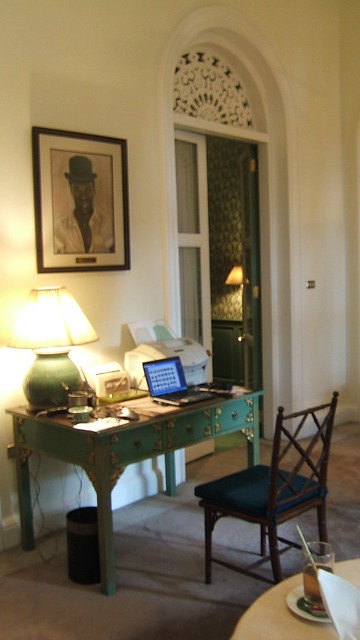
I'd been out-of-touch since last being able to use the internet at Mount Popa Resort, so I signed-up for 1-days internet usage. Using Wi-Fi on my notebook computer, I was getting speeds about 50% faster than back home, so I took the opportunity to upload some of my pictures, in addition to dealing with e-mails and writing to Blogger.

The Noel Coward Suite, Oriental Hotel, Bangkok. The writing desk in the sitting room shown set up for using the notebook computer. The double doors lead to the bedroom.

Nprmally, I'd go out to explore Bangkok. I've not yet travelled on the overhead electrified railway serving the airport and I'd considered trying it out. But I was still feeling tired so the attractions of staying in the hotel proved too great. I summoned the energy to explore the hotel, going to the Riverside Terrace which is a favourite spot for meals. But part of the terrace was closed and builders were in occupation. A row of sandbags had been placed on the river side of the terrace. The small garden which links the original hotel building to the terrace was also partly closed and criss-crossed by fire hoses. In addition, the windows and doors of the original building had been boarded-up for a few feet above the ground and more sandbags were in evidence. It appeared that the river had, at some stage, risen above its retaining walls but, when I was there, things were reverting to normal.

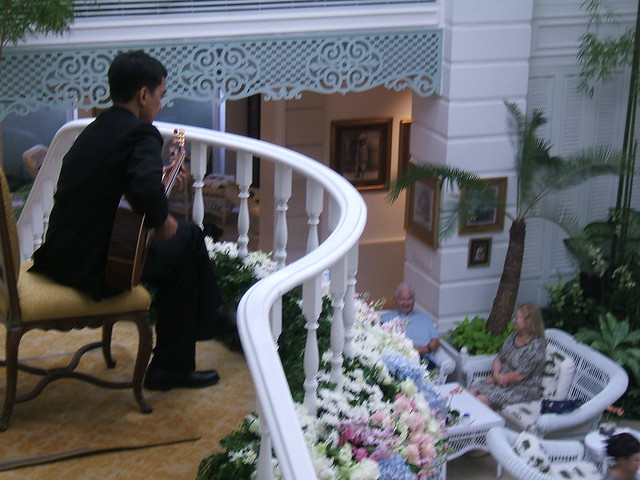
The public part of the original hotel building is a palm court style tea room, painted white where (like the Strand in Yangon) you can take afternoon tea, so I decided that, lacking the energy to explore Bangkok, afternoon tea would be suitably relaxing. Access to the Authors' Suites on the first floor is via two staircases provided with a small balcony which lead up from the tea room. Whilst afternoon tea is being served, an excellent acoustic guitarist plays gentle music from this balcony.

The guitarist entertains the guests taking afternoon tea from the balcony.

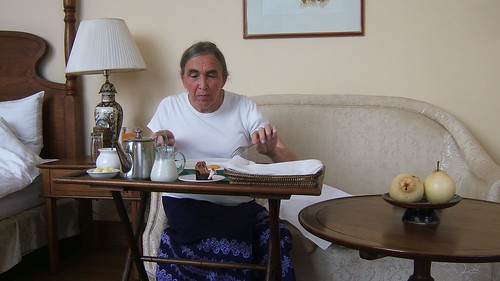
I passed an equally relaxing evening in my suite before completing my packing ready for my trip home the next day. I ordered breakfast in my room (for the second day running), retired to the comfortable bed and slept soundly.

Wednesday, 16 November 2011

Leaving the 'Road to Mandalay'

Wednesday, 2nd November 2011

It's always with some sadness that I leave the 'Road to Mandalay'. When I made my first visit to Myanmar and the 'Road to Mandalay' in March 2008 as part of my 'Round the World 5' tour (see posts), I little realised what a powerful effect Myanmar would have on me.

As always, I'd had a wonderful (and tiring) time on this latest trip. It had been my fifth trip to Burma and my fourth cruise on the 'Road to Mandalay' (it would have been my fifth cruise had not Cyclone Nargis severely damaged the ship). But it was time to leave the sybaritic pleasures of 'Road to Mandalay', say farewell to my friends on the ship and board the coach for Mandalay Airport.

The coach was scheduled to leave at 7.0 a.m. and all the passengers made it on time. We wound our way out of Shwe Kyet Yet, past the now-familiar sights of life by the roadside and took a recently-completed section of dual-carriageway which made our transfer to the airport fairly painless.

'Road to Mandalay' staff checked in baggage and obtained our boarding passes for us, so we only had to make our way through security to the departure hall overlooking the apron. A number of flights were scheduled to leave fairly close together so we had a little wait before boarding a bus for the short trip to our aircraft. A simple snack meal was served on the non-stop journey to Yangon which took an hour and a bit.

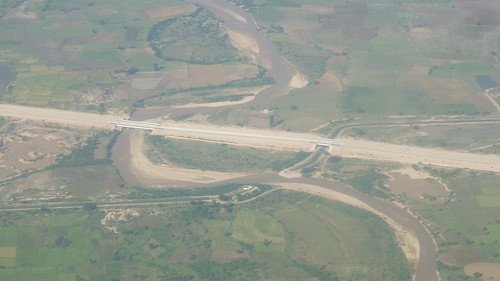
Our route to Yangon took us over this new dual carriageway road.

Our turbo-prop aircraft made a straight-in approach at Yangon and had soon parked on the apron. As usual, a bus ferried us the short distance to the Domestic Terminal where I quickly spotted my guide, Nay Lin. He despatched a man with my luggage receipt to retrieve my case and we were soon in the car and on our way into Yangon. Time was allowed for sight-seeing so I picked the places I'd not already been to.

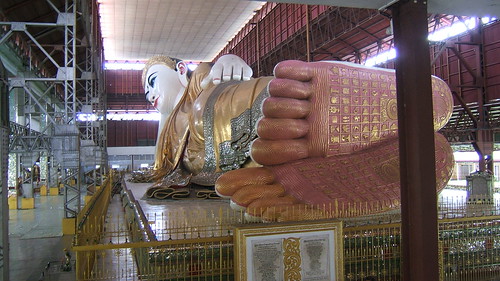
Yangon's huge Reclining Buddha in its massive 'shed'.

First stop was Yangon's famous Reclining Buddha. It's big and it's impressive but what fascinated me was the huge steel-framed building which protects the image from the elements. The heavily-braced industrial structure looks as if it should hold a rolling mill, rather than a delicately-modelled Buddha image.

The 'Royal Barge' in Karaweik Park.

Next stop was Karaweik Park. We had to pay at the gate and then the car drove to a decking-covered viewpoint at the side of a lake. The location had a commanding view of what appeared to be a huge 'Royal Barge' further along the shore. In fact, the barge is actually made of concrete and is built on land but it's spledidly modelled to resemble the type of Royal Barge I'd seen around Lake Inle on a previous visit.

We then made our way to busy Pyay Road and the National Museum which I'd previously seen from the outside but not visited. The National Museum is a large, modern building spread out over a number of floors so, by the time we'd looked at all the exhibits, I was getting rather tired. There is some labelling of the items in English but there is, apparently, no English guide book. Since photography is prohibited, I've no record of the visit, which is a shame because there were some very interesting artefacts on display covering all aspects of Burmese history, culture and life. There weren't many visitors in the museum and only a couple of those were European.

There was a large, privately-owned souvenir shop on the ground floor. I spent some time looking at the books in English and finally purchased a 1995 reprint of 'A Tour in Burma in March and April 1892'. This is a description of religious architecture in Burma by F. O. Oertel, complete with 40 original photographic plates. Although sold as new, the copy was rather battered and I suspect had been waiting for a purchaser for some time!

I was now quite ready to be delivered to my Hotel. As our car passed the Peoples' Park, I spotted a couple of interesting displays. There was a small steel-hulled gunboat, looking rather curious set on blocks above ground level, and a large tank locomotive, painted green and with the Walschaerts motion finished with aluminium paint. I made a mental note to try to have a better look next time.

The usual warm welcome awaited me at the Strand Hotel and, this time, I was in room 103, a front corner site, overlooking the Australian Embassy.

Room 103 at the Strand Hotel

I'd had thoughts of making another journey on Yangon's Circle Line, as I'd first done in 2008 (see post), but after the early start to the day and the exercise I'd already had, I decided I was too tired so I settled instead for Afternoon Tea downstairs. Later, I made another fruitless attempt to use the internet and then, having booked breakfast in my room for the next morning, retired and slept soundly.

Thursday, 3 November 2011

Three Orphanages

Tuesday, 1st November 2011

The programme for guests allowed for viewing the Offering of Alms at the local monastery followed by a river trip to Mingun in a motor boat. After lunch, guests were offered a trip to Mandalay City or Sagaing, depending upon the group they were travelling with. I attended the Offering of Alms to the monks, because I always find this inspiring but afterwards Doctor Hla Tun had arranged a different programme for me for the rest of the day. Once again, we were pleased that Captain Myo Lwin was able to come with us.

The Captain, the Doctor and I travelled the 40-odd miles to Maymyo in a very comfortable car, distributing stationery and donations at three Orphanages.

(1) Thukha Myittar Boys' Orphanage

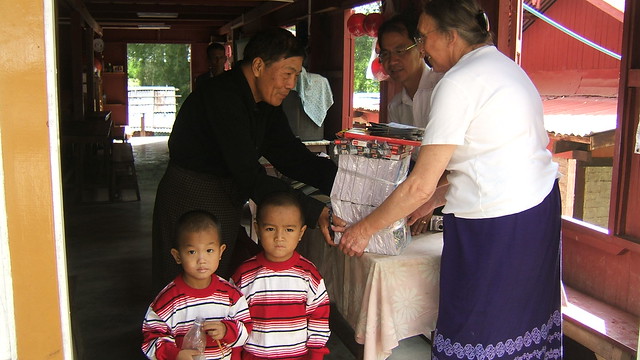
This small boys' orphanage has been open for less than a year and is run by a retired headmaster, U Phone Myint Aung. It is located directly on the road to Maymyo, about 24 miles from Mandalay, very near the newly-opened 'I.T. City'. The 'I.T. City' trains young people in computing and a 'technology park' of manufacturers is being established.

There are currently 58 boys at the orphanage but when we visited they were all away at school for the day, apart from the two youngest orphans who are not yet of school age (5 years old in Myanmar). Boys between the ages of 2 and 8 who have lost one or both parents are accepted and they are currently all from the Pa-O tribe in Shan State. The sprightly 70-year old founder is assisted by six staff. The small site is divided by a stream providing clean water and the dirt playground has been marked out for football and provided with rustic goal posts. Building work was in progress when we were there, repairing the site boundary walls.

The presentation of donations from RTM.

More pictures here.

(2) Doe Pin Boys' Orphanage

I'd visited Doe Pin before in September 2009 when the orphanage was home to over 500 boys (earlier report). It now caters for 1,015 boys! Class rooms on site extend teaching to Grade 8 - beyond Grade 8, suitable pupils can attend a Government School We were there during the lunch hour, when all the boys on site assembled in the large hall for the rather basic meal of steamed rice with a small portion of soya bean paste and a little vegetable soup.

We made donations to the monk in the assembly hall before making a tour of the site. During the tour, we met the irrepressible Head Monk and Founder, U Pan Na Wa, still laughing and surrounded by a group of young children.

Boys quietly awaiting lunch in the Assembly Hall.

More pictures here.

We carried on to Maymyo, used by the British as a Hill Station and with a number of very English-looking properties. There's more about the town in an earlier post. On my latest visit, we stopped for a very pleasant lunch on the outskirts of the town before locating the Girls' Orphanage we'd come to see.

(3) Shwe Sin Minn Girls' Orphanage

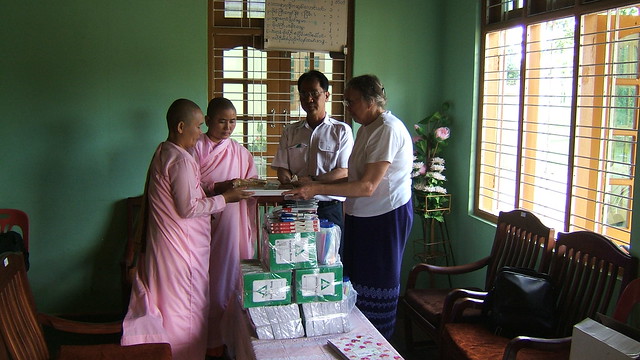
Two nuns founded the orphanage in 1999 and they currently look after 335 orphans or single-parent girls from poor families from various tribes. At present, the girls go off-site for school but a major building programme is almost complete which will allow teaching up to Grade 7 to be carried out in the Nunnery Compound.

Some of the girls become nuns, just as some of the boys at Doe Pin become monks. The discipline for both nuns and monks allows no food to be taken after 12 noon so one criterion is how well a child can tolerate a life of breakfast and lunch alone.

The presentation of donations from RTM to the two nuns.

More pictures here.

As we toured the new building works, the girls started to return to the Nunnery Compound. We made our farewells very impressed by the energy and dedication of the two nuns, we made our way back to the town centre and took refreshments in a rather up-market tea room. We finally made a tour of the large market at Maymyo. There is a dry-goods market with a bewildering array of mainly Chinese items and a wet market of mainly locally-produced food. It was then time to make the fairly long journey back to the 'Road to Mandalay' after a tiring but very educational day.

Visit to Monastery School No. 21, Taung Be Lar, Sagaing, Myanmar

Monday, 31st October 2011

The 'Road to Mandalay' had moored midstream during the night but around 6.0 a.m. she continued north. I took an early breakfast in the restaurant and spent some time on the top deck watching our progress.

Doctor Hla Tun describing the effects of Cyclone Nargis.

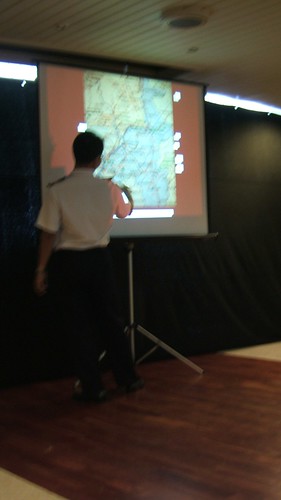
At ten o'clock, the Doctor was scheduled to give a talk in the Observation Lounge titled 'Road to Mandalay Social Contribution'. I had been asked if I would add a few words afterwards from the perspective of an ordinary paying passenger who has become a donor. The Doctor had prepared a 'Powerpoint' presentation detailing the work being carried out. In addition to the building of schoolrooms and the provision of various types of support to schools, a Mobile Clinic is still operating in the Delta Area which was so badly affected by cyclone Nargis and following the more recent cyclone Giri, a Mobile Clinic was provided in Rakhine. Finally, the Free Clinic in Bagan is now operating. Because not all the interested passengers had been able to attend the Bagan Clinic opening ceremony on the previous day, I'd put together a few photographs of the event which I used as the basis for some informal comments on the work. It all seemed to be well-received and a number of passengers were keen to help.

Before long, it was time for lunch and, just before 2.0 p.m., we passed under the old Ava road and rail bridge, then under the new road bridge and carefully docked at Road to Mandalay's Shwe Kyet Yet River Station.

'Road to Mandalay' making fast at Shwe Kyet Yet River Station.

A number of tour buses were already waiting to take the passengers on a Mandalay City Tour or, on the other side of the river, a tour of Sagaing. However, the Doctor had arranged that he and I would visit Monastic School No. 21 in the Sagaing hills to distribute stationery. We were delighted that the Captain was to accompany us. We piled into a taxi and crossed the river on the new road bridge to reach Sagaing. The hills of Sagaing are said by some to be the most beautiful and spiritual in Burma. Temples and Pagodas are scattered across the wooded hills and each summit is topped with a shining pagoda which catches the sun and draws the eye. But the foothills to the south, although lush and green, have only a network of dirt roads almost inaccesible to road vehicles with occasional smallholdings or farms.

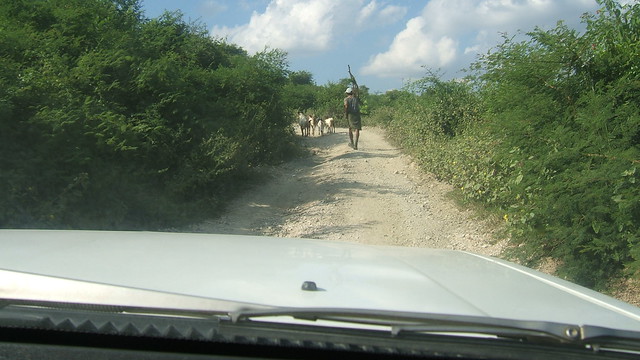
Meeting goats and the goatherd on the way to Taung Be Lar.

In this poor area lies Taung Be Lar Monastic School Number 21, with over 300 pupils. I'd visited once before and 'Road to Mandalay' has funded various improvements at this school. We found further extensions to the main building being constructed, this time funded by a local donor.

Distributing Stationery (Click on picture for the full width showing left to right Jan, the Deputy Headmistress and Dr. Hla Tun).

My pictures of this visit to the school are here.

Following the distribution of stationery, we made our way to the important temple on the tallest hill of Sagaing, where we spent a peaceful and contemplative time before returning to the ship.

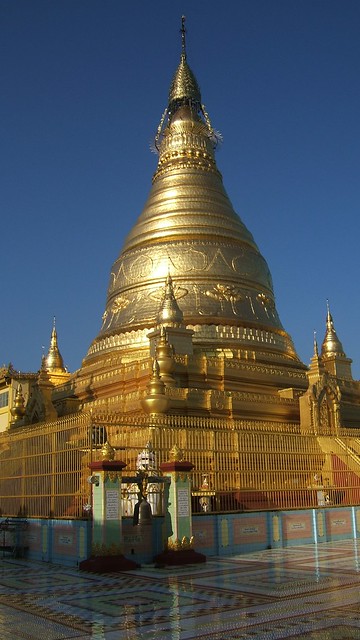
The gilded pagoda at Soon U Ponya Shin.

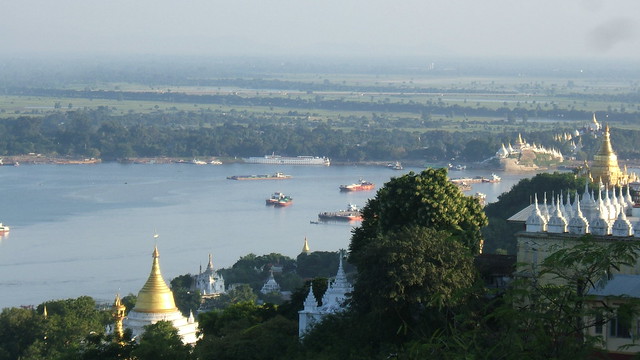
View of the Irrawaddy from Soon U Ponya Shin Pagoda. The large white vessel moored on the opposite bank is the 'Road to Mandalay'.

There are a few more pictures here.

In the evening, the Doctor invited me to join him for dinner in the restaurant, which gave me a further opportunity to ply him with questions!

Opening of the Bagan Medical Clinic

Sunday, 30th October 2011

I didn't sleep too badly but that was probably due to the mild sedative the Doctor had prescribed. I was up early in order to take breakfast as soon as the restaurant opened at 6.0 a.m. At 6.45 a.m. Sammi the hotel manager and I took the motor boat to the shore. A few minutes walk from the landing stage brought us to the Clinic. Having heard a motor boat engine somewhere near the ship before Sammi and I left, I was not surprised to see the Doctor and the Logistics Manager already at the Clinic, making final preparations for the ceremony.

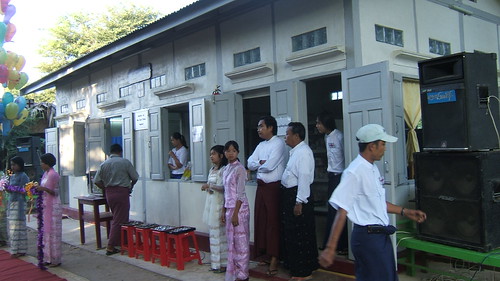
The Clinic, just before the Opening Ceremony.

A large number of local school children were marshalled at one side of the Clinic and a crowd of villagers waited patiently. The Head Monk of the local monastery, whose support was vital in bringing the project to fruition, was provided with a chair facing the Clinic to watch the proceedings. After a few introductory words from the Doctor, one of the Guests guest from the boat and the writer were invited to cut the opening tape.

The Burmese version of cutting the opening tape involves a tape, five girls in traditional longyi and a collection of helium-filled balloons. Two of the girls hold the ends of the tape and the third holds the middle, where the balloons have been attached. The other two girls each hold a tray with a pair of scissors for the tape cutters. When each half of the tape is cut, the balloons are allowed to float up into the air in another interpretation of 'Balloons over Bagan'.

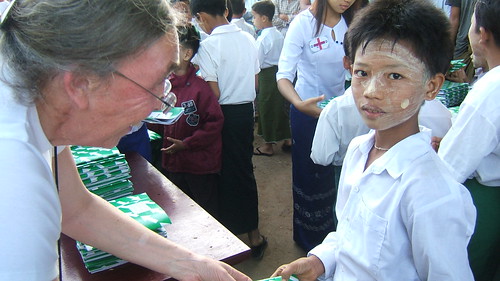
The writer was invited to add a few words for the benefit of those guests from the boat who were attending the opening ceremony and then the Doctor presented the commemorative pennant (inscribed in English and Burmese) to the writer. Afterwards, this pennant will remain on display in the Clinic. Next, it was time for the presentation of stationery to the schoolchildren. The children lined up in front of the Clinic where tables had been set up bearing exercise books, pencils and ballpoint pens. Helpers prepared each pack, normally comprising two exercise books and two pencils (with erasers) so that the Doctor and the writer could rapidly hand them out to the lines of children. The children invariably lowered their heads on receiving the gift, some would say 'Mingele bar', a minority would say 'Thank you' in English. Burmese children are dark haired with dark eyes and often very fine facial bone structure. It's always very moving to see this long procession of innocent, beautiful children when presentations of this kind are made.

A young boy, face covered with Thanaka for sun protection, appears somewhat over-awed.

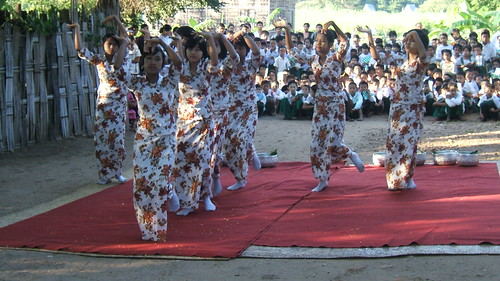
We were now entertained by a concert performed by young people to celebrate the opening of the Clinic. First, three young boy dancers in matching, colourful traditional costumes performed a dance to (rather loud) music from the sound system. Next, eight girls carrying decorated silver-coloured bowls and dressed in matching white longyi printed with a floral design performed a traditional water dance.

Eight girls perform a traditional dance.

The third act was a modernised form of a traditional light-hearted dance where a man with a parasol flirts with a girl. In this case, boys played both parts. Six children then performed a very amusing dance with three girls carrying clay water pots dressed in longyi representing village life and three boys in baggy trousers, sports shirts, baseball caps and sunglasses representing city life. The comic effect of the contrast between the boys and girls was irresistible.

Village life meets City life!

Then, the lead dancer from the first act performed another traditional dance. Finally, a young man dressed in a special costume, male on the right side, female on the left side and incorporating a dummy female head on the left side, performed a dance where the male and female sides of his appearance are alternately presented with appropriate steps and gestures.

In general, the crowd, although clearly impressed by the entertainment, remained largely impassive. Smiling is allowed but open-mouthed laughing in public is considered rude. In meetings with Burmese, they will frequently cover an open mouth with their hand in a show of modesty. Manners are still important in Burmese society - Burmese walking in front of you will often bend low in a sign of respect.

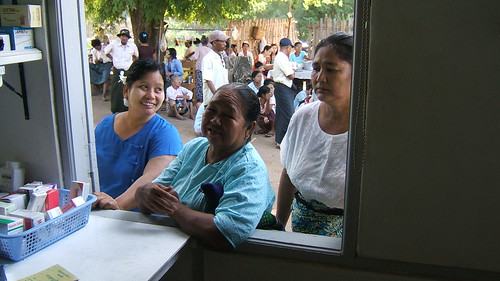
This was the end of the opening ceremony, so the children and the watching crowd slowly melted away. However, a large number of people remained, gently jostling at the Clinic window to ensure registration for an appointment with a doctor, before patiently settling down in the area around the Clinic to wait their turn.

Patients registering for treatment at the Clinic window.

Before starting his consulations, the Doctor gave me a conducted tour. There's a small waiting room, two consultation rooms with examination couches and a general purpose room which serves as dispensary, patient reception and staff room. There's a separate toilet block connected to a septic tank and electricity and water are provided by the monastery, Two doctors currently share the duties and there are a number of volunteers acting as auxiliaries. The auxiliaries are unqualified but already trained to a high standard by Dr. Hla Tun. All the staff carry specially-made badges with a large red cross for instant recognition. In addition, a young monk was in attendance as a commanding presence showing the head Monk's approval of the project. I afterwards learned that the young monk actually sleeps on the premises!

The rear of the clinic is only a few yards from the river bank and there was a pleasant cooling breeze from the river. A number of banana trees have already been planted between the clinic and the river - as these mature, they will provide shade and further natural cooling.

I was invited to watch a number of Dr. Hla Tun's consultations and was impressed, not only by the Doctor's quiet efficiency but by the distances travelled by the patients (up to 30 km) and the fact that most conditions could be significantly improved by the use of standard drugs. Patients are asked to contribute 1000 kyat for a consultation (around one U.S. Dollar) but in the case of poverty, this charge is waived.

Dr. Hla Tun during a consultation.

More pictures of the Opening Ceremony, the Concert and the Clinic getting back to treating patients are here.

Until this trip, I was not aware that 'Road to Mandalay' had provided a school building at the local school at Bagan and so the Doctor suggested I take a look at the buildings (there's no school on Sunday) whilst he continued seeing patients. The Captain allocated a member of the ship's 'shore party' to accompany me and, although a car was offered, we decided to walk. My young Burmese friend from the "Bagan Cycling Club" (see earlier posts here and here) also came with us. Sadly, there was insufficient time for a cycling meeting on this trip. I was shown around the school buildings by what I took to be Headmistress. The 'Road to Mandalay' building had recently been repainted with funds from the Charity. Actually constructing a new building, of course, is the easy part. It's normally necessary to plan for an ongoing maintenance budget and support for stationery costs and teachers' salaries.

More pictures of the school are here.

I returned to the Clinic which still had a serious number of patients waiting to see a Doctor. Since the ship was due to sail for Mandalay at ten o'clock, Doctor Hla Tun reluctantly left the balance of the patients for the two doctors and the Doctor and I took the waiting motor boat back to the ship. I noticed as the motor boat approached the ship's gangway that the anchor had already been raised and, from the wash at the stern of the ship, the Captain was using power to hold station until we had boarded.

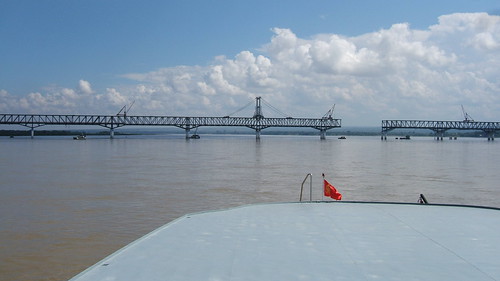
After all the excitement of the Clinic opening, I was glad to resume the easier pace of life on the ship. The Captain kindly invited me to join him on the bridge and we talked at length on numerous topics. Passengers are welcome on the bridge wings and the Captain spent some time chatting with various passengers and answering their questions about the river and Myanmar. Great interest was caused as we passed under the new bridge over the river which is nearing completion. The bridge has innumerable steel spans supported on concrete piers and I believe the total length will be over 2 miles. This is part of a series of major projects under way to improve the transport infrastructure and develop communications with adjacent countries.

This massive road and rail bridge is nearing completion.

Being concerned as to my comfort, the Hotel Manager kindly offered an upgrade to the Governor's Suite, situated just ahead of the central reception area, so there was a flurry of activity whilst I collected my scattered belongings which were whisked by the helpful stewards to the new location. In the evening, after a cocktail party on the top deck, I enjoyed dinner in the restaurant with the Doctor, giving me a chance to learn more about the diverse Social Contribution provided by the ship with the help of donations from the ship's guests.

At 9.30 p.m., there was the 'Surprise on the River' where hundreds of tiny rafts each carrying a candle and provided with shades to give different colours are launched upstream. The current then carries the rafts downstream until the ship is surrounded by a mass of moving lights. Even for 'Returners' like me who have previously seen the effect, it's a wonderful show. Afterwards, I was quite ready for bed and slept soundly in my new quarters.

Mount Popa to Bagan

Saturday, 29th October 2011

The view from the restaurant terrace was still hazy as I took an early breakfast before leaving Mount Popa Resort at 7.0 o'clock. We headed back towards Bagan, having arranged to meet Dr. Hla Tun at the junction with the road to Htee Pu village at 7.30 a.m. The Doctor was waiting for us in a pick-up truck loaded with gifts. In convoy, we set off down the rutted, sandy track which is the only way to reach the village, passing a series of smallholdings and homes constructed from bamboo, neatly laid out with woven fences surrounding yards and a few buffalo patiently waiting.

Although schools are closed on a Saturday, most of the pupils were there, both boys and girls clad in white tops and green longyi. A group of boys were scooping sand from part of the schoolyard to improve the rutted path to the newest 'Road to Mandalay' building. Bunting was being hung on the verandah of another building, with matting laid on the concrete floor and a battered sound system connected up, to provide a stage for the concert.

We examined the building opened a year ago which now has a permanent brick floor - a year ago, it was still an earth floor. A 2-cubicle toilet block and septic tank, also provided by donors, is nearing completion. There is a large assembly hall now under construction. Part of this building has been provided with a temporary roof and is already in use. Also new is an open-sided workshop where carpenters contruct combined desk and seat units, mostly from reclaimed timber. A number of these units are intended for other schools.

Distributing stationery at Htee Pu.

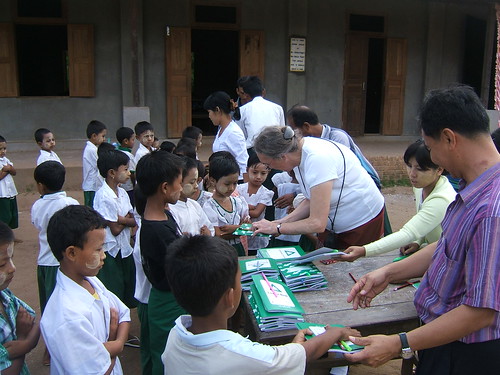
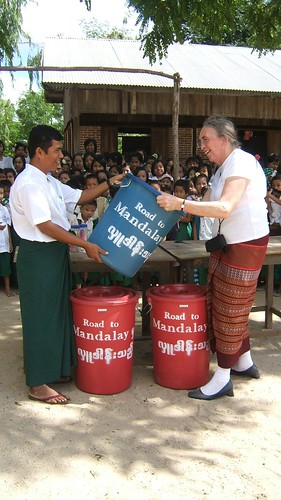
All the children lined up obediently and the distribution of stationery was made - two exercise books and two pencils for each pupil. Then, with rather loud music from a DVD player, different age groups entertained us with various dance routines - some traditional, some modernised. A further presentation gave a green longyi to each of the teachers, after which a donation of cash was made to the headmaster, to support payments to teachers. Finally, under a new initiative, a number of plastic refuse (trash) bins were presented in a drive to promote tidiness and recycling.

My first visit to Htee Pu was in 2009 and my pictures are here.
I returned in 2010 for the Official Opening of a new building - there are pictures here and also here.
My pictures on this latest visit are here.

The pick-up and my car bumped their way back up the track to the main road and continued towards Bagan before taking another rutted track which, after a couple of miles led to Pon village and its school. I'd not been to Pon before but the arrangement is similar to other locations with classrooms for grades 1 to 5 provided by the government and classroom for higher grades donated by Road to Mandalay and its passengers. Once again, stationery was distributed to the well-behaved children and plastic refuse bins to the headmaster.

Distributing stationery at Pon.

The concert which followed was a fairly impromptu, rather unrehearsed affair with singing in place of a sound system but absolutely charming. We then went to the adjacent wooden monastery building to meet the elderly head monk, whom the Doctor treated whilst other members of our party sat for simple food and drink. A number of the younger children were on the ground floor of the monastery which acts as a creche or safe haven for children during holidays or other times.

Pictures taken on this visit to Pon are here.

We retraced our route back to the main road and carried on towards Bagan. But we were not yet finished - we took another side road which seemed even bumpier and even longer than at Pon to reach our last call at Kyauk Kan (also written Chauk Kan) school.

Road to Mandalay have also provided a new building here but an older open-sided structure with palm leaf roof is still in use. We looked around the various buildings before going to the assembly hall where the children had been quietly waiting. We were entertained by a well-rehearsed concert of a number of dances with music supplied by a battery-powered sound system. The headmaster then invited us to the Staff Room, where refreshments had been provided. As elsewhere, we distributed stationery to the pupils and refuse bins to the headmaster.

The Headmaster receives 'Road to Mandalay' trash bins as part of a new initiative.

There are currently 256 students at Htee Pu, 172 at Pon and 285 at Chauk Kan. Incidentally, pictures of all the schools supported by 'Road to Mandalay' which I've posted so far can be found in the collection 'Educational Support in Myanmar here, but there are a number of other schools supported.

Following our third school visit, we drove directly to the ship at its usual midstream mooring in Bagan. Although I'd seen photographs of the new Clinic building at Bagan (they are here) I got my first glimpse with my own eyes just before the bus pulled up at its destination. It looked splendid. Motor boats were on hand to transport us to the ship, where I received the usual warm welcome. All the other guests were already aboard and completing their lunch, so I quickly took a light lunch myself and deferred checking out my cabin until later. By the time I'd eaten, the buses were being loaded for the tour of Bagan and I joined the guide San on his bus.

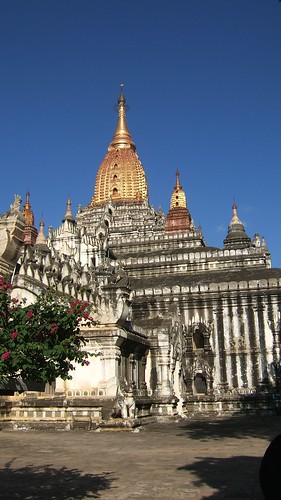
The famous Ananda Temple.

We visited the Ananda Temple, the Gubyaukgyi Temple, the 'Everstand' lacquerware factory and the 'Sunset Pagoda' - all places I'd been to before (and photographed) but I was happy to see them again. My pictures on this trip are here.

We were back on the ship around 6.0 p.m. and, at last, I went to my cabin. I'd been given one towards the stern and I was bit worried about the noise. The exertions of the day were beginning to tell so, by the time I'd had a leisurely dinner, I was ready to crash out.

Friday, 28 October 2011

Around Mount Popa

After the exertions of Thursday, I'd planned to stay in the resort on Friday. But Kyaw was keen to help so, when I said I intended to do some walking on the trails around the mountain, he offered himself as guide. We arranged to meet in the lobby at 9.0 a.m. Friday.

Mount Popa is a large extinct volcano, heavily forested, rising to 4981 feet. The Mount Popa Resort is about halfway up, at 2618 feet. The nearby rock column with temples is called Taung Kalat and it rises to 2417 feet. When you view Taung Kalat from the Resort, you are actually slightly looking down on it.

I set the alarm for 6.0 a.m. but woke a little before it went off. I took my time getting ready and went for breakfast on the restaurant terrace at 7.0 a.m. I transferred the text I'd prepared on my Notebook Computer to a memory stick and went to the lobby at 8.15 a.m. to hire their computer. It was a little slow, but it worked, so I was able to send the blog post about Thursday's activities. Just as I was finishing, Kyaw arrived with the driver by car.

The driver had decided he'd also come, so the three of us set off on foot along the trail to the Water Spring. It's supposed to be a one hour trek but with all our stops en route and coming back a different way, we were gone for three and a half hours. We started on a typical forest road - crushed rock overgrown except for two tracks where vehicle tyres ran. The rocks were quite large so I found the going a little tedious. Some areas of trees have been cleared for tea plantations and our route took us past people working in the tea plantations and past the headquarters buildings, with a marvellous view point for Taung Kalat.

Tea Plantation workers. Curiously, their supervisor is using a digital camera.

Road tankers take water from the headquarters to various outstations for irrigation. We passed one tanker returning - a World War II British military vehicle still going strong! Once we left the plantation behind, the track was more overgrown, although still designed for vehicles. Eventually we reached a small pumping station - a wooden building with woven bamboo sides. The worker let me have a look round. About a third of the hut area appeared to be his living space: the rest was taken up by an electric motor driving a small pump through belts and pulleys. There was also a Chinese diesel engine, presumably as backup should the electricity fail.

We carried on to what Kyaw assured me was the source of the spring water. There were two domestic-looking buildings and a third labelled 'Rest House'. An elderly gentleman appeared and solemnly opened the rest house for us, before disappearing to fetch green tea. The Rest House had been nicely constructed on piles in the sloping site, wood panelled, lots of windows and a verandah all the way round. It had got a bit shabby over the years and termites were doing their best to demolish the building - some of the handrails on the verandah has disappeared. It was still a pleasant spot to catch our breath.

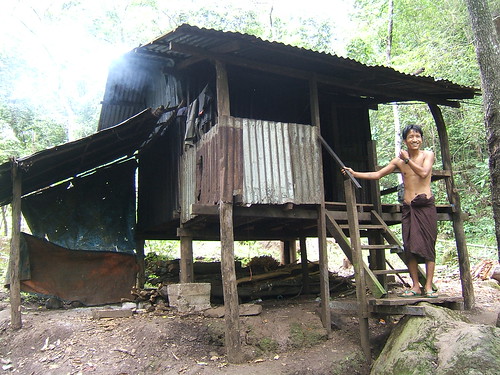
There were various concrete water tanks in the vicinity and lots of plastic water pipes running downhill in the direction we then took. This was the hardest part of the trek. Some way down the hill, the water pipes led in and out of a small complex of equipment rooms. Nearby was a shack occupied by a worker clad in a longyi, flip-flops and nothing else except a digital watch and a tattoo.

The worker poses outside his home.

The track now became easier to follow as we continued our descent. There were wheel tracks of a small motor bike but going up and down must be like motor cycle scrambling back home. We came to a concrete road which was much easier walking apart from it continually changing direction and going up and down following the contours. Where we had the chance to leave the road and take another track back to the resort, I was happy to take it.

Kyaw and the driver returned to their accommodation in the village and, feeling peckish, I had an omelette in the restaurant. Suitably revived, I booked another horse ride for three o'clock.

It was the same horse but a different horseman who again led the horse at an easy pace, only occasionally speeding up. We descended on the Resort road, finally making a left turn into the Environmental Education Centre operated by the Ministry of Forestry. There was a rather nice Exhibition Building, locked up until an aged caretaker appeared to open it up. The exhibits were a little sparse and sorry looking but still very interesting. I then toured the extensive gardens of 'Popa Medical Plants'. A second sign said 'Forest Department Medicinal Plantation'. The Medical Plant Library building was locked up and there was no sign of whoever tends the gardens.

Part of the extensive Medicinal Plantation.

I re-mounted my steed (with arthritis, easier said than done) and we made our way back to the Resort. Time for a short swim followed by a simple dinner once again on the verandah of the restaurant and then I'll try to post this report. I'll be sorry to leave the Resort on Saturday, but other attractions beckon.

Exploring Burma

Wednesday 26th October 2011

The aircraft to Yangon was a Thai A330 with 2+2+2 seating in business class. We boarded on time and then sat at the gate for almost an hour with engines stopped. I didn't find out why - probably Air Traffic Control delays. Eventually we taxied to the queue of departing aircraft and took off about the time we should have arrived in Yangon. They served a reasonable meal on the 1 hour flight. We landed and taxied to the International Terminal where the airbridge was promptly attached. After a few minutes walk, I had an early position in the immigration queue for 'Foreigners' and, after the usual amount of checking of passport and visa, I was admitted by the smiling young immigration officer. There was the usual huddle of passengers around the carousel in the baggage hall but I only had to wait a minute or two before my bag appeared. In the arrival hall, I easily found my guide as his board displayed the tour company (Sun Bird), the booking agents (Wexas) and my own name. Outside the terminal, we were picked up by the car for the transfer to my hotel. It was already pitch dark and most roads are not well-lit so there wasn't much to see on the 30 minute journey.

There was the usual warm welcome at the Strand Hotel. My air ticket for the next day's flight to Bagan was waiting so my guide checked the details and arranged to pick me up at 4.45 a.m. the following day. I'm on Asian Wings Airways AWM-891 due to leave Yangon for Nyaung U (Bagan), Mandalay and Heho. I arranged a wake-up call for 4.00 a.m. and a simple breakfast in my room for 4.15 a.m. before retiring to the comfort of room 103.

My computer attached to the hotel's Wi-Fi without difficulty but I was surprised to receive the following screen:-

"Dear Valued Customers,

On 17 October 2011, Due to the failure of SEA-ME-WE 3 submarine fiber optic cable, the Internet connection was unstable. It is being fixed by concerned personnel and during this period, the Internet connection may be significantly slow and possibly offline sometimes. We will keep you informed accordingly and we sincerely apologize for any inconvenience caused.
With regards,

Yatanarpon Teleport"

The hotel staff confirmed that the internet was very slow and suggested I might do better on the machine in their business centre. Having tried that with very limited success, I eventually gave up on the internet and went to bed.

There are pictures of the Strand Hotel here.

Thursday 27th October 2011

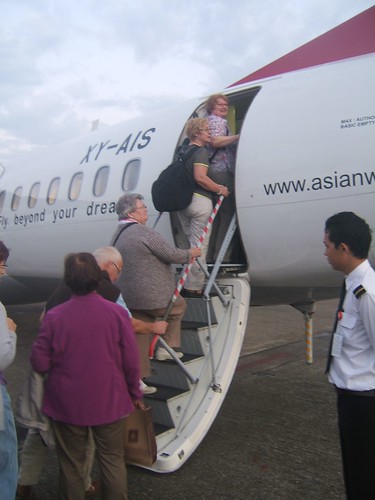
I was picked up at 4.45 a.m. as arranged and we arrived at the domestic terminal about 5.15 a.m. to catch Asian Wings Airways flight AWM-891. This is a new airline which started up in January this year, operating a couple of ATR-600 turbo-props. Check-in was painless and after waiting in the departure hall, I was surprised when the flight was called at about twenty to six. We sat in the bus for a while and then drove 100 yards across the tarmac to the waiting aircraft.

Boarding the Asian Wings flight at Yangon Domestic Terminal.

We were airborne just on 6.0 a.m. The cabin crew of a steward and stewardess served a simple meal and we landed at Nyaung U (the airport for Bagan area) around 7.15 a.m.

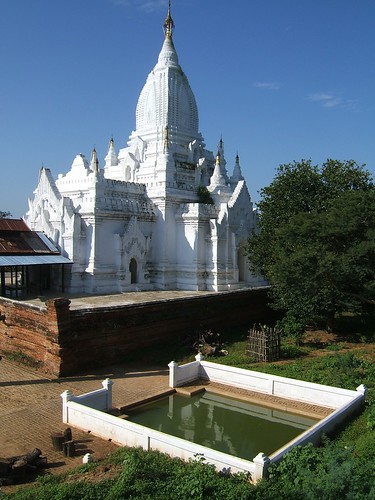
I easily found my guide Kyaw (pronounced 'chore') and, having located my luggage and the car with driver, we were soon on the way. I explained that I'd seen the major temples of Bagan but I was keen to see some of the smaller, quieter locations. We spent a wonderful couple of hours on dirt roads looking at minor temples and ruins. Amazingly, the souvenir sellers have some sort of radar which directs them to a tourist, even when on the 'road less travelled'. One girl with good English insisted she'd seen me the year before and I decided she was right.

The restored features of a once-large monastery.

My pictures of this exploration are here.

After these exertions in the hot sun, we took the hot, sweet tea that the Burmese love at a typical tea shop. The tea is made with condensed milk, as they also take it in India. Green tea is also available. I had one green tea and two cups of sweet tea whilst Kyaw contacted the Doctor on 'Road to Mandalay' by mobile phone to make arrangements for our meeting on Saturday morning. Then we set off for Mount Popa, pausing at Bagan railway station for me to check it out. The service is sparse so, as expected, we didn't see a train but I was able to take photographs of the infrastructure before we continued on the rather rough road to Mount Popa.

There had been heavy rain recently and, at a number of places, short-lived watercourses had flooded across the road. Although the watercourses had thoroughly dried-out again, the sand brought down by the water had been thickly deposited across the road. In addition, the water had damaged the tarmac road surface. We passed various road-mending gangs on our way to Mount Popa. Large heaps of crushed stone had been dumped at the roadside, together with drums of bitumen. A large, yellow road roller was usually in attendance for the final stage. But all the earlier stages of the work preparing the road bed and laying the roadstone was carried out manually, with large gangs of mainly women. I spotted one firepit where the bitumen was being heated ready for laying. A pit had been dug in the verge, a few feet long and a couple of feet wide. This had been filled with brushwood and set alight. Three drums of bitumen had been placed side-by-side across the pit and flames surrounded the drums.

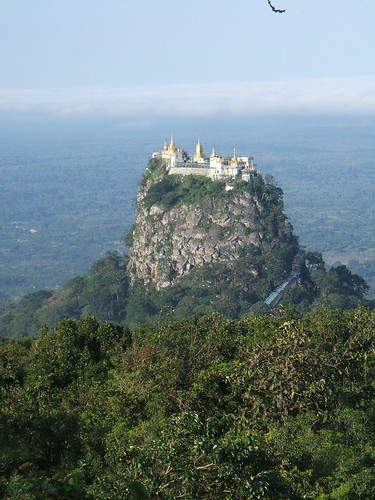
Taung Kalat viewed from Mount Popa.

The flat plain gave way to hills and the road we were on twisted and turned as it climbed through the wooded landscape to arrive at the village at the foot of the astonishing column of rock topped with temples called Taung Kalat. The rock column sprouts from one side of the substantial extinct volcano of Mount Popa. The village was even more chaotic than the last time I'd visited because a section of the village street was closed for re-surfacing. Kyaw and I set off up the 777 steps (I didn't count them) to the temples at the summit. It was hot but conditions were better than on my last ascent when heavy rain had made the steps very slippery. We spent some time checking the views from the top before coming down. There were very few visitors and the souvenir sellers seemed preoccupied with taking lunch. We passed a group of around six Germans making there way up - they'd travelled from Yangon on the aircraft I'd been on.

My pictures of Taung Kalat on this trip are here.

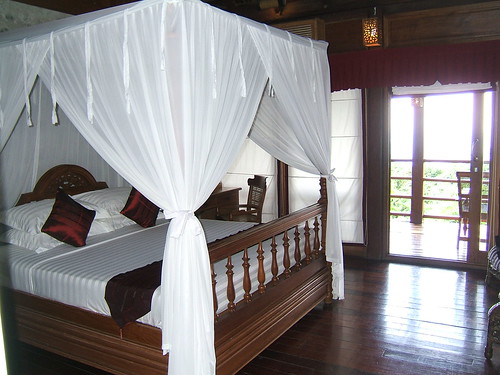
We located our car and driver and our car made its winding way up the mountain to Mount Popa Resort. I was expected and was quickly conducted to just the villa I'd imagined - semi-detached, wood and stone construction with a wooden shingled roof. The building was built on piles on the wooded hillside, with a spacious verandah looking across to the fairy-tale looking temples of Taung Kalat we'd just visited. The one wall of the bedroom was completely glazed so the view from inside was almost as good. I was absolutely charmed by the spot.

The splendid accommodation at Mount Popa Resort.

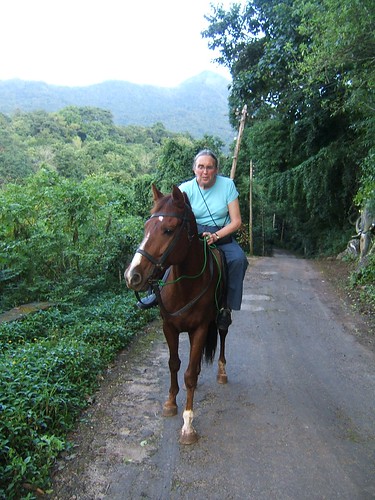
Feeling a little peckish, I ordered 'Fish and Chip' and a coke from room service which I enjoyed on the verandah. Afterwards, I looked at the infinity swimming pool (which also has views of the temple rock) but decided to try the horse riding first. As I expected, this was a little sedate but still marvellous fun. The horse was led through a forest road to the Deer Park, where I dismounted and was invited to look out for deer. We did spot a couple of deer but they remained a little distance away, suspiciously watching us and ignoring the enticing calls of the gamekeeper.

Jan, on the way back from the Deer Park.

On my return, I had a quick dip in the pool then relaxed a little before going to the dining room for a simple evening meal. I took my meal outside on the restaurant verandah which, of course, had a splendid view of Taung Kalat, now twinkling with electric lights in the warm evening air.

My pictures around Mount Popa Resort are here.