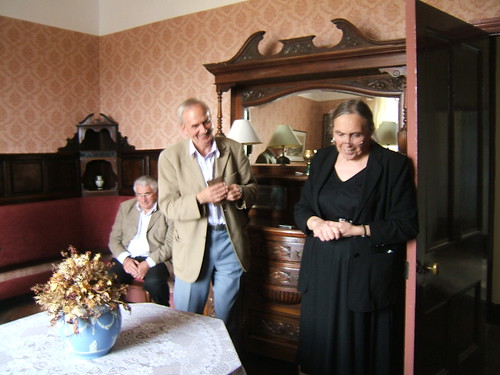
Friday, 18 November 2011

The Oriental Hotel, Bangkok

Thursday, 3rd November 2011

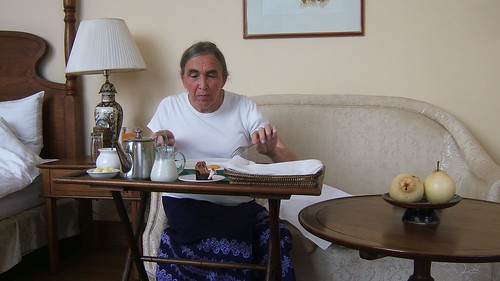
The Strand provided breakfast in my room promptly and as ordered so I was ready when Nay Lin arrived to transfer me to Yangon Airport for my flight to Bangkok.

Breakfast at the Strand Hotel, Yangon.

Traffic seemed particularly heavy on the way out to the airport, so the driver deemed it wise to make a detour using some fairly basic roads. We arrived at the International Terminal in good time and I said goodbye to my guide and driver. Check-in for the Thai morning flight to Bangkok was painless and Passport Control only took a few minutes. Soon I was relaxing in the small but comfortable Thai lounge until my flight (TG0304) was called.

On the flight to Bangkok, they served a very adequate breakfast. I was in a central aisle seat on this trip, so I was unable to see any signs of the flooding as we came in to land but the morning Thai English-language newspaper I'd been reading on the journey had extensive coverage of what had become a major emergency for Thailand. One of the newspaper maps suggested that floodwater had extended to a point near the boundary of the airport we were to use but we landed without incident, taxied to the stand and the air bridge was quickly attached. Since I was to spend Thursday night at the Oriental Hotel in Bangkok, I had to retrieve my large suitcase from the baggage carousel but this didn't take long and, as I made my way into the Arrival Hall, I quickly spotted the Oriental representative in his distinctive orange jacket.

He telephoned to the driver of the hotel limousine and I was soon seated in the comfortable rear of a BMW saloon. The Oriental chauffeurs always wear a lightweight white suit with white peaked cap. More importantly, they are professional drivers so the journey is invariably smooth and safe. We used the toll road to the city, passing two toll stations where the first took 25 Baht and the second 45 Baht. The car was fitted with the 'Express Toll' equipment so it was only necessary to slow on the approach to each toll gate until the barrier lifted automatically.

When we were a few minutes from the hotel, I was particularly impressed when the driver turned slightly and asked "May I make contact with the Hotel, Madam?" before he telephoned his arrival time to the hotel. This ensures that when the car pulls up at the hotel, not only is the Door Man and his staff of Bell-Boys in attendance, but there are at least three Reception Staff lined up to welcome the guest by name and present the traditional Thai floral tribute. I was amused when the Receptionist explained that I'd been booked into a room not quite as good as last time (which I knew). They offered a half-price upgrade to the suite I'd had before which I accepted. I was then conducted to the Old Building overlooking the river and the Noel Coward Suite which I'd had on my previous visit.

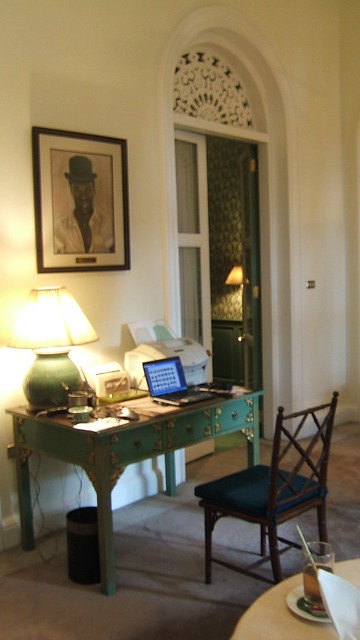
I'd been out-of-touch since last being able to use the internet at Mount Popa Resort, so I signed-up for 1-days internet usage. Using Wi-Fi on my notebook computer, I was getting speeds about 50% faster than back home, so I took the opportunity to upload some of my pictures, in addition to dealing with e-mails and writing to Blogger.

The Noel Coward Suite, Oriental Hotel, Bangkok. The writing desk in the sitting room shown set up for using the notebook computer. The double doors lead to the bedroom.

Nprmally, I'd go out to explore Bangkok. I've not yet travelled on the overhead electrified railway serving the airport and I'd considered trying it out. But I was still feeling tired so the attractions of staying in the hotel proved too great. I summoned the energy to explore the hotel, going to the Riverside Terrace which is a favourite spot for meals. But part of the terrace was closed and builders were in occupation. A row of sandbags had been placed on the river side of the terrace. The small garden which links the original hotel building to the terrace was also partly closed and criss-crossed by fire hoses. In addition, the windows and doors of the original building had been boarded-up for a few feet above the ground and more sandbags were in evidence. It appeared that the river had, at some stage, risen above its retaining walls but, when I was there, things were reverting to normal.

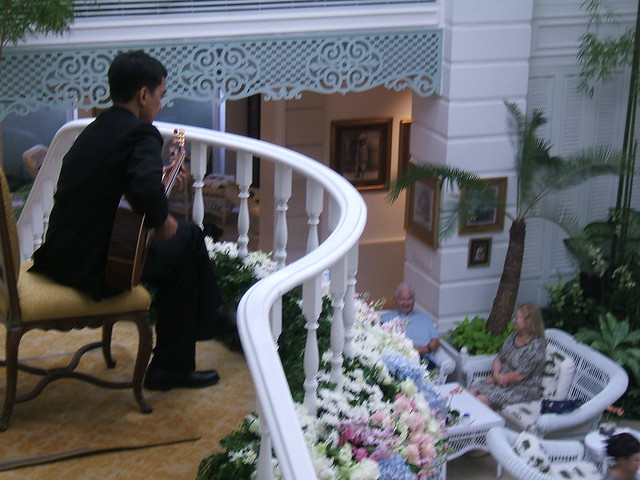
The public part of the original hotel building is a palm court style tea room, painted white where (like the Strand in Yangon) you can take afternoon tea, so I decided that, lacking the energy to explore Bangkok, afternoon tea would be suitably relaxing. Access to the Authors' Suites on the first floor is via two staircases provided with a small balcony which lead up from the tea room. Whilst afternoon tea is being served, an excellent acoustic guitarist plays gentle music from this balcony.

The guitarist entertains the guests taking afternoon tea from the balcony.

I passed an equally relaxing evening in my suite before completing my packing ready for my trip home the next day. I ordered breakfast in my room (for the second day running), retired to the comfortable bed and slept soundly.

Wednesday, 16 November 2011

Leaving the 'Road to Mandalay'

Wednesday, 2nd November 2011

It's always with some sadness that I leave the 'Road to Mandalay'. When I made my first visit to Myanmar and the 'Road to Mandalay' in March 2008 as part of my 'Round the World 5' tour (see posts), I little realised what a powerful effect Myanmar would have on me.

As always, I'd had a wonderful (and tiring) time on this latest trip. It had been my fifth trip to Burma and my fourth cruise on the 'Road to Mandalay' (it would have been my fifth cruise had not Cyclone Nargis severely damaged the ship). But it was time to leave the sybaritic pleasures of 'Road to Mandalay', say farewell to my friends on the ship and board the coach for Mandalay Airport.

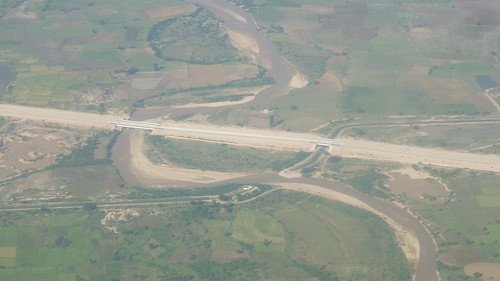
The coach was scheduled to leave at 7.0 a.m. and all the passengers made it on time. We wound our way out of Shwe Kyet Yet, past the now-familiar sights of life by the roadside and took a recently-completed section of dual-carriageway which made our transfer to the airport fairly painless.

'Road to Mandalay' staff checked in baggage and obtained our boarding passes for us, so we only had to make our way through security to the departure hall overlooking the apron. A number of flights were scheduled to leave fairly close together so we had a little wait before boarding a bus for the short trip to our aircraft. A simple snack meal was served on the non-stop journey to Yangon which took an hour and a bit.

Our route to Yangon took us over this new dual carriageway road.

Our turbo-prop aircraft made a straight-in approach at Yangon and had soon parked on the apron. As usual, a bus ferried us the short distance to the Domestic Terminal where I quickly spotted my guide, Nay Lin. He despatched a man with my luggage receipt to retrieve my case and we were soon in the car and on our way into Yangon. Time was allowed for sight-seeing so I picked the places I'd not already been to.

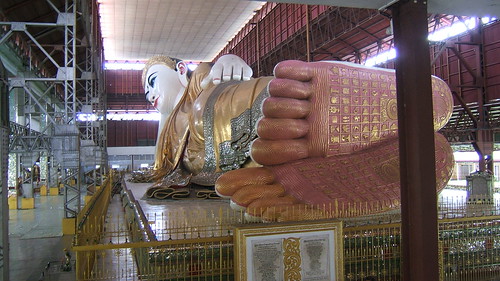
Yangon's huge Reclining Buddha in its massive 'shed'.

First stop was Yangon's famous Reclining Buddha. It's big and it's impressive but what fascinated me was the huge steel-framed building which protects the image from the elements. The heavily-braced industrial structure looks as if it should hold a rolling mill, rather than a delicately-modelled Buddha image.

The 'Royal Barge' in Karaweik Park.

Next stop was Karaweik Park. We had to pay at the gate and then the car drove to a decking-covered viewpoint at the side of a lake. The location had a commanding view of what appeared to be a huge 'Royal Barge' further along the shore. In fact, the barge is actually made of concrete and is built on land but it's spledidly modelled to resemble the type of Royal Barge I'd seen around Lake Inle on a previous visit.

We then made our way to busy Pyay Road and the National Museum which I'd previously seen from the outside but not visited. The National Museum is a large, modern building spread out over a number of floors so, by the time we'd looked at all the exhibits, I was getting rather tired. There is some labelling of the items in English but there is, apparently, no English guide book. Since photography is prohibited, I've no record of the visit, which is a shame because there were some very interesting artefacts on display covering all aspects of Burmese history, culture and life. There weren't many visitors in the museum and only a couple of those were European.

There was a large, privately-owned souvenir shop on the ground floor. I spent some time looking at the books in English and finally purchased a 1995 reprint of 'A Tour in Burma in March and April 1892'. This is a description of religious architecture in Burma by F. O. Oertel, complete with 40 original photographic plates. Although sold as new, the copy was rather battered and I suspect had been waiting for a purchaser for some time!

I was now quite ready to be delivered to my Hotel. As our car passed the Peoples' Park, I spotted a couple of interesting displays. There was a small steel-hulled gunboat, looking rather curious set on blocks above ground level, and a large tank locomotive, painted green and with the Walschaerts motion finished with aluminium paint. I made a mental note to try to have a better look next time.

The usual warm welcome awaited me at the Strand Hotel and, this time, I was in room 103, a front corner site, overlooking the Australian Embassy.

Room 103 at the Strand Hotel

I'd had thoughts of making another journey on Yangon's Circle Line, as I'd first done in 2008 (see post), but after the early start to the day and the exercise I'd already had, I decided I was too tired so I settled instead for Afternoon Tea downstairs. Later, I made another fruitless attempt to use the internet and then, having booked breakfast in my room for the next morning, retired and slept soundly.

Thursday, 3 November 2011

Three Orphanages

Tuesday, 1st November 2011

The programme for guests allowed for viewing the Offering of Alms at the local monastery followed by a river trip to Mingun in a motor boat. After lunch, guests were offered a trip to Mandalay City or Sagaing, depending upon the group they were travelling with. I attended the Offering of Alms to the monks, because I always find this inspiring but afterwards Doctor Hla Tun had arranged a different programme for me for the rest of the day. Once again, we were pleased that Captain Myo Lwin was able to come with us.

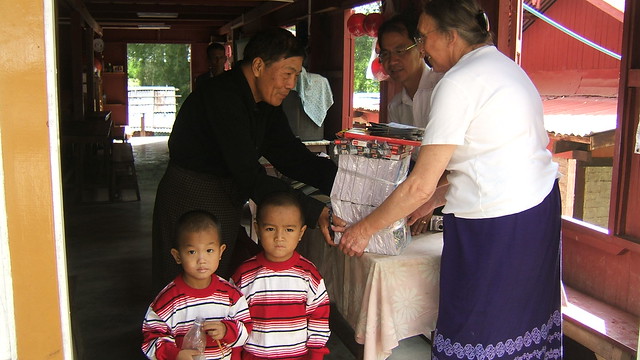
The Captain, the Doctor and I travelled the 40-odd miles to Maymyo in a very comfortable car, distributing stationery and donations at three Orphanages.

(1) Thukha Myittar Boys' Orphanage

This small boys' orphanage has been open for less than a year and is run by a retired headmaster, U Phone Myint Aung. It is located directly on the road to Maymyo, about 24 miles from Mandalay, very near the newly-opened 'I.T. City'. The 'I.T. City' trains young people in computing and a 'technology park' of manufacturers is being established.

There are currently 58 boys at the orphanage but when we visited they were all away at school for the day, apart from the two youngest orphans who are not yet of school age (5 years old in Myanmar). Boys between the ages of 2 and 8 who have lost one or both parents are accepted and they are currently all from the Pa-O tribe in Shan State. The sprightly 70-year old founder is assisted by six staff. The small site is divided by a stream providing clean water and the dirt playground has been marked out for football and provided with rustic goal posts. Building work was in progress when we were there, repairing the site boundary walls.

The presentation of donations from RTM.

More pictures here.

(2) Doe Pin Boys' Orphanage

I'd visited Doe Pin before in September 2009 when the orphanage was home to over 500 boys (earlier report). It now caters for 1,015 boys! Class rooms on site extend teaching to Grade 8 - beyond Grade 8, suitable pupils can attend a Government School We were there during the lunch hour, when all the boys on site assembled in the large hall for the rather basic meal of steamed rice with a small portion of soya bean paste and a little vegetable soup.

We made donations to the monk in the assembly hall before making a tour of the site. During the tour, we met the irrepressible Head Monk and Founder, U Pan Na Wa, still laughing and surrounded by a group of young children.

Boys quietly awaiting lunch in the Assembly Hall.

More pictures here.

We carried on to Maymyo, used by the British as a Hill Station and with a number of very English-looking properties. There's more about the town in an earlier post. On my latest visit, we stopped for a very pleasant lunch on the outskirts of the town before locating the Girls' Orphanage we'd come to see.

(3) Shwe Sin Minn Girls' Orphanage

Two nuns founded the orphanage in 1999 and they currently look after 335 orphans or single-parent girls from poor families from various tribes. At present, the girls go off-site for school but a major building programme is almost complete which will allow teaching up to Grade 7 to be carried out in the Nunnery Compound.

Some of the girls become nuns, just as some of the boys at Doe Pin become monks. The discipline for both nuns and monks allows no food to be taken after 12 noon so one criterion is how well a child can tolerate a life of breakfast and lunch alone.

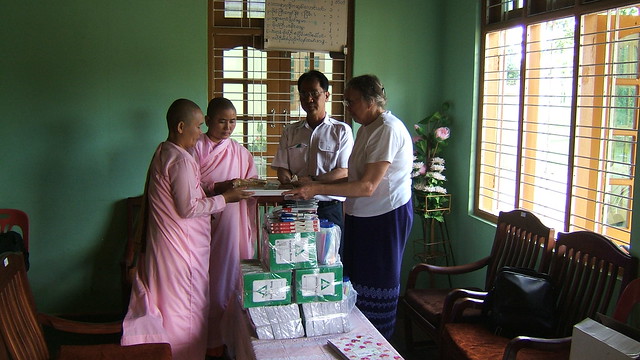
The presentation of donations from RTM to the two nuns.

More pictures here.

As we toured the new building works, the girls started to return to the Nunnery Compound. We made our farewells very impressed by the energy and dedication of the two nuns, we made our way back to the town centre and took refreshments in a rather up-market tea room. We finally made a tour of the large market at Maymyo. There is a dry-goods market with a bewildering array of mainly Chinese items and a wet market of mainly locally-produced food. It was then time to make the fairly long journey back to the 'Road to Mandalay' after a tiring but very educational day.

Visit to Monastery School No. 21, Taung Be Lar, Sagaing, Myanmar

Monday, 31st October 2011

The 'Road to Mandalay' had moored midstream during the night but around 6.0 a.m. she continued north. I took an early breakfast in the restaurant and spent some time on the top deck watching our progress.

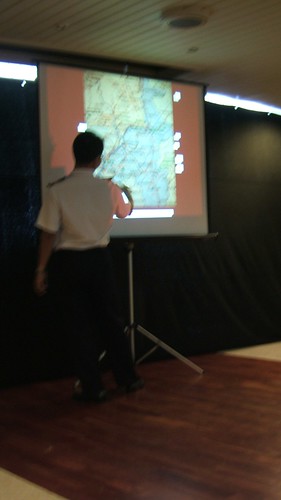
Doctor Hla Tun describing the effects of Cyclone Nargis.

At ten o'clock, the Doctor was scheduled to give a talk in the Observation Lounge titled 'Road to Mandalay Social Contribution'. I had been asked if I would add a few words afterwards from the perspective of an ordinary paying passenger who has become a donor. The Doctor had prepared a 'Powerpoint' presentation detailing the work being carried out. In addition to the building of schoolrooms and the provision of various types of support to schools, a Mobile Clinic is still operating in the Delta Area which was so badly affected by cyclone Nargis and following the more recent cyclone Giri, a Mobile Clinic was provided in Rakhine. Finally, the Free Clinic in Bagan is now operating. Because not all the interested passengers had been able to attend the Bagan Clinic opening ceremony on the previous day, I'd put together a few photographs of the event which I used as the basis for some informal comments on the work. It all seemed to be well-received and a number of passengers were keen to help.

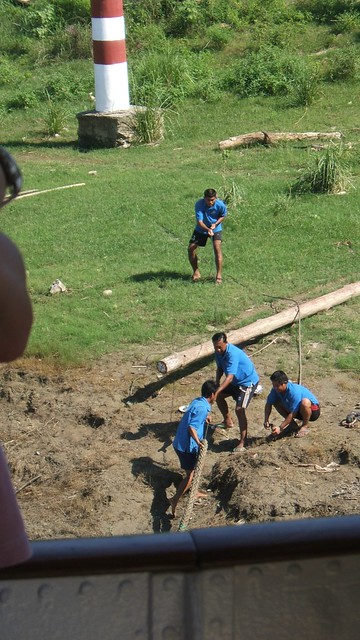
Before long, it was time for lunch and, just before 2.0 p.m., we passed under the old Ava road and rail bridge, then under the new road bridge and carefully docked at Road to Mandalay's Shwe Kyet Yet River Station.

'Road to Mandalay' making fast at Shwe Kyet Yet River Station.

A number of tour buses were already waiting to take the passengers on a Mandalay City Tour or, on the other side of the river, a tour of Sagaing. However, the Doctor had arranged that he and I would visit Monastic School No. 21 in the Sagaing hills to distribute stationery. We were delighted that the Captain was to accompany us. We piled into a taxi and crossed the river on the new road bridge to reach Sagaing. The hills of Sagaing are said by some to be the most beautiful and spiritual in Burma. Temples and Pagodas are scattered across the wooded hills and each summit is topped with a shining pagoda which catches the sun and draws the eye. But the foothills to the south, although lush and green, have only a network of dirt roads almost inaccesible to road vehicles with occasional smallholdings or farms.

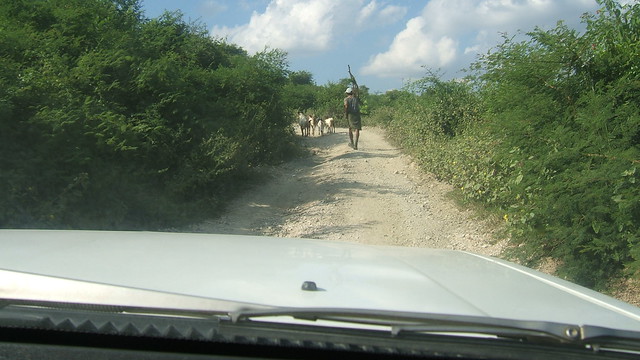
Meeting goats and the goatherd on the way to Taung Be Lar.

In this poor area lies Taung Be Lar Monastic School Number 21, with over 300 pupils. I'd visited once before and 'Road to Mandalay' has funded various improvements at this school. We found further extensions to the main building being constructed, this time funded by a local donor.

Distributing Stationery (Click on picture for the full width showing left to right Jan, the Deputy Headmistress and Dr. Hla Tun).

My pictures of this visit to the school are here.

Following the distribution of stationery, we made our way to the important temple on the tallest hill of Sagaing, where we spent a peaceful and contemplative time before returning to the ship.

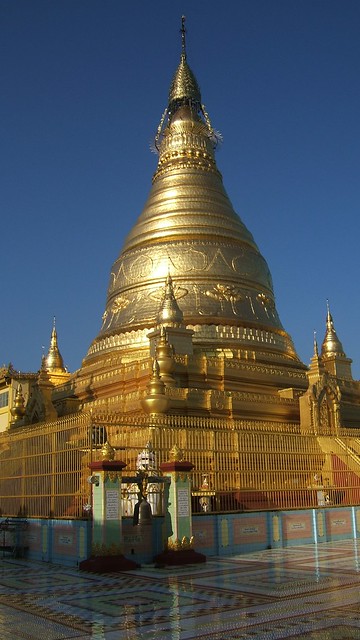
The gilded pagoda at Soon U Ponya Shin.

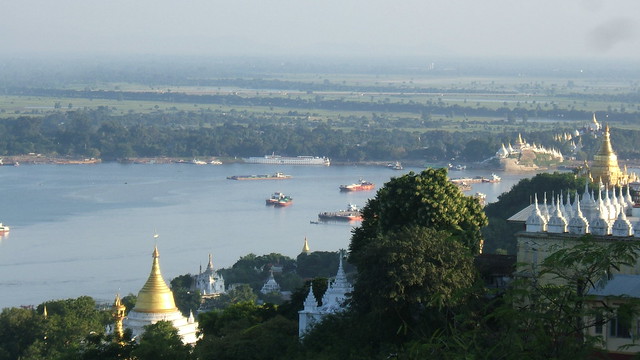
View of the Irrawaddy from Soon U Ponya Shin Pagoda. The large white vessel moored on the opposite bank is the 'Road to Mandalay'.

There are a few more pictures here.

In the evening, the Doctor invited me to join him for dinner in the restaurant, which gave me a further opportunity to ply him with questions!

Opening of the Bagan Medical Clinic

Sunday, 30th October 2011

I didn't sleep too badly but that was probably due to the mild sedative the Doctor had prescribed. I was up early in order to take breakfast as soon as the restaurant opened at 6.0 a.m. At 6.45 a.m. Sammi the hotel manager and I took the motor boat to the shore. A few minutes walk from the landing stage brought us to the Clinic. Having heard a motor boat engine somewhere near the ship before Sammi and I left, I was not surprised to see the Doctor and the Logistics Manager already at the Clinic, making final preparations for the ceremony.

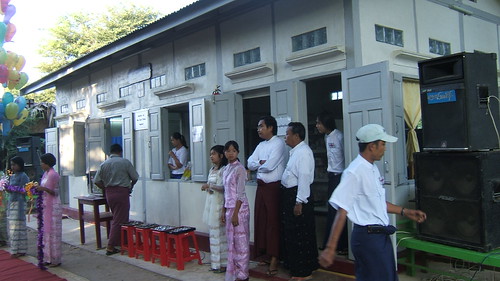
The Clinic, just before the Opening Ceremony.

A large number of local school children were marshalled at one side of the Clinic and a crowd of villagers waited patiently. The Head Monk of the local monastery, whose support was vital in bringing the project to fruition, was provided with a chair facing the Clinic to watch the proceedings. After a few introductory words from the Doctor, one of the Guests guest from the boat and the writer were invited to cut the opening tape.

The Burmese version of cutting the opening tape involves a tape, five girls in traditional longyi and a collection of helium-filled balloons. Two of the girls hold the ends of the tape and the third holds the middle, where the balloons have been attached. The other two girls each hold a tray with a pair of scissors for the tape cutters. When each half of the tape is cut, the balloons are allowed to float up into the air in another interpretation of 'Balloons over Bagan'.

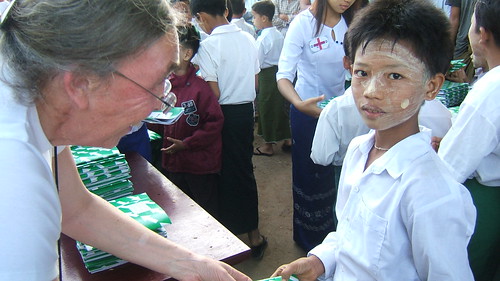
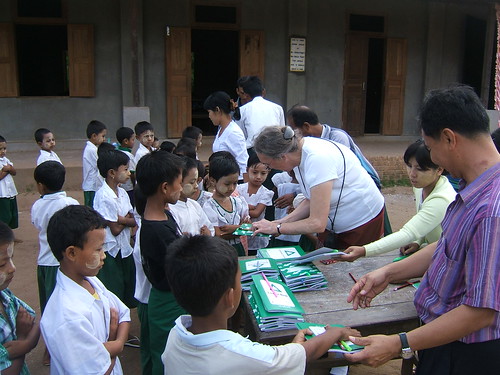
The writer was invited to add a few words for the benefit of those guests from the boat who were attending the opening ceremony and then the Doctor presented the commemorative pennant (inscribed in English and Burmese) to the writer. Afterwards, this pennant will remain on display in the Clinic. Next, it was time for the presentation of stationery to the schoolchildren. The children lined up in front of the Clinic where tables had been set up bearing exercise books, pencils and ballpoint pens. Helpers prepared each pack, normally comprising two exercise books and two pencils (with erasers) so that the Doctor and the writer could rapidly hand them out to the lines of children. The children invariably lowered their heads on receiving the gift, some would say 'Mingele bar', a minority would say 'Thank you' in English. Burmese children are dark haired with dark eyes and often very fine facial bone structure. It's always very moving to see this long procession of innocent, beautiful children when presentations of this kind are made.

A young boy, face covered with Thanaka for sun protection, appears somewhat over-awed.

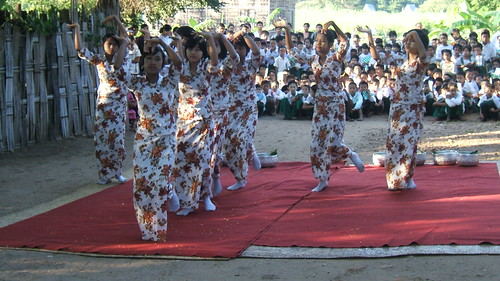
We were now entertained by a concert performed by young people to celebrate the opening of the Clinic. First, three young boy dancers in matching, colourful traditional costumes performed a dance to (rather loud) music from the sound system. Next, eight girls carrying decorated silver-coloured bowls and dressed in matching white longyi printed with a floral design performed a traditional water dance.

Eight girls perform a traditional dance.

The third act was a modernised form of a traditional light-hearted dance where a man with a parasol flirts with a girl. In this case, boys played both parts. Six children then performed a very amusing dance with three girls carrying clay water pots dressed in longyi representing village life and three boys in baggy trousers, sports shirts, baseball caps and sunglasses representing city life. The comic effect of the contrast between the boys and girls was irresistible.

Village life meets City life!

Then, the lead dancer from the first act performed another traditional dance. Finally, a young man dressed in a special costume, male on the right side, female on the left side and incorporating a dummy female head on the left side, performed a dance where the male and female sides of his appearance are alternately presented with appropriate steps and gestures.

In general, the crowd, although clearly impressed by the entertainment, remained largely impassive. Smiling is allowed but open-mouthed laughing in public is considered rude. In meetings with Burmese, they will frequently cover an open mouth with their hand in a show of modesty. Manners are still important in Burmese society - Burmese walking in front of you will often bend low in a sign of respect.

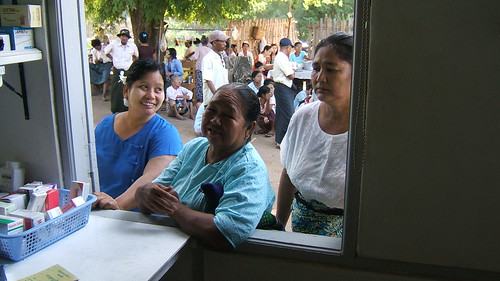
This was the end of the opening ceremony, so the children and the watching crowd slowly melted away. However, a large number of people remained, gently jostling at the Clinic window to ensure registration for an appointment with a doctor, before patiently settling down in the area around the Clinic to wait their turn.

Patients registering for treatment at the Clinic window.

Before starting his consulations, the Doctor gave me a conducted tour. There's a small waiting room, two consultation rooms with examination couches and a general purpose room which serves as dispensary, patient reception and staff room. There's a separate toilet block connected to a septic tank and electricity and water are provided by the monastery, Two doctors currently share the duties and there are a number of volunteers acting as auxiliaries. The auxiliaries are unqualified but already trained to a high standard by Dr. Hla Tun. All the staff carry specially-made badges with a large red cross for instant recognition. In addition, a young monk was in attendance as a commanding presence showing the head Monk's approval of the project. I afterwards learned that the young monk actually sleeps on the premises!

The rear of the clinic is only a few yards from the river bank and there was a pleasant cooling breeze from the river. A number of banana trees have already been planted between the clinic and the river - as these mature, they will provide shade and further natural cooling.

I was invited to watch a number of Dr. Hla Tun's consultations and was impressed, not only by the Doctor's quiet efficiency but by the distances travelled by the patients (up to 30 km) and the fact that most conditions could be significantly improved by the use of standard drugs. Patients are asked to contribute 1000 kyat for a consultation (around one U.S. Dollar) but in the case of poverty, this charge is waived.

Dr. Hla Tun during a consultation.

More pictures of the Opening Ceremony, the Concert and the Clinic getting back to treating patients are here.

Until this trip, I was not aware that 'Road to Mandalay' had provided a school building at the local school at Bagan and so the Doctor suggested I take a look at the buildings (there's no school on Sunday) whilst he continued seeing patients. The Captain allocated a member of the ship's 'shore party' to accompany me and, although a car was offered, we decided to walk. My young Burmese friend from the "Bagan Cycling Club" (see earlier posts here and here) also came with us. Sadly, there was insufficient time for a cycling meeting on this trip. I was shown around the school buildings by what I took to be Headmistress. The 'Road to Mandalay' building had recently been repainted with funds from the Charity. Actually constructing a new building, of course, is the easy part. It's normally necessary to plan for an ongoing maintenance budget and support for stationery costs and teachers' salaries.

More pictures of the school are here.

I returned to the Clinic which still had a serious number of patients waiting to see a Doctor. Since the ship was due to sail for Mandalay at ten o'clock, Doctor Hla Tun reluctantly left the balance of the patients for the two doctors and the Doctor and I took the waiting motor boat back to the ship. I noticed as the motor boat approached the ship's gangway that the anchor had already been raised and, from the wash at the stern of the ship, the Captain was using power to hold station until we had boarded.

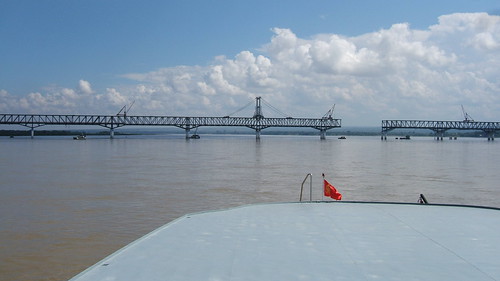
After all the excitement of the Clinic opening, I was glad to resume the easier pace of life on the ship. The Captain kindly invited me to join him on the bridge and we talked at length on numerous topics. Passengers are welcome on the bridge wings and the Captain spent some time chatting with various passengers and answering their questions about the river and Myanmar. Great interest was caused as we passed under the new bridge over the river which is nearing completion. The bridge has innumerable steel spans supported on concrete piers and I believe the total length will be over 2 miles. This is part of a series of major projects under way to improve the transport infrastructure and develop communications with adjacent countries.

This massive road and rail bridge is nearing completion.

Being concerned as to my comfort, the Hotel Manager kindly offered an upgrade to the Governor's Suite, situated just ahead of the central reception area, so there was a flurry of activity whilst I collected my scattered belongings which were whisked by the helpful stewards to the new location. In the evening, after a cocktail party on the top deck, I enjoyed dinner in the restaurant with the Doctor, giving me a chance to learn more about the diverse Social Contribution provided by the ship with the help of donations from the ship's guests.

At 9.30 p.m., there was the 'Surprise on the River' where hundreds of tiny rafts each carrying a candle and provided with shades to give different colours are launched upstream. The current then carries the rafts downstream until the ship is surrounded by a mass of moving lights. Even for 'Returners' like me who have previously seen the effect, it's a wonderful show. Afterwards, I was quite ready for bed and slept soundly in my new quarters.
Mount Popa to Bagan

Saturday, 29th October 2011

The view from the restaurant terrace was still hazy as I took an early breakfast before leaving Mount Popa Resort at 7.0 o'clock. We headed back towards Bagan, having arranged to meet Dr. Hla Tun at the junction with the road to Htee Pu village at 7.30 a.m. The Doctor was waiting for us in a pick-up truck loaded with gifts. In convoy, we set off down the rutted, sandy track which is the only way to reach the village, passing a series of smallholdings and homes constructed from bamboo, neatly laid out with woven fences surrounding yards and a few buffalo patiently waiting.

Although schools are closed on a Saturday, most of the pupils were there, both boys and girls clad in white tops and green longyi. A group of boys were scooping sand from part of the schoolyard to improve the rutted path to the newest 'Road to Mandalay' building. Bunting was being hung on the verandah of another building, with matting laid on the concrete floor and a battered sound system connected up, to provide a stage for the concert.

We examined the building opened a year ago which now has a permanent brick floor - a year ago, it was still an earth floor. A 2-cubicle toilet block and septic tank, also provided by donors, is nearing completion. There is a large assembly hall now under construction. Part of this building has been provided with a temporary roof and is already in use. Also new is an open-sided workshop where carpenters contruct combined desk and seat units, mostly from reclaimed timber. A number of these units are intended for other schools.

Distributing stationery at Htee Pu.

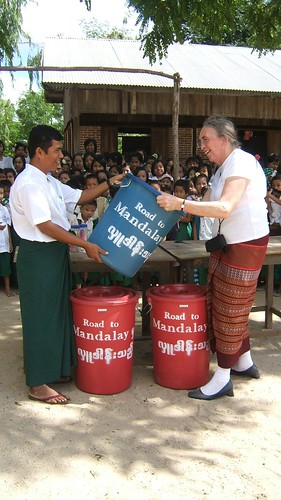
All the children lined up obediently and the distribution of stationery was made - two exercise books and two pencils for each pupil. Then, with rather loud music from a DVD player, different age groups entertained us with various dance routines - some traditional, some modernised. A further presentation gave a green longyi to each of the teachers, after which a donation of cash was made to the headmaster, to support payments to teachers. Finally, under a new initiative, a number of plastic refuse (trash) bins were presented in a drive to promote tidiness and recycling.
My first visit to Htee Pu was in 2009 and my pictures are here.
I returned in 2010 for the Official Opening of a new building - there are pictures here and also here.
My pictures on this latest visit are here.

The pick-up and my car bumped their way back up the track to the main road and continued towards Bagan before taking another rutted track which, after a couple of miles led to Pon village and its school. I'd not been to Pon before but the arrangement is similar to other locations with classrooms for grades 1 to 5 provided by the government and classroom for higher grades donated by Road to Mandalay and its passengers. Once again, stationery was distributed to the well-behaved children and plastic refuse bins to the headmaster.
Distributing stationery at Pon.

The concert which followed was a fairly impromptu, rather unrehearsed affair with singing in place of a sound system but absolutely charming. We then went to the adjacent wooden monastery building to meet the elderly head monk, whom the Doctor treated whilst other members of our party sat for simple food and drink. A number of the younger children were on the ground floor of the monastery which acts as a creche or safe haven for children during holidays or other times.
Pictures taken on this visit to Pon are here.
We retraced our route back to the main road and carried on towards Bagan. But we were not yet finished - we took another side road which seemed even bumpier and even longer than at Pon to reach our last call at Kyauk Kan (also written Chauk Kan) school.

Road to Mandalay have also provided a new building here but an older open-sided structure with palm leaf roof is still in use. We looked around the various buildings before going to the assembly hall where the children had been quietly waiting. We were entertained by a well-rehearsed concert of a number of dances with music supplied by a battery-powered sound system. The headmaster then invited us to the Staff Room, where refreshments had been provided. As elsewhere, we distributed stationery to the pupils and refuse bins to the headmaster.

The Headmaster receives 'Road to Mandalay' trash bins as part of a new initiative.

There are currently 256 students at Htee Pu, 172 at Pon and 285 at Chauk Kan. Incidentally, pictures of all the schools supported by 'Road to Mandalay' which I've posted so far can be found in the collection 'Educational Support in Myanmar here, but there are a number of other schools supported.

Following our third school visit, we drove directly to the ship at its usual midstream mooring in Bagan. Although I'd seen photographs of the new Clinic building at Bagan (they are here) I got my first glimpse with my own eyes just before the bus pulled up at its destination. It looked splendid. Motor boats were on hand to transport us to the ship, where I received the usual warm welcome. All the other guests were already aboard and completing their lunch, so I quickly took a light lunch myself and deferred checking out my cabin until later. By the time I'd eaten, the buses were being loaded for the tour of Bagan and I joined the guide San on his bus.

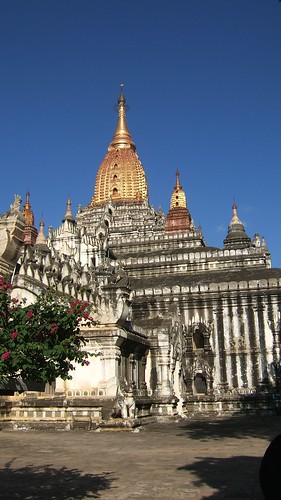
The famous Ananda Temple.

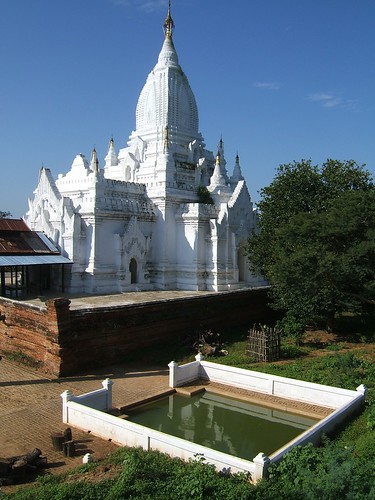
We visited the Ananda Temple, the Gubyaukgyi Temple, the 'Everstand' lacquerware factory and the 'Sunset Pagoda' - all places I'd been to before (and photographed) but I was happy to see them again. My pictures on this trip are here.

We were back on the ship around 6.0 p.m. and, at last, I went to my cabin. I'd been given one towards the stern and I was bit worried about the noise. The exertions of the day were beginning to tell so, by the time I'd had a leisurely dinner, I was ready to crash out.

Friday, 28 October 2011

Around Mount Popa

After the exertions of Thursday, I'd planned to stay in the resort on Friday. But Kyaw was keen to help so, when I said I intended to do some walking on the trails around the mountain, he offered himself as guide. We arranged to meet in the lobby at 9.0 a.m. Friday.

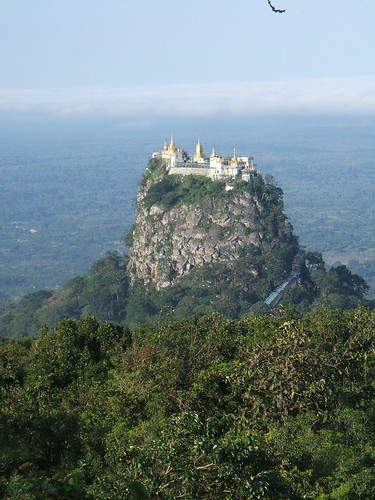
Mount Popa is a large extinct volcano, heavily forested, rising to 4981 feet. The Mount Popa Resort is about halfway up, at 2618 feet. The nearby rock column with temples is called Taung Kalat and it rises to 2417 feet. When you view Taung Kalat from the Resort, you are actually slightly looking down on it.

I set the alarm for 6.0 a.m. but woke a little before it went off. I took my time getting ready and went for breakfast on the restaurant terrace at 7.0 a.m. I transferred the text I'd prepared on my Notebook Computer to a memory stick and went to the lobby at 8.15 a.m. to hire their computer. It was a little slow, but it worked, so I was able to send the blog post about Thursday's activities. Just as I was finishing, Kyaw arrived with the driver by car.

The driver had decided he'd also come, so the three of us set off on foot along the trail to the Water Spring. It's supposed to be a one hour trek but with all our stops en route and coming back a different way, we were gone for three and a half hours. We started on a typical forest road - crushed rock overgrown except for two tracks where vehicle tyres ran. The rocks were quite large so I found the going a little tedious. Some areas of trees have been cleared for tea plantations and our route took us past people working in the tea plantations and past the headquarters buildings, with a marvellous view point for Taung Kalat.

Tea Plantation workers. Curiously, their supervisor is using a digital camera.

Road tankers take water from the headquarters to various outstations for irrigation. We passed one tanker returning - a World War II British military vehicle still going strong! Once we left the plantation behind, the track was more overgrown, although still designed for vehicles. Eventually we reached a small pumping station - a wooden building with woven bamboo sides. The worker let me have a look round. About a third of the hut area appeared to be his living space: the rest was taken up by an electric motor driving a small pump through belts and pulleys. There was also a Chinese diesel engine, presumably as backup should the electricity fail.

We carried on to what Kyaw assured me was the source of the spring water. There were two domestic-looking buildings and a third labelled 'Rest House'. An elderly gentleman appeared and solemnly opened the rest house for us, before disappearing to fetch green tea. The Rest House had been nicely constructed on piles in the sloping site, wood panelled, lots of windows and a verandah all the way round. It had got a bit shabby over the years and termites were doing their best to demolish the building - some of the handrails on the verandah has disappeared. It was still a pleasant spot to catch our breath.

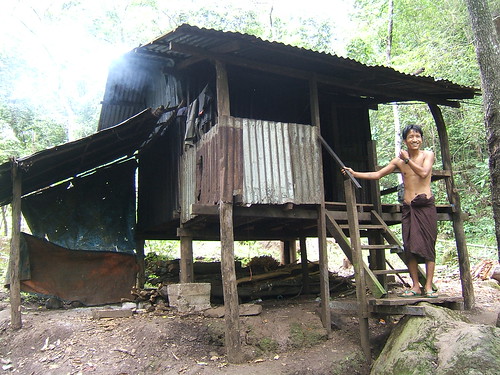
There were various concrete water tanks in the vicinity and lots of plastic water pipes running downhill in the direction we then took. This was the hardest part of the trek. Some way down the hill, the water pipes led in and out of a small complex of equipment rooms. Nearby was a shack occupied by a worker clad in a longyi, flip-flops and nothing else except a digital watch and a tattoo.

The worker poses outside his home.

The track now became easier to follow as we continued our descent. There were wheel tracks of a small motor bike but going up and down must be like motor cycle scrambling back home. We came to a concrete road which was much easier walking apart from it continually changing direction and going up and down following the contours. Where we had the chance to leave the road and take another track back to the resort, I was happy to take it.

Kyaw and the driver returned to their accommodation in the village and, feeling peckish, I had an omelette in the restaurant. Suitably revived, I booked another horse ride for three o'clock.

It was the same horse but a different horseman who again led the horse at an easy pace, only occasionally speeding up. We descended on the Resort road, finally making a left turn into the Environmental Education Centre operated by the Ministry of Forestry. There was a rather nice Exhibition Building, locked up until an aged caretaker appeared to open it up. The exhibits were a little sparse and sorry looking but still very interesting. I then toured the extensive gardens of 'Popa Medical Plants'. A second sign said 'Forest Department Medicinal Plantation'. The Medical Plant Library building was locked up and there was no sign of whoever tends the gardens.

Part of the extensive Medicinal Plantation.

I re-mounted my steed (with arthritis, easier said than done) and we made our way back to the Resort. Time for a short swim followed by a simple dinner once again on the verandah of the restaurant and then I'll try to post this report. I'll be sorry to leave the Resort on Saturday, but other attractions beckon.

Exploring Burma

Wednesday 26th October 2011

The aircraft to Yangon was a Thai A330 with 2+2+2 seating in business class. We boarded on time and then sat at the gate for almost an hour with engines stopped. I didn't find out why - probably Air Traffic Control delays. Eventually we taxied to the queue of departing aircraft and took off about the time we should have arrived in Yangon. They served a reasonable meal on the 1 hour flight. We landed and taxied to the International Terminal where the airbridge was promptly attached. After a few minutes walk, I had an early position in the immigration queue for 'Foreigners' and, after the usual amount of checking of passport and visa, I was admitted by the smiling young immigration officer. There was the usual huddle of passengers around the carousel in the baggage hall but I only had to wait a minute or two before my bag appeared. In the arrival hall, I easily found my guide as his board displayed the tour company (Sun Bird), the booking agents (Wexas) and my own name. Outside the terminal, we were picked up by the car for the transfer to my hotel. It was already pitch dark and most roads are not well-lit so there wasn't much to see on the 30 minute journey.

There was the usual warm welcome at the Strand Hotel. My air ticket for the next day's flight to Bagan was waiting so my guide checked the details and arranged to pick me up at 4.45 a.m. the following day. I'm on Asian Wings Airways AWM-891 due to leave Yangon for Nyaung U (Bagan), Mandalay and Heho. I arranged a wake-up call for 4.00 a.m. and a simple breakfast in my room for 4.15 a.m. before retiring to the comfort of room 103.

My computer attached to the hotel's Wi-Fi without difficulty but I was surprised to receive the following screen:-

"Dear Valued Customers,

On 17 October 2011, Due to the failure of SEA-ME-WE 3 submarine fiber optic cable, the Internet connection was unstable. It is being fixed by concerned personnel and during this period, the Internet connection may be significantly slow and possibly offline sometimes. We will keep you informed accordingly and we sincerely apologize for any inconvenience caused.
With regards,

Yatanarpon Teleport"

The hotel staff confirmed that the internet was very slow and suggested I might do better on the machine in their business centre. Having tried that with very limited success, I eventually gave up on the internet and went to bed.

There are pictures of the Strand Hotel here.

Thursday 27th October 2011

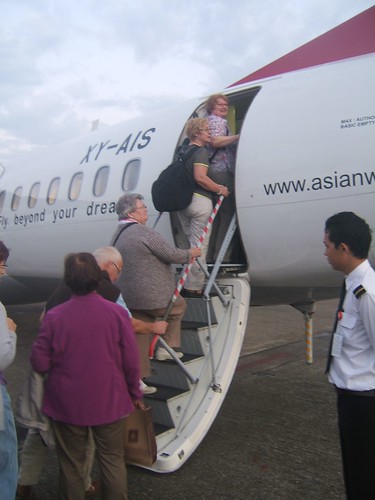
I was picked up at 4.45 a.m. as arranged and we arrived at the domestic terminal about 5.15 a.m. to catch Asian Wings Airways flight AWM-891. This is a new airline which started up in January this year, operating a couple of ATR-600 turbo-props. Check-in was painless and after waiting in the departure hall, I was surprised when the flight was called at about twenty to six. We sat in the bus for a while and then drove 100 yards across the tarmac to the waiting aircraft.

Boarding the Asian Wings flight at Yangon Domestic Terminal.

We were airborne just on 6.0 a.m. The cabin crew of a steward and stewardess served a simple meal and we landed at Nyaung U (the airport for Bagan area) around 7.15 a.m.

I easily found my guide Kyaw (pronounced 'chore') and, having located my luggage and the car with driver, we were soon on the way. I explained that I'd seen the major temples of Bagan but I was keen to see some of the smaller, quieter locations. We spent a wonderful couple of hours on dirt roads looking at minor temples and ruins. Amazingly, the souvenir sellers have some sort of radar which directs them to a tourist, even when on the 'road less travelled'. One girl with good English insisted she'd seen me the year before and I decided she was right.

The restored features of a once-large monastery.

My pictures of this exploration are here.

After these exertions in the hot sun, we took the hot, sweet tea that the Burmese love at a typical tea shop. The tea is made with condensed milk, as they also take it in India. Green tea is also available. I had one green tea and two cups of sweet tea whilst Kyaw contacted the Doctor on 'Road to Mandalay' by mobile phone to make arrangements for our meeting on Saturday morning. Then we set off for Mount Popa, pausing at Bagan railway station for me to check it out. The service is sparse so, as expected, we didn't see a train but I was able to take photographs of the infrastructure before we continued on the rather rough road to Mount Popa.

There had been heavy rain recently and, at a number of places, short-lived watercourses had flooded across the road. Although the watercourses had thoroughly dried-out again, the sand brought down by the water had been thickly deposited across the road. In addition, the water had damaged the tarmac road surface. We passed various road-mending gangs on our way to Mount Popa. Large heaps of crushed stone had been dumped at the roadside, together with drums of bitumen. A large, yellow road roller was usually in attendance for the final stage. But all the earlier stages of the work preparing the road bed and laying the roadstone was carried out manually, with large gangs of mainly women. I spotted one firepit where the bitumen was being heated ready for laying. A pit had been dug in the verge, a few feet long and a couple of feet wide. This had been filled with brushwood and set alight. Three drums of bitumen had been placed side-by-side across the pit and flames surrounded the drums.

Taung Kalat viewed from Mount Popa.

The flat plain gave way to hills and the road we were on twisted and turned as it climbed through the wooded landscape to arrive at the village at the foot of the astonishing column of rock topped with temples called Taung Kalat. The rock column sprouts from one side of the substantial extinct volcano of Mount Popa. The village was even more chaotic than the last time I'd visited because a section of the village street was closed for re-surfacing. Kyaw and I set off up the 777 steps (I didn't count them) to the temples at the summit. It was hot but conditions were better than on my last ascent when heavy rain had made the steps very slippery. We spent some time checking the views from the top before coming down. There were very few visitors and the souvenir sellers seemed preoccupied with taking lunch. We passed a group of around six Germans making there way up - they'd travelled from Yangon on the aircraft I'd been on.

My pictures of Taung Kalat on this trip are here.

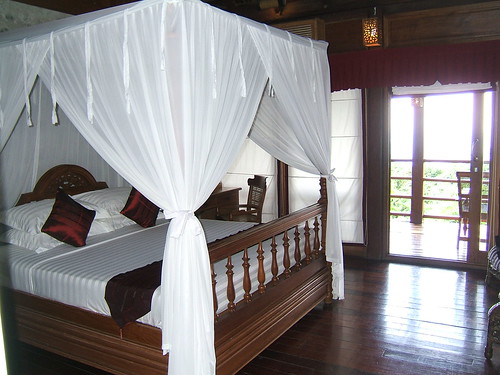
We located our car and driver and our car made its winding way up the mountain to Mount Popa Resort. I was expected and was quickly conducted to just the villa I'd imagined - semi-detached, wood and stone construction with a wooden shingled roof. The building was built on piles on the wooded hillside, with a spacious verandah looking across to the fairy-tale looking temples of Taung Kalat we'd just visited. The one wall of the bedroom was completely glazed so the view from inside was almost as good. I was absolutely charmed by the spot.

The splendid accommodation at Mount Popa Resort.

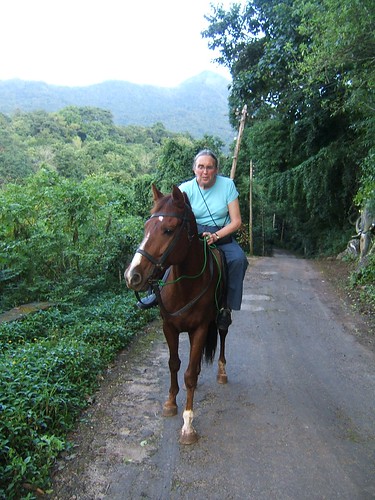
Feeling a little peckish, I ordered 'Fish and Chip' and a coke from room service which I enjoyed on the verandah. Afterwards, I looked at the infinity swimming pool (which also has views of the temple rock) but decided to try the horse riding first. As I expected, this was a little sedate but still marvellous fun. The horse was led through a forest road to the Deer Park, where I dismounted and was invited to look out for deer. We did spot a couple of deer but they remained a little distance away, suspiciously watching us and ignoring the enticing calls of the gamekeeper.

Jan, on the way back from the Deer Park.

On my return, I had a quick dip in the pool then relaxed a little before going to the dining room for a simple evening meal. I took my meal outside on the restaurant verandah which, of course, had a splendid view of Taung Kalat, now twinkling with electric lights in the warm evening air.

My pictures around Mount Popa Resort are here.

Wednesday, 26 October 2011

Bangkok and Beyond

We boarded the Eva Air 777-300ER on time but the aircraft was about one hour late pushing back. I'm afraid no announcement was made but there was a lot of bumping and clanging going on under the floor so I rather think they were late loading cargo containers. I couldn't see anything from my (port) side so I assumed loading was from the right hand side. After taxiing a short way in the shadow of the new control tower, we were stopped by red taxiway lights. Within a few minutes, we continued following the line of green lights, making a right turn to head east on the main taxiway which is parallel to Runway 27 Right (the departure runway in use that evening). A procession of aircraft roared past on their take-off roll as we advanced up the queue for departure. After eight or nine aircraft had preceded us, we took off, making a left-hand climbing turn to gain our route across southern England.

View of Heathrow's Runway 27 Right as our aircraft lines up for a rolling takeoff.

I managed to work out how to drive the AVOD system (Audio Visual On Demand) and had a brief look at 'Cars 2', but I wasn't in the mood for CGI so I switched to 'Too Big to Fail' about the banking crisis which I found gripping. Odd that, because it's just a series of scenes with people talking - no action. Meanwhile, they served a reasonable supper before closing all the window shades and dimming the lights. The seats are partially electric recline but not fully-flat and I slept only fitfully, in between watching a bit of 'Boardwalk Empire' and an episode of 'Mad Men'.

Our flight time was twelve and a bit hours, mostly at 600 m.p.h. and 35,000 feet. Our route took us overhead Myanmar (I always fantasise about parachuting out at this stage to avoid the rest of the flight to Bangkok, transiting and flying back to Myanmar). On the approach to Bangkok signs of the recent serious flooding were apparent. We turned south, flying parallel to Bangkok Airport which lay to our left. We continued to the coast, made a 180 degree left hand turn over the sea and a straight-in approach to the runway. Heading east, of course, we'd 'lost' hours so it was 3.15 p.m. local time when we arrived at our stand and the two airbridges were attached.

As I've said before, the architecture at Suvarnabhumi Airport isn't too bad - at least it's light and airy but the distances to walk are huge. The arrival concourse is one floor up from the ground and the departure concourse is up one further level. I followed the signs for 'Transit' and soon came to the security lounge where passengers and their hand luggage are scanned. A whole-body scanner is now in use for passengers. At least the staff are pleasant and helpful and after a few minutes an escalator disgorged me on the departure level, a few yards from the Thai transfer desks where I got my boarding pass and an invitation to the Thai lounge nearest my departure gate - a walk of over half a mile! So the Thai lounge is where I type this update, prior to boarding flight TG 305 for the short flight to Yangon.

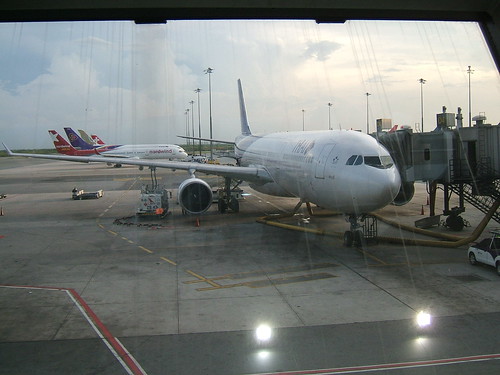
View of the Thai aircraft at Suvarnabhumi Airport shortly before boarding for Yangon.

There are more pictures of Suvarnabhumi Airport here.

I don't know what Internet access I'll have in Myanmar but, as possible, I'll keep you updated.

Tuesday, 25 October 2011

Back to Burma

Another journey starts! I'm returning to Burma (which we should now call the Union of Myanmar) for a short cruise on that magical river the Irrawaddy (as the English spelt it). In addition to the cruise, I'm finding out more about the various charitable initiatives organised through the cruise ship the 'Road to Mandalay' which is operated by Orient Express.

There are so many parts of the world I've not visited, I'm normally content to make one visit and then explore somewhere else. But Burma has had a special effect on me and this will be my fifth visit!

I'm writing this in the Admiral's Club Lounge at Heathrow Terminal 3. This is the American Airlines lounge but it's shared by the Taiwanese carrier Eva Air with whom I'm flying to Bangkok this evening.

Alan picked me up at home a little before 5.0 p.m. and drove me to Heathrow, passing through a number of tremendous rainstorms en route. Terminal 3 was reasonably quiet so check-in and security was not as tedious as it can frequently be. The airline lounge is a wonderful oasis of calm to prepare for the rigours of the 13-hour flight to Bangkok.

En route from the airline lounge to the aircraft, I spent a few minutes in the departure lounge - a vivid reminder of just how many people would be sharing the flight tonight!

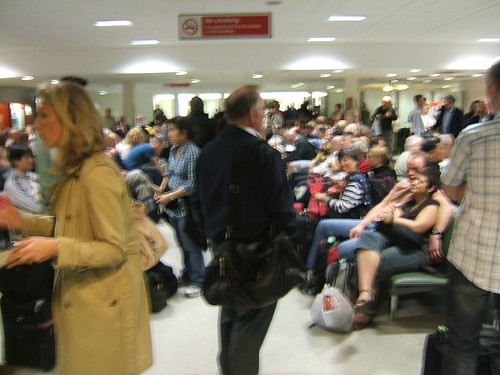
The departure lounge at Heathrow, just before boarding the aircraft.

This will be my fifth visit to Burma. There are lots of pictures from earlier trips:-

1st Visit in 2008 - Pictures are here. My first visit to Burma was part of a Round the World trip.

2nd Visit in 2008 - Pictures are here.

3rd Visit in 2009 - Pictures are here.

4th Visit in 2010 - These pictures can't currently be viewed, thanks to the demise of the fotopic photo hosting site. I'll re-post them as soon as I can.

One of the charitable initiatives in Burma run by 'Road to Mandalay' is Educational Support in poorer areas of the country. There are some pictures of a new building being opened at Htee Pu school (whilst I was in Burma during 2010) here.

Another initiative is a small Medical Centre in Bagan which started treating patients a couple of months ago. There are a few pictures of the building and its early clinics here. All being well, I'll see the clinic for myself on this trip.

I'll tell you more when I can but, for now, the 'Big Silver Bird' beckons.

Wednesday, 19 October 2011

Day Out with Thomas: October 2011

The Battlefield Line ran their final Thomas events of the year on the 8th, 9th, 15th and 16th October 2011.

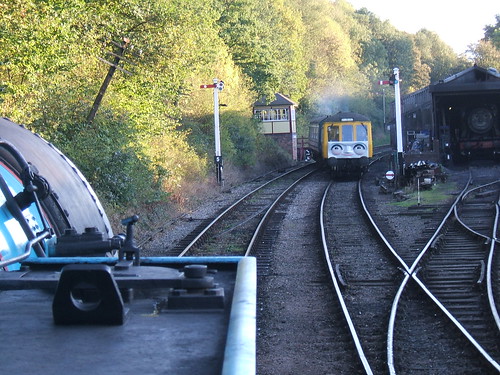
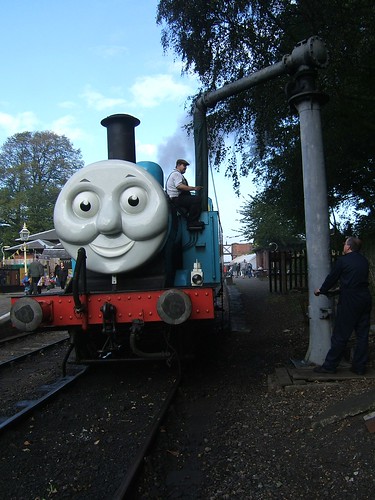
A view from the footplate of 'Thomas' as 'Daisy' slowly negotiates the crossover to Platform 1. This picture was taken late in the day on the 16th October, when 'Henry' (on the right) had already retired to the shed.

On the 9th October I was 'Driving Miss Daisy', the diesel railcar. Every time the service train arrives back at Shackerstone, the DMU dashes onto the single line. Originally, this allowed the locomotive of the service train to run round ready for its next trip to Shenton. However, most service trains in October were being 'top and tailed' so Daisy's foray onto the single line was being curtailed at the second bridge out from Shackerstone. The driver then changes ends and brings the DMU back to Shackerstone, usually platform 1. This allows Daisy's passengers to transfer to the service train on platform 2 for a trip all the way to Shenton.

The local authority have recently closed the footbridge at Shackerstone to await repairs, so at present access from platform 1 to platform 2 is solely via the sleeper crossing at the north end of the platforms. When the railway is closed, this footbridge forms part of a public footpath so local authority signs on the footbridge approach detail the detour which walkers must take.

'Daisy' performed flawlessly and I was able to carry out the 'diagram' as required. Although the ride is short, the passengers inevitably enjoy the 'extra treat' of a ride on the diesel railcar.

On the 16th October I was in charge of Thomas. Things didn't quite go to plan as there was no fireman and no trainee for 'Thomas' so I was faced with lighting up and oiling round on my own. Although the boiler was warm from the previous day's service, I hadn't obtained working pressure by 9.30 a.m. when 'Thomas' was booked to enter the station with the Fat Controller on the footplate and break a tape stretched across the line. Mick and Chris were in somewhat better shape on 'Sir Gomer' so we coupled the engines together and 'Sir Gomer' propelled 'Thomas' into the platform. By this time, 'Thomas' had 'made' reasonable pressure, so 'Thomas' was able to move independently, with Chris or Dave on the footplate with me. During the morning, we carried out the usual activities around the station. The Engine Races are always popular!

'Thomas' taking water. Chris checks the 'Bag' and Dave works the water valve.

We made a visit to the water column at the south end of platform 2 to top-off the side tanks ready for the 'Lunch with Thomas' service. Counter-intuitively, you turn the water valve on the column clockwise to open it. Perhaps this is an oddity of the Island of Sodor Railways? 'Bo-Co' (with the usual pair of wheels missing as our loco is actually a 'Bo-Bo') arrived from Shenton on Platform 1 and we backed 'Thomas' onto the train, which rapidly filled with passengers.

'Thomas' at the head of the 'Lunch with Thomas' service ready to depart from Platform 1 at Shackerstone.

Although he was unfamiliar with the engine, Mick came on board as fireman for the run. With a heavily-loaded 5-coach train and 'Bo-Co' as a trailing load, 'Thomas' was worked quite hard but Mike maintained good boiler pressure throughout the run. Quite a few passengers got on or off during our stop at Market Bosworth then it was on to Shenton. Because we were top and tailing, we had no more work to do for a while as 'Bo-Co' hauled the train back to Shackerstone.

Once back at Shackerstone, we spent the afternoon doing Engine Races, playlets (this time it was Jan who had water thrown at her), singing the 'Thomas' song and even giving Brake Van rides. 'Thomas' picked up the 'Tidmouth Dairies' milk tank wagon and a brake van and gave rides from the north end of Platform 2 to just past the signal box.

The last train of the day was 'Tea with Thomas' so we watered and stood clear whilst the main train arrived in Platform 2. 'Bo-Co' uncoupled from the train for we were to take it 'on our own'. Mick was to fire again but Danny (who'd been on 'Henry' all day) came as well, to give some pointers to Mick. We had a good run, stopping at Market Bosworth then continuing to Shenton. We ran round fairly smartly and returned to Shackerstone with a brief pause at Market Bosworth as the sky darkened.

Once uncoupled from the train, we shunted to Platform 1 opposite a spare locomotive spring which was lifted onto the footplate. Rather than go on shed, the locomotive was to be loaded onto a waiting low-loader for the road journey back to Llangollen.

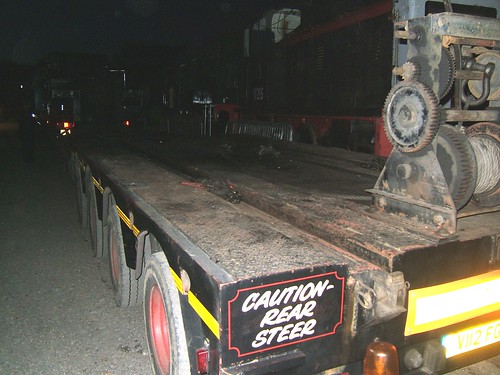
By 6.30 p.m., it was already dark and a low-loader was in position, being prepared for hauling 'Thomas' aboard. The following day, 'Thomas' was returning to Llangollen by road.

Having cleaned the fire and filled the boiler, Adrian took over the engine and moved it to the north end. The transport contractor then positioned the low-loader trailer stradding the track so that 'Thomas' could be winched onto the trailer.

After a fairly heavy 12-hour shift, I was happy to 'Book Off' at this point and leave them to it.

My pictures taken on the 16th October are here.

Friday, 14 October 2011

NADFAS visit to Brewood Hall

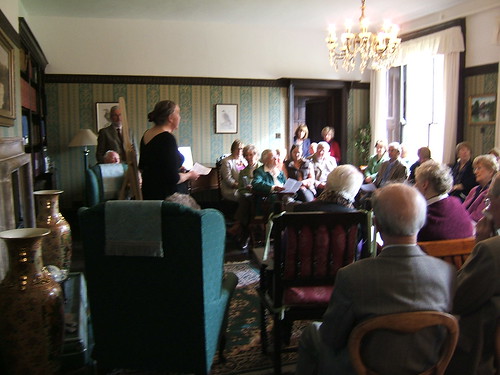
Jan Ford talks about the history of Brewood Hall.

On the 13th October 2011, around 40 members of the local branch of the National Association of Decorative and Fine Arts Societies (NADFAS) visited Brewood Hall. The members gathered in the Lounge Hall at 11.30 a.m. and Jan talked about the history of the Hall and the conservation work which has been carried out. Members had been asked to bring at packed lunch so at 12.30 p.m. individual groups of members settled down for a snack, distributing themselves in the dining room, lounge hall and (since the weather was mild) the kitchen yard and the front steps.

A group of NADFAS members taking lunch.

For the tour of the principal rooms on the ground and first floors, the visitors were divided into two groups. Whilst Jan conducted the first group on a 30-minute tour around the building, the second group were invited to explore the 1 acre of gardens and see the inside of the restored Small Barn. Jan then took the second group around the Hall allowing the first group to visit the garden and Small Barn.

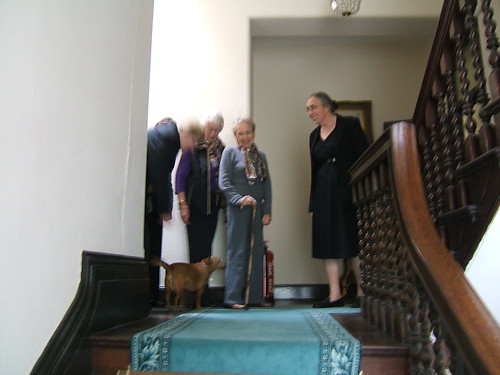
Jan taking the visitors around the building, accompanied by Marion's dog Harry.

NADFAS are a substantial organisation in both education and conservation in connection with our heritage in decorative and fine arts. They are active at around 340 locations in the U.K. and Europe. For more information, go to their website.

Jan and visitors chatting in the Victorian Sitting Room.

All the visitors appeared to enjoy the opportunity to see a little more of Brewood Hall. Once again, thanks are due to Marion Reeves for her help with this visit. There are more photographs of this visit here.

Wednesday, 12 October 2011

Tai 1996 - 2011

On the 8th October 2011 I lost my dog Tai to the inoperable tumour that had been growing for the last four years.

There's an earlier piece on Tai here and pictures in the set Tai and Friends. He was a very gregarious dog so he also pops up in the set Friends and Family at Brewood (and a few other places). He was a loyal and loving companion and, even at the end as his mobility became compromised, his spirit was undiminished.

He was a very special dog and will be greatly missed by me and all his many friends.

Tuesday, 27 September 2011

The Stour Valley Line

In the early 1960s, I was a regular visitor to a number of signal boxes in the West Midlands and there's a series of posts about my experiences. At the time, I lived in Wolverhampton but most of the signal boxes I visited were in the Tipton and Dudley Port area. I was working for a local company as an Electronics Engineer, so most of my visits were on a Saturday. Going through the Notebook I've recently found for Sedgeley Jn., I'm surprised at what a regular visitor I was. It seems that most Saturdays saw me leaving home early to visit one of my friends in a Signal Box.

My home was about 30 minutes walk from Wolverhampton High Level Station and I must have set off somewhere between 6.0 a.m. and 6.30 a.m. Occasionally, I'd get a trolleybus to town (yes, Wolverhampton had trolleybuses until 1967) but they were a bit thin on the ground at that time of day so I'd usually walk.

On arrival at the station, I'd get a return ticket to either Tipton or Dudley Port (according to where I was headed and what trains were running).

The Sedgeley Jn. Notebook includes brief details of some of these journeys, so I thought we'd take a look. Original notes are in italics with recent comments in square brackets.

Visit to Sedgeley Jn. Mon 24th December 1962

From Wolverhampton platform 2 with two ‘Type 4’ in multiple – D268 and D229. [Clearly, a London service].

Visit to Sedgeley Jn. Sat 12th January 1963

I travel on 1B03 departing Wolverhampton at about 7.15 a.m. The 6.55 a.m. Up Local is still stuck in the Down Bay, boxed in by a 2-car DMU. 1M16 arrives just before we leave.

Visit to Sedgeley Jn. Sat 26th January 1963

I travelled on an Up DMU which arrived Dudleyport at 8.59, departed 9.0 a.m. I later discovered that the Guard arrived back on foot at 9.08 to report the DMU failed in the section. With a Wrong Line Order, the Parcels Engine went onto the DMU at 9.23, dragged it back and cleared the main line at 9.36. It was arranged that the passengers off the stranded DMU would be taken forward by 1B08. There was one passenger for Oldbury so a Special Stop Order was issued to 1B08 so that the Oldbury passenger could be set down. The failed DMU was left at Dudleyport until an engine could be found to drag it back to the Depot. [The Wrong Line Order would be issued by the Dudley Port Signalman to the driver of the Parcels Engine, allowing him to return to Dudley Port, dragging the failed DMU. An impressive example of an operational problem swiftly dealt with].

Visit to Sedgeley Jn. Sat 9th February 1963

To Dudleyport from Wolverhampton behind 46228, "sounding like an engine!". [Presumably a London service and a welcome change from diesel haulage]. Noted that 61018 is ‘Gnu’ [?]

Evening Visit to Sedgeley Jn. February 1963

50460 is Dudley end of local. 6.30 p.m. Wolverhampton – Burton is a 2-6-0 tender first with a British Rail 1st/2nd Composite and an ER Brake/2nd Composite! [Rather cryptic, I'm afraid].

The London and North Western Railway

The London and North Western Railway called itself 'The Premier Line' for some years. The railway could not be accused of false modesty! It was run for many years by Captain Mark Huish (1808 - 1867). Later, with Sir Richard Moon (1814 - 1899) as Chairman and with the towering, if controversial, figure of Francis William Webb (1836 - 1906) as the Chief Mechanical Engineer ruling his empire at Crewe with a rod of iron, the railway was bound to have a high opinion of itself. But in many ways, that opinion was justified. The railway was a joint stock company, owned by its shareholders, so the first measure of success was did its shareholders receive a good dividend? Yes, they did - consistently.

The railway boasted some of the finest permanent way in the country, made possible by the steelworks using the Bessemer process set up at Crewe so that the railway could manufacture its own rails, in longer lengths than otherwise available, reducing the number of rail joints and improving ride quality.

Webb believed that manufacturing in-house led to highest quality and lowest cost to the railway so Webb is also responsible, amongst other things, for the distinctive L.& N.W.R. signals and signal boxes. There's a little on L.& N.W.R. signalling here and on the 'Crewe' All Electric signalling system here. Steam Index has a wonderful Webb collection here.

1054 at the Battlefield Line in 1997 (Photo: John Fairclough).

But, of course, Webb is best known as a locomotive designer. The only Webb locomotive I've had an opportunity to drive is the preserved 'Coal Tank' number 1054, when she visited the Battlefield Line in 1997.

Slideshow at Brewood

Clockwise from left front: Phil, Mick, Ian, Dave, John, Keith.

My friend Phil arranged for Keith to give a slideshow on 18th March 2011 to a small group of interested people. Keith talked about his involvement in the partial restoration of the main station building at Wolverhampton Low Level. Needless to say, there was also animated discussion during the evening of other historical railway subjects. Present were Phil, Mick, Ian, Dave, John, Keith and Jan.

Clockwise from left front: Dave, John, Keith, Phil, Mick, Ian.