Sunday, 31 January 2010

Spring Vale Electrical Controls (Part 2)

Part 1 of this series introduced the drawings detailing the electrical controls at Spring Vale Sidings Box. There's a brief description of this signal box here. It's helpful to keep in mind the layout, shown below. Clicking on any diagram gives an enlarged image which can be downloaded or printed.

In this instalment we'll look at Block Control on the Up and Down Lines (shown on sheet 2 of the drawing set).

Introduction to Block Control:

Early block instruments were purely communication devices. The safe working of trains depended upon the signalman only giving 'Line Clear' for a train to approach when it was safe to do so. Various improvements were introduced, like 'Sykes Lock and Block' and 'Interlocking Block' but these were partially mechanical systems, not completely foolproof and were not universally adopted. Over the years, successive accidents revealed weaknesses which could be guarded against by adding electrical controls.

Signal Proving:

One source of accidents was trains running away because signals were not displaying a 'Stop' aspect when required, either through a Signalman's direct error or because the position of the signal arm did not correspond with the position of the controlling lever in the signal box. At night (or in conditions of low visibility) a signal lamp 'out' could similarly result in running away.

Normally, 'Line Clear' was given to the box in rear before permission had been obtained for the train to proceed into the section ahead. This was perfectly safe provided that the Home signal was at danger so as to stop the approaching train. In addition, the Distant signal should be at Caution, as advance warning to the driver of the need to stop at the Home signal.

Let's summarise the electrical interlocks required:-

(1) Prove signal arms 'on': The mechanical interlocking on the lever frame responds to the position of the lever - there is no information about the actual position of the signal arm controlled from the lever.

(2) Prove Home signal lever 'Normal' and electric lever lock not energised: This ensures that the Home signal levers are correctly Normal at the time 'Line Clear' is given to the box in rear.

At Spring Vale, Block Control was provided on both the Catchems Corner and Deepfields block instruments to ensure that the relevant Home and Distant signals were 'On' before 'Line Clear' could be given to the box in the rear. The detailed circuit is described below.

Catchems Corner direction:

On the Up Main, the criteria for accepting a train offered from the Catchems Corner direction were:-

- Up Distant Signal Arms (19a/19b) proved 'On'.

- Up Home Signal Arms (levers 20 & 23) proved 'On'.

- Up Home Signal Levers (20 & 23) proved 'Normal' and electrically locked.

On the right of the diagram above is the block instrument to Catchems Corner with two polarised galvanometers and the commutator switch. The right hand side of each galvanometer connects to line and thence to the block instrument in the Catchems Corner direction via contacts on the Block Switch ('BNC'). The Block Switch contacts are closed when Spring Vale Sidings box is 'Open'. On the Up Main, separate batteries are provided for giving 'Line Clear' and 'Train on Line'. Negative 'Line Clear' battery is fed via contacts: '20LCC' (Lock Proving Contact on 20 lever lock, proving lever normal and lock not energised), '23LCC' (Lock Proving Contact on 23 lever lock, proving lever normal and lock not energised), '20RGCR' (contact on Red Signal Proving Relay for signal 20), '23RGCR' (contact on Red Signal Proving Relay for signal 23),'19YCR' (contact on Yellow Signal Proving Relay for signals 19) to the 'LC' pole of the commutator. If the control conditions are met when the signalman places the Block Instrument Commutator to 'Line Clear', current flows from the battery, through the proving contacts, through the commutator at 'Line Clear', through the closed front contact of relay 'T1TPS' (track Circuit 1 Track Repeating Stick Relay), through the coil of polarised relay 'UP MAIN BS' (Block Stick Relay) and via a current limiting resistor to the positive of the 'Line Clear' battery 'RET'. A stick relay is one which, once operated, self-maintains. The 'UP MAIN BS' contact shorts out the chain of proving contacts, allowing the signalman to obtain 'Line Clear' from the box in advance and clear his signals, without losing the 'Line Clear' to the box in rear.

Can we come back to a proper discussion of 'T1TPS' in a later installment? For now, assume that track circuit T1 (the Up Main 'Berth' track circuit) is clear and that 'T1TPS' is energised.

Note, in passing, that the 'DN MAIN BCR' (Block Proving Relay) is a polarised relay which will energise only when 'Line Clear' polarity is being received from Catchems Corner direction. Energisation of this relay is used to release the down signals at Spring Vale Sidings.

Deepfields direction:

On the Down Main, the criteria for accepting a train from Deepfields direction were:-

- Down Distant Signal Arms (37, 36a/36b) proved 'On'.

- Down Home Signal Lever (35) proved 'Normal' and electrically locked.

Similarly, on the right of the diagram above is the block instrument to Deepfields. On the Down Main, separate batteries are provided for giving 'Line Clear' and 'Train on Line'. Negative 'Line Clear' battery is fed via contacts: '35LCC' (Lock Proving Contact on 35 lever lock, proving lever normal and lock not energised), '36a/b YCR' (contact on Yellow Signal Proving Relay for signals 36a/36b), '37YCR' (contact on Yellow Signal Proving Relay for signal 37) to the 'LC' pole of the commutator. If the control conditions are met when the signalman places the Block Instrument Commutator to 'Line Clear', current flows from the battery, through the proving contacts, through the coil of a polarised relay 'DOWN MAIN BS' (Block Stick Relay) and via a current limiting resistor to the positive of the 'Line Clear' battery 'RET'. The 'DOWN MAIN BS' contact shorts out the chain of proving contacts, allowing the signalman to obtain 'Line Clear' from the box in advance and clear his signals, without losing the 'Line Clear' to the box in rear.

Note, in passing, that the 'DN MAIN BCR' (Block Proving Relay) is a polarised relay which will energise only when 'Line Clear' polarity is being received from Deepfields direction. Energisation of this relay is used to release the Up signals at Spring Vale Sidings.

In the next instalment, we'll talk about Lever Locks.

Princes End Electrical Controls (Part 2)

Part 1 of this series introduced the drawings detailing the electrical controls at Princes End after it became a Fringe Box to Wolverhampton Power Signal Box. There's a brief description of this signal box here. It's helpful to keep in mind the track layout, shown below.

This simplified and approximate diagram shows Princes End with the single line to Wednesbury on the left and the double track to Tipton Curve Junction (controlled by Wolverhampton PSB) on the right. Clicking on any diagram displays a higher-resolution version which can be downloaded or printed

Layout of Relay Room

Layout of relay room at Princes End

All the relay rooms on the West Midlands Resignalling were more-or-less the same size - they certainly all followed the same basic design. Whereas some of the main-line relay rooms were packed with equipment, there was plenty of spare space at Princes End, with cable terminations on one long wall, battery chargers on the other long wall and equipment in the middle of the room.

Cable Terminations

One long wall was dedicated to cable terminations for signalling, telecommunications and power cables. All cables entered the relay room underground from the concrete trough cable route outside. The signalling cables were terminated on substantial test disconnection links to facilitate tracking down faults. The other side of the disconnection links was wired via overhead cable trays to the equipment. Cables PE1 and PE6 both ran to Location Case PE2/1. Cable PE2 ran to Location Case PE2/2. Cables L1 and L2 ran to the signal box. Finally, track circuits 464 and 467 had their adjustment resistors (464TO and 467TO), fusing and links mounted on the termination panel.

Layout of Cable Termination Panels at Princes End

Relay Racks at main line relay rooms

The West Midland Resignalling introduced 'Geographical Interlocking' using pre-wired relay units each dealing with a standard signalling function such as a 'Main Signal' or a 'Single Ended Point'. These standard units were then interconnected by multicore cables plugged into plug couplers, allowing rapid replacement during fault-finding. Relay racks mounting the 'Geographical' units were normally in one or more rows away from the walls giving technicians access to both the front and rear of the racks.

Relay Rack at Princes End

Princes End was a much simpler proposition, with only a few relays to be accommodated, so the relay rack was 'free-wired' (as all relay interlockings had been prior to the adoption of 'Geographical' units). Next to the relay rack, the Standard Telephones and Cables Train Describer was housed in an equipment cubicle with hinged access doors.

Layout of relay rack at Princes End

The relays were mainly Westinghouse style 'P'. This series of miniature plug-in railway signalling relays was the immediate predecessor to the 'BR930' plug in relays still used today.

The top row of relays were for signal and miscellaneous relays. The Down colour-light starter (lever 6) needed 3 relays, plus 1 relay associated with the next signal (WN186, controlled by Wolverhampton). The Up Home 1 (lever 19) needed 6 relays. There were 4 style 'J' relays for miscellaneous functions. The second row of relays mounted 11 relays associated with track circuits. The remaining rows were unused, apart from two style 'R4' Track Feed Sets for track circuits 464 and 467.

Power

A secure Signalling Supply of 650 volts a.c. was fed throughout the area to power Location Cases and Relay Rooms. The relay room at Princes End had a 1 kVa step-down transformer to 110 volts a.c. which was distributed to various power supplies, low voltage transformers and battery chargers. The diagram below shows two 50 volt d.c. supplies, two 12 volt d.c. supplies (one with battery back-up), 12 volts a.c. (for the lamps on the illuminated diagram at Princes End) and 110 volt a.c. supplies.

Note the way in which supplies were designated. 'B' identified the positive and 'N' the negative. The nominal voltage was appended, for example 'B12' meant 12 volts positive Where there were multiple supplies with the same nominal voltage, suffixes were added such as 'N50(S)'. Alternating supplies had an 'X' added such as 'BX110'.

Power Supply Layout

The Fuse Panel for all the supplies was located on the end of the relay rack. Layout and Allocation of Fuses

In the next instalment (here), we'll tackle some of the relay circuits.

Thursday, 28 January 2010

Spring Vale Electrical Controls (Part 1)

In the 1950s, mechanical signalboxes were still very common, where semaphore signals were operated by wire and points by rodding from a mechanically-interlocked lever frame in the box. Block Signalling Instruments were used to authorise the passage of trains between signal boxes. Over the years, various other electrical controls were applied, on a piecemeal basis, according to perceived risk.

Introduction:

As an example, we can look at the situation which applied at Spring Vale Sidings box in 1961 (after remodelling). There's a brief description of this signal box here. It's helpful to keep in mind the layout, shown below. Clicking on the layout gives an enlarged image which can be downloaded or printed.

The Drawings:

A group of six drawings detailed the electrical controls and a set of dyeline prints was kept in the equipment cupboard at the box for use by the Signal & Telegraph Lineman during his visits. The drawings were controlled by the London Midland Region Divisional Signal Engineer's Office at Crewe. I managed to obtain a partial set of drawings which have been scanned. The index to these drawings is here. The image can be viewed in various sizes, downloaded or printed. The assistance of British Railways back in the '60s in furnishing these obsolete drawings is acknowledged.

Drawing Symbols and Labelling Conventions:

The symbols for the various circuit elements are drawn in the style used back then and, in general, the symbols are peculiar to railway signalling so they may be unfamiliar. Nowadays, much simplified symbols are used (although these are probably harder for the novice to follow). The student also has to get used to the letter codes used to label components. A group of letters and figures is used to identify each component. For instance, the designation '20RGCR' means [20][Red][Signal][Proving][Relay]. Once you've mastered the principal codes, understanding diagrams becomes much easier.

The Drawing Set:

This set of drawings was numbered CW.137/59/x, where 'x' was the sheet number. These drawings were prefaced by a Contents and Ordering page. The 'Contents' gave details of the drawing pages and 'Ordering' was a brief stores description of the various electrical items. The list of sheets was as follows:-

1 : Controls (I'm afraid this sheet has not survived)
2 : Block Control
3 : Lever Locks
4 : TPR's, TPS & TXR
5 : Repeating
6 : Bonding (later version)

There is also an earlier bonding diagram, before remodelling here and a later diagram outlining alterations to be made here.

Each of these sheets can be viewed in various sizes, downloaded or printed.

In the next instalment (here), we'll look at these sheets in a little more detail.

[For a long time, many of the above links stopped working, as explained here. I've finally restored most of them. Hope it helps: 28-Dec-2015]

Saturday, 23 January 2010

Princes End Electrical Controls (Part 1)

Introduction:

In the 1960s, British Railways modernised the signalling in the West Midlands as part of the 25kV Electrification Project. Westinghouse was the signalling contractor for new Power Signal Boxes at Wolverhampton, Birmingham, Walsall and the Down Tower at Bescot. Control of the North Stour was transferred to Wolverhampton Power Box and a number of the mechanical boxes I'd been familiar with were either abolished or downgraded to Shunt Frames. However, Princes End box was retained as a Fringe Box to Wolverhampton. This involved significant changes. After these changes at Princes End, I had the opportunity to work the box (unofficially) a number of times, as described in an earlier article. Although the main line signalling installations are still in use, after the Princes End Branch was closed the track was lifted and very little remains today of this once-important freight route.

This fairly recent view Wolverhampton Power Box shows that it is little altered externally and (unlike some Power Boxes like Trent, Saltley and Derby) retains its flat roof. Larger overhanging fascias have been fitted, presumably because of difficulties viewing the signalling console in strong sunlight

Principal Changes at Princes End

This simplified and approximate diagram shows Princes End as a Fringe Box, showing the single line to Wednesbury on the left and the double track to Tipton Curve Junction (controlled by Wolverhampton PSB) on the right. Clicking on the image displays a higher-resolution version which can be downloaded or printed

Continuous track circuiting was introduced on the Up and Down lines on the Wolverhampton side of Princes End Box so that the former Absolute Block working could be replaced by Track Circuit Block (TCB) working. Although a single-stroke bell and 'tapper' was provided to communicate with Wolverhampton Power Signal Box, in general trains were sent and received using a Train Describer. The Up Home 1 signal was replaced by a 3-aspect colour-light and the Down starting signal was replaced by a 4-aspect colour-light. To accommodate the necessary equipment, a relay room was built on the Up side, a few yards on the Wolverhampton side of Princes End box. The relay room was a substantial flat-roofed affair in blue brick, similar in design to all the relay rooms provided in connection with the Wolverhampton re-signalling. In addition, steel Location Cases ("Locs") were provided periodically along the route to house relays and other equipment associated with track circuits and signals. The Location Cases, Relay Room and Princes End Signal Box were interconnected, as necessary, by rugged signalling control cables laid in sectional concrete troughing at the side of the running lines. Each troughing section comprised a 'U' shaped duct closed by a flat lid. The Signalling Power Cable and Telecommunications cables also used the concrete troughing.

The Drawings:

I was interested in the methods of electrical control employed and took every opportunity to study the changes which had been made. Eventually, I managed to obtain prints of some of the drawings which had been used during the installation and commissioning phase. I've made 'quick and dirty' photographed copies of these drawings - the index to these photographed copies is here. Alternately, the links in the section 'The Contractor's Drawings' below take you directly to an image of each individual sheet. The image can be downloaded or printed. The assistance of British Railways back in the late '60s in furnishing these drawings is acknowledged.

'Red Lined' Drawings:

Some of these drawings had required change during installation and commissioning and had been 'Red Lined'. The required changes were made by hand (in red) on dyeline copies of the affected drawings. On completion of the work, the changes would have been permanently incorporated on the drawing 'Master' held in the design offices. In the mid '60s these Masters were usually drawn in ink on translucent linen or plastic drawing film, so as to be durable and suitable for using to take dyeline copies. Once the Masters were updated and reviewed, fresh, corrected dyeline copies could be issued for record and maintenance purposes. There are some inconsistencies between the sheets presented here but hopefully these will not prevent some understanding of the principles involved.

Drawing Symbols and Labelling Conventions:

The symbols for the various circuit elements are drawn in the simplified style now used. They're probably a little harder to follow than the earlier symbols (mentioned in the post Spring Vale Electrical Controls). The student also has to get used to the letter codes used to label components. A group of letters and figures is used to identify each component. For instance, the designation '19GCR' means [19][Signal][Proving][Relay]. Once you've mastered the principal codes, understanding diagrams becomes much easier.

Lever and Signal Controls:

There is one drawing prepared by British Railways (LMR). This drawing (NW630385/8) shows requirements for new Lever and Signal Controls as a table. The remaining drawings detail how those requirements are implemented.

The Contractor's Drawings:

The remaining drawings detail the electrical controls at Princes End and these were prepared by Westinghouse for British Railways. The Westinghouse drawings were numbered L2689/x where 'x' was the sheet letter or number. The list of sheets was as follows:-

/A :Index
/B :Layout of Relay Room
/C :Layout of Relay Rack (currently unavailable, sorry)
/D :Power Supply Layout (currently unavailable, sorry)
/E :Layout and Allocation of Fuses
/F1 :Cable Terminations (Relay Room)
/F2 :I'm afraid sheet /F2 has not survived.
/G :Contact Analysis
/1 :5(N) Lock & 6 Signal Selection, Control, Lighting & Indication Circuits
/2 :19 Signal Selection, Control, Lighting & Indication Circuits & 462 TJR circuit
/3 :Incoming & Outgoing TPR Circuits
/4 :Filament Failure & (PO) Indication Circuits
/5 :Track & Signal Indication Circuits
/6 :18(N) Lock & Single Line Working Circuits
/7 :Typical Unit Wiring.

I've also included a drawing fragment showing the Key Token Instrument wiring here.

In the next instalment (here) we'll look at some of these sheets in a little more detail.

[For a long time, many of the above links stopped working, as explained here. I've finally restored most of them. Hope it helps: 28-Dec-2015]

Friday, 22 January 2010

Review of the Year - 2009

The year just finished seems to have scrambled past with undue haste. I've been lucky, once again, to have accumulated a stock of new experiences.

What stands out?

Modern Railways

Rail journeys in the U.K. usually bring out the worst in me and, in January, I was grizzling in 'Brave New Railway'. The picture shows a Virgin 'Pendolino' at Euston. I'd return to this theme later in the year in 'Brave New Railway (again)'. Just to be scrupulously fair, I must point out that, on one occasion during the year, we left on time and arrived in Euston on time. I was quite excited until my return later in the day - twenty minutes late into Wolverhampton.

Germany

At the end of January, a business trip took me to Frankfurt and Mannheim. We flew from Birmingham to Frankfurt and then took the train to Mannheim. The picture shows a statue of Goethe in Frankfurt. I like Germany and was impressed by the trains we travelled on - see High Speed Trains. Having taken a number of pictures of the station at Mannheim and 'snatched' pictures of a number of signals on the journey back to Frankfurt, I was inspired to write a piece about German Railway Signalling. Whilst Britain developed 'Route Signalling' which tells the driver the line he is to travel on, Continental practice uses 'Speed Signalling' where the driver is given a maximum safe speed but the actual line is not identified.

Egypt

March saw me on another river cruise - this time on the Nile aboard the luxurious 'Zahra'. Impressed with the antiquities I had seen on an earlier visit to Egypt as part of my 'Round the World Two' trip (see entry for 9-Feb-2005 in my report here), I'd determined to return to look at some of the temples on the Nile. They did not disappoint. I didn't make any rail journeys but the visit was not completely devoid of railways and a short visit to Aswan station at breakfast time one day was particularly enjoyable.

Jordan

After Egypt, I spent a week travelling through Jordan by car from Amman down to Aquaba. I achieved a childhood ambition by swimming in the Dead Sea which is extremely buoyant because of the high salt levels. High point of Jordan was my visits to the Red Rose City of Petra. This ancient city of the Nabateans features a number of amazing buildings carved into the living rock. I was so impressed by my first full-day visit that I returned early the next day for a morning visit. You can find all my posts on this holiday to Egypt and Jordan (with links to my photographs) here.

Restored '8F'

The long-awaited debut of the '8F' locomotive restored at Peak Rail took place on Saturday 23rd May and I was fortunate to be on the footplate for part of the day. The day was not without drama. I prepared the locomotive at Darley Dale and travelled light to Rowsley (coupled to 'Royal Pioneer') but the Traction and Train Crew Officer decided to drive the first trip carrying members of the '8F' Society. When the train returned to Rowsley, it had developed a hot big end, so I took over a 'sick' engine which was repaired in record time by the '8F' Society restoration team. Belatedly, the '8F' triumphantly entered revenue service. There's a report here linked to pictures.

New Platform at MOSI

On Saturday, 27th June, I was the driver on the 'Planet' replica when the new platform was inaugurated at the Museum of Science and Industry in Manchester. When I wrote a report on this development, I was reminded that I've been a volunteer here for over 21 years. The 'New' platform is, more or less, back where the original platform was when I became a working member of the Friends, although the platform now serves the next line across as the original line has been 'lost' to car parking space.

Lionsmeet 2009

'Lionsmeet' at York on 1st August hit bad weather this year but our hosts made up for it with their hospitality. Once again, Jan was 'volunteered' to act as official observer, taking the results from the Dynamometer Car. The site is next to the East Coast Main Line so it was odd to see main-line electrics and diesels passing, as I commented in my report.

Peak Rail War Weekend

The day after 'Lionsmeet 2009', I was on the footplate of 'Royal Pioneer' at Peak Rail for the War Weekend. Fortunately, the weather was much better than at 'Lionsmeet'. There were lots of military exhibits and re-enactors around and the kind weather encouraged large numbers of visitors. There's a brief report here.

Transport Festival

Later in the month, the Museum of Science and Industry in Manchester hosted a very successful 'Transport Festival', with an emphasis on the locomotives of Manchester-based Beyer Peacock and their distinctive 'Beyer-Garrett' articulated types. The Festival lasted over a week and I was on the footplate on a couple of days. On certain days, Bus Trips had been organised to the former Beyer Peacock works in Gorton, where the Boiler Shop survives. I was fortunate enough to be able to join one of these trips. Click here for more details.

Trip to Far East

On the 23rd August, I started another adventure in the Far East. I wrote quite a bit about this trip which took in Bangkok, Burma, East Bengal (well, Kolkata) and the magical kingdom of Bhutan - you can find all my posts here. It was good to return to Burma and join the 'Maiden Voyage' of the 'Road to Mandalay' after extensive repairs and refitting necessitated by Cyclone Nargis. I was able to meet all my friends from earlier trips (and make some new ones) and find out more about the educational and medical work sponsored by Orient Express staff. Moving on to Bhutan, I saw a little of what I think is the most improbable country I've visited - part internet generation, part medieval.

Brewood Hall Tour

Although Brewood Hall is a private house, we occasionally have visits from interested groups. There have been a couple of visits by the Civic Society and, on the 19th September, as part of their Heritage Month, Staffordshire Libraries organised a walking tour of interesting sights around Brewood Village led by Dave Evans. The tour ended with a visit to Brewood Hall where Jan Ford outlined some of the history of the Hall as the visitors were taken round the principal rooms. There's a brief report here.

Corporate Day

Sometimes, commercial organisations (particularly those operating in the railway industry) organise functions for selected clients at preserved railways. This year, Peak Rail hosted a corporate day for STRail on 7th October. I was on the footplate of the '8F' with Derek and we took turns driving and firing. After a formal session at the Whitworth, the delegates were able to enjoy lunch on the train before alighting at Rowsley for an opportunity to study the STRail level crossing products on display. The maroon '8F' was much admired and a couple of managers were given a footplate ride. This was an unusual and enjoyable day - report here.

Thomas and Friends

Once again, Shackerstone hosted 'Thomas and Friends' on a number of weekends in the year. The 'Thomas' franchise is very strictly controlled by Hit International and events are frequently audited by their staff.

In June, I had one day driving 'Daisy' the DMU. In October, I had two days on 'Thomas' and one day on 'Daisy'. It's always good fun to see how fascinated the children are by steam, even if the loco crew occasionally get wet in one of the 'Water Games'. My report is here.

Scouts at Brewood Hall

Brewood has an active Scout group and one of the Scout Leaders suggested that a visit would be of interest to the young people. I readily agreed so, one evening in November, it was the turn of Brewood Scouts to have a short conducted tour of the principal rooms at Brewood Hall, followed by biscuits and orange juice. There's a short report with a link to a few more pictures here. There were lots of questions and it was quite a jolly event. It would be good to repeat the tour in summertime, with the benefit of light evenings.

Santa Specials

The 'Santa Specials' at Peak Rail handled record numbers in 2009. Santa Claus was in attendance, as usual, assisted by lots of helpers to make sure that all the children received presents. At many preserved railways, a disproportionate amount of the annual turnover is earned in the period leading up to Christmas, so it does get a bit frantic and volunteers are usually in short supply to cover all the extra tasks.

Peak Rail ran a maximum-length 7-coach train which was top-and-tailed by two steam locomotives this year. I had one day driving 'Royal Pioneer' and one day on the '8F' - see report here.

Mince Pie Specials

Christmas itself was fairly quiet this year, but I enjoyed to opportunity to 'collapse'. But by the 31st December, despite the cold, I was happy to venture out. What better way to spend the last day of the year than a gentle 'turn' driving the DMU 'Mince Pie Specials' at Shackerstone? The sun was shining and, although it was cold outside, the heaters on the DMU were working. There's a short report here.

Work

Work took up a fair bit of my time, but I don't usually write extensively about this area of my life. Amongst other jobs, we were kept busy with a Tunnel Telephone System for the East London Line (now to be part of the 'London Overground') and Enhancements to a Tunnel Telephone system we supplied a few years ago for the Northern City Line from Finsbury Park down to Moorgate. I spend most weekdays in our converted-barn offices at Brewood but I do get out on site from time to time. Visits to King's Cross in connection with the Northern City Line project were the trigger for various posts involving King's Cross, such as this one.

Nor have I written about the friends and relatives who have passed on during the year. As you get older, you tend to go to more funerals than weddings or Christenings. Whilst all these events are important to me, I usually choose not to feature them here.
Looking back over the year, I really do think I've been very fortunate. Who knows what 2010 will bring, good or ill? Best wishes to all of you!

Sunday, 3 January 2010

Battlefield Line Mince Pie Specials 2009

The DMU ready to depart from Shackerstone

On 31st December 2009, I was the driver when the Battlefield Line ran three round trips from Shackerstone to Shenton with the 2-car diesel railcar. The weather was very cold but bright. I allowed plenty of time for preparation because the weather had been very frosty but Ritchie had charged the batteries a couple of days earlier and made sure that the heaters were serviceable so there were no difficulties. One engine was a bit reluctant to start but once running gave no problems, leaving time to do a Line Inspection trip (and drop off some materials for the new restaurant being installed in the Ticket Office building at Market Bosworth) before starting the service.

These passengers have 'bagged' seats giving a panoramic view of the Leicestershire countryside

There were a surprising number of passengers for the first train and although the remaining two trips were not heavily-loaded, I think everybody enjoyed the journey and the warm mince pies. A pleasant and not too strenuous end to the year! The DMU railcars are operated by the Shackerstone DMU Group. For an earlier post (with a link to more photographs) click here.

Friday, 1 January 2010

Loco-profile 1: "Lion"

'Lion' when on display at the Museum of Science & Industry in Manchester

The first locomotive I drove was the 1838 "Lion", star of the Ealing Film 'The Titfield Thunderbolt'. I sometimes say that every other engine since has been a bit of an anticlimax, but that's an exaggeration.

The last steaming of "Lion" was at Birmingham Railway Museum, Tyseley in 1988. She was stored there for some time before moving to Dinting for a while in anticipation of bringing her back to steam. Unfortunately, Liverpool Museums decided that "Lion" will not steam again and she was moved to Dorothea Restorations at Whaley Bridge for cosmetic restoration. I was able to 'drive' "Lion" one last time on a 'rolling road' at Dorothea using air, not steam. At that time, there was no suitable space to display "Lion" in Liverpool so she spent some years on display in the Museum of Science and Industry in Manchester. "Lion" is now stored in Liverpool, in anticipation of static display in the remarkable new museum being completed in Liverpool.

I've written a few posts about "Lion", her history and her supporters club (The Old Locomotive Committee or simply 'OLCO'). To see all these posts, Click here.

Wednesday, 30 December 2009

Peak Rail Santa Specials 2009

It seems amazing that a year has passed since my report on the 2008 'Santa Specials' at Peak Rail. Once again, I had a couple of turns on the footplate. The format of four round trips during the day with a 7-coach train 'top-and-tailed' was retained. 'Royal Pioneer' was at the south end but, this year, the north end was graced by '8624', the only known maroon '8F' in captivity.

Sunday, 6th December

On Sunday, 6th December I was on 'Royal Pioneer'. 'Royal Pioneer' is still stabled at Darley Dale but, for the 'Santa Specials' this year, both 'Royal Pioneer' and the '8F' were prepared on the long outside pit at Rowsley. Fortunately, the weather wasn't bad for December but, of course, it does gets dark early.

Seven coaches plus the weight of the '8F' gave 'Royal Pioneer' a decent load but she's perfectly equal to the task - she'll move 1,000 tons on the flat, just not very quickly. Speed isn't a requirement for 'Santa Specials'. There are a lot of people moving around on the train - Santa, all his helpers, the entertainers - so smoothness is what's required. On this Sunday, 71 diners were being given Christmas Luncheon so that's another reason to avoid jerking. Steam heating of the train was being left to the '8F' so the fireman on 'Royal Pioneer' could concentrate on providing the steam to get from Rowsley to Matlock and then look forward to a rest whilst the '8F' took us back to Rowsley.

Temporary watering facilities had been provided for 'Royal Pioneer' at the south end of Rowsley. The arrangements comprised a tank wagon, provided with a small-capacity connection to the mains water supply to replenish the tank wagon, connected to a portable water pump powered by a petrol engine. A fire hose was normally stowed on the ballast parallel to the tracks which was dragged across to the tank filler of the adjacent locomotive as required.

Saturday, 12th December

On Saturday, 12th December I saw the 'other end' of the operation because I was on the '8F'. With outside Walschaerts motion, the '8F' is easy to oil round, apart from the necessity to attend to the axlebox underkeeps which requires the use of the pit (an earlier post describes preparation in a little more detail). Around 10.00 a.m., we came 'Off Shed', coupled onto the stock and started steam heating.

During the day, we made four round trips, with 'Royal Pioneer' hauling the train to Matlock and the '8F' returning the train to Rowsley. The '8F' performed flawlessly and it was, as usual, a pleasure to be on the footplate of a Stanier engine. Stanier, of course, was at Swindon for a number of years before being 'head-hunted' by the L.M.S. His designs added his own flair to the 'Wiltshire Wisdom' he brought with him from the G.W.R.

Apparently, the 2009 Santa trains produced a Santa revenue record for Peak Rail. This result is due to the hard work and dedication of lots of volunteers to whom thanks are due.

There are a few pictures here.

Tuesday, 8 December 2009

Redevelopment at King's Cross Station

October 2009: Two diesel and two electric services operated by National Express, a few days before the franchise was turned over to East Coast.

It's nearly two years since I first wrote about King's Cross Station (click to read original story) so perhaps a brief update is in order. The 1852 station was designed by Lewis Cubitt for the Great Northern Railway and, according to Network Rail, was based on the design of "the riding school of the Czars of Moscow".

It seems I was not alone in being aggrieved by what I called "thoughtless modern adaptations and extensions" presently giving passenger access to the main platforms. Apparently, this structure was intended to be 'temporary' when erected by British Rail in 1972. The good news is that, forty years on, it is due to be removed so that the original appearance of the facade of the trainsheds can be revealed. To achieve this, a new station building is being built on the west side of the station. This should improve passenger flows, particularly to and from the adjacent St. Pancras International.

Footbridge view in 2008

In 2008, I was pleased to note the retention of the footbridge shown in the picture above. Alas, this has now succumbed as part of the rebuilding and the picture below shows some of the forlorn remains of the bridge.

Remains of footbridge view in 2009

King's Cross doesn't seem to be having any better luck with its main line train operating franchisees. GNER were awarded the franchise in 1996, successfully renewed the franchise but were then invited to surrender their franchise in December 2006. GNER continued to run the service under a 'management contract' for a year. In December 2007, National Express East Coast took over, only for their parent National Express to withdraw support in July 2009. With maximum acrimony, National Express have recently been replaced by East Coast. 'East Coast' is a private company wholly owned by the Government (not to be confused with a 'nationalised railway' - New Labour dumped Clause 4 some years ago).

Now with 'East Coast' markings, a re-badged Class 43 passes King's Cross Power Box.

Part of the rebuilding at Kings Cross involves the creation of a new terminal platform. The picture below shows the major civil engineering work in progress to drive the new track on the extreme East Side, next to the present Platform 1.

Preparations for the new platform at King's Cross

It was only when I saw this view that I was reminded that, until 1976, King's Cross had two through platforms. Up suburban trains stopped at a platform called King's Cross York Road before diving underground on what was called the York Road Curve, joining the 'Widened Lines' and terminating at Moorgate. In the opposite direction, trains from Moorgate left the 'Widened Lines' on the Hotel Curve, surfaced on the west side of King's Cross at Platform 16 and continued northwards. In 1976, these suburban services were diverted to reach Moorgate via the Northern City Line (previously operated by London Underground) and King's Cross lost its through platforms.

It looks from the picture above as if the East Side Offices at King's Cross were built to accommodate access at ground level. Was this for a carriage road? Can anybody confirm? The new construction appears to be taking advantage of this facility. I'm told the new platform is to be called 'Y' (to which I replied 'Why?' but I suppose it could be 'Y' for 'York Road').

There's a rather prosaic Network Rail Site and a useful Wikipedia article.

My (extended) collection of pictures is here.

Ty Gwyn ships out Timber

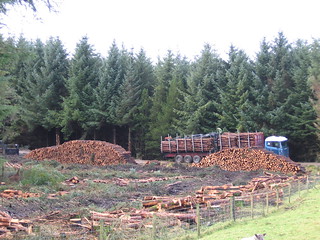
Since my earlier report, the Ponsee 'Ergo' Harvester has been joined by a Ponsee Forwarder and timber is currently being shipped from the site.

The Harvester at work (Photo: R MacCurrach)

The Harvester or 'Processor' is crucial to the efficiency of any logging operations and the Ponsee 'Ergo' working at Ty Gwyn is an example of one of the leading machines. Finland has had well-managed forests for a long time, so I was not surprised to discover that Ponsee is a Finnish company. Einari Vidren was a farmer's son who became a forestry worker. Dissatisfied with the forestry machines available in the 1960s, he built his own and the success of his own designs led him to found Ponsee in 1970. 'Ponsee' is apparently a crossbreed dog found in Finland. This firm now has over 800 workers and is active in 40 countries. It describes itself as "A logger's best friend". For more information on the firm and its products, go to their website.

The two methods of logging are 'tree length' where the main trunk is brought out in one piece and 'cut to length' where each trunk is accurately cut to sections of the required length as part of the felling. The second method makes heavy demands on the harvester technology, leading to increased capital cost, but offers benefits each time the timber is handled after felling.

The forwarder loading cut timber (Photo: R MacCurrach)

The Ponsee Forwarder has the same rough-terrain design and telescopic crane as the Harvester. Its task is to grapple the cut logs into its load space and transfer them to the loading area adjacent to a forest road for loading onto a timber truck for long-distance transfer on public roads.


Timber truck at a loading point (Photo: R MacCurrach)

According to the requirements of the end user, the timber may be graded into two or more types. This depends principally upon the diameter of the trunk and this is measured automatically by the harvester head as part of the cut-to-length operation. Timber trucks have their own vehicle-mounted crane so that they can self-load and self-unload.

With modern computer and communication technology, it is now possible for all the machines and trucks involved to be linked to the receiving mill and planning office for best overall efficiency. The Ponsee software systems are briefly described here.

My pictures of this stage of harvesting are here.

[Ponsee links updated 25-Jul-2014]

Wednesday, 2 December 2009

Platform Numbering Revisited

In an earlier post I talked about the Japanese mastery of 'Platform 0'. I'm indebted to a correspondent in Japan for introducing me to 'Kaleidescope World' which has a comprehensive list of 'Platform 0' with photographic evidence.

I should have credited the U.K. with three 'Platform 0' - one in England (Stockport), one in Wales (Cardiff) and one in Scotland (Haymarket). Europe musters five 'Platform 0' and Japan remains the undisputed leader with 40 remaining 'Platform 0'. Years ago, Japan had 100 stations with a 'Platform 0'!

In my earlier post, I illustrated the entrance to 'Platform 9-3/4' at Kings Cross as being England's attempt at unusual platform numbering.

On a recent visit, I was surprised to find the portal had magically moved itself to a new location.

I can only assume that whatever magical spirits dwell around the portal have been disturbed by all the building work going on at Kings Cross and have thus relocated to a slightly more congenial area.

Part of the rebuilding at Kings Cross involves the creation of a new platform. The picture below shows the major civil engineering work in progress to drive the new track on the extreme East Side, next to the present Platform 1.

You might imagine that a new platform next to Platform 1 would logically be given the title 'Platform 0'. But, of course, Network Rail laughs in the face of such conformist logic. I am reliably informed that the new platform will be designated 'Platform Y'. Why? The suggestion is that some of the existing signalling or information systems are unable to handle a 'Null'.

Sunday, 15 November 2009

Pontcysyllte Aqueduct

This famous aqueduct crosses the valley of the Dee near Llangollen, carrying the canal 127 feet above the river on 18 stone pillars. It has been a feature of the landscape since 1805, when it was completed by Thomas Telford and William Jessop. The canal is carried in an iron trough 11'10" wide, 5'3" deep and 1007 feet in length.

Somehow, I'd never actually visited the aqueduct until today, when Carol took a side road off the A5 so that I could photograph a rainbow. The clouds had shifted by the time I took the shot, so I didn't get the effect I was after but, having stopped, we decided to walk across the aqueduct. The sun had come out and it was quite mild so quite a number of visitors were walking along the footway across the aqueduct.

Telford's novel approach to canal building showed what was possible and his methods were later used by the railways where cuttings, embankments, bridges and viaducts were similarly required. In fact, looking down the valley from the aqueduct, you get a good view of the viaduct built to carry the Shrewsbury - Wrexham line of the Great Western Railway.

I was also intrigued by a hydraulically-operated lifting bridge across the canal. This bridge is rather younger, built by British Waterways in 1990.

My pictures

I took a number of other pictures which are currently missing, as explained here. I'm sorry.

Wednesday, 11 November 2009

Harvesting at Ty Gwyn

Harvesting in progress (Photo: R. MacCurrach)

I've written about the small commercial woodland at Ty Gwyn in an earlier post. This year, Ty Gwyn became a 'Certified Woodland' as the management has been certified to the Sustainability Criteria of the Forest Stewardship Council.

The commercial spruce from about half of the woodland at Ty Gwyn is being harvested in late 2009. The timber has been sold as "standing trees" and so the purchaser is responsible for felling and carrying away.

Harvesting in modern woodlands is largely automated and the 'Harvester' is central to the operation. This tracked or partially-tracked vehicle can work in difficult terrain. The jib is a little like that on a 'JCB' but instead of a bucket, there is a complex harvester head which splits so as to pass around the trunk of the tree to be felled. The head then firmly grasps the trunk and a built-in chain-saw cuts through the trunk. The felled tree is then lowered to a horizontal position so that minor branches can be automatically stripped as the trunk is passed through the harvester head. Finally, the trunk is chain-sawed into preset lengths which are laid on the ground to await collection by the Forwarder.

The Forwarder is another vehicle adapted for harsh conditions, usually with some sort of 'Hiab' crane for lifting logs into the load space. Forwarders are often articulated with large tractor-type wheels. Their job is to transfer logs to a suitable loading point with road access where conventional timber lorries can take away the logs.

More pictures.

Friday, 6 November 2009

Brewood Scouts visit Brewood Hall

Brewood Scouts made an evening visit to Brewood Hall on Friday, 6th November 2009. Jan Ford talked briefly about the history of the Hall before taking the group on a conducted tour of the principal rooms. There were plenty of questions from the young people about the Hall itself and the artefacts on display.

The visit concluded with orange juice and biscuits in the dining room. The Scouts impressed both with their keen interest in everything they saw and their excellent discipline. This was certainly the first visit by the Scouts to the Hall in over 40 years.

More pictures.

Thursday, 29 October 2009

Day out with Thomas: 2009

Children help the Conductor to fill buckets of 'Special Water' for 'Thomas's' side tanks as Sam stands ready.

The Battlefield Line normally run 'Thomas and Friends' events on a number of weekends during the year. I've written about these before and you can find all the posts (including this one) here.

June 'Thomas' events

In June 2009, 'Thomas' appeared on the 6th, 7th, 13th and 14th. I wasn't rostered on a steam locomotive on these dates but I did get a footplate ride on 'Thomas'(a Butterley 'Jinty' on this occasion). I did have a day "Driving Miss Daisy", the 2-car DMU (pictures). The 'Thomas and Daisy Shuttles' where 'Thomas' is attached to 'Daisy' for a short trip up the running line have become very popular, so most of the DMU trips were like this, with 'Daisy' providing power from Shackerstone to Headley's Crossing and 'Thomas' bringing the train back. One entry fee lets the public take advantage of all the attractions and a ride with 'Thomas' is always appreciated. Since 'Thomas' spends a lot of the day in the station taking part in races, playlets or simply being admired, another locomotive hauls most of the service trains to Shenton. This year, that's the immaculate 'Mayflower' (pictures).

The 'Thomas and Daisy Shuttles' give everybody a chance to have a short ride behind 'Thomas' and make best use of the railway infrastructure. 'Daisy' and 'Thomas' are coupled together in Platform 1 and load passengers so that, as soon as 'Mayflower' arrives in Platform 2 with the service train from Shenton, they can depart into the recently-vacated single line section for a journey of about a mile. Any other locomotives have to move out of platform 1 so that 'Mayflower' can run round, ready for the next Shenton departure. By the time 'Thomas' has brought the 'Thomas and Daisy Shuttle' back to Shackerstone, 'Mayflower' should have run round, leaving Platform 1 clear for the arriving shuttle. The departure of 'Mayflower' is intentionally delayed to give time for passengers from the 'Thomas and Daisy Shuttle' to cross over the bridge and join the train for Shenton. 'Thomas' uncouples from 'Daisy' and is ready for more fun and games in the station whilst 'Daisy' shunts into the DMU siding to await the next shuttle service. All this requires smart working from the operating staff involved.

Working the Shuttle

'Thomas' is vacuum-braked for working passenger trains and the 'Modernisation' DMU were also fitted with vacuum brakes, so it's possible to work 'Thomas' coupled to the DMU with braking controlled from the leading vehicle. The DMU were designed for intensive stopping services with frequent station stops, so they are provided with a special 'high speed' vacuum brake where a second pipe runs down the train to enable vacuum to be re-created quickly, even when a number of units are being worked in multiple. When coupling 'Daisy' to 'Thomas', the shunter has to remember that the vacuum hose on the DMU with the red-painted coupling is the vacuum brake which is coupled to 'Thomas'. The other (blue) coupling remains on the stopper.

When 'Daisy' is leading, the driver on 'Thomas' shuts off the steam supply to the vacuum ejector and the brake application valve is placed in the 'Running' position so that 'Daisy's' driver has control of the brakes. 'Daisy' is driven normally, with the vacuum created by the exhausters, and 'Thomas' is just 'tail traffic'.

At Headley's Crossing, 'Daisy's' driver shuts down the cab and moves to the other end of the train. The cab next to 'Thomas' is opened up and the vacuum brake application valve is placed in the 'Lap' position. The DMU driver also needs to activate the 'Deadmans' device, otherwise 'Thomas' is unable to create vacuum. The DMU is normally placed in 4th gear with the engines left idling. 'Thomas' is then able to haul the DMU back to Shackerstone as if it were hauling normal coaches.

October 'Thomas' events

In October 2009, 'Thomas' appeared on the 10th, 11th, 17th, 18th and 19th. I was on 'Thomas' on the first two days, then on 'Daisy' on the third day. This time, 'Thomas' was the 'Hunslet' we'd used in 2008 (pictures). Since then, 'Thomas' has had his wheels re-tyred and now makes a faint 'whirring' when in motion, like a small electric motor. The engine steams well and pulls well. In addition to the normal 'Thomas and Daisy Shuttles', the races (against a diesel electric) and the playlets, 'Thomas' took the first and last service trains to Shenton. The last train is 'Tea with Thomas' and a childrens' meal is served on the journey, so 'Thomas' has to be on his best behaviour not to jerk the train whilst the children are enjoying their teatime. 'Fergus' was also in steam, pottering around the station at Shackerstone (pictures). There were lots of other activities including Face Painting, Model Railways, Balloon Modelling and a Children's Entertainer. The weather was generally kind, attendance was quite good and I think everybody had a good time. A few pictures of the October event are here.