skip to main |
skip to sidebar
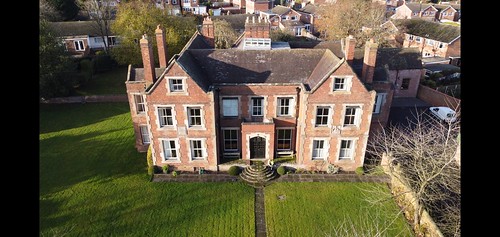
Brewood Hall: View showing the Lantern Roof (taken by drone)
Brewood Hall is topped by an elborate, wooden-framed, glazed skylight which, because of its raised design, we've always called the Lantern Roof. This is not thought to be an original feature of the design; rather I've always considered it to most likely date from 19th century alterations. It provides natural light to part of the attics on the second floor otherwise without daylight. Formerly, the light was shared between two rather modest rooms which were assumed had served as servant bedrooms. The need for servant bedrooms having lapsed, I decided that the space would make a tranquil library and the studwork partition between the two rooms was removed to give a convenient area, albeit nested into the sloping roof at the front of the Hall.
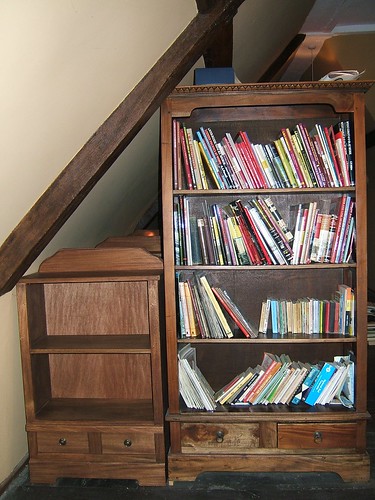
Part of Brewood Hall Library: The low-level units make use of the restricted headroom under the sloping roof
The exposed location of the lantern roof hastened its deterioration and a copy the original design was made and fitted. Unfortunately, this copy used a soft wood which resulted in a rather short life. By 2006, I was faced with replacing the structure for the second time.

View showing deterioration to the earlier lantern roof in 2006, prior to its replacement.
This time, I made sure that a hard wood (Idigbo from Africa, I think) was used in the construction. Once the custom joinery was complete, it was shipped to Brewood and the major task of raising it into position was undertaken, purely using manpower.

My dog Tai inspects the replacement lantern roof on its arrival in 2007
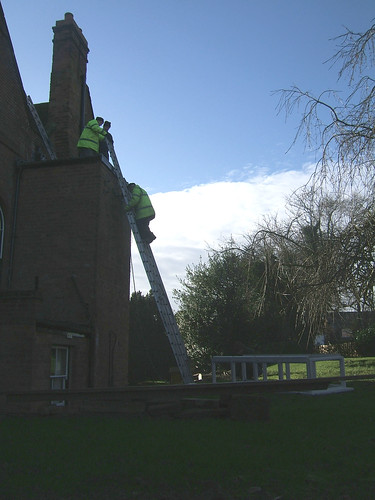
Preparations are made to lift the new lantern roof.
By the end of 2007 the new lantern roof was fitted, glazed and undercoated. Because of poor weather, the final painting, inside and out, was deferred until Summer 2008.

Dave paints the inside of the new lantern roof, whist John paints the outside.
As early as 2011 the need for further restorative care was noted but not provided in a timely manner. Consequently, in 2019 water ingress was occuring in the library. Dean volunteered to make an inspection and we were disappointed to confirm that, although the timber was surviving well, the paint film had deteriorated and much of the putty in the glazing had dried out. Some wooden flashing at the base of the lantern roof had completely detached. Dean carried out emergency repairs to carry us through the winter.

Brewood Hall Lantern Roof: deterioration prior to emergency repairs in 2020
With the better weather in Spring 2021, Jim carried out full repairs and outside repainting.

"All scraped and sanded down and loose putty removed, ready for primer" on 21st April 2021

Brewood Hall: Lantern Roof on completion of repairs
All that remains to be done is lantern roof internal repainting (oh, and finishing cataloguing and organising the library itself).
My posts about Brewood Hall
You can find all my posts about Brewood Hall here (in reverse date-of-posting order), with links to albums of pictures.
Pictures of Brewood Hall Lantern Roof
Brewood Hall Lantern Roof
Since I became involved in the management of Ty Gwyn Woodland, the most noticeable alterations have been the addition of a forest road system, the harvesting/replanting of trees and the creation of a small 'amenity' pool. My partner Daemon and I planned the creation of the pool many years ago but the work didn't happen until after his death in 1999 so it now serves as a memorial. The pool was created, near the eastern end of the northern road, by damming a small, perennial stream which runs across the site. At that time, the southern edge of the pool was fringed by mature spruce trees. In 2015, harvesting these trees changed the appearance of the pool area but, slowly, natural regeneration and growth by the sitka planting is restoring the original pool setting.
Visit on 12th June 2021
It had always been my intention to have an inflatable boat for the pool. Some years ago now, Daemon and I enjoyed a memorable touring holiday around Cornwall, made special for me by acquiring an inflatable dinghy. Well, that dinghy was not to be found so I'd never actually 'taken to the water' on the pool at Ty Gwyn (although I'd managed to get fairly wet a few times attempting to walk around the pool on the shore). Ann and Dean decided that my ambition needed some assistance and determined to surprise me during a visit to the forest in June 2021. When we arrived at Ty Gwyn's pool, Dean removed a brand-new 2-man inflatable boat from the boot and set about assembling and inflating it. I was surprised and delighted in equal measure.

Ty Gwyn 2021: Ann watches as Dean inflates the boat
Once the boat was ready, Dean carefully 'launched' it and helped me to board. This was easier said than done as the shore-line is not well-defined and the land changes from 'fairly dry weeds' to 'fairly wet weeds' unexpectedly. With my added weight, the boat became rather wedged in the weeds and it took me a few minutes, kneeling and facing the intended direction of travel, to paddle and haul my craft into clear water. Exhausted by that modest effort, I spent the rest of the voyage lying on my back with my head comfortably cradled near the bow, alternately rowing backwards or forwards depending on which method seemed more effective at the time. The lie-flat rowing position was not ideal for making an effective stroke with the oars which frequently became enmeshed with weeds, slowing progress.

Ty Gwyn 2021 (Photo: D Mould)
It was a very warm afternoon so for much of the time I was happy to just lie back and enjoy the peace but I did reach the tiny island, just big enough for one multi-stemmed tree. The channel on the south side of the island had become completely fouled by weeds so I had to abandon the idea of circumnavigating the island.
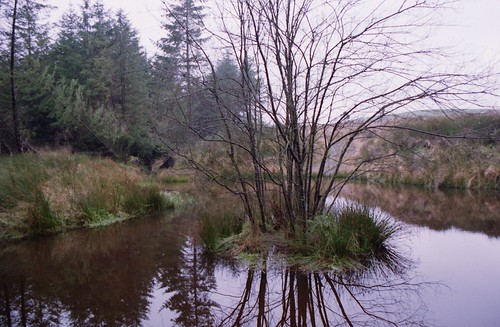
Ty Gwyn THEN: The appearance of the island in 2011 (looking west from the dam)

Ty Gwyn NOW: The appearance of the island in 2021, looking east (Photo: D Mould)
Nor was I able to inspect the dam which controls the level of water in the pool. When first built, it was possible to walk around the pool to the dam, a simple affair of rocks and mud incorporating two large plastic drainage tubes to direct the outfall into the stream leaving the woodland. Since then, tree growth has made the land approach impassable and the weeds prevented me from manoeuvring the boat close to the dam.

Ty Gwyn: Dam outfall pipes in 2006
The high ground to the north of the pool was originally fairly bare (as shown in the 2006 picture immediately below). Best forestry practice encourages increasing the proportion of broadleaved trees in plantations so this area was chosen for introducing more broadleaves. The planting has been very successful and the second picture shows the remarkably changed appearance created by careful planting combined with natural regeneration.

Ty Gwyn THEN: The high ground to the north of the pool in 2006 ( with the pool visible on the right) showing Jan checking the progress of the mixed broadleaves planting.

Ty Gwyn NOW: Jan inspecting the mixed broadleaves on the high ground to the north of the pool in 2021 (Photo: D Mould)
Visit on 15th July 2021
A few weeks later, I made another visit to Ty Gwyn with my friend Geoff. Once again, the weather was excellent although insect bites were rather problematic. The otherwise good conditions encouraged me to walk the length of the western arms of both the north and south roads. Both sides of the western end of the north road were re-planted around 2010, following harvesting of the earlier crop. Growth rates on this upland site with plenty of water are very good. Rosebay willowherb was flowering in the margins. Having grown-up in England after World War II, I always think of it as "the bombsite flower".

Ty Gwyn 2021: Western arm of north road, looking north, showing gaps between stands of trees currently around 12 years old. Rosebay willowherb flowering in the foreground.
The roads have been periodically flailed, to inhibit the growth of self-set plants and trees which otherwise ultimately render the roads impassable. As a result, we found the roads carpeted a profusion of attractive yellow wild flowers.

Ty Gwyn 2021: End of western arm of north road, looking west with 2010 planting on both sides of road.

Ty Gwyn 2021: View from link road looking east, showing growth in the 2015 planting. Note windfarm in distance.

Ty Gwyn 2021: View from western arm of south road, looking north, with 2015 planting in the foreground
Part of the site lies west of the western end of the south road but it was not practical to examine this area as the undergrowth is fairly impenetrable, so we finished the trip by driving along part of the track outside the plantation, to check the integrity of the fence. The grassland surrounding the woodland is used for sheep grazing, making sound fencing important as otherwise animals getting into the woodland may be unable to find their way out again.

Ty Gwyn 2021: Geoff looking north from the south road
My posts about Ty Gwyn
You can find all my posts about Ty Gwyn here (in reverse date-of-posting order), with links to albums of pictures.
Pictures of Ty Gwyn
Pictures in this post can be viewed uncropped, where necessary, by clicking on the image. Selecting from the full 2021 album below allows viewing or downloading in various resolutions:-
Ty Gwyn 2021
You can find all my albums of pictures of Ty Gwyn here.
The year started with snow, as described in the post Christmas in Brewood 2020. It continued cold and wet delaying Springtime this year and adding to the gloom resulting from the government lockdown in the UK as we struggled with the effects of the Covid-19 global pandemic.
The view below shows the ancient and rather compromised solitary apple tree and the row of bare oak trees in early April 2021. These trees had been grown from acorns by my Uncle, long passed on, and as saplings about four feet tall were planted by me on the Upper Lawn. It was only in April that signs of new growth became apparent.

The ancient and rather compromised solitary apple tree (left) and the row of bare oak trees in April 2021
The copper beech on the front lawn was equally late to bud in 2021.

A visiting cock pheasant struts self-importantly past the still-bare copper beech tree on the front lawn
Adjacent to the upper lawn, there's a very small area of woodland, mainly holly but with a few cherry and birch trees. I have recently decided to call my tiny wood 'Little Wood', as an affectionate tribute to a far more substantial wood called 'Big Wood' some three miles to the south west on the Chillington Hall Estate. At a little under 200 square metres, the name is at least accurate.

View of Little Wood from the Upper Lawn
Little Wood is home to an annual display of bluebells which, year by year is spreading in area.

Brewood Hall Garden 2021: Bluebells in Little Wood in April
There is also one isolated small enclave of bluebells on the Upper Lawn, near a hawthorn tree adjacent to a holly.

Bluebells on the upper lawn (Brewood Hall Garden 2021)
Cherry blossom time appeared, a little late and not quite as impressive as in previous years,

Cherry trees in blossom on the front lawn (Brewood Hall Garden 2021)
During spring, the weather was an odd mixture of bright sun, heavy rain and high winds which seemed to confuse plant-life. There was an unexpected early appearance of fungi on the Front Lawn.

An unexpected early appearance of fungi in May (Brewood Hall Garden 2021)
The Weeping Ash on the Upper lawn shed numerous dead branches during the high winds and showed no sign of life until May and, even then, at first budding appeared only in isolated branches, suggesting that this venerable tree might be failing.

Welcome signs of life in the Weeping Ash in May (Brewood Hall Garden 2021)
And yet, during the following weeks, the tree managed to adorn itself with the usual luxuriant foliage,although becoming noticeably lop-sided.

Brewood Hall Garden 2021: The Weeping Ash, becoming rather lop-sided
During 2020 Foxglove appeared for the first time, as recorded in the post here. In 2021, they became almost rampant, colonising numerous spots around the garden, with a particularly sturdy example near the front wall.

Brewood Hall Garden 2021: Foxglove adjacent to the front wall
In the UK, inoculation programmes using the Astrazeneca and Pfizer vaccines starting early in 2021 gave cause for hope and the government targeted June 2021 for the lifting of restrictions. These hopes were dashed at the last moment as Covid-19 infections from the so-called 'Delta Variant' proliferated and July 19th was then announced as the "terminus date" for legally-imposed restrictions.
My pictures
Pictures in this post can be viewed uncropped, where necessary, by clicking on the image. Selecting from the full 2021 album below allows viewing or downloading in various resolutions:-
Brewood Hall garden 2021
The year 2020 was dominated by the destruction caused by the global pandemic of Covid-19. Nature, of course, followed her normal cycle of the seasons.
In April 2020, post here, talked about Springtime in the garden of Brewood Hall, when the country was under government-mandated full lockdown. This was a return to a theme I'd first touched on in 2011 with a very short post Blossom Time at Brewood
By the start of June 2020, the garden was a riot of colour, from the vivid purple of the delphiniums planted the previous year to the rich red of roses. There was also the first flowering of the Hollyhock, also planted the previous year.

Delphinums (Brewood Hall garden 2020)

Roses (Brewood Hall garden 2020)

Hollyhock (Brewood Hall garden 2020)
A group of foxglove plants, both purple and white, were unexpected, but welcome, arrivals around the stump of the tree which had been removed in 2018 because of its dangerous condition. The removal of the tree is mentioned in the post More Brewood Hall Tree Maintenance.
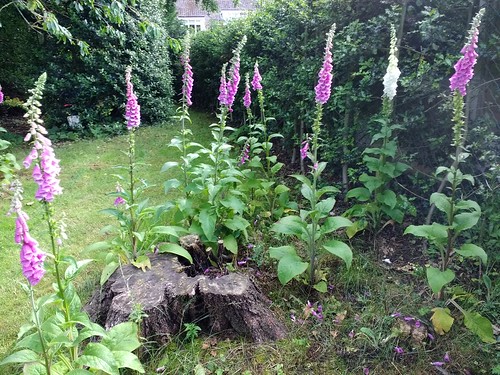
Foxgloves (Brewood Hall garden 2020)
The two flower troughs at the front of the Hall, built by Rick Evans, continued to add colour until late in the year.

Flower trough at the front of the Hall (Brewood Hall garden 2020)
In 2020 the single rather ancient apple tree with its whitened, hollowed trunk surprised by giving a copious supply of fruit which, although tart, for the first time could almost be classed as eating apples. A number of apple pies resulted (not baked by the writer).

The single apple tree produced a good crop (Brewood Hall garden 2020)
My favourite tree remains the solitary Yew on the front lawn, which seems to grow wider every year. I see this as the sole remaining connection with the once-famous topiary at Brewood Hall, long removed, which I mentioned in the section 'Gardens and Orchards' of the post Notes on the History of Brewood Hall.

The Yew Tree (Brewood Hall garden 2020)
Following a summer of only slightly-relaxed 'social distancing' regulations, Autumn brought full lockdown again. The colourful displays around the garden persisted until late in the year but eventually the deciduous trees produced their crop of fruit, the leaves turned brown and dropped. On the large Barn, the Virginia Creeper turned from green to an attractive red-brown before it, too, lost its leaves.

Oak tree in October, showing acorn (Brewood Hall garden, 2020)

Virginia Creeper on Barn, October: Leaves starting to change colour and fall (Brewood Hall garden, 2020)
Right at the end of the year, after a Christmas holiday reduced by the Government to one day of restricted celebration in an attempt to control transmission of the Coronavirus, we had snow. There's more about this odd period in the post here.
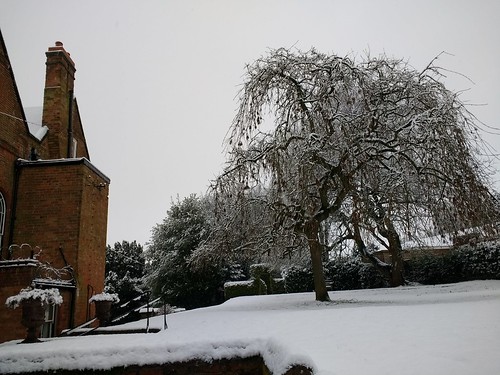 Snow at Brewood Hall, 28th Dec 2020
People throughout the world live in hope of less traumatic year in 2021.
My pictures
Pictures in this post can be viewed uncropped, where necessary, by clicking on the image. Selecting from the full 2020 album below allows viewing or downloading in various resolutions:-
Brewood Hall garden 2020
This article is a continuation of the topic London Underground - Traction Power Distribution
London Underground uses a fairly unusual fourth rail electrification system with a nominal voltage of 630 volts direct current (d.c.). At the time the system was being developed, the available insulation materials for traction motors made higher voltages problematic.
Normally, this voltage would be quoted at 'Full Rated Current'. But the current drawn from traction substations varies as trains start, coast, stop. Worst case is generally when two (or more) trains start away at the same time. The trip current on the High Speed Circuit Breaker feeding the positive rail at each sub station should be higher than the normal maximum current expected, otherwise 'nuisance tripping' can occur. But, of course, if a few thousand amps is being drawn by a traction section, there is a voltage drop on the track feed cables and the conductor rails so trains will experience a lower voltage which will change both according to the current drawn by each train and its position of the train in the traction section. The techniques of double end feeding, track paralleling and coupling of adjacent sections mean that a number of rectifiers may be contributing current to a single train. Although Kirchoff's Law allows you to work out the contribution of current from each rectifier, the situation will change second-by-second so, in general, all potential sources of current are paralleled to minimise voltage drop.
The nominal 630 volts d.c. is derived from incoming 11kV or 22kV 50Hz from the grid via transformers and semiconductor rectifier units. Nominal a.c. voltages are subject to variation as the load on the grid varies, also affecting the d.c. traction voltage.

Suite of modern traction circuit breakers (negative breakers at Marlborough Road Traction Sub Station during installation in 2011)

General view of Baker Street Traction Sub Station.

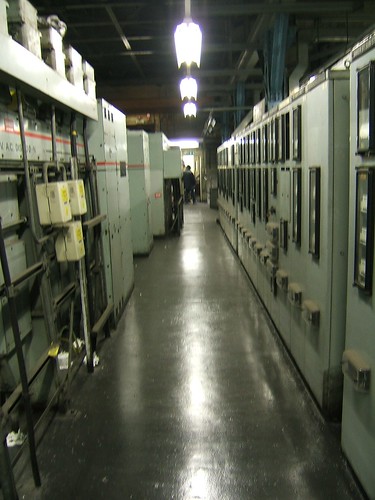
View inside a Acton Traction Sub Station on London Underground.
The fourth rail electrification system is nominally earth-free principally because the materials and construction used in early traction motors were prone to insulation failure introducing an earth. With earth-free distribution, it's possible to continue running if a train develops an earth or partial earth to either the positive or negative side of the supply. But you need to know about it, before a second train develops an earth to the other side and a High Speed Circuit Breaker detects an overcurrent and disconnects the supply.
As described in an earlier article, a potential divider of 220 ohms in series with 110 ohms is installed at the end of each traction sectionalisation to deliberately earth the traction with 220 ohms to the positive rail (outer), 110 ohms to the negative (centre) rail and the connection between the resistors earthed. Applying Ohm's Law to a nominal supply of 630 volts d.c. shows that each resistor takes a current of 1.909 amps and the positive rail sits at 420 volts positive to earth and the negative at minus 210 volts to earth (a 2:1 ratio). These voltages are only true if the 630 volts is nominal - as it goes up and down, the measured voltages to earth will go up and down, too. The voltages are only true if there is no connection to earth other than intentionally via the bleed resistors. In practice, the various spurious paths to earth may unbalance the ratio, offering a fairly simple means of monitoring the section for earth leakage. A system called 'TED' (Traction Earth Detection) is used to display the ratio at the Service Control Centre (formerly called Line Control Centre). If the ratio increases or decreases beyond preset limits, an alarm is automatically sounded to alert the Service Controller.

Traction Earth Detection (TED) equipment at the Metropolitan Line Service Control Centre.
To enable trains to increase demand on the traction distribution system (to support a combination of increased speed, increased service frequency and air conditioning requirements) all new equipment is designed to operate at 750 volts d.c. rather than 630 volts d.c. Operational changes are in progress to implement this change.
Related posts on this website
London Underground and Jan
London Underground: The Waterloo & City Line
Fourth Rail Electrification
London Underground - Traction Power Distribution
My pictures
There's a very patchy collection of pictures showing some of the London Underground lines on my 'Flickr' site (most of them are rather poor, I'm afraid). You can find them all here.
I've placed links to some of these albums below.
The various lines:-
Central Line.
White City (Central Line).
District & Circle Line.
Hammersmith & City Line.
Jubilee Line.
Metropolitan Line.
Northern Line.
Waterloo & City.
Service Control Centres (formerly Line Control Centres):-
District Line LCC.
Metropolitan Line LCC.
Waterloo & City (combined with general pictures).
Traction Sub Stations:-
Acton TSS.
Baker Street Substation.
Finchley Road TSS.
Marlborough Road Substation.
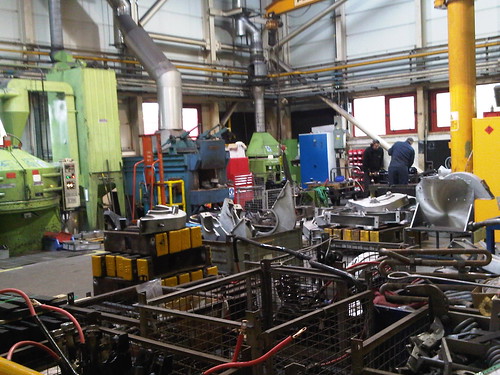
One corner of the Railway Engineering Works at Acton
Crewe, Swindon, Doncaster, Eastleigh, Acton - Acton? Perhaps Acton isn't one of the more famous railway works but London Underground established an important works at Acton. Mass transit sysytems are very intensively used and maintenance of rolling stock and infrastructure to the highest standards is essential.
My interest in Acton Works only started around 1995 when my firm became involved in work for London Underground, as described in the post London Underground and Jan. To be allowed 'behind the scenes' on any railway requires induction, safety training and various examinations matching the roles to be undertaken. An undergound fourth-rail electrified railway has particular risks and London Underground had a well-developed set of in-house training courses based at a Technical Training Centre at Acton Works. So I became a fairly regular visitor to Acton Works as I obtained different certifications and periodic re-certifications in connection with our work supplying Tunnel Telephone equipment, initially for the Jubilee Line Extension project and later for other London Underground lines. During these training visits, I saw glimpses of the work carried out around the sprawling Acton site, a mixture of old, modern and relocatable buildings.
Visits in 2006
During visits to REW Acton in connection with the design and supply of Tunnel Telephone equipment for a new installation at White City (necessitated by major changes to the London Underground depot in connection with the building of Westfield London Shopping Centre), I was able to take pictures of the external Signalling Training Facility that had previously intrigued me. Nearer the original Bollo Lane entrance to the site, a large concrete base provided with a fabric roof mounted an array of full-size working signalling equipment, including signals (colour light and disc shunting), point machines and train stops. On London Underground, points and train stops are electrically controlled but use compressed air to provide power, so the normal features of an air main running alongside the track provided with electro-pneumatic controls were also fitted. This allowing Signalling Technicians to receive training in maintenance of the various types of equipment in use on London Underground in a realistic environment supplementing training given in the adjacent Signal Training School, a large relocatable building provided with examples of various types of control system.

Signal Training facility, Bollo Lane, Acton with a variety of signals and air-operated points. The air main and control cables are along both sides, carried on posts.
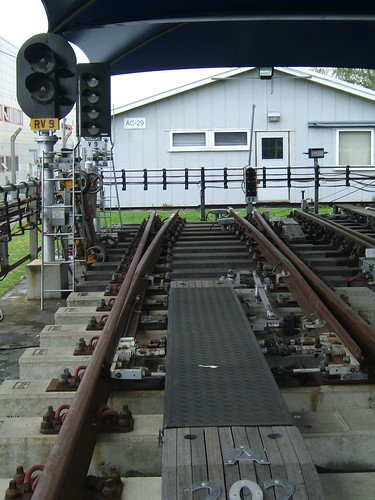
View in opposite direction of Signal Training facility. Left: Colour light signals Right: Turnout. The gabled building in the background is the Signal Training School.
Tour in 2011
During another business visit in March 2011, one of the London Underground staff arranged a fascinating, although brief, tour of part of the works. There wasn't time to get a proper understanding of the variety of work undertaken but I quickly realised the expertise available on the site. Below is a small selection of the things I saw.
Repair and refurbishment of rolling stock equipment forms a vital part of the work. In the reception area of one modern building, a part-sectioned motor wheelset for 1983 tube stock and part-sectioned gearbox for 92 tube stock were displayed.

Motor Wheelset for 1983 tube stock (part sectioned) on display at REW Trains Division, Acton.
In the Traction Motor Section of the works, rows of motors were being processed.

Traction motor section, REW Acton
Nearby, a series of massive jigs were provided for working on the pre-wired underbody control sub-assemblies.

Underbody control sub-assembly, mounted on jig.
Various signalling equipment is maintained at Acton, including heavy items like trainstops and various types of electro-mechanical relays.

Trainstop complete assembly, REW Acton

Shop for re-certifying electro-mechanical signalling relays (REW Acton)
I hadn't realised that surface-mounted cables feeding signalling equipment were normally pre-fabricated in standard lengths including moulded terminations, minimising time-to-exchange when replacement was necessary. I think these cables were bought-in complete but REW Acton also acts as a central stores for London Underground.

Prefabricated multicore cable for signalling showing moulded termination for fast connection to 12 terminal posts (REW Acton)
On an intensive mass transit system, every minute counts and London Underground has always provided clocks on stations to assist passengers and staff. But I was still surprised by the variety of clocks being repaired and regulated in the Clock Section. At the time of my tour, London Underground still had a few mechanical clocks at stations requiring weekly visits for winding!

The Clock Section (REW Acton)
Redundant D78 vehicles
During my 2011 visits, I saw a redundant D78 vehicle leaving the works on a low-loader. At the time, I thought the coach was going for scrap but I discovered afterwards these trains had been bought by Vivarail for conversion into modern, lightweight diesel-electric units for use on heavy-rail infrastructure. I caught up with these former D78 vehicles on a visit in 2018 to Quinton Rail Technology Centre (there's a post on that visit here).

Redundant D78 vehicle leaving REW Acton on low-loader in 2011.
My pictures
Pictures at REW Acton.
Books
There's a book on Acton Works titled ‘Underground Train Overhaul – The Story of Acton Works’ by J. Graeme Bruce/Piers Connor, published by Capital Transport Publishing in 1991 (ISBN 1 85414 134 1).