skip to main |
skip to sidebar
The year 2020 was dominated by the destruction caused by the global pandemic of Covid-19. Nature, of course, followed her normal cycle of the seasons.
In April 2020, post here, talked about Springtime in the garden of Brewood Hall, when the country was under government-mandated full lockdown. This was a return to a theme I'd first touched on in 2011 with a very short post Blossom Time at Brewood
By the start of June 2020, the garden was a riot of colour, from the vivid purple of the delphiniums planted the previous year to the rich red of roses. There was also the first flowering of the Hollyhock, also planted the previous year.

Delphinums (Brewood Hall garden 2020)

Roses (Brewood Hall garden 2020)

Hollyhock (Brewood Hall garden 2020)
A group of foxglove plants, both purple and white, were unexpected, but welcome, arrivals around the stump of the tree which had been removed in 2018 because of its dangerous condition. The removal of the tree is mentioned in the post More Brewood Hall Tree Maintenance.
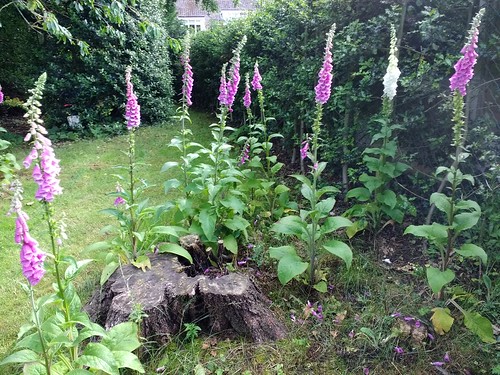
Foxgloves (Brewood Hall garden 2020)
The two flower troughs at the front of the Hall, built by Rick Evans, continued to add colour until late in the year.

Flower trough at the front of the Hall (Brewood Hall garden 2020)
In 2020 the single rather ancient apple tree with its whitened, hollowed trunk surprised by giving a copious supply of fruit which, although tart, for the first time could almost be classed as eating apples. A number of apple pies resulted (not baked by the writer).

The single apple tree produced a good crop (Brewood Hall garden 2020)
My favourite tree remains the solitary Yew on the front lawn, which seems to grow wider every year. I see this as the sole remaining connection with the once-famous topiary at Brewood Hall, long removed, which I mentioned in the section 'Gardens and Orchards' of the post Notes on the History of Brewood Hall.

The Yew Tree (Brewood Hall garden 2020)
Following a summer of only slightly-relaxed 'social distancing' regulations, Autumn brought full lockdown again. The colourful displays around the garden persisted until late in the year but eventually the deciduous trees produced their crop of fruit, the leaves turned brown and dropped. On the large Barn, the Virginia Creeper turned from green to an attractive red-brown before it, too, lost its leaves.

Oak tree in October, showing acorn (Brewood Hall garden, 2020)

Virginia Creeper on Barn, October: Leaves starting to change colour and fall (Brewood Hall garden, 2020)
Right at the end of the year, after a Christmas holiday reduced by the Government to one day of restricted celebration in an attempt to control transmission of the Coronavirus, we had snow. There's more about this odd period in the post here.
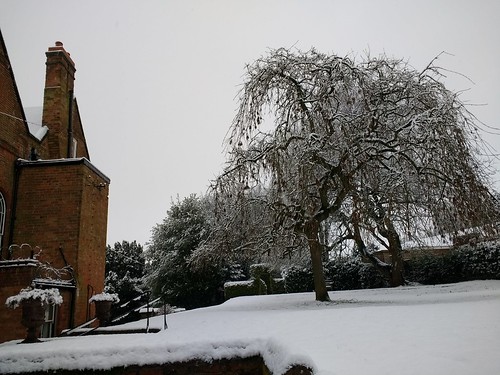 Snow at Brewood Hall, 28th Dec 2020
People throughout the world live in hope of less traumatic year in 2021.
My pictures
Pictures in this post can be viewed uncropped, where necessary, by clicking on the image. Selecting from the full 2020 album below allows viewing or downloading in various resolutions:-
Brewood Hall garden 2020
This article is a continuation of the topic London Underground - Traction Power Distribution
London Underground uses a fairly unusual fourth rail electrification system with a nominal voltage of 630 volts direct current (d.c.). At the time the system was being developed, the available insulation materials for traction motors made higher voltages problematic.
Normally, this voltage would be quoted at 'Full Rated Current'. But the current drawn from traction substations varies as trains start, coast, stop. Worst case is generally when two (or more) trains start away at the same time. The trip current on the High Speed Circuit Breaker feeding the positive rail at each sub station should be higher than the normal maximum current expected, otherwise 'nuisance tripping' can occur. But, of course, if a few thousand amps is being drawn by a traction section, there is a voltage drop on the track feed cables and the conductor rails so trains will experience a lower voltage which will change both according to the current drawn by each train and its position of the train in the traction section. The techniques of double end feeding, track paralleling and coupling of adjacent sections mean that a number of rectifiers may be contributing current to a single train. Although Kirchoff's Law allows you to work out the contribution of current from each rectifier, the situation will change second-by-second so, in general, all potential sources of current are paralleled to minimise voltage drop.
The nominal 630 volts d.c. is derived from incoming 11kV or 22kV 50Hz from the grid via transformers and semiconductor rectifier units. Nominal a.c. voltages are subject to variation as the load on the grid varies, also affecting the d.c. traction voltage.

Suite of modern traction circuit breakers (negative breakers at Marlborough Road Traction Sub Station during installation in 2011)

General view of Baker Street Traction Sub Station.

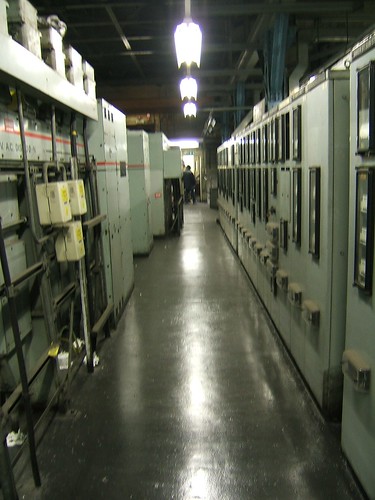
View inside a Acton Traction Sub Station on London Underground.
The fourth rail electrification system is nominally earth-free principally because the materials and construction used in early traction motors were prone to insulation failure introducing an earth. With earth-free distribution, it's possible to continue running if a train develops an earth or partial earth to either the positive or negative side of the supply. But you need to know about it, before a second train develops an earth to the other side and a High Speed Circuit Breaker detects an overcurrent and disconnects the supply.
As described in an earlier article, a potential divider of 220 ohms in series with 110 ohms is installed at the end of each traction sectionalisation to deliberately earth the traction with 220 ohms to the positive rail (outer), 110 ohms to the negative (centre) rail and the connection between the resistors earthed. Applying Ohm's Law to a nominal supply of 630 volts d.c. shows that each resistor takes a current of 1.909 amps and the positive rail sits at 420 volts positive to earth and the negative at minus 210 volts to earth (a 2:1 ratio). These voltages are only true if the 630 volts is nominal - as it goes up and down, the measured voltages to earth will go up and down, too. The voltages are only true if there is no connection to earth other than intentionally via the bleed resistors. In practice, the various spurious paths to earth may unbalance the ratio, offering a fairly simple means of monitoring the section for earth leakage. A system called 'TED' (Traction Earth Detection) is used to display the ratio at the Service Control Centre (formerly called Line Control Centre). If the ratio increases or decreases beyond preset limits, an alarm is automatically sounded to alert the Service Controller.

Traction Earth Detection (TED) equipment at the Metropolitan Line Service Control Centre.
To enable trains to increase demand on the traction distribution system (to support a combination of increased speed, increased service frequency and air conditioning requirements) all new equipment is designed to operate at 750 volts d.c. rather than 630 volts d.c. Operational changes are in progress to implement this change.
Related posts on this website
London Underground and Jan
London Underground: The Waterloo & City Line
Fourth Rail Electrification
London Underground - Traction Power Distribution
My pictures
There's a very patchy collection of pictures showing some of the London Underground lines on my 'Flickr' site (most of them are rather poor, I'm afraid). You can find them all here.
I've placed links to some of these albums below.
The various lines:-
Central Line.
White City (Central Line).
District & Circle Line.
Hammersmith & City Line.
Jubilee Line.
Metropolitan Line.
Northern Line.
Waterloo & City.
Service Control Centres (formerly Line Control Centres):-
District Line LCC.
Metropolitan Line LCC.
Waterloo & City (combined with general pictures).
Traction Sub Stations:-
Acton TSS.
Baker Street Substation.
Finchley Road TSS.
Marlborough Road Substation.
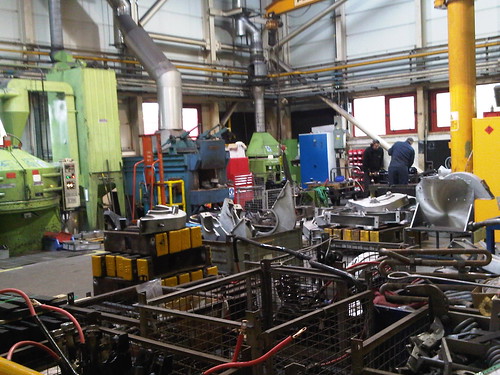
One corner of the Railway Engineering Works at Acton
Crewe, Swindon, Doncaster, Eastleigh, Acton - Acton? Perhaps Acton isn't one of the more famous railway works but London Underground established an important works at Acton. Mass transit sysytems are very intensively used and maintenance of rolling stock and infrastructure to the highest standards is essential.
My interest in Acton Works only started around 1995 when my firm became involved in work for London Underground, as described in the post London Underground and Jan. To be allowed 'behind the scenes' on any railway requires induction, safety training and various examinations matching the roles to be undertaken. An undergound fourth-rail electrified railway has particular risks and London Underground had a well-developed set of in-house training courses based at a Technical Training Centre at Acton Works. So I became a fairly regular visitor to Acton Works as I obtained different certifications and periodic re-certifications in connection with our work supplying Tunnel Telephone equipment, initially for the Jubilee Line Extension project and later for other London Underground lines. During these training visits, I saw glimpses of the work carried out around the sprawling Acton site, a mixture of old, modern and relocatable buildings.
Visits in 2006
During visits to REW Acton in connection with the design and supply of Tunnel Telephone equipment for a new installation at White City (necessitated by major changes to the London Underground depot in connection with the building of Westfield London Shopping Centre), I was able to take pictures of the external Signalling Training Facility that had previously intrigued me. Nearer the original Bollo Lane entrance to the site, a large concrete base provided with a fabric roof mounted an array of full-size working signalling equipment, including signals (colour light and disc shunting), point machines and train stops. On London Underground, points and train stops are electrically controlled but use compressed air to provide power, so the normal features of an air main running alongside the track provided with electro-pneumatic controls were also fitted. This allowing Signalling Technicians to receive training in maintenance of the various types of equipment in use on London Underground in a realistic environment supplementing training given in the adjacent Signal Training School, a large relocatable building provided with examples of various types of control system.

Signal Training facility, Bollo Lane, Acton with a variety of signals and air-operated points. The air main and control cables are along both sides, carried on posts.
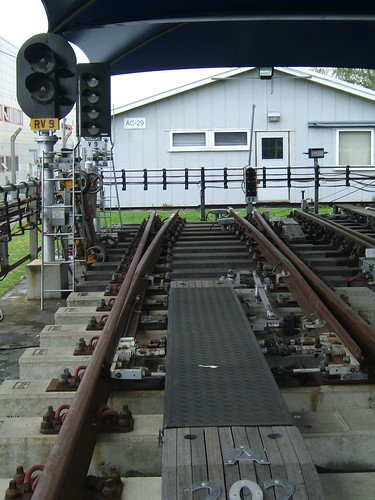
View in opposite direction of Signal Training facility. Left: Colour light signals Right: Turnout. The gabled building in the background is the Signal Training School.
Tour in 2011
During another business visit in March 2011, one of the London Underground staff arranged a fascinating, although brief, tour of part of the works. There wasn't time to get a proper understanding of the variety of work undertaken but I quickly realised the expertise available on the site. Below is a small selection of the things I saw.
Repair and refurbishment of rolling stock equipment forms a vital part of the work. In the reception area of one modern building, a part-sectioned motor wheelset for 1983 tube stock and part-sectioned gearbox for 92 tube stock were displayed.

Motor Wheelset for 1983 tube stock (part sectioned) on display at REW Trains Division, Acton.
In the Traction Motor Section of the works, rows of motors were being processed.

Traction motor section, REW Acton
Nearby, a series of massive jigs were provided for working on the pre-wired underbody control sub-assemblies.

Underbody control sub-assembly, mounted on jig.
Various signalling equipment is maintained at Acton, including heavy items like trainstops and various types of electro-mechanical relays.

Trainstop complete assembly, REW Acton

Shop for re-certifying electro-mechanical signalling relays (REW Acton)
I hadn't realised that surface-mounted cables feeding signalling equipment were normally pre-fabricated in standard lengths including moulded terminations, minimising time-to-exchange when replacement was necessary. I think these cables were bought-in complete but REW Acton also acts as a central stores for London Underground.

Prefabricated multicore cable for signalling showing moulded termination for fast connection to 12 terminal posts (REW Acton)
On an intensive mass transit system, every minute counts and London Underground has always provided clocks on stations to assist passengers and staff. But I was still surprised by the variety of clocks being repaired and regulated in the Clock Section. At the time of my tour, London Underground still had a few mechanical clocks at stations requiring weekly visits for winding!

The Clock Section (REW Acton)
Redundant D78 vehicles
During my 2011 visits, I saw a redundant D78 vehicle leaving the works on a low-loader. At the time, I thought the coach was going for scrap but I discovered afterwards these trains had been bought by Vivarail for conversion into modern, lightweight diesel-electric units for use on heavy-rail infrastructure. I caught up with these former D78 vehicles on a visit in 2018 to Quinton Rail Technology Centre (there's a post on that visit here).

Redundant D78 vehicle leaving REW Acton on low-loader in 2011.
My pictures
Pictures at REW Acton.
Books
There's a book on Acton Works titled ‘Underground Train Overhaul – The Story of Acton Works’ by J. Graeme Bruce/Piers Connor, published by Capital Transport Publishing in 1991 (ISBN 1 85414 134 1).
 'Traditional' methods of cargo handling still in use on the quayside
in Sittwe, Myanmar.
Background
International shipping has always been important to trade but, within the last century, methods have been revolutionised by the introduction of standardised shipping containers ('containerisation') which replaced traditional cargo handling a piece at a time ('break-bulk cargo'). The enterprising North American haulier Malcolm McLean (1913-2001) accelerated this process in the 1950s. Effective designs by mechanical engineer Keith Tantlinger (1919-2011) allowed Freuhauf to build demountable shipping containers for McLean (Freuhauf invented the road trailer for motor trucks under the leadership of Augustus Freuhauf. The long and ultimately chequered history of Freuhauf is detailed by the Freuhauf Trailer Historical Society here).
McLean patented his designs, but gave a royalty-free license to the International Standards Organisation and the success of the innovation allowed goods to be efficiently moved around the world. There are Wikipedia articles about containerisation here and the containers used here. The most common containers are 20 feet or 40 feet long but shorter, longer and taller ('hi-cube') patterns are also used. Various special-purpose containers are provided either for carrying bulk liquids in tanks or products requiring refrigeration. The latter, called 'reefers', have built-in chilling equipment and loaded containers need external electric power to be connected whilst in storage or transit.
The success of the system was founded on the simplicity and reliability of the Twistlocks used in handling and securing containers - each container has eight Twistlock corner castings (4 on top, 4 underneath) which mate with either the handling crane, carrying vehicle (road trailer, rail vehicle or ship) or separate 'mid-locks' (allowing containers to be stacked). The need for manual labour was dramatically reduced and theft of cargo, whilst not eliminated, became a much more sophisticated crime. Road lorries could transport containers directly to or from the consignee or to a shipping agent who could ‘stuff’ or ‘strip’ part container loads. So, in docks all over the world, huge areas were concreted over to provide access for the container lorries and storage for the shipping containers coming and going.
The efficiency of container ships for intercontinental transport led to continuous increases in size of these vessels to reduce shipping costs. The size of ships that can pass through the major canals of the world (notably the Panama and Suez) sets the upper limit for ship dimensions. There's a clear explanation of the terms 'Panamax', 'Post-Panamax' and 'Panamax New' in Wikipedia here. A rough idea of the capacity of container ships is given by the 'TEU' - 'Twenty-foot equivalent unit', dscribed in Wikipedia here. Large container ships now have a capacity of 23,000 TEU.
Panama Canal
In 2008, I made a 'Partial Transit' of the Panama Canal, which is described here, with some additional information in the post The Panama Canal Railway. An additional set of larger locks opened in 2016, allowing ships up to 'Panamax New' to be handled - see the Wikipedia article here.
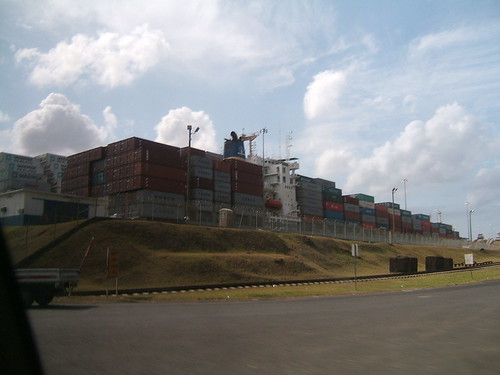
Container ship in Gatun Locks, Panama Canal
Suez Canal
I visited the lock-free Suez Canal in 2009, as described in the post Canal Zone, Egypt.

Maersk Line 'Sealand Slings' with deck container stacks 6-high in places heading north on the Suez Canal
Intermodal transport
Whilst massive container ships can economically move goods large distances, docking requires deepwater berths with specialist handling equipment so getting to the final destination usually requires transhipment to other transport modes - road, rail or sometimes smaller ships.
The significance of road trailers for motor trucks was mentioned in 'Background' above. Although local arrangements vary in different countries, articulated flatbed trucks for containers are a familiar sight. The Wikepedia article here gives a useful survey (and explains the various terms used to describe these vehicles).
But railways have been able to capture part of this market, moving containers between ports and inland distribution centres, from where final delivery may be by road. In the U.K. Freightliner offer over 37 direct routes between sea ports at Felixstowe, Southampton, Tilbury, London Gateway and Seaforth connected to 'major conurbations'.

Bournemouth by Train: View from Winchester platform 2, showing Up 'Freightliner' train passing.
At these terminals, rail-mounted goliath gantry cranes transfer containers to and from trains of special flat bogie wagons. The cranes are tailored to each site and many were constructed by famous bridge builders Sir William Arrol (who became Clarke Chapman in 1969). Freightliner describe the Seaforth (Liverpool) crane as follows:-
Terminal Crane Arrol 2-5-2 with with two cantilver outreaches built 1969. Specifically designed to load ISO containers on/off rail wagons stabled within the span of the crane and road wagons under one cantilver, the other cantilever used for the storage of containers. Rail span: 23.05m. S.W.L. under twistlocks: 32.0 tonnes. Lifting capacity: 20, 30, 40 and 45 foot containers at 13 lifts per hour.
Lawley Street, Birmingham, is an example of an 'inland port' or distribution centre.

Part of Lawley Street container depot.
Where containers are to be on- and off-loaded at destinations with fewer facilities, smaller ships (frequently provided with cranes on the vessel) are used.

View from the bridge of 'RMS St. Helena' en route from Cape Town to St. Helena, showing containers. The white-painted containers are 'reefers'. Note the two container-handling cranes in the 'stowed' position.
In my travels, I've seen a number of sea ports around the world modernised for handling shipping containers and a selection is illustrated below.
Liverpool
Liverpool and its docks have always fascinated me and many of my posts with the label Merseyside talk about docks and shipping on the River Mersey. Formerly operated by The Mersey Docks and Harbour Board, the docks are now run by Peel Ports whose website on its Liverpool facilities is here (and contains lots of interesting information, including data sheets for all the ship handling tugs operating on the Mersey).
In 1971, Seaforth Dock at the northern end of Liverpool Docks opened, with its group of strange-looking container-handling cranes for loading and unloading specialist container ships. This rendered many of the older docks redundant.There's a Wikipedia article here and an interesting aerial photograph by 'fragglehunter' here
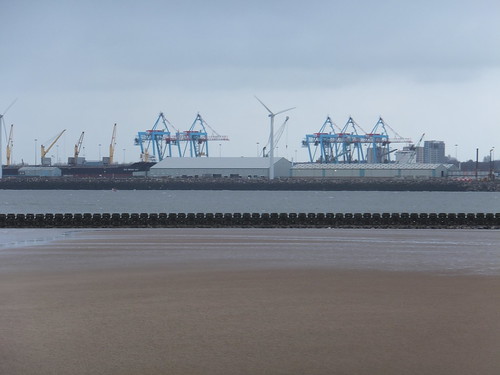 Royal Seaforth Dock seen from New Brighton.
Peel Ports completed phase 1 of the new deepwater container port 'Liverpool2' in 2017, ultimately capable of handling two 380m-long 'Panamax New' vessels simultaneously - see the Wikipedia article here.

New Brighton by rail: View of Liverpool2 Dock from New Brighton, showing 4 of the 5 phase 1 container cranes with a group of young people in wet-suits on the beach.
There are two collections of my pictures showing Liverpool and Liverpool Docks
Southampton
I've visited Southampton a number of times over the years, but the pictures below are both taken from a train on a trip to Bournmouth in 2019 (described here. The Western Docks at Southampton now form a container port. The largest berth DP5, served by 5 container cranes, can accommodate 'Post-Panamax' vessels such as the 20,000 TEU 'MOL TRIUMPH' shown below.

Bournemouth by Train: View of DP World berth DP5 at Southampton after passing Millbrook station. The ship is MOL TRIUMPH.

Bournemouth by Train: View of DP World container cranes at berths DP1 to 4 at Southampton with Freightliner container crane in foreground. Note the 'Hoyer' tank container.
Yangon, Myanmar
In 2014, I walked along Strand Road, to see what was visible of the enclosed docks, as described here).
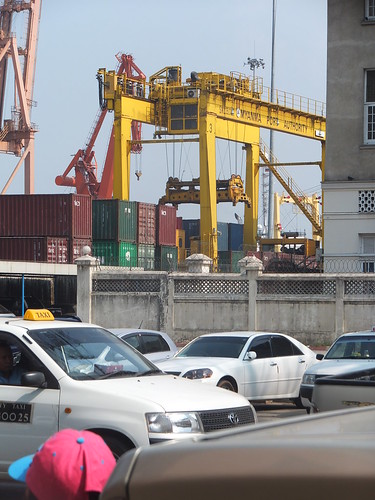
Yellow-painted Container Crane, showing the container-handling 'spreader' suspended from lifting cables, adjacent to Strand Road, Yangon, Myanmar.
Auckland, New Zealand
On the 'Tropic of Capricorn' trip early in 2020 (described here, I saw Auckland docks from both land and sea.
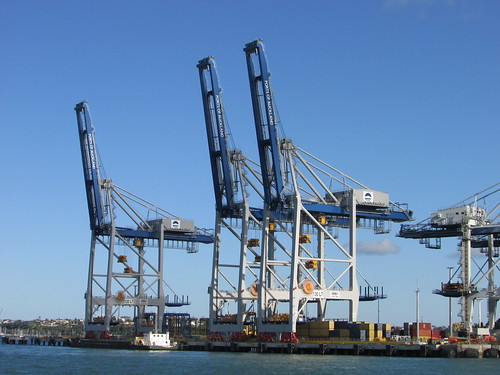
Container cranes on Fergusson Wharf, Auckland viewed from 'Caledonian Sky' (Tropic of Capricorn)
Haydarpasa (Istanbul), Turkey
Whilst exploring Istanbul's ferries in 2018 (described here, I saw the container port at Haydarpasa.
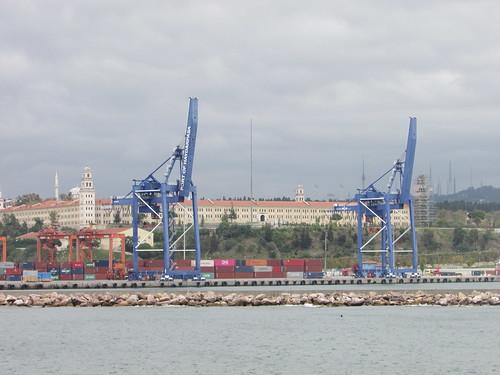
Port of Haydarpasa (Asian side) with two blue-painted container cranes and orange Straddle Cranes. In the background, the massive Selimiye Barracks (Istanbul's Ferries: Eminonu - Kadikoy).
Valparaiso, Chile
In 2016, a cruise to visit the Chilean fjords and the Antarctic Peninsula embarked from Valparaiso. The departure is described in the post 'Silver Explorer'
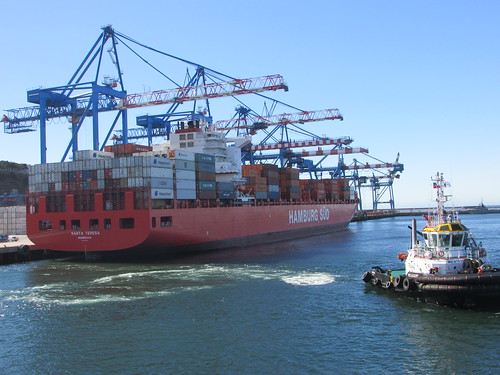
Container terminal, Valparaiso with Hapag-Lloyd container ship ‘Santa Teresa’.
Books
[1] 'Deep Sea and Foreign Going - Inside Shipping, the Invisible Industry that Brings You 90% of Everything' by Rose George, published by Portobello Books (ISBN: 078 1 84627 299 8).
[2] 'The Box: how the shipping container made the world smaller and the world economy bigger' by Marc Levinson, published by Princeton University Press (ISBN: 978-0-691-13640-0).
An ambitious Day Trip from Wolverhampton to Glasgow on 13th April 2019.
The outward journey to Glasgow (described here) was on 9S47 which should have arrived in Glasgow at 13:15. Unfortunately, our arrival was about 13:59. Because I had already committed to a return service leaving Glasgow at 16:00 (pre-booking a particular train using an 'Advance' ticket can save significant sums of money), I'd insufficient time to carry out my planned excursion to Gourock on the Firth of Clyde. I reverted to my 'fallback plan' of a trip around Glagow's Subway.
Glasgow Subway brief history
Glasgow Subway has a fascinating history. Opened in 1896, it is the third oldest underground railway serving a city in the world (after London and Budapest), consisting of two iron-segment lined underground single-line tunnels arranged side-by-side as a continuous route six and a half miles long around the city, part north of the River Clyde, part to the south. Each tunnel carries a single 4 foot gauge track called Outer Circle (clockwise trains) and Inner Circle (anti-clockwise trains). The trains (initially single-carriage but with a second trailer carriage soon added) were originally cable-hauled by stationary steam engines. The carriages were electrically lit by a system feeding power to two rails (known as 'T-irons') mounted on the tunnel wall which was collected by wheels mounted on the side of the carriage. In 1935 the cable haulage was replaced by third-rail 600 volt d.c. electric traction (the original system of carriage lighting was retained with the collection wheels changed to 'skates'). In 1976, an ambitious modernisation plan introduced new trains, new signalling and a new maintenance depot. These changes served the city until 2019 when modernisation of all stations was completed and the first of a new fleet of trains built by Stadler arrived.
I hope to write more about this unique railway one day.

Map of Glasgow Subway (Strathclyde Partnership for Transport)
By Subway to Govan
Although Glasgow Central has two underground platforms (16 and 17), these serve Network Rail's 25 kV suburban network, not the Subway, so it's necessary to take a walk of a few minutes through the city to reach the nearest subway station - St. Enoch - offering the opportunity to admire some of Glasgow's stone-built architecture. According to Geocache (their website is here):-
"Sandstone is the dominant building stone type used in Glasgow. Two types of sandstone were generally used in the construction of the buildings - the so-called 'red' and 'blonde' sandstones. Many of city’s stone buildings were built in the second part of the 19th century and are now of an age where some of the stonework is showing signs of decay and require repair. The legacy of air pollution from industry and domestic coal burning through much of the 20th century has accelerated stone decay in many parts of the city."

Glasgow, Scotland
Strathclyde Geoconservation Group (part of the Geological Society of Glasgow) has produced an interesting 16-page booklet on the stone used in the city's buildings. Catchily titled 'Glasgow Rocks' they've made it available here.
St. Enoch Subway Station building is a rather eccentric design in stone, described as 'Flemish Renaissance' style, sited in the centre of St. Enoch Square. Originally, the passenger entrance was via the ground floor of the building with the offices of the subway on the upper floor but two new covered entrances have been provided, one 50 metres north, the other 50 metres south. The original building has been re-purposed as a branch of 'Caffe Nero'.

Former Glasgow Subway station building at St. Enoch - now a Caffe Nero: Glasgow, Scotland

Glasgow Subway: St. Enoch station following modernisation
Click for larger view
I entered St. Enoch via one of the modern covered entrances which reminded me of an oversize Slinky Toy (for those unfamiliar with this, Wikipedia have an interesting article here). This led me down to the long concourse joining the two covered entrances. Here I purchased a multi-trip ticket, then passed through an automatic ticket barrier and descended to the Outer Circle Platform. An Inner Circle train arrived at the opposite platform, displaying the sharply inward-curved upper panels of the coaches, necessitated by the small diameter tunnel bores. The livery of trains at that time included bright orange sections, giving rise the the line's informal title of 'Clockwork Orange' (a play on the title of Stanley Kubrick's 1971 dystopian film).

St. Enoch Subway Station - platform level (Glasgow Subway)
Boarding my Outer Circle train to travel seven stops to Govan, the restricted space inside was very apparent. I disembarked at Goven, a Burgh from 1864 to 1912 until absorbed by Glasgow. The burgh arms featured a ship flanked by shipyard workers with the motto 'Nihil sine Labore' - nothing without work. I crossed Govan Road from bus station, adjacent to the Subway station, and entered Water Street to reach the River Clyde, passing the splendid, restored Aitken Memorial Fountain. I afterwards found its interesting story here

The restored Aitken Memorial Fountain, Govan (Glasgow, Scotland)
At the river bank, I found the remains of the loading ramp of the Goven Ferry, a former vehicle ferry across the river. There's still a seasonal passenger ferry from an adjacent pontoon on the southern bank to a landing stage adjacent to the Riverside Museum on the northern bank but it wasn't operating during my visit.
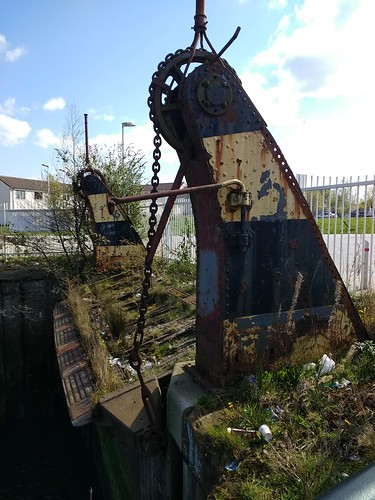
Remains of loading ramp on south bank, Govan Ferry, Glasgow, Scotland
Looking across the Clyde the Riverside Museum, designed by Zaha Hadid, is a startling sight. It's a long five-bay warehouse but each bay has a different span and the gable roof of each bay a different height. Rather than retaining a rectangular footprint, the bays sweep in an asymmetric 'S'. This remarkable building, opened in 2011, now houses the transport collections based from 1964 in a disused tram depot in Pollockshields, moving to Kelvin Hall in 1987, which I visited once. The preserved Clyde-built sailing ship 'Glenlee' look rather incongruous against the backdrop of the Riverside Museum building. I'm afraid I'm not a fan of the ultra-modern and hadn't liked the architect's Heydar Aliyev Centre in Baku, Azerbaijan which I'd visited briefly at the end 2018 (report here).

View of River Clyde from Govan, looking upstream, showing Riverside Museum and 'Glenlee'
Looking downstream, all signs of Glasgow's engineering history had been removed and replaced by modern apartment blocks, so I decided to retrace my steps to Govan Subway station to continue my trip on the Subway.

View of River Clyde from Govan, looking downstream, showing modern apartments
By Subway to Partick
I determined to initially travel one stop to Partick, crossing under the River Clyde at a low point in the tunnels called 'The Sump'. There was a little wait before my Outer Circle train appeared.

Govan Subway Station - platform level (Glasgow Subway)
Partick has a modern, utilitarian building at street level. Like Govan, the bus station is just outside the entrance to the Subway.
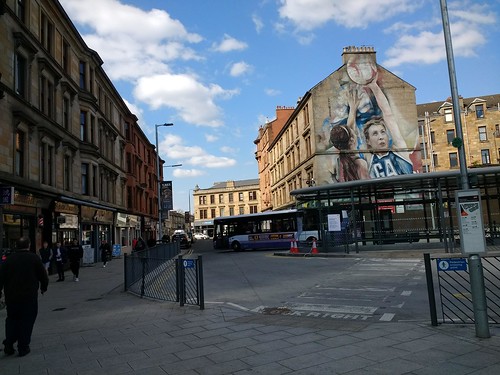
View north on Merkland Street, Partick with bus station on right, Subway station behind camera (Glasgow, Scotland)
In addition to the Subway station and bus station, Partick station on Network Rail's 25kV suburban line is only yards away. I considered using this line to return directly to the underground platforms at Glasgow Central but there was a wait before the next service so I decided to return to the Subway station to complete my circuit of the subway.

Eastbound Platform waiting area at Partick Station, Glasgow
By Subway back to St. Enoch
I'd entertained the idea of getting off the Subway at Buchanan Street and walking to Network Rail's Queen Street station but, on that Saturday afternoon, the Subway service was fairly sparse and I realised I'd have to simplify my tour if I was to catch my booked Virgin return train so I stayed on the Subway train to St. Enoch and then walked back to Glasgow Central, pausing on Argyle Street, where this busy street passes under the railway station, to photograph the glazed side screen on the station overall roof.

View of Glasgow Central Station from Argyle Street showing glazed side screen on station overall roof
Making my way across the concourse to my train, I again admired the thoughtful architectural design, not yet ruined despite the modernising of general facilities and 'retail opportunities'. In particular, I delighted in the airy, light space provided by the huge, glazed overall roof, which reminded me of Waterloo station in London (I talked about Waterloo's roof approvingly in the post Waterloo Station, London (Part 2)).

Glasgow Central Station concourse
By Virgin Pendolino back to Wolverhampton
Once aboard the Virgin train, I was able to relax after my dash around the city. I continued to take pictures whilst the light held but I'm afraid they are poor. I haven't attempted to describe the long return journey which was fortunately without incident. It was an exhausting, but very satisfying, day.
Related Posts on other Websites
Glasgow Subway (Wikipedia).
Glasgow Subway (Strathclyde Partnership for Transport).
St Enoch subway station (Wikipedia).
Aitken Memorial Fountain.
Related Posts on this Website
The following post describes my outward journey to Glasgow:-
Glasgow by Rail
My pictures
Where necessary, clicking on an image above will display an 'uncropped' view or, alternately, pictures may be selected, viewed or downloaded, in various sizes, from the albums below:-
Pictures taken that day are divided between various albums:-
Glasgow by train.
Glasgow by rail (return).
Glasgow Central Station.
Glasgow Subway.
Scottish Railways.
Glasgow, Scotland.
My first visit to Morecambe (Promenade) railway station was in 1952 when I was nine and I clearly remember how impressed I was. Sadly, my recollection of details of these far-off events is imperfect, so forgive me if I make errors. I found an attractive stone-built range of station buildings facing the promenade with the sea only yards away (when the tide was in - it recedes a long way at low tide in Morecambe!). Having passed through the entrance hall with ticket office and an airy, glazed concourse two long, island platforms presented themselves. Only one platform was occupied and my attention focussed on the small side-tank locomotive standing at the head of a short train of maroon compartment coaches. I barely registered the lattice truss portal structures along the platforms which supported an overhead catenary system above the tracks. Still less did I see the significance of an elderly, green-liveried, 3-car set of coaches with a pantograph stabled in an adjacent siding.

Morecambe: Former Midland Railway Morecambe (Promenade) station building, tracks long gone, now Tourist Information Office, performance space ('The Platform') and public house ('The Station')
I recognised the steam train as a 'Pull and Push' operated by one of a small class of Stanier 0-4-4T fitted for 'auto' working (this recognition possibly as a result of reading an illustrated article in the 'Railway Magazine about a similar service between Harrow & Wealdstone and Stanmore). From platform level, the engine looked similar to the six-coupled 'Standard Shunt' design which was a familiar sight where I lived but there were curious additions adjacent to the smokebox which I realised were part of the Vacuum Controlled Regulator which, when the locomotive was pushing the train, should have allowed the Driver to remotely control the regulator from a small driving compartment in the leading coach.

Stanier 0-4-4T, classification 2P, shown with original stovepipe chimney, later replaced (from 'British Locomotive Types, published by The Railway Publishing Company in 1938)
Click for larger view
Although I could be a shy child, I somehow struck-up a conversation with the fireman. Presumably my fascination with railways was apparent from my close observation. The fireman was young, lean, wearing overalls without a jacket and a beret (often preferred by fireman, to a 'greasetop' hat, it appeared to me at the time). Eventually, I was introduced to the driver who was middle-aged, wearing overalls with a jacket and a greasetop. He possessed the confident, patient bearing I'd seen in other drivers. When departure time came, I was confused to be told to jump onto the footplate. The locomotive was pulling the train on this journey to Lancaster Green Ayre, so the driver remained on the footplate and, once the fireman relayed the 'right away' to him, he tugged at the regulator and we started to move. I think that was the first time I'd been on a moving locomotive so I found the experience both facinating and terrifying. Pressed against the cab back-sheet, it was noisy, hot and, in the enclosed cab, unexpectedly dark. The unfamiliar lurching motion was unsettling and periodically, I had to avoid the fireman's shovel as he turned to scoop up coal from the bunker. I noted that, on the easy route, the fireman had less shovelling to do than I expected and spent most of his time keeping a lookout through the front spectacle, occasionally using an injector to maintain the boiler water level which, when operating, added a continuous roar to the cab noise.
All too soon, we arrived at Lancaster (Green Ayre). I thought I would be dismissed but the kindly driver explained that the train would now take the short single line to Lancaster (Castle), returning immediately. He would not take me on the footplate to that station, on the West Coast Main Line (presumably because there was always someone on the lookout for 'trouble' there). The fireman led me to the leading passenger compartment and told me to travel there. I remember protesting that I hadn't a ticket but the amused fireman told me not to worry and, should the guard query it, refer him to the footplate crew. We made our way up the gradient to Lancaster (Castle) which did appear big and important. I watched our driver walk the length of the train to reach his driving compartment when pushing and we soon returned to Lancaster (Green Ayre). The fireman collected me and I joined him on the footplate. This time, there was just the fireman and me on the footplate which seemed very strange. Although the engine was fitted with a Vacuum Controlled Regulator which should have given the driver control from his Driving Compartment, I never saw it used. There was an electric bell in the cab, operated from the Driving Compartment so, when the driver sounded this, the fireman opened the regulator. Once underway, the fireman decided when to adjust the driving controls for running between stations and I think he similarly decided when to shut off steam so as to drift to the next stop. That just left the driver with the delicate job of judging the brake operation to bring the train to a stop in the correct position. It was already obvious to me that a push-pull operation like this required close co-operation between driver and fireman.
By the time we arrived back at Morecambe (Promenade) after this momentous experience, fascination had almost overcome my terror of being on the footplate and I'm ashamed to say I probably asked to be able to do it again. The kind crew indulged me and I'm unclear how many trips I managed that day and the following day between Morecambe and Lancaster. Occasionally, a service would take the branch to Heysham and I was on the footplate for at least one of the Heysham runs. At that time, the station there still had its all-over roof and I remember the platforms being dark and gloomy and not at all inviting.
One of the few locomotive running numbers that sticks in my memory is the number of that Stanier 0-4-4T which I rode up and down on - 41901. I wonder if that kindly locomotive crew realised the seed they planted back in 1952? Thirty-six years later, I, too, joined the ranks of footplate crew in steam preservation.
Related posts on this website
Steam around Morecambe
Railways around Morecambe
Track Diagrams: Lancaster (Green Ayre) (Visit in 1967)
Return to Heysham (Visit in 2013)
Morecambe by Rail (Visit in 2019)
Video from 1960s by David Chandler
Lost railways of Lancaster and Morecambe: Episode 1.
[Picture & drawing added 9-Jan-2021]