skip to main |
skip to sidebar
A late arrival in Baku, Azerbaijan's capital, the previous day (described here) meant that our programme became compressed. We had managed to carry out the planned walking tour of Baku the previous evening (described here) but the day described below, the last day of my trip with Golden Eagle, was equally stimulating.
Friday 28th September 2018
Buffet breakfast was available from 06.30 a.m. in the Four Seasons large Zafferano Restaurant. At nine o'clock we all met up in Reception to join our various coaches. We were to visit the Gobustan National Park to see the ancient rock art. Our coaches slowly extricated their way south out of the city and I realised that we were retracing our arrival route the previous afternoon when the double-track electrified main line appeared on our right. Our highway, the E119 remained on the seaward side of the railway. We passed the massive LafargeHolcim Cement Plant to our right and various industrial sites to our left.
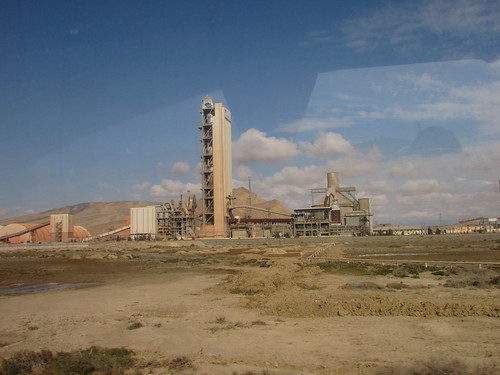
Around Baku: LafargeHolcim Cement Plant Garadagh, viewed from E119 highway.
Periodically, we passed modern police stations. Our guide invited us to recall that the transition from Soviet state to independent nation in the last twenty five years has not been without difficulties and Azerbaijan experienced a repressive and lawless phase. He suggested that the large glazed areas in modern police stations were intended to send the message that the modern police have nothing to hide.
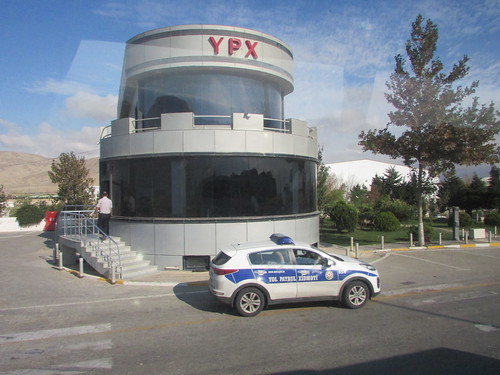
Around Baku: Local Police Station on the E119 Highway.
To reach the Gobustan National Park, now a World Heritage Site, our coach crossed over the railway line on a road bridge and climbed into the muddy-looking foothills I'd first seen the previous afternoon as we arrived at Baku by train. We parked in a car park already busy with cars and coaches. We deferred an exploration of the very modern Visitor Centre until later and our guide led us directly into the rocky area where it seemed that almost every near-vertical cliff has been embellished with primitive carvings depicting scenes from the lives of the prehistoric people who once lived there.
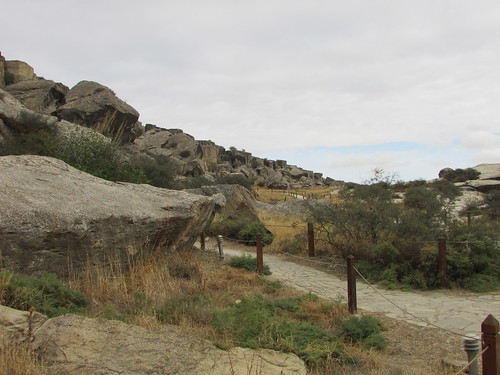
The Rock Carvings of Gobustan National Park, Azerbaijan: One of the footpaths leading through the rocky landscape.
Despite the simplicity of the artworks, I found them evocative and full of vigour. Most are believed to be between 5,000 and 20,000 years old.
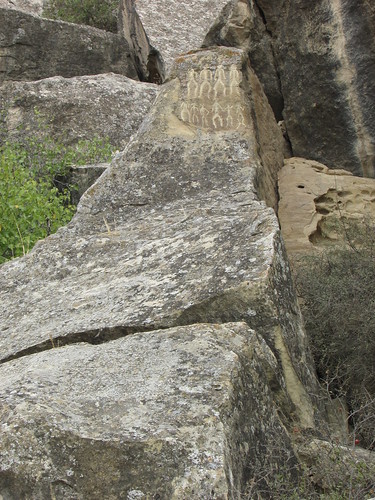
The Rock Carvings of Gobustan National Park, Azerbaijan
I found the carvings of animals particularly interesting but I'm afraid my camera couldn't really do justice to what we we saw.
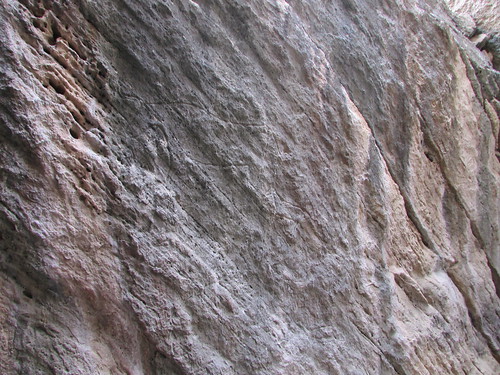
The Rock Carvings of Gobustan National Park: animal images.
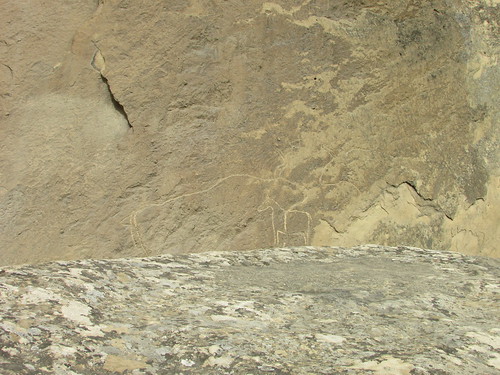
The Rock Carvings of Gobustan National Park: more animal images.
We also saw a 'Gaval Dash' - a naturally-occurring stone which resonates when struck. The example was about three feet long and this type of stone has only been found in the area of Gobustan where I assume the unique geology has produced gaseous inclusions in the stone, giving a strange ringing sound when struck by a smaller stone.
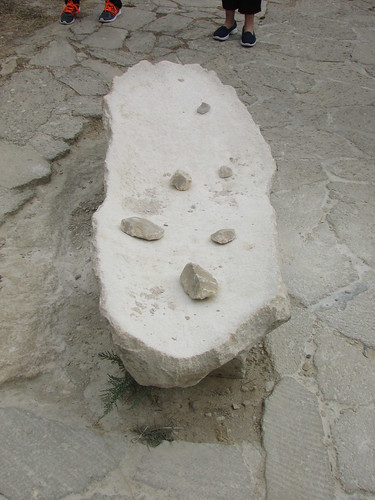
The Rock Carvings of Gobustan National Park, 'Gaval Dash' musical stone viewed from above.
I enjoyed the park itself but the modern visitor centre was rather crowded so we shuffled past the interpretations of prehistoric life fairly quickly. Nearby, there was a representation of a prehistoric village, with a number of full-size mannequin and a series of straw-covered huts. I was amused to discover that one of these huts housed a modern tea vending machine.
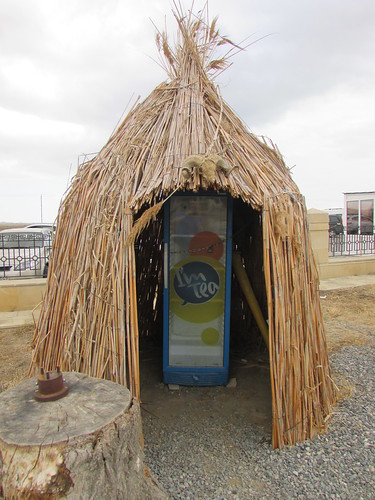
The Rock Carvings of Gobustan National Park: An unexpected tea vending machine!
The elevated site offered good views of the Caspian Sea, and the profusion of offshore oil and gas platforms served as a reminder of Azerbaijan's modern history.
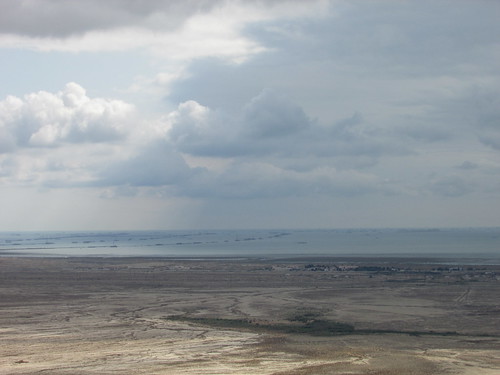
The Caspian Sea viewed from Gobustan National Park, Azerbaijan
Wikipedia has an article about Gobustan National Park here. There's also a rather frantic presentation about the site here which gives some idea of the area. I was rather disappointed that we didn't get to visit one of the mud volcanoes in the area but I suppose it tends to be a rather messy business. The mud is reputed to have medicinal qualities.
We clambered back aboard the buses and drove back to the E119 highway which lead us back towards Baku. In places, we were close to the shore of the Caspian Sea - a rather odd sight with a chain of offshore oil or gas platforms spread across the view, some complete with drilling rigs.
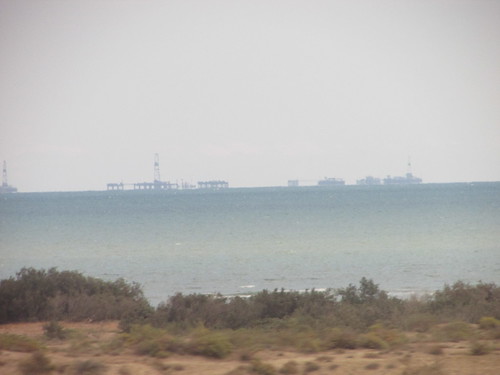
Around Baku, Azerbaijan: The Caspian Sea, with a chain of offshore oil or gas platforms.
We passed the entrance to the ambitious Khazar Islands project - a planned city to be built on around 40 artificial islands which lost funding following a fall in oil price and currently on hold. The artist's impressions on the Design Build Network site here are certainly striking.
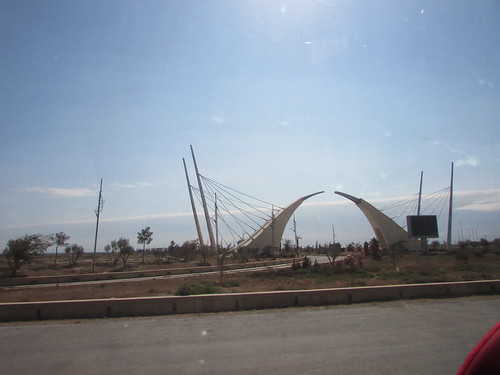
By coach to Baku from Gobustan, Azerbaijan: Entrance to Khazar Island (project currently suspended).
As we approached the city, our guide pointed out a large, informal taxi rank adjacent to a roundabout where passengers negotiate with the waiting drivers.
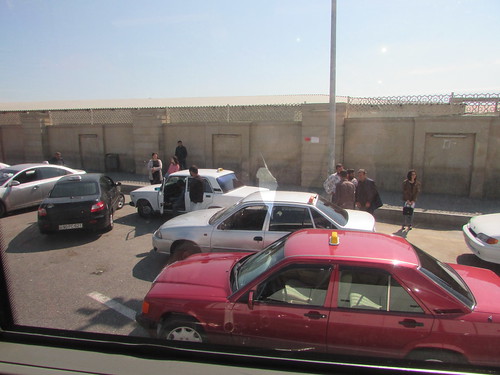
Around Baku, Azerbaijan: Informal 'taxi rank'.
Passing an area called Shikh Beach, we passed the waiting jack-up offshore rigs moored at a long jetty I'd spotted from the train on our arrival the previous day.
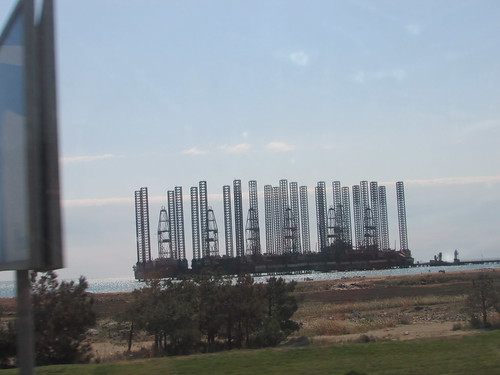
Around Baku, Azerbaijan: Moored 'Jack-up' Drilling Rigs at Shikh Beach.
We turned right off the highway into the narrow streets of Bibiheybat, an old part of the city and our coaches gingerly descended the hill towards the shore of the Caspian Sea.
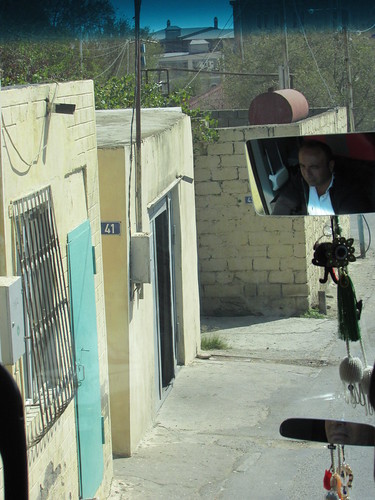
Bibiheybat, Baku, Azerbaijan
We stopped near Nar Sharab hotel and restaurant where we were shown into a large restaurant overlooking the Caspian. The sun shimmering on the water and the outdoor sun terrace looked very attractive and some of the guests commented that they would have liked the opportunity to get closer to the sea but the service in the air-conditioned restaurant was friendly and prompt, the Azeri set menu was good and they served some interesting local wines.
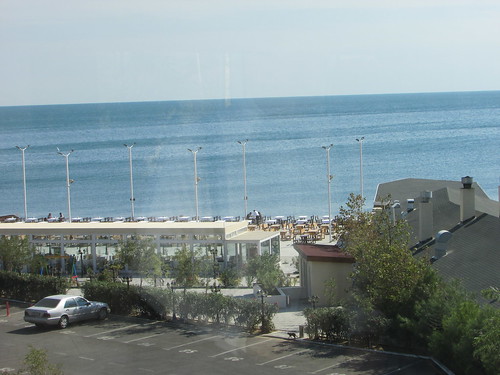
Lunch at Nar Sharab hotel and restaurant, Baku, Azerbaijan
As we finished lunch, we were invited to choose from a revised afternoon programme of free time in Baku, a visit to the Carpet Museum or a trip to the Ateshgah Zoroastrian Temple of Fire. I chose to improve my very limited knowledge of the Zoroastrians and was shepherded onto the appropriate coach.
Bibiheybat is on a promontory thrusting into the Caspian. Our restaurant had given us views to the south but, within a few minutes of setting off, we were heading west along the northern shore of the promontory in an area called South Bay which was an active, but rather neglected, area of docks. There were four fishing vessels and four larger vessels of about 5,000 tons DWT (either oil tankers or bulkers) laid-up but looking rather sorry. I counted four floating dry docks, of various sizes, apparently in regular use.
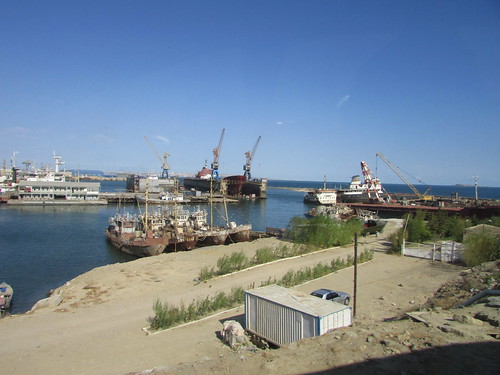
South Bay, Baku, Azerbaijan
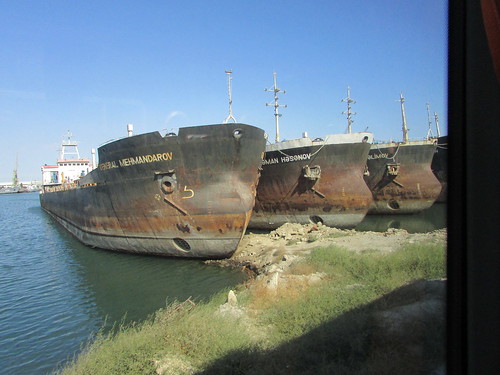
Cargo ships laid-up in South Bay, Baku, Azerbaijan
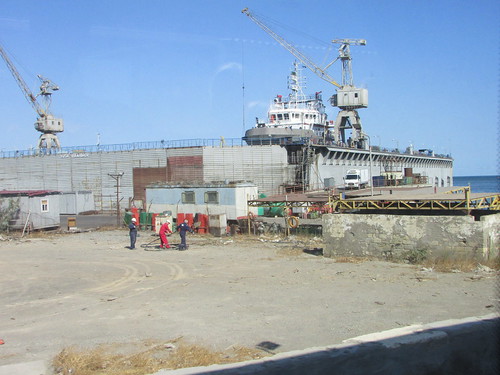
Ocean-going tug undergoing repairs in the Floating Dry Dock 'Yusif Ibrahimov', South Bay, Baku, Azerbaijan
We passed the modern campus building of Baku Higher Oil School and then, as often occurs around Baku, we passed into a rather barren area populated only by a few 'nodding donkey' electrically-driven oil pumps, quietly extracting the source of Azerbaijan's wealth. These pump installations are more correctly called 'Pumpjacks' - there's a useful Wikipedia article here.
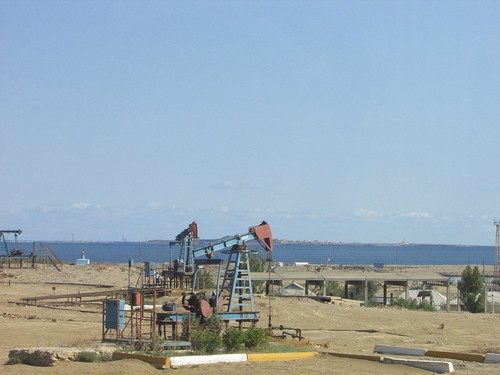
Pumpjacks around Baku, Azerbaijan
Equally suddenly, we were back in a modernised area with manicured lawns and the imposing Baki idman Sarayi Aquatic Palace.
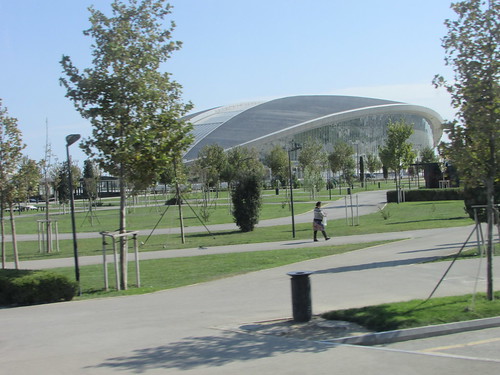
Baki idman Sarayi Aquatic Palace, Baku, Azerbaijan
In keeping with any modern, capital city, Baku has equipped itself with a Contemporary Arts Centre. This is housed in one of a group of restored industrial buildings. The Yarat Centre has a website (in English) with more information here. The adjacent buildings appear to offer a variety of dining experiences.
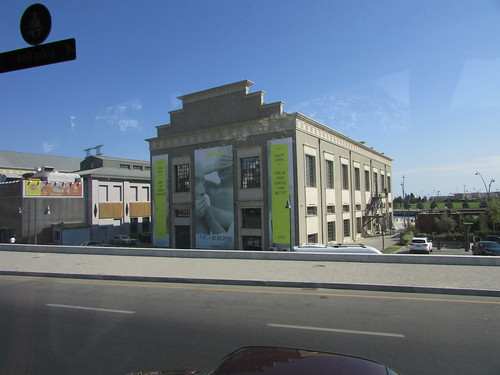
The Yarat Contemporary Arts Centre housed in a restored former industrial building, Baku, Azerbaijan>
A little further on, a disused electricity generating station built in 1921 has been restored and re-purposed as the Heydar Aliyev Foundation's Stone Chronicle Museum (following the collapse of the Soviet Union in 1991 Heydar Aliyev was the third President of Independent Azerbaijan, succeeded on his death in 2003 by his son Ilham Aliyev who is the current President). As our coach sped by on the E119 highway, I little realised that behind the Stone Chronicle Museum, a Russian 'L' class 2-10-0 steam locomotive had been plinthed and cosmetically restored.
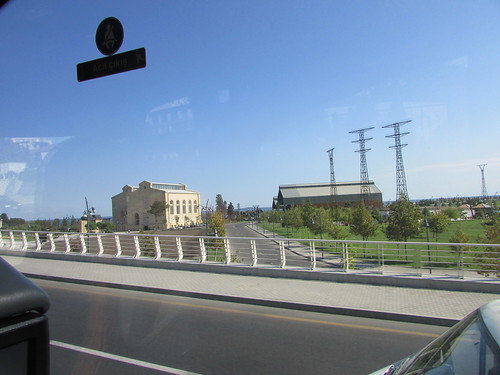
Former electricity generating station restored as the Stone Chronicle Museum, Baku, Azerbaijan. Note the disused electricity transmission towers.
We were now passing the waterfront Boulevard area with the 60 metre Ferris wheel called the Baku Eye and the not-quite-finished Caspian Waterfront Mall (there's an interesting article on the history of the Caspian Waterfront on the architect's website here).
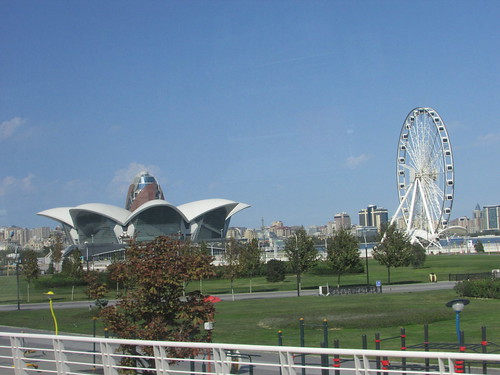
L: Almost complete Caspian Waterfront, R: Baku Eye. Baku, Azerbaijan
We passed the Azerbaijan Carpet Museum, designed to resemble a huge rolled-up carpet, then 'Mini-Venice' and the Yacht Club on our right, leaving our hotel, the Four Seasons, on our left. The coach traversed Neftchilar Avenue before turning away from the shore to continue north-east on Heydar Aliyev Avenue, passing a variety of modern buildings, some still under construction.
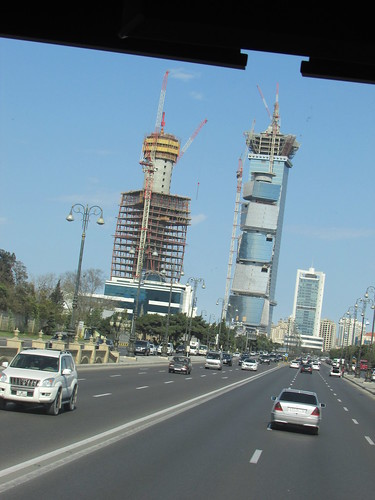
Around Baku, Azerbaijan
The coach continued east along the broad Airport Road before turning off into another of the strange, desolate areas around Baku of bare earth with oil derricks, pumpjacks and small capacity pipelines.
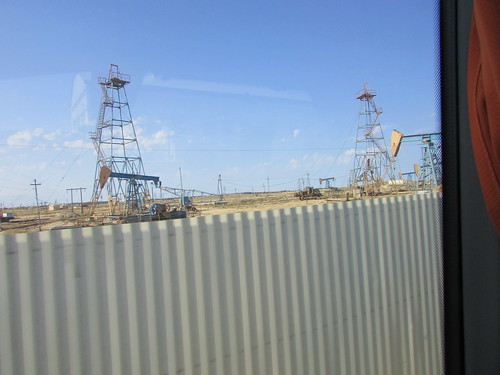
More Pumpjacks around Baku, Azerbaijan
Then we were back in a normal, suburban area, crossing a single track railway at a level crossing on the Zigh Highway before turning south-east along Balandin which took us past Surakhani station and into the coach park of the Ateshgah Zoroastrian Temple of Fire.
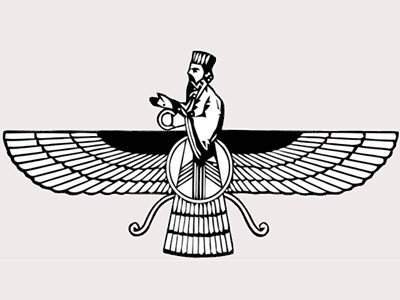
Zoroaster
Zoroaster was a Persian philosopher, prophet and spiritual leader who believed in two spiritual forces of Good and Evil with human free-will able to choose which to follow. Optimistically, he believed in the ultimate triumph of Good. He is generally thought to have lived between 1,000 and 1,500 years before the birth of Christ but this is uncertain. His thinking gave rise to the religion of Zoroastrianism which became the dominant religion in Persia.
See Zoroaster (Wikipedia) and Zoroastrianism (Wikipedia) for more.
The five-sided temple at Ateshgah has the appearance of a stone fortress, with a series of rooms and cells built into the thickness of the walls and a single access gateway, as shown in the plan below.
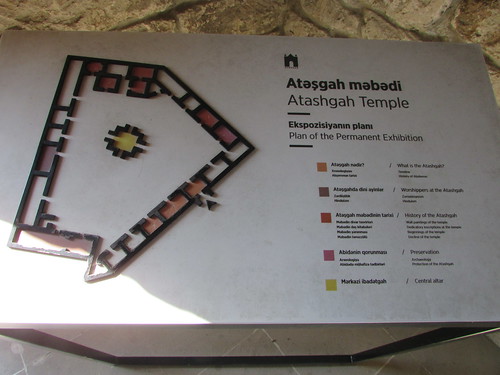
Plan of Ateshgah Zoroastrian Temple, Baku
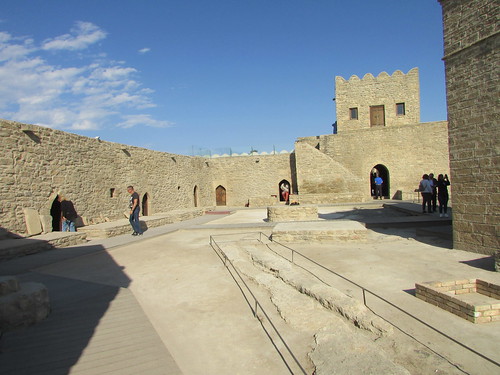
Ateshgah Zoroastrian Temple, Baku: View of inner courtyard with five doors to cells in outer wall and access gateway on right
Fire was an important symbol in Zoroastrianism and the main altar always had an 'eternal flame'. Until recently, the 'eternal flame' on the main altar at Baku was fed by a natural escape of gas but increased gas extraction rates commercially in the area resulted in connection to the gas main!
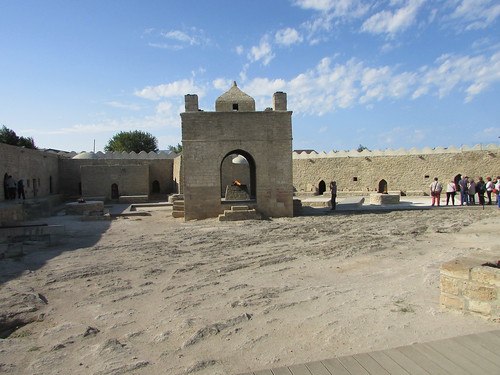
Ateshgah Zoroastrian Temple, Baku: Central altar and 'eternal flame'
Although believed to have been built during the 17th and 18th centuries for Zoroastrians, the site also became a place of worship for Hindus. The Temple of Fire is now arranged as a museum with interesting displays illustrating the life of ascetic pilgrims.
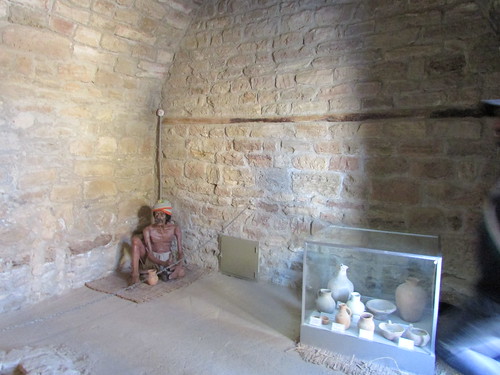
Ateshgah Zoroastrian Temple, Baku: Pilgrims' cell.
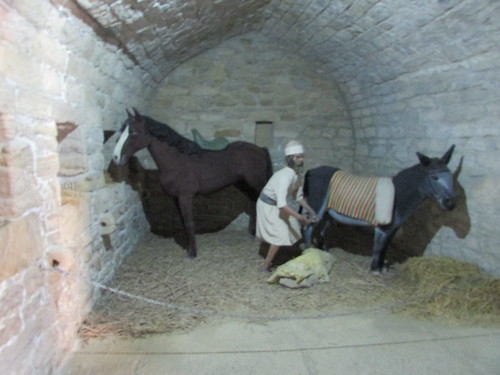
Ateshgah Zoroastrian Temple, Baku: Stable for pilgrims' horses.
See also Fire Temple of Baku (atlas obscura).
After this very worthwhile visit, it was 'back on the bus' and retrace our route to the Four Seasons Hotel in Baku, pausing briefly to admire the flowing architecture of the Zahar Hadid designed Heydar Aliyev Centre. There's more on this building on Wikipedia here.
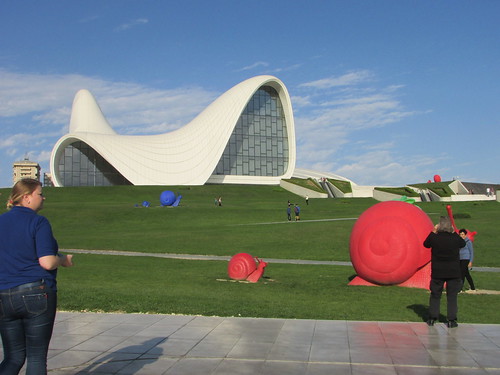
Heydar Aliyev Centre, Baku, Azerbaijan.
My 'Golden Eagle' trip was almost over - just dinner then bed because I had a very early start the following day. Dinner had been arranged for the whole party in the Mughab Club Restaurant, a few hundred yards walk from the hotel. We ate at two long tables, caravanserai-style with traditional musical entertainment provided. The meal was enjoyable but those of us with early departures the following day were happy enough to make our way over the cobblestones of the lanes leading us back to the main road, the hotel and bed after a packed day of excursions in Baku.
Related posts on this website
This is the last one of a series of posts describing my 'Golden Eagle' Caspian Odyssey trip, starting with Travelling East.
Alternately, clicking on the 'All my Caspian Odyssey reports' link displays all the posts on this trip in reverse date-of-posting order.
All my Caspian Odyssey reports.
On leaving Baku by air, I flew to Istanbul for a weekend. Clicking on the 'Next report' link below displays my first post describing Istanbul.
Next report.
My pictures
These albums include more pictures of the events described above:-
Four Seasons Hotel, Baku, Azerbaijan.
Around Baku, Azerbaijan.
The Rock Carvings of Gobustan National Park, Azerbaijan.
Ateshgah Zoroastrian Temple, Baku.
All my pictures taken in Azerbaijan (except 'technical' railway pictures) are in the collection Azerbaijan.
Although the double-track Liverpool & Manchester Railway initially adopted a 'Time Interval' system between trains which were only allowed to travel in one direction on each line, over time the deficiencies of this system had to be addressed, because of the risk of a following train running into the rear of an unexpectedly-halted previous train.
Train Staff Working
But single-line railways needed a different approach from the start as there was not only the danger of one train catching up with another but the possibility of trains travelling in opposite directions meeting head-on. The Americans have an evocative phrase for this event - 'cornfield meet'. In the U.K. the system of a 'Train Staff' was adopted. This was often a rounded length of wood (hence the name 'staff'). There was only one Train Staff for each single line section, marked with the section of line to which it applied. Before entering a single line, the driver took possession of the unique Train Staff and was thus assured that no other train was occupying the section. On clearing the single line, the driver would surrender the staff, allowing another train to enter the single line. Provided drivers were in possession of the the Train Staff when on the Single Line, this simple system was safe.
To increase the capacity of the line, a long single line was often divided into separate sections by intermediate stations provided with passing loops. There was only one Train Staff for each single line section between passing loops, marked with the names of the two stations between which it applied. Again, provided the footplate crew made certain they were carrying the correct staff for the section, the system remained safe. Train Staffs could be distinctively painted or shaped to assist the driver and fireman in identifying the correct staff but enginemen were also expected to read the names of the stations marked on the staff as a cross check. When I was a trainee fireman in preservation, I was taught to collect the Train Staff from the Signalman (or person in charge), check the details, shout "Correct Staff!" then display it to my Driver so that he could independently satisfy himself that we had proper authority to enter the single line section.
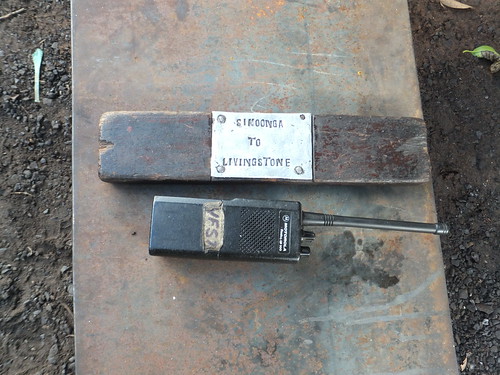
Simoonga - Livingstone single line staff (and two-way train crew radio), Victoria Falls Steam Railway, Zambia.
A bigger problem with this simple system was its inflexibility. If trains alternated in direction on the single line, the first train carried the staff from station A to station B, the second train, in the opposite direction, returned it from station B to station A. But there was no way for a second train from A to B to follow the first whilst the Staff remained at station B. There are tales of junior porters having to carry the Staff to the opposite end of the single line by bicycle in exceptional circumstances.
Train Staff and Ticket Working
Train Staff and Ticket Working seeks to address the inflexibility of ordinary Train Staff Working. The signalman or Person in Charge at station A must be in possession of the Train Staff before allowing a train into the single line section.
If a second train will run in the opposite direction, the Train Staff is actually CARRIED by the driver of the first train so as to be available for the second train on arrival at station B.
If a second train will follow the first in the same direction, the driver of the first train must be SHOWN the Staff. Seeing the Staff gives assurance that another train has not entered the opposite end of the section. The signalman also issues a numbered paper Ticket to the driver, identifying the specific train and giving authority to pass through the single line. When the train arrives at station B, the ticket is surrendered to the Signalman or Person in Charge there who cancels the Ticket. Because the Train Staff is still at station A, a second train may follow, this time with the driver CARRYING the Staff (unless a further Ticket is issued because of a third train in the same direction).
With Staff and Ticket working, telephone communication between the Signalmen or Persons in Charge at either end of the single line is essential because a further Ticket must not be issued until any previous Ticket had been correctly received and cancelled. Before allowing a train onto the single line, the Signalmen or Persons in Charge at both ends must agree upon the direction of the NEXT train required to pass over the single line. Whether a driver receives the Staff or is shown the Staff and receives a Ticket depends upon the direction of the NEXT train through the section. If the next working is in the opposite direction, the Staff is carried to the other end so it can be given or shown to that train. If the next working is in the same direction, the driver is shown the Staff (so that it can be shown to or carried by the following train) and CARRIES the Ticket. Tickets are valid for one specific train and, after a single use, are cancelled by the Signalman or Person in Charge receiving the used ticket.
Electric Token Working
Single-line control eventually benefited from the use of electrical interlocking from one end of a single line section to the other, allowing multiple single line tokens to be housed in machines at either end of each single line but ensuring that only one token could be released at a time and that it had to be returned (to either machine) before a further token could be extracted (from either machine). This arrangement allows 'unbalanced' working of trains until either machine runs out of stored tokens. Numerous designs are in use in various parts of the world, including:-
Electric Key Token ('Lollipop' token).
Tablet (round, metal disk token).
Ball token (Neale's pattern as widely used in Thailand)
This very simple explanation clearly needs expanding in the future.
Interlinking with Signals
A feature of British signalling practice where a train staff is used is an electrical interlock to ensure that the appropriate staff is present in the signal box before the signal admitting a train to the single line (the 'section signal') can be 'cleared'. For instance, this safeguard is provided at Shackerstone on the Battlefield Line.
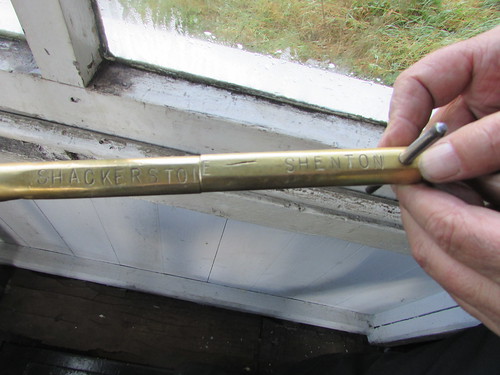
The Single Line Token at Shackerstone.
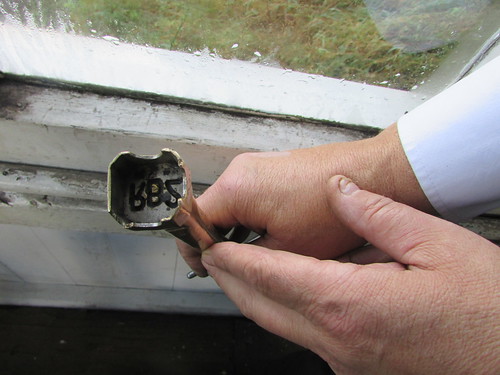
The Single Line Token, showing the incorporated 'Castell Key'.
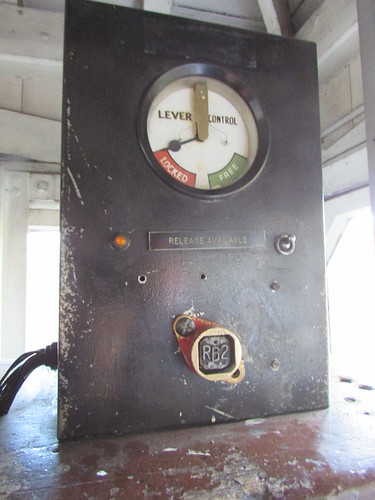
The Release equipment in Shackerstone signal box for the 'Section Signal'.
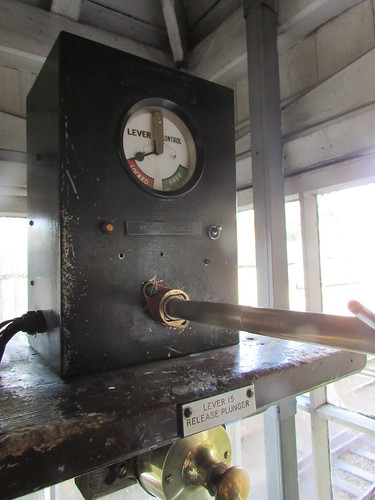
Token inserted into Release equipment.
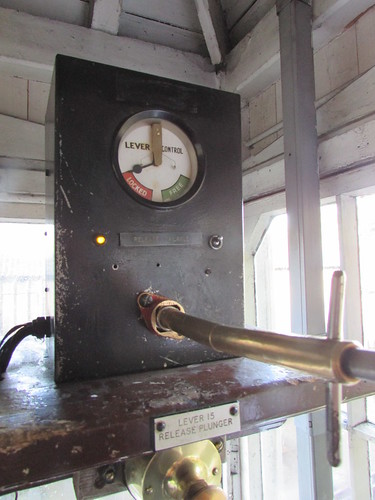
Token inserted into Release Control and turned. Yellow Lamp lit indicates the release is available to allow the 'section signal' to be 'cleared'.
Pilotman Working
If a train staff is lost or damaged or electric token equipment fails, subject to suitable safeguards, trains may continue to run using a 'human agent' as a Pilotman. He identifies himself to all staff by wearing a special armband marked 'PILOTMAN' (or, in exceptional circumstances, an armband made from a red flag).
Related articles on other sites
Token (railway signalling) Wikipedia.
Indian Railways single line instruments The Signal Box.
My previous post here describes our journey across Azerbaijan, arriving in Baku station at 16:34. It was already becoming dusk and I was quite ready to retire to a hotel room but the organisers had decided that our walking tour of the Old City, which had been planned for that morning, would take place before we checked into our hotel.
A little background
The history of the area now forming Azerbaijan is very complex. There's a useful Wikipedia article here but I found a three-minute animation from 'Cartographious' here which shows the various changes informative. Use the 'Back Button' to return here. Imperial Russia, seeing the strategic importance of the area, pursued a series of wars against Persia and eventually managed to wrest control, as shown in another animation, this time from 'EmperorTigerstar', here. Use the 'Back Button' to return here.
The astonishing wealth-creation and growth of Baku in the 19th century resulted from the unique geology of the area. The world's first oil well was drilled at Bibiheybat, Baku in 1846 and the increasing demands for petroleum products both in the Russian Empire and in the West had attracted the attentions of the Nobel Brothers and Rothschilds by 1883.
Thursday 27th September 2018 (Evening)
The coaches drove us on busy streets from Baku railway station to a dropping-off point near the Old City. Although there were large, ambitious modern 'skyscrapers', the more conservative architecture lining the streets was similar to European and American cities developed in the 19th and early 20th centuries featuring Baroque, Gothic and Beaux-Arts styles, together with later Soviet styles. The picture below illustrates this architectural mix, with a medieval Persion palace (foreground), Soviet-style (rear left - although Baku TV Tower, started 1979, was not completed until 1996 after the collapse of the Soviet Union) and ultra-modern (rear right two of the three 'Flame Towers' described on Wikipedia here).
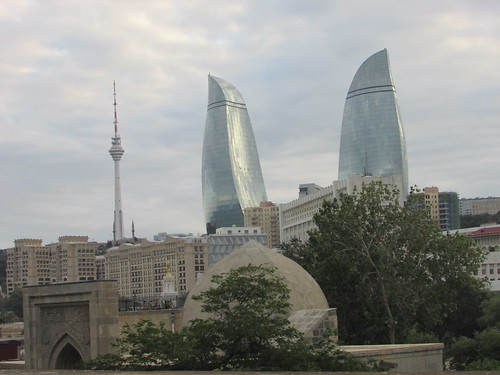
A mix of architectural styles in Baku, Azerbaijan: Persian, Soviet and ultra-modern.
The Baku Executive Authority Building, completed in 1904, was built as a Municipal Duma or town hall in the Baroque building style and now serves the Mayoralty of Baku. There's a Wikipedia article here.
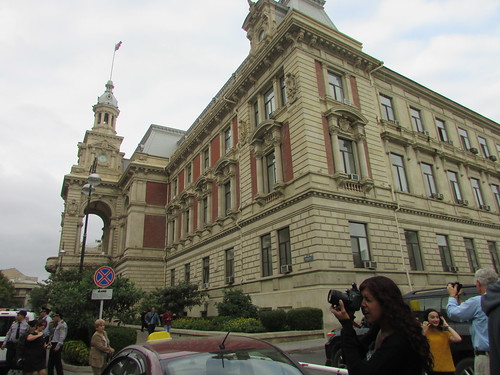
Baku Executive Authority Building
We came across various oddities, like a strange larger than life size bust of the Baku poet Aliaga Vahid (1894-1965) and the Baku Museum of Miniature Books (see Wikipedia article here).
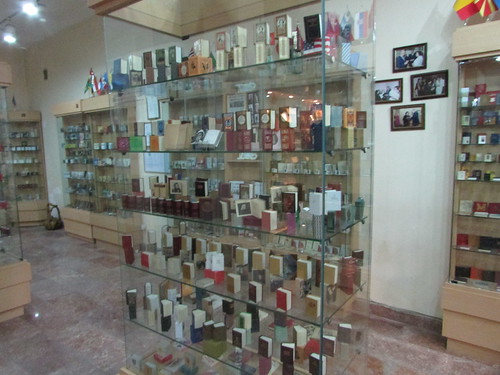
Baku Museum of Miniature Books, Baku, Azerbaijan
The Old City, Icherisheher, was built when Azerbaijan formed part of the Persian Empire, incorporating 12th century (or perhaps earlier) features and defensive walls, with later additions. There's a Wikipedia article here. Our walk took us past the surviving parts of the encircling Old City walls and the Maiden Tower. The Old City has been changed by modern reconstruction but a model on display in the Palace of the Shirvanshahs gave an impression of the 15th century city. The Old City, including the Palace of the Shirvanshahs, is now a World Heritage Site
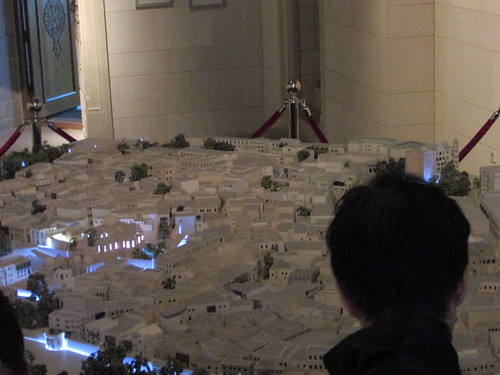
Model of 15th century Baku, Azerbaijan
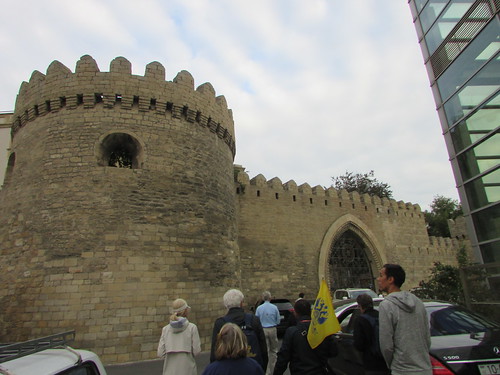
Walls of the Old City, Baku, Azerbaijan
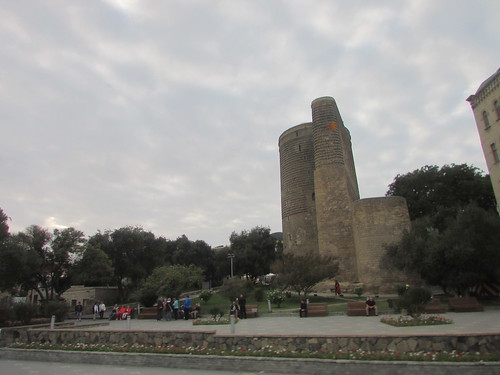
Maiden Tower, Old City, Baku, Azerbaijan
The highlight of our walking tour, for me, was a visit to the 15th century Palace of the Shirvanshahs. Considerable reconstruction has been carried out and, although its detailed history is still a matter of some debate, I found it a fascinating and tranquil complex of elegant buildings.
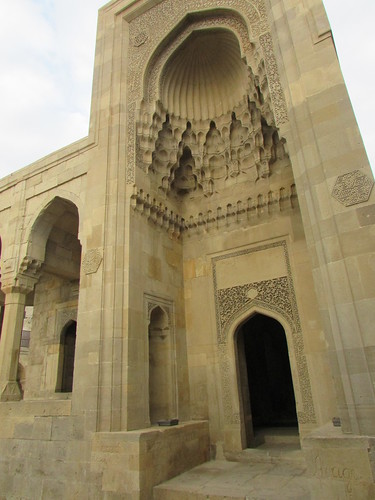
Palace of the Shirvanshahs, Baku, Azerbaijan
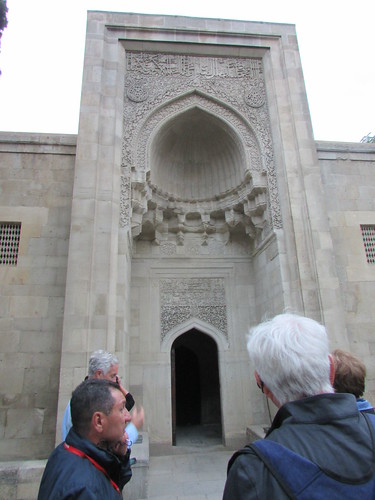
Palace of the Shirvanshahs, Baku, Azerbaijan
Below I list Wikipedia and other articles which give more background on the Palace of the Shirvanshahs:-
Palace of the Shirvanshahs (Wikipedia)
PALACE OF THE SHIRVANSHAHS (Alluring World)
Shirvanshah Palace, Baku (Advantur)
Palace of the Shirvanshahs (Azerbaijan International)
We left the Palace and continued our walking tour, past preserved bathhouses and a medieval caravanserai but, by this time, my tiredness was overcoming my concentration and I felt quite relieved when I saw that we were finally headed towards the Four Seasons Hotel.
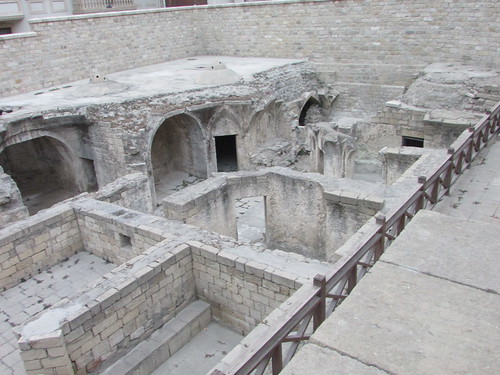
Preserved bathhouses in Baku, Azerbaijan
I was a little worried that, with a fair number of guests arriving simultaneously, check-in might take a while but, in fact, I was issued with a room key within a few minutes and gratefully headed for the lifts. My room was well-appointed and huge.
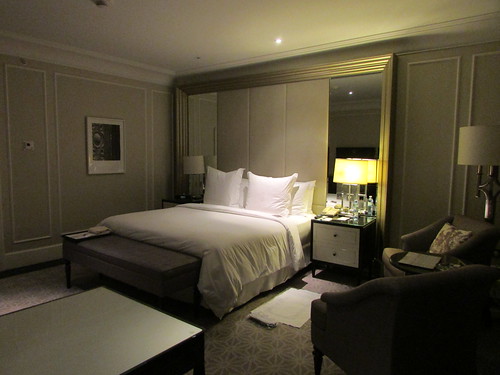
Four Seasons Hotel, Baku, Azerbaijan
Related posts on this website
This is one of a series of posts describing my 'Golden Eagle' Caspian Odyssey trip, starting with Travelling East.
Clicking on the 'Next report' link (where shown) displays the post describing the next events. In this way, you may read about the trip in sequence.
Next report.
Alternately, clicking on the 'All my Caspian Odyssey reports' link displays all the posts on this trip in reverse date-of-posting order.
All my Caspian Odyssey reports.
My pictures
These albums include more pictures of the events described above:-
Baku walking tour, Azerbaijan.
Four Seasons Hotel, Baku, Azerbaijan.
Around Baku, Azerbaijan.
All my pictures taken in Azerbaijan (except 'technical' railway pictures) are in the collection Azerbaijan.
With a reasonable weather forecast for Saturday, 17th November 2018, I decided to repeat the day trip to Liverpool which I occasionally make. Public transport in my area is now more restricted, so the possibility of bus to Penkridge to catch the train (as described in the post here) no longer exists. Instead, I presented myself at the bus stop for the first service to Wolverhampton, due at 08:35. I'd hoped that, if it ran to time, that might allow me to catch the 09:20 'London Northwestern Railway' service to Liverpool. When the bus arrived over ten minutes late, I resigned myself to a later departure from Wolverhampton but the bus made good time and, after getting off in Stafford Street a brisk walk to the station made me more optimistic about catching the 09:20.
Railway Drive has been blocked to vehicles for some time as the 'Midland Metro' at last constructs its extension from the present inconvenient St. George's terminus in Bilston Street to the railway station. A light rail system for the West Midlands was mooted in the 1960s but it was 1981 before serious studies were made and 1999 before trams on a single route from Wolverhampton to Birmingham Snow Hill started running. In my 2016 post Grand Central and Birmingham New Street Station I described progress on the extension at the Birmingham end to Birmingham New Street station and that is now in use. As I hustled to the station, I could see that track laying (using inset track) had started in Railway Drive - a mere 20 years after the opening of the light rail system.
Although the 09:20 was on time, I was able to catch it after all and I would have enjoyed the ride apart from a 'Hen Party' of a dozen ladies and one man who noisily crowded into my coach with their plastic wine glasses, a large bottle of prosecco and various mixers, celebrating a birthday (I couldn't determine whose) in a particularly noisy fashion which continued unabated until our arrival in Liverpool.
We stopped in platform 11 at Crewe, as usual, and I admired the polychrome brickwork I'd commented on in an earlier post here. There's a brief description of Crewe and the architecture of its station in the post Crewe Station.
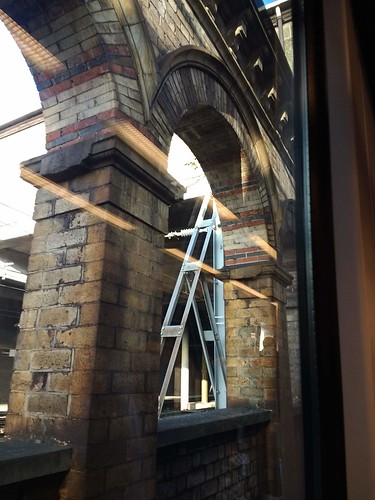
Crewe Station 17-Nov-2018: A close-up of the polychrome brick supporting wall flanking platform 11 (apologies for the reflection of the carriage lighting).
As we continued to Liverpool, we passed considerable re-signalling work in progress. I couldn't determine the present extent but some new colour light signals were in use, with the control code 'WE' and 4-digit signal numbers so I concluded that at least part of the line has now transferred control to the Manchester Rail Operating Centre. I still have trouble grasping that we'll end up with just 14 such Operating Centres in the country (Derby, Gillingham, Cardiff, Saltley, Edinburgh, Ashford, Didcot, Glasgow, Three Bridges, Manchester, Romford, York, Basingstoke, Rugby). Halton Junction signal box seemed to have gone and the Air Raid Precautions signal box structure at Runcorn had the windows papered over so presumably is no longer operating. Ditton Junction, Speke Junction and Allerton Junction appeared to be still in use but no doubt their days are numbered. We swept past Edge Hill signal box and descended through Edge Hill Cutting where new signals were in evidence. Lime Street station re-opened in July 2018 following a period of complete closure allowing the modernisation work to be completed. There's more information about the work undertaken in a 2016 article from Rail Engineer here.
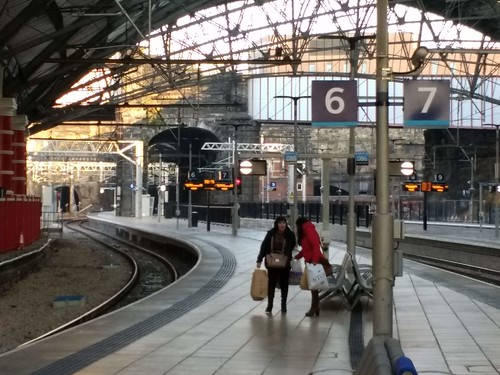
Liverpool Lime Street Station, 17-Nov-2018
I purchased a 'Saveaway' ticket allowing travel on buses, trains and ferries within Merseyside that day and descended by a series of escalators to the underground 'Mersdeyrail' platform at Lime Street Station. The first train took me two stations to James Street, where one of a series of lifts returned me to street level. It wasn't too warm but the sun was shining brightly so it was a pleasant walk to the Waterfront. I judged I'd not have time to catch the 11.00 a.m. Mersey Ferry, so I watched 'Royal Iris of the Mersey' slip way from Pierhead before entering the Museum of Liverpool where I checked that the star exhibit, the locomotive 'Lion', was still safe. I walked around the outside of the Museum to take a photograph of the Old Pilotage Building.
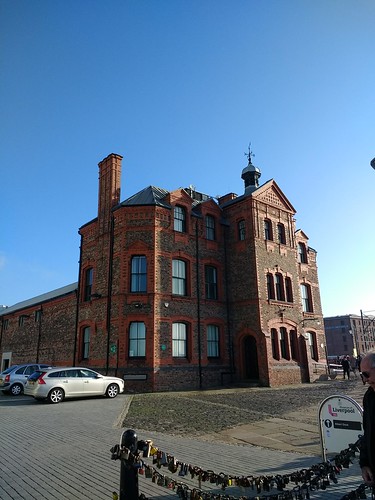
Liverpool, 17-Nov-2018: The Old Pilotage Building.
Next to the Old Pilotage, I found a massive display of 'Love Locks'. There's an article on this phenomenon here.
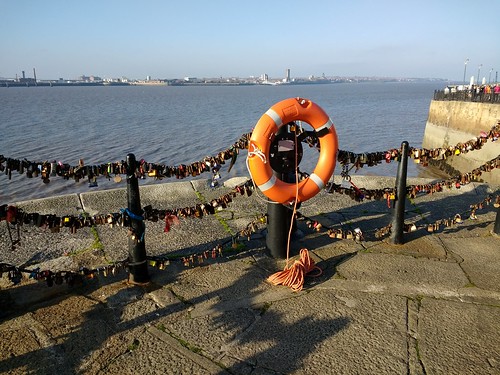
Liverpool, 17-Nov-2018: 'Love locks' overlooking the Mersey.
The clocks on the Liver Building were once again working and my picture shows the bright sun and blue sky on the day.
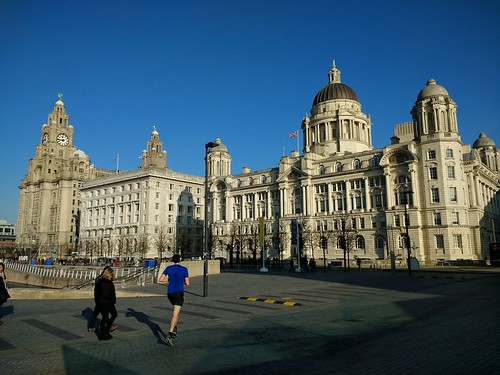
The 'Three Graces'.
It's become a tradition that I take the Mersey Ferry when in Liverpool, so I boarded the ferry which left at noon. Once we set off, the wind on the river was quite fierce, but with jacket zipped-up and gloves on, I was fine. The ferry first heads downstream on the Liverpool side whilst the pre-recorded commentary describes the north docks. We passed a number of small motor vessels moored with groups of men rod fishing. A large vessel was approaching us mid-stream and, as it came closer, I identified the passenger/car ferry 'Ben-My-Chree' returning from Douglas, Isle of Man. Once she'd passed us, our ferry turned to port to cross behind 'Ben-My-Chree' and head back upstream on the Birkenhead side. As we crossed through the wake of the larger ship, there was a fair amount of pitching. We berthed at Seacombe Landing stage with another vessel already moored.
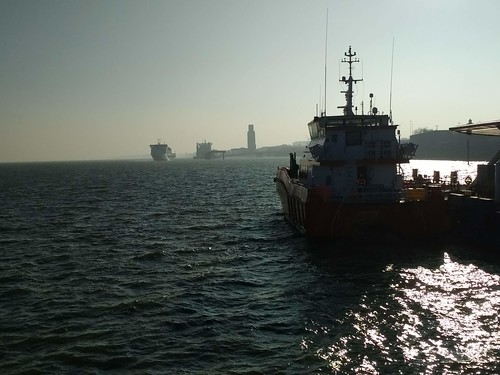
Liverpool, 17-Nov-2018: View from Mersey Ferry 'Royal Iris of the Mersey' approaching Seacombe Landing Stage with catamaran Njord Magni already moored at the south end. In the background, 'Ben-My-Chree' is berthing at Twelve Quays.
After passengers had alighted and boarded at Seacombe, we set off upstream past the moored vessel - crew transfer vessel 'Njord Magni', one of the high-speed catamarans which services the various offshore windfarms established in the Irish Sea. We passed the northern berth at Twelve Quays whilst 'Ben-My-Chree' was still docking. The southern berth was occupied by 'Stena Forerunner', which I don't believe I've seen before, apparently currently operating the Belfast service.
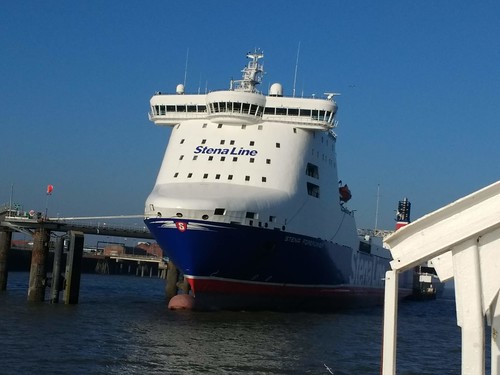
Liverpool, 17-Nov-2018: Twelve Quays, with 'Stena Forerunner'.
We docked at Birkenhead Woodside Landing Stage, where I left the ferry before it completed its triangular cruise by sailing back to Pierhead, in time to form the next departure from Liverpool Waterfront at 1.00 p.m.
I made the usual walk to Hamilton Square Merseyrail station and descended to the underground concourse serving the three platforms using one of the series of electric lifts. After a few minutes wait, I boarded the next train to New Brighton. New Brighton's Victoria Road led me to the Old Town, where I purchased a fish cake and chips which I ate as I walked to the Marine Promenade. I sat in one of the delightful Victorian shelters to finish my meal. The bright sun had encouraged lots of people to 'take the air' and there was quite a holiday atmosphere. I decided to patronise the ice cream van selling soft ice creams before continuing west. I passed Fort Perch Rock but decided to defer my visit to the weekend museum based there. Their website is here. I continued past the Marine Lake, admiring the decommissioned New Brighton Lighthouse (a Grade II* listed building) and entered King's Parade, with its modern shopping centre on my right and New Brighton Lifeboat Station, where they operate a rigid inflatable inshore lifeboat (a 'B' class 'Atlantic'). Then I turned left into Atherton Street to return to the railway station, noting that the local signage seems to have adopted the dreadful modern importation 'Train Station'. A stiff climb took me back to the attractive, welcoming and warm Merseyrail station and, somewhat exhausted, I thankfully took my seat on the waiting 3-coach train.
This time, I stayed on the train all the way to Liverpool Lime Street, noting that the journey between Hamilton Square and James Street stations had taken just over five minutes - considerably quickly than my enjoyable surface journey in the opposite direction a few hours earlier! A Birmingham service was already in platform 7 and I was happy to take this train back to Wolverhampton after a pleasant, if short, trip to Merseyside.
Related posts on this website
To view all my posts on Merseyside, click here or, alternately, select label 'Merseyside'. Posts are displayed in reverse date-of-posting order.
My pictures
This album includes pictures taken during this trip:-
Liverpool.
Ty Gwyn is a small commercial woodland in north Wales extending to about 27 hectares (66 acres). In 2009-2010, around half of the plantation was harvested. This area was replanted with Sitka spruce and mixed broadleaves during 2010. In 2015, a further 10 hectares were felled and replanted, again with Sitka spruce and mixed broadleaves. The balance of the woodland has not been felled but has been left to continue growing.
I made an inspection visit to Ty Gwyn on 21st November 2018 with David Adam of Fountains Forestry who manage the site. In 2016, Fountains Forestry became part of F & W Forestry Services based in Georgia, USA. The weather was overcast and quite cold. Access is via a single gate and a system of internal forest roads gives access throughout the plantation for timber lorries and similar vehicles. The southern road leads on a heading somewhat south of westerly from the gate on the eastern boundary to just short of the western site boundary. A little over halfway along the southern road, a junction leads to a short link road connecting to the northern road which runs more-or-less parallel to the southern road from just short of the western site boundary to the Pool in the east.
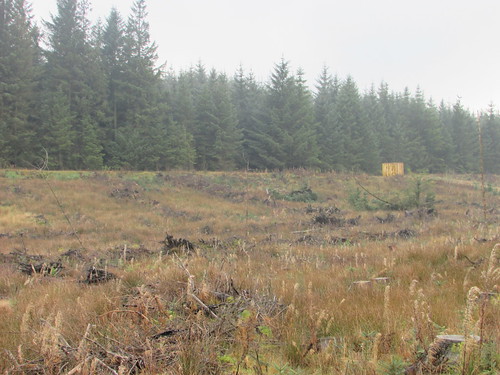
Ty Gwyn 2018: View from northern road looking south, with 2015 planting in the foreground and the unfelled compartment in the background.
We conducted our inspection on foot, mainly using the forest roads. Shortly after we started, we experienced sleet which, fortunately, only lasted a few minutes. Later, the sun tried to break through but it remained a poor day for photography.
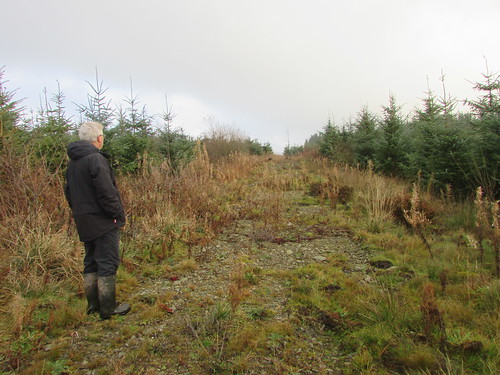
Ty Gwyn 2018: David Adam looking east on northern road.
The 2010 planting impressed me with its growth in eight years.
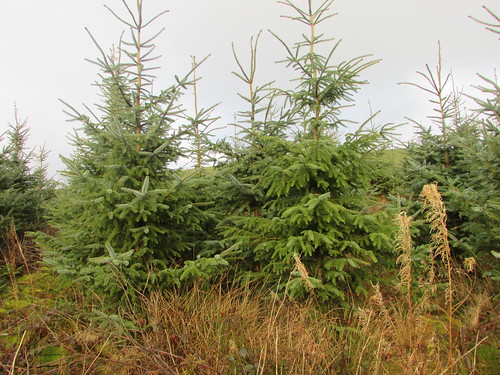
Ty Gwyn 2018: 8-year old growth near the northern boundary.
The appearance of the Pool was much improved following maintenance work.
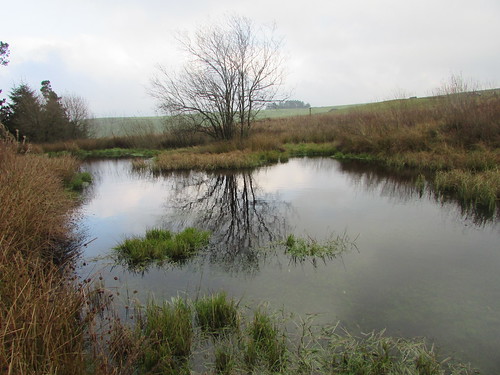
Ty Gwyn 2018: The Pool, looking east.
David confirmed that the progress of the 2015 planting was perfectly satisfactory although some maintenance work would probably be needed in Spring 2019.
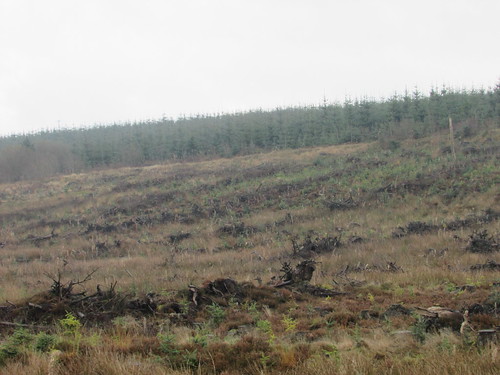
Ty Gwyn 2018: View from northern road looking south, with 2015 planting in the foreground and 2010 panting in the rear.
My posts about Ty Gwyn
You can find all my posts about Ty Gwyn here, with links to albums of pictures.
Pictures of Ty Gwyn
Ty Gwyn 2018.
You can find all my collections of pictures of Ty Gwyn here.
The Battlefield Line held a Steam Gala on the weekend of 13th and 14th October, 2018. Three locomotives were in steam - 'Light Prairie' 5542 (which had performed excellent work on the steam services throughout 2018) 'Pannier' 6412 (expected to remain until Christmas 2018) and veteran 6-coupled saddletank 813.
A little history
The Shackerstone Railway Society was set up in 1969 and early passenger operations took place on a single-line between Shackerstone and Market Bosworth, using the original signal box at Market Bosworth to control a run-round loop at Market Bosworth. In 1992, the single-line was extended to Shenton (the re-opening is mentioned in my post here). The signal box at Market Bosworth was taken out of use and all the semaphore running signals were placed at 'clear' with a view to re-commissioning the signal box at a later date. The Single Line Train Staff which allowed one train onto the Shackerstone-Shenton single line was arranged as a 'Split-Staff' with two halves screwed together to facilitate re-opening Market Bosworth as a Block Post later with two single line sections (Shackerstone-Market Bosworth and Market Bosworth-Shenton) but, until the 2018 Gala, drivers have always had to have both halves of the Train Staff in their possession before setting off.
The complete Shackerstone-Shenton Single Line Staff, showing the 'Castell Key' used to release the Starting Signal (nowadays termed 'Section Signal') at Shackerstone.
In 1998, when the 125th Anniversary Celebrations of the Ashby and Nuneaton Joint Railway were held, Shenton Station Working was introduced where an engine was allowed to lay-by in the loop at Shenton ready to take the next arriving train back to Shackerstone, under the control of a Person in Charge at Shenton but I don't think that arrangement has been used for some time.
Train Staff Working
On a double-track railway where each line is used in one direction only (in the UK 'left-hand running' is usual) the biggest risk is a train running into the rear of an unexpectedly-halted previous train. The 'space interval' or Absolute Block system was introduced to address this danger.
But single-line railways needed a different approach from the start as there was not only the danger of one train catching up with another but the possibility of trains travelling in opposite directions meeting head-on. The evocative American phrase for this situation is 'cornfield meet'. In the U.K. the system of a 'Train Staff' was adopted. This was often a rounded length of wood (hence the name 'staff'). There was only one Train Staff for each single line section, marked with the section of line to which it applied. Before entering a single line, the driver took possession of the unique Train Staff and was thus assured that no other train was occupying the section. On clearing the single line, the driver would surrender the staff to the signalman or person in charge, allowing another train to enter the single line. Provided drivers were in possession of the Train Staff when on the Single Line, this simple system was safe.
To increase the capacity of the line, a long single line could be divided into separate sections by intermediate stations often provided with passing loops. There was only one Train Staff for each single line section, marked with the names of the two stations between which it applied. Again, provided the footplate crew made certain they were carrying the correct staff for the section, the system remained safe. Train Staffs could be distinctively painted or shaped to assist the driver and fireman in identifying the correct staff but enginemen were also expected to read the names of the stations marked on the staff as a cross check. When I was a trainee fireman in preservation, I was taught to collect the Train Staff from the Signalman (or person in charge), check the details, shout "Correct Staff!" then display it to my Driver so that he could independently satisfy himself that we had proper authority to enter the single line section.
This simple system was safe but inflexible. If trains alternated in direction on the single line, the first train carried the staff from station A to station B, the second train, in the opposite direction, returned it from station B to station A. But there was no way for a second train from A to B to follow the first whilst the Staff remained at station B. There are many tales of junior porters having to carry the Staff to the opposite end of the single line by bicycle.
Train Staff and Ticket Working
Train Staff and Ticket Working seeks to address the inflexibility of ordinary Train Staff Working. The signalman or Person in Charge at station A must be in possession of the Train Staff before allowing a train into the single line section.
If a second train will run in the opposite direction, the Train Staff is actually CARRIED by the driver of the first train so as to be available for the second train on arrival at station B.
If a second train will follow the first in the same direction, the driver of the first train must be SHOWN the Staff. Seeing the Staff gives assurance that another train has not entered the opposite end of the section. The signalman also issues a numbered paper Ticket to the driver, identifying the specific train and giving authority to pass through the single line. When the train arrives at station B, the ticket is surrendered to the Signalman or Person in Charge there who cancels the Ticket. Because the Train Staff is still at station A, a second train may follow, this time with the driver CARRYING the Staff (unless a further Ticket is issued because of a third train in the same direction).
With Staff and Ticket working, telephone communication between the Signalmen or Persons in Charge at either end of the single line is essential because a further Ticket must not be issued until any previous Ticket had been correctly received and cancelled. Before allowing a train onto the single line, the Signalmen or Persons in Charge at both ends must agree upon the direction of the NEXT train required to pass over the single line. Whether a driver receives the Staff or is shown the Staff and receives a Ticket depends upon the direction of the NEXT train through the section. If the next working is in the opposite direction, the Staff is carried to the other end so it can be given or shown to that train. If the next working is in the same direction, the driver is shown the Staff (so that it can be shown to or carried by the following train) and CARRIES the Ticket. Tickets are valid for one specific train and, after a single use, are cancelled by the Signalman or Person in Charge receiving the used ticket.
Introduction of Train Staff and Ticket Working for the 2018 Gala
By dividing the Battlefield Line into two Single Line Block Sections (Shackerstone-Market Bosworth and Market Bosworth-Shenton), it's possible to have a more intensive service, although trains in opposite direction cannot yet pass at Market Bosworth. Following modern British signalling practice, 'Distant' boards have been erected approaching Market Bosworth in both directions, followed by 'Stop' boards nearer the station. Trains are 'called by' the 'Stop' boards by a yellow flag displayed from the platform by the Person in Charge. Leaving Market Bosworth in both directions, further 'Stop' boards are provided, reminding drivers that they require the appropriate Train Staff or Ticket and permission from the Person in Charge before proceeding. All these arrangements had been designed by John W. who was also Person in Charge at Market Bosworth on both days of the Gala and had established a 'Train Control Office' at one end of the museum building on Market Bosworth platform which he had equipped with a Train Control Board giving a graphical display of trains as a reminder. Actual timings of all movements were recorded, just as the Signalman at Shackerstone recorded all movements in his Train Register Book. There's an introduction to the Train Register Book here.
A new passing loop at Market Bosworth is currently under construction which, when completed, will allow trains to pass one another.
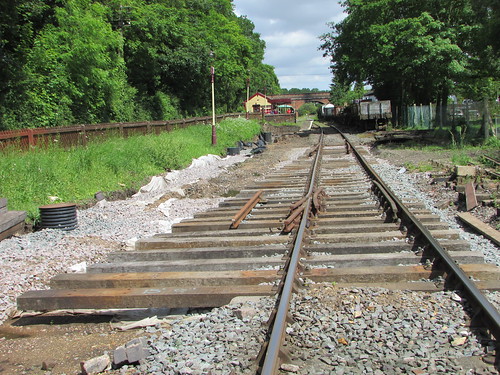
Market Bosworth View from foot crossing looking towards Shackerstone showing the station and work in progress on the new passing loop.
In addition, the 'platform siding' through the station is to be controlled by Annett's Key from a 2-lever ground frame being installed at the north end of the station and this would also enable a train to 'lay-by' and be passed by another train.
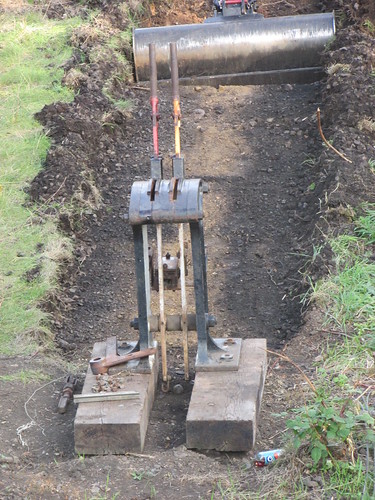
Market Bosworth, October 2018: The 2-lever Ground Frame which, on completion, will control access to the platform siding.
With neither the loop nor the siding available for the Gala, operations were more limited but the use of Train Staff and Ticket working allowed the main train to leave Shackerstone for Shenton and, once it had cleared Market Bosworth, for another train (usually the 'Auto train') to leave Shackerstone and follow as far as Market Bosworth. The 'Auto train' could then return to Shackerstone and, once the 'Auto train' was clear of Market Bosworth, the main train could return from Shenton as far as Market Bosworth. Once the 'Auto train' had arrived back at Shackerstone, the main train could complete its run back to Shackerstone.
Whether a driver receives the Staff or is shown the Staff and receives a Ticket depends upon the direction of the NEXT train through the section. If the next working is in the opposite direction, the Staff is carried to the other end so it can be given or shown to that train. If the next working is in the same direction, the driver is shown the Staff (so that it can be shown to or carried by the following train) and CARRIES the Ticket. Tickets are valid for one specific train and, after a single use, are cancelled by the Signalman or Person in Charge receiving the ticket. Close co-operation between the Signalman at Shackerstone and the Person in Charge at Market Bosworth is clearly essential.
Events of 13th October 2018
I was rostered to drive 813 with Jamie W. initially firing until he was relieved by Rod T. later in the morning. Locomotive 813 had previously visited the railway back in 2007 and I'd been impressed then with what a lively, willing engine she was. There's a brief report on that visit here.
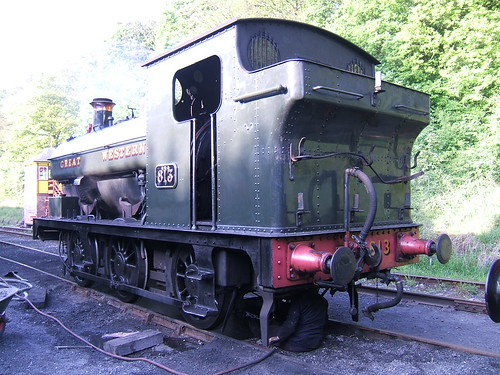
Locomotive 813 outside Shackerstone shed in 2007.
Our first working of the day was the demonstration freight train to Shenton, due to depart Shackerstone at 08:00. Jamie and I were delighted that Adrian L. had agreed to light-up and start oiling round, making a much easier start for us both. In the days of steam on the 'Big Railways', 'P and D' ('Prep and Dispose') turns were commonplace where a driver and fireman would spend the whole shift in and around the locomotive shed either preparing engines to go out (steam-raising and oiling-round) or 'putting to bed' incoming engines (coaling, watering and either cleaning the fire or withdrawing it, depending upon the engine's next duty). In preservation, having Preparation or Disposal done for you is unusual.
I had intended to complete the oiling-round myself but the new system of working, with the line divided into two single line sections (Shackerstone-Market Bosworth and Market Bosworth-Shenton) was being introduced that day and by the time I'd attended the induction meeting held by John W. for all the loco. crews and signed to confirm that I understood the arrangements for Train Staff and Ticket Working, Adrian had completed the oiling.
In the post Santa Specials at the Battlefield Line 2017 I commented "The rather cramped track layout at Shackerstone requires careful choreography to manage two trains". For the Gala, we had three locomotives and three trains - 4-coach passenger, 1-coach passenger ('Auto train') and Freight train so the moves had to be well-planned by the Director of Operations.
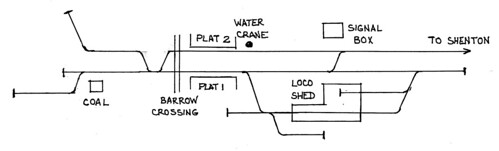
Shackerstone track diagram. North is to the left on this sketch.
Click on diagram for uncropped view.
The loco shed at Shackerstone is a 'straight shed' and, from the main door, the locos had been stabled in the order 6412, 813 and 5542. So we had to wait for 6412 to move forward into platform 1 and set back into the DMU Siding adjacent to the shed where the Great Western 'Auto' coach was stabled before we could come 'off shed' and couple onto our freight train waiting in platform 1. The train make-up was:-
Box Van
Long wheelbase tool van
LMS Hand crane
Match wagon
LNER Brake van
The Hand crane and Brake Van are recent arrivals from the now-closed Electric Railway Museum in Coventry.
With Carl M. as Guard on the brake van, we set off. We were due to be back at Shackerstone before the first passenger working so, as expected, we were issued with the 'half-staff' authorising movement to the 'Stop' board approaching Market Bosworth.
Working loose-coupled freight trains requires some care since there is always slack in the couplings and, apart from the Guard's screw handbrake, only the locomotive has a working brake but with such a light train I didn't anticipate problems and there were none. Although the morning was still rather damp, we passed a number of photographers before slowing for the new 'Stop' board approaching Market Bosworth. Spotting a yellow flag displayed from the station platform, I gave a 'pip' on the whistle in thanks and kept the train rolling into the platform. I surrendered the Shackerstone-Market Bosworth 'half-staff' to John W. and was issued with the other 'half-staff' authorising movement between Market Bosworth and Shenton. This half of the staff includes an Annett's Key which would allow us the unlock the Ground Frame at Shenton. John W. also gave permission for us to pass the 'Stop' board so we continued our pleasant run to Shenton.
I'm afraid we don't often have the chance to run demonstration freight trains at the Battlefield Line. I think my last freight at Shackerstone was during the 2015 Gala, described here. On that occasion, the freight was 'double-braked', with a brake van on each end, so running round at Shenton was similar to running round a passenger train. But in 2018, we only had one brake van so we had to move it to the other end of the train before returned to Shackerstone. My earlier report on the 2015 Gala mentioned a favourite question posed to trainee shunters:-
Simple loop at end of a branch: one engine, set of wagons, one brake van arrives. What are the moves to run round and go back?
The arriving train stops with the brake van just outside the loop points. Van brake is applied and brake van is uncoupled. Engine draws wagons into line 1 and sufficient wagon handbrakes are applied before engine uncouples, draws forward to headshunt, reverses round line 2 to the brake van, attaches it and takes it forward round line 2 to the headshunt, then propels the brake van onto the waiting wagons. Brake van is attached to wagons, brakes set as required, engine uncouples, forward into headshunt, reverse around line 2 until outside the loop points which are then set towards the wagons. Finally, engine moves forward onto the wagons and couples. Job done!
So, on arrival at Shenton, that's what we did. After detaching the brake van, we drew the wagons just clear of the loop points leaving most of the train outside the platform. This was the first proper run these wagons had been on in some time so, although they'd all been previously got ready for their excursion, Carl and I agreed it was prudent to examine both sides of the train and check for any overheating in the axleboxes before returning. Everything was (literally) 'cool', so we completed the moves, using the 'half-staff' to release the ground frame controlling the loop points. Carl obtained permission from Market Bosworth Train Control to return and, with the 'half-staff' back on the engine, we set off bunker-first.
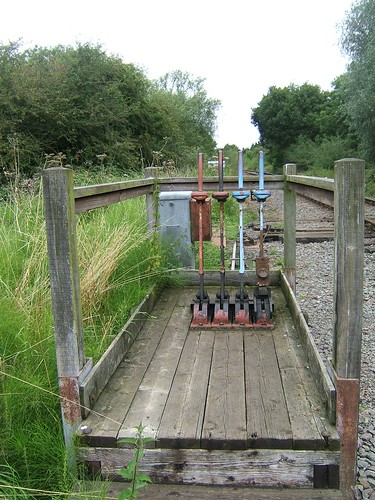
Shenton Ground frame. The 4-lever frame is released by inserting the Train Staff into the lock near the bottom of the rightmost lever.
Approaching the new 'Stop' board at Market Bosworth, I whistled to announce our arrival and received a yellow flag from the platform, which I acknowledged with a 'pip'. In the platform, John W. received the Market Bosworth-Shenton staff, issued the Shackerstone-Market Bosworth staff and gave permission to pass the new 'Stop' board leaving Market Bosworth. We set off for a gentle romp home, again passing a few photographers.
At Shackerstone, the tall lattice post home signal (No. 2) came 'off', the lower disc ground signal outside the box (No. 3) came 'off' as we approached, we surrendered the Train Staff to the signalman waiting on the landing outside the box and brought our train to a gentle stop short of the 4-coach main train standing in platform 2. When a main running signal (like No. 2) is off, the driver is assured that the line is clear at least up to the next signal, but a ground signal 'off' only authorises movements "as far as the line is clear" towards the next signal. We'd had a great trip but, following a late start, we were still about 15 minutes late arriving.
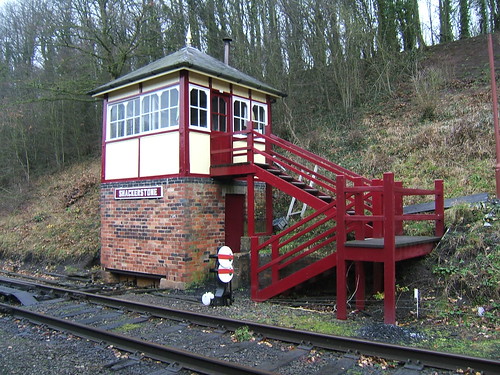
Shackerstone Signal Box, showing the 2-disc ground signal controlling movements into platform 1 (top disc) or platform 2 (bottom disc).
The next move was the first single-coach 'Auto Train' to Market Bosworth, with 'Pannier' 6412 propelling the coach with the driver, Adrian A., controlling the train from the driving compartment in the 'Auto trailer'. Numerous people watched expectantly as the 'Auto' eventually left at 09:20, 20 minutes 'down'.
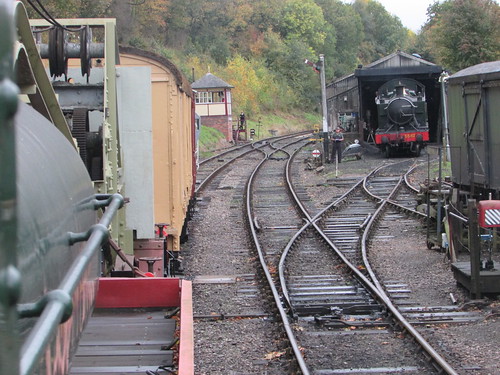
Battlefield Line Steam Gala 2018: 813 simmers after the freight train run and the 'peg' is off for the first 'Auto Train' of the day. 5542 waits to come off shed.
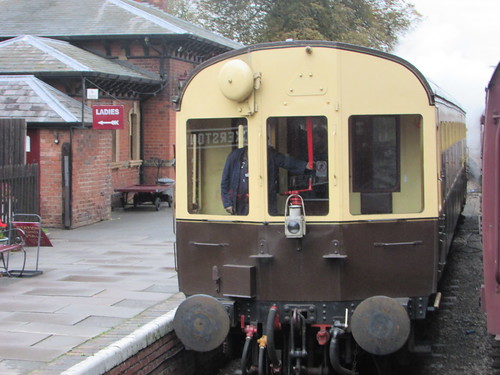
Battlefield Line Steam Gala 2018: The first 'Auto Train' leaves Shackerstone.
Once the 'Auto Train' had left, there was a period of furious activity as the freight train was stabled in the DMU Siding alongside the shed, out of the way, and 5542 moved onto the coaches in platform 2 before the 'Auto Train' returned.
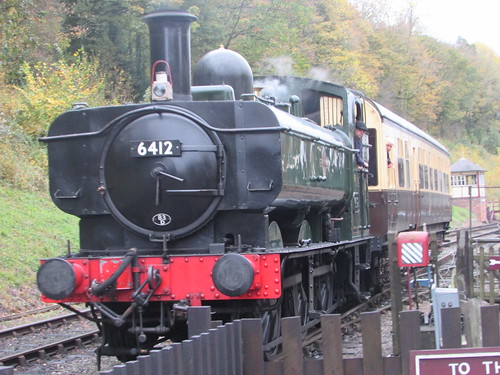
Battlefield Line Steam Gala 2018: The first 'Auto Train' arriving back at Shackerstone.
After 5542 had left with the late-running 09:30 to Shenton, Shackerstone became quiet again. The timetable called for 5542 to complete its round trip, after which the 'Auto Train' was scheduled to make its second trip to Market Bosworth at 10:30. At that point, we were still about 20 minutes adrift.
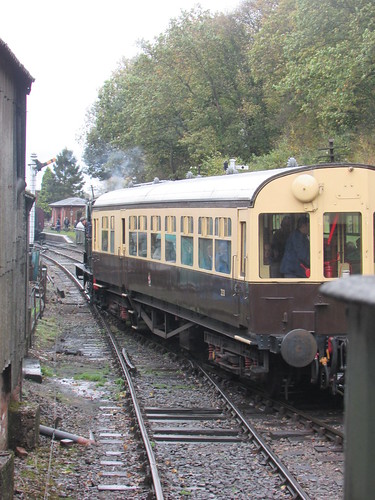
Battlefield Line Steam Gala 2018: The second 'Auto train' leaves Shackerstone, viewed from 813 standing on the DMU siding.
With the 'Auto train' away, I was able to shunt 813 across to platform 2 and attach to the 4-coach train for our first passenger working. Once the 'Auto' was back, we were able to leave. It should have been 11:00, but we were still about 17 minutes late.
This time, the 'Auto' was to follow us after we'd reached Market Bosworth, so I was shown the Train Staff and issued with Train Staff Ticket No. 1, issued to train 1S02 (the second Shenton train). I placed the ticket on the shelf at the back of the cab, with two empty pottery mugs as paperweights.
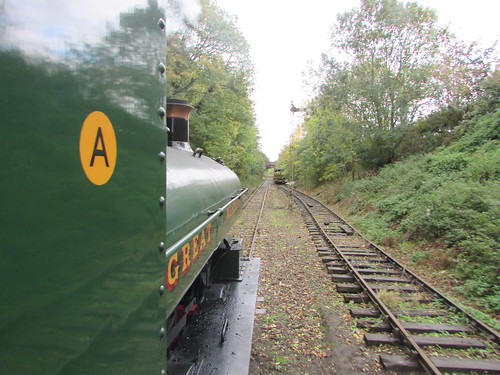
Battlefield Line Steam Gala 2018: Leaving Shackerstone with 813 on the late-running 11:00 train.
All went well until we were past the photographers near Headley's Crossing when a sudden, strong cross-wind whipped everything off the shelf at the back of the cab. A plastic cup of tea I was about to sample emptied itself in Jamie's direction and, when I checked, Train Staff Ticket No. 1 had disappeared. We continued to Bosworth and I sheepishly admitted my failure to John W., offering a fuzzy photograph of the missing item as a substitute. I resolved to thereafter carry Tickets in a pocket, for safety.
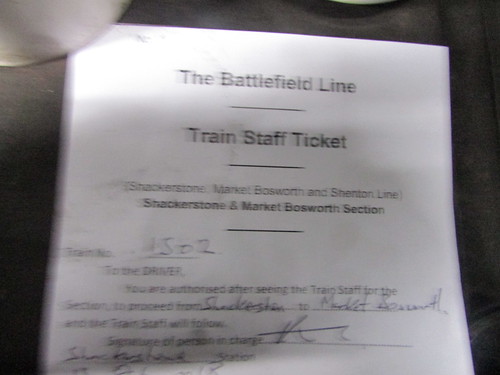
Battlefield Line Steam Gala 2018: Train Staff Ticket No. 1
We were issued to the Market Bosworth-Shenton train staff, were given permission to proceed and completed our run to Shenton without further incident. We ran round our four coaches, ready for the return run. All went to plan to Market Bosworth. In the platform, I surrendered the Market Bosworth-Shenton staff and John W. issued the Shackerstone-Market Bosworth staff, also giving us permission to pass the new 'Stop' board leaving Market Bosworth. Once all the passengers had sorted themselves out, we received the 'Right Away' from the Guard and set off up the bank.
On a standard Great Western engine, the vacuum ejector would normally be used only until the speed had reached 15 m.p.h. since the vacuum pump could then be relied upon to maintain the required 25 in/Hg (inches of mercury) partial vacuum in the train pipe until the next brake application was made. But 813, being a 'Swindonised' Hudswell Clarke, lacks a vacuum pump so the vacuum ejector must be used as required.
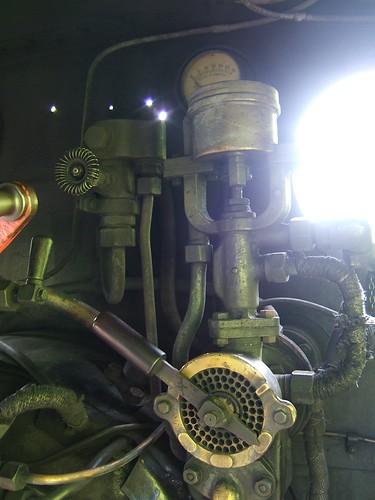
The Great Western combination steam/vacuum brake application valve fitted to 813 (shown in 'Fully Applied' position).
It became clear that 813 had gone 'off the boil'. Performance deteriorated as the boiler pressure fell and then the ejector had difficuly maintaining the vacuum. Speed dropped further as the train brakes started to drag, despite Jamie's attention to the fire. Shortly after Headley's Crossing, it was obvious we'd have to 'stop for a blow up' so we came to a gentle stop and applied the handbrake. Carl M. descended to the track and we agreed to 'pull the strings' on the train, which would allow to us to complete the journey to Shackerstone with a slightly lower partial vacuum above the brake pistons, if the boiler remained reluctant to steam. Carl and I made sure all eight brake pistons on the train were fully 'down', releasing the coach brakes, by which time matters on the footplate looked far healthier. Having lost a few more minutes, we were then able to finish the journey back to Shackerstone.
5542, attached to the freight, was waiting for us to arrive so that the delayed noon freight train could set off. Once the freight had passed Market Bosworth, 6412 followed with the fourth 'Auto train' of the day to our middle station and back. Meanwhile, 813 was run round, watered and made ready to work the third passenger service of the day to Shenton. By this time, Rod had relieved Jamie as fireman and I explained the problems we'd had with the brakes on the previous trip.
I'm not sure how late we were departing by the time 5542 returned with the freight but, once we were clear of the restrictions up to Barton Road Bridge, I gave 813 full First Valve, well linked-up, and she ran like the proverbial sewing machine. There's a very short restriction to 10 m.p.h. near the Water Works but, once past this, we ran down the bank past Airport Bridge in fine style. I braked, prepared to stop at the new 'Stop' board but John W. gave us a yellow flag so I was able to keep the train moving into the platform at Market Bosworth. I extracted the folded-up Ticket from my overall pocket and delivered it to John who gave me permission to proceed and the Market Bosworth-Shenton Train Staff. Having observed the speed restriction leaving the station and across the underbridge near Deer Park Siding, I was able to open-out 813 a little and we made an excellent run, finally slowing for the 5 m.p.h. 'slack' near the Ambion Lane underbridge and the approach to Shenton Station. The weather was now dry, the sun had appeared and there were lots of visitors admiring 813 as we ran-round the train. Rod kept the boiler 'up to the mark' so we enjoyed an excellent run back to Shackerstone.
5542 had disposed of the freight train and was ready to 'hook-on' to the south end of the main train to work the delayed two o'clock departure to Shenton. As usual, once 5542 had left Market Bosworth, the 'Auto train' made another trip to 'Bosworth and Back'. But, this time, when 5542 returned from Shenton with the 4-coach main set, rather than the 4-coach train forming the next train to Shenton (the late-running three o'clock), this time the 'Auto train' was to go all the way to Shenton. With 5542 on the south end of the 4-coach train and 813 on the north end, the idea was that the 'top-and-tailed' main set would follow to Market Bosworth and back for variety.
The sight feed lubricator on 813 chose that inopportune moment to "throw a wobbly" (having worked perfectly until then). It shouldn't have been empty, but we drained the lubricator, refilled it with the specified 680 SAE compound steam oil and attempted to restart it. I failed: Rod, Adrian and Carl failed so the Director of Operations decided to cancel the 'top and tail' working. Unfortunately, by this time, the 'Auto train' had already left, carrying a Ticket, in expectation of the 'top and tail' working following to Market Bosworth with the Train Staff. So, (shades of the junior porter story mentioned earlier), a Volunteer who was just about to leave for the day was asked if "he wouldn't mind just dropping off the Train Staff at Market Bosworth on the way". By this method, the 'Auto train' was finally able to return to Shackerstone but the four o'clock service to Shenton, hauled by 5542 was now quite late, so the five o'clock service, which should have been 813's last train was cancelled. 813 was coaled, watered and assisted with the re-marshalling of the freight train ready for the following morning. I then handed over the locomotive and booked off since I would be back again the following day (on 5542). 813 would be the last locomotive into the shed on Saturday evening because it was the first engine required the next day.
Not all the arrangements for the ambitious timetable had worked but I'd had an enjoyable day, as I hope did the other Volunteers and our visitors.
Lubricating the steam circuit in locomotives
Moving parts in contact with steam (such as the valves, pistons and regulator valve) require lubrication. 813 is provided with oil cups on the front of the cylinders, accessed by opening the hinged 'piano front' under the smokebox door.
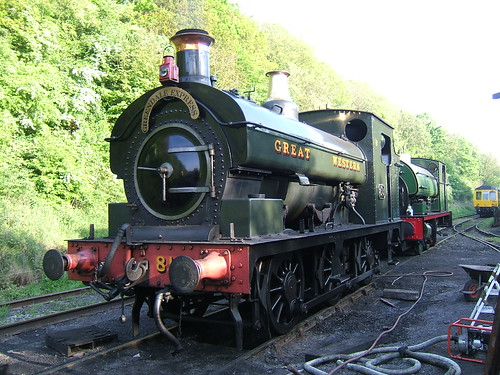
813 stands in front of Shackerstone resident 'Sir Gomer' in 2007. 813's hinged 'piano-front' can be seen under the smokebox door, with a single, central knob.
On early locomotives, one 'dose' of oil to this type of cylinder oil cup during preparation, possibly repeated later, would frequently be the only oil supplied to the steam circuit. With lower boiler pressures and saturated steam, the entrained moisture in the steam could be quite an effective lubricant. The introduction of higher-temperature steam, especially when 'Superheating' was used, required better compound steam oils which could retain their properties at higher temperatures and a more consistent method of feeding the oil. For a long time, the Sight Feed Lubricator provided the required reliability of oil feed until the use of mechanical lubricators became widespread. Even non-superheated locomotives (like 813) could benefit from the installation of a Sight Feed Lubricator and 813 has one, mounted in front of the driver. Although private locomotive builders started to fit sight feeds where specified, I suspect the one on 813 is a Swindon modification as it appears to employ some parts used elsewhere by Swindon.
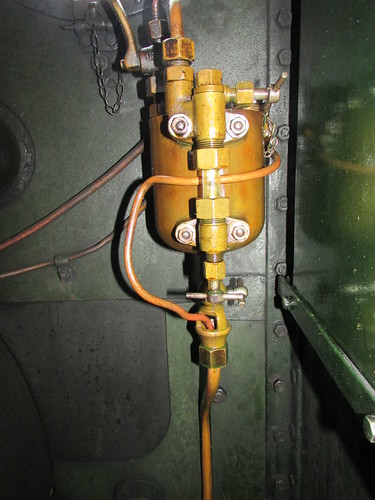
GWR loco 813, October 2018 The Sight Feed Lubricator.
Related posts on this website
Battlefield Line Steam Gala 2018 (Part 2)
The last Steam Gala at the Battlefield Line was in 2015 and my report on that event is here.
Locomotive 813 previously visited the railway back in 2007 and my report on that visit is here.
To see all my posts about the Battlefield Line, select Label 'Battlefield Line' or click here.
My photograph albums
Where necessary, clicking on an image above will display an 'uncropped' view or, alternately, pictures may be selected, viewed or downloaded, in various sizes, from the albums listed:-
5542 GWR Locomotive
813 GWR
Battlefield Line Steam Gala 2018
Battlefield Line, 2017-2018
All my Battlefield Line albums
[Link to part 2 added 4-Jan-2019]

