skip to main |
skip to sidebar
Each year, The Old Locomotive Committee (OLCO) has an event, called 'Lionsmeet', for live steam models of the 'Lion' locomotive and similar models of designs up to around 1850. In 2018, the event was held on Saturday, 28th July at the Broomy Hill track of the Hereford Society of Model Engineers.

The 'shield' of the Hereford Society of Model Engineers.
Getting there

"Boarding the train to Hereford". Picture posed at Shenton on 28th July 2018.
To Hereford by train? I'm afraid it's been some years since it was possible to get to Hereford using the type of 1950s Diesel Multiple Unit shown above. However, I was rostered to drive a preserved DMU at the Battlefield Line a couple of days before 'Lionsmeet' and knowing that Hereford was one of the destinations served by Tyseley depot, the unit's last allocation before withdrawal, I couldn't resist posing this shot.
I actually travelled to Hereford in a modern Class 172 and that journey is described in the post To Hereford by rail. A taxi then took me across the city to the event. My return rail journey, via Shrewsbury, is described here.
The Event
In the summer of 2018 Britain experienced a period of unbroken hot weather extending for a number of weeks but on the journey to Hereford I'd encountered areas of heavy rain. Although it was dry on my arrival at Broomy Hill, the skies darkened and live-steam running of models was eventually curtailed by rain which started gently but later had a monsoon nature.
Our hosts, the Hereford Society of Model Engineers (HSME) are a long-established club who moved to the spacious Broomy Hill site in the 1960s, I believe. A mature and well-equipped site now greets visitors. The site is adjacent to the historic Waterworks Museum which was operating the following day (and steaming their stationary pumping engine) but, sadly, was closed on the day of 'Lionsmeet'.
At HMSE, there are elevated and ground level running tracks, together with a 20m x 30m model boating pond all laid out on a plain. The club house, workshops and an extended garden railway are situated on somewhat higher ground.
Elevated Track
I started my visit at the continuous elevated track which serves 3.5 inch and 5 in gauge models and was greeted by Lionsmeet co-ordinator Andrew Neish. I found a well-equipped station, Compton High Level, with an overall roof adjacent to raised steaming bays radiating from a turntable which were also provided with roofing. Three 'Lion' models were being prepared but early-bird Adrian Banks was already out on the running track.

'Lionsmeet' 2018 28th July 2018: The covered steaming bays serving the elevated track radiate from a turntable.

'Lionsmeet' 2018 28th July 2018: A new member of OLCO preparing his model.

Lionsmeet' 2018: Adrian Banks was in steam early with his 'Thunderbolt' model. In the background, the model boat pool and John Dalton on the ground level track (having just passed under the 3-doll signal gantry). The brick building on the right is part of the adjacent Waterworks Museum.
A little later, after Adrian had finished his running, the other 'Lion' models shared the elevated track until deteriorating weather eventually drove everybody up to the clubhouse where for lunch and conversation.

'Lionsmeet' 2018 28th July 2018: Three 'Lion' models on the elevated track at HMES.

'Lionsmeet' 2018 28th July 2018: Jon Swindlehurst and his 5-inch 'Lion' with OLCO Chairman John Brandrick as passenger.
Ground Level Track
The main station on the extensive dual-gauge (5 inch and 7.25 inch) ground level track is Broomy Hill Junction, provided with an island platform with canopy, ticket office and signal box. A turnout here leads to a turntable serving a number of ground level sidings plus an incline leading to a sector table with six elevated preparation roads radiating.

'Lionsmeet' 2018 28th July 2018: Broomy Hill Junction station with the 'HMES Shed' in the foreground featuring turntable, sidings and incline leading to a sector table with six elevated preparation roads radiating. Note the storage bunker on the right with hinging lid.
There is some complex dual-gauge pointwork in evidence, featuring 'back-drive' as now used on modern full-size railways. At least one turnout had multiple 'back-drive' and 'moving frog' construction, eliminating the problem of lack of support to wheels when passing through a 'common crossing'.

'Lionsmeet' 2018 28th July 2018: Dual-gauge turnout on HMES track featuring power operation, multiple 'back drive' and 'moving frog' design.
I noted that platform 1 through Broomy Hill Junction unusually featured 4-rail dual gauge track, rather than the 3-rail (shared rail, 5 inch rail, 7.25 inch rail) provided elsewhere. Studying my pictures later, the most likely explanation appeared to be that the line had originally been 'out and back' rather than 'continuous'. My pictures show a chord, now removed, which would have allowed out-and-back running.

HMES Broomy Hill: A substantially-built dual-gauge diamond crossing at Broomy Hill Junction.
The ground level track is equipped with realistic, working Western Region pattern lower-quadrant semaphore signals, pneumatically operated from the miniature lever frame in the signal box at Broomy Hill Junction.
John Dalton from Chelmsford Society of Model Engineers steamed his splendid 7.25 inch gauge 'Lion' and later he was joined by resident 'modern image' model in 'Santa Fe' livery with petrol-hydraulic transmission.

'Lionsmeet' 2018 28th July 2018: John Dalton of Chelmsford club attended with his 7.25-in gauge Lion, shown being admired by Harrye Frowen.

'Lionsmeet' 2018 28th July 2018: Adrian Banks chats to John Dalton about John's 7.25 inch 'Lion'. Note the signal box with working miniature lever frame and resident 'modern image' model on the right in 'Santa Fe' livery with petrol-hydraulic transmission.
Club house
As the weather deteriorated, I made my way towards the club house complex, where an excellent range of 'lunch plates' were available and animated discussions took place. A number of members were displaying models, part assembled models or components for models.

'Lionsmeet' 2018 28th July 2018: Animated discussions in the clubhouse over lunch.
Jon Swindlehust exhibited his 5 inch gauge 'Rocket' commenting that he has run it on air but not steamed it.

'Lionsmeet' 2018 28th July 2018: 5 inch gauge 'Rocket' by Jon Swindlehust exhibited in the Clubhouse.
Considering the 'fiddly' nature of many of the parts, Jon added that he now wishes it had been a 7.25 inch gauge model! Having worked on the full-size replica (at the Birmingham Railway Museum Gala in 1988, at the Riot of Steam in 2005 and at L & M 180th Celebrations in 2010), I was impressed by the attention to detail. The fidelity to the full-size replica operated by National Railway Museum can be judged by comparison with my picture below.
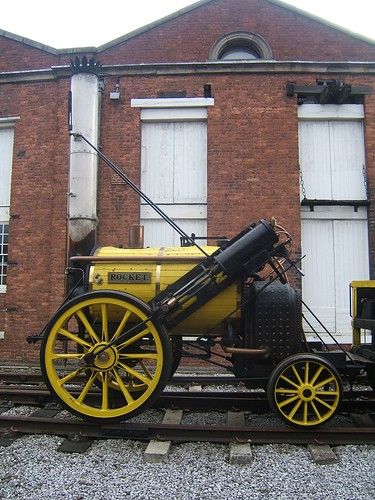
The National Railway Museum 'Rocket' replica.
But there was a model of an even older prototype on show. Harrye Frowen displayed his remarkable 7.25 inch gauge model of 'Puffing Billy' at an advanced stage of construction.

7.25 inch gauge 'Puffing Billy', under construction by Harrye Frowen.

Detail of the geared 4-wheel drive on 7.25 inch gauge 'Puffing Billy', under construction by Harrye Frowen.
The 2018 'Lionsmeet' was the first since the death of much-missed founder member David Neish. His son, Andrew, displayed the familiar 'Lion' model built by David as a static exhibit since the boiler was awaiting a minor repair. That struck me as somehow appropriate.

5 inch gauge 'Lion' built by the late David Neish, exhibited by Andrew Neish.
Following the death of prolific modeller Barrie Larke, his son David exhibited a variety of interesting models.

'Lionsmeet' 2018 28th July 2018: Part-built 'Lion' model by the late Barrie Larke.
The HMES Chairman Wally Sykes, a keen modeller and technical writer, gave a brief address to which OLCO Chairman John Brandrick responded, thanking the club for their hospitality.

OLCO Chairman John Brandrick (right) responds to HMES Chairman Wally Sykes' address with 'Lionsmeet' Co-ordinator Andrew Neish in the foreground.
I'd been invited to explore the remaining facilities associated with the club house. Next to the clubroom, I found the Project Area with a number of projects in hand. The club has a policy of training young people in engineering, issuing its own certificates as skills are acquired to assist them in seeking employment (there's more information on the Society's website here. I spotted a '14XX' tank engine, complete with part-built auto-trailer and what I assumed was a 7.25 inch narrow-gauge locomotive under construction. One side of the project area houses a 4mm scale model railway 27 feet by 9 feet with accurately-detailed scenery only partly complete. It is based on Ledbury station, with a series of storage loops and a magnificent model of Ledbury Viaduct dominating the scene. The 31 arches of the prototype have been slightly condensed to 28. I'd travelled through Ledbury and over the prototype of the viaduct that morning, as described here. Spectators are separated from the layout by a glazed wall, made to look like the outside of a Great Western coach, complete with brass door handles!

'Lionsmeet' 2018 28th July 2018: 'Ledbury Viaduct' in 4mm scale.
Outside (the rain had abated somewhat) I found two railway van bodies well-equipped as what I assumed were the original workshops. Beyond these workshops was a large garden railway. The main station (provided with both turntable and sector table) was on raised baseboards and provided with a large overall roof. Beyond the station area, the railway was on a mixture of raised baseboards and low-level formation with scenic features.

'Lionsmeet' 2018 28th July 2018: The garden railway.
The club house complex on the hill overlooks the ground level running track on the plain. The substantial carriage shed serving the ground level track has been built on two levels. The upper level, with easy access from the club house level, has its own well-equipped workshop. A ladder and an external ramp lead down to the storage tracks. A model of a GWR diesel railcar particularly caught my eye, based on one of the later batch with the rather angular body styling. When I was growing up, I remember travelling between Wolverhampton Low Level and Dudley on these railcars.

HMES Broomy Hill: Carriage shed storage tracks.
Outside the carriage shed, the four storage tracks combine into one, with the points controlled from a 3-lever ground frame. This track, flanked by the continuous ground level running track which joins from the right, passes through a double-track tunnel (which has a 'secret storage siding') before converging with the continuous track through a small station called Howards Halt, provided with steps to the higher level and the adjacent club house.
The HMES chairman had told me that the whole plains area on which the running tracks are constructed are subject to occasional flooding and up to 3 feet of water has been recorded. So I was prepared for the novel feature of a depth gauge mounted on the tunnel portal!

HMES Broomy Hill: The tunnel portal, with depth gauge mounted on the right side, viewed from Howards Halt. The carriage shed is just visible in the background. Note the 3 storage sidings on the left.
Well, the weather could have been better but the welcome we received from the host club could not have been warmer. After an enjoyable visit, I left Broomy Hill for my train journey home very impressed with what the Hereford Society has achieved on the site.
Related posts on this website
All my posts about the Old Locomotive Committee can be found here, with links to my pictures.
My pictures
Where necessary, clicking on an image above will display an 'uncropped' view or, alternately, pictures from may be selected, viewed or downloaded, in various sizes, from the albums listed:-
Lionsmeet 2018.
All my 'OLCO' albums.
On Saturday, 28th July 2018, I travelled to Hereford by rail, via Birmingham, to attend the 2018 'Lionsmeet' being held at Hereford Society of Model Engineers. The outward journey is described in the post here, the 'Lionsmeet' event is described here: this post describes my return.
Hereford-Wolverhampton
After I had attended 'Lionsmeet' during the day, John from the Hereford Society very kindly gave me a lift back to Hereford station. I had decided to return to Wolverhampton by a different route from the outward journey, by travelling to Shrewsbury on the former LMS/GWR Joint Line, there changing to a Wolverhampton train on the former GWR route. I'd previously travelled over the Hereford-Shrewsbury line on 26th July 2014 and described that trip in the post here.
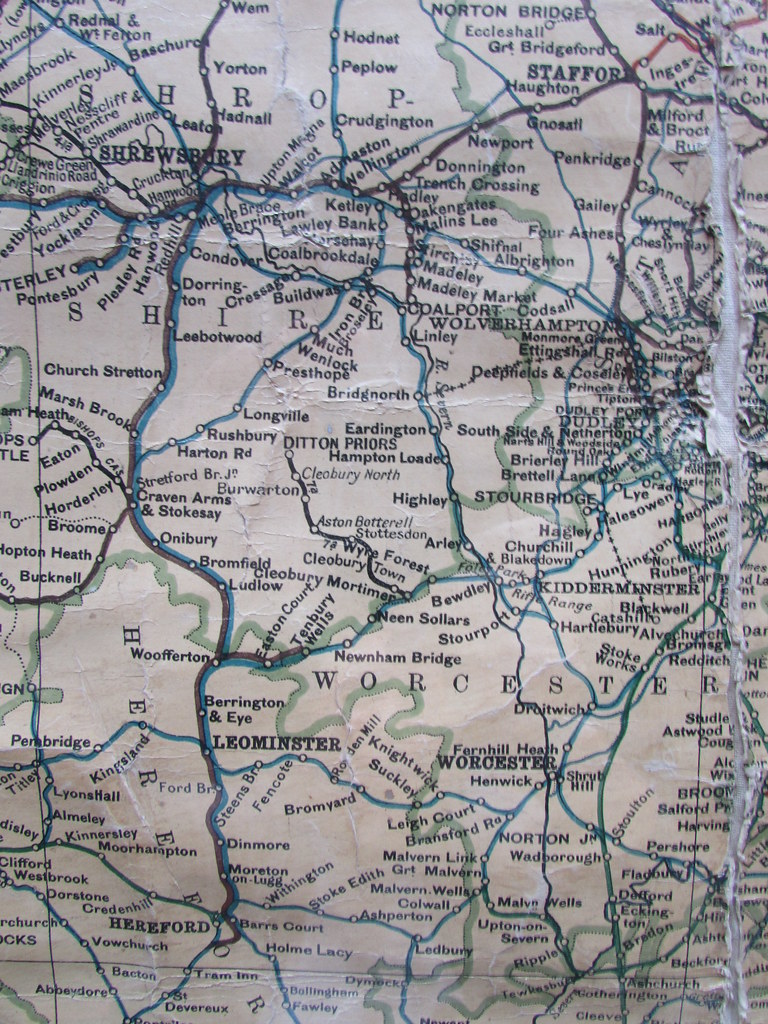
In pre-grouping days, shown in the map below, five routes served Hereford but today Hereford is a just a through station on the Welsh Marches line from Crewe to Newport, plus the route I'd used to get to Hereford that morning which converges with the Welsh Marches line at Shelwick Junction, a couple of miles north of Hereford.

Pre-grouping railway map showing Hereford-Wolverhampton (W & A K Johnston, 'Railway Map of England and Wales 11th Edition').
Click for larger image
Waiting for the slightly late-running Manchester service which would take me to Shrewsbury gave me the opportunity to collect a few pictures around the station although intermittent rain made conditions less than ideal.
There are four roads through the station, two central Relief lines and two main lines, flanked by platforms. The Down platform (Southbound) has two faces and the outer face is used by terminating services from Birmingham. There is one signal box, south of the station on the Down side. Local points and shunting signals are mechanically operated, with power operation of more distant connections. Running signals are multiple aspect colour light.

Hereford station 28th July 2018: Looking north from platform 3.
 Hereford station 28th July 2018: Looking south from platform 3, showing signal box. Note barrow crossing, protected by lights.
The 3-coach Arriva Trains Wales diesel multiple unit arrived, already fairly full, but I managed to find a seat. As we set off north in the rain I noticed, on the Up side, the remains of the two triangles which once served other railways converging on Hereford. In the early days of railway preservation, this area was home to the Bulmer's Railway Centre. Bulmer's established in Hereford in 1887 and I think were the largest cider maker in the world at one point. They are now owned by Heineken. In turn, we passed Shelwick Junction, Moreton-on-Lugg then the two single-bores of Dinmore Tunnel.

Shelwick Junction, Hereford, showing the signalling equipment room. 28th July 2018:
Just after Leominster signal box, we stopped at Leominster station. Once Leominster spawned at branch heading east to Worcester, south of the station and a second branch to the west, north of the station.

Hereford-Shrewsbury line, Leominster signal box, 28th July 2018.
I didn't even spot the site of Woofferton Junction, six miles beyond Leominster, where the branch to Tenbury Wells and Bewdley once diverged. Our next station stop was Ludlow and, seven miles further on, we paused at Craven Arms with its unattractive modern mechanical signal box.

Hereford-Shrewsbury, Craven Arms Signal Box in the rain, 28th July 2018:
We made our stop at Church Stretton and then continued to Shrewsbury.
Twelve miles further on, we passed the standard Great Western design signal box at Sutton Bridge Junction, where the single Central Wales line diverges. The Great Western liked to dignify their signal boxes with a single, cast-iron name plate showing the name in full so I noticed the imposing length of the sign mounted on side facing the tracks reading 'SUTTON BRIDGE JUNCTION SIGNAL BOX'.
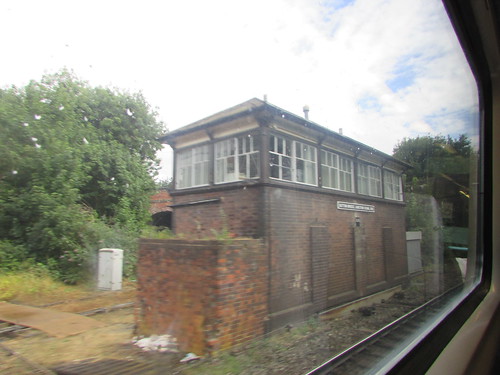
Shrewsbury area rail: Sutton Bridge Junction signal box, 28th July 2018.
The running signals at Sutton Bridge Junction are tubular post semaphore on a mixture of upper- and lower-quadrant patterns, all modified to feature better-protected access arrangements to meet modern Health and Safety requirements.

Shrewsbury area rail: Sutton Bridge Junction 2-doll Down Home, 28th July 2018.
We then passed the imposing bulk of Severn Bridge Junction which controls the south end of Shrewsbury station. This massive box always delights me because it is a London and North Western pattern construction (although, in my view, the original clean proportions have been marred by modern Health and Safety modifications).
 Shrewsbury area rail: Severn Bridge Junction signal box, 28th July 2018.
Severn Bridge Junction is now signalled by a haphazard collection of upper-quadrant semaphore, lower-quadrant semaphore and colour light signals!
At Shrewsbury, I changed to a Wolverhampton train (now operated by West Midlands Railway) after an interesting, but tiring, day.
Related articles on this site
To Hereford by rail.
A Trip to South Wales (Part 2).
Railways around Shrewsbury.
My pictures
Where necessary, clicking on an image above will display an 'uncropped' view or, alternately, pictures may be selected, viewed or downloaded, in various sizes, from one of the albums below:-
Shrewsbury-Hereford line.
Shrewsbury area railways.
Wolverhampton to Shrewsbury Line.
Wellington, ex-Great Western Railway.
West Midland Railways.
[Link to 'Lionsmeet' event added 26-Aug-2018]
On Saturday, 28th July 2018, I travelled to Hereford by rail to attend the 2018 'Lionsmeet' being held at Hereford Society of Model Engineers.
Wolverhampton-Hereford
I took a taxi to Wolverhampton (our bus service starts too late on a Saturday to be of help), a 'Virgin' London working to Birmingham New Street and then a 'West Midland Trains' service was supposed to take me to Hereford. The taxi worked, the short leg to Birmingham worked but the final segment proved 'interesting'.
I found the Class 172 Diesel Multiple Unit (DMU) which was to form the 08:50 to Hereford in platform 10. The unit was shut down and displaying a red tail lamp at each end but the Conductor had already arrived, opened the doors and passengers were boarding.

West Midland Railways: Birmingham New Street: Class 172 in platform 10, 28th July 2018.
The driver appeared, started the unit and we departed on time. The train slowly left New Street on the Down Gloucester line, passing through four tunnels (Holliday Street, Canal, Granville Street and Bath Row) before speed increased through Five Ways Station. We were due to stop at University Station, about two and a half miles from our starting point but suddenly the driver made a 'Full Service' brake application and we came to a rapid stop. 'What now?' I thought. I was sitting on the left (as I usually do, offering a limited view of passing signals) and could see no reason for our unscheduled halt. On the right of the train, clouds of smoke drifted by and passengers on that side started to take pictures with their mobile phones. Still puzzled, I got up, moved across and looked ahead on the right. I was quite started to see fierce flames on the heavily overgrown embankment.

28th July 2018: Near University, a fallen tree on the embankment on the Up side had displaced the wires of the overhead traction system, producing a fairly spectacular fire.
The view from modern trains is not good and looking obliquely ahead through the double-glazed window unit was not ideal but it appeared that a tall tree on the embankment had fallen across the tracks and the return conductor, catenary wire and contact wire had all been pushed towards the ground by the weight of the tree. The main trunk was now horizontal, balanced across the overhead lines. The orange flames appeared to be the dry undergrowth burning but there was also a bright, white light in the fire suggesting that sustained arcing from the overhead system might still be occurring. As I watched the impressive display, there was a loud 'Whump', startling a number of passengers, and the white light ceased. I imagined this might be as the traction system finally 'tripped', or was intentionally discharged following a call on the radio from our driver. The orange flames continued and the young conductor announced that we were setting back a few yards to maintain a safe distance from the conflagration. The driver 'changed ends' and moved the train fifty yards or so back towards Birmingham New Street.
As we waited, I was impressed that, rather than resorting to the public address, the conductor worked his way through the 2-coach train advising passengers directly of his rather gloomy prediction that "we could be stuck here for hours". That seemed unduly pessimistic to me (we were only about two miles from Birmingham New Street Station) and, indeed, after perhaps ten minutes the conductor announced that we were returning to New Street. The driver set off 'wrong road' back the way we'd come but after a few hundred yards, an emergency crossover crossed us to the 'right road' and we continued under normal signalling back to New Street Station. We were were routed back into platform 10, where the colour light signal halfway along the platform beckoned us to the stop at the south end of the platform face. Birmingham New Street retains much of its complex network of approach routes, offering alternative ways of keeping trains moving when a line become unavailable. I anticipated that we'd continue our journey by taking the Up Derby as far as Grand Junction, diverging to St. Andrews Junction and then taking the Camp Hill line so as to regain our original route at Kings Norton. The Camp Hill line is not electrified, so that option was not available to the 'Cross City' service of Electrical Multiple Units (EMU) which provide a frequent commuter service to Longbridge and Redditch.

'Environs of Birmingham & Wolverhampton' from the 11th Edition of the Pre-Grouping 'Railway Map of England and Wales' published by W & A K Johnston.
Passengers who wanted stations to Kings Norton were advised to disembark and new passengers boarded. It was almost an hour since our initial departure so the new passengers had probably arrived for the next service. Still anxious not to give false hope to his passengers, the conductor announced that "at some point" our train would depart. Almost immediately, the signal cleared and the conductor ran to the 'back cab' to get the train away. As expected, we were routed to the Camp Hill line.

Flyunder near Grand Junction, Birmingham. L-R: Down Camp Hill, Down Derby, Up Derby, Up Camp Hill (on bridge), 28th July 2018.
At Kings Norton, we were back on the electrified route and each station we passed had an EMU waiting in the Up platform, unable to proceed further towards Birmingham until the catenary damage near University Station had been addressed.
I'd not been following the saga of the extension of electrification from Barnt Green (where the single-line branch to Redditch diverges), down the famous Lickey Incline to a new enlarged, remodelled and resignalled station at Bromsgrove. This was to have been completed in 2014 and the new 4-platform station certainly looked impressive. I discovered afterwards that the new, improved electric services were to start the very next day - Sunday 29th July 2018 - a mere four years late!

South end of the remodelled Bromsgrove station: 28th July 2018:
Two miles beyond Bromsgrove, we diverged right at Stoke Works Junction and, after four miles of single track, joined the double-track line from Kidderminster at Droitwich Spa Junction. Lower quadrant signals and a standard GWR design signal box (albeit with modern alterations) confirmed that we were now on former Great Western lines.

Worcester Area Rail: Droitwich Spa signal box 28th July 2018
As we continued our journey, the conductor announced that his Control had informed him that our late-running service would now terminate at Great Malvern and that passengers for stations beyond there should de-train at Worcester Foregate Street where road transport onwards would be made available. On our modern railway system (which a member of the Rail Delivery Group recently had the temerity to describe as "the envy of Europe") passengers, who are now called 'customers', are casually treated with contempt. Although the original reason for delay was unfortunate (although probably avoidable with better arrangements for periodic lineside inspection and maintenance), Control's concern was to seek to get the unit and crew back onto their scheduled 'diagram', by turning the train around short of its destination. The inconvenience to passengers didn't seem to feature in their calculations, as we discovered on our arrival at Worcester Foregate Street where station staff confirmed that there was no onwards road transport and we should simply wait for a following train to Hereford.
Since the following train was also running late, I had time to take some photographs around the station. Although at first sight it appears a conventional 2-track station with flanking platforms, the two lines form the southern apex of a triangle and two elderly, wooden, hand-painted signs at the southern ends of the platforms warn:-
CAUTION
TWO-WAY
working on
BOTH LINES
I assumed that the mix of upper and lower case was to fit the message in the available space.

Worcester Area Rail: View from Worcester Foregate Street Platform 1 looking towards Rainbow Hill Junction, 28th July 2018.
Eventually, the following train for Hereford arrived, loaded up and set off southwards, passing over Foregate Street bridge which gives the station its name. The two parallel single lines are then carried over the 935 yard Worcester Viaduct and the River Severn before crossovers at Henwick Level Crossing signal box restore normal Up and Down running through Malvern Link and Great Malvern stations.
 Worcester Area Rail: Great Malvern station Up platform, 28th July 2018.
About one mile beyond Great Malvern station, at Malvern Wells signal box, the line singles through Colwall Tunnel (1536 yards) and Colwall station. After Ledbury Tunnel (1316 yards), Ledbury station has a passing loop but becomes single again before crossing over the 372 yard Ledbury Viaduct. Another 12 miles of single track leads to Shelwick Junction on the double-track Shrewsbury-Hereford Line. This junction is now remotely-controlled from Hereford, about 2-miles further on. My arrival at Hereford was 86 minutes late.

Hereford station buildings viewed from platform 1: 28th July 2018.
The 'Lionsmeet' event is described in the post here.
My return rail journey, via Shrewsbury, is described in the post here.
My pictures
Where necessary, clicking on an image above will display an 'uncropped' view or, alternately, pictures may be selected, viewed or downloaded, in various sizes, from one of the albums below:-
West Midland Railways.
Worcester Area Rail.
Shrewsbury-Hereford line (includes more pictures of Hereford station).
[Link to return journey added 11-Aug-2018, link to 'Lionsmeet' post added 26-Aug-2018]
One of the joys of property owning is the recurrent need for repairs. This is particularly the case with a building dating from 1640 which is also Listed Grade II. From time to time, I review some of the work carried out.
I think the first post describing external repairs covered 2014 and is here.
2016
Prior to the Garden Party at Brewood Hall in 2016 (described in the post here) repairs were carried out on the garden paths at the front of Brewood Hall. Work started with the delivery of materials by a large lorry equipped with a remotely-controlled self loading/unloading hydraulic crane.
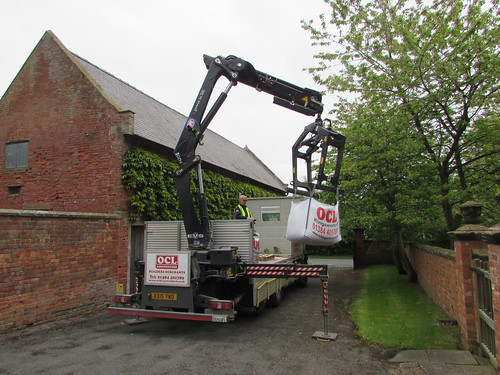
Path repairs at Brewood Hall: OCL lorry (with a remotely-controlled self-loading/unloading hydraulic crane) delivering materials.
A couple of days later, a large skip was delivered to carry away spoil from the repairs.
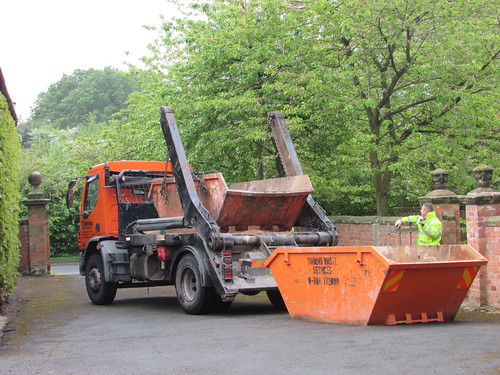
Path repairs at Brewood Hall: Delivery of a large skip to carry away spoil.
The paths at the front of the building were relaid by Jim and Pete from A. M. Griffiths, together with Dave who has looked after the gardens (extending to about one acre) for some years.
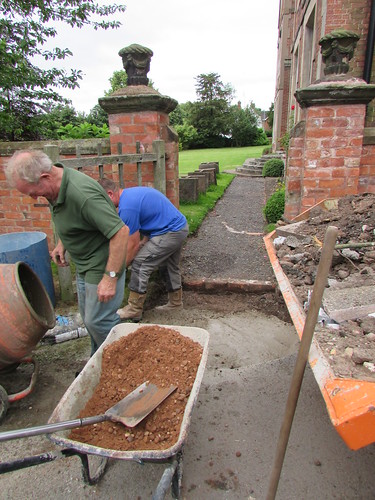
Path repairs at Brewood Hall in 2016.
2017
During 2017, improvements were carried out to the path at the rear of the building where damaged stone slabs were replaced by reclaimed paviours to better match the paved area outside the kitchen and the small barn. Further work will eventually improve the adjacent decorative cobbled area.
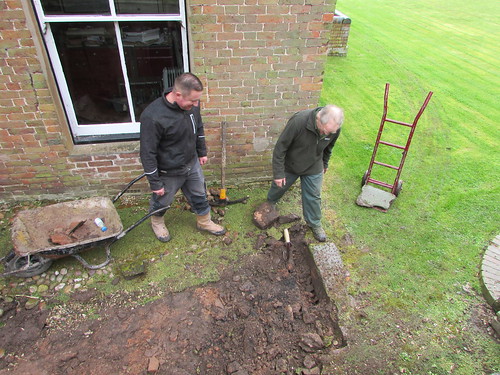
Brewood Hall: Jim and Dave working on repairs to path at rear.
To gain access to the front elevation allowing repairs to the decorative cement quoins, a 'Genie' Self-Propelled Articulating Boom Z-45/25 was hired in. Whilst the machine was on site, some high-level repointing of brickwork was also carried out. It was an amazing machine and I took some pictures from an elevated position. The work was completed prior to the Brewood Garden Party in 2017 (described in the post here).
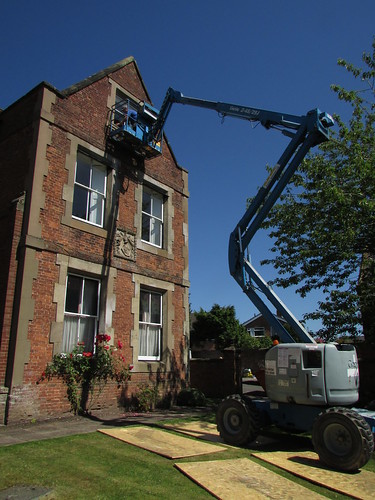
Repairs at Brewood Hall: 'Genie' Self-Propelled Articulating Boom Z-45/25
In November 2017 I visited Cawarden Brick and Tile Reclamation Yard near Rugeley with Brendan where we obtained sufficient reclaimed Staffordshire Blue Edgers for the front path which Dave later installed.
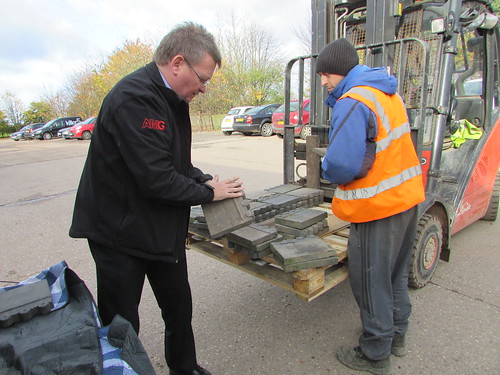
Cawarden Brick and Tile Reclamation Yard: Brendan inspecting reclaimed edgers.
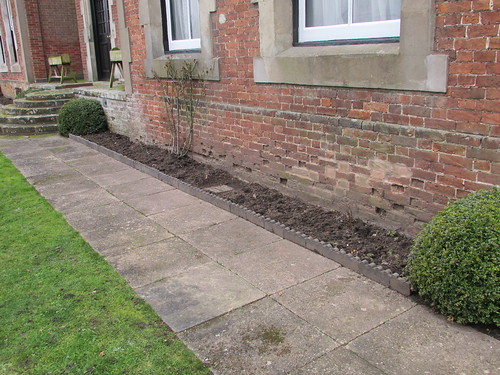
Brewood Hall Garden 2018: Reclaimed edging installed adjacent to the front path.
Related posts on this website
Brewood Hall Maintenance.
Brewood Hall Tree Maintenance.
To see all my posts on Brewood Hall, select Label 'Brewood Hall' or click here.
My Pictures
Where necessary, clicking on an image above will display an 'uncropped' view or, alternately, pictures from may be selected, viewed or downloaded, in various sizes, from the album below:-
Repairs at Brewood Hall.
Reclamation Yard.
Brewood Hall garden has a number of trees. Just as the Hall itself, a Listed Building, requires maintenance the trees also require periodic inspection and attention. The situation is complicated because all the trees are within the Brewood Conservation Area.
In 2012 a group of oak trees along one boundary were pruned for the second time and this is described in the post here.
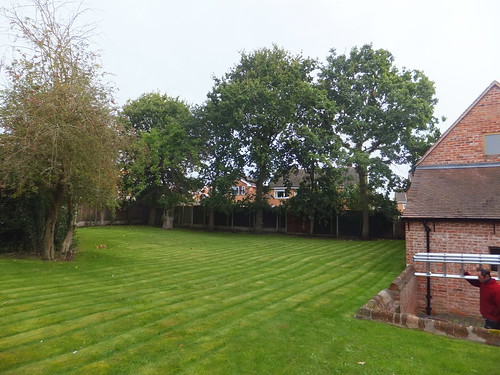
Oak Tree Pruning at Brewood
In September 2014, a self-set sycamore very near the front garden wall had to be felled. It had grown so as to threaten to demolish the garden wall. Although I'm not keen on sycamore, I'd given it a chance to grow clear of the wall but, of course. it didn't oblige. With a chain saw and an expert bit of rope work, Rik and Dave safely brought down the main trunk across the front lawn before quickly reducing the tree to a series of 'rounds'.
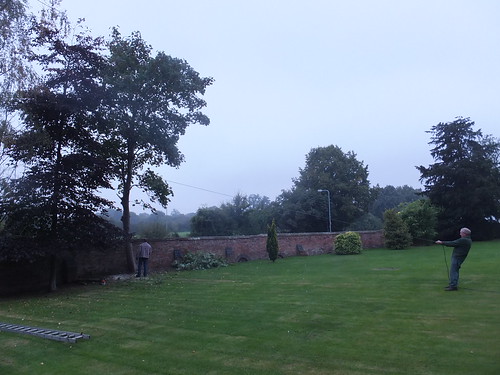
Sycamore felling at Brewood Hall, with Dave on the rope.
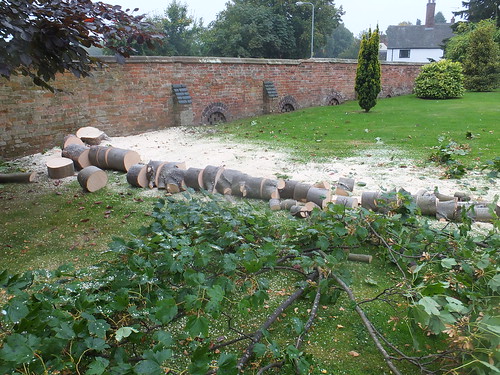
Sycamore felling at Brewood Hall: The felled tree reduced to a series of 'rounds'.
In contrast, I find silver birch attractive. My partner had planted one near the front gates in the 1980s as a replacement for a much older silver birch nearby which had been well-established when I came to Brewood in 1971 but had since died. The replacement tree lasted until 2017 when inspection showed that it was in danger of collapse so, reluctantly, I agreed to felling and Rik and Dave promptly carried out the work on 25th October 2017.
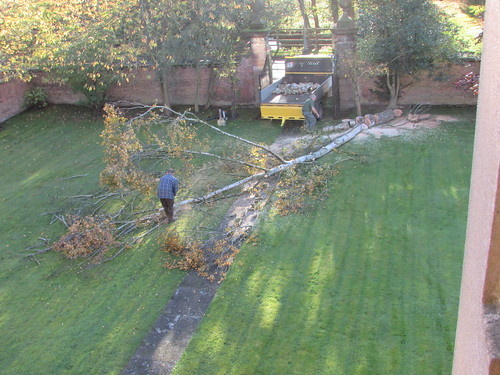
Tree felling at Brewood Hall: This view shows the height of the felled tree.
Related posts on this website
Oak Tree Pruning at Brewood Hall
My Pictures
Where necessary, clicking on an image above will display an 'uncropped' view or, alternately, pictures from may be selected, viewed or downloaded, in various sizes, from the album below:-
Oak Tree Pruning at Brewood.
Brewood Hall: Sycamore felling.
Felling of dying silver birch.
Even casual perusal of this blog is likely to reveal my enthusiasm for driving steam locomotives, latterly at a couple of preserved railways in the United Kingdom. At the Battlefield Line, I also drive the Diesel Multiple Units (DMU) owned by Ritchie Marcus and there's a steadily-increasing number of posts describing this (you can find them all here or by selecting 'DMU' from the list in 'Labels to select a blog topic').
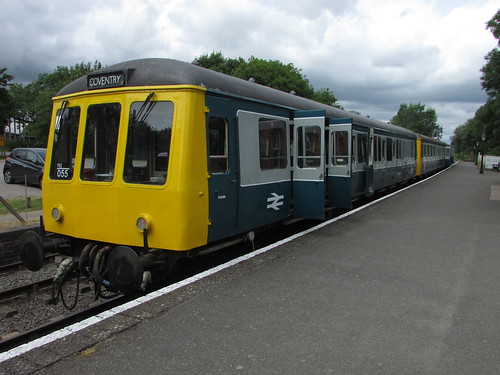
DMU Days at the Battlefield Line: After taking the school party to Shenton on 4th July 2017, the 1-car coupled to the 2-car set wait at Shenton prior to the return to Shackerstone.
In the summer of 2018, these diesel railcars provide the 'Midweek Services' on Tuesdays, Wednesdays and Thursdays so I seem to be getting regular DMU driving turns. I've always enjoyed driving the 'British Railways Modernisation' DMUs, which I remember from my own childhood when they were first introduced but the afflictions of increasing age make a 'diesel day' increasingly attractive for a number of reasons.
Firstly, preparation time is much reduced, compared with steam. 'Checking levels', as on a car, is required but the laborious 'oiling round' is avoided. Whilst a visual examination around the underframe is essential, once the engines are started, also from ground level, the driver can return to the cab whilst the compressors establish sufficient control air pressure to allow movement.
Secondly, driving is carried out whilst seated. Whilst I don't find the seat design particularly good (and manoeuvring around it is tight), it represents luxury compared with most steam locomotives which either make no provision for sitting or offer a rather mean wooden tip-up seat. Gresley is renowned for fitting a padded leather bucket seat on some of his steam locomotives. On most designs, many drivers (the writer included) preferred to remain standing to make the most of the poor forward vision offered by the cab design.
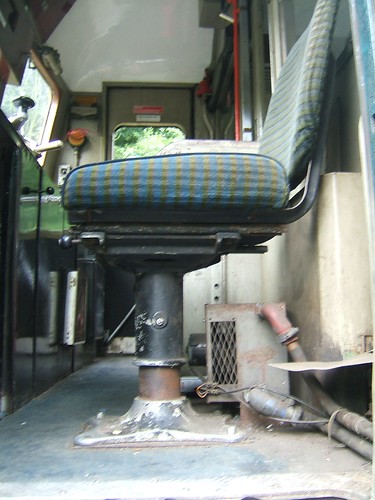
Detail of the driver's adjustable seat.
I often say '90% of a driver's attention should be focussed on the line ahead'. We can debate the exact percentage but keeping a good lookout is vitally important. The windows across the full width of the DMU cab give a panoramic view down the line very welcome to steam drivers brought up on leaning out of the cab to get reasonable sightlines around the front of the boiler. Provided the blinds at the rear of the DMU cab are raised, the passengers, too, can enjoy the view of the route ahead. The blinds were provided, of course, for use at night when the lights in the passenger compartment would otherwise damage the driver's night vision. More modern designs of diesel railcar reverted to solid walls between passengers and cab.
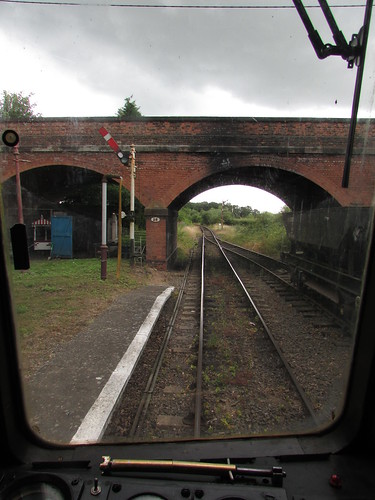
DMU Days at the Battlefield Line: Driver's view leaving Market Bosworth for Shackerstone.
On a steam-hauled train, to give the driver any chance of watching the line ahead, it's a requirement that the locomotive is a the front of the train (except where special arrangements are made called 'push-pull' or 'auto' trains). This means that, at each and of the line, there's a period of furious activity where the locomotive is uncoupled from the coaches, shunted to the other end of the train and re-coupled. On DMU, a driving cab is provided at each end of the train so that, at the end of the line, it's only necessary for the driver to 'close' what had been the leading cab, move to the other end of the train and 'open' what had been the 'back cab' so as to become the leading cab. The business of 'closing' and 'opening' cabs involves the transfer of an electrical master key and removable handles to control the final drive and braking systems.
Although the supply of coal carried by a steam locomotive is normally arranged to suffice for a whole day, the water supply (which is boiled to produce steam, used to impel a piston up and down a cylinder producing useful work and then discharged as exhaust steam from the chimney) often requires replenishment a number of times a day. By contrast, a DMU may be able to run for a number of days before the diesel fuel tanks require topping-up and water (used to cool the diesel engines, as in a car) is recirculated.
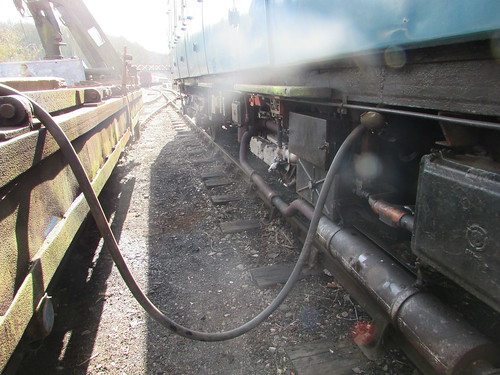 Refuelling the DMU at Shackerstone.
On a DMU, the driving controls, instruments and indications are laid out on the desk in front of the driver in a reasonably ergonomic manner unheard of on steam locomotives although Riddles, in designing the British Railways 'Standard' steam locomotives, attempted a convenient layout.
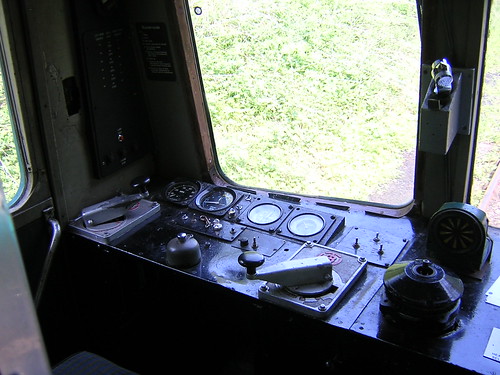
The driving controls, instruments and indications are neatly laid out on the desk in front of the driver.
Drivers also appreciated the 'power on demand' nature of the DMU. With steam traction, the power available to work the train depended upon many factors including time since last 'shopping', time since last boiler washout, quality of coal and, not least, attitude and competence of the fireman. In contrast, a DMU normally works as intended or doesn't work at all. That's a bit of a simplification but, in general, when a diesel driver opens the throttle, the power will flow, giving the driver a feeling of confidence that the job will go well.
But perhaps the best feature of working on a DMU is the opportunity to meet passengers. Many passengers seek out a seat in the leading coach where they can see the line ahead and watch the driver at work. In stations, passengers (men, ladies and children) can often be seen studying the cab and may ask questions. When working on steam, although we always try to acknowledge anyone nearby, the workload involved hinted at above means that a protracted chat is rarely possible. In contrast, when working on a DMU there are better opportunities for passengers to take photographs of the driver's 'office' or to answer questions (admittedly at the risk of boring them to tears - 'too much information'). I never cease to be amazed at the interesting backgrounds and experiences of our visitors. And, at the end of the day, I'm not quite as shattered (or dirty) as after a steam 'turn'.