skip to main |
skip to sidebar
Before I left on my Myanmar trip at the end of September 2017 (that trip is described in a series of posts, the first of which is here), I'd offered some dates for the end of October and November to both the Battlefield Line and Peak Rail. I discovered that the Battlefield Line had covered all the October 'turns' and was not running steam in November in preparation for the intensive 'Santa Special' season in December. Peak Rail rostered me for the 11th November after which they, too, had a short break to get ready for the 'Santa Specials'.
The Battlefield Line: 22nd October 2017
Although I'd not been rostered on the Battlefield Line during October, on Friday 20th October, I received an urgent text telling me that Shackerstone had 'lost' the crew for both Saturday 21st and Sunday 22nd October. I offered to do either day and was asked to cover Sunday which (like Saturday) had a 'Gold' Footplate Experience prior to the public service. There's a description of the format of the 'Gold' Footplate Experience in an earlier post here (when we were using 'Austerity' tank locomotive 'Cumbria'). Jamie had offered to fire on the Sunday so I knew we'd have an enjoyable day. Our engine was Great Western 'Light Prairie' 5542.
It had been some years since I'd driven 'Light Prairie' 5542 - there's a very short post here.
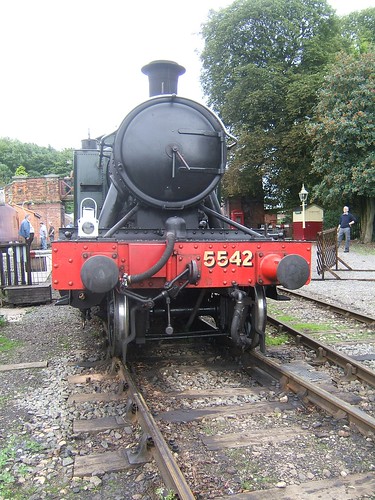
5542 running round its train at Shackerstone during the visit in 2010.
5542 Layout of Valve Gear
All the 2-cylinder Great Western designs (until Hawksworth produced his remarkable Pannier tanks with Walschaert's motion for shifting empty stock in and out of Paddington) featured Stephenson Link motion with four eccentrics mounted on the driving axle between the frames to provide the necessary valve events. Where outside cylinders and valves were required, the movement of the dieblocks was transmitted from inside the frames to outside via the intermediate valve rods, rocking shafts and finally via the valve rods to the valve spindles, as shown in the diagram below.
 Click here for a larger view.
The diagram above is drawn as for a larger, tender engine. In the 'Light Prairie', the intermediate valve rods are shorter and set at a steeper angle so as to connect to the inner valve arm attached to the rocking shaft mounted on the framing. The outer valve arm then drives the valve rod connected to the valve spindle.

5542: Link motion for right-hand cylinder.
The set of pictures of 5542 here has a number of pictures of the valve gear illustrating how the layout in the diagram above is implemented in practice.
5542 Sight Feed Lubricator
The sight feed lubricator is mounted in the cab on the boiler backhead, in front of the driver. Moving parts in contact with superheated steam (such as the valves, pistons and regulator valve) require lubrication with a special, compound mineral oil, formulated to retain its properties at high temperature. Sight feed (or hydrostatic) lubricators are often used for this purpose and Swindon developed a range of suitable lubricators. Through training and the issue of circulars, Swindon ensured that drivers understood the method of operation and the importance of the Sight Feed Lubricator. A copy of Great Western Circular 5801 issued in November 1937 by C.B. Collett can be accessed (and downloaded) here.
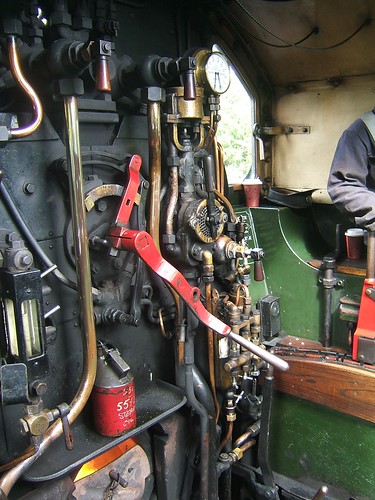
5542: Boiler backhead.
5542 preparation
Whilst Jamie raised steam, I set about reminding myself of all the oiling points as I carried out the daily examination and oiling. The most obvious change since 2010 was that the 'shaded' tankside lettering 'G W R' had been changed for the GWR Roundel which was used between 1934 and 1942 (see 'GWR Roundel' link below). There were changes to the mechanical arrangements for remote control of the regulator used when working 'push-pull' or 'Auto' trains. I discovered that the locomotive had acquired a Stone's electric generator since I last saw her - certainly not a Swindon feature - but not yet in use. I talk about electric generators on steam locomotives in the post Electrical Systems on Steam Locomotives. And the locomotive certainly has a hopper ashpan now.
Having started with oiling the 'easy bits' accessible from ground level alongside the engine (principally crankpins, big ends, little ends and crossheads), I moved into the pit underneath the locomotive and clambered up, perching on a mixture of brake rigging and axles, as I dealt with the Stephenson link motion and axleboxes. Then it was onto the framing at the front of the engine to deal with the vacuum pump oil pot, rocking shafts and a few more oiling points. In the cab, I topped-up the two oil boxes which serve the trailing coupled wheels.
We were kept pretty busy all day, so I didn't manage to take any pictures, but I've included pictures from an earlier visit by the locomotive in 2010.
Peak Rail: 11th November 2017

Locomotive 'Jennifer' at Matlock Town earlier in 2017.
I discovered that this was to be the final weekend for 'Jennifer' at Peak Rail. Although the locomotive engineering department had failed to cure the oscillation in the drawgear which had created some problems for passengers (and crews), she was a 'solid steamer' and strong so I viewed her return to Llangollen with some regret. She was facing 'downhill' so we operated the service coupled to the south end of the train, 'top and tailed' with the diesel electric.
Operating on a Saturday, we saw East Midlands Trains Diesel multiple units at Matlock Town two or three times in the day.
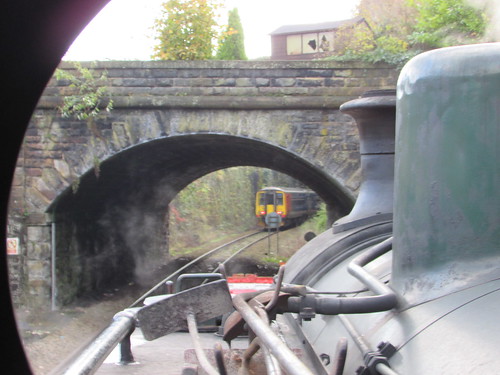
Peak Rail 11th November 2017: View from the footplate of 'Jennifer' on arrival at Matlock Town as an East Midland Trains Class 156 departs.
Related posts on other websites
Although the links below worked at the time this post was published, be warned that changes by a website's owner may 'break' the links.
GWR Roundel.
Locomotive 5542 Limited.
Related posts on this website
All my Battlefield Line posts.
All my MIC posts.
All my Peak Rail posts.
My photograph albums
Where necessary, clicking on an image above will display an 'uncropped' view or, alternately, pictures may be selected, viewed or downloaded, in various sizes, from the albums listed:-
5542 at Shackerstone.
All my Battlefield Line pictures.
'Jennifer'.
Peak Rail 2017.
All my Peak pictures.
Events of Wednesday, 18th October 2017
My trip to Myanmar had been a remarkable odyssey. I'd met so many kind people, seen so many sights, both familiar and new, that I could hardly believe the experiences I'd had. Finally, I faced the journey returning to England and, even with a ticket for Emirates Business class, the prospect was a little daunting. Emirates had changed their schedules since my previous visit to Myanmar so the first leg of the flight, from Yangon's modernised Mingalardon airport, left at 02:10 hours, early in the morning. I was able to use my comfortable room at the Belmond Governor's Residence until 11.30 p.m. when the hotel provided their car (an Executive model 'Alphard' in black) to take me to the airport. At that time of night, we made good time to the airport and the spacious facilities in Terminal 1, only open a few months, were quiet so check-in and security were swiftly completed. There was an extensive new lounge shared by a number of airlines I'd not visited before. I enjoyed a thick pea soup as I'd not had much to eat since breakfast but I didn't take any pictures of the new lounge.
We boarded the aircraft, a Boeing 777-200, on time, and I was settled in an unusually-empty Business Class cabin by the friendly cabin crew. I couldn't remember flying on a 777-200 before and I found the seating arrangements in the row I'd been given a little odd compared with the Boeing 777-300ER that I'm more familiar with.
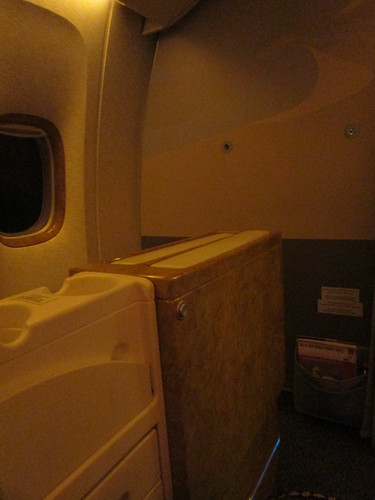
Up, Up and Away: Boeing 777-200 Yangon to Dubai.
During the flight to Dubai, I watched a little 'Doctor Who', slept and then watched more 'Doctor Who' until we neared Dubai.
Our arrival at Dubai was scheduled for 5.55 hours local time, but, with my body still on 'Yangon Time', it felt much later to me. That, together with the enforced activity of leaving the aircraft and having to negotiate the transfer through the airport to my connecting flight meant that I didn't expect to sleep again. A number of my more recent flights into or out of Dubai have involved transfer buses to sometimes remote areas of the huge airport. But this arrival was at Terminal C and we disembarked through an airbridge into the not-yet-completed building. A reasonably long walk aided by some moving walkways took me to a transfer area where, having passed through security, I was able to discover from the passenger information screens the gate from which my connecting flight would leave, requiring another long walk, again with some assistance from moving walkways. As I plodded through the huge terminal, I realised that the departure gate was actually very close to the arrival gate, but one floor down.

Dubai Airport: Walking to the departure gate for Birmingham at incomplete terminal C. The 'palm trees' are fully electrified with uplighters.
There was a very smart Emirates lounge near the gate. Rather than unpack my laptop, I attempted to log-on to one of a series of 'Lenovo' desk computers provided for travellers. I was either very tired or very unlucky because it was not until I tried the third computer that I succeeded in connecting to my e-mail.
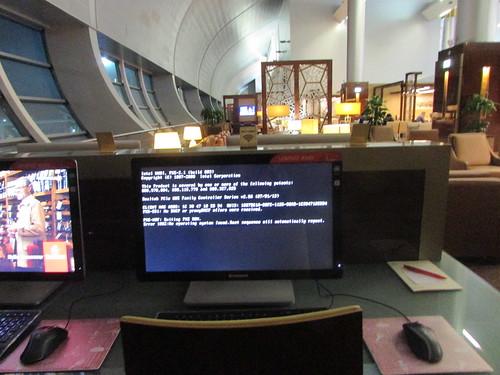
Dubai Airport: IT problems in the Business Lounge - "No operating system found".
I then typed part of a draft blog post before moving to the departure gate and boarding my connecting flight. This time, the aircraft was the familiar Boeing 777-300ER.
It took our aircraft a while, with various stops, to negotiate the taxiways to reach the departure runway. Looking back, I could see the usual row of Emirates wide-bodied aircraft lined up at the terminal we'd left.
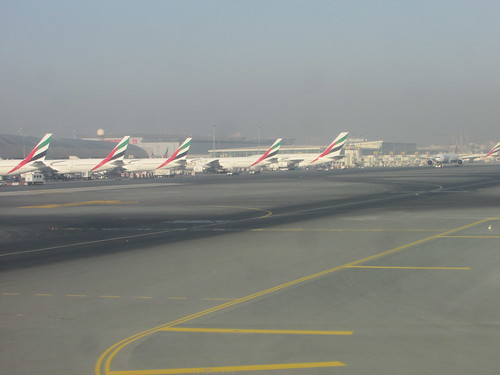
Dubai Airport: Looking back to the terminal we've left, showing Emirates 'wide-bodies'.
On the flight to Birmingham, sleep eluded me but I was fairly comfortable as I monitored our journey across the Middle East and Europe, taking occasional pictures of the changing scene.

From Dubai to Birmingham: Germany from five miles above.
The winds had been in our favour and we arrived at a rain-swept Birmingham about 20 minutes early. I had to wait a few minutes for my transport home, but I was quite content just to be safely back. It's nice to go travelling, but it was good to be home.

Birmingham Airport (BHX) in the rain.
Related posts on this website
This is one of a series of posts describing my 12th visit to Myanmar. The post Starting out is the first post in the series.
This is the last report on the trip.
Alternately, clicking on the 'All my Burma-2017(2) reports' link displays all the posts on this trip in reverse date-of-posting order.
All my Burma-2017(2) reports.
My photograph albums
Where necessary, clicking on an image above will display an 'uncropped' view or, alternately, pictures may be selected, viewed or downloaded, in various sizes, from the albums listed:-
Yangon Airport.
Up, Up and Away.
Dubai Airport, U.A.E.
From Dubai to Birmingham.
Birmingham Airport, England.
Events of Tuesday, 17th October 2017
I slept well again on Monday night and took a fairly early breakfast. I had two ideas in mind for my final day. The first was book purchases, the second rail travel.
Book buying
During previous visits, I'd learnt that the TAB Book Centre in the Taw Win Shopping Centre carried a good range of books in English about Myanmar, particularly reprints of recollections by English people who'd spent time in the territory. I'd already assembled a small collection (there's a bibliography in the post Kipling's Burma) and my aim was to extend this collection.
The Taw Win Centre is a shopping mall and hotel complex just 700 metres from the Belmond Governor's Residence so, breakfast completed, I set out on foot. The Taw Win Centre is bounded by Pyay Road, a minor road and the railway line at Pyay Road Station, so the floor plan is a right-angled triangle which invariably confuses me as I work through the various floors looking for the TAB Book Centre which is located on the third floor. The well-stocked bookshop also sells computer equipment.
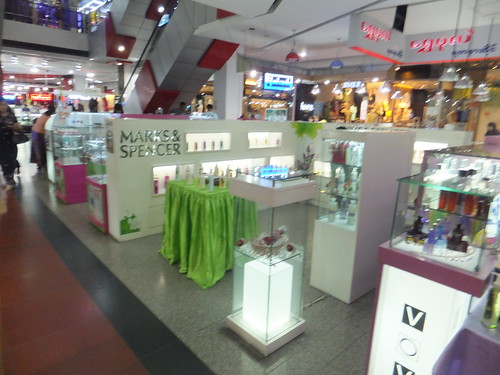
Yangon: Taw Win Shopping Mall in 2012.
An English-speaking assistant directed me to the section of books in English. I'd remembered that the store carried a wide range of Buddhist books so it seemed appropriate that the shop's sound system was playing a recording of a monk intoning a sacred text. However, after about five minutes, in a rather jarring change, the monk was replaced by a modern 'pop' song. I'd taken the precaution of taking a list of books already in my collection, in the hope of avoiding duplication but there were still plenty of interesting-looking titles to choose from. Having completed my selection, I completed my purchases in cash. Whilst credit cards are now far more widely accepted in Myanmar than a few years ago, the TAB Book Centre remains a cash establishment. I walked back to the hotel, warm but delighted with my new books.
Rail travel
A new port, operated by Hutchison Ports, has been established at Thilawa, a little downstream from Yangon city and the old docks. 'Yangon' is now a cruise destination but the cruise ships invariably actually dock at Thilawa. I'd seen the new port from afar when I visited Kyaik Khauk Pagoda in 2016 (see the post Visiting Pagodas. Elaborate enquiries had suggested that there was just one train each day from Yangon Central Station to Thilawa, leaving at 12:15 in the afternoon and not returning until the evening. Each time I'd considered attempting this journey, something had intervened to prevent me. So, with an unexpected surge of confidence, having succeeded in my book purchases, I took a cab to Yangon Central Station and made my way to the suburban booking office on platform 6/7 where they speak some English.

Thilawa Port viewed from Kyaik Khauk Pagoda.
In the hope of avoiding confusion, I'd written the destination, time and ticket price (in 'Roman' characters) on a piece of paper. The ticket clerk confirmed that my information was correct, and immediately issued me with a ticket (but written in Myanmar characters). With suburban trains coming and going regularly, identifying the correct departure remained a problem but the ticket clerk assured me that he would alert me to the right train. A few minutes later, the clerk re-appeared and directed me to a Diesel Multiple Unit standing in the Western part of the platform. Since my destination was east, I queried this. "Thilawa, Thilawa" he re-assured me. Well, I knew that some eastbound trains started from the western end of the platform so I felt I had no alternative but to board the indicated train. Almost immediately, an inspection of tickets took place. The ticket inspector studied my ticket very carefully but was satisfied so I once again enquired whether the train was for Thilawa. He was emphatic that it was, just before the train set off westwards on a long clockwise circuit of the Circle line which didn't take me to Thilawa.
I still don't know what went wrong with my careful arrangements except that travelling on the Circle Line is something of a 'Rite of Passage' for many foreign tourists, so perhaps they just thought 'Foreign Tourist - Put her on the next Circle Line Train'. I never tire of watching the passing scene on the Circle Line so, lacking the energy to bound off the train and plan another adventure, I meekly accepted my fate and travelled around most of the Circle Line. A further discouragement was that it was raining quite heavily as we left Yangon Central, although it dried-up later in the journey.
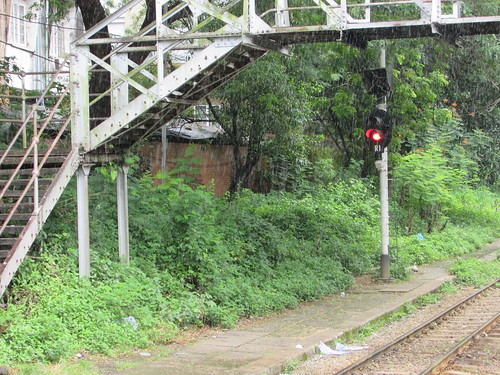
The Circle Line (Yangon - Mahlwagon c/w): Leaving Yangon in heavy rain.
Signalling on the Circle Line
Yangon's Circle Line is described in the post here. It is double track throughout, signalled by a variety of 2-aspect and 3-aspect colour light signals from a number of signal cabins with intermediate sections controlled by Automatic Block.
Yangon Central Station is still controlled by an elderly British-made Westinghouse Style 'L' miniature lever frame, described here.
Kyee Myin Daing remains a delight for me with two mechanical signal boxes (North and South), facing points provided with Facing Point Locks/Locking Bars and semaphore signals on the sidings. There's a description here and a report on an official visit here.
Insein has a Korean 'NX' (eNtrance-eXit) signalling panel also described here.
Da Nyn Gone has a locally-built signalling panel controlled by miniature switches, described here.
Mingalardon has another locally-built signalling panel controlled by miniature pushbuttons, mentioned in my report on an official visit here.
Paywet Seik Kone also has a locally-built push-button signalling panel, mentioned in my report on an official visit here.
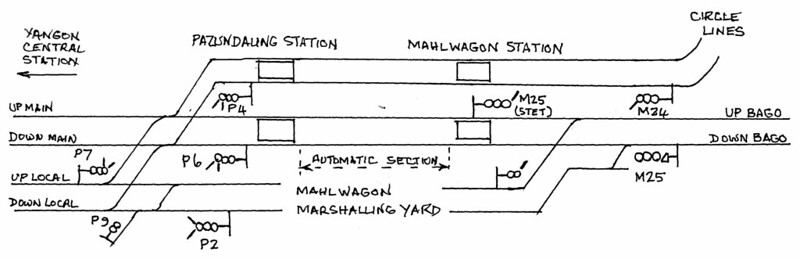
My very first trip on the Circle Line in 2008 piqued my interest in the railways between Mahlwagon and Pazundaung. At Mahlwagon, the double track Circle Line joins the double track main line from Mandalay and there is quadruple track from there to Pazundaung, as shown in the diagram below. At Mahlwagon, a double junction gives access to the large Mahlwagon Marshalling Yard (an official visit is described here). At Pazundaung, two lines emerge from the Marshalling Yard and tangle with the other lines at the complex ‘flat crossing’ junction where trains to and from the Circle Lines cross the Up and Down Bago and Mandalay main lines as they pass from or to the local lines. This is because, at Yangon Central, long distance trains use platforms 1, 2, and 3 on the north side of the station whilst local trains usually use platforms 4, 5, 6 and 7 on the south side. There's the further complication, west of Pazundaung, of the splitting of the Down and Up Goods Lines (which by-pass Yangon Central Station to the south) and the junction to the single line branch to the old docks along Strand Road.
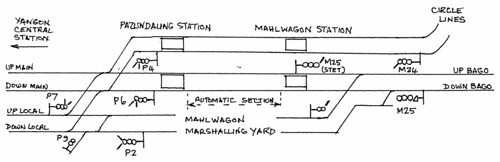
Myanma Railways: Simplified line diagram Pazundaung to Mahlwagon
Click for larger version
At the time of my official visit in 2017 mentioned above, I thought it likely that Pazundaung and Mahlwagon had similar locally-built installations but this is not correct. My German friend Dieter later wrote that Siemens modernised these areas in the 1960s as part of the Circle Line colour-light project. Certainly, when I checked my photographic record, I confirmed that, in the Mahlwagon and Pazundaung area, electric point machines and colour light signal heads are Siemens built. There is some ambiguity over the signal numbers originally carried on the posts (There appeared to be two signals 'M25'!) but the prefixes used 'M' and 'P' suggested two control panels. A further oddity is that three colour light signals at Mahlwagon carry line-of-white-lights route indicators although there are currently no track connections between the Circle Lines and the Bago lines.
Time for gaining a better understanding of the present arrangements is getting shorter because, as I mentioned in my post here, the Japan International Cooperation Agency is involved in modernising Myanma Railways and I saw new location cases and point machines in the Pazundaung area.
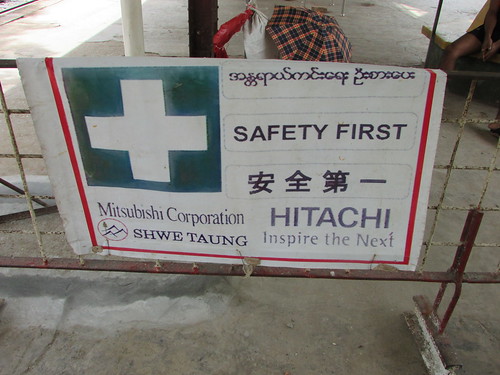
The Japanese railway modernisation project is well in evidence around Yangon.
Mahlwagon
It took my Circle Line train about two and a half hours to reach Mahlwagon, on the interesting four-track section described above. I decided to leave the train and explore the area around the station on foot, taking a number of pictures before returning to the station to catch the next service back to Yangon Central.

Mahlwagon Main Line seen from the north end of the Up Yard showing Train Number 5 Up (the 15:00 hours Yangon-Mandalay, due to arrive 05:00 the following day) with a Chinese-built Bo-Bo-Bo on a rake of Chinese-built 'air-bag suspension' coaches.
By this time, I was rather tired so, after a short period watching movements around the station, I made my way outside to find a taxi. I'd had an enjoyable and informative afternoon, even if it wasn't as planned. I was able to use my comfortable room at the Belmond Governor's Residence until 11.30 p.m., when the hotel car was transferring me to Mingalardon Airport. I spent the evening packing, drinking tea and trying to relax before my long night flight home.
Related posts on this website
This is one of a series of posts describing my 12th visit to Myanmar. The post Starting out is the first post in the series.
Clicking on the 'Next report' link displays the post describing the next events. In this way, you may read about the trip in sequence.
Next report.
Alternately, clicking on the 'All my Burma-2017(2) reports' link displays all the posts on this trip in reverse date-of-posting order.
All my Burma-2017(2) reports.
My photograph albums
Where necessary, clicking on an image above will display an 'uncropped' view or, alternately, pictures may be selected, viewed or downloaded, in various sizes, from the albums listed:-
The Governor's Residence Hotel, Yangon.
The Circle Line (Yangon - Mahlwagon c/w).
The Circle Line (Mahlwagon - Yangon Central Station c/w).
Getting there
On Thursday 16th November 2017, I attended the Rail Research UK Association (RRUKA) Annual Conference in London. After transfer to Wolverhampton station by car, I caught the 06:04 Virgin service to Euston. At that time of the morning, there wasn't much to see on the way down but I'm happy to report the train arrived on time.
I'd decided to walk to the venue at Kings Place (gritting my teeth that the location chooses not to use an apostrophe in spelling its name). I walked east along Euston Road, past St. Pancras to King's Cross station.
King's Cross Station
Having a little time in hand, I briefly examined the new and old concourses at the station, which sometimes uses an apostrophe in the name, sometimes not. I tend to be similarly inconsistent (depending how 'modernist' I'm feeling). I'm not a fan of the new concourse with its 'alien beanstalk' roof framing dominating the space.

King's Cross Station: The 'New' concourse illuminated.
But I've always had a soft spot for Cubitt's compact train shed at this terminus, unobtrusively but effectively carrying out its function.
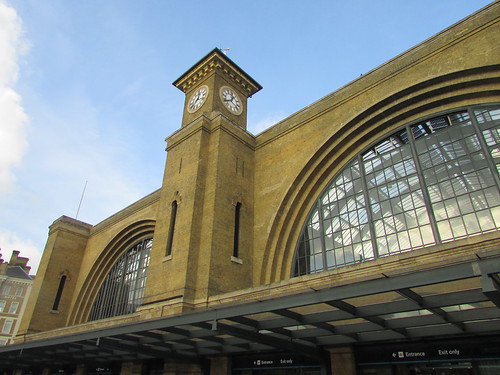
King's Cross Station: The simple but elegant end of the train shed is revealed.
Although I'm sure my long-suffering mother took me to look at King's Cross when I was a child, it was probably not until around 1974 that I became a regular visitor when my firm, Ford Electronics, supplied and installed an Electrification Telephone System for 100 route-kilometres of electrified railway on the Great Northern Line (briefly described here). My most unusual journey from King's Cross came in 2005 when, in connection with TPWS development, I travelled on a Class 373 Test Train from King's Cross to Grantham, described here. Somewhat later, Ford Electronics also modernised an aging British Rail-designed Tunnel Telephone system serving the Northern City line to Moorgate. Since the Moorgate line was actually controlled from King's Cross Power Box, special interface equipment was installed, and I became quite familiar with the Power Box over the years.

King's Cross Power Box: General view of operating floor in 2002.
'Related posts' below leads you to earlier mentions of King's Cross in this blog.
After my brief tour, I turned the south-east corner of the station building into York Way and, for the first time, noticed some modern steel bracing which had been added to Lewis Cubitt's venerable wall. One of the braces was in front of a Boundary Stone set in the brickwork and appeared to have cracked the face of the stone but I still found it a fascinating relic.

King's Cross Station: Insensitive bracing added to the SE corner of Cubitt's station building has virtually destroyed this boundary stone.
Origins of RRUKA
In 1993 state-owned British Rail was privatised with control of the infrastructure (and responsibility for safety and standards) passing to privatised Railtrack. Railtrack collapsed in 2001, resulting in the creation of a new body in 2003, the Rail Safety and Standards Board (RSSB) as an independent not-for-profit company limited by guarantee. Since then, a host of initiatives have been created (leading to an 'alphabet soup' of acronyms such as SPARK, CIRAS, SMIS+ and RRUKA). The Rail Research UK Association (RRUKA) was established in 2010 with core funding provided by RSSB, to form a partnership between the British rail industry and UK universities. Each year, there is a conference, currently held at Kings Place, London.
The venue
Kings Place is a modern building on the opposite side of York Way from King's Cross Power Box, mentioned above, just a few yards further north. The website here invites visitors to "Come and experience two world-class concert halls, purpose-built art galleries, a bar/café, waterside restaurant and award winning conference and events facilities - all under one roof." Although I tend to dislike modern architecture, Kings Place is thoughtfully laid out and appears to carry out its remit well. All the arrangements worked well throughout the day and I ended up fairly impressed.
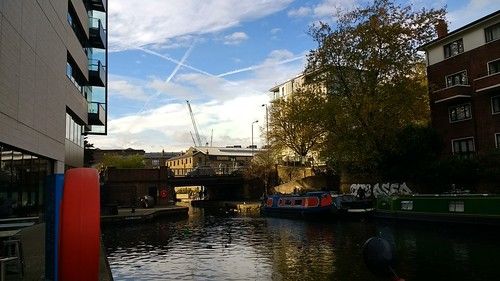
London: The Regent's Canal at Kings Place, looking towards York Way and Maiden Lane Bridge.
The event
Registration was quickly completed in the Music Foyer on the Lower Ground Floor where numerous polite and friendly staff were on hand to dispense beverages.
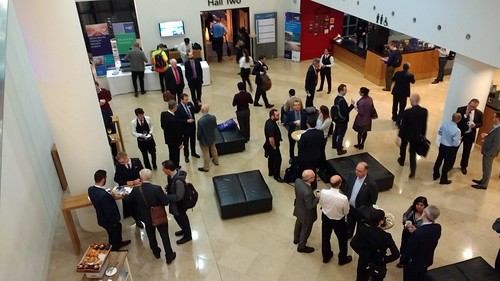
RRUKA Annual Conference 2017, Kings Place, London: Registration and beverages.
On time, delegates moved to the adjacent Hall 2 for the event itself. Hall 2 was equipped with effective audio-visual facilities (incorporating a Yamaha digital live-sound mixing console M7CL), theatre-style lighting and reasonably comfortable individual chairs.

RRUKA Annual Conference 2017, Kings Place, London: Hall 2 showing lighting arrangements and computer projector.
After opening remarks by Luisa Moisio (R&D Programme Director RSSB), the Keynote Address was given by Marco Caposciutto (Technical Director Trenitalia) and Ernesto Sicilia (Chairman /M.D. Trenitalia). This was followed by a review of research partnerships by Luisa Moisio and Sharon Odetunde (Head of Academic Partnerships RSSB). Next, there were two research presentations on 'Time spent by passengers at stations' and 'Benefits of mechatronically-guided vehicles on railway track switches', terminating in a short question-and-answer session.
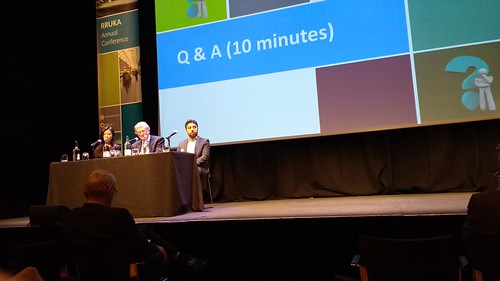
RRUKA Annual Conference 2017, Kings Place, London: One of the Question and Answer sessions.
There was then an opportunity to visit the 'Blue-Sky Village' exhibition in the Battlebridge Room, where refreshments were served.
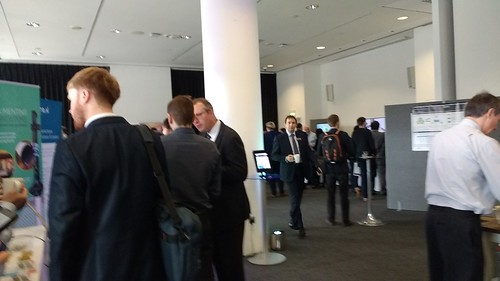
RRUKA Annual Conference 2017, Kings Place, London: The 'Blue-Sky Village'.
The morning session continued in Hall 2 with three research presentations covering automated servicing of passenger train fluids, a cab front cleaning robot and robotic systems for wheelset reworking, followed by questions and answers. The morning session concluded with three 'elevator pitches' for future studies.
A buffet lunch (with a choice of three 'mains') was served in the Battlebridge Room, giving ample opportunity to talk to the exhibitors in the 'Blue-Sky Village'.
At 2.00 p.m., the afternoon session was introduced by Stuart Hillmansen, Senior Lecturer at the University of Birmingham. Three more 'elevator pitches' were followed by two research case studies on the SmartDrive Project and the integration of real-time performance measurement with simulation. The afternoon coffee break offered a final opportunity to study the displays in the 'Blue-Sky Village'.
Iain Roche (Head of Innovation HS2) then gave the afternoon Keynote Address. The formal business of the day concluded with the presentation of the RRUKA Best Young Researcher Award and closing remarks by Stuart Hillmansen, after which delegates were invited to a drinks reception in the Music Foyer.
An interesting event, well-organised by RSSB and RRUKA.
Related posts on this website
Electrification Telephone Systems for British Rail.
London's Terminal Stations.
Redevelopment at King's Cross Station.
Class 373 Test Train to Grantham.
My photograph albums
Where necessary, clicking on an image above will display an 'uncropped' view or, alternately, pictures may be selected, viewed or downloaded, in various sizes, from the albums listed:-
London: King's Cross Station.
Kings Cross Power Box.
RRUKA Annual Conference 2017.
Events of Monday, 16th October 2017
After a good nights sleep and a relaxing breakfast in the comfortable Belmond Governor's Residence, I felt somewhat restored. I'd had an e-mail from Sule Shangri-La Hotel saying they'd found something I'd left behind, discreetly not explaining what it was. I have a history of leaving a trail of possessions behind in hotels so, still unsure what they'd found, I decided to go there to recover it.
At reception, they called a taxi for me and I was fascinated as the concierge tracked its approach on his smartphone. I was about to sample my first 'Uber' taxi. A small, clean saloon arrived and made good time to the centre of Yangon and the Sule Shangri-La Hotel. The fare was less than half the 'normal' taxi fare. The concierge at the Sule Shangri-La Hotel was helpful but regretted that it would take a little while for housekeeping to bring whatever they'd found to the lobby. I'd already a plan in mind, so I said I'd call back a little later in the morning and I set off, through the rapidly-warming streets, to Yangon Central Station to observe movements in this always-busy station.
The Carriage Department Staff were kept busy that morning. Whilst I was at the station, two trains had problems releasing the train brakes, requiring repairs to be carried out on the coaches before the trains could leave.

Yangon Central Station, Monday 16-Oct-2017: The Locomotive Driver (right) squats patiently whist four men from the Carriage Depot replace a defective vacuum brake hose ('ABS Hose') between two coaches on Platform 7.
The temperature was only around 32 degrees Celsius but, after about an hour of walking up and down the suburban platforms recording the scene with my camera, I was ready to return to Sule Shangri-La Hotel to see what they'd found. What they'd found was the credit card I'd mislaid during my stay. The card was no longer valid because I'd reported the card missing as soon as I discovered the loss. Fortunately, I had another card available for use. Another 'Uber' taxi then returned me to the Belmond Governor's Residence, where I'd arranged an afternoon meeting with Eddie Teh, Belmond's General Manager in Myanmar, for further discussions on the charitable work of the Belmond Myanmar Foundation.
The rest of the day was spent uploading pictures to the internet and catching up on e-mail correspondence.
Related posts on this website
This is one of a series of posts describing my 12th visit to Myanmar. The post Starting out is the first post in the series.
Clicking on the 'Next report' link displays the post describing the next events. In this way, you may read about the trip in sequence.
Next report
Alternately, clicking on the 'All my Burma-2017(2) reports' link displays all the posts on this trip in reverse date-of-posting order.
All my Burma-2017(2) reports.
My photograph albums
Where necessary, clicking on an image above will display an 'uncropped' view or, alternately, pictures may be selected, viewed or downloaded, in various sizes, from the albums listed:-
The Governor's Residence Hotel, Yangon.
Yangon Central Station (3).
Hand-operated Cranes
In 2017, I spotted a couple of small wagon-mounted hand cranes laid aside at Myitnge, but I wasn't able to take a photograph.
Steam Cranes
During my tour of Insein Locomotive Works in May 2015, I paid a brief visit to the 'scrap line' and made a hasty record of two steam cranes lying there.
The first vehicle was a 30-ton steam crane made by Cowans Sheldon and Company Limited in Carlisle in 1933. The cast-iron worksplate gives the works number as 5373 but the top line reads R.S.R. - Burma Railways, suggesting that the same design was shipped to both Thailand and Burma. The crane carried a second cast-iron plate which I assumed was the Burma Railways running number '30TSC 9878'. The crane was paired with a match- or runner-wagon bearing a cast running number plate marked 'J 4886'.
The other crane was also a Cowans Sheldon product but rated at 35 tons, works number 8628 built 1945. A cast-iron plate gave the running number as '35TSC 9887'. In this case, the match wagon was built by Hurst, Nelson and Company Limited in Motherwell and carried a cast-iron plate giving the running number as 'J 9817'.
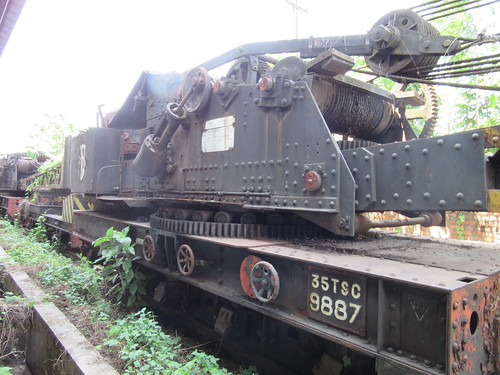
The 35-ton crane with the older, 30-ton crane in the background.
Diesel Cranes
I saw a 60 ton diesel crane in Insein Works, painted canary yellow and labelled 'QIQIHAR CHINA' and 'N603-102'. This was supplied to Myanmar in 1995 by the CNR Qiqihar Railway Rolling Stock (Group) Company Limited. The company's website here. I believe other exports to Myanmar were Depressed container wagons, Brake Vans and Covered Wagons (all with a 12.5 ton axle-load). Qiqihar is a large industrial city in north-east China. Oddly, this city is called 'The City of Cranes' because it is the habitat of Red-crowned Cranes.
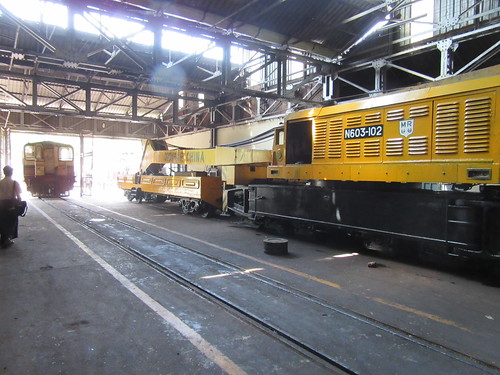
Qiqihar 60-ton crane inside Insein Locomotive Works, Yangon.
At Mahlwagon Diesel Depot I found an Orton McCullough 45 ton diesel crane bearing the painted running number '45.T.DC 9892'. I didn't know this manufacturer but, according to the Historical Construction Equipment Association based in the U.S.A.:-
"Orton & Steinbrenner Company was apparently founded in Chicago, Illinois, in 1906. It was renamed Orton Crane & Shovel in 1922, then Orton Crane Company. It discontinued cable cranes in 1945 to focus on locomotive cranes. John F. McCullough purchased the company in 1972 and renamed it Orton-McCullough Crane Company. Orton-McCullough relocated to Huntington, Indiana, and apparently ceased operations by January 2012".
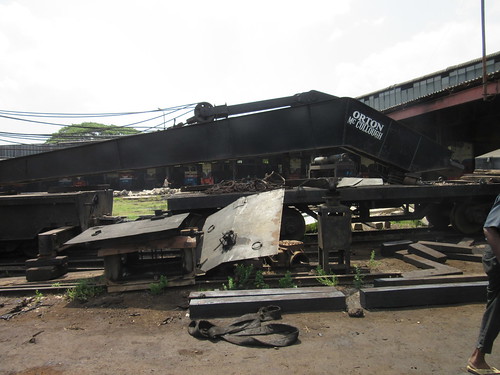
Jib of Orton McCullough 45 tone crane.
Related posts on this website
This is one of a series of posts describing railways in Myanmar. Clicking on the 'All my Myanma-Railways reports' link displays all the posts in reverse date-of-posting order.
All my Myanma-Railways reports
My photograph albums
Where necessary, clicking on an image above will display an 'uncropped' view or, alternately, pictures may be selected, viewed or downloaded, in various sizes, from the albums listed:-
Rail-mounted Cranes in Myanmar.
[Qiqihar website updated, 6-Dec-2019]
I've come across a number of plinthed and laid-aside steam locomotives in Myanmar. This is an index to the photographs I've managed to take so far of the survivors.
Plinthed Dubs 2-4-0T at Naypyitaw
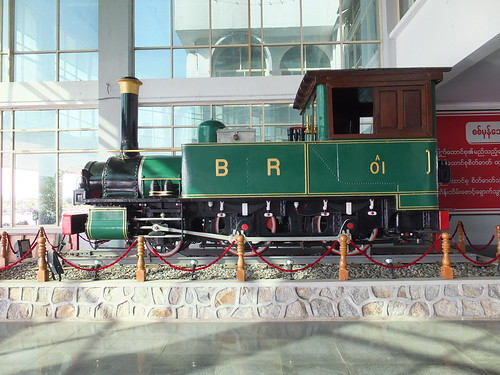
Reputed to be the first steam locomotive to run in Burma, this Dubs is plinthed in the entrance to Naypyitaw station.
More pictures
There’s a large oil painting depicting the inaugural train hauled by the Dubs in the Myanma Railway Museum which I discovered on my visit in 2013 (described here: My pictures around the museum are in an album here).
2-6-4 Tank Locomotives in Burma
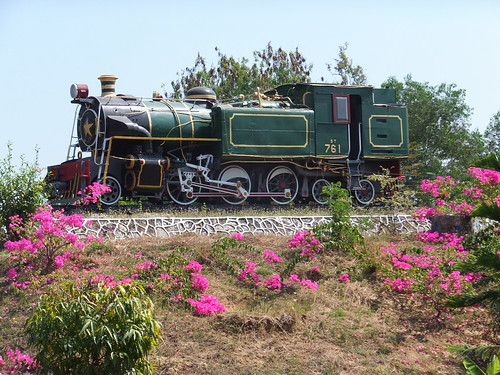
The 'ST' Class formerly worked the intensive suburban services on Yangon's Circle Line.
More pictures
4-6-4 Tank Locomotive in Burma
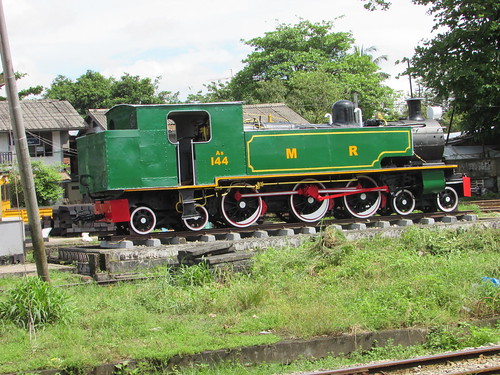
This impressive 'Baltic' tank, As144, is now plinthed at Yangon Central Station.
More pictures
4-6-2 Steam Locomotives in Burma
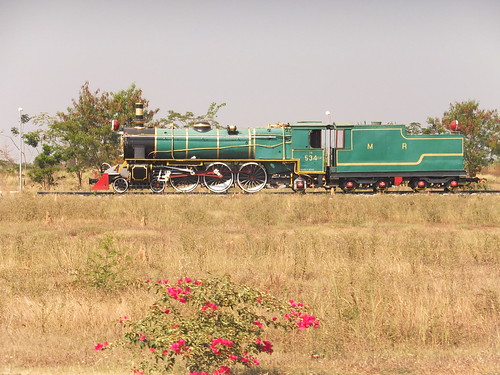
Oil-fired 'Pacific' YB 534 is displayed outside the station at Naypyitaw. Coal-fired 'Pacific' YC 628 with rocking grate was reasonably complete when seen at Mahlwagon Diesel Depot. Oil fired YC 627 at Insein was in poor condition, as were other unidentified 'Pacifics' at Insein.
More pictures
Burma Railways GC 833 Beyer Garratt at Thazi
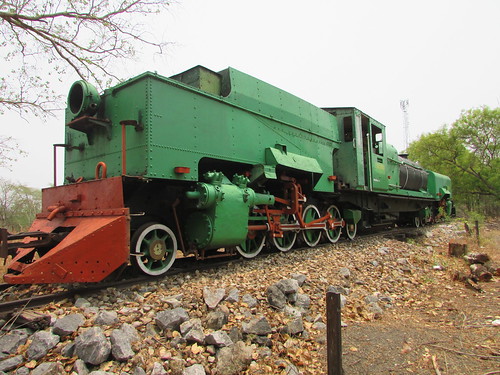
In 2016, I was surprised to find a Beyer Garratt laid aside at Thazi. Externally, she looked reasonable but the cab had been gutted.
More pictures.
Two other albums have some technical information about Beyer Garratts:-
Burma Railways Beyer Garratts.
Burma's Beyer Garratts.
Plinthed 0-6-0T at Thazi Diesel Depot
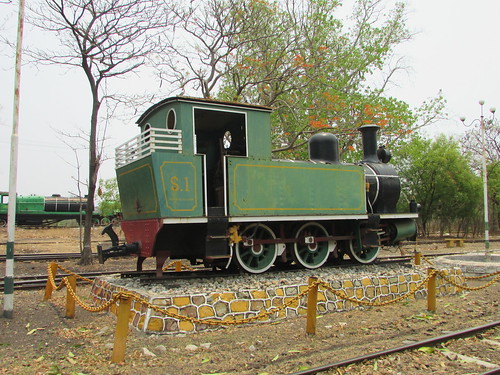
The 0-6-0 side tank plinthed at Thazi Diesel Depot is numbered S.1.
Album
Plinthed 0-6-0T at Insein Locomotive Works
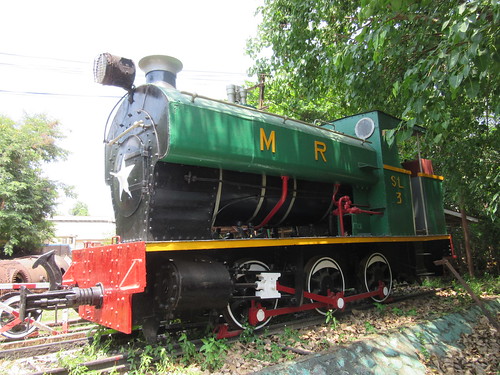
The 0-6-0 saddle tank plinthed at Insein is numbered SL 3.
More pictures
C56 plinthed at Thanbyuzayat
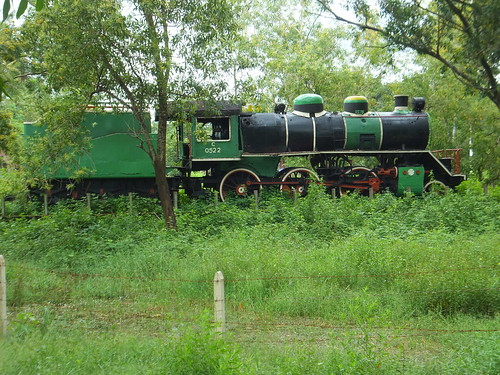
Preserved Japanese-built 'Mogul' C 0522 a few hundred yards from Thanbyuzayat War Cemetery. It is claimed to be the first locomotive to run on the completed 'Death Railway' linking Thailand with Thanbyuzayat.
More pictures
Plinthed Narrow Gauge Kerr-Stuart at Mahlwagon
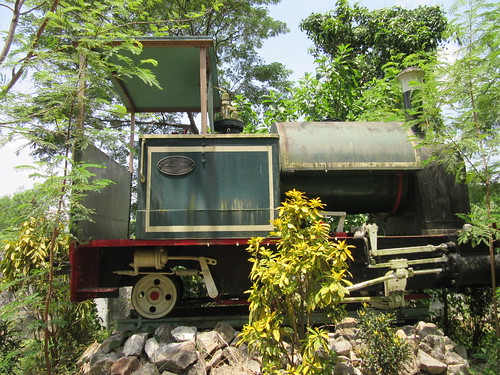
Although I spotted this locomotive, half-hidden in the trees, on my first visit to Myanmar in 2008, it was not until 2015 that I was able to take a closer look.
More pictures
Plinthed Orenstein and Koppel Narrow Gauge Locomotive at Mandalay Diesel Depot
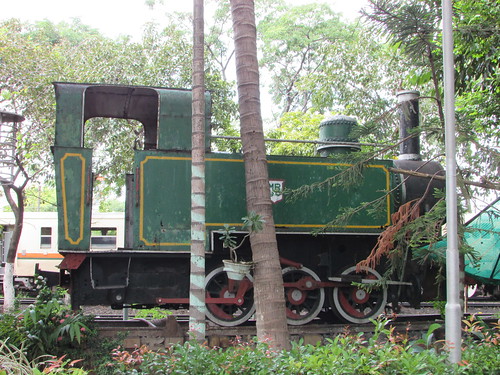
It was not until October 2017 that I spotted this locomotive plinthed at the Diesel Depot in Mandalay.
Album
2-8-2 Steam Locomotives
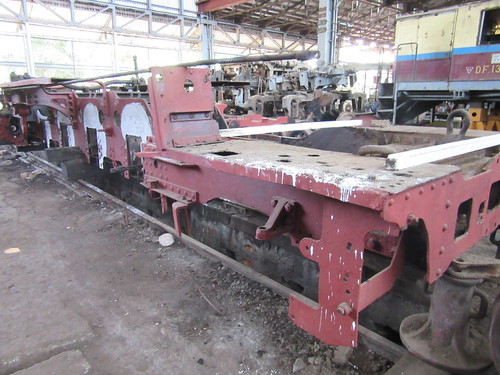
I haven't tracked down any YD class so far, apart from stripped-down examples under restoration at Insein but there are two or three working locomotives. See FarRail's Trip Reports at https://www.farrail.com/
Restoration pictures
[C56 added: 15-Nov-2017]
Events of Sunday, 15th October 2017
A number of guests were leaving the ship on Sunday morning, being ferried ashore at different times, depending upon their onward travel arrangements. As I made my way to the restaurant for breakfast around seven o'clock, I said "good-bye" to one group.
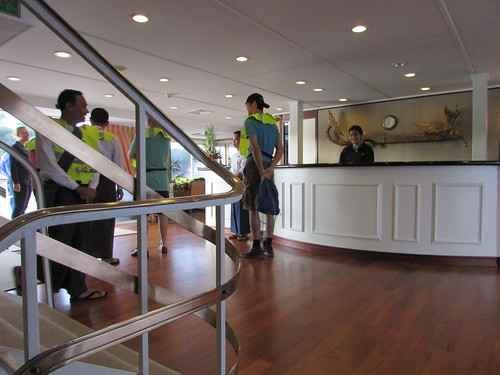
'Road to Mandalay' at Bagan and final leaving.
My own pleasant sojourn on 'Road to Mandalay' was coming to an end and I was to travel back to Yangon, where I'd been invited to spend the last two nights of my trip at the 'Belmond Governor's Residence'. An American guest who was remaining on the ship as she sailed north back to Mandalay had expressed interest in visiting Bagan Medical Clinic. It had been arranged that the guide Pyae Pyae would take him ashore around 8.00 a.m. for a brief tour and I decided to go ashore with them. Doctor Hla Tun had gone ashore much earlier in order to finish his 'list' before the ship sailed a little after nine.
Bagan Medical Clinic opens each week, apart from a break around the New Year. But, for around 8 months in each year, Doctor Hla Tun's duties as Belmond's Chief Medical Officer mean that he is aboard 'Road to Mandalay'. So the Clinic's opening on Friday, Saturday and part of Sunday are tied to the sailing schedule of the ship, which normally arrives at Bagan around 9.00 a.m. every Friday and remains at anchor until Sunday morning. On this trip, when the guests went ashore on Friday at 9.30 a.m., Doctor Hla Tun went straight to the clinic, staying until about 11.00 p.m. On Saturday, he went ashore with guests at 8.30 a.m., again working at the clinic until 11.00 p.m. Finally, he made an early start on Sunday at around 6.00 a.m. in order to 'clear' his list before returning to the ship around 9.00 a.m. This punishing and voluntary schedule is then carried out each week.
What about the 'closed' season embracing the hottest part of the year when 'Road to Mandalay' does not sail? Doctor Hla Tun manages charitable initiatives elsewhere - most notably around Yangon and the Orphans and Vulnerable Children (OVC) Project in Mon State. During this period, each week, the Doctor makes his way to Bagan to carry out consultations on Friday, Saturday and Sunday. Occasionally, the Clinic is opened for additional days. My last visit to Myanmar in May 2017 was during the 'closed' season when I accompanied the Doctor to Mon State and then on to the Bagan Clinic. That trip is described in a series of posts here.
Before going ashore with Pyae Pyae and the guest, I'd said my final "good-byes" to the ship's hotel staff and my luggage went ashore too. The Clinic was unusually quiet as almost all the patients had been dealt with. A few patients were still readying themselves for their journey back to their home and Clinic staff were tidying-up after a hectic few days. Pyae Pyae, the guest and I went from building to building whilst I explained a little of the history of the Clinic. We spoke briefly to Doctor Hla Tun who was preparing to finish then walked back to the Belmond landing stage where Pyae Pyae and the guest boarded the motor boat waiting to return to the ship. At ten past nine, Doctor Hla Tun came running down the steps and jumped aboard the motor boat.
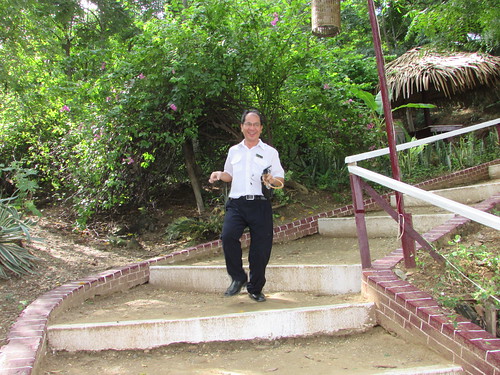
Bagan Medical Clinic Sunday: Doctor Hla Tun running to catch the last motor boat back to the ship.
Within moments, the motor boat was roaring away from the bank to deliver its three passengers back to 'Road to Mandalay' and I was left on the shore waving to my friends.
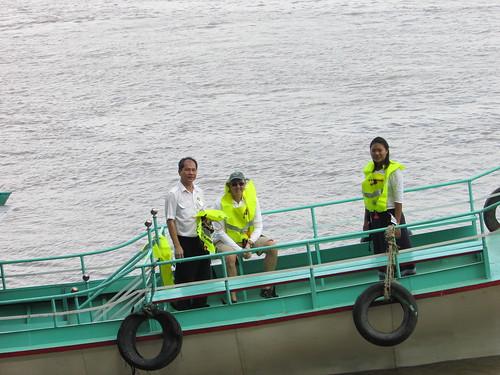
Bagan Medical Clinic Sunday: Dr. Hla Tun, the Guest and Pyae Pyae returning to 'Road to Mandalay'.
Before leaving myself, I had a quiet walk around the Clinic, thinking about the changes I'd seen since the first, small clinic building was opened in 2011. You can find all my posts charting these changes in a series of posts here. It had been arranged that the Monastery Car would take me to Nyaung Oo Airport for my flight to Yangon so, having said farewell to the remarkable staff and the Abbott of the Monastery who, with Doctor Hla Tun, is responsible for the Clinic, I was whisked to the airport.
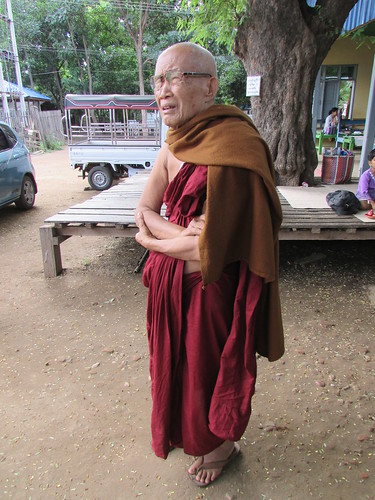
Bagan Medical Clinic Sunday: The Abbott
As we made our way past the temples of the Bagan Plain, we kept passing groups of young people, in orange tee-shirts and blue hard-hats. It's apparently an initiative by volunteers to improve the appearance of the area, presumably to aid tourism. Bravo!
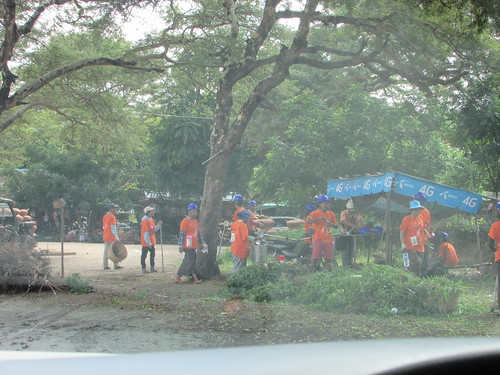
Volunteers litter-picking and grass-cutting around the temples of Bagan.
We'd made good time on the way to Nyaung Oo Airport so I had a fair wait for my flight but, for once, I was relaxed about the enforced inactivity.
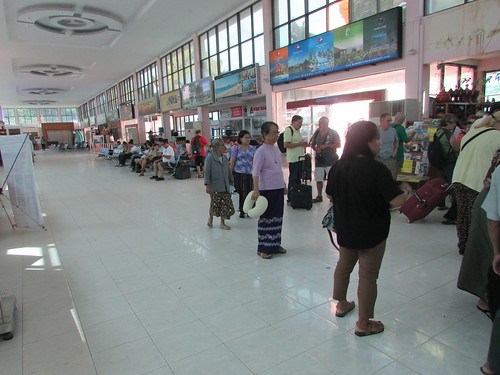 Nyaung Oo Airport.
Regular readers may remember that in Tasmania earlier in 2017, I'd been surprised to discover God's Car Parking Space (that's described in the post here). I was similarly nonplussed when, waiting to board the aircraft at Nyaung Oo, a man walked across the tarmac in a lemon high visibility jacket marked 'AIR KBZ G O D'. After a short reflection, I decided he was probably the Ground Operations Director.
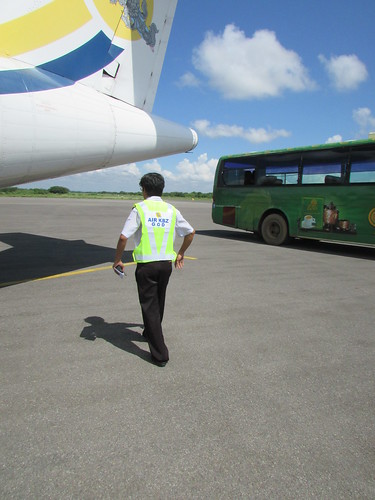
Nyaung Oo Airport.
We touched-down in Yangon just before 12.30 p.m. and parked in a line with similar KBZ aircraft, from where a transfer bus took us to the Domestic Terminal.
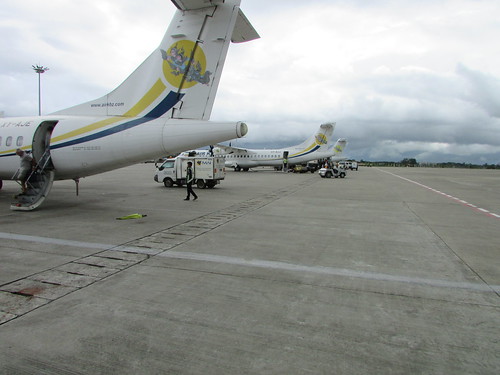
AIR KBZ aircraft lined up at Yangon.
There is now an impressive baggage hall with multiple luggage carousels. Unfortunately, it now seems to take much longer for bags to arrive than in the 'old days' when they'd dump bags just inside the terminal building and let the passengers tussle to extract the right bag. Once re-united with my case, I quickly found the smartly turned out driver with the smartly turned out car who was waiting to take me to my hotel. By two o'clock, I was in my airy, comfortable room at the Belmond Governor's Residence. The combination of the availability of fast internet and my exhaustion from the activities of the previous few days meant that I didn't leave the hotel on Sunday but concentrated on uploading pictures, writing to the blog and catching up on e-mails.
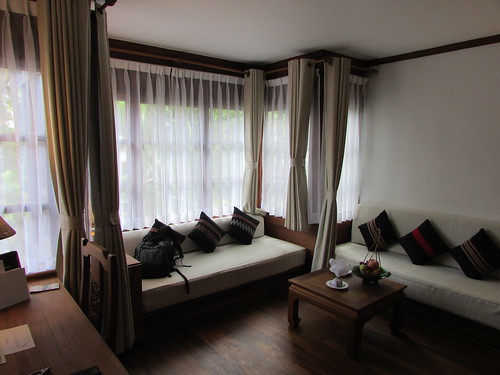
Belmond Governor's Residence, Yangon: Sunday 15-Oct-2017
Related posts on this website
This is one of a series of posts describing my 12th visit to Myanmar. The post Starting out is the first post in the series.
Clicking on the 'Next report' link displays the post describing the next events. In this way, you may read about the trip in sequence.
Next report
Alternately, clicking on the 'All my Burma-2017(2) reports' link displays all the posts on this trip in reverse date-of-posting order.
All my Burma-2017(2) reports.
My photograph albums
Where necessary, clicking on an image above will display an 'uncropped' view or, alternately, pictures may be selected, viewed or downloaded, in various sizes, from the albums listed:-
'Road to Mandalay': October 2017.
Bagan Medical Clinic, Sunday.
Bagan - Yangon by road and air.
The Governor's Residence Hotel, Yangon.
 Click here for a larger view.