skip to main |
skip to sidebar
The East London Line has a fascinating and varied history which I'm afraid I had almost completely overlooked until my firm became involved in supplying replacement Tunnel Telephone equipment for the section of the line which passes through the Thames Tunnel.
The Initial Vision
The rapid growth of London and its docks gave rise to a need for better communication across the Thames but early attempts to construct a tunnel met with difficulties owing to the geology. Marc Brunel (father of the better-known I.K. Brunel), having patented a 'tunnelling shield', obtained finance in 1824 for the ultimately-successful project to build the Thames Tunnel. The project suffered a succession of problems and Marc's 20-year old son Isambard became involved and was awarded a silver medal by the Royal Humane Society in 1828 for his bravery in saving lives during serious floodings of the workings (Royal Humane Society Report). Eventually, in 1843, the tunnel was completed as a twin tunnel with frequent cross-passages between Wapping and Rotherhithe. A plaque erected by London Transport at Wapping Station announces the tunnel's pioneering status:-
The tunnel which runs under the Thames from this station was the first tunnel for public traffic ever to be driven beneath a river.
It was designed by Sir Marc Isambard Brunel 1769-1849 and completed in 1843
His son Isambard Kingdom Brunel 1806-1859 was engineer-in-charge from 1825 to 1828.
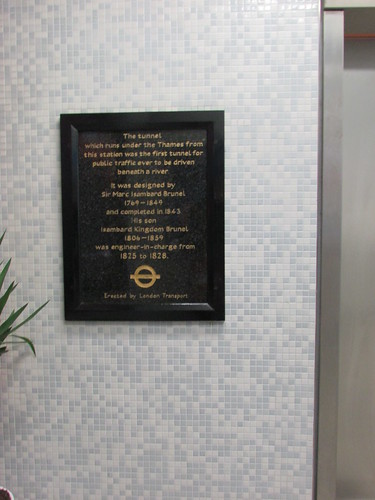
Commemorative plaque in Wapping station.
The cost overruns meant that approach ramps allowing the tunnel to be used by horse drawn carriages as originally intended could not be financed so, by placing stairways in the construction shafts on either side of the river, the tunnel was opened only to pedestrians. It was not a commercial success, despite becoming a major tourist attraction with numerous stalls in the tunnel selling souvenirs.
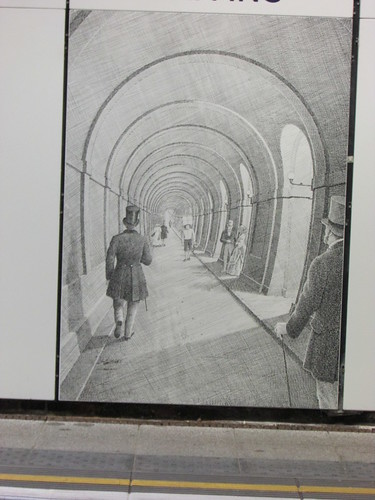
Wapping station: Modern mural showing Thames Tunnel as a pedestrian tunnel.
The building at Rotherhithe which originally housed the pump for the Thames tunnel is now The Brunel Museum Thames Tunnel, with a website here.
Conversion to railway use
Although the Tunnel had not achieved its aim of providing a cross-river link for horse-drawn vehicles, its dimensions allowed it to be adapted for rail traffic and, in 1865, the tunnel was purchased by the East London Railway. This was a joint venture by six railways hoping to profit from better freight and passenger connections across the river:-
Great Eastern Railway
Metropolitan Railway
District Railway
London, Brighton & South Coast Railway
London, Chatham and Dover Railway
South Eastern Railway
(The last three railways ultimately formed part of the Southern Railway and there are brief histories of these lines in two posts 'Origins of the Southern Railway' listed in 'Related posts on this site' below).
With Sir John Hawkshaw as engineer, the tunnel was converted and approaches built allowing its use as a double-track railway which was extended on both side of the Thames with a number of stations and making connections with the participating railways. The work was carried out in stages and completed by 1884.
The Great Eastern terminus at Liverpool Street was the northern extremity of the East London Line passenger service. Rather inconveniently, freight trains to and from the Great Eastern had to reverse at Liverpool Street. Alternately, there was provision for transferring wagons (two at a time) a hoist at Spitalfields. North of the river, stations were provided at Shoreditch, Whitechapel, Shadwell and Wapping. South of Whitechapel station, St. Mary's Curve provided a connection to the route operated jointly by the Metropolitan and Metropolitan District railways.
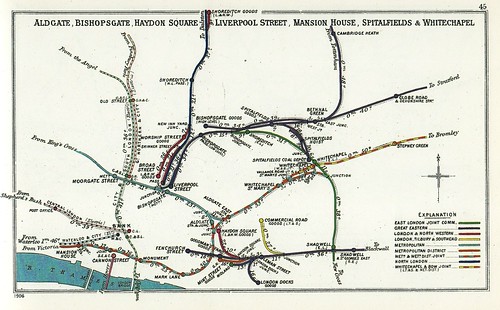
Northern section of East London Railway in 1906 (Railway Clearing House).
Click here for larger view.
South of the river, the line passed through Rotherhithe and Deptford Road stations before dividing into three branches which joined the L.B.S.C.R. South London Line to Victoria, the L.B.S.C.R. Croydon and Brighton Line from London Bridge and the S.E.&C.R. line from London Bridge.
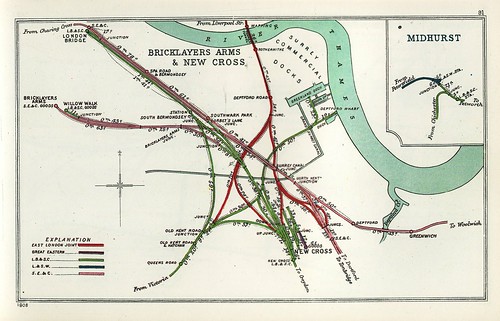
Southern section of East London Railway in 1908 (Railway Clearing House).
Click here for larger view.
The well-known 'Brighton Terriers' were one of the locomotive types commonly used on passenger trains on the East London Line.

A modern mural at Wapping showing a steam-hauled Northbound passenger train arriving at Wapping station.
London Underground
In 1933, the East London Line was taken over by the London Passenger Transport Board and was operated by London Underground. Between Shoreditch and two southern termini at New Cross Gate and New Cross gate the line was electrified using the standard Fourth Rail Electrification arrangements (as outlined in the post here) and Metropolitan Line rolling stock based at a depot at New Cross. When heavy repairs were required, the trainsets travelled to Neasden, accessing the main Metropolitan route using St. Mary's Curve. Freight trains continued to use the line until the 1960s. Apart from a morning and evening 'rush', the East London Line was fairly quiet and it continued as a rather 'forgotten line'.
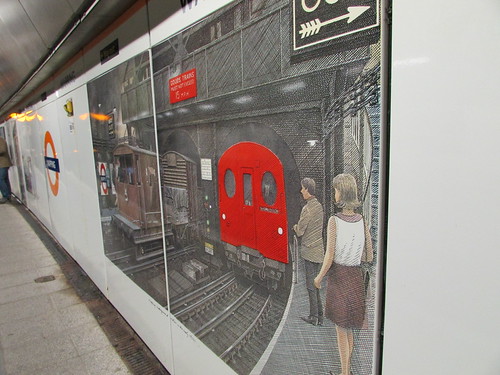
A modern mural at Wapping showing a Northbound electric train arriving at Wapping station, passing a freight train.
Temporary closure in 1995
In 1995 the line was completely closed to allow repairs to the Thames Tunnel itself and the building of an interchange station at Canada Water with the Jubilee Line which was being constructed. The use of 'shotcreting' in the Thames Tunnel proved contentious and a short section was preserved as-built. The repair work included replacement of the elderly Tunnel Telephone system required on the underground sections of the line and my firm supplied the new equipment. In 1998, the East London Line re-opened, continuing the earlier services from Whitechapel (Shoreditch during the 'rush') and either New Cross or New Cross Gate.
London Overground Era
In 2007, the London Overground had taken over operation of a number of mainly North London services including Euston to Watford, Clapham Junction to Willesden, Stratford and Barking. More ambitious plans were accepted to add an extended and modernised East London Line to the London Overground Network. The East London Line closed again in 2007 allowing re-signalling, station upgrades and building of a depot for the new trains at New Cross Gate. The electrification system was converted to third rail 750 volts d.c. and the technical changes necessitated replacement of the Tunnel Telephone equipment on the East London Line which, again, my company supplied.
Rolling Stock
The London Overground is operated by various versions of Class 378, built by Bombardier at Derby. There were originally three variants - 378/0 3-car, 378/1 4-car d.c. and 378/2 4-car a.c./d.c.
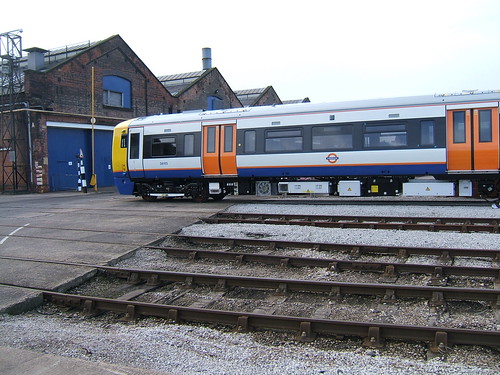
Newly-built Class 378 at Bombardier, Litchurch Lane, Derby in 2009.
East London Line re-opening
The East London Line re-opened in 2010 with modern, full-size trains through the Thames Tunnel from Highbury & Islington in the North to New Cross and, via New Cross Gate and existing Network Rail lines, to West Croydon and Crystal Palace in the south. I travelled on part of the new line in June 2010 and there's a short post here.
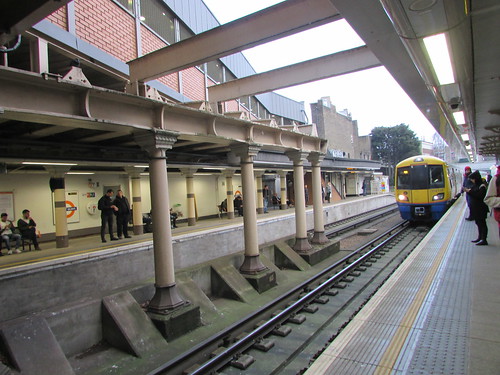
East London Line: Up train entering Surrey Quays station.
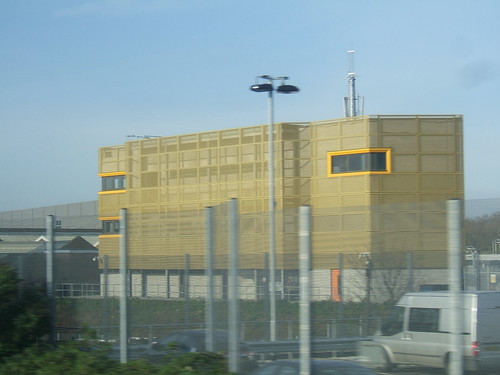
East London Line Service Control Centre ('OBC'), viewed from a London Bridge - East Croydon train.
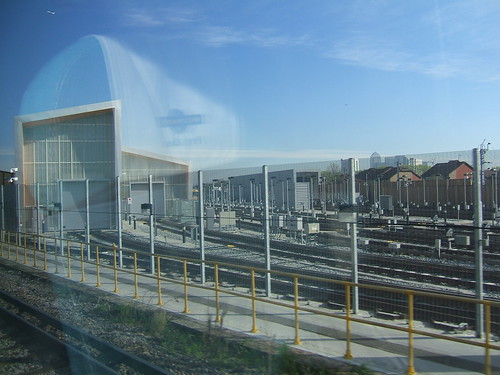
New Cross Gate London Overground Depot, viewed from a London Bridge - East Croydon train.
London Overground Expansion
The new services have proved popular. There are now 57 trainsets - the 378/0 were converted to 378/1 and both 378/1 and 378/2 have been augmented to 5-car sets in an attempt to meet increased demand, necessitating elective door opening at certain East London Line stations with short platforms.
The abandoned connection south of Surrey Quays with the former South London Line has been re-instated (with a grade-separated junction at Silwood Junction, South of Surrey Quays), adding a service via the Thames Tunnel to Clapham Junction. With change of trains, the London Overground now provides a 'ring' service around London.
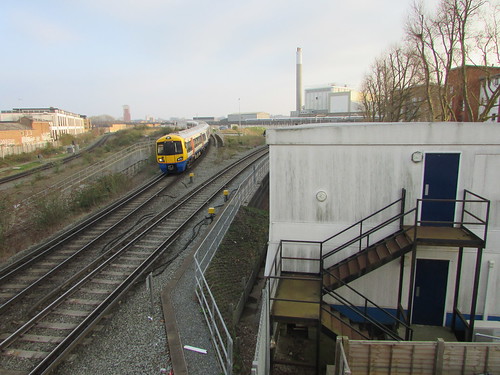
Silwood Junction looking south. Trainset 378 149 on Up passing over the bridge carrying the Down South London. The line converging from the right is the Up South London.
Book References
Track diagrams showing the early stages of the redevelopment of the East London Line as part of the London Overground system are shown in the 2008 publication:-
‘Railway Track Diagrams Book 5: Southern and TfL’ (TRACKmaps: 3rd edition) ISBN 978-0-9549866-4-3.
Related posts on other sites
Thames Tunnel (Wikipedia).
East London Line Extension (Wikipedia).
East London Line (Wikipedia).
British Rail Class 378 (Wikipedia).
Clive's UndergrounD Line Guides: East London Line.
Related posts on this site
East London Line (2010 re-opening).
Origins of the Southern Railway: Part 2: L.B.S.C.R.
Origins of the Southern Railway: Part 3 - S.E.C.R.
Fourth Rail Electrification.
My Pictures
Where necessary, clicking on an image above will display an 'uncropped' view or, alternately, pictures from may be selected, viewed or downloaded, in various sizes, from the album listed:-
London: East London Line.
Railway Clearing House Junction Diagrams.
Introduction
Passenger trains through the Channel Tunnel to and from London were inaugurated in 1994. Although high-speed trainsets were used (the 'Trans Manche Super Train' or 'TMST') running within Britain was initially rather pedestrian, being confined to existing, conventional third-rail electrified lines. I was never tempted to try out this service.
Eventually, in 2003, section 1 of the U.K's first high-speed line ('High Speed 1' or 'HS1') was opened so, having made fairly leisurely progress from Waterloo International to Fawkham Junction, a few miles beyond Swanley, Eurostar trains diverted onto the new high speed line, allowing speeds up to 186 m.p.h. I still didn't make a high-speed trip or travel through the Channel Tunnel.
However, my firm became involved with the 'TMST' trainsets when the British form of an Automatic Train Protection ('ATP') system was introduced. This APT combined the traditional Automatic Warning System ('AWS') with a new Train Protection and Warning System ('TPWS'). I helped with various elements of the design and validation of the equipment installed on the 'TMST' trainsets (by this time known, more prosaically, as 'Class 373') and, in 2005, I had the opportunity to travel on a Class 373 Test Train on the East Coast Main Line to assist with equipment testing. That trip is described here which includes a little more about the background to TPWS in the section 'The Introduction of TPWS'.
Test Train on 17th January 2006
A few months after the Grantham trip, I was able to travel on a Class 373 Test Train from Waterloo International to Paris (Gare du Nord) which travelled from Waterloo International to Fawkham Junction on conventional, third-rail electrified lines before continuing on section 1 of 'High Speed 1' through the Channel Tunnel and on to the Gare du Nord in Paris.
 Waterloo Station from the air, with the long, curving platforms used by the 'Eurostar' trainsets on the left (Photo: Network Rail).
Click on image above for larger view.
Since test trains carried no passengers, they earned no revenue so understandably the operator, Eurostar, only reluctantly scheduled such trips. However, we had learnt that a software update for the traction control was to be tested between London and Paris on an international test train and we 'piggybacked' on this to be able to carry out further testing of the equipment we'd evaluated on the earlier trip to Grantham. We would only be able to conduct full tests between Waterloo and Fawkham Junction - beyond here on High Speed 1, in the Channel Tunnel and on the continent, the TVM cab signalling system would be in use. However, we continued to monitor our equipment in case of any anomalies.
Our equipment was set up in the equipment room just behind the front cab and we were kept pretty busy between Waterloo and Fawkham Junction checking for correct responses from the equipment which were also being saved by a recording multi-channel oscilloscope for subsequent analysis. I noticed that the cab itself was fairly full on the way from Waterloo to High Speed 1 with traction control engineers but, as we approached the Channel Tunnel, they all went back to the leading passenger coach where their test equipment was set up.
So I was able to join the friendly English driver throughout our undersea journey and a fair distance towards Paris. He apologised that he couldn't quite travel at 186 m.p.h. because one of the traction control blocks had 'tripped', reducing the top speed, but I think we were still doing around 160 - 170 m.p.h. I was surprised at what little sensation of high speed there was as we dashed through the French countryside. In high speed trains, the driving position is intentionally on the centre line of the train and the front window is surprisingly narrow, to minimise the distracting 'flicker' produced by passing Overhead Line structures and, in the tunnel itself, the frequent tunnel lighting luminaires. I'm afraid I didn't manage any photographs on the way to Paris.
In Paris, I didn't even alight from the train. We only stood for a few minutes whilst the traction engineers checked their test equipment and reset the tripped traction control block, allowing us to return at 186 m.p.h. (300 k.p.h.) where authorised. On the way back, we were in the 'back cab', which we had to ourselves. On the way back, I did manage a few pictures which are in the album Channel Tunnel and High Speed One.
Once clear of the suburbs of Paris, the line is remarkably straight across the plains of northern France and we were running at full speed.
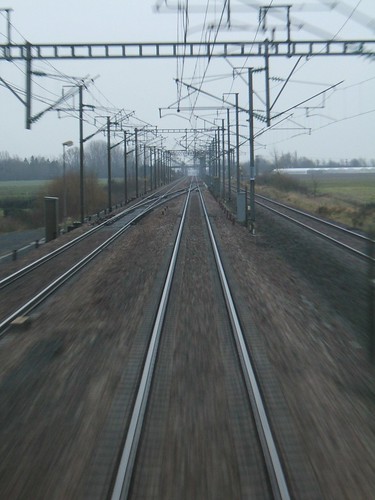
On the French High Speed Line from Paris to the Channel Tunnel.
Sooner then I anticipated, we were plunged into the Channel Tunnel (the only trouble with being in the 'back cab' is you can see where you've been, but not where you are going). I couldn't resist a picture of me 'in the chair' in the blackness of the Tunnel.
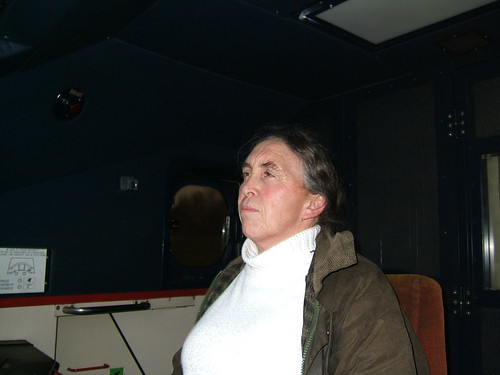
Jan in the 'Back Cab' as we speed through the Channel Tunnel returning to Waterloo.
My attempt at a "driver's view" wasn't very successful, but you can just make out tunnel lighting which is always illuminated.
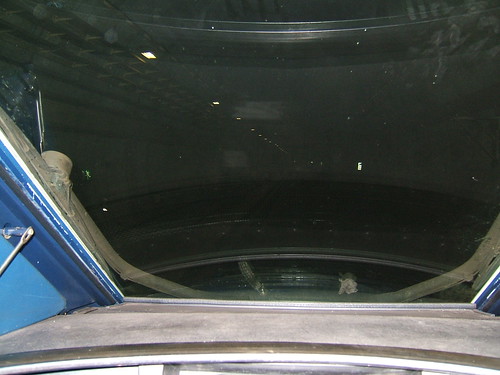
View from the 'Back Cab' passing through the Tunnel on our return to the U.K.
After 22 miles of blackness, we popped into daylight again, passing several high-speed turnouts which divert the car shuttle trains onto the their reversing loop and unloading/loading station. Tall fences flanked the high-speed line.
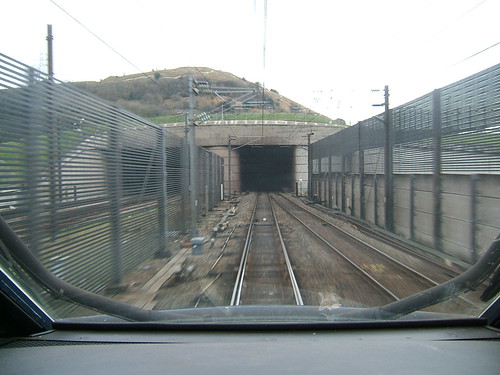
View from the 'Back Cab' emerging into the daylight in the U.K.
We were now travelling on the first section of High Speed 1 (at this date, the final section to St. Pancras International was still under construction). We by-passed Ashford International station (shared with conventional trains) by taking the concrete viaduct, allowing us to maintain our impressive speed.
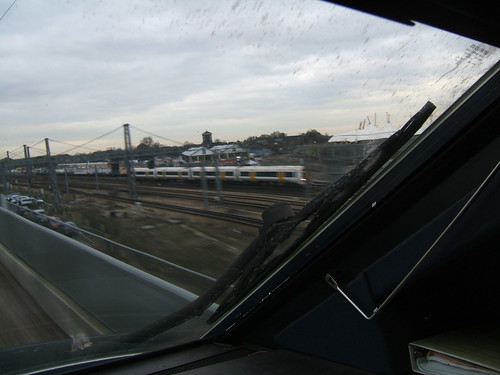
View from the 'Back Cab' as we passed Ashford on High Speed One.
At Southfleet Junction, we left the continuation of HS1 to London, still under construction, on a high-speed turnout provided with a 'swing-nose' crossing. Having decelerated, we joined the conventional third-rail electrified network at Fawkham Junction, continuing to Waterloo at a very sober pace.
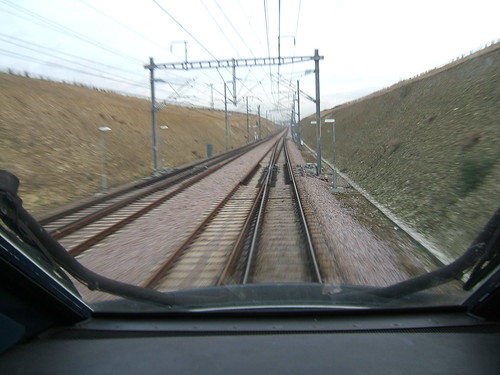
Class 373 to Waterloo: Southfleet Junction, where we left the continuation of HS1 to London.
It was dusk as we approached London Waterloo and passed a Down 'Eurostar' service.
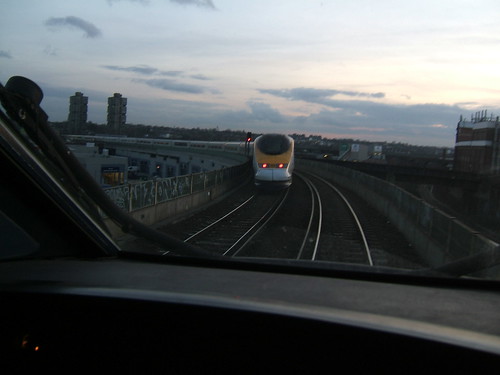
View from 'Back Cab' approaching Waterloo, having just passed a Down 'Eurostar' train.
Our train, with just a handful of engineers aboard, pulled into platform 24, next to an already well-loaded International service awaiting departure from platform 23. I'd had a fascinating trip.
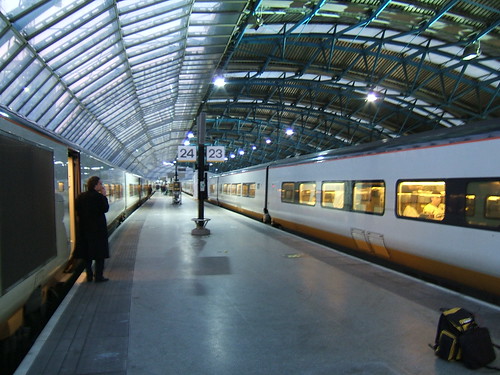
Our arrival at Waterloo International
Completion of the U.K. High Speed Route
Finally, in 2007, the complete 'HS1' was brought into use, terminating at St. Pancras International as the new London terminus and with the servicing of the high speed trainsets moved to a new depot at Temple Mills. Although I'd briefly looked at the St. Pancras terminal in 2008 (there's a post here), I still haven't made a trip on the new route to Paris, but I have been as far as Ebbsfleet International on a Class 395 trainset, as described in the post Channel Tunnel Rail Link.
References
Track diagrams showing Waterloo to Fawkham Junction, section 1 of High Speed 1 and the Channel Tunnel are shown in publication:-
‘Railway Track Diagrams Book 5: Southern and TfL’ (TRACKmaps: 3rd edition) ISBN 978-0-9549866-4-3. Note that this edition also shows section 2 of High Speed 1 to London St. Pancras International but, at the time of the journey described above, section 2 was still under construction.
Related posts on other sites
TRAIN PROTECTION IN THE UK. (The Railway Technical Web).
High Speed 1 (Wikipedia).
Transmission Voie-Machine (Wikipedia).
British Rail Class 373.
Related posts on this site
Class 373 Test Train to Grantham.
Channel Tunnel Rail Link.
Books
The following is an informal list of books I've read about the Channel Tunnel and the 'Eurostar' trainsets.
[1] ‘From the Footplate: EUROSTAR’ by Peter Waller (Ian Allen 1998) ISBN 0 7110 2427 8.
[2] ‘EUROTUNNEL: The Illustrated Journey’ by Jeremy Wilson & Jerome Spick (Harper Collins 1994) ISBN 0-00-255539-5.
[3] ‘Channel Tunnel: Engineering Triumph of the Century’ by P.W.B. Semmens (Railway Magazine Special Publication 1994).
[4] ‘Eurostar’ by Simon Pielow (Ian Allen 1997) ISBN 0 7110 2451 0.
My Pictures
Where necessary, clicking on an image above will display an 'uncropped' view or, alternately, pictures from may be selected, viewed or downloaded, in various sizes, from the albums listed:-
Channel Tunnel and High Speed One.
Introduction
It always seemed daft to me that the U.K. were involved in the Channel Tunnel Project (completed 1993), built a posh new London terminus at Waterloo International (opened 1994), acquired a fleet of French-designed high speed trains capable of speeds of 186 m.p.h. called TMST (Trans-Manche Super Train) and then ran these new trains for years on ancient third-rail electrified lines already congested with traffic. The complex new trains operated by Eurostar were introduced in 1993 and classified Class 373 in the UK. They could operate from 750v d.c. third-rail in England or from a number of overhead a.c. voltages. Various control systems were fitted including signalling systems TVM and KVB for use in the Channel Tunnel and in Continental Europe but only AWS was initially required to run on conventional lines in the U.K.
Class 373
The fleet of Class 373 was initially split into two types - 'Three Capitals' (to handle London-Paris and London-Brussels services) and 'North of London' (to deal with proposed feeder services within the U.K.). Trial running North of London was not encouraging - the existing electrified routes had difficulties supplying the new power-hungry trains and interference with signalling systems was problematic. As a stop-gap, conventional feeder trains, not available to ordinary passengers, were run to Waterloo to connect with services through the Channel Tunnel. I once managed to 'hitch' a ride from Wolverhampton to Birmingham on one of these restricted services from Manchester when the normal service was disrupted and I knew the Train Guard. This was a locomotive-hauled train with the coaches retro-fitted with central door locking. Load factors were disappointing on these feeder services, which were soon discontinued.
The enterprising GNER franchise leased some of the spare 'North of London' sets and, following the technical approval phase, managed to operate a service between King's Cross and, I think, York. At least some of the GNER sets were re-painted in dark blue, which suited them very well.
Raising speed from the Channel Tunnel to London
The Channel Tunnel Rail Link, also called 'High Speed 1' as the U.K's first high-speed line linking the Channel Tunnel to London, was built in two sections. The first section, opened in 2003, allowed high speed running at up to 186 m.p.h. between the Channel Tunnel and the Southfleet Junction (a little south of Gravesend) using the TVM signalling system. After an interchange section to Fawkham Junction (on the existing Swanley to Rochester lone) Eurostar trains then continued to Waterloo International station in London on third-rail d.c. electrified lines. In 2007 the second section of 'High Speed 1' was completed from Southfleet Junction to St. Pancras International, allowing maximum speeds of 140 m.p.h. The existing St. Pancras station required complete re-furbishment and a new station was built at the north end of the site to handle domestic trains and the extreme length of the International trains. Waterloo International became redundant after less than 14 years use. Although Waterloo International is slowly finding new uses, its design is not well-suited to handling domestic services. Incongruously, for a time a dramatisation of 'The Railway Children' was successfully staged in the International Platforms. In addition, the purpose-built North Pole International Depot which had serviced the Class 373 since their introduction had a rather short initial working life. It was not conveniently situated for providing trains to the new terminus at St. Pancras International so a new maintenance depot at Temple Mills replaced the original one at North Pole.
The Introduction of TPWS
Accidents such as Southall and Ladbroke Grove had focused attention on the limitations of the Automatic Warning System (AWS) used in Britain. It was not (nor intended to be) an Automatic Train Protection (ATP) system, since it could be over-ridden by the driver. Various schemes were afoot in Europe but, in an attempt to plot a course that was both affordable and achievable in a reasonable time-frame, the Joint Enquiry into Train Protection Schemes (available here concluded that a plan to supplement AWS with a Train Protection and Warning System (TPWS) should be implemented. All locomotives and multiple units, including Class 373, had to be fitted with TPWS in addition to AWS. There's an RSSB publication about these systems here.
Test Train on 6th October 2005
When I was writing about a trip on the Channel Tunnel Rail Link in early 2017 (Channel Tunnel Rail Link), I was reminded of an earlier trip on a Class 373 Test Train in 2005 which I have described below. The following is very much an historical account: since I became involved in the design and validation of some of the new equipment for Class 373 in 2005, so much has changed. I had one opportunity to travel on a special Class 373 Test Train from North Pole to King's Cross then to Grantham and return when I assisted with the tests being carried out. Arriving by road with our test equipment at North Pole, we found depot security quite tight but eventually lugged our gear onto the waiting train. Leaving North Pole International Depot we had to take an intriguing route across North London to King's Cross before we could start the proper test run to Grantham. We were using a recording multi-channel oscilloscope to collect data about the response of various sensors at different speeds.
North Pole International Depot to King's Cross
The Depot had four Reception Sidings (actually bi-directional) diverging from the Down West London Line and one Departure line (also bi-directional) which passed under the West London Line and trailed into the Up West London Line at North Pole Junction. Whilst these connections were convenient for getting to and from Waterloo, our train needed to head in the opposite direction to get to the East Coast Main Line. Having driven the train out of the Depot and south of North Pole Junction, the driver had to change ends before continuing. Whilst we made our way to King's Cross, I was involved in helping to set up and check the test equipment located just behind the 'active cab', so I couldn't pay much attention to our interesting route on the way out. We crossed over the Great Western Main Line before turning left at Mitre Bridge Junction, crossed over the West Coast Main Line at Willesden Junction High Level, crossed over the Midland Main Line at West Hampstead, turned right at Gospel Oak to join the North London Line at Camden Road. Here, we took the single North London Incline and joined the Down Slow of the East Coast Main Line, continuing to Finsbury Park where the driver had to change ends again. We set off and crossed to the Up Slow for the short journey to King's Cross. Now the equipment was set up and we were in the 'back cab', I was able to take a few pictures of the rain-swept railway.
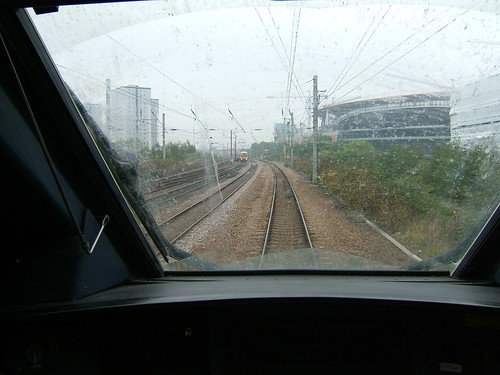
View from back cab of 373 passing Holloway Jns. on Up Slow en-route to King's Cross. Emirates Stadium on right.
At Holloway Junctions, we were switched to the Up Fast and then the Up Slow passed over us on a flyover, just north of Copenhagen Tunnels. This arrangement transposes the four running lines from Up Slow, Up Fast, Down Fast, Down Slow to Up Fast, Down Fast, Up Slow, Down Slow. This gets the stopping trains using the Slow Lines onto the west side of King's Cross, handy for Suburban platforms 9, 10 and 11. There were formerly three double-track bores forming the Copenhagen Tunnels but the East Bore is now disused. South of Copenhagen Tunnels, all four running lines become reversible and we were switched to the adjacent line which forms the Down Fast further north but is designated 'Number 1 Fast' here. I spotted the North London Incline we'd used earlier to access the East Coast Main Line before we were plunged into the 528 yard Gasworks Tunnels which were also formerly three double-track bores before the East Bore was abandoned.
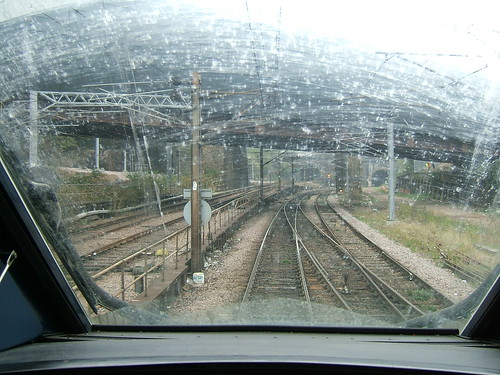
View from back cab of 373 on No. 1 Fast, Copenhagen Tunnels in background, North London Incline on left, CTRL viaduct above: East Coast Main Line.
We stopped in platform 6 and, of course, the driver changed ends once again. Before we set off, I managed to take the picture below from the leading cab before concentrating on the testing we carried out as the train sped northwards to Grantham.
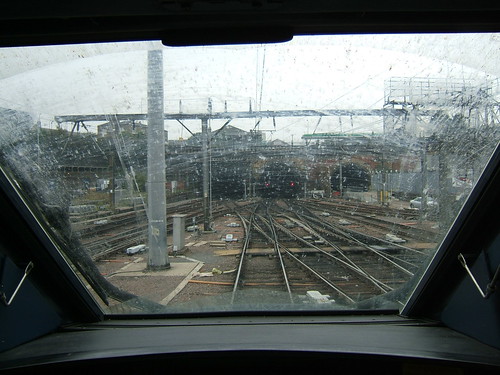
King's Cross on a rainy morning: View from now-leading cab prior to departure from platform 6 to Grantham, showing South Portals of Gasworks Tunnels.
King's Cross to Grantham
I was kept pretty busy monitoring the testing on the Down journey to Grantham. I'm not sure of the Line Speed Limit at the time, but we were batting along and passing signals frequently so there are no photographs recording the trip. We had a slight problem with the test gear at one point but, other than that, we collected plenty of useful data to be analysed later. It was still raining when we stopped at Grantham.
Grantham back to London
As soon as the driver had changed ends, we set off back to London, crossing to the Up Line on the crossover south of Grantham station. We were not carrying out active tests this time, as we were now at the rear of the train, so I was able to take a few pictures as we hurtled south.
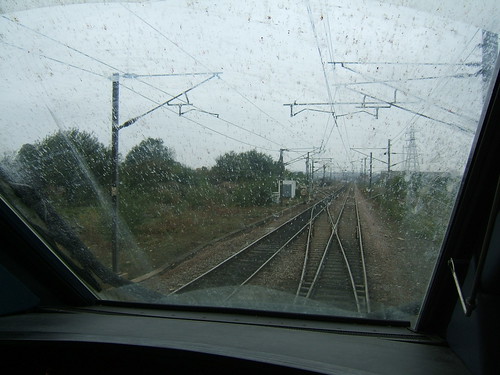
View from back cab of 373 passing Grantham South Junction as we cross to the Up Main for our journey back to London on the East Coast Main Line.
After the 880 yard Stoke Tunnel, the route became 4-track 'paired by direction' and we passed the site of "Mallard's" record breaking run.

Jan in the 'Back Cab' near Essendine on the return journey.
We reeled off another twenty miles at speed to reach Spital Junction, Peterborough.
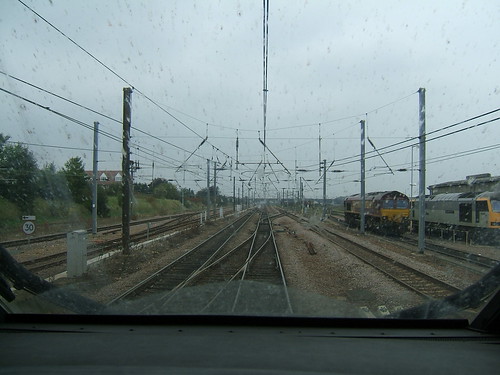
View from back cab of 373 at Spital Junction, Peterborough, with Peterborough North Depot on the right, on the way back to King's Cross: East Coast Main Line.
We took the Up Fast through Peterborough station and passed under the distinctive girder arch bridge which takes Thorpe Road over the railway.
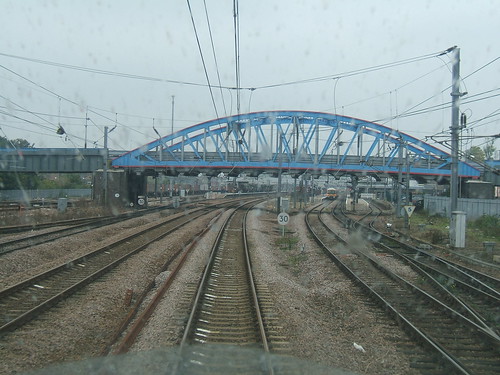
View from back cab of 373 south of Peterborough station on the way back to King's Cross: East Coast Main Line.
South of Hitchin, I was on slightly more familiar ground as, back in 1974, my firm had installed an Electrification Telephone system for British Rail between Hitchin and King's Cross. This is briefly mentioned in the post Electrification Telephone Systems for British Rail. Just north of Wood Green (the station is now called 'Alexandra Palace') we passed the flyover junction leading to the Hertford Loop.

View from back cab of 373 approaching Wood Green on Up Fast, passing an EMU on the Up Slow. The Enfield Viaduct carrying the Down Hertford is in the background and the Up Hertford is on the right: East Coast Main Line
We were routed onto the Up Slow at Finsbury Park, continuing on the Up Slow Flyover into the West Bore of Copenhagen Tunnels. At lowered speed, we took the crossover to the Down Slow and, emerging from Copenhagen Tunnel, diverged onto the North London Incline.

View from back cab of 373 on the North London Incline with the South Portals of Copenhagen Tunnels in the background as we returned to North Pole International Depot .
I noticed that construction work in connection with the various new connections to St. Pancras International was well advanced.
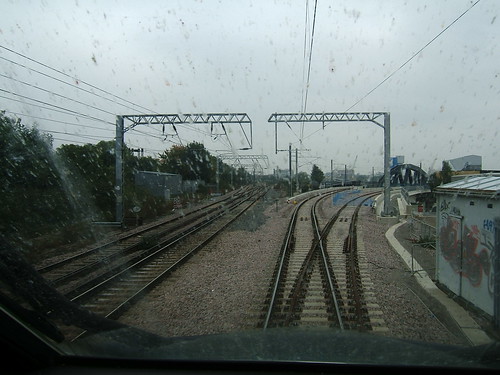
View from back cab of 373 on the North London Incline at Camden Road Incline Junction with new connection to Cedar Junction on the right as we returned to North Pole International Depot. The North London Line is on the left, with both third rail and overhead electrification. Camden Road East Junction is in the left background.
Our Test Train joined the North London Line at Camden Road Central Junction, and passed through the station where passengers were waiting for an expected Eastbound train at modest speed. After passing Camden Road signal box (since abolished) we diverged onto the branch to Gospel Oak.
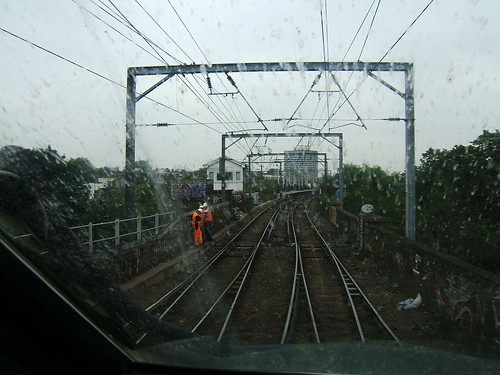
View from back cab of 373 passing Camden Road onto the Gospel Oak Branch as we returned to North Pole International Depot. This section of the North London Line has both third rail and overhead electrification.
We passed through Gospel Oak and continued fairly slowly to Kensal Green High Level Line Junction where we were routed onto the middle one of the three diverging routes.
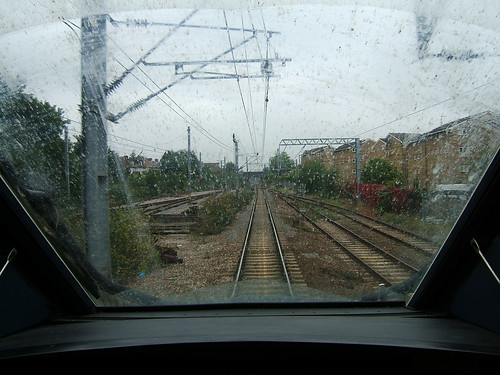
View from back cab of 373 passing Kensal Green High Level Line Junction on Down Line as we returned to North Pole International Depot.
Our route took us through Willesden Junction High Level station and the bridges over the West Coast Main Line. At Willesden High Level Junction signal box (since abolished) we took the sharply-curved Down High Level Line to Mitre Bridge Junction where we joined the Up West London Line, coming to a stand south of North Pole Junction.
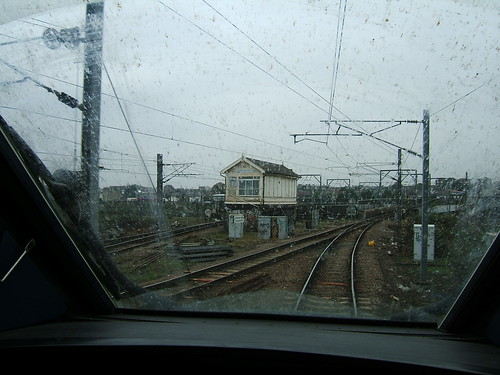
View from back cab of 373 passing Willesden High Level Junction and taking the sharply-curved Down High Level Line to Mitre Bridge Junction as we returned to North Pole International Depot.
After the driver changed ends for the final time, we made our way into the Depot, using the reversible Departure Line. We unloaded our test equipment and left the Class 373 after a productive and fascinating trip.

View of the Class 373 on arrival back at North Pole Depot.
References
Track diagrams showing North Pole International Depot and the route through Willesden Junction High Level are shown in publication:-
‘Railway Track Diagrams Book 5: Southern and TfL’ (TRACKmaps: 3rd edition) ISBN 978-0-9549866-4-3.
Track diagrams showing the route from North Pole International Depot to King's Cross and from King's Cross to Grantham are shown in publication:-
‘Railway Track Diagrams Book 2: Eastern’ (TRACKmaps: 3rd edition) ISBN 0-9549866-2-8.
The above issues show the route substantially as it was at the time of my journey: later issues will, of course, reflect subsequent changes.
Related sites
TRAIN PROTECTION IN THE UK. (The Railway Technical Web).
Related posts on this site
Channel Tunnel Rail Link
My Pictures
Where necessary, clicking on an image above will display an 'uncropped' view or, alternately, pictures from may be selected, viewed or downloaded, in various sizes, from the albums listed:-
Class 373: Test Train to Grantham.
[Extent of first section of 'High Speed 1' corrected: 12-Mar-2017]
On Friday, 17th February 2017 I arrived at London Euston with a few hours to spare before an invitation to Afternoon Tea. I intended to take a short trip on the Channel Tunnel Rail Link (CTRL) first and decided I'd time to travel from St. Pancras International to Ebbsfleet International and back, so I walked east along Euston Road from Euston to St. Pancras International.
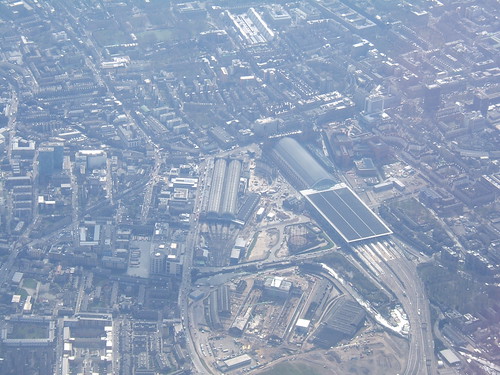
London: Aerial view looking south in 2009 showing King's Cross (left) and St. Pancras International (right).
St. Pancras International
The Grade 1 listed station hotel in Gothic Revival style fronting Euston Road was designed by George Gilbert Scott (see Wikipedia article here) and has been handsomely restored. I'm glad it's been saved but even I find its exuberant style a bit florid.

London: St. Pancras International: restored frontage to Euston Road.
I passed through the entrance onto the station concourse beneath the magnificent arched roof designed by William Henry Barlow (see Wikipedia article here). This has also been restored and I commented approvingly in a 2008 post here. The concourse area was eerily quiet on my visit, as were the international platforms, segregated behind their glass walls.
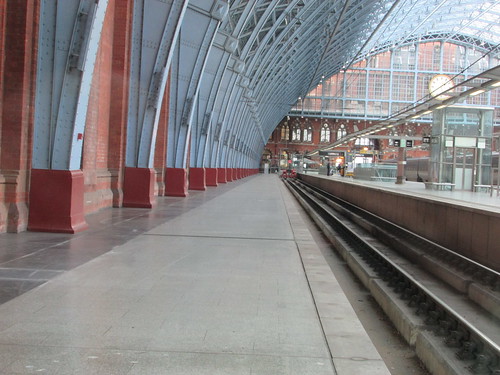
St. Pancras International: View of Barlow's trainshed looking south, with International Platform 10 on the right.
But looking down to the undercroft below, I could see plenty of activity. The need for the Midland Railway approaching St. Pancras to cross over the Regent's Canal just north of the station required the platforms to be elevated above the level of Euston Road. Barlow turned this necessity into a virtue by building the undercroft to store the major shipments of beer from Burton-on-Trent required to slake the Capital's thirst! Now, the undercroft presents shopping and eating opportunities to the traveller. The modified undercroft and the new-build concourse at ground level just north of the original train shed were much busier. This concourse has ticketing and check-in for international services on the south side, domestic ticketing on the north side and exits to the adjacent King's Cross Station of the east side.
I successfully purchased a return to Ebbsfleet International from an automatic machine and took the escalator to platform level to catch the 11:12 Southeastern High-speed domestic service, operated by a Class 395 'Javelin' Electric Multiple Unit (EMU). The Class 395 can run at up to 140 m.p.h. on High Speed 1. Back in 2007 I was involved in design and testing for some of the on-board signalling equipment for this design. There's a short post about the design here and a post about site testing here.
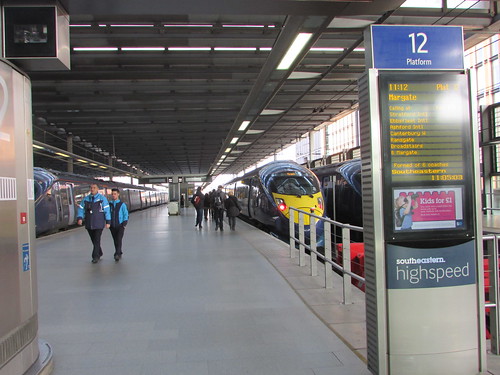
London: St. Pancras International: High-Speed Domestic Platforms.
High Speed 1
High Speed 1, linking the Channel Tunnel (opened 1993) to London, was built in two stages. The first stage, opened in 2003, allowed high speed running at up to 186 m.p.h. between the Channel Tunnel and the vicinity of Ashford International; Eurostar trains then continued to Waterloo International station in London on existing, third-rail d.c. electrified lines. In 2007 the northern section was completed to Stratford and St. Pancras, providing maximum speeds of 140 m.p.h., and a new maintenance depot at Temple Mills replaced the original one at North Pole. The Wikipedia article here briefly outlines the 'alarums and excursions' involved during the completion of this very expensive project.
My Class 395 departed on time with the train reasonably full. Leaving St. Pancras, colour light signals are provided and the KVB control system. 'KVB' stands for 'Contrôle Vitesse par Balise' ('Speed Control by Beacon') since the system is of French origin. The track layout is quite interesting. CTRL curves to the right, but throws off three connections on the left: a maintenance siding which connects with the Midland Mainline, the single line Silo Curve which joins the North London Line at Camden Road (allowing running onto the West Coast Main Line) and the single line ECML Connection. There's also a North London Line CTRL Connection from York Way South Junction to join Silo Curve at Cedar Junction. The picture below was taken from a CTRL train arriving at St. Pancras International.
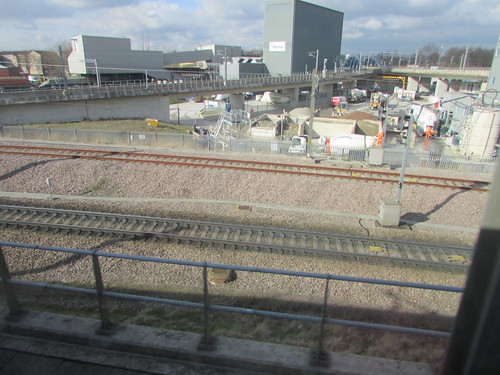
Approaching St. Pancras International on Up CTRL (on viaduct)). Down CTRL in foreground, ECML Connection behind. Silo Curve left rear and North London Line CTRL connection right rear converge at Cedar Junction in the distance.
The ECML Connection (currently not in regular use) joins the much older North London Incline at York Way North Junction, then joining the Down Slow of the East Coast Main Line just south of the Copenhagen Tunnels. Leaving St. Pancras International, I just managed to picture the East Coast Main Line and Copenhagen Tunnels before the double-track CTRL crossed the East Coast Main Line on a covered bridge.
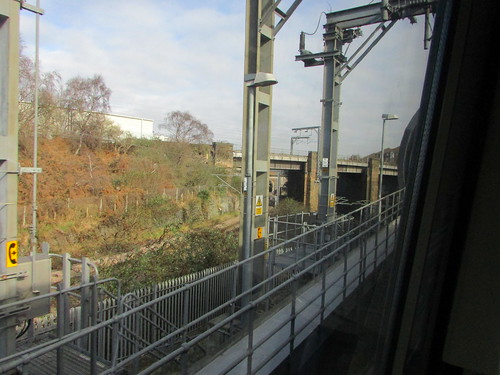
London: Leaving St. Pancras International on CTRL, North London Incline and ECML Connection on left, high level bridges of North London Lines crossing the East Coast Main Line on right with south portals of Copenhagen Tunnels in the distance. The portal of the covered bridge on HS1 is just visible on the right.
We entered the twin tunnels called London Tunnel 1, each around 7.5 km long. In-cab signalling using the TVM-430 system is in use. This system is also French and 'TVM' stands for 'Transmission Voie-Machine' ('Track to Train Transmission). There's a useful article on Wikipedia here. Left-hand running is normally adopted but the signalling is arranged to allow bi-directional running when required.
At Stratford International, the London 1 tunnels emerge into a long concrete station box, open to the sky but not very attractive. There's plenty of pointwork and a single line grade-separated connection allows empty stock to get to and from the depot at Temple Mills. From north to south, the six lines of High Speed 1 are Down International, Down CTRL, Down RDO, Up RDO, Up CTRL, Up International. My train paused at the single island platform used by Southeastern trains. The Down CTRL and Up CTRL are through lines used by Eurostar services whilst the Down International and Up International loops are flanked by platforms although these are currently unused.
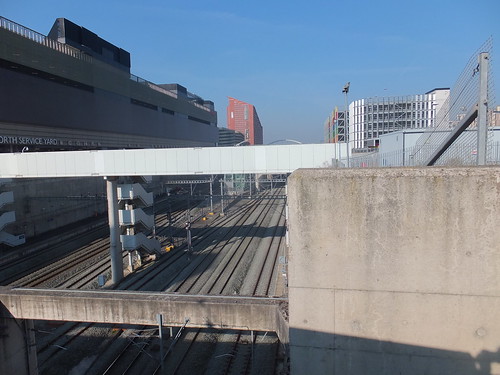
High Speed One: East end of Stratford International. Looking west towards St. Pancras from Montifichet Road with the Westfield Stratford City on left.
My train continued through the twin tunnels called London Tunnel 2, each just over 10 km long, emerging at Dagenham Docks Junctions, where connections allow freight trains from the Channel Tunnel to reach Ripple Lane Railhead. The Tibury branch of the line from Fenchurch Street ran parallel past Rainham to our north, then we crossed over that line near Purfleet, with views of the River Thames and the disused Littlebrook Power Station on the south bank. After brief views of the Queen Elizabeth II Bridge which (together with a twin-tube tunnel) carries the M25 motorway across the river, we made our own river crossing by the twin tubes of the Thames Tunnel which, including covered ways extending beyond the tunnel portals, are a little over 3 km long.

View from High Speed 1, looking across the River Thames, with the Queen Elizabeth II Bridge on the left.
Ebbsfleet International
Emerging from the Thames Tunnel, we were already slowing for Ebbsfleet International. Like Stratford International, there are six lines through the main station, but arranged in a different order. From east to west they are Down CTRL, Down International (with platform), Down Domestic LL and Up Domestic LL (both served by an island platform), Up International (with platform) and Up CTRL. The Domestic Platforms are identified as 'LL' for Low Level as there is a further island platform for Domestic High Speed trains continuing on the (conventional) North Kent Line. High speed domestic services from St. Pancras International for the North Kent Line diverge via a grade-separated junction just after the Thames Tunnel and, after stopping at the High Level platform, join the North Kent Line from Dartford at Springhead Junction, another flyover junction.
I left the train which continued to Margate and set about a brief survey. The station is surrounded by grassland with several large car parks. There were taxis and people waiting for a bus. Swanscombe lies to the West with Dartford further afield. Northfleet lies to the east with Gravesend a little more remote.
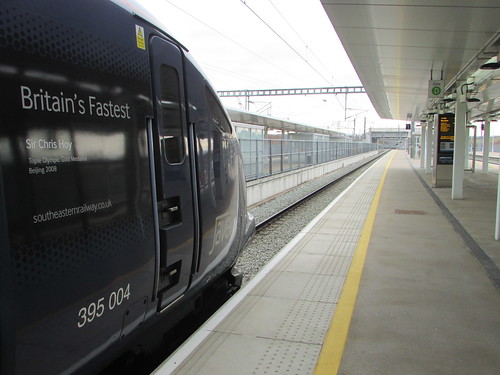
High Speed 1: Ebbsfleet International. Looking towards the coast as the train I arrived on leaves, viewed from Down Domestic Platform with the Down International Platform on the left.
The station really is 'International' (unlike Stratford) and two continental departures were on the information display near the Eurostar Check-In.

High Speed 1: Ebbsfleet International, Passenger Information Display at 'Eurostar' Check-In.
I then travelled back to St. Pancras International on another Class 395, after an informative few hours learning about CTRL and I made my way to a very enjoyable Afternoon Tea.
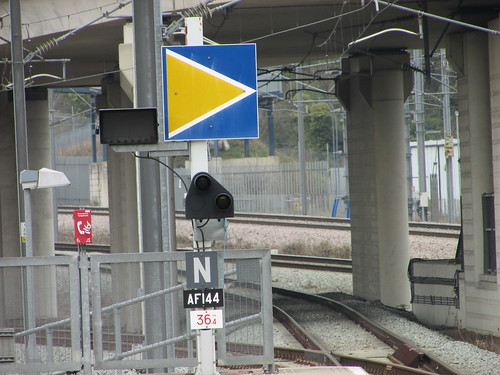
High Speed 1: Ebbsfleet International. Looking towards St. Pancras from Down Domestic Platform with the TVM Block Marker and subsidiary signal AF144.
Books
Track diagrams of the Channel Tunnel Rail Link are in the following publication (or later issue):-
‘Railway Track Diagrams Book 5: Southern and TfL’ (TRACKmaps: 3rd edition) ISBN 978-0-9549866-4-3
Related sites
St Pancras railway station (Wikipedia).
High Speed 1 (Wikipedia).
Transmission Voie-Machine (Wikipedia).
HS1 Ltd (The operating company).
St. Pancras International.
Stratford International.
Ebbsfleet International.
Ashford International.
Related posts on this site
Class 373 Test Train to Grantham.
London's Terminal Stations (discusses St. Pancras).
Crewe International Electric Maintenance Depot.
Class 395 Trainsets.
Testing Class 395 Trainsets.
My Pictures
Where necessary, clicking on an image above will display an 'uncropped' view or, alternately, pictures from may be selected, viewed or downloaded, in various sizes, from the albums listed:-
London: St. Pancras Station.
High Speed 1.
Class 395: Testing.
Channel Tunnel and High Speed One.
London, England.
Arriving in London on Friday, 27th January 2017 with a few hours before a business meeting, I decided to repeat a trip I made on on 8th September 2014 (described here) when I'd taken a short trip on the former Great Eastern Railway from Liverpool Street to Stratford (the one in East London, not the one associated with William Shakespeare).
I arrived by Virgin 'Pendolino' at Euston and walked along Euston Road to Euston Square station where I caught a train five stops on the historic Circle Line to Liverpool Street.
Liverpool Street - Stratford
I didn't pause to admire the restored parts of the Great Eastern Railway terminus around the main line concourse but made my way to the subterranean platforms to catch a Stratford train.
I was surprised to find that the service between Liverpool Street and Shenfield had, since May 2015, been operated for TfL Rail by MTR Corporation (Crossrail) Limited (who, following the previously-noted fear of capital letters which is becoming endemic, usually call themselves 'mtr crossrail'). When the massive Crossrail Project is complete, MTR will also operate the new or upgraded route from Reading and Heathrow in the west to Shenfield and Abbey Wood in the east, under the branding 'Elizabeth Line'. The line will be operated by new, 9-coach Class 345 'Aventra' trains being built by Bombardier in Derby.
At the time of my visit, Class 315 EMU were operating the service from Liverpool Street, terminating at Brentwood, presumably whilst upgrading was taking place on the rest of the line to Shenfield.
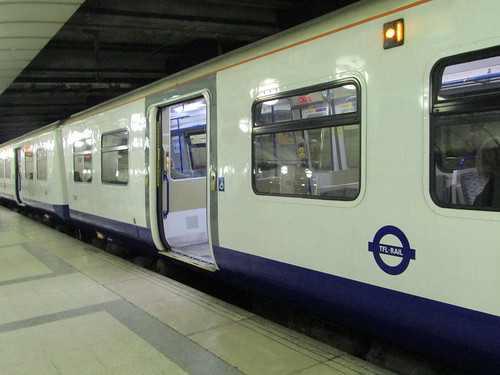
Class 315, in TfL Rail livery, in platform 17 at Liverpool Street.
We departed on time and effortlessly climbed the bank to Bethnal Green, where the branches to north London diverge, and continued to Stratford, passing the once-notorious former Bryant & May match factory, which is now apartments in the 'Bow Quarter', with a website here. I say 'once-notorious' as this was the location for the "Match Girls' Strike" of 1888 which led to the creation of the first womens' trade union.
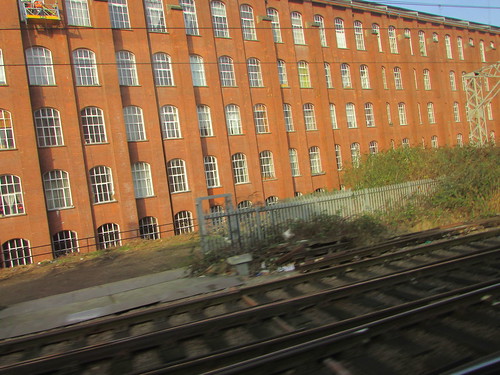
The former Bryant & May match factory, now apartments in the 'Bow Quarter'.
After passing the Queen Elizabeth Olympic Park (with its dreadful ArcelorMittal Orbit tower - more on their website here), we slowed for the station stop at Stratford, where I left the train.

Queen Elizabeth Olympic Park, home to West Ham United Football Club and the ArcelorMittal Orbit.
Docklands Light Railway
I had not kept up with the pace of developments on the Docklands Light Railway (DLR). There's an informative history of the network, including proposals for still further extension, in Wikipedia here and the present route map is here.
The system originally opened, in 1987, with a just a city terminus rather inconveniently located at Tower Gateway extending via Canary Wharf to a terminus at Island Gardens, north of the river. At Poplar, just north of Canary Wharf, a triangular junction connected to a branch to Stratford. The original Operating and Maintenance Centre (OMC) was at Poplar. In 1991, construction of the tunnel section to Bank gave much better interchange with the tube system and, since then, the system has been significantly extended and upgraded.
I decided to travel from Stratford to Greenwich, using the DLR. Originally, the interchange at Stratford was just a short bay platform 'cut into' the existing island platform serving the Up Electric and Westbound Central Line. Currently, DLR has its own 2-platform terminus on the original branch from Poplar, plus two more platforms on the former British Rail Stratford Low Level line now incorporated into the DLR route from Stratford International to Canning Town and from there to Beckton or Woolwich Arsenal.
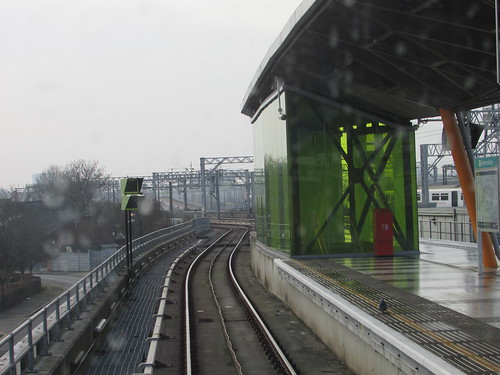
View from front of DLR train leaving Stratford platform 4A.
The line singles leaving Stratford, squeezed into a narrow margin on the south side of the former Great Eastern main lines. Next, the line doubles and slews to the left through Pudding Mill Lane station before turning right, reverting to the original alignment of a single line next to the main lines. Apparently, this (fairly recent) alteration was to accommodate Crossrail works in the vicinity of the original station - Pudding Mill Lane now has quite a grand new station.
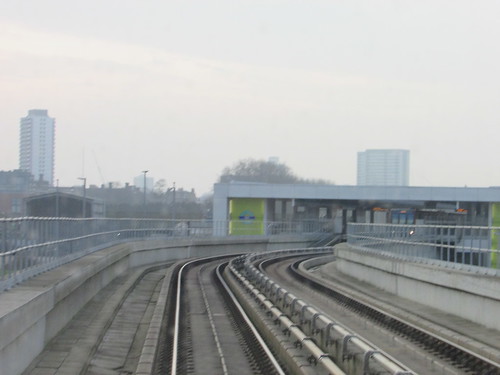
The single line doubles through the new Pudding Mill Lane station.
After continuing parallel to the Liverpool Street lines past the former Bryant & May factory, the line turns south and becomes double track before Bow Church station.
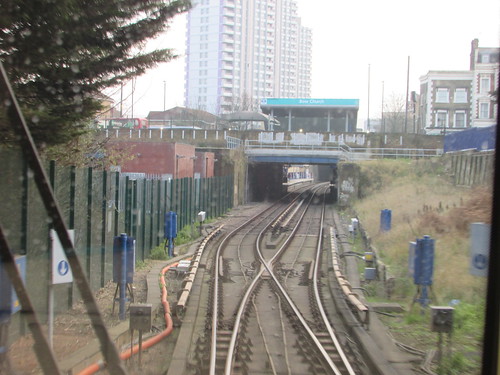
The single line doubles before Bow Church station.
Our route continued through Devons Road, Langdon Park and All Saints. Beyond All Saints stations, connections diverge to the right to serve the sidings at the depot at Poplar. Approaching Poplar station, the route from Canning Town converges.

Docklands Light Railway: Turnouts approaching Poplar station.(L-R): WB Canning Town, SB Stratford, NB Stratford, EB Canning Town (on flyover).
Leaving Poplar station, my train swung sharply left as it climbed the steep East Curve to West India Quay. Just 200 metres further on, we stopped under the elliptical, glazed roof of Canary Wharf Station, where I changed trains. The three roads through the station are provided with two island platforms and two flanking platforms so each road has a platform on both sides to improve passenger flow. I alighted on the correct side and, within a minute or two, my connecting train arrived on the opposite face of the same platform.
 Docklands Light Railway: Changing trains at Canary Wharf.
The train I'd joined was heavily loaded for our journey through Heron Quays, South Quay, Crossharbour (with its turnback siding) and Mudchute (now with a third, terminal platform). Originally, the double track beyond Mudchute ran on the surface to a simple terminal at Island Gardens. Now the line is extended to Lewisham, the line dives underground to a new underground station at Island Gardens after which it crosses the Thames to a second underground station called Cutty Sark, where I disembarked, along with a crowd of other passengers. The train I'd left would continue to stations at Greenwich, Deptford Bridge, Elverson Road and Lewisham. I reached the surface quite near the river and the impressive bulk of Cutty Sark, now transformed into a major tourist attraction.
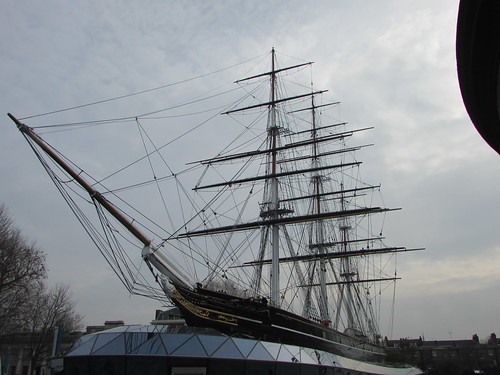
London, Greenwich: Cutty Sark.
I was tempted to go back to Island Gardens through the Greenwich foot tunnel which, since the last time I used it, now has user-operated lifts. However, unsure of the time this detour would take, instead I took a few photographs around what is now Maritime Greenwich World Heritage Site.
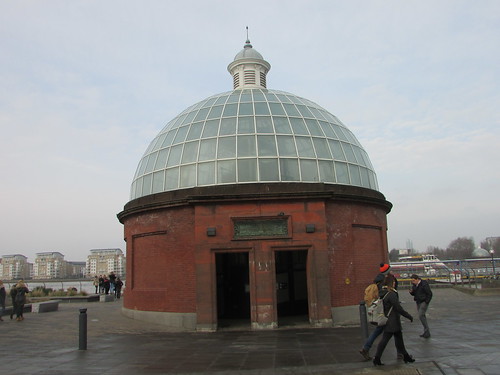
London: Entrance to Greenwich Foot Tunnel
Near the river, there were splendid views of the incomparable 17th-century buildings designed by Sir Christopher Wren (on the site of the earlier Royal palace) built as the Royal Hospital for Seamen, housing retired veterans of Britain's navy, later seeing service as the Royal Naval College. The Old Royal Naval College has a website here.
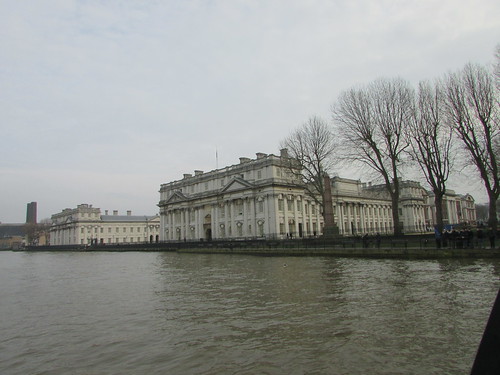
London: The Old Royal Naval College, Greenwich:
After admiring Wren's creation, my eye was also drawn downstream to the rather grim outline of Greenwich Power Station, with its four 8-sided chimneys and, thrust into the Thames, its disused coal unloading jetty standing on sixteen massive cast-iron Doric columns.
Greenwich Power Station
In the post London Underground - Traction Power Distribution, I mentioned the importance of London Underground's Greenwich Power Station. Since Lots Road Power Station was shut in 1998, London Underground has derived its power from the National Grid, but Greenwich was retained as the Central Emergency Power Supply.
Greenwich Power Station was built in two stages between 1902 and 1910 for the London County Council to power trams and underground trains. There are articles on the origins of Greenwich Power Station in Grace's Guide here and in Port Cities here. There's also a brief account in Wikipedia here.
I was surprised to discover that tables showing the generated output from the power station for the ten years to 2014 are available online (following a Freedom of Information Request) here. This is available through the mySociety project of the charity UK Citizens Online Democracy (UKCOD).
A plan to improve efficiency and lower the carbon footprint of the station using a new Combined Heat and Power (CHP) gas installation is under consultation.

London: Greenwich Power Station.
Ferry to London Bridge
I'd decided to take a ferry from Greenwich to London Bridge City pier, near the location of my meeting. MBNA Thames Clippers operate a scheduled service of fast ferries on the river. Their web site is here and details of their fleet of modern, large catamarans powered by waterjet or propellor are here. The huge 220-seat 'Hurricane Clipper' arrived on time and, within moments, was loaded and heading upstream again.
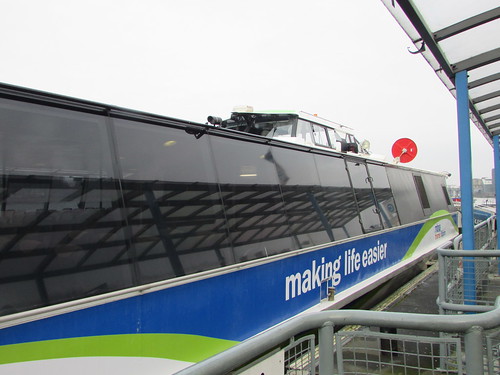
London: 'Hurricane Clipper' at Greenwich landing stage.
After a brief pause at Canary Wharf we continued upstream, passed through the north fixed span of Tower Bridge and then set off again, passing the moored light cruiser 'H.M.S. Belfast' (there's a post describing a visit I made here) and stopping at London Bridge City Pier after a total journey time of just over 20 minutes. I disembarked with a few other passengers and 'Hurricane Clipper' roared away upstream.
After an informative and enjoyable few hours, I made my way to my meeting.
My Pictures
Where necessary, clicking on an image above will display an 'uncropped' view or, alternately, pictures from may be selected, viewed or downloaded, in various sizes, from the albums listed:-
London: Former Great Eastern Line.
Docklands Light Railway.
London, England.


