skip to main |
skip to sidebar
On Sunday 22nd May 2016, the 'Peak Forester' Railtour, operated by the Railway Touring Company, ran from London to Rowsley, the northern terminus of Peak Rail. The train was hauled by Bullied Light Pacific 34052 'Lord Dowding'. Actually, this locomotive was really 'West Country' class 34046 'Braunton' but re-numbered and re-named to commemorate the 75th anniversary of the 'Battle of Britain' since the original locomotive 34052 was scrapped at Barry. 34046 was restored by Locomotive 34046 Limited and is currently based at Locomotive Services Limited, Southall.
On previous railtours I've seen at Peak Rail (see 'Related posts' below), the Peak Rail 'top-and-tailed' service train has continued running all day, requiring this train to 'recess' in the Up Loop at Darley Dale whilst the rail tour arrived and then 'recess' in the Down Loop at Darley Dale when the railtour departed. More problematically, on arrival at Rowsley and having discharged its passengers, the stock of the railtour had to be shunted across to the loop so that the platform line was available for the 'top-and-tailed' Peak Rail service train to arrive and deport.
So, for the 2016 'Peak Forester' it had been decided that the 'top-and-tailed' Peak Rail service train would only operate three round trips (rather than the normal five) and that the 6-coach Peak Rail train would then be stabled in the yard at Rowsley, leaving the platform line and run round clear for the arrival, servicing and departure of the railtour.
I was rostered on 'Lord Phil' with Phil M. We operated the scheduled three round trips top-and-tailing with D9539 (Class 14) before assisting the diesel in stabling our train in the Heritage Shunters yard and disposing of our locomotive on the outside pit. We then moved forward to stable outside the shed, leaving plenty of room for the visiting locomotive to use the pit.

'Lord Phil' was stabled clear of the outside pit.
Although I've been rostered at Peak Rail on the dates of a number of previous Main Line Railtours, this was the first time I've been at Rowsley and able to watch the activities there. Quite a few spectators had gathered at Rowsley by the time we had the 'wire' that the Railtour was 'on time' joining Peak Rail metals.
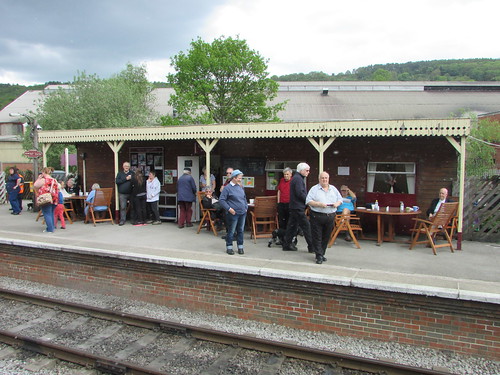
Some of the spectators awaiting the arrival of the steam special.
Two lorries had arrived - a self-unloading Mercedes 8-wheel coal lorry with fuel for the return journey and an articulated tanker with water. I made my way back to Rowsley's single platform to watch the Railtour come to a stand very gently.

'Lord Dowding' arriving at Rowsley.
It had been some years since I'd been in charge of a Bulleid locomotive. I became familiar with 'Merchant Navy' class 'Canadian Pacific' at Birmingham Railway Museum, when she was used on 'Learn to be a Driver' courses. On completion of that duty, the locomotive spent a weekend as a static exhibit at a major exhibition at the National Exhibition Centre. Queues of visitors formed for the opportunity of standing on the footplate whilst museum staff gave explanations. I wasn't rostered for duty at the exhibition but, when I turned up as a visitor, I was invited to act as relief by the harrassed crew which I did, wearing a blue polka-dot summer dress and high heeled shoes! Later, I worked on 'West Country' class 'Taw Valley' both when she had a spell on 'Learn to be a Driver' courses at Birmingham Railway Museum and also at the Battlefield Line on both 'Learn to be a Driver' courses hauling a private passenger train along the full length of the line and on Service Trains. I really must try to write more about Bulleid's remarkable 'Pacifics'.
As soon as the train stopped, a number of people descended from the footplate (including Roger Hallett, who'd acted as the Peak Rail Conductor Driver) and a crowd of support crew appeared from the Support Coach marshalled as the first vehicle in the train. The locomotive was uncoupled from its train and drawn forward level with the water crane. Surrounded by support crew, the locomotive was watered both from the Peak Rail water crane and the road tanker, whilst a succession of fire irons was used to break up the firebed ready for dropping the fire.

34052 taking water.
The locomotive then shunted across to the 60-foot vacuum-operated turntable to be turned for the return journey. The inauguration of this turntable in 2010 (described in the post In a Spin with Pete Waterman) allowed Peak Rail to welcome steam Railtours. Now facing London, the locomotive moved gently to the outside pit to drop the fire. This was originally called the 'Turnback Pit' as it was intended for visiting engines arriving with a train and requiring fire-cleaning, coal, water and perhaps oiling before departing with another train, so the use 34052 made of it was historically correct. The Palfinger hydraulic grab crane on the coal lorry transferred its load to the Bullied tender whilst a new fire was laid in the firebox and ash was cleared from the sides of the wide firebox.
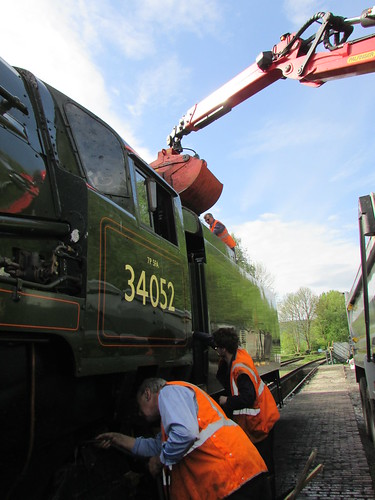
Coaling and ash clearance on the Turnback Pit.
Meanwhile, Rowsley's 'Class 31' had shunted across to the coaching stock, detached the support coach, run round to the other end of the support coach (using the 'short loop' formed by the main run round loop and the connections on the 'Third Line' by the Loading Dock) and re-attached the support coach to the London end of the train, ready for 34052. I presume the 'Class 31' was used as it was dual-fitted with both vacuum and air brake systems and it was desired to shunt the Support Coach using the air brake system.
All that now remained was for the 'refreshed' 34052 to shunt from the 'Turnback Pit' back to its train, ready for the marathon journey back to London. Well, I'd had a fairly early start, so I was content to say my 'goodbyes' at that point.
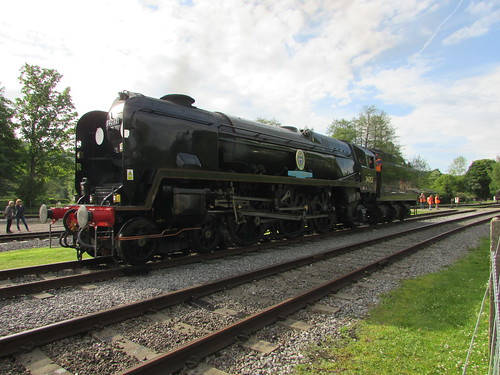
34052 on the run-round loop at Rowsley, heading back to its train.
Related posts
Reports on other main line rail tours I've seen at Peak Rail are listed below:-
2015: The Dimple, Darley and Dale.
2014: HST Charter to Peak Rail.
2013: The 'Peak Forester'.
2012: Steam Charter to Peak Rail.
All my posts on Peak Rail can be found here.
My pictures
Pictures in this article can be viewed uncropped by clicking on the image. To view in other resolutions or download select from the album below:-
'Peak Forester' 2016
All my pictures at Peak Rail can be found here.
The first tram system in Rangoon
Steam trams were introduced in Rangoon (as the British called Yangon) towards the end of the 19th century, without conspicuous success. The system was electrified in the early 20th century and, by the mid 1930s, was carrying 40 million passengers a year.

Shwedagon tram terminus in the 20th century (Photo: Tram Views of Asia).
Bombing of power stations by both the British and the Japanese during World War II led to power shortages which sealed the fate of the Rangoon Electric Tramway, although post-war wrangling over shareholder compensation meant that the company was not finally liquidated until 1961. There's a brief article on this period here.
The Building of Rangoon's Docks
The British developed extensive docks on the north shore of the Yangon River with extensive rail access from the British-built metre gauge railway system. Like Liverpool's docks, Rangoon's docks were enclosed and, just outside the enclosing walls of the docks, there is a dock access road which runs parallel to the important Strand Road built on the landward side. The dock access road was provided with a railway line with sidings into the docks at various points. At the western end of the docks, this line branched inland to reach interchange sidings with the main railway system at Kyee Myin Daing. At the eastern end of the docks, a second branch went inland to meet the main railway system at Pazundaung. Just north of Pazundaung, a large marshalling yard and motive power depot was built at Mahlwagon. There's a description of a visit to Mahlwagon area here.
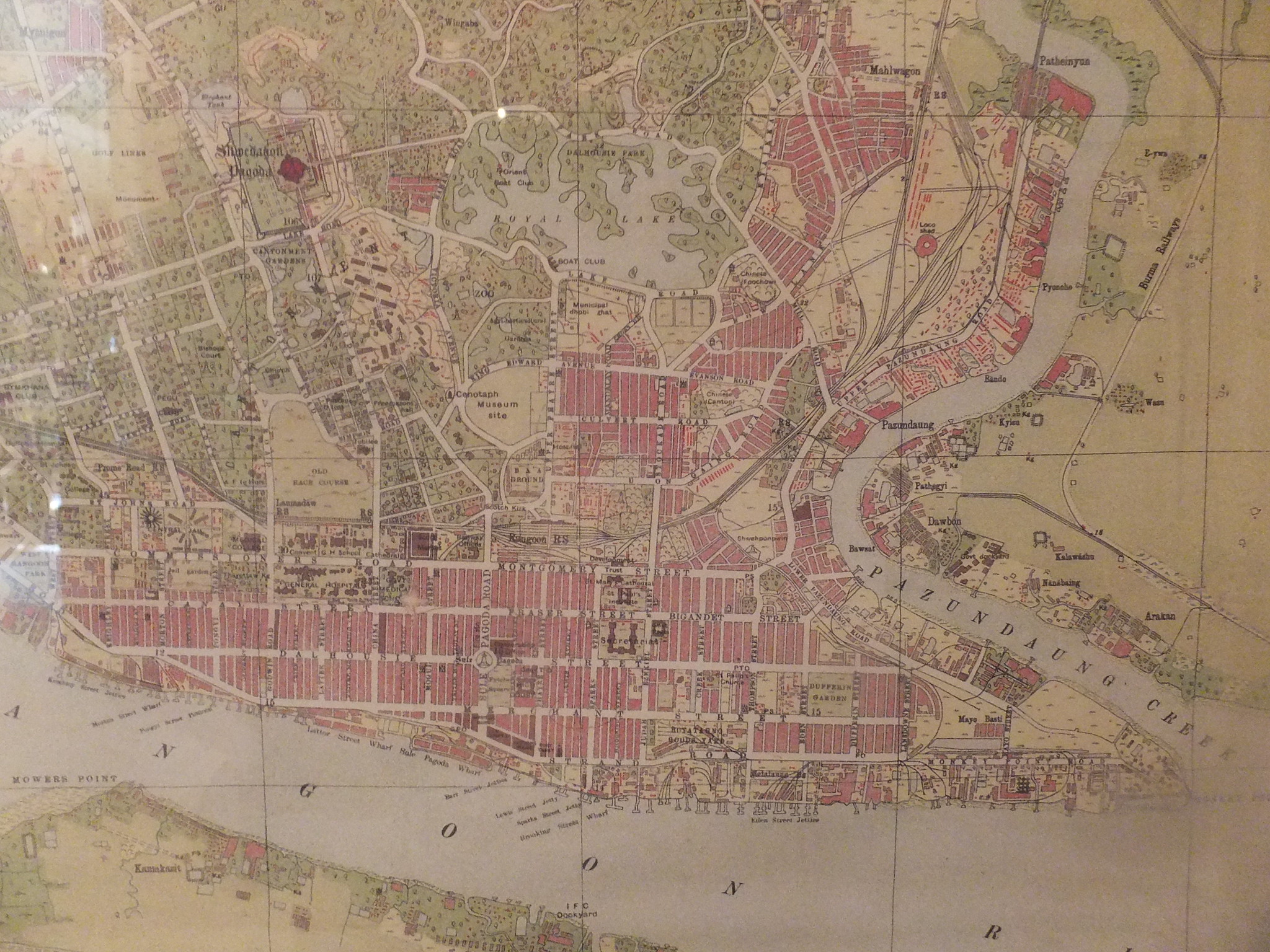
The Rangoon Guide Map of 1930 (published under the direction of Brigadier R. H. Thomas D.S.O., Surveyor General of India) gives a good idea of the extent of the docks at that date and the elaborate network of railway sidings built to serve the docks.
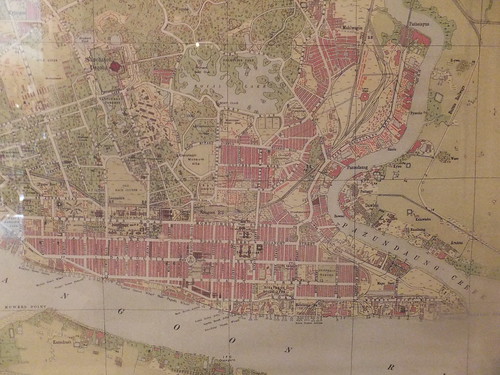 The central area of docks in 1930.
Click here for a larger view
Recent Developments in Yangon's Docks
Like Liverpool, Yangon's dock area has seen massive changes with the introduction of Containerisation, including the construction of a completely new deep-water port at Thilawa, 16 miles from Yangon (see website here). In 2014, exploring Strand Road, I was surprised to find that the railway line along the dock access road, inset in concrete, was now dual-gauge (metre/standard gauge).
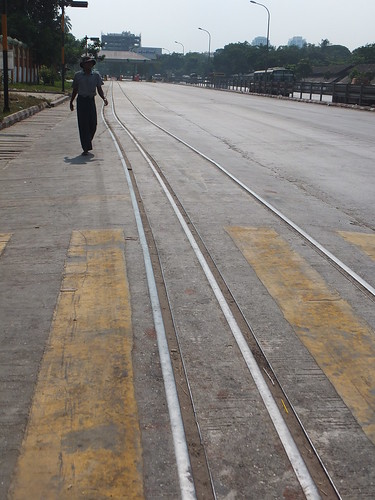
Looking west along the Dock Access Road, Strand Road, Yangon in 2014, showing dual gauge (metre/standard gauge) track.
This discovery is described in the post here. I found the railway goods depot still in use at Botataung (on the landward side of the line) and, later, I confirmed that there's a second depot still operating at War Dan (on the river side of the line). Although I was now certain that metre gauge trains must still run along this dock line to service these depots, it was not until Tuesday 5th May 2015 that I actually saw an unidentified Bo-Bo-Bo diesel-electric slowly make its way westbound along the dock line with a short train of bogie vans as I took afternoon tea in the Cafe at the Strand Hotel at about half past five. The following morning, I had a greater surprise for, at twenty past seven whilst taking breakfast in the Cafe at the Strand Hotel, red-liveried railcar RBE 30.02 paused briefly opposite on its way east on the dock line.
Plans for Yangon's Electric Railway Revealed
Before I had an opportunity to investigate the standard gauge trackwork and whether there was now a passenger service along Strand Road, my railway friend in Myanmar informed me that Yangon was to open a new Electric railway and I found limited information on the internet.
A report on the MITV site dated 25th August 2015 (see [reference 1] below) stated that carriages of electric train (tram rail) which would be used for the first time in public transport of Myanmar had arrived at Thilawa Port, and would commence operation in October 2015. The project, led by Myanma Railways, was intended to provide better services and facilities for train commuters. U Ohn Kyi, Assistant General Manager, Myanma Railways (Lower Myanmar) claimed that 18 freight, 379 passenger and 25 Circular trains were currently operated but the electric train project would construct three new electrified lines, ultimately leading to an electric Circular train in addition to the current Circular Line services which transport around 100,000 people a day. U Kway Lwin, Assistant Engineer, Myanmar Railway (Urban), added that the new lines would be standard gauge.

One of the 'new' trams, numbered 3005B in 'salmon pink' livery (Photo: MITV).
The announcement was starting to make sense to me. I already knew that Myanma Railways 'RBE' single-unit diesel railcars were actually supplied second-hand from Japan (see report Diesel Railcars in Burma). In 2013, I first saw other second-hand diesel multiple units from Japan starting to appear and, on my most recent visit in 2016, I found that 5-car Diesel Multiple Units are now common around Yangon. This initiative is part of a comprehensive plan put forward by the Japan International Co-operation Agency (JICA), outlined in my post here. If diesel railcars and diesel multiple units can be given extended usefulness in this way, why not also re-cycle second-hand Japanese standard-gauge trams to Myanmar?
I found a couple more pictures from MITV showing a 3-section tram, apparently ready for service and also a piece by 'ElevenMyanmar' reporting a deal between Myanmar Government and the "Japanese West Corporation" signed 27th July 2015 which would start operating a service the same year along the Yangon Waterfront. The Ministry of Rail Transportation said the service would open from Pansodan to Htawlikwae in Ahlone Township in October and from Pansodan to Lansdown in December. The Japanese partner would provide the specialist equipment for overhead power distribution and the Yangon Electricity Corporation would provide the 5 megawatts power required. The electric power poles would be erected 50 metres apart. Two 3-section sets and one 1-car set would be prepared and would provide speeds between 19 and 25 miles per hour. I'm not sure about the "Japanese West Corporation" but this may refer to the public company JR-West which provides transport in Western Japan.

A '3-section' tram numbered TCE3001 in its rather fetching Myanma Railways livery of two-tone blue with grey undergear (Photo: MITV).

Detail of the pantographs on TCE3001 (Photo: MITV).
My railway friend confirmed my understanding, informing me that the vehicles were type 1650 trams, originally used in Osaka, Japan and that public operations would commence on 11th January 2016.
On 22nd December 2015, Myanmar Business Today (see [reference 2] below) confirmed a delay in starting the service giving a new start date of second week of January 2016, according to U Kyaw Soe Lwin, Deputy General Manager of Myanma Railways (MR). U Htun Aung Thin, General Manager of Myanma Railway (Lower Myanmar) commented that the electric train would be fully air conditioned and have three carriages. It would run ten times per day and tickets would cost 100 Kyat each (about 10 cents U.S.). U Tun Aung Thin said the electric trains were equipped with a capacitor bank, to prevent the train from stopping suddenly in the event of an electricity cut. I'm not sure that I understand this last remark unless it refers to Ultra-capacitors retro-fitted to 40 year old rolling stock, which seems unlikely.
On 11th January 2016, MITV reported an opening ceremony the previous day (see [reference 3] below) and Myanmar Times gave a very upbeat assessment of the future (see [reference 4] below). On the 12th January, the Railway Gazette (see [reference 5] below) had a brief report under the title 'Yangon launches light rail line' and, by the 19th January 2016, BBC Asia had posted a video under the title 'Trams return to the streets of Yangon' (see [reference 6] below).
Jan takes the tram
I travelled on the line on 21st April 2016 (producing a brief report here and pictures here. Operating over a line extending less than three miles, with a one-way journey time of 30 minutes and with a service frequency of just three return trips each day, the tram could hardly be expected to be a commercial success at this stage. However, I was quite favourably impressed. The 3-section tram I travelled on, whilst elderly, appeared quite well refurbished. The overhead power system, as far as I could judge, was of modern design and properly implemented.
Operations suspended
On 1st July 2016, another online media company, 'Yangon Coconuts', published the following obituary under the title 'No more electric tram on Yangon's Strand Road' (see [reference 7]):-
It was good while it lasted. Or maybe it wasn’t, since so few people bothered to buy a ticket. Yangon’s fancy new electric tram stopped service today after only six months of running along Strand Road from Linsadaung to Wardan Street. It was a short route of only a few miles but was supposed to help ease congestion on Strand Road. Trams ran along Strand Road in colonial times and the project, a $3 million deal between Myanma Railways and Japan's West Corporation, was aimed at reviving the alternative transportation as Yangon’s streets brim with taxis and buses. But it didn’t catch on. Myanmar Railways general manager Tun Aung Thin told Global New Light of Myanmar that a few days ago only 10 people took the tram, and without going into specifics, he said accidents would sometimes occur in crowded areas. He also told the Voice that, instead of relieving congestion, the tram sometimes added to it because of all the container trucks plying the route right next to the tracks running along Strand Road. The carriages will be kept near Wardan Street to use in special cases, such as if there are emergencies. Well, RIP Yangon’s electric tram. We'd like to say it was nice having you around, but you were here for such a short time we never got to know you.
Afterword
Although I'd been impressed by what had been achieved, there were clearly a number of constraints on successfully developing the tram system. The initial route was single-line with no passing loop. The route was shared with heavy vehicle traffic to and from the dock area, giving rise to access conflicts. Earlier announcements said that the initial route would be extended at the western end to Kyee Myin Daing and at the eastern end to Pazundaung. Certainly, I had seen dual gauge track on the dock branch at Kyee Myin Daing (see report in the section 'The Docks Branch' of the post Kyee Myin Daing) so at least some work was put in hand. In addition, Yangon's electricity cuts off quite frequently because of lack of capacity and the wisdom of using "the amount of electricity to run a small city ward" for a tram has been questioned.
At the opening ceremony, U Htun Aung Thin, General Manager of Myanma Railway (Lower Myanmar), was quoted as saying "We want to provide good public transportation. At present we will run three carriages that can carry nearly 460 commuters. Of all the types of train, the tram is the easiest to maintain and operates at a low cost. We will continue to offer this service whether we gain profit or not. By using this tram, commuters from six downtown townships will find their journey to work more convenient and they can avoid traffic jams.”
But, apparently, it was not to be. A Short History, certainly, but not a happy one.
Related posts on other sites
[reference 1] 'MITV' (Myanmar International Television).
[reference 2] 'Myanmar Business Today'.
[reference 3]'MITV'.
[reference 4] 'Myanmar Times'.
[reference 5] 'Railway Gazette'.
[reference 5] 'BBC Asia'.
[reference 7] 'Yangon Coconuts'.
Related posts on my site
see Trams Return to Rangoon
My pictures
Yangon's Trams.
(Pictures may be viewed and downloaded in various resolutions).
According to Wikipedia, the English word 'serendipity' is first attributed to Horace Walpole in the 18th century, supposedly derived from a Persian Fairy Tale 'The Three Princes of Serendip' (an old name for what is now Sri Lanka) whose heroes "were always making discoveries, by accidents and sagacity, of things they were not in quest of".

The idea of "happy accidents" accords quite well with my own rather unstructured approach to life and certainly has played a large part in my involvement with Myanmar.
By the time I was 50 years old, I'd been fortunate in visiting a number of countries, mainly on business and these are briefly outlined in the post Jan Ford's Travels - The early trips. As I grew older, I decided I needed to see more of the world so, at the end of 2001, I set off on my first 'Grand Tour', visiting Thailand, Australia, New Zealand, Fiji and the United States in just two weeks. There's a very short report here. This whetted my appetite for further travel and, over the following years, a number of trips followed, selecting countries to visit in a fairly haphazard manner. Most of these later trips are summarised in the post Jan Ford's Travels. There's also a listing of countries visited with links to my (often indifferent) pictures on 'Flickr' in the post Jan Ford's Travels: Around the World in pictures.
In March, 2008 I embarked on a fifth 'Round the World' trip (posts at Round the World Five), starting in Myanmar with a luxury river cruise on the 'Road to Mandalay'. Myanmar was then only starting to emerge from its long period of isolation under military rule and I'd thought long and hard about the wisdom of the visit. After Myanmar, I spent one day in Bangkok before taking the long flight to Los Angeles and then on to Las Vegas. After Las Vegas, I flew to Cancun, Mexico to see the ruins at Chichen Itza. Then, it was on to Cuba and finally Panama before returning home with transits in Mexico City and Frankfurt. Each of the countries I visited gave me a host of memories but Myanmar had created a particularly special impression. In my 'Afterword' post, I wrote "I intend to return to Myanmar" but, at that stage, I didn't realise how important the country and the friendships I forged would become.
I was by no means alone in finding Burma very special. During England's long association with Burma, a number of British writers described the unique nature of the country and its peoples. Kipling is probably the best known, with his poem 'The Road to Mandalay' and the thought from one of his letters:-
"This is Burma and it will be quite unlike any land you know about".
I've written a short post about Kipling, which also includes a list of various books by English authors describing their experiences in Burma, here. One of the books I would particularly recommend is 'The Burman: His Life and Notions' by Shway Yoe (Sir James George Scott), first published 1882, re-published by W. W. Norton & Co, Inc. in 1963. The author spent thirty years as a British Civil Servant in Burma during which time he studied the people in depth, writing with affection and humour under the pen-name 'Shway Yoe'.
I didn't anticipate being drawn back to Myanmar regularly but, since my first visit in 2008, a pattern seems to have established itself so that I currently make an annual visit. So far, I've made ten visits to Myanmar, each producing a number of blog reports, listed in 'Related posts on Myanmar' below. Each visit broadly has four aims:-
1. To see more of the country and learn more about its people.
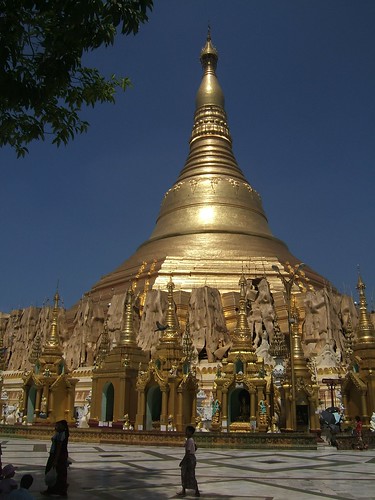
The most revered site in Myanmar: the Shwedagon in Yangon.
2. To visit some of the educational initiatives forming part of the charitable 'RTM Social Contribution'.
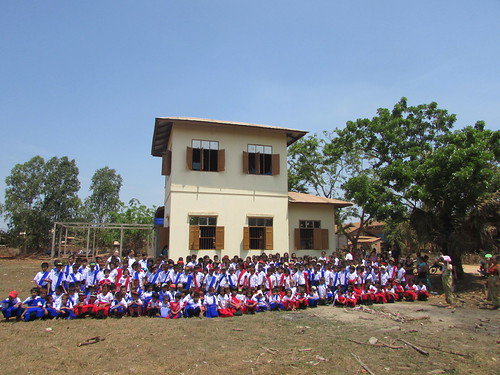 Ko Dut Drop In Centre.
3. To see the work of the charitable Bagan Medical Clinic which is supported by the 'RTM Social Contribution'.
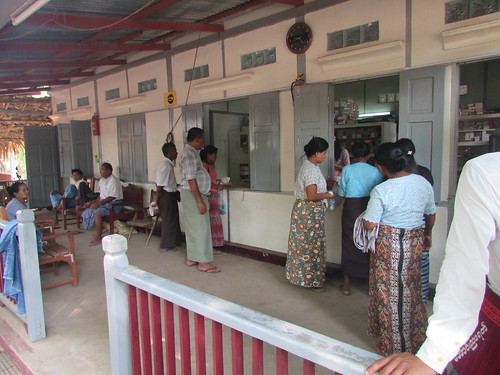 The first clinic building (opened 2011). The fourth building is currently being completed.
4. To study Myanmar's railway system. There's an explanation of this, seemingly odd, aim in the post Myanmar, Railways and Jan.
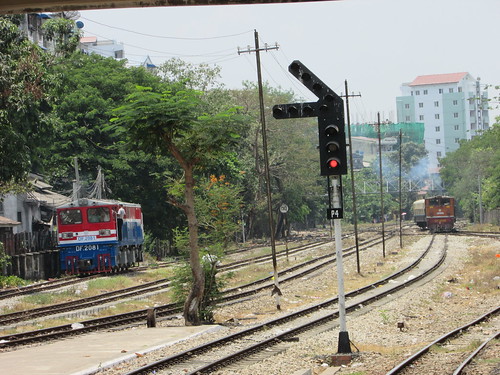 Around the Circle Line in 2016.
Related posts on Myanmar
Year-by-year travel:-
Round the World Five (2008).
Far East 2 (2008).
Far East 3 (2009).
Far East 5 (2010).
Trip to Burma (2011).
Burma-2012 (2012).
Far East 6 (2013).
Burma-2014 (2014).
Burma-2015 (2015).
Burma-2016. (2016).
All Education Support posts:-
Education.
All Medical Support posts:-
Medical Support.
All Myanma Railways posts:-
Myanma-Railways.
Location
Insein is an important station about nine miles from Yangon Central Station on the double-track section of the line to Pyay, also used by Circle Line trains. Some suburban trains from Yangon terminate and reverse at Insein. It became the location of the Locomotive Works and Carriage Works. The station building is on the east side of the line adjacent to platform 1 and two further island platforms, each provided with umbrella roofing, give a total of five platform lines. Platform 1 also has a large (but now rather decrepit) buffet. Two sidings on the west side now appear to be little-used but give access to the Locomotive Works.
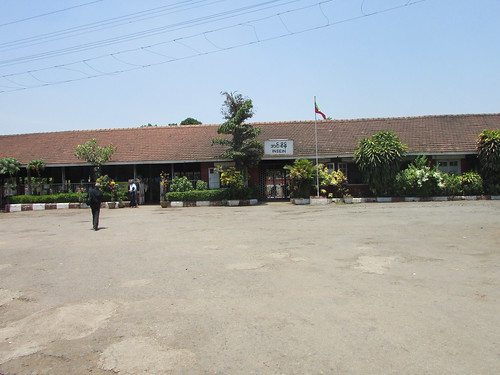 Road approach to Insein Station.
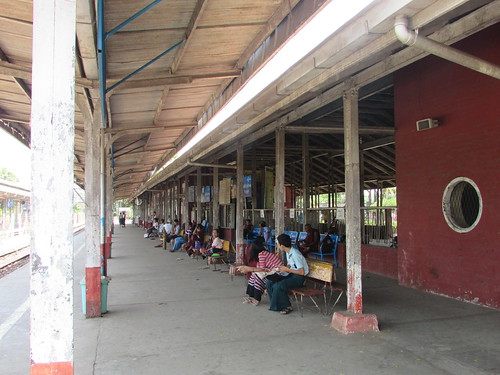 Insein, platform 1.
There's a concrete post and chain link fence in between platform 1 line and platform 2 line, to prevent too indiscriminate crossing of the lines by passengers but the fence is provided with an opening opposite the entrance from the main station building which most passengers choose to use, although there is also a steel footbridge linking the three platform groups [1], [2, 3], [4,5]. No fencing is provided between the other platform tracks. This arrangement is similar to some other stations in Myanmar.
Origins of Insein Station
Rail transport was first introduced in Myanmar in May 1877, when Lower Burma was a British colony, with the opening of the 163-mile (262 km) Yangon to Pyay line by The Irrawaddy Valley State Railway. This line passed through Insein. At that time, the Yangon terminus was at Kyee Myin Daing (about 5 miles south of Insein).
Track Layout
At Insein, the double track main line splits into five platform roads with two sidings on the west side. There are connections to the Locomotive Works on the west at both the south (apparently unused) and north of the station. There are connections to the Carriage Works on the east side at the south of the station.
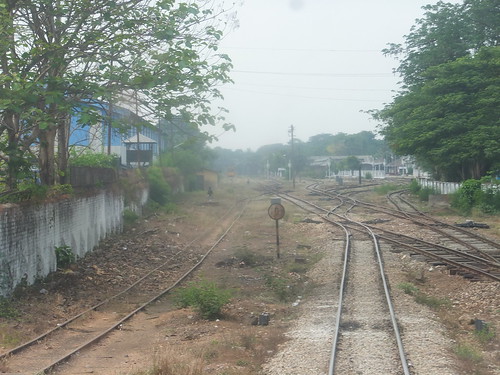 Cab view looking north as we approach Insein from the south.
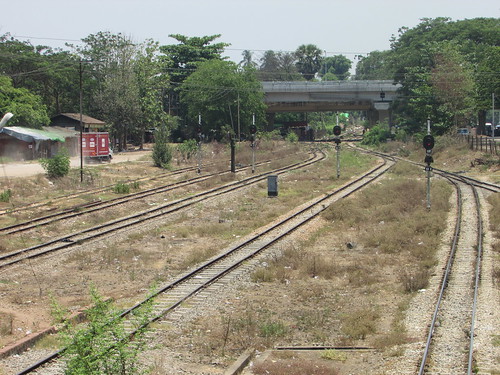 View of the north end of Insein Station, looking north.
Signalling
'Home' signals in each direction are 2-aspect colour light with theatre-type route indicators.

Insein Up 'Home' 2-aspect signal '1R' displaying 'Yellow' with '5' displayed in the theatre-type route indicator for platform 5.
The station area is controlled by a 2-aspect colour light signals with position light subsidiary aspects.
 Insein: Showing 2-aspect colour light signals with position light subsidiary aspects and motor-driven trap points. DF.1240, having arrived with a terminating train from Yangon direction in platform 2 (on the left) and uncoupled now approaches the camera on platform 1 as it runs round.
'Starting' signals in each direction are 3-aspect colour light and lead to automatic signalling sections.
Points are operated by electric point machines.
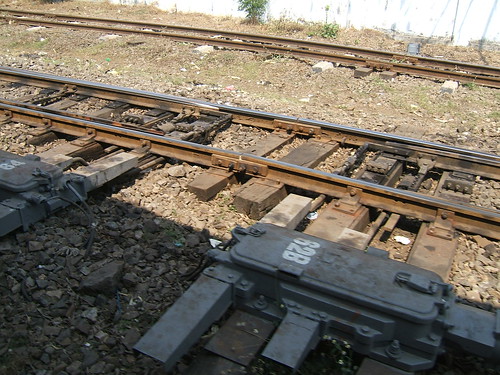 Insein in 2008: Two turnouts, 62B & 64, with electric point machines, insulated soleplates and insulated rail joints.
Signal Cabin at Insein
A 3-storey reinforced concrete building towards the south end of platform 1 accommodates the power-operated signal cabin.
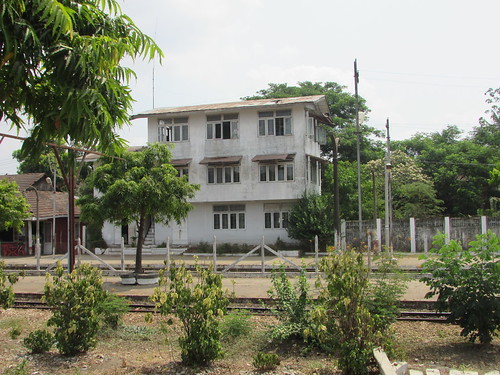 The Power Signal Box at Insein.
Insein Locomotive Works
In 2015, I had a conducted tour of the locomotive works which is described here.
 Insein: The building on the right is the Erecting Shop of the Locomotive Works. There is a long line of scrapped diesel locomotives alongside this building. Note the row of 2-aspect colour-light signals with position-light subsidiary signals (L to R: 8L/38L, 9L/39L, 10L/40L) and Location Case.
Insein Carriage Works
As yet, I've not found out much but note it's become the haunt of the 'new' second-hand diesel multiple units. In 2016 I found a new steel-framed workshop under construction.
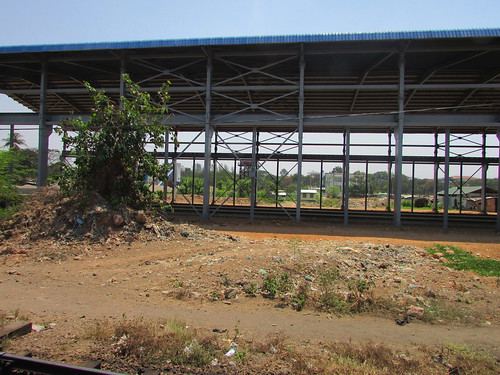 New steel-framed workshop under construction, Carriage Works, Insein.
Background
I've collected information about Insein over a number of years, mainly through making trips around the Circle Line.
I first saw Insein in 2008 when I made a round trip on the Circle Line (described in the post The Circle Line, Yangon).
In 2012 I travelled on part of the Circle Line (report here) but didn't pass through Insein.
The following year, on 14th February 2013, I travelled from Yangon Central Station to and from the junction at Da Nyn Gone, producing pictures here and the post Yangon Area Railways.
On the 25th April 2014, I made a cab ride around the Circle line (see post Cab Ride around the Circle Line), and pictures here.
By 2015, the 'New' Diesel Multiple Units were being introduced and, on 4th May 2015, I went around the Circle line on one of these collecting more views in album The Circle Line by DMU.
Another 'New' Diesel Multiple Unit provided the motive power on 22nd April 2016 when I made another clockwise trip of the Circle Line with my young friend Aung (pictures here).
Finally, on Friday 6th May 2016 I took the Circle Line clockwise to Kyee Myin Daing and, after exploring around the station area, I continued to Insein for more exploring before returning to Yangon by an anti-clockwise Circle Line train (pictures at Yangon to Insein by Train.
Related posts in my blog
The Circle Line, Yangon (2008).
Exploring Yangon's railways.
Railway Signalling in Burma - Part 2: Colour Light Signals & Motor Points.
Railway Signalling in Burma - Part 6: Signal Boxes with Electrical Interlocking.
Yangon Area Railways
All my Myanma Railways posts.
My Pictures
Pictures in this article can be viewed uncropped by clicking on the image. To view in other resolutions or download, select from the album Insein Railway Station.
All my Myanma Railways Pictures.
Events of Monday, 25th April 2016
Wooden-hulled fishing boats of the Mergui Archipelago
Once again, we took our morning tea or coffee on deck as fishing vessels set off in various directions around us and the sun rose higher in the sky. Each ship was notably individual but perhaps we can distinguish some typical characteristics. The wooden-hulled boat shown at rest below (there's also a larger version of the image available) had a crew of six.
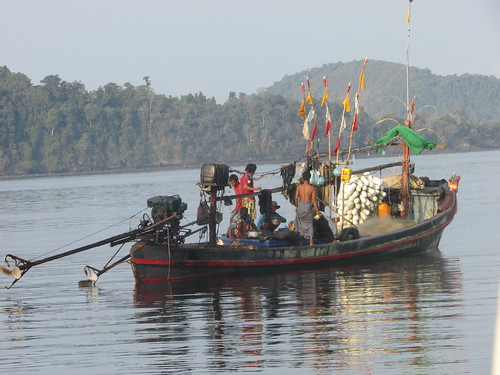 The Fishing Fleet at Nyaung Wee: A typical wooden-hulled drift net fishing vessel with two engines and 'long-tail' 2-blade propellors. Six crew can be seen.
Click here for a larger view.
Tied to the bow (on the right) a number of coloured scarves can be made out, with some cut flowers. These are presumably to propitiate the malign spirits, the 'Nats'. In Burma, belief in the 'Nats' co-exists with Buddhism. There is a square-section post near the bow which carries a series of drooping leaves, I assume again to please the 'Nats'. This post carries a cross-arm to support a covering (furled away in this picture). When extended towards a similar crossarm on a second square post, this covering provides some protection against the intense heat of the sun. The bow post also supports what appears to be a VHF radio antenna. On the foredeck, there's a large pile of white plastic moulded floats presumably attached to the top edge of a long fishing net arranged to hang vertically when deployed. The rather gay-looking flagpoles are attached to floats and and are intended to be attached to the fishing nets to assist finding the net again prior to hauling in a catch. Each flagpole has a battery-operated beacon near the top, no doubt invaluable when fishing at night. The deck is provided with an untidy string of electric light bulbs running fore-and-aft for use after dark, but I couldn't work out what provides the power. Elsewhere, large car batteries driving a solid-state inverter are common.
The crew can be seen towards the stern apparently finishing breakfast, in an area with a number of large moulded plastic boxes as used to store the 'catch'. Towards the stern, there's a shorter square post topped with a small 'table' which carries a moulded plastic fuel drum for diesel, which is fed to the engine through an uncertain-looking arrangement of flexible hoses.
The motive power is provided by a 'long tail' arrangement, common in Asia. The engine is mounted on the centreline of the hull above the sternpost on a pivoting and tilting frame. The engine spins a long propeller shaft carried in a tube with a propeller (in this case, a 2-blade propeller) at the far end, hence the name. The long propeller shaft is necessary to place the propeller at a reasonably shallow 'angle of attack' to the water for effective propulsion. The 'helmsman' controls the boat by physically manoeuvring the engine, lowering the propeller into the water for drive or lifting it clear as required.The propeller blades are protected by a steel rod 'bumper' welded underneath (a bit like a 'tail skid' on early aircraft) to prevent damage when operating in shallow water. Directional control is achieved by pivoting the whole engine and 'long tail' assembly left or right, producing 'thrust vectoring'. In Thailand, motor car engines frequently provide the motive power for 'long-tail' boats but, in Myanmar, I think I've only seen the rugged Chinese-made single cylinder compression-ignition (diesel) engines used, presumably a consequence of Myanmar's long period of isolation from Western markets. The exposed engine flywheel also drives a small water pump which lifts water from the sea, circulates it through the engine to provide cooling and expels it through a pipe attached to the long tube housing the propeller shaft. The end of this tube is shaped so that the water is discharged against the rear of the propeller blades, throwing up an impressive spray.
The boat illustrated, like many, also has a second, similar engine. I'm not sure whether this is to improve the top speed, increase reliability, improve manoeuvrability or for other reasons. The second engine is mounted on the gunwale (the strong top edge of the side of the boat) on the port (left) side a little forward of the stern on a separate pivoting and tilting frame.
The picture below shows a rather extreme example of this type of wooden-hulled boat, in this case provided with three 'long tail' engines.
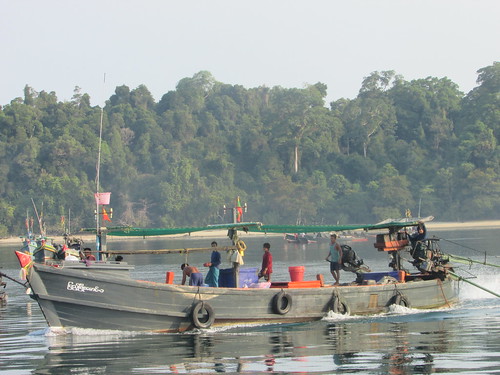 This extreme example of the wooden fishing vessel, seen leaving Nyaung Wee had three engines and long-tail propellers and a crew of seven.
Click here for a larger view.
Again, there are scarves and (rather dessicated-looking) flowers on the bow, on the left of the picture. There are three square-section vertical posts, this time all tall enough to carry a green sun-shade almost the full length of the deck. This green shade is deployed and securely tied in place with the usual string of electric light bulbs underneath. The post near the bow also supports a VHF radio antenna and, on a steel cross-arm, two navigation lights. The second square post also carries a steel cross-arm with two navigation lights, plus a small Myanmar National Flag. The post near the stern has a wooden platform carrying moulded plastic fuel drums for diesel and, above this platform, there's a small rectangular, permanent roof which is presumably a sun-shade for the fuel. Diesel has a much higher flashpoint than petrol, making it a much safer fuel from the point of view of flammability.
To provide motive power, the first engine is mounted on the centre line (being controlled by a man I take to be the 'Captain'), the second engine (which does not appear to be in use) is on the port side, a little ahead of the stern and a third engine is mounted on the starboard side, significantly further forward and being controlled by one of the crew.
Steel-hulled fishing boats of the Mergui Archipelago
A group of larger fishing vessels remained at anchor and, silhouetted against the sun, I thought they looked vaguely threatening.
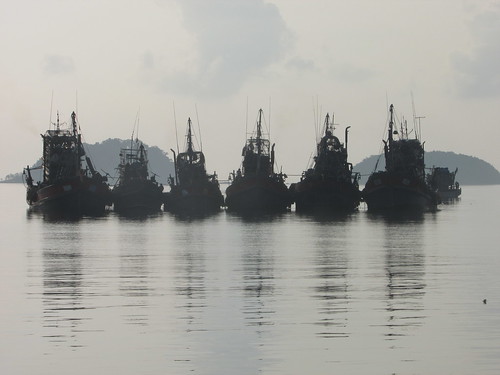 Larger fishing vessels anchored at Nyaung Wee.
After we'd enjoyed a generous breakfast, our host said "Would you like to visit a fishing boat?" and we all enthusiastically said "Yes!" so, a little later, we all piled into the dinghy and I discovered that our destination was to be one of the larger vessels I'd photographed earlier. Now the sun was illuminating the boats, the sense of menace had gone but their size meant they were still imposing! These were steel-hulled vessels, which seemed intended for deep sea fishing. There were variations in design between the various ships: most were painted in a livery of grey, with the upper part of the hull in red. The bow of each boat carried the expected scarves: more puzzling was that the name of each vessel had been deliberately, but not completely effectively, obscured by a rectangle of material. An anti-fisheries protection measure? I wondered.
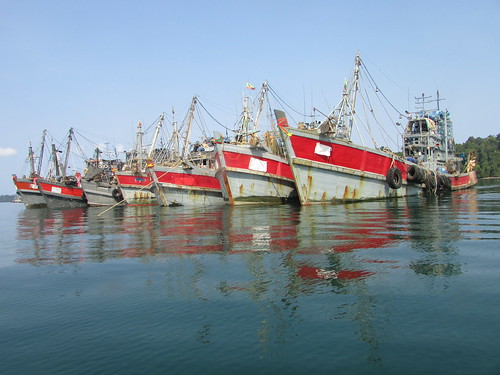 Visiting a fishing trawler.
We approached the port side of the outside vessel of the group. The foredeck of the boat mounted a serious-looking derrick, with a derrick mast using 'stiff-leg' staying and a single boom (other vessels nearby also had derricks, but with the mast guyed). The top of the derrick mast carried the familiar series of drooping leaves and Myanmar National Flag. The 2-storey superstructure (with the wheelhouse at the forward end, deck level) extended towards the stern of the boat and, with the addition of extensive storage on the roof of the superstructure for a large number of moulded, plastic drums (I assumed for the 'catch'), the ship towered above us. At the stern, on both sides, large metal-bound wooden boards were stowed - 'otterboards' used to keep the open end of the large conical fishing net dragged behind a trawler from closing. This seemed to fit with the heavy-duty winch on the port side, just level with the wheelhouse (I assume that there was a second, similar winch on the starboard side) and the row of large tyres hanging from the port side level with the foredeck (to prevent damage to a 'side trawl' net being hauled aboard).
Our inflatable dinghy came alongside the hull and, with my impaired mobility, I thought "I wonder if this is completely wise?". A couple of my fellow-passengers climbed onto the deck successfully, so I thought I'd better try. Just to my left, I spotted a scupper in the hull of the vessel. 'Scuppers' are openings in the 'wall' ('bulwark') around the deck provided to allow water to drain off the deck and I realised that this opening offered a reasonable foothold. So I stood on the inflated tube forming the side of our dinghy, moved slightly to the left and with some difficulty managed to lift my left foot and wedge it into the aperture of the scupper. Reaching upwards, I grasped the steelwork and, with some effort (and, I think, with some assistance from behind) clambered onto the deck.
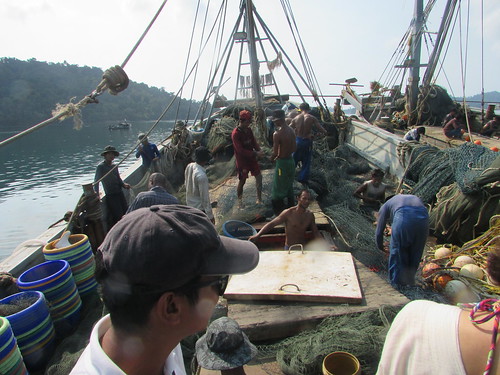 On board a moored fishing trawler at Nyaung Wee Island, Mergui Archipelago.
Every inch of deck seemed to be covered with green fishnet and I counted 12 men engaged in repairing the nets. In addition, I spotted what I took to be the Captain and Mate relaxing in the shade outside the wheelhouse. I took a picture of the 'net repair kit' - a number of plastic moulded shuttles, each loaded with a length of variously-coloured polypropylene rope.
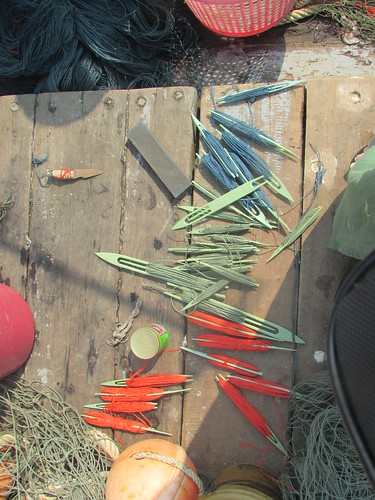
'Net repair kit'.
One of the men was standing in the hatchway to the forward hold, and he sorted a selection of decent-sized fish plus a number of the ubiquitous squid into a plastic bowl for us to take back to the cook on 'Meta IV', for which we paid with two trays of canned local beer. After watching the net repairing activities for a while and taking more photographs, it was time to leave the boat. By reversing the procedure I'd used to clamber aboard, I descended to our waiting dinghy without incident. When everybody was back on board, we headed back to 'Meta IV'.
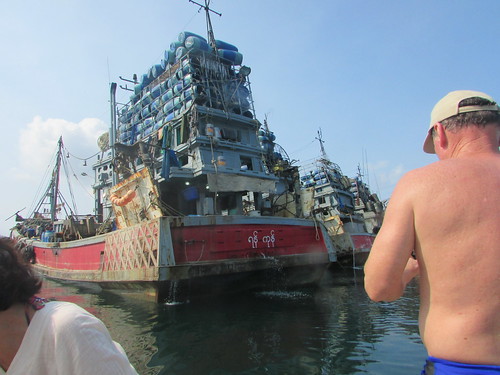 View of the stern of the fishing vessel we had just visited.
On our way back to our yacht, we paused briefly at one of the smaller wooden-hulled boats where the crew were happy to exchange more fish for cans of drink. While this transaction was in progress, the smiling captain relaxed near the bow, smoking a cigarette, shaded from the sun by the rather tattered roof covering.
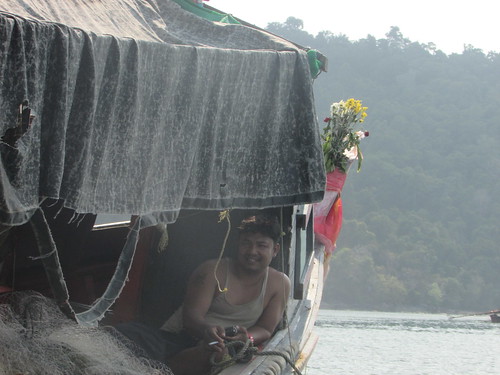 The captain of a smaller fishing boat relaxing. Note the coloured scarves and spray of flowers attached to the bow.
The mangrove forests of Lampi Island.
Once we were safely back on 'Meta IV' she set off north towards the the west coast of Lampi Island within Lampi Marine National Park, the only marine national park in Myanmar. There are two perennial rivers on Lampi Island and we anchored offshore near one of these, Lampi South River. Once again, we all piled into the dinghy for a cruise part of the way upstream on the river.
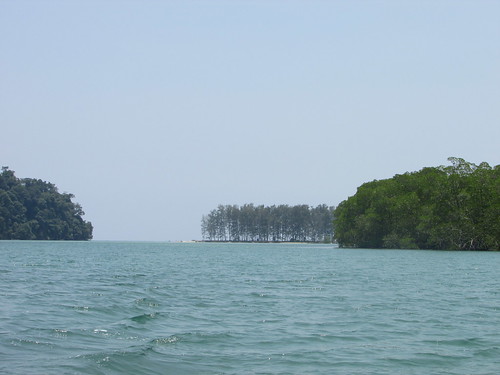 Looking back to the sea as we head upriver to the Mangrove Forest of Lampi South River.
No riverbank was visible on either side - the vegetation overhung the water. As we continued, the elaborate the other-worldly root systems of mangrove appeared all around us - they give the trees the appearance that they are capable of walking. The complex adaptations provide filtration of the high salt levels possible in tidal areas and help resist the effect of wave action.
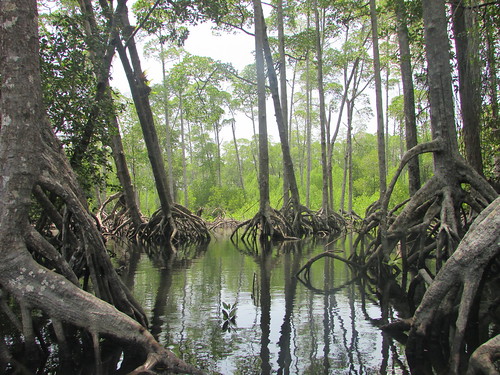 Mangrove Forest, Lampi South River.
With the noisy outboard stopped, we were able to drift with the current for a while, emphasising the 'other-world' feel of these locations.
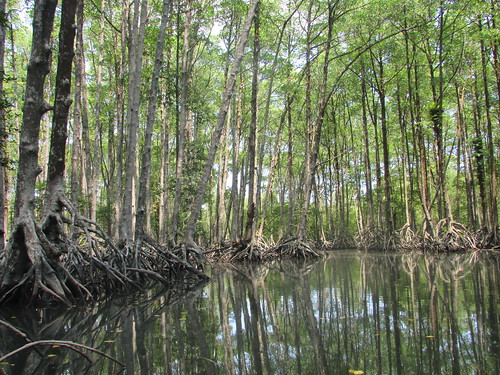 Mangrove Forest, Lampi South River.
There's a Wikipedia article on mangroves here and I've written about visiting mangroves in the Asmat area of Indonesia here and at Bako National Park, Sarawak, Malaysia here.
Beach Visit to Island 60
After our fascinating trip by inflatable dinghy to Lampi South River, our ship continued northwards to a small, uninhabited island known, I believe, as 'Island 60' where another beach visit had been offered. Whilst we were preparing to go ashore by dinghy, we were passed by a group of local fishing boats. The wooden-hulled lead boat had a 'long tail' propulsion system and carried a Myanmar National Flag, allowing it to tow six dug-out canoes, each carrying one person. As far as I could make out, the motor boat held a man and woman, the towed boats carried an old woman, a girl, a boy, a woman, a man and another woman.
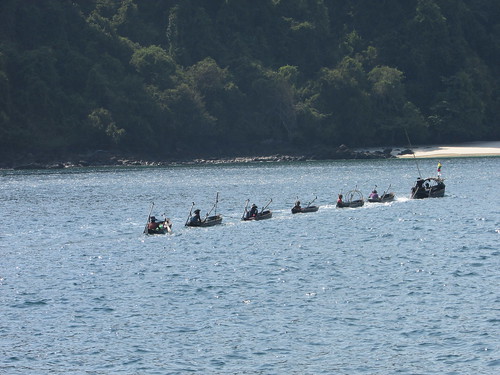 Local Fishing Boats near Island 60.
As I watched, the raft of seven boats passed a couple of stationary boats - a large dug-out fitted with a 'long tail' motor with one man aboard which had towed a smaller dug-out carrying a woman to their current position. By the time our dinghy has taken us ashore, there was no sign of the other boats and we were alone on a pristine beach allowing swimming, snorkelling and beachcombing.
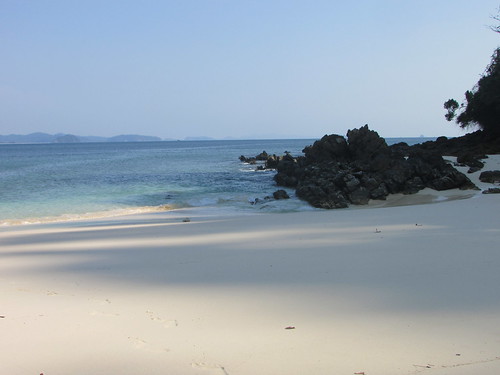 The Beach on Island 60.
Ko Phaar Island and Hornbills
By the time we left the beach at Island 60, it was late afternoon but our host promised one more excursion by dinghy to see hornbills. We took the dinghy to a location a couple of hundred yards from the shore of the heavily-wooded island of Ko Phaar and waited as dusk darkened the sky. Before long, the distinctive silhouette of a hornbill was spotted, heading for Ko Phaar Island and passing overhead close to our position. I managed to capture a not-very-good image of this solitary bird.
 A single Hornbill returning to Ko Phaar Island.
After a few minutes, three hornbills approached from a different direction. We were clearly in the right place, at the right time, for hornbills continued to appear, in ones, twos and threes, from various directions, heading for their overnight roosts high in the trees of Ko Phaar Island.
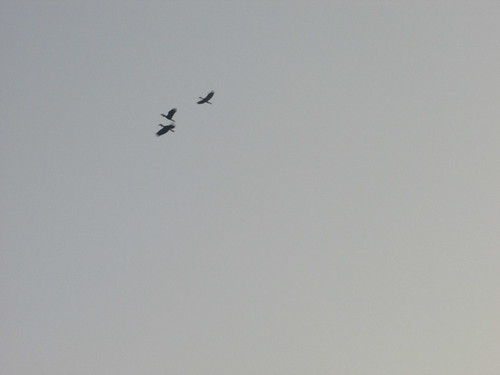 The Hornbills of Ko Phaar Island.
I'd seen the Hornbills in captivity elsewhere, (such as at Port Moresby Country Park, Papua New Guineau, as described here) but to see numerous birds in the wild, returning to roost on Ko Phaar Island, was a wonderful sight.
There's a Wikipedia article on this interesting family of birds here.
After a fairly intensive day, we returned to 'Meta IV' for another splendid dinner, after which I was quite ready to retire to my cabin.
Related posts
My report on the following day aboard 'Meta IV' can be found here.
All my posts on my trip to Myanmar in 2016 can be found here.
My pictures
Pictures in this article can be viewed uncropped by clicking on the image. To view in other resolutions or download, select from the albums below:-
The Fishing Fleet at Nyaung Wee
Visiting working fishing vessels.
Mangrove Forest.
The Beach on Island 60 and Fishing Boats.
Ko Phaar Island, Mergui Archipelago.
Events of Sunday, 24th April 2016
The sea remained calm overnight as we lay at anchor off Ba Wel Island, so I slept fairly well in the unfamiliar surroundings, We enjoyed an excellent European-style cooked breakfast in the dining area on the open aft deck, as the nearby fishing vessels set off for the day. I was amused by the sight of a powered vessel, with the customary Chinese-made, noisy, single-cylinder diesel engine driving a 'long tail' propellor, towing a number of small boats each with one man taking his ease as they moved to the fishing ground. The deck of the larger boat carried three more small boats. Presumably, when they reached a suitable location, all the small boats would fish independently, positioning themselves using the pair of T-handled oars each boat carried.
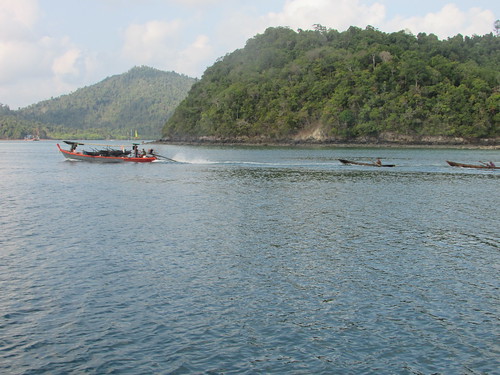 Powered fishing boat leaving Ba Wel Island, towing small boats.
The islands in this area are the home of the remaining 'Moken Sea Gypsies' who do not use fishing nets. Originally, the men practiced spear-fishing from small boats whilst women would dive for sea urchins. Our ship sailed to one of the islands where the simple life style of the 'Sea Gypsies' survives - Nyaung Wee Island, south of Lampi Island.
We approached Naung Wee, a heavily-wooded, hilly island from the east. As we came nearer, we could see a village of simple buildings straggling along a narrow, white sand shore. Behind the village, a steep path led diagonally up the hillside to a small, golden pagoda.
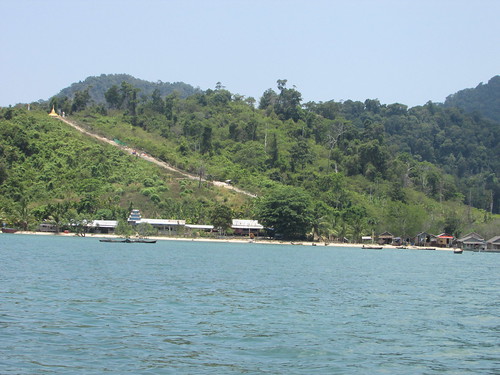 Nyaung Wee Island, Mergui Archipelago.
We anchored in the bay among a variety of vessels and our dinghy was brought alongside to take the guests ashore. As we clambered onto the narrow beach, we were quickly joined by the young local children who took their visitors by the hand and conducted us along the single village 'street'.
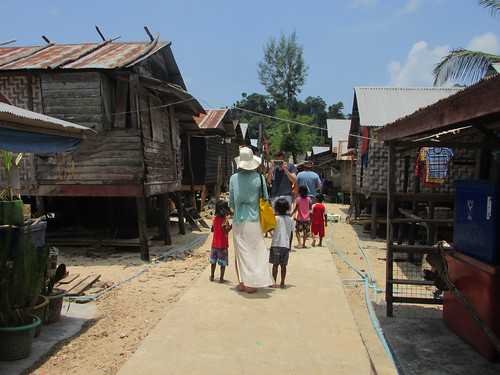 Being conducted through the village by the young local children.
It may not have been entirely coincidental that we ended up at the village shop where our Burma Boating guide arranged some simple treats for the young people.
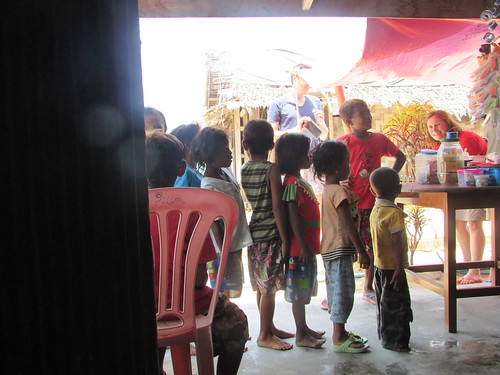 Nyaung Wee Island: At the village shop.
The neat pedestrian street ran parallel to the shore, in between two rows of wooden-framed buildings, lifted a few feet off the ground. Walls were either woven bamboo, wooden planks or galvanised iron and roofs were clad with galvanised iron sheets or, in a few cases, thatch. Each building had a mains water supply, provided from a system of blue HDPE distribution pipes with plastic isolating cocks which was simply laid in the sand on either side of the walkway. At least one beach-side property sported a satellite dish. One house was being re-built, revealing the no doubt effective but rather crude building techniques adopted.
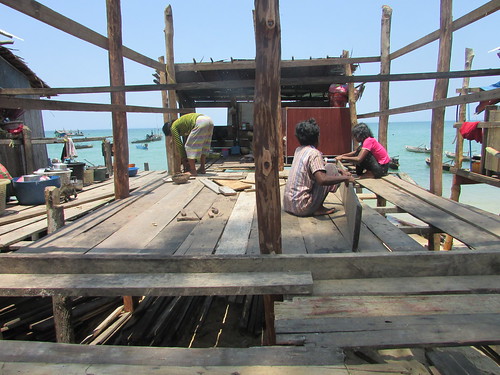 Nyaung Wee Island: Rebuilding a house.
We passed the Government primary school (closed, as our visit was in the holiday period as well as on a Sunday) and returned to our waiting dinghy. The bay had numerous moored small boats, of various sizes, testifying to the importance of the sea to the villagers. A few boats had the familiar diesel engine with 'long-tail' propellor but most were wooden dug-outs with the characteristic T-handled oars.
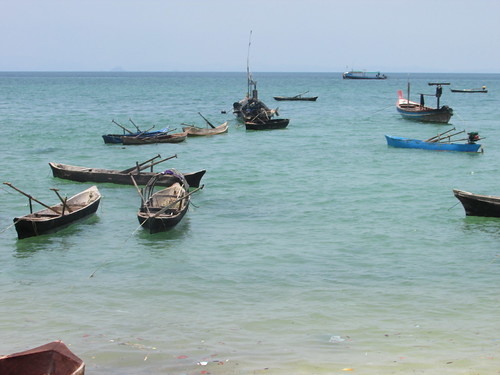 Nyaung Wee Island, Mergui Archipelago.
I felt rather wistful as 'Meta IV' left the island and its interesting community but lunch was available and we'd been promised a visit later to a beach on an uninhabited island called variously Clara Island or, more prosaically, island 115.
This trip ashore was definitely for pleasure, allowing swimming and snorkelling from the white sand beach.
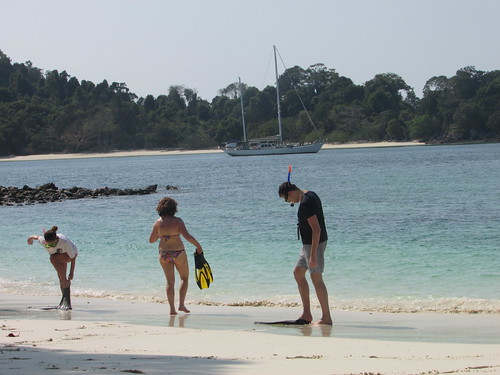 Clara Island beach visit, with 'Meta IV' in the background.
Following some problems with my knees made worse by the exertions of my trip earlier in the year (described here), I again declined the temptations of swimming in the delightfully warm water but the dinghy had also towed a moulded plastic 2-person kayak to the beach for those interested. I eventually decided to take out the kayak and, after initial difficulty launching from the soft sand, had a marvellous interlude slowly paddling around the bay.
 Clara Island beach visit: The kayak patiently awaits its next user.
Our dinghy returned the guests to 'Meta IV' for relaxation prior to the evening meal. Meanwhile, the ship was positioned to a suitable overnight anchorage off Nyaung Wee. As the previous night at Ba Wel, we soon found ourselves in the company of a number of fishing vessels also anchoring for the night. They maintained what might be thought a 'respectful' distance but I found their presence rather comforting. I'm afraid that once the evening meal was finished, I was finding myself quite ready for bed so I didn't delay long before retiring.
Related posts
My report on the following day aboard 'Meta IV' can be found here.
All my posts on my trip to Myanmar in 2016 can be found here.
My pictures
Pictures in this article can be viewed uncropped by clicking on the image. To view in other resolutions or download, select from the albums below:-
Nyaung Wee Island, Mergui Archipelago.
Beach visit (115).
All my pictures taken on my trip to Burma in 2016 are in the collection Burma, 2016.