skip to main |
skip to sidebar
Click on any image below for 'uncropped' view, or search 'My pictures' to view or download in various sizes.
Events of Saturday 6th February 2016
By train to Llandudno
Although it was raining quite hard at home when I got up, I decided I would take the first bus to Wolverhampton and travel to Llandudno (a favourite destination) by train.
The first departure from Wolverhampton was an Arriva Cross Country to Manchester which I took as far as Stafford. Whilst waiting for the following London Midland Liverpool train, I was able to study the historical pictures displayed in the waiting room.
 A 1938 view of the north end of Stafford, with the Wellington line (long gone) curving to the left, the four tracks to Crewe in the centre and the Uttoxeter line (long gone) curving to the right.
The London Midland Class 350 made good time to Crewe. As we slowed down into platform 11, I spotted a steam locomotive outside the Locomotive Storage building. From the brief glimpse, I took it to be 'Royal Scot', which I later confirmed. Since I had a while to wait before my connection to Chester, I decided to have a walk down Gresty Road (it was still raining hard). Leaving the station, there was smoke rising from the north side of the Nantwich Road bridge, so the steam locomotive had apparently moved down, ready to shunt onto its steam special train.
When I first visited Gresty Road, it was home to British Railways Signal Workshops, housed mainly in various LNWR-built buildings. I had a number of business meetings here when we were supplying telecommunication systems to the railways (briefly described here and here).
The first long block of offices I came to was typically LNWR - functional yet pleasing. I discovered it's now the Technical Investigation Centre for Signalling Projects operated by the consultants 'Atkins' (who have succumbed to replacing the 'A' in 'Atkins' with an upside-down capital 'V', following the same illiterate convention as the car company 'Kia' which I complained about in the post By Rail to Guildford. In case mis-spelling 'Atkins' fails to confuse the visitor sufficiently, they've also turned the whole name through 90 degrees on the sign).
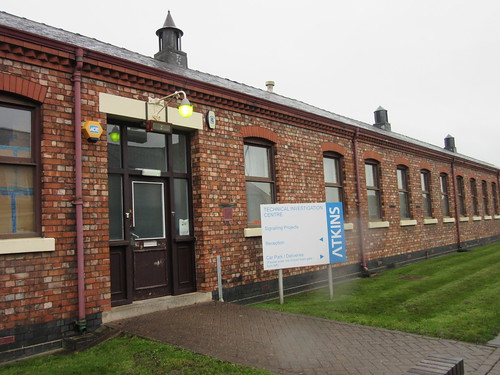 Gresty Road showing Technical Investigation Centre for Signalling Projects operated by the consultants 'Atkins'.
The next group of LNWR buildings are now part of the extensive Unipart Rail site. Opposite, the road leading into a housing estate is called 'Claughton Avenue'. Bowen-Cooke's 4-cylinder 4-6-0 class was introduced in 1913, but named after the then-chairman of the LNWR, Sir Gilbert Claughton (1856-1921)
 Gresty Road showing entrance to Unipart Rail.
I remember when Technical Investigations at Crewe were still part of British Rail. Most of the British Rail signalling workshops were initially privatised as N.R.S. (National Railway Supplies) but it now forms Unipart Rail.
Before turning back, I came to YMCA Crewe. I don't know the history of this modernised building but it certainly looks as if it could have served as a locomens' lodge or similar. Can anyone enlighten me, please?
 YMCA Crewe in Gresty Road.
On my walk back to the station, I tried, unsuccessfully, to get a better view of a complete British Railways standard design signal box and colour light signals on the Unipart Rail site, presumably part of a training facility. But I could read the sign on an adjacent training room:-
Welcome to the
FACULTY ON THE FLOOR
This is where we ..
..learn to use and improve the principles, systems, tools and techniques of the Unipart Way, access best practice developed elsewhere, and develop new ideas and coach each other in their use.
For more on 'the Unipart Way', look here.
Approaching the station, I was joined by large numbers of people I guessed were about to join the steam special. I made my way to platform 9 for the 09:23 DMU to Chester, noting that the steam special was due to follow my train after 6 minutes. Maroon-liveried 'West Coast' stock was standing in platform 12 and 'Royal Scot' with its "blood-and-custard" support coach had already drawn forward onto the Down Chester, awaiting the signal to set back onto the train. After a short pause, 'Royal Scot' backed onto its train, sporting a rather 'posh' storm sheet between the trailing edge of the cab roof and the tender.
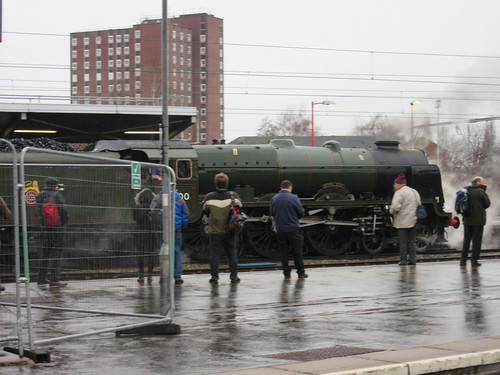 'Royal Scot' (and support coach) backs onto its train in platform 12.
My 2-car DMU arrived and a lot of passengers got off. Then a lot of passengers, including me, got on and we were soon under way for the trip to Chester, where we arrived in the bay platform. A Manchester - Llandudno train was expected in a few minutes, so I positioned myself on platform 3B (the western end of the long down through platform) ready to board the connection and I was soon under way again. I noticed a significant police presence on the station, which was probably due to the following steam train. The middle aged men with cameras hanging around were certainly there for 'Royal Scot'.
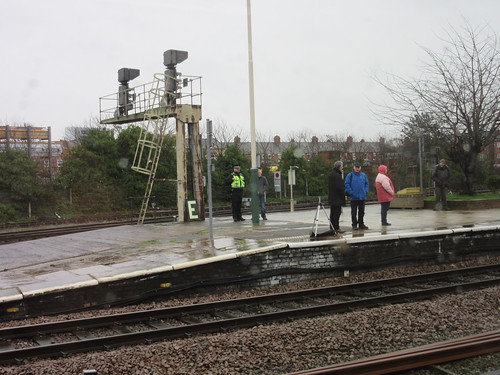 Chester station, waiting for 'Royal Scot' on the Holyhead Private Charter.
These enthusiasts could also be seen as I continued to Llandudno Junction, despite the inclement weather, not just at stations but also at various farm gates along the line. I'm afraid I didn't see the steam special again myself after leaving Crewe.
When we paused at Shotton Low Level, I was interested to see rodent traps deployed, because I'd noticed these at Shotton High Level on an earlier trip (8th March 2014), described here.

Shotton Low Level Up Platform (with what appears to be a rodent trap at the base of the lamp post).
We made our scheduled stop at Fflint (more enthusiasts), sped past the now very sad looking 'Duke of Lancaster' (which still has a website here), stopped at Prestatyn then Rhyl. The line is only double track now but a number of signal structures remain cantilevered 2-doll brackets which originally served the 4-track route, now equipped with just one arm. Distant signals are a mixture of colour light and semaphore.
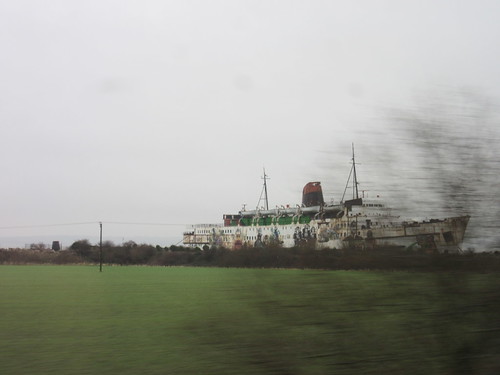 The beached 'Duke of Lancaster'.
Beyond Rhyl, we hurried through Abergele in the rain without stopping. When I was young, I always thought this a romantic railway location - four-track with platforms flanking the outer slow lines, Camping Coaches on the seaward side and a dignified LNWR signal box in the middle of it all. Now, it's just 2-track but the down line throws off a loop to the platform line. The facing points leading to the down loop are controlled by two rodding runs - one for the Facing Point Lock, one for the points themselves. The trailing points just need one rodding run to operate the points. Signals around the station remain LMS upper-quadrant. There's a series of posts in this blog about British railway signalling, starting here. Mechanical Operation of Points is described in Part 6. I'm happy to report that, for some reason, the signal box has avoided the worst of the structural alterations I usually complain about and, whilst there are external changes, it looked 'right' (at least from some vantage points). I spotted the expected contingent of steam enthusiasts sheltering under the awning on the Up platform, waiting for 'Royal Scot'.
We stopped briefly at Colwyn Bay which has lost two of the four platforms I remember,together with some of its station buildings, its LNWR glazed screens and is no longer a block post. Between Colwyn Bay and Llandudno Junction, the line was quadruple from 1904 to the 1980s, when it reverted to double track and the A55 Expressway took over the freed-up land. This section of line has a place in railway history for two reasons, which I'll cover in a later post.
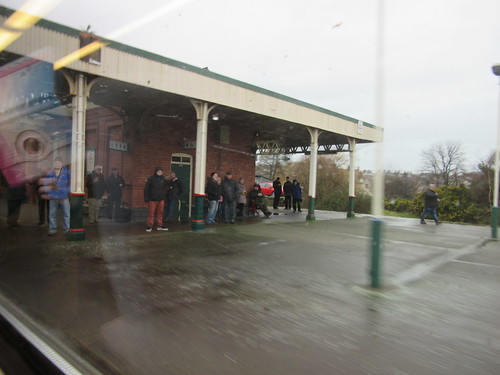 Stopping at Llandudno Junction. Note the steam enthusiasts awaiting the arrival of the following 'Royal Scot'.
After another brief stop at 'The Junction', we were soon underway on the final, short leg of our journey. Deganwy is now shown as a 'request stop', and we sailed right through on this occasion.
It was still raining when I got off the train at Llandudno but, undaunted, I set off on foot along Vaughan street to the promenade, crossing the end of the main Victorian shopping street, Mostyn Street, at the delightfully named 'North Western Gardens'.
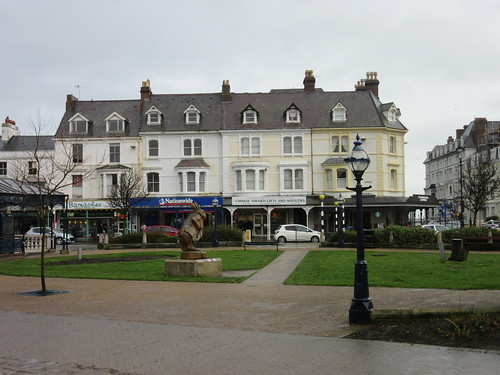 View across North Western Gardens showing the canopied shops in Mostyn Street.
The modern shopping centre, with its large car park, lay a few yards on my right - I don't believe I've ever visited it. Arriving at the promenade near the Imperial Hotel, the curve of the bay between the Little Orme and Great Orme headlands, with the wide pedestrian promenade and the arc of hotels facing the sea, captivated me, as it always has. I happily walked along the promenade towards the pier.
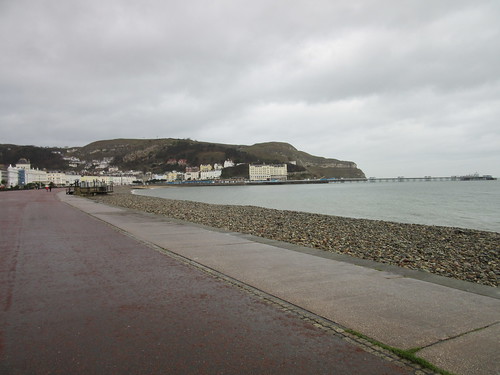 Llandudno: The Promenade looking towards the Great Orme, with the pier on the right.
Much of the beach is shingle but, near the War Memorial, there is often a sandy stretch until the tide comes in which I was happy to share for a while with a few children and dogs. I then headed away from the sea via St. George's Place, crossed Mostyn Street and continued along Lloyd street to the Town Hall, where the local 'Lions Club' were holding a charity Antiques Fair which I decided to support.
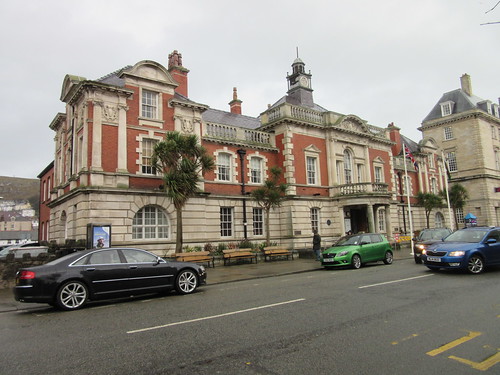 Llandudno: The Town Hall.
On one stall, I was surprised to find two black-and-white framed locomotive photographs which I recognised as North British works photographs. One was 'Royal Scot' as built and I commented to the stallholder that I'd seen that very engine (in its rebuilt form) a little earlier. I resisted the strong temptation to purchase it, instead selecting the picture of ill-fated 6399 'Fury'. This experiment in the use of high-pressure steam was abandoned and the locomotive was rebuilt as a conventional 'Royal Scot'.
Near the Town Hall is the famous fish and chip restaurant 'Tribells' so I decided to try their take-away service. Both fish and chips were cooked while I waited (reminding me of fish and chips I had in Sydney on my Round the World One trip in 2001). I started to eat as I walked back to the prom and then sat watching the grey sea. The rain had stopped and the food was excellent. Two seagulls patiently waited on the tarmac a few feet away as I ate - a bit different from a few years ago when they would 'dive-bomb' for food. In view of their good manners, I allowed a small piece of fish to fall as I disposed of the polystyrene tray in a litter bin. I later found notices warning against feeding and littering but there was certainly no litter left!
I made my way back to Mostyn Street to look at some of the shops. Opposite Marks and Spencers, there's the Victoria Centre with its roof-top car park. It's cod-Victorian, not real but does capture some of the atmosphere of the original Victorian shopping arcades, so I don't object to it too much. Many of the shops along Mostyn Street retain Victorian canopies over the pavement (with various degrees of modernisation to keep them watertight). I was soon drawn back to the Promenade and decided to patronise the covered terrace restaurant at the Imperial Hotel, where I enjoyed a toasted teacake and a pot of tea tea with panoramic views of the sea.
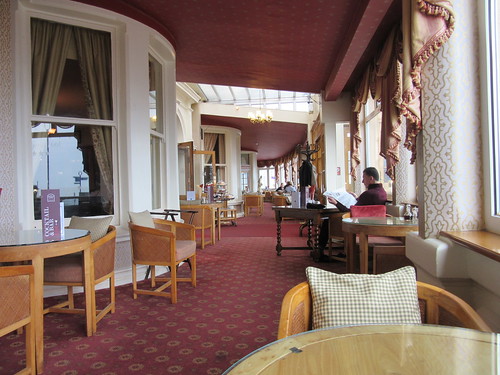 The Terrace at the Imperial Hotel.
I'd made a note of trains back to Wolverhampton in time to let me take a bus back to my village, so I reluctantly stirred myself from the Imperial and made the walk to the station, which took around ten minutes. The LNWR station buildings have been quite tastefully modernised, so I took a few pictures before joining the waiting train - a 3-coach 'Class 175' only going to Llandudno Junction before returning to Llandudno.
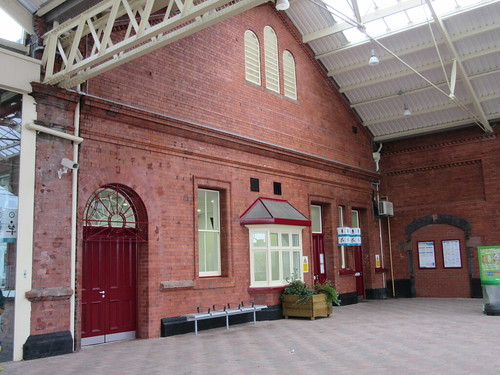 The modernised concourse at Llandudno station.
I boarded at the front of the train and noticed that the cab door was open, because the Driver was in the passenger section chatting to another railwayman. The friendly driver readily agreed to my taking a couple of pictures of the cab before he left.
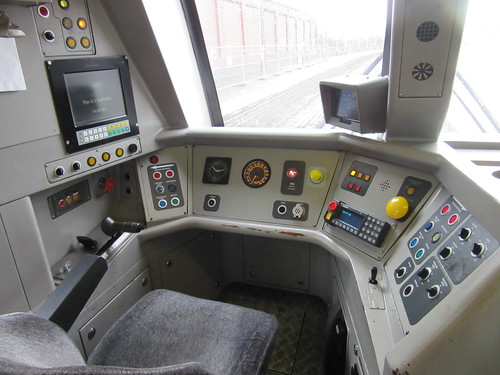 Cab View of 'Class 175' at Llandudno station.
This time, we paused at Deganwy and I took a rather grey picture of Conwy and its ancient castle as we departed. There's a bit about Conwy, its river bridges and castle in my post Trip to Holyhead (Part 2: Llandudno to Holyhead).
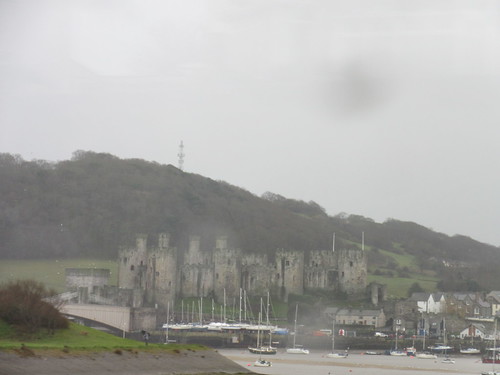 Conwy viewed from Deganwy.
I only had a few minutes to wait before my connection arrived - a 2-car multiple unit which made a few stops before Chester. Here, I had a choice - I could stay on the train which reversed at Chesterand took the former Great Western Railway route through Wrexham and Shrewsbury, calling at Wolverhampton before continuing to Birmingham International. The alternative was a Virgin Voyager service to Crewe, changing to a London Midland Electric Multiple Unit to Wolverhampton. The cheerful Welsh lady Conductor/Guard, having checked my ticket, used her portable ticket issuing machine to confirm the timings via Crewe. She recommended staying on her train, which would arrive at Wolverhampton only about five minutes later than the alternative involving two changes.
But, of course, with my allegiance to the "Nor'Wessie" and its successor the L.M.S., I chose to change at Chester and Crewe. Although I was getting fairly tired, I managed a few more pictures of the imposing station buildings at Chester, before boarding the 'Quiet Coach' at the rear of the Virgin 'Voyager' already waiting in platform 4.
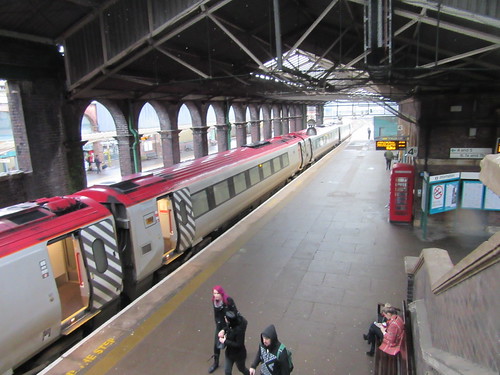 Virgin 'Voyager' from Holyhead to London at Chester.
Fortunately, the rest of the journey back to Wolverhampton worked well, the bus was on time, so I was back home happy but fairly exhausted. The next day, I was on the footplate at Peak Rail!
Book References
[ 1] '‘British Railways Layout Plans of the 1950’s - Volume 1: ex-LNWR main line, Euston to Crewe’ (Signalling Record Society) ISBN: 1 873228 00 7.
[ 2] ‘British Railways Layout Plans of the 1950’s - Volume 10: LNW Lines in North Wales, Chester and Wirral areas’ (Signalling Record Society) ISBN: 1-873228-12-0.
[ 3] 'An Historical Survey of Chester to Holyhead Railway Track Layouts and Illustrations' by V. R. Anderson and G. K. Fox (Oxford Publishing Co.) ISBN 0 86093 216 8.
[ 4] ‘Along LMS Routes’ by Bill Hudson, Volume 1 Central & Western Divisions (Headstock Publications) ISBN 0 9512793 4 3.
Related articles in this blog
A Trip to the Seaside (Part 1).
A Trip to the Seaside (Part 2).
Trip to Holyhead (Part 1: Crewe to Llandudno).
Trip to Holyhead (Part 2: Llandudno to Holyhead).
The Holyhead to Crewe Railway Line.
Llandudno.
Llandudno Railway Station.
My pictures
Stafford Area rail.
Crewe Area rail.
North Wales Line (Crewe - Llandudno).
Llandudno (pictures around the town).
In January and February, Peak Rail operates a winter timetable, running from Rowsley, through Darley Dale to Matlock Riverside. Riverside was Peak Rail's original Matlock terminus, before the extension to Matlock Town was opened in 2011 (described here). Riverside has run-round facilities (originally controlled from a ground frame released by the Single Line Train Staff and a set of hand points, now controlled from Matlock Riverside Signal Box) so the winter timetable can be operated by just one steam locomotive, running round its train at each terminus. This is like a proper branch line in the steam era so, although it's harder work, I prefer it.
The winter timetable was first introduced at the end of 2013, as I described in the posts Winter Timetable at Peak Rail and Peak Rail in early 2014.
A year later, in early 2015, I operated the winter timetable on a couple of days, as described in the post Rain, Sleet and Snow.
Events of 17th January 2016
It was snowing at home when I got up and it continued to snow on the journey. By the time I reached Peak Rail, the snow had stopped but everywhere was white over.
 Peak Rail in the Snow.
Mike S. the fireman and Jacob S. the cleaner reported nothing frozen up and, since the locomotive had been in use the day before, the locomotive was starting to steam. So, we didn't seem to have too much to complain about. I like to view our footplate work as a tribute to the real professionals who ran the nation's steam railways under almost unimaginable conditions in the past. In the post Rain, Sleet and Snow, in referring to an earlier trip under adverse conditions described here, I quote one of my sayings "Anyone can work on the footplate in good weather. It takes an engineman to do it in bad weather."
But I had to admire a group of military re-enactors who had spent the previous night in bivouac within the trees, with only small, canvas tents for shelter. As I arrived, they were just getting up and preparing a simple breakfast.
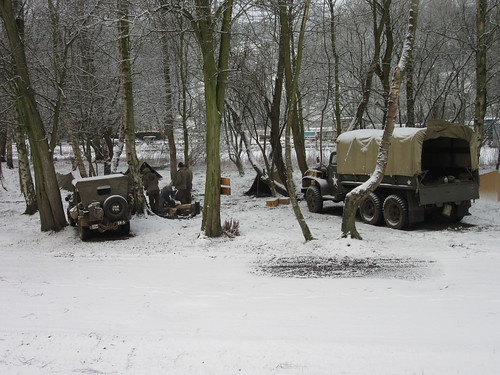 Peak Rail in the Snow: A group of military re-enactors after a night in tents.
After a number of years as a fireman, Mike S. had just started training to pass out for driving so I encouraged him to do most of the oiling-round and daily examination. It's important to be methodical, so as not to omit oiling points but the driver should try to keep an open mind during examination, looking for anything out of the ordinary, not just checking items by rote. Time spent at this stage will give the driver confidence that he can carry out the booked working without interruption.
Before working the service train, we had a one hour driving experience course booked so we came 'off shed' as early as possible to move across to the platform where we would pick up our trainee driver. The snow could affect both adhesion and braking but the locomotive was handling fairly normally. To reach the platform, we had to change a number of sets of points. Changing points ('knobbing up' is a common railway slang term) involves moving one switch rail away from the stock (fixed) rail and moving the other switch rail so as to fit tightly against the other stock rail. The two switch rails are tied together by a 'point stretcher' so both switch rails are moved at once. We didn't have icing conditions so the first operation, moving one switch rail away from the stock rail was fine, simply pushing loose snow out of the way. The second operation involves squeezing a switch rail against the stock rail which, when there's snow, usually compacts snow against the stock rail preventing the switch rail from 'fitting up' properly unless snow is first cleared away from the area involved.
The first two sets of points we changed were locally operated 'Hand points'.
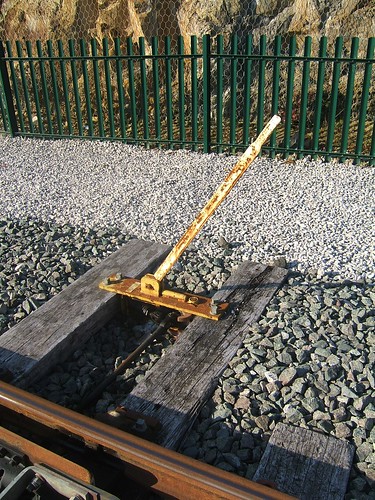
Typical point lever for Hand Points (at Matlock Town on Peak Rail).
Next, we had to 'reverse' the crossover leading to the single line which is operated from a Ground Frame released by the Single Line Token, move the locomotive onto the single line, replace the crossover to 'normal', retrieve the token and move down to the platform.
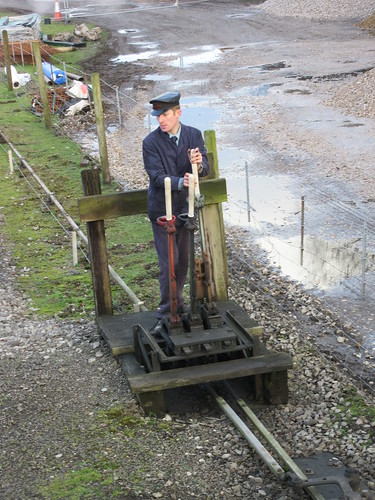
Jacob operating the South Ground Frame at Rowsley (on a day without snow!).
With all the snow clearing involved, it took a lot longer to complete the light engine move from the shed to the station than normal.
Apart from the safety issues of moving around on the ground in the snow, there are always important safety considerations when working near points - it's vital nobody has a hand or foot in the way when there's a chance somebody will attempt to operate them. With hand points, the lever is close by but with ground frames the lever may be some yards away, increasing the risk. Where points are operated from a signal box, the lever may be hundreds of yards away or, with power operation, miles away. Safety is achieved only by coming to a clear understanding with the person controlling the points before starting any work. There's a bit more information about British railway signalling in a series of posts starting here. In this series, Part 6 covers Mechanical Operation of Points.
We spent the next hour showing our driving experience candidate how to drive and fire a small locomotive.
The rest of the day was spent running four round trips to Matlock Riverside. I drove the first and last trips and let Mike drive the other two. Becoming a competent driver requires practice (and, I always say, 'fierce concentration').
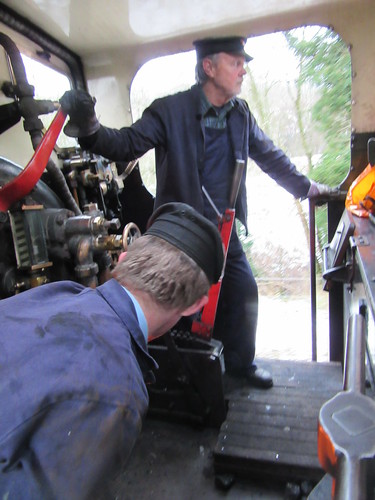
Returning to Rowsley bunker-first, with Mike driving and Jacob firing.
At the end of traffic, we took 'Lord Phil' back to shed for disposal after an enjoyable day.
Events of 24th January 2016
A week later, I was back at Peak Rail, this time without snow and with Phil M. as fireman. After a number of years as a fireman, Phil M. had also just started training to pass out for driving so I suggested that he did most of the oiling-round and locomotive examination whilst I assisted and provided hopefully helpful comments. Once again, we started with a 1-hour driving experience course which our trainee greatly enjoyed (as they usually do). I drove the first service train, let Phil drive the second and third, then I drove the last train before we came on shed to dispose. Another good day!
My pictures
Peak Rail in the Snow
Saturday, 3rd January 2016 was overcast and wet but I decided to made a trip to the rebuilt Birmingham New Street Station now that work was complete and the associated 'Grand Central' shopping centre was open.
Preparatory work on this major project was started in September 2009 and three and a half years later some of the the facilities were brought into use. With temporarily-narrowed platforms and limited access between the platforms and concourse level, I found passing through the station uncomfortable, as I reported in an earlier report here.
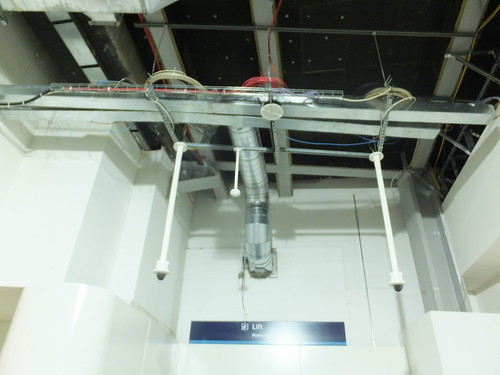 Birmingham New Street half-rebuilt in 2013. All the services are in but the false ceiling is still to be fitted.
After a further two years of relative misery, the station was fully opened on 24th September 2015, after an expenditure some sources estimate at 750 million Pounds Sterling. Incidentally, when they did put all the false ceilings in, it's in the form of a series of vertical panels with 'wavy' edges. It appears that "modern architects abhor a straight line".
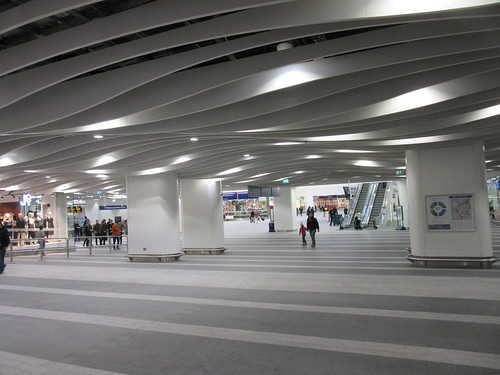 Grand Central, soon after fully opening, showing the 'wavy' false ceiling.
Birmingham City Council funded the rebuilding as part of the 'Gateway Plus' project but, in the meantime, a settlement of 1,100 million Pounds Sterling was awarded against the Council for equal pay claims. The National Exhibition Centre Group had already been sold for 307 million Pounds Sterling and now Grand Central is for sale.
Lead designer was Haskoll Architects and the site's 'Unique Selling Points' appear to be a reflective steel facade, a bigger concourse and, especially, 450,000 sq ft of shops. Back in 2012, the more modest claim was that the 'Pallasades' (the old shopping centre dating from when the line was being electrified) was being 'renamed'.
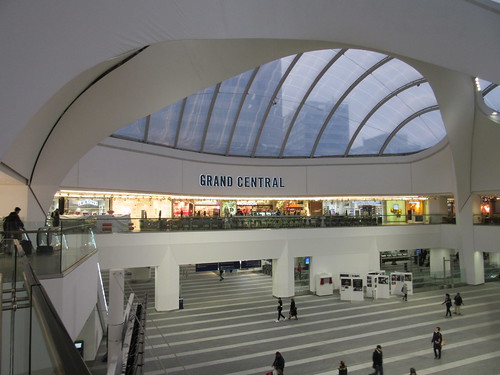 Grand Central, Birmingham New Street: The much-vaunted atrium over the main shopping area.
The railway station
The various street entrances now available and the larger concourse with escalators, lifts and stairs provided to the subterranean platforms are a distinct improvement but the 12 through platform lines are substantially unchanged. Since the station was rebuilt in the 1960s, there has been only one alteration to platforms - the creation of a short bay at the Wolverhampton end of platform 4 called platform 4c which is used by London Midland services.
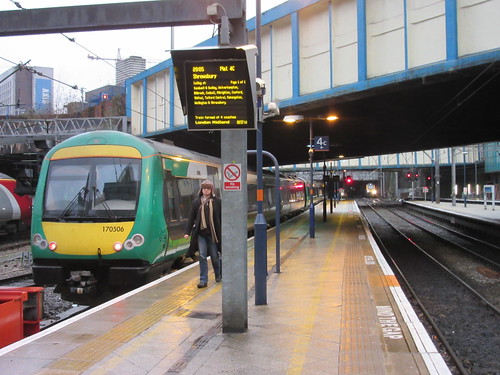 Birmingham New Street: North end of platform 4 with bay 4c (used by 'London Midland' trains) on the left.
The main platforms are as uninviting as before, apart from the escalators, lifts and stairs plus somewhat better lighting and a 'paint job'
 Birmingham New Street: Platform 4 looking south after the opening of Grand Central.
Perhaps I didn't see the outside of the station at its best (it continued to rain). The reflective steel facade is certainly striking in a 'gosh - an alien space-ship has just landed' sort of way, but it certainly didn't make me think "here's an exciting place to travel from - and I can shop, too!".
 Grand Central, Birmingham New Street: The pedestrian entrance coming from the Bull Ring direction.
I also looked at the Hill Street pedestrian entrance. Plenty of shiny metal embraces the station but the retricted sight-lines give a rather muddled appearance.
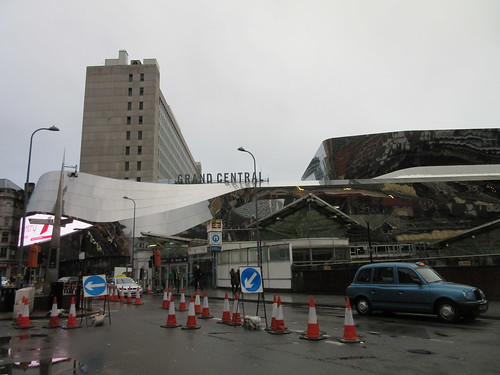 Grand Central, Birmingham New Street: View from Hill Street.
There's a little more on Wikipedia about Grand Central here. The history of Birmingham New Street Station is also outlined on Wikipedia here.
There's a typically 'bullish' report from Network Rail here about the redevelopment and their information pages on the station are here.
The 'Midland Metro'
The railway station will be accessible from 'Midland Metro' trams once the line is extended from the present terminus at Snow Hill, along Corporation Street to New Street station. The 127 million Pounds Sterling project should have opened in 2015 but February 2016 is currently being mooted. The tram line will then be extended past the Town Hall to Centenary Square.
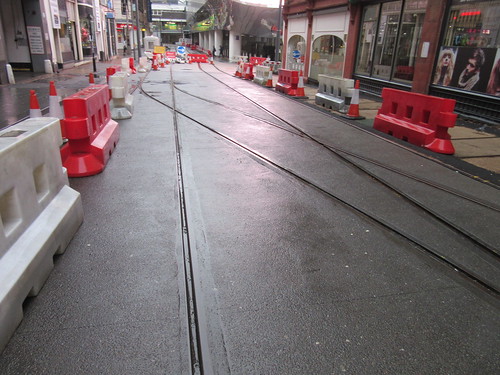 Grand Central, Birmingham New Street: The new tram lines in Stephenson Place, with the shiny cladding of the station on the right.
The real Grand Central
I couldn't resist this picture of the REAL Grand Central in New York, taken on my visit in 2007. There's a short report, with a link to my pictures, here, plus a bit on platform numbering here.
 The Concourse at Grand Central Terminal, New York.
Related posts on this website
Walsall by Rail ( when the station was 'half-rebuilt')
9:17 a.m. to Birmingham
My pictures
West Midland Railways.
Grand Central, Birmingham New Street.
Birmingham.
Book references
[01] ‘Birmingham New Street - Background and Beginnings’ by Richard Foster (Wild Swan Publications) ISBN 0 906867 78 9.
[02] ‘Birmingham New Street - Expansion & Improvement’ by Richard Foster (Wild Swan Publications) ISBN 0 906867 79 7.
[03] ‘Birmingham Railway Scene’ by C. C. Dorman (Town & Country Press).
[04] ‘Birmingham Railways in Old Photographs’ by Mike Hitches (Alan Sutton Publishing) ISBN 0-7509-0027-X.
[05] ‘New Street Remembered’ by Donald J. Smith (Barbryn Press Limited) ISBN 0 906160 05 7.
Click on any image below for an 'uncropped' view.
Dean had been given a birthday present piloting a flight simulator and I accompanied Ann and Dean to Birmingham Airport where SoftekSim had a 'shop' in the arrivals hall fitted with a simulator for a Beechcraft 'King Air' turbo-prop aircraft. I say "had" because, sadly, this facility closed at the end of January 2016 and it's not yet clear whether it will re-open.
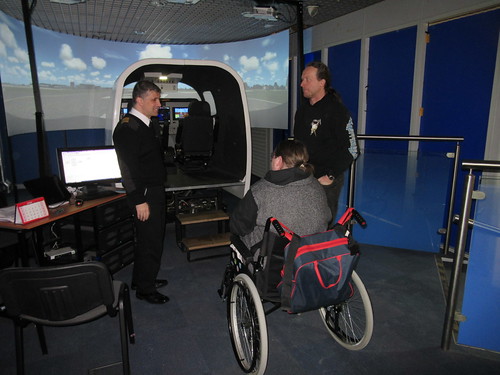 Flight Simulator: L-R: The Instructor, Ann and Dean.
I was surprised to discover that the simulator was built in Latvia by SoftekSim, who are based in Riga. Although I've been a passenger in a few Beechcraft aircraft, I've not been in the upmarket King Air which the simulator represented. This was a "glass cockpit" aircraft so all the basic flying instruments were on duplicate screens in front of the Pilot (left-hand seat) and Co-pilot (right-hand seat). A larger screen in the centre displayed map information together with a host of gauges. Together with all the flying and engine controls, a host of switches and alarm annunciators, it was all pretty impressive. A large, wrap-around display outside the cockpit showed the outside world and, we soon discovered, there was realistic sound and jacks provided the appropriate motion effects.
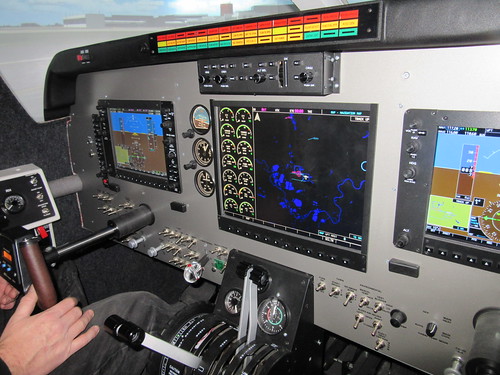 Flight Simulator.
Dean took the left-hand seat and I squeezed into the right-hand seat, just for the ride.
The first task was to fly from London Heathrow to London City Airport in good weather. The map display and the wrap-around display showed that we were just clear of the eastern threshold of the northern runway at Heathrow, so we were going to take off to the west on runway 'Two-Seven Right'. The instructor ran briefly through some start-up checks and then had Dean start the turbo-props, producing a reassuring roar from the sound system. Power was increased and Dean taxied out, turning left (using the rudder pedals to steer on the ground) onto the runway centreline. Set take-off flap and more power, then the take-off roll commenced. The instructor prompted 'Rotate' as we achieved take-off speed and the aircraft started to climb. The instructor called for a left-hand climbing turn and, at a safe height, take-off flap setting was retracted, power was reduced and we settled into level flight heading east towards our destination.
Then, suddenly, we were nose-down, plummetting towards the ground, with the wrap-around display showing the buildings getting larger and larger! "Not your fault" shouted the instructor, hitting the main reset. As we all laughed with relief the instructor explained that they were experiencing an occasional software fault on the simulator and we'd been unlucky. This, he said, was the reason the Birmingham Airport facility was being closed, whilst the software problem was addressed in Latvia. The simulator used three computers running 'Windows' so it took a little while to re-boot.
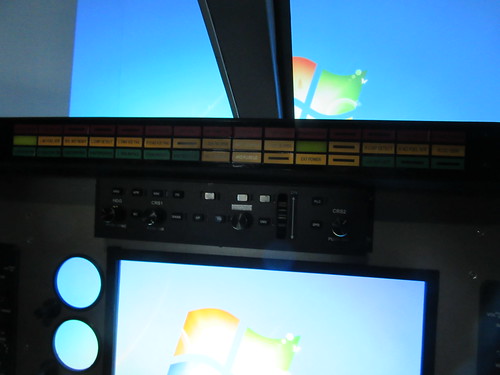 Flight Simulator: The familiar 'Windows' screen appears in the cockpit and 'outside' as the system restarts.
The instructor was able to position the flight at the point where the problem occurred and Dean was able to continue to 'fly' the aircraft. Overflying Canary Wharf, I had a good view of the 'O2' from my side.
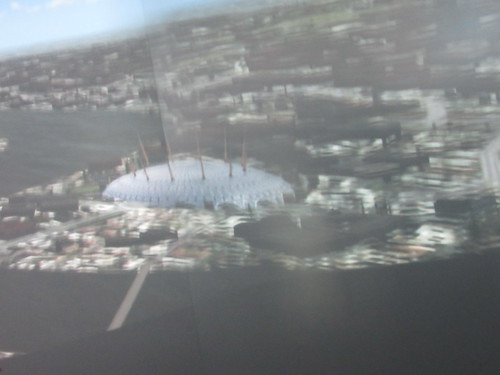 View of the 'O2' as we approached London City airport.
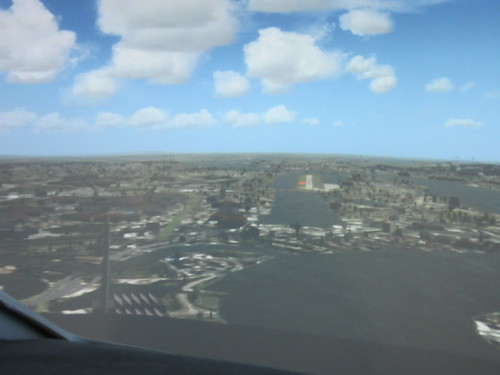 Flight Simulator: Approaching London City Airport. The 'grey' areas are water.
Dean safely 'let down' on the runway but had a bit of trouble steering on the ground (the 'yoke' controlling the ailerons are ineffective on the ground - only the rudder pedals work. We veered onto the grass and I was sure we we going to get a 'dunking' in the adjacent dock but Dean managed to stop just before we hit the chain link fence at the boundary. The instructor seemed quite impressed commenting "Any thing you walk away from is a 'perfect landing'".
There was time for Dean to make a second landing. This time, the instructor positioned the aircraft cruising up the valley between the mountains on the approach to Innsbruck International Airport in Tyrol, western Austria.
 Flight Simulator: The mountains around Innsbruck, Tyrol, western Austria.
This time, Dean was able to land and brake in a straight line, impressing everybody. I'm sure Dean would have happily done it all again, but the next customers were already waiting for their 'slot'.
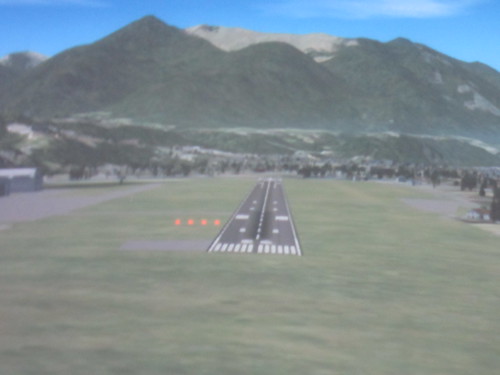 Flight Simulator: Coming in to land at Innsbruck airport.
Despite the 'hiccup' with the computers, Ann, Dean and I were very taken with the set-up and hope that SoftekSim will be able to resume operations in the future.
My pictures
Flight Simulator.
In the last few days I've made two trips to Coulsdon in Surrey for business meetings and it looks as if this may become a regular jaunt.
Click on any picture below for an 'uncropped' view.
Wolverhampton Station
Almost all my trips by rail start from Wolverhampton. I've always found the 'new' station building erected during electrification particularly dismal, so I've only just been persuaded to take a picture of the view which greets the passenger from the station approach road. All my Railway pictures around Wolverhampton station and in the West Midlands are here.
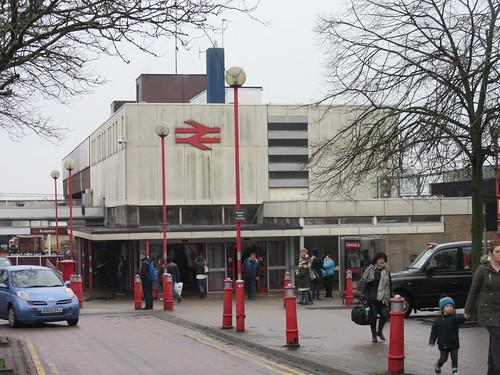 Wolverhampton Station.
The depression that the sight of this uninspired building invokes is usually quickly compounded by a sense of being 'fleeced' when purchasing a ticket (although nowadays I sometimes buy tickets on the internet in advance). On both of my recent trips, I was travelling on the 06:04 departure to Euston and on each day Virgin did get me to Euston within a few minutes of right time.
Events of 14th January 2016
On the first of these trips, when I arrived at Euston I decided to take a Victoria Line train to Victoria. This proved to be a mistake as a signalling failure south of Victoria meant that southbound trains were only going as far as Victoria before reversing. Because of this, we were held for a few minutes at both Oxford Circus and Green Park to allow earlier trains to sort themselves out.
At Victoria, I lost no time in heading for the Brighton Line platforms and was on the move quite quickly to East Croydon with just one intermediate stop at Clapham Junction.
I knew that I had to change at East Croydon but, in theory at least, I might still have been earlier into my destination, Coulsdon South, than by travelling via London Bridge. However, the time lost on the Victoria Line ensured that this was not the case.
When my meeting was over, I walked back to Coulsdon South Station and, whilst waiting for my train back to London, I conducted a quick photographic survey. Of the 'bus shelters' on both platforms, the less said, the better. But the inoffensive brick station building on the Up side had been quite nicely renovated and the ticket office was staffed so, overall, I was quite impressed.
 Coulsdon South Station.
One odd feature of the location of Coulsdon South station is the parallel Brighton main line a little over 100 yards away on which frequent fast trains (including the 'Gatwick Express' service) pass in both directions. This results from the rather curious origins of the history of these lines, outlined in Early railways around London below. The South Eastern Railway ended up sharing the London and Brighton metals to Stoats Nest (about one mile south of Purley station) then continuing on its own route through what is now Coulsdon South to Redhill.
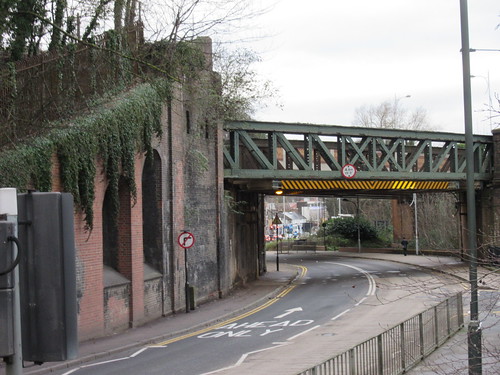 Bridge carrying the Brighton main line viewed from the road approach to Coulsdon South Station.
My train (a Bombardier 'Electrostar' Class 377) arrived on time and we made uneventful progress back to the still-being-rebuilt London Bridge, arriving at terminal platform 11.
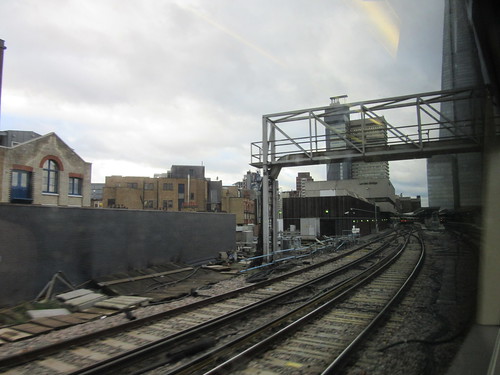 The rebuilt terminal platforms at London Bridge viewed from my arriving train.
I wrote about the rebuilding of London Bridge in August 2015 in the post Visiting former 'Southern' stations in London and there's a suitably upbeat article from Network Rail about the project here.
The arched roof flanked by glazed bays which stood over the terminal platforms for more than a century has, of course, gone. Each rebuilt platform now has umbrella roofing supported on substantial, fabricated rectangular pillars. For some reason, the roof itself is wavy. It's probably not necessary to comment that it didn't appeal to me.
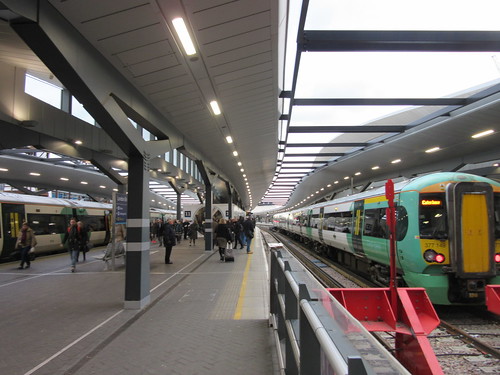 'Wavy' umbrella roofing on the terminal platforms at London Bridge.
However, the airy, light concourse area is a distinct improvement on the muddle of the former arrangements. But development is not scheduled to be completed until 2018 so intrusive 'retail opportunities' may yet damage the effect. Network Rail excitedly refer to "the huge concourse, natural light ... bigger than the pitch at Wembley Stadium".
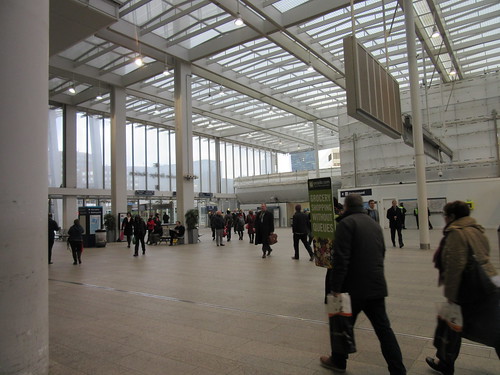 The new concourse at London Bridge.
It's quite a walk to the Underground station and, on the way, 'London Bridge Vaults' already presents a host of 'retail opportunities'. The Northern Line then conveyed me back to Euston to catch a 'Virgin' service back to Wolverhampton.
Events of 28th January 2016
This time, on arrival at Euston, I took a Northern Line (City Branch) train to London Bridge which allowed me to join the 08:30 Horsham service and arrive at Coulsdon South just after 09:00 - a better result than on the 14th January.
When my meeting was finished, I caught the first train back to London. This was a 'Thameslink' service to Bedford, booked to call at East Croydon and Blackfriars, omitting London Bridge because of the continuing remodelling there. After the East Croydon stop, we sped past the massive Selhurst Depot.
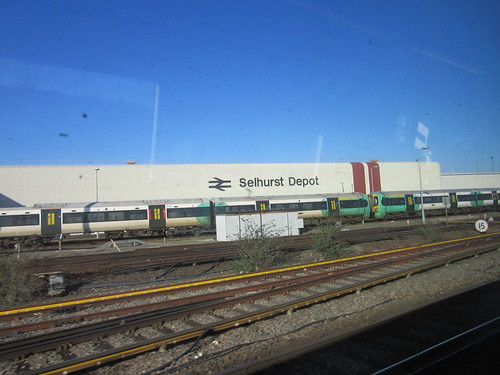 Selhurst Depot viewed from the Up London Bridge Fast.
We passed through Norwood Junction and turned left onto the Up Crystal Palace Spur. At this point signalling control changed from Three Bridges Area Signalling Centre to Victoria Area Signalling Centre. The train continued through Crystal Palace, Gipsy Hill and West Norwood at a very sedate pace.
I realised that we were traversing the route I'd taken in the opposite direction on 12th February 2014. This trip was described in the post Industrial Action. On that occasion, I'd used the 'Thameslink' service because the 'Tube' was on strike but my train was diverted away from London Bridge because of a 'Signalling Failure'.
After West Norwood station, we took the Up West Norwood Spur, to reach Tulse Hill South Junction.
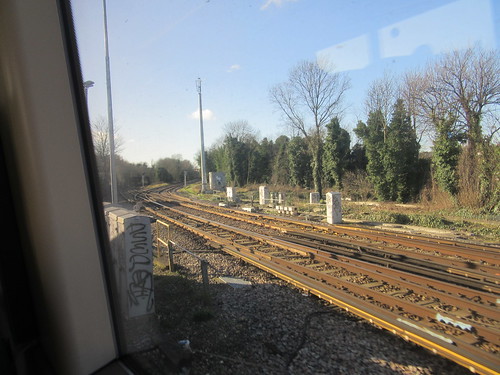 Tulse Hill South Junction, viewed from a train on the Up West Norwood Spur. The Portsmouth lines are in the centre, with the Leigham Spurs (leading to Balham) curving away to the right.
Having passed through Tulse Hill station, we continued our leisurely progress and turned left onto the Up Holborn line leading to Herne Hill. On my right, I was too slow to catch a picture of the splendid south portal of Knight's Hill Tunnel, but there's a little piece on the 'Southern E-Group' site here and a decent picture on 'Geograph' here.
At Herne Hill, the Chatham Lines joined on our right and, after the station, diverged on our left. Another mile took us to Loughborough Junction where the Brixton Spurs joined on the left, the Cambria Spurs joined on the right and we became four track through Elephant and Castle (Up and Down Holborn Slow, Up and Down Holborn Fast).
When we stopped at London Blackfriars, I was surprised when the driver shut-down the cab and restarted it. I wondered if some of the earlier slow running was related to a problem he was trying to clear. The re-built Blackfriars still offers views along the river. I was struck, once again, by just how ugly the re-development of Charing Cross station is (and it's up against some pretty stiff competition in London). At least the road side of the station and the concourse retains some dignity (see my picture album London Charing Cross Station).
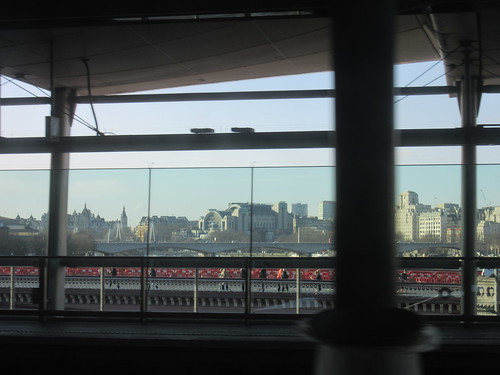 View from London Blackfriars station, looking upriver, with Charing Cross station in the centre.
The train continued to the gloom of City Thameslink. After a brief pause, we carried on to Farringdon, passing the brightly-lit Smithfield Sidings on our left before entering the platform where the driver switched the dual-voltage train to receive a.c. current from the pantograph for the remainder of the journey. Our next stop was St. Pancras International, where I left the train. I'd not noticed before that the Overhead Line Equipment through the low-level platform features a solid aluminium extruded beam, rather than the usual Contact wire.
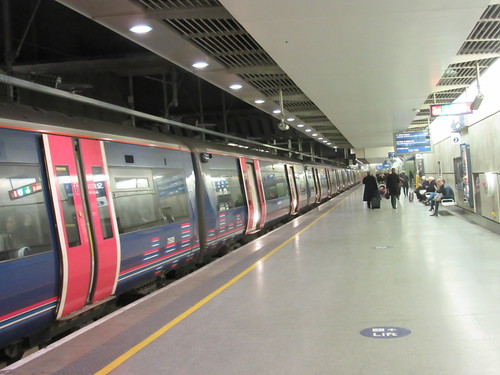 St. Pancras International.
I walked to Euston and was able to catch a 'Pendolino' to Preston via Wolverhampton. I tend to travel in the 'Quiet Coach' which usually means walking the length of the train at Euston as Coach 'A' is normally at the 'country end'. I'm happy to report that, once again, we made a right-time arrival in Wolverhampton.
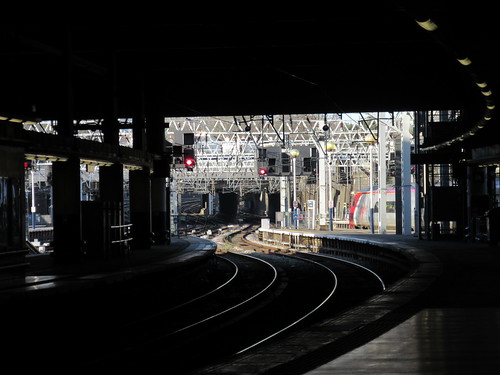 Euston: View from platform 7 looking towards Camden bank.
Early railways around London
The London & Greenwich Railway was opened throughout by 1838 with its London terminus at Tooley Street (now London Bridge). The following year, the London & Croydon Railway opened from West Croydon to a junction with the London & Greenwich Railway, sharing the Tooley Street terminus. In turn, the London & Brighton Railway opened throughout in 1841 from Brighton to a junction with the London and Croydon Railway, then sharing their lines to Tooley Street. The South Eastern Railway had obtained parliamentary approval for a line from London to Dover in 1836 but this railway was also to share the lines of the London & Greenwich Railway, the London and Croydon Railway and the London & Brighton Railway as far as Purley. Furthermore, the London & Brighton Railway was to build, at cost, the line on behalf of the South Eastern Railway from its junction with the London & Brighton Railway to Redhill. This line stayed quite close to the London and Brighton line and crossed under it to reach Redhill! After this rather tedious route out of London, William Cubitt then provided the South Eastern Railway with an almost dead straight main line from Redhill to Folkestone and Dover, with major intermediate stations provided with through lines for fast trains and platform loops for stopping trains.

Click on the map for a larger view.
1905 Railway Clearing House Map of lines in the vicinity of Coulsdon.
My pictures
These albums include pictures from these and earlier trips.
West Midland Railways.
London & Birmingham Railway.
London: former 'Southern' lines.
After 'Rocket' and 'Flying Scotsman' perhaps the best known locomotive is a fictional one - 'Thomas'.
BACKGROUND
'Thomas the Tank Engine' was created by the Reverend Wilbert Vere Awdry in 1946 as a character in the second book in his 'Railway Series' for children. The publishers engaged a professional artist to produce the book illustrations and the appearance of 'Thomas' was based on Billington's 'E2' class for the London, Brighton & South Coast Railway.
In 1979 Britt Allcroft arranged a deal to make the books into a television series which ultimately became popular all over the world as 'Thomas and Friends'.
Britt Allcroft saw the potential in video, toys and books and a franchising operation to exploit the 'Thomas Brand' was created. The Wikipedia post here has more information. It's believed that the Reverend Awdry became increasingly unhappy about the commercialisation of his creation. Britt Allcroft Company became Gullane Entertainment who sold the 'Thomas Brand' to HiT Entertainment after two years of wrangling. In 2005 Apax Partners acquired Hit Entertainment, selling the 'Thomas Brand' to toymaker Mattel in 2011 for a reported 680 million dollars.
Licensed Day out with Thomas events became popular on preserved railways in the U.K., as described in the section below, and in other countries but the increasing costs of mounting the event due to additional requirements imposed by HiT Entertainment resulted in many preserved lines discontinuing these events.
I'd not realised the extent of the interest in every aspect of 'Thomas' until I looked at the Sodor Island Fansite. There's all sorts of stuff out there - discussions of gender, race and class in the Reverend Awdry's work and forensic studies such as Henry the Green Engine.
'THOMAS' ON PRESERVED RAILWAYS
 'Thomas' at Shackerstone (Picture: The Sodor Island Fansite).
Over the years, I have driven 'Thomas' many times but, whisper it, not always the same locomotive. 'Thomas' seems to share with Doctor Who the ability to regenerate in a variety of forms. It's always been a six-coupled side tank, painted blue with the number '1' on each tank and with a cheeky face on the front but otherwise, there have been differences.
Birmingham Railway Museum, Tyseley
My first opportunity to drive 'Thomas' came when I was a volunteer driver at Birmingham Railway Museum. Tyseley held occasional 'Thomas' events, with 'Richard III' posing as 'Thomas'. This locomotive was a large Robert Stephenson & Hawthorn (7537 of 1949) built for the British Electricity Authority (which later became C.E.G.B.). In 1972 it entered preservation at Shackerstone on what is now known as the Battlefield Line. There's are more details of the engine and its history by Chris Simmons here. I enjoyed driving this locomotive a few times but there were frequent problems with firebox leaks. One day, when George was driving 'Thomas' (I can't remember what engine I was on), he showed me the most spectacular leaks which had developed in the inner firebox (which was noticeably 'quilted') and that was the last steaming, I'm afraid. That must have been some time in the 1990s. 'Richard III' is now back at the Battlefield Line undergoing a very protracted restoration.

'Richard III' (Photo: C. Simmons)
Peak Rail
In the 1990s, Peak Rail ran 'Thomas' events. I was there for at least one 'Thomas' weekend but I wasn't rostered to drive and don't remember which 'Thomas' had been hired in. Peak Rail decided that the 'Thomas' event licensing conditions had become too financially arduous and discontinued 'Thomas' weekends.
Battlefield Line, February 2004
I can't remember when I first became involved with 'Thomas' at the Battlefield Line but the earliest pictures I've found are from 2004, in the collection Thomas, Shackerstone, February 2004 using 'Coventry No. 1' (North British Works No. 24564) - a big industrial 0-6-0 side tank.
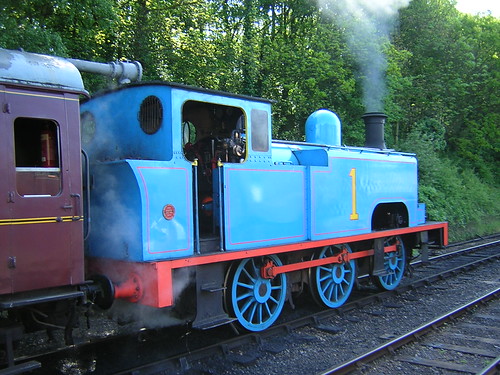 'Thomas' at the Battlefield Line in 2004 (formerly 'Coventry No. 1', North British works no. 24564.
Battlefield Line, May 2005
This time, 'Thomas' had acquired outside cylinders and was celebrating his 60th Anniversary. There are a few pictures here.
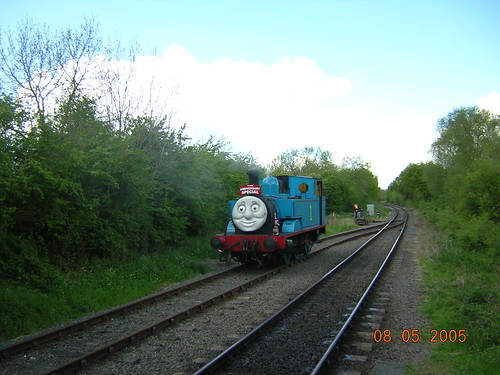 'Thomas' running round his train at Shenton.
Battlefield Line, May 2006
This time, 'Thomas' was played by a 3F 0-6-0T originally built for the L.M.S. as '7298' by Hunslet Engine Co. Ltd. (Hunslet 1463 of 1924). Between 1924 and 1931 a total of 422 locomotives of this class were built (all but 15 by private builders). There's a Wikipedia article here. They were usually called by railwaymen a 'Standard Shunt' or a 'Jocko' but, for some reason I've never divined, they were called a 'Jinty' by enthusiasts and modellers.
 7298, posing as 'Thomas', shows her classic Midland lines and an odd paint job (of course, the Somerset and Dorset 'Standard Shunt' engines were blue at one stage, but not that shade).
Battlefield Line, July 2007
I was re-united with 'Gothenburg' which I'd driven at East Lancs Railway many years before but the dignified dark green lined livery she'd had then was replaced by the cheerful blue of 'Thomas'. 'Gothenburg' was built by Hudswell Clarke and Company Limited (No. 630 of 1903) for the Manchester Ship Canal. All their locomotives were named after international seaports. For more information about this extensive railway system, see the book ‘The Railways of the Manchester Ship Canal’ by Don Thorpe (Oxford Publishing Co.) ISBN 0-86093-288-5.
There's a very short blog report here and my pictures of 'Gothenburg' are here.
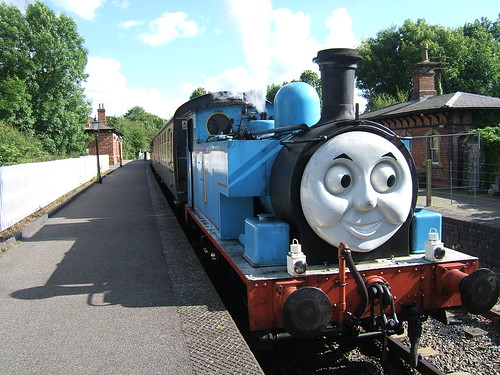 'Thomas' at Shenton ready to return to Shackerstone in July 2007 (actually Hudswell Clarke No. 630 of 1903 'Gothenburg').
Battlefield Line, 2008
In the early part of the season, 'Coventry No. 1' (North British Works No. 24564) posed as 'Thomas'. In July 2008, I had a couple of days driving 'Thomas' at the Battlefield Line and one day in 'Daisy', the diesel multiple unit. There's a report on the 'Thomas events here and there are pictures here.
Between August and October, 'Thomas' had 'morphed again'. A Hunslet Engine Co. Ltd. six-coupled industrial (No. 1873 of 1937) had been very effectively converted from a saddle tank to a side tank (with extended side tanks, just like Thomas). Two 'splashers' had been fitted over the leading wheels (again, just like 'Thomas') but they were purely cosmetic because the small coupled wheels were well clear of the foot framing.
 'Thomas' (Hunslet No. 1873 of 1937).
In theory, the extended tanks help to maintain a useful water capacity whilst allowing the driver more space to clamber into the motion for oiling. Despite my smile in the picture below, I found it very cramped and uncomfortable.
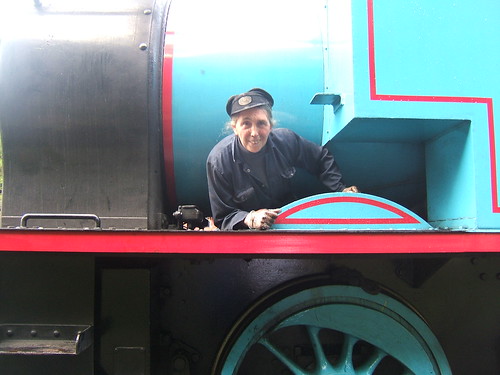 Preparing 'Thomas'.
There's a report on the October events in a short post here (which includes a video) and there are pictures here and here.
Battlefield Line, 2009
During June 'Thomas' was played by '47327', an ex-L.M.S. 'Standard Shunt' from Midland Railway Centre and during October by Hunslet No. 1873 of 1937 (as in the previous year). There's a report here.
Battlefield Line, 2010
This time, 'Thomas' was celebrating his 65th Anniversary. Once again, ex-L.M.S. 'Standard Shunt' 47327 performed the role of 'Thomas' as shown in the reports here and here. There are pictures here and here.
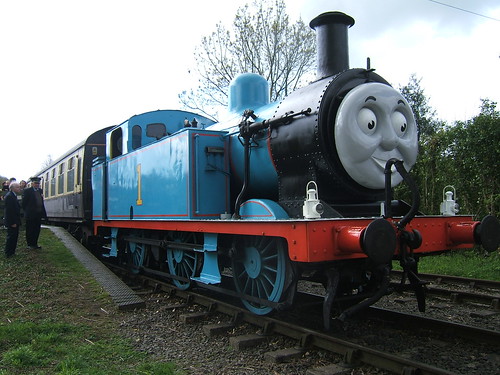 'Thomas' at Shenton, ready to return to Shackerstone on 3rd May 2010.
Battlefield Line, 2011
'Standard Shunt' '47327' returned as 'Thomas' for four days in June offering 'Day Out with Thomas' events. There's a report here and pictures here.
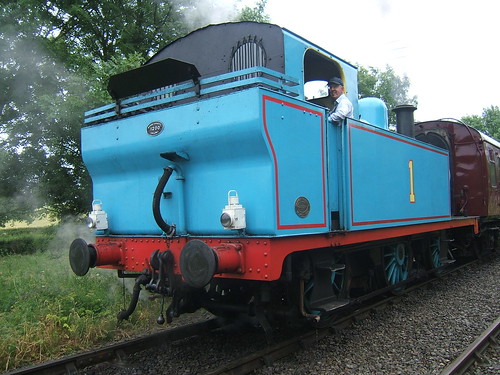 'Thomas' at Shenton, ready to return bunker-first to Shackerstone on 25th June 2011.
Museum of Science and Industry September 2011
MOSI first ran 'A Day Out with Thomas' events in 2010, whilst I was overseas. It was repeated in 2011 over four consecutive days, using 'Gothenburg' as 'Thomas'. I was the driver on 1st September 2011 and there's a report here with pictures here.
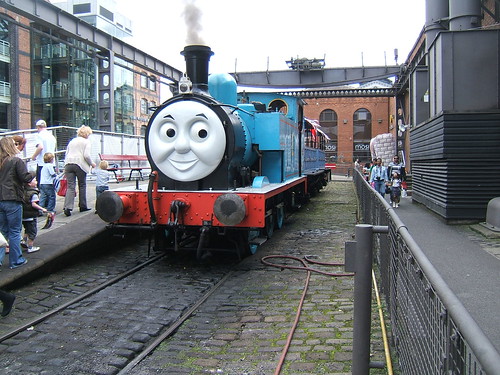 'Thomas' at MOSI in September 2011.
Battlefield Line October 2011
This time, 'Standard Shunt' '7298' returned as 'Thomas' for four days. I had one day driving 'Daisy' the Diesel Multiple Unit and one day driving 'Thomas'. There's a description in the post Day Out with Thomas: October 2011 and pictures are here.
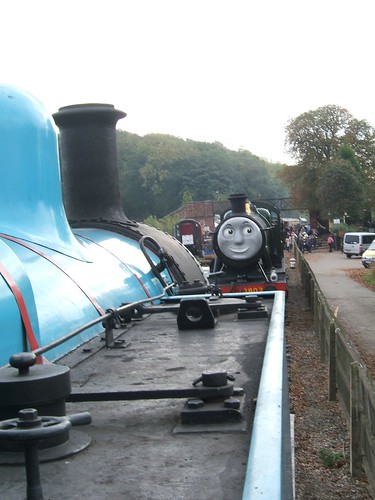
'Thomas' "head-to-head" with 3803 during shunting on 16th October 2011.
Battlefield Line May 2012
'Standard Shunt' '7298' was with us for the four days of the 'Thomas' event in April. On Sunday 22nd April I was on 'Daisy', on Saturday 28th April I was on 'Thomas' and on Sunday 29th April I was back on 'Daisy'. There are more details in the post 'Thomas' at the Battlefield Line.
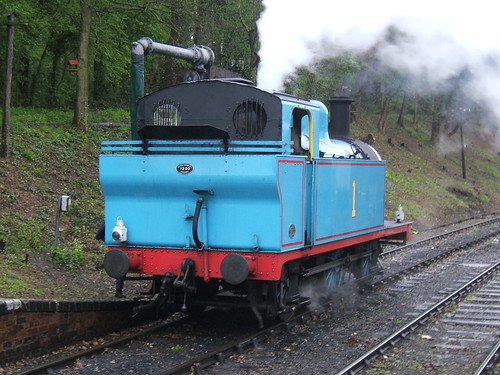 'Thomas' stands at the water column on platform 2 at Shackerstone.
Museum of Science and Industry August 2012
'Standard Shunt' '7298' visited MOSI as 'Thomas' for a four-day event. There's a report here and there are pictures here. I think that was the last 'Thomas' event at MOSI and recently I believe all railway operations here have been suspended.
 'Thomas' with his 2-coach train.
Footnote
There's an 'Austerity' 0-6-0 saddle tank called 'Wilbert' after the Reverend Awdry who created the 'Thomas' stories. I drove this locomotive at Peak Rail's 'Balzing Saddles' event described here. There's more information about 'Austerity' 0-6-0ST locomotives and 'Wilbert' here.
Summary of posts of 'Thomas' events on this website
You can find all my reports about 'Thomas' events here but I've listed these reports individually below:-
'Gothenburg'.
Day Out With Thomas 2008.
Day Out with Thomas.
Day out with Thomas: 2009 Battlefield Line, October 2009.
Happy Birthday, Thomas! Battlefield Line, April 2010.
Happy Birthday Thomas! (part 2) Battlefield Line, June 2010.
Day Out With Thomas - June 2011 Battlefield Line, June 2011.
'Thomas' visits MOSI MOSI, September 2011.
Day Out with Thomas: October 2011 Battlefield Line, October 2011.
'Thomas' at the Battlefield Line Battlefield Line, May 2012.
Day out with Thomas at MOSI MOSI, August 2012.
Summary of my albums of pictures of 'Thomas' events
Thomas, Shackerstone, February 2004.
Thomas, Shackerstone, 2005.
Day out with Thomas, October 2008.
Hunslet Works Number 1873 (as 'Thomas'.
2009-10-10 Thomas and Friends: 2009 (Oct 2009).
Thomas at 65 (Battlefield Line May 2010).
Thomas, Shackerstone, October 2010 (Battlefield Line).
'Thomas' - June 2011 (Battlefield Line).
'Thomas' 2011 (Battlefield Line).
Thomas at MOSI (2011).
Day Out With Thomas: October 2011 (Battlefield Line).
Day Out With Thomas: April 2012 (Battlefield Line).
Thomas at MOSI (2012).


