skip to main |
skip to sidebar
When I was young, my family started the tradition of having a day out by car on Boxing Day or thereabouts. My choice was always somewhere 'inappropriate', usually the seaside. We had more than one picnic in snowstorms. The idea still appeals to me but nowadays it's usually a trip by train, once our national rail network resumes some sort of service after the inevitable (and often over-running) major engineering works.
Events of 29th December 2015
In 2015, Christmas day fell on a Friday, so the official Boxing Day holiday was moved to Monday, 28th December. Bus and rail services were expected to resume on the following day but I thought it might be safer to defer any trip until Wednesday. However, following a wet, overcast and windy Boxing Day where I live (there had been serious floods in parts of the country), Tuesday was dry and wind-free so, on the spur of the moment, I left my home to catch the first bus of the day to Wolverhampton. Somewhat to my surprise, the bus arrived on time and made good progress to Wolverhampton.
I walked from the bus to the railway station (which is often now called the 'train station' - an Americanism I'm not fond of). Although I had an idea of my preferred destination, I asked the fares to three different places but, since the Booking Clerk knew me, she did not find the multiple enquiries unexpected. Whilst I understand a little about railways, the various ticket prices and restrictions which apply nowadays tend to defeat me. I sometimes book tickets on the internet but I always retain the suspicion that there is a better fare, if only I could work it out.
Regular readers will not be surprised at my decision to purchase a return ticket to Liverpool - it's a city which always attracts me and, if the weather became poor, there would be plenty of things to see indoors.
There was about 15 minutes to wait before the direct service but I was in time to board the earlier 'Virgin' 'Pendolino' service to Edinburgh, changing at Crewe. When running correctly, I admit to being impressed by the 'Pendolino' trains. We made the non-stop journey to Crewe in just over 30 minutes.
Crewe
Of course, on arrival at Crewe, I had to wait for the following 'London Midland' direct service to Liverpool to arrive but I'm always happy to wander round the station, principally looking at the architecture.
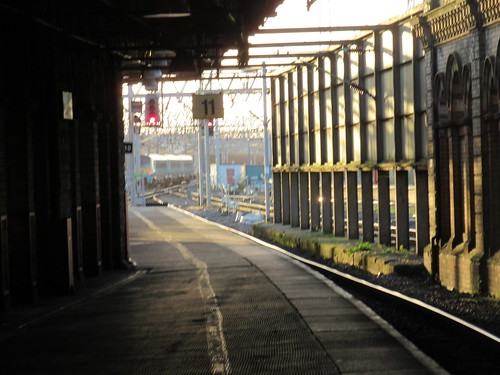 Crewe Station: View from platform 11 (former platform 3) looking south, showing LNWR screen. An 'Arriva Trains Wales' DMU is departing for Shrewsbury.
There are a number of earlier posts on Crewe, such as Crewe Station. There are also two collections of pictures which get added to from time to time Crewe Station Buildings: L&NWR and Crewe Area rail.
The 'London Midland' service to Liverpool arrived about 5 minutes late - the usual 4-car 'Desiro' Electric Multiple Unit. By the time all the waiting passengers had boarded, there were only a few seats left empty.
Crewe to Liverpool
We set off for Liverpool, stopping at Winsford, Hartford, Runcorn and Liverpool South Parkway. It's fairly hopeless trying to take pictures from modern trains with double-glazed windows and brightly-lit interiors but the collection Liverpool area rail has a number of pictures taken between Crewe and Liverpool.
On this journey, as we crossed the Dutton Viaduct over the River Weaver, the sky was blue and the sun was shining, making it hard to believe it was December and I decided I might have picked the right day for my trip.
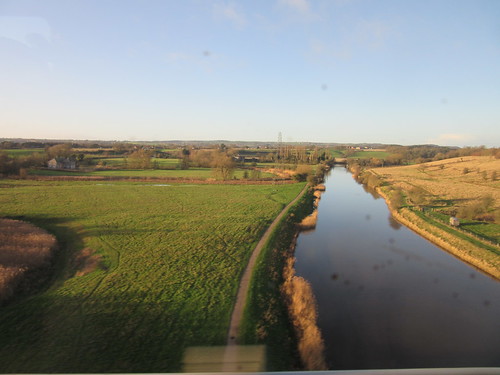 The view west as we crossed the River Weaver on the Dutton Viaduct.
At Weaver Junction, we left the West Coast Main Line to the north, diverging onto the Liverpool Line. The gradient diagram from Weaver Junction to Liverpool Lime Street is reproduced below. In steam days, firemen could be anxious as to whether they'd be able to generate sufficient steam to get over the next summit and then be able to re-fill the boiler. With powerful modern electric trains, the profile of the line is of less importance, although it's still necessary to understand how the gradient will affect braking at any point on the route.

Gradient diagram Weaver Junction - Liverpool Lime Street.
We made a brief stop at Runcorn, crossed the Manchester Ship Canal and the River Mersey on the three spans of the Runcorm Railway Bridge (built in 1868) and, after galloping past Ditton, Halewood and Speke, were soon making our stop at Liverpool South Parkway. I still can't get used to the huge, modern transport interchange here.
 Liverpool South Parkway.
A few more minutes took us past Mossley Hill and Wavertree to curve left on the approach to Edge Hill where we briefly joined the historic route of the 1830 Liverpool and Manchester Railway, now electrifed throughout. We then diverged from the route to the original Crown Street terminus to descend through the remarkable sandstone cutting to our final destination, Liverpool Lime Street. This cutting does not form part of the original 1830 line. Because of the commercial success of the Liverpool and Manchester Railway, in 1837 a double track tunnel, initially cable-worked, was constructed from Edge Hill to a new station at Lime Street. Continuing growth in traffic resulted in work starting in 1881 to open-out the 2-track tunnel into the four track cutting which remains in use today. There's a post with more information about the construction of the cutting here.
I've posted a video of a similar London Midland electric multiple unit passing through the cutting from Edge Hill to Lime Street on 26th March 2015. To view the video Click here. When you've viewed the video, you can use the 'Back Button' to return to this post. This video was made on the day I travelled to Irlam, for the Irlam Station Launch. The journey itself is described in the post By Train to Irlam but note that the section 'SIGNALLING FROM WOLVERHAMPTON TO LIVERPOOL is already out of date since (as anticipated) Wolverhampton Power Signal Box, Stafford No. 4 signal box and Stafford No. 5 signal box have now been abolished.
Liverpool
I'm always drawn to Pierhead, now marketed as part of Liverpool Waterfront. It's very different from my childhood memories, when there was the Liverpool Overhead railway, electric trams, steam locomotives fussing around on the dock lines, and frequent Mersey ferries coming and going across the river, but it still has the amazing river and retains a limited ferry service.
The Museum of Liverpool, 'Lion' and the Old Locomotive Committee
A modern addition to the area is the Museum of Liverpool which displays the 1838 locomotive 'Lion'. As I'm currently Secretary of the 'Lion' supporters' club 'The Old Locomotive Committee' (usually called 'OLCO'), I try to 'pay my respects' to the locomotive when I'm nearby.
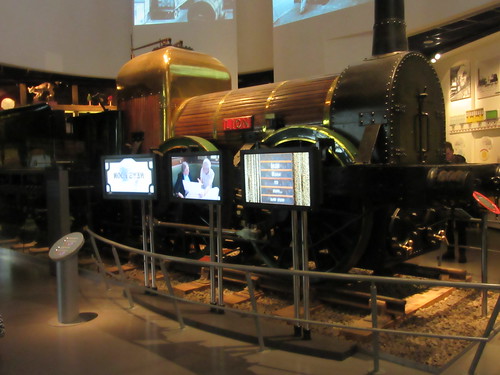 Museum of Liverpool: 'Lion'.
My introduction to 'Lion' and the activities of OLCO is here. All my posts about 'Lion' and OLCO activities can be found here.
OLCO has its own website dedicated to 'Lion' and models of 'Lion' here.
The Museum of Liverpool website has a page on 'Lion' here which includes links to two video interviews, 'Lion's Story' (with the Museum's Curator of Land Transport Sharon Brown) and 'Lion takes centre stage' (with two Officers from the Old Locomotive Committee, John Hawley the Magazine Editor and, ahem, Jan Ford the Secretary). 'Lion takes centre stage' is also available to museum visitors on the display screens next to the exhibit by pressing a button.
There's a short post on the making of 'Lion takes centre stage' here, more about the Museum of Liverpool and the way 'Lion' is displayed in the post Royal Visit to the Museum of Liverpool and a brief description of the complex Audio Visual Installations at the Museum here.
It's a great Museum and there were plenty of visitors enjoying the displays but I'm not a fan of the museum's modern architecture. Having checked that all appeared to be well with 'Lion', I walked to the nearby Mersey Ferry Building (another ghastly, modern affair) to board the next ferry.
 The Museum of Liverpool.
'Ferry cross the Mersey'
I was surprised at how many passengers were queuing for the eleven o'clock sailing, operated by the ferry 'Snowdrop', still in her 'DAZZLE' paint scheme I complained about in an earlier post here. The river was like a millpond, there was no wind and the sun beamed down on us as we made our crossing to Seacombe ferry terminal. It was such a glorious day, I decided to disembark at Seacombe and walk along the Promenade to New Brighton.
On Foot to New Brighton
The promenade from Seacombe to New Brighton looked inviting in the unexpected sunshine. There were a number of rod and line fishermen engaged in their hobby, together with joggers, dog-walkers, bicycles and casual walkers. There was the atmosphere of a seaside resort and, although Liverpool north docks were clearly visible on the opposite bank of the river, they didn't seem obtrusive.
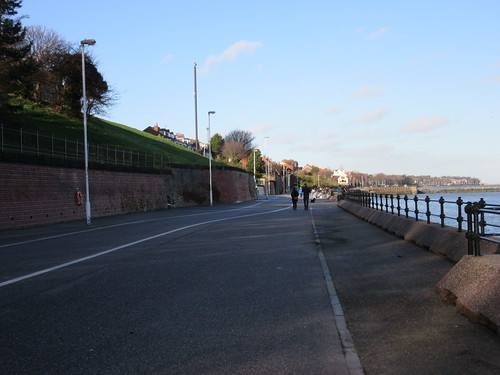 The Wirral: The start of the Promenade from Seacombe to New Brighton.
After passing the imposing bulk of Wallasey Town Hall (there's an article on its history here), I came to the traditional public house called 'The Ferry' at Egremont. In the picture below, you can see the first five massive new red-painted container cranes of the new 'Liverpool 2' port facility.
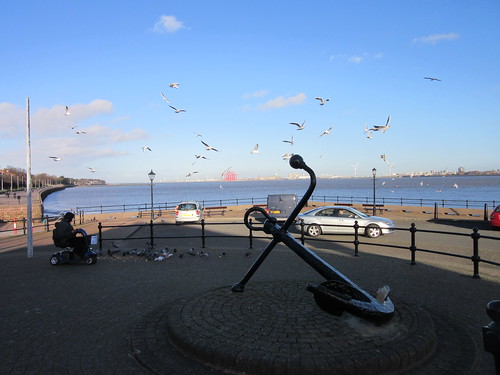 The Wirral: The Promenade from Seacombe to New Brighton at Egremont, looking seawards.
Egremont is also the location of Captain's View which not only has a first floor apartment you can rent but is the site of one of the Wirralcam web cameras.
Using the 'Wirralcam' site, you can observe shipping on the Mersey from anywhere in the world. Supplement the pictures with ship data and position information on the River Mersey page from Ship AIS and you have an addictive 'virtual reality'.
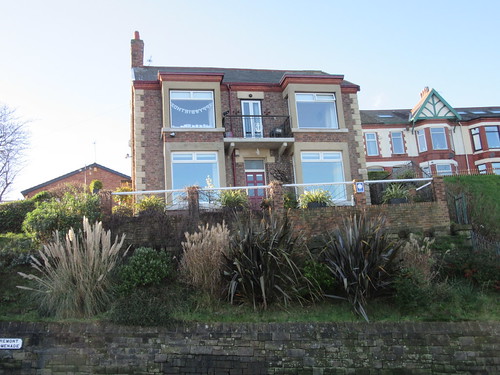 The Wirral: 'Captain's View', Egremont, viewed from the Promenade from Seacombe to New Brighton.
As I continued walking, I watched two tugs assisting a bulk carrier which was leaving the north docks stern-first. If you're interested, a telescope, binoculars (or the 'zoom' on a modern camera) can show a lot of detail.
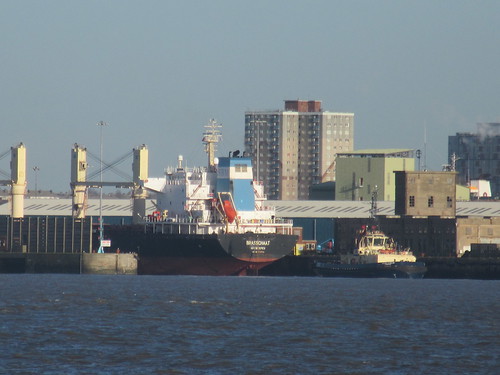 Liverpool Docks: Bulk Carrier 'Brasschaat' leaves the docks, stern first, assisted by two tugs.
As I continued, I passed the War Memorial for World War I which faces the river.
1914 - 1919
TO THE GLORY OF GOD
AND IN HONOUR OF THE
BRAVE MEN OF THIS BOROUGH
WHO SERVED IN THE GREAT
WAR AND TO THE LOVING
MEMORY OF THOSE WHO
MADE THE SUPREME SACRIFICE
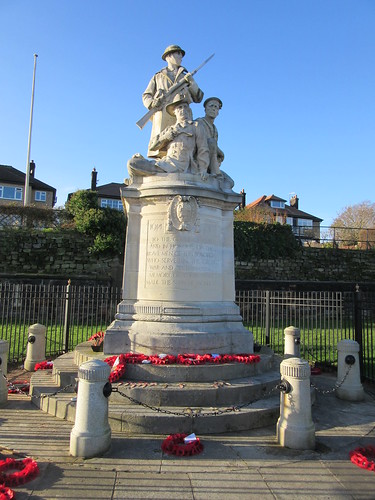
The Wirral: War Memorial 1914-1919 on the Promenade from
Seacombe to New Brighton.
Once having released her tugs, I was surprised at the speed with which 'Brasschaart' (operated by Sobelmar, Antwerp) headed for the Irish Sea. The picture below shows one of the two tugs posed in front of the Liverpool Bulk Terminal (briefly described in my post On foot around Liverpool Docks (3).
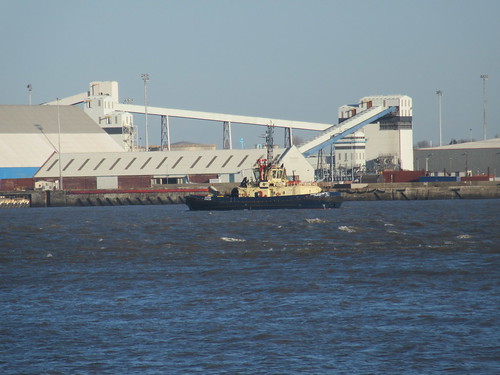 Liverpool Docks: Tug 'Svitzer Stanlow' after assisting 'Brasschaat', with Bulk Materials Storage conveyors in the background.
Quite unexpectedly, I came upon a 'pirate ship' made out of driftwood by 'PIRATES AT ART' (geddit?). I'm normally immune to Art Installations but I found the 'Black Pearl' charming. I saw a number of parents watching their children as they went inside the hull and climbed up to the deck. A very gentle 'Health and Safety' warning was posted on the promenade.
PIRATES AT ART want you to enjoy this Art installation. As it is an open access piece of work we ask you to take responsibility for yourself and those in your care. Please supervise your children at all times.
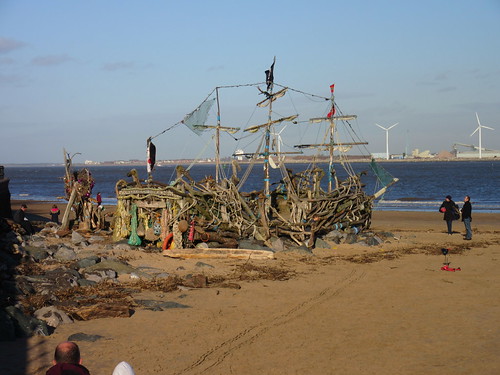 'The Black Pearl' New Brighton.
As I approached New Brighton, the size of the five massive new red-painted container cranes across the river at the 'Liverpool 2' terminal became more apparent. With the booms horizontal (as in the picture below) each stands over 300 feet tall and weighs 1600 tonnes. What I find more amazing is that all five cranes arrived fully assembled carried on a single ship 'Zhen Hua 23' after a 18,000 mile journey from Shanghai. The arrival, in November 2015, is described in SHIP-TO-SHORE CRANES ARRIVE.
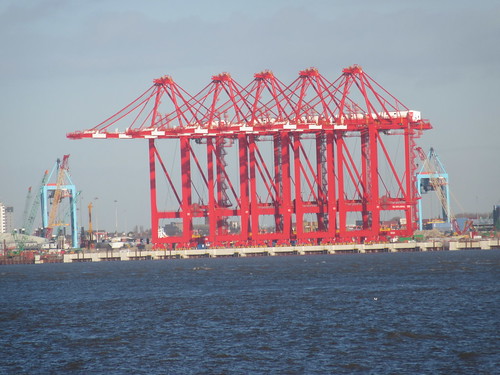 Liverpool Docks: The first five Container cranes at 'Liverpool 2'.
By the time I reached Fort Perch Rock, I decided I'd nearly had enough walking, so I walked inland along Victoria Road towards the railway station.
 New Brighton: Fort Perch Rock, with the lighthouse in the background.
By rail to Hamilton Square
On the way to the station, I paused at a Fish and Chip shop to buy a can of soft drink and a very generous portion of chips. I soon reached the railway station and managed to finish my chips before boarding the electric train to Birkenhead Hamilton Square. There's a little about this line and its origins here.
'Resurgam'
A short walk took me from the station to the Woodside Ferry Terminal. With a few minutes in hand before the arrival of the ferry to Liverpool, I decided to have a better look at the replica of an early submarine displayed outside the terminal. It is a full-size replica of 'Resurgam' built by trainees of Rathbone C.I. in 1997.
The Rathbone family were merchant traders with a social conscience who were founding members of the Liverpool Committee for the Abolition of Slavery. Rathbone C.I. was formed in 1995 by a merger of Rathbone educational charity work with a similar charity - Community Industry.
A brass plate on the replica gives a brief history of the original vessel:-
RESURGAM
Built in 1879 by J. T. Cochrane, Cleveland Street, Birkenhead
Designed by Reverend George Garrett (1852-1902)
"RESURGAM" - Latin for "I shall rise again"
This is a full-size model of one of the first submarines ever built. She was designed by Reverend George Garrett, a curate in Birkenhead who was a trained chemist. The construction was of iron and wood, 45 feet (14m) long, 10 feet (3m) in diameter and weighing 330 tons; she cost £1,538 to build. She was powered by a closed cycle steam engine and crewed by 3 men.
Trials in the East Float of Birkenhead Docks and at sea showed that she did sail and submerge, if only briefly. This was the first vessel to be successfully propelled mechanically underwater.
On her way to Portsmouth for a demonstration to the Royal Navy in February 1880, she sank in a storm 15 miles off Rhyl. The wreck was only found in 1995.
The model was built by AMARC trainees in 1997 and was refurbished in 2009 by the Maritime & Engineering College North West, Monks Way, Birkenhead.
There's more information in the Wikipedia article Resurgam.
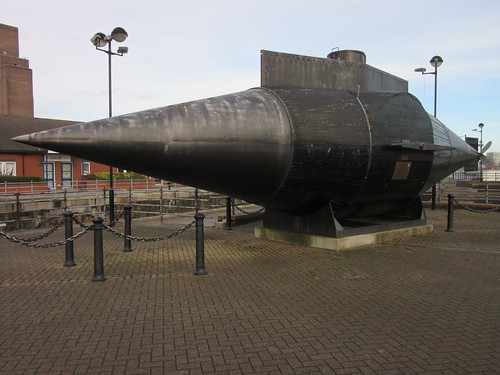 Replica of 'Resurgam' outside Woodside Ferry Terminal.
By Ferry to Pierhead
The ferry 'Snowdrop' arrived as scheduled from Seacombe but it took a short while to tie-up as a wind had started up and the river was far more lively than on my earlier crossing.
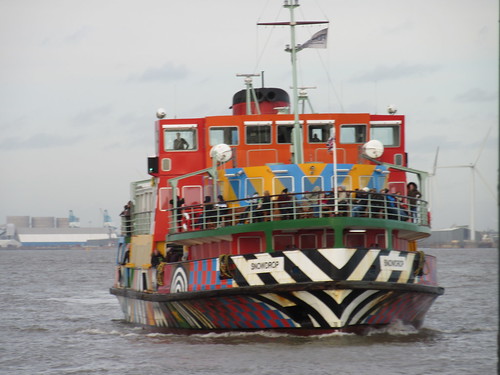 Birkenhead: 'Snowdrop' approaching Woodside Ferry Terminal.
The short trip back to Liverpool gave views of the Cammell-Laird Shipyard (website here) and RFA 'Fort Austin' which I believe arrived on the 29th June 2015. She is one of two Fort-class 'Solid Support Ships' (formerly called 'Fleet Replenishment Ships'). On 8th February 2014 I'd seen her sister-ship 'Fort Rosalie' in the Cammell-Laird Ship Repair Site in Birkenhead's West Float (reported here).
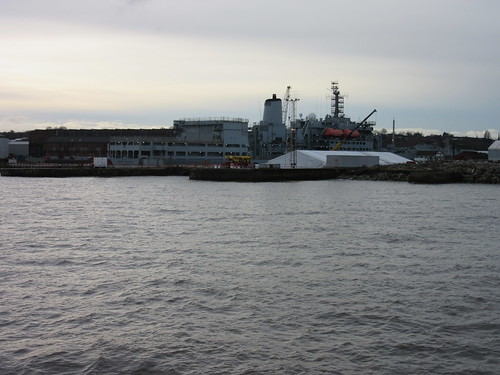 Birkenhead: RFA 'Fort Austin' in Cammell-Laird Shipyard.
Beyond 'Fort Austin', I saw 'Go Pegasus' which forms part of the fleet of Singapore-based Otto Marine. Constructed at Otto Marine's Batam yard in Indonesia, 'Go Pegasus' is Norwegian designed and DNV-classed as an Anchor Handling Tug Supply (AHTS) vessel. With a 24,000 b.h.p. power unit, it is suitable for work in harsh environments and is equipped with Dynamic Positioning 2 (DP2) capabilities. Dynamic Positioning is described in a Wikipedia article here. DP1 systems are essentially simplex, DP2 are dual-redundant with voting for higher reliability and DP3 uses three sytems with other features. There's a graphic comparison of the system layouts in a Marine Technologies PDF here.
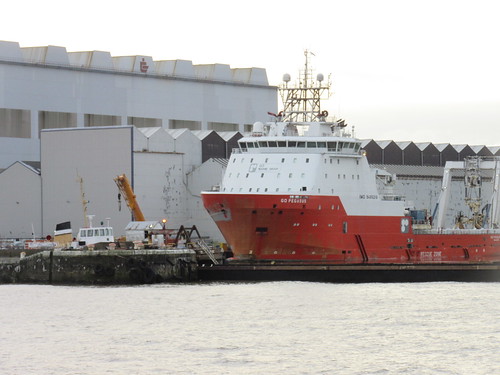 ' 'Go Pegasus' in the Cammell-Laird Shipyard.

This aerial view of the shipyard appeared on the Cammell-Laird site.
Whilst my attention was drawn to the shipyard, I hadn't noticed that we were being overhauled by a tanker heading upstream, probably to Stanlow. 'Stolt Redshank' (registered in Cardiff) is one of a large fleet of regional tankers, all named after birds, operated by Stolt-Nielsen Inter-Europe Service. This regional operation is part of the larger company Stolt-Neilsen Limited, founded by Jacob Stolt-Neilsen (1931-2015) in 1959 with one chartered ship.
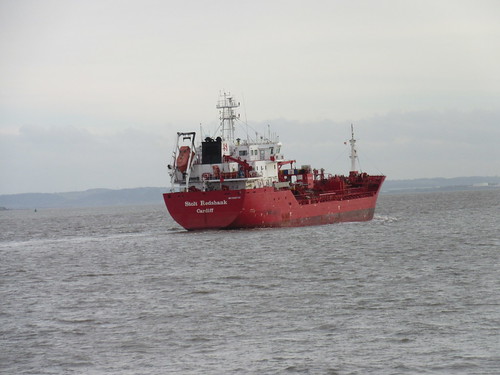 'Stolt Redshank' heads upstream.
As our ferry manoeuvred towards Pierhead, another tanker heading upstream passed us. 'Aragonith' is an oil/chemical tanker operated by 'UNIBALTIC', a shipping company set up in Poland is 2003 with an informative website here with details of its fleet, including 'Aragonith'.
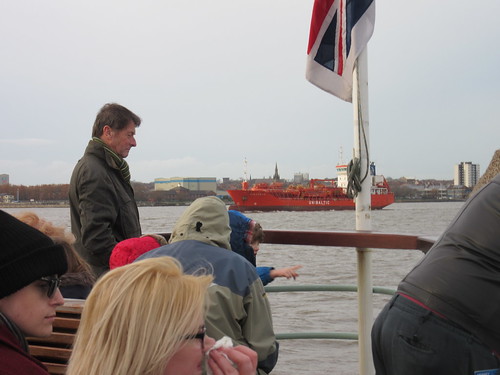 'Aragonith' heads upstream as 'Snowdrop' approaches Pierhead.
Homeward Bound
By the time I'd disembarked from 'Snowdrop', I thought I'd had sufficient exercise so I walked to James Street station and caught the next electric service to Lime Street. I was in good time for the hourly 'London Midland' service to Birmingham so I headed for home after an interesting (if tiring) trip.
Related posts on this website
There are all sorts of posts about Merseyside including:-
Birkenhead and New Brighton by train (Part 1).
Day Trip to Southport and Liverpool (Part 2).
More Merseyrail.
On foot around Liverpool Docks.
Preston to Liverpool by Rail.
My pictures around Merseyside
Liverpool.
Liverpool Docks.
Birkenhead and its Docks.
The Wirral.
New Brighton.
Liverpool area rail.
Merseyrail.
[Link to Cammell Laird updated: 7-Feb-2017]
Early 0-6-0 tank locomotives of the G.W.R.
Early six-coupled tank engines produced by the Great Western railway varied considerably in design from lot to lot. The complex history is meticulously chronicled by Jim Russell in his book [reference 1]. All of these locomotives were provided with saddle tanks and many were outside-framed.
At least one G.W.R. inside-framed saddle tank of the period survives - '813' which is described in more detail below.
Introduction of pannier tanks
From 1911 onwards, as these saddle tank locomotives entered the works for heavy repair, pannier tanks progressively replaced the saddle tanks. The pannier tank is an ingenious way of solving the problem of storing water on locomotives without a separate tender. I discussed this in the post Water, water, everywhere.
Collett's '57XX' class
The ubiquitous 'Pannier Tank' with 4 ft. 7.5 in. diameter wheels which I remember from the steam era was introduced by Collett in 1929, as a replacement for the elderly stock of 'Pannier Tanks'. The initial build as the '57XX' class was based on the earlier '27XX' class after rebuilding with pannier tanks. When the last batch of 'Pannier Tanks' was built in 1950, 'Pannier Tanks' (including variations) totalled 863 locomotives.

Whilst the leading and driving axles had leaf springs, the trailing axle had a dual coil springs on each wheel, which stood up into the cab, making the fireman's job a little harder.
The Great Western didn't build all the 'Panniers' itself and batches were sub-contracted to private builders. For instance, Birmingham Railway Museum's Pannier Tanks 7752 and 7760 (shown below) were both built by North British Locomotive Company Limited in 1930. There's a short article on North British here.
Preserved 'Pannier' 7752 at Tyseley (Photo: Birmingham Railway Museum).
The design survived because of its practicality. Although officially designated as a 'light goods and shunting engine', they were very versatile - my friend John frequently makes fun of me for my off-the-cuff remark once when being interviewed for a railway video that "You can do anything with a Pannier".
There's a detailed history of the '57XX' class on Wikipedia here and in the Great Western Archive pages Introduction and Details of Allocation.
Collett's '54XX'/'64XX'/'74XX' classes
In 1932, 'Pannier Tanks' with 5 ft. 2 in. diameter wheels, 165 p.s.i. boilers and fitted for 'Auto Train' working were introduced, as a replacement for similar elderly locomotives. The '54xx' class had 25 members. A further batch of 40 locomotives, also 'Auto' fitted, were produced with 4 ft. 7.5 in. diameter wheels, forming the '64XX' sub-group. Finally, between 1936 and 1950, 50 locomotives of the '74XX' group were constructed with boilers uprated to 180 p.s.i. but not 'Auto' fitted.
There's further information on the '54XX' class and the sub-classes in Wikipedia here and in the Great Western Archive pages Introduction and Details of Allocation.
6412, 6430 and 6435 have been preserved.
Collett's '1366' class
In 1934, six 'Pannier Tanks' with 3 ft. 8 in. diameter wheels and outside cylinders were built to replace life-expired types for dock and similar shunting.
There's further information on the '1366' class in Wikipedia here and in the Great Western Archive pages Introduction and Details of Allocation.
1369 has been preserved and there is a detailed history of this locomotive here.
Hawksworth's '94XX' class
The story goes that the Chairman of the G.W.R. Sir James Milne (1883-1958) had decided that a more modern design of locomotive was required for bringing empty coaching stock into Paddington to promote the proper corporate image to passengers as they joined their train. Certainly, Collett's '57XX' locomotives then in use, with a large dome and cast chimney appeared to be from an earlier era.
Accordingly, Frederick Hawksworth, the Chief Mechanical Engineer, was tasked with producing a suitable design. Hawksworth used the cylinder design and boiler from Collett's successful 2251 class. Swindon Standard Boiler Number 10 was a tapered, domeless Belpaire boiler pressed to 200 p.s.i. with a sloping grate of 17.4 square feet area.
I love the story but don't know if it's true. Certainly, James Milne was opposed to nationalisation of the railways and, when the G.W.R. was nationalised after World War II, he declined the offer of the chairmanship of the Railway Executive of the British Transport Commission which would run the nationalised railways, instead taking retirement.
Swindon managed to produce the first ten '94XX' locomotives prior to Nationalisation in 1948. In the post The End of an Era I talked about the Nationalisation of the railways in Britain in 1948 and the subsequent building of 999 steam locomotives of various modern designs, intended to help to unify the former 'Big Four' railways into a single unit. However, in what may be seen as a final act of defiance, the Great Western Railway placed an order with private contractors for 200 more of the '94XX' class, leaving British Railways to pick up the bill.
There's more about the '94XX' class in Wikipedia here and in the Great Western Archive Introduction and Details of Allocation.
Hawksworth's '15XX' class
This was a remarkable Hawksworth design to conclude the 'Pannier Tank' story. It adopted some of the '94XX' design and used the same Swindon Standard Boiler Number 10 but featured a short wheelbase, two outside cylinders and Walschaerts motion! Ten were built at Swindon, post-nationalisation, in 1949 and all had a short working life. '1501' is preserved.
There's more about the '15XX' class in Wikipedia here and in the Great Western Archive Introduction and Details of Allocation.
Hawksworth's '16XX' class
Between 1949 and 1955. 70 off of this 'Pannier Tank' were built at Swindon. With 4 ft 1.5 in diameter coupled wheels and height kept to an minimum, they could work on routes with low clearances but their working life was short. One locomotive,'1638', was preserved.
Wikipedia has details here and the Great Western Archive pages has information on Introduction and Details of Allocation.
Saddle Tank '813'
'813' was not actually G.W.R.-built. She was built by Hudswell Clark in 1901 for the Port Talbot Railway and Docks Company. The G.W.R. operated this line for the Port Talbot company from 1908 and finally absorbed the company in 1922. This locomotive served the G.W.R. for some years (acquiring various 'Swindon' features) before finally being sold off in 1934. There's a more detailed history of this interesting survivor on the GWR 813 Preservation Fund website here.
When this locomotive visited The Battlefield Line in 2007, I had a couple of enjoyable days driving her. There's a brief report here. The rather lop-sided headboard 'Greendale Express' visible in the picture below was carried during a 'Postman Pat' weekend. If you know as little about Postman Pat as I do, the Wikipedia article here is a useful primer.
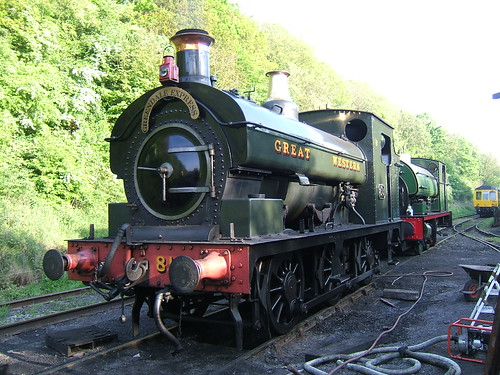 '813' being prepared at Shackerstone on 5th May 2007.
I've worked on six preserved 'Pannier Tanks', listed below:-
7752
I've driven this 'Pannier' many times, on passenger trains, demonstration freight trains and supervising Driving Experience Courses at three locations: Birmingham Railway Museum (as it was then), the Battlefield Line and the Avon Valley Railway. She's always been in green Great Western Railway livery.
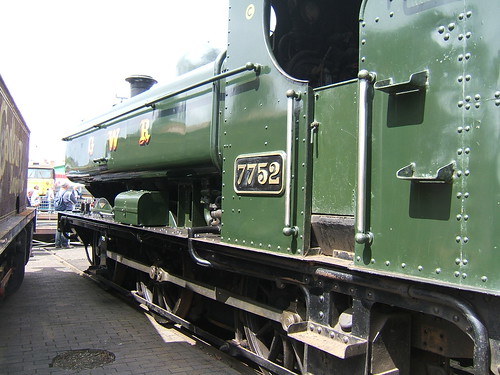 7752 displayed on the Turntable at 'Tyseley 100'.
There's a detailed history of this locomotive on the Tyseley Locomotive Works website here.
7760
I've driven this 'Pannier' many times, on passenger trains, demonstration freight trains and supervising Driving Experience Courses at both Birmingham Railway Museum (as it was then) and the Battlefield Line. The locomotive has been in both green Great Western Railway livery and red London Transport livery (as L90).
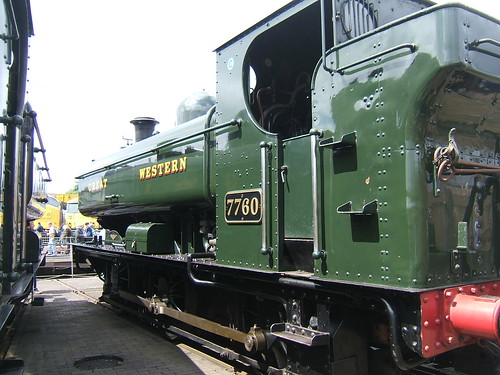 7760 displayed on the Turntable at 'Tyseley 100'.
There's a detailed history of this locomotive on the Tyseley Locomotive Works website here.
9600
Built 1945 at Swindon in the final form with enlarged cab and larger, rectangular spectacles. I've driven this 'Pannier' a number of times at Birmingham Railway Museum (as it was then), always in British Railways lined black livery .
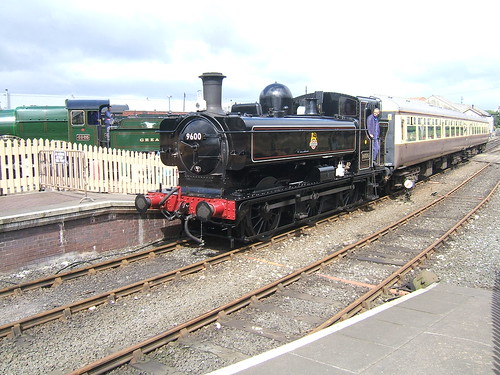 9600 on a passenger train at 'Tyseley 100'.
There's a detailed history of this locomotive on the Tyseley Locomotive Works website here.
5764
I've worked on this locomotive once, when I was invited fire a round trip on the Severn Valley Railway - I think it was in 2004. I believe she was withdrawn from traffic in 2011 and is currently in store awaiting restoration.

5764 at Bewdley in 2008 (Photo: Peter Broster via Creative Commons).
5786
I've enjoyed one day driving this 'Pannier' in October 2010 at the Battlefield Line. I think the unlined black livery with the early totem suits the locomotive (not so sure about the face for 'Day out with Thomas'). This locomotive was preserved by the Worcester Locomotive Society in 1969 and there's more information on the South Devon Railway Association site here.
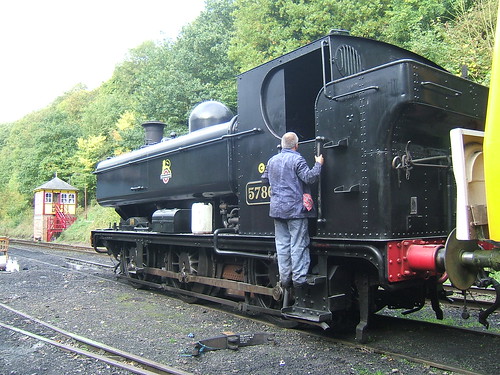 5786 being prepared for duty at Shackerstone in October 2010.
9466
I've driven this 'Pannier' a number of times, always in green Great Western Railway livery, on passenger trains at the Battlefield Line.
green at the Battlefield Line. I think the last time was in 2008. This locomotive was built by R. Stephenson in 1952 as their works number 7617 (so the G.W.R. livery is historically incorrect). This engine is kept in immaculate condition, is fitted with a speedometer, AWS/TPWS and an OTMR (Automatic Warning System, Train Protection and Warning System, On Train Monitoring Recorder) and is approved for running on the National Rail Network.
Although they were certainly capable engines, most of the former British Railways enginemen I've spoken to still preferred the earlier Collett '5700' design. One particular problem drivers complained about was that because the design used the '2251' boiler and wider cab, the driver's brake valve ended up too far 'inboard' for the driver to operate it conveniently when leaning out whilst closing up to vehicles. This was fixed with an official brake valve extension link, placing the handle closer to the side of the cab.

Cab view of 9466: The brake valve, with a large copper pipe descending through the floor, is hidden by the regulator handle. A curved link connects the valve to a separate brake lever provided with a turned wooden handle towards the right.
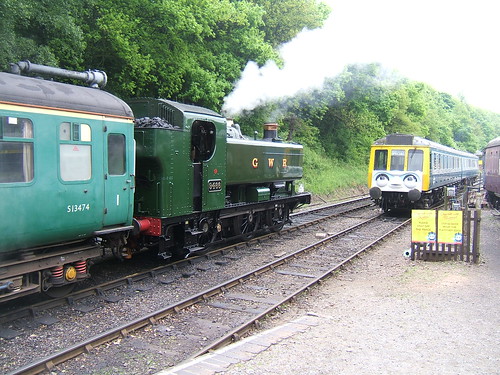 The Battlefield Line, May 2008: '9466' waits to depart from Shackerstone as the DMU (with a face for 'Day out with Thomas') arrives.
There is an album of pictures showing the construction of this locomotive at portrait at Portrait of a Pannier'.
References
[ 1] ‘A Pictorial Record of Great Western Engines’ by J. H. Russell (Oxford Publishing Company Vol. 1 & 2 1975: reprinted as one volume 1978) SBN 0 86093 02 6.
In an earlier post here, I described my driving turn on Saturday 19th December 2015. I was back on the following Wednesday, described below.
The '2251' Class
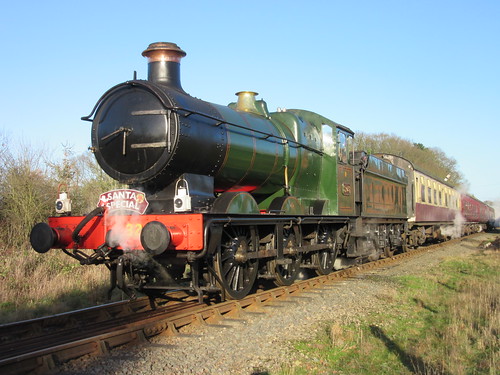 Battlefield Line 'Santa' Trains 2015: '3205' pauses at Market Bosworth before continuing to Shenton.
This class was introduced by Charles Collett in 1930 as a replacement for the much-loved and long-lived 'Dean Goods' and Armstrong 0-6-0 tender locomotives. The 'Dean Goods' was introduced by William Dean in 1883 and by 1899 260 off had been completed.
The Collett locomotive proved versatile, handling goods, short-distance main line and stopping passenger trains. The design had two inside cylinders, each 17.5 inches diameter by 24 inch stroke, fed from slide valves controlled by Stephenson Link Motion. With 5 foot 2 inch diameter coupled wheels, tractive effort was 20,155 pounds. Whilst the 'Dean Goods' had no route restrictions, the heavier axle load of the '2251' (a little over 15 tons) gave them a 'Yellow' route colour. Swindon Standard Boiler Number 10 was produced for the class - a tapered, Belpaire boiler pressed to 200 p.s.i. with superheating and a sloping grate of 17.4 square feet area. Subsequently, the Number 10 Boiler was used by Collett's successor, Frederick Hawksworth in the '9400' 'Pannier' and the '1500' outside-cylindered 'Pannier' locomotives.
In the design of the '2251', Collett followed the standards introduced by Churchward so construction and driving controls are largely similar to other Great Western engines. The '2251' has a screw reverser, rather than a lever reverser. Like most of the Great Western tank engines, the locomotive is fitted with a steam brake, combination brake valve, vacuum ejector and vacuum pump. When shunting light engine using just the steam brake, the driver has to first ensure that the vacuum brake on the standard tender is released.
Events of Wednesday 23rd December 2015
Wednesday's 'Santa' timetable called for fewer services than on my turn the previous Saturday: '3205', the 'Collett Goods', was booked to make two trips to Shenton (leaving Shackerstone at 11 a.m. and 3 p.m.) whilst 'Cumbria' was diagrammed to make one trip (at 1 p.m.).
Adrian L. was the other driver and he generously suggested I took '3205' knowing I'd not previously driven the class, assuring me "You'll like it" (Of course, he was right. I was once asked 'What's your favourite engine?' An old engineman present commented 'Anything they'll let her drive!').
Dave H. was once again marked as fireman with Jamie as Trainee. Since Jamie was very close to passing out as a Fireman, Dave let him perform most of the firing. Whilst Dave and Jamie lit the fire, I went round the engine examining, oiling and familiarising myself with the layout.
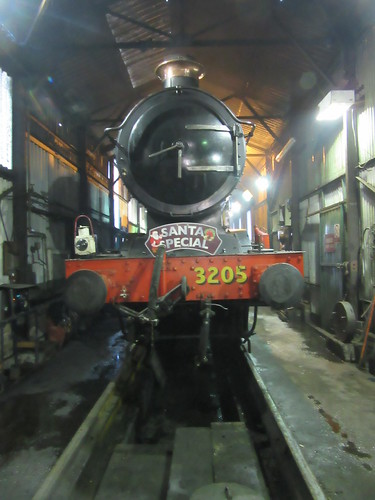
'3205' being prepared inside the shed at Shackerstone.
I found one cork missing from an Expansion Link, which we replaced from a small stock in the toolbox on the tender, otherwise everything seemed to be in order. Having been used the previous day, the engine came into steam fairly quickly.
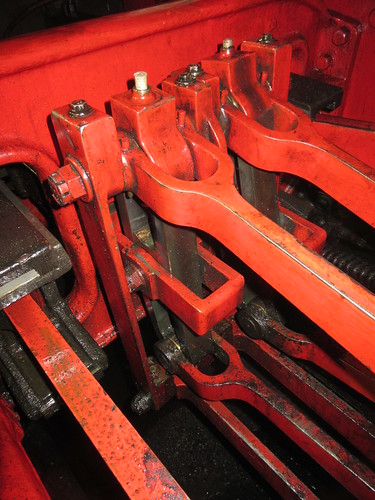
View looking forwards on the left side of engine. Motion Plate (top) L-R: Rear of slide bars and LH Connecting Rod, LH Lifting Links and Expansion Link (showing attachment of Valve Rod to Die Block), RH Lifting Links and Expansion Link. Forward Eccentric Rods connect to top of Expansion Link, Back Eccentric Rods connect to bottom of Expansion Link.
The Great Western, like most railways, made their tenders interchangeable, so '3205' was actually running with the tender from previous-visitor to Shackerstone '3803' which I'd last seen in black livery. There are a number of posts on '3803', such as Easter Saturday at the Battlefield Line. The tender tank had been filled using the water hose in the shed and the water gauge on the tender indicated that we had the full 3,000 Gallons (although being float-operated such gauges are not always truthful). With only two round trips, we didn't need to trouble the water column on platform 2 during the day.
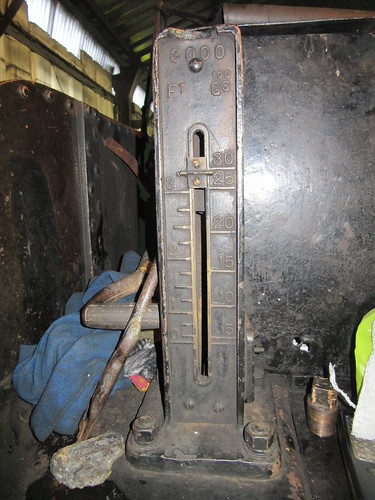
Float-operated water gauge on tender, marked in Feet and Gallons.
We came off-shed, moved across to our train in platform 2, coupled on and commenced steam heating. On the Fireman's side of the cab, a Carriage Warming Isolating Cock is connected to the steam manifold, receiving full boiler pressure. This feeds a Mason's Reducing Valve, allowing the steam pressure fed to the train to be regulated.
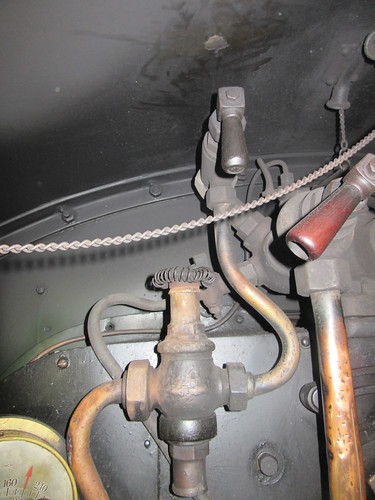
Wooden-handled steam isolating cock for Carriage Warming (top), feeds a Mason's Reducing Valve (bottom) for regulating the pressure.
A Bourdon Gauge (similar to the Boiler Pressure Gauge) indicates the carriage warming pressure being fed to the train. The engraved brass dial on G.W.R. carriage warming pressure gauges lists the pressure to be used according to length of the train.
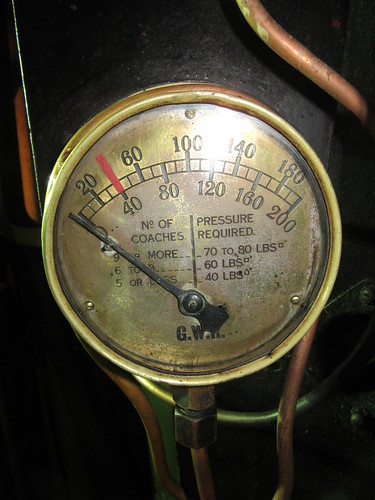
Carriage Warming Pressure Gauge showing pressure to be used according to length of train.
As expected, departure was a little late, waiting for passengers. On receipt of the Guard's 'right away', I checked the signals, whistled and, with the screw reverser set to full forward gear (about 75% cut-off indicated) and the cylinder drain cocks open, eased the regulator open. After a few yards, I closed the drain cocks. We collected the Single Line Staff from the signalman and made our way up the bank, observing the 10 m.p.h. speed limit. By this time, I'd wound the reverser back to around 35% cut-off, at which the engine appeared quite happy. Once clear of the speed restriction, I only allowed speed to rise a little as Santa trains are always leisurely as groups of passengers are led through the train to visit Santa.
Once we were on the downgrade to Market Bosworth, I was able to shut off steam. I banged the regulator shut, to make sure it had closed, and then gently moved the regulator handle open far enough for curved link lifted by the regulator handle to open the Jockey Valve so that the Sight Feed Lubricator would continue to feed oil to the moving pistons and valves. I also wound the reverser to full forward gear - the 'Drift' position which suits most locomotives fitted with Stephenson Link Motion. A little braking as we approached the platform at Market Bosworth reduced our speed then I used a little steam to ease the whole train into the platform before stopping. The fireman wound the tender handbrake on as we were likely to stand a little while. We took the opportunity to take a few photographs.
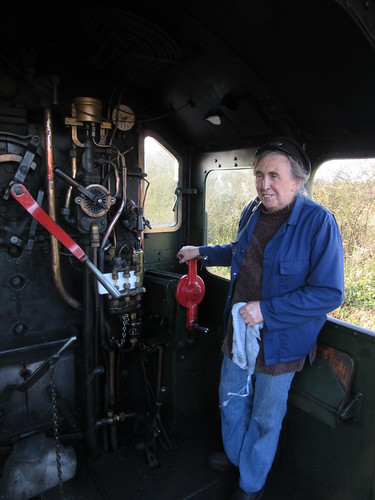
Dave took this picture of Jan as we waited at Market Bosworth.
When we received the 'right away', starting away was generally similar to leaving Shackerstone - there's a 5 m.p.h. slack over the foot crossing until past the out-of-use signal box then a further slack of 5 m.p.h. over the underbridge near the siding. Once clear of this slack, I used a little more steam to climb the bank, again with about 35% cut-off but running at a very modest speed.
I was able to 'drift' on the downgrade to Shenton, bring our speed down with gentle braking on the approach and a little steam to bring the train into the station. With vacuum destroyed, I 'eased-up' onto the train to make uncoupling easier then made the locomotive safe for 'going between' to uncouple - tender handbrake hard on, regulator fully shut, reverser in mid-gear, cylinder drain cocks open. After uncoupling and with one lamp on the buffer beam at each end, we ran around the train and coupled on again, setting the lamps to 'Express' (one over each buffer on the tender).
Soon we were making our leisurely progress back to Market Bosworth, tender first. It can be unpleasant running tender first with the wind and when it rains - well! There was a canvas storm sheet available which can be rigged between the cab roof and two supports at the front of the tender but it was not needed as we were lucky with the weather. Once again, we stood for some minutes in Market Bosworth, so I took the picture below.
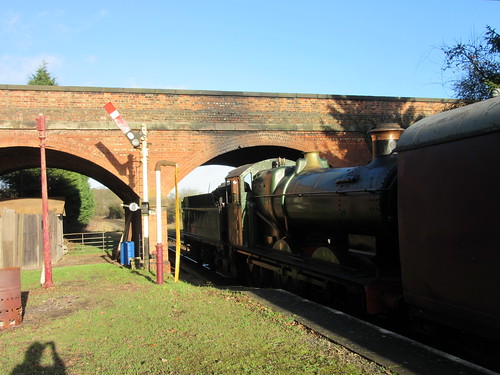 Battlefield Line 'Santa' Trains 2015: '3205' waits for the 'right away' from Market Bosworth.
When we arrived back at Shackerstone (unfortunately stopping a little short because of a problem releasing the train brakes after an application), 'Cumbria' was ready to leave with the 'De Luxe' service. Once all our passengers had disembarked, I positioned the train correctly and we ran round, ready for the 3 p.m. departure.
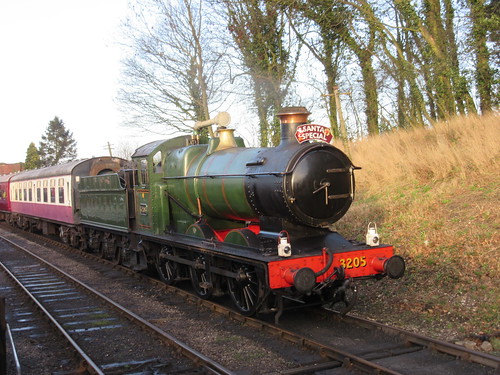 '3205' ready to take the 3.00 p.m. from Shackerstone on 23rd December 2015.
The 3.00 p.m. train was a little late away and we made the usual unhurried progress to Shenton, pausing at Market Bosworth for a while. By the time we had run round, it was dusk, so we made sure the loco lamps were lit (there's a short article on traditional lamps MIC - Lamps). Once again, we were held at Market Bosworth in the gathering gloom but this time the Guard, before issuing the 'right away' using a handlamp, gave us the instruction "Go for it!". Of course, '3205' worked the train up to line speed without effort and, all too soon, we were approaching Shackerstone and looking out for the Outer Home signal.
Although the signals at Shackerstone are semaphore and were originally lit by paraffin (there's an article about semaphore signals at night here), they have been adapted and are now electrically lit. The signalman had "given us the road" so we gingerly descended the bank, surrendered the Single Line Staff and stopped in platform 2 (this time in the right place). We quickly uncoupled and dropped forward clear of the points to await our path to the shed, which was blocked by the 'De Luxe' train stock. The picture below gives an idea of how dark it had become. You can just see the right hand side of '3205', ahead of us the last coach of the 'De Luxe' train and on the right the passengers off our train, streaming past to the car park.
Adrian had already disposed of 'Cumbria' in the shed but, in its place, he'd attached a diesel shunter which performed the final shunt I'd carried out using 'Cumbria' on Saturday 19th December 2015. Once the coaches had been drawn up towards the single line, we were able to make our way through platform 1 to the 'Dock' ground frame and into the shed. We quickly disposed, I completed the necessary paperwork and thanked Dave and Jamie for a splendid day.

Not yet 5.00 p.m. but already dark: View from the footplate of '3205' (left) as we wait for the empty stock ahead of us to be drawn clear so that we can reach the shed. Happy passengers (right) stream past to the car park.
You can find all my posts on 'Santa Special' trains here.
My pictures of Battlefield Line 'Santas' in 2015
Battlefield Line 'Santa' Trains 2015.
The Battlefield Line now operates two 'Santa' trains, alternately, on its line from Shackerstone to Shenton. One, with vestibule stock, is dubbed the 'Classic' train. In this train, Santa's Helpers take groups of passengers, in turn, to see Santa Claus in his Grotto, where the children receive an early Christmas present. The second train has corridor compartment stock and forms the 'De Luxe' train. On the De Luxe service, families or groups can book a private compartment provided with refreshments and Christmas Crackers and Santa makes a 'house call' at each compartment, distributing presents.
In December 2015, visiting locomotive 3205 (the 'Collett Goods') worked the 5-coach 'Classic' train and another visitor, 'Cumbria' (Hunslet 3794 'Austerity Tank'), hauled the 4-coach 'De Luxe' train. I'd first seen both engines at the The Battlefield Line Steam Gala in October 2015.
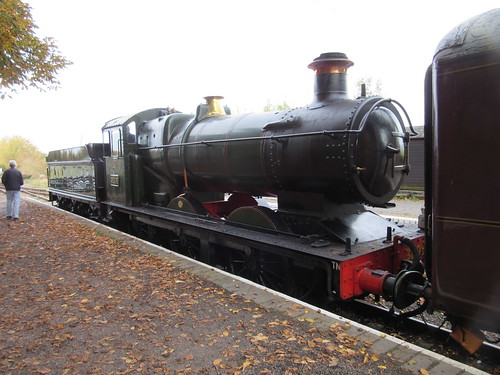 3205 Collett Goods at the Battlefield Line Steam Gala, October 2015
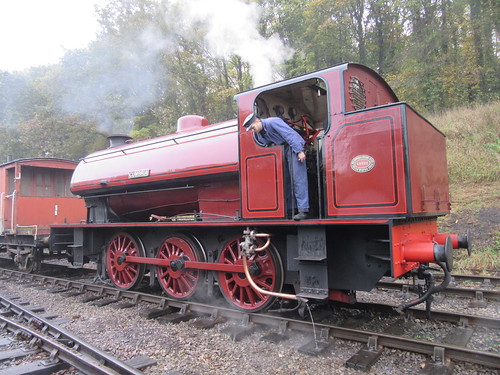 Hunslet 3794 'Cumbria' at the Battlefield Line Steam Gala, October 2015
Events of Saturday 19th December 2015
I had been rostered to drive 'Cumbria'. For whatever reason, there was no fireman for 'Cumbria' although our trainee, James, was well-on with steam raising, under the watchful eye of Dave H. who was actually booked as Fireman on the 'Collett Goods'. The day was only saved by Dave agreeing to be fireman on both locomotives, since there was also a trainee fireman on the 'Collett Goods' to assist. Whilst trainee firemen can carry out most of the tasks, and are allowed to work under the supervision of the driver in 'station limits', once a locomotive leaves Shackerstone, there must be a registered fireman on the footplate.
The 'Collett Goods' was booked to make three trips to Shenton (leaving Shackerstone at 10 a.m., 1 p.m. and 4 p.m.) whilst 'Cumbria' was diagrammed to take two trips (at half past eleven and half past two). All trains were 'Sold Out'.
We came off shed with 'Cumbria' in good time to allow us to steam heat the 'De Luxe' train standing in platform 1. The day was overcast with intermittent rain. The 'Collett Goods' moved across to the head of the 'Classic' train in platform 2 shortly before departure time at 10:00. The 'Classic' train coaches have Electric Train Heating so can be warmed from an electric 'Shore Supply' before the locomotive arrives although, once coupled, the 'Collett Goods' provided conventional steam heating. The 10 o'clock departure left about ten minutes late, waiting for tardy passengers. We continued to warm our train whilst the other train travelled to Shenton and back and all the young people on that train had had a chance to meet Santa.
I think our first departure was about ten minutes late and we made very leisurely progress down the line to Market Bosworth. With a full train, Santa has his work cut out to see everybody so we stood for a while before carrying on to Shenton.
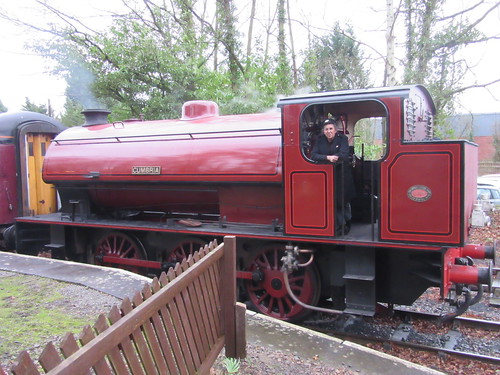 Jan relaxes on the footplate as 'Cumbria' pauses at Market Bosworth en route to Shenton with the 11:30 from Shackerstone.
We made similarly pedestrian progress to Shenton. Then we had a flurry of activity as we uncoupled, ran round and "hooked on" again for the return, this time chimney leading. When we finally arrived back in platform 1 at Shackerstone, the one o'clock 'Classic' service was able to leave, but there was, once again, a slight delay as late-arriving passengers were rounded up. Once that train had left, we were able to run round our train, pausing at the water column at the south end of platform 2 to replenish our saddle tank. Once re-coupled, it was back to keeping the train warm ready for the 2.30 p.m. train.
Our second trip down the line was similarly uneventful (and slow). The day had remained overcast and, only three days before the Winter Equinox, we lit our paraffin headlamp before returning from Shenton. Of course, in the days of steam, the headlamp was principally a means of indicating to signalmen the type of train approaching. It's only modern high-intensity lights, now mandatory on Network Rail lines, that offer the driver any improved visibility ahead and that effect is limited.
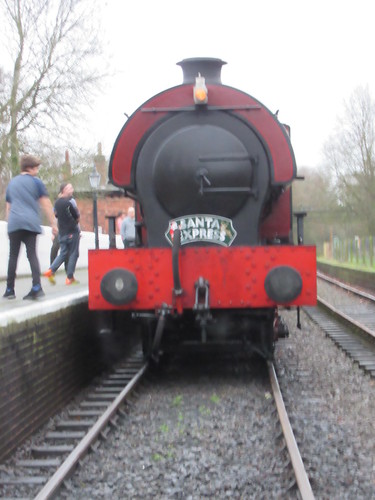
'Cumbria' (with headlamp lit) ready to return from Shenton.
We stood for some time at Market Bosworth, giving me a chance to take a picture of James on the footplate of 'Cumbria'. I also managed a shot of Santa himself making his way from compartment to compartment.
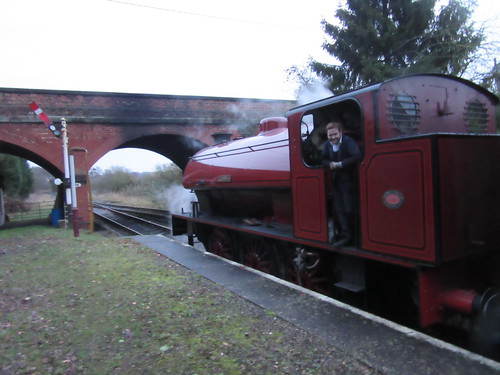 James smiles for the camera at Market Bosworth on our second return trip to Shackerstone.
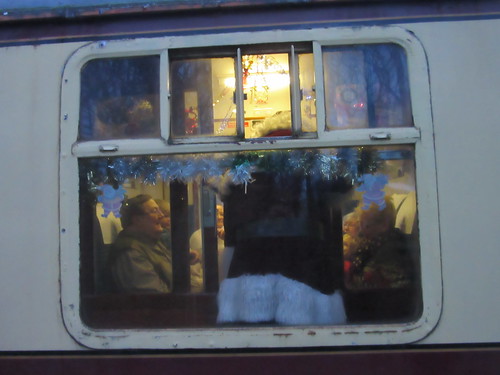 View from the platform at Market Bosworth as Santa visits each compartment of the 'De Luxe' train in turn.
Eventually, we arrived back at Shackerstone, with a lot of happy passengers. A little later, the 'Collett Goods' left with the 4.00 p.m. departure - the last train of the day. My initial hopes that we might then put our engine to bed were dashed. With our 4-coach train blocking platform 1, there was no 'release road' to allow the 'Collett Goods' onto shed on his return and, in the absence of a suitable diesel shunting locomotive, and so we ran round our train and re-coupled. We remained there until the last train returned to platform 2. Our Guard also agreed to stay, to act as Shunter riding in the end of the stock. Once the last train had arrived, Leon, the signalman, "gave us the road", including permission to pass the Starting Signal (nowadays usually called the 'Section Signal') at danger sufficiently to get our 4-coach clear of the crossover and the two-disc ground signal which protects the crossover. The top disc 12 reads to platform 1, bottom disc 3 reads to platform 2. Signals by handlamp from both the Guard and Signalman let us know when we were 'clear'. The 'Collett Goods' wasted no time in uncoupling and, as soon as we'd drawn our train clear of platform 1, shunting into the shed.
The crossover road was reversed again and disc 12 cleared. The Guard, keeping lookout from what was now the leading vehicle, continuously gave lamp signals and I cautiously propelled the train back into platform 1. The Guard applied his handbrake, I 'squeezed up' to make sure the coupling was slack then James uncoupled. We followed the 'Collett Goods' into the shed and completed disposal of our engine.
More
I was back at the Battlefield Line on 'Santa' trains on Wednesday 23rd December 2015, driving '3205', as described here.
You can find all my posts on 'Santa Special' trains at the Battlefield Line and Peak Rail here.
My pictures
Battlefield Line 'Santa' Trains 2015
In an earlier post here, I described the service on 6th December 2015. I was there again on Sunday, 20th December 2015, this time with Phil M. as fireman. Having prepared 'Lord Phil', we moved across to Rowsley platform road and coupled onto the south end of the 7-coach train, giving us over an hour to perform 'carriage warming'.
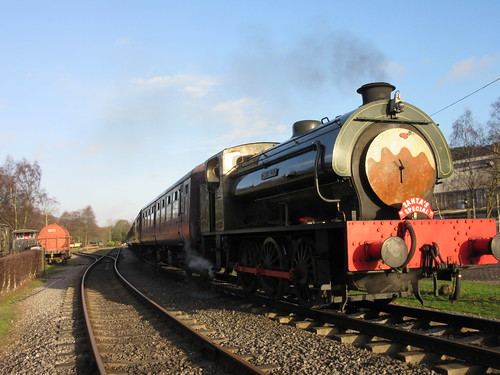 Steam heating the stock prior to the first departure from Rowsley.
This time, the 'Class 31' had been left in the shed overnight but it came across and coupled up to the north end of the train to 'top and tail' in time for the first departure, which was a little delayed waiting for missing passengers.
We were still enjoying mild weather for December and the sun shone for most of the day but there was a wind which rather chilled the driver's side of the cab.
All tickets on the 'Santas' are pre-booked and we were told that all four trains were 'Sold Out'. In addition, Sunday Lunch was being served in the Palatine Set and, again, all seats were booked.
Of course, Santa Claus was there to welcome his young visitors, together with a reindeer, a cow and Peppa Pig.
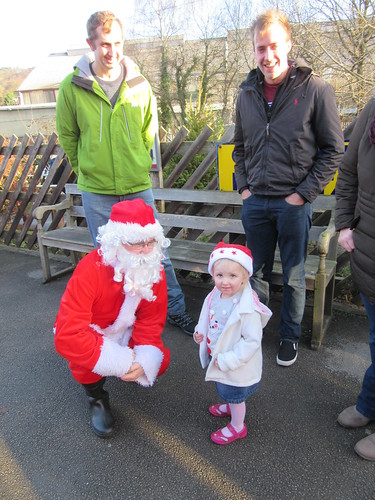
Santa greets a young visitor.
Once again a choir from Matlock Musical Theatre sang Christmas Carols on the platform at Rowsley as passengers boarded the train. Initially, there were six singers but other members strengthened the group later.
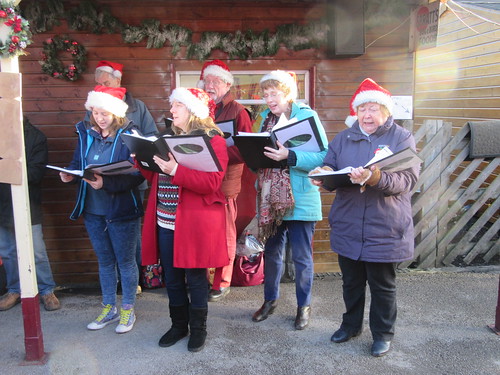 Carol Singers from Matlock Musical Theatre.
Phil drove the first trip while I fired. I seem to be loosing strength in my arms so that even firing the small grate on an 'Austerity' is getting harder. On the right-hand drive 'Austerity', the fireman should work from the left of the footplate, preferably using his right arm to push the shovel blade, leaving the left hand to support the shaft of the shovel. Unfortunately, I'm naturally left handed but on the small footplate of an 'Austerity' there's not enough room to fire from the 'wrong' side. Originally, most locomotives were right hand drive. The Great Western Railway remained right hand drive to the end, as did many countries which adopted right-hand running on double track. But in Britain, we've always used left-hand running on double track so the sighting of signals is easier if the driver is on the left and more modern locomotives tended to be left-hand drive. Since both left-hand and right-hand locomotives were in use (even within the same class sometimes), it was advantageous for fireman to be able to fire from either side - indeed, some driver's insisted that fireman stayed on their own side of the cab.
A few years ago the consummate railway professional Dick Hardy wrote to me about a day he'd spent firing 'Port Line' on a main line steam special, saying he found the firebox about a foot longer than he remembered from when he was younger. I know exactly what he meant.
I drove the three remaining trips and we worked through the day without incident which, of course, you always aim to do.
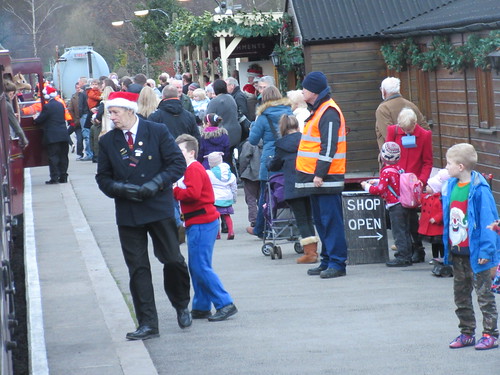 Rowsley Station.
I don't think any of our departures from Rowsley were on time and the various speed restrictions don't give much scope for making up time 'on the road' but we made sure we didn't lose further minutes. There's a short video clip showing our final approach to Matlock Town, passing the Sainsbury's car park here. After watching the clip, the Back Button will return you to this blog.
On the final return from Matlock Town, Phil made sure our red tail lamp was lit. When we stopped at Darley Dale, the illuminated Christmas decorations showed up well.
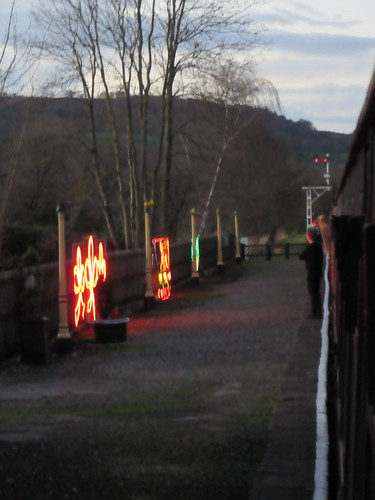
The last Down train at Darley Dale, showing the illuminated decorations.
To be able to check the gauges in the gathering gloom, Phil had donned his head-mounted 'miner's lamp'.
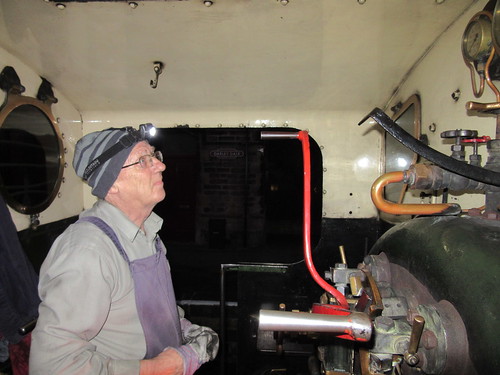 Flash photography shows Phil (with 'miner's lamp' ) checking the gauges.
On arrival at Rowsley, we received the single line token from the station staff so that we could uncouple from the train and make our way, via the South End ground frame, to the loop and third line. At the North end, we then passed the token back to the diesel crew, allowing them to release the North End ground frame so that the 'Class 31' could make its way to the shed. We took 'Lord Phil' to the siding outside the shed, so that Chris could coal our bunker using the Bucket Loader. We then made our way to No. 1 road where we disposed and left 'Lord Phil' over the outside pit.
My pictures
Peak Rail 'Santa' Trains - 2015.
Bookings for Peak Rail's 'Santa Trains' in December 2015 have been very satisfactory.
Sunday, 6th December 2015
On the second day of the Santa service I was booked to drive, with Mike S. as fireman. Having prepared 'Lord Phil' and topped-up the bunker with coal, we coupled onto the south end of the 7-coach train ready to 'top and tail' with the 'Class 31' diesel-electric which had been left coupled at the north end overnight. We were nice and early so, before the first departure at 10:45, we had over an hour to perform 'carriage warming', supplying steam at 30 p.s.i. via the Reducing Valve to the heating system on each of the coaches. The weather was fairly mild for December and, although we had intermittent rain during the day, it was reasonably pleasant.
Rowsley Station had been decorated for Christmas and looked quite inviting. All tickets on the 'Santas' are pre-booked and volunteer helpers are always in demand to deal with the large number of passengers. Santa had a number of Elves and other helpers in attendance to assist in distributing presents to the children whilst the grown-ups enjoy mulled wine and a mince pie during the journey to Matlock Town and back.
As the passengers arrived, there was quite a pleasant atmosphere of anticipation, particularly when Santa patrolled the platform greeting the boys and girls together with professional entertainers who juggled, did magic and clowned. There was also a reindeer and a bear.
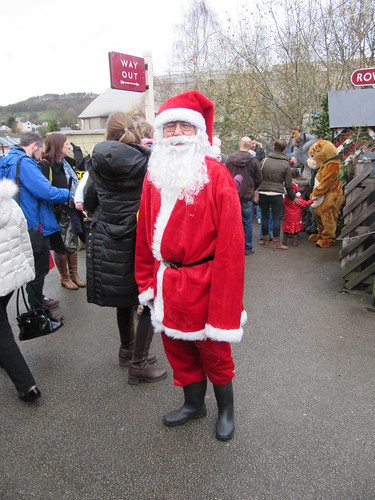
Santa poses for the camera before resuming greeting the visitors. The reindeer and bear are in the background.
In addition, a choir sang Christmas Carols on the platform at Rowsley as passengers boarded the train.
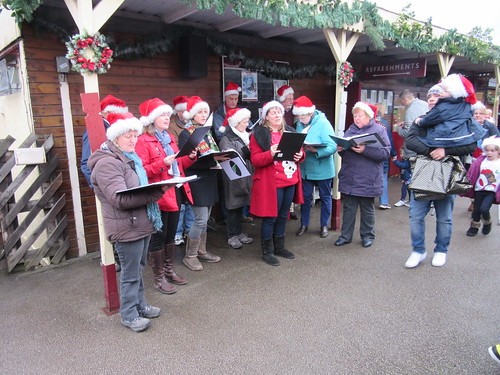 The choir perform in front of the decorated station buildings at Rowsley.
The two coaches marshalled next to the steam locomotive at the south end form the 'Palatine Set' comprising one full restaurant car and a restaurant/bar/kitchen car. The 'Palatine Set' was thronged with staff preparing to serve Christmas Lunch to the diners on the second departure from Rowsley at 12:18.
Santa trains are often a little late departing because of booked passengers arriving late but, as far as possible, the timetable is adhered to. With the number of speed restrictions on the route, it's difficult to make up time.
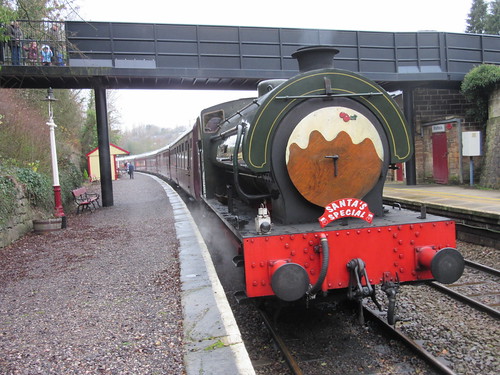 'Lord Phil' on arrival at Matlock Town, with 'Christmas Pudding' smokebox decoration and 'Santa's Special' headboard. It is displaying a tail lamp, ready for the return journey.
The 'Class 31' hauled the train back to Rowsley where Mike and I replenished the saddle tank. The water consumption is increased, of course, when supplying steam to heat the train. With the diners and booked passengers aboard, we set off on our second round trip. This was completed without incident, with Mike using the classic "little and often" method of firing. We didn't need to top-up with water this time.
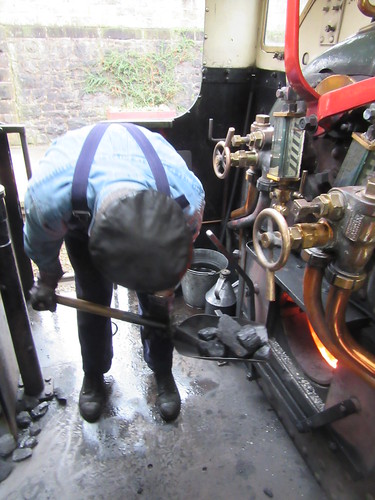
Mike using the classic "little and often" method of firing.
The train was very busy on the two round trips in the afternoon during which parties of adults arrived by, I think, at least four large motor coaches. After the third round trip, we filled the saddle tank, this time with me perched on top of the engine, allowing me to take a couple of pictures from my elevated position.
 A view of Rowsley whilst taking water. On the far left, the maroon exhibition coach is visible, stabled on the turntable siding.
On the last trip to Matlock, it was starting to grow dark so we lit the locomotive paraffin lamps, displaying a white near the chimney on the way there, changing to a red tail lamp on the buffer beam for the journey back. There's a little piece about lamps here.
 'Lord Phil' at Matlock Town, displaying a lit tail lamp.
The 'Class 31' took us back to Rowsley for the last time, pausing briefly in the Down platform at Darley Dale. Now it was properly dark, the illuminated Christmas decorations on both platforms showed up well, encouraging a number of passengers to take photographs of the displays.
On arrival, we were given the single line token, allowing us to uncouple from the train and make our way, via the loop and third line, to the North end where we surrendered the token to the diesel crew, so that they could stable their locomotive in the shed on No. 1 road. Meanwhile, we took 'Lord Phil' to the siding outside the shed, so that Chris could coal our bunker using the Bucket Loader. We then made our way back to the North end and attached the exhibition coach from the turntable siding. With Jacob acting as guard, we propelled the coach over the third line back onto the loop. We then drew the coach along the loop, stopping where instructed adjacent to the main train. With the coach 'tied down' and uncoupled, it was now our turn to make our way to No. 1 road where we carried out the disposal procedures and stabled 'Lord Phil' over the outside pit.
Go to 'Santa Specials' at Peak Rail - Christmas 2015 (part 2)
My pictures
Peak Rail 'Santa' Trains - 2015.


.jpg/320px-GWR_Class_5700_No_5764_Pannier_(3000285676).jpg)
