skip to main |
skip to sidebar
Every year, the Old Locomotive Committee (OLCO) organises a get-together, called 'Lionsmeet' for modellers of the 'Lion' locomotive (and similar models of designs from the early days of railways). On Saturday 8th August 2015, 'Lionsmeet' returned to the home of Guildford Model Engineering Society (GMES) at Stoke Park, Guildford.
Getting there
I travelled by train to Guildford and there's a brief write-up at By Rail to Guildford.
The Event
My train took me to 'London Road (Guildford)' station, from where I walked along London Road to Stoke Park and signed in as a visitor at the GMES entrance. For more details of GMES, go to their website here.
The Steaming Bays are always the centre of activities and I found a number of our members there, together with John Brandrick (Chairman), Jon Swindlehurst (Treasurer & Membership Secretary), John Hawley (Magazine Editor) and Andrew Neish (Lionsmeet Organiser).
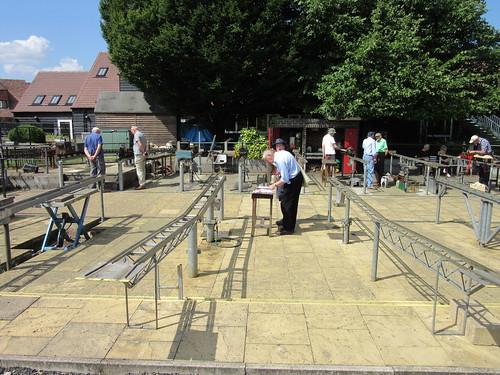 The Steaming Bays at Guildford M.E.S., with John Brandrick and Andrew Neish talking at the table in the centre of the picture. The lifting trusses in the foreground allow models to be conveniently transferred directly to and from parked vehicles.
Guildford is the 'home club' for both Andrew and his father David and together they were steaming David's reliable 'Lion' model. Jon Swindlehurst steamed his very successful 'Lion' and other 'Lion' models were also being prepared for service.
John Hawley kindly took me to the Clubhouse for a welcome cup of tea. The Clubhouse detained me for a while, because an interesting display of models had been arranged. My eye was taken by a handsome 0-4-0 tank locomotive named 'Cynthia'. Published as a 5 inch gauge design, "Gemma" was serialised in "Engineering in Miniature" magazine as a model of the Great Eastern Railway 0-4-0 built by Neilson & Company in 1874 (incidentally, there's a little about Neilson's in my post North British Locomotive Company Limited).
 The label on this striking model read: "Gemma built as the drawings came out in Engineering in Miniature c1983. She has had a hard life and can pull 3 adults with the blower full on. Living in the Gunnislake area in Cornwall at the time she is in the East Cornwall Minerals Railway livery. Our garden railway reflecting the full size a mile away. David and Lily Scott Reading."
There was a live-steam model of 'Invicta' from the Canterbury and Whitstable Railway. Mention of the Canterbury and Whitstable always reminds me of my favourite dialogue from the film 'The Titfield Thunderbolt' which I quote in my eponymous post here.
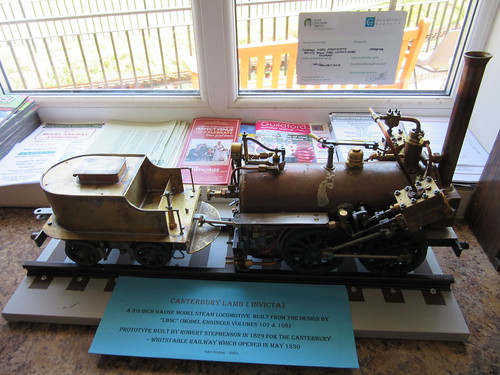 "Canterbury Lamb (Invicta) a 3.5 inch steam locomotive built from the design by 'LBSC' (Model Engineer Volumes 107 & 108). Prototype built by Robert Stephenson in 1829 for the Canterbury-Whitstable Railway which opened in May 1830. Peter Christmas - GMES."
 Work in progress: Wheels and (far left) chassis: "Will be 'Royal George' by Timothy Hackworth 1827. No 'real' plans survive - so half the battle is to produce the 'engineering drawings'".
 Work in progress: Foreground: "5 in Gauge Lion under construction. Owner - John Hawley. Built to this stage by Michael Lee, loco and tender chassis completed. Running gear started. Boiler by Blackgates. All to LBSC design." Background: "Boiler for 7.25 in gauge Lion. Designed: John Hawley (OLCO). Built: Peter Carr (Kingswood Boilers)."
It was good to see that John Hawley is producing what he calls "Lionswarf" and is modelling, as well as editing.
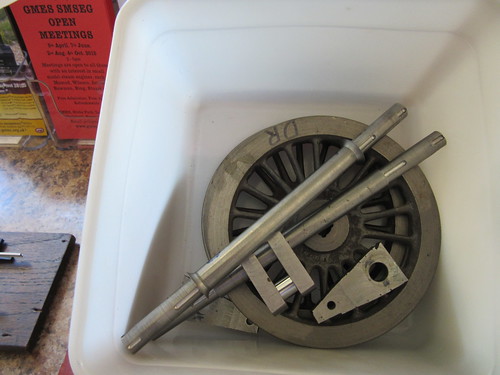 "A few of the components required to construct the leading and crank axle/wheel assemblies. I'm experimenting with round keys and semi circular keyways." - John Hawley.
In addition, one end of the Clubhouse housed a large well-detailed 4mm scale layout based on the long-gone G.W.R. terminus 'Cheltenham Spa St. James'.
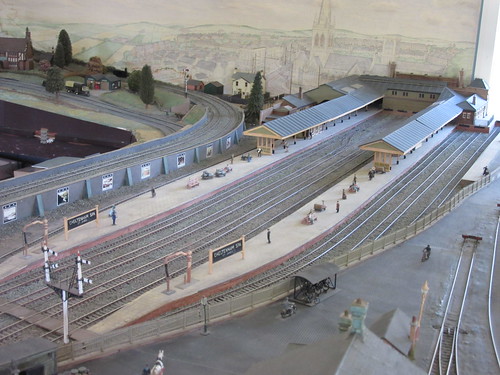 A view of part of the 4mm scale layout.
Fortified by a cup of tea, I found the Safety Officer, was kitted out with a High-Visibility jacket and then allowed to survey the running lines on foot. There are two 'deformed oval' running lines.
The inner circuit is an elevated dual-gauge track which features clockwise running. Colour light signals are provided. These operate automatically from short track-circuited sections in appropriate positions. The outer circuit is ground level 7.25" gauge with anti-clockwise running. This circuit also has signalling but the signal heads (which are removed after a running day for security) were not needed for 'Lionsmeet'. Part of this circuit is dual-gauge 5"/7.25", giving rise to some impressive dual-gauge pointwork. The ground level track has an attractive brick-built carriage and locomotive shed. A spur, complete with a number of semaphore ground disc signals built in 'Southern Railway' style leads to a turntable. This is a mature site and the extensive steaming bays with the large traverser are substantial and well-engineered.
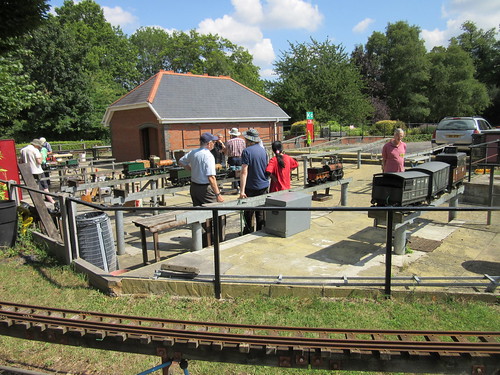 Lionsmeet 2015: Looking across the steaming bays towards the Carriage Shed.
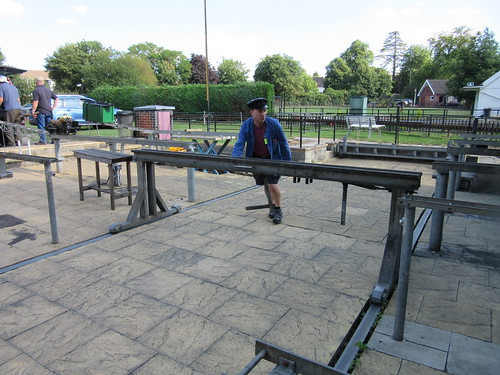 Andrew Neish moving the impressive Traverser in the Steaming Bays.
The steaming bays featured a 'Locomotion' model, lifted clear of the rails, operating on compressed air. A fascinating sight! There's a video clip on YouTube here. When you've watched the video, use the 'Back Button' to return to this post.
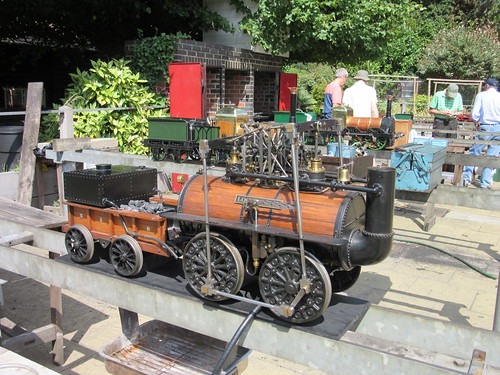 'Locomotion', lifted off the rails, was running on compressed air.
There are two other layouts offering live-steam running. The first is a well-established 32mm gauge fully landscaped layout intended for narrow gauge models.
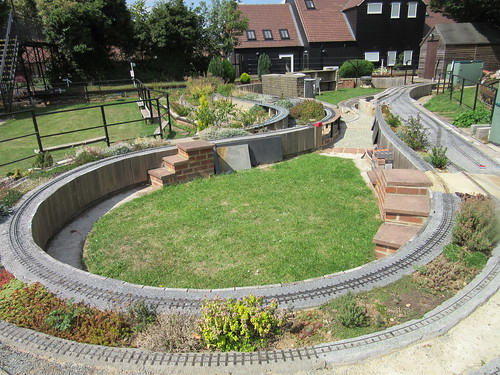 The 32mm gauge landscaped 'narrow gauge' circuit.
The second is a more-recent Gauge 1 layout featuring a double-track oval with sidings. This is built on a raised baseboard.
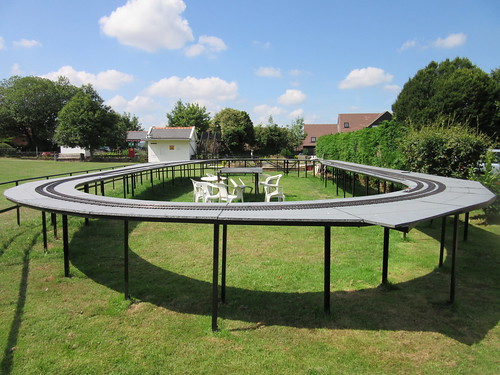 Gauge 1 elevated layout under construction.
Various models of 'Lion' were steamed during the day. Sometimes the driver would be alone, sometimes one or more passengers would be taken - informality is the style of 'Lionsmeet'. Occasionally, OLCO members without a 'Lion' model would be given the opportunity to drive. David Neish kindly allowed me to take a turn on his 'Lion'.
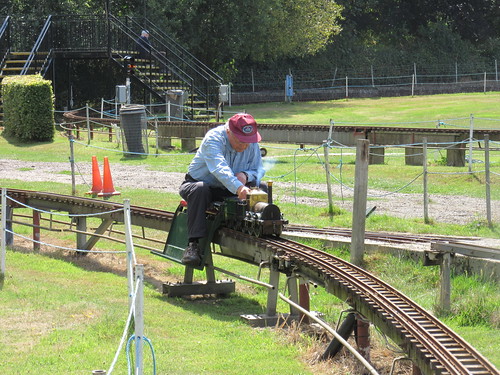 David Neish passing over the Sector Table which gives access to and from the Steaming Bays.
 'Lion' with a rather smart driving trailer passing over the Two-leaf Swing Bridge.
One performer was in the striking red and green livery from the film and carried 'Thunderbolt' nameplates.
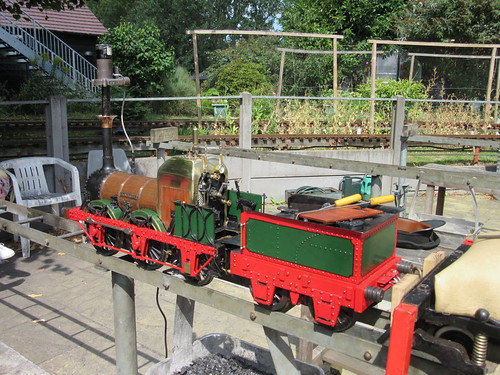 'Thunderbolt', in the striking livery from the film.
The host society had provided a splendid buffet lunch in the Clubhouse, so most railway activities ceased for a while, before resuming with added gusto. Later in the day, both John Brandrick and John Hawley had a drive.
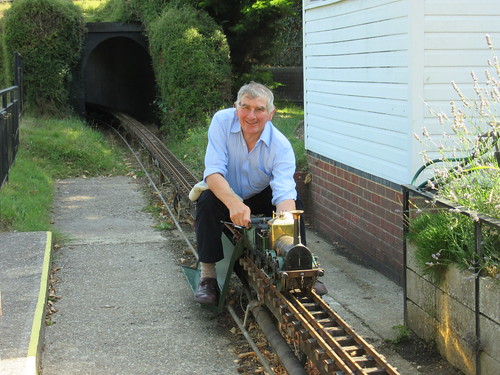 John Brandrick driving David Neish's 'Lion'.
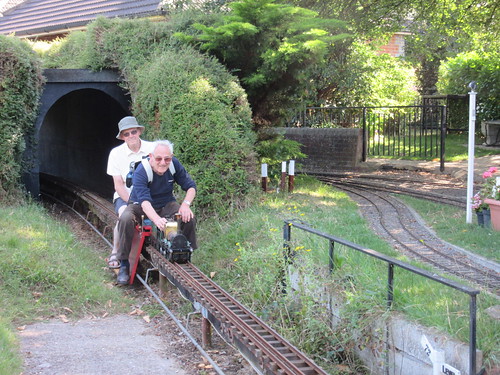 John Hawley at speed with Jon Swindlehurst's 'Lion'.
John Dalton from Chelmsford M.E.S. had brought his 7.25in gauge 'Lion'. I'd first seen this model at Kinver during 'Lionsmeet 2010 (there's a brief description here) but at Guildford, I managed to get a ride behind this engine.

John Dalton's 7.25in 'Lion' performed on the ground level circuit.
David Neish was determined to steam his Gauge 1 Aster 'Lion'. It was set up on the Gauge 1 layout and, with assistance from Roger Hayward, was successfully steamed. I found the management of these Methylated Spirits powered models most strange - no water gauge, no pressure gauge (but there is a safety valve). Although water can be added, this is done from a dispensing bottle against boiler pressure. Apparently, when it runs out of water, the absence of steam to the blower means that the boiler remains safe! After a bit of experimenting, 'Lion' successfully completed a lap and honour was satisfied. An OLCO member had brought his own Aster 'Lion' which he had never steamed and, with suitable ministrations from Roger Hayward, this, too, operated to the owner's delight.
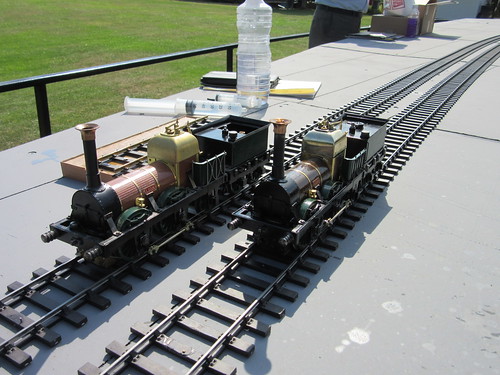 Two Gauge 1 Aster 'Lion' models.
At 'Lionsmeet' 2014, a new member surprised us by displaying an early 'Lion' model he'd acquired. Well, no, he didn't bring his locomotive and run it at Guildford. Instead, he surprised us by arriving in his veteran 'Alvis'.
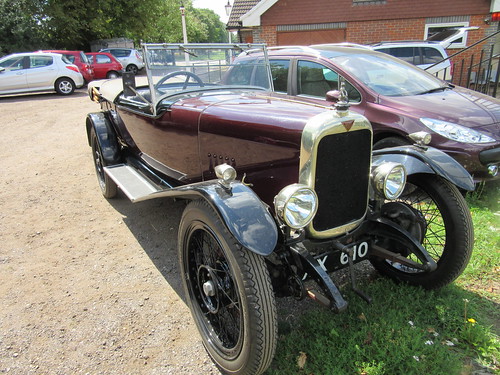 One OLCO member arrived in this veteran 'Alvis'.
We enjoyed wonderful weather and the Guildford Club had made us most welcome, so it was another successful 'Lionsmeet' and thanks are due to all concerned. As a tailpiece, I couldn't resist this picture of Roger Hayward's unusual live steam narrow gauge locomotive 'Nanny Bubbles' which he ran on the 32mm gauge track.
 Lionsmeet 2015: Roger Hayward's narrow gauge 0-4-4T 'single-ended Fairlie' 'Nanny Bubbles' on the 32mm gauge layout.
Lionsmeet pictures
Lionsmeet 2015.
[Video clip of 'Locomotion' model added 22-Aug-2015]
On Saturday 8th August 2015, I travelled to Guildford to attend the 2015 'Lionsmeet' at the Guildford Model Engineering Society.
I took the first bus from Brewood to Wolverhampton at 06:43, walked to the railway station and managed to catch the 07:25 'Virgin' service to London Euston. The seat reservation system was not working so I suffered the inconvenience of being asked to move by a party who apparently had reservations for a group of seats including the one I'd taken. This would be less annoying if it were not a fairly common experience. In general, Train Managers seem to believe a simple statement that the system is not working is sufficient. There's no evidence that staff and management feel that 'customers' (as they insist on calling passengers) have been let down. However, we made it to London on time at 09:15.
The usual irritation of negotiating Euston's concourse to reach the Underground entrance followed. The area was packed with people and their luggage standing and studying the departure display, making it difficult to find a way through, particularly since other people were also attempting to criss-cross the concourse in different directions, often oblivious of the effect of their own wheeled luggage in the confined area. I caught a Northern Line train to Waterloo - crowded but tolerable.
The concourse at Waterloo was thronged but not as packed as Euston. Waterloo was the London terminus of the London and South Western Railway (L&SWR) and there's a little about this famous station here. South West Trains provide fast, frequent third-rail electric trains which stop at Guildford but I chose instead a South West Trains stopping train from Platform 1. South West Trains are part of the 'Stagecoach' group which operates a number of rail franchises ("let's have rail competition, but not too much").
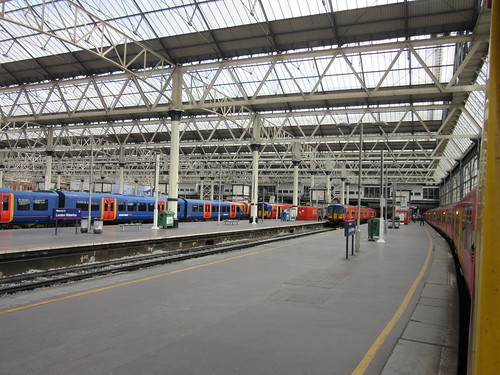 View across Waterloo station from platform 1.
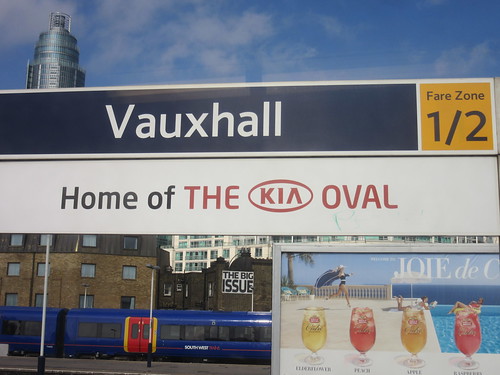
We left on time, and soon made a brief stop at Vauxhall, the nearest station to the Oval. In 2013, I rather grumpily wrote "The Oval (which we are now supposed to call 'The Brit Insurance Oval')". No longer - new nameboards at the station proclaim that Vauxhall is now "The home of the KIA Oval". At least, I think that's what is says. With the modern obsession with 'branding' the car company's logo replaces the letter 'A' with an inverted 'V'. I weep for the English language.
We ran fast through Queenstown Road and paused at Clapham Junction. There's a post about Clapham Junction (also touching on Vauxhall and Queenstown Road) here.
We continued to Raynes Park where we diverged from the main line to Woking and continued (stopping at all stations) to Epsom. Here, a branch trailed in on our left, originally built by the London, Brighton & South Coast Railway bringing trains from Mitcham and West Croydon directions. Epsom still has two island platforms providing four platform faces.
We continued through Ashtead to Leatherhead. After Leatherhead there's a junction where the straight-on route leads to Dorking and Horsham. This line was also built by the London, Brighton & South Coast Railway and the the 'Pre-Grouping Railway Junction Diagrams 1914' (see Maps below) show the line from Epsom to Leatherhead as 'L&SWR/LB&SCR Joint. Even today, it's a separate Train Operating Company which works the route through Epsom to Horsham - Southern.
At the junction, my train took the sharply-curved right-hand route leading to Effingham Junction where the L&SWR branch from Surbiton trailed in from the right (having passed through the rather exotically-named station of Cobham and Stoke D'Abernon). At Effingham Junction, there's a storage and maintenance depot for Multi Purpose Vehicles. Railway Multi Purpose Vehicles are used variously for rail head treatment, weed spraying and conductor rail de-icing but no 'hardware' was on show.
 Effingham Junction, showing the MPV Maintenance Depot.
We soon reached the penultimate stop for the service at 'London Road (Guildford)', where I alighted. This is a very rural station in contrast with the final stop for my train at Guildford itself. The London Road station which I was brought up with was located in Manchester, now renamed 'Piccadilly' but I discovered that there are two 'London Road' stations south of London - one at Guildford and one at Brighton.
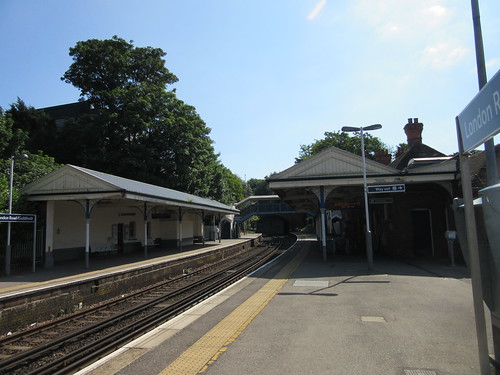 London Road (Guildford).
A brisk walk along London Road led me to 'Lionsmeet' and, after an enjoyable day at Guildford Model Engineering Society (described here), I retraced my steps to 'London Road (Guildford)' station. For variety, I decided to travel to Guildford Station and return towards London on a fast service.
 View of Guildford Station from the covered footbridge, looking towards London. The train I'd arrived on is on the right in Platform 1, the 'Cobham Bay'.
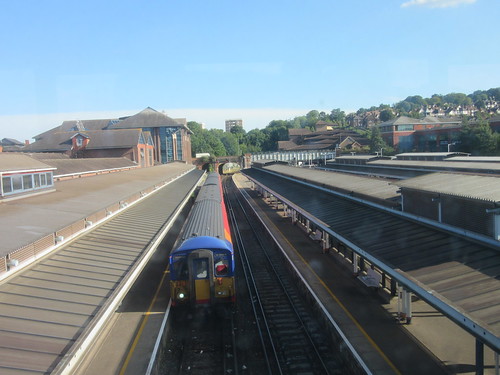 View of Guildford Station from the covered footbridge, looking away from London.
Within a few minutes, I was on an 'Up' train which stopped at Worplesdon, Woking (where we joined the line from Basingstoke and the West) and then was 'Fast' to Clapham Junction. I left the service here and crossed to the former LB&SCR platforms to catch a 'Down' train to East Croydon, since I wanted to visit my friend Rita.
Maps
[1] 'Pre-Grouping Railway Junction Diagrams 1914', published by Ian Allen (ISBN 0 7110 1256 3).
[2] Details of the modern railways south of London are shown in one of the 'Quail Track Diagrams' books:-
'Railway Track Diagrams Book 5: Southern and TfL' Third Edition, published by TRACKmaps (ISBN 978-0-9549866-4-3).
Related information on other websites
Historic:
London and South Western Railway (Wikipedia).
London, Brighton and South Coast Railway (Wikipedia).
Modern:
South West Trains.
South West Trains Network Map.
Southern.
Southern Network Map.
Related posts on this website
Waterloo Station, London.
Clapham Junction Station, London
My pictures
London: former 'Southern' lines.
In 2015, the Peak Rail 1940s Weekend took place at the beginning of August. I was rostered as steam driver with Dave P. as fireman on Sunday, 2nd August - the second day of the event. As I arrived at Rowsley, the various tented camps for military re-enactors were stirring.
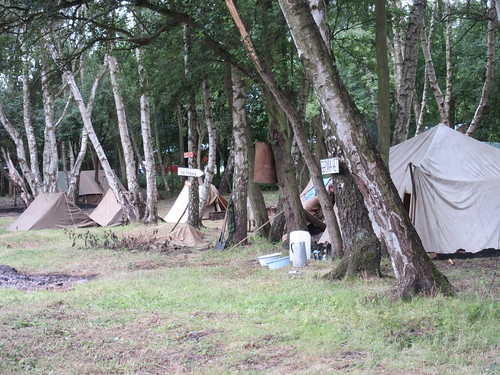 Tents in the wooden area, with the Russian 2nd Guards Rifle Division in the foreground.
With my interest in Burma, I was pleased to see a small group representing the W.A.S.(B) - the Women's Auxiliary Service (Burma) which operated from 1942 to 1946. There's a brief article about the wartime work of W.A.S.(B) on Wikipedia here.

A wartime picture of a W.A.S.(B) Canteen (Photo: Wikipedia via Creative Commons).
Whilst preparing our locomotive we were visited by an American lady War Correspondent re-enactor who had based her character on a real wartime journalist who worked for a Chicago newspaper.
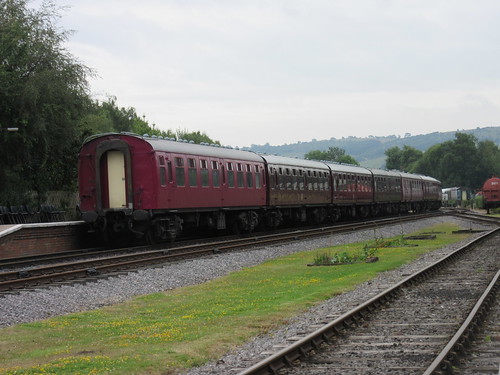 The 7-coach train stabled in the platform at Rowsley. The 'Class 31' is out of sight at the far end of the stock.
We were 'booked' to marshal 'Lord Phil' on the north end of the 7-coach train, with the 'Class 31' on the south end. I'd expected to find our locomotive turned so that we worked 'chimney leading' coming back from Matlock, as we had done for the 1940s Weekend in 2014 and 2013, but 'Lord Phil' had not been turned (drawing critical comments from a couple of enthusiasts who thought working bunker first was 'inelegant' (their description was rather more 'earthy'). We were hooked onto the train in good time and the 'Class 31' had been left coupled to the stock overnight. There were lots of people arriving, many of them in civilian or military dress for the period. The first train at 11:15 was pretty crowded.

Civilian and military dress for the period on display.
During the day, we completed the five round trips to Matlock Town station without much difficulty. Some variety was introduced since we were working bunker-first at the north end (although we'd worked like this earlier in the year when the water tank at the south end of Rowsley station was found to be empty, as described here). We also had the relative luxury of more conventional watering facilities at the north end of Rowsley (avoiding the need to drag fire hoses around, as is the case currently at the south end).
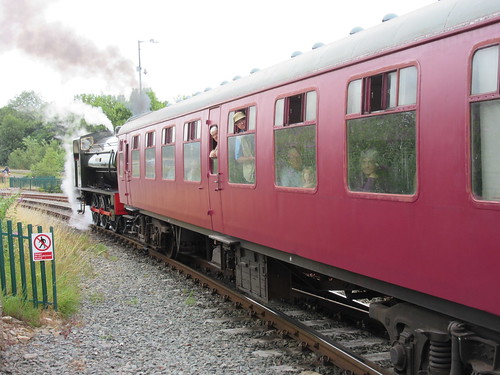 'Lord Phil' at Matlock Town, ready to return to Rowsley.
Wartime entertainment was provided throughout the day in a large, aluminium-framed marquee adjacent to the station at Rowsley.
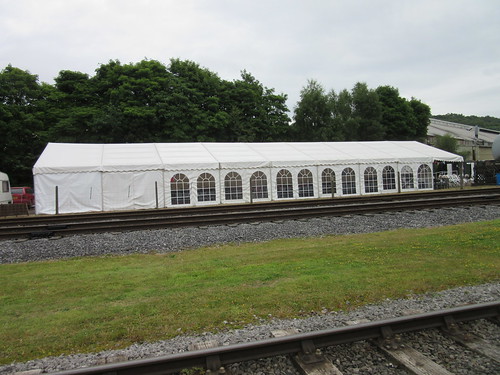 The marquee at Rowsley.
During the day I managed a brief visit to the marquee, in time to see Paul Harper introduce Sue and Steve Mace's exuberant dancing to the music of the Ashby Little Big Band. With the band's line-up of saxophones, they certainly captured the Glenn Miller swing style always associated with the second World War.
 Sue and Steve Mace dance to the music of the Ashby Little Big Band.
The marquee was always busy with people enjoying the entertainment and making full use of the bar, which was being looked after by Richard. In addition, the LMSCA were operating a refreshment stall.
 The LMSCA refreshment stall in the marquee.
The Picnic Area featured displays of civilian and military vehicles of the period, together with a number of trade stands.
 Part of the display of civilian vehicles.
The afternoon features a battle re-enactment. Working on the train, you don't get to see the action because the train is sent to Matlock before it starts and isn't allowed to return until the re-enactment has finished. All the public are moved from the Picnic Area to the east side of the railway and, whilst the train is absent, the platform forms a viewing area for the public.
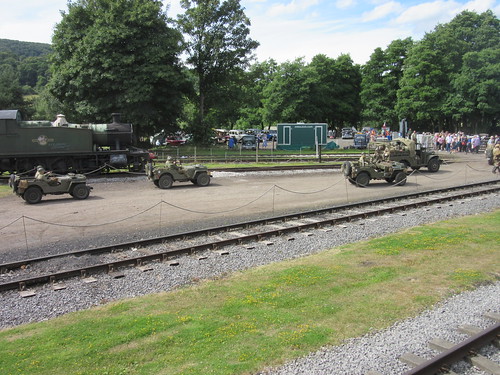 Prior to the battle re-enactment, the Americans take up their initial positions whilst the public are moved from the Picnic Area to the east side of the railway.
I understand the dramatisation featured German troops overwhelming the Russian camp and subsequently surrendering to a counter-attack by Americans and Russians with superior firepower. The re-enactment represented the final period of WWII and concluded with an announcement that the German forces had capitulated so that the war in Europe was over.
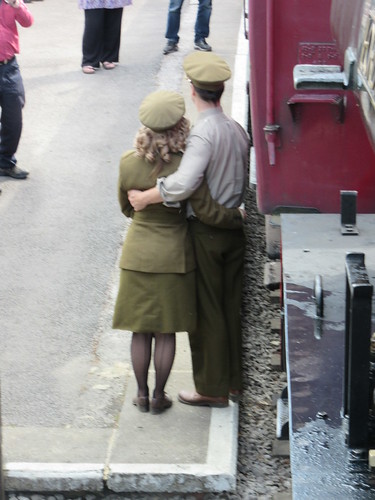
"Happy Days are here again!"
Related posts/pictures
I've participated in the 1940s Weekend at Peak Rail a number of times.
2014 event (pictures only).
2013 event (article with link to pictures).
2012 event (article with link to pictures).
2009 event (article with link to pictures).
2008 event (article with link to pictures).
2007 event (pictures only).
2006 event (pictures only).
My pictures of the 2015 event
Peak Rail 1940s Weekend, 2015
In 2005 I went on a steam driving holiday in Ukraine. That's described in a series of posts:-
Ukraine 2005.
Driving Steam in Ukraine (Part 1).
Driving Steam in Ukraine (Part 2).
Driving Steam in Ukraine (Part 3).
Driving Steam in Ukraine (Part 4).
Driving Steam in Ukraine (Part 5).
Railway Workshops in Kiev.
At the time of my visit to Ukraine in 2005, I'm afraid I was completely ignorant about Russian Railway Signalling practice.
On my visit to the Wolsztyn Experience in Poland in 2003, I'd seen a mixture of semaphore and colourlight signalling (there's a brief post on that trip here) but in Ukraine I only saw colour light signals with electric operation of points.
Signalling at Mikulichin, Ukraine
On Wednesday 26th October 2005, we made our first trip on the single line from Kolomiya to Vorokhta. There's a description of this trip here. We had a wait of around two hours at Mikulichin, awaiting a 'path' onwards to Vorokhta. We spent some time exploring the minor road through Mikulichin before returning to the fairly isolated station, where the friendly lady Stationmaster allowed me to study the signalling and telecommunications facilities.
 The friendly lady stationmaster at Mikulichin allowed me to study the signalling and telecommunications facilities.
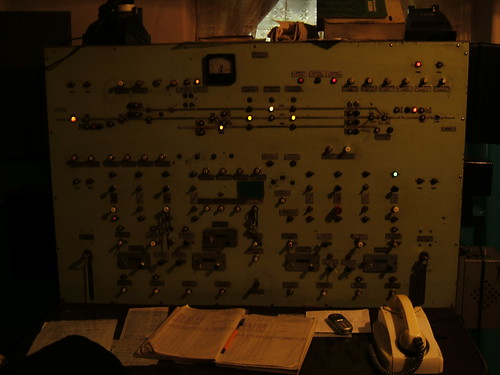 Detail of the signalling control panel at Mikulichin.
A couple of Linemen were working in the relay room adjacent to the Stationmaster's Office, so I managed a few pictures of the relay racks.
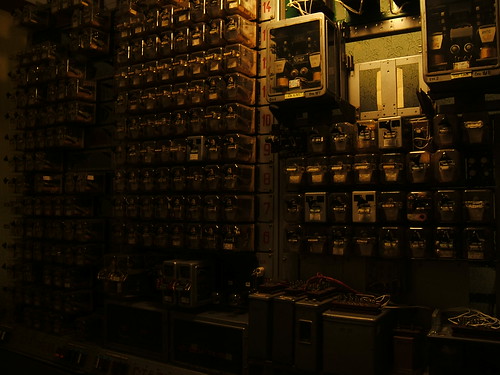 The signalling relay room at Mikulichin.
On Thursday 27th October 2005, the format of the day was similar but this time the run was terminated at Mikulichin. There's a description of this trip here. Whilst waiting for our return 'path' I studied the outside equipment - signals and points.
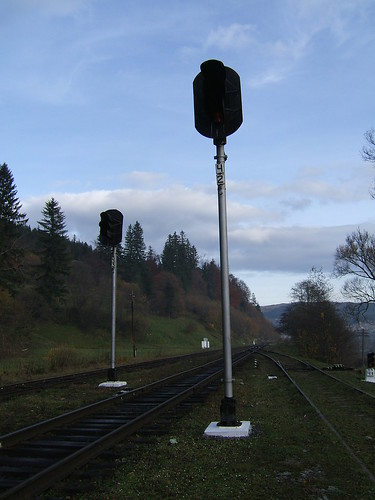
High level 3-aspect colour light 'Exit' signals on running lines.
 Low level 3-aspect colour light 'Exit' signal on siding, with motor-operated trap points in background.
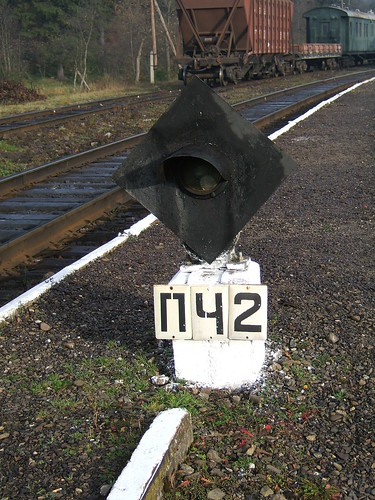
Another form of low level signal.
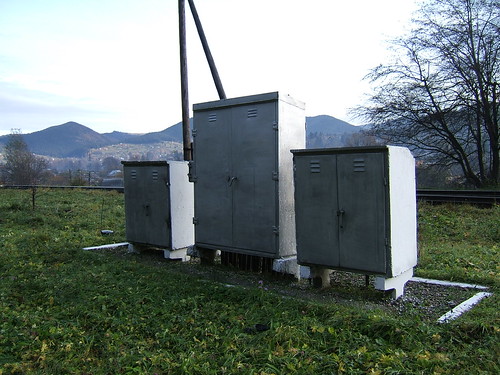 Typical group of trackside equipment cases.
Russian Railway Signalling Practice
Because Ukraine was part of the U.S.S.R. before its dissolution in 1991, signalling in Ukraine reflects Russian practice. The U.S.S.R. and Communist states like China developed largely separately from European railways. OSShD is the Romanisation of the Russian initials 'ОСЖД' - the 'Organisation for the Combined Operations of Railways', referred to as OSSHD in some places. However, this organisation is also referred to as the Organisation for Co-operation between Railways (OSJD).
Wolfgang Meyenberg's site (although not, apparently, being updated) has a simple-to-understand section on signal aspects in the OSSHD/OSJD here.
The Signal Page was started in 2003 in Holland and claims to be the world's largest website on railway signalling systems worldwide. From the index page you can select a variety of articles (not all in English). A good starting point is J. B. Calvert's article here.
Related posts on this website
In 2011, a river cruise from Moscow to St. Petersburg (described in a series of posts here) gave me tantalising glimpses of railways in Russia. Then, in 2011, I travelled by the 'Golden Eagle' private train from Ulaan Baatar to Moscow (described in a series of posts here).
Photographs
Signalling at Mikulichin, Ukraine.
The Old Locomotive Committee (OLCO) is the 'Supporters Club' for the 1838 locomotive 'Lion' and 'Lion' models. The full-size 'Lion' now has pride of place in the Museum of Liverpool adjacent to Liverpool's Pierhead.
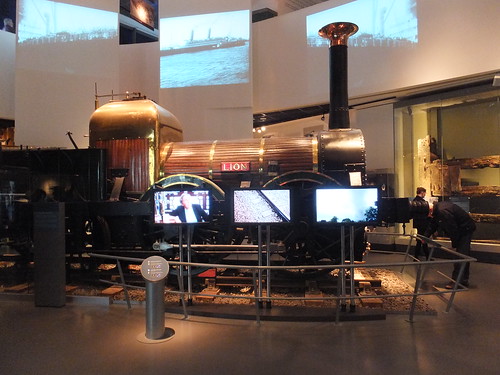 'Lion' in the 'Great Port' Gallery at the Museum of Liverpool.
The 31st Annual General Meeting of OLCO was held in the Museum of Liverpool on Saturday, 30th May 2015.
The Museum's Curator of Land Transport & Industry, Sharon Brown, was unable to attend this year's meeting but Sharon's colleague Claire Hunter (Assistant Curator of Urban History) made OLCO Members welcome and we are grateful to Sharon and Claire for providing the venue. We were in Education Room 3 on the first floor, which provides spectacular views over the River Mersey.
This was the Fourth time that the A.G.M. had been held at the Museum. There are brief reports on the earlier A.G.M.:-
2012
2013
2014
The Annual General Meeting
The Chairman of OLCO, John Brandrick, opened the formal A.G.M. at 1.00 p.m. and welcomed those attending. This was the first A.G.M. since the death of our Founder and President E.F. Clark and, after a few moments silence, the meeting continued.
The Agenda items were dealt with promptly and the Election of Officers (once again) resulted in no changes to those serving during the previous year. There was lively discussion during 'Any Other Business' and the Chairman closed the meeting at 3.05 p.m. Members of the Old Locomotive Committee have been sent minutes of the proceedings as part of the July 2015 edition of the magazine 'Lionsheart'.
The magazine is currently produced by the indefatigable 'Lionsheart' Editor John Hawley and this publication, alone, is worth the OLCO Membership Fee, which also gives access to the special Members' Area of the OLCO Website.
The River Mersey
I'm afraid I didn't make a photographic record of the proceedings this year. I took a few pictures of the River from our vantage point (which I've added to my album Liverpool). The Mersey Ferry 'Snowdrop' was operating the service but has received a 'paint job'. Last year, 'Snowdrop' was in a dignified livery but she is currently transformed by a 'DAZZLE' livery which is not to my old-fashioned taste. This commission is one of the Word War I Centenary Art Commissions. 'DAZZLE' painting was used extensively in WWI, but the interesting Wikipedia article here seems dubious as to its value.
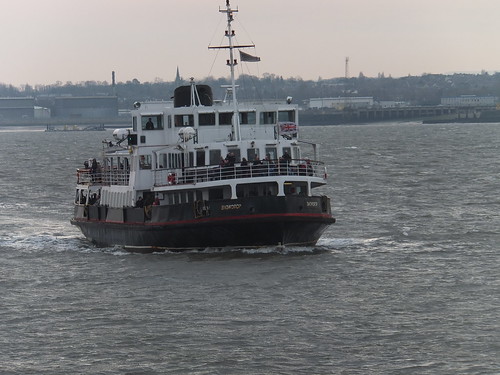 'Snowdrop' looking like a Mersey Ferry in March 2014.
 'Snowdrop' in her current 'DAZZLE' livery in May 2015.
More about 'Lion' on my website
The Old Locomotive Committee (an introduction to 'Lion' and OLCO).
All my posts about OLCO activities are here.
More about 'Lion' on OLCO's website
Lion & Old Locomotive Committee (the website of the Old Locomotive Committee).
My OLCO Pictures
All my pictures showing OLCO events are in the collection The Old Locomotive Committee and Lionsmeet.
The Heritage Railcar runs midweek in the season at the Battlefield Line, either as a single-unit 'Bubble Car' or, where additional accommodation is desired, attached to half of a 2-car set (the other half of the 2-car set is currently in the 'Works'). The railcar also operates on various special occasions and, most importantly, can provide a 'Backup' service (sometimes at short notice).
This was the case on Easter Saturday this year when '3803' broke a spring hanger and the diesel railcar 'deputised' whilst repairs were carried out to the steam locomotive. There's a description of the day here.
Sunday 7th June 2015
This was another day that didn't quite work out as planned. Originally I was rostered as steam driver but I was informed that a fireman was not available and asked to operate the service with the diesel railcar instead. I turned up to drive the diesel railcar to find Andy, Carl and Dave preparing '3803' to work the service. Although 3803 was booked to do 5 trips, delay in bringing her into steam meant that I was asked to operate the first trip with the diesel railcar. Andy, Carl and Dave worked the second, third and fourth trips with '3803'.
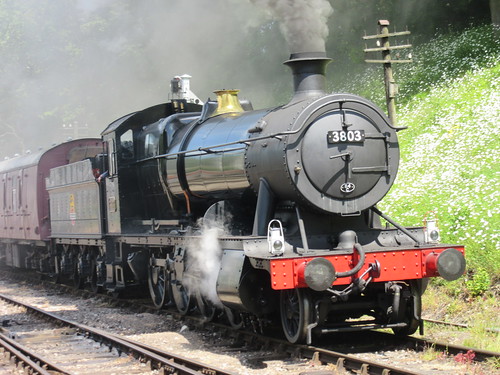 '3803' leaving Shackerstone.
The day was very hot so, on the 4th trip, '3803' was found to be setting the grass alight.
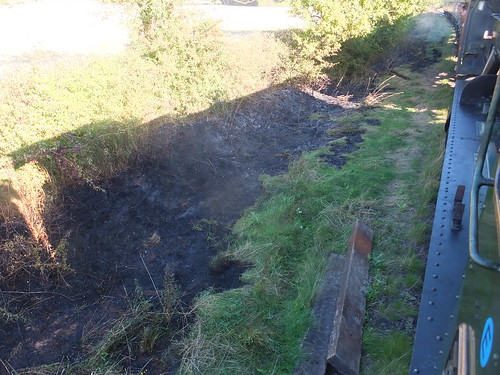 Aftermath of a previous grass fire photographed on 7-Sep-2014.
To prevent further problems, I was asked to 'fire-up' the diesel railcar again for the last trip of the day, allowing the crew of '3803' to take an 'early bath'.
 The two DMU trips used the single-unit 'Bubble Car'.
Tuesday 7th July
I prepared the 'Bubble Car', swept out the passenger areas and moved down to platform 1 at Shackerstone in plenty of time to work the 11.00 o'clock departure. Unfortunately, because of a misunderstanding, our Guard did not appear. Ritchie Marcus, who owns the railcars and was working on the half of the 2-car set currently in the 'Works', volunteered to act as Guard temporarily. Meanwhile, the Signalman made attempts to contact the rostered guard by telephone. Later in the day, the rostered guard appeared, allowing Ritchie to return to his repair work. The weather was generally good with some intermittent rain and we had a reasonable number of passengers during the day.
Tuesday 21st July 2015
We enjoyed bright sun and an excellent day for passenger numbers. Fortunately, the single unit 'Bubble Car' had been reunited with the in-service half of the 2-car set so we'd sufficient seating available. At Shenton we were joined by a party from a Leicestershire Care Home so the Guard's Compartment became full of wheelchairs and walking frames. The party spent some time at Shackerstone station before posing for a group photograph and travelling back to Shenton and their waiting road transport.
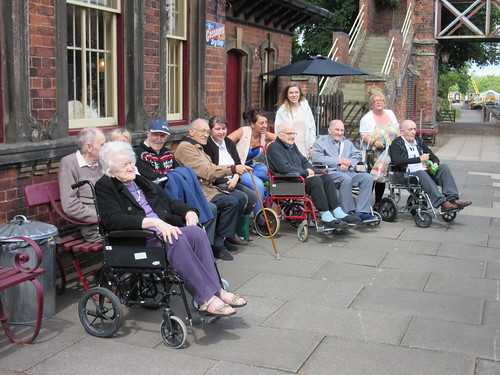 A party from a Leicestershire Care Home pose at Shackerstone for a group photograph before taking the train back to Shenton.
Each of the trains was quite well patronised amd we carried a number of children and parents. At Market Bosworth, railway volunteers were making preparations for the Rails & Ales Event on the 24th, 25th and 26th July. On one trip, the Guard's Compartment carried a Freezer from Shackerstone to Market Bosworth and on the last trip two large, metal wheeled bins were carried!
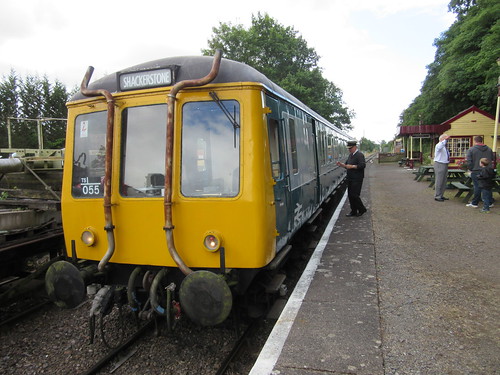 The DMU pauses at Market Bosworth on its way back to Shackerstone.
Related posts on this site
Diesel Multiple Units.
Midweek Diesel Railcars at the Battlefield Line (2014).
My pictures
Shackerstone, June 2015.
The Battlefield Line, Summer 2015.
I was intrigued to read the following press release:-
PRESS RELEASE - 12 MAY 2015
Dr Pete Waterman OBE DL is delighted to announce that he has reached an agreement with Peak Rail to base his Waterman Railway Heritage Trust assets at its Rowsley site.
Over the coming months, Pete expects to announce exciting plans to overhaul his trust’s steam locomotives, return them to active steaming and in the process provide structured training opportunities for young people interested in a career in the railway industry.
It has always been Pete’s passion to see young people given the chance to learn engineering skills and over the last 30 years or so, he has provided such opportunities to dozens of people via apprenticeships.
Pete said “I have long been an admirer of Peak Rail and they were a natural choice for me when I decided to relocate from the Crewe Heritage Centre. In my time at Crewe, I’m proud to have created hundreds of skilled jobs by providing investment that no-one else had the vision or foresight to do. I intend to work with Peak Rail to continue that tradition”.
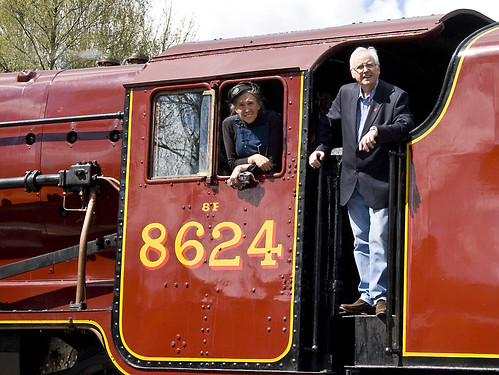 Pete Waterman on the footplate of 8624 on 1st May 2010 when he inaugurated the new turntable at Peak Rail.(Photo: Sheila Rayson).
On Sunday, 21st June 2015, I was able to have an initial, brief look at two of the Waterman Railway Heritage Trust locomotives now at Peak Rail. This was the day of the Peak Rail Preserved Bus Gathering 2015, which is described here.
Number 5224
This is a Great Western Railway 2-8-0T of the 5205 class, built by Collett in 1923. The design is based on Churchward's 4200 class built between 1910 and 1923.
 5224 outside Rowsley locomotive shed.
Number 5553
This is a Great Western Railway 2-6-2T of the 4575 class, built by Collett between 1927 and 1929. The design is based on the earlier 4500 class. I believe this locomotive claims the distinction of being the last locomotive out of Barry Scrapyard. There's an excellent series of articles on the remarkable story of Barry Scrapyard on the Great Western Archive website, starting with The Barry Scrapyard story, part 1.
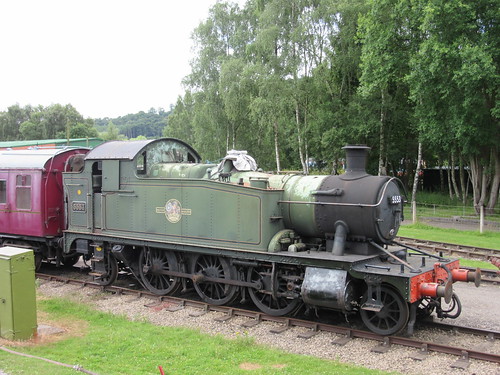 5553 in the sidings at Rowsley.
My pictures
G.W.R. Locomotive 5224.
G.W.R. Locomotive 5553.
Events of Sunday, 21st June 2015
Once again, I was the driver on 'Lord Phil' with Richard (now a 'Passed Fireman' and able to perform driving turns) as fireman. As usual, we were 'top and tailing' with the Class 31 and a load of six coaches. This was the day of the Preserved Bus Gathering so there were lots of preserved buses on site, making a very colourful scene.
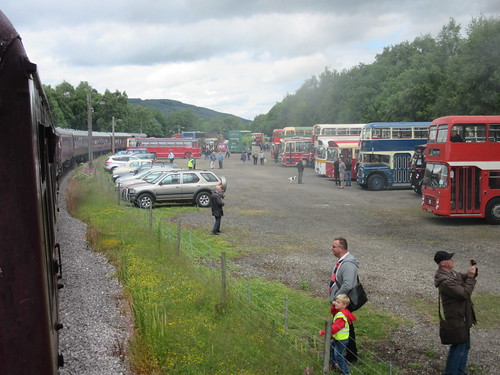 View of Rowsley station car park as 'Lord Phil' sets off for Matlock Town.
The Bus Gathering is organised by the Chesterfield 123 Preservation Group and they reported 64 buses attending, of which 24 ran in service. When we passed through Darley Dale during the day, we normally spotted one of the 24 buses in passenger service, making an attractive juxtaposition of train, level crossing and bus.

A London 'Routemaster' parked at Darley Dale station, a long way from Marble Arch.
 Preserved Chesterfield bus passes over the level crossing at Darley Dale.
We usually make a special attempt to make our last arrival at Matlock Town on a Sunday 'right time', as passengers from our train are sometimes hoping to make a connection with the East Midlands Trains service to Nottingham. With the various permanent and temporary speed restrictions in force, this is not always an easy task.
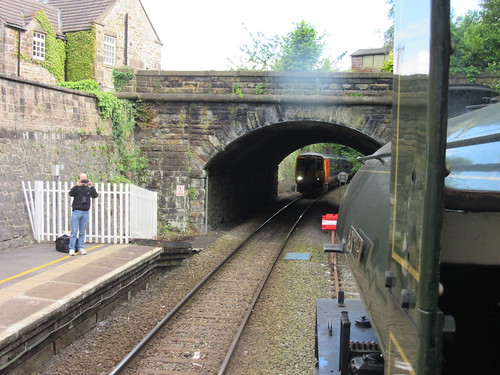 2-car train of Class 156 units arriving at Matlock Town.
The Class 31 hauled us back to Rowsley, Richard uncoupled and we took our engine across to the pit outside the engine shed and completed our disposal duties.
 'Lord Phil' stands on the pit outside the engine shed.
Related posts on other sites
Chesterfield 123 Preservation Group.
Related posts on this site
Vintage Commercial Vehicles at Peak Rail.
All my posts on Peak Rail can be found here.
My pictures
Peak Rail Preserved Bus Gathering 2015.
A steam engine needs a 'working fluid' to move heat from where it is generated (by the combustion of a suitable fuel) to where it is converted into mechanical energy. Water is boiled to make steam which readily flows to where it is converted into mechanical energy, usually in a reciprocating cylinder. Hence, a railway locomotive must carry water as well as fuel.
In England, steam locomotives were normally identified by counting wheels using Whyte's Notation. For instance '4-6-2' means four leading carrying wheels, six coupled wheels providing traction and two trailing carrying wheels. The English were never seduced by the equally reasonable idea of counting axles until the widespread adoption of diesel and electric traction, although Bullied called his 'Merchant Navy' Pacifics the '2 1 C' class.
If no qualifying letter was appended, it was assumed that there was a tender to carry the required water and fuel so, for instance, '0-6-0' implied a six-coupled locomotive with a tender.
It was convenient to produce designs omitting a tender for shunting or shorter distance working but this meant that the water tank had to be carried on the engine frames, together with the necessary fuel. The suffix 'T' is used to indicate 'Tank' and we call such engines 'Tank Engines'. In Germany, the term 'Tenderlok' is used for designs without a tender.
Early tank engines often carried water in a tank squeezed between the frames, underneath the boiler, rather limiting water capacity but early designers were very wary of raising the centre of gravity. I've driven an 1874 industrial six-coupled locomotive like this called 'Bellerophon' (not to be confused with the L.M.S, 'Jubilee' 4-6-0 of the 1930s). By providing outside cylinders and outside Gooch motion, a reasonable size water tank was included. A 'W' is often added to the designation to indicate 'Well Tank' so 'Bellerophon' is an 0-6-0WT.
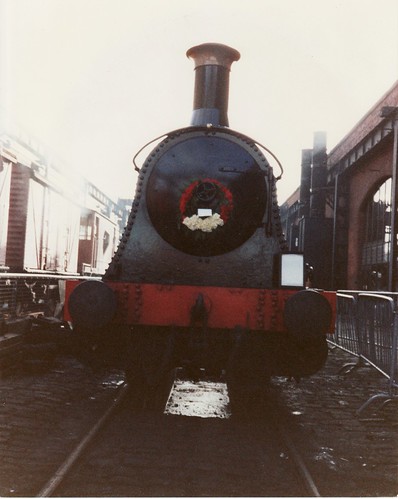
Visiting locomotive 'Bellerophon' at Manchester Museum of Science and Industry, carrying smokebox wreath and explanatory notice on the bufferbeam, commemorating the death of Mick Todd who was closely associated with the restoration of the locomotive.
Beattie designed a 2-4-0WT. I've driven both survivors. He somehow crammed inside motion (Stephenson Link, if I remember correctly) in front of the water tank, severely restricting capacity, so the lower part of the coal bunker is an extra water tank. I've written a post about these delightful engines here.
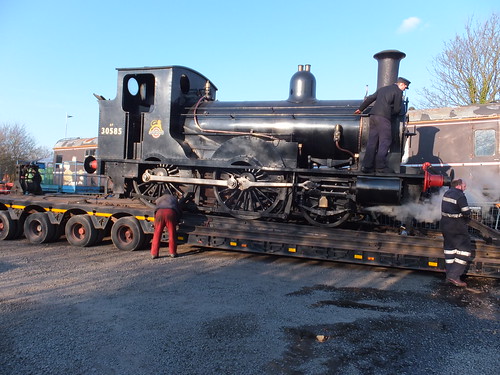 30585, still in steam, is chained in position on the low loader.
The 'saddle tank' was widely used, the name suggested by the curved shape of the tank placed on top of the boiler barrel, used particularly in small four-coupled engines like 'Henry' described here. An 'S' is often added to the designation. Saddle tanks are also used on larger 6-coupled locomotives like 0-6-0ST 'Sapper', described here. At least there's some space between the foot-framing (running plate) and the bottom of the tank to perform oiling and inspection. The disadvantage is that the water tank construction is complicated by the need to allow the chimney, dome and safety valves to pierce the tank, unless the tank is shortened to avoid either the chimney or safety valves.
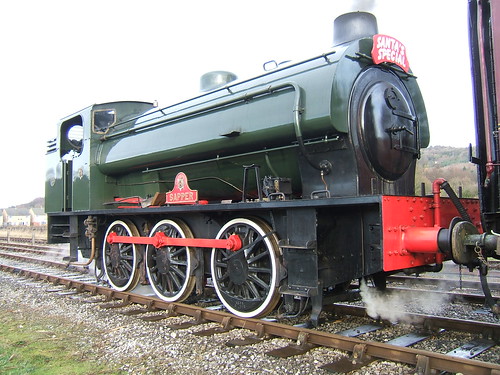 0-6-0ST 'Sapper'.
Carrying water in two flat tanks either side of the boiler then became a common practice. No extra letter was allocated so, for instance, 'Thomas the Tank' remains simply an 0-6-0T. I've driven a number of side tank locomotives (including a few posing as 'Thomas'). When you prepare a side tank with inside motion (which most British engines had), you quickly find the big disadvantage - access to the motion becomes very difficult, encouraging not-very-ladylike language.
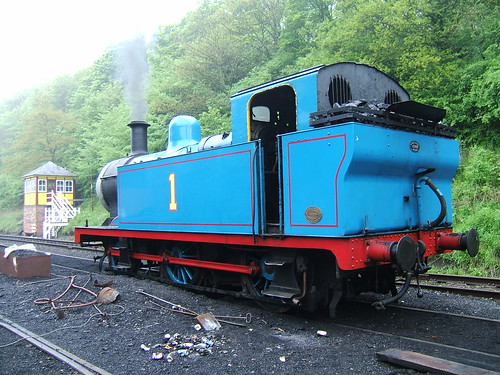 47298, posing as 'Thomas' shows her classic Midland lines and an odd paint job.
My posts on various 'Thomas' locomotives, all side tanks, are here.
The Great Western Railway used side tanks on its larger tank engines - this arrangement probably allows the largest water capacity.
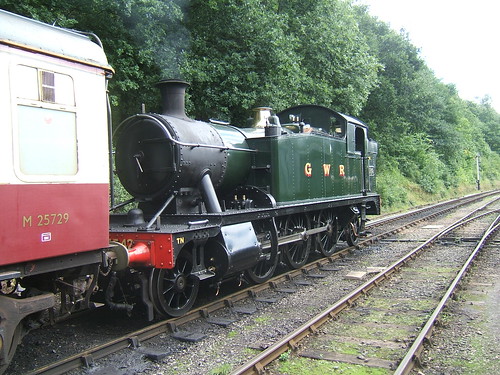 'Light Prairie' 5542 ready to depart from Shackerstone on the Battlefield Line.
I'm afraid Britain was very slow to adopt a layout with two outside cylinders and outside Walschaerts motion, which eliminates the problem of access to the motion and allows full-length side tanks, although I've driven at least one such 0-4-0T - 'Cadbury No. 1' built by Avonside which worked at the Bournville chocolate factory.
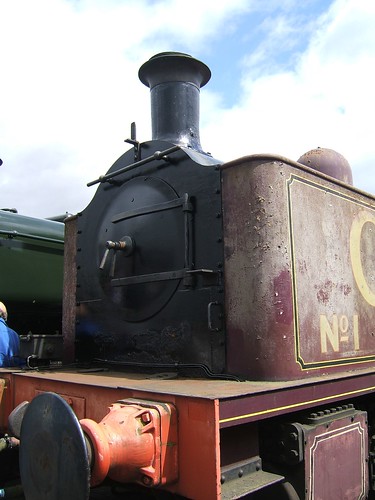
'Cadbury No. 1' has outside cylinders and Walschaerts motion, allowing full-length side tanks. The engine is currently out of traffic.
For their smaller tank engines, the Great Western Railway came up with a tank layout which allowed improved access to inside Stephenson Link Motion. Their solution has much to commend it - they used two 'pannier' water tanks allowing access to inside motion but leaving the top of the boiler unencumbered. A letter 'P' is often added to the designation. I've driven six or seven different 'Pannier' 0-6-0PT but not written a lot about these engines. These are capable, versatile engines and, as my friend John likes to remind me (after I used the phrase on a railway video) "You can do anything with a Pannier". There are some pictures of one example (5786) here. There are pictures of a later version (9466) which, remarkably was not built until 1952, here. I think Belgium was one of the few other countries which used the 'pannier' principle.
 Pannier tank 5786 'on shed' at Shackerstone.
Perversely, when the Great Western Railway did use Walschaerts motion (on the 4-cylinder express engines) they put it between the frames making access even worse than with link motion - just try oiling a 'Castle' or a 'King'. But valve motions are another story.
The Post Title
"Water, water, every where" is a line from The Rime of the Ancient Mariner by Samuel Taylor Coleridge.


