skip to main |
skip to sidebar
Sunday 19th April 2015
Visit to Ka Mar Wet
From Kot Kha Pon (described in Part 1), we drove a few miles to the Drop In Centre at Ka Mar Wet (also in La Mine Township), which I’d first visited in 2014 (described in the series of posts Burma-2014). As expected, the small building was already full of excited children, from various grades, obediently seated on the floor and monitored by a group of volunteers, many of whom I recognised from my first visit. I was also recognised by the volunteers, there not being many elderly English ladies in La Mine Township.
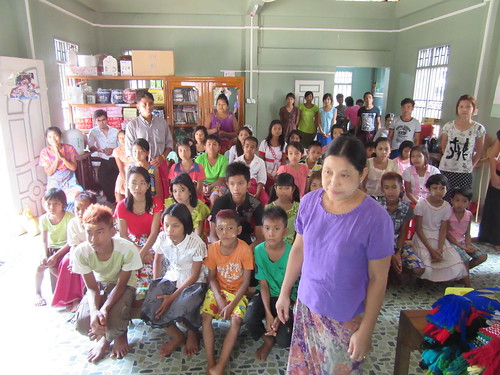 Ka Mar Wet Drop In Centre.
In addition to presenting the ‘kit’ for the new school year (school bag, folding umbrella, supply of exercise books, pencils, eraser, sharpener, Biro, plastic ruler and a school uniform appropriate to the age and sex of each child), a few girls at High School were being given financial assistance to continue their studies. Doctor Hla Tun made the presentation of assistance to these girls first, before carrying out a medical examination on a small boy who had been hurt in an accident with a bicycle a few weeks earlier and had been brought by his concerned mother. The boy didn’t look very happy and he certainly had some nasty abrasions, inexpertly covered by bandages, but a few tests confirmed that there were no broken bones and his mobility was good so the treatment was a course of antibiotics to prevent wound infection and paracetamol for his discomfort during the healing process.
 The injured small boy with his mother.
The distribution had been made easier this time because the staff had placed all the other items in the school bag so Emily and I were able to present the remarkably heavy bag to each student quite easily.
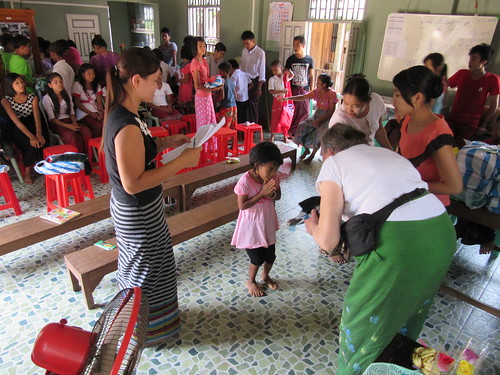 The distribution being received by a young girl.
After the children had changed into their new uniforms, we then posed for the 'group shot'.
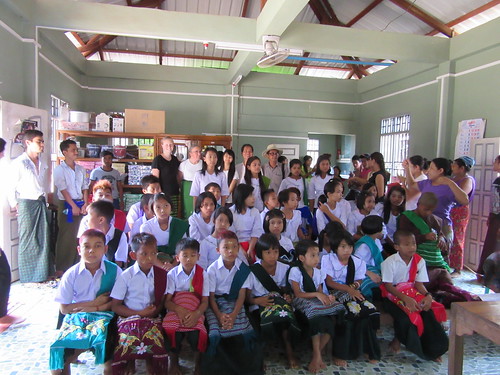 Having changed into their new school uniforms, the children looked very smart.
We were to sleep at the Ko Dut Drop in Centre, so as to be ready for presentations at Ko Dut the next morning. From Ka Mar Wet, we drove to Thanbyuzayat with its 'Tin Shelter' and paused to look at the 'plinthed' C56 steam locomotive displayed near the end of the 'Death Railway'.
The road to Ko Dut is not great at the best of times but a bridge closed for maintenance meant that we had to take a detour from the usual route. Part of this detour ran across a series of fields so, with heavy traffic in both directions, it seemed more like Stock Car Racing than a public road.
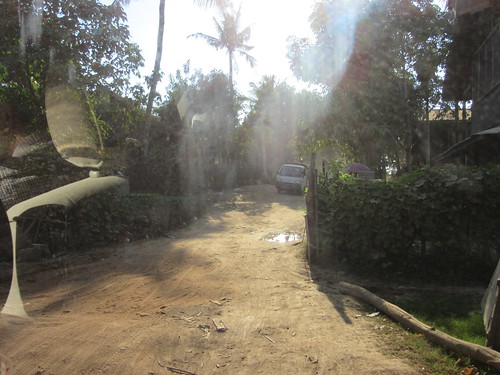 Part of the diversion to Ko Dut.
We re-joined the ordinary road with some relief. The previous year, we'd examined a Monastic School under construction a little outside Ko Dut but it was clear that work had stopped. Dr. Hla Tun explained that the Head Monk had paused the work at the school so that he could use the budget to 'seal' at least some of the rutted dirt roads by laying coated roadstone ('Tarmac'). As we turned onto these 'sealed' roads we noticed a remarkable improvement in 'ride quality'. We stopped at the house of the manager of Ko Dut D.I.C. and were invited in for snacks before moving to the 'Mon School'.
Go to next post.
My pictures
Ka Mar Wet D.I.C.
Around Mon State, 2015
C56 plinthed at Thanbyuzat
My posts on this trip
All my posts on this trip to Myanmar can be found here.
[Pictures added 15th May 2015]
Saturday, 18th April 2015
After resting as much as possible during the day, we loaded all our kit into Dr. Hla Tun’s car. The Doctor drove together with the American medical student, Emily, the Doctor’s daughter and two sons and the writer. After a while, I realised that we had not started the journey proper but that we were transiting across Yangon to where we would meet friends of the Doctor who had arranged a vehicle and driver to take us to Mon state. It was some sort of smart-looking Japanese SUV (you should know by now, I’m not very good at cars - I eventually found out it was a Toyota Alphard) and we transferred everything to the new vehicle and set off.
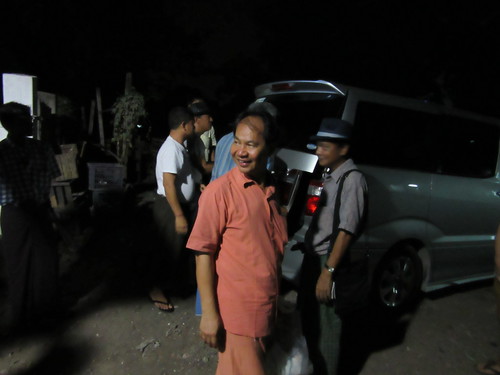 Loading the car which took us to Mon State.
We were driver and assistant, Emily and the writer behind and the Doctor, daughter and one son on the rear seat. The other son was to drive Dr. Hla Tun’s car back to the family home.
Once we'd made our way out of Yangon, we joined a fairly fast dual carriageway. I presume this was the highway to Mandalay. Then, we made a right turn onto a narrower but reasonable road. I assumed we were in the vicinity of Bago and we’d turned to the south on the road to Mawlamyine. The driver was pushing fairly hard which was fine until we hit one of the discontinuities in the road surface, which occurred frequently when passing over the many concrete culverts. This lifted all the passengers up before slamming them down again quite hard, producing cries of astonishment not unlike those produced by a roller coaster ride.
Since the British were involved in the rule of Burma when road transport became mechanised, it was logical to adopt right-hand drive vehicles travelling on the left side of the road. However, following meetings between General Ne Win of Myanmar and President Nixon of the United States, the General decided that Myanmar should emulate the United States by also driving on the right. Unfortunately, all the motor vehicles remained right-hand drive, producing quite a serious situation, particularly when one vehicle overtakes another. As the vehicle moves to the left to overtake a slower vehicle, the driver remains in ignorance of the conditions ahead. This means that the driver’s assistant becomes important in being able to advise the driver of the situation. A stream of Overnight Buses were heading south to Mawlamyine and beyond and, as we approached each bus, I noticed that the bus driver illuminated the flashing left turn indicator to signal either “I am ready to be passed on my left side” or “I am about to pull to the left as you start to overtake, giving you the FRIGHT OF YOUR LIFE” (With acknowledgement to the cartoonist Fougasse and writer Donald McCullough who I think first used this formulation in their book You Have Been Warned – A Complete Guide to the Road).
Around halfway to Mawlamyine, we came to the series of roadside cafes which the Overnight Buses use to break the journey. On this occasion, when we stopped at perhaps the most popular of the cafes, there was no bus parked and the eating area was empty, apart from staff.
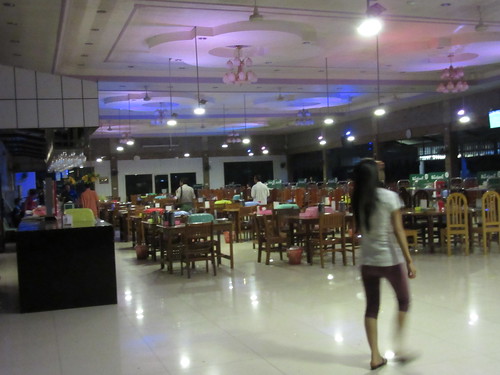 An unusually-quiet cafe on the way to Mawlamyine.
A number of flat-screen television screens were showing SKYNET, inevitably showing a British Premier Division football match featuring Manchester United. One or two snacks were bought from the shop situated near the entrance to the seating area and then we carried on south.
The journey was punctuated by brief halts to pay the road toll at various Toll Stations. We made good time and, having passed over the long road and rail bridge across the River Thanlwin, pulled up at a traffic island on the approach to Mawlamyine where, after a brief wait, a motorcycle appeared and conducted us to the ‘CARE’ Drop In Centre. The driver of the motorcycle unlocked the gates, allowing our car to park in the small yard. By the time we had extricated our personal luggage from the car, the building had been opened and Emily and I were shown to an upstairs room where sleeping mats had been provided on the floor to allow us to take a few hours sleep before Sunday dawned.
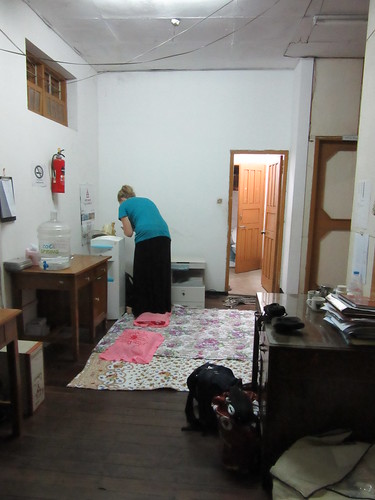
Sleeping mats for Emily and I at the 'CARE' Centre, Mawlamyine.
Sunday 19th April 2015
Somewhat refreshed, we loaded up the car and continued south, pausing at a typical Burmese teashop to refuel the passengers and at a modern filling station to refuel the car.
 Our car outside the teashop.
Our first destination was the Drop In Centre at Kot Kha Pon Village, in Mudon Township where crowds of excited children, obediently seated on the floor, anticipated our arrival.
 Staff at Kot Kha Pon distribute snacks to the waiting children.
Dr. Hla Tun described the presents they were about to receive. A complete ‘kit’ to start them on the new school year was demonstrated, including a sturdy bag, a folding umbrella, a supply of exercise books, pencils, eraser, sharpener, Biro, plastic ruler and a school uniform appropriate to the age and sex of each child.
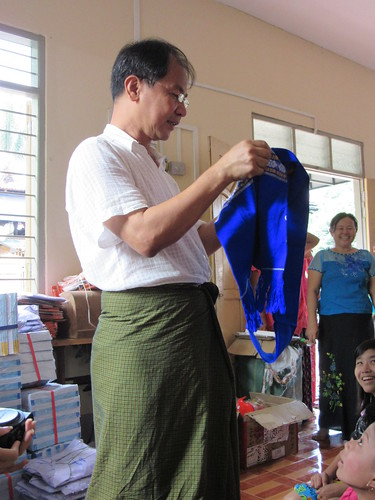
Dr. Hla Tun with one of the sturdy bags,
First, the Doctor donated financial support to four High School students who had performed well in the previous year.
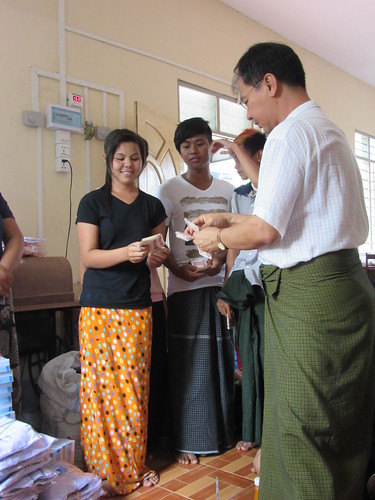
Dr. Hla Tun with outstanding students.
This gave the D.I.C. assistants a few minutes to start assembling the ‘kits’ for the younger children, each kit presented on a metal tray. Emily and Jan made the presentations then the children were invited to try on their new uniforms (white shirts for boys, white blouses with green detailing in different styles for different age ranges for girls, green shorts or longyi for boys, green longyi with a black border top and bottom for girls.
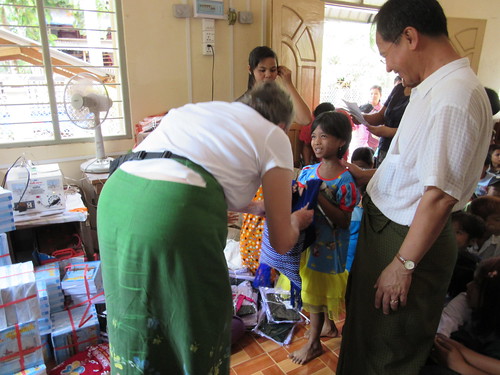 Jan making a presentation to a young girl.
Very soon, we were looking at a sea of white shirts and blouses, rather than the multi-coloured hues of the day clothes the children had arrived in.
 "... a sea of white shirts and blouses..."
One of the girls was noted for her traditional dancing and she was prevailed upon to give a short demonstration.
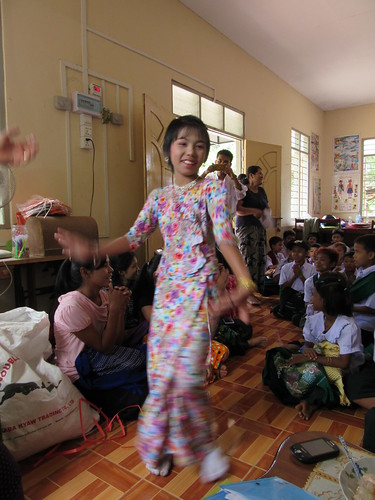
A demonstration of traditional dancing.
There was then a feature I'd not seen before. Each child had been given a handwritten ticket with a number. Additional gifts had been made up into lots with extra pencils or similar school items and the number on each ticket indicated the extra gift the child received.
Finally, there was the 'group shot' to record the children, volunteers and visitors who had participated.
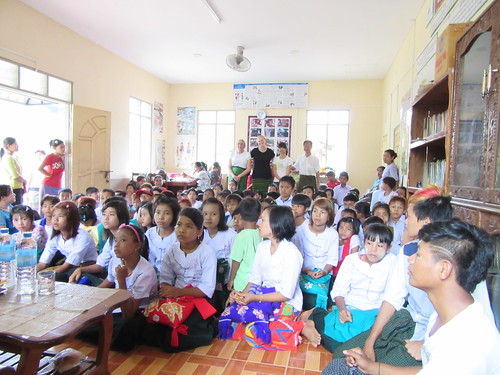 Kot Kha Pon D.I.C.: The group shot.
What happened next? An awful lot. I'll tell you about it as soon as I'm able.
Go to next post.
My pictures
By road to Mon State.
Kot Kha Pon D.I.C.
My posts on this trip
All my posts on this trip to Myanmar can be found here.
[Pictures added 12th May 2015]
'Rangoon', of course, is the old British name for the city of Yangon in the Republic of the Union of Myanmar, but I couldn't resist the alliteration of 'Return to Rangoon'. Incidentally, the airline ticketing code for Yangon remains 'RGN'.
I've just started my ninth visit to the 'Golden Land' and I write this from my friend Dr. Hla Tun's house in Yangon. I left home at 05:30 on Friday, 17th April to catch the Qatar Airways flight from Manchester to Doha, transiting there to a flight to Yangon. There was quite a bit of traffic on the M6 Motorway, even that early, and there was what appears to have become permanent road works on long sections but the journey only took a little over one hour. Terminal 2 was fairly quiet, thankfully, so before long I was checked-in, through security and looking for the appropriately named 'Escape Lounge' which passed the time before boarding pleasantly enough.
Flight QR22 was operated by a (slightly tired-looking) A330 and we left on time at 09:00 for the approximately six hour flight to Doha.
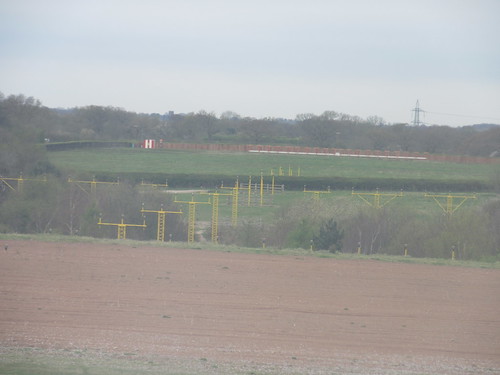 A view of the runway approach lighting at Manchester as we taxied to the runway threshold for take-off.
During the journey, I watched the recent release 'Mr. Turner' (which had a mention in my earlier post Rain, Sleet and Snow) and most of 'Interstellar' before my video-on-demand system packed up. I enjoyed 'Mr. Turner' (although the under-lit candle-light scenes were a bit hard to follow) but I rather formed the opinion that 'Interstellar' was trying to be another '2001' and not quite succeeding.
At about 18:00, we came to a stand at the airbridge at Doha and I entered Hamad International Airport. A year earlier, I'd made my first flights through Doha (this trip was described in the collection of posts labelled Burma-2014) but this was when the 'old' airport was in use. The architecture of the new airport was quite impressive but what I noticed was the number of staff patrolling and the courtesy with which they assisted passengers. I was intrigued by a Paramedic patrolling on what I first thought was a 'Segway' but was fitted with a third small stabiliser wheel. There were also numerous 4-wheeled sales trollies selling Duty-Free, pushed around by smartly-suited young men. If you won't visit Duty-Free, Duty-Free will come to you! I gather the new airport has already won an award for customer service. The Business Lounge was large and fairly spectacular. In the separate dining area, food was available buffet-style with staff on hand to serve your selection but there was also a squad of uniformed waiters taking orders so that passengers could avoid the tedium of actually carrying the food to the table. All the staff I saw (including the toilet cleaners) were noticeably polite and friendly. Like all modern airports, there are fair distances to walk and not all the 'moving pavements' were working, so I left plenty of time to reach my departure gate, B5, for the QR918 to Yangon leaving at 20:40. The aircraft was another A330 in excellent condition and with a very friendly, attentive cabin crew. We pushed-back on time and joined the short queue for the runway (34 Right, I think). By this time, it was dark and I noticed that the 'Windsock' near the runway threshold was internally lit so that it could be seen at night.
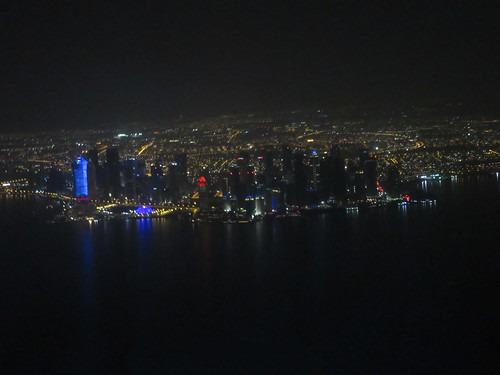 View of Doha by night as we departed from Hamad International Airport.
Having had a snack at Hamad International, I just took a simple cheeseboard after take-off before watching the three available episodes of 'NCIS', none of which I'd seen before. Then I put the seat in 'Bed' mode and managed to relax until we were about 90 minutes out of Yangon when I had a cursory wash and took a light breakfast. It was very hazy as we came into land in Yangon but I still spotted the Circle Line curving beneath us. We taxied to the stand and two airbridges were attached, one near the nose for business class, one a little further back for economy.
 The A330 on arrival at Yangon.
Another walk led to immigration where I was the second arrival. For the first time, I'd been issued an 'Electronic Visa' rather than having a paper visa stuck in the passport. I'd been given a 'Letter of Introduction' to the immigration officer and, to my relief, I was quickly admitted. It was a few minutes before the bags started to arrive on the carousel but mine was one of the early ones so, having had all my luggage X-rayed, I was quickly through customs at 06:25 - the nominal arrival time.
Within a few minutes, Dr. Hla Tun and his son had picked me up and we drove to the same restaurant we'd visited a year earlier (mentioned in the post here). This time, I was even more circumspect about the food I sampled. We then drove to the Doctor's home where, after exchanging greetings with members of his family, I was shown to a bedroom and instructed to rest. After a shower, I set my alarm and slept until eleven a.m. Then, I spent some time re-organising my luggage so that I could travel more lightly on our trip to Mon State. I was then introduced to a young American medical student, Emily, who is to accompany us to Mon State, and her Myanmar friend Mi Mi. After a delicious home-cooked lunch, I took out the Notebook computer to write this initial report. I'll write more when I'm able to.
Go to next post.
All my posts on this trip to Myanmar can be found here.
My pictures
Manchester Airport.
Doha Airport.
Yangon Airport.
[Pictures added 8-May-2015]
Sandakan, Sabah, Malaysia: Tuesday, 10th February 2015
After our visit to the Agnes Keith House and lunch at the English Tea House and Restaurant (described in Part 21), the coaches took us to the Bornean Sun Bear Conservation Centre and Sepilok Orangutan Rehabilitation Centre. These two important conservation locations are side-by-site near Sepilok, about fourteen miles from Sandakan town.
We first toured the Bornean Sun Bear Conservation Centre (BSBCC). This was set up by biologist Wong Siew Te in 2008 to rescue and rehabilitate Sun Bears kept in unhealthy captivity in Sabah with support from the Sabah Wildlife Department, the Sabah Forestry Department and Land Empowerment Animals People. In 2008, the Centre started with 7 Sun Bears and by 2013, 28 Sun Bears were being cared for. We passed through the rather smart reception building and climbed steps to an extensive overhead viewing area, looking down on a large area of forest which had been fenced off for the Sun Bears. We watched a number of the small, attractive Sun Bears snuffling around the undergrowth. The bears share the space with a number of monkeys who kept us amused with their acrobatics.
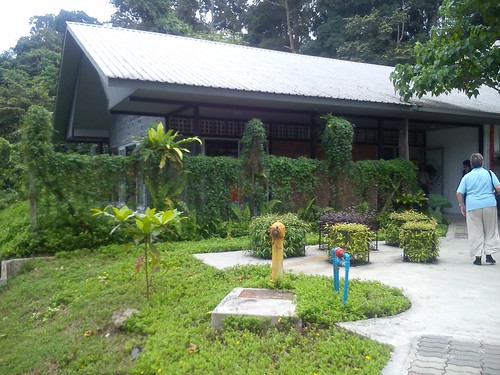 The Entrance to BSBCC.
 One of the Bornean Sun Bears.
There's a Wikipedia article on Sun Bears here.
Leaving BSBCC, a short walk took us to Sepilok Orang Utan Rehabilitation Centre. This was founded in 1964 in a 43 square kilometre reserve to look after orphan Orangutans. There are now up to 80 Orangutans living free in the reserve. A boardwalk for visitors circles around part of the forest with a large viewing area overlooking the feeding platform. Basic food is delivered to the feeding platform twice a day. It's a deliberately boring diet to encourage the orangutans to forage for their own food in the extensive forest so there's no guarantee orangutans will appear at the feeding platform. Our visit had been timed to co-incide with the afternoon feeding so the viewing area was already crowded with visitors when we arrived. We'd watched at least one orangutan performing gymnastics high in the trees before one of the staff delivered a basketful of food to the Feeding Platform. A couple of orangutans arrived, sat down and slowly munched their way through the food. They seemed happy to let monkeys steal some of the food.

The Entrance to Sepilok Orangutan Rehabilitation Centre
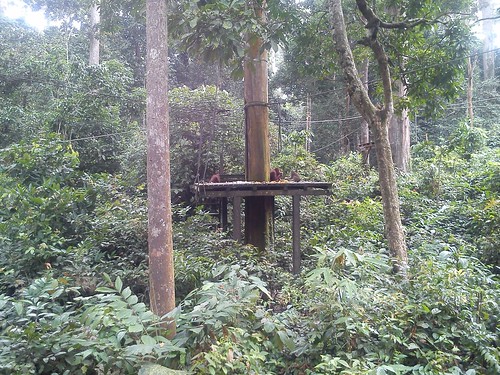 Two orangutan (and the inevitable monkey) at the feeding platform.
There's more about Sepilok on the U.K. Appeals site here.
After watching the orangutans, we made our way back to the entrance. Some of our group watched a video presentation in the air-conditioned theatre, some visited the shop, others did a spot of bird watching. We then re-joined our coaches for the drive back to Sandakan after a fascinating, if tiring, day. We drove to the Four Points by Sheraton hotel at Sandakan Harbour Square, where check-in was very promptly carried out. Issued with a room access card (which also was needed to make the lift work), I was soon in my room on the 21st Floor, with my luggage waiting for me. The views of the town and the bay were stunning.
Later, we enjoyed a buffet dinner in the modern dining room. After the meal, I was tempted to retire but, remembering the maxim "I may never pass this way again", decided I should make the effort to have a walk around the town. Although now dark, there was plenty of artificial lighting. I joined two of my fellow-passengers and we made our way along the shore line which featured a number of bars and cafes overlooking the Bay. I declined their offer to join them for a drink at one of the open-air bars and pressed on, passing the bus station thronged with local people, and then the Navy Base. Beyond the Navy Base, there was a long promenade which seemed to attract a number of young couples enjoying the warm evening. The sea wall had been built from pre-cast concrete sections and each one had been used as a canvas where locals had added graffiti on various topics. There were the usual declarations of love but I was fascinated by a rather crude depiction of a Malaysian Airways aircraft crashing which I took to be a commemoration of the loss of Flight 370 or Flight 17 (or both). By now quite tired, I returned to the hotel and slept soundly in the large bed.
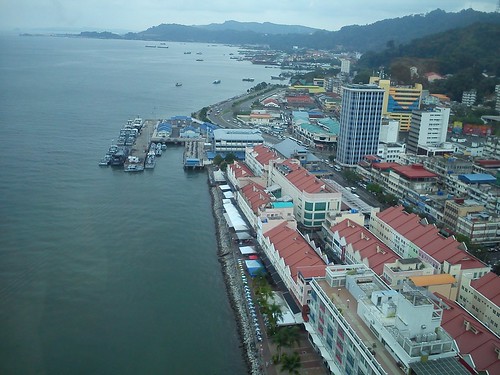 View of Sandakan from the Four Points by Sheraton hotel. The dock we arrived at is on the extreme left of the promentary in the distance.
Sandakan, Sabah, Malaysia: Wednesday, 11th February 2015
I took a fairly light breakfast and determined to make one final foray into the town before leaving by coach for the airport. First, I walked around Sandakan Central Market - a modern building offering anything you can imagine, including a large fish market with many unfamiliar species on display. I continued walking along the main road near to the shore as far as the base of the Marine Police, with its large covered slipway. I then retraced my steps and took the direction of the previous evening, passing the bus station and Navy Base. The road next to the sea wall had lost its young couples - these had been replaced by a long row of white 'minibuses' about the size of a small van, waiting for business. Beyond the next rounabout lay a pleasant, wooded park overlooking the bay. A building in the corner of the park is the Dewan Masyarakat Sandakan, which is shown as an 'Event Space and Convention Center'. At the far end of the park, I had a good view of the first of a number of jetties serving fishing vessels. A few boats were still returning, presumably after a night fishing. I decided I'd better turn round and return to the hotel in order to catch the coach transfer to Sandakan Airport. On the way back, I completed an artistic photo-essay of Sandakan (using my mobile 'phone, as my Fuji camera had failed much earlier in the trip), which I'm sure you would have enjoyed, had I not left the telephone on the table in the hotel reception in the rush to board the buses. I discovered the loss as soon as we arrived at the airport and alerted the agents, who contacted the hotel. Alas, 'phone and pictures were never discovered.
Sandakan has a fairly small airport. We enjoyed the usual hanging-around whilst waiting for check-in to commence. Most of the passengers off the ship were travelling on the same flight to Kuala Lumpur together. There, the majority would transit to a British Airways London flight, after a fairly long wait. After an even longer wait, I was booked on an Emirates flight to Dubai, changing there for a Birmingham flight. And so my cruise from the Coral Sea to the South China Sea came safely to an end, leaving me with memories of exotic locations and friendly people.
You can find all the posts on this trip here.
My pictures
Sandakan, Sabah, Malaysia.
Bornean Sun Bear Conservation Centre.
Sepilok Orang Utan Rehabilitation Centre.
Four Points by Sheraton, Sandakan.
THE JOURNEY, THURSDAY, 26th MARCH 2015
I'd been invited to the Irlam Station Launch that day by Hamilton Davies Trust and the joining instructions gave details of car parking arrangements adding "But wouldn't it be great to arrive at the station launch by train?". I replied (somewhat indignantly) "CAR? No, I intended to entrust myself to the tender mercies of Northern Rail in any case." Northern Rail had kindly provided some complimentary tickets from Manchester or Liverpool to Irlam and one of these was issued to me.
The simplest route would probably have been Wolverhampton to Warrington Bank Quay, walk to Warrington Central then two stops along the former Cheshire Lines Committee route to Irlam. However, to give me the opportunity of further research on Edge Hill Cutting, I decided to travel on the 11:20 'London Midland' service from Wolverhampton to Liverpool Lime Street and then on the 12:55 'Northern Rail' service as far as Irlam.
The Wolverhampton to Stafford line is in the process of being re-signalled, prior to control being transferred to the West Midlands Signalling Centre. Network Rail are committed to centralising signalling control at a small number of Integrated Electronic Control Centres (IECC) covering large areas. There's a brief description in 'Wikipedia' here. The picture below (snatched from a passing train on an earlier journey on the Derby Line) shows the West Midlands Signalling Centre at Saltley, Birmingham, which is progressively taking over control of the the railways in the West Midlands.
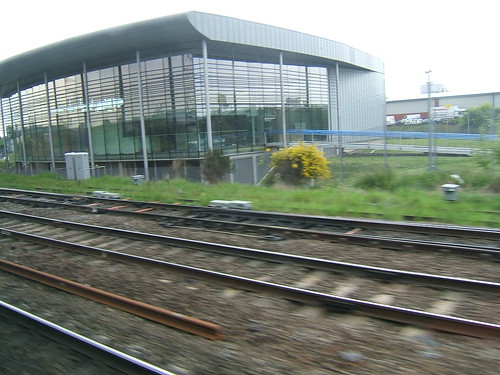 The futuristic West Midlands Signalling Centre at Saltley, Birmingham.
On the way to Stafford, we passed a number of small gangs of men working on signalling . Some replacement signals were already in use, others were lying flat, awaiting installation. At present, the next signal box to Wolverhampton Power Signal Box is Stafford Number 4, south of Stafford station and then Stafford Number 5, north of Stafford station. We made our scheduled stop at Stafford and then made good time on the Down Fast to Crewe. The signalling on the line from Stafford to Crewe was modernised some years ago and is now controlled from Stoke-on-Trent. However, approaching Crewe, control passes first to Basford Hall Junction (a much-modernised LNWR box) and then to Crewe Signalling Centre which is situated on the site of the former Crewe North Motive Power Depot (and which I always think looks like a B & Q warehouse). We arrived in platform 11, where quite a few passengers got off or boarded. I didn't find out the significance of the 'bear' wearing a High Visibility jacket who was trying to embarrass the member of station staff 'seeing us away'.
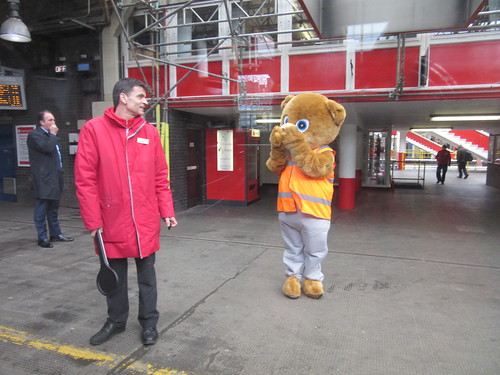 The 'bear' in the High Visibility jacket at Crewe station.
Crewe Signalling Centre only controls the immediate station area (it was a 'temporary' arrangement, some years ago) so the next signal box is the A.R.P. box at Crewe Coal Yard. From Crewe, we ran on the Down Slow, so I was not surprised when we slowed to a standstill just short of Winsford where the four running lines (Down Slow, Down Fast, Up Fast, Up Slow) reduced to two. I correctly guessed that we were about to be overtaken. Sure enough, I noticed the overhead line over the Down Fast start to oscillate slowly up and down and a few seconds later a 'Pendolino' swept by us. The pressure wave caused my train to lean away briefly on its air suspension. The overhead line over the Down Fast continued to oscillate after the train had passed. Very soon, our signal cleared and we carried on to our booked stop at Winsford station. The next box to Crewe Coal Yard is Winsford (another much-modernised LNWR box) which controls the line to and including Weaver Junction, interfacing with Halton Junction (on the Liverpool Line) and Warrington Power Signal Box (on the West Coast Main Line). We made further booked stops at Hartford and Acton Bridge before taking the Liverpool line at Weaver Junction. The previous signal box at Weaver Junction still stands on the up side with its operating floor boarded-up. It had a small 'NX' panel put in when the West Coast Main Line was first electrified.
Next, on our left, Halton Junction signal box is another LNWR survivor, heavily modified. The former double track spur to Frodsham has been singled and made uni-directional, allowing traffic from Frodsham to Halton Junction but not the other way. We then passed through the sandstone cutting to Runcorn station, which retains its A.R.P. signal box. After a brief stop at the character-less modern station, we crossed the River Mersey on the spans of the lattice-girder Runcorn Railway Bridge (with its Grade II* listing) and then traversed the sweeping Ditton Viaduct.
The station at Ditton Junction is long closed but one LNWR signal box hangs on, called simply 'Ditton'. There are four running lines (paired by use) from here to Wavertree. There are Exchange sidings on our left serving the car plant at Halewood then another surviving LNWR signal box, Speke Junction, controlling one junction of the triangular connection serving the Freightliner depot adjacent to Garston Dock. Freightliner call this Depot 'Liverpool', to distinguish it from their 'Seaforth' depot. There's an outline of their Port and Terminal Network here. The second junction to Garston is controlled by the next signal box - Allerton Junction, which also controls the junction with the Hunt's Cross Chord which allows trains from Lime Street to join the former Cheshire Lines Committe route to Manchester. We stopped at the modern station of Liverpool South Parkway (formerly Allerton) so I could have changed here for the Northern Rail service to Irlam but, as I mentioned above, I'd decided to use the trip to look again at the Lime Street Cutting. My train carried on to Edge Hill (where there's an 'NX' signal box) then down through the cutting to Lime Street, still controlled by a Westinghouse Style 'L' 'All Electric' power frame in the A.R.P. design signal box dating from the 1940s.
I knew that video from inside a train with no opening windows, double-glazing and bright lights wouldn't be very good, but there's a video from Edge Hill to Lime Street here.
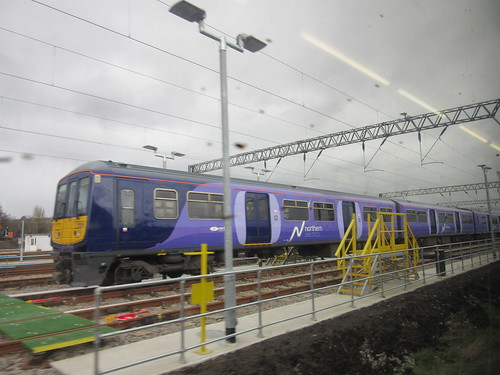
My train arrived at its usual platform 8, leaving me plenty of time to make my way across to the 'local' platforms (1 to 6). The original Liverpool and Manchester Line had been recently electrified at 25 kV a.c. and I was able to get a picture of one of the "new" Northern Rail electric multiple units. Four-car set 319 363 was standing in platform 1 looking quite smart in its blue livery labelled 'Northern Electrics'. Of course, the Class 319 were introduced between 1987 and 1990 and have seen heavy use in the London area. There's a Wikipedia article here. Early in 2015, the first of 20 sets of the 25-year old trains cascaded from the London area entered service following 'overhaul'. Northern Rail wax quite lyrical about the new seats and paint job here. Of course, under our crazy rail privatisation, trains are actually owned by one of the 'ROSCOs' - Rolling Stock Companies, in this case Porterbrook and their sales catalogue for Class 319 here makes interesting reading.
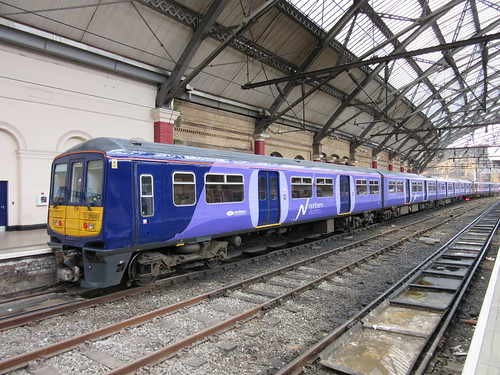 Class 319 electric at Liverpool Lime Street.
The big departure board on the concourse gave platform 6 for the 'Northern Rail' train to Manchester Oxford Road I was to catch. I was 'foxed' for a minute because the Passenger Information Display at the entrance to the platform only showed a Norwich service. Then, I realised that the 2-coach Class 156 on the buffer stops was my train and the other coaches formed the East Midlands Trains service to Norwich. We set off on the same route as the Norwich train, but we were booked to stop at most stations. Up the bank on the Up Fast to a brief stop at Edge Hill station, then we passed Edge Hill Power Signal Box and diverged to the right onto the Crewe line stopping at Mossley Hill, West Allerton and Liverpool South Parkway. Allerton Junction signal box turned us onto the Hunt's Cross Chord. As we passed Northern Rail's Allerton Train Maintenance Depot, I spotted another of the "new" electrics.
 Class 319 electric at Allerton Train Maintenance Depot.
Our next stop was Hunts Cross where most of the people on the platform were waiting for the Merseyrail electric train (there's a brief description of an earlier visit to Hunts Cross in More Merseyrail. Setting off again, we passed the rather bleak modern signal box then stopping at Halewood, Hough Green and Widnes. As I mentioned in the the section 'THE CLC ROUTES TODAY' forming part of the post The Cheshire Lines Committee, 'Widnes' station was orignally named Farnworth but when the loop through Widnes was abandoned and the original Widnes station lost, the name was transferred to Farnworth. I doubt if many people were fooled by this sleight-of-hand. Then we stopped at Sankey for Penketh and Warrington Central. At platform level, this station, with its polychromatic brickwork and glazed canopies supported on cast columns has been quite attractively restored. The structure of the classical main station building on the up side survives (let out to small businesses, I believe) but access from the street is now via the usual miserable British Railways 'modern' building. Warrington Central retains its British Rail Standard signal box on the down side. My train was not booked to stop at the next station, Padgate and after pausing at Birchwood (modern brick brutalism, I'm afraid) we didn't stop at Glazebrook either, but other services do stop at both Padgate and Glazebrook. The triangular connection to the G.C.R. line to Wigan west of Glazebrook station is long gone, together with the signal boxes at Dam Lane Junction and Glazebrook West Junction but I did spot a redundant road overbridge over the former branch from Glazebrook West Junction. Glazebrook East Junction (another British Rail Standard signal box) survives, although the branch to Stockport and the Exchange Sidings with the Manchester Ship Canal have gone. The box now talks to Warrington Central signal box and Manchester Piccadilly Signalling Centre and controls a Down Passenger Loop and a crossover between the main lines. The next stop was Irlam where I left the train and I received my first sight of the Irlam station building I'd come to visit. My train departed, to shortly cross over the Manchester Ship Canal.
When the Cheshire Lines Committee built the line from Liverpool Central to Manchester, they placed the main station building at each intermediate station, including Irlam, on the Down side of the track. Later, when the Manchester Ship Canal was built, it intersected the railway just east of Irlam station. So that a bridge could be used to carry the railway over the canal, inclines were necessary in the railway on either side of the bridge and the railway was deviated to the south. This required a new station to be built to the west of the first station. After the deviation and new station were introduced, Irlam became the only intermediate station on the line where the main station building was on the Up side of the line!
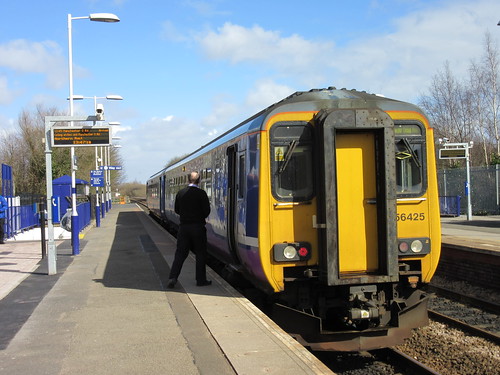 Irlam Station: The train which had brought me from Liverpool about to leave.
For a description of the 'launch' itself, see Irlam Station Launch.
SIGNALLING FROM WOLVERHAMPTON TO LIVERPOOL
Wolverhampton Power Signal Box in 2013

Click here for other sizes.
Stafford No. 4 in 2013
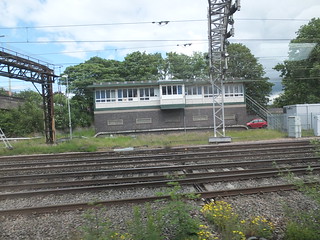
Click here for other sizes.
Stafford No. 5 in 2013
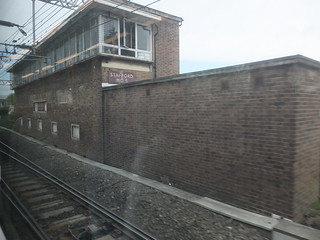
Click here for other sizes.
Stoke-on-Trent Signal Control Centre
Sorry, no suitable illustration at present.
Basford Hall Junction in 2013

Oh dear - not very good.
Crewe Signal Control Centre in 2014

Click here for other sizes.
Crewe Coal Yard in 2015
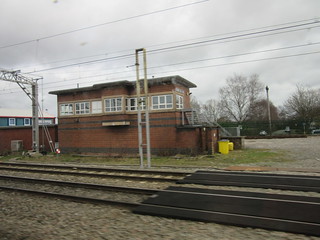
Click here for other sizes.
Winsford in 2015
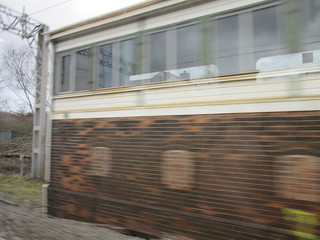
Click here for other sizes.
Halton Junction
Sorry, no suitable illustration at present. I found a picture of the box on sale here.
Runcorn in 2010
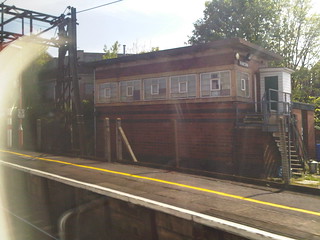
Click here for other sizes.
Ditton
Sorry, no suitable illustration at present.
Speke Junction, 2012
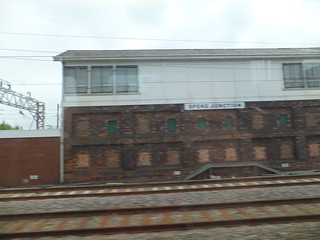
Click here for other sizes.
Allerton Junction in 2015

Click here for other sizes.
Edge Hill Power Signal Box in 2010
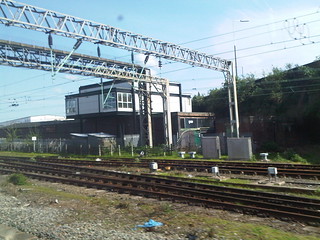
Click here for other sizes.
Liverpool Lime Street Power Signal Box in 2012
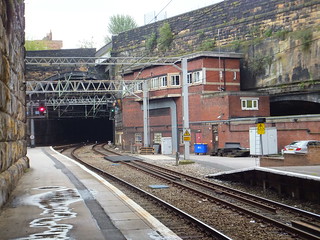
Click here for other sizes.
Related articles on other sites
Stations and Junctions (around Irlam).
The Industries of Irlam and Cadishead.
Related posts on my site
Day Trip to Liverpool (2010: Brief).
Liverpool by Train (2012).
Liverpool Lime Street.
The Cheshire Lines Committee.
The Cheshire Lines Committee Routes Today.
Signalling on the former Cheshire Lines Committee in the 1950s
Irlam Station Launch.
My pictures
West Midland Railways.
Stafford Area rail.
Crewe Area rail.
Liverpool area rail.
CLC Manchester - Liverpool.
Irlam Station Launch.
Sandakan, Sabah, Malaysia: Tuesday, 10th February 2015
Early on Tuesday morning, we had our first sightings of our destination - Sandakan. This was originally part of British North Borneo which is now called Sabah and is part of Malaysia. We passed the massive bulk of Pulau Berhala on our starboard side and entered the large natural harbour which allowed Sandakan to develop as an important port.
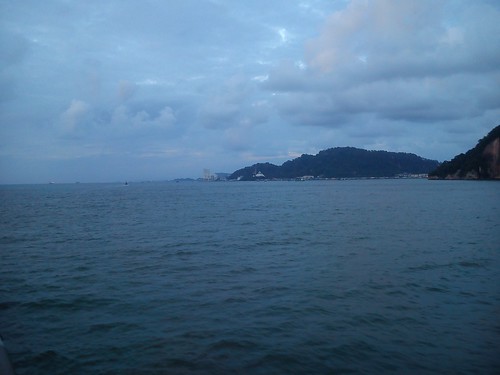 Approaching Sandakan, with a large mosque and beyond the multi-storey bulk of the 'Four Points by Sheraton' visible. Notice the number of ships dotted around the natural harbour.
For the last time on this trip, I watched a Pilot climb aboard to assist the Captain in the final approach to our quay.

The Sandakan Pilot climbs aboard.
At about 7.00 a.m. Tuesday, we berthed alongside the quay, facing a rather bleak-looking transit shed. It appeared that our quay was more used to handling freight rather than people. A number of large, bulk material conveyor units stood ready for use at one end of the quay and a massive mobile harbour crane with a rubber-tyred chassis and outriggers stood at the other end of the quay. The crane was labelled 'Gottwald' but these cranes now seem to be marketed as Terex Gottwald Port Solutions. An adjacent quay appeared to deal with smaller passenger ferries which I think go to the Phillipines.
 'Caledonian Sky' gently approaches the quay at Sandakan.
An open lorry drew up next to the ship and the crew started to take our luggage ashore, setting it out next to the lorry. A group of musicians appeared and set up outside the transit shed, playing for seven dancers in traditional costume, watched by the passengers from various decks on the ship. A group of dock employees appeared and enjoyed the free entertainment.
 Traditional dancers welcome the ship.
Saying our 'goodbyes' to the crew (many of whom were being relieved at Sandakan by fresh crew), the passengers disembarked for the last time, identified their luggage which was then loaded onto the lorry and boarded the three coaches which had appeared. We were to spend the day around Sandakan, before being reunited with our luggage (hopefully) at the 'Four Points by Sheraton' hotel. The coaches moved off through the dock area to join the main road to Sandakan town, about five miles away. The contrast with some of the rural places we'd visited was very striking. Everything is modern - the Japanese occupation during World War II and the subsequent Allied bombing reduced the town to rubble. Now, there are dual carriageways and frequent housing developments up to four stories tall. We didn't initially drive into the town centre but turned inland, eventually arriving at what was clearly a fairly 'upmarket' area of apartments with some detached houses. The coaches parked at the side of the road and we disembarked to enter the Sandakan Memorial Park. A dignified sign explained:-
"The Government of the State of Sabah has set aside this site as a memorial to those prisoners of war who suffered and died here, on the Death Marches and at Ranau. The memorial also commemorates the suffering and sacrifice of the local people."
The wooded gardens were in immaculate condition and radiated a great sense of peace, in jarring contrast with how the area would have been during the Japanese occupation during World War II.
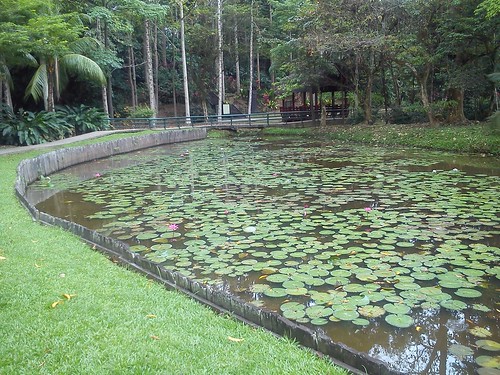 The immaculate gardens at Sandakan Memorial Park.
In 1942, 1500 Australian Prisoners of War were brought here to construct a military airfield for the Japanese. The following year, around 700 British and a further 500 Australian Prisoners of War arrived. Late in 1943, the prisoners were force-marched 260 km to Ranau in three 'Death Marches'. The only recorded survivors of these marches were six escapees. A Wikipedia article on this tragic era is here.
In the Sandakan Memorial Park, a wooden Commemorative Pavilion houses information displays and photographs. Nearby, there are a few reminders of the wartime camp - concrete water tanks, the remains of an ancient vertical boiler, an electric generator and a British 'Ruston Bucyrus' excavator. The excavator was commandeered by the Japanese but later sabotaged by an Australian prisoner. There is an engraved black marble monolith as the focus of the memorial park, and we were invited by our guide to observe a one minute silence here before three of the group placed wreathes.
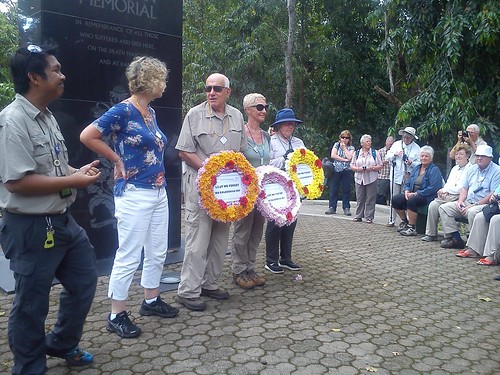 The Memorial Monolith.
After this thought-provoking interlude, we returned to our coaches and continued our tour of modern Sandakan. Building is still proceeding - Sandakan is the second largest town in Sabah with a population of around 400,000. Only Kota Kinabulu (formerly called Jesselton) is larger. There are still fairly basic wooden houses on stilts but there is a policy to remove these, transferring the occupants to modern (if rather barrack-like) apartments.
 Modern apartments in Sandakan.
As we neared the centre of the town, we turned up into the hills overlooking the sea. Here we visited St. Michael's and All Angels Church, a granite building dating from the early twentieth century, next to the large St. Michael's school.
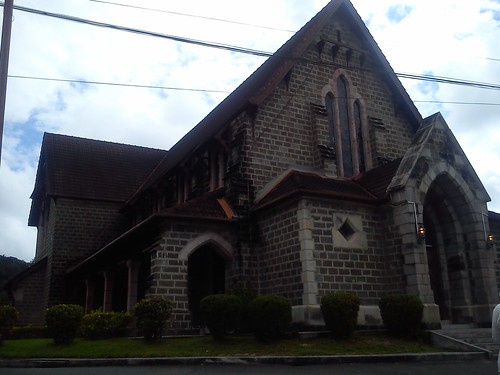 St. Michael's and All Angels Church.
We re-joined our coaches for a short ride to the English Tea House and Restaurant which has the proper appearance of a colonial bungalow, with its own croquet lawn. Its hilltop location offers wonderful views of the natural harbour of Sandakan.
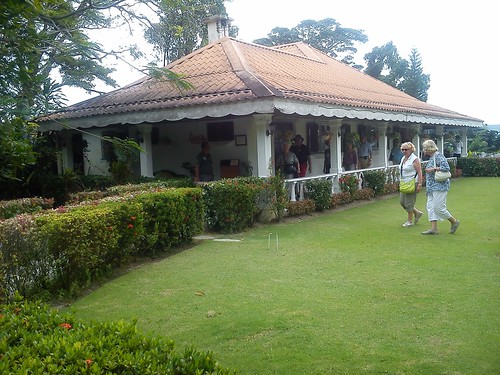 The English Tea House and Restaurant, Sandakan.
However, before we enjoyed luncheon at the English Tea House, we visited 'The Agnes Keith House' just next door. I'm afraid I'd not heard of Agnes Keith, but I was charmed by her house. Before World War II, she lived at the house with her husband who was Conservator of Forests and Director of Agriculture for the government of North Borneo. She wrote a book of her experiences called 'Land Below the Wind' which was prize-winning and has become a classic. During the War, the family were interned by the Japanese and that grim time is recounted in her book 'Three Came Home'. Upon release at the end of the War, they found that the house had been destroyed, but they rebuilt it on the same site and spent about five more years there, giving rise to another book 'White Man Returns', before moving first to the Phillipines and then Libya. The house in Sandakan became derelict before being restored by Sabah Museum and becoming an important visitor attraction.
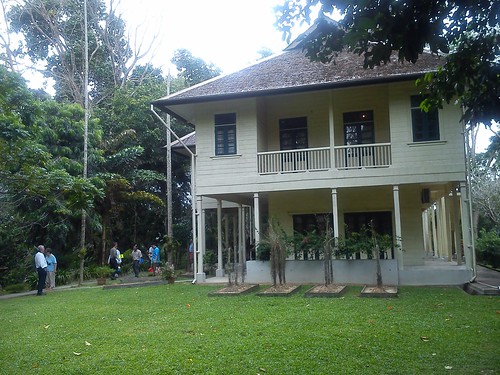 The restored Agnes Keith House.
We then returned to the English Tea House for a very enjoyable buffet lunch. I was then drawn back to the Agnes Keith House for a final walk around the well-kept garden before boarding our waiting buses. Our next journey took us inland. After some of our recent visits to rather smaller communities, I was still having trouble getting used to the scale of developments around Sandakan - such as the aptly-named 'Giant' Hypermarket, part of the Malaysian 'Giant' chain.
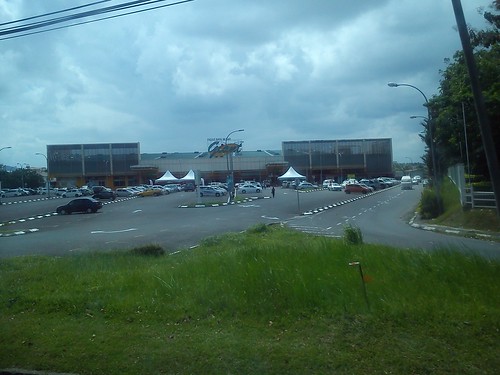 The 'Giant' Hypermarket, Sandakan.
We were heading broadly west on Malaysia Federal Route 22. Around 14 miles from Sandakan, we left the main road to reach Sepilok, where we were to visit the Bornean Sun Bear Conservation Centre and Sepilok Orang Utan Rehabilitation Centre. I'll describe these visits in Part 22.
You can find all the posts on this trip here.
My pictures
Arriving at Sandakan, Sabah, Malaysia.
Sandakan, Sabah, Malaysia.
Sandakan Memorial Park, Sabah.

