skip to main |
skip to sidebar
More from Singapore: Monday, 26th January 2015
At noon, the whole group boarded two large, modern coaches for a sightseeing tour around Singapore. We drove through the forest of tall buildings which covers most of the city centre to a small area in Chinatown called Far East Square. Here, a group of earlier brick-built Shophouses have been modernised but retaining much of the original. The development won an Architectural Heritage Award in 1999. We walked to a Chinese restaurant called Spring (Fu Chun Yuan) for lunch. After lunch, we returned to our coaches and continued the tour.
Our next stop was at the oldest Taoist temple in Singapore, Thian Hock Keng, originally built in 1821 as “a humble joss house”. Preparations for the Chinese New Year were well advanced, so we saw all sorts of decorations.
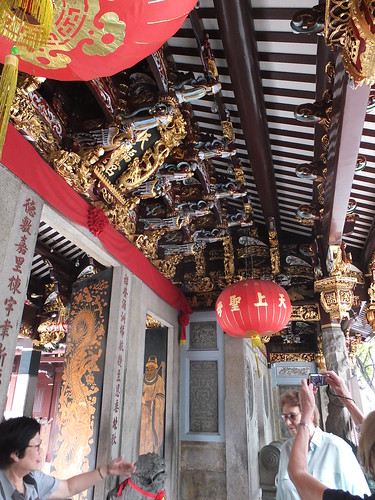
Thian Hock Keng Temple, Singapore.
Later, we drove past both Hindu and Buddhist places of worship on the way to Clarke Quay, where the passengers from each bus joined two tourist boats for a River trip.
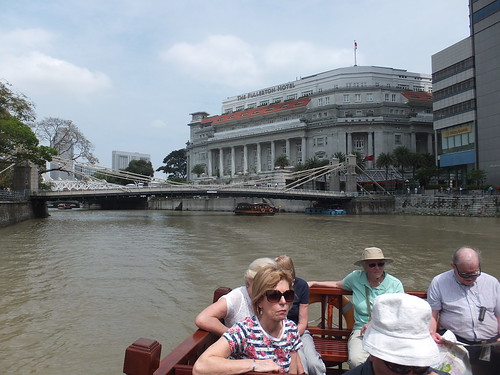 Singapore - City river trip.
They called the boats we took by the traditional name of a ‘Bum Boat’ but, in these days of Health and Safety, the whole business has become far more regulated. There were lots of tourist boats on view, all of similar design and apparently well-maintained, with the staff wearing T-sheets and baseball caps carrying the company logo. It was far more fun ten years ago when I just went to Clifford Pier and hired a rather beat-up launch which took me on a splendid tour of river, container port and one of the islands (briefly described in an earlier post here).
The modern trip boats took us down river, under the various road bridges named after Englishmen from the British era and into the broad stretch of water called Marina Bay. This area has seen major developments since my last visit. The symbol of Singapore, the Merlion statue, was there ten years ago but is currently swathed in scaffolding. The north west quay now has One Fullerton (a “food centre’), the Fullerton Pavilion and the Fullerton Bay Hotel. The south east quay now has a futuristic-looking Art Science Museum, theatres, a casino, a convention centre, various event spaces and rather pompously-named “The Shoppes at Marina Bay Sands”. The scruffy water taxi dock at Clifford Quay which I remember has gone – I was told it has been relocated. As our boat retraced its route back to the river, we passed two more recent features – ‘The Helix’, a bridge with two opposed spirals inspired by the ‘Double Helix’ structure of DNA and ‘The Marina Bay Seating Gallery’ (a huge inclined slab of concrete with open-air seating facing the water). To complement the Seating Gallery, a large floating pontoon has been moored in the water which carries a giant television screen. I suppose inevitably, in this computer-obsessed age, the pontoon is called “The Float @ Marina Bay”. We disembarked at the landing stage at Clarke Quay where we’d boarded and walked back to the coaches.
Another drive across the city took us to Singapore Botanic Gardens which is seeking adoption as a World Heritage Site. Our guides took us on a walking tour of the world-famous Orchid Gardens. It has a section displaying ‘V.I.P. Orchids’ where the flower has been selected by a politician or member of a Royal family from a number of hybrids offered. An adjacent, similar selection showed ‘Celebrity Orchids’ chosen by people from the entertainment history.
 Singapore Botanic Gardens has a spectacular display of hybrid orchids.
Then it was back onto the two coaches for our final transfer to the airport where we were to check in a 5.00 p.m. for our overnight Air Niguini flight to Papua New Guinea. We then found out that check-in would not commence until 7.00 p.m. because the inbound aircraft was late. We made a queue of our luggage which our tour organiser for this section agreed to guard, allowing the members of the tour to wander off.
Singapore Airport currently has three Terminals (T1, T2 and T3). A fourth Terminal is being built. These terminals are linked by a network of driverless trains running on rubber tyres. I decided to check this out whilst waiting to check-in with the airline. I travelled from T1 to T2 on one line, T2 to T3 on a second line and T3 back to T1 on a third. That’s not the full extent of the lines!
Back safely at T1, I joined my luggage at the check-in queue. One young man started check-in on time, but it was an awfully slow process at first. Later, a girl opened a second check-in position which improved matters. But the disappointing news was that departure had gone back to 11.00 p.m. This delay meant that the check-in agents were writing a voucher for each passenger to pay for a snack. It transpired that the value of the voucher was only 8 Singapore dollars (about four pounds Sterling) but I, and the other group of passengers I was with, made sure we used these. Eventually, our flight was called so we walked to the gate – D40. Security was being carried out at the Gate, so we had to join another queue waiting to pass through a thorough security check before we could enter the Departure Lounge. The staff were pleasant enough, which helped a bit. I think it was just after 11.00 p.m. when we finally started boarding the Boeing 777-300 and it must have been well after after 11:30 when we finally took off. For this leg, I was booked Economy so I found it all a bit cramped and, on top of the delay at Singapore, I was not looking forward to another six hours or so of overnight flight before we reached Port Moresby Airport in Papua New Guinea.
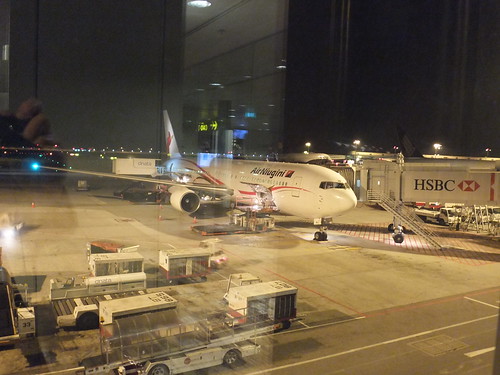 The Air Niugini Boeing 777-300 which took us to Papua New Guinea.
P.S. It got better! I’ll tell you about it when I'm able. You can find all the posts on this trip here.
My pictures
Singapore, 2015.
Singapore - City river trip.
Singapore Botanic Gardens.
Singapore (Changi) Airport.
[Pictures and links to albums added 14-Feb-2015]
More from Singapore: 26th January 2015
I enjoyed a wonderful night's sleep in the huge bed at the Shangri-La and awoke refreshed. Buffet Breakfast was in 'The Line' restaurant which the hotel claims is "a spectacular display of cutting edge modern surrounds, The Line is designed by the world acclaimed Adam D. Tihany". It's modern, illuminated by large orange-coloured rectangular lighting fittings mounted at odd angles and full of hard surfaces and structural beams so, of course, I didn't like it. Even though I picked a less-busy area, it was still noisy and accompanied (like the whole of Singapore I rather think) by the penetrating low-frequency rumble of air conditioning plant. It's a large restaurant, broken up into a number of areas each with a different table layout. The food, however, was impressive. A wide range of styles is on offer from what the hotel rather archly calls "16 interactive theatre kitchens". This means there are lots of counters manned by cooks who take your requirements and cook it in front of you. Simpler items are laid out for self-service. I was impressed with the variety on offer and the quality of the end product.
 Part of 'The Line' Restaurant, Shangri-La Hotel, Singapore.
After breakfast, I met up with the the lady from 'Destination Asia Singapore' at the special Hospitality Desk for people on this Noble Caledonia trip. I discovered that the reason I'd not found her the previous evening was because the 'main party' didn't arrive at the hotel until after 8.0 p.m. because of delay to the British Airways flight from London. At noon, the whole group will have a sightseeing tour including lunch at a Chinese Restaurant and a river trip.
We'll then check-in at the airport for our overnight flight to Papua New Guinea.
More when I'm able. You can find all the posts on this trip here.
My pictures
Shangri-La Hotel, Singapore.
Singapore.
An update from Singapore
I left the lounge at Dubai in good time for flight EK354 to Singapore. As I expected, the aircraft was the huge Airbus A380, where the Business Class is on the Upper Deck, served by a separate Air Bridge. So the gate 'A8' I'd been directed to was only dealing with upper deck passengers. There was still something of a queue at the gate, probably because of the sheer size of the upper deck. Although an A380 can be configured for around 800 passengers total, I think the Emirates version like the one I boarded, an A380-800 registration A6-EED, 'only' caters for 500 odd. In the upper deck, all seats are aisle seats and every other row is also a window seat.
I watched a couple of recent Science Fiction films ('Lucy' and a Tom Cruise outing about 'Mimics' invading Earth) then I slept for a bit until they served breakfast. That probably sounds more pleasant than it seemed to me - it was my second 7-hour flight since leaving home the day before. At least the A380 seat becomes properly flat when turned into a bed.
On our approach to Singapore, our aircraft turned over the sea so as to approach runway 02 from the south, giving me a brief view of the dozens and dozens of ships, including large container ships and oil tankers, awaiting their turn to enter the port.
I was quite relieved to get off the plane, despite the long walk needed to reach Passport Control. Matters were helped by a number of 'moving pavements' which, I noticed, they call 'Travellators'. The delay at Passport Control was quite moderate and, moving on to the Luggage Hall, although the carousel area was crowded with waiting passengers, my case arrived after a couple of minutes. My luggage was quickly X-rayed by two helpful young men and I was waved through Customs. My air fare had included a limousine to my hotel so I found the Emirates desk dealing with car transfers and, having checked his list, he gave me a note of the car number allocated and directions to the waiting zone. A procession of smart black Mercedes were pulling up, loading passengers and driving off. In the three or four minutes I was waiting for the right car, at least a dozen must have loaded.
The journey into the city was quite relaxing. The dual carriageways seemed to be limited to a speed of 90 km/hr. I was amused that my Black Mercedes was consistently indicating '89'. On my last visit in 2005 (there's a brief description here, I commented on the multi-storey flats everywhere. Somehow, they've found room to shoe-horn more in and today there seems to be new buildings and building work in progress everywhere.
This trip was my first stay at the Shangri-La in Singapore but I've previously stayed at the Shangri-La Bangkok). The Singapore staff were helpful and the room was a good standard so I was tempted to just stay in the hotel but I finally decided to make a short walk, leaving the hotel just before 5.0 p.m. The Shangri-La is in a fairly upmarket area of hotels and apartments about 15 minutes walk from the main shopping street, Orchard Road. I declined the hotel's "Shopper's Bus" which frequently circles the major shopping destinations. The pavements were crowded, mainly with young people, including plenty of Europeans (a mixture of holiday makers and ex-patriates, I think).
Back at the hotel, I briefly explored the hotel facilities before returning to my room to set up my Notebook computer. I decided to have a meal in my room (yes - fish and chips), followed by a bath, by which time I was really in need of some proper sleep.
More when I'm able. You can find all the posts on this trip here.
My pictures
A380 DXB-SIN (pictures during the A380 flight).
Shangri-La Hotel, Singapore.
Singapore.
An update from Dubai
It's two o'clock in the morning and I'm in the Emirates Business Lounge in Terminal A of Dubai Airport. I caught the EK040 from Birmingham Airport which left about right time at 13:25. The aircraft was a smart Boeing 777-300, registration A6-ECZ. It should have taken 6 hours 20 minutes to Dubai but, mainly because of a headwind of about 40 knots, we were around one and a half hours late into Dubai. Dubai airport seems to have expanded again since my last trip through. There's now driverless rubber-tyred 'trains' between the three terminals that accelerate at a cracking pace. There was quite a bit of walking before and after the train. According to the signage, it takes 12 minutes to walk from one end of the Business Lounge to the other end! I'd had a meal on the inbound flight (I had a very decent grilled turbot in butter sauce with rice and carrots as the main course) but I was ready for a small bowl of minestrone with a small baguette before I located the business lounge and the Samsung machine I'm using. I had some trouble getting into Google - the browser is Internet Explorer and I got locked in a loop with Microsoft telling me what a wonderful experience the new Explorer delivers before it reluctantly dumped me into Bing.
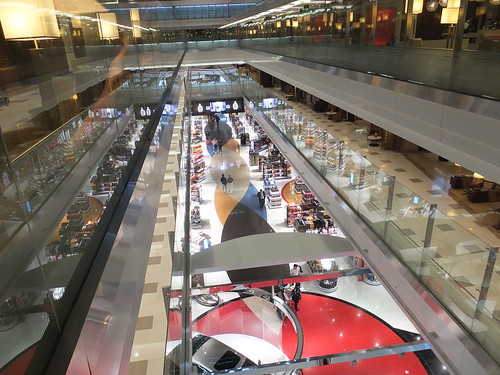 View from the Business Class lounge in Terminal A at Dubai.
Shortly, I'll make my way to gate A8 for the 03:15 flight EK354 to Singapore which is apparently a 'Code Share' with Quantas. The wonders of modern air transport still impress me, but I don't have the stamina I once had.
More when I'm able. You can find all the posts on this trip here.
My pictures
Dubai Airport, U.A.E. (pictures from this and other trips).
"A journey from Singapore to Sandakan aboard the MS Caledonian Sky".

MS 'Caledonian Sky' (Photo: Salén Ship Management).
I booked on the above Noble Caledonia small-ship cruise, leaving home on 24th January 2015. Noble Caledonia's description of the cruise is here and there's more about the vessel here.
As the adventure unfolds, I'll try to add updates but these may be erratic. However, you can track the vessel's position (provided it's within range of a shore based AIS receiving station) via various websites such as Marine Traffic.
More when I'm able. You can find all the posts on this trip here.
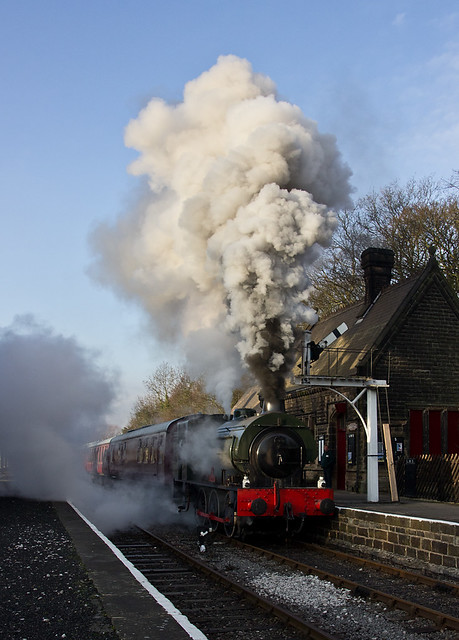
 'Sapper' takes an Up train out of Darley Dale. (Photo: Sheila Rayson)
Brief Locomotive History
'Sapper' was built by Hunslet in Leeds in 1944. The Works Number was 3163 and she was very similar to other six-coupled saddletanks built for military service during the Second World War. When 'de-mobbed' this locomotive, and some other members of the class, were acquired by Hunslet. Their aim was to sell-on the locomotives for industrial use. To make the locomotives more attractive to industry (which was, by then, more interested in diesel locomotives or rejecting rail altogether, in favour of road transport). Hunslet converted the locomotives to a Gas Producer Combustion System based on the work of the Argentinian engineer L. D. Porta. There's an excellent article by Martyn Bane on the 'Austerity' class as built and as modified here.
The Hunslet initiative wasn't an unqualified success and, whilst a number of 'Austerity' saddle tanks (both modified and un-modified) have ended up in preservation, I think all the ones actually in use have reverted to a more conventional firebox design and hand firing.
Steam Heating
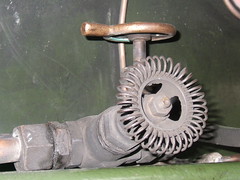
Of course, as-built the 'Austerity' locomotives were not provided with steam-heating facilities but restored locomotives used for passenger trains on preserved railways have this feature added. In preservation, warming is typically carried out at a steam pressure of about 30 pounds per square inch.
This is only a fraction of boiler pressure so steam from the boiler is admitted to the heating system through a Reducing Valve. It takes a while for steam to work its way through the train so it's usual to open the steam heat cock on the back of the train until steam can be seen escaping, assuring that all the intermediate cocks between carriages are open and the steam heating hoses correctly coupled. This process should be started well in advance of departure to give the coaches a chance to start warming before the passengers board. Once steam heating is started, the fireman needs to account for the extra demand for steam - coal and water will need to be added more frequently.
Handbrake/Steam Brake
'Sapper' is provided with a handbrake and a steam brake. On each wheel, there is a cast-iron brake block which can be pulled against the steel tyre of the wheel through a substantial arrangement of brake rods and cross-members forming the brake rigging. The brakes are applied on all wheels simultaneously either by rotating the handbrake screw using an l-shaped handle in the cab or by the movement of a piston rod connected to the piston in the steam brake cylinder. The steam brake cylinder is mounted under the footplate on the driver's side of the footplate and the supply of steam to the brake cylinder is controlled by a valve in the cab.
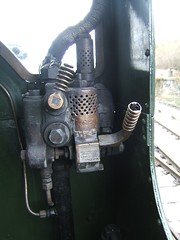
Two brackets mounted on the boiler backhead support a transverse shaft which can be rotated by handles at either end. A steam brake valve is supported by the left hand bracket and operated by the rotation of the shaft from either side of the cab. A copper pipe runs from the brake valve to the piston in the steam brake cylinder. Pulling on either steam brake handle applies steam to the brake cylinder: pushing the handle cuts off the steam supply and vents the steam in the brake cylinder to atmosphere, allowing a substantial spring under the front of the locomotive to pull back the brake rigging and release the brakes.
Vacuum Brake
Following a series of dreadful accidents in the 19th century, it became a requirement that all passenger trains be provided with an 'Automatic' brake. There's a little more about brakes in a post called MIC - Brakes.
As-built the 'Austerity' locomotives were not provided with vacuum brakes but restored locomotives used for passenger trains on preserved railways have this feature added. In 'Sapper' a Davis and Metcalfe Type 'M' Ejector including the Driver's Brake Application Valve has been fitted.
Related posts in this blog
Preparation of Locomotive 'Sapper'.
My pictures
'Sapper' Austerity Tank Locomotive.
Background
Ukraine has an extensive railway system to the Russian gauge of 5 feet and, although Ukraine has been a sovereign state since 1991, the railway infrastructure and rolling stock was principally provided by Russia during the Tsarist and Soviet eras.
My post Ukraine 2005 briefly describes my trip to Ukraine in 2005 to drive Russian-built steam locomotives. After a long interval, I added more detail in a series of posts starting with Driving Steam in Ukraine (Part 1). The last day of our driving in Kolomiya and our journey by overnight train back to Kiev is described here.
Events of Friday, 28th October 2005
On our arrival in Kiev, the trip organisers (East Europe Railtours Limited in the U.K. and Dzherelo SPK in Ukraine) had arranged visits to two Railway Workshops.
Kiev Railway Works (Passenger)
This works dealt with heavy maintenance to passenger locomotives. The entrance to the works was near the south east end of Kiev main station. We stopped to admire the only surviving 'FDp20' steam locomotive, displayed on a very elaborate welded steel plinth, suggesting a girder bridge. There's a little more about this locomotive class in Loco-profile 3: Russian 'FDp20' class 2-8-4.
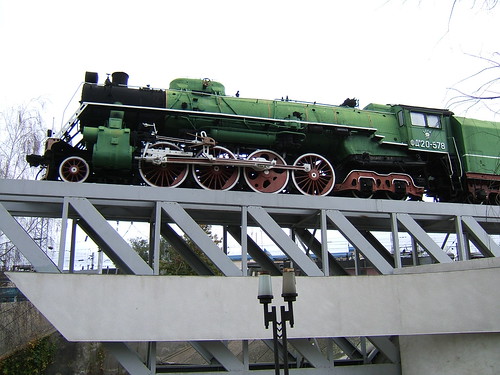 The remaining FDp class 'plinthed' at the entrance to Kiev Locomotive Works (Passenger).
Before entering the works, we watched the comings and goings on the main line and looked at the outside of the 8-road locomotive roundhouse.
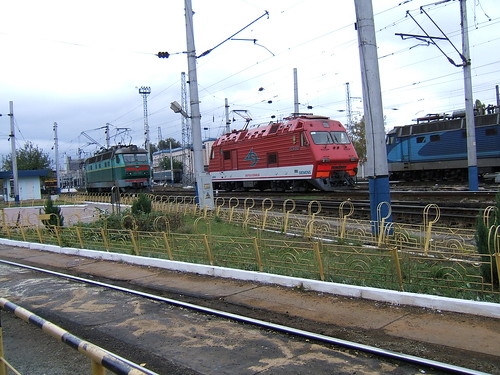 A variety of electric traction outside Kiev Main Station. Note the decorative fencing and the shrubs.
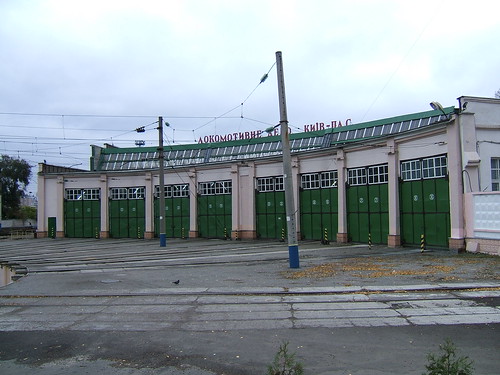 The depot roundhouse. Note the overhead catenary for each road.
In the first works building there were various types of electric locomotive, including an elderly 'Skoda'.
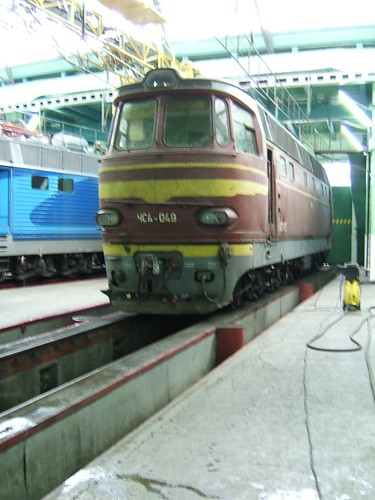
An elderly Skoda ChS4 Co-Co 25 kV a.c. electric locomotive, number 049. These were built between 1966 and 1972 and featured a fibreglass body but were being rebuilt to extend their life.
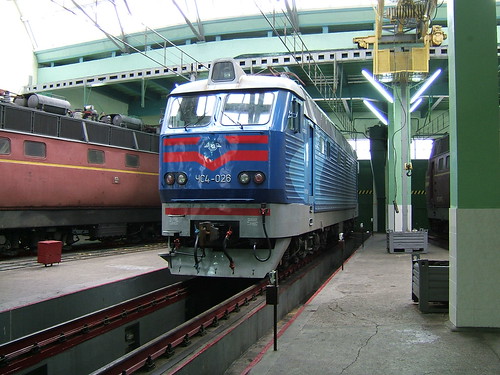 A rebuilt Skoda ChS4 Co-Co 25 kV a.c. locomotive, number 026.
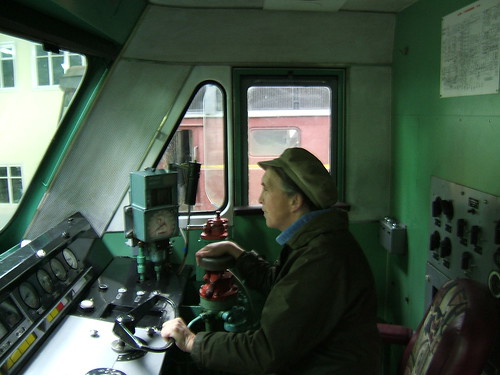 Jan in the Driving cab of rebuilt Skoda ChS4 Co-Co electric locomotive, number 026.
A separate 'shop' dealt with repairs to the driver's air brake application valve. This was a lofty room with large curtained windows, a domestic wall clock, rather dated light fittings incorporating fluorescent tubes and a potted plant.

The Brake Valve Shop.
We walked through a corridor (where a large artwork had been placed to encourage workers) to look at the shop where Speed Recorders were refurbished. An adjacent shop dealt with the re-machining of the discs for brake application valves (to keep them air-tight). We then passed through the erecting shop for electric locomotives, provided with an overhead travelling crane, inspection pits and high-level access platforms to get to roof-mounted equipment.
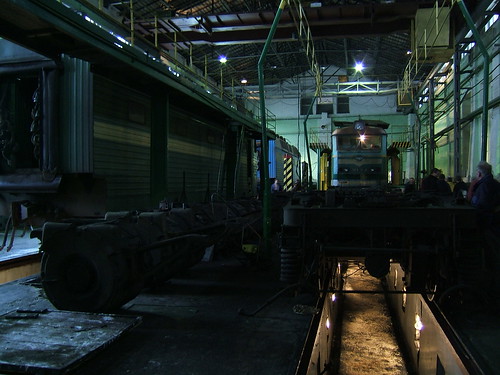 The Erecting Shop.
One pit was provided with a wheel lathe for re-profiling tyres whilst the wheelset was still mounted on the bogie. There were various parts littered around - complete motors, a 'Scissors' pantograph, motor armatures awaiting attention. Nearby, an almost-deserted machine shop had a veteran selection of large lathes and machine tools. Another shop was re-furbishing the large Blowers used on electric locomotives. There were at least three men intently working away here. I noticed a small electric hoist had been slung from one of the steel roof beams, to ease the handling of the bulky fan assemblies. In another long corridor, there was another large artwork - this one of a smiling, athletic young woman. As we left the Workshops, we passed the Conservatory - in the U.S.S.R., large factories commonly had Conservatories so that workers were able to enjoy Nature even in harsh weather.
 The Conservatory.
Finally, we passed a suitably-heroic mosaic near the entrance to the Works.
 The mosaic near the entrance to the Locomotive Works.
The rather run-down appearance of the buildings and the various inspirational artworks certainly suggested how I imagine the U.S.S.R. was after the gruelling years of the second world war. The Works have clearly lacked recent investment, but it was impossible not to be impressed by the skills of the people working there.
Kiev Railway Works (Freight)
A coach took us to the second works, which handles heavy maintenance of freight locomotives. It took almost an hour to reach the site - traffic in the city was heavy and our destination was on the outskirts of Kiev. I think the site served as a running depot for both diesel and electric traction, for in the extensive yard, we found both electric and diesel locomotives. In the Repair Shops, we only saw diesel locomotives under repair. A hand-painted plan of the yard was on display.
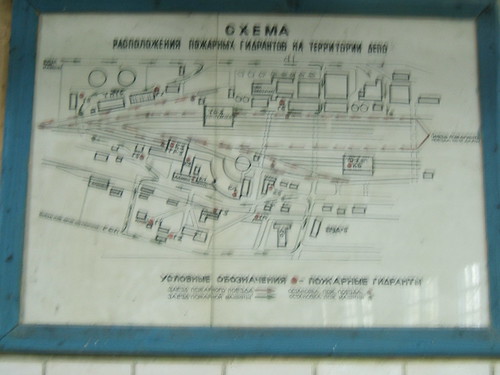 Plan of the Yard.
In the yard, there was a Type VL80 2-section Bo-Bo 25 kV a.c. electric locomotive, number VL80s288. The 's' isn't clear in the picture but the cab side also carries the later number 12505764 in the Russian 1984 numbering system (briefly explained here) which appears to confirm the sub-type as 's', meaning that two 2-section locomotives could be connected in multiple. A second VL80 (VL80t1324) was of the 't' sub-type with rheostatic braking.
 View of the yard with a Type VL80 2-section Bo-Bo 25 kV a.c. electric locomotive. The two tall towers in the background appear to be built using pre-cast concrete sections.
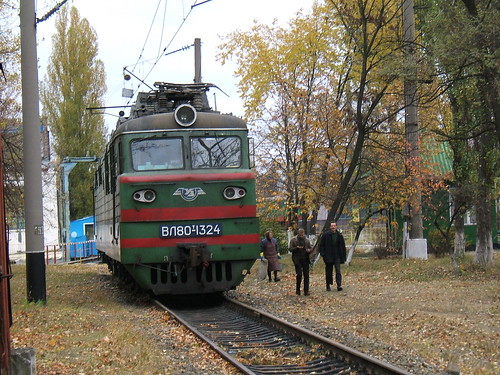 Another VL80 in the yard (VL80t1324).
Diesel traction was represented in the yard by a 2-section Co-Co diesel electric 2TE116-1365 and a 750mm gauge diesel electric locomotive (TU2-165) loaded on a 5 foot gauge flat wagon for transport. About 300 of these narrow gauge locomotives were made, but they were not particularly successful. You can read more about the TU2 on Dimitry Zinoview's interesting site here.
 2-section Co-Co diesel electric 2TE116-1365.
 750mm gauge diesel electric locomotive (TU2-165) loaded on a 5 foot gauge flat wagon.
We made our way through a rather gloomy roundhouse where I examined the cab of what I think was a ChME3. Outside the roundhouse was a colourful line-up of TEM2-7052, ChME3-1296 and ChME3-1811, all Co-Co diesel electrics. The turntable was painted in the blue of the Ukrainian flag and the picture below shows the portal frame in the centre of the turntable crowned with a rotating connection box for the overhead electric cable. The picture also shows two of the smaller Bo-Bo diesel electric shunting locomotives ChME2-322 on the left, ChME2-431 (in rather faded green) on the right. This class, built by CKD in Czechoslovakia, has a 4-stroke 6-cylinder diesel engine developing 552 kW. I assume the modern straight shed in the background of the picture is a running shed, since it is topped by six sand towers (patriotically painted in the Ukrainian flag colours of blue and yellow). There are two more tall towers in the background built with pre-cast concrete sections.
 TEM2-7052, ChME3-1296 and ChME3-1811 outside the roundhouse.
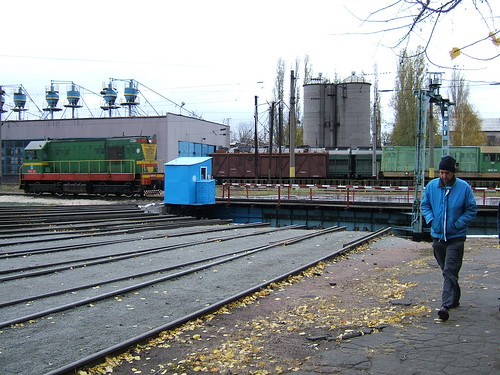 The roundhouse electric turntable. Left: ChME2-322, Right: ChME2-431.
We moved back inside the older, straight shed which serves as the erecting shop. We examined a moveable portal crane, used for lifting wheelset/motor sub-assemblies and admired a delightful four-wheel railcar marked 'ACIA N3285' which I suspected was used as an Inspection Saloon.
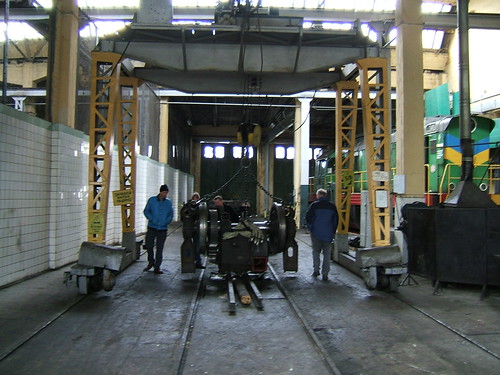 Crane, with wheelset/motor sub-assembly.
 Railcar ACIA N3285
We found numerous other ChME3 Co-Co diesel electric locomotives around, in various states of 'undress'. Over 7,000 (with various sub-classes) were built by CKD in Czechoslovakia, using the CKD type K6S310DR 4-stroke 6-cylinder diesel engine developing 993 kW. The pictures below shows the engine with all the engine cowling removed and the size of each of the six pistons required to develop this power.
 CKD K6S310DR engine.
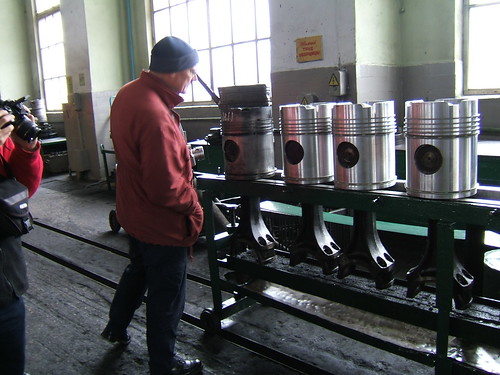 Piston/crank used on K6S310DR engine.
After our two fascinating visits to workshops, our coach struggled through the traffic again, to take us to our hotel on Independence Square. There was time for a little sightseeing later in the day and the following morning, before we were taken to the airport for our flights home.
Russian Railway background
At the time of my visit in 2005, I was almost completely ignorant about Russian Railway practice. The book 'Soviet Locomotive Types - The Union Legacy' (reference [1] below) is an invaluable primer on Russian steam, diesel and electric traction. In 2011, a river cruise from Moscow to St. Petersburg (described in a series of posts here) gave me tantalising glimpses of railways in Russia. Then, in 2011, I travelled by the 'Golden Eagle' private train from Ulaan Baatar to Moscow (described in a series of posts here).
Book References
[1] 'Soviet Locomotive Types - The Union Legacy' by A J Heywood & I D C Button (Frank Stenvalls Forlag) ISBN 0-9525202-0-6.
Photographs:
The railways:
Ukraine Steam.
Ukraine Modern Image.
Kiev Locomotive Works (Passenger).
Kiev Locomotive Works (Freight).
The country:
Ukraine.
In Part 4 I described my third day on the footplate at Kolomiya in Ukraine on 26th October 2005, when Er797-86 and Em735-72 double headed our train to Vorokhta and back.
On Thursday 27th October 2005, the format of the day was similar but this time the run was terminated at Mikulichin.
Into the Mountains again
As before, Er797-86 was leading from Kolomiya with Em735-72 tender first. This time, our train comprised a bogie hopper wagon, a bogie flat wagon and one of the two green coaches Su251-86 had brought from Chernivtsi. The trip the previous day had given us a little 'route knowledge' and were able to start to anticipate.
We made our way through Delyatin and Yaremcha and continued our climb as far as Mikulichin.
 Yaremcha station building.
 View ahead from Em 735-72 leaving Yaremcha.
I commented about the poor quality of coal in Part 4. As time went on, the situation got worse as all the loose coal became used. We spent some time in the tender with shovels breaking-up the concrete-like contects, trying to release coal which stood a chance of burning. I never really got used to the firing shovels in use. Rather than the 'T' handle of English shovels, where you can use the palm of your hand to either drive the shovel blade into the coal stack or propel a shovelful to the front of the firebox, the Ukraine shovels had a long, straight handle which I found difficult to use.
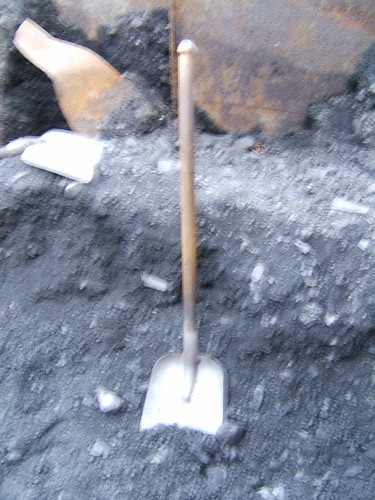
Typical firing shovel.
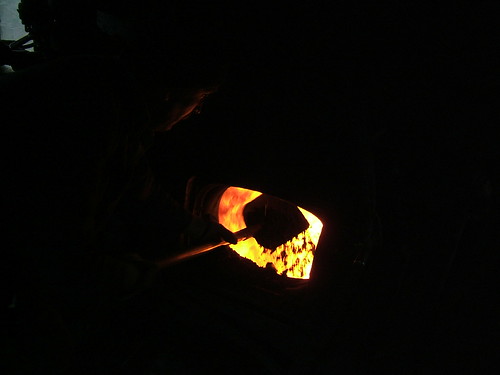 Em 735-72 being fired.
On arrival at Mikulichin, we ran the engines round the train ready for the return journey. There was time for me to take more pictures around the station and our train before we set off back to Kolomiya.
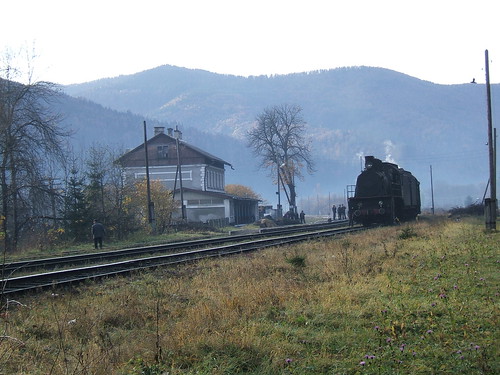 Our train at Mikulichin, ready to return to Kolomiya
On the return journey, the group with Mike and I was once again on the lead engine, Em 735-72, taking it in turns to drive.
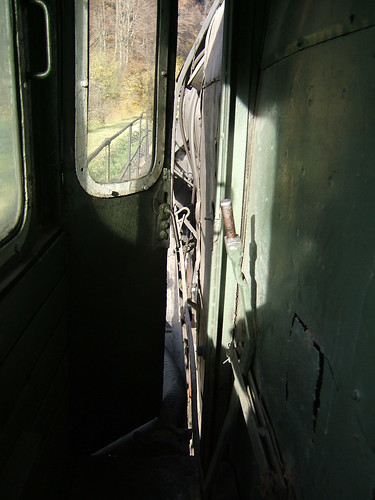
Em 735-72: Fireman's view ahead. The door giving access to the foot-framing is partly open.
At Yaremcha, we passed a 2M62-class diesel electric with a single coach, which I thought might be a dormitory coach for track workers. At one point, when I was driving, we passed a group of track workers, standing clear. We solemnly saluted one another and it reminded me that the unspoken comradeship between railwaymen is not peculiar to the English.
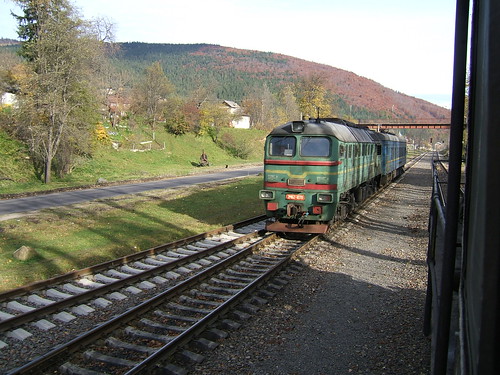 Passing 2M62-1070 with a single coach near Yaremcha.
This was the fourth day that steam trains had been seen on the Rakhov line and I had started to notice how many people in the lineside properties were outside as we passed, watching the train go by, just as in England when steam specials appear on the main line.
I was driving as we approached the junction at Kolomiya where the line from Ivano Francovsk converged on our left. I looked out for our colour light signal which was showing 'off' but with a 'Green Bar' lit. I realised that we were being crossed into the 'loop' platform and shut off in plenty of time. We clattered over the points leading to the 'loop' and drifted along the platform, with only light braking needed to stop where the Ukrainian driver indicated.
And so our steam driving experience in Ukraine had come to an end. Not all of the arrangements had worked out during the week but I still found it a wonderful experience. We sadly said our "goodbyes" to our Ukranian railway friends, checked out of our hotel and were taken by coach back to Ivano Francovsk. We had a short time to look around the town before entering the railway station to catch our overnight train to Kiev. This time, my booking arrangements worked and I had a 4-berth compartment to myself.
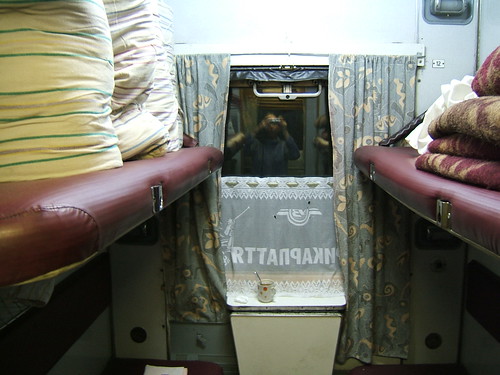 My 4-berth compartment on the Kiev train.
On arrival in Kiev, we were to visit two railway repair works (described here) and spend a night in a hotel before flying home.
Russian Railway background
At the time of my visit to Ukraine in 2005, I was almost completely ignorant about Russian Railway practice. The book 'Soviet Locomotive Types - The Union Legacy' (reference [1] below) is an invaluable primer on Russian steam, diesel and electric traction. Later, in 2011, a river cruise from Moscow to St. Petersburg (described in a series of posts here) gave me tantalising glimpses of railways in Russia itself. Then, in 2011, I travelled by the 'Golden Eagle' private train from Ulaan Baatar in Mongolia to Moscow (described in a series of posts here), finding out a little more about Russia's remarkable railway heritage.
Book References
[1] 'Soviet Locomotive Types - The Union Legacy' by A J Heywood & I D C Button (Frank Stenvalls Forlag) ISBN 0-9525202-0-6.
My pictures
The railways:
Ukraine Steam.
Ukraine Modern Image.
The country:
Ukraine.
In Part 3 I described my second day on the footplate at Kolomiya in Ukraine, on locomotive Su251-86.
On Wednesday 26th October 2005, my friend Mike and I made our first excursion onto the single line from Kolomiya to Rakhov. We found out how our hosts had dealt with the problems of 24th October when Er797-86 had got into trouble, short of steam, on the Rakhov line (mentioned in Part 2). The solution adopted was to subsequently double-head the train, with Er797-86 coupled tender to tender with Em735-72. Er 797-86 (chimney leading) would haul the train out from Kolomiya with Em 735-72 (tender first) assisting as required. After running round both engines coupled together at the far end, Em 735-72 (now chimney leading) would return the train to Kolomiya with assistance from Er 797-86.
'E' class background
The 'E' class 0-10-0 had been introduced in 1912 as a development from the earlier 'O' series 0-8-0. Russian-built 'E' class were supplemented in the early 1920s by imported 'E' class from Germany and Sweden. The 'Eu' class was a Russian redesign built in large numbers from 1926 until the 'Em' was introduced in 1931. Modifications to the 'Em' design produced the 'Er' class, more powerful and economical than the 'Em'. This class was built between 1935 and 1957. Altogether over 11,000 of the various types were built. There's a little more information on the class here.
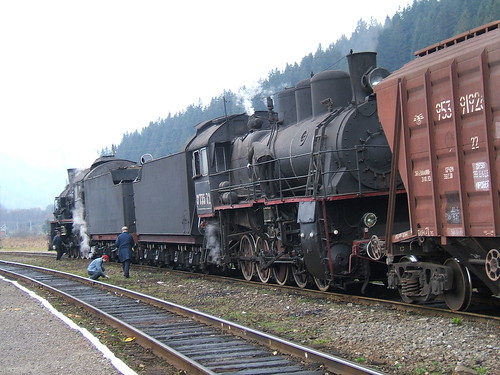 Er 797-86/Em 735-72 stand at Mikulichin.
A journey into the Carpathian Mountains
Although the organisers had initially hoped that we could travel to Rakhov, in fact we were only allowed as far as Vorokhta (about 90 km from Kolomiya).
On the first leg of the journey out, Mike and I were allocated to Em 735-72, which we'd been on for our first day's driving (described in Part 2). We departed from Kolomiya heading west with a train comprising bogie hopper, bogie open and bogie flat wagons. About 47 km from Kolomiya, we arrived at the junction station at Delyatin, where a direct line from Ivano Francovsk converges. Delyatin had a most impressive station building but only the very narrow, low platforms common at smaller stations.
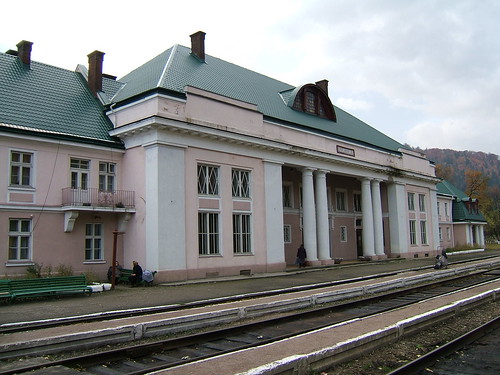 The impressive station building (and narrow, low platforms) at Delyatin.
A handful of passengers were waiting and our train stood at Delyatin for about half an hour until a diesel multiple unit travelling in the opposite direction cleared the line ahead.
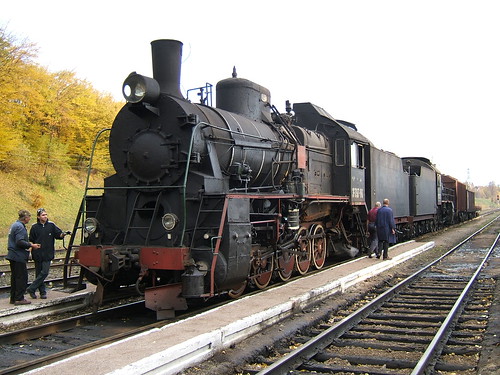 Er 797-86/Em 735-72 pause at Delyatin.
As we continued, the scenery became far more rugged as we headed into the forest-covered mountains. The picture below shows the view ahead of the train, looking from the footplate through the aperture in the tender cab (Em 735-72 was travelling tender first).
 View ahead from Em 735-72.
The above picture also gives a clue regarding the steaming problems. The coal in the tender was very small pieces - slack. Worse, the dust which accompanies slack had been lying in the tender, exposed to the rain, for goodness knows how long, turning the dust to mud which had then dried like cement. We'd not had major problems on our trip to Stefaneshty or with the Su251-86 on the fairly level route to Chernivtsi, but the route to Rakhov was clearly more demanding. In addition, the amount of ash we'd seen dumped by Em 735-72 at Stefaneshty and by the Su251-86 at Chernivtsi suggested that it wasn't a high grade coal to start with. A good coal for locomotives should have a high calorific value, low content of incombustible ash and low content of harmful elements like sulphur which can produce an 'acid rain' attacking the boiler tubes.
8 km beyond Delyatin, we passed through Yaremcha which is an important tourist centre, with a modernised station. The year following my visit, the Romanised spelling of the name was changed to 'Yaremche' (see Wikipedia here). After a further 10 km, we stopped at Mikulichin, where we had to wait for a 'path'. Mikulichin was as pretty a village as the website here suggests and we spent some time exploring the minor road through the village before returning to the fairly isolated station.
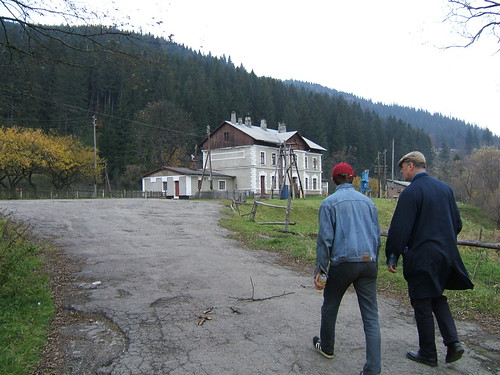 Station approach, Mikulichin.
Back at the station, the friendly lady stationmaster allowed me to study the signalling and telecommunications facilities. I'll describe what I was able to glean in a later post. After a wait of around two hours at Mikulichin, we finally had our 'path' to enable us to set off on the remaining 16 km to Vorokhta. For this leg, the eight trainees had swopped engines, so Mike and I were now on the leading engine, Er 797-86, again taking it in turns to drive.
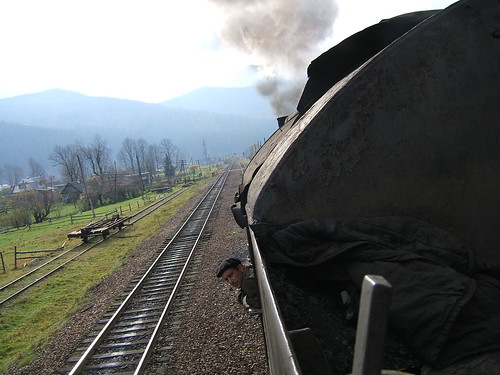 Er 797-86 leaving Mikulichin.
Approaching Vorokhta, we passed over a fairly notable modern viaduct. There were sentry boxes at each end, presumably from the Soviet era, but they appeared to be no longer in use.
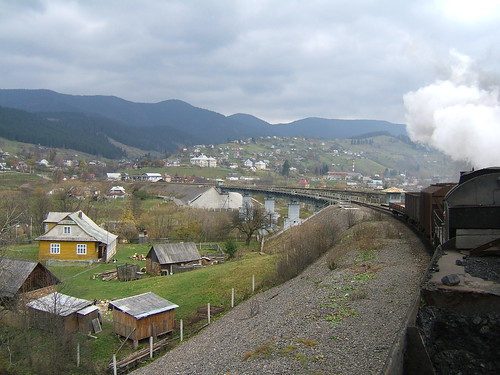 View from Er 797-86: looking back, approaching Vorokhta.
At Vorokhta, the two locomotives were detached from our train and, coupled together, run round our three wagons ready for the return journey. There was then a 'photocall' as everyone (bar the photographer) posed in front of Em 735-72 as pictures were taken with various cameras.
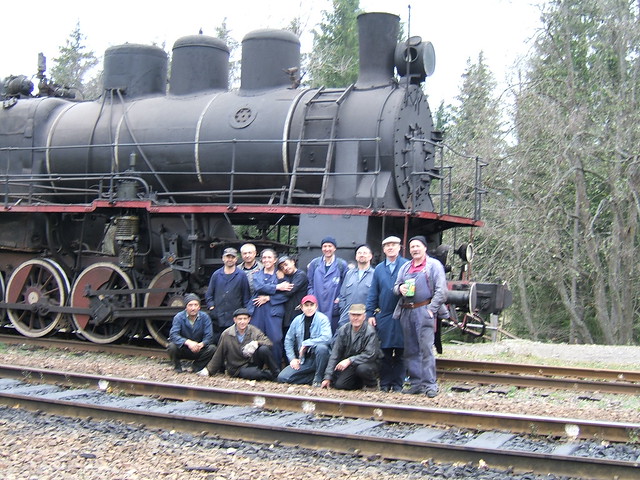 Em 735-72 and the entire cast pose for photographs.
The Ukrainian crews then invited us to lunch on the footplate of Er 797-86. A wooden table appeared from somewhere and lots of typical Ukrainian food was handed round. It was a very jolly interlude.
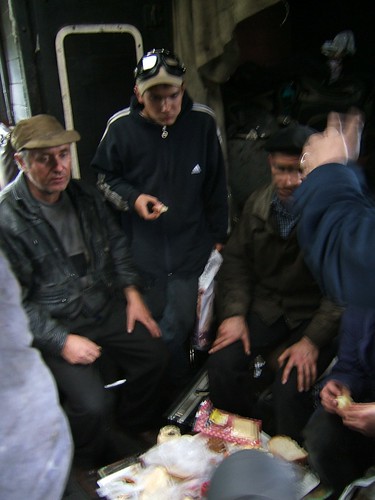
Er 797-86: Lunch on the footplate at Vorokhta.
We set off on our trip back to Kolomiya having swopped round again so that Mike and I were once again on Er 797-86. The picture below gives a good idea of the attractive area we were passing through. The train is about to pass over one of the many ungated road crossings. Notice the open wire pole route for telephones.
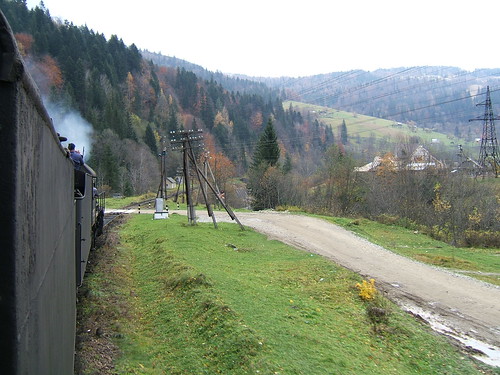 View from Er 797-86 returning from Vorokhta.
I'm afraid I'm unclear exactly which bits of the line I drove personally, but I do remember driving through the tunnel on this line. I usually drive with the sliding side window of the cab (which the Russian locomotives also have) open. Approaching the tunnel, I deemed it wise to slide it shut. The tunnel wasn't a 'tight fit' so conditions weren't bad but there was plenty of steam swirling around the cab. We were on the leading engine, of course, so I don't know whether matters were less comfortable on Er 797-86 behind us!
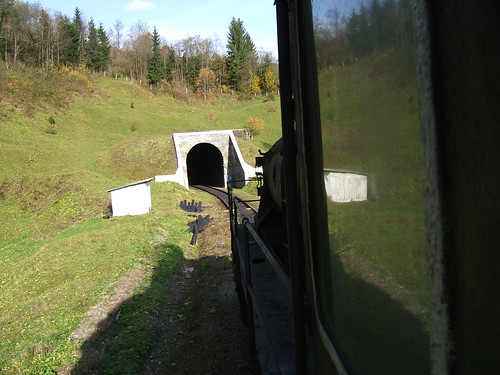 Fireman's view of the tunnel from the cab of Em 735-72 en route to Kolomiya.
The last pictures I took on that day were at Yaremcha. By the time we arrived back at Kolomiya, we'd had an interesting but tiring day. The following day would be our last driving day, and that's described here.
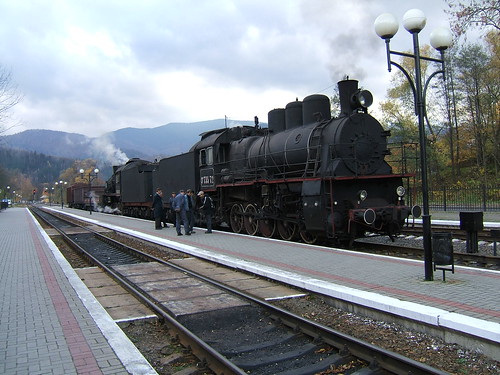 Er 797-86/Em 735-72 at Yaremcha.
Russian Railway background
At the time of my visit to Ukraine in 2005, I was almost completely ignorant about Russian Railway practice. The book 'Soviet Locomotive Types - The Union Legacy' (reference [1] below) is an invaluable primer on Russian steam, diesel and electric traction. In 2011, a river cruise from Moscow to St. Petersburg (described in a series of posts here) gave me tantalising glimpses of railways in Russia. Then, in 2011, I travelled by the 'Golden Eagle' private train from Ulaan Baatar to Moscow (described in a series of posts here).
Book References
[1] 'Soviet Locomotive Types - The Union Legacy' by A J Heywood & I D C Button (Frank Stenvalls Forlag) ISBN 0-9525202-0-6.
Photographs
The railways:
Ukraine Steam.
The country:
Ukraine.