skip to main |
skip to sidebar
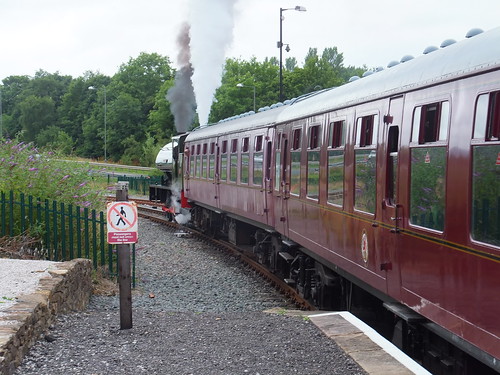
On Saturday, 16th August 2014, I was at Peak Rail driving 'Lord Phil' with Dave as fireman and Jacob as Cleaner.
Before the Service Train started running, we went Light Engine to Darley Dale to pick up a 'Driving Experience' candidate who was able to drive the line between Darley Dale and Matlock (Riverside) a few times and try his hand at firing. I was not surprised to learn that
he was a 'Park and Ride' bus driver because his control of the locomotive, particularly when braking, was above average. I've noticed many times with our trainees that, whilst car drivers used to high-performance brakes and responsive engines can often be a little heavy-handed, drivers with experience of lorries or buses grasp the problems of controlling a steam engine more quickly.
At 10:45, we re-united our trainee with his family at Darley Dale and then scuttled up to Rowsley to pick up our train. We were back to the 'standard arrangement' with the steam locomotive on the south end of the train, 'top-and-tailing' with a diesel locomotive on the north end. The load was six coaches.
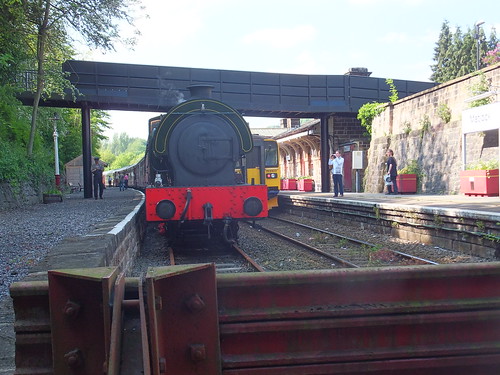 'Lord Phil at Matlock (Town) in an earlier meeting with a Class 153 on 18-May-2014.
This time, Peter Bridden's Class 14 was on the north end. We made five round trips during the day without experiencing problems.
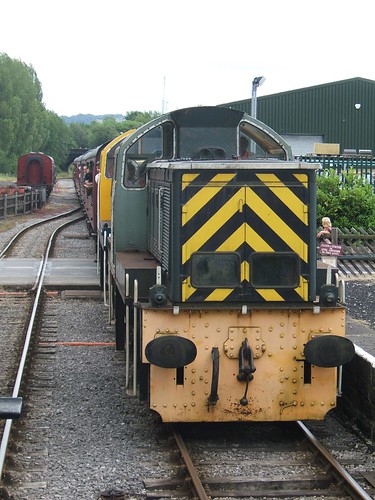
The Class 14 brings a Down train into Darley Dale on 10-Jul-2010.
Being a Saturday, at Matlock (Town) we frequently met an East Midland Trains Class 153 on the Matlock - Nottingham service. As we pulled into Matlock (Town) on the fourth trip, there was a Class 153 already arrived at the other platform. In surprise, Jacob called out "It's got a nameplate!". Intrigued, we walked back along our platform until we were level with the DMU and clambered into our train to check out the nameplate.
Sure enough - the nameplate read "X24 EXPEDiTiOUS". I correctly guessed it was a Naval reference, but I'd forgotten that the 'X-boats' were mini-submarines. Wikipedia has information here. The actual submarine survives and is on display in the Royal Navy Submarine Museum, Gosport.
The East Midland Trains website has a report on the naming ceremony here and 'Navy News' has more.
As I described in an earlier post Timber Extraction at Ty Gwyn, about 10 hectares or the Ty Gwyn woodland is being harvested. I made a progress visit to the site with Rob on 18th August 2014. The Harvester had earlier suffered a failure and the delay obtaining the necessary spare meant that progress since our visit on the 24th July was less than planned. The Harvester was out of action again for most of the day with a failed hydraulic hose, requiring a spare to be collected from Bala, but we found a Forwarder working and timber being taken away by the road haulier.
 Harvester (left) awaiting hydraulic pipe; Forwarder (right) collecting logs already felled by the Harvester.
The Forwarder was a 'Timberjack' 1410D. According to the Wikipedia article here, Timberjack has been owned by John Deere since 2000. Although I knew John Deere for agricultural machines and mowers, I'd not realised their prominence in forestry. The John Deere Forestry website here claims that the company is "the worlds leading designer, manufacturer and distributor of forest machines". The 1410D Forwarder is no longer part of the current range but there's a detailed data sheet on this model here.
The Forwarder comprises two chassis sections or 'frames' each carried on a four-wheel patented balanced bogie. The 'frames' are joined by an articulated 'middle joint'. The design offers remarkable flexibility when working on uneven ground. The wheels are rubber-tyred but, where necessary, heavy chains can be fitted on each bogie, effectively producing a tracked vehicle.
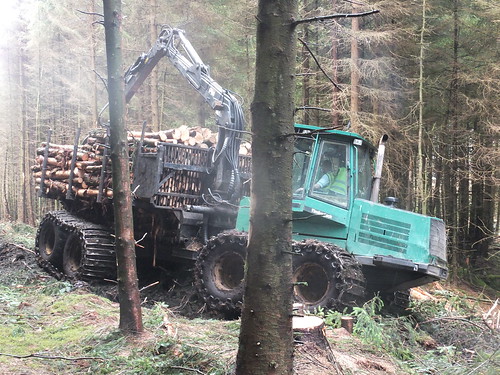 The 'Timberjack' 1410D Forwarder at work.
The area being felled at Ty Gwyn has parts which are soft and peaty, using the characteristics of the Forwarder to the full. Being situated on high ground in Wales, the Ty Gwyn woodland is generally wet, encouraging high growth rates but with the disadvantage that the trees tend to establish only shallow root systems, making them more prone to 'windblow' - uprooting by the wind.
 A tree brought down by 'windblow', showing the shallow 'rootplate'.
When I visited, the road haulier was using two 'rigs' to carry out the timber, both classed as "six wheel and drag". The 'six wheel' part has one steerable axle at the front and a double axle at the rear, based (I think) on a Scania truck chassis. This part has the cab, diesel engine, compartment for carrying logs and, at the rear, a crane for loading and unloading. The 'drag' is a three-axle trailer semi-permanently coupled to the front part with a further compartment for logs. To minimise the tare weight, the framework forming the load carrying compartments are made of aluminium by Alucar. The manufacturer's website is here. The crane I saw was a very smart 'Epsilon' Forest Crane. There are more details here. Once the driver is in the crane cab, it is raised hydraulically, giving the driver a better view of the loading and unloading process.
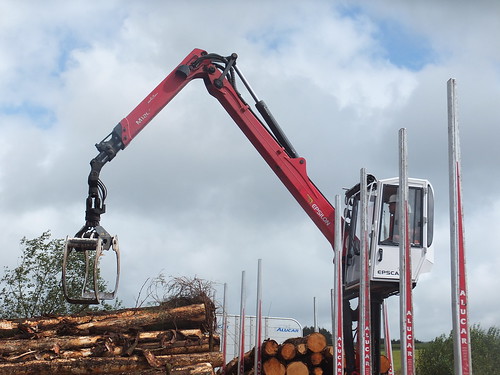 With the crane cab in the raised position, the driver had a good view of the loading process.
It was recognised some years ago that lowering the pressure of pneumatic tyres increases the contact area between tyre and surface, improving handling on soft surfaces and reducing road damage. One of the two 'rigs' hauling from Ty Gwyn has a Central Tyre Inflation system ('CTI') enabling the driver to select the appropriate pressure for the work in hand from pushbuttons in the cab. Whilst I'd heard of the system, I hadn't realised the potential importance to the logging industry. You can read more:-
on Wikipedia,
on How Stuff Works and
in a report on tests in 2006.
Some of the timber is being taken directly to Kronospan in Chirk either to make pallets or to be used in the making of wood panel products like MDF, (as described here), but the larger logs are being shipped to a different sawmill.
 Large logs (left) are being taken to a sawmill, smaller logs (right) go directly to Kronospan.
Related articles on this site
Timber Extraction at Ty Gwyn.
All my Ty Gwyn posts.
The Manufacture of MDF (Describes a visit to Kronospan, Chirk).
My pictures
Harvesting (2) 2014 - this visit.
Harvesting (1) 2014 - previous visit.
All my Ty Gwyn pictures.
On Saturday, 26th July 2014, I travelled to Shrewsbury, took the slow train on what's now marketed as the 'Heart of Wales Line' to Swansea then headed to Cardiff and Newport before returning to Wolverhampton via Hereford and Shrewsbury.
In the post A trip to South Wales (Part 1) I described the journey as far as my arrival in Swansea.
Swansea
It remained a warm, sunny day as I left the station to explore a little of the town. The pleasing 1930s stone facade of the station building built by the Great Western Railway was echoed by the Grand Hotel which faces it. Neon signs atop the hotel read 'Croeso i Abertawe' and, for the benefit of non-Welsh speakers, 'Welcome to Swansea'.
 Swansea Railway Station.
 The Grand Hotel, Swansea.
It appears Swansea is both a city and a county, with a total population around a quarter of a million. I continued along the High Street which has some decent buildings but much of the area was devastated during World War II air raids. The remains of Swansea Castle face Castle Square with its fountains and "Swansea's Big Screen". I continued along Wind Street which is largely given over to Bars and Restaurants to reach the dual carriageway of Quay Parade.
This marks the start of the 'Maritime Quarter'. I could see the neo-classical Swansea Museum built in 1841 and also the more modern National Waterfront Museum. It was only on my return home I read that the National Waterfront Museum
"is housed in a magnificent building that elegantly combines old and new architecture. A Grade II listed former dockside warehouse (formerly the Swansea Industrial & Maritime Museum) built in 1902, contrasts with a spectacular new glass and slate structure designed exactly a century later, by Stirling Prize-winning architects Wilkinson Eyre".
I wasn't in the mood for culture and even eschewed the former docks which now appear to be a marina for pleasure craft. In addition, on the grass outside the museum there was some sort of "Meet the Emergency Services" exhibition and the air was rent with almost continuous screeching and wailing as the various types of audible warning used by emergency vehicles were demonstrated. I decided to return to the railway station and continue to Cardiff.
On to Cardiff
I took a few more pictures around the 4-platform terminus at Swansea, whilst waiting for the next Cardiff service, from platform 1.
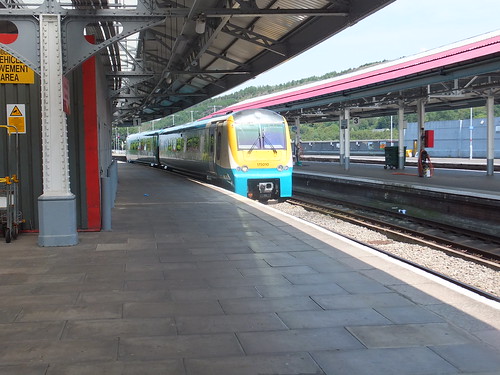 DMU 175010 arriving at platform 1, Swansea.
This was a 2-car Class 175 which changed direction at Swansea at Swansea so as to leave the station on the Up Main, passing Landore Depot on our left (where the First Great Western HS125 trains serving Swansea are serviced).
 Landore Depot, Swansea.
Eight miles brought us to our first stop at Neath, just under six more miles took us to our second stop at Port Talbot Parkway (where the Signalling Centre controlling the area is located). Beyond Port Talbot, the extensive Tata Plant (formerly Corus, formerly British Steelat Margam lay on our right, with its two remaining blast furnaces (numbers 4 and 5), Basic Oxygen Steel Plant and the hot and cold rolling mills. There's a Wikipedia article about the site here and an excellent Visitor Guide produced by Tata here. Part of Port Talbot's output is shipped to Shotton for coating - there's a little about the Shotton plant in my earlier post By rail to Liverpool (Part 1).
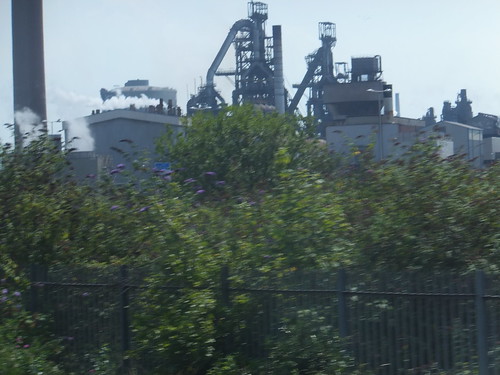 A glimpse of the surviving blast furnaces at Margam.
There are still extensive sidings serving the steelworks at Margam Knuckle Yard, then the aspect is less industrial. Our next stop was at Bridgend where, in addition to the two through platforms, there are two bays. Bay 1A on the Down side serves the double-track line to Barry whilst Bay 4 on the Up side serves the single line to Maesteg. Then we ran non-stop the 20 miles to Cardiff Central (the last 14 of which were under the control of Cardiff Signalling Centre). Our journey from Swansea had taken just over 50 minutes.
Cardiff Central
In the 1930s, the Great Western Railway provided Cardiff Central with a handsome set of station buildings in Portland stone which continue to distinguish this important station. I took a few pictures around the main line platforms and located the Signalling Centre on the Down side at the western end of the station. I took a lousy picture against the sun which also features Brains Brewery. Steps and lifts take passengers from platform level to two subways running across the station to the main building on the north side. Automatic ticket gates give access to an airy booking hall with three wide entrances leading to a pedestrian plaza and the city. The station buildings are listed Grade II. The weather was still hot and I was starting to wilt a little so I decided to stay in the vicinity of the station, rather than exploring the city.
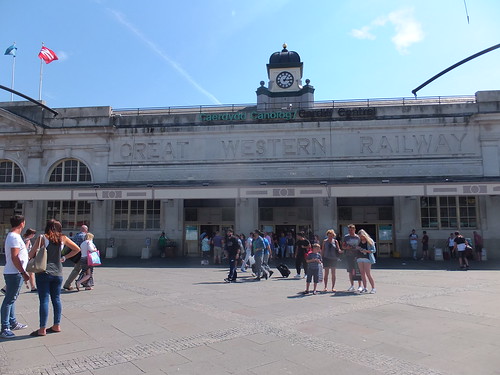 Cardiff Central Station viewed from the pedestrian plaza.
The name of the original station owner, 'GREAT WESTERN RAILWAY' is proudly incised into the stone in large letters and is clearly visible. In contrast, the modern sign above reading 'Caerdydd Canalog/Cardiff Central' was almost invisible in the bright sunshine. I think the sign is internally lit so matters may be improved at night.
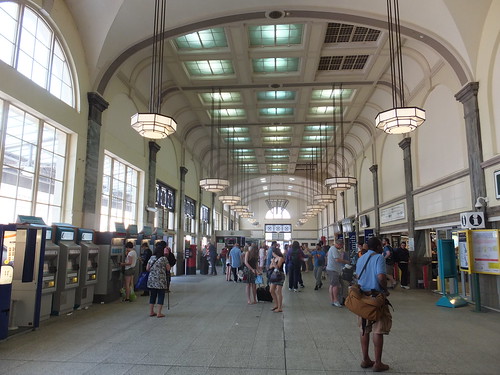 The Booking Hall.
The Booking Hall with its Art Deco fittings is still relatively uncluttered, although I didn't find the modern signage (in English and Welsh) very informative, particularly when I tried to find platform 0. Platform 0 is a fairly recent creation and falls outside the system of automatic ticket barriers.
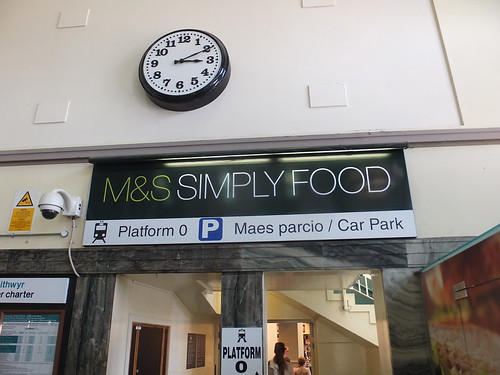 'M & S Simply Food'.
It took me a few moments to realise that the approach to 'M & S Simply Food' also gave access to the car park and, at a higher level, platform 0 for trains to Ebbw Vale. Whereas the original station has fairly extensive platform canopies, platform 0 is equipped with a series of 'bus shelters' distributed along its length.
I decided I'd press on to Newport, so I caught the next service east. Approaching Newport, on our right we passed the siding connections leading to the Celsa Steel UK plant at Tremorfa. Their website here gives an introduction to their processes and products including reinforcing products ('rebar'), wire rod, bars and light sections.
Newport
My last visit to Newport was in 2012 when OLCO held 'Lionsmeet 2012' there (report here) and on that occasion I travelled by train and took a few pictures around Newport station. On the present trip, I added a few more railway pictures and had a brief walk outside the station but I was starting to flag a little so I was soon back on the station awaiting my train back to Shrewsbury.
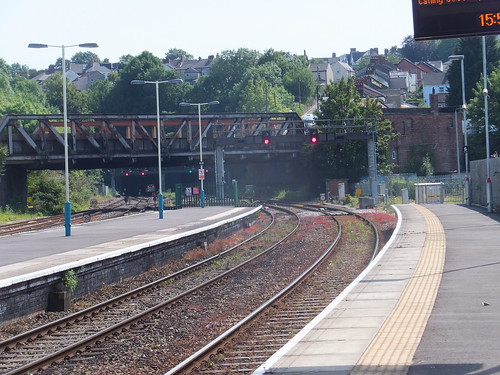 Newport: View looking west from platform 4 showing the girder road bridge and, beyond, Newport Old Tunnel (L) and Newport New Tunnel (R).
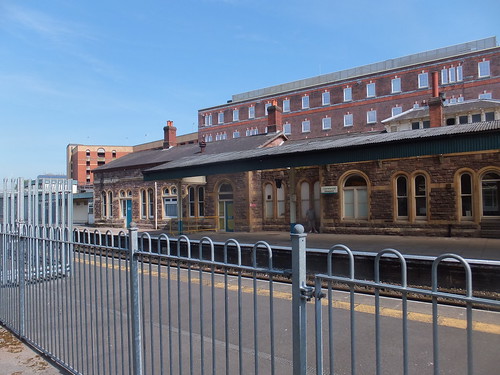 Newport: North Elevation of station buildings on platform 3 viewed from the footpath adjacent to platform 4.
Shrewsbury-Hereford-Newport Line
This line has been heavily 'rationalised' so there's not so much of railway interest. There are a number of stations and, for the most part, signalling is Absolute Block with semaphore signals (Western Region style). Pontypool is reduced to an island platform and little else. Abergavenny retains its signal box and a smattering of sidings.
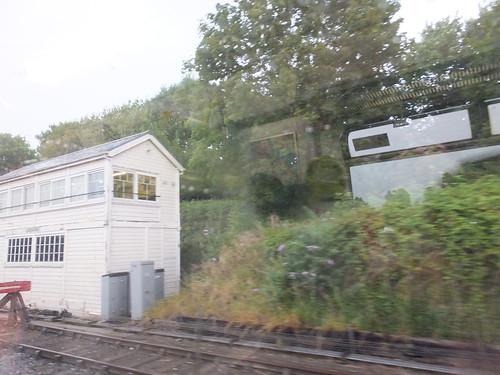 Abergavenny signal box.
Between Abergavenny and the remote Tram Inn signal box there are still fifteen accommodation level crossings.
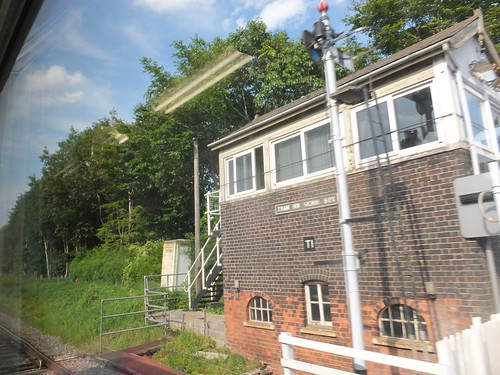 Tram Inn signal box.
Six miles further on we paused at Hereford. There were once four railways fighting for access, with a complex of lines and junctions. But now, one signal box controls the area. Originally called 'Ayleston Hill', it is now simply 'Hereford'. This brick structure has been fitted with uPVC window units. Local points remain mechanically operated: more remote connections are power operated. Running signals seem to be multiple aspect colour light.
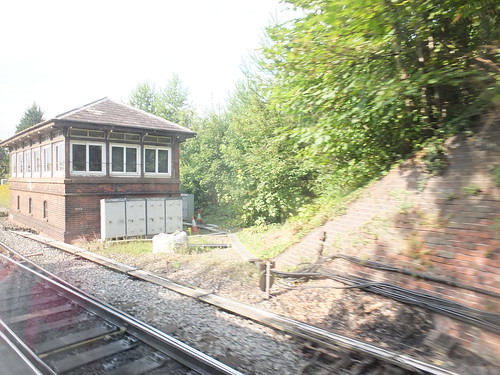 Hereford Signal Box.
Similarly, the station which was once styled 'Hereford (Barr's Court)' is now simply 'Hereford'.
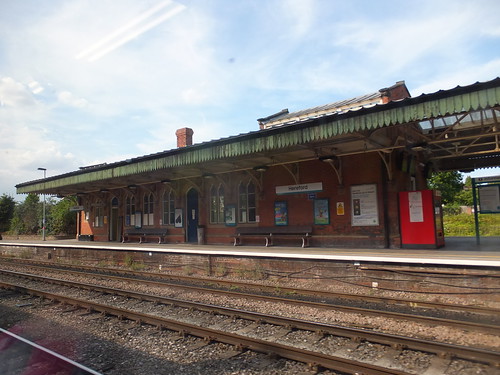 Hereford: Station building on Down Main Platform.
Five miles beyond Hereford, we passed Moreton-on-Lugg signal box with its barrier crossing and connections to sidings which originally served a Royal Army Ordnance Corps Depot.
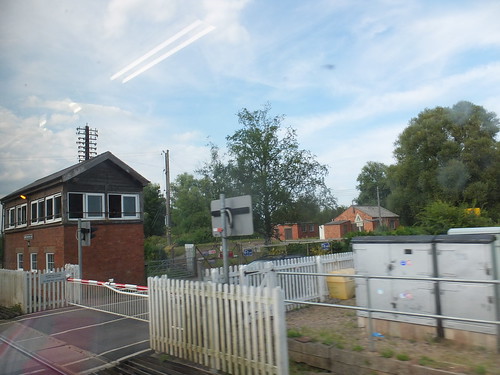 Moreton-on-Lugg signal box.
Three miles further on, we passed through Dinmore Tunnel (1054 yards long). There are two single-bore tunnels and the Down Line tunnel is a few yards away from our tunnel and at a slightly lower level. The Down Line tunnel dates from 1853 and the Up Line tunnel from 1891.
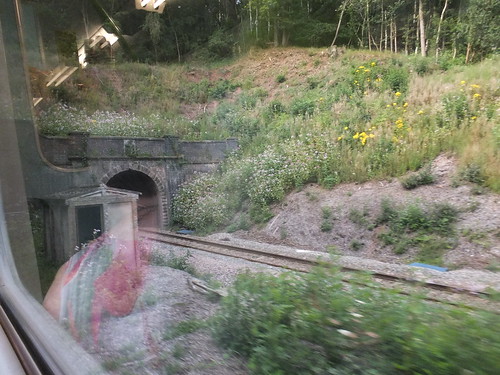 Dinmore Tunnel: The southern tunnel mouth on the Down Line.
Another five miles took us to Leominster with its big, squat signal box.
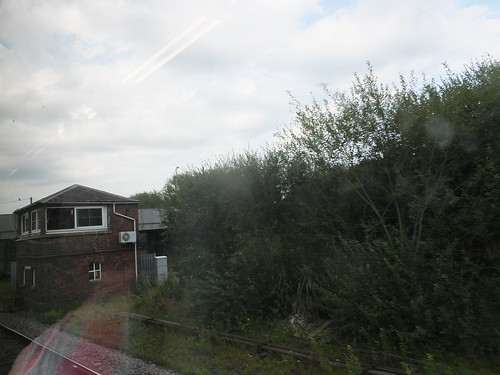 Leominster signal box.
There are nineteen level crossings between Leominster and Craven Arms - mostly minor and user-worked but with some automatic with barriers on busier roads. I managed to get a shot of timeless Stokesay Castle as we sped by.
 Stokesay Castle.
I also took a shot of Dorrington signal box but then I relaxed on the last few miles to Shrewsbury.
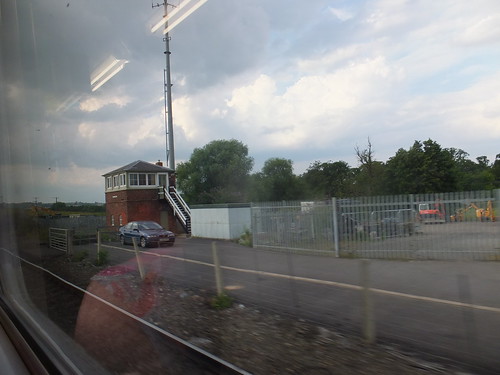 Dorrington signal box.
At Shrewsbury, I changed to a Wolverhampton train and made my weary way home after an interesting, if tiring, day.
Well, that's an impression of how it is now. As time permits, I hope to add some notes on how it was, pre-Grouping and pre-Beeching.
Map of Railways described above in Pre-grouping period
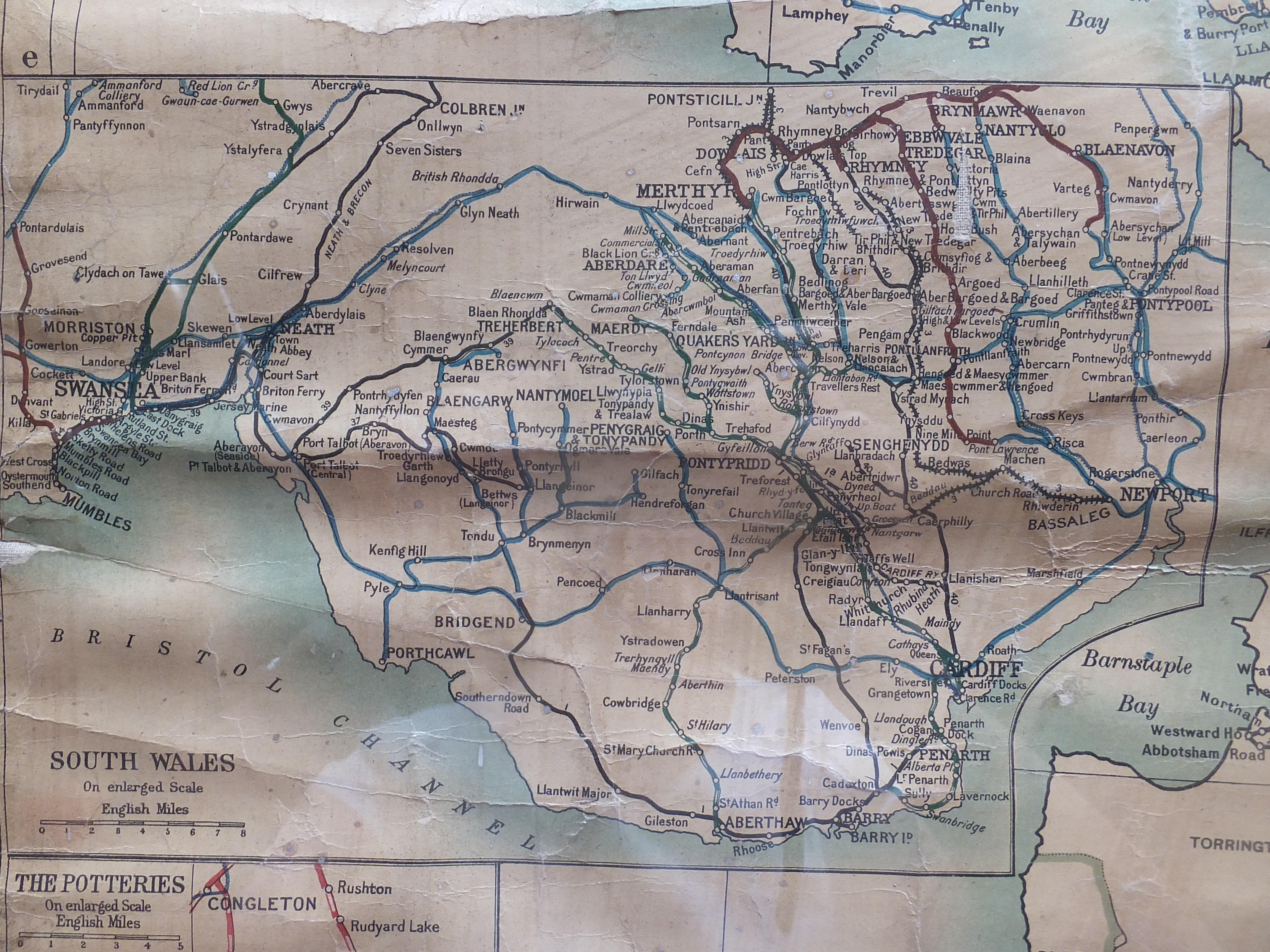
Up until the Railways Act 1921 which grouped railway companies into the 'Big Four', there was a plethora of independent railways. The three map fragments below show South Wales, Newport to Leominster and Leominster to Shrewsbury and are taken from the 'Railway Map of England & Wales, 11th Edition', published W. & A. K. Johnston. The explanation of the colours or numbers on these map fragments is shown in the table below.
| Colour or number |
Railway |
| Blue |
Great Western |
| Brown |
London & North Western |
| Green |
Midland |
| Green/white |
Taff Vale |
| 1 |
Barry |
| 3 |
Brecon & Merthyr |
| 37 |
Port Talbot |
| 39 |
Rhonnda & Swansea Bay |
| 40 |
Rhymney |
| (named) |
Neath & Brecon |
Map of Pre-grouping Railways in South Wales
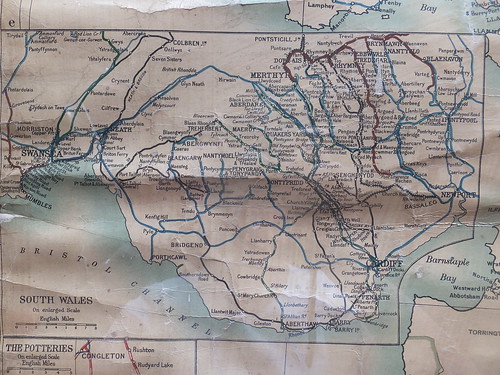
Click for larger image.
Pre-grouping railways in South Wales.
Map of Pre-grouping railways from Newport to Leominster

Click for larger image.
Pre-grouping railways from Newport to Leominster.
Map of Pre-grouping railways from Leominster to Shrewsbury
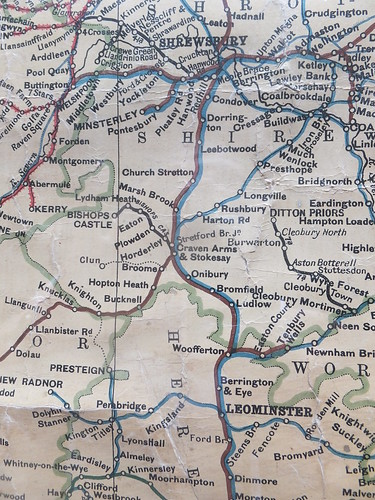
Click for larger image.
Pre-grouping railways from Leominster to Shrewsbury.
Some time after the trip, I assembled some historical and other data which you can find in Part 3.
Book References
[1] 'A Regional History of the Railways of Great Britain: Volume 12 South Wales by D. S. M. Barrie, published by David & Charles (ISBN 0-7153-7970-4).
Track Diagrams
[1] 'Track Layout Diagrams of the GWR and BR WR: Section 38 Newport' by R. A. Cooke, published by R. A. Cooke 1980.
[2] 'Railway Track Diagrams Book 3: Western', published by Trackmaps (ISBN: 0-9549866-1-X).
[3] 'Track Layout Diagrams of the GWR and BR WR: Section 38 Newport' by R. A. Cooke, published by R. A. Cooke 1980.
Related articles on other sites
Cardiff Central Railway Station (Wikipedia).
Cardiff Central Station (National Rail).
Related articles on this site
Part 1.
Part 3.
My pictures
General:
Swansea.
Newport, Gwent.
Railway pictures:
Swansea area railways.
Cardiff's railways.
Newport Station, Gwent.
Shrewsbury-Hereford-Newport line.
Peak Rail has run a 1940s Weekend for a number of years (the ones I've been involved in are listed near the end of this post).
In 2014, the event was held on Saturday 2nd August and Sunday 3rd August. This year, the event had a special resonance because Monday 4th August was the centenary of the outbreak of World War I. The Saturday was very wet in the morning but weather improved in the afternoon. I was rostered as steam driver on the Sunday and we enjoyed sunny, hot weather all day. When I arrived, I found 'Lord Phil' simmering on the pit at Rowsley. The booked fireman, Phil and I chatted briefly and then I set about oiling-round and carrying out the 'Daily Exam'. As previously, we were to operate a 7-coach train top-and-tail. 'Lord Phil' would be attached to the north end of the stock, facing north, with D8 'Penyghent' at the south end. This meant that we could take water from the water tank at the north end of Rowsley station. Providing the driver stops accurately, it's much easier taking water here than having to maul around a fire hose when taking water at the south end of Rowsley.
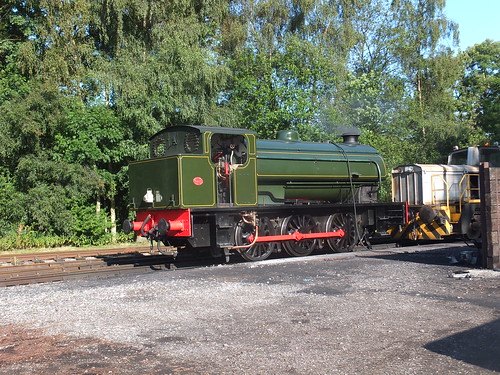 'Lord Phil' simmers on the pit at Rowsley.
Running the service
We came off-shed in plenty of time using the Train Staff to operate the 3-lever Ground Frame at the north end of Rowsley, so as to get to the north end of the train and Phil 'tied-on'. I walked back to the shed to deliver the Train Staff to 'Penyghent' so that, when they were ready, they could shunt across to the southern end of the train. The 2-coaches of the 'Palatine' restaurant set were next to 'Penyghent', followed by five more coaches including the Buffet Car and the Brake Composite with the Guard's accommodation. The 'Palatine' was not being used for meals so it was available for ordinary passengers and I gather they opened the 'Palatine' bar (in addition to the normal licensed bar in the buffet car).
Well before departure time, the train was filling up with passengers and the platform was very crowded. Initially, the Guard tried to keep the back two coaches empty, to be used by passengers joining the train at Matlock Town, but there were just too many people arriving so passengers were allowed first into the sixth and then the seventh coach.
'Penyghent' took the first train to Matlock (Town), with 'Lord Phil' doing no work. On arrival, the Single Line Staff was transferred to us from 'Penyghent' ready for the return journey. We then had the task of returning the train to Rowsley, being careful to stop well up at Darley Dale with seven coaches and a main-line diesel behind us (we'd set a suitable 'mark' on the first Up journey) and stopping at Rowsley on the correct 'crack between platform paving stones' to make sure the swinging arm of the 'water crane' accurately lined up with the water filler on top of the saddle tank.
During the day we completed the five round trips to Matlock (Town) without fuss and sticking very closely to time.
 'Lord Phil' at Matlock (Town) ready to set off for Rowsley.
Special Activities
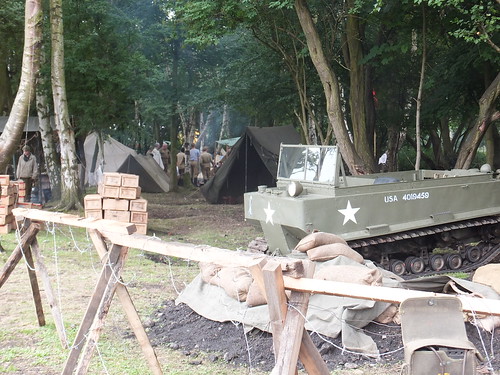
There's an awful lot of preparation and planning involved in the lead-up to the 1940s Weekend. In the large marquee there was 1940s-themed entertainment (and a licensed bar!). A variety of military and civilian vehicles were on display. In the Car Park near the station there were a number of stalls selling memorabilia of the period. In the woods opposite Rowsley platform and in the Picnic Area there were elaborate military encampments.
 Military encampments in the woods at Rowsley.
Pricipally, there were the re-enactors, either in a wide variety of military uniforms or in civilian clothing of the 1940s. My own minor contribution was my 'Tin Helmet' which I periodically wore and my respirator which I carried from time-to-time (but which I decline to don). According to the Official Programme the following groups were represented:-
Panzer GD Living History Group
Feldjagerkorps 44 (German Miltary Police)
FJR-5 German Paratrooper Group with Nurses and anti-tank gun section
WW2 German Paratroopers
Hungarian Troops
Luftwaffe Pilots and Ground Crew
German and Finnish Snipers
Russian 2nd Guards Rifle Division
USA Camp
British Infantry and Paratroopers
French Resistance
British Army Group
Womens Land Army
Home Guard
Of course, working on the train means that you don't get much of an opportunity of looking around the extensive activities at Rowsley, but I did snatch a few photographs around the site. At 3.00 p.m. each day, there was a battle re-enactment opposite the platform at Rowsley, but this only took place once the train had departed for Matlock and it was all over well before we returned. The Programme promised the scene at a railway siding, somewhere in Germany in the Spring of 1945, as the German forces attempted to move precious artefacts and paintings back to Berlin by train, whilst Allied forces sought to prevent this. I didn't see the action, but I did manage to snatch a picture of the artefacts.
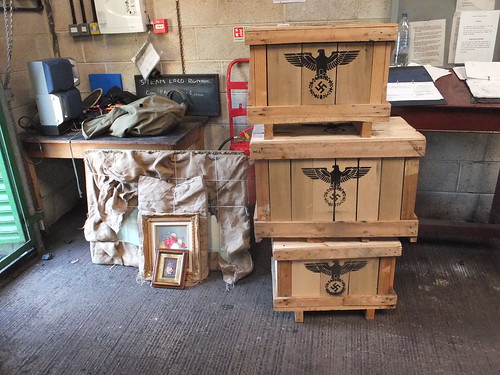 Pictures and artefacts which the Germans attempted to move to Berlin by train.
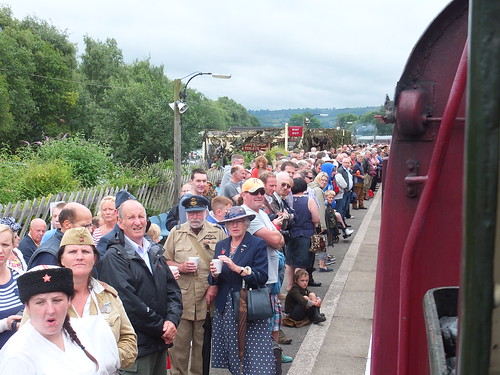
 Crowds line the platform at Rowsley.
The Sunday event seemed particularly well-attended helped, no doubt, by the good weather (although there were a couple of light showers during the day).
Previous 1940s Weekends
I've participated in a number of earlier 1940s events at Peak Rail:-
2013 event (article & pictures link).
2012 event (article & pictures link).
2009 event (article & pictures link).
2008 event (article & pictures link).
2007 event (pictures only).
2006 event (pictures only).
My Pictures
Peak Rail 1940s Weekend, 2014.
In 2014, the Ty Gwyn woodland is shipping out timber again and, since the output is going to the large Kronospan factory at Chirk, I thought I'd better find out a little more about what Kronospan do. Rob, the forest manager, arranged a conducted tour of Kronospan and on Thursday, 24th July 2014 we were made very welcome and shown around the impressive plant. I find any large-scale industrial process fascinating but the wood-product manufacturing we saw was particularly interesting. I'll try to give you an impression of the visit but, since my prior knowledge of this type of process was around zero, my grasp of the details is a bit tenuous.
History of Kronospan
In 1897, a family-owned sawmill was established in Lungotz, Austria. This business, still family-owned, now claims to be the world's largest manufacturer of wood panel products, employing 11,000 people in 38 plants worldwide. The graphic below illustrates some milestones in the company's history.
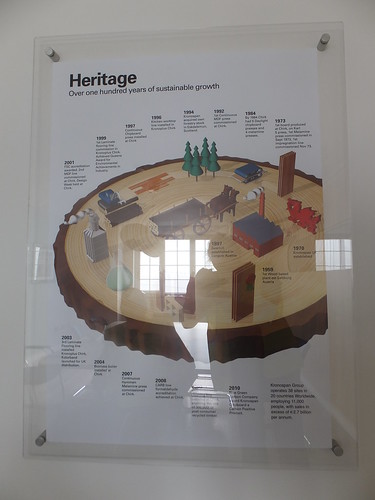
Graphic showing milestones in the company's history.
Products made by Kronospan
The company uses the tag "Kronospan - Wood, perfected", emphasising that, unlike natural wood, its products are homogeneous, non-warping, sap and knot free. A wide range of different products are now made, all often referred to generically (if incorrectly) as 'MDF'.
The standard product is Medium Density Fibreboard, produced in various thicknesses up to 38mm.
A lighter grade of MDF, 'Krono Light' is available where weight is important, in thicknesses up to 25mm.
High Density Fibreboard ('hardboard') can be up to 6mm thick.
'Deep Router' grade is optimised for routing.
'Moisture Resistant' grade is intended for high humidity areas.
'Krono Thin' is supplied in 3mm or 4mm thickness.
Particle Board comprises three layers of resin-bonded wood chips.
Oriented Strand Board (OSB) offers high strength and moisture tolerance.
Faced boards have a melamine or treated paper surface which can be coloured or patterned to simulate natural wood. The simulated wood products may be textured to enhance the wood effect.
These products are normally supplied in 8 ft. by 4 ft. or 10 ft. by 4 ft. sheets.
The Kronospan Plant at Chirk
Kronospan produces most of the above options (excluding OSB) at its plant at Chirk. The picture below shows a model of the plant. The actual manufacturing lines and the sawmill are housed in the two huge 'sheds'. The mysterious-looking equipment at the rear is the Pre-production area where the wood particles are produced for the various products. At the rear of the site is the railway line from Shrewsbury to Chester. Kronospan have their own private siding and receive up to eight trains a week of logs. On the right, is the logyard where logs and wood chips are stored.
 Model of the Chirk plant.
The picture below is a very simplified graphic outlining the manufacturing processes.
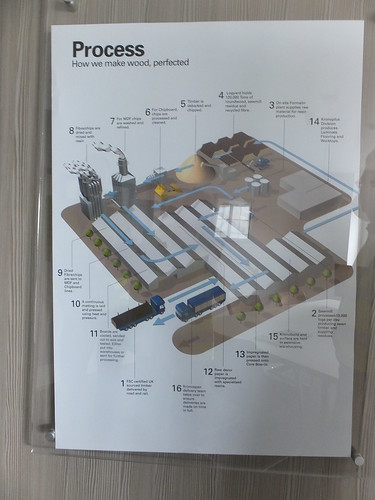
Graphic illustrating the manufacturing processes.
1. Wood is received by road and rail. 70% is FSC-Certified (see the Forest Stewardship Council website for more details).
2. The sawmill processes around 13,000 logs per day.
 The Control Room at the Sawmill.
3. The onsite formalin plant provides the raw material for resin production. Formadehyde is a gas at room temperature but dissolved into water becomes formalin. Treated with Urea it forms urea formaldehyde resin which is used to bind the materials. Formaldehyde is probably a human carcinogen but Kronospan MDF products are 'low formaldehyde' to the European Standard E1 (see the HSE site for more information).
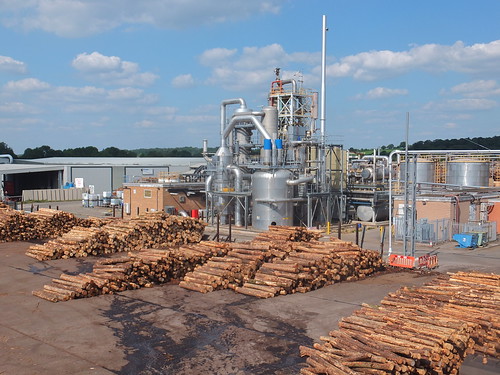 The Formalin Plant at Chirk.
4. The logyard can hold around 120,000 tons of roundwood, sawmill residue and recycled fibre.
5. Timber is de-barked and chipped.
6. For chipboard, chips are processed and cleaned in Pre-production.
7. For MDF, chips are washed and refined in Pre-production.
8. Fibre/chips are dried and mixed with resin in Pre-production.
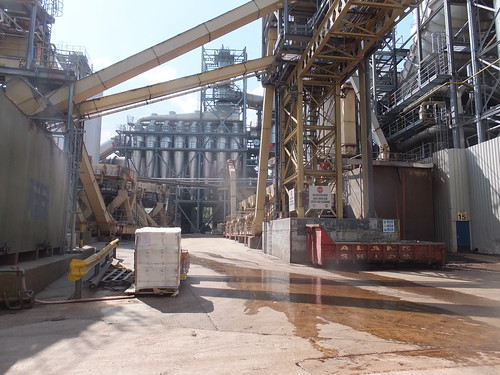 General view of the Pre-production area.
9. Dried fibre/chips are sent to MDF and Chipboard lines.
10. A continuous matting is laid and pressed using heat and pressure.
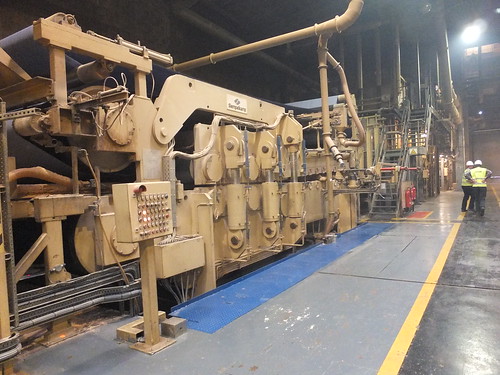 Production line for MDF.
11. Boards are cooled, sanded, cut to size, tested then either warehoused or sent for further processing.
 Cooling MDF production.
12. Raw Decor Paper is impregnated with special resins.
13. Impregnated Decor Paper is pressed onto core boards.
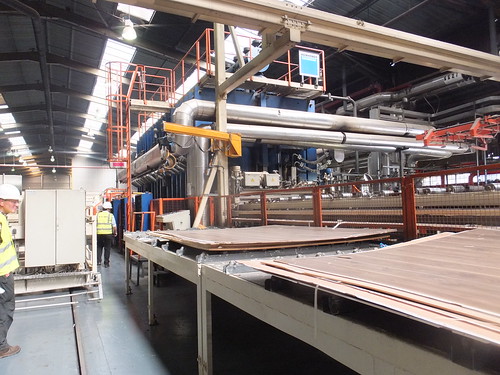 Applying Decor Paper to core board.
14. Kronoplus Division produces laminate flooring and worktops.
15. Products are held in warehousing.
16. Products are delivered to customers or distributors.
Manufacturers of Process Machinery
Much of the plant we saw was from the Siempelkamp Group from Germany, which includes a number of companies specialising in different aspects of the process. They are a major manufacturer of process equipment for this industry and the group website is here. Studying this website gives a little more information on the techniques used. There are a number of PDF files which can be downloaded including:-
1. Wood preparation and blending technology for flakes, fibers, and strands.
2. Mat Forming Concepts for Particleboard, MDF and OSB.
3. Laminating Plants.
4. Finishing Lines for the Wood-Based Panel Industry.
5. 'SicoScan' Process Measuring Systems for new plants.
6. Biomass power plants by Siempelkamp.
The laminating press applying Decor Paper which we looked at was from Wemhoener, also in Germany.
Related articles on other sites
Medium Density Fibreboard (Wikipedia).
High Density Fibreboard (Wikipedia).
Oriented Strand Board (Wikipedia).
Particle Board (Wikipedia).
Related articles on this site
All my posts on commercial woodland at Ty Gwyn.
My pictures
Kronospan, Chirk.
Well, more correctly, a busy 8-days. In the earlier post A Busy Week I described a reasonably busy week in July 2013. July 2014 gave me another fairly hectic few days. On the days I wasn't at a preserved railway, I was at the office.
Events of Saturday, 12th July 2014
I was booked steam driver at Peak Rail, with Dave as Fireman. It was an early start because we had a two-hour Driving Experience using 'Lord Phil' before starting the Service Trains. I've described the format of Driving Experience courses a number of times. Our Trainee Driver, like many candidates, was (belatedly) celebrating a 'Significant Birthday'. He was an apt pupil and everything seemed to thrill him. Watching how much people enjoy these courses reminds the crew just what a privilege is it to work on a steam locomotive. At 10:45, we said 'Goodbye' to our new friend and his waiting family and travelled Light Engine to Rowsley where our Guard called us onto the south end of the usual 7-coach train. Peter and Roy attached the Class 14 diesel locomotive at the north end and we were ready to set off at 11:15 on the first of five round trips to Matlock Town. The sun was shining brightly and we were clearly in for a very warm day. I think the forecast was for temperatures up to 30 degrees Celsius. It certainly seemed warm to me on the trip I fired so that Dave could have a drive. We completed the diagram without incident but, with the hot weather, I found it an exhausting day.
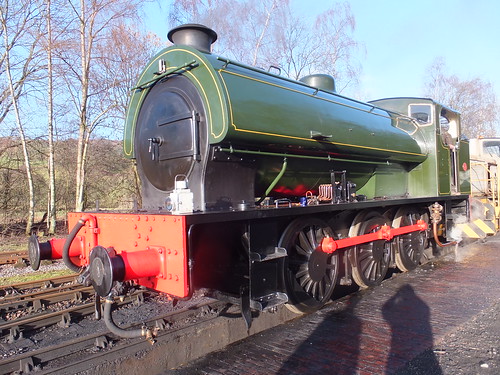 'Lord Phil' being prepared for traffic earlier in the year.
Events of Tuesday, 15th July 2014
At the Battlefield Line, a diesel railcar service operates on Tuesdays, Wednesdays and Thursdays in summer. I was the railcar driver on 15th July. I arrived to find the 5-coach main train standing in platform 1. This is now all in maroon, but not all the vehicles are lined-out as yet. I walked up the line expecting to find the diesel railcar in the Railcar Siding but it soon became clear it wasn't there. Looking back towards the station, I could now see that the 'Bubble Car' was waiting for me in platform 2 but I hadn't spotted it as I walked along platform 1 because of the stock for the main train masking it.
Preparation for a diesel railcar is a much briefer task than on steam, but it's important it's done properly. In the cab I found a note saying that if the single-car became overloaded with passengers or I suffered an engine failure (both events fairly unlikely), one coach of the 2-car DMU was serviceable and could be attached to the 'Bubble Car'. The other 'half' of the 2-car set was in the shed, receiving 'TLC' from the owner, Richie Marcus.
We operated four round trips, starting from Shackerstone at 11:00, 12:30, 14:00 and 15:30. There were no problems and we carried a reasonable number of passengers. All-in-all a pleasant and not too strenuous day.
 An earlier picture of the single-unit DMU at Shackerstone.
Events of Saturday, 19th July 2014
On the afternoon of Friday, 18th July, I received a text asking if I was available as the steam driver at the Battlefield Line the following day. Following my maxim of 'Embrace the Unexpected', I replied 'OK'. On the day, almost everything went wrong but, despite (or because?) of this, I had a great day.
I expected to find the passenger stock still in platform 1, as it had been the previous Tuesday. In fact, it had been moved across to platform 2 and had "grown" - a 'blood and custard' liveried coach had been added at the north end, making a six coach load. As I walked towards the Signing-on Point, I looked across from platform 1 to see if the extra coach appeared to have been 'hooked-on' correctly. From the platform, all looked well. Having signed on, I checked the details of the day in the Monthly Operating Notice. A standard steam service of five round trips to Shenton was called for, with departures from Shackerstone at 11:15, 12:30, 13:45, 15:00 and 16:15. In the shed, Dave was preparing the Great Western 2-8-0. Together, we got her lit-up and oiled-round. We had plenty of time before our first departure, although I was concerned that Dave was suffering from some sort of infection. He said he'd work the first trip and then see how he felt.
By the time we'd hooked-on to the train (with a full tender of water but not too much coal), we'd a little more information about the day. It appeared that 150 Morris Dancers were booked to travel back from Shenton on the second or third train, enjoying a sandwich lunch on the way. The whole party would return to Shenton by train later. The railway were providing the food and we were told that the first departure would be delayed waiting for the catering supplies to arrive. When we came to create vacuum, we discovered that we could only create 10 inches of mercury (compared with 25 inches of mercury which the Great Western used). I climbed down to the track and walked back along the train looking for problems. Although I hadn't been able to see when I'd earlier looked across from platform 1, from my new vantage point I could see that, although the coupling and gangway connections had been correctly made when adding the sixth coach, the flexible vacuum hoses had not been connected-up. Adrian quickly 'bagged it up' and, on returning to the engine, all was well.

Driver's view while awaiting 'the road' at Shackerstone.
We finally received the 'Right Away' from the Guard and we set off for Shenton on our first trip, rather late, whilst the train catering staff prepared and laid out the lunches. At Shenton, we found the Morris Dancers arriving by car. We completed our run-round at Shenton and, still late of course, returned to Shackerstone where, once again, we ran round. Although he'd bravely carried out the fireman's duties on the first trip, Dave decided that it wasn't wise to carry on. Fortunately, Jason came to the rescue. He'd been expecting to spend the day painting the Class 73 in the shed but agreed to deputise for Dave for the rest of the shift. By the time we arrived at Shenton on the second trip, the Morris Dancers were on the platform, dancing. Eventually, the dancers finished their performance and joined the train where their lunches had been laid out ready and we returned to Shackerstone.
By now, we were later than ever, so we were not surprised to be informed on arrival back at Shackerstone that our third trip had been cancelled and that our next working would be the three o'clock departure. We detached the locomotive and moved across to platform 1, where we intended to park for a while so that people could admire '3803'. All the Morris Dancers were on platform 1 and soon the various 'sides' or teams were performing. It was a very jolly time.
The station footbridge at Shackerstone, which also forms part of a public footpath, is currently closed and the local authority seem to be taking their time commencing repairs. This means that the barrow crossing at the north end of the station is the only route for passengers between the two platforms. We'd carefully stopped with the 'blood and custard' liveried coach at the north end of our train clear of the crossing. This meant that the vehicle at the south end of the set (a 'BG' bogie Guards/Luggage Van) was hanging out of the platform. Then we discovered that a wheelchair-bound member of the Morris Dancers, with his companions, was 'marooned' in the 'BG'. Jason and I readily agreed to complete our run round and, with Adrian supervising, propel the train northwards until the 'BG' was in the platform, allowing the wheelchair ramp to be put in place and the wheelchair off-loaded. For extra safety, Adrian clipped the turnout at the north end where platform 2 line converges with platform 1 line. Having off-loaded our wheelchair passenger, we had to draw forward again so that the wheel chair could be taken over the barrow crossing to join the fun on platform 1.
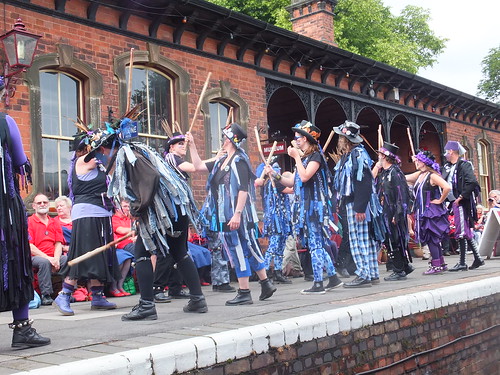 Painted faces, tattered jackets and sticks - the Border Morris tradition.
Of course, as departure time approached, we had to repeat the procedure - bring the wheelchair back to platform 2, set back the train to allow the wheelchair passenger back into the 'BG', then draw forward again to finish boarding all the remaining passengers. Our trip back to Shenton with the Morris Dancers was uneventful and our new dancing friends seemed very happy. It was only then that I discovered more about the event - a celebration for Anstey Royale Chalfont's 30th birthday with eleven 'sides' or teams performing. They had arranged one more display that day - at the Dog and Hedgehog Public House, Dadlington.
The weather had been warm and sunny until we started on our return to Shackerstone when the wind started to blow and the sky became very dark. Jason prepared the storm sheet which can be rigged from the rear edge of the cab roof to the tender, providing better protection than the standard cab.
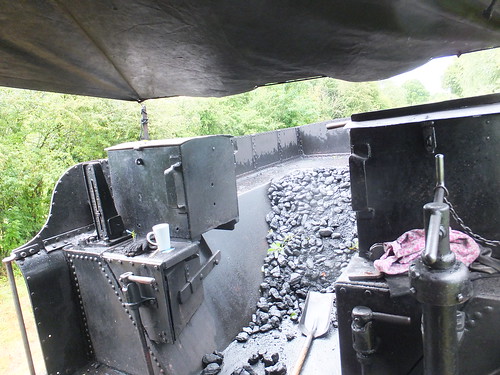 View from the footplate looking towards the tender with the storm sheet deployed.
Back at Shackerstone, we ran round our train and, as we waiting for departure, the thunderstorm hit. I've seen some violent storms over the years but this was possibly the worst I've experienced. In addition to the usual startling thunderclaps some of the thunder sounded rather strange - long drawn-out noise conjuring up the image of sheet metal being ripped. This was accompanied by very heavy rain. The rain came downwards, then the rain came horizontally, then as the wind changed again the rain corkscrewed. We had the Guard's 'Right Away' so we set off. Visibility ahead was very poor, the rain appeared almost like fog. We picked up the Train Staff and carried on but we were very close to the Starting Signal before I could confirm that it was 'off'. A short lull in the wind revealed the front of the engine for a moment to show a large branch sticking out sideways from the buffer beam. I slowed to a stop and told Jason about the branch. "I've got one my side, too", he reported. He managed to wrestle both branches clear and we set off again. To have any sort of view forwards, I had to have the spectacle glass open, which meant that rain sluiced into the cab and into my face. Although the storm sheet was a massive improvement, both Jason and I were becoming a little bedraggled but there was not a word of complaint from Jason. I was reminded of one of my sayings: "Anyone can work on the footplate in good weather. It takes an engineman to do it in bad weather."
By the time we made our stop at Market Bosworth, the thunder appeared to have passed and the wind had subsided a little. It was still raining fairly hard, though. "We'll have to look out for fallen trees going up the cutting to Shenton", I said as we left Market Bosworth. We passed under one bridge with the line curving left and there was a tree, sitting in the middle of the track. I shut the regulator and gently braked. We were still on the uphill section so it didn't take to much braking to stop just clear of the substantial fallen tree, which must have reached at least halfway up the smokebox. The Guard joined Jason and I and between the three of us we removed the obstruction in two pieces (it must have been fairly rotten) and dragged it clear of the line.
The storm appeared to have blown itself out. By the time we ran round at Shenton, worked back to Shackerstone and shunted light engine to stand just outside the shed at Shackerstone, the weather wasn't bad. The signalman at Shackerstone had told us he'd had a complete power failure for a while but power had been restored. Jason discovered that the shed was still without power so the electric roller shutter door to the shed couldn't be raised. We examined the manual operating chain but found that it was disengaged. A little later, power to the shed was restored and the door could be raised. At that point, I signed-off. Thanks to Dave and Jason for a memorable day.
Events of Sunday, 20th July 2014
I was booked as steam driver at Peak Rail again, with Mike as Fireman. I was quite relieved that we didn't have a Driving Experience Course on the day, as the previous day at the Battlefield Line had proved quite demanding. Mike had got 'Lord Phil' "brewing up" nicely and the locomotive was sparkling, thanks to Mike's earlier efforts. It takes an awful lot of effort to keep even a small locomotive looking smart.
After the excitement of the previous day, I was quite content that we had a 'standard' day performing five round trips to Matlock Town with 'Penyghent'. We made a bit of an effort on our last run to Matlock as we connect with an East Midlands Train service. We were on time - the East Midland Trains service was a few minutes late arriving. The train stopped with the rear cab adjacent to the cab of 'Lord Phil', so we exchanged a few words with the friendly guard before he changed ends.
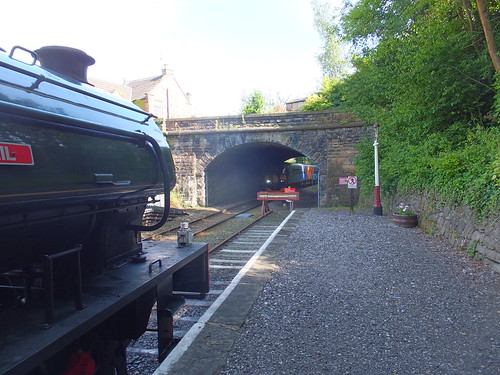 'Lord Phil' on arrival at Matlock Town, as an East Midland Trains Class 156 arrives from Nottingham.
When the driver arrived at the cab, ready for going back, there was a short dialogue about the differences between the methods of working between Network Rail and Peak Rail:-
"We've no AWS ..."
"And no TPWS ..."
"No Vigilance ..."
"And no National Radio Network!"
Despite the differences, it's interesting that the safety of working on single lines still largely relies upon the principle of a unique train staff or token carried by the driver. Our own Token had been handed to the crew of 'Penyghent' ready for our return journey to Rowsley. The driver of the Class 156 carefully laid his Token, authorising his return to Ambergate, on his control desk.
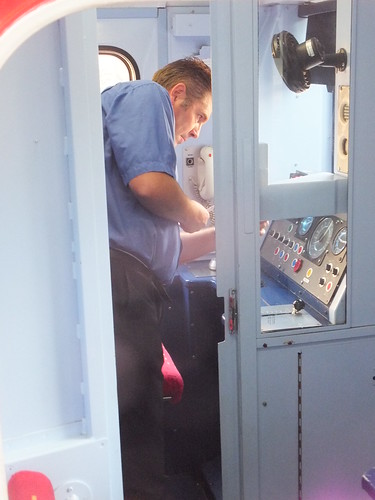 The Driver of the Class 156 checks his control panel ready for the return journey.
With a wave and a short blast on the horn, the Class 156 set off and we saluted with a 'pop' on our whistle. The Guard was riding in the back cab and, as he passed us, he waved and gave us a 'toot' on the horn which, of course, we acknowledged. Soon, we made our final return to Rowsley where we detached from the train and shunted across to the pit to complete our disposal, bringing to a close my busy eight days.
My Pictures
Peak Rail, May 2014.
Anstey Royale Chalfont at the Battlefield Line.