skip to main |
skip to sidebar
Click on any picture to see an uncropped image or browse the albums listed in 'My Pictures' below.
Events of Wednesday 7th May 2014
Walking in Yangon
I enjoyed a leisurely breakfast in the Cafe at the Strand Hotel. I managed to contact both Doctor Hla Tun and Captain Myo Lwin on the telephone and we all arranged to meet in my hotel later in the day.
Although still fairly exhausted, I decided I'd take a walk in the city. There's always so much to see and the legacy of Britsh-inspired buildings is a permanent fascination. There's a useful book [reference 1] on Heritage Buildings in Yangon, with the delightful sub-title 'Inside the City that captured Time'. I decided to head north, away from the river but, instead of taking the major thoroughfare Pansodan Street, I took the narrower street to the east, Seikanthar Street. My first discovery was that the side of the Strand Hotel was being cleaned. Four men were clinging to two rather primitive rope ladders with bamboo 'rungs', scrubbing away at the walls. One man on the flat roof was controlling the water supply to two flexible plastic pipes dangling by the cleaners.
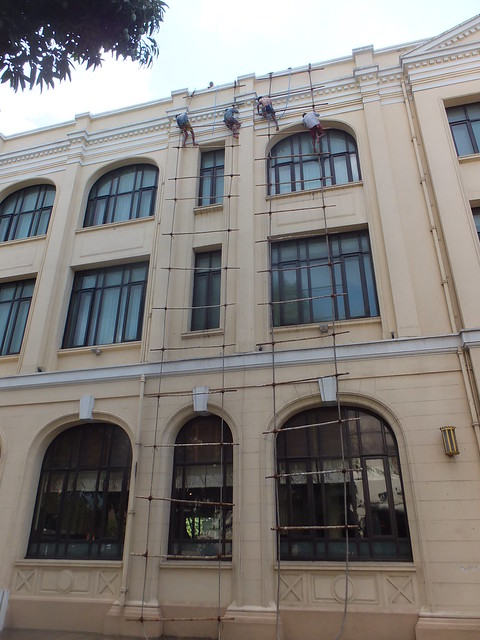
Cleaning the Strand Hotel.
I passed a number of Colonial-era warehouse buildings and a few commercial/residential buildings, none in a very good state of repair. These were interspersed with more modern apartment blocks, usually seven storey.
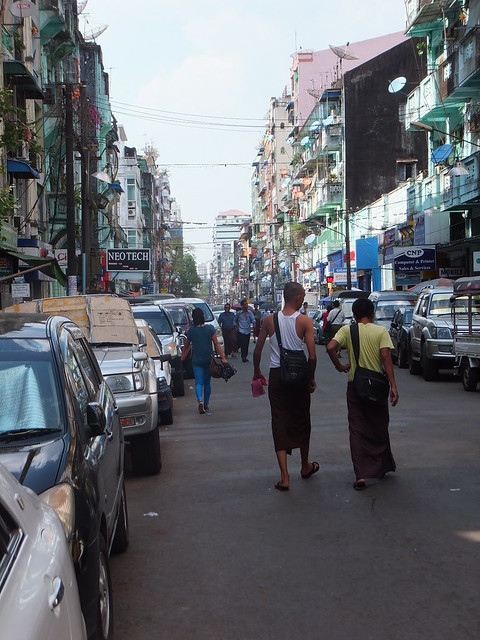
Seikanthar Street, looking north.
What was most striking was that this appeared to be 'Computer Street'. Most of the ground floor businesses were selling computers, mobile phones, audio equipment or 'white goods'. Rather than the usual crowded jumble of stock, most of the premises were well-lit, western-style showrooms and most of the posters were in English, with only the occasional Burmese text.
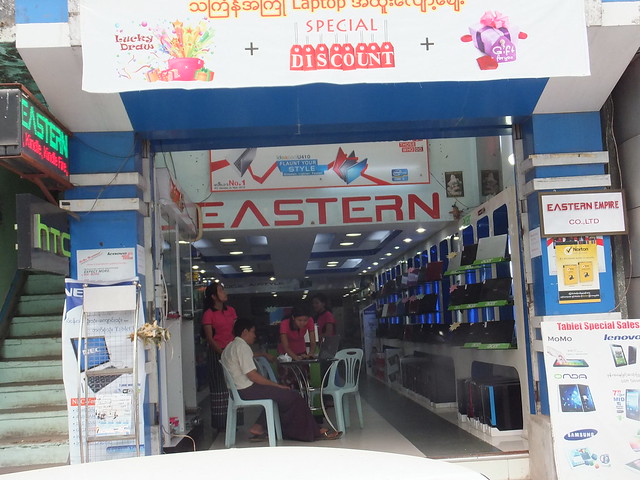 The Computer Showroom of Eastern Empire Co. Ltd.
Not far from these showrooms selling 'state of the art' products, I passed a more low-tech business - a one-man mobile snack bar. Two specially-made small wooden tables carry two metal pots of food plus accessories. Four metal supports rising from each table are gathered into a supporting ring. The owner has a wooden yoke so that, to move to another location, the supporting ring on each table is threaded onto each end of the yoke and the whole weight can be carried on the owner's shoulders. There were also three small moulded plastic stools for the customers which (elsewhere) I've seen wedged into the framework of the wooden tables whilst the whole set-up was being moved.
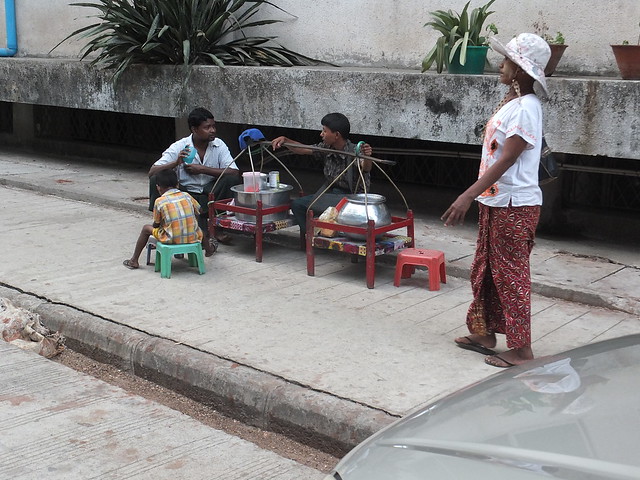 Mobile Snack Bar, Burmese-style.
Yangon Central Station
Perhaps inevitably, when I reached Bogyoke Aung San Road (which runs east-west, south of the railway), I climbed the steps of the bridge which gives access to the station and descended onto platform 7 (one of the three 'suburban' platforms). One of the new Japanese diesel railcars was standing in the platform, covered in advertising, but before I could draw level, it departed westwards.
The rear of the train carried its running number 'RBE-P5032' on one panel and 'Gold Roast COFFEE MIX' on the other - another triumph for marketing, I suppose, just like the ghastly trains with advertising running around in Britain.
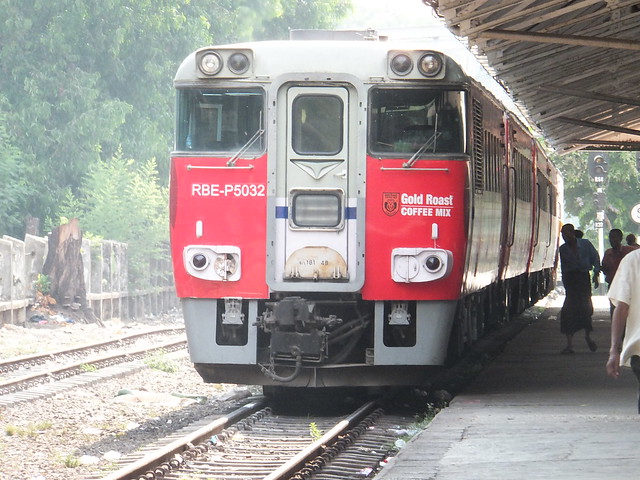 Japanese diesel railcar leaving Yangon Central Station.
City Hall
I slowly made my way back towards the hotel, this time using the busy Pansodan Street. At the junction with Mahabandoola Road, I passed City Hall - a curious but imposing confection in Britsh - Myanmar style built in stages between 1925 and 1940 where components of Burmese Palace and Temple architecture have been added-on to a typical British municipal building. In 2011, it was repainted in a striking lilac with purple details.
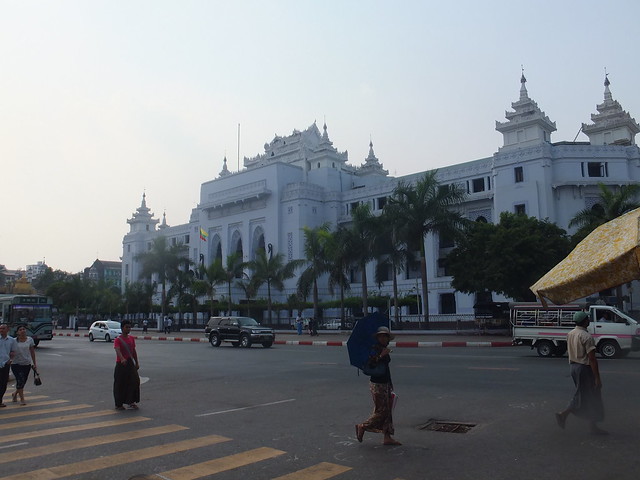 City Hall.
Central Telegraph Office
Built between 1913 and 1917. By 2000, it had lost most of its original roles. It is owned by the Ministry of Communications, Posts and Telgraphs and I believe the ground floor now houses stalls selling mobile phones.
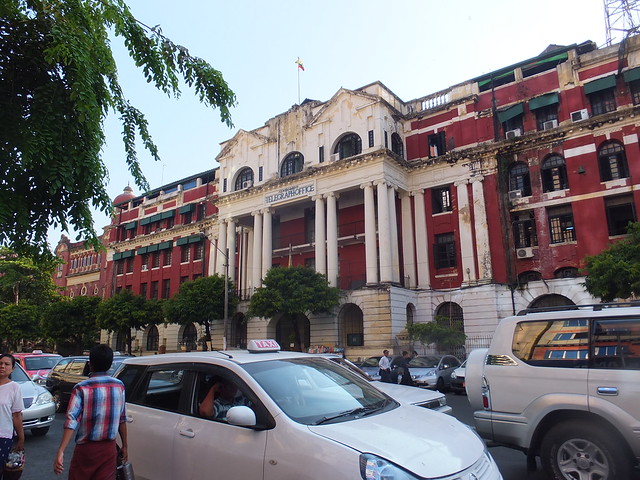 Central Telegraph Office.
High Court
This 'archetypal colonial administrative building' was built between 1905 and 1911 and remains in use, although the Supreme Court has moved to Naypyitaw.
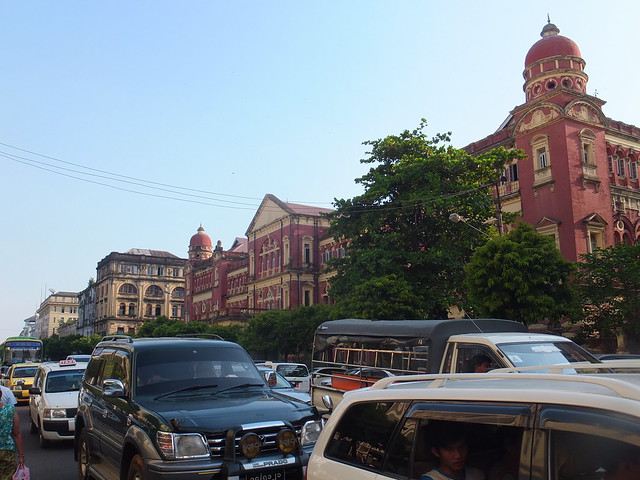 Rear elevation of High Court.
Internal Revenue Department
This building was commissioned by Surti Indian Traders from the port of Rander (hence the name 'Rander House'). It was built in 1932 and, after serving various roles, in now used by Inland Revenue, with apartments in the upper floors.
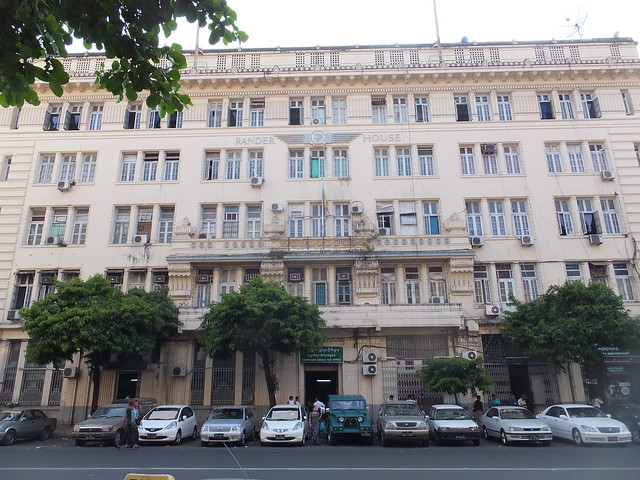 'Rander House', now the Internal Revenue Department.
Meeting Friends
I was back at the hotel in plenty of time for my visitors Doctor Hla Tun and Captain Myo Lwin. They declined the offer of a meal so, instead, we had soft drinks in the Bar. Soon, it was time to say 'goodbye' to my friends - I was leaving Myanmar early the next morning by air for Doha in Qatar.
Books
[reference 1] '30 Heritage Buildings of Yangon', published by Association of Myanmar Architects in association with Serindia Publications Inc (ISBN 978-1-932476-63-7 Softcover).
My Pictures
Yangon (Rangoon).
(Pictures from March 2008, September 2008, September 2009, September 2012)
Yangon (2013).
Around Yangon, 2014.
Strand Hotel, Yangon.
Yangon's Railways
More
Next Post describing this trip.
Click on any picture to see an uncropped image or browse the albums listed in 'My Pictures' below.
More events of Tuesday 6th May 2014
Introduction
When I arrived at Sittwe by air on 3rd May 2014 (described in the post On to Mrauk U), we simply drove along the Main Road through the town to the boat yard where I embarked for the trip up the Kaladan River to Mrauk U.
On 6th May 2014, I returned from Mrauk U to Sittwe by boat and this journey is described here. However, on this occasion there was time to see a little of Sittwe before catching my flight back to Yangon.
Mrauk U had been the capital of the Rakhine state for centuries and, initially, the British had a presence there. But the British decided to develop Sittwe (or 'Sittway' as they spelt the name) as their Adminstrative Centre, accelerating the decline of Mrauk U.
The influence of the British is still visible. Most of the development took place along a long, straight thoroughfare parallel to the shore called 'Main Road'. A number of the buildings, even today, clearly show British architectural ideas.
The Merchant's House
We entered the forecourt of a large house set back from the road. The design was generally 'British Colonial Villa', although the arched windows gave a rather ecclesiastical appearance. The building was topped by two gilded spires of Burmese design which I assumed were a later addition.
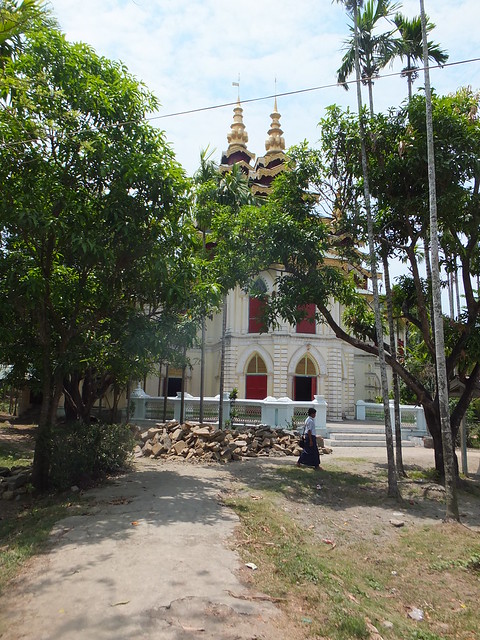
Merchant's House in Sittwe.
During the British period, certain people did very well from the trade opportunities and this house had been the home of a businessman of, I think, Indian origin who died in 1911. A rather austere photograph of the merchant hangs on the wall.
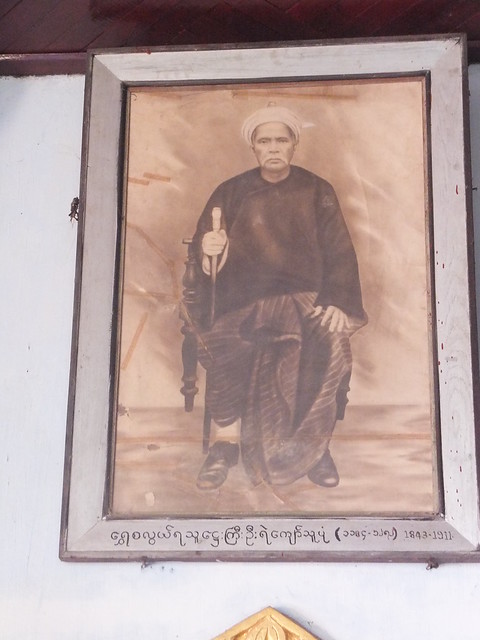 The Sittwe Merchant.
I believe the merchant bequeathed the house to the people of Sittwe and appears to be currently part of a Buddhist temple. The ground floor of the building formed single, large room, with a number of columns supporting the upper floor. I was intrigued that each column was formed from two substantial rolled steel 'U' sections, back to back, simply painted yellow. The sections were clearly marked 'DORMAN LONG & Co LTD MIDDLESBOROUGH ENGLAND'. All the doors and windows were open, leaving the large room cool. A number of men were stretched-out on sleeping mats on the wooden floor resting from the heat. There were few furnishings, other than a Buddhist shrine with two adjacent boxes for donations.
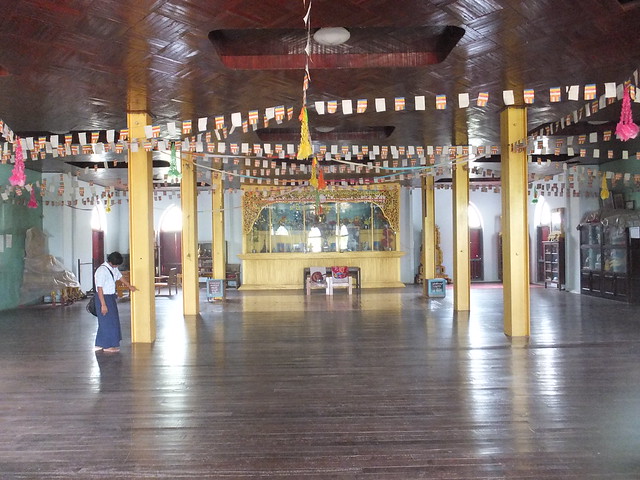 The ground floor of the Merchant's House.
A wooden staircase led to the first floor. This was fitted with an ancient retractable lattice gate (like the gates on old-fashioned lifts) so that the upper floor could be closed off. Sections of Marsden Matting (the perforated steel planking designed in World War II for temporary roads and runways) had been adapted to 'box-in' the stairway. The first floor appeared to be empty, apart from a couple of men resting.
The Sittwe Temple
Next to the Merchant's House, there was a particularly exuberant building. Its design owed much to traditional Burmese monastery practice, but there were various European-influenced features, like arched windows and a clock tower.
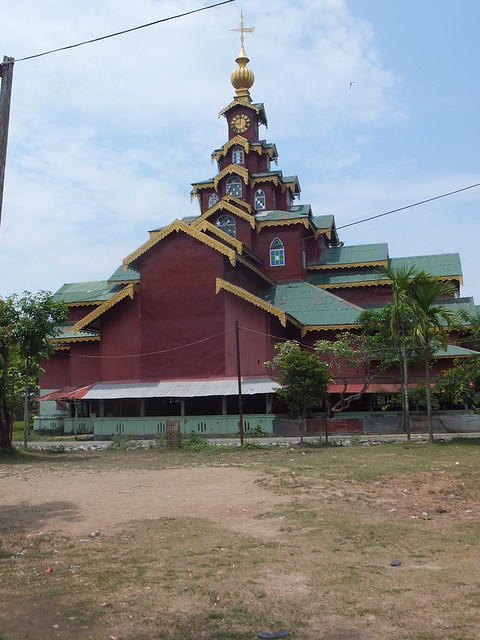 The Sittwe Temple.
Entering the Temple, the main impression was one of size - the structure was huge, rivalling European cathedrals. This had been achieved by adopting steel framing throughout, with corrugated iron sheets for the various roof sections and wood for walls. No attempt had been made to disguise this construction and, somehow, this made the effect more breathraking. Four massive rolled steel columns supported the central tower and similar, smaller columns were provided for the other roof sections. At least one column was marked 'TATA IRON & STEEL'.
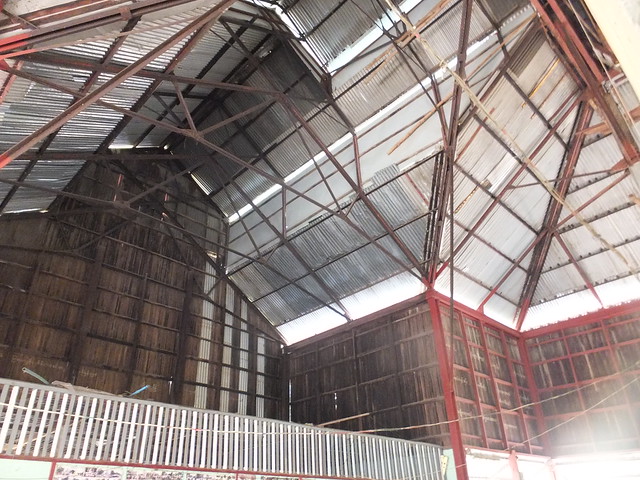 The complex roof is supported by numerous steel trusses.
A large Buddha image occupied the centre of the tiled floor. Once again, there were various people sleeping on the floor.
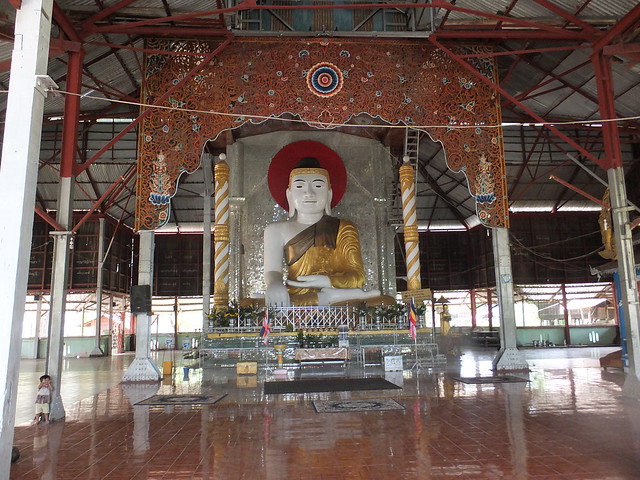 The Buddha image in the Sittwe temple.
This wasn't the first time I'd seen a large steel framed building used for religious purposes in Burma. In November 2011, I visited Yangon's huge Reclining Buddha which is housed in a steel framed 'shed' as described in my post here (with more photographs here.
Bhaddanta Wannita Museum
Five minutes drive from the Sittwe Temple, we came to another Colonial-era residence which now serves as the Bhaddanta Wannita Museum. Bhaddanta Wannita was the head monk at the Maha Kuthala monastery and he collected the various artefacts which are now displayed here.
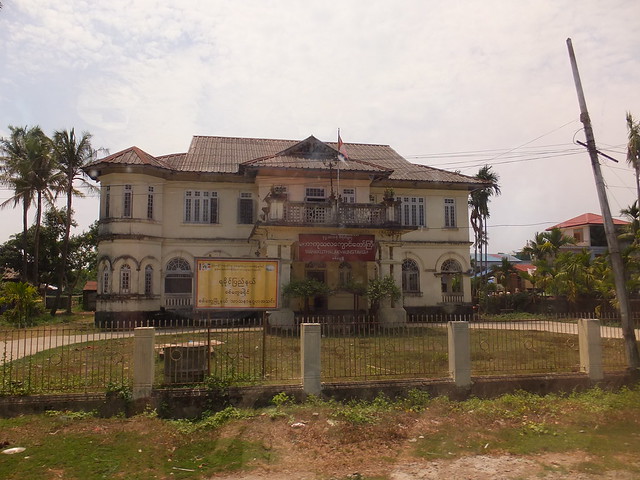 Bhaddanta Wannita Museum.
There was a large collection of Offering Bowls and Buddha Images but some of the items were more prosaic - smoking pipes and old currency, for instance.
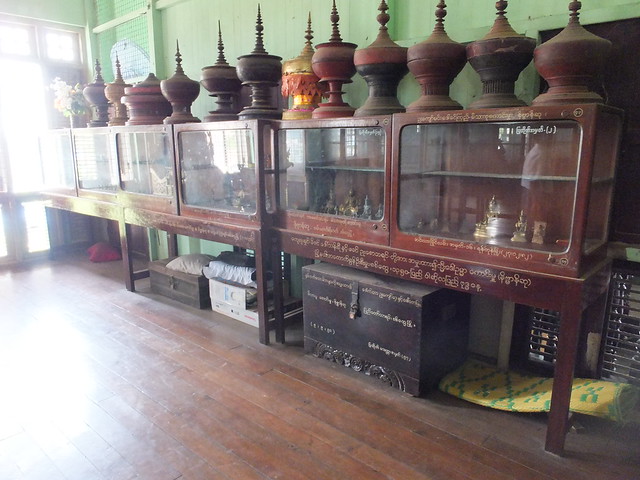 Offering Bowls and Buddha Images displayed at the museum.
Sittwe Port Area
As we approached the port area, we could see two large cargo ships anchored offshore. There is only one decent jetty (made of reinforced concrete) where a larger ship can discharge and load. Otherwise, ships anchor in deeper water and use their derricks to transfer cargo to and from a smaller lighter which can moor at one of the quays.
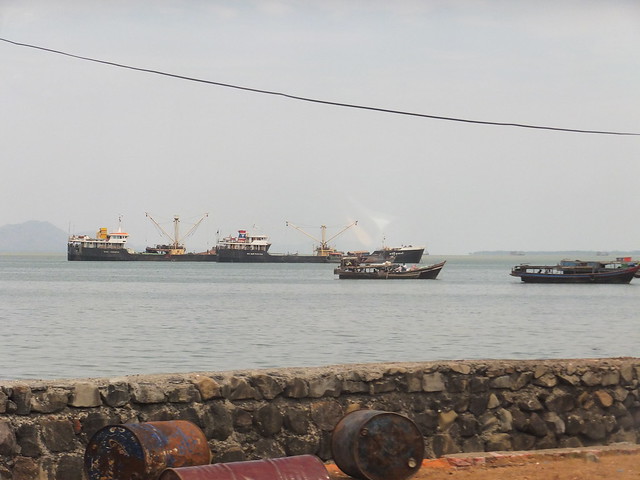 Cargo ships anchored offshore unloading and loading to lighters.
Near the quays there was a busy market. The narrow passages between stalls were also used by a number of porters shifting prodigious loads on massive and rather ancient 2-wheel trucks so it was necessary to keep a sharp lookout.
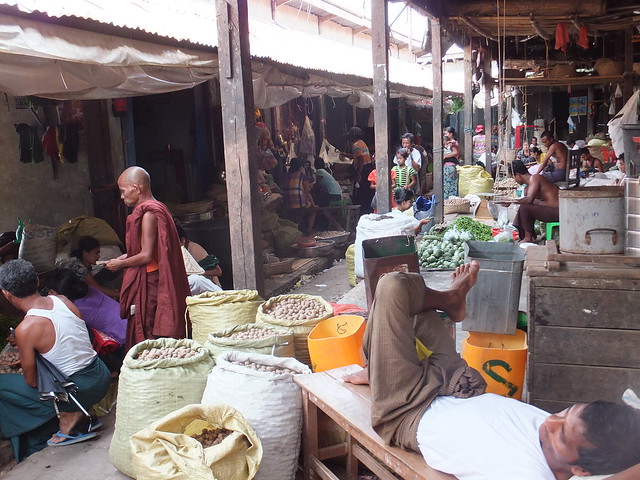 The Market at Sittwe.
One part of the quay seemed to serve as a 'taxi-rank' for small boats ferrying people and goods around the Sittwe area.
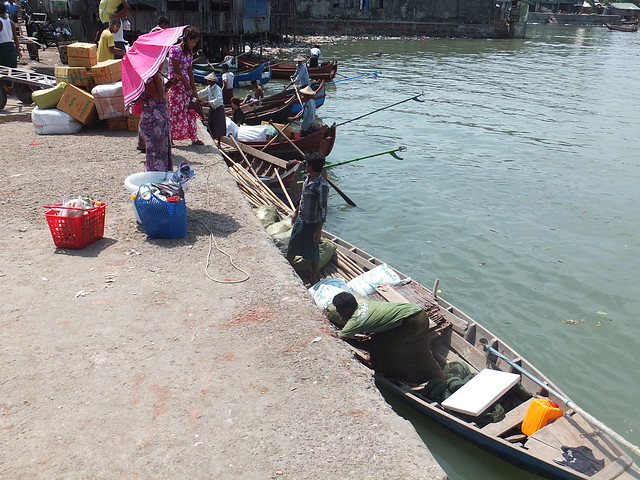 The quay used by small boats.
The small boat quay gave a good view of the numerous small boats criss-crossing the water and the single jetty where a cargo ship was berthed and able to discharge its load directly to trailers which were then hauled along the jetty by a tractor (I think the first tractor I'd seen on the trip - farm work is more usually done by animals).
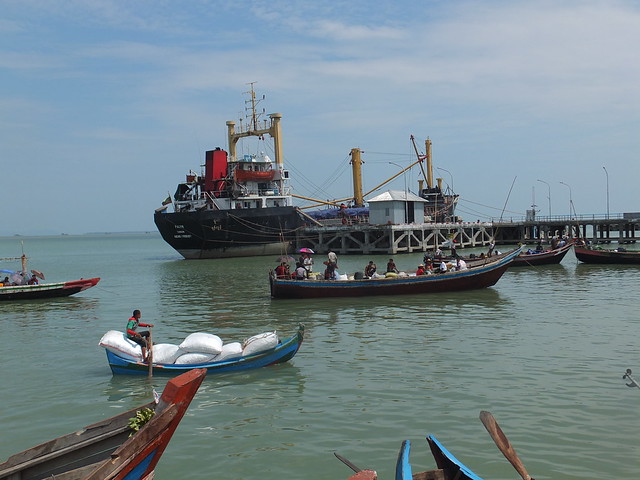 The busy scene near the Jetty.
We continued our tour of the market, passing through the Fish Market to the area where large volumes of dried fish were being bagged and weighed prior to being exported to Bangladesh as animal feed. As we came back to the road, there were two ladies with treadle-operated sewing machines offering an 'instant repairs' service.
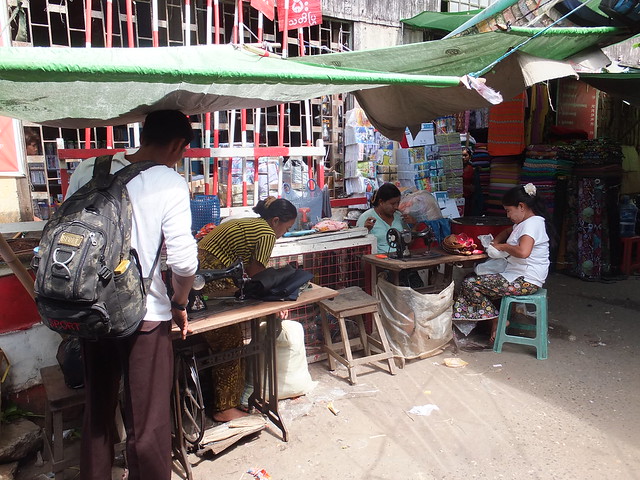 Clothing repairs while you wait.
We rejoined our vehicle at a point where the map shows a second jetty which I failed to spot. I think this jetty is used exclusively by the Myanmar Navy, which operates a significant fleet. There's a list of vessels on Wikipedia here. We continued south past a large construction site next to the water. This is apparently a second commercial jetty being built by India.
Sittwe View Point
The road then turned into a modern promenade leading to a spit of land called View Point. I realised that this was the area I'd photographed from the air on my arrival at Sittwe.
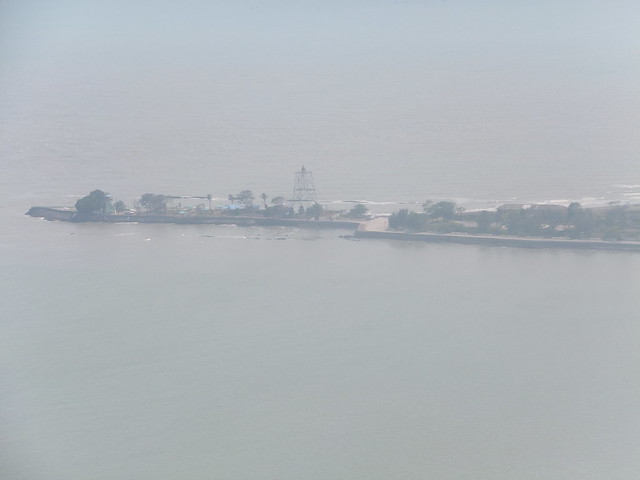 Sittwe's View Point area from the air.
I'm sure the improvements carried out have made the area a popular destination for locals. The light house at View Point is a distinctive landmark and replaced a now-disused light house visible on a island just offshore. To the west, we could see View Point Beach stretching away.
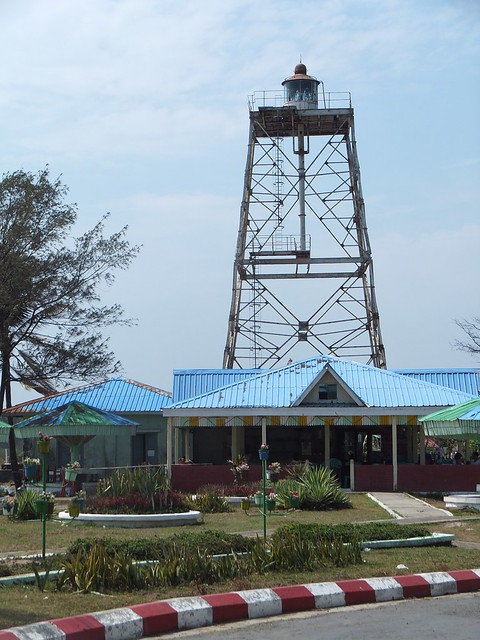
The Light House at Sittwe's View Point.
It only remained for us to drive back towards Sittwe, passing the British-built jail (still in use) and make our final stop at a modern pagoda.
Lawkar Nanda Pagoda
Construction of this pagoda only started in 1995 and the enshrining of Buddha relics took place in 1999. The main pagoda is surrounded by eight small satellite padodas. The upper part of the main pagoda was covered in woven bamboo 'scaffolding' to allow maintenance work (usually 're-gilding').
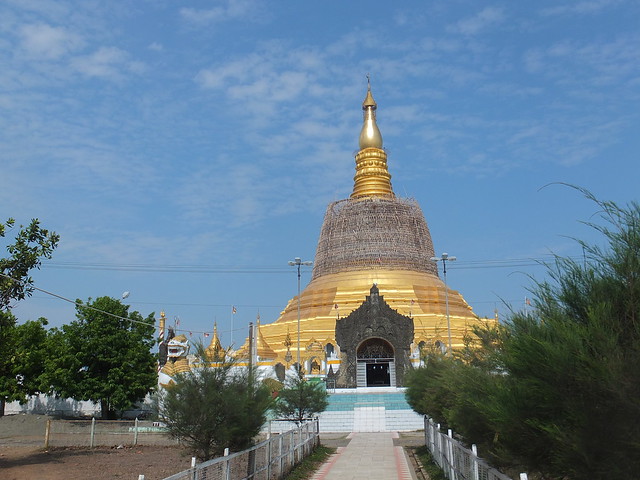 Lawkar Nanda Pagoda.
Nearby, we examined the Sakkramuni Image, now housed in a special chamber called Maha Wayyan Sasana Beikman. This is an ususual bronze Buddha image about 18 inches tall where the entire body is covered with small Buddha images. It was re-discovered at Mrauk U 14 years ago by a fisherman and is credited with "miraculous powers".
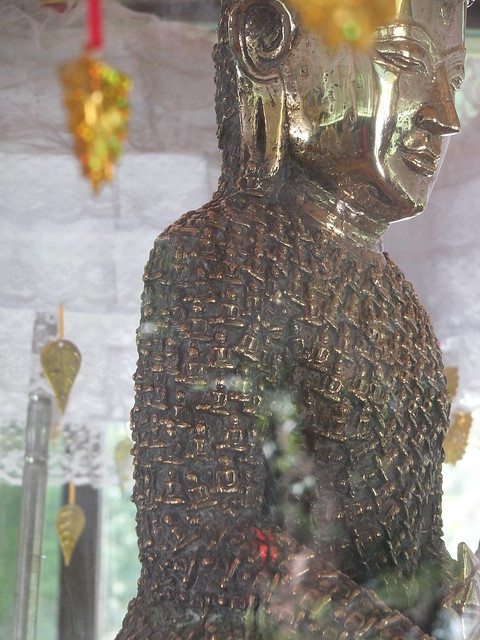
The Sakkramuni Image.
Sittwe Airport
We continued to the airport terminal building where the guide released the car. Check-in was quick and then the guide and I walked to the Airport Cafe (a couple of hundred yards away back along the approach road!) for a soft drink. Having said our 'goodbyes' after an absorbing three days, the guide made his way to relatives in Sittwe where he was going to spend the night before travelling back to his home in Mrauk U the following day.
I walked back to the airport and went through security into the departure lounge, to discover that my flight was running around an hour late. An 'Asian Wings' aircraft on the apron provided a small diversion. I'd been told it was awaiting technicians to carry out repairs. 'Aircraft On Ground' ('AOG') is a serious business and, whilst I waited, two mechanics opened the access cowlings on the starboard engine and, after carrying out some work, started the engine. Later, flight crew boarded the repaired 'Asian Wings' aircraft and carried out comprehensive power checks. By this time, my delayed 'Air KBZ' aircraft had landed so I was able to board for the direct flight back to Yangon.
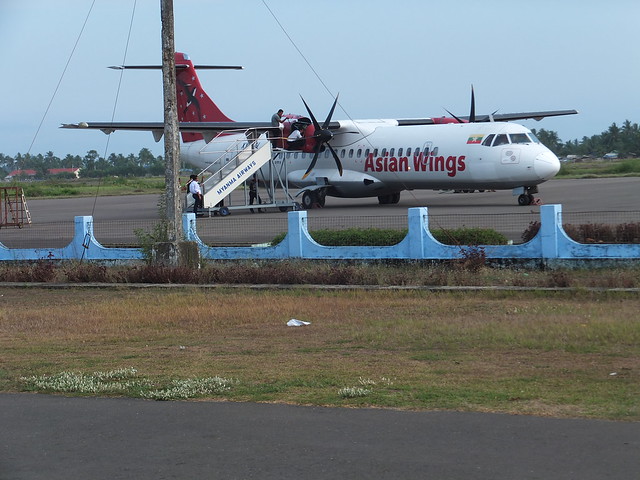 Mechanics working on the failed 'Asian Wings' aircraft.
On arrival in Yangon, my usual friendly young driver was waiting for me outside the domestic terminal to transfer me to the Strand Hotel. It was dark and I noticed that the city now has many more illuminated advertising signs than on my first visit back in 2008. I suppose this is what we are pleased to call 'progress'.
I received the usual warm welcome at the Strand Hotel. This time, I was in room 107 on the first floor. After the exertions of the day, I slept well.
My Pictures
Sittwe, Myanmar.
The Merchant's House.
Sittwe Temple.
Lawkar Nanda Pagoda, Sittwe.
Sittway Airport, Myanmar.
Strand Hotel, Yangon.
More
Next Post describing this trip.
[Revised 9-Jun-2014]
Click on any picture to see an uncropped image or browse the albums listed in 'My Pictures' below.
Events of Tuesday 6th May 2014
Today was a day for travelling. First, downstream by river to Sittwe, then a flight with Air KBZ to Yangon for my last but one night at the Strand Hotel before flying home.
I set the alarm for 06:15 but, in fact, I got up just before six, had a shower, made a cup of tea and finished my packing. The plan was to leave at seven o’clock from the hotel jetty by private hotel boat back to Sittwe, taking breakfast on the journey. Well, they came to collect me from my room just after seven and we walked to the jetty and I clambered aboard the same boat I’d arrived in.
A breakfast table for one had been set on the main deck. We’d boat crew, hotel and catering staff and my guide aboard. I always feel guilty about all these people hanging around at my pleasure but the positive side is that at least a number of jobs are provided through tourism in a country suffering extreme poverty.
Soon the unmistakable sound of an electric starter motor failing to engage with the flywheel of the Hino 6-cylinder diesel engine mounted beneath the main deck was heard. They tried a second time and then a number of mechanics appeared. I presume the chief mechanic was the guy carrying an assortment of double-ended side spanners and a hammer. A couple of them clambered down into the engine compartment and remarkably quickly re-appeared clutching the starter motor. They took this to the adjacent boat and a lot of hammering followed. They eventually re-appeared with what appeared to be the starter motor from the other boat. There was then a lot of banging from our engine compartment.
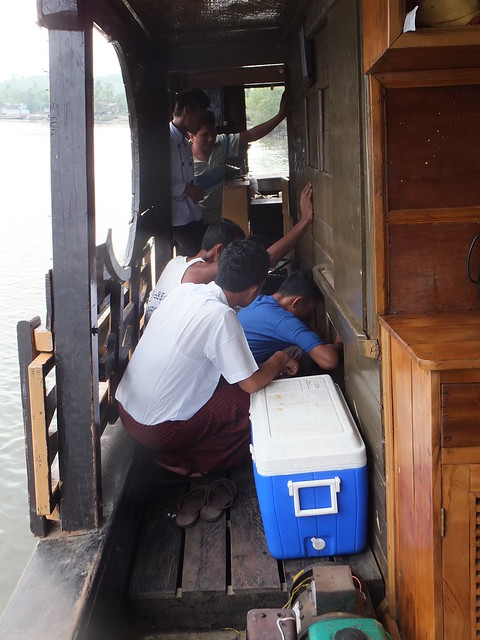 Mechanics cluster anxiously around our engine compartment.
The waiter asked if I’d like to take breakfast. I assume that he, like me, didn’t know how long the repair would take. I had tea, with cold milk, and a selection of bread with preserves. This was followed by a plain omelette. I was just tucking into my omelette when there was an ominous ‘click-click-click' from the new starter motor. After a short delay whilst further adjustments were made, there was a loud roar as the diesel engine came to life. Two plumes of water were being discharged powerfully sideways from just above the waterline. I presume one was engine cooling water, the other might have been bilge pump but I’m not sure (we were carrying an independent portable pump which appeared to be rigged as an ‘as required’ bilge pump).
We cast off about 50 minutes late but my guide assured me we had plenty of time. We were expected to make better time downstream, going with the current.
After a while, the captain decided to make a power check, raising the engine speed for a while. My guide said he was unsatisfied with the result and suspected that the propeller was fouled. The engine was idled and drive removed. Then the crew lifted a series of boards on the main deck near the stern, revealing a rectangular access to the water. I was viewing from the upper deck. The river viewed through the hatch was an almost luminous green and looked quite inviting. Just as well, because one of the crew, clad only in a longyi, lowered himself through the hatch and swam underwater to reach the propeller.
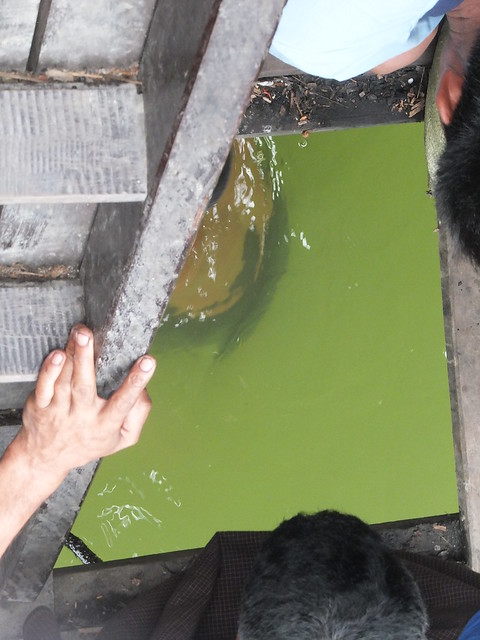 Looking down into the river, the tanned body of the underwater swimmer is just visible.
Soon, a large, tattered plastic bag drifted astern, followed shortly by a woven plastic sack and two more remnants of plastic bags. I was intrigued that this debris was cast adrift to wreak its havoc on some other unsuspecting motor boat.
After this interesting interlude, we seemed to make better speed and continued down the wide, twisting river towards Sittwe. The area was not unlike the Irrawaddy, with farmed flatland on both banks, trees and water buffalo.
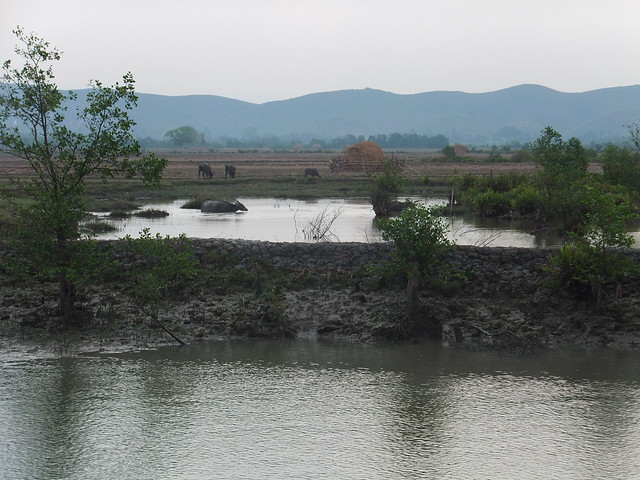 View across the farmed land to the distant mountains, with water buffalo grazing or keeping cool in the water. Note the hayrick.
We passed isolated bamboo cottages, each with one or more traditional wooden longboats, some provided with the usual small engine driving a propeller through a long shaft, some just paddled. At one point, we passed a larger village of about thirty bamboo houses with a pagoda and solidly-built adjacent temple.
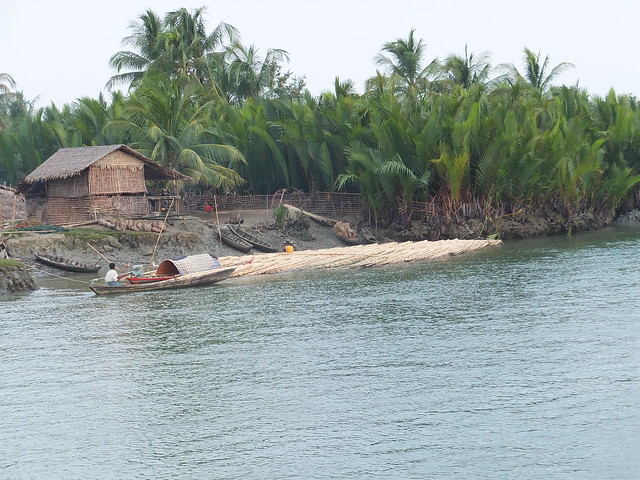 A typical bamboo cottage, with a number of longboats. Harvested bamboo is being built into a 'raft', presumably before shipping it for sale on the river.
As it started to warm up, the crew and hotel staff took advantage of the opportunity to doze. A little later, they decided to deploy part of the awning on the upper deck. There was a substantial wooden framework carrying a square mesh of ropes. From somewhere, they retrieved a large rather threadbare sheet which they extended across the supporting rope matrix, tying it off at crucial points. More sheets would have been necessary to cover the whole upper deck, but the single sheet gave some shelter to the helmsman and, by moving my table and chair, also me. As the hot sun beat down, it was a distinct improvement.

Installing the awning on the upper deck.
From time to time, we passed various other boats using this important waterway. The Myanmar Ministry of Transport is responsible for Inland Water Transport which operates a significant fleet of passenger and freight vessels. We passed a rather care-worn 'Government Ferry' operating the Sittwe-Mrauk U service.
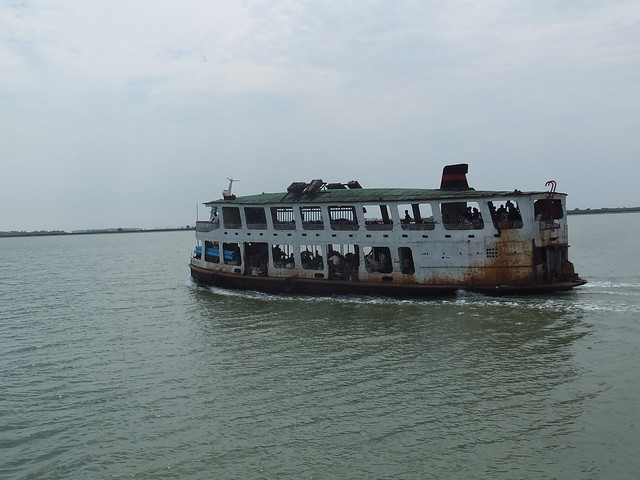 A 'Government Ferry' on the Kaladan River.
From a boat, you get fascinating glimpses of life along the river. Near a rather dilapidated bamboo house, an equally dilapidated wooden boat was under repair. Damaged planks were being replaced but, when we passed, the two workmen were engaged on rigging an awning over the work, suspended from four bamboo poles. Two young boys were with the workmen and they waved as we passed.
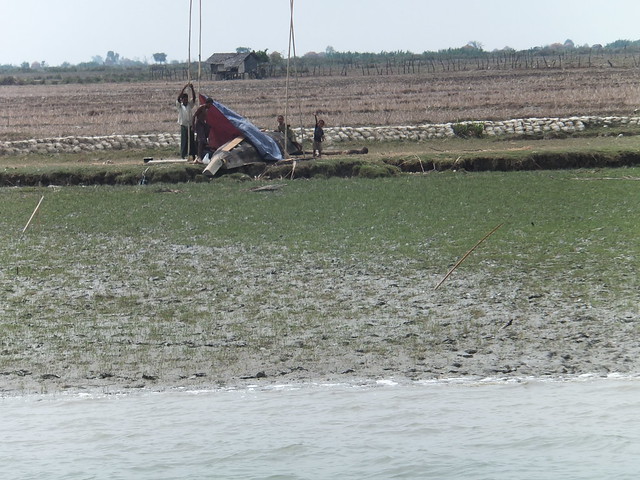 Erecting an awning over a wooden boat under repair.
My lunch was served on the main deck. I took a picture of the attractively-presented dessert.
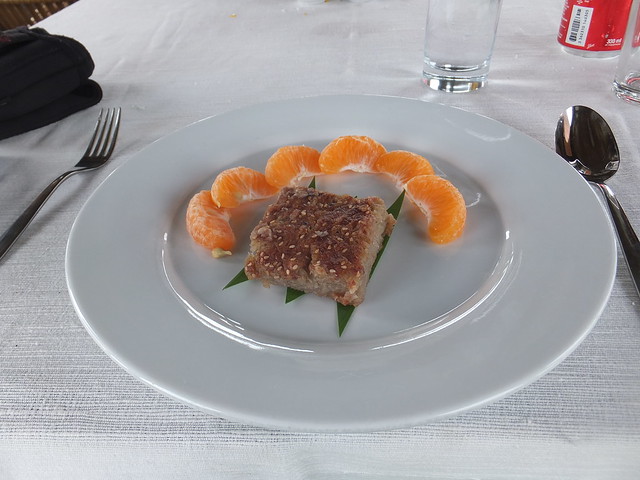 The attractively-presented dessert.
About 5 km before Sittwe, we passed a port on our right with an array of warehouses, and a number of boats of various sizes clustered around an ocean-going ship moored at a decent jetty. My guide said this location handled imports and exports with Bangladesh.
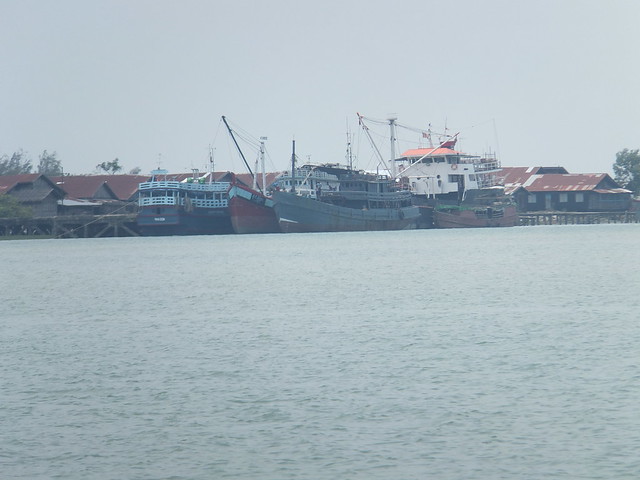 The port near Sittwe.
Nearing Sittwe, we passed a Naval Gunboat moored to an offshore buoy before we turned to starboard to enter Sakrokeya Creek to reach the boat yard where I'd joined the boat just three days previously. I'd had so many wonderful experiences in those three days, it felt more like three weeks. This time, the dilapidated wooden jetty was occupied by a large wooden cargo boat. A second, smaller boat was moored alongside the cargo boat and a third wooden boat had moored at right angles. It took a minute or two for us to tie-up to the second boat so that we were three-abreast. This meant that I had to 'run the gauntlet' of crossing to the second boat, stepping up to the large wooden cargo boat and then using a temporary board which had been laid between the cargo boat and the notorious jetty to facilitate loading the cargo boat. There were plenty of helping hands so, before I knew it, I and my luggage were installed in the waiting vehicle with my guide and we were driving out of the shipyard.
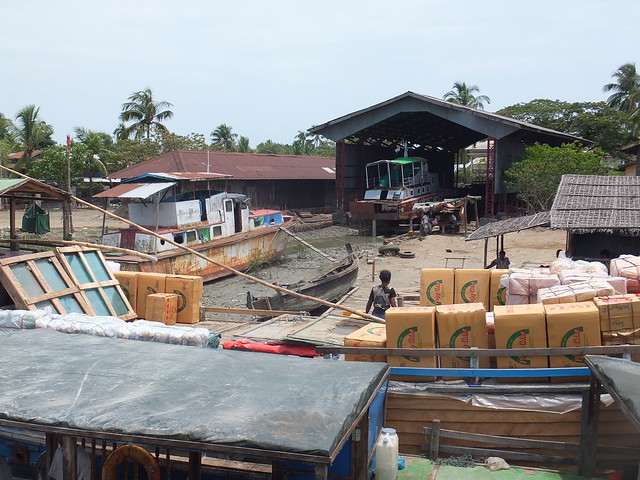 Arriving back at the boat yard in Sittwe.
My Pictures
Mrauk U Princess Resort.
By Boat back to Sittwe.
More
Next Post describing this trip.
[Revised 5-Jun-2014]
Click on any picture below to see an uncropped image or browse the albums listed in 'My Pictures' below.
Events of Monday 5th May 2014
At 7.00 a.m. I said goodbye to my new friends Marco and Carlotta who left the Princess Resort, returning to Sittwe on one of the Resort’s boats.
Mrauk U market
The driver and guide collected me in the Jeep at 8.00 a.m. and we had a further look round the market. The ‘Covered Market’ was also open since it was a weekday – it had been closed the previous day. A new batch of Chinese-made pedal bicycles was being unloaded from a pick-up truck. An improbably large number of bicycles had somehow been carried and men were trying to extricate the load one machine at a time. We looked at water pots on sale. In this area, they’re usually metal and I’d assumed they were spun aluminium, but I was told they were zinc, to keep the weight down, and imported from Bangladesh. There was a wide range of solar panels, both Chinese and Indian, pharmacies with a wide range of drugs and herbal remedies and a barber’s shop.
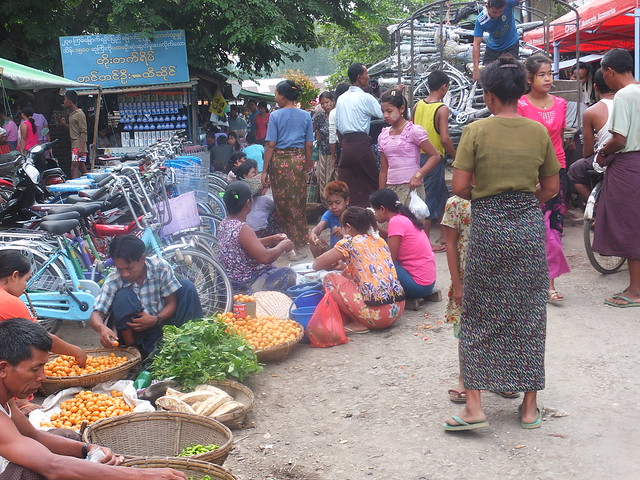 Mrauk U market. In the background, men unload a consignment of new Chinese bicycles from a pick-up truck.
Village life
The Jeep then took us to a small village not far away and we walked round. The villagers were curious but not unfriendly. The village had its own small market comprising half a dozen stalls. These ‘convenience stores’ avoided a walk to the town.
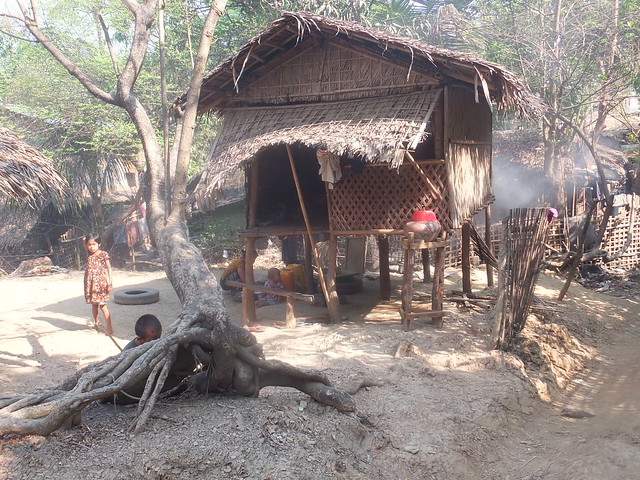 A modest family home.
At the edge of the village, next to a small monastery, men were carrying out repairs to the village rainwater pond. The banks of the pond were being built up manually with lumps of clay soil which, when damp, would form a waterproof lining. This pond was completely dry. As ponds dry out, the villagers have to rely on other sources further away. The start of the rainy season is always anxiously awaited to replenish their supplies of water. A short walk took us to a muddy patch where two large pigs were happily relaxing, covered in mud. Nearby, there was a smaller rainwater pond which still contained some water.
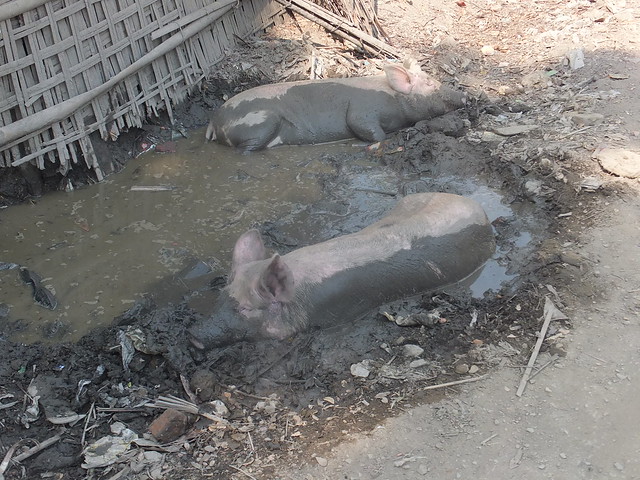 With temperatures around 42 degrees Celsius, these pigs were happy to relax in mud.
In the days of its former glory, the area was home to numerous libraries containing scriptures. The local head monk allowed us to visit one such library, in ruined condition but with some restoration work carried out.
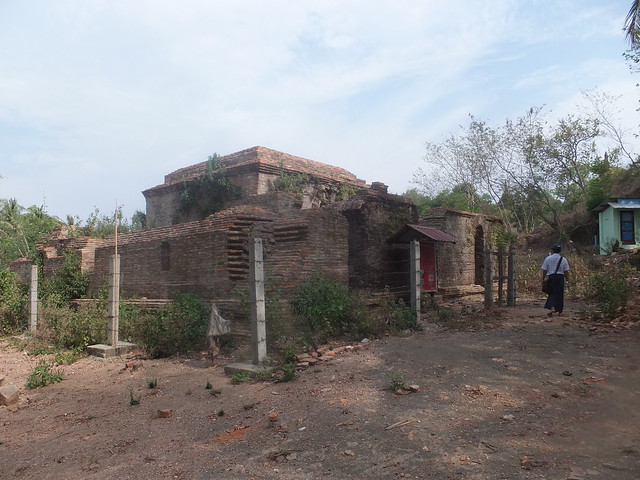 We visited this ruined library.
Sakya Manaung Pagoda
We then rejoined the Jeep and drove to the Sakya Manaung Pagoda, built by King Thiri Thudhamma Raza in 1629 to commemorate the reigns of the Sakya clan. We approached from the western gate, which is protected by two large stone ogres. The main pagoda is built of stone, elaborately carved, 114 feet in height and is surrounded by twelve smaller pagodas. A stone wall encloses the compound.
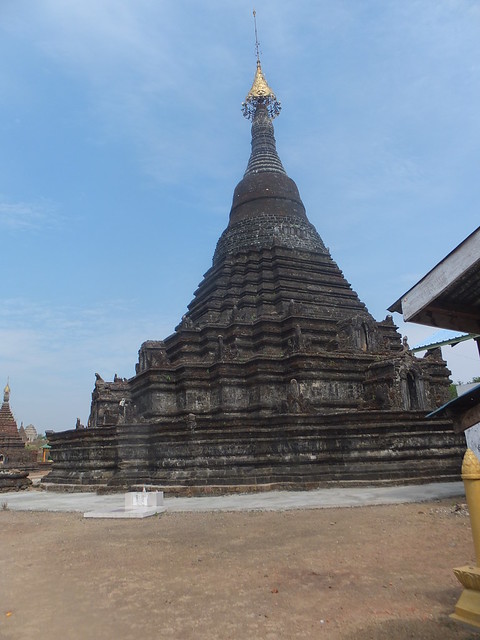
The main pagoda at Sakya-Manaung.
Ratana Manaung Pagoda
Another drive to the north took us to the Ratana Manaung Pagoda. Founded by King Sanda Thudham-maraza and Queen Ratana Piya Dewi in 1658, it is dedicated to the 'Three Buddhist Gems' (the Buddha, the Dhamma and the Sangha). The pagoda is stone, eight-sided and 180 feet in height.
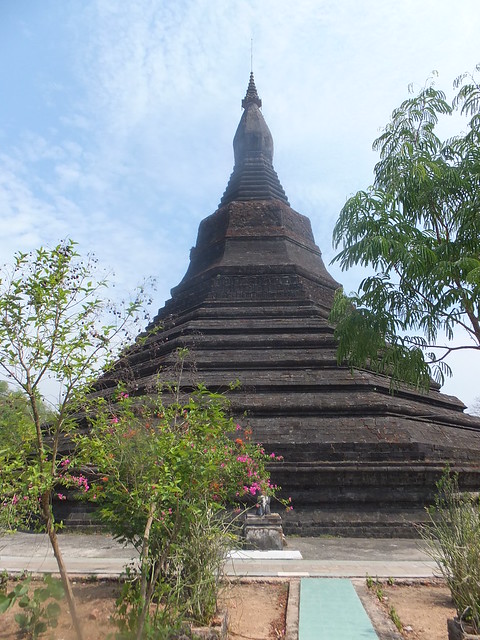
Ratana Manaung Pagoda
A stone wall encloses the compound - in the north-west corner is a stone-built 'cave', 54 feet long, 13 feet wide and 10 feet in height which originally served as the King's Sabbatical Chamber. This building is called the Guphu ('White Cave') and now houses a number of painted Buddha images.
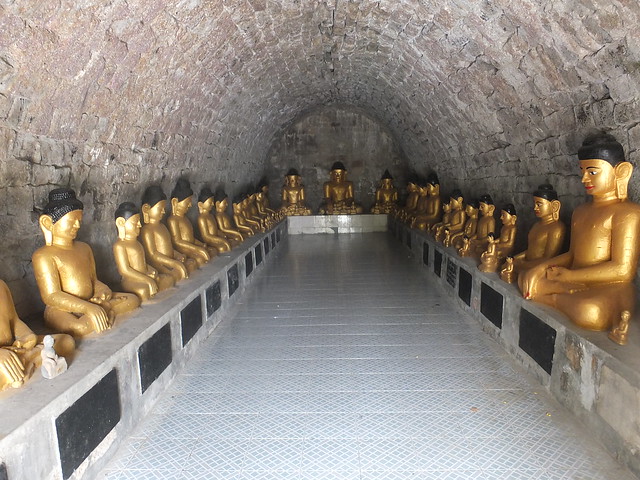 Inside the 'White Cave'.
There is a modern monastery adjacent to the pagoda compound. Another short drive took us to Andaw-thein Temple and the adjacent Ratanabon Pagoda.
Andaw-thein Temple
This temple was originally built by King Mong Razagri in 1596 to house the "molar tooth relic" brought from Sri Lanka. The relic was moved to the Sanda Muni Monastery and the present octagonal Andaw-thein pagoda surrounded by eight smaller octagonal pagodas is due to King Mong Saw Hla.
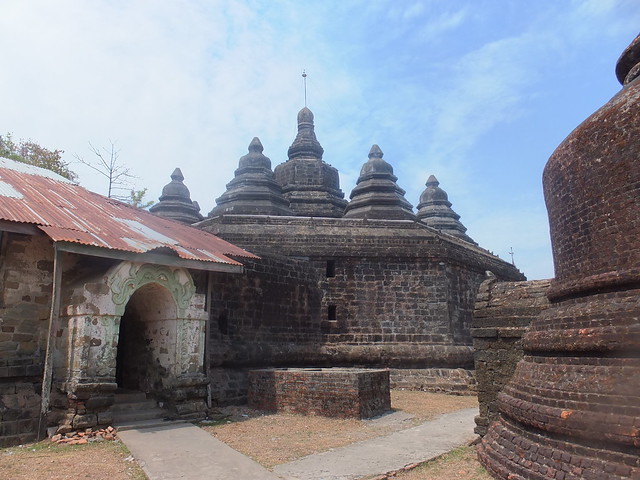 Andaw-thein Temple
Inner, vaulted passages lined with Buddha images lead to a central chamber.
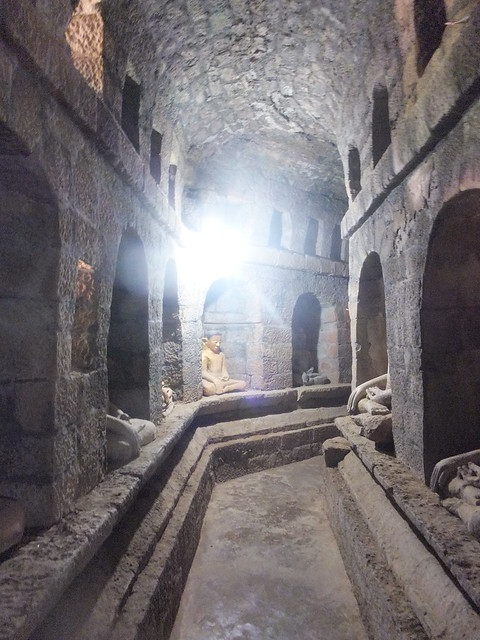
Andaw-thein Temple>
Ratanabon Pagoda
This pagoda was donated by King Khamoung in 1612. I walked among the numerous brick-built satellite pagodas. We were now close to the fortress-like Htuk Kant Thein Temple we’d only seen from the outside the previous day.
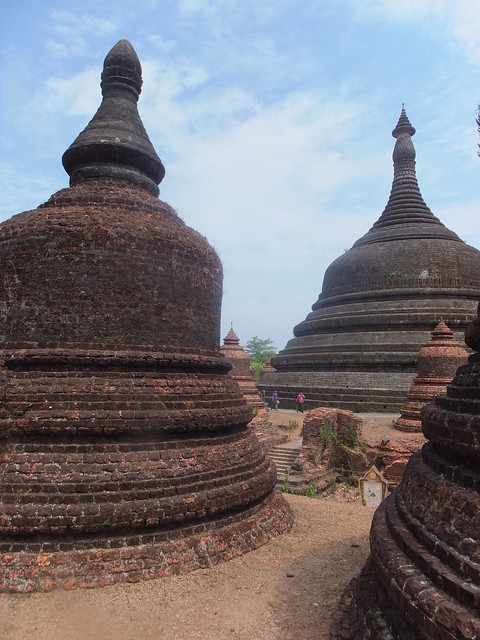 The main pagoda in the background dwarfs the visitors walking by. The main pagoda is surrounded by a number of smaller, brick-built pagodas.
Htuk Kant Thein Temple
This interesting temple dates from 1571. It was donated by King Mong Phalaung and Queen Shun Latt. It has a rectangular plan measuring 137 feet (east-west) and 110 feet (north-south). Once inside, it took us some time to spiral twice clockwise around its broad internal passage lined with 146 stone Buddha images set in niches.
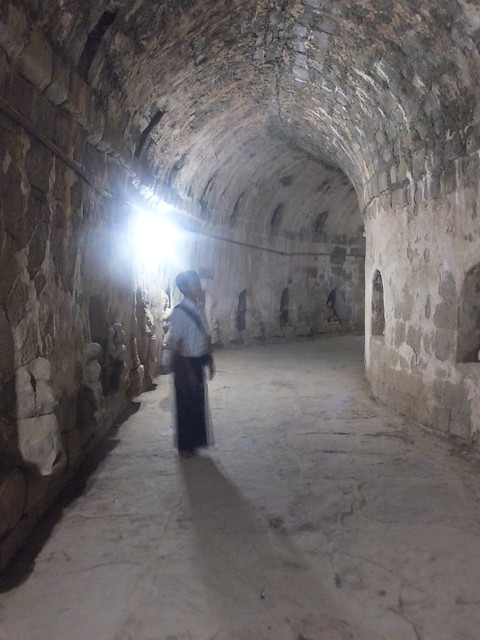 The spiral passage makes two complete circuits of the building.
We then entered a chamber with stone steps leading up to an inner temple.
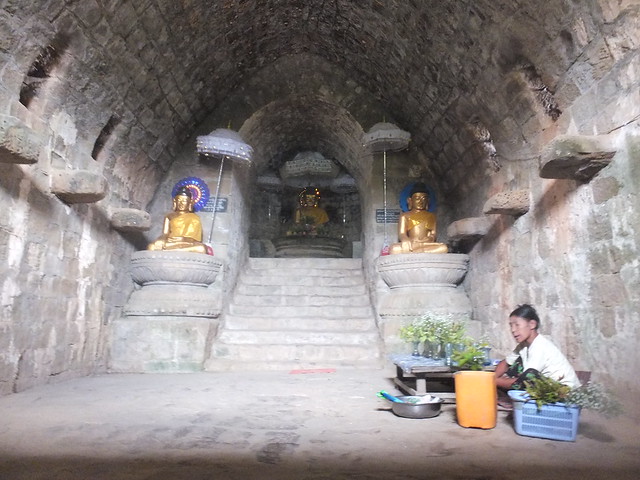 The inner temple at Htuk Kant Thein.
After this interesting tour, I was returned to my hotel for a rest before our final exploration. I was now the only guest in the hotel, and a gang of about 30 builders had started banging and hammering in the main building housing the restaurant. A very cold Coca Cola with lots of ice and a plain salad in the restaurant revived me. The hotel staff were very apologetic about the 'noises off' but I tried to reassure them that it was not a problem.
The horizon darkened and a ferocious wind started up. Quickly finishing my lunch, I trotted through the gardens to my cottage as it was starting to rain. After a rest, I emerged to find the weather significantly improved.
Around Mrauk U
Late afternoon, I was again picked up by my guide, driver and 'Jeep' for the last excursion at Mrauk U. We drove to a beautiful complex of lakes on the south side of Mrauk U which not only provide a reliable source of drinking water but are popular for recreation with swimming and canoeing possible. We walked for some time around the lakes, allowing me to study the different methods of water collection in use and ponder the life style. I'd spotted flat 'washing stones' on the shore of the lake and, after a while, two ladies arrived to do a bit of washing. A group of young people took to the water for a swim. To increase the possibilities for swimming games, one or two hired inflated lorry tyres from a small business on the shore which also rented boats. The water was quite shallow, so it was quite a safe location.
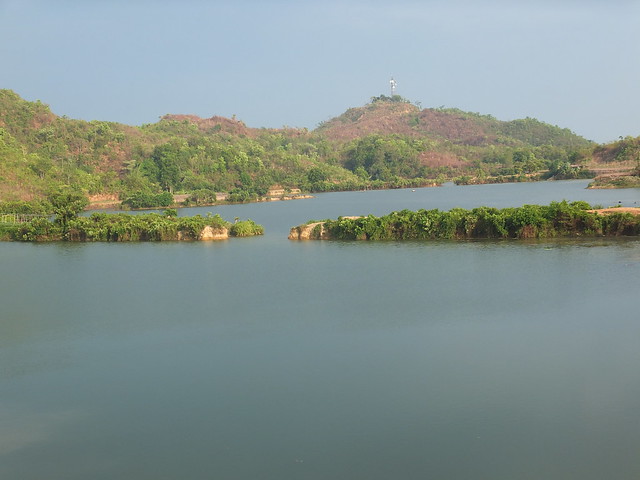 Lat-say-kan Lake, Mrauk U.
Looking inland, I watched a group of boys playing ball games in a field. At the side of the path we were taking, we passed an elderly woman who had made a small wood fire on the ground and she was happily cooking a piece of beef.
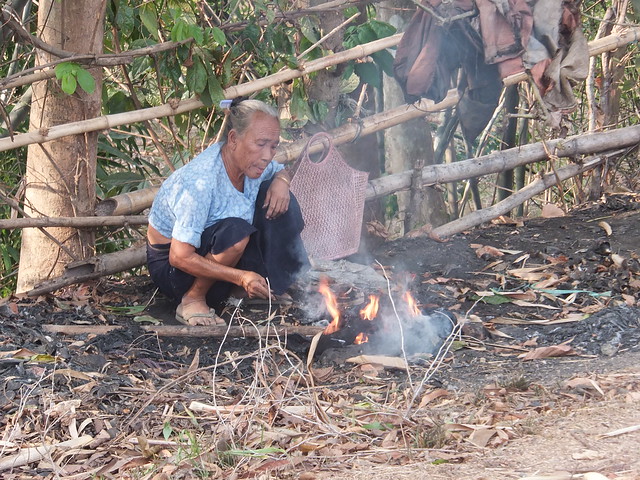 An elderly woman cooking at the side of the path.
We continued to a small village. A 'thatcher' was trying to complete roof repairs to one of the houses using sections of palm leaves before it became dark. In Bagan, this method of roofing lasts around three years - I didn't find out whether Mrauk U is similar. Our 'Jeep' has gone ahead to the village and was waiting for us.
Hilltop Pagoda
Near the centre of Mrauk U, we made our last pagoda visit. A steep path led uphill to a modern monastery complex set on a plateau. We then faced quite a stiff climb up steps to the pagoda set on the hilltop. A European gentleman was at the top, practicing meditation and accompanied by his own guide. Other than Marco and Carlotta, he was the first European I'd seen since leaving Sittwe.
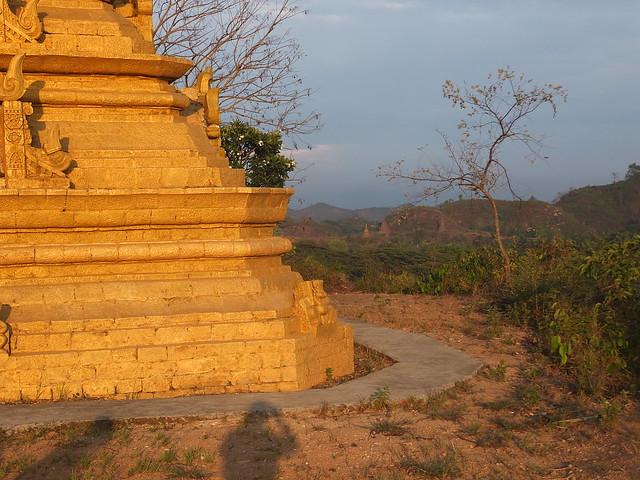 View from the Hilltop pagoda, with a group pf pagodas visible in the distance.
Then it was back to the hotel, tired but happy. The following morning, I was to board a hotel boat at 7.00 a.m. for my own journey back to Sittwe. I readily agreed to take breakfast on the boat.
My Pictures
Mrauk U Princess Resort.
Mrauk U and its Market.
Around Mrauk U.
Mrauk U: Sakya Manaung Temple.
Mrauk U: Ratana Manaung Zedidaw.
Mrauk U: Andaw-thein Temple.
Mrauk U: Ratanabon Pagoda.
Mrauk U: Htuk Kant Thein Temple.
Mrauk U: Hilltop Pagoda.
More
Next Post describing this trip.
[Revised 2-Jun-2014, 4-Jun-2014]

