skip to main |
skip to sidebar
Events of Sunday, 20th April 2014
Another adventure starts! Alan picked me up from home at 6.00 a.m. and we had a speedy journey to Terminal 2 at Manchester. This time, I'm flying Qatar Airways to Doha where I change for a flight straight to Yangon. This avoids the irritation of flying to Bangkok (overflying Burma in the process) and then having to take another flight back to Yangon. It's my first time with Qatar Airways so we'll see how I get on.
It's a while since I flew from Manchester and, at first sight, the terminal building seemed a bit daunting. A bit of a walk took me to the Qatar Airways check-in desks where a friendly Lancashire girl quickly completed the formalities. With just one carry-on shopping bag (including my trusty Fujitsu notebook computer) I made my way upstairs and more walking took me to the security area.
There are a number of 'Rapiscan' baggage scanners - each associated with an elaborate conveyor system for transferring the plastic boxes for items of luggage through the X-ray machine and then, once emptied, returning them to the loading point. Body scanning was by the normal 'portal' scanner, accompanied by smiles from the staff.
More walking took me to the glitzy Duty Free and retail area. I picked up my Sunday newspaper from W.H. Smiths. Nothing as prosaic as a normal sales till here - just a row of computer screens each associated with a scanner to check both the purchase and the Boarding Pass. Fortunately, two young members of staff, a boy and a girl, were in attendance. The process didn't seem that simple when the girl rapidly processed my newspaper - I shudder to think how long it would have taken me unaided. I don't think I'm really cut out for this automated age.
Duty Free (seemingly reluctantly) disgorged me to the departure gates area. I managed to find the signs leading to the 'Escape Lounge' (appropriate name) which, amongst other airlines, handles Qatar Airways. Real people here and, again, friendly. I started to relax a little.
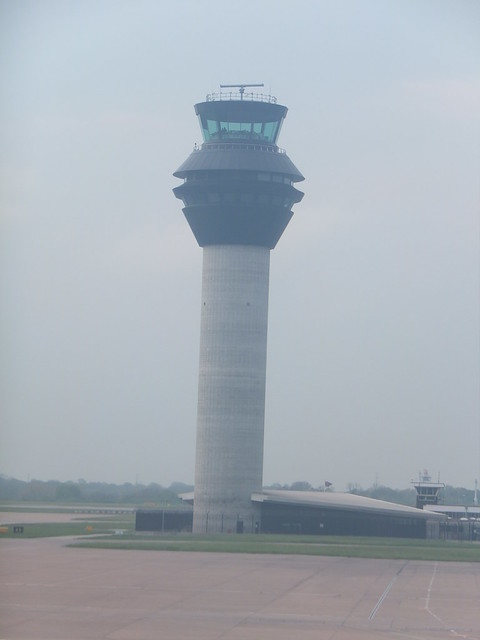 Manchester Airport Control Tower (the camera's leaning, not the Control Tower).
My Pictures
Manchester Airport
More
Next post describing this trip.
When I was young, I was an avid reader of model railway magazines. A recurrent theme was 'minimum space layouts', aiming to convince the reader that, wherever they lived, they had room for a model railway layout. Some layouts were arranged to form part of, say, a bookcase, so that they could be on display in a sitting room. Others were arranged to hinge upwards so as to be parallel to a wall when not in use. A fairly drastic approach was the layout suspended on cables from the ceiling and carefully counterbalanced, allowing the whole layout to be raised to the ceiling once the operating session had ended.
But, back then, I didn't see advocated the rather startling solution adopted by the model railway shown in my picture.
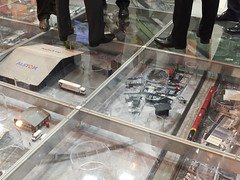
A 'computer floor' has been fitted in the model railway area. These are often provided in offices where a 'false floor' is provided by a grid of square frames suspended on pillars a few inches above the real floor, invariably concrete in modern buildings. Each pillar is provided with some height adjustment to compensate for the real floor being not quite flat. Each rectangular frame is then fitted with a substantial 'tile'. The space below the tiles then gives an unemcumbered space to lay cables.
But this modeller has decided that the technique which provides space for cabling in offices would be better used for a 4mm scale model railway, complete with scenery! All that's needed is clear tiles so that you can see the railway beneath your feet. It looks as if clear polycarbonate material has been used for the 'false floor'. Presumably to provide extra support, a number of lengths of clear tube (a similar length to the supporting pillars) have been dotted around.
Considering how innovative the technique adopted for providing space for the railway is, the track layout is rather unimaginative - a large double-track oval with a couple of modern trains both running clockwise (probably a Class 323 and a rather short 'Pendolino set).
Will this solution catch on, I wonder? Well, I doubt it. Construction must be rather expensive and the arrangement is not ideal for dealing with derailments or re-marshalling of trains.
Actually, this model was an eye-catching publicity stunt on the Alstom stand at the 2012 'Infrarail' exhibition at Earl's Court.
My pictures of the Alstom Model Railway
Model Railways
Introduction
In the 19th century, Myanmar, then known as Burma, was administered as part of 'British India'. The British built the extensive metre gauge railway network so it’s not surprising that the system largely followed British and Indian practice.
On my first trip to Burma in 2008, I travelled on the Circle Line in Yangon (see my post The Circle Line, Yangon) and that got me hooked on railways in Burma. During the long period of military rule in Burma, the railways have been cut-off from British influence, leading to interesting (and sometimes odd) consequences. Part of my fascination with the railways in Burma is that there doesn't seem to be too much information readily available to assist the study. My trips to Myanmar are not principally railway holidays, but I do take any opportunity presented to find out more. On each visit, I try to collect a little more information.
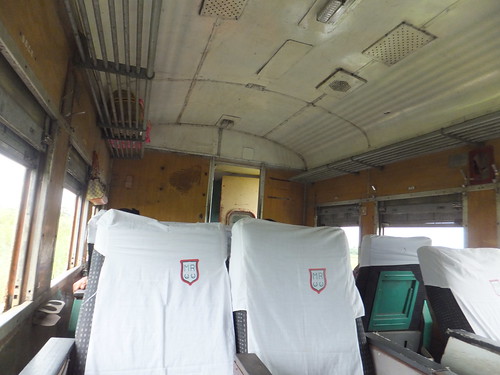
The Myanmar Railways Shield appears on each seat cover in this Upper Class coach.
Control
Railways in Myanmar are controlled by the Ministry of Rail Transportation. There is a website here but most of the site is in Burmese.
Although a lot of the system is decrepit through lack of maintenance, Myanmar is now engaged in a programme of doubling some of the single-line sections and constructing new railways so the maps below may not be up-to-date.
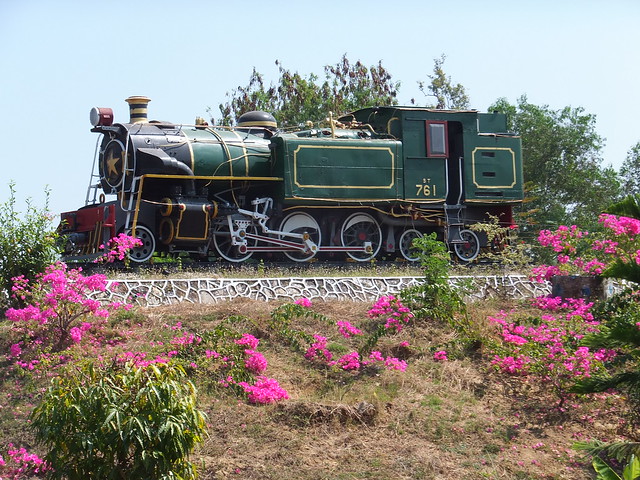
Plinthed steam locomotive outside the Ministry of Rail Transportation in Naypyidaw.
Railway Maps
The maps below show how the railways in Myanmar are divided into 11 Divisions. These maps originally appeared on the official Ministry site but they can also be found in the Wikipedia article List of railway stations in Burma. On these maps, only a few main stations show their name in English but the Wikipedia article also lists the names of all stations (and their mileages) in English. Clicking on any of the maps below will show a larger version.
Key Map
Myitkyina (Division 1)
I've twice made round trips on a 'Road to Mandalay' private train between Katha and Naba within the Myitkyina Division. The first trip was in 2010 (described in posts here and here). The second trip was on the 18th September 2012 and is briefly described here. Each of the posts has links to photgraphs.
Ywa Htaung (Division 2))
My first visit to Ywa Taung was in 2012 when I visited by road with Doctor Hla Tun. I became quite excited studying the 'Trapped Key' interlocking provided on points, described in the post Manual Control of Points and Interlocking. My second vist was in 2013, again by road. There's a set of pictures here.
Mandalay (Division 3)
There's a brief post about the Mandalay area here and this post links to photographs. On 23rd March 2013 I travelled from Mandalay to Maymyo by train, described in a post here.
Kalaw (Division 4)
Taungoo (Division 5)
Yangon (Division 6)
In 2012 I travelled from Yangon Central to Bago and Kyaikto (described here and here).
Yangon Central(Division 7)
My first trip on the Circle Line in 2008 is described here. In 2012 I travelled on part of the Circle Line from Yangon Central to Mahlwagon on the way to Bago and Kyaikto (described here) and later in the same trip I made a journey as far as Pa Ywet Seit Gone then back to Yangon Central (described here). In 2013 I travelled from Yangon Central to Da Nyn Gone and back and from Pazundaung to Yangon Central.
There's a general description of the railways around Yangon here.
Mawlamyine (Division 8)
Hinthada (Division 9)
Pakokku (Division 10)
Bagan (Division 11)
Railway Rolling Stock in Burma
Freight Rolling Stock in Burma
Passenger Rolling Stock in Burma
Diesel Railcars in Burma
(Other topics in preparation).
Railway Signalling in Burma
There's a series of posts about the signalling of the railways:-
Part 1: Semaphore Signals
Part 2: Colour Light Signals & Motor Points
Part 3: Control of Trains
Part 4: Manual Control of Points and Interlocking
Part 5: Signal Boxes with Interlocking Frames
Part 6: Signal Boxes with Electrical Interlocking
(Other topics in preparation).
Related articles on other sites
The Man in Seat 61
(Covers rail travel all over the world) and the best source I've found describing the actual business of using trains in Myanmar).
Myanmar Railways (Wikipedia).
Mike's Railway History
(Includes a brief description of Burma's railways in the 1930s. I believe much of the information was derived from 'Railway Magazine' or a similar technical publication. I found the same text and photographs appear as a PDF on the Old Martinians' Association U.K. Website. This article, by Peter R. Moore, includes additional material and a number of more modern photographs showing steam locomotives at work in Burma).
My Pictures
All my railway pictures in Burma form a Collection Railways in Burma.
This report is based on information from Doctor Hla Tun, who also supplied the photographs.
The Bagan Clinic made 2,265 treatments in March 2014, bringing the total number of treatments since the Clinic opened about two and a half years ago to 100,203.
Treatment Summary
The table below summarises the number of treatments per month in 2013/2014 and the total number of treatments since the clinic opened on August 6, 2011.
| Month |
Treatments in month |
Total treatments |
| February 2013 |
2,713 |
49,850 |
| March 2013 |
2,713 |
49,850 |
| April 2013 |
2,061 |
54,924 |
| May 2013 |
3,303 |
58,227 |
| June 2013 |
5,586 |
63,813 |
| July 2013 |
6,079 |
69,892 |
| August 2013 |
5,337 |
75,229 |
| September 2013 |
4,826 |
80,055 |
| October 2013 |
3,647 |
83,702 |
| November 2013 |
4,465 |
88,167 |
| December 2013 |
3,387 |
91,554 |
| January 2014 |
3,501 |
95,057 |
| February 2014 |
2,881 |
97,938 |
| March 2014 |
2,265 |
100,203 |
Monthly notes
In March, the temperature in Bagan is around 40 to 42 degree Celsius and fewer patients attend. Most patients have to travel significant distances to reach the clinic and the heat makes travelling more uncomfortable.
An 81-year old lady had travelled 55km from her village to the clinic. A week before, she suffered a fracture of the neck of her left femur. She needed assistance both medically and financially. A donation was made for further management in the Hospital.
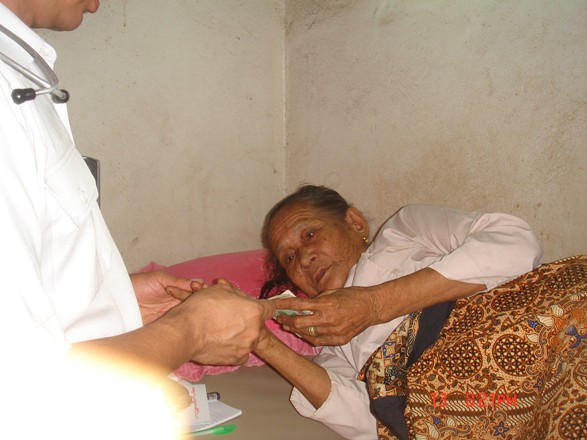 An 81-year old lady with a fractured femur.
In January, a 12-year old boy suffering from mucopolysacchroidosis was brought to the Clinic by his mother. According to his mother, he could speak until he was 5-years old but the condition became worse and he has been unable to speak since he was 6-years old. A donation was made to assist with an investigation at the hospital in Mandalay and a local Non-Governmental Organisation (NGO) was suggested for additional help. After a CT-scan a diagnosis of mucopolysacchroidosis with ventricular enlargement was made. The neurosurgeon suggested surgery to improve the ventricular problem. The NGO has provided 50% of the cost of surgery and the Bagan Clinic has donated 25% of the cost.
 12-year old boy suffering from mucopolysacchroidosis.
On the 'Clinic Days' Friday and Saturday, a free lunch is served to patients and their companions. Between 250 and 400 meals are served each day.
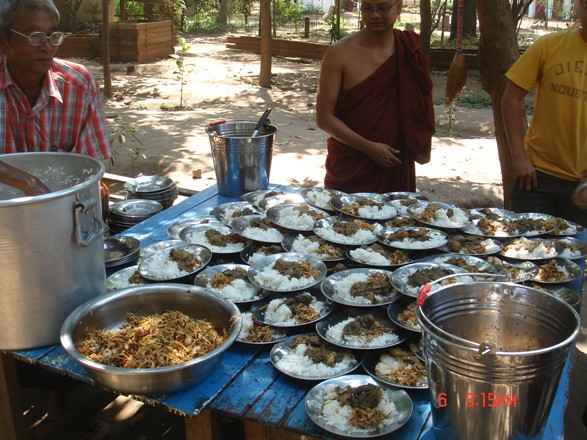 Free lunches being prepared at the Bagan Clinic.
There are a number of posts in this Blog on medical support in Myanmar provided by the RTM Social Contribution with help from donors around the world. You can find them all here.
Doctor Hla Tun's photographs showing the work of the Bagan Clinic in 2014 are here. There's a larger collection of pictures showing the Bagan Clinic from its inception here.
This report is based on information from Doctor Hla Tun, who also supplied the photographs.
On 11th December 2013, a visit was made to three orphanages to make donations of Teachers' salary, Stationery, Toys, First Aid Medicine and Clothing. The three orphanages were Doe Pin, ThuKhaMyittar and ShweSinMin Orphanages.
ThuKhaMyittar Orphanage
ThuKhaMyittar Orphanage was founded about four years ago by a retired headmaster. It is situated in Pyin Sar Village which is on the way from Mandalay to MayMyo. It is about 28 to 30 miles away from Mandalay and it is very close to YaTaNarPon Teleport/Silicon Valley.
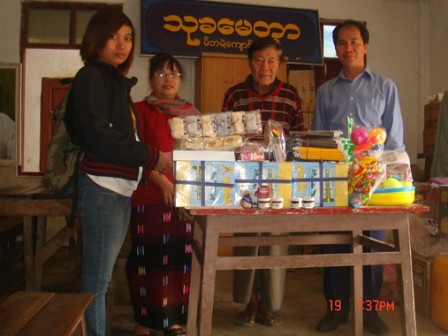
ThuKhaMyittar Orphanage accepts orphans and single parent children up to 8 years old. There are currently about 80 children there. The children attend school during the day so they were not at the orphanage when the donation of toys, first aid medicine, stationery and snacks was made to the founder.

Doe Pin Orphanage
Doe Pin accepts orphans and single parent children. It is situated on the road from Mandalay to MayMyo about 34 miles from Mandalay. There are currently 1,467 children attending. There is a Monastic Post Primary School in the Monastery compound recognised by the Government, allowing children from the orphanage to attend school from Grade 1 to Grade 8 in the Monastery Compound.

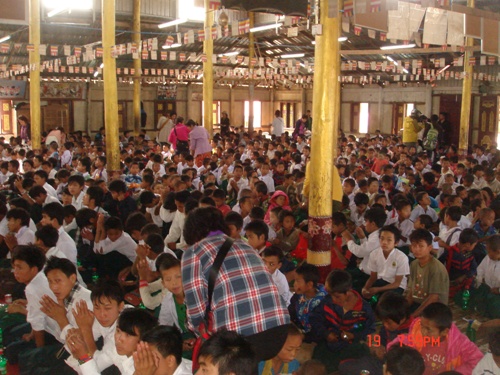
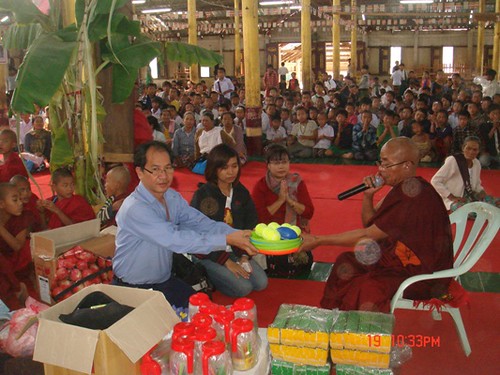
The donation was made to the Founder and Head Monk of Doe Pin, watched by some of the children. During the day, older children leave the monastery to attend high school.

ShweSinMin Nunnery/Orphanage
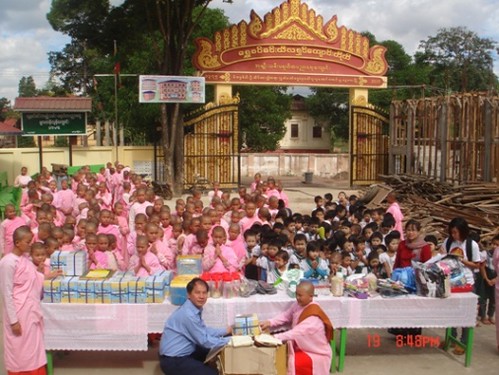
ShweSinMin Nunnery/Orphanage accepts only girls and there are currently 494 orphans and single parent children here. The Orphanage was founded by 2 nun sisters in MayMyo about 14 years ago. RTM Social Contribution makes an annual donation of Teachers’ salary, stationery, first aid medicine, food and clothing to the head nun.
In the nunnery compound, there is also a Monastic Post Primary School allowing children to attend from Grade 1 to 8.

There are a number of posts in this Blog on education support in Myanmar provided by the RTM Social Contribution with help from donors around the world. You can find them all here.
My posts labelled 'Work' form an occasional series describing work-related events.You can find all the 'Work' posts here. This post goes right back to the start, over 50 years ago, when I left school and got a job.
For various reasons, I didn't enjoy secondary school. I obtained passes in ten subjects at G.C.E. 'O' Level and continued for two years in the Sixth Form (as it used to be called - we hadn't imported American 'Grades' then). I managed passes at G.C.E. 'A' Level in Physics, Chemistry and Maths for Science. The intention then was to join British Railways and undertake a 'Sandwich' Degree Course at a technical university, probably Southampton. Well, the Civil Engineers seemed quite keen to have me but I wanted a career in railway signalling design and the Signal and Telegraph Department didn't quite come up to my expectations - the posts on offer didn't match my expectations. At the time, I was very disappointed. I turned my back on the idea of a career on the railways and, instead, was interviewed and obtained a post as an Electronics Engineer Trainee at a local electrical/electronics firm.

This cast nameplate (in various sizes) was attached to panels made by Contactor Switchgear Limited (Photo: Wolverhampton History and Heritage Website).
Contactor Switchgear Limited had been founded in 1936 in Wolverhampton. As its name suggests, it built electrical control panels, manufacturing its own relays and contactors. A reputation for high quality meant that there were around 600 employees at the factory in Moorfield Road when I knew it. Industrial electronics was still in its infancy but, wishing to expand into that area, Contactor Switchgear had purchased an established company from Watford called Radio Aids. Renamed Contactor Switchgear (Electronics) Limited, the company moved to Wolverhampton and I joined about thirty employees. Contactor Switchgear (Electronics) divided its time between supplying electronic equipment to its parent which was incorporated into control gear for industrial automation and designing and building electronics on a sub-contract basis for various outside companies. Although I'd learnt a bit about electronics as a hobby, my job was all a bit of a challenge but I found the technical aspects fascinating and I became completely engrossed.
There's a brief history of Contactor Switchgear here, on the Wolverhampton History and Heritage Website.
One of the first jobs I worked on was a set of boiler controls using electronics required for modifications at the West Thurrock Power Station. This power station had opened in 1962 as a coal fired plant but Babcock and Wilcox had designed modifications to allow the boilers to burn oil as well.
 West Thurrock Power Station in 1973 (Photo: Peter Land).
When I started at Contactor Switchgear (Electronics), the electronic boiler control equipment had already been built and it was set up in a combined laboratory/engineering/test department for factory testing. I was impressed - there were a number of six foot high 19-inch wide racks loaded with sub-racks of electronics. There were hundreds of adjustable potentiometers and indicator lights at the front of the sub-racks. At the rear, there were chunky multicore cables terminated in 'Plessey' military-style connectors, allowing sub-racks to be quickly exchanged in the event of a fault. Opening up a sub-rack revealed numerous plug-in printed circuit boards crammed with resistors and transistors. Well, Contactor Switchgear (Electronics) had built all this kit to the Client's drawings but when they came to test it, it didn't quite work. I arrived just as a strategy had been agreed with the Client for fixing the problem.
The transistor age was still developing and only a limited range of transistors was available. The Mullard OC71, first introduced around 1954, was used all over the new boiler controls. The OC71 was a small, sealed glass tube (painted black) with three thin lead-out wires (emitter, base, collector) emerging from the glass at one end. A few devices had suffered broken glass, offering the opportunity to examine the internal construction of these germanium alloy junction PNP transistors. The glass envelope was packed with silicone grease - carefully removing this revealed a small rectangle of germanium, supported on one of the lead-out wires, with a 'blob' on each side forming the two alloyed junctions. The two 'blobs' were connected to the other two lead out wires. It was hard to believe that such a construction could provide useful control of an electric current but that was the start of a revolution which has changed all our lives.
The designer of the boiler control equipment had been a little optimistic about just how good the Mullard OC71 germanium alloy junction transistors were. Manufacturers' Data Sheets usually give "typical characteristics" for parameters like gain or leakage current. However, in the manufacture of these early semiconductors, it was difficult to obtain consistent results over a batch and so, to allow the manufacturer to sell more devices rather than throw them away, they also published guaranteed limits. For instance, a device with a typical gain of 30 might have a guaranteed gain of only 20.
Rather than use electromechanical relays to provide the necessary interlocks, digital logic was used, with a large number of OC71 transistors arranged to form logic gates ('NOR' Gates) using a circuit arrangement called 'RTL' (Resistor Transistor Logic). This all worked well if the transistors provided the expected characteristics but where transistors had less gain or more leakage than expected, anarchy resulted. This wasn't the only problem - there were other specialised circuits associated with checking the brightness and 'flicker' of a boiler flame which also required modification.
So I was tasked with testing all the assembled printed circuit boards to identify transistors which needed changing. I also tested hundreds and hundreds of new transistors, measuring gain and leakage and 'selecting' the devices into groups. By the time all the modifications had been carried out and the equipment had been tested and shipped to site, I was starting to realise just how much I had to learn. But I had also embarked on a career that would be challenging and stimulating.
Related Posts on other sites.
History of the transistor (Wikipedia).
Mullard Semiconductors.
History of Philips’ Semiconductors in the 1950s
Bipolar junction transistor (Wikipedia).
After the usual post-New Year closure, services on the Battlefield Line re-started at the beginning of March, mainly provided by a 1-coach or 2-coach diesel railcar. I was rostered to drive the railcar on 22nd March 2014.
The service comprised four round trips from Shackerstone to Shenton, stopping each way at the increasingly-popular Market Bosworth station. Departures from Shackerstone were at 11:00, 12:30, 14:00 and 15:30. We were using the 'Bubble Car' 55005 coupled to Driving Motor car 51131.
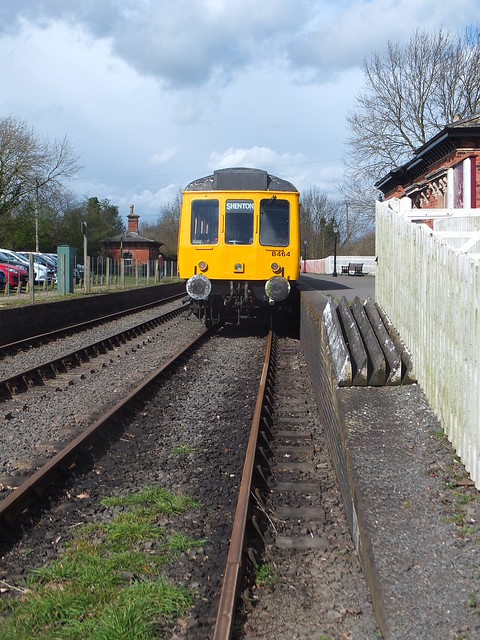
The DMU at Shenton Station, viewed from the level crossing.
At the end of service, when I'd put the DMU 'to bed' (this time at the North End, ready to draw forward into platform 2 for the following day's service), I visited the Loco Shed. The DMU vehicle we'd not used that day (51321) was in the shed being worked on. Further inside, the massive Great Western 2-8-0 '3803' was waiting for its next duty. Beyond the 2-8-0, 'Sir Gomer' (currently in black livery) waited for repairs to be completed. A visitor on the other shed road was No. 323 'Bluebell', a Wainwright 'P' class, one of eight built at Ashford for the South Eastern and Chatham Railway in 1910. There's a little more information on the 'P' class on the Southern E Group site here.
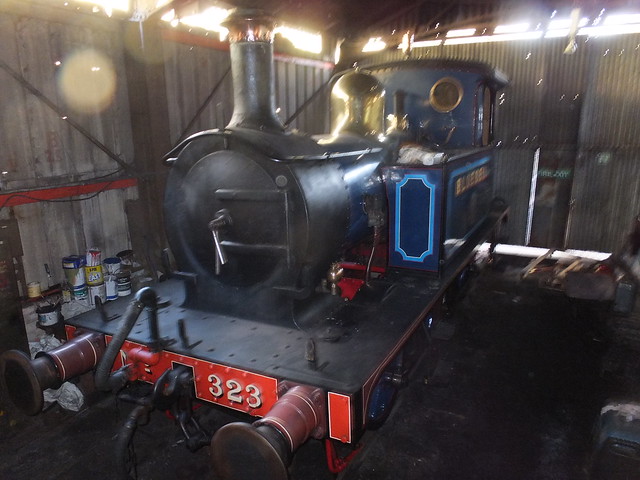 'Bluebell' in the shed at Shackerstone.
The Battlefield Line DMU Group
The Battlefield Line DMU Group (formerly the Shackerstone DMU Group) operates a single-car DMU and a 2-car DMU. The brief history of the vehicles below is taken from the Battlefield Line DMU Group pamphlet.
55005
55005 in British Railways blue and grey livery in 2011.
This is a single-car unit, invariably nicknamed the 'Bubble Car', built in 1958 by Gloucester Railway Carriage and Wagon Company seating 65 passengers. During its life on British Railways, it was based initially at Leamington Spa and later at Inverness, Manchester, Birimngham and Plymouth. In 1992, it became the first 'Bubble Car' to be be preserved but required new seats, windows, gearboxes and substantial electrical work before re-entering service.
51131
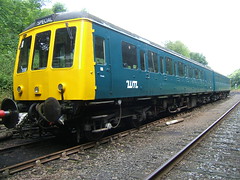
51131 in British Railways blue livery in 2007.
This is a Driving Motor Brake built at Derby in 1958. This vehicle, originally part of a 3-car set, seats 65 and includes a large guard's van. It was initially allocated to Newport (Gwent) but, with the closure of the Valley Lines around Newport in the 1960s, was transferred to Tyseley (Birmingham). It was withdrawn in 1993 with a failed gearbox and arrived at Shackerstone the following year. After a replacement gearbox was fitted, it re-entered service. It is usually paired with 51321 but the flexibility of the railcar design means that it may operate with 55005, if required.
51321
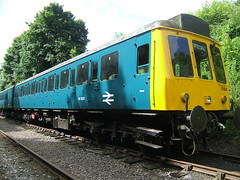
51321 in British Railways blue livery in 2007.
This is a Driving Motor car built in 1960 by Birmingham Railway Carriage and Wagon, seating 89 passengers. It formed part of a 3-car set allocated first to Plymouth and later Bristol before moving to Tyseley (Birmingham) in 1987. Withdrawn in 1991, it was initially used as a Service Vehicle then stored as a source of spare parts for other units. Following arrival at Shackerstone in 1997 most electrical and driving cab equipment required refitting and mechical and cosmetic work was needed before entering service on the Battlefield Line. It is usually paired with 51131 but is currently in the shed at Shackerstone undergoing body repairs.
Related Posts on other sites.
The Railcar Site
Related posts on this site
A number of posts deal with the DMUs at Shackerstone (most recent first):-
Midweek at the Battlefield Line
Battlefield Line 1940s Weekend (June 2013)
Sunday Diesel
Battlefield Line Modellers' Weekend 2012
'Thomas' at the Battlefield Line
The 'Mince Pie Flyer'
Battlefield Line Mince Pie Specials 2009
The Battlefield Line DMU Group
Diesel Multiple Units
My pictures
The Battlefield Line, 2014
Bubble Car.
Shackerstone DMU Group.
Bluebell.
Click on any picture below to see 'uncropped' versions, or explore using the links in 'My Pictures' below.
Introduction
Liverpool has alway had a fascination for me which I mentioned in a 2009 post Liverpool and subsequent posts about the railways. In the post By rail to Liverpool (Part 1), I described my journey on Saturday, 8th March 2014 via the former Great Western and former Great Central lines to Bidston station, on the Wirral. This post describes my travels from Bidston that day.
By Merseyrail from Bidston
Despite the roar of traffic from the nearby elevated M53 motorway, Bidston manages to give a very rural impression, surrounded by greenery, a lot of it no doubt where nature has taken back the land after the extensive goods sidings were removed. From earlier visits, I remember Bidston Dee Jn. signal box, a 65-lever L.M.S. construction facing the platform. That's now gone - most of the Merseyrail network is now controlled from Sandhills Control Centre. By the time I'd purchased my Merseyrail ticket, a train from West Kirby was arriving, headed for Liverpool Central and, although it was already crowded, I decided to board. This meant deferring a trip to West Kirby until another visit. Shortly after the train left Bidston, the line from New Brighton converged on our left and I was now retracing the route I'd last used on my trip on 8th February 2014 (described here). When we stopped at Birkenhead North, I was amazed to find major progress on the new footbridge incorporating lifts for disabled access.
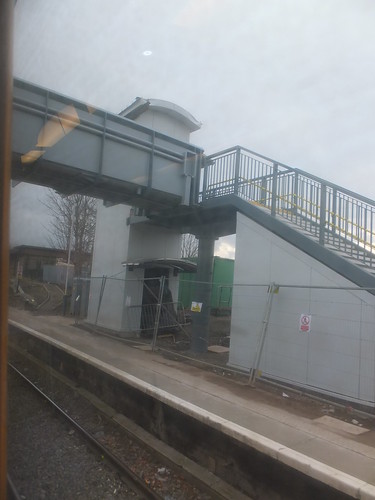
The new footbridge under construction at Birkenhead North.
I had toyed with the idea of getting off at Birkenhead Park. This was originally the end-on junction between the Mersey Railway and the Wirral Railway and provided with four platforms. Until the L.M.S. electrified the Wirall Railway lines, through passengers had to change between electric and steam trains and it must have been a busy place. Now, it's reduced to a single island platform between Up and Down lines, with steps leading up to station buildings on the road overbridge. The road is Duke Street, which, further north, divides the West Float and East Float as I described in my earlier post. Anxious to make the most of my limited time, I abandoned the idea of getting off and stayed on the even more crowded train as it called at Conway Park and Hamilton Square.
After Hamilton Square, we passed under the River Mersey using the first tunnel built under the Mersey. There's a little more about the tunnel-building in my post here. I still find it hard to believe that from 1886 to 1903, the trains through the tunnel were worked by steam traction.
Liverpool
The first station on the Liverpool side of the river is James Street and, originally, the line continued to an underground terminus at Liverpool Central, as shown in my post here. In 1977, British Railways opened the underground 'Liverpool Loop' and now, after James Street, trains call at Moorfields, Lime Street and Central, before re-appearing at James Street heading in the opposite direction.
I left the train at Central and escalators took me to the surface. It's a modern station but I found it quite pleasant, even at lunchtime on a Saturday when it appears that everyone wants to travel. A particularly civilised detail was the clean, free toilets so I emerged into the streets in a fairly relaxed mood.
A Walk through Liverpool
I'd initially intended to continue my journey by train but the streets were busy with apparently good-natured pedestrians and the weather was dry for a while, so I decided to stay 'topside'. Feeling peckish, I bought takeaway fish cake and chips at a small, scrupulously clean cafe and sat at a nearby junction where there were lots of seats and litter bins and enjoyed my food while I watched the shoppers go by.
I admired what I afterwards discovered was only the modest side elevation of the Lyceum. The neo-classical Lyceum was designed by the architect Thomas Harrison from Chester following an open competition with the local Liverpool architect John Foster (Surveyor to the Corporation of Liverpool). The Lyceum was built between 1800 and 1802 and has a colonnaded front facing Bold Street which I didn't study on this trip. The building has served various functions over the years (including Post Office) but is largely unused at present and the owner's of the Grade II Listed Building are seeking a new tenant or a sale. The Waterloo Place facade which caught my attention has four Ionic columns with three relief panels by F.A. Lege. Once, this facade housed the entrance to the Library and Newsroom, now it's the Co-operative Bank (or 'The co-oper.tive b.nk' as the sign declared. Perhaps there's a ready market for stolen letter 'a'?).
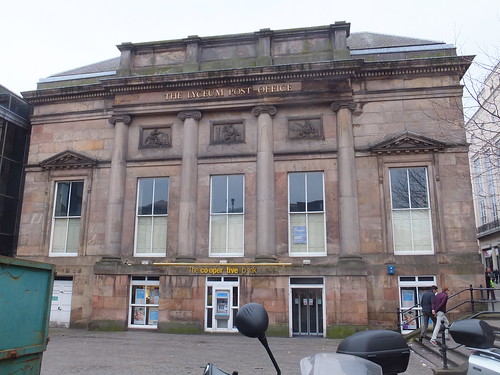 The Waterloo Place facade of the Lyceum.
Having finished my meal, I decided to walk through the city to Pierhead, with the idea of using the Mersey Ferry to cross back to the Birkenhead side. My route took me through the pedestrianised Church Street, then Lord Street and Derby Square (where there's an elaborate memorial to Queen Victoria).
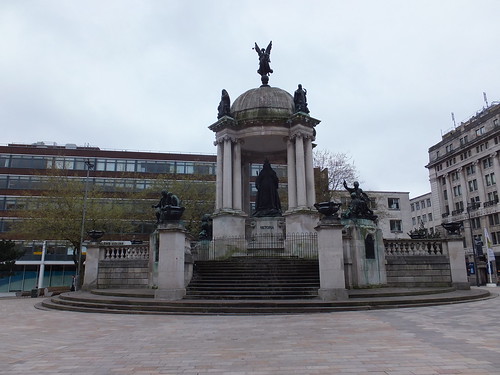 Victoria Memorial, Derby Square.
I continued down James Street, passing the Merseyrail Station on the right, with its bus stop outside for easy interchange. I approve of the attempt at an integrated transport system, but the ugliness of the associated street furniture and station facade contrasts sharply with the pleasing appearance of the Mersey Tunnel Pumping Station, framed against a background of acres of unrelieved black glass of the Mann Island modern development.
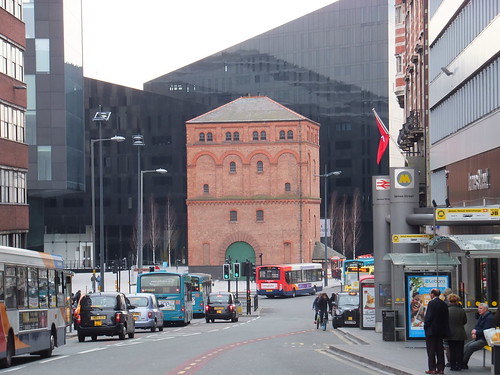 Looking down James Street, the black glass of the modern developments highlights the clean lines of the Mersey Railway Pumping Station, still at work.
Then I crossed the wide dual-carriageway of Strand Street and passed the ventilating shaft and associated offices of the Mersey Road Tunnel. The architectural style is not my favourite but the sense of proportion lends a satisfying dignity quite missing from much modern work (like the black glass Mann Island development mentioned above).
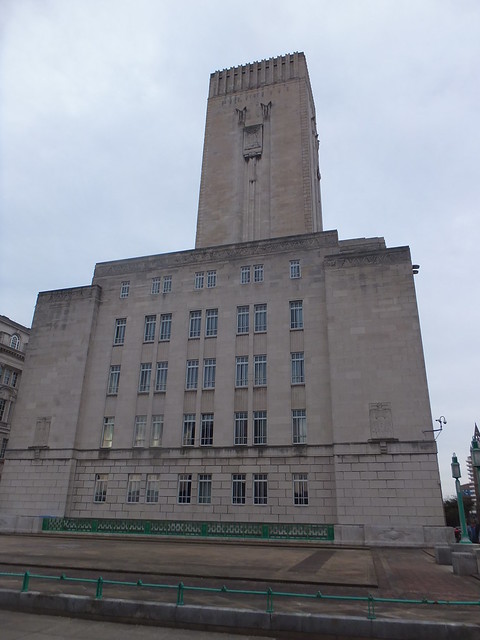
Mersey Road tunnel ventilating shaft and offices.
The Museum of Liverpool
There remained time to make a very brief visit to The Museum of Liverpool (part of Liverpool Museums) just to check on the centre piece of the 'Great Port' Gallery - the locomotive 'Lion'.
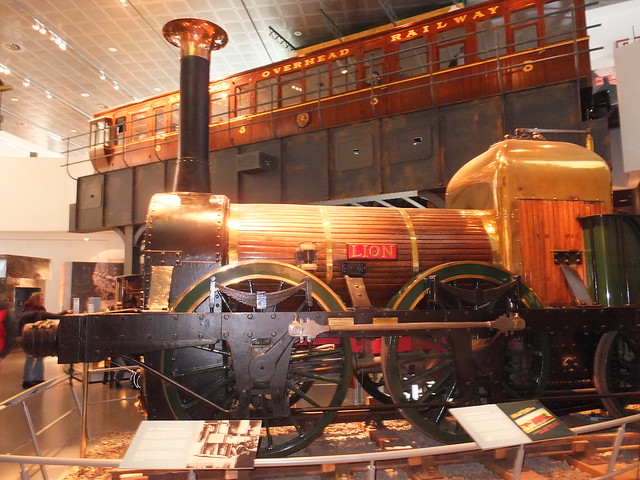 'Lion' on display in the Great Port Gallery, with the Liverpool Overhead Railway coach in the background.
I'm still secretary of the Old Locomotive Committee (the 'Lion' supporters club) and I've written a number of posts which are here. But I don't think I'll ever grow to love the 21st century architecture of this museum on a World Heritage Site designed by the Danish architects 3XN. Originally 'Nielsen, Nielsen and Nielsen', they became '3 x Nielsen' and then '3XN'.
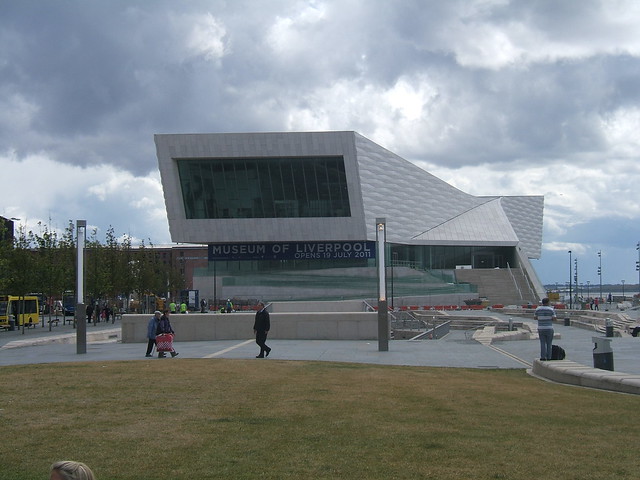 The Museum of Liverpool shortly before opening to the public in 2011 - "Fourth Grace" or "Dented Shoebox"?
Ferry Cross the Mersey
Then on to Georges Pierhead and the Booking Office for the Mersey Ferry. This is another modern building suffering the same affliction as the Museum of Liverpool and the Mann Island Developments - a morbid fear of the Right Angle. But the Staff were friendly and, clutching my Boarding Pass, I was soon making my way outside to await the arrival of the Mersey Ferry 'SNOWDROP'.
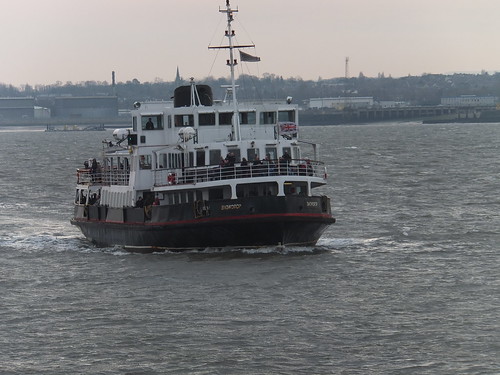 Mersey Ferry 'Snowdrop' approaching Pierhead.
The ferry leaves Pierhead 'on the hour', calling first at Seacombe and then Woodside before returning to Pierhead for the next trip. With a well-loaded ferry, we were under way right time.
This time, there was no Cruise Ship at the adjacent terminal but, instead, the rather threatening bulk of HMS Dragon - a Type 45 'Daring' class Air Defence Destroyer. You can learn more on Wikipedia here or the Royal Navy site here.
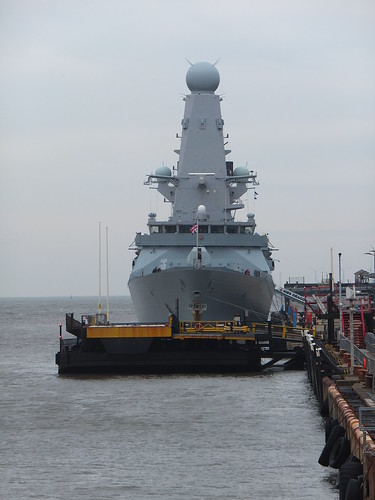
HMS Dragon is a Type 45 'Daring' class Air Defence Destroyer, seen making a weekend visit to Liverpool.
The sun was bright but there was a strong wind. Within a few minutes, the ferry was berthing at Seacombe. The Captain and First Officer were relieved by two more men, presumably just starting an afternoon 'watch'. There was a little pantomime when the gangway was raised before it was realised that the relieved men were still aboard, so the gangway had to be lowered again to let them disembark.
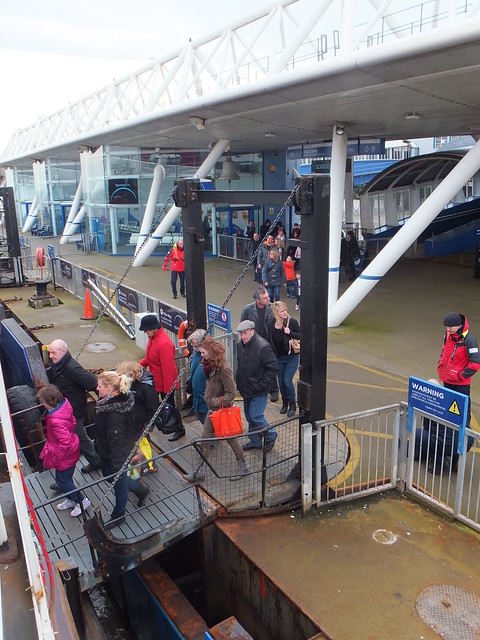
Passengers boarding at Seacombe Landing Stage.
The ferry then continued upstream to Woodside Landing Stage, passing the lock gates giving access to Birkenhead Great Float and Stena Line's 12 Quays Terminal where the Isle of Man ferry 'Ben-My-Chree' was berthed. This ferry is described in Wikipedia here.
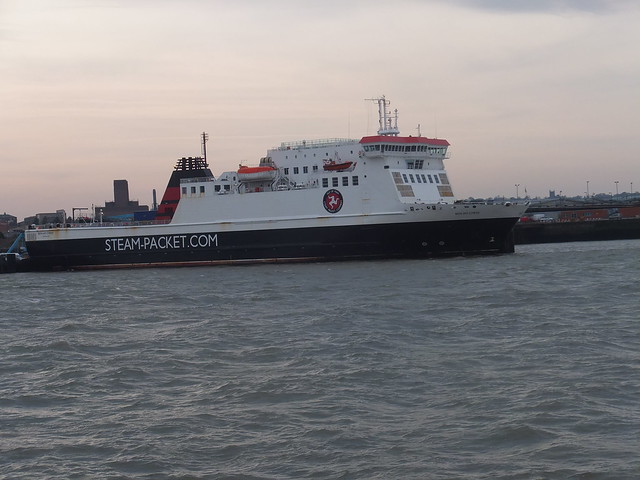 Isle of Man ferry 'Ben-My-Chree'.
Birkenhead Briefly
I disembarked at Woodside and walked to Hamilton Square Station, passing the Mersey Railway Pumping Station at Shore Road. This is similar in appearance to the one on the Liverpool side (mentioned above) but larger. Although electric pumps now do the work, the original steam pump, 'The Giant Grasshopper' is still in situ. A few years ago, I was able to visit and see the pump operating (using air, not steam) but I believe it's closed at present because of financial constraints.
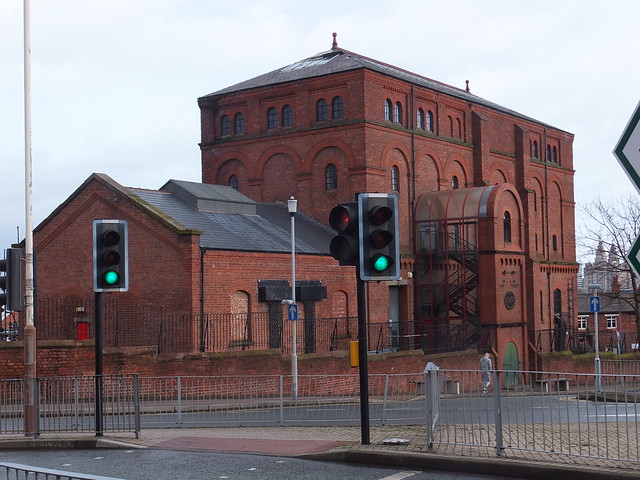 Birkenhead: Pumphouse with 'The Giant Grasshopper' pump.
Entering Hamilton Square Station, I took the lift to Platform Level and caught the first train towards Chester, on the route I'd travelled on 8th February 2014, described in the post here.
I decided to alight at Bebington station and pay a visit to the Lady Lever Art Gallery at Port Sunlight. Bebington was formerly on a four-track route paired by use, with one island platform flanked by single platforms either side. A subway provided access to the platforms. Merseyrail now uses only the old slow lines, so the subway ramp I took leaving the station originally served the island platform.
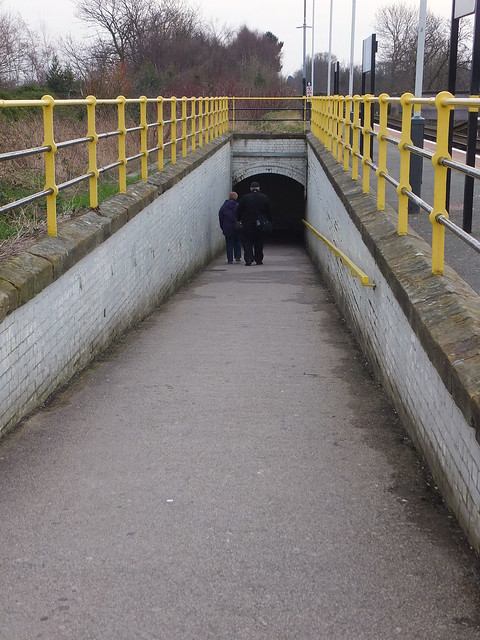
Mersey rail: Access ramp at Bebington Station.
Lady Lever Art Gallery
In the post Birkenhead and New Brighton by train (Part 1) I wrote a little about Port Sunlight. I'm afraid I found the Model Village rather 'twee', although I admire William Lever's intentions. In a real village, a clash of building styles over time can be attractive but when each block deliberately differs from its neighbour in a self-conscious manner, as here, I'm not so sure.
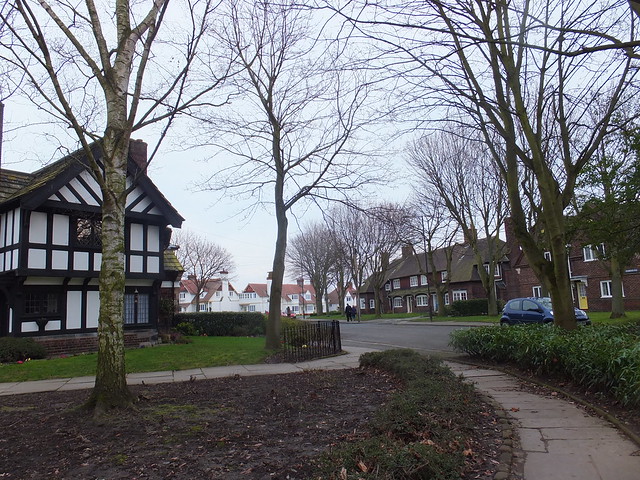 Port Sunlight, showing varying building styles.
A ten-minute walk from the station took me to the Lady Lever Art Gallery. The Gallery was opened in 1922 by William Lever (by then the First Viscount Leverhulme) and named in memory of his wife Elizabeth. It was designed by architects William and Segar Owen from Warrington and is now Listed Grade II.
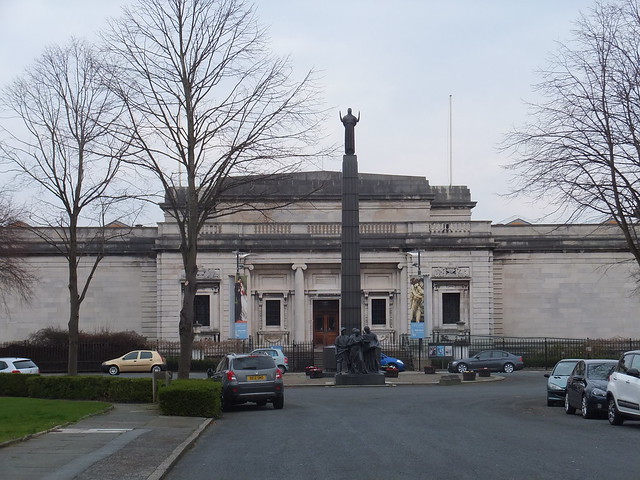 The Main entrance to the Lady Lever Art Gallery.
The Collection was always intended for public display, not as a rich man's private pleasure. Lady Lever Art Gallery claims it "houses one of the UK’s finest collections of fine and decorative art. It has the best collection of Wedgewood jasperware anywhere in the world and its collection of Pre-Raphaelite paintings is internationally renowned". Display is fairly traditional and certainly worked for me. I was enchanted by the place.
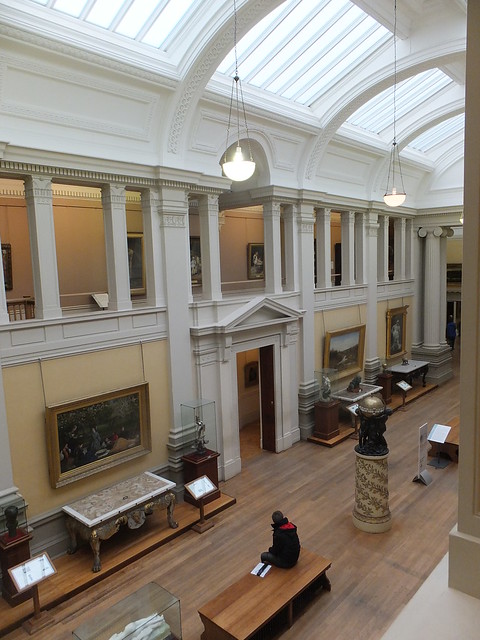
View of the Main Hall from the East Balcony Gallery.
The Art Gallery is now part of Liverpool Museums and the contrast with the Museum of Liverpool I'd visited earlier could hardly be more pronounced.
The Lady Lever Art Gallery has a special exhibition of the works of J.M.W. Turner until 1st June 2014. I was able to study around 30 works from different periods of his life during my visit.
The Journey Home
I walked back to Bebington Station to catch the next train south. This was an Ellesmere Port train and, at first, I intended to travel to Ellesmere Port. However, during the journey, I decided that I'd had enough adventures for one day so I 'bailed out' at Hooton and transferred to the following Chester train.
At Chester, my onward connection was from the platform 2 bay. We took the North Wales Coast route to Saltney Junction where we turned left onto the (now singled) former Great Western line to Wrexham. At Wrexham General, we were back on double track and I rejoined the route out I'd taken that morning.
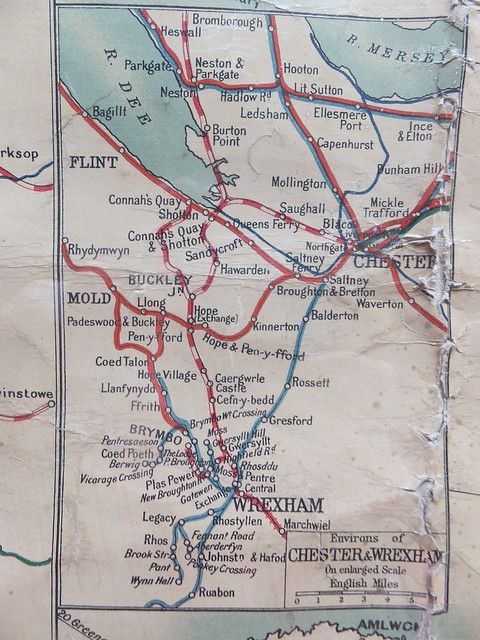 'Environs of Chester & Wrexham' from the 11th Edition of the Pre-Grouping 'Railway Map of England and Wales' published by W & A K Johnston.
The train from Chester took me as far as Shrewsbury where I alighted on platform 4. The train then continued - for Cardiff, I think, but I was quite tired by this time and not paying attention. The next arrival on platform 4 was my connection, arriving from Aberystwyth (I think) and reversing before going on to Birmingham International, allowing me to get off at Wolverhampton.
Another excellent (if exhausting) day trip.
Book references
[1] 'An Illustrated History of Liverpool's Railways' by Paul Anderson, published Irwell Press (ISBN 1-871608-68-6).
[2] 'A Regional History of the Railways of Great Britain': Volume 10 The North West by G. O. Holt, Second Edition published by David & Charles (ISBN 0946537 34 8).
Related posts on this site
By rail to Liverpool (Part 1)
Early Days of the Mersey Railway.
Birkenhead and New Brighton by train (Part 1)
Birkenhead and New Brighton by train (Part 2)
Birkenhead and New Brighton by train (Part 3)
Railways around Birkenhead
My pictures
Merseyrail.
Liverpool.
Museum of Liverpool.
Port Sunlight, Wirral.
This report is based on information from Doctor Hla Tun, who also supplied the photographs.
The Bagan Clinic treated 2,881 patients in February 2014, bringing the total number of treatments since the Clinic opened on 6th August 2011 to 97,938.
Treatment Summary
The table below summarises the number of treatments per month in 2013 and the total number of treatments since the clinic opened on August 6, 2011.
| Month |
Patients treated |
Total treatments |
| February 2013 |
2,713 |
49,850 |
| March 2013 |
2,713 |
49,850 |
| April 2013 |
2,061 |
54,924 |
| May 2013 |
3,303 |
58,227 |
| June 2013 |
5,586 |
63,813 |
| July 2013 |
6,079 |
69,892 |
| August 2013 |
5,337 |
75,229 |
| September 2013 |
4,826 |
80,055 |
| October 2013 |
3,647 |
83,702 |
| November 2013 |
4,465 |
88,167 |
| December 2013 |
3,387 |
91,554 |
| January 2014 |
3,501 |
95,057 |
| February 2014 |
2,881 |
97,938 |
Monthly notes
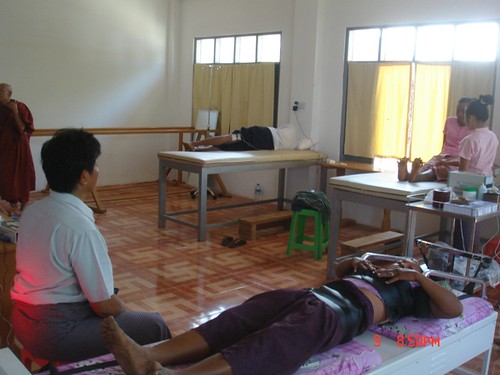
The New Clinic Building was brought into use on 14th February 2014 as a temporary Physiotherapy Unit until the building of a permanent Physiotherapy Unit is completed. The majority of patients attending can benefit from physiotherapy, having suffered strokes, joint pains and muscular pains. Treatments include Infra Red, Ultrasound, Traction Machine, Electric Massage and Handrails for patients with walking difficulty.
 New Clinic building in use as a temporary Physiotherapy Unit.
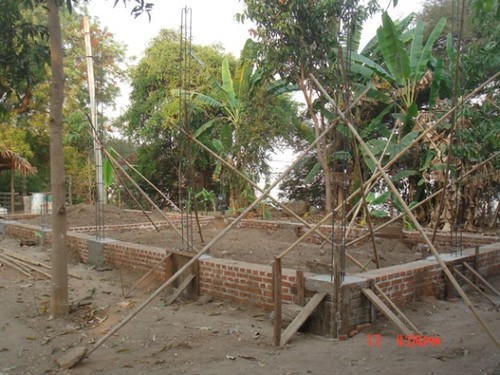
Building work has already started on a permanent Physiotherapy Unit building near the original Clinic building. The building has been donated by a United Kingdom Travel Company and their clients.
 New Physiotherapy Unit under construction near the Clinic.
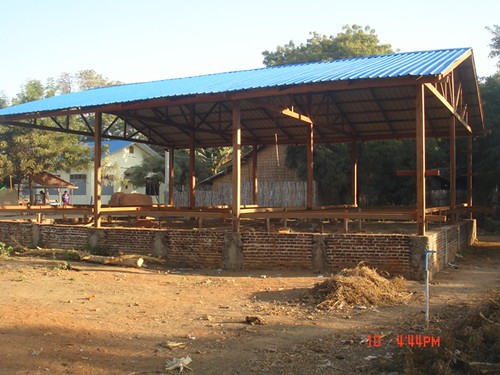
Few of the patients treated are from the local area. The majority of patients have to travel distances up to 250km. This means that most patients need to stay in the Monastery Compound for one or two nights. On clinic days, shelter is also needed by patients waiting for attention. The United Kingdom Travel Company and their clients mentioned above have also funded the building of a new Accommodation Shelter.
 New Accommodation Shelter under construction.
There are a number of posts in this Blog on medical support in Myanmar provided by the RTM Social Contribution with help from donors around the world. You can find them all here.