skip to main |
skip to sidebar
When I was young, there was a steam-hauled 'Push-Pull' service directly between Wolverhampton and Walsall. With dieselisation, the service progressively deteriorated in frequency until direct services were withdrawn altogether. A few years ago, a limited direct service from Wolverhampton to Walsall using Class 323 EMU was introduced but passenger numbers were disappointing and this, too, was withdrawn.
The railway route was always in competition with road transport for passengers. In the 1950s, both Wolverhampton and Walsall operated electric trolley buses. Wolverhampton's green and yellow buses alternated with Walsall's pale blue buses on the Wolverhampton to Walsall route. Of course, the "trollies" were eliminated in favour of diesel buses.
Development of the railways around Walsall
The South Staffordshire Railway was formed in 1846 to connect Walsall with Lichfield and construct associated branches. The Grand Junction Railway line, opened in 1837, had been built to link Birmingham (at one end of the London and Birmingham Railway) with Earlestown (at the midpoint of the Liverpool and Manchester Railway). This was the start of Britain's railway network. By 1847, Walsall was linked to the Grand Junction at Bescot. Two years later, the line to Lichfield and Wychnor Junction came into operation, followed by a branch to Cannock ultimately extended to Rugeley where it made a connection with the L&NWR Trent Valley Line. In 1879, the Midland Railway opened a line from Castle Bromwich (on the Birmingham - Derby line) to Wolverhampton and triangular junctions accessed the South Stafford Line at Ryecroft Junction, just north of Walsall station.
Railways to Walsall in the 1950s
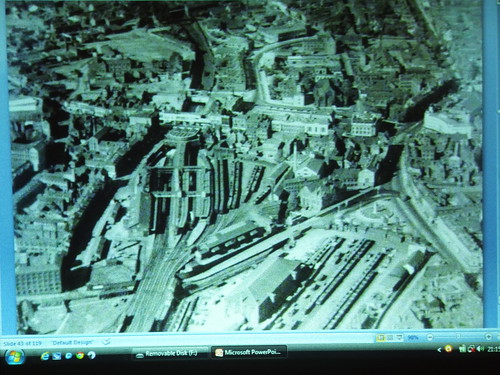
The railways around Walsall always impressed me - between Pleck Junction and Ryecroft Junction there were four running lines and extensive sidings. Pleck Junction controlled three diverging routes (Bescot on the Grand Junction, the South Stafford line to Dudley and Darlaston on the Grand Junction). Ryecroft Junction controlled no less than four diverging routes (Wolverhampton via the Midland line, the line to Cannock and Rugeley, the line to Lichfield and Wychnor Junction and Sutton Park and Castle Bromwich via the Midland Line). At a Railway Group Session at Brewood in June 2013, Keith had shown his presentation 'Black Country Railways from the Air' which included the picture below showing Walsall station in steam days.
 A screenshot from Keith's presentation showing Walsall station, with its round booking hall.
I'm old enough to remember the distinctive large, round booking hall at Walsall station which is clearly visible in the above picture. It had become very shabby in its latter days (like most of our railway system post-war) and was demolished to create the Saddlers Shopping Centre which opened in 1980. I particularly remember the mechanical signalling and the impressive signal gantries that were needed to control the many routes through Walsall. There were two routes regularly used by trains between Birmingham New Street and Walsall (via the Soho Road line and via Aston) and I've listed the signal boxes which controlled these routes below.
Signal boxes between New Street and Walsall, via Soho Road line:
Birmingham New Street No. 5
Sheepcote Lane
Monument Lane
Harborne Jn.
Winson Green Jn.
Soho East Jn.
Soho Road
Handsworth Jn.
Perry Barr North Jn.
Great Barr
Newton Road
Newton Jn.
Bescot No. 1
Bescot No. 2
Bescot No. 3
Pleck Jn.
Walsall No. 1
Walsall No. 2
Walsall No. 3
Signal boxes between Perry Barr North and New Street, via Aston:
Perry Barr Station Junction
Witton Goods
Aston No. 2
Aston No. 1
Vauxhall
Proof House Jn.
Birmingham New Street No. 1
You can find detailed signal box diagrams of all the above signal boxes in the Signalling Record Society publication 'British Railways Layout Plans of the 1950's - Volume 11: LNW Lines in the West Midlands (excluding Trent Valley Line)' (ISBN: 1 873228 13 9).
I'd become familiar with the line through Bescot and Aston in the 1950s, briefly described in the post 9:17 a.m. to Birmingham. In the post My First Steam Special, I summarised a trip from New Street to Walsall via the Soho Road Line in 1960 behind the preserved Midland Compound '1000', on our way to Stoke. By July 1962, modernisation was well in hand and I described a roundabout trip to Stafford via Walsall in the post A Sunday Stroll to Stafford.
Railways to Walsall in recent times
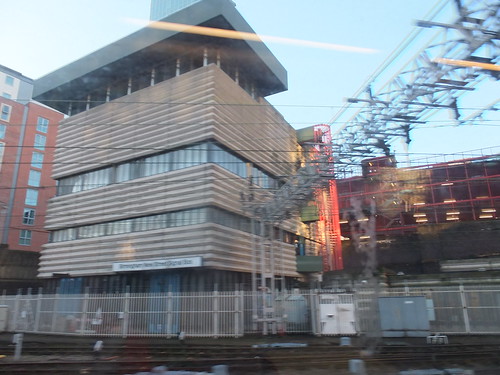
In the 1960s, all the above signal boxes were abolished, first with the introduction of Walsall Power Box at Pleck Junction (provided with 'Westpac' modular interlocking and an 'NX' signalling panel) in 1965, then, the following year, with the commissioning of the Birmingham New Street Power Signal Box (similarly equipped with Westinghouse equipment). The striking architectural design of the New Street signal box has led to the building being Listed Grade II in 1995 (listing details).
 Birmingham New Street Signal Box
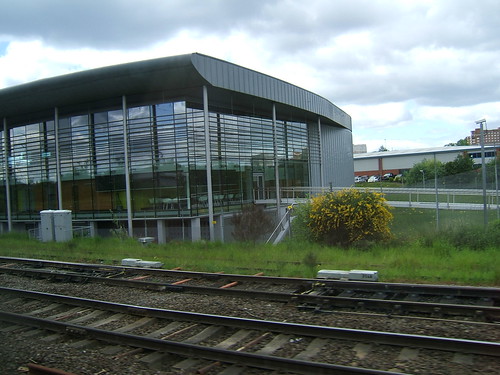
During 2013, Walsall Power Box was, in turn, made redundant and control is now from the West Midlands Signalling Centre at Saltley.
 The part-commissioned West Midlands Signalling Centre, Saltley, Birmingham now controls Walsall area.
To see what remains in 2013, refer to 'Railway Track Diagrams Book 4: Midlands & North West', Third Edition, published by Trackmaps (ISBN: 978-0-9549866-7-4).
A trip to Walsall in January 2014
Provided you're in no hurry, it's still possible to go from Wolverhampton to Walsall by train, using the Stour Valley Line from Wolverhampton to Birmingham New Street, changing there to a Walsall train. On Saturday, 11th January 2014, I decided to do just that.
I arrived at Wolverhampton station in time to see an Arriva Trains Wales DMU depart for Birmingham. A few minutes later, I boarded the following well-loaded Cross-Country 'Voyager' from Manchester which would take the Bristol line after Birmingham New Street. Following on the heels of the earlier DMU, we suffered a signal check on the way and then stood for a couple of minutes in New Street North Tunnel.
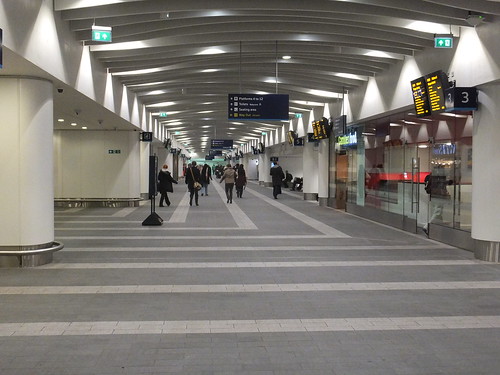
The 'Way out' signs at Birmingham's 'half-rebuilt' station were very confusing but I made my way to the concourse and decided that platform 5 offered a DMU to Rugeley via Walsall.
 The rebuilt concourse at the 'half-rebuilt' Birmingham New Street Station.
There was already a Wolverhampton EMU in one end of platform 5 and, after a few minutes, a train arrived from New Street South Tunnel and stopped behind the EMU, discharging a heavy load of passengers. This train claimed to be from Rugeley but the waiting passengers were warned not to board - I don't know why - because, a few minutes later, the Passenger Information Display screens decided we were to board for Rugeley. I noticed that there are now two public address systems giving passenger announcements, one with a female voice, one with a male. I didn't find the two message streams easy to follow, I'm afraid.
The arriving train had clearly been routed via Aston but the unit did not reverse so as to retrace the same route. Rather, once the Wolverhampton EMU had left, we followed in the same direction, receiving a number of single yellow and double yellow signals before branching right at Winson Green to take the Soho Road line to Perry Barr.
At Perry Barr, we joined the Grand Junction line, always called 'The Old Road' once the Stour Valley Line was opened. This is the limit of New Street Power Box control area - beyond here, control is now from the West Midlands Signalling Centre at Saltley. A tall aqueduct leads the Tame Valley Canal over the railway. The canal was not built until 1844 so the railway got here first! We stopped at Tame Bridge Parkway - a modern invention dating from 1990 described by Wikipedia here.
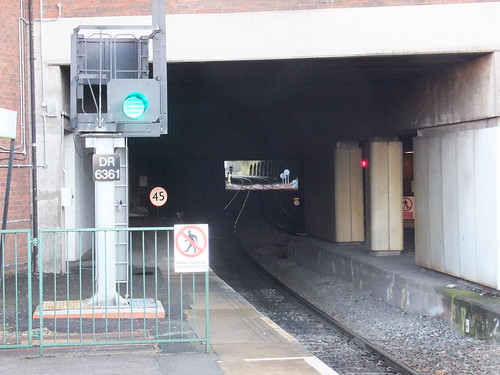
We passed the large marshalling sidings at Bescot with both Down and Up sides provided with Hump Yards for dealing with the formation of single wagon loads into complete trains. The Down Hump Yard was fully automated in the 1960s, around the time British Railways abandoned the idea of being a 'full service' freight operator accepting single wagon loads and concentrated on 'block loads'. The line to Walsall diverges to the right and plunges under the elevated M6 motorway, where the remains of the abandoned route to Bescot Curve Junction and the South Stafford Line are visible. At Pleck Junction, the truncated South Stafford line to Dudley is now arranged as a siding with run-round. The line from Darlaston Junction joined on our left, we passed the Network Rail Training Centre and came to a stand in platform 1 at Walsall, where I alighted. Looking north, the short Park Street Tunnel was as gloomy as I remember but, of course, Walsall No. 3 signal box which was sited in the tunnel is long gone.
 Park Street Tunnel viewed from platform 1. Note the new signal, controlled from the West Midlands Signalling Centre. The control code 'DR' stands for 'Droitwich - Ryecroft'!
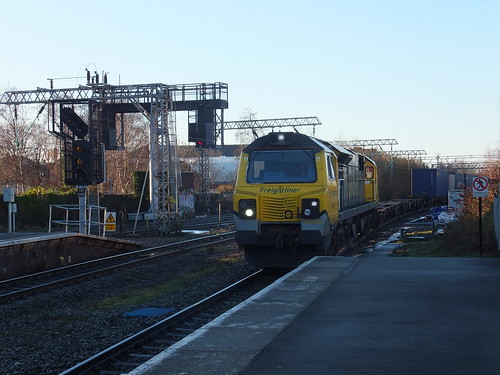
After a brief stop, my DMU departed for Rugeley on what is now marketed as 'The Chase Line'. Within a few minutes, a Class 70 on a container train followed.
 Bescot end of Walsall station showing a Class 70 with a container train. Note the new signals on the Up Fast, Platform 3 and Platform 2 (showing double yellow for a DMU which will shortly depart for Birmingham).
I wandered around Walsall town for a while. Although it retains a fairly traditional open market, the actual shopping areas feature the usual high street names which make one town indistinguishable from any other. I found the Saddler Shopping Centre as depressing as I expected so I hurried back to the station to catch the next EMU to Birmingham, so as to return to Birmingham by a different route.
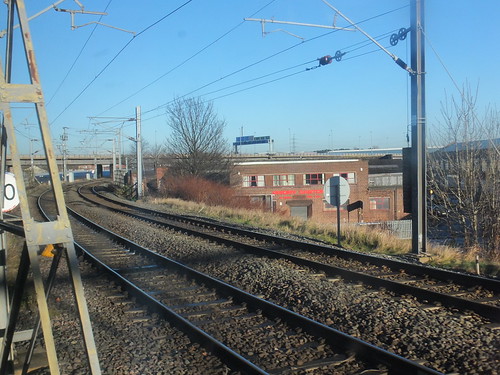
After re-tracing my outward route as far as Perry Barr North Junction (noting with delight that the station building on the Up platform at Hamstead is still the L&NWR standard pattern wooden building), we continued on the Grand Junction Route. The line from Lichfield joined on our left at Aston (this line, also electrified, forms one end of the 'Cross-City Line').
 Aston North Junction, showing converging line from Lichfield. Note the elevated M6 motorway in the background.
The four-track section from Aston towards Birmingham is now two track (with the remains of the former Goods Lines). After pausing at Duddeston Station (which used to be called Vauxhall and Duddeston), we passed the Aston Signalling Control Centre which controls the Lichfield Line beyond Aston. The building is a composite B.R. signal box design which used to be Vauxhall Signal Box and, more recently, Vauxhall Shunt Frame. At Proof House Junctions, we croseds to the Down Stour and were soon running into platform 6 at New Street. Although my train would continue All-stations to Wolverhampton, it was booked to stand for about 15 minutes first, so I found an earlier departure to complete my journey back to Wolverhampton.
Related articles on other sites
Grand Junction Railway (Wikipedia).
South Staffordshire Line Website.
Walsall Railway Station (Wikipedia).
Trolleybuses in Wolverhampton (Wikipedia).
Trolleybuses in Walsall (Wikipedia).
Related posts in this blog
9:17 a.m. to Birmingham.
My First Steam Special.
A Sunday Stroll to Stafford.
My pictures
West Midland Railways
I've always been fond of Blackpool. Whilst it lacks the elegance of some British seaside resorts, it has an energy that appeals to me. It also has a tramway system and, when I was young, two large terminal stations both with excursion platforms to handle heavy railway traffic in the season.
There's a brief description of a trip I made by train in 1957 in the post Halfex to Blackpool, when the return fare was 14 shillings (70p) and the journey took 2 hours 40 minutes.
Over the years, I've been back to Blackpool a number of times and my latest trip was on Friday, 3rd January 2014, described briefly in the post A Trip to the Seaside. In 2014, the return fare was £52.00 and, despite a change at Preston each way and with some station stops because I was travelling on normal service trains, the journey was around 20 minutes faster than in 1957.
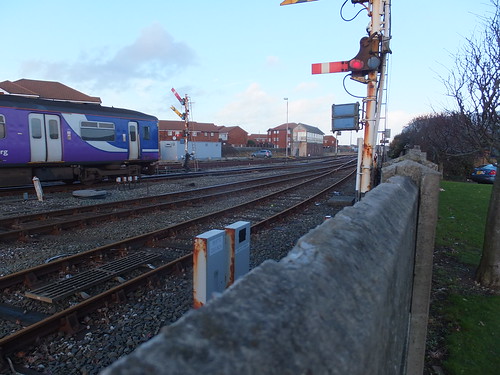 In 2014, a DMU leaves Blackpool North, with Blackpool North No. 2 signal box in the background.
Development of Railways from the Fylde Peninsula to Preston
The first railway from Preston to the Fylde Peninsula was opened by the Preston and Wyre Railway in 1840. It went to Fleetwood, via Kirkham and Poulton-le-Fylde. This aided the development of Fleetwood as a resort, as a ferry port and as a fishing port. In 1846 a branch was constructed from Poulton to a station which became known as Blackpool Talbot Road (renamed Blackpool North in 1932). The Blackpool line joined the Fleetwood line via a severe curve and, following a serious derailment in 1693, the layout at Poulton was completely re-designed to improve the alignment of the Blackpool route. Also in 1846, another branch opened from Kirkham to Lytham. By 1874, the separate railway from Lytham to Blackpool had been joined to the Kirkham to Lytham branch, providing a roundabout route to Blackpool following the coast which ended at a well-situated terminus appropriately called Blackpool (Central).
The growth of tourist traffic led to four running lines being provided from Kirkham North Junction to Preston, paired by use, in 1889. Even on the four track sections, congestion was a problem and additional signal boxes were installed with running signals and either no points or just emergency trailing crossovers as a means of 'shortening the block', allowing trains to follow one another more closely. The circuitous route from Kirkham North Junction to Blackpool Central limited capacity, so a 'New Line' was built in 1903, running in a virtually straight line from Kirkham North Junction to a junction at Blackpool South No. 3 from where four running lines were provided to Blackpool Central. Four running lines were also provided through Poulton-le-Fylde station.
 Approach to Blackpool Central Station in 1921 (Photo: N.R.M.)
Blackpool (and Fleetwood) to Preston in the 1950s
In the 1950s, the routes were controlled by semaphore signals, manual signal boxes (of Lancashire and Yorkshire Railway pattern) and Absolute Block working. The signal boxes on the various lines are listed below.
Fleetwood Branch:
Fleetwood
Wyre Dock Station
Wyre Dock Jn.
Wyre Power Station
Burn Naze North
Burn Naze South
Thornton Cleveleys
Tarn Gates L.C.
Poulton No. 5
Blackpool North to Preston:
Blackpool North No. 3
Blackpool North No. 2
Blackpool North No. 1
Layton
Carleton L.C.
Poulton No. 4
Poulton No. 3
Poulton No. 2
Poulton No. 1
Singleton
Singleton Bank
Weeton
Bradkirk
Kirkham North Junction
Kirkham
Kirkham South Junction
Treals
Spen Lane
Salwick No 2
Salwick No 1
Constable Lane
Lea Road
Ashton
Maudland Viaduct
Blackpool Central to Kirkham (via Lytham):
Blackpool Central
Spen Dyke
Bloomfield Road
Blackpool South No. 3
Blackpool South No. 1
Squires Gate
St. Annes
Lighthouse Intermediate Block Signals
Ansdell
Lytham
Lytham Goods Yard
Warton
Moss Side
Wrea Green
Blackpool South No. 3 to Kirkham (via New Line):
Blackpool South No. 2
Watsons Lane Bridge
Marton
Plumpton
Bradkirk
You can find detailed diagrams for these signal boxes in the 1950s in the excellent series of publications from the Signalling Record Society 'British Railways Layout Plans of the 1950's' - 'Volume 5: ex-Lancashire & Yorkshire Railway Lines in West Lancashire' (ISBN: 1 873228 04 X).
Blackpool to Preston in recent times
As car and coach travel grew, the demand for trains reduced. The impressive railway infrastructure which had allowed large numbers of passengers to be transported was either reduced or abandoned. The direct line from Kirkham North Junction to Blackpool Central was abandoned (apart from around one mile at the Kirkham end which was retained as a Tip Siding). The M55 motorway was built on the rest of the trackbed. At Blackpool, destruction of Blackpool Central station and its extensive sidings in 1964 released significant real estate for commercial redevelopment or (the ultimate irony) road vehicle parking.
The branch from Kirkham to Lytham and Blackpool was cut back to Blackpool South in 1970 and, from 1982, a single uninviting windswept platform has terminated a singled line from Kirkham operated as a 'long siding'.
In 1966, Fleetwood station was closed but a passenger service continued to operate to Wyre Dock until 1970. The branch from Poulton was then used by freight trains as far as the chemical works at Burn Naze. Today, the whole branch is 'Out Of Use'.
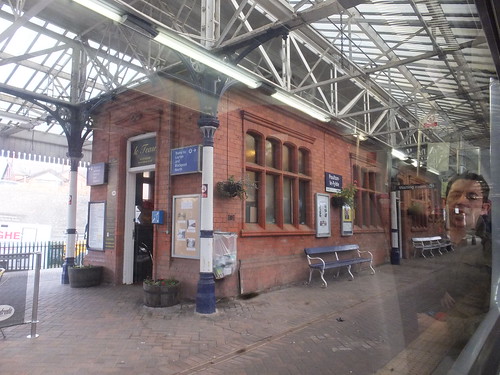 The L&Y island platform, canopy and brick station buildings at Poulton-le-Fylde have been triumphantly restored (apologies for the reflections).
Double track remains from Blackpool North through Poulton and Kirkham (which retains a short section of four-track line) to Preston. The remaining signal boxes are listed below.
Blackpool North No. 2
Carleton L.C.
Poulton No. 3
Kirkham North Junction
Salwick
I visited Salwick box some years ago. It served as a 'fringe' box to Preston Power Signal Box with Track Circuit Block working to Preston and (I think) to Kirkham. I believe the signal boxes further north still use Absolute Block working - they certainly retain upper-quadrant semaphore signals. However, this line is being electrified at 25 kV a.c. and by 2016 these few signal boxes will be abolished. On my trip in 2014, work was in hand raising a number of overbridges to provide clearance for the overhead lines.
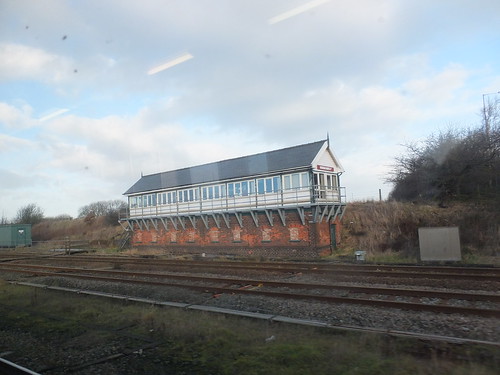 The L&Y signal box at Kirkham North Jn. is just recognisable despite significant alteration but the heavy-duty landing allowing access to the windows seems rather over-kill.
To see what remained on my visit in 2014, refer to 'Railway Track Diagrams Book 4: Midlands & North West', Third Edition, published by Trackmaps (ISBN: 978-0-9549866-7-4).
Book References
[1] 'A Regional History of the Railways of Great Britain: Volume 10 The North West by Geoffrey O. Holt, published by David & Charles (ISBN 0-946537-34-8).
[2] 'Rails to the Lancashire Coast' by Richard Kirkman and Peter van Zeller, published by Dalesman Books (ISBN: 1 85568 027 0).
[3] 'Railways to the Coast' by Michael H. C. Baker, published by Patrick Stephens (ISBN 1-85260-058-6).
[4] 'Lost Railways of Lancashire' by Gordon Suggitt, published by Countryside Books (ISBN 1 85306 801 2).
[5] 'Railways of the Fylde' by Barry McLoughlin, published by Carnegie Publishing,1992 (ISBN 0-948789-84-0).
Related articles on other sites
Preston and Wyre Joint Railway (Wikipedia).
Blackpool North Railway Station (Wikipedia).
Blackpool North (National Rail.
Blackpool tramway (Wikipedia).
Related posts in this blog
Halfex to Blackpool.
A Trip to the Seaside.
Track Sketch: Fleetwood.
My pictures
Blackpool Trams.
Blackpool's Railways.
Railways around Preston.
[Reference [5] added 12-Feb-2014]
High tides and high winds, particularly affecting the west coast of England - what better time to choose for a quick trip to Blackpool by rail? On Friday, 3rd January 2014 I decided to visit Blackpool again, using the Virgin 'Pendolino' service from Wolverhampton to Preston, changing to a Diesel Multiple Unit for the onward leg to Blackpool (North).
On arrival in Blackpool, there was certainly strong wind and occasional rain squalls but the sun came out and it was quite pleasant. I walked towards the promenade along Talbot Road, pausing in Talbot Square to look at the Town Hall, built in 1900. I joined the promenade near the North Pier (Blackpool still retains its three piers) and the sea was rougher than I've seen before at Blackpool.
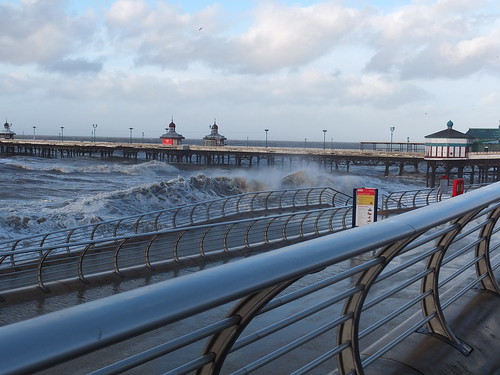
One of the modern trams built by Bombardier passed me and, spotting the 'Fleetwood' destination, I chased after it to the nearby tram stop and boarded for the 8-mile journey to Fleetwood. It was my first trip on the re-furbished tram system which re-opened in 2012 and I was impressed by the new trams. The older trams which I remember still operate in the season from special 'Heritage Tram' stops.
The weather was a bit wild in Fleetwood but I still enjoyed wandering around the town, taking a few photographs. The aerial picture below (taken a few years ago) gives a good impression of the town. The Stena Line ferry service to Northern Ireland (visible at the bottom of the picture) was withdrawn in 2010.
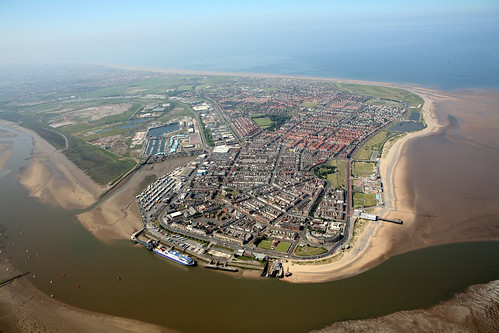
Fleetwood: The Stena Line service to Northern Ireland was withdrawn in 2010. (Photo: 'Life in Fleetwood'/Urbed).
Click for larger image
The elegant designs of the architect Decimus Burton still grace the town but more modern developments have not been helpful. Fleetwood enjoyed a period of prosperity as a seaside resort and ferry port. The first railway from Preston served Fleetwood but when additional branches to Blackpool were built, Fleetwood became overshadowed by its southern neighbour as a holiday resort.
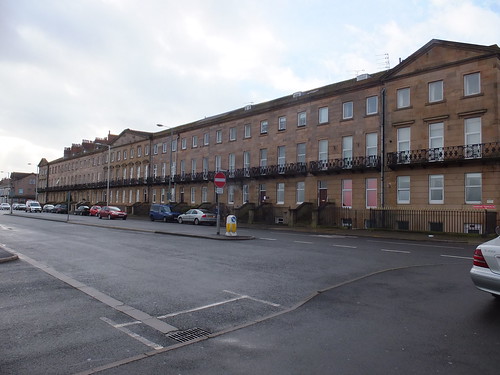 Queen's Terrace, Fleetwood. Designed by Decimus Burton and completed in 1844.
With the development of the Wyre Dock, Fleetwood became home to the third largest fishing fleet in the country. With membership of the EEC and as countries like Iceland extended their fishing limits, the Fleetwood fishing fleet was decimated. The history of fishing in Fleetwood is described passionately here in an article forming part of the excellent Fleetwood Maritime Heritage Trust site. In 1970 the railway to Fleetwood was closed and nothing now remains of the railway station. The station area was eventually re-developed as the Stena Line ferry port but that, too, was lost in 2010.
I returned to Blackpool by tram. We passed lots of people walking on the cliff top and they all seemed to be taking pictures of the angry seas. Approaching North Pier, the line descends to a lower promenade level and water was breaking over the promenade as the waves pounded the sea wall. Trams had stopped running further south to Starr Gate, presumably because of conditions along the front.
Once away from the sea front, the weather wasn't bad and I spent some time exploring Talbot Road and recording the existing mechanical railway signalling at Blackpool (North), as this will be replaced under a project in hand to electrify the line from Preston.
Then I joined a Diesel Multiple Unit heading to Manchester Airport as far as Preston, where I changed for a through service back to Wolverhampton.
Related articles on other sites
Blackpool (Wikipedia).
Fleetwood (Wikipedia).
'Life in Fleetwood'.
Fleetwood Think Piece (Urbed).
My pictures
Blackpool and Fleetwood.
Blackpool Trams.
Blackpool's Railways.
Railways around Preston.
I was first introduced to the railways around Morecambe in 1952 as I described in the post
Steam around Morecambe. I've been back to the Morecambe area by road a few times since, notably in 1967 when I saw how Lancaster (Green Ayre) had changed. There's a post based on the 1967 visit titled Track Diagrams: Lancaster (Green Ayre).
Recently, I made a brief foray back to the area by rail, described in the post Return to Heysham which includes architectural comments. I've left my more technical railway musings for this present post.
Brief History

Click here for enlarged view
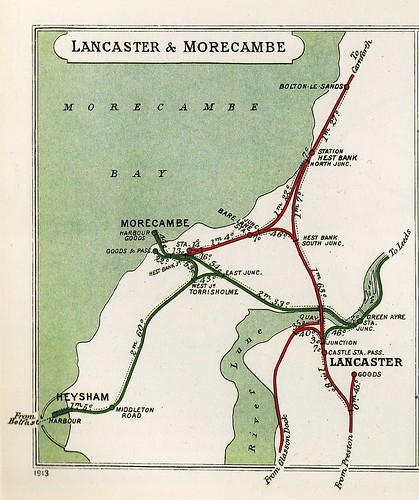
Details of the lines around Morecambe in 1913 originally published by the Railway Clearing House. Reprinted in 'Pre-Grouping Railway Junction Diagrams 1914', published by Ian Allen (ISBN 0 7110 1256 3).
The North Western Railway (usually called the 'Little North Western' to distinguish it from the mighty L&NWR) built a line from Settle to join up with the Lancaster and Carlisle Railway (now part of the West Coast Main Line) and that spawned a branch to Morecambe, terminating at Northumberland Road, which opened in 1848. This branch was first leased by the Midland Railway in 1859 and subsequently acquired by them.
The L&NWR constructed its own branch from their main line to Morecambe in 1864. This branch initially shared the Northumberland Road terminus but, in 1886, a dedicated L&NWR terminus opened at Euston Road.
The Midland Railway were anxious to develop the Irish traffic and in 1904 opened a branch to a new ferry port at Heysham. In 1907, the Midland replaced Northumberland Road station with a spacious station nearer the sea called 'Promenade'. Keen to try out electric traction, the Midland's Lancaster - Morecambe - Heysham network was electrified in 1908 at 6,600 volts, 25Hz a.c. with overhead current collection. This scheme was very successful but, by 1951, the electric rolling stock was life-expired.
British Rail decided to refurbish the line, changing the supply frequency to that of the National Grid - 50Hz, so as to provide a test-bed for subsequent main line 50 Hz electrification. Steam-worked push and pull services maintained the service from February 1951 until August 1953 when the 50Hz electric trains resumed operations. See Steam around Morecambe for more details.
In 1966, as part of Beeching's simplification of the network, the former Midland line from Lancaster Green Ayre to Morecambe (and the electrification) was abandoned and remaining services from the West Coast Main Line were routed into Morecambe Promenade station.
In 1994, a new station was opened a little inland of Morecambe Promenade and the now-redundant area around Promenade Station was redeveloped, although the main building on the promenade was preserved for non-railway purposes.
Wikipedia has an article on the Morecambe Branch here.
The Routes in the 1950s
In the 1950s, the routes were mainly controlled by semaphore signals, manual signal boxes and Absolute Block Signalling.
Ex-L&NWR signal boxes:
Lancaster No. 1
Lancaster No. 2
Lancaster No. 3
Lancaster No. 4
Morecambe South Junction
Hest Bank
Bare Lane
Morecambe Euston Road
You can find detailed signal box diagrams in the excellent series of publications from the Signalling Record Society 'British Railways Layout Plans of the 1950's'. Lancaster (Castle) and the L&NWR lines to Morecambe (Euston Road) are in 'Volume 6: West Coast Main Line (Euxton Junction to Mossband) and branches' (ISBN: 1 873228 05 8).
Ex-Midland signal boxes:
Ladies Walk
Lancaster Green Ayre
Torrisholme Jn. No. 1
Morecambe Promenade
Torrisholme Jn. No. 2
Heysham Moss Sidings
Heysham Harbour Jn.
Heysham Harbour Jn.
Again, you can find detailed signal box diagrams in the Signalling Record Society publication 'British Railways Layout Plans of the 1950's'. Lancaster (Green Ayre) and the Midland lines to Morecambe (Promenade) and Heysham are in 'Volume 12: ex-MR Main Line Carlisle to Leeds, associated branches and joint lines' (ISBN: 1 873228 15 5).
The Routes in 2013
The double-track West Coast Main Line is now electrified at 25 kV a.c. and the other routes are either abandoned or simplified. The entire area is signalled with colour-light signals remotely controlled from Preston Power Signal Box. To see what remains in 2013, refer to 'Railway Track Diagrams Book 4: Midlands & North West', Third Edition, published by Trackmaps (ISBN: 978-0-9549866-7-4).
Lancaster station today
This L&NWR station on the West Coast route was formerly called Lancaster (Castle) to distinguish it from the Midland Railway's Lancaster (Green Ayre) station. Well, the Castle still sits on the hill brooding over the L&NWR station but the station is now simply called 'Lancaster' and is one of the stations operated by Virgin.
 Lancaster Station looking north with a 'Pendolino' arriving in platform 3.
Bare Lane station today
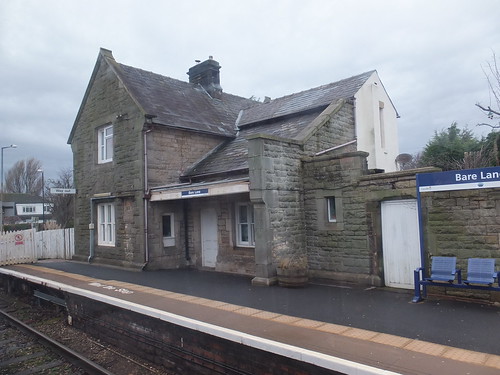
Bare Lane has become a rather curious junction. Two single lines approach from the West Coast Main Line, forming a triangle. Trains from Lancaster direction leave the main line at Morecambe South Junction. This was formerly a double-track connection but is now singled. Trains from Carlisle direction leave the main line at Hest Bank: this connection was always single. I didn't visit Hest Bank this time but there's a post based on a visit to Hest Bank back in 1967 titled Track Diagrams: Hest Bank. The two single lines combine east of Bare Lane station and then immediately split into two parallel single lines (the original double track L&NWR route converted into two 'long sidings' both used by trains in both directions from Bare Lane to the new Morecambe station each used by trains in both directions). The former Down line is now designated 'Heysham' and the former Up line is designated 'Morecambe'. The Bare Lane signal box structure (with lever frame) remains, overlooking the barrier-controlled road crossing. Colour light signals control movements through Bare Lane. The Bare Lane signal box controlled the area until 2012, when Preston Power Signal Box took over.
 The attractive stone-built former station building on what was the Up platform at Bare Lane.
Morecambe station today
The original Morecambe station lay right on the promenade and its rather grand station building survives (listed Grade II) although now divorced from the railway. The L&NWR built their own route to Morecambe with a separate terminus a little inland called Morecambe (Euston Road. Crossovers between the L&NWR and Midland lines outside both stations allowed trains from the L&NWR to arrive at either station. This juxtaposition of the two routes has allowed a fairly ingenious adaption of the original complex arrangement of lines to today's very simple facilities. The two parallel single lines from Bare Lane divert onto the former Midland trackbed and continue to an island platform at the present station.
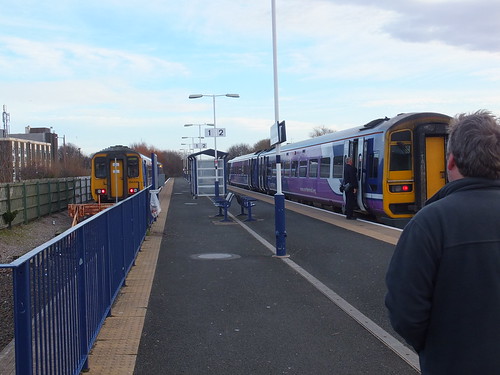
 Rush hour at Morecambe: view from the buffer stop end looking towards Bare Lane. Class 156 Lancaster train in platform 1 (left) and Class 158 Leeds train on right.
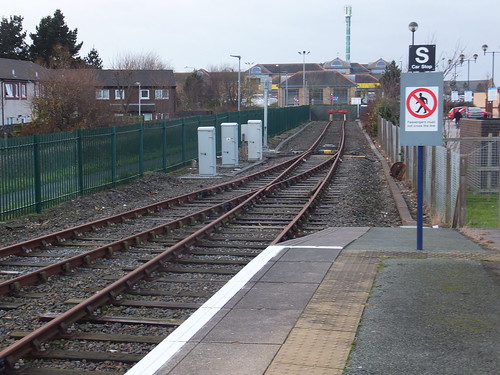
The 'Morecambe' line (platform 1) is just a simple siding but the 'Heysham' line (platform 2) has a run-round loop. This is so that nuclear 'Flask' trains arriving at Morecambe for Heysham Nuclear Power Stations can run-round before reversing direction and diverting onto the single line to Heysham. The connection to the Heysham Branch is normally set for running to and from Bare Lane, but a 2-lever ground frame at the junction points (I assume electrically released from Preston P.S.B.) allows the train crew to change the points. The points at either end of the run-round loop appear to be spring operated without manual levers. There is a 'Point Indicator' reading from headshunt to the run round loop. The 'Point Indicator' looks like a 2-aspect colour light signal and presumably is lit yellow when the points are correctly fitted-up for the loop, as proved by an electrical detection box.
 View of headshunt beyond platform 2 and spring points set for the run round loop.
The view below shows the present junction with the Heysham line.
 This view, from the Westend Road bridge shows the two lines to Bare Lane on the left, the single line to Heysham curving away at the top. In the centre, the two-lever ground frame with the 'Point Indicator' for Up movements adjacent. The are two more point indicators for Down movements on the left of the junction. On the right, the spring points at the Bare Lane End of the run-round loop.
The Ground Frame is operated by Train Crew - on my journey to Heysham, the driver had a trainee with him. We stopped clear of the points, driver and trainee both climbed down, shutting the door from outside (the 'Pacers' don't have a separate driver's door). My picture below shows the trainee with the cabinet open, presumably obtaining the release. The Point Indicator changed from 'Yellow' to 'flashing red' whilst he inserted the release key into the ground frame, operated the release lever to reverse (withdrawing the Facing Point Lock from the point stretcher), operated the second lever to change the points for the Heysham line, placed the release lever normal (inserting the Facing Point Lock through the second notch in the point stretcher) and withdrew the release key. I assume they carried the key as authority to occupy the line, but I didn't spot it. The point indicator had gone back to 'yellow' as the driver and trainee clambered back on and we set off for Heysham, bouncing quite well (as these dreadful Class 142 4-wheel vehicles do).

The 2-lever ground frame controlling access the the Heysham branch.
Heysham Port station today
Just before arriving at Heysham station, we passed another 2-lever frame (presumably released by the release key used at the Morecambe end) which allowed trains into the Power Station Siding. We continued to the present single used platform. The remains of the original three platforms were still visible, but only one was served by railway track. Originally, the three platforms were longer and led to pointwork at the far end of the station but a modern ferry terminal now occupied the space. I remember the all-over roof originally made it a rather dark station. Although the roof has now gone, many of the supporting columns remain, with a 'T' shaped head where the horizontal supporting girders had been cut short. I was able to take a few pictures before the train returned to Morecambe.
 Heysham Port station.
After a few minutes, we were approaching Morecambe. The driver stopped when the train was clear of the Heysham junction points (the guard at the rear 'buzzed' the driver when he was 'over') and the driver and his trainee worked the Ground Frame to restore the points to the Bare Lane direction, ready for their working to Lancaster and then Leeds. Having picked up more passengers at Morecambe station, we made our way back to Lancaster, where I left the train.
Heysham Port and its Ships
There's a Wikipedia article on the port here. Heysham Port is now operated by Peel Ports (who operate a number of U.K. ports, including Liverpool.
Years before, I'd seen British Rail's TSS Duke of Lancaster which operated on the Heysham - Belfast route. This ship was a replacement for the earlier L.M.S. owned RMS Duke of Lancaster. Oddly enough, the 1956 'Duke of Lancaster' can still be seen, beached in a creek on the North Wales coast. Nowadays, the Belfast service is operated by Seatruck Ferries with a fleet of modern 'Roll-on, Roll-off' ferries. I found the Seatruck Ferries site particularly helpful - there's comprehensive data on each of their vessels, including Seatruck Panorama which was berthed on the South Quay.
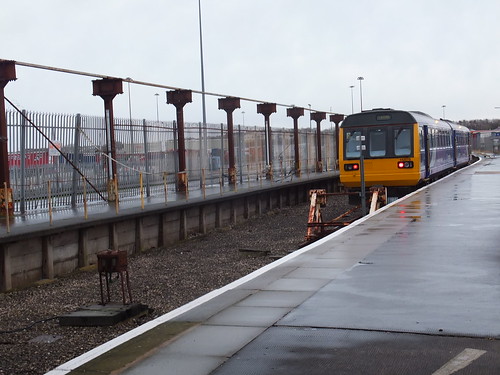
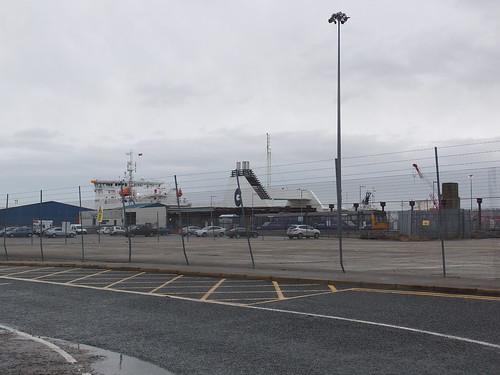
 A fairly deserted Heysham Port, viewed from the approach road. 'Seatruck Panorama' is berthed on the South Quay, dwarfing the 'Pacer' which would return me to Morecambe.
Heysham Nuclear Power Stations
I was surprised at just how close to Heysham Port railway station the two power stations were. The Advanced Gas-cooled Reactor (AGR) was heralded as the way forward when introduced but technical difficulties during meant that that promise was unfulfilled. There are useful Wikipedia articles on the AGR design and the two slightly different designs in use at Heysham Nuclear Power Stations.
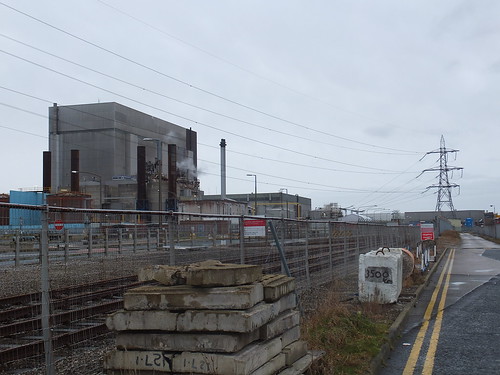
 View of Heysham No. 1 Power Station from the road. Note the railway sidings beyond the fence. The output from the power station is delivered by the dual three-phase high voltage transmission line. Heysham No. 2. has its own transmission line.
Since we 'privatised' our electricity production and distribution, the two Heysham Power Stations have been operated by EDF Energy which is owned by the French state-owned organisation Électricité de France. Huh? There's information on the web which is regularly updated - see Heysham No. 1 and Heysham No. 2.
The two dual transmission lines from the two power stations enter a High Voltage Switch Yard after a few hundred yards and from there, various transmission lines march off to serve different areas.
 The High Voltage Switch Yard just outside Heysham Port Station.
My pictures
Morecambe (includes pictures of former Promenade station building).
Morecambe area railways.
Lancaster area rail.
[Spelling of 'Torrisholme' amended - 24-Mar-2014]
The narrow gauge Ashover Light Railway ran from the industrial complex of the Clay Cross Company at Clay Cross to Ashover in Derbyshire. Intended to serve the Company's quarries, the railway also developed a healthy passenger traffic. A stud of ex-World War I Baldwin steam locomotives worked the line.
For more information about the history of the Ashover Light Railway, see the Wikipedia Article.
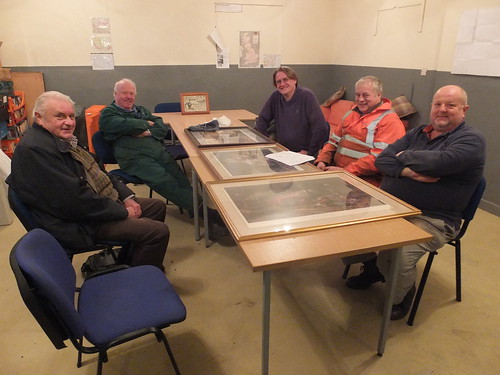
The line is now long-gone but still inspires enthusiasts, a group of whom have formed the Ashover Light Railway Society. On 9th November 2013 I was invited to a meeting between Henry Frampton-Jones of the Derbyshire Dales Narrow Gauge Railway and Trustees of the Ashover Light Railway Society at their workshops in Sheffield.
 Trustees of Ashover Light Railway Society at a meeting with Henry Frampton-Jones in Sheffield. L-R: Henry, Richard, Andrew, Jonathan, Graham.
The Society has acquired a selection of rolling stock, mainly from the Ashover Light Railway and is carrying out an active restoration programme. I was most impressed with the work I saw and my pictures don't really do justice to the high standards achieved.
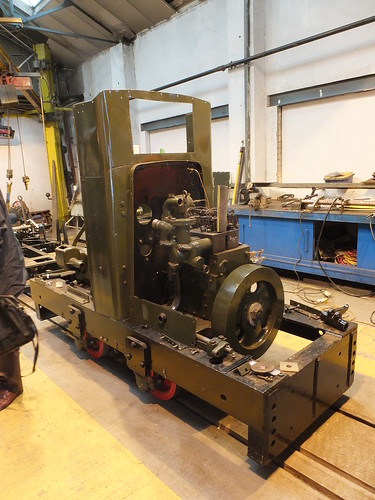
The restoration of a Ruston diesel shunter is now nearing completion.

Ashover Light Railway Society: Ruston shunter under restoration.
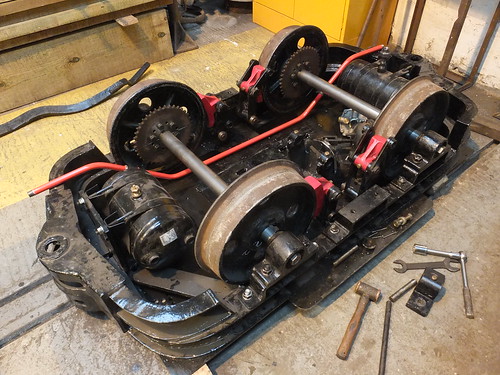
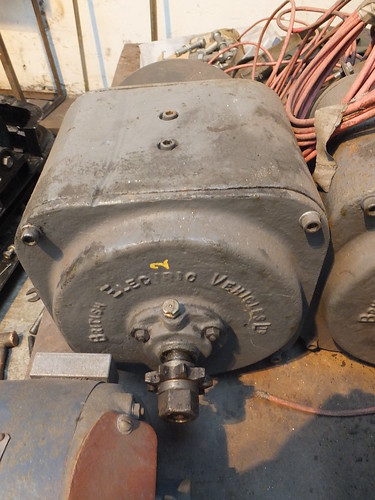
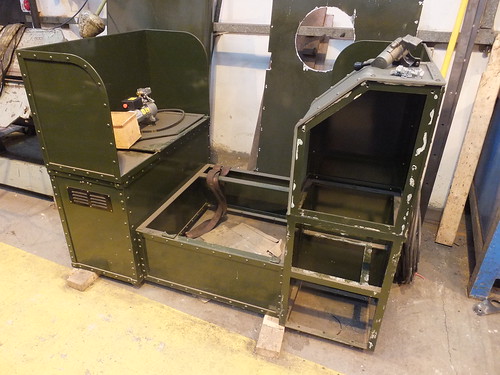
A battery electric Shunter is also well-advanced. I believe that it originally worked in a power station, having been constructed in the power station workshops. The two electric notors are by British Electric Vehicle, often known as 'BEV', which was originally based in Southport.
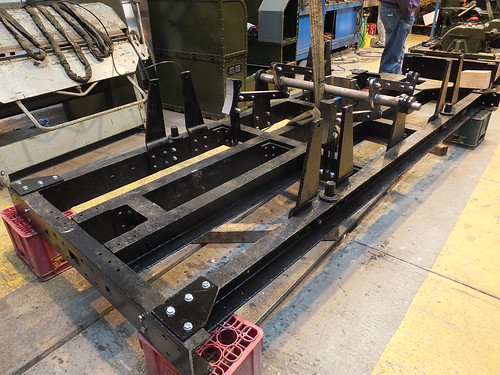
 Underframe for Battery Electric Locomotive (inverted) under restoration. Note the sprockets on the far wheels for chain drive from the two motors. The underframe appears to have been modified from a mining tub wagon.

Ashover Light Railway Society: One of two electric motors for the Electric Locomotive under restoration. Note the sprocket on the end of the armature for chain drive direct to the wheels.
 Body for Battery Electric Locomotive under restoration.
A number of items of rolling stock from the Ashover Light Railway have been acquired and restoration is being carried out, as circumstances permit.
 Coach Underframe (inverted) under restoration.
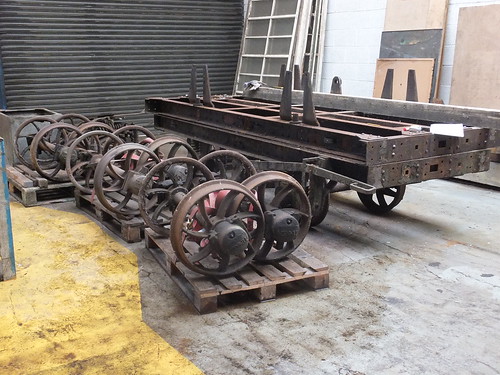
 Two Coach Underframes awaiting restoration, together with various wheelsets and Timken axleboxes.
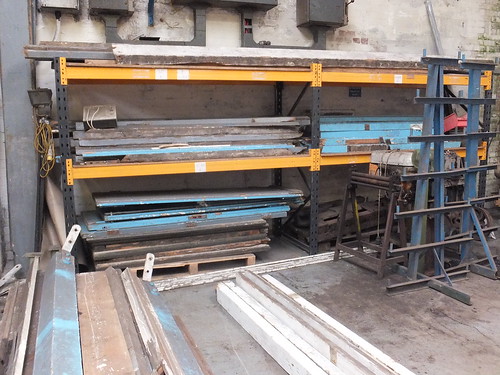
The Society is currently completing a detailed catalogue of the timbers from the dismantled 'End of the Rainbow' Restaurant' which originally was a very distinctive feature of the railway at Ashover.
 Timbers from the 'End of the Rainbow' Restaurant in store, pending future rebuilding.
However, perhaps the most improbable artefacts held by the Society are the remaining parts of the 'Sentinel' steam locomotive formerly used on the Jaywick Miniature Railway. But that's another story.
To find out more about the Ashover Light Railway Society, refer to their website here.
Books
'The Ashover Light Railway' by K. P. Plant (Locomotion Paper No. 30) published Oakwood Press.
My Pictures
Ashover Light Railway
Having a 'free day' on Saturday 14th December, I decided to have a day out by rail. A brief internet timetable search suggested Morecambe as a suitable destination. I was surprised to find that the branch from Morecambe to Heysham still had a passenger service, albeit only one return working on the day of interest, so I determined to try to make it back to Heysham (sixty-odd years after my first trip there by rail).
On a Saturday, the first bus into Wolverhampton (where I normally catch trains) leaves at 08:05 and doesn't arrive in Wolverhampton until about half past eight. Allowing for the walk from the bus to the station and the need to buy a train ticket, it didn't seem very likely that I'd be able to catch the 08:37 to Edinburgh but, in fact, I just made it. The 'Pendolino' made an uneventful journey to Lancaster.
The station buildings in stone at Lancaster are listed Grade II. There's more on the British Listed Buildings site here.
 Lancaster: View from Station Road of part of the station buildings on the Down side.
I spent a few minutes taking photographs before boarding the Morecambe train, arriving at a windswept Morecambe around 10:40. Outside the small, modern station building a dual carriageway led me via an equally-modern retail park of large warehouses to the promenade. Sixty years ago on my first visit to Morecambe, it was all very different - no dual carriageway, no retail park. Morecambe Bay itself presented the rather grey, forbidding appearance which I remembered from previous visits.
On the landward side of the promenade, I came to the stone-built preserved station building of the long-closed Morecambe Promenade station, which had so impressed me on my first visit. This is now a Grade II listed structure part of which is doing duty as a tourist information office. The roofed concourse area has been converted into a performance area called The Platform. See the British Listed Buildings site here.
 Morecambe: The elegant facade of the former Promenade station.
Having photographed the station building and obtained a free street map from the friendly tourist office staff, I crossed to road to the distinctive art-deco Midland Hotel, still occupying its prominent location on the seaward side. Now listed Grade II*, it's been restored. There's more on the history of this iconic hotel on the 'Friends of the Midland Hotel' site here. The British Listed Buildings entry is here.
 Morecambe: The Midland Hotel.
It was too early for lunch, but the hotel was serving morning tea and coffee in the (rebuilt) Sun Terrace room. I spent a pleasant half-hour here before heading east along the promenade to the War Memorial where I continued along the beach. It was blustery and starting to rain, but still pleasant.
 Morecambe: The Beach.
I left the beach near the Clock Tower, having spotted The Old Pier Bookshop. This is a labyrinthine wonderland of second-hand books - I can't improve on the affectionate review I afterwards found here (on the 'Nothing To See Here' site). Carrying my purchases, I made my way back through the town to the railway station, in time to catch the Heysham Port train along with two middle-aged gentlemen.
The train took us to a deserted Heysham Port where the station was adjacent to the equally-deserted Ferry Waiting Room. It was clear that no ferry departure was imminent, although Sea Truck Ferries Roll-on, Roll-off ferry 'Sea Truck Panorama' was berthed against the south quay. I had less than twenty minutes to explore before the train returned to Morecambe. Outside the station, the most noticeable feature was the two nuclear Power Stations (logically known as Heysham 1 and Heysham 2) just a few hundred yards away.
 Heysham 2 (l) and Heysham 1 (r) Nuclear Power Stations, viewed from the Ferry Port car park.
I took the public road leading away from the ferry area. If time had permitted, I could have walked to Heysham Village or even continued to Morecambe but, anxious to catch the train back to Morecambe, I didn't get far in the time available. Returning to the train, I was amused to find that the two other passengers had not even troubled to get off before returning to Morecambe. Certainly, the 2-car 'Pacer' was considerably warmer than outside - still overcast and with light rain.
The train made its way back to Morecambe where the train crew 'changed ends' so I didn't have to get off before being returned by the same train to Lancaster. Here, I had a little time to take more photographs of the station and its buildings before catching a southbound service to Wolverhampton. I was even early enough to catch the four o'clock bus back home.
I've deliberately omitted the railway, shipping and power generation technical comments from this post - they can be found in the post Railways around Morecambe.
My pictures
Morecambe.
Morecambe area railways.
Lancaster area rail.

SEASON'S GREETINGS!
No, it's not snowing at present - that's just a suitable snow scene (the picture was actually taken in January 2013). A few days before Christmas it's dull, it's raining, it's cold but it's not snowing (yet).
This is just to wish all my friends and readers Best Wishes for Christmas and the New Year.
If you are keen on snow and ice, you could read The Battle of Brewood or, for really serious snow enthusiasts, try Arctic Adventure.
Introduction
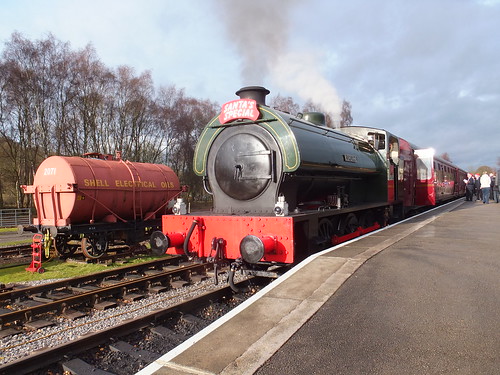
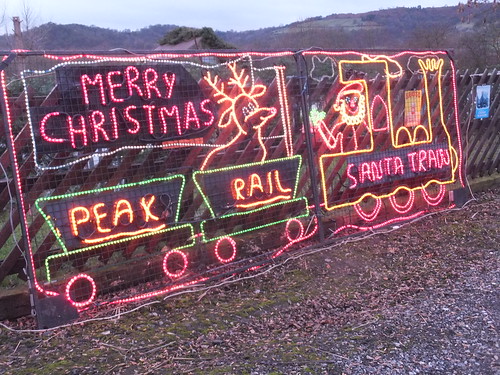
The 2013 season of Peak Rail 'Santa' trains started on 7th December, when I was the driver of 'Lord Phil', with Dave as fireman. When I arrived, the locomotive was on the outside pit facing south, ready to top-and-tail the 'Santa' train with 'Penyghent'. Dave already had matters well in hand as far as steam raising went, so I busied myself oiling round. Roger brought us the train staff and we were ready to come off-shed at the booked time, 10:00. The Special Traffic Notice had said we'd have a 7-coach train, but there were only 5 coaches standing in the platform, because the 2-coach 'Palatine' restaurant set had been shunted onto the 'Third Line'. This meant that we had to reach our train by leaving the depot via the 3-lever ground frame at the north end which is released by the train staff. We then headed south on the run-round loop, 'trailing' the trap points at the north end of the run-round loop which are controlled by a second ground frame. I came to a stand at the ground disc signal controlled from the 3-lever ground frame at the south end of the loop. The white signal disc has a yellow bar, rather than red, so as to permit movements into the headshunt when the signal is 'on'. Dave walked forward to the ground frame, reversed the crossover and cleared the signal. I moved the engine forward onto the single line, Dave restored the points, removed the train staff from the frame and climbed back onto the footplate. We then moved up to the waiting 5 coaches, Keith the guard called us on and Dave 'tied us on' and started steam heating the train.
 'Lord Phil' at the head of the 10:45 'Santa' train.
Steam Heating
With British weather, carriage warming during the heating season is important. Warming is carried out by passing an auxiliary supply of steam from the locomotive via flexible hose couplings between vehicles to radiators in each coach, typically at a steam pressure of about 30 pounds per square inch. This is only a fraction of boiler pressure so steam from the boiler is admitted to the heating system through a Reducing Valve. It takes a while for steam to work its way through the train so it's usual to open the steam heat cock on the back of the train until steam can be seen escaping, assuring that all the intermediate cocks between carriages are open and the steam heating hoses correctly coupled. Ideally, this process should be started well in advance of departure to give the coaches a chance to start warming before the passengers board. Since the train was rather cold, we were asked to increase the pressure somewhat to improve matters. Once steam heating is started, the fireman needs to account for the extra demand for steam which will increase water and coal consumption.
Of course, as originally built the 'Austerity' locomotives, like 'Lord Phil,' were not provided with steam-heating or vacuum brake facilities but restored locomotives used for passenger trains on preserved railways have had these features added.
There's a little more about steam heating in my article here.
In the old days on the 'big railway', it was common practice to allocate a special locomotive to the task of pre-warming rakes of coaches. At some carriage depots, stationary boilers were provided for this purpose. These were usually old boilers removed from locomotives (or even fairly complete locomotives). A stationary locomotive boiler does not have the advantage of the steam blast which, on a locomotive in motion, discharges used steam through the blast pipe into the chimney, enhancing the airflow through the fire. To make up for this deficiency, tall chimneys were usually added to create sufficient draught.
Working the trains
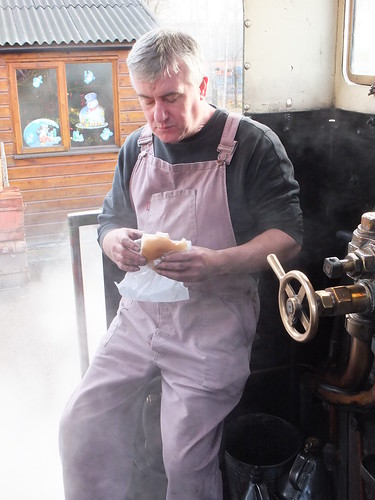
The timetable called for four trips top-and-tailed to Matlock Riverside, leaving Rowsley at 10:45, 12:15, 13:45 and 15:15. Dave and I had time for a bacon bap before we left with the first train.

Dave enjoys a bacon bap.
I usually concentrate on describing working on the locomotive but, of course, there are many other people required to keep a passenger railway running, including Signalmen, Guards, Stationmasters, Platform Staff, Ticket Office and on-train Ticketing Staff, Shop Staff and Catering Staff. These 'front line' roles are backed up by a host of support staff working on maintenance of the Permanent Way, Locomotive and Rolling Stock, Signal and Telegraph equipment and buildings. The majority of these roles on a preserved line are carried out by volunteers and the railway's Management has to ensure that volunteers are suitably trained and examined for the roles they undertake in addition to ensuring compliance with the myriad rules which apply to a passenger-carrying railway. It's hard enough to fill all these positions at any time of the year but the 'Santa' trains make extra demands because of the larger number of passengers normally carried and all the extra help needed to support Santa as he brings his special 'magic' to the railway.
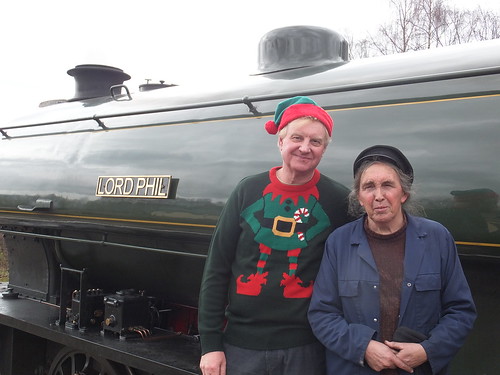
 A festive-looking John and Jan pose alongside 'Lord Phil'.
Both 'Lord Phil' and 'Penyghent' initially had a little trouble with 'dragging brakes'. This improved later in the day, possibly following 'pulling the strings' on all the vacuum brake cylinders of the coaches. By the time we were on our last round trip, it was becoming dark, showing up the illuminations on the platforms at Darley Dale to advantage. All the platform lights on the Up platform at Darley Dale were lit up, making the station look very inviting. Although the cast iron columns for similar lighting on the Down platform have been fitted and painted, they await the lanterns.

All the trains during the day were either full or well-loaded - there were certainly plenty of people around. Once we arrived back at Rowsley on the last train, we uncoupled and made our way across to the shed where Harvey coaled us, ready for the following day's service. We then stabled the locomotive on the outside pit and completed disposal. There's a general description of what's involved in disposal in the article MIC - Disposal. Once these duties were complete, Dave and I could 'sign off' after a satisfying day.
Related posts in this Blog
Santa Specials.
On the Footplate (Part 2).
My Pictures
Peak Rail 'Santa' trains 2013
Lord Phil.
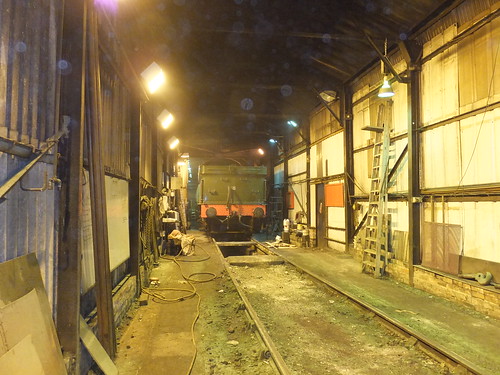
The Battlefield Line started its well-supported programme of 'Santa Specials' for 2013 on Saturday, 30th November. I was the booked driver the following day. This necessitated getting up at 4.20 a.m. in order to 'sign on' at Shackerstone a little after six. It was still dark but it didn't seem too cold. Dave, the fireman, was already in the engine shed emptying the ashpans on our locomotive - Great Western 3803. The engine was well-inside the shed, making it easier to admire the recently-installed additional lighting which has improved working conditions significantly.
 3803 in the shed at Shackerstone.
Dave and I worked together preparing the locomotive. He did the inside oiling for me and I fetched coal forward - only a few hundredweight remained in the tender, perched on top of the tender tank right at the back so coaling was going to be essential. Later, Jason arrived to carry on with re-painting a coach which was sitting in platform 1. Jason fired up a diesel shunter to propel the coach from platform 1 towards the DMU Siding, leaving the line clear for Dave and I to move 3803 through platform 1 to the coaling point in the North End sidings. Jason started the Bucket Loader and coaled our engine. I moved the engine across to platform 2 and Dave coupled us on to the head of our five coach 'Santa' train.
As stewards helped arriving passengers to their correct seats, we started to steam heat the train. Dave explained that they'd had a problem the previous day - the flexible hose under the footplate carrying steam for carriage warming from the locomotive to the tender was leaking and an additional jubilee clip had been fitted as a remedy. It was apparent that the problem was not completely cured, as clouds of steam swirled around the cab.
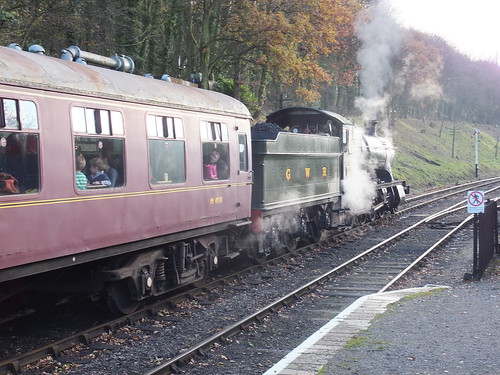
 3803 at the head of the 10:00 'Santa' train.
Eventually, all our passengers were boarded and, rather late, we set off on the first of four trips. The steam heating leak wasn't too bad but forward visibility through the cab spectacles was impaired. I had to lean well out of the cab to keep a lookout ahead. The situation seemed to improve later in the day probably because, as the air temperature increased, the drifting steam didn't immediately condense to form a thick fog. We had an uneventful run to Market Bosworth station. We were booked to stand here until Santa had worked his way down the train, speaking to all the boys and girls and giving them presents. The train was well-loaded, so we stood for twenty minutes or so.
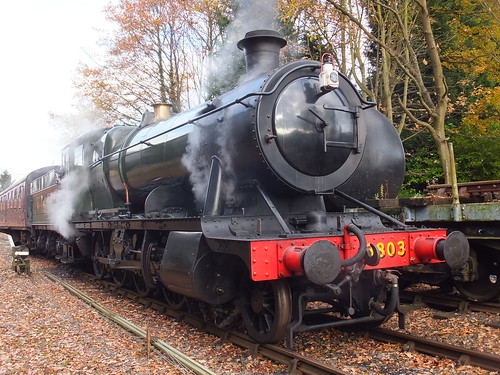
 The unmistakeable Great Western lines of 3803, waiting at Market Bosworth.
Eventually Martin, the Guard, gave us the 'Right Away' and we continued our journey to Shenton. I 'eased up' to slacken the coupling between the tender and the first coach and Dave 'hooked off', allowing us to run round our train, ready for the tender-first run back to Shackerstone.
I'm afraid we continued to run late throughout the day. We were able to make up a little time on the journey but each departure was a little late and, of course, the important thing was to allow Santa time with all our young passengers. The final departure from Shackerstone was the 16:00. We were still a little late away but this train was not filled to capacity.

Dave, in a cheerful mood.
Dave was suffering from an infection and had coped manfully with the heavy day but Jason had agreed to join us and fire the last trip. It was becoming dark as we left Shackerstone with trees and bridges silhouetted against a deep blue sky. People are often surprised that, in the age of steam in Britain, a steam locomotive driver had no view ahead at night. The lamps carried on the engine were purely for identification and the driver largely had to rely on sounds to know his location. In other countries, attempts were made to give the driver some visibility ahead (I always think of the classic American 4-4-0 bearing a huge oil searchlight in front of the diamond stack). Of course, on Network Rail all trains, including those hauled by steam locomotives, now have a high-intensity headlamp but preserved railways continue the tradition of 'running in the dark'.
On arrival at Shenton, we ran-round for the last time and were soon on our return journey to Shackerstone. By this time, it was properly dark. The driver is always on the look-out for signals and, traditionally, semaphore signals were lit by paraffin lamps. There's a little about the lighting of signals here. On preserved lines, signals are often converted to being electrically lit, for convenience. Approaching Shackerstone, the first lit signal is the outer home, which was showing a cheerful 'Green' (there is a preceding fixed distant signal, but this is not lit). We dropped down the bank towards the signal box, complying with the 10 m.p.h. speed restriction and observing the two red lights of the inner home (a two disc ground signal - there's a daytime picture of this signal here). As we approached, the lower red light turned to green, beckoning us into platform 2. With a 5-coach train, we had to stop with the engine fouling the barrow crossing to platform 1. Since the footbridge is still closed, all our passengers had to wait for Dave and I to unhook the engine and draw forward over the hand points at the north end, where we waited until everybody had made their way across to platform 1. Once the foot crossing was clear, we headed for the shed and quickly completed our disposal after an enjoyable, if tiring, day.
Related posts in this Blog
Santa Specials.
Locomotive 3803.
Railway Signalling in Britain: Part 4 - Semaphore Signal Aspects by Night.
My Pictures
Santa at Shackerstone 2013
3803
My post Jan Ford's Travels lists the 'Grand Tours' I embarked upon starting in 2001 but I'd had a number of trips abroad before then. I've now listed most of these earlier trips although details are rather vague, I'm afraid. Even dates are approximate until I find other evidence. I haven't all my old passports (one passport was stolen while current in Centraal Station Amsterdam).
If there's already a blog post, I've provided a link and, if I've found any photographs for the trip, they are also usually linked. There's also a post Jan Ford's Travels: Around the World in pictures.
Alternately, if there are sets of photographs, you can go directly to the list of all my collections here, where collections for each country visited are listed in alphabetical order (followed by 'special interest' collections on railways, charitable initiatives and similar).
France (1951)
My first overseas trip was a day trip to Boulogne with my mother around 1951. There's a short report here.
Republic of Ireland (1972-1973)
In 1972, my firm, Ford Electronics, undertook a railway project for Westinghouse Brake and Signal in Eire. Various staff from Ford Electronics, including the writer, made a number of trips to Eire during the installation and commissioning phases. It was an interesting time which I've not yet described and, at the moment, there are no pictures.
Germany (1976)
In 1976, Ford Electronics started design work on the Trunk Line Electrification Project in Taiwan for G.E.C. I made a couple of visits to Frankfurt, visiting the German consultants on the project. No report or pictures at present.
Holland (1977)
I made my first visit to Amsterdam with my mother. No report or pictures at present.
Taiwan (1977-1978)
In 1977 and 1978, I made three trips to Taiwan in connection with telecommunications equipment we supplied to G.E.C. for the Trunk Line Electrigfication Project. There's a short report here. No pictures at present.
Holland (1980)
In 1980, I became a weekly commuter for some months when carrying out consultancy work for Philips, briefly described here. Later, I visited a couple of times with my partner Daemon. No pictures at present.
Italy (1980)
My first trip to Italy was a visit to Milan in connection with consultancy work for Philips. Later, I made a trip to Venice. No report or pictures at present.
Korea (1980)
I visited Seoul with a team from Philips when they were engaged in tendering for a project in Iraq. There's a short post here. No pictures at present. I've only transited through Incheon since (on my Trip to Japan here).
Poland (November 1981)
The Soviet Empire was shaken in 1980 by the emergence of an independent trade union in Poland - 'Solidarity'. My mother was keen to visit and she and I spent a few (rather tense) days in Warsaw. The following month, Martial Law was declared. There's no report or pictures yet.
Paris (1982)
My firm was involved with an American computer company Dynabyte. A trip to Paris for a Dynabyte seminar gave me a little time to explore the city. No report or pictures at present.
Thailand (1988-1989)
I made 5 trips to Thailand in 1988-1989 in connection with the commissioning of the Train Despatcher Project for G.E.C. On the last of these visits, I took part in the 'Train Despatcher Project I & C Seminar' described here, with pictures here. No other report or pictures at present.
Switzerland (1989)
I visited the International Telecommunications exhibition in Geneva when it was known as the CCITT exhibition (from the French Comité Consultatif International Téléphonique et Télégraphique). In 1993, CCITT became ITU-T (for International Telegraph Union Telecommunication Standardization Sector). After visiting the show, I extended my stay to spend a couple of days dashing round the country by train, with a side trip to Italy through the Simplon Tunnel. Sorry, no report as yet and no pictures.
Thailand (1990)
I made a further trip to Thailand to assist in the opening of the Bangkok Railway Museum, described here.
India (1992)
My first visit to India was in connection with the commissioning of telecommunications equipment for the Delhi Ring Railway. I flew to Delhi in May 1992, returning almost seven weeks later. There's a post here, with a link to a continuation post here. The continuation post has a series of links to railway and travel photographs.
[Link to Jan Ford's Travels: Around the World in pictures added 12-Nov-2015]
An American correspondent recently wrote to me, describing a visit to Surbiton railway station, which he found "remarkable", although his preference would be for a rather earlier architectural style. I completely agree with those sentiments. I'm not usually a fan of Art Deco but the 1937 building designed by the Southern Railway Architects' Department under J. R. Scott is impressive, fully justifying its Grade II Listing.
 Surbiton Station (Photo: Ok2010 (Own work) [CC-BY-SA-3.0 (http://creativecommons.org/licenses/by-sa/3.0)], via Wikimedia Commons.
The (rather terse) description of the building in 'Architect Speak' is:-
Reinforced concrete, painted. Flat roof. 4 bay central tall single storeyed booking hall,
flanked by low, narrow bays containing kiosks, curvng backwards to meet long, low
wings. Continuous cantilevered canopy of concrete to centre and wings, with moulded
edge. Clock tower to left with strong, but narrow cornice and horizontal strings to
upper, set back part. Long square headed windows with narrow closely spaced
mullions to booking hall. Original wood and bronze doors below, with triple bronze
bars in front of long narrow windows. Central facia to canopy with "Surbiton" in
sans serif capitals. Marble lined booking hall. Two long single storeyed buildings
remain on platforms; also reinforced concrete, with rounded ends and horizontal
glazing bars to windows. Built to contain offices, lavatories and waiting rooms.
Similar ideas were employed in a number of suburban stations on the extensive electrified network, neatly reinforcing the impression that the Southern was a modern, forward-looking railway. Buildings with rounded ends (mentioned above) were a recurrent motif, being frequently applied to signal boxes of the period.
 Former Wimbledon 'A' signal box on the right. The area is now controlled from Woking.
Railway architecture is one of my interests and my collection of pictures Railways (UK) includes a number of photographs of buildings, bridges and other constructions (now termed 'the built environment'). Having introduced one outstanding Southern Railway building above, I thought I'd make reference to a few other Southern Railway buildings. The Southern Railway was formed by the amalgamation of the London and South Western Railway, the London, Brighton and South Coast Railway, the South Eastern and Chatham Railway and other minor companies in the 1923 'Grouping'.
I've written about the L.S.W.R. terminus at Waterloo here and my pictures are here
Victoria Station is two stations, side-by-side, one for the L.B.S.C.R., one for the S.E.C.R., as described in my post here. My pictures of Victoria are here.
Clapham Junction is a combination of L.S.W.R. and L.B.S.C.R. routes, described here with my pictures here.
There are also pictures of railway buildings in the set London: former 'Southern' lines, in the set London's Railways (although not all the buildings in this set are former Southern Railway) and in the set London Bridge Station.
Related articles on other sites
Surbiton Railway Station (Wikipedia).
Subiton Station.
The Southern Railway (Wikipedia).
British Listed Buildings.
I hope to return to this theme in the future.
 A screenshot from Keith's presentation showing Walsall station, with its round booking hall.
 Birmingham New Street Signal Box
 The part-commissioned West Midlands Signalling Centre, Saltley, Birmingham now controls Walsall area.
 The rebuilt concourse at the 'half-rebuilt' Birmingham New Street Station.
 Park Street Tunnel viewed from platform 1. Note the new signal, controlled from the West Midlands Signalling Centre. The control code 'DR' stands for 'Droitwich - Ryecroft'!
 Bescot end of Walsall station showing a Class 70 with a container train. Note the new signals on the Up Fast, Platform 3 and Platform 2 (showing double yellow for a DMU which will shortly depart for Birmingham).
 Aston North Junction, showing converging line from Lichfield. Note the elevated M6 motorway in the background.