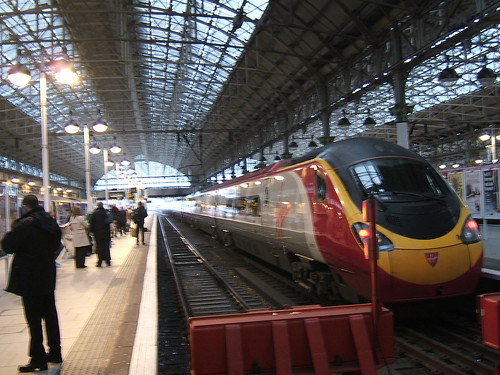
On Tuesday, 12th March 2013, I joined a group from the Museum of Science and Industry in Manchester for a tour 'behind the scenes' at Manchester Piccadilly Station. This had been arranged by Adrian Bailey, a regular volunteer on the railway at the Museum having retired from the 'Big Railway'. Thanks go to Adrian and the Network Rail staff we met for a most interesting evening.
We met just after 6.00 p.m. on the Concourse, near the Network Rail Reception. Before the tour could start, we each had to provide a 'Photo I.D.' to the receptionist who entered our details onto the computer system and took a photograph. Seventeen individual passes were then printed, fitted into a holder and issued. Security is taken very seriously.
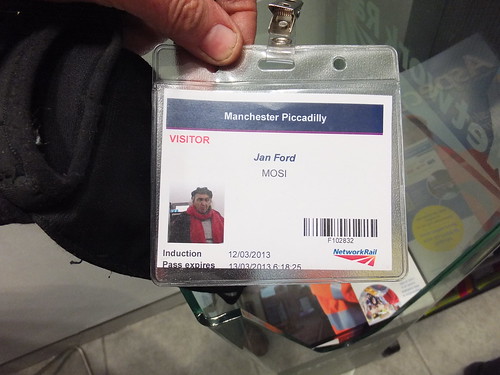
Once we all had our passes, we were welcomed by the Station Manager and Duty Station Manager. After a brief introduction, we moved upstairs to the station control room.
Announcer's Room
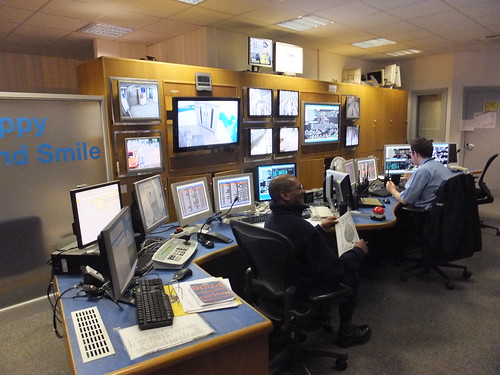
The station control room is often called the Announcer's Room but its duties are much broader and, in the event of an incident, it takes command of all actions. Train announcements are now issued by a computerised system. All possible announcements are pre-recorded, stored digitally and then issued automatically according to the timetable, unless the operator intervenes on his computer screen as is frequently necessary. The operator not only has access to displays showing the identity, location (and lateness) of all trains in the immediate area but also further away. The operator can examine in detail the planned and actual timing of any train throughout its journey. The Station Manager was proud of the fact that the announcements are recorded not by a professional actor but by a lady Network Rail employee from the offices with a suitable voice. The system also controls the large number of PIDs (Passenger Information Displays) around the station.
A large station like Manchester Piccadilly (whose 14 platforms handle more movements daily than Euston with 18 platforms) is a potential terrorist target. The whole station is searched for suspicious packages every hour. The effectiveness of these searches is tested periodically by the Department for Transport, who place test 'suspicious packages' on the station for the staff to find. Manchester Piccadilly has a good record for promptly locating such test packages.
Closed Circuit Television plays an important part in keeping passengers safe. The station has over 400 colour cameras, all available on the various monitors in the Announcer's Room. The smaller monitors normally cycle through a number of cameras. The whole system is controlled from computer screens which can display scale plans of each area showing the location and identity of the cameras.
Comprehensive Fire Detection systems are installed throughout the station area. In the event of an alarm, the first action is to detail a member of staff to investigate. Evacuation only occurs after a confirmed alarm or multiple alarms. Again, computer screens display scale plans of each area showing the location, identity and status of detectors.
The Announcer's Room also controls the staff who provide assistance to disabled or elderly passengers.
Manchester Piccadilly Undercroft
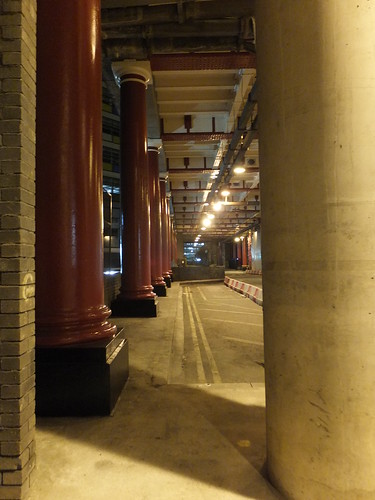
The Trainsheds covering the platforms and the Undercroft on which they're built are listed structures and efforts have been made to retain as much as possible. In contrast, the concourse, offices and retail outlets are very modern. We descended to the Undercroft from the Announcer's Room via modern, grey-painted steel stairs.
View showing original columns supporting the Trainshed above and access road for delivery vehicles.
In areas built using brick arches, the original arches have been restored and then modified for their present uses with blockwork. The Undercroft has allowed a secure road network to be created allowing the retail outlets to receive deliveries by road and hold the stock in individual store rooms underground. As required, stock is taken to the shops by wheeled crates, minimising disruption in public areas. The undercroft is a rabbit warren of roads, car parks and passages and, by the time we had finished, I was thoroughly disorientated. We left through a pair of doors directly onto Piccadilly 'Metrolink' tram station, and I felt a little like the rabbit emerging from the hole in 'Alice in Wonderland'. We walked back to the concourse of the main station and took a non-public lift up to the third floor.
Manchester Piccadilly Signalling Control Centre
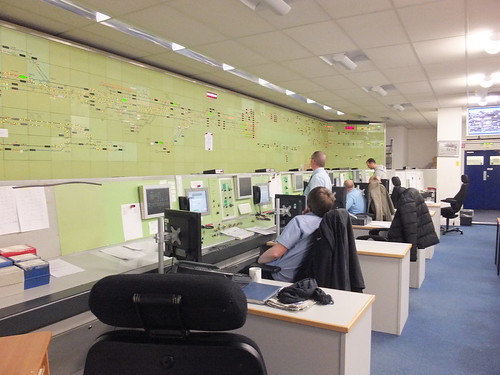
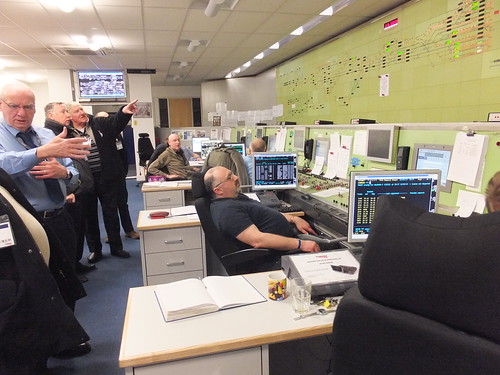
A huge illuminated display of the area controlled dominates the room. The control method is 'NX' ('eNtrance-eXit') but, whereas a 'classic' control panel would combine the indications and control pushbuttons in a single track diagram at which the signallers worked, at Manchester all indications are presented on a very large, vertical illuminated track diagram of the area with the control pushbuttons grouped onto five smaller non-illuminated track diagrams, one for each of the five control zones. These pushbutton panels are arranged horizontally in front of the five signallers, allowing the signaller to work whilst seated, if preferred. Each signaller has a desk immediately to their left, with a computer screen enabling a wide range of data to be readily accessed. Presumably the separation of the pushbuttons from the illuminated diagram was intended to make the signaller's task less strenuous - a large 'classic' 'NX' panel involves a lot of walking up and down and reaching up to access pushbuttons as required.

Of course, there are plenty of other computer screens for various purposes. Each signaller has a touch-screen telephone concentrator (the screen top right in the picture above).
One further extension to the area controlled by the Signalling Control Centre is in hand. The Atherton Line to Wigan Wallgate will be controlled from Piccadilly, abolishing existing boxes at Crow's Nest Junction, Atherton Goods Yard and Walkden. By complete co-incidence, I'd travelled that line from Wigan Wallgate earlier in the day to reach Manchester. Display screens at the Shift Manager's desk were displaying the future extension.

References
Manchester Piccadilly (Wikipedia).
Manchester Piccadilly (Network Rail).
My Pictures
Manchester Piccadilly Announcer's Room.
Manchester Piccadilly Undercroft.
Manchester Piccadilly Signalling Control Centre.
Manchester Area Rail.
Tuesday, 19 March 2013
Manchester Piccadilly Station - Behind the Scenes

By Rail to Manchester
Sundry Notes and Musings, divided (approximately) into two periods
Pre-1980:
I don't believe I travelled to Manchester in the steam era, so I only know the line as it was around Manchester from photographs. Back then, the main services from my nearest station, Wolverhampton, were routed via Stafford, Crewe, Sandbach and Stockport.
Stafford
In the '50s and '60s I travelled as far as Stafford many times and was amazed by the Stanier 'Pacifics' rushing through the station with 'Named' expresses. The section 'Some Related Posts in this Blog' (below) has links to a couple of posts describing Stafford in that period.
Crewe
Less frequently, I travelled from Wolverhampton as far as Crewe - it was a 'Mecca' for me and I've written a number of posts featuring Crewe, listed in the section 'Some Related Posts in this Blog' (below).
Sandbach
In the 1960s, travelled as far as Sandbach on the Manchester line from Crewe. This was after the Euston to Manchester route had been chosen for the first major 25kV a.c. overhead electrification project. My trip to Sandbach was for an official visit to the new Power Signal Box (arranged by a kindly manager at Crewe). The power box was just north of the station on the Up side.

after electrification of the line.
(Stephen Craven) / CC BY-SA 2.0
Westinghouse Brake and Signal installed a 'One Control Switch' ('OCS') panel at Sandbach. Track circuit and signal indications were on a vertical, geographical display. Controls were on an inclined, modular panel in front. Each signal had at least one thumbswitch (red for main signals, white for subsidiary) which was turned to clear the signal. Where there were additional routes beyond the signal, additional thumbswitches were provided, one for each route. The thumbswitches for each signal were stacked in a vertical column, where the top thumbswitch selected the 'leftmost' route. Any required point movements were automatically 'called' by turning the signal thumbswitch, although there were also 3-position individual point thumbswitches, black in colour (Normal, Automatic, Reverse).
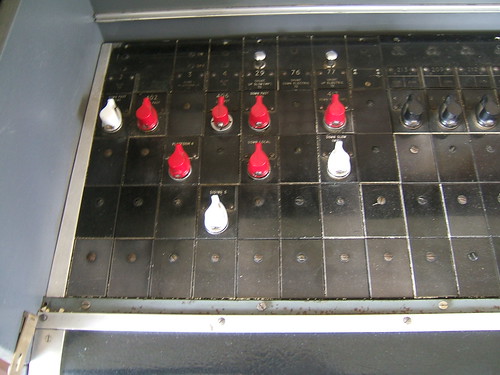
Westinghouse installed similar new 'OCS'panels at Wilmslow (where the Styal Loop diverged from the main line through Stockport) and at Manchester Piccadilly (see below).'OCS' did not remain in favour much longer and 'Entrance-Exit' (enjoying the rather odd acronym 'NX') became the preferred approach for later power box schemes.
Stockport
Oddly, the Stockport area evaded signalling modernisation during electrification and the conventional signal boxes at Cheadle Hulme, Edgeley Junction No. 1, Edgeley Junction No. 2, Stockport No. 1, Stockport No. 2 and Heaton Norris remained for some time with mechanical operation of points although colour light signals replaced the earlier semaphore signals. They were all L.N.W.R. boxes (except Heaton Norris, which had been rebuilt with a B.R. Standard frame).
Manchester
In 1908/1909, the station (then called Manchester London Road) was re-signalled with the 'Crewe' All Electric system installed in three signal boxes. There's a brief description of the system here.

Manchester London Road No. 2 box in 1957.
These three boxes survived until electrification of the line, when Westinghouse Brake and Signal installed a 'One Control Switch' ('OCS') panel, similar to Sandbach and Wilmslow, in a new building on the Down side.

The Manchester Piccadilly Signal Box housing
the 'OCS' panel (Photo: John Hillmer).
Post-1980:
It was the 1980s before I started to travel regularly to Manchester, initially for a series of business meetings and later to reach what was then called 'Manchester Museum of Science and Industry' (now MOSI and part of the Science Museum). I became involved as a 'Railway Volunteer' at the Museum and there are a number of posts in this blog about the museum to which there's a link in the section 'Some Related Posts in this Blog' (below).
As you'd expect, having electrified the route, traction in the 1980s was electric - either Mark I coaches locomotive hauled or the lively Electric Multiple Units. Over the years since then, both the pattern of services and the rolling stock has changed quite a bit. Now, addition to modern EMUs and Pendolinos, DMUs and Voyagers are common 'under the wires'.
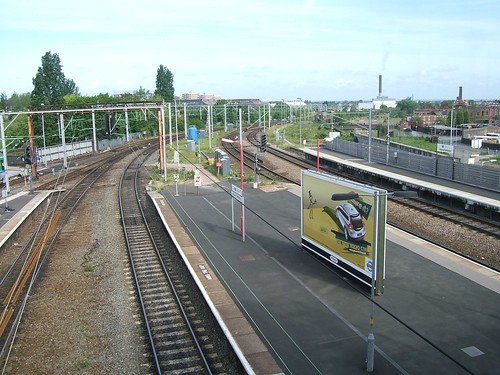 The north end of Wolverhampton Station in 2007.
My journeys in the 1980s started from Wolverhampton which, by that time, had been provided with a Power Signal Box and an 'NX' signalling console by Westinghouse Brake and Signal during electrification of the area.
 This 2008 view Wolverhampton Power Box shows that it is little altered externally and (unlike some similar Power Boxes like Trent, Saltley and Derby) retains its flat roof. Larger overhanging fascias have been fitted since its initial construction, presumably because of difficulties viewing the signalling console in strong sunlight
Signal boxes between Wolverhampton and Stafford had been abolished by Wolverhampton Power Box although Littleton Colliery box survived as a Shunting Frame until the pit was closed in 1993. Stafford had been reduced to two boxes - Number 4 at the south end of the station on the Up side and Stafford Number 5 at the north end on the Down side.
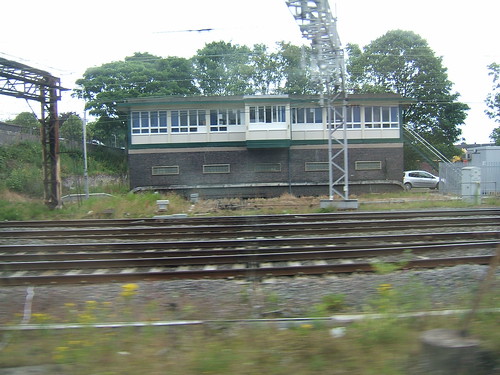
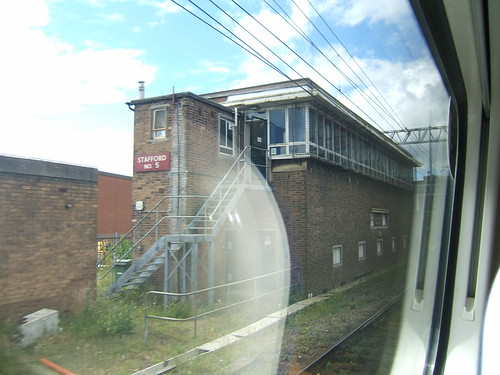
There was then a fairly small power box with an 'NX' panel at Norton Bridge then (although the ground floor relay room remains, the operating floor has now gone). At Norton Bridge there were two possibilities - continue on the former L.N.W.R. main line to Crewe then turn right for Manchester or turn right at Norton Bridge and follow the North Staffordshire Railway route, joining the line from Colwich at Stone and continuing through Stoke-on-Trent to Cheadle Hulme where the L.N.W.R. route from Crewe was rejoined for the remaining journey through Stockport to Manchester.
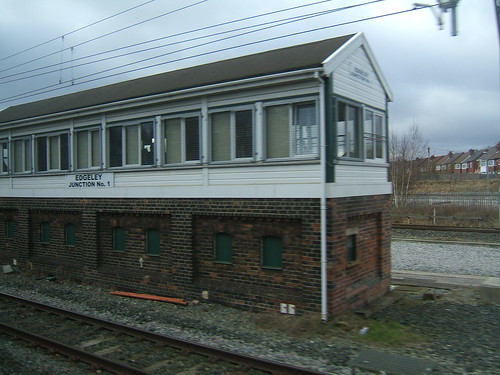
Approaching Stockport from the south, the Buxton line converges from the right at Edgeley Junction No. 1.
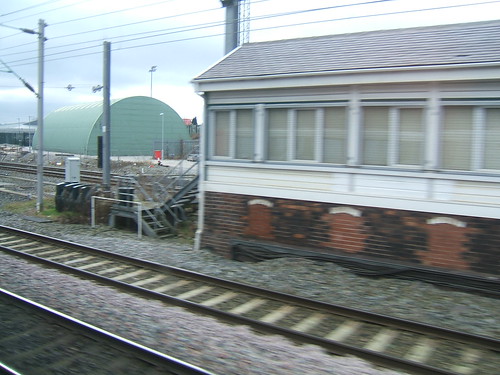
After a few hundred yards, the line from Chester converges from the left at Edgeley Junction No. 2.
The line continues through a cutting to Stockport Station. This was originally a tunnel but was opened-out during electrification to improve clearances for the overhead catenary. A further two highly-modified LNWR signal boxes look after Stockport Station itself - Stockport No. 1 at the south end and Stockport No.2 at the north end.
 Stockport Number 2 in 2008.
The terminus in Manchester was called 'Manchester London Road' until 1960 when, in a fit of modernisation, British Railways changed the name to 'Manchester Piccadilly'. British Railways had a lot of bright ideas like this. In 1965 British Railways finally lost their 'way' (geddit?) and became modern, thrusting 'British Rail'. The signal box with the 'OCS' panel has now been replaced by Manchester Piccadilly Signalling Control Centre. A visit I made to the new signalling centre in 2013 is described here.
The Trainshed at Manchester Piccadilly showing a London-bound 'Pendolino'.
Photographs
West Midland Railways.
Stafford Area.
Manchester Area.
Some Related Posts in this Blog
Stafford Station in the 'Fifties.
A Sunday Stroll to Stafford.
Railways at Crewe in the '50s.
Crewe North Junction (1940) Signal Box.
Crewe North Junction History.
Crewe Station Signal Boxes.
Crewe Station.
Museum of Science and Industry, Manchester.
Manchester Piccadilly Station - Behind the Scenes
Some Related Wikipedia articles
Stockport railway station.
Manchester Piccadilly station.
Privatisation of British Rail.
British Rail.
Thursday, 14 March 2013
'Blazing Saddles'
'Blazing Saddles'? No, not the 1974 Mel Brooks film but the name given to the March 2013 Gala at Peak Rail.

John Alvin's poster for the politically
incorrect movie (Wikipedia).
It's 70 years since Hunslet's 18-inch shunter design was adapted for a wartime order of 'Austerity' six-coupled locomotives and Peak Rail's 'Blazing Saddles' event on Saturday 9th March 2013 and Sunday 10th March 2013 was intended as a tribute to the success and endurance of this class. Peak Rail had no less than five examples of the class in steam, plus a sixth on static display on the Rowsley turntable. The timetable featured two-passenger train working, with the two 4-coach trains passing at Darley Dale.
Residents 'Royal Pioneer' and 'Lord Phil' were joined by 'Sapper', 'Mech. Navvies' and 'Wilbert'. These five locomotives operated a variety of trains during the day whilst 'Swiftsure' (awaiting repairs) posed on the turntable.
On Saturday, I was driver on Dean Forest's 'Wilbert'. I'd not seen 'Wilbert' before but preparation and handling is generally similar to that for other 'Austerity' tanks. The locomotive was facing south and required to haul the 4-coach 'B Set' to Matlock Town, top-and-tailed with 'Lord Phil' facing north and hauling the train back to Rowsley.

On Sunday, I was driver on 'Sapper' which is one of the 'Austerities' (along with 'Lord Phil') modified by Hunslet after the war to incorporate the ideas of the Argentinian locomotive engineer L. D. Porta. (described here). Although much of the modification has been removed, the locomotive retains part of the improved draughting. First task was Preparation, which I've described for 'Sapper' in an earlier post.
To 'ring the changes', the locomotive was turned to face north and during the day we hauled the 4-coach 'A Set' to Rowsley. We were top-and-tailed with 'Lord Phil' facing south and hauling the train to Matlock Town.
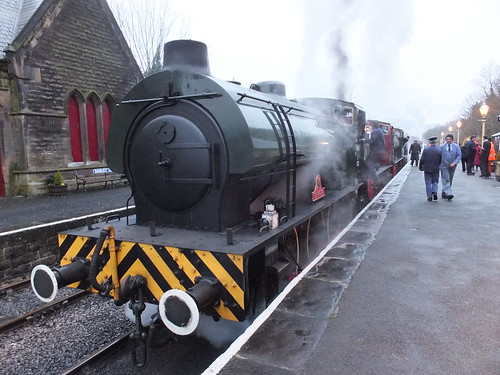
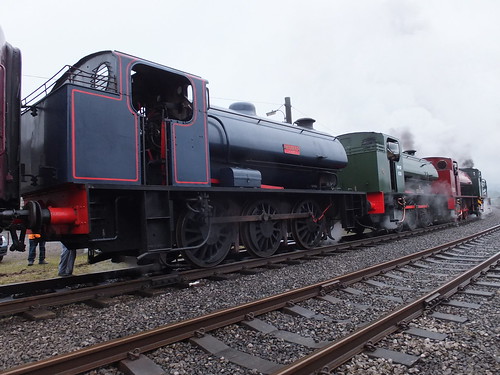
On both days, the final round trip from Rowsley to Matlock Town and back was an 8-coach train hauled by all five locomotives in steam (four on one end, one on the other).
My Pictures
'Blazing Saddles' 9-March-2013.
'Blazing Saddles' 10-March-2013.
'Sapper' Austerity Tank Locomotive.
All my Peak Rail pictures form a Collection here.
References
The 18 in. Hunslets (Industrial Railway Society).
Hunslet Austerity 0-6-0ST (Wikipedia).
Austerity 0-6-0st as modified (Martyn Banes).
Wednesday, 6 March 2013
Mandalay Area Railways
Introduction
Mandalay Central Station (shown as a black square on the map below) is an important rail hub. It forms the northern end of the mainly double-track trunk railway line from Yangon. A single-line extends further north to Madaya. Like Yangon, there is a 'Circle Line' around the city but I believe this only has one train a day. Just south of the city, the station at Myo Haung is the junction for the single line heading east to Maymyo and then Lashio. From Myo Haung, there is a single line which crosses the Ayerwaddy to Ywa Taung serving the north of Myanmar as far as Myitkyina and branches including the line through Mon Ywa.

Route Map of Mandalay Division from Myanmar Railways
(Click on map for larger version)
Some stations in the Mandalay area
Going south on the trunk line:-Myo Haung station
Shanzu
Myo Haung (Junction for Lashio line)
Ta Gun Daing
Myitnge
Paleik (Junction for Myingyan)
Myo Haung to Pyin U Lwin (Maymyo):-
Thoe Gyan
Tonbo
Sedaw
Sa Tu Ta Lun Hto (Zig-zag)
Zi Pin Gyi
Thondaung
Anisakan
Pyin U Lwin (Maymyo)
Going across the river to Ywa Taung:-
Shanzu
Myo Haung
Amarapura
Ya Ta Na Gu
Shwe Kyet Yet
Ywa Taung
Going north to Madaya:-
Oh Bo (Junction for Circle Line)
I visited Myo Haung by road on the afternoon of Sunday, 17th February 2013. Photographs are here.
Owe Boe station
I visited Owe Boe by road on the afternoon of Sunday, 17th February 2013. Photographs are here.
By Train to Maymyo
On Tuesday, 19th February 2013 I travelled on the morning train from Mandalay to Maymyo. Photographs are here.
My Related Blog Posts
Railway Signalling in Burma - Part 2: Colour Light Signals & Motor Points.
Yangon Area Railways.
Wikipedia Links
List of railway stations in Myanmar
My Photographs
Burma: Colour Light Signals & Motor Points.
Railways in Myanmar.
More Railways in Burma.
Myo Haung Station.
Owe Boe Station, Mandalay.
By Train to Maymyo.
Monday, 4 March 2013
Sunday Diesel
Events of Sunday, 3rd March 2013
The Battlefield Line had planned to operate a steam-hauled service on the 2nd and 3rd of March. However, bad weather had delayed the completion of essential track repairs between Market Bosworth and Shenton. The railway substituted a diesel railcar service operating between Shackerstone and Market Bosworth only and I was the driver on the Sunday.
I arrived early and the P.Way gang were assembling the Works Train which would continue the track repairs that day. Diesel electric shunter 08 825 was the Works Train motive power. This locomotive is functional but in need of cosmetic restoration.
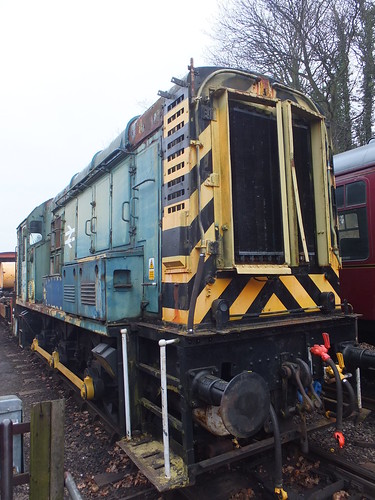
Works train locomotive 08 825.
'ED' locomotive 73 114 was also used during the shunt but, on completion, this was stabled on platform 2 along with the coaches forming the normal service train. When the works train departed towards Shention, it comprised a 20-ton brake van, well wagons and a tool van, propelled by 08 825, under the authority of an Engineering Possession for the complete line. Once the Works Train had passed Market Bosworth station, a 'STOP' board and red flag were set to protect the train and the Engineering Possession between Shackerstone and Market Bosworth station was withdrawn by telephone and recorded in the Train Register book at Shackerstone signal box. In the meantime, I'd prepared the single coach 'Bubble Car' 55005 for the passenger service.

'Bubble Car' 55005.
Once the signalman 'cleared' the 'dummy' (ground disk signal - also called 'dolly'), I moved the unit down to platform 1. The sun was starting to peek through but it was still cold, so I started both hot air heater units to warm the coach.
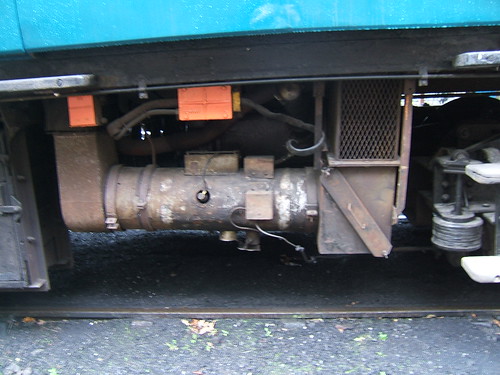 One of the two underframe-mounted heater units.
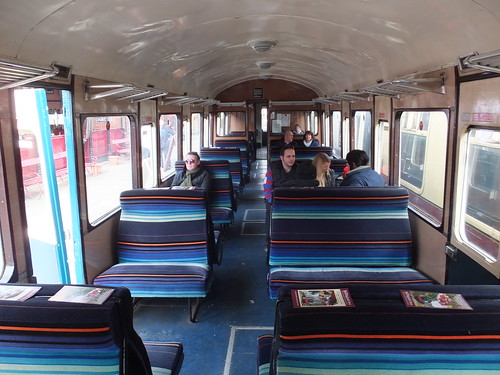 Passengers on the first service to Market Bosworth.
An 'Emergency' timetable was in use, with departures from Shackerstone at 11:15, 12:30, 13:45 and 15:00. We were 'booked' to stand at Market Bosworth around 15 minutes before returning to Shackerstone. The timetable was carried out without incident. The relative comfort of driving a railcar (rather than steam) makes a nice change occasionally.
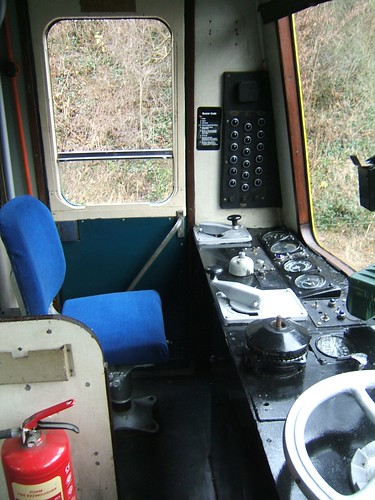
The neat arrangement of driving controls in the cab of 55005.
I first became a member at Shackerstone when I was an instructor/driver at Tyseley Railway Museum on their driving experience courses. Tyseley had agreed to run additional courses at Shackerstone using 'Kolhapur' and 'Taw Valley'. Shackerstone's resident engine at the time was 'Lamport No. 3' - a very reliable 6-coupled saddletank which I drove many times until her 'ticket' ran out and she was laid-up in the back of the shed. On 3-Mar-2013, I found 'Lamport No. 3' moved to the DMU siding prior to being moved by road to new owners. I said my farewells and took a few photographs.
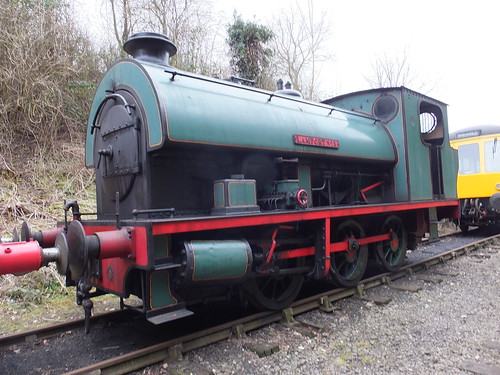 Farewell to 'Lamport No. 3'.
My Pictures
Works Train on the Battlefield Line.
Bubble Car.
Lamport No. 3.
The Battlefield Line Collection.
Saturday Steam
Events of Saturday, 2nd March 2013
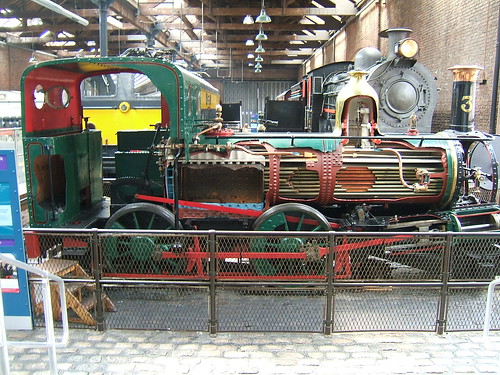
I was rostered as driver with Richard as fireman, Mike as operating officer and Peter as guard at the Museum of Science and Industry (MOSI) in Manchester. 'Agecroft No. 1' was waiting on the pit for us, having recently returned from a short visit to the Ribble Steam Railway. While Richard put a fire in the locomotive, I started oiling-round.
Mike suggested that we assembled the train whilst steam was being raised so we opened the door to the Power Hall (a purely manual operation at present since recent maintenance has resulted in disconnection of the electric motor which used to drive the door).
The Battery Electric shunter was already coupled to the two four-wheel passenger coaches in the Power Hall allowing me to draw the coaches out and place them in the railway compound. Once the gates were secured, we could complete the shunting without crossing areas open to the public. The Battery Electric has recently received a new set of batteries, giving it a new lease of life. Having 'pinned down' the coaches, I moved the shunter to 'Agecroft No. 1', picked it up and put it on top of the coaches and moved the whole train back to the platform. The shunter was then stabled for the day in the railway compound clear of the running line.
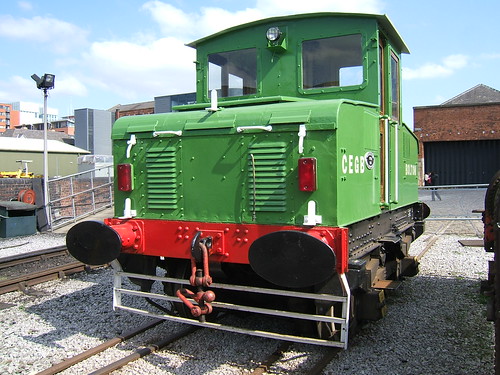
The 20-ton brake van had been left on the buffer stop at the end of the platform and Peter elected to run with the brake van attached, allowing him to light the stove in the brake van in order to keep warm.
The Museum is using a new source of Welsh Steam Coal and this performed very well. We were able to do our 'test run' to ensure everything was in order quite early and our first passenger train left around 11:45. Although the day was cold, the sun came out making it quite pleasant and we had plenty of passengers throughout the afternoon. Each time we completed a run, Peter quickly 'ticketed' the next departure (Guards are, once again, manually collecting fares and issuing tickets, since the modern Automatic Ticket Machine at the end of the platform has been taken out of use) so we had little time to relax between trips.
At the end of the day, we detached the brake van and moved the train down the running line to the Disposal Point where we 'knocked the fire out' and emptied the ashpan. Then, I moved the Battery Electric to the head of the train, drew the train forward to clear the Power Hall points and propelled the lot into the Power Hall. An enjoyable, if tiring day!
Friday, 22 February 2013
Napyidaw
Events of Thursday 21st February 2013
At 8.0 a.m. I was collected by a charming young lady guide from Yangon called Miss Khin Khin Chaw with a driver and Toyota 'Hiace'. They'd driven from Yangon to Mandalay the previous day to meet me. That journey takes over 8 hours. On the Thursday, we were only going as far as Napyidaw (about 5 hours driving) and we would overnight there. The highway from Yangon to Mandalay has only been open a few years. It's dual carriageway with at least two lanes each way and broad verges (except where the highway passes over bridges). The road's most impressive feature is how little traffic there is.
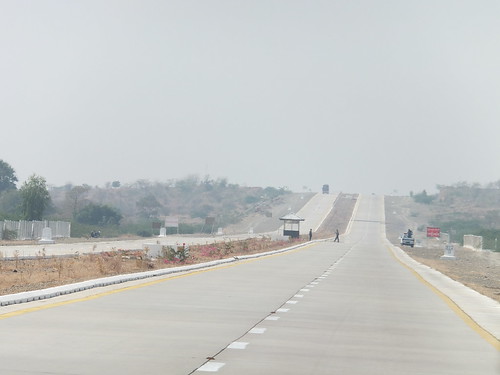
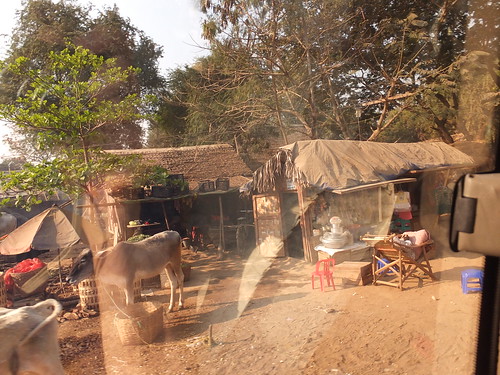
I'd planned to visit Paleik station on the double-track main line from Mandalay to Yangon and so we turned off the highway and were immediately on country roads where the tarmac strip is only wide enough for one vehicle so that passing vehicles each have to drive with one wheel on the verge. We passed through a village with simple bamboo houses very similar to the one I visited in Nga-Minn-May a few days earlier.
Leaving the village, we were plunged back into open country. Just as I was starting to despair, we came to a small town and found the station. I gathered what information I could and we waited while a mixed train from Mandalay passed without stopping.
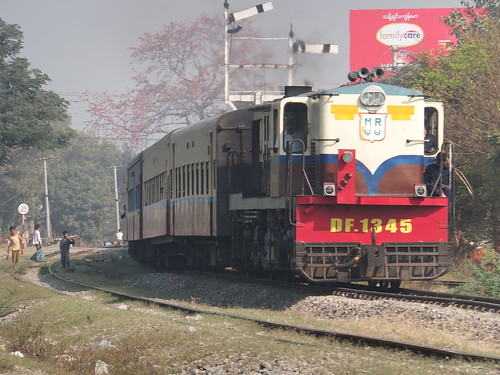
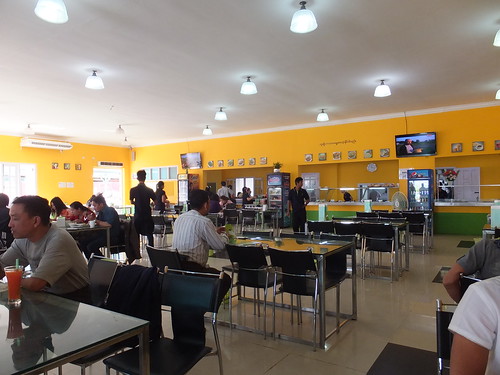
Our driver retraced our route to get back to the highway and we continued south. We carried on to the 'Rest Stop' about halfway to Napyidaw. This had a large cafe area and I realised it was designed to handle the sudden influx of people when a number of long-distance buses stopped.
We carried on to the junction for Napyidaw and joined a short length of highway which passed a Toll Station and then led us through a residential zone of Napyidaw. The main roads were all dual carriageway, with at least four lanes in each direction but traffic was very sparse. Electric lighting was provided and all the verges were planted with trees and shrubs and well-tended.
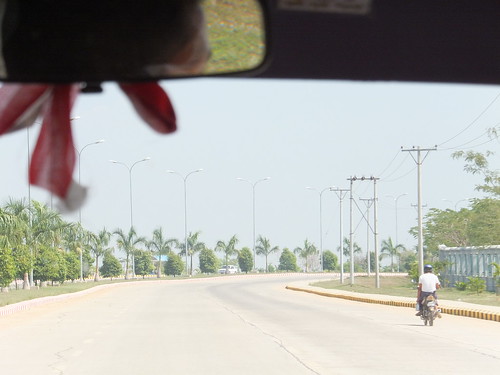
New building was going on around us, particularly as we passed through the Hotel Zone (Napyidaw is a 'planned' new city built on a 'greenfield' location). My guide asked if I'd like to check into my hotel but I was anxious that we located the Railway Museum. Although my guide and driver seemed convinced there was such a museum, they didn't know where it was (it was my guide's first visit to the capital). I suggested enquiring at the main railway station, but they preferred to ask the groups of people relaxing on the verge near each road junction. This was not productive.
By then, we were driving through the government office area - the road we were on merely carried signs to the various ministries and landscaped side roads led to the actual buildings. There was a certain irony that the Ministry of Information had no idea about a railway museum but a second attempt at the Ministry of Rail Transportation apparently obtained some guidance. I was quite taken by a rather odd 3-aspect upper quadrant semaphore signal at the road junction and even more taken with the plinthed locomotive (a class 'ST' 2-6-4T) near the offices.
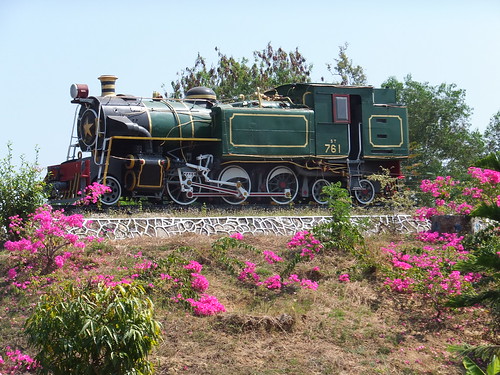
The locomotive appeared to be festooned in chains of 'fairy lights' outlining the shape so I probably wouldn't have been quite so impressed if I'd seen it at night. The actual ministry building was a modest, modern office block - I'd expected something more flamboyant.
Leaving the Ministry, I knew our route was now taking us towards the railway line, so I was a little more hopeful. Once the double-track line was in sight, I spotted a semaphore distant signal which enabled me to confirm the direction to the nearest station. Unfortunately, my guide and driver were convinced that our route lay in the opposite direction. It was only after a mile or so of increasingly rural travel that they could be persuaded to turn around and retrace our steps. I was much happier as we approached a station but couldn't help pointing out that it seemed a very small, very rural station to host a museum. However, I was always happy to do a quick survey of another station so we crossed the tracks to the station buildings at Twa Daw, where my guide was assured by the stationmaster that the museum was located at the next station along - the main railway station for Napyidaw.
After another drive along the wide, virtually deserted roads we came to the huge, modern station of Napyidaw. The station and its ten platforms were certainly impressive but it was odd that there were no other buildings nearby, no sign of the city it served. It reminded me a little of all the 'Parkway' stations we now have in England, where the name is a warning that the place served is some distance away. It was also odd that, in the whole time we spent in the vicinity of the station, not a single wheel turned on the railway. There were coaches, diesel locomotives and railcars but all with an abandoned air, in stark contrast to the permanent bustle around Yangon Central station.
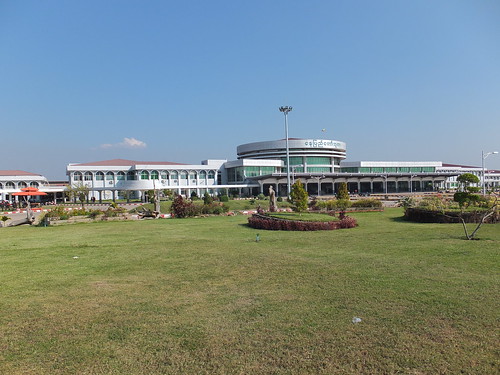
The guide enquired as to the exact location of the museum - it was another modern building about 100 yards from the station. Yes! It was clearly marked 'Myanma Railway Museum' and 'Inaugurated 4th January 2012'. It was also clearly closed.
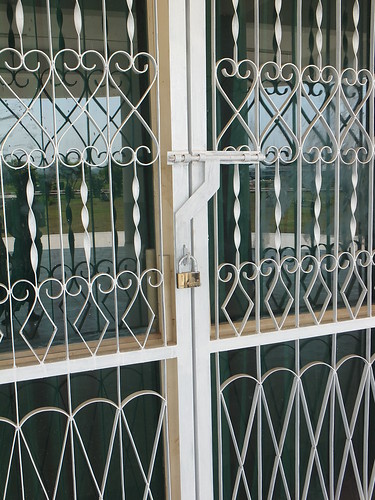
Thwarted by a decorative security gate and padlock.
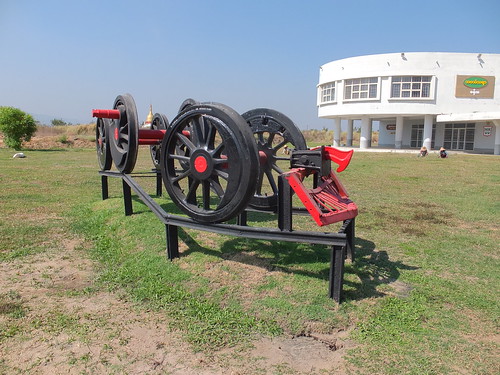
It was here that my guide showed her true colours. Bidding me wait, she and the driver disappeared towards the station. I reviewed what was outside. A wooden shelter housed a short length of track mounting a wagon wheelset and a coupled wheelset. Nearby there were three wheelsets with a ''cowcatcher' and chopper coupling mounted on an curious undulating length of 'track'. I could only assume this was 'Art' because, even in my rather jaundiced state of mind, I had to admit that this 'track' was worse than any of the permanent way I'd seen in Burma (and I'd seen some very poor track).
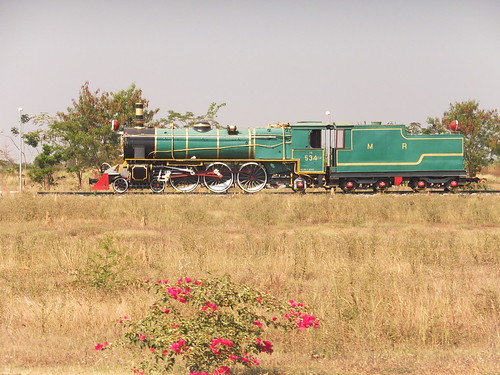
A little way off, there was an example of topiary in the general shape of a locomotive. I decided it was a bit too hot to look at this just then. Further off, there was a plinthed locomotive which definitely deserved inspection, but I decided to keep this as my 'consolation prize' for failing to visit the museum. At that moment, my guide and driver returned with three people in tow. One was apparently the curator, and one had a key for the padlock. Success! There was quite a reasonable display of models and fairly small artefacts. Most had simple descriptions in English I spent around 40 minutes furiously trying to capture as much as possible for further study.
Then it was check on the topiary, record the rather handsome plinthed 'Pacific (not sure about the chimney extension, though) and I rejoined the car, totally exhausted, with a view to finding the hotel.
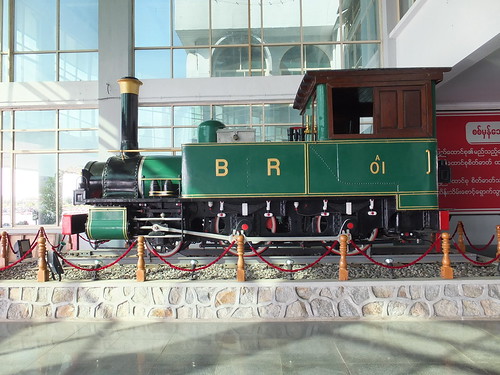
Before we drove off, my guide innocently enquired "Don't you want to look at that?". I'd completely missed what's supposed to be the first steam locomotive in Burma - a 'Dubs' 2-4-0 tank with an odd smokebox extension displayed inside the main station building.
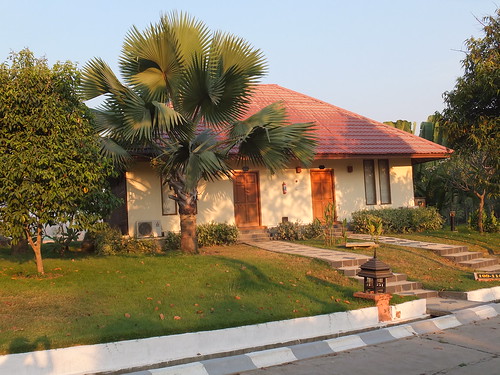
Finally, having snatched a few pictures of the Dubs, we set off to find my hotel - the Aureum Palace Hotel. Having booked in at Reception, I was taken in an electric golf cart about 200 yards to a very decent semi-detached 'villa' overlooking an artificial, but attractive small lake. The lake had a fair population of geese.
I wasn't quite finished for the day, because my guide had offered to return and take me to see the modern golden pagoda in Napyidaw and I'd agreed to be ready to go out again in a couple of hours.
My Pictures
Road from Mandalay to Napyidaw.
Paleik Station.
Around Napyidaw.
Twa Daw Station.
Napyidaw Station.
Myanma Railway Museum.
Aureum Palace Hotel, Naypyitaw.
[Revised 8th March 2013, 17-Mar-2013, 19-Mar-2013, 20-Mar-2013]
Wednesday, 20 February 2013
More Mandalay
Events of Wednesday 20th February, 2013
I'd arranged with my guide that we'd make one more excursion, travelling to the ever-beautiful Sagaing Hills. It's a trip I'd made before but I never tire of the area. However, we made a slight detour on the way, to look again at Ywa Taung station.
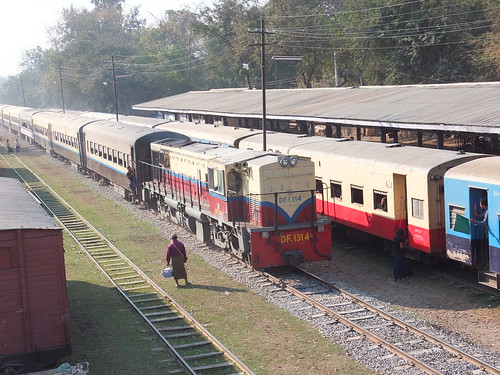
I'd first visited Ywa Taung in 2012 with Doctor Hla Tun as we returned from making a stationery donation at Taung Be Lar School. That earlier visit is described here. On my second visit to the station on 20th February 2013 I took additional photographs to clarify arrangements. My second visit coincided with seeing two trains! On our arrival, a local train to Mandalay was waiting in the platform loop. Most of the lines are single and the local was stopped for the Mandalay to Myitkyina express to pass. This important train included a restaurant coach. Once the express had passed, I could see the pointsman changing the points so that the stopping train could continue on to Mandalay.
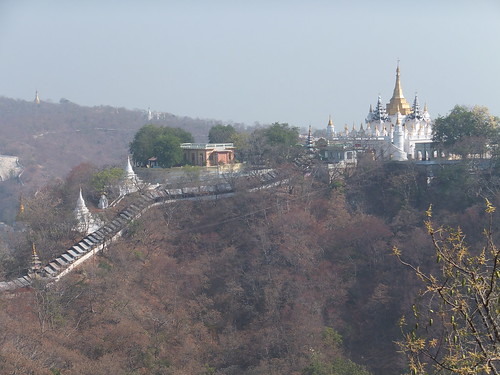
Then we took the winding road to the summit at Sagaing and the temple housing the most famous Buddha image. We spent some time on the promenade surrounding the temple which commands marvellous views in all directions. It was a little hazy, limiting how far we could see, but we could study the amazing number of pagodas, monasteries and other religious buildings and watch all the river activity in the Shwe Kyet Yet area.
Driving back to Mandalay City across the new road bridge, it was clear just how low the water was. The broad river had two small navigable channels, one adjacent to either river bank, and the rest was sandbanks.
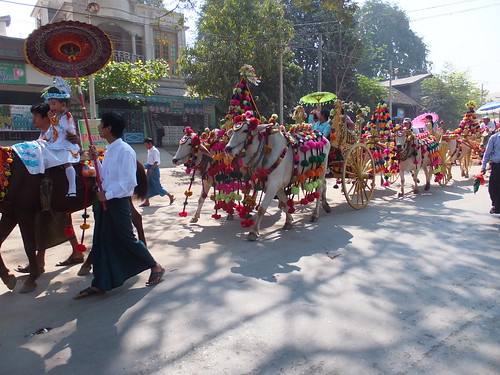
We returned to the Sedona Hotel passing a very elaborate Noviciation Procession which included an elephant. It's quite expensive to arrange for an elephant, I was told, so this was a rich family. The actual Noviciation Ceremony would probably be held on the following day.
Safely back at the Sedona Hotel, it was time to say "goodbye" to my guide and driver. On the following day I was to meet a different guide and driver for the journey south.
Wednesday was the day that a new group of guests arrived for the 'Road to Mandalay'. They would have flown into Mandalay International Airport. In the past, I have poked fun of the fact that Mandalay International Airport had no scheduled International Flights (just the occasional charter flight). Perhaps it's an indication of the changes taking place in Burma that the budget airline AirAsia now has regular flights to Bangkok for 50 dollars. I'm told AirAsia will also introduce a direct service to Singapore shortly. At the airport 'Road to Mandalay' guests would have met their guides for the trip, boarded the waiting coaches and spent the morning touring Mandalay. The guests were to meet at the Sedona Hotel for a buffet lunch before joining their coaches once again for the drive by road to Myin Mu where their ship was waiting.
Doctor Hla Tun had told me that he was usually at the hotel for the buffet lunch, in case any of the guests required medical help. I waited outside as the various buses arrived and, of course, I knew many of the staff and guides looking after the newly-arrived guests.

Doctor Hla Tun arrived a little later: he had been to purchase medicines for use on the ship. The Doctor and I talked for a while in the hotel lobby and then (having left word where he'd be, if required) we walked around the corner to the Shwe Pyi Moe Cafe where the Doctor ordered a simple Burmese meal, whilst I had a Coca-Cola.
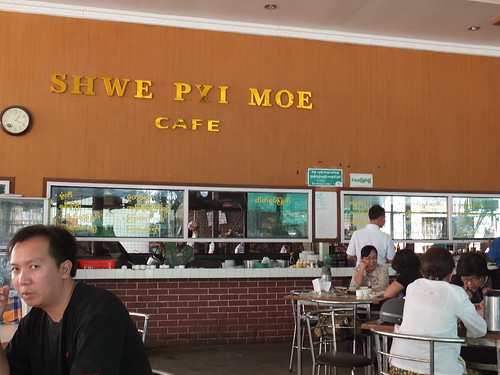
When we arrived back at the hotel the last 'RTM' coach was just leaving. The Doctor quickly collected his medicines, said goodbye and joined the bus. Amongst the new Guests, there were two 'stragglers' who had somehow missed the coaches. They were eventually located by the member of 'RTM' staff who had remained behind with a car so disaster was averted.
The following day, I was to leave Mandalay and head south by car.
My Pictures
Ywa Taung Station.
Sagaing (2013).
Noviciation Procession in Mandalay.
'RTM' at the Sedona.
[Revised 8th March 2013]
