Wednesday, 19 September 2012

By Train to Naba

Events of Tuesday, 18th September 2012

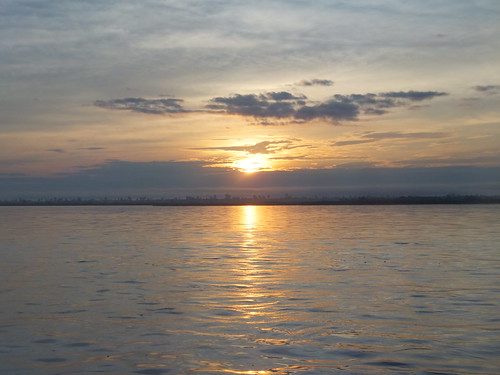
Sunrise on the Ayeyarwaddy, north of Katha.

Once again, I attempted a photograph of the sunrise on the Ayeyarwaddy. I was brought up on Kipling's poetic image of sunrise on what the British called the 'Irrawaddy' where he writes "The dawn comes up like thunder outa China 'cross the bay". I'm still not sure what he meant. Instead of dwelling on this, I had breakfast whilst the Captain moved the ship downstream from its overnight mooring to Katha.

By now, all the guests were getting quite used to the routine of being taken ashore by the two Fast Boats. Waiting for us this time, on our second visit to Katha, were not 'trishaws' but a line of 2-wheel horse-drawn covered 'traps' which are used as taxis. When everyone was allocated to 'trap', the procession moved off. We turned inland and then took the turn leading to Katha Railway Station. Through the diminuitive ticket window (such as stations in England once had) the almost-invisible booking clerk was handing out pasteboard tickets one at a time for the special train waiting in the single platform. The train was headed by a fairly battered diesel-hydraulic locomotive of German origin and the train comprised three 'Upper Class' corridor coaches in excellent condition, by Myanmar Railway standards, with a 'composite' coach ('Ordinary Class'/'Luggage'/'Guard') bringing up the rear.
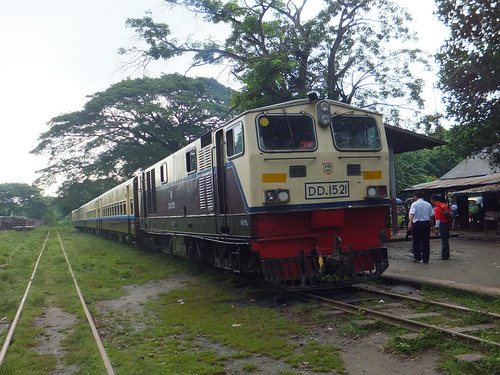
The 'Road to Mandalay' Special Train ready to depart from Katha.

I don't think the 'Road to Mandalay' Guests would have been happier to discover that the 'Luggage' section contained re-railing jacks, spare sleepers and tools to deal with the problems if the train became derailed!

Two years before, after a bit of negotiation, I had managed to travel in the cab of the locomotive (there's a full description here, with links to pictures and the report on the return journey). This time, somebody on the railway decided it was not possible. The mechanic from my earlier journey recognised me and was very friendly. He explained to the driver (who looked very smart in a uniform with a name badge) that I also drove trains. I hadn't managed to bring any prints with me but I had loaded a few of my railway pictures into my camera and these were studied by everyone around the locomotive. The driver became very friendly and he had surprisingly good English. He allowed me into the cab and engine room to take some quick pictures but then I had to board the train. As is fairly standard practice in Burma, I left the coach door open and stood in the doorway to take pictures. Although 'Road to Mandalay' staff invited me to sit and were clearly concerned for my safety, they eventually accepted that I was intent on travelling like that, so I was able to get some technical pictures on the way to assist my understanding.

Leaving Katha, there were a lot of mainly bamboo buildings near the track and plenty of of people wanted to wave at the special train. We then passed through fields and crops, passing the tiny halts of Netyetwin and Langma. Up until this point, we had tantalising views of a cloud-covered mountain range - Gangaw Taung, I think. But now jungle closed in around us and our views were restricted. The railway has to insinuate itself through these mountains, partly by climbing and partly by twisting left and right. After about one and three quarter hours, the jungle receded and we approached Naba through more fields. To reach the platform, we had to travel right through the station, wait for the points to be switched and then reverse. By the time we were able to get off, it was about two hours after our departure from Katha, giving us an average speed of not much above 10 miles per hour. Students at the Katchin College gave the 'Road to Mandalay' Guests a performance of ethnic music and dancing on the platform and 'Road to Mandalay' staff provided refreshments. A larger audience was provided by local people who were generally happy to watch from behind the barriers which had been set up.
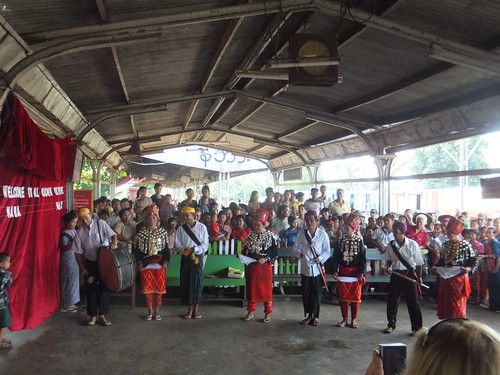
A performance of Kachin music and dance on the broad platform at Naba.

We then divided into groups with our various guides for a walking tour of the pretty village of Naba. As we walked through the various lanes there were (like everywhere) numerous photogenic children. A brief stop was made at a private lending library where there seemed to be an off-shoot business producing snacks.
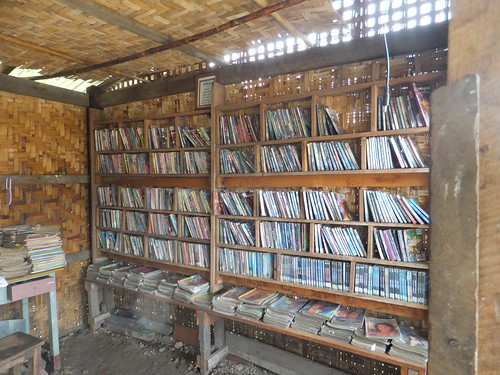
The lending library at Naba.

We looked at the mechanics of a business producing noodles which was situated in and around a timber-built house with a colourful garden. Our route back to the station used a much-used footpath which crossed one of the sidings. A train had inconsiderately been parked in this siding, severing the footpath. Pragmatism had come to the rescue and two railway sleepers had been laid in between two of the parked wagons. One sleeper was laid from the ground on one side with the other end resting on the top of the coupling between the two wagons, the other sleeper has been similarly placed on the other side, providing a bridge in the form of an inverted, shallow 'V'. Whilst we crossed, a couple of men were on hand to assist anybody who was in difficulty.

Back at the station, there were a few minutes for me to talk with the driver and crew. The driver had his digital camera with him and insisted on getting the Mechanic to take a posed picture of he and I shaking hands.
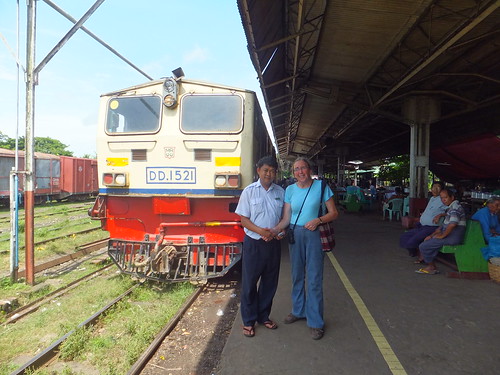
The train driver and Jan on the platform at Naba.

Then, it was time to set off on the return journey to Katha which took around a couple of hours. I remained standing in the open doorway of the coach behind the engine for most of the journey, so I was hot and tired by the time rolled into Katha. I think the Guests enjoyed the trip but everybody was tired by the time the horse-drawn 'traps' had returned us to the landing steps and the Fast Boats had transferred us to the 'Road to Mandalay'.

I enjoyed a buffet lunch in the restaurant as the ship continued downstream. The day was still hot so a decided on a swim in the pool on the top deck. As I left the pool, dark clouds approached us, a strong wind started and within minutes there was a heavy rainstorm. I retired to my cabin until the storm blew itself out. As it became dark, we anchored midstream at Kyan Hnyat (where we'd gone ashore a few days earlier). There were some amazing cloud effects as the sun sank below the horizon. As you might expect, the clouds in the west were tinted red as the last of the sunlight was refracted. But there was sufficient light to illuminate the clouds in the east a very dramatic pink.
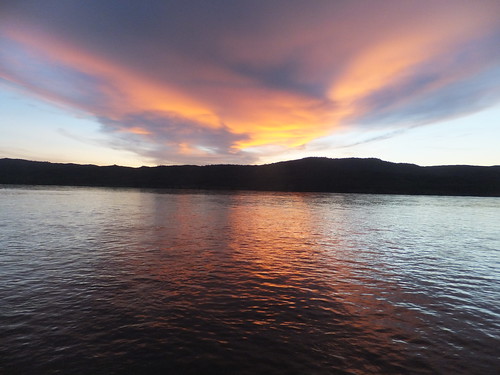
A dramatic sunset at Kyan Hnyat.

A tiring, but enjoyable, day was completed by a dinner comprising typical Burmese dishes.

Photographs:

Private Train to Naba.
Katha to Naba (mainly 'technical' pictures).
Naba Station (mainly 'technical' pictures)
Naba to Katha (mainly 'technical' pictures).

Monastic Noviciation Ceremony at Moe Dar

Events of Monday, 17th September 2012

The ‘Road to Mandalay’ moored mid-channel on arrival opposite Moe Dar village which is on the west bank. We could see that Moe Dar was a fairly large place, with buildings extending some distance along the river bank downstream. The monastery itself seemed quite large. One of the three regular passenger ferries was tied-up when we arrived, its deck rails lined with passengers, but it slipped away towards Bhamo as the two Fast Boats took us to the village. We arrived in a long dirt road parallel to the riverbank lined with buildings which appeared to be mainly shops. An entrance gateway and steps leading to the monastery lay on the upstream side, but we could see a procession and hear music coming towards us from the other direction. The area was crowded with Burmese anxious to watch the procession, but they made room for the ship’s Guests to watch as well.

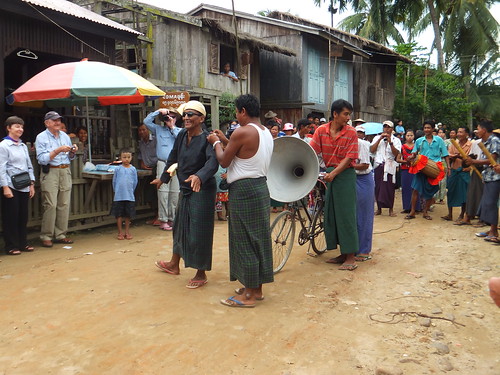
The procession was led by a bicycle being pushed by one man. A large horn public address loudspeaker had been tied to the handlebars, a battery (probably an automotive battery) hung from the side and a mixer/amplifier was fixed to the rear carrier. A second man managed the mixer/amplifier and two long cables going to hand microphones held by male and female singers following. A group of musicians provided accompaniment (I saw cymbals, a horn and a sort of recorder). The loudspeaker was painfully loud, but I resisted the temptation to put my fingers in my ears, in case this was interpreted as disrespect. Two lady dancers, keeping pace with the bicycle, performed to the music.

Dancers, musicians and bicycle public address.

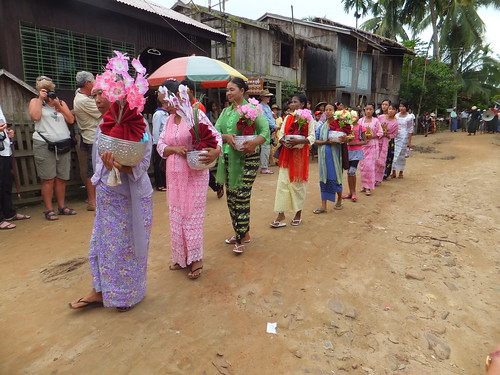
A single file of people walked behind – three men with floral banners, three ladies (two with offerings of fruit and flowers carried on the head), a number of men with fans, five ladies with offerings dressed in ‘Sunday Best’. Each of the five offerings included a piece of maroon cloth, attractively folded into a sort of flower. Finally, there were a number of young ladies, also in ‘Sunday Best’ and carrying offerings.

Five ladies and five young ladies, all with offerings.

A second procession followed. This was led by a male comic dancer dressed in longyi, black shirt and dark glasses, moving his arms, legs and body in an erratic style. Very dark skin and a gap-toothed smile added to the comic effect. I assumed that this dance was one variation on the Burmese comic male dancer tradition I had seen before. The dancer was followed by another ‘public address bicycle’, a male singer with a hand microphone and a ‘band’ with different instruments. A man came up to the dancer and pinned money to his shirt. No such encouragement was needed, possibly because of the presence of the ship’s Guests, it was some minutes of antics before the dancer could be persuaded to move on.
Money is pinned to the shirt of the male comic dancer.

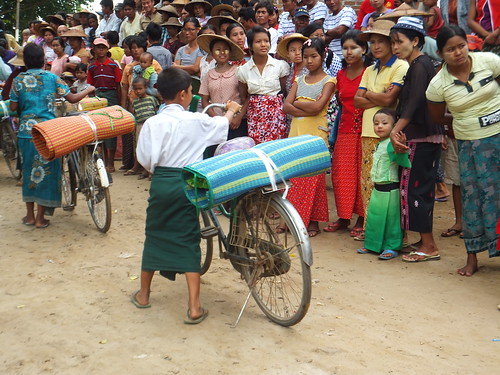
Behind the musicians, a number of girls walked with offerings and the procession was completed by five bicycles being pushed, each loaded with a prayer mat wrapped around other items I couldn’t identify strapped to the rear carrier.

Two of the five bicycles in the second part of the procession are studied with interest by the watching crowd.

A third procession comprised five garlanded horses, each bearing a young boy dressed in very fine clothes with a head-dress and referred to as a ‘Prince’. Each ‘Prince’ had two men holding parasols above their head, to complete the regal effect. I concluded that the five boys (aged about 5 years and upwards) were the noviciates and that the princely attire symbolised the Lord Buddha’s origins as a prince. The noviciates each carried a bag of wrapped sweets, which they threw into the crowd, to the delight of the many children watching. Each noviciate was fairly heavily made up, to give a very pale skin colour.

The third part of the procession comprised the five 'Princes' on horseback.

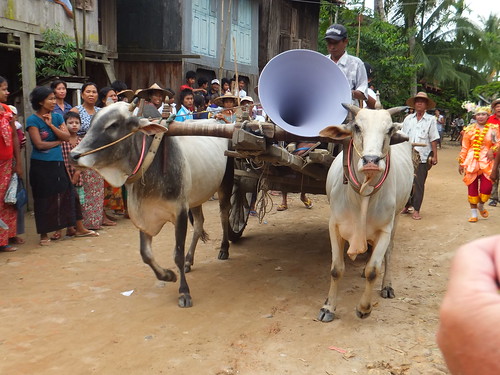
The final mobile public address system was the ‘de luxe’ model, mounted on a bullock cart drawn by two animals. Another group of musicians requiring amplification this time travelled in comfort on the cart. The animals seemed quite unfazed by all the activity and noise. The music was for a final young boy dancer dressed, like the noviciates, in a colourful, princely attire, also garlanded and wearing make-up who performed a traditional dance including elegant arm and finger movements.

The bullock cart carrying musicians and public address.

It was now time for us to enter the monastery and the main hall where the noviciation ceremony would take place. Normally, family and friends of the new novices would be invited but ‘Road to Mandalay’ had arranged for their Guests to witness this important ceremony.

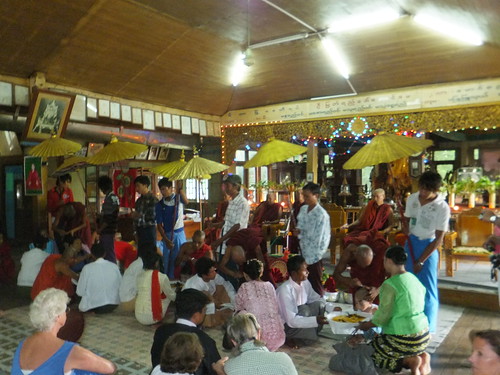
The Ordination Hall of the monastery was of wooden construction, lifted above the ground on tall wooden pillars. The walls were decorated with religious posters, pictures of monks (including elderly, framed photographs). One wall carried a long row of framed certificates. At one end of the hall a low stage was provided with a sort of proscenium arch, like a theatre. This arch carried was decorated with strings of LED lights. The rear of the stage area housed shrines and a multitude of venerable objects. At the front edge of the stage, six decorated, wooden chairs had been placed for the senior monks. The chair for the head monk was much wider than the others and had a microphone on a stand. Family and friends of the noviciates were seated on the floor of the Hall and ‘Road to Mandalay’ Guests either joined them, seated themselves on benches around the hall or remained standing. The musicians we’d first seen in the procession had already positioned themselves on the floor at the rear of the hall and they were playing so that the older of the two dancers could continue her slow, sinuous, almost hypnotic movements.
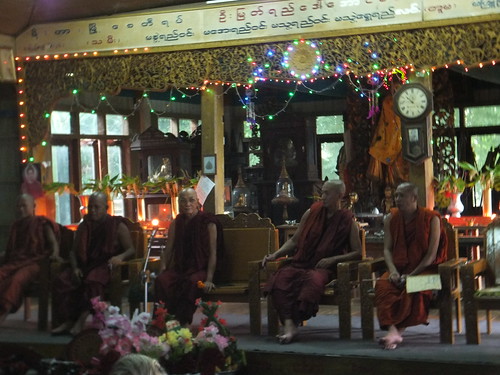
Four senior monks and the bespectacled head monk took their places and the five noviates, now without their princely costumes, were brought in and sat in a line facing the stage.

"Four senior monks and the bespectacled head monk took their places".

The head monk intoned for a few minutes and then the symbolic shaving of the hair commenced. Each noviciate was shaved, apparently expertly and painlessly, by a monk and the hair was carefully collected on a special tray held by the noviciate's parents or supporters whilst another man held a single parasol above the boy.

The heads of the noviciates are shaved.

Each noviciate was led away once the shaving was completed and then the offerings brought by the procession could be seen, lined up in front of the stage. The maroon cloth I’d seen folded ‘like a flower’ was now revealed as the noviciates first robe. Each noviciate, stripped to underpants, was carefully and, it appeared, tenderly dressed in the robe by an elderly monk. The noviciates then squatted in a line facing the senior monks and the head monk spoke for a while.

The noviciates are addressed by the head monk.

The ceremony was complete and the senior monks retired to a reserved area adjacent to the stage where they relaxed around a low table.

There was, apparently, an ‘official photographer’ who posed each noviciate with proud parents or guardian so that this important event could be recorded for posterity. Ruth and I were rather surprised to be asked to join some of these groups and I was reminded of a wedding photographer in my country as the friendly cameraman pushed us into the composition he wanted. I must confess that I have some misgivings about very young boys and girls becoming novices when they can’t be said to give “informed consent”. But it should be understood that such youngsters, if they are orphans, have only one parent or come from a very poor family are given better life chances under the protection of the monastery. In Burma, monastic institutions are not enclosed orders but form a vital part of the wider community. Novices cannot be ordained as monks until they reach the age of 20 and even then monks and nuns can, if they choose, return to a ‘normal’ life and marry. As Ruth and I left, there were a number of young novices relaxing and we both took the opportunity to take some more pictures.

Outside the monastery, there were still lots of villagers who’d been watching the earlier procession. The Doctor was handing out small treats to the local children. We walked down the long, dusty main street, trying to take in all the varied activity. I was particularly taken by the lady owner of a general store who had diversified by setting up one end of her shop as a ‘video arcade’. There were three domestic television sets side by side and a number of hand-held games consoles. Two young children were completely absorbed in a 2-person game.

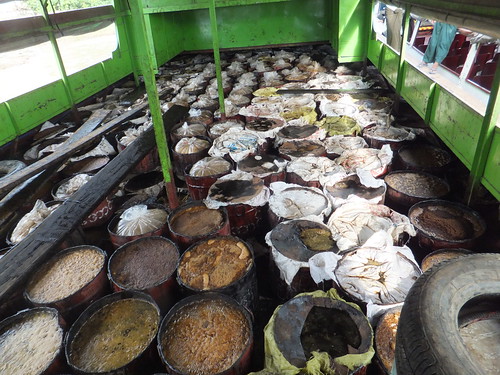
I’d anticipated we’d have to take the long walk back to the landing steps where we’d arrived but, instead, we were directed into an elaborate modern building. It was not obvious what the business was but we walked right through the building to emerge on a sandy beach where a number of large, wooden cargo-carrying boats were moored, together with a host of small boats. Children were playing or swimming and one young married couple were standing in the muddy water carrying out their afternoon ablutions and innocently delighting in one another's company. A gangplank had been provided to one of the large wooden cargo boats and we were directed across it. We crossed the lower deck of the cargo boat on planks, noting that the entire lower deck was filled with containers of molasses being shipped for wine-making.

The lower deck of the wooden cargo boat was filled with containers of molasses.

Moored on the river side of the wooden boat were our Fasts Boats, ready to take us back to our temporary home and dinner.

Photographs:

Noviciation Ceremony at Moe Dar.

[Completely revised 5-Oct-2012 as the wrong text had been inadvertently posted whilst I was in Burma - mea culpa!]

Tuesday, 18 September 2012

Returning through the Second Defile and Visit to Shwe Paw Island

Events of Monday, 17th September 2012

All was quiet at Kaung Tone when I got up. The Captain weighed anchor and set off downstream while I was having breakfast. I went up on the Top Deck and discovered a slight problem. The lens of my camera was completely misted up. I decided not to panic (yet) and, within a few minutes, a hazy picture appeared on the view screen. By the time we'd passed under the New Bridge and entered the narrow Second Defile, the camera seemed to have recovered. Our passage was uneventful but pleasant. We all took some more pictures of the "Parrott's Beak" as we passed. Our two Fast Boats could seen up ahead of us.

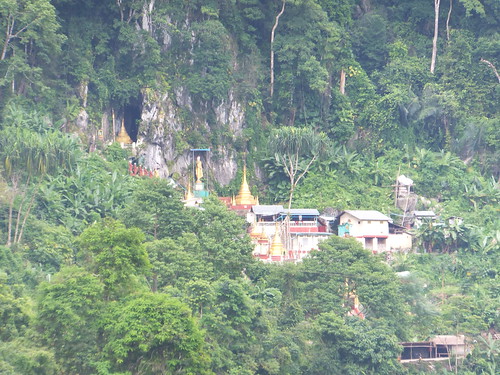
An improbable-looking monastery in the Second Defile with Pagodas, a large golden Buddha Image and a row of statues of Monks.

Around 9.30 a.m. we arrived at Shwe Paw island, with its many pagodas and monastery buildings. The captain dropped anchor midstream (with the bow pointed upstream, of course) and our two Fast Boats busied themselves ferrying the Guests ashore. It had been agreed that, rather than go with the tour guide, Nang, I would accompany the Dr. Hla Tun, the Ship's Doctor to get a better insight into the Social Contribution the 'Road to Mandalay' makes.

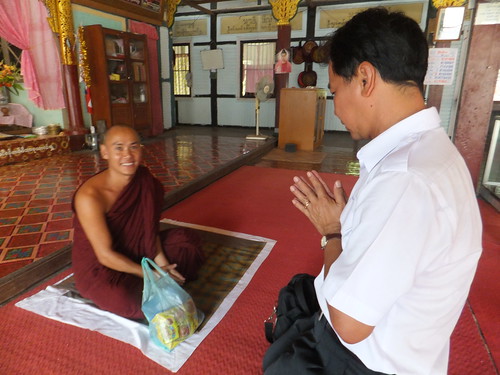
We first went straight to the monastery to see the head monk. He was surprisingly young, with an open, smiling face and twinkling eyes.

The Head Monk and Doctor Hla Tun.

The Doctor had been treating the head monk and this was a final visit during which the head monk's blood pressure was taken. A number of kittens were wandering around unmolested and what I took to be the mother came to me for some 'fuss' whilst the Doctor was completing his consultation. We then went to the adjacent nunnery, where the Doctor wanted to make a small gift. The head nun, middle-aged and bespectacled, received the gift with a blessing and discussed some features of the room shrine with the Doctor before we left.

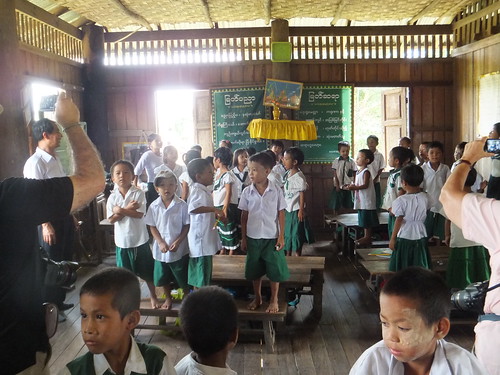
Our next stop was the local primary school, a few hundred yards away and the Doctor was concerned that the Guests would arrive there before us, so we broke into a run. The school is in an elderly wooden building building on stilts and comprises one long room in which five classes are held simultaneously. During our visit, each pupil was given and exercise book, a pencil, a pencil sharpener and an eraser. The stationary distribution had started when we arrived but I soon joined the other Guests in completing the task. The Doctor then encouraged each class in turn to sing for the visitors. All the children were well-behaved, dressed in the simple uniform of schools in Myanmar and radiated a beauty and innocence that we all found irresistible. Even in Government schools, funding for remote areas is so erratic that donations from the RTM Social Contribution are much appreciated.
Shwe Paw Island School.

We made our way quickly back to the landing steps. On the way, I was amused by a new building in course of erection. The downstairs brick walls were complete but no doors and windows had been fitted. The upstairs was only a wooden framework which supported a roof of corrugated galvanised iron (universally referred to as a 'tin roof'). Yet, even in this state of unreadiness, half of the downstairs was already in use as a general stores. I've commented before that this pragmatism seems typical of Myanmar.
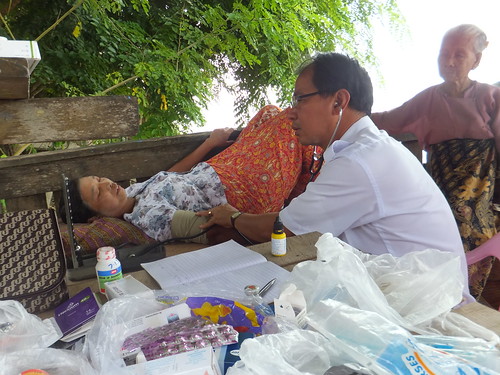
Next to the landing steps, there was a rather rickety wooden structure, uncertainly held over the edge of the river, topped with a 'tin roof'. It normally served as a waiting room for passengers travelling by the various small boats which connected the island to the mainland but, when we were there, it also formed a temporary surgery for the Doctor. A number of patients were already waiting when we arrived.

Medical practitioners in Myanmar need traditional diagnostic skills largely superceded in the West by the widespread availability of blood tests, X-ray, Ultrasound, Scans and other aids. In areas like Shwe Paw, none of this is available. Even in the cities, facilities may be limited and patients from the countryside are unlikely to be able to travel to such facilities, let alone pay for them. So a doctor needs to be able to diagnose conditions from a limited number of observations available. Measurement of blood pressure (invariably using a traditional, manual instrument) becomes a vital tool. The Doctor carries a wide range of modern drugs, separated into a series of carrier bags. Of course, in conditions like this, the privacy that a patient would expect in the West is completely absent but patients appeared merely happy to be receiving free treatment.

Dr. Hla Tun checks the blood pressure of a patient on Schwe Paw Island.

A number of patients had brought fresh Pomelo fruit in payment and there was soon quite a collection of fruit. As the Doctor methodically worked away, keeping case notes for each patient and explaining to them how they were to take the medication, the one Fast Boat loaded up Guests and took them back to the ship. The first Fast Boat returned and loaded more guests, leaving the second fast boat still moored at the landing steps. Sadly, not all the patients could be seen before we had to collect up the medication (and the Pomelo) and hurry onto the waiting Fast Boat (along with some 'stragglers' amongst the Guests) and return to the ship. Guests are presented with a comprehensive selection of activities and the ship needed to leave the island on time in order to arrive at Moe Dar in time for the afternoon activity.

Photographs:

Downstream through the Second Defile.
Shwe Paw Island.
Shwe Paw Island School.
Shwe Paw Island Clinic.

[Revised 16-Sep-2012]

Monday, 17 September 2012

The Second Defile and Bhamo

Events of Sunday, 16th September 2012

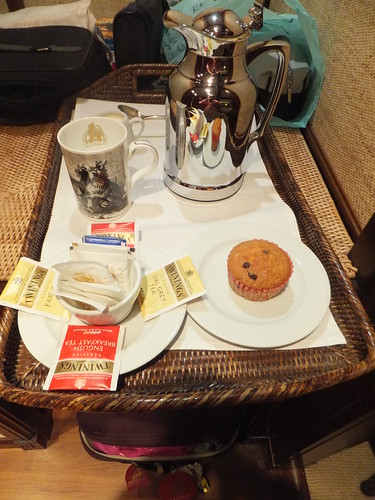
Early morning tea.

After early morning tea in my cabin, I had a simple breakfast in the restaurant as the ship raised anchor and headed upstream. Around 9.00 a.m. we entered the Second Defile. 'Defile' is a rather odd word which the British used - the word 'Gorge' is perhaps more readily understood. Certainly, the scenery became more rugged and the river became narrower. It was also distinctly cooler. Jungle covered mountains lay left and right, falling steeply towards the river. There were frequent small villages on both sides with a few houses constructed of bamboo. Sometimes, there were isolated dwellings. Always, there were boats both powered and un-powered, for there are very limited roads here. The larger clusters of houses might have a pagoda nearby, sometimes we saw small pagodas isolated near the river. We passed Wei-Ma Elephant Camp on the east bank, but we only saw one elephant.

Three Men in a Boat and One Elephant at the Wei-Ma Elephant Camp.

In places there were sheer rock walls, rather reminiscent of the Mekong River passing through the northern part of Laos. Trees and shrubs tenaciously eked out an existence even in these rocky sections. On the west bank, there's a small outcrop of rock known as the "Parrot's Beak". It protrudes from the face of the rock just above the waterline. Somebody with a good imagination once decided it looked like the head and beak of a parrot. It's now painted in bright colours to make the resemblance more obvious.

The Parrot's Beak.

Recently, there had been quite a lot of rain so we saw a number of small waterfalls cascading down the rock walls.

One of the fast boats was visible ahead, moored at a small sandy spit. The Captain said that they had stopped to clear weeds which were fouling the propeller. When we came abeam, the boats crew of five men (two with hard hats) were all standing in shallow water dealing with the problem. The Fast Boats, in common with many of the larger boats on the Ayeyarwaddy, have the propellor mounted on a substantial welded steel outrigger extending from the stern of the boat and driven through additional propellor shafts including some form of Ackerman flexible joints. This outrigger can be raised or lowered by altering the effective length of an angled supporting shaft leading to the stern of the hull by turning an adjustment wheel. The outrigger had been raised so that the propellor was half out of the water. The weeds must have been pretty tough because one boatman was belabouring the rearmost propellor shaft with a large hammer.

The crew of the Fast Boat attending to the propellor.

They succeeded with the repairs and caught up with us in Bhamo. Our ship only makes four trips up to Bhamo each year so we attracted quite a lot of attention from the people who live near the river banks. Most of them would wave as we passed and, of course, we reciprocated.

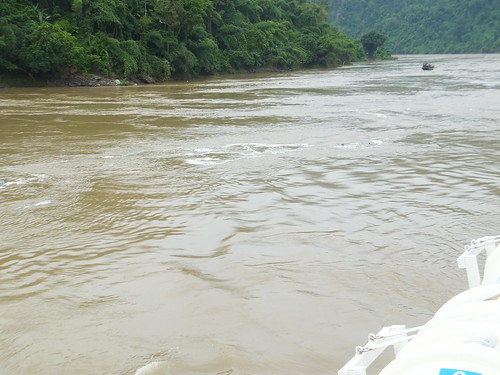
The river is much narrower in the Second Defile, so it runs much deeper to drain the headwater. The Captain invited us to inspect the Echo Sounder screen - the depth was typically 150 to 160 feet when we looked. The underwater rocks disturb the water flow, creating vortices of rotating water which appear as whirlpools on the surface. The Captain explained that there are often two contra-rotating whirlpools abreast and the helmsman will aim for the 'slack water' in between them. Because of the skill of those on the bridge, our ship made stately progress apparently oblivious to all the turbulent water.

Troubled Waters in the Second Defile.

The river became wider and the hills more gentle as the approached Bhamo. On the east bank there was a logging camp for conveying timber away by water. Huge teak logs were stockpiled awaiting shipment. There were a couple of the traditional rafts, where the logs are suspended by ropes from massive pontoons These rafts are then towed by a powerful tug boat. But there were also a couple of massive steel barges, already loaded with logs cut to the width of the barge. In this case, the tug boat often lashes the barge alongside and they proceed 'two abreast'.

We passed under the New Bridge which appears almost complete. There are eight steel truss spans but only the one we used was marked for river traffic. There were 'traffic lights' on the bridge piers but they were not lit. The bridge carried a lane for road traffic (equipped with lighting standards), a single track metre gauge railway and a pedestrian lane. On either side of the bridge spans, there are reinforced concrete approaches. I was told that the railway track will be connected to the new triangular junction I saw two years previously at Katha in one direction and extend to Bhamo in the other direction.

Fairly soon, the important town of Bhamo was clearly visible on the east bank in the afternoon sun. The first Fast Boat was waiting for us at an island on our left and the Captain pointed out the that the second Fast Boat had almost caught up with us after stopping for repairs.

One of the smart twin-funnelled modern ferry boats was berthed at the waterfront on our right. The Captain told me that there are three of these in service between Mandalay and Bhamo, calling at various places on the way. Between them, they provide a daily service on the river. The Captain dropped anchor mid-stream and, as usual, the two Fast Boats ferried the passengers ashore.

This year, activities in Bhamo have been restricted because of the security situation involving dissaffected tribesmen. The population of Myanmar is made up of over one hundred ethnic groupings who do not always co-exist peacefully. In the hot sun, we had a walk around the central part of the town, looking at the bewildering range of items on offer in the huge market (similar to Katha but even larger) and street after street of shop premises.

Refreshments had been provided for us at the modern building of 'The Bakery', overlooking the dual carriageway road. However, the carriageway nearer the river was almost entirely taken over by an open-air market and their customers so the odd vehicle on that side made only slow progress. Then, we all walked by to the landing steps where the two Fast Boats were waiting to take us make to the ship. Once we were all aboard, the Captain started downstream to Kaung Tone where he anchored for the night.

The open-air market on the carriageway nearer the river at Bhamo.

In the evening, a group of Kachin dancers in ethnic costume entertained us on the top deck with a number of traditional dances.

Photographs:

Through the Second Defile to Bhamo.
Bhamo.
Kachin Dancers.

[Revised 16-Oct-2012]

Sunday, 16 September 2012

Visiting Katha and Shwe Gu

Events of Saturday, 15th September 2012

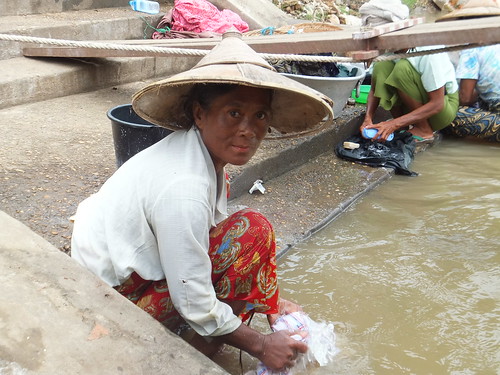
I was up at 6.00 a.m. but, since my cabin was on the starboard side, I couldn't see the town of Katha we were moored at because that's on the west bank. I had a 'simplified breakfast' in the restaurant and was ready well before 8.00 a.m. when the 'Fast Boats' would transfer us to the shore. Katha was the largest town we'd seen on the journey, apart from Mandalay city (which we had passed on our way from Shwe Kyet Yet to Mingun without actually stopping). I'd visited Katha once before, on my first trip to Bhamo in 2010 (see the group of posts labelled FE5) but I was pleased to make a second visit. I was on the 'Green Flag' 'Fast Boat' which was the second to depart from the ship. It quickly took us to the landing steps - there was no shore here and the river lapped at the bottom of the concrete steps leading up to the level of the town. The same elderly woman I'd seen two years previously was at the foot of the steps washing baskets of laundry in the brown water as she's probably done on most days since my last visit.

A smile from the elderly washerwoman at Katha.

A long line of 'Trishaws' (tricycle rickshaws) was drawn up along the road at the top of the landing steps and there was slight chaos as guides and staff from the ship allocated passengers to the 'Trishaws'.

Guests landing at Katha being distributed amongst the waiting trishaws.

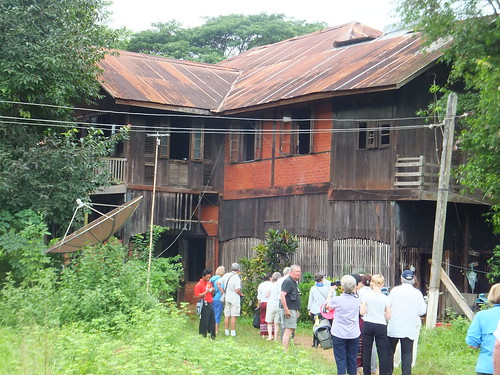
We were soon off, in a long convoy moving fairly slowly as the driver pedalled hard to get the load of one or two passengers moving. We travelled for around ten minutes before stopping at the former British Club. The building (like a lot of once-decent buildings in Myanmar) was rather dilapidated although still apparently in use. As we wandered around outside the building, peering in through the dirty windows, it was easy to imagine the British here. George Orwell described the situation in his early novel 'Burmese Days'.

The former British Club in Katha.

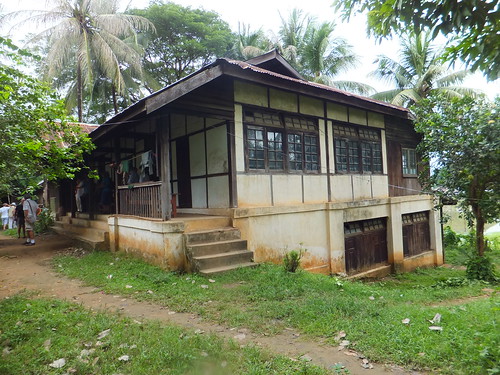
We trooped back to the waiting 'Trishaws' and, having found the machine and driver who brought us from the landing stage, clambered aboard. Another slow procession took us to George Orwell's house. This is now under Government control and in very poor condition. Two of the rooms were occupied by two families - the rest of the building was unused. The whole place was very dilapidated and surrounded by an overgrown field which was probably once recognisable as a garden. A large satellite dish in the 'garden' added an incongruous touch.

George Orwell's House in Katha.

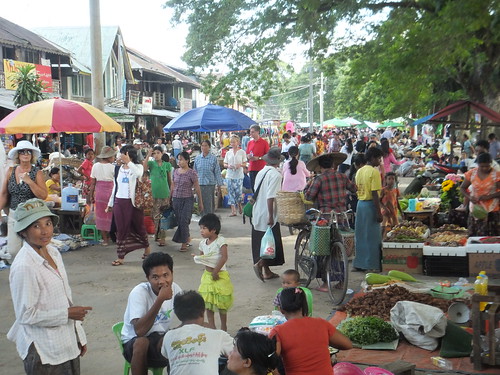
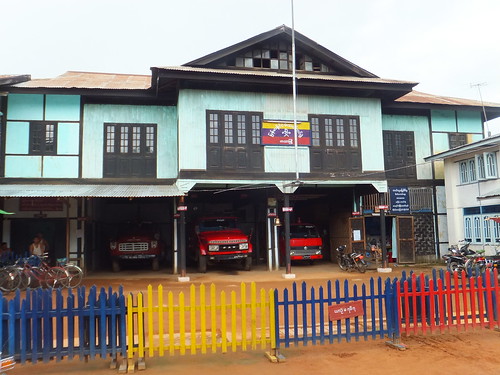
Then, it was back on the 'Trishaws' for a ride to the market. The market was similar to the one at Kyan Hnyat we'd toured the day before, but larger. I happily wandered around the market on my own (as did a number of the passengers) trying to make sense of it all, but I remained bewildered by all the activity. I made my way back to the 'Trishaws' passing Katha Baptist Church built in 1960 and the Fire Station with three different-sized fire appliances lined up ready for action. With so many wooden buildings, fire is never to be taken lightly.

The Fire Station in Katha is rather grand.

Although the 'Trishaws' were provided to return us to the landing stage, quite a few passengers (and the writer) elected to walk back. When it started to spit with rain, I wondered whether I'd made a mistake but it was only a very light shower which passed very quickly and we had no other rain in the day.

When everybody was back on board the ship, the 'Fast Boats' set off ahead of us and the ship followed upstream. Later, we caught up with the 'Fast Boats'. They'd stopped and let us pass, then chased after us. Shortly afterwards, I saw the Captain on the V.H.F. radio and the first 'Fast Boat' drew alongside on the port side. This time, I was allocated to the first boat so, once the passengers were loaded, the 'Fast Boat' headed upstrean to allow the second 'Fast Boat' to moor alongside the ship and collect its complement of passengers.

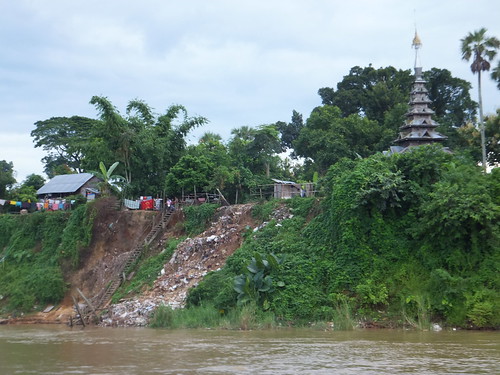
We cruised upstream for fifteen minutes, passing a number of communities on the east bank. Plenty of the local people, not just the children, stopped whatever they were doing to watch us pass and wave a greeting. I'm afraid a common, and unattractive, feature of each cluster of buildings was an area along the high, sloping river bank where they dumped their refuse - paper, plastic, whatever. One of the 'Road to Manadalay' initiatives in schools is the donation of plastic 'trash cans' as part of a drive to teach young people to preserve the environment.

A village dump.

We arrived at the town of Shwe Gu on the east bank, where we were to land. A group of six youngsters were swimming just by the landing place. Partly to impress us, no doubt, they were repeatedly jumping into the water from a crude landing stage used by small boats, carrying out cartwheels and twists before running round to repeat the performance.

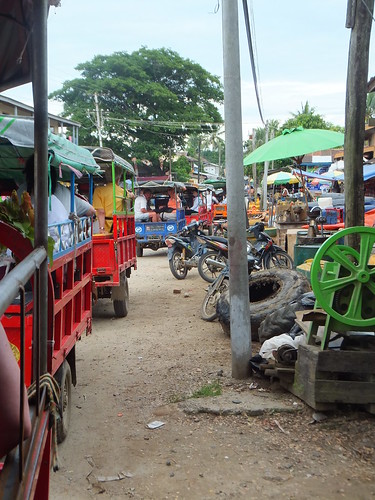
The usual arrangements for disembarking were made - two long planks laid side by side, clamped together at the midpoint with two pieces of wood secured by two sets of bolts and with two boatmen holding a long bamboo pole as a handrail. There was plenty of activity in the vicinity of the landing place - as we docked I'd spotted a passenger ferry going upstream which I think had stopped at Shwe Gu shortly before us so a lot of cargo was being removed from the landing area by a number of small lorries. These lorries are powered by an exposed Chinese engine mounted on an articulated front end and they were being manoeuvred with some abandon in the 'staging area' in between the river and the parallel road.

Also in the 'staging area', there were at least twelve of the 'motor tricycle' type of vehicle. The front end looks like a motor bicycle, with a single front wheel mounted in forks and steered using handlebars by the driver who sits in the usual position. On some models, there was a conventional contoured fuel tank above the engine (although I think it may have been just a 'dummy'), on other types there was a rectangular fuel tank attached to the vertical bulkhead behind the driver. I think all types had a transverse radiator mounted in front of the engine (like the old 'Velocette'): some vehicles appeared to incorporate an electric fan. The back of the vehicle was like the small four-wheeled pick-ups, with a low-sided body allowing goods to be carried. At Shwe Gu, these vehicles are used as taxis, so bench seats were provided down each side. These 'motor tricycles' were to be our transport to our destination - a nearby Shan Village. As the convoy of 'motor tricycles' formed up to take us to the village, the impressive bulk of the 'Road to Mandalay' ship sailed past, saluting the town with a blast on the siren.

"We got ourselves a Convoy".

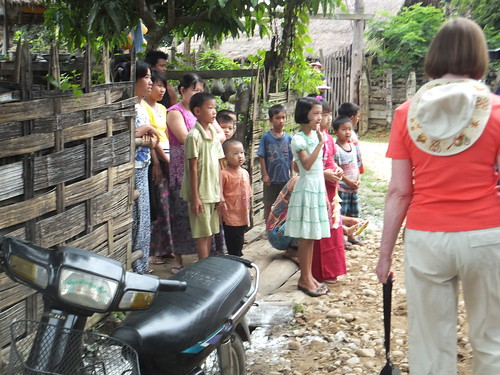
The Shan village was around a mile out of town, an arrangement of criss-crossing dirt roads lined by a mixture of modest houses made in bamboo and much more substantial houses in brick and concrete stucco. There were wooden pig sties and fenced compounds for chickens. Everywhere there were children, watching the visitors and happy to return a "Mingela Bar", the Burmese greeting, wave and smile.

Children in the Shan Village.

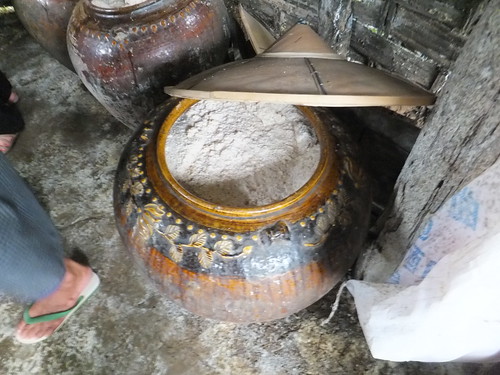
We walked a short distance to the village Distillery - this village is famous for its distilled rice whisky. You need lots of water in the process and the Distillery had a large water tank. The water, I was told, is drawn from an artesian well. In the wooden building next to the water tank, I found a Chinese packaged engine driving a Chinese alternator through a belt drive. Next to this arrangement was an electric motor driving a 2-cylinder 'V'-form reciprocating compressor through another belt drive. I traced the output of the compressor to a small diameter pipe leading to the artesian well, so I assumed the compressed air is used to help to 'lift' the water from the well. The walls of this room were lined with storage jars containing rice powder and water. These are left to ferment for four or five days. When the covers of the storage jars were lifted for our inspection, we could see the mixture bubbling away happily. This produces rice wine about 3% alcohol.

The fermentation is carried out in a number of storage jars.

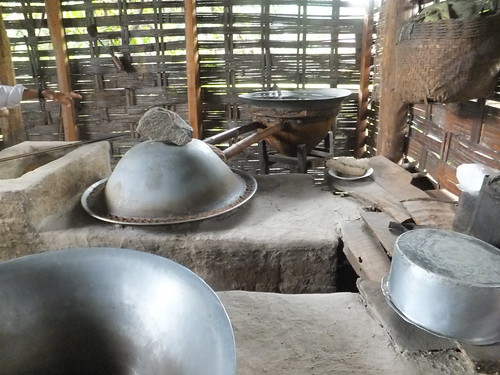
In the next room, we were shown a number of stills. Each comprised a well-constructed rectangular oven with a large metal 'wok' on top. Rice wine is placed in the 'wok' and a domed metal cover is placed on top and sealed with what looked like clay. Two pipes emerge from this cover and connect to the body of an adjacent metal 'condenser'. A discharge pipe fitted near the bottom of the 'condenser' allows the condensate (the whisky) to drain into a suitable container.

The 'wok' with the domed cover is in use. The two horizontal pipes allow vapour to circulate to the 'condenser' in the background which is cooled by a supply of water. The discharge pipe from the condenser is not visible in this view.

Enough rice whisky is produced not only to supply the village itself but for shops to sell in the town, with the liquid placed in 600 ml plastic water containers. Usually, they add herbs which are supposed to be health-giving and this gives the product an attractive golden colour. We were offered small shots of this potent drink. I found it brought tears to the eyes.

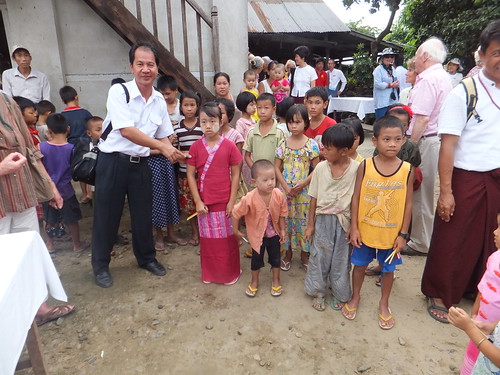
Outside the distillery, we were offered soft drinks by the 'Road to Mandalay' team. The Ship's Doctor has assembled the village children and presented them with pencils. Some of the children were dressed in traditional Shan clothing.

Doctor Hla Tun with some of the village children.

We walked back to the waiting 'motor tricycles' and clambered aboard. The procession set off with much waving and most of the people we passed on the road back to Shwe Gu Landing Place were happy to wave and smile. One 'Fast Boat' boarded half the passengers and set off upstream. The other 'Fast Boat' was moored a few feet away unloading numerous large, green 'kit bags' of dirty linen and large empty plastic water containers which it had clearly fetched from the ship whilst we were at the village. Logistics were expediting the unloading and very soon the 'Fast Boat' was able to pick up the remaining passengers and follow the first 'Fast Boat'. Our ship was waiting only a few hundred yards upstream so we were all soon safely back on board after a fascinating excursion.

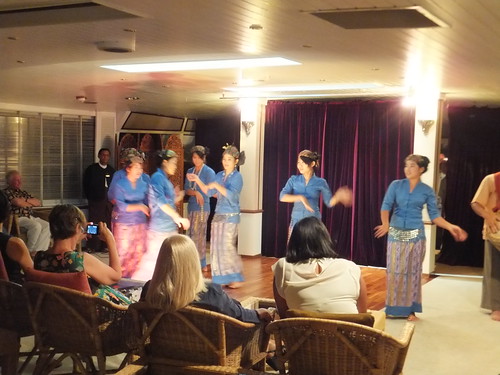
After dinner, a troupe of Shan Dancers came aboard with their musicians and traditional instruments and performed a number of traditional dances to an enthusiastic audience in the Observation Lounge.

Shan Dancers performing on the 'Road to Mandalay'.


Photographs:

Katha.
Shwe Gu.
Shan Dancers.

[Revised 5-Oct-2012, 7-Oct-2012]

Saturday, 15 September 2012

Visiting Kyan Hnyat Village and School


Events of Friday, 14th September 2012

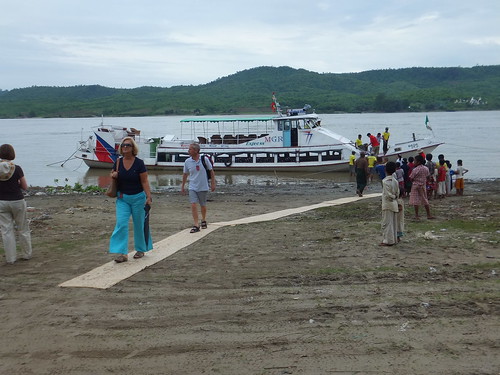
Rise at six, quick shower and to the restaurant for breakfast. Meantime, the ship had raised anchor and continued upstream as far as Kyan Hnyat village. The two 'Fast Boats' could be seen tied-up at the village and the both left the shore to meet us in midstream. Those passengers wishing to go on the early excursion transferred to the 'Fast Boats' at 7.30 for the short journey to the shore. The beach shelves only gently here, so my fast boat had to moor a few feet out from the water's edge. This meant that the normal 'two planks side-by-side' gangplank would not fully reach so a second, similar gangplank was laid on the first at a steeper angle making disembarkation a trifle hairy. The beach was rather muddy, so Logistics had laid a number of lengths of matting end-to-end. We then climbed a set of concrete steps to the level of the village.

Disembarking from the Fast Boat at Kyan Hnyat Village.

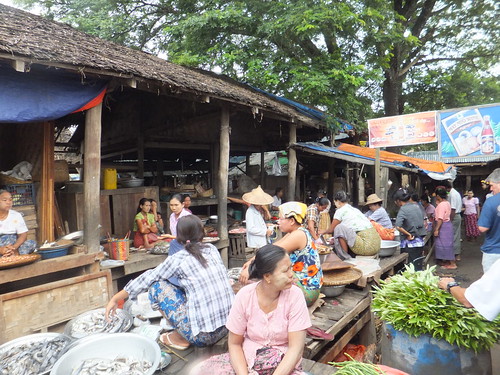
Lots of children and adults were keenly watching the strange-looking visitors who arrive by the Great White Ship four times a year. The bustling village market extended right up to the top of the steps where pottery jars in various sizes were on offer and we were immediately immersed in the sights and sounds of vibrant commerce. We made our way through the narrow passages between rows of stalls selling every possible requirement. Vegetables, meat, fish, eggs, rice and spices abounded. But there were also manufactured goods, clothes, metalware and plastic items, mainly originating in China.

Each market stall is a raised wooden platform on which the vendor squats, surrounded by their stock.

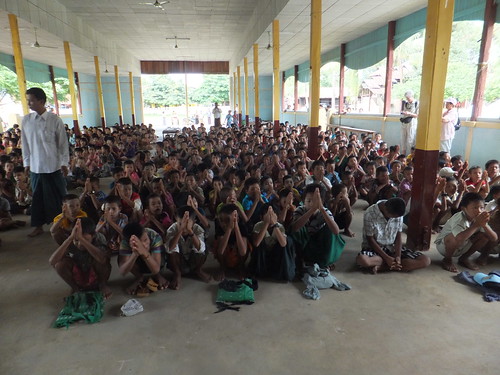
We left the market and walked along the dirt road leading to Kyan Hnyat school, passing a group of young monks accepting offerings of alms (prepared food) from the villagers. At the school, a large, open-sided assembly building was crowded with children of all ages, all squatting on the bare concrete floor.

The assembly building at Kyan Hnyat School immediately prior to the distribution of stationery.

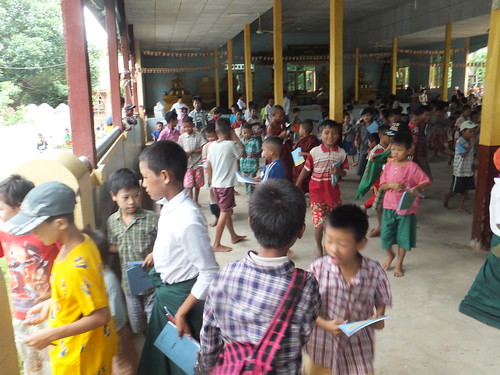
As we arrived, the headmaster started the waiting pupils reciting whilst Doctor Hla Tun and various helpers unpacked the stationery which Logistics had brought from the ship. Each child was to receive an exercise book, a pencil and a short plastic ruler. A number of guests assisted in distributing this stationery and there was quite a hubbub as this task was carried out. 'Road to Mandalay' staff had set up a table at the rear of the hall with various types of soft drinks for the guests. By half past eight, all the children had received their stationery and the headmaster told them to go back to their classrooms for the start of their normal lessons.

Children returning to their classrooms with their stationery.

The guests started to return to the 'Fast Boats' followed by lots of curious children and watched by friendly residents. I was interested in a small blacksmith's shop equipped with very basic facilities - various anvils, a few hand tools including tongs and a small forge. The forge was a hole in the ground for the fuel, surrounded by a series of crude curved metal plates vaguely enclosing the fire. To raise the temperature of the fire sufficiently for metalworking, forced air is necessary, produced by a bellows or equivalent. Here, ingenuity had been employed. The air was supplied by a ducted rotary fan which looked as if it had been rescued from some discarded equipment. The fan was mounted on a fairly substantial wooden chassis which was long enough to accommodate an old bicycle mounted upside-down. A drive rope passed around the large rear wheel of the bicycle (with the tyre and inner tube removed, of course) and connected to a small drive pulley on the fan. The blacksmith's young assistant proudly demonstrated how turning the bicycle pedal by hand spun the fan to get the forge to working temperature.

We ran the gauntlet of the numerous small motor bicycles in the main street, alked back through the market and boarded the 'Fast Boats'. In addition to the 'Road to Mandalay' Logistics team, we were seen off by the headmaster (who recorded the scene with a digital camera), a number of children, some of the young monks and various local people. By 9.00 a.m. we were back on board the ship. The 'Road to Mandalay' continued upstream for most of the day.

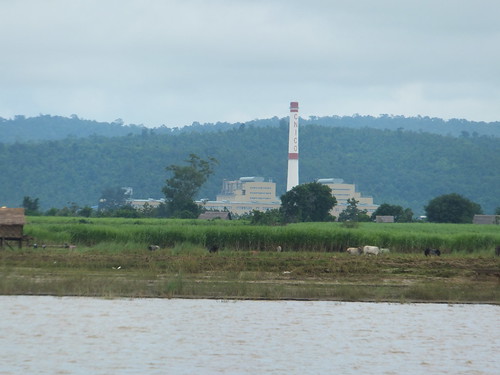
We passed the industrial area on the east bank I'd noted two years before but this had changed significantly. The new construction is a joint venture between China and Myanmar to produce nickel. A quay with two grab cranes has been built. These appear to be for unloading coal or ore from barges. The cranes discharge into hoppers feeding a conveyor system leading to a large stockyard. From here, the conveyor continues to a large processing building near a tall chimney marked 'CNICO'. A further very long conveyor appears from the mountain and extends to the processing plant. In discussions with the Captain, we concluded that the nickel ore is mined somewhere up in the mountains and then brought to the main plant for processing (or, perhaps, storage) by the very long conveyor.

The 'CNICO' main nickel processing plant.

Sunset was at 6.10 p.m. and we dropped anchor mid-stream opposite the town of Katha around this time. I enjoyed a leisurely dinner with Arun (a new friend) and Audrey and Margot (with whom I sailed two years ago). The launch of the Shan Fire Ballons took place a little earlier than advertised so, by the time I got to the top deck, the Fire Balloons were drifting away in the night sky.

Photographs:

Kyan Hnyat Village.
Kyan Hnyat School.
Upstream on the Ayeyarwaddy.

[Revised 7-Oct-2012]

Friday, 14 September 2012

Visit to a Pottery Village and Stationery Distribution to 8 Schools

Events of Thursday, 13th September 2012

A wind from the south caused a certain amount of buffeting of waves against the hull during Wednesday night which occasionally woke me but I had no trouble slipping off to sleep again. I'd planned a fairly gentle start to the day with the alarm set for 6.00 a.m. and tea in my room ordered for 6.15 a.m. I think it was well after seven when I sauntered down for breakfast but the dining room was still quiet. We were already under way upstream. After breakfast, I went up to the bridge and the Captain and I had a long conversation. We were due to leave the ship using the 'Fast Boats' for a visit to Nwe Nyein village. The first boat was due to depart at 10.00 a.m. and the second (on which I was scheduled to travel) ten minutes later.

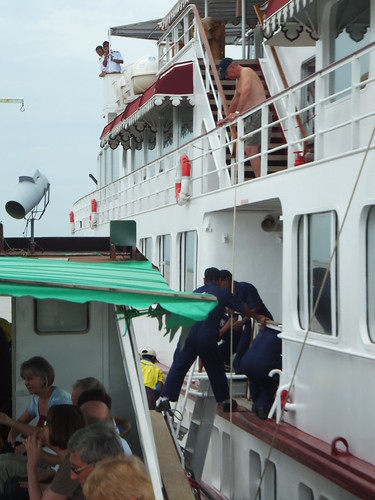
The transfer of passengers to the 'Fast Boats' is normally done with 'Road to Mandalay' under way so there's a certain frisson of excitement associated with crossing between two moving boats but there are always plenty of helping hands close by to make sure the process is safe. Once the first 'Fast Boat' was loaded, it slipped the three mooring lines and moved away from the big ship noisily, to be quickly replaced alongside by the second 'Fast Boat'. The remaining passengers (including me) boarded and we were soon chasing the first 'Fast Boat'.

With all the Guests transferred to the Fast Boat (left) the access steps from the 'Road to Mandalay' are removed.

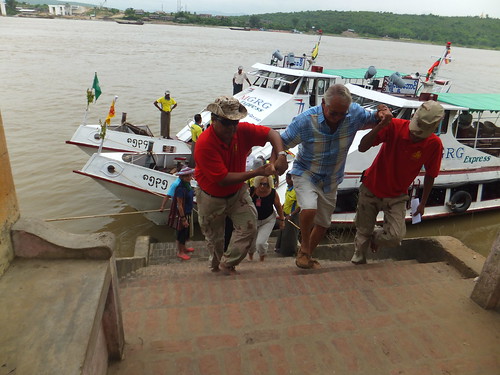
Both boats travelled up river for about 45 minutes. The first boat was already moored at the brick and concrete steps leading to a monastery compound and the passengers were going ashore. We tied-up next to the first boat and disembarked by crossing to the first boat using a large metal plate laid between the boats and then by using the first boat's gangplank - two narrow planks vaguely held together and with a long pole of bamboo held by two boat men to serve as a handrail. It's not quite as hairy as it sounds.

Logistics Staff assisting Guests from the Fast Boats to the shore.

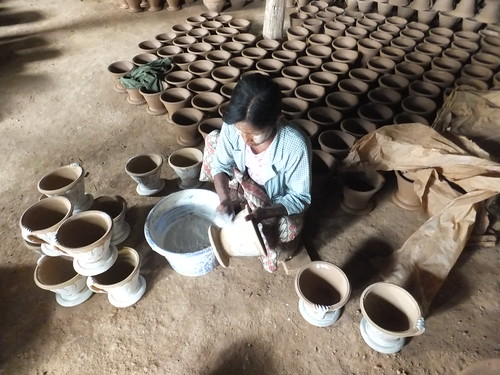
We walked through the monastery compound and into Nwe Nyein village. It seems that the entire village is devoted to the production of pottery jars, from small bowls, through larger bowls, some with glazed decorative pattern, to large storage jars up to about four feet in height. A number of small boats were docked in the mud of the river bank and were being loaded with different products. First, we passed a huge stack of timber which is used in the kiln for the firing process. Next, we came to a hole in the ground about 8 feet long, 3 feed wide and perhaps 3 feet deep. Two types of dry clay, in the correct proportions, are tipped into this mixing pit and thoroughly mixed manually by young men working in the pit. The clay may have been carried up to a mile to reach the pottery. When required, water is carefully added to the dry mix whilst thoroughly 'kneading' to produce wet clay of the proper consistency.

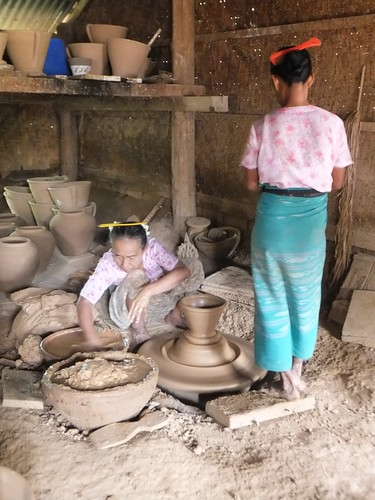
We saw two women making larger bowls with a simple 'kick wheel' potter's wheel. The potter sat at the wheel, 'throwing' the shape while the assistant remained standing kicking the potter's wheel and fetching and carrying for the potter as required.

The potter 'throwing' a bowl using a 'kickwheel' spun by her assistant.

Nearby, a third woman was applying the white 'slip' which would define the pattern on these bowls. The result is a repeated swirling leaf pattern suggesting a number of plants growing up the outside of the pot. I was amazed at the method adopted to create this decoration. The lady dips her hand into the white slip then, with a rapid, curving sweep of the fingers, transfers the slip to the outside of the pot, each finger tracing an individual leaf. The pot is then turned to allow the next 'plant' to be created until the pattern encircles the pot. Within a few seconds, the job is done and, with a couple more flourishes to 'paint' the rim and base, the pot a laid aside to dry and the process is repeated on the next pot. Before firing, the pot is covered with a clear glaze. After firing, the 'unpainted' clay is a lustrous dark brown and the leaf motif is a golden yellow. The effect is most attractive.

Applying decoration to the bowls.

Making the large water pots is a physically demanding task and we only saw male potters undertaking the work. When I was young, I was taught how to make small 'coil pots' from modelling clay. The raw material is rolled into a long 'sausage' which is coiled to form a circular base. Further 'sausages' are added as necessary to build up the walls of the pot to the desired shape and height. The large water pots are made using the same method, writ large.

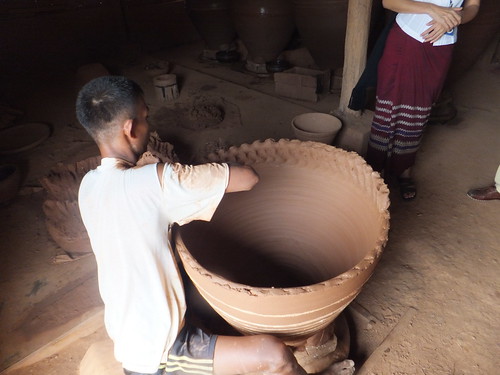
The pot is constructed on a 'kick wheel' used only to rotate the work in progress as required by the potter using one foot. The potter sits on a tiny wooden stool but, as the pot grows, a second stool is placed on top of the first to bring the potter to a more convenient height. The potter has quite a sizeable pile of clay at his side, from which he takes a good 'dollop' and kneads it to form a sausage three or four feet long and five or six inches in diameter. Working such an unwieldy 'sausage' must take considerable strength. The result is also quite heavy, so one end of the 'sausage' is laid over the potter's shoulder whilst the other end is used to form the pot. Once the walls of the pot are started, the potter rapidly 'crimps' the sausage to the ring below by squeezing the clay between thumb and forefinger every few inches, slowly turning the wheel with his foot as he goes. Once the potter has reached the widest point of the jar, one 'sausage' will not even complete one ring, so the process of 'sausage' making, applying and 'crimping' is repeated many times.

The potter feeds the clay 'sausage' (supported on his right shoulder) and 'crimps' it in place on the growing large pot.

Further clay is added to produce a smooth surface outside and in. Leaf motif decoration, as described above is usually provided, with glaze over the decorated part of the pot. We saw one brick-lined kiln for firing the various pots made at the village. It was built on a slope with entrances at both the high and low ends. Since it was still being loaded, we were able to walk inside. Once full, wood fires are set and the entrances bricked up, apart from small 'firing holes' which allow more wood fuel to be added. The 'Road to Mandalay' team has set up a refreshment table so that we could have a drink before walking back to the two 'Fast Boats' waiting for us at the Monastery steps.

By this time the 'Road to Mandalay' ship had passed, and was a few hundred yards upstream of us, so it took only a few minutes to rendezvous with the ship and transfer the passengers back aboard. As each 'Fast Boat' disembarked its passengers, it took off at speed to go ahead of us. The ship had now entered the 'Third Defile' of the river, so I took lunch on the Top Deck to better watch the passing scenery.

The section of the river to Male, where we were to anchor that evening, has eight schools near to the river so on each of the four trips to Bhamo during the year, stationery is donated to these schools as part of the 'Road to Mandalay' Social Contribution. Each 'Fast Boat' had gone ahead of us to deliver the donations to four schools and their task was to deliver that stationery in bulk before our ship passed each school. The school staff then rapidly distributed the donations (usually exercise books and pencils) so that the pupils were waiting on the river bank when the 'Road to Mandalay' passed.

As we approached each school, the 'Road to Mandalay' manoeuvred as close to the shore as was prudent and gave a long blast on the siren to alert the school.

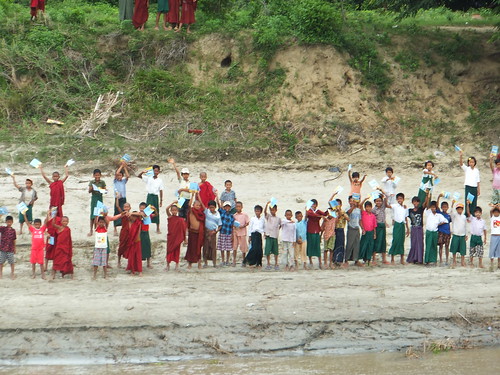
A few of the 1,427 grateful school children (and their teachers) who greeted us as we passed.

At every location, all the pupils were lined up on the river bank waving their just-received stationery and cheering us in thanks. The ship acknowledged with a series of short blasts on the siren and all the passengers watching from the rail on the top deck would wave back. Many, many photographs were taken.

More grateful school children.

The 1st school (on the West Bank) was Ma-Aw, which has 154 pupils.

The 2nd school (on the East Bank) was Pya which has 58 pupils.

The 3rd school (on the East Bank) was Nyaung Pin Tha which has 95 pupils.

The 4th school (on the West Bank) was Yone-Pin, which has 270 pupils.

The 5th school (on the West Bank) was Kote-Tet, which has 355 pupils.

The 6th school (on the West Bank) was Ka-Bwet, which has 327 pupils.

The 7th school (on the East Bank) was Kyaw-Lay, which has 60 pupils.

The 8th school (on the East Bank) was Pon Ner which has 108 pupils.

Before we'd passed the last of the schools, it had started to rain but that didn't seem to dampen the spirits of the school children or the passengers.

Photographs:

By Fast Boat to a Pottery Village.
Schoolchildren along the Ayeyarwaddy.

[Revised 6-Oct-2012]