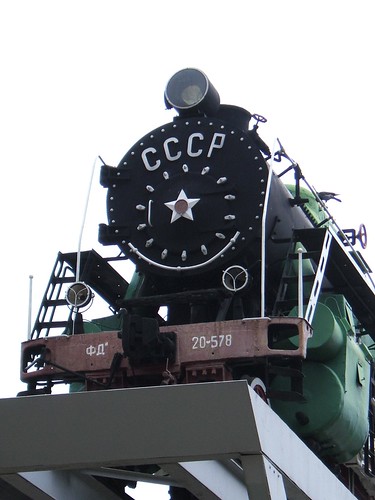
Sunday, 16 September 2012
Visiting Katha and Shwe Gu
I was up at 6.00 a.m. but, since my cabin was on the starboard side, I couldn't see the town of Katha we were moored at because that's on the west bank. I had a 'simplified breakfast' in the restaurant and was ready well before 8.00 a.m. when the 'Fast Boats' would transfer us to the shore. Katha was the largest town we'd seen on the journey, apart from Mandalay city (which we had passed on our way from Shwe Kyet Yet to Mingun without actually stopping). I'd visited Katha once before, on my first trip to Bhamo in 2010 (see the group of posts labelled FE5) but I was pleased to make a second visit. I was on the 'Green Flag' 'Fast Boat' which was the second to depart from the ship. It quickly took us to the landing steps - there was no shore here and the river lapped at the bottom of the concrete steps leading up to the level of the town. The same elderly woman I'd seen two years previously was at the foot of the steps washing baskets of laundry in the brown water as she's probably done on most days since my last visit.
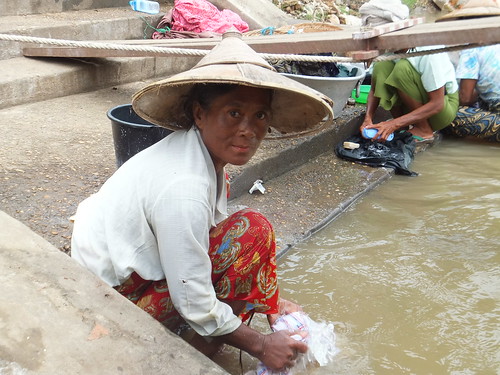
A smile from the elderly washerwoman at Katha.
A long line of 'Trishaws' (tricycle rickshaws) was drawn up along the road at the top of the landing steps and there was slight chaos as guides and staff from the ship allocated passengers to the 'Trishaws'.
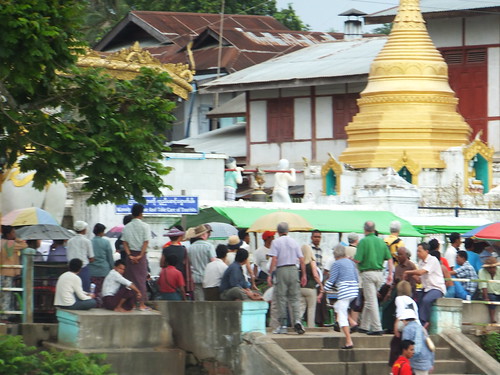
Guests landing at Katha being distributed amongst the waiting trishaws.
We were soon off, in a long convoy moving fairly slowly as the driver pedalled hard to get the load of one or two passengers moving. We travelled for around ten minutes before stopping at the former British Club. The building (like a lot of once-decent buildings in Myanmar) was rather dilapidated although still apparently in use. As we wandered around outside the building, peering in through the dirty windows, it was easy to imagine the British here. George Orwell described the situation in his early novel 'Burmese Days'.
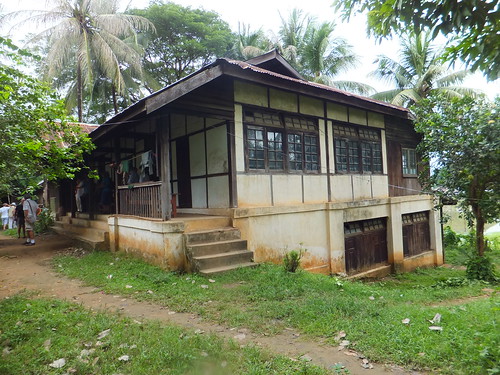
The former British Club in Katha.
We trooped back to the waiting 'Trishaws' and, having found the machine and driver who brought us from the landing stage, clambered aboard. Another slow procession took us to George Orwell's house. This is now under Government control and in very poor condition. Two of the rooms were occupied by two families - the rest of the building was unused. The whole place was very dilapidated and surrounded by an overgrown field which was probably once recognisable as a garden. A large satellite dish in the 'garden' added an incongruous touch.
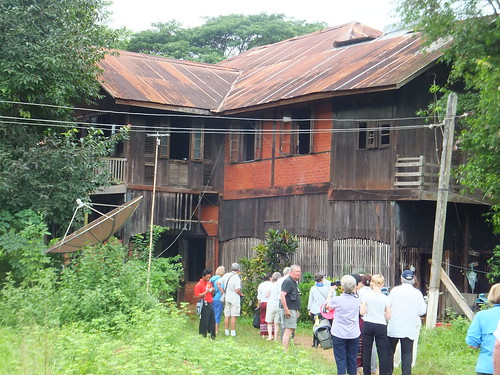
George Orwell's House in Katha.
Then, it was back on the 'Trishaws' for a ride to the market. The market was similar to the one at Kyan Hnyat we'd toured the day before, but larger. I happily wandered around the market on my own (as did a number of the passengers) trying to make sense of it all, but I remained bewildered by all the activity. I made my way back to the 'Trishaws' passing Katha Baptist Church built in 1960 and the Fire Station with three different-sized fire appliances lined up ready for action. With so many wooden buildings, fire is never to be taken lightly.
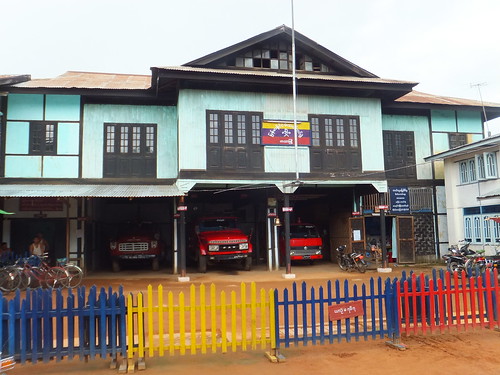
The Fire Station in Katha is rather grand.
Although the 'Trishaws' were provided to return us to the landing stage, quite a few passengers (and the writer) elected to walk back. When it started to spit with rain, I wondered whether I'd made a mistake but it was only a very light shower which passed very quickly and we had no other rain in the day.
When everybody was back on board the ship, the 'Fast Boats' set off ahead of us and the ship followed upstream. Later, we caught up with the 'Fast Boats'. They'd stopped and let us pass, then chased after us. Shortly afterwards, I saw the Captain on the V.H.F. radio and the first 'Fast Boat' drew alongside on the port side. This time, I was allocated to the first boat so, once the passengers were loaded, the 'Fast Boat' headed upstrean to allow the second 'Fast Boat' to moor alongside the ship and collect its complement of passengers.
We cruised upstream for fifteen minutes, passing a number of communities on the east bank. Plenty of the local people, not just the children, stopped whatever they were doing to watch us pass and wave a greeting. I'm afraid a common, and unattractive, feature of each cluster of buildings was an area along the high, sloping river bank where they dumped their refuse - paper, plastic, whatever. One of the 'Road to Manadalay' initiatives in schools is the donation of plastic 'trash cans' as part of a drive to teach young people to preserve the environment.
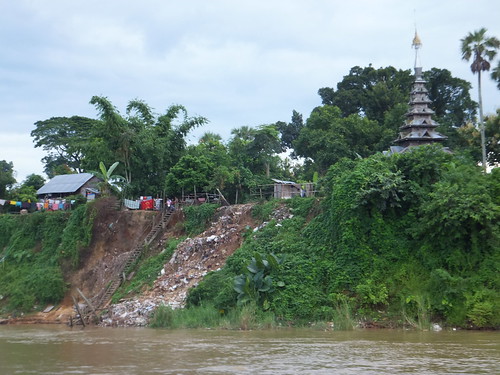
A village dump.
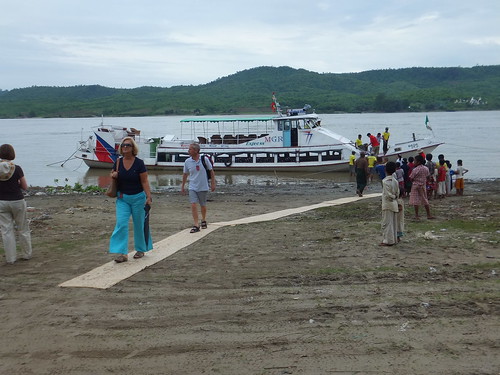
We arrived at the town of Shwe Gu on the east bank, where we were to land. A group of six youngsters were swimming just by the landing place. Partly to impress us, no doubt, they were repeatedly jumping into the water from a crude landing stage used by small boats, carrying out cartwheels and twists before running round to repeat the performance.
The usual arrangements for disembarking were made - two long planks laid side by side, clamped together at the midpoint with two pieces of wood secured by two sets of bolts and with two boatmen holding a long bamboo pole as a handrail. There was plenty of activity in the vicinity of the landing place - as we docked I'd spotted a passenger ferry going upstream which I think had stopped at Shwe Gu shortly before us so a lot of cargo was being removed from the landing area by a number of small lorries. These lorries are powered by an exposed Chinese engine mounted on an articulated front end and they were being manoeuvred with some abandon in the 'staging area' in between the river and the parallel road.
Also in the 'staging area', there were at least twelve of the 'motor tricycle' type of vehicle. The front end looks like a motor bicycle, with a single front wheel mounted in forks and steered using handlebars by the driver who sits in the usual position. On some models, there was a conventional contoured fuel tank above the engine (although I think it may have been just a 'dummy'), on other types there was a rectangular fuel tank attached to the vertical bulkhead behind the driver. I think all types had a transverse radiator mounted in front of the engine (like the old 'Velocette'): some vehicles appeared to incorporate an electric fan. The back of the vehicle was like the small four-wheeled pick-ups, with a low-sided body allowing goods to be carried. At Shwe Gu, these vehicles are used as taxis, so bench seats were provided down each side. These 'motor tricycles' were to be our transport to our destination - a nearby Shan Village. As the convoy of 'motor tricycles' formed up to take us to the village, the impressive bulk of the 'Road to Mandalay' ship sailed past, saluting the town with a blast on the siren.
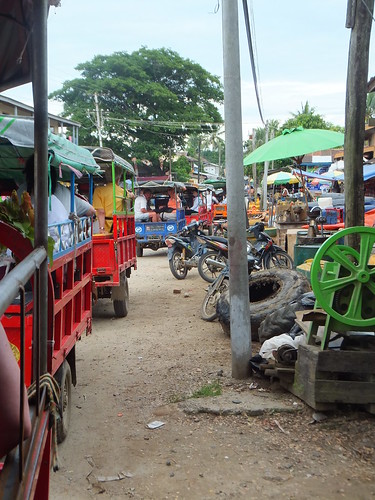
"We got ourselves a Convoy".
The Shan village was around a mile out of town, an arrangement of criss-crossing dirt roads lined by a mixture of modest houses made in bamboo and much more substantial houses in brick and concrete stucco. There were wooden pig sties and fenced compounds for chickens. Everywhere there were children, watching the visitors and happy to return a "Mingela Bar", the Burmese greeting, wave and smile.
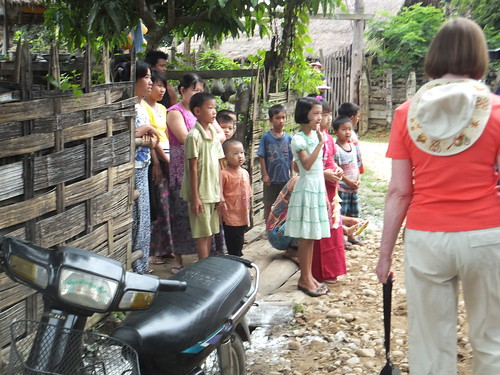
Children in the Shan Village.
We walked a short distance to the village Distillery - this village is famous for its distilled rice whisky. You need lots of water in the process and the Distillery had a large water tank. The water, I was told, is drawn from an artesian well. In the wooden building next to the water tank, I found a Chinese packaged engine driving a Chinese alternator through a belt drive. Next to this arrangement was an electric motor driving a 2-cylinder 'V'-form reciprocating compressor through another belt drive. I traced the output of the compressor to a small diameter pipe leading to the artesian well, so I assumed the compressed air is used to help to 'lift' the water from the well. The walls of this room were lined with storage jars containing rice powder and water. These are left to ferment for four or five days. When the covers of the storage jars were lifted for our inspection, we could see the mixture bubbling away happily. This produces rice wine about 3% alcohol.
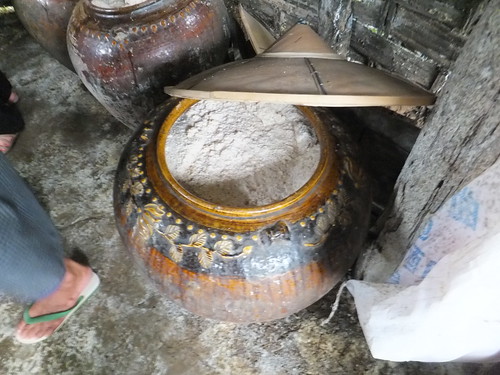
The fermentation is carried out in a number of storage jars.
In the next room, we were shown a number of stills. Each comprised a well-constructed rectangular oven with a large metal 'wok' on top. Rice wine is placed in the 'wok' and a domed metal cover is placed on top and sealed with what looked like clay. Two pipes emerge from this cover and connect to the body of an adjacent metal 'condenser'. A discharge pipe fitted near the bottom of the 'condenser' allows the condensate (the whisky) to drain into a suitable container.
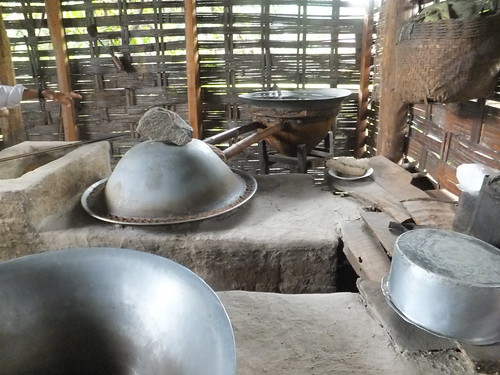
The 'wok' with the domed cover is in use. The two horizontal pipes allow vapour to circulate to the 'condenser' in the background which is cooled by a supply of water. The discharge pipe from the condenser is not visible in this view.
Enough rice whisky is produced not only to supply the village itself but for shops to sell in the town, with the liquid placed in 600 ml plastic water containers. Usually, they add herbs which are supposed to be health-giving and this gives the product an attractive golden colour. We were offered small shots of this potent drink. I found it brought tears to the eyes.
Outside the distillery, we were offered soft drinks by the 'Road to Mandalay' team. The Ship's Doctor has assembled the village children and presented them with pencils. Some of the children were dressed in traditional Shan clothing.
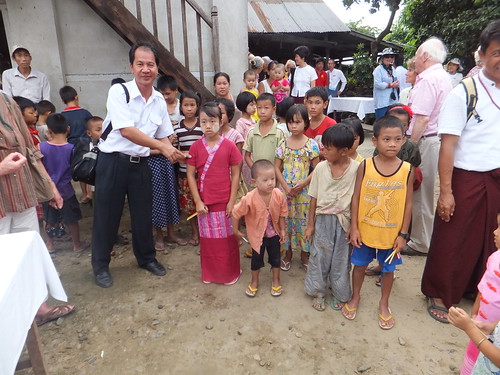
Doctor Hla Tun with some of the village children.
We walked back to the waiting 'motor tricycles' and clambered aboard. The procession set off with much waving and most of the people we passed on the road back to Shwe Gu Landing Place were happy to wave and smile. One 'Fast Boat' boarded half the passengers and set off upstream. The other 'Fast Boat' was moored a few feet away unloading numerous large, green 'kit bags' of dirty linen and large empty plastic water containers which it had clearly fetched from the ship whilst we were at the village. Logistics were expediting the unloading and very soon the 'Fast Boat' was able to pick up the remaining passengers and follow the first 'Fast Boat'. Our ship was waiting only a few hundred yards upstream so we were all soon safely back on board after a fascinating excursion.
After dinner, a troupe of Shan Dancers came aboard with their musicians and traditional instruments and performed a number of traditional dances to an enthusiastic audience in the Observation Lounge.
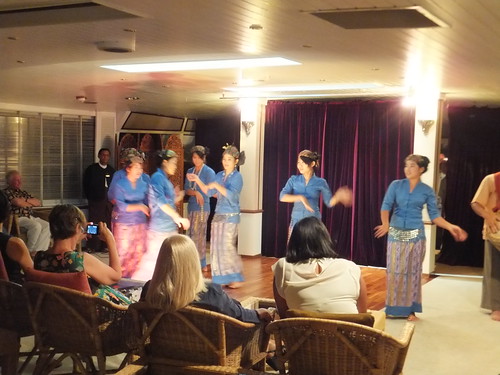
Shan Dancers performing on the 'Road to Mandalay'.
Photographs:
Katha.
Shwe Gu.
Shan Dancers.
[Revised 5-Oct-2012, 7-Oct-2012]
Saturday, 15 September 2012
Visiting Kyan Hnyat Village and School
Events of Friday, 14th September 2012
Rise at six, quick shower and to the restaurant for breakfast. Meantime, the ship had raised anchor and continued upstream as far as Kyan Hnyat village. The two 'Fast Boats' could be seen tied-up at the village and the both left the shore to meet us in midstream. Those passengers wishing to go on the early excursion transferred to the 'Fast Boats' at 7.30 for the short journey to the shore. The beach shelves only gently here, so my fast boat had to moor a few feet out from the water's edge. This meant that the normal 'two planks side-by-side' gangplank would not fully reach so a second, similar gangplank was laid on the first at a steeper angle making disembarkation a trifle hairy. The beach was rather muddy, so Logistics had laid a number of lengths of matting end-to-end. We then climbed a set of concrete steps to the level of the village.
Disembarking from the Fast Boat at Kyan Hnyat Village.
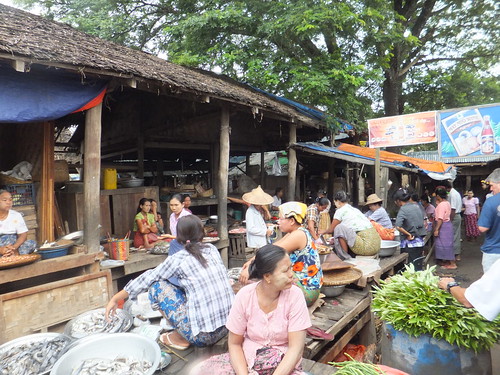
Lots of children and adults were keenly watching the strange-looking visitors who arrive by the Great White Ship four times a year. The bustling village market extended right up to the top of the steps where pottery jars in various sizes were on offer and we were immediately immersed in the sights and sounds of vibrant commerce. We made our way through the narrow passages between rows of stalls selling every possible requirement. Vegetables, meat, fish, eggs, rice and spices abounded. But there were also manufactured goods, clothes, metalware and plastic items, mainly originating in China.
Each market stall is a raised wooden platform on which the vendor squats, surrounded by their stock.
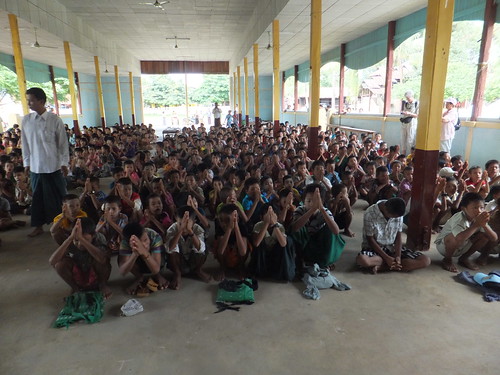
We left the market and walked along the dirt road leading to Kyan Hnyat school, passing a group of young monks accepting offerings of alms (prepared food) from the villagers. At the school, a large, open-sided assembly building was crowded with children of all ages, all squatting on the bare concrete floor.
The assembly building at Kyan Hnyat School immediately prior to the distribution of stationery.
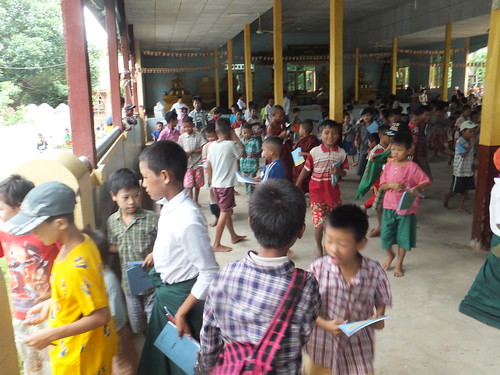
As we arrived, the headmaster started the waiting pupils reciting whilst Doctor Hla Tun and various helpers unpacked the stationery which Logistics had brought from the ship. Each child was to receive an exercise book, a pencil and a short plastic ruler. A number of guests assisted in distributing this stationery and there was quite a hubbub as this task was carried out. 'Road to Mandalay' staff had set up a table at the rear of the hall with various types of soft drinks for the guests. By half past eight, all the children had received their stationery and the headmaster told them to go back to their classrooms for the start of their normal lessons.
Children returning to their classrooms with their stationery.
The guests started to return to the 'Fast Boats' followed by lots of curious children and watched by friendly residents. I was interested in a small blacksmith's shop equipped with very basic facilities - various anvils, a few hand tools including tongs and a small forge. The forge was a hole in the ground for the fuel, surrounded by a series of crude curved metal plates vaguely enclosing the fire. To raise the temperature of the fire sufficiently for metalworking, forced air is necessary, produced by a bellows or equivalent. Here, ingenuity had been employed. The air was supplied by a ducted rotary fan which looked as if it had been rescued from some discarded equipment. The fan was mounted on a fairly substantial wooden chassis which was long enough to accommodate an old bicycle mounted upside-down. A drive rope passed around the large rear wheel of the bicycle (with the tyre and inner tube removed, of course) and connected to a small drive pulley on the fan. The blacksmith's young assistant proudly demonstrated how turning the bicycle pedal by hand spun the fan to get the forge to working temperature.
We ran the gauntlet of the numerous small motor bicycles in the main street, alked back through the market and boarded the 'Fast Boats'. In addition to the 'Road to Mandalay' Logistics team, we were seen off by the headmaster (who recorded the scene with a digital camera), a number of children, some of the young monks and various local people. By 9.00 a.m. we were back on board the ship. The 'Road to Mandalay' continued upstream for most of the day.
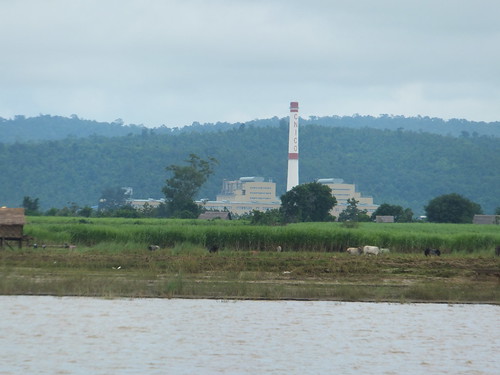
We passed the industrial area on the east bank I'd noted two years before but this had changed significantly. The new construction is a joint venture between China and Myanmar to produce nickel. A quay with two grab cranes has been built. These appear to be for unloading coal or ore from barges. The cranes discharge into hoppers feeding a conveyor system leading to a large stockyard. From here, the conveyor continues to a large processing building near a tall chimney marked 'CNICO'. A further very long conveyor appears from the mountain and extends to the processing plant. In discussions with the Captain, we concluded that the nickel ore is mined somewhere up in the mountains and then brought to the main plant for processing (or, perhaps, storage) by the very long conveyor.
The 'CNICO' main nickel processing plant.
Sunset was at 6.10 p.m. and we dropped anchor mid-stream opposite the town of Katha around this time. I enjoyed a leisurely dinner with Arun (a new friend) and Audrey and Margot (with whom I sailed two years ago). The launch of the Shan Fire Ballons took place a little earlier than advertised so, by the time I got to the top deck, the Fire Balloons were drifting away in the night sky.
Photographs:
Kyan Hnyat Village.
Kyan Hnyat School.
Upstream on the Ayeyarwaddy.
[Revised 7-Oct-2012]
Friday, 14 September 2012
Visit to a Pottery Village and Stationery Distribution to 8 Schools
A wind from the south caused a certain amount of buffeting of waves against the hull during Wednesday night which occasionally woke me but I had no trouble slipping off to sleep again. I'd planned a fairly gentle start to the day with the alarm set for 6.00 a.m. and tea in my room ordered for 6.15 a.m. I think it was well after seven when I sauntered down for breakfast but the dining room was still quiet. We were already under way upstream. After breakfast, I went up to the bridge and the Captain and I had a long conversation. We were due to leave the ship using the 'Fast Boats' for a visit to Nwe Nyein village. The first boat was due to depart at 10.00 a.m. and the second (on which I was scheduled to travel) ten minutes later.
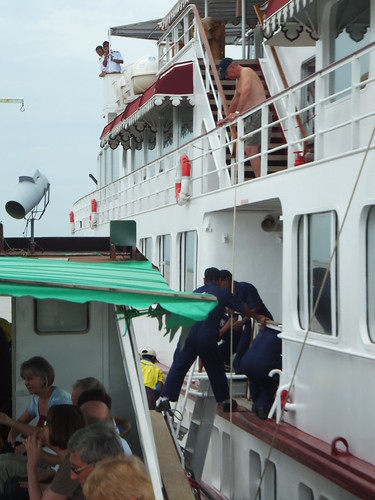
The transfer of passengers to the 'Fast Boats' is normally done with 'Road to Mandalay' under way so there's a certain frisson of excitement associated with crossing between two moving boats but there are always plenty of helping hands close by to make sure the process is safe. Once the first 'Fast Boat' was loaded, it slipped the three mooring lines and moved away from the big ship noisily, to be quickly replaced alongside by the second 'Fast Boat'. The remaining passengers (including me) boarded and we were soon chasing the first 'Fast Boat'.
With all the Guests transferred to the Fast Boat (left) the access steps from the 'Road to Mandalay' are removed.
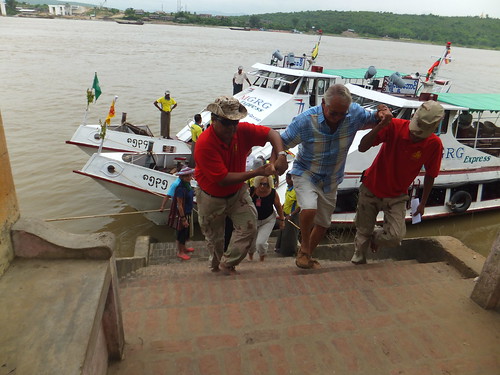
Both boats travelled up river for about 45 minutes. The first boat was already moored at the brick and concrete steps leading to a monastery compound and the passengers were going ashore. We tied-up next to the first boat and disembarked by crossing to the first boat using a large metal plate laid between the boats and then by using the first boat's gangplank - two narrow planks vaguely held together and with a long pole of bamboo held by two boat men to serve as a handrail. It's not quite as hairy as it sounds.
Logistics Staff assisting Guests from the Fast Boats to the shore.
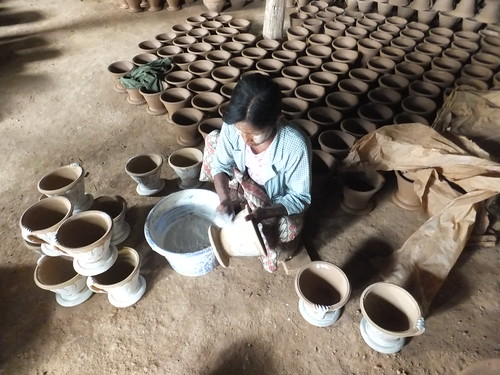
We walked through the monastery compound and into Nwe Nyein village. It seems that the entire village is devoted to the production of pottery jars, from small bowls, through larger bowls, some with glazed decorative pattern, to large storage jars up to about four feet in height. A number of small boats were docked in the mud of the river bank and were being loaded with different products. First, we passed a huge stack of timber which is used in the kiln for the firing process. Next, we came to a hole in the ground about 8 feet long, 3 feed wide and perhaps 3 feet deep. Two types of dry clay, in the correct proportions, are tipped into this mixing pit and thoroughly mixed manually by young men working in the pit. The clay may have been carried up to a mile to reach the pottery. When required, water is carefully added to the dry mix whilst thoroughly 'kneading' to produce wet clay of the proper consistency.
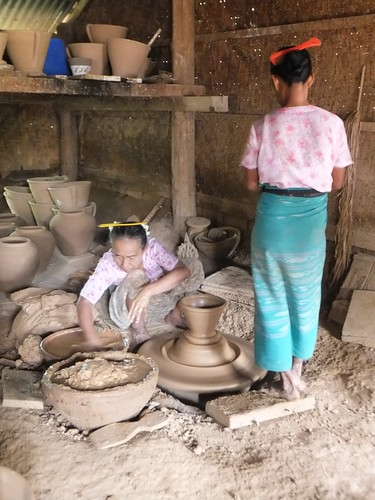
We saw two women making larger bowls with a simple 'kick wheel' potter's wheel. The potter sat at the wheel, 'throwing' the shape while the assistant remained standing kicking the potter's wheel and fetching and carrying for the potter as required.
The potter 'throwing' a bowl using a 'kickwheel' spun by her assistant.
Nearby, a third woman was applying the white 'slip' which would define the pattern on these bowls. The result is a repeated swirling leaf pattern suggesting a number of plants growing up the outside of the pot. I was amazed at the method adopted to create this decoration. The lady dips her hand into the white slip then, with a rapid, curving sweep of the fingers, transfers the slip to the outside of the pot, each finger tracing an individual leaf. The pot is then turned to allow the next 'plant' to be created until the pattern encircles the pot. Within a few seconds, the job is done and, with a couple more flourishes to 'paint' the rim and base, the pot a laid aside to dry and the process is repeated on the next pot. Before firing, the pot is covered with a clear glaze. After firing, the 'unpainted' clay is a lustrous dark brown and the leaf motif is a golden yellow. The effect is most attractive.
Applying decoration to the bowls.
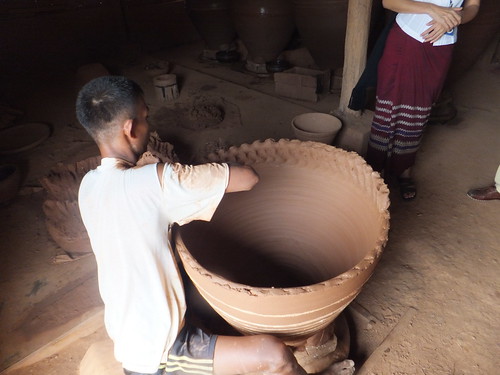
Making the large water pots is a physically demanding task and we only saw male potters undertaking the work. When I was young, I was taught how to make small 'coil pots' from modelling clay. The raw material is rolled into a long 'sausage' which is coiled to form a circular base. Further 'sausages' are added as necessary to build up the walls of the pot to the desired shape and height. The large water pots are made using the same method, writ large.
The pot is constructed on a 'kick wheel' used only to rotate the work in progress as required by the potter using one foot. The potter sits on a tiny wooden stool but, as the pot grows, a second stool is placed on top of the first to bring the potter to a more convenient height. The potter has quite a sizeable pile of clay at his side, from which he takes a good 'dollop' and kneads it to form a sausage three or four feet long and five or six inches in diameter. Working such an unwieldy 'sausage' must take considerable strength. The result is also quite heavy, so one end of the 'sausage' is laid over the potter's shoulder whilst the other end is used to form the pot. Once the walls of the pot are started, the potter rapidly 'crimps' the sausage to the ring below by squeezing the clay between thumb and forefinger every few inches, slowly turning the wheel with his foot as he goes. Once the potter has reached the widest point of the jar, one 'sausage' will not even complete one ring, so the process of 'sausage' making, applying and 'crimping' is repeated many times.
The potter feeds the clay 'sausage' (supported on his right shoulder) and 'crimps' it in place on the growing large pot.
Further clay is added to produce a smooth surface outside and in. Leaf motif decoration, as described above is usually provided, with glaze over the decorated part of the pot. We saw one brick-lined kiln for firing the various pots made at the village. It was built on a slope with entrances at both the high and low ends. Since it was still being loaded, we were able to walk inside. Once full, wood fires are set and the entrances bricked up, apart from small 'firing holes' which allow more wood fuel to be added. The 'Road to Mandalay' team has set up a refreshment table so that we could have a drink before walking back to the two 'Fast Boats' waiting for us at the Monastery steps.
By this time the 'Road to Mandalay' ship had passed, and was a few hundred yards upstream of us, so it took only a few minutes to rendezvous with the ship and transfer the passengers back aboard. As each 'Fast Boat' disembarked its passengers, it took off at speed to go ahead of us. The ship had now entered the 'Third Defile' of the river, so I took lunch on the Top Deck to better watch the passing scenery.
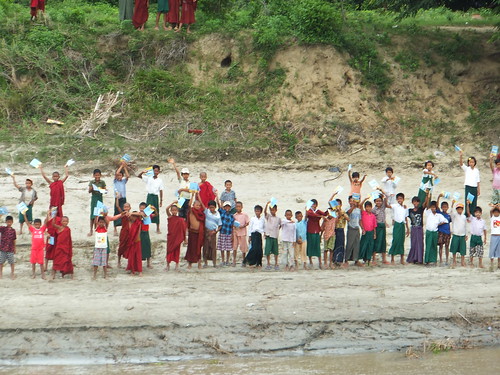
The section of the river to Male, where we were to anchor that evening, has eight schools near to the river so on each of the four trips to Bhamo during the year, stationery is donated to these schools as part of the 'Road to Mandalay' Social Contribution. Each 'Fast Boat' had gone ahead of us to deliver the donations to four schools and their task was to deliver that stationery in bulk before our ship passed each school. The school staff then rapidly distributed the donations (usually exercise books and pencils) so that the pupils were waiting on the river bank when the 'Road to Mandalay' passed.
As we approached each school, the 'Road to Mandalay' manoeuvred as close to the shore as was prudent and gave a long blast on the siren to alert the school.
A few of the 1,427 grateful school children (and their teachers) who greeted us as we passed.
At every location, all the pupils were lined up on the river bank waving their just-received stationery and cheering us in thanks. The ship acknowledged with a series of short blasts on the siren and all the passengers watching from the rail on the top deck would wave back. Many, many photographs were taken.
More grateful school children.
The 1st school (on the West Bank) was Ma-Aw, which has 154 pupils.
The 2nd school (on the East Bank) was Pya which has 58 pupils.
The 3rd school (on the East Bank) was Nyaung Pin Tha which has 95 pupils.
The 4th school (on the West Bank) was Yone-Pin, which has 270 pupils.
The 5th school (on the West Bank) was Kote-Tet, which has 355 pupils.
The 6th school (on the West Bank) was Ka-Bwet, which has 327 pupils.
The 7th school (on the East Bank) was Kyaw-Lay, which has 60 pupils.
The 8th school (on the East Bank) was Pon Ner which has 108 pupils.
Before we'd passed the last of the schools, it had started to rain but that didn't seem to dampen the spirits of the school children or the passengers.
Photographs:
By Fast Boat to a Pottery Village.
Schoolchildren along the Ayeyarwaddy.
[Revised 6-Oct-2012]
Thursday, 13 September 2012
Boarding the 'Road to Mandalay'
The alarm woke me at 5.30 a.m. to give me time for a shower and getting dressed before breakfast was delivered to my room at the Strand Hotel just after six o'clock. I was ready to leave by 6.30 a.m. and Min and the driver were waiting for me in reception. At that time of the morning, there were no traffic problems on the way. We reached Mingaladon Airport around ten to seven and I said 'goodbye' to Min and the driver.
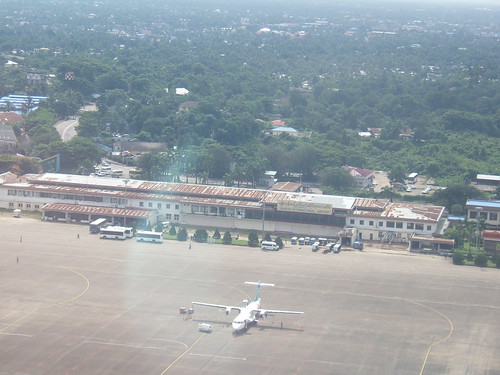
An aerial view of the Domestic Terminal at Yangon's Mingaladon Airport (taken on an earlier trip).
All the formalities at the Domestic Terminal for our Air Bagan flight were, as usual, carried out efficiently by 'Road to Mandalay' personnel so in a few minutes I was in the Departure Hall, delayed only by brief conversations with 'Road to Mandalay' staff I'd met on previous trips. I've never had to wait such a short time because in moments we were moving out to the Transfer Bus. Yangon has a rather superannuated set of transfer buses but we boarded a modern bus in Air Bagan colours to join the Fokker 200 twin-jet which was to take us to Mandalay.
I was seated with Linda and Ruth, two friends I'd travelled with before, on the 2010 trip, which was pleasant. The smiling Air Bagan staff were kept busy throughout the flight serving a snack meal and clearing it away because the jet is only allowed one hour for the journey to Mandalay. A couple of rather more rickety transfer buses were on duty at Mandalay but they successfully completed the short journey across the tarmac. Because we were on an internal flight, the Immigration desks were unattended. We were also able to ignore the baggage carousel - 'Road to Mandalay' Logistics Staff dealt with checked baggage which was magically waiting in our cabins when we arrived at the ship. I met more 'Road to Mandalay' staff I'd previously sailed with, plus Margot and Audrey, two more American ladies I'd met on an earlier trip. Once we'd worked out which group we'd been allocated to, we joined our lady guide Nang (whom I'd not met before) and boarded one of the six waiting buses.
Our bus drove to Shwe Kyet Yet, on the Ayeyarwaddy but, instead of turning to the River Station where our ship waited, we drove over the new road bridge to the west bank of the river and climbed the tortuous road through the Sagaing Hills to the famous pagoda at the summit. It was a hot, sunny day with a clear sky and we had good views of sprawling Mandalay City a few miles away on the opposite bank. More importantly, directly opposite us we could see the imposing white hull of our soon-to-be home, the 'Road to Mandalay' ship, dwarfing the many teak-carrying barges moored in the vicinity.
The Sagaing Hills, with its many temples, pagodas, monasteries, nunneries and study centres, is a Sacred Place of great significance to all Buddhists and, as always, there were numerous pilgrims but tourists taking photographs are not resented and the whole area had a peaceful, friendly atmosphere.
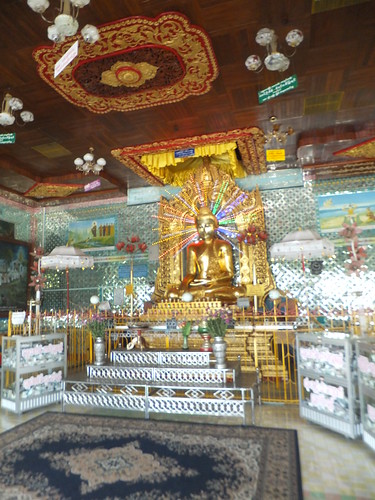
One of the many shrines. I always find the radiating lines of flickering Light Emitting Diodes added to many Buddha images rather odd.
We returned to the bus which gingerly descended by a different, twisting road (a one-way system is in use) to an area in the lower reaches of the Sagaing Hills where there are a number of nunneries. Our bus parked and a short walk took us to Zeyar Theingi Nunnery which I'd visited before. We were allowed to wander between the buildings and see a little of the life of nuns. It was a friendly, welcoming place and the permanently-smiling head nun accompanied us, answering questions which our guide translated.
The Head Nun at Zeyar Theingi Nunnery.
Some of the nuns were bathing in the communal open-air pool, separated by a wall. A simple sign in English 'No photos please' was regarded as sufficient to maintain the nuns' privacy.
Whereas the local population make daily offerings of cooked food for monks, nuns accept offerings of uncooked food. This is stored in various wooden cupboards in a communal kitchen provided with a number of simple cooking stoves. Typically, two nuns share one stove and each cooks on alternate days. We saw a number of nuns eating lunch seated on tiny stools next to low, round tables. As for monks, lunch is also the last meal of the day for nuns.
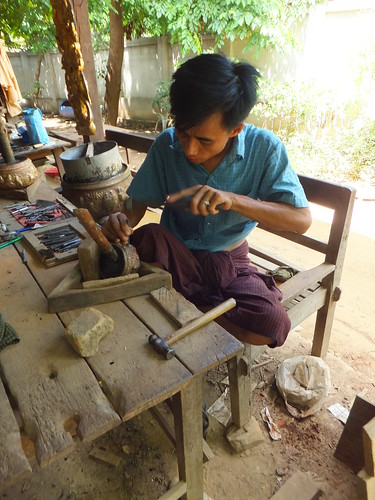
Sagaing is famous for silverware and we next went to a silversmiths' workshop with a large showroom attached. The delicacy and beauty of the finished product contrasts with the primitive workshop equipment used to produce it.
The skill of the craftsman produces elegant, deep-relief embossing using only a handful of punches and a hammer.
On leaving the silversmiths, we retraced our route back over the new road bridge and into Shwe Kyet Yet and the 'Road to Mandalay' River Station. Once again, it was a time of happy reunions for me, before being lead to my cabin. As soon as all the passengers were aboard, Captain Myo Lwin cast off and headed upstream whilst a buffet lunch was offered to the 65 passengers in both the restaurant on the main deck and alfresco on the Top Deck. On my way to lunch, I met Dr. Hla Tun, who had somehow missed finding me when I came aboard. I also detoured to the bridge where the Captain greeted me warmly. He, too, had intended to see me on my arrival but had also missed me.
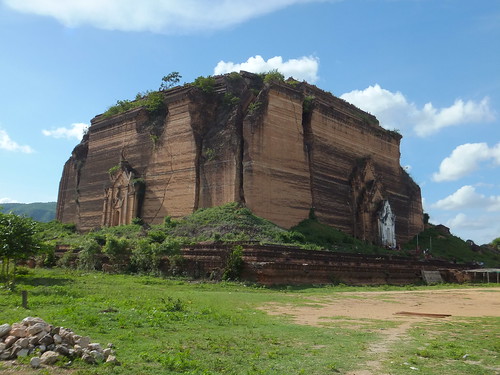
By the time I'd finished lunch, we were approaching Mingun, where the massive bulk of the Unfinished Pagoda dominated the west bank. The ship anchored mid-channel, facing upstream and two 'Fast Boats' approached she ship and, one after the other, ferried us ashore for a walking tour of Mingun. First, we viewed the Unfinished Pagoda from ground level.
The collosal bulk of the Unfinished Pagoda at Mingun.
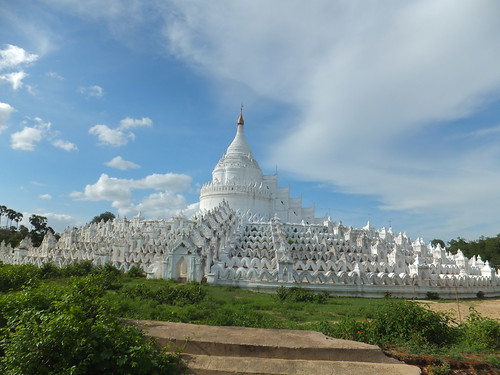
Then, we examined 'The World's Largest Uncracked Bell'. There were opportunities to sound the bell by striking the rim with a hefty piece of wood and for standing underneath the bell whilst it was sounded from outside. I did both. We then went on to the Shinbyume Pagoda, often called the 'Wedding Cake Pagoda' because of its tiered construction and whitewashed stucco finish. As on previous visits, I climbed the steps to the top of this pagoda but I seemed to need more frequent 'breathers' this time than I recall.
Shinbyume Pagoda, Mingun.
We walked back through the village to the landing place where our two 'Fast Boats' waited to transfer us back to the ship, still at anchor mid-channel. At 7.00 p.m. Sammy, the hotel manager, introduced the officers, heads of department and guides to the passengers on the Top Deck. Then Mr. Win, the guide, introduced a short performance of traditional Burmese dances. This was followed by the Welcome Dinner in the restaurant, held in two sittings at 7.30 and 8.30 p.m. I was on the second sitting and the food was superb. It had been an enjoyable but tiring day.
Photographs:
Sagaing Temples (including pictures from 2011).
Zeyar Theingi Nunnery (including pictures from 2008).
Silversmiths in Sagaing (including pictures from 2008).
Mingun Revisited.
[Revised 6-Oct-2012]
Tuesday, 11 September 2012
Back to Yangon
Tuesday, 11th September 2012
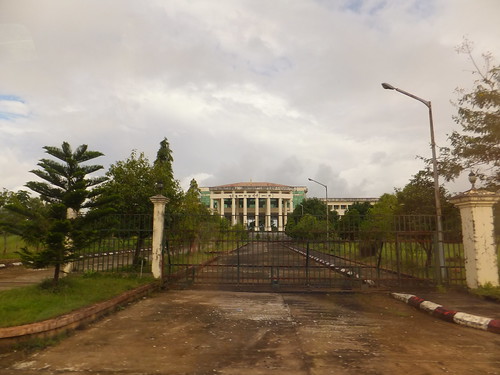
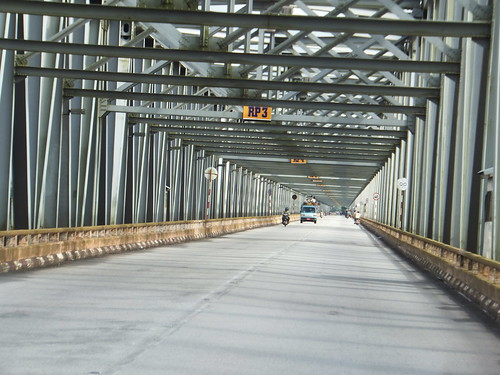
I’d slept quite well at the Zwekabin Hotel and was quite sorry to leave at 8.30 a.m. We took the Yangon road and shortly crossed a girder bridge over a wide river as it started to rain. We passed a large, modern but rather shabby-looking modern building which Min said was the Pa-An computer university.
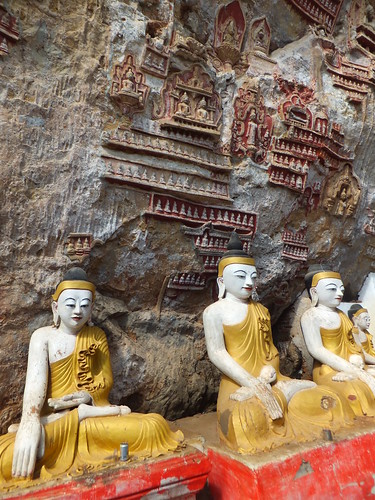
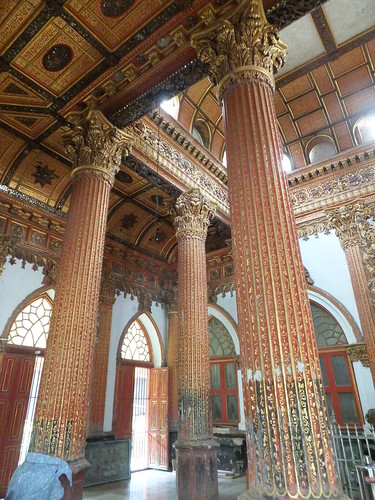
By the time we turned off the main road onto a minor road leading to the seventh century Kawgoon Cave site, I was pleased that the rain had stopped for a while. A long, straight, narrow road in very poor repair led past numerous houses to stop at a monastery site. Min paid a friendly monk in an admissions office and we walked along the base of a sheer, and in places overhanging, cliff. Most of the cliff face was decorated with thousands of bas-relief Buddha images, either carved in the limestone or cemented to the limestone. There were also numerous Buddha figures in various materials and of different ages. A building abutting the cliff held a large reclining Buddha together with Buddha images in various positions and in different sizes. We then entered a large, natural cave with the cave walls similarly decorated with bas-relief Buddha images and with numerous larger Buddha figures. As we made our way back to the main road, the rain (which had obligingly held off whilst we were out of the vehicle) restarted.
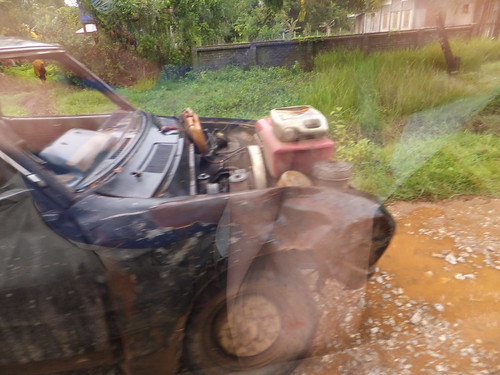
A production car caught my attention. It was very second-hand and the original engine had clearly failed so some blacksmith had ripped off the bonnet and front grille to allow one of the standard Chinese engines to be somehow connected up. Although parked when we saw it, the modified vehicle was clearly in regular use.
In the distance, we saw the cement factory and, next to it, the scarred hillside which had been the subject of the blasting we'd heard yesterday evening.
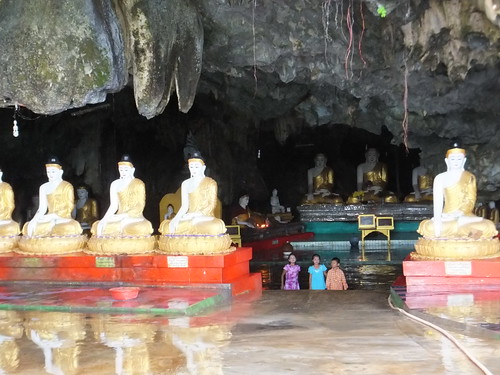
Before long, we arrived at the second caves we were to visit. The road we were on terminated in a half-flooded car park. Apparently, in the dry season the water recedes and there is a covered arcade which leads to a monastery complex near three bathing pools fed from a hot spring. Once the rains come, a number of wooden boats (similar to the ferry we'd used to Shampoo Island) are used to transfer monks and pilgrims to and from the monastery. Even with the boats, it was necessary to do a bit of paddling when getting in or out. Once on land, we followed a convoluted set of concrete steps which wound between the various buildings. There were monks, pilgrims and children. There were domestic animals like dogs and chickens and lots of acrobatic monkeys on the lookout for any food they could steal. We entered a large cave with lots of seated Buddha figures.
I'd come prepared with a small torch so, once Min pointed out the concrete path to the inner caves, I was off. In the darkness, I hadn't noticed Min wasn't following me me. I was told the passage goes about 600 feet into the mountain, with various Buddha figures on the way. I had reached the final chamber before Min, with a borrowed torch and the torch's owner, caught up. I was disappointed to see all the graffito in the final chamber - 'Kilroy was here' is not solely an English problem. We returned to our vehicle by boat, this time with a young monk as the boatman.
We rejoined the main road to the north at Thaton and continued to Kyaikto, where I'd left the train on the journey south with some relief. Another large girder bridge took us over the Sittang River and, to the right, I could make out the multiple spans of the girder bridge which carries the railway over this river.
Lunch was taken in a large steel-framed building with lots of tables and at least twelve young male waiters. The scale of the place (and the fact that there were at least eight ladies toilet cubicles, squat-type and a little basic) made me conjecture that the place provided meal stops for the many long-distance coaches which use the route and Min confirmed that this was correct. The meal was, in fact, excellent.
We set off again and it started to rain again, this time with a vengeance. Eventually, we came to Bago, where I knew our route took us over the railway just south of Bago station. Rain or no rain, I was determined to take some more photographs of the railway from the vantage point of the bridge. I got wet and I'm afraid Min (who insisted on looking after me) got wet, despite having a good-sized umbrella.
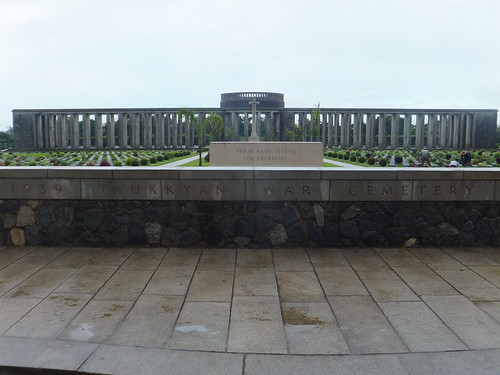
Our final call was at the large War Cemetery at Taukkyan near Yangon which is kept in immaculate condition. The large, stone colonnaded structure records the names of 27,000 soldiers of various races who gave their lives 'in Burma and Assam ... in the service of the British Crown'.
Tired, damp but happy I was delivered back to the Strand Hotel. Early the next day, I was to be transferred to Yangon's Domestic air terminal for the flight to Mandalay and the to 'The Road to Mandalay' ship for the rest of the adventure. I'll post updates when I'm able.
Photographs:
Kawgoon Cave.
Hot Springs.
Taukkyan War Cemetery.
[Revised 3-Oct-2012]
Monday, 10 September 2012
Leaving Mawlamyine
Monday, 10th September 2012
After my customary breakfast, I took a short walk along the promenade before checking-out and meeting Min and the driver in reception just before 9.0 a.m. Our first visit was to be to Gaung Say Island ('Shampoo Island'). We drove underneath the approach span to the new bridge, as I had done on foot two days earlier. Instead of the deserted car park I'd seen then, there were now hundreds of mopeds and their drivers, Min explained that it was the date for re-taxing mopeds, hence the urgency.
We parked near a concrete slip where a small wooden ferry was being boarded by a Nun. It was agreed that we would share the boat and I clambered aboard, followed by Min. The ferry was powered by an automotive engine mounted on a universal joint on the stern, with a long propellor shaft terminated in a small propellor. We made a brief, but noisy, passage to Gaungse Kyun (usually called 'Shampoo Island') where we berthed at a slip protected by a number of "barber's poles" rather reminiscent of Venice.
The Island used to be isolated in the wide estuary but now the long new bridge we'd used to get to Mawlamyine passes very close to one end of the Island. The island is about 9 acres in size, with a number of large and small monastery buildings, gardens, stupas and interconnecting paths. We were allowed to inspect the main building and one of the monks joined us to answer questions put by Min. There are now only three monks in permanent residence and around ten nuns. The monk then took us on a walking tour of the fascinating island.
We drove back to the city centre and took the road up the range of hills running north – south to the east of the old city. There are five monasteries and shrines along this range of hills. First, we entered the famous Mahamuni Paya, the largest temple complex in the city built in the 'Mon Style'. Unlike the Mahamuni temple in Mandalay, in Mawlamyine women are allowed to enter the main chamber containing a golden Buddha image. A short drive took us to the Kyaikthanian Paya with the most visible stupa in Mawlamyine. We took an ancient-looking lift from the road, avoiding the long, covered stairways to the main platform. This stupa is believed to have been the inspiration for Rudyard Kipling's reference to "the Old Moulmein Pagoda" in his famous poem 'The Road to Mandalay' and, I confess, was the reason I decided to come to 'Moulmein' (now rendered as 'Mawlamyine') on this trip.
Kyaikthanian Paya - "the Old Moulmein Pagoda".
Finally, we made a brief visit to the 19th century Seindon Mibaya Kyaung monastery, now in need of a lot of repair work. We didn't go inside any of the sad-looking buildings.
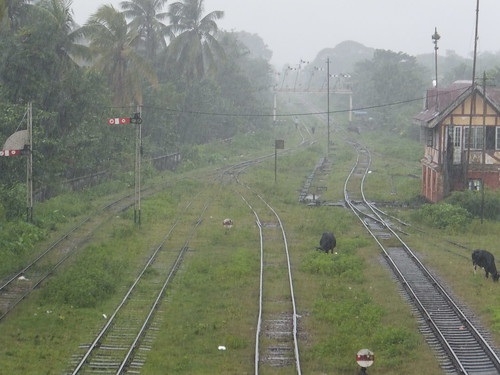
We descended the range of hills on the east side, where the railway station is situated. The station building is quite large and modern but, once on the platform, the usual run-down appearance of Myanmar stations re-asserts itself. Countless vendors had 'pitches' on the platform and the wall of the station building facing the track was covered from end-to-end with things to buy. After a few minutes looking around, I found Min talking to the Station Master. My brief presence had been noted and I gather the Station Master was disappointed I wasn't travelling by train as he hadn't had European travellers for a few weeks! Min thought taking photographs might be 'sensitive' but there's a very small collection here.
A Victorian 'jewel' at Kaw Hnat.
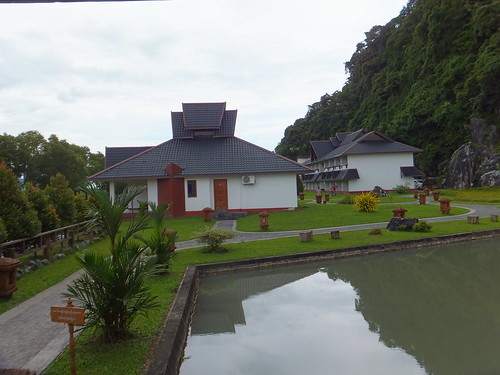
Hotel Zwekabin. My semi-detached 'cottage' is on the left.
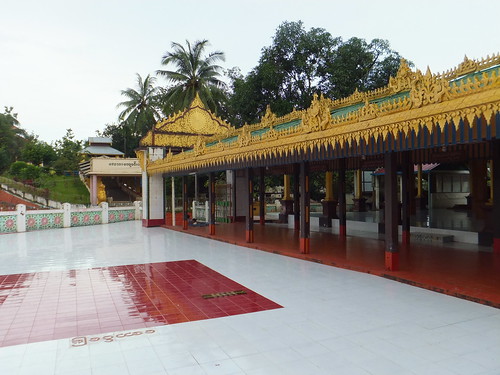
Shwe Yin Myaw Pyi Taw Aye pagoda, Pa-An.
Photographs:
Gaung Say Island ('Shampoo Island').
The Hilltop Temples of Mawlamyine.
Mawlamyine Railway Station.
By Road to Pa-an.
Kaw Hnat U Na Auk Pagoda.
Kyauk Kalat.
Around Pa-An.
Shwe Yin Myaw Pyi Taw Aye pagoda.
Hotel Zwekabin.
[Revised 27-Sep-2012, 3-Oct-2012]
Sunday, 9 September 2012
South of Mawlamyine, Burma
Sunday, 9th September 2012
I had a decent breakfast before being picked up by Min and the driver in the ‘HiAce’. We were to head south on the main road. Even though parts of the route were toll roads, both directions of traffic shared a single carriageway and, despite passing a few ‘patching teams’ repairing potholes (on the Sabbath) the ride was quite hard (‘though nowhere near as bad as the previous day’s rail trip).
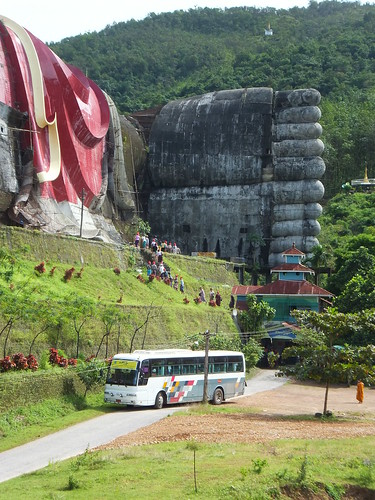
Our first stop was the ‘World’s Largest Reclining Buddha’ built a few years ago. In a pretty valley with a stream cascading through it, a huge Buddha in the reclining position has been created on one side of the valley. To support this massive monument, the statue is built on a huge reinforced concrete structure. We entered, to see a labyrinth of bare rooms on different levels interconnected by concrete stairs. I haven’t got the statistics but there are over 500 rooms within the supporting structure! No attempt has been made to finish inside which remains bare concrete. Water has penetrated the structure so parts of the inside are wet or moss-covered already. This has been the project of a single, now-elderly monk. Amazingly, on the opposite side of the valley, a second reclining Buddha is being built. Builders were busy forming ‘rebar’ (reinforcing bars) into the necessary shape ready for concrete to be poured into shuttering. At this stage, the work in progress on the second Buddha looked as if it might be a new tourist hotel taking shape.
This view of the robes and feet of the Reclining Buddha being examined by a coachload of tourists gives an idea of the scale of the construction.
We continued south through the large town of Mudon, eventually reaching the small town of Thanbyuzayat, named after the ‘tin shelter’ forming its town centre ‘feature’. Most towns have a ‘feature’ – clocktower, decorative pillar or, in the case of Thanbyuzayat, what looks like a Victorian bandstand with a distinctive roof. The town was at the Burmese end of the Burma – Siam ‘Death Railway’ built by prisoners of the Japanese during the second World War. Near the town centre, the first locomotive to run on that tragic line has been plinthed – a Japanese-built 2-6-0. Not far away is Thanbyuzayat War Cemetery with 3,771 graves of Allied prisoners of war. It’s a thought-provoking place, particularly since the 3,771 graves represent only a fraction of the overall death toll. Up to 100,000 conscripted labourers from various Asian countries may have perished during the project.
A drive of about 9 km took us to Khaikhami Yele Paya, an important Buddhist Shrine built over the sea. The original wooden bridge leading from the shore has now been supplemented by a covered, concrete structure, incomplete but already in use. The elaborate decorative metalwork which adorns the roofs of Burmese shrines was in course of erection. Being the Sabbath, the place was quite busy with Myanmar people, either worshipping or having a day out (or both). At one spot, numerous silver-coloured Carp had gathered as visitors threw coloured treats to them.
At last I’d seen the Andaman Sea from the shore, rather than from an aircraft! We stopped for lunch at a local café just outside the Buddhist Shrine before back-tracking towards Thanbyuzayat. Before we reached the town, we turned off a drove to Setse which has a long, sandy beach with lots of local-area visitors. There was plenty of room for everyone, so I joined the paddlers. The beach area was served by a clutch of snack bars and shops.
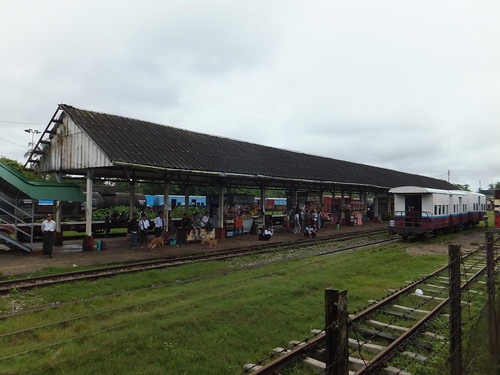
We drove back to Thanbyuzayat and (surprise, surprise) I had a quick look at the small station. There were lots of people waiting so, presumably, a train was due.
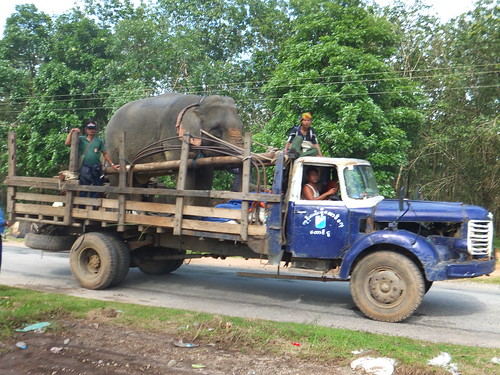
We then made the long journey on the indifferent roads back to Mawlamyine. On the way, I saw many memorable images you can't capture with a camera. Some of these I'll remember and many I’ll just forget. One sight I did photograph was working elephants being transported with their handlers, each on the back of an open lorry. We saw seven such lorries all told. They were from an elephant sanctuary, Min said, and were presumably off on a working contract.
Before dropping me at my hotel, we drove to a view point overlooking the city and the water before climbing a little higher to a monastery complex offering both views of the city side and the land side.
Photographs:
The World's Largest Reclining Buddha.
Thanbyuzayat Area.
Khaikhami Yele Paya.
Mawlamyine.
[Revised 27-Sep-2012}
Yangon to Kyaikto by Train
During my trip to Burma in 2012 (described in a series of posts here), I travelled by train from Yangon via Bago to Kyaikto. This post describes the journey from Yangon to Bago with a bit more technical detail. The second part of the journey, from Bago to Kyaikto, is described here. For this description, I've assumed the 'Down' direction is away from Yangon (although I've found one source which contradicts that). I've called the two signal boxes at Bago 'South' and 'North', based on the geography, but I don't know their official designation.
Journey made on Saturday, 8th September 2012
This post describes the first half of an uncomfortable (but interesting) journey from Yangon to Kyaikto.
I’d been to Yangon Central Railway Station before, on my first visit to Burma, when I took a clockwise Circle Line train (see The Circle Line, Yangon). This time, we were at the Main Line side and a footbridge took us to our waiting train on Platform 3 for the Mawlamyine line. We were to take the train to Kyaikto and then continue by car. As far as Yangon Central Railway Station is concerned, ‘Eastbound’ departures are for Mawlamyine, Mandalay or Circle Line anti-clockwise.
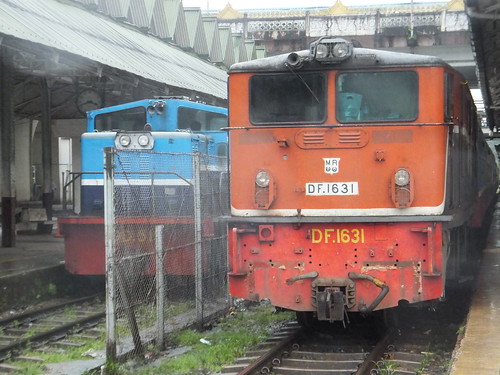
There was plenty of time before our 7.15 a.m. departure, so I busied myself taking photographs at the platform end. There was quite a bit of activity. DF.1631 was at the head of our train in a light brown/dark brown livery and the rolling stock featured a variety of liveries, although the ‘light brown and blue’ predominated. I was surprised to find the coach painting specification signwritten on the end of some vehicles. The ‘F’ in the locomotive number indicates six axles. On this design, they’re distributed over three two-axle bogies. I think the transmission is diesel-hydraulic (but I’m not sure). ‘Chopper’ couplings are used. Vacuum brakes were connected through (Circle Line trains still appear to trundle around without benefit of continuous brakes).
On the adjacent platform face, DF.1352 arrived travelling in the opposite direction to us with a passenger train. This locomotive has the ‘high nose switcher’ outline carried on two six-wheel bogies. Livery is dark brown and cream and I assume it’s diesel-electric.
Two trains were standing on the Circle Line platforms. First to go, Eastbound on the Circle Line road (there are four tracks paired by use to the east of the station) was DD.1145, an ‘end cab switcher’ painted blue with a white waist line. The first coach was off a diesel railcar and had a driving cab, the second looked fairly normal but the third and last bogie coach seemed shorter and lightweight – I don’t know where they found it. At least all three coaches were in matching ‘light brown and cream’ livery. The other locomotive in the Circle Line platform was DF.1202 painted light brown with a white waist line – a ‘low nose switcher’ mounted on three 4-wheel bogies.
DF.1631 ready to depart for Mawlamyine with the 7.15 a.m. train.
The next movement was on the line next to my train – DD.517, a ‘low nose, low hood switcher’ carried on two 4-wheel bogies and painted dark blue/light blue with a white waist line. This was pulling a non-vacuum fitted flatcar and a rake of coaches. I assumed that this was the ‘station pilot’ removing the stock from an earlier arrival (I’d seen a flatcar in use as a “shunter’s truck” at Mandalay on a previous visit). DF.1352 then re-appeared light engine heading east on the Circle Line platform, having left its train at the adjacent platform face to us.
A long blast from our locomotive’s horn indicated that we were about to move away, so that ended my period of observation at Yangon. We started very slowly, accompanied by a loud crashing and banging from the chopper couplers and tremendous buffeting. We were only moving very slowly and eventually things settled down a bit. The driver then ‘opened up’ and accelerated out of the station. We were only travelling at 20 – 25 miles per hour but even that seemed excessive because the train was riding rough. Partly due to the poor track and perhaps partly due to the vehicles themselves, the coach would periodically lift up violently then crash down again with spine-jarring force. After a while, the repeated up and down motion would subside, to recur after a brief respite. In addition, the coach would suddenly start yawing to left and right in an alarming manner. Eventually, this motion would die down, to restart all too soon. It was all I could do to hold on and I failed to make any of the photographs I’d intended of the 4-track approaches to Yangon from the East. We had a brief respite when we stopped at Mahlwagon station. DD.1145 pulled in on an adjacent line with the three coaches I’d seen him leave Yangon with just 45 minutes earlier so he can’t have gone far before running round for the return.
Shortly after leaving Mahlwagon, the two roads of the Circle Line (now on our left) curved away to run a little west of north serving the eastern side of Yangon. Our double track headed approximately north-east towards Bago. We had been running under elderly 3-aspect colour light signals from Yangon. We were now on ‘plain line’ with no complications. Colour lights still marked our progress but they now became ‘dark’ with an ‘out of use’ marker in the conventional form of two crossed sticks forming an ‘X’. I couldn’t resist the thought that problems with track circuits in this more remote area had probably resulted in the solution of simply taking the signals out of service.
The appearance of a lattice post semaphore distant signal indicated that we’d left the Yangon signalling area and were now under different rules. The semaphore arm was steel with two corrugations for strength and appeared slightly wider at the end than at the spectacle, which had three apertures. The design appeared similar to the North American 3-aspect semaphore where the the indications are:- Arm horizontal, Arm raised 45 degrees, Arm raised 90 degrees. You would expect the three apertures to carry three different coloured filter glasses but all the semaphore signals I've seen in Burma have no glass. I couldn't see a sign of a lamp either, but there did appear to be an electric motor for raising the arm and on subsequent, similar signals there appeared to be an electric cable running from the top of the post and disappearing into the ground. I'm afraid the erratic motion of the train makes all this rather conjectural. The arm extended to the left of the post, was yellow with a 'V' cutout at the left end and black chevron a few inches in from the end, all as British practice. But there was also one white disc of colour to the left of the chevron and a second to the right. Each coloured disc appeared to carry a black marking, but I couldn't make it out. The back of the arm appeared to be black with a white chevron. The signal ladder with guard loop at the top was similar to British practice. Of course, you would expect a cast iron finial at the top of a signal post but I saw very few signals with finials. Those that did carry them had an attractive, old-fashioned design terminating in a long spike.
Soon after passing the distant signal, a siding commenced on the left. It was concrete-sleepered, parallel to the running line and very inadequately ballasted.
Then we came to a lattice-post signal with a square ended-arm, generally similar to the distant but the arm was raised 45 degrees so I was not surprised when the driver kept going. The front of the arm was red with a white bar and, again, there were two white discs with unreadable markings. The back of the arm was black with a white bar.
Shortly after the stop signal, the siding joined the main line by a crossover and there were the remains of a point indicator at the siding trap points. A single-lever ground frame operated the crossover and a 'pointsman' was in attendance, displaying a green flag.
In the absence of any visible evidence for loading and unloading wagons on the siding, my provisional conclusion was that the siding had been designed for 'recessing' freight trains by drawing them forward clear of the siding points, reversing the points and setting the train back into the siding. This rather cumbersome arrangement was widespread on British railways in the past.
The railway frequently has to cross watercourses. If they are streams, no attempt appears to be made for the passage of boats. The sleepered track is carried on two deep 'I'-section beams seated on fairly substantial abutments. We crossed a wide stream requiring three sets of 'I' beams and two intermediate piers.
Shortly after this bridge, we came to another distant signal in the horizontal position, similar to the first, except that the post appeared to be an 'I'-section rolled steel joist. Again, there was a 'recess' siding with concrete sleepered track, but it appeared to have been simply laid on the trackbed with no attempt at ballasting. In addition, the sleepers were irregularly spaced and generally further apart than you'd expect. The anticipated stop signal was similar to the one described above except that, like the preceding distant, the signal post was an RSJ. The signal arm was raised 45 degrees and we kept going. The siding joined the main line at a crossover as described above. The 'pointsman' displayed a green flag and, at the station immediately following, what I presumed to be the stationmaster also displayed a green flag.
We were approaching Bago, although I didn't realise this until we came to the subsequent signals. I presume there was a distant signal but I didn't see it. Remember, I was still being buffeted intermittently in a most painful way. The stop signal I did see had a lattice post and the arm was raised 45 degrees for 'off'. Although the colour scheme and marking of the front of the arm was as described above, the arm was parallel sided rather than tapering and the spectacle was 2-aspect. The rear of the arm was white with a black bar and, apart from the peculiarities of the marking on the front of the arm, it looked like a British Railways standard upper quadrant. This signal was mechanically operated over a signal wire and the balance weight and bar was mounted near the top of the signal post. Finally, a triangular notice was attached to the front of the signal post bearing two Burmese characters. Beyond this signal, a number of lengths of rail were lying beside the track and the ballast had been dug out, Soon after, we came to another stop signal and I realised that the first signal was an outer home and the second an inner home. When I first spotted the inner home, I thought it was an offset bracket with a single doll, because the front part of the train obscured my view. As we passed I realised that it was a rather grand gantry signal spanning the two running lines made from channel section with five dolls each carrying the 'modified British Railways' upper quadrant stop signal. The rightmost signal arm was off.
We were arriving at Bago!
If anyone can offer any clarification of Myanmar Railways practices, it would be welcome.
I’ll stop there for now, just commenting that this journey was awarded the accolade of the roughest rail journey I’ve had anywhere and I got off at Kyaikto exhausted with being thrown about.
Train Timing and Photograph Locations
As yet, most of the stations are unidentified. There's a table below showing approximate journey time from leaving Yangon (hours:minutes), photo reference (prefixed 'DSCF') and brief description. There are links to the Sets containing these pictures in 'Photographs' below.
| Elapsed Time | Photo Ref | Description |
| 0:12 | 5980 | River Bridge |
| 0:17 | 5985 | Mahlwagon Station |
| 1:18 | 5993 | Down Motor Distant |
| 1:19 | 5998 | Down Motor Home |
| 1:27 | 5999 | Down Distant |
| 1:28 | 6002 | Down Home |
| 1:54 | 6009 | Bago South Down Outer Home |
| 1:55 | 6011 | Bago South Down Home Gantry |
| 1:57 | 6019 | Bago Station |
Photographs:
Yangon to Bago by Train.
Bago Station.
[Revised 11-Sep-2012, 26-Sep-2012, 3-Oct-2012, 20-Dec-2012]
Saturday, 8 September 2012
By Rail and Road to Mawlamyine
Saturday, 8th September 2012
My Blackberry (used as an alarm clock) woke me at 5.40 a.m. after a good, if rather short, sleep. By the time I’d had a shower, my breakfast was at the door (two fried eggs sunnyside, fried tomatoes, two rounds of white toast and English Breakfast tea). Just time to eat it and get downstairs with my luggage for 6.30 a.m. My guide, Min, and the driver were already there so we were soon driving the short distance to Yangon Central Railway Station.
I’d been to the station before, on my first visit to Burma, when I took a clockwise Circle Line train. This time, we were at the Main Line side and a footbridge took us to our waiting train for the Mawlamyine line. We were to take the train as far as Kyaikto, where we would meet up with our SUV and driver again. No, I didn’t ask for the rail journey – it was part of the offered programme and I happily accepted it.
There was plenty of time before the 7.15 a.m. departure, so I busied myself taking photographs at the platform end. There was quite a bit of activity. I’ll put the technical comments in a separate post (Yangon to Kyaikto by Train with links to the railway pictures), just noting that this journey was awarded the accolade of the roughest rail journey I’ve had anywhere and I got off at Kyaikto exhausted with being thrown about.
We drove to a nearby Hill Resort for a simple lunch and then continued by road to Mawlamyine, arriving late afternoon. Until a few years ago, Mawlamyine was isolated from the north by a wide estuary and a vehicle ferry was necessary to reach the town. But now, a long bridge of numerous steel spans takes both road and rail effortlessly across the estuary.
I’m in a modern, fairly large hotel called the Mawlamyaing (their spelling) Strand Hotel, set on the road along the sea wall which has a wide pedestrian promenade. The splendid views are not of open sea but across the channel between the mainland and Bilu Island.
View near the Market Hall in Mawlamyine
Somewhat restored by a shower, I determined to have a walk before it got dark. I followed the promenade south then cut across to the nearest parallel main shopping street and returned north, passing the staff entrance at the rear of my hotel. I carried on until I was underneath the new road/rail bridge across the river estuary we’d used to reach Mawlamyine earlier. I decided to have a simple meal at a hotel near my own which Min had recommended for food and they provided an excellent potato soup at the outdoor dining area on wooden decking overlooking the estuary. By the time I left for the short walk back to my hotel, it was completely dark.
Photographs
Mawlamyine.
Mawlamyaing Strand Hotel.
[Revised 27-Sep-2012]
Thursday, 6 September 2012
East Again!
Thursday, 6th September 2012
There's so much of the world I've not yet seen (and, sadly, probably never will) that I tend to visit a place once and not go back. Russia is one exception. I went by boat from Moscow to St. Petersburg in 2011 (see posts Trip to Russia) and then returned in 2012 on my way back from Mongolia (see posts Trans-Siberian).
But The Union of Myanmar, formerly Burma, is an outstanding exception. In 2008 I made my fifth Round the World Trip and included Burma in the itinerary (see posts RTW5). Burma and the Burmese People made a big impression on me and, in 2011, I made my fifth visit (see posts Trip to Burma). Now, I'm en route to Burma on my sixth visit.
I left home mid-morning on Thurday 6th September by road to Birmingham Airport to catch the Emirates afternoon flight to Dubai. There's a very decent Emirates Lounge at Birmingham now, so I was able to enjoy a three-course hot buffet lunch before I'd even left the ground. The aircraft was a Boeing 777-300ER which has an excellent 'on-demand' entertainment system. As we took off from Runway 15, I was able to monitor the front-facing camera on my seat-back video screen. During the flight, they served a comprehensive dinner and I watched 'Men In Black 3' (quite cleverly plotted but, I thought, lacking the charm of MIB1 and MIB2). Later I watched Ridley Scott's 'Alien' Prequel called 'Prometheus' (interesting but, as you would expect, not for the squeamish).
Friday, 7th September 2012
I write this in the Emirates Business Centre in Dubai Airport at half past one (night time) local time. My connecting flight is the 02:20 hours EK384 to Bangkok, where I should have another wait before taking Friday's 14:20 hours PG703 to Yangon. All being well, I'll be met at the airport and transferred to one of my favourite hotels, the Strand for one night before the adventure continues. I'll tell you more when I'm able.
When I started to leave the Emirates Lounge to find the departure gate, the guy manning the entrance said it would be a shorter walk to leave by the Middle Entrance (the lounge at Dubai is, I think, the largest I've seen and has three entrances). He was right - just outside the Lounge there was a business class check-in for my flight. Since there was no other check-in at this level, it started to dawn on me that I was about to have my second A380 flight. A group of us were directed to a lift which had separate floors marked for 'A380 Business and First' and 'A380 Economy'. The lift seemed reluctant to move at all and, when it did, it would only take us to the ground floor where economy passengers were boarding the lifts to go up one floor to 'Economy'. We alerted Emirates' staff to the problem and, eventually, we were invited to go to the 'Economy' level and walk up the stairs inside the aircraft. I found it quite amusing.
Although the individual staggered cubicles are quite interesting (and give everybody an aisle seat), I still find the cabin too big for my comfort. The bed wouldn't lie flat, either, but the On-Demand audio and video worked. I watched Pixar's 'Brave', another film and managed a little sleep during the six-hour leg to Bangkok. There was a hot breakfast, for those who wanted it.
By the time we were stopped and the Air Bridges attached at Bangkok, there was only an hour and a bit to wait for my Air Bangkok flight to Yangon.
This Bangkok Air A319 took me from Bangkok to Yangon.
We boarded the A319 on time but some problem with the cargo delayed take-off just over half an hour. They served a reasonable hot meal on the short flight to Yangon (a little over an hour in the air).
We made the customary 'straight in' approach to Yangon and I was soon in the terminal. Not only was I one of the first to pass through Immigration where the female staff quickly processed my entry but my one 'Checked Bag' was about number six onto the carousel. Customs were friendly and quick and my guide, Min, was waiting for me in the Arrivals Hall. Although traffic was heavy on the road into the city centre, I was quite comfortable in the 'SUV' provided so I started to relax. There was the usual welcome from the 'Strand' staff. I'm in room 104 (again) for one night and my guide is picking me up at 6.30 a.m. tomorrow.
[Additions on 8-Sep-2012, 26-Sep-2012]
A Busy Few Days
Thursday, 30th August 2012
It started on Thursday 30th August when I was Afternoon Driver at the 'Day Out With Thomas' event in Manchester, described here.
Saturday, 1st September 2012
I spent the following day at work but on Saturday I was at Peak Rail on a slightly less-famous six-coupled tank engine currently in the guise of 68013. Robin was acting as fireman so he'd had a very early start. I turned up just before seven o'clock which gave me time for oiling-round and the daily exam. Since this was the first steaming since a Washout, Paul was also on hand to pronounce the boiler 'Fit'. Harvey also arrived to issue us with the single line staff for the Rowsley - Church Lane section so that Robin and I were able to leave the shed, on schedule, at 8.15 a.m. for Darley Dale, where we were to pick up our booked Driving Experience candidate. Harvey worked the gates at Church Lane to let us through and we surrendered the staff. Once we had our Trainee on the footplate, Harvey loosed us over the Darley Dale level crossing and issued us with the Darley Dale - Matlock single line staff.
After two hours of Driving Experience, we returned light engine to Rowsley. By this time, the booked signalmen were on duty at Darley Dale and Church Lane to work the gates and signals and collect and issue the single line staffs. We stood clear of the six coach train in the platform at Rowsley whilst the guard supervised the coupling of the 'Class 31' to the north end of the stock then the guard called us onto the south end.
During the day, we made five round trips without incident to Matlock (Town) where we hauled the train to Matlock and the '31' dragged us back. There's a more detailed description of the 'Top and Tail' working at Peak Rail in the post A Day on the Footplate (2).
Sunday, 2nd September 2012
The following day I had an even earlier start at the Battlefield Line. David, the fireman, was being examined by John as we ran five trains to Shenton using '3803', the Great Western 2-8-0. It was the weekend of the annual Shackerstone Family Festival so we were running with five coaches rather than the usual four.
On the previous day, the coaches had been left in platform 1 but they needed to be moved to platform 2 before we started so that the train could be serviced. Although we'd had the water hose in the tender tank during preparation, we needed to move across to the water column at the south end of platform 2 to 'have a drink' before the coaches were moved. Once the train was in platform 2 with the north end clear of the foot crossing (currently the only passenger access to platform 2 whilst the footbridge is closed), we'd not be able to access the column.
There was some discussion about the best way to shunt the coaches but, in the end, we watered, hooked onto the south end of the stock and dragged the train up the cutting (having been instructed by the signalman to pass the Starting Signal at danger), until the last vehicle was clear of the crossover. With the points changed for platform 2 and the Inner Home disc signal 'off', we propelled the stock into platform 2, with Peter riding in what was now the leading vehicle, keeping a lookout and giving us handsignals. We left with the first train 'right time'.
The rest of the day didn't quite go as planned, I'm afraid. I'll tell you more later.
Tuesday, 4th September 2012
A day at work on Monday gave me a slightly more leisurely start but on Tuesday the alarm clocks (I use two) were set to 4.30 a.m., allowing me to sign on at Peak Rail (again) at about 6.50 a.m. This time, Chris was fireman and Rob issued the staff and let us over Church Lane Crossing. Once we had Dave, our Driving Trainee that day, on the footplate Rob let us over Darley Dale Crossing and issued the staff for the Darley Dale - Matlock section. The pattern of the very hot day was similar to the previous Saturday, until the middle of the afternoon when a problem with the steam brake manifested itself. We managed to keep going until the end of service when it became clear that serious attention was required before the next day. I left Ed, Rob and Chris in the Workshop addressing the problem.
[Dates corrected 19-Dec-2012]
Friday, 31 August 2012
Day out with Thomas at MOSI
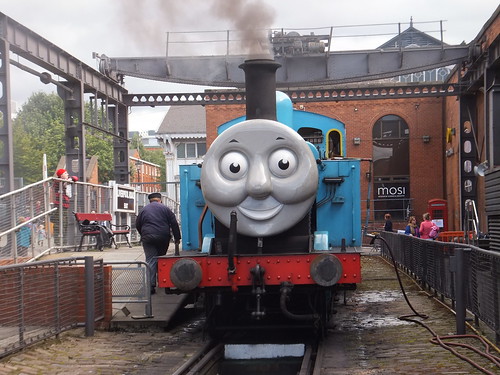
'Thomas' ready to depart on Thursday 30th August 2012.
'Thomas' is visiting MOSI (the Museum of Science and Industry in Manchester) for four days from Thursday 30th August 2012 to Sunday 2nd September 2012. Visitors can meet Sir Topham Hatt (the Fat Controller), visit the Imagination Station (storytelling, colouring pages and tabletop toys), watch 'Thomas' DVDs, have a free 'Thomas' sticker, facepainting and temporary tatoos, attend balloon modelling shows and have a go on the 'Thomas' Bouncy Castle. But, of course, the highlight is a ride behind the real 'Thomas'.
Jan was Thomas's driver on the afternoon of the first day and I'm pleased to report that Thomas behaved very well. So well, in fact, that Sir Topham Hatt presented Thomas with a celebratory 'Coal Cake' at a ceremony by the 1830 Station Building. 'Planet' (with a face) was in the yard in light steam and visitors could actually go on the footplate. The other locomotives parked outside also sported faces.
Of course, 'Thomas' is quite a celebrity, so a reporter from the Manchester Evening News arrived to take pictures on Thursday afternoon.
There are more pictures of Thomas's visit here.
For more technical pictures of this locomotive, goto Anatomy of a 'Jinty'.
Tuesday, 28 August 2012
Numbering of Russian Locomotives and Rolling Stock
Where letters are used in designations, Russia uses the Cyrillic alphabet but, in this text, the Romanised form is used throughout.
Prior to 1912, there were various different methods of numbering in use. In 1912, locomotive classes were identified by a capital letter, often followed by a subscripted or superscripted letter indicating some feature or modification, completed by a running number.
In 1925, a numeric system using a series number followed by a 2-digit running number was imposed. This scheme had only limited application because of the inconvenience of allocating a new series number for every 100 locomotives.
The system introduced in 1931 used class letters taken from the names of various political heroes, followed by digits representing the axle-loading and terminated by a running number. This system was not without risk when the political climate changed. For instance, the 2-8-4 passenger class introduced in 1932 was originally called the 'IS' class (for Iosif Stalin) but, in 1962 when Stalin became persona non grata the class was quietly re-named 'FDp' where the 'p' indicated the passenger version of the similar 2-10-2 freight class called 'FD' (commemorating Feliks Dzerzhinski).
During and after the second World War, additional variety was introduced because the class letters were sometimes alphanumeric. So, some classes were known just by a letter (for instance, the 'L' class) whereas the 'P36' class used the factory project number and some politically-inspired class designations were used. After the War, the letter 'T' represented a captured locomotive and this was combined with a letter indicating a similar Russian-built class (for instance, the captured German 'Kreigslok' locomotives became 'TE' class. Running numbers could be 3-digit or 4-digit.
Further changes were introduced with dieselisation. With multi-section locomotives, an initial digit indicated how many sections, followed by 'TE' for diesel electric transmission and 'TG' for diesel hydraulic types. A third letter 'M' or 'P' indicated shunting or passenger types, respectively. Imported locomotives were identified by a further prefix, for example the ChME3 came from Czechoslovakia. Individual sections of multi-section locomotives were coded A, B, V, G (the first four letters of the Cyrillic alphabet).
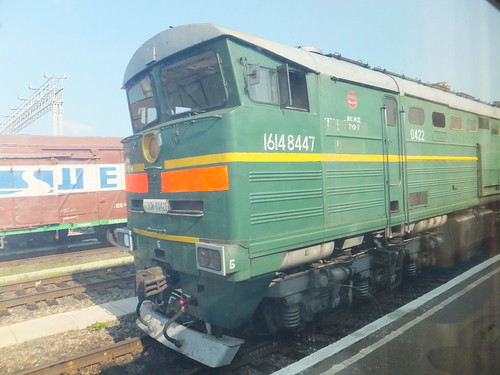
This 2TE10M-variant locomotive at Naushki not only carries the number '2T310M K0422' on the end (with the number '0422' also stencilled near the access door) but also the 1984 renumbering '1614 8447', where '161' means Locomotive - Multi Section Diesel - Freight. The Cyrillic 'B' stencilled near the lamp cluster indicates that this is the 'B' section of a 2-section locomotive.
After WWII, large numbers of main-line electric locomotives were produced, coded with a letter representing the builder and figures representing either the number of axles or the axle loading. In 1963, this was replaced by the prefix 'VL' and a class number up to 39 (for d.c. types) or 40 and above for a.c. types. Imported locomotives used letters representing the country of origin, as adopted with diesel traction.
Diesel multiple units were coded 'D', followed by a letter indicating the the builder (often 'R' for Riga) and a class number. Electric multiple units were similarly coded, but starting 'E'.
In 1984, an all-numeric system of identification was introduced for all locomotives and rolling stock, to facilitate computerisation. All numbers were 8-digit, divided into two groups of four for legibility. The system was unpopular and various problems arose. The first digit indicated the type of vehicle (0 for passenger coaches, 1 for traction units, 2 to 9 for freight vehicles).
For traction units (code 1), the second digit indicated the basic type of traction (steam, diesel, etc.), the third digit the intended purpose (passenger, freight, shunting etc.) and the fourth digit the individual class of traction. The 5th, 6th and 7th digit provided a group of 1,000 individual running numbers.
In all cases, the final (8th) digit was a checksum, calculated from the previous seven digits.
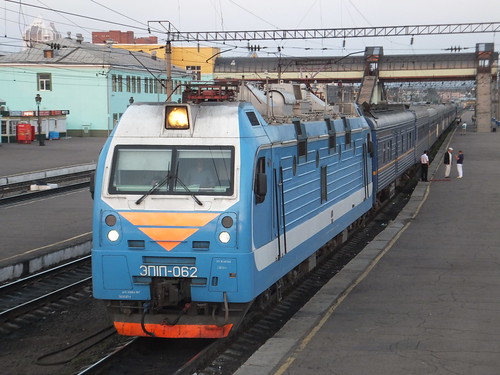
Class 'EP1P' number 062, built in 2010 does not display the 8-digit numbering.
This article on numbering systems is adapted from Appendix 1 of Reference 1 which gives more detailed information (up to 1994).
References:
Reference 1: 'Soviet Locomotive Types - The Union Legacy' by A J Heywood & I D C Button (Frank Stenvalls Forlag) ISBN 0-9525202-0-6.
Friday, 24 August 2012
Loco-profile 4: Russian 'FD20' class 2-10-2
'FD20' Class 2-10-2 number 588 at Novosibirsk Rolling Stock Museum.
In the early 1930s, the Soviet Union introduced two modern, large locomotive classes. The 'FDp' was a 2-8-4 intended for passenger working with 1850 m.m. diameter coupled wheels whilst the 'FD' was generally similar but arranged as a 2-10-2 with smaller coupled wheels intended for freight duties.
I saw the only surviving 'FDp', number 578, in Ukraine in 2005 when I went with my friend Mike on a steam driving holiday which is briefly described here and with a set of pictures (including the 'FDp') here.
It was to be 2012 and my Trans-Siberian trip before I saw an 'FD20' class, number 588, in the Rolling Stock Museum at Novosibirsk. Pictures of this locomotive are in the set Loco-profile: Russian 'FD20' class 2-10-2.
All the pictures from the Rolling Stock Museum at Novosibirsk are here.
For technical specifications, refer to Reference 1.
References:
Reference 1: 'Soviet Locomotive Types - The Union Legacy' by A J Heywood & I D C Button (Frank Stenvalls Forlag) ISBN 0-9525202-0-6.
Loco-profile 3: Russian 'FDp20' class 2-8-4
Surviving 'FDp20' class (formerly IS class) plinthed near Kiev main station.
In the early 1930s, the Soviet Union introduced two modern, large locomotive classes. The 'FDp20' was a 2-8-4 intended for passenger working with 1850 m.m. diameter coupled wheels whilst the 'FD' was generally similar but arranged as a 2-10-2 with smaller coupled wheels intended for freight duties.
The passenger class was originally called the 'IS' class (for Iosif Stalin) and the freight class was called 'FD' (for Feliks Dzerzhinski). However, in 1962 (when Stalin became persona non grata the 'IS' class was quietly re-named 'FDp' where the 'p' indicated 'passazhirskii'.
I saw the only surviving 'FDp20', number 578, in Ukraine in 2005 when I went with my friend Mike (now, alas, passed on) on a steam driving holiday which is briefly described here and with a set of pictures (including the two pictures of the 'FDp' in this post) here. The surviving 'FDp20' is displayed on a very elaborate welded steel plinth outside the passenger locomotive repair works near the centre of Kiev in the Ukraine.
Front view of surviving 'FDp20' class. Note that the complete smokebox front is hinged on the left and, once unbolted, can be swung open for re-tubing and access to the tubeplate. There is a smaller door in the smokebox front used for char removal. This door is hinged on the right and secured by 14 'dogs' or clamps which, when tightened, ensure that the smokebox door is airtight.
For technical specifications, refer to Reference 1.
References:
Reference 1: 'Soviet Locomotive Types - The Union Legacy' by A J Heywood & I D C Button (Frank Stenvalls Forlag) ISBN 0-9525202-0-6.