Friday, 19 June 2009

Railway Signalling: Spring Vale Sidings Box

A copy of the box diagram in its later form

Introduction:

Spring Vale Sidings Box was on the double-track Stour Valley Line from Wolverhampton High Level to Birmingam New Street. Catchem's Corner was the next box towards Wolverhampton and Deepfields the adjacent box on the Birmingham side. Spring Vale was an L.M.S. standard 'composite' box with a brick locking room and glazed, wooden operating floor. In addition to the Up and Down Main lines, a bi-directional Up and Down Goods Line extended from Spring Vale to Deepfields. There were extensive sidings on both the Up and Down sides of the main lines. The signal box commanded a good view of the steel works on the Up side of the line which gave rise to the box's importance.

The box diagram above shows the arrangement in the later years after changes associated with an ill-starred Steel Terminal built on the down side. Originally, a running crossover with single slip was provided on the Wolverhampton side of the box. After remodelling, motor points 2A/2B and the facing crossover 5/6 provided similar functionality. Originally, access to the Down & Up Goods Loop from the Up Main was via a scissors crossover. Following remodelling, separate crossovers 5/6 and 13A/13B provided similar functionality. The Bonding Diagram below shows the original arrangement.

After electrification of the line, Spring Vale Sidings box struggled on as a Shunt Frame for a few years but, like the steelworks it was built to serve, it has now disappeared.

The Steelworks:

In the early 1950s, I visited the Steelworks on an official tour which started my interest in steelmaking and heavy engineering in general. At the time, the works was universally known as Stewarts and Lloyds but it ended up part of British Steel and was eventually closed. Very little sign of a once-major employer remains.

There was one Blast Furnace, a post-war affair called 'Elizabeth' named after the then-princess, now Queen, Elizabeth. Once 'lit' blast furnaces are kept going as long as possible. A 'campaign' can last 10 - 15 years. The blast furnace produces iron from iron ore in a batch process. Every few hours, the furnace would be 'tapped' to release the new batch of 'blast furnace metal'. Originally, this would be sand-cast into 'pigs', allowed to solidify, then broken up and carried away for further processing which involved melting it again. In an 'Integrated Steel Works', blast furnace metal is kept molten and transferred immediately for further processing. The Spring Vale Works had a number of electric-arc furnaces, used for converting iron into steel.

As British Steel modernised, the more efficient Basic Oxygen Steel process was introduced at certain sites, together with new, larger blast furnaces which, whilst still batch-orientated, had a much larger throughput than 'Elizabeth'. So the Spring Vale works became less economical and closure became inevitable.

Signalling:

The box was provided with an L.M.S. standard lever frame unusally on the track side (because the brick base was 'undercut' due to limited clearance to the siding running behind the box). The lever frame stood about 18 inches above the floor. All the interlocking was contained within the Operating Floor in flat trays protruding to the rear of the frame. The catch handles were 'trigger levers' mounted behind the lever top (similar to old-fashioned car handbrakes). 'Catch Handle Locking' was provided so that, if a lever was locked, it was not possible to squeeze the catch handle against the lever top to release the catch prior to moving the lever. This prevented the signalman from 'taking a swing' at a lever which was locked, minimising the chance of injury. Nonetheless, I always preferred the older L. & N.W.R Webb design where locking was on the lever, not the catch handle. A number of levers in the frame were provided with electric lever locks or circuit controllers.

One feature of L.M.S. frames was that the levers controlling running signals for the main lines were grouped towards the middle of the frame, rather than at each end, so as to minimise the required walking by the signalman. At Spring Vale Sidings, the levers required for an Up Train were thus 20 (Home), 21 (Starter) and 19 (Distants). For a Down train, the "pull" was 35 (Home), 34 (Starter), 36 (Distants) and 37 (Distant).

Signalling at Spring Vale Sidings was upper-quadrant semaphore, wire-operated. The Down Starting Signal (with Catchems Corner Down Inner Distant below) originally had an ususual 'gallows' post but the limited remodelling changed this for a straight post with a 'Shunt Ahead' subsidiary signal below. Note that the lever number for the 'Shunt Ahead' signal was 33 - my diagram incorrectly shows it as 35. Originally, points were all mechanically operated via rodding but the limited re-modelling introduced electric operation of points 2A and 2B.

Absolute block signalling was in use on the main lines, using L&NWR instruments of Fletcher's 'DN' pattern.

The Down and Up Goods Line to Deepfields was worked 'Permissive', using special bi-directional single-line block instruments. Although each instrument had two block indicator needles, only one needle could be used at a time, according to whether the train was 'coming' or 'going'. In addition, the commutator which allowed the block to be set at 'LINE CLEAR', 'TRAIN ON LINE' or, when not in use, 'LINE CLOSED' also included a mechanical reminder device which displayed the total number of trains in the section in a small window.

I'm afraid I never did a detailed signalling diagram before the remodelling, but the diagram above represents Spring Vale in its final years as a block post.

Down Main Signals:

Spring Vale Sidings Down Block Section extended from Deepfields Down Starting Signal to Spring Vale Sidings Down Home Signal (35), just outside the box. 'Station Limits' extended from the Home Signal to the Starting Signal (34).

A Distant Signal is, of course, provided sufficiently far in the rear of the Home Signal to serve as a warning to the driver of an approaching train of adverse stop signals ahead. The location of a Distant Signal depends upon Line Speed, Gradients, Sighting Distance and train braking characteristics. If a Block Section is sufficiently long, the distant signal will be placed on its own post but where Block Sections are shorter (such as along the Stour Valley Line), the Starting Signal of the box in rear would often intervene so a distant arm was placed below the Starting Signal arm. A 'Slot' mechanism on the signal post would prevent the distant arm from coming 'Off' until the Starting Signal had cleared. The lever of the Distant Signal would work the 'Weight Bar' in the Slot mechanism, enabling the Distant Arm to clear once the Starting Signal is cleared. There's a bit more about 'slotting' here. A further Distant Signal would have to be provided under the Home Signal of the box in the rear, similarly 'slotted'.

In fact, Spring Valve Sidings controlled a total of three Distant Signals in the Down direction, all mounted under Deepfields 'stop' signals and 'slotted' by them. Lever 37 operated the weight bar for a Distant Signal 1144 yards from the Home Signal, mounted under Deepfields' Down 'Home 1' signal. You can imagine that getting the weight bar to move correctly at this distance required a certain technique. Lever 36 operated the weight bars for two Distant Signals - 36a (mounted under Deepfields' Down 'Home 2' signal) and 36b (mounted under Deepfields' Down Starting signal).

Up Main Signals:

Spring Vale Sidings Up Block Section extended from Catchems Corner Up Starting Signal to Spring Vale Sidings Up Home Signal (20), from where 'Station Limits' extended from to the Starting Signal 21).

Spring Valve Sidings controlled two Distant Signals in the Up direction, both mounted under Catchems Corner 'stop' signals and 'slotted' by them. Lever 19 operated the weight bar for Distant Signal 19b mounted under Catchems Corner Up Starting Signal. Provided the weight bar came 'off' correctly, a circuit controller applied power to motor-operated Distant Signal 19a mounted under Catchems Corner Up Home Signal. This motor-operated Distant Signal was 1190 yards from Spring Vale Sidings Up Home Signal.

Down and Up Goods Loop & Adjacent Sidings:

The 'third line' on the Deepfields side of Spring Vale Sidings was an up and down permissive block goods line. 'Permissive' meant that a second, or subsequent, goods train could be admitted onto the occupied line. To ensure the co-operation of signalmen at Spring Vale Sidings and Deepfields regarding trains on the Down & Up Goods Loop, stop signals at either end were 'Slotted' (in a similar fashion to slotting of Distant Signals described above) so that both signalmen had to operate their slot lever before the signal cleared. Lever 29 at Spring Vale Sidings worked the slot on the bracket signal allowing Up Trains to proceed to Deepfields. Lever 50 at Spring Vale Sidings worked two slots at Deepfields allowing Up Trains to approach Spring Vale. One slot was on the arm controlling facing movement from the Down Main to the Down & Up Goods; the other controlled the 2-arm miniature semaphore ground signals controlling movements setting-back from the Up Main to the Down & Up Goods.

The 'fourth line' on the Deepfields side of Spring Vale Sidings box gave access to a fan of sidings which extended to Deepfields. There was no block signalling on these sidings and the connection at the Deepfields end was very rarely used.

Typical working:

Whilst some boxes were only open during the daylight hours, Spring Vale Sidings worked three shifts ('Early', 'Late', 'Nights') most of the week.

A lot of the activity was concerned with the through trains. This involved accepting the 'Is Line Clear?' from the box in the rear ("Taking On"), obtaining 'Line Clear' from the box in advance ("Sending On"), clearing the signals in the order Home, Starter finally Distants ("Pulling Off"), observing the train as it passed, sending 'Train Entering Section' ("Section") to the box in advance, ensuring a tail lamp was carried, replacing the signals, giving 'Train Out of Section' ("Knocking Out") to the signal box in rear and waiting for the box in advance to send 'Train Out of Section'. Even this repetitive process could get quite demanding at busy times when trains followed one another on short headways and, of course, trains were being handled in both directions. Once freight trains, requiring to detach or attach wagons, terminate or originate at Spring Vale, were added to the mix, life could be quite hectic.

Signalling Controls:

There's a bit about the electrical signalling controls at Spring Vale Sidings starting here.

References:

For an earlier diagram of the arrangements at Spring Vale Sidings, refer to the Signalling Record Society publication 'British Railways Layout Plans of the 1950's', 'Volume 11: LNWR Lines in the West Midlands' (ISBN: 1 873228 13 9).

For details of the the Stour Valley line in 2005, refer to 'Railway Track Diagrams Book 4: Midlands & North West', Second Edition, published by Trackmaps (ISBN: 0-9549866-0-1). The First Edition of this book was published by Quail in 1988.

[Additional material added January 2010. New links added July 2013]

Sedgeley Junction remembered

In the post 'Sedgeley Junction', I talked about this signal box on the South Stafford Line. My friend Phil is contemplating a model based on the area and was recently interviewed on radio, appealing for more information, particularly about the Palethorpes operation.

So I've trawled the gloomy recesses of my memory for more information to 'add to the pot'.

The railway spelling of the placename - Sedgeley Junction - always intrigued me. The nearby 'Sedgley Road West' eventually leads to the town of 'Sedgley'. Both names get by with only two 'e' in the name, but the railway always used three in the name of their junction.

Sedgeley Junction controlled access to Palethorpes' private sidings. These sidings were situated on the Up side between Sedgeley Junction and Dudleyport Low Level station. There was a fairly basic loading platform with awning. The main factory was a short distance away. I'm indebted to John Dunn for this brief history of Palethorpes:

Henry Palethorpe commenced business as a butcher at Gooch Street, Birmingham, in 1852, where he was to develop a product that was to lead to the business becoming the largest producer of sausages in the world. In 1870 the business was moved to the Market Place, Dudley, as by then more production capacity was required. The business continued to grow, the year 1892 saw the purchase of premises formerley used as a brewery, belonging to Whitehouse Brothers, in Park Lane West, Dudley Port, later to be known as Tipton. These premises were known as the 'Model Brewery'. After extensive modification production commenced there in 1896, and continued until the 1967, when the company moved to a new purpose built factory in Market Drayton, Shropshire.

I believe 'Black Country Bugle' number 711 has an article about the demolition of the Park Lane West factory after the move to Market Drayton.

Palethorpes had its own fleet of railway vans, carrying the company name and a large picture of their sausages. Each weekday afternoon, these vans were attached to various passenger trains for distribution around the country and the unloaded, empty vans returned the next morning. There were no run-round facilities in Palethorpes' sidings so, when I used to visit Sedgeley Junction, two shunting locomotives would normally arrive at around the same time. In the morning, vans from two directions would be brought in and the two locomotives would co-operate in getting the vans positioned at the loading platform. In the afternoon, two loaded trains would be made up. As far as I remember, one train would head up the 'Third Line' to Dudley, the second would take the down branch to Dudleyport. At Dudleyport, further shunting would attach the vans to the required expresses.

Sedgeley Junction track diagram. Click on the diagram to enlarge.

The lack of a run-round and the inconvenient layout at Sedgeley Junction meant that there was quite a bit of 'fussing about' to get two trains away. In particular, the train for Dudleyport would be drawn up the 'Third Line' past the signal box by the engine for the Dudley working attached to the Dudley end of the vans. The Dudleyport engine (often a Stanier 2-6-4T) would then attach to the Dudleyport end of the vans, clear of the crossover. The points were then set for 'Up Main' to 'Third Line' and the Dudleyport engine would then draw its train onto the Up Main, clear of the facing points. Once the points were reset for the main line, the engine would propel its train past the box to clear the crossover points. 'Line Clear' would be got from Dudleyport for a '1-3-1', the junction points set for Dudleyport and the crossover reversed. The train would then depart on its short journey to Dudleyport. This move was invariably called 'the W move'. The lack of ground signals for shunting (except actually leaving the Palethorpes' siding) meant that all these moves were authorised from the signal box by handsignal - a raised arm given at an open window.

The freight guards who came with the Palethorpes' trains were kept quite busy by all this shunting. Freight guards jobs then were totally different from today. Railway staff who worked inside private sidings were frequently given little 'perks' by the businesses to ensure their co-operation. It was customary for the train guard to grab a snack at the Palethorpes' works canteen and, on one occasion, a friendly guard invited me to accompany him. The main works which housed the canteen was large and brick-built, four or five stories high and built right up to the pavement. The canteen was crowded and noisy but we were quickly furnished with bacon sandwiches.

Palethorpes' works was dominated by a tall brick chimney and, from time to time, this emitted what I found a very distasteful smell as a reminder of what the plant was about. Once, exactly what the business involved was brought forcefully home to me. I had visited my friend Tom at Sedgeley Junction on a Saturday and, checking the Special Traffic Notices, found that a special train was due to arrive at Palethorpes. The train duly arrived with about eight or ten cattle wagons and was 'loosed up' the 'Third Line'. The wagons were full of live pigs, all squealing. I still remember my sense of guilt as the train was slowly reversed down to the Palethorpes' loading dock where the pigs were unloaded to await their fate. In a while, the engine returned with just its brake van and, after performing the 'W' move, departed on the down main propelling the brake, 'rightaway Bescot'.

Normally, of course, the locomotive has to be at the front but the propelling of one or two brake van was permitted - the guard would usually be on the front verandah keeping a lookout. The 'Is Line Clear?' for an engine with one or two brake vans was '1-1-3'. Timetables usually used the acronym 'EBV' (Engine and Brake Van); railway staff called them 'Engine and Brake' or 'Horse and Cart'.

The Diesel Parcels Units (DPU) became quite familiar when I was working signal boxes. It was quite usual to see them with 'tail traffic' of a few vacuum-fitted vans. But I don't remember personally seeing a DPU hauling a 'Palethorpes' van, although there's photographic evidence that they did. DPU were quite common on the Stour Valley and the South Stafford Line on normal parcels trains but I never saw one go into Palethorpes'.

Dudley was a somewhat unlikely destination for day trips, mainly because of the Zoo. At Bank Holidays, a number of steam-hauled excursion trains would converge on Dudley from various towns, mainly in the East Midlands, so it was an interesting time to visit the box. Next time, I'll tell you a little about these excursions.

Thursday, 28 May 2009

Stanier '8F' inauguration at Peak Rail

The public debut of the maroon Stanier 8F, 8624, took place on Saturday 23-May-2009, as part of a 3-day steam gala at Peak Rail for the Bank Holiday weekend. The first day didn't quite go to plan, as I'll explain shortly. I was marked as driver on 8624 during Saturday morning with Chris Ward as fireman, then we were both to swap onto 'Royal Pioneer' giving brake van rides at Rowsley for the afternoon.

When I arrived at Darley Dale South Yard, The invariably-smiling Chris was on hand and 8624 was quietly 'brewing-up' at the North End of Siding 2. 'Royal Pioneer' was being prepared in the usual spot, over the inspection pit towards the south end of siding 2. After exchanging greetings with Derek and Harvey on 'Royal Pioneer', I returned to 8624 to set about the driver's preparation duties.

I've talked about preparation of 'Royal Pioneer' in an earlier article. The same principles apply to an '8F' - it's just a bit bigger. The '8F' has one major advantage over 'Royal Pioneer' - it has two outside cylinders and Walschaert's Valve Gear outside, so it's easier to get at most oiling points. Some of the corks are a bit high-up so that the foot-framing (running board) gets in the way but hinged flaps are provided in the foot-framing so that the driver can attend to these oiling points from above.

On 'Royal Pioneer', steam oil is dispensed by a sight feed lubricator but on the '8F' a mechanical lubricator, driven from the motion, distributes oil as long as the engine is in motion. During preparation, the driver has only to lift a hinged lid on the lubricator to ensure there's sufficient oil in the reservoir for the day's work. The driver will also turn the lubricator by hand perhaps twenty turns to 'prime' the oil lines with oil before setting off.

On the '8F', a second mechanical lubricator (a 'Silvertown' of a slightly different pattern) distributes 'motion oil' to the top of the coupled axleboxes to feed the journals and hornguides. At present, there is no manual handle for priming, so this lubricator is 'cranked' by turning the nut on the end of the pump spindle with a spanner.

Although the mechanical lubricator will provide a supply to the axleboxes, it's also necessary to go underneath the engine to attend to the axlebox underkeeps, for Stanier introduced the very reliable Swindon design of axlebox on the L.M.S. The picture below shows one axlebox on the pony truck of the '8F'.

The 'Achilles Heel' of many Derby-built locomotives before Stanier was said to be inadequate bearing size in axleboxes. There was a famous tussle when Derby placed an order with Beyer Peacock in Manchester for the 2-6-0 + 0-6-2 'Garratts'. Beyer Peacock politely pointed out that they would recommend the use of their standard axleboxes with generous dimensions. But Derby insisted on the standard axlebox, with predictable consequences for reliability. On his arrival at Derby, Stanier went about quietly introducing a number of Swindon ideas, including his version of the Swindon axlebox. The underkeep is in the form of a generous oil reservoir. A worsted pad is immersed in the oil, with a spring pressing the pad upwards to wipe oil onto the journal. Each reservoir is topped-up via a protruding pipe closed with a cork, accessible when the locomotive is standing on an inspection pit. The bottom of the reservoir has a hex-headed bolt which may be slackened to drain any water from the reservoir.

When the crew of 'Royal Pioneer' had finished their preparation, they moved the engine off the pit, so that I could set back 8624 onto the pit to check the axleboxes. By the time I'd done this, it was 09:15 - time to tie the two engines together and make out way to Rowsley. Having obtained the Darley Dale - Matlock single line staff from the Darley Dale signalman, the crew of 'Royal Pioneer' were able to operate the South Yard Ground Frame and drag us onto the running line. With the ground frame restored to normal, I received the staff (Peak Rail has changed it rules so that it's now the leading engine which carries the staff) and we made our way towards the Darley Dale Down Home signal which 'cleared' as we approached.

I surrendered the single line staff to the signalman as we entered the double track section through Darley Dale station. As we approached Church Lane, the signal came 'off' and, having picked up the staff for the Church Lane - Rowsley section, we carried on up the bank, to stop by the crossover ground frame on the approach to Rowsley. Here, we 'split' the two engines.

I took 8624 up to the 6-coach train in the platform and 'Royal Pioneer' made its way into the sidings to pick up a brake van for the brake van rides. The guard called us onto the stock and members of the 48624 society joined the train, for the first round trip due to depart at 09:45 was to be be a private working for society members. The Traction and Train Crew Officer had decided to drive the first trip, so I was left at Rowsley, waiting for the train to return.

When the train returned, it was quickly discovered that the big end bearing on the right hand side was very hot. Alen gave a monosyllabic diagnosis - "SHED!". So, I took over a 'sick' engine, unable to work the first revenue-earning public train. 'Royal Pioneer' was told to drop his brake van off and get attached to the front of the train to work the service whilst repairs were attempted to 8624. Once 'Royal Pioneer' had shunted onto the train, I was able to gingerly shunt 8624 across to the shed, where we positioned the engine as required by Alen and the working members of the 48624 Society.

The team took down the right hand motion in order to examine the big end. This is an easier task on an locomotive with outside motion, but it's not a job for the faint-hearted. The parts are heavy and cumbersome and strength is required, even with a willing team. My pictures of 8624 include some shots showing the repair in progress.

Once the four nuts securing the return crank are removed and the eccentric rod is disconnected from the expansion link, the return crank and eccentric rod can be lifted off and set aside. The gudgeon pin is then removed, allowing the little end of the connecting rod to be separated from the crosshead. The big end is then slid off the crankpin and the long, heavy connecting rod withdrawn. This is easier said than done because the connecting rod passes through the motion bracket (also called the 'spectacle') and has to be manhandled towards the cab until it's clear of the motion bracket. The rod can then be set down on wooden blocks to allow the whitemetal bearing to be examined.

Judicious 'scraping' was performed on the whitemetal bearing to remove possible 'high spots'. Years ago, this was a favourite training job for apprentices in the works. Meanwhile, the oil pad was given a good soaking in fresh oil. Before re-assembly, all bearing surfaces were given a liberal application of oil, then the procedure for taking down the motion was reversed until the engine was complete again. As a test, we ran the engine the length of the loco yard and back three times. After each run, the big end temperature was checked and the following run was made at a slightly higher speed. The repair was judged a success and the engine was released to traffic, after less than three hours on shed - a tribute to the 48624 team's professionalism.

While all this was going on, 'Royal Pioneer' had completed two round trips to Matlock. 8624 shunted to the south end of the train and 'Royal Pioneer' moved from the north end to the yard, to resume brake van rides. The first revenue service operated by 8624 was the late-running 13:45 departure, reporting number 2M05. The engine was tender first, of course, going to Matlock. I'm afraid the Stanier 4000 gallon tender doesn't give the driver very good visibility when running tender first. When I used to work mechanical signalboxes (unofficially) when I was young, I was intrigued that some freight train drivers would insist on turning their engines on a nearby triangle so as to work back 'chimney leading', whereas other drivers would save time by working back tender first. Most of the British Rail Standard tenders were 'inset' at the top, to improve visibility.

I've discussed some of the duties of the traincrew in 'The working of trains' but if it's an unfamiliar engine, the driver also has to work out the best way of handling the engine. Below is a small selection of the things to bear in mind
- On any engine with piston valves, aggressive use of the cylinder drain cocks is essential, to prevent condensate being trapped in the cylinders.
- Each time the regulator is shut, there's a fair amount of steam left in the main steam pipe and this steam will be expanded as it passes through the superheater, so the engine will remain under power for some seconds.
- A screw reverser allows fairly precise setting of the cut-off, but it can become a little heavy if you're doing a lot of shunting.

Chris had things well in hand on the fireman's side, as usual, so I could concentrate on driving. It's always policy to start off in full gear, to ensure you can produce enough torque to start away cleanly with a moderate regulator opening. After a few yards, I pulled her back to 55% for better economy. Since 55% is also the marked position for drifting (coasting), I could shut off without making any further adjustment to the reverser. On this run, we wanted to keep the speed down and, every time we stopped at a station, we checked the right hand big end which remained cool. So we enjoyed an uneventful, if rather restrained round trip. I was reminded that this was a fairly special occasion as we approached Rowsley on the way back in bright sunshine. In the field on the left, there was a fan of about ten photographers, lenses trained on our engine as we made our sedate progress into the platform.

On our arrival, I squeezed up and Chris 'hooked off'. Long-term Peak Rail member Bill Berisford marked the occasion by the charming gesture of presenting me with flowers, shown in this picture by Mick Cramp. Then it was time to relieve the crew on 'Royal Pioneer' and Jack and Mike took over 8624 for its second revenue trip. The Traction and Train Crew Officer decided to take 8624's third revenue trip. Chris and I continued the brake van rides during the afternoon and when 8624 completed its third trip (by now about one hour 'down' on the schedule), we coupled the two engines together. 'Royal Pioneer' led the way home to the South Yard at Darley Dale, where the two engines were disposed. An interesting and tiring day. The early failure of 8624 was clearly disappointing but the marvellous way in which the members of the 48624 society rallied round to get the engine back in traffic was in the very best traditions of steam railways.

Other Articles on 8624 in this Blog

Stanier '8F' restored at Peak Rail.
In a Spin with Pete Waterman.

Tuesday, 19 May 2009

Ask the Expert - 1

"Thank you. This is a rather nice commemorative plaque featuring a Great Western 'Castle' class locomotive. Modelling can be very variable on this sort of objet but this is quite well done. There's a limit, of course, to how much detail can be incorporated but the classic lines of the 'Castle' are quite clear."

"Churchward introduced the Great Western 'Star' class which laid out the basic format for a four cylinder express locomotive. Divided drive, with two inside cylinders set well forward connected to the leading cranked driving axle and two outside cylinders driving the next axle via crankpins. Although Stephenson link motion had been used with complete success on other types, Churchward decided to fit two sets of Walschaert's motion inside the frames working the piston valves on the inside cylinders directly and the piston valves for the outside cylinders via rocking levers. Initially, the 'Atlantic' wheel arrangement (4-4-2) was to be used, as on the De Glehn compounds he'd evaluated, but Churchward became convinced that the extra adhesion contributed by a pair of coupled wheels, rather than a pony truck, would be more valuable, giving rise to the classic Great Western 4-6-0. The 'Castle' closely followed the outline of the earlier 'Star' but Collett did provide a somewhat improved cab, allowing us to quickly identify this plaque as a 'Castle'."

"Turning to the material which has been used for this plaque, the brown colouration suggests terracotta which, in the right hands, can provide the level of detail we see here... I beg your pardon? Chocolate? Did you say CHOCOLATE? You are surely mistaken" ...

(MUNCH) ... "Certainly, it's rather softer than I would have expected. Terracotta requires the correct kiln temperature for 'firing' to produce a durable artefact ..."

(MUNCH) ... "Of course, Churchward used only a low degree of superheat and it wasn't until after the Second World War that higher superheat was used. The traditional Great Western sight feed lubricator was not sufficiently reliable with the resulting higher steam temperatures and so a mechanical lubricator was used for the cylinder oil. A double chimney and blastpipe was introduced, to reduce back pressure and consequent power losses" ...

(MUNCH) ... "The name of Sam Ell is associated with this post-war work at Swindon where the steaming of a number of classes was significantly improved, often by quite minor changes to the draughting. By this time, the work of Lemaitre, Chapelon and Kylala was becoming well known" ...

(MUNCH) ... "Now, looking again at this commemorative plaque ... Oh dear, it seems to have gone. Next object, please!"

Thursday, 7 May 2009

Fourth Rail Electrification

Fourth rail electrification, White City, London Underground

Electric railways were introduced towards the end of the 19th century. Electric traction was particularly suitable for use on underground railways where steam traction could be particularly troublesome. Early systems used locally-generated direct current, produced by stationary steam engines.

Largely because of the available materials for generators and motors, working voltages were limited to six or seven hundred volts. At these relatively low voltages, currents are fairly high, so a third rail, the conductor rail, was provided to carry the traction current between the feed point and the train to be powered. One or both running rails were used to return the current to the feed point. The conductor rail was carried on glazed porcelain insulators (invariably called 'pots') mounted on the transverse timbers ('sleepers') to which the running rails were also fixed. The high insulation resistance of the insulators ensured that almost all the current flowing in the conductor rail was that drawn by the train.

The situation was more complex as far as the return current from the train was concerned. The running rails were held at the proper gauge by fixing them rigidly to the sleepers which, in early days, were generally made of wood - a reasonable electrical insulator. To provide resilience against the dynamic loads of passing trains, the sleepers were buried in ballast, often crushed limestone - again a reasonable insulator. Sleepers and ballast were in contact with the mass of the earth. The earth resistance from the running rails may be fairly high in dry conditions but, when wet, earth resistance falls. Although most of the return current would flow from the train to the feed point through the rail, a proportion leaked from rail to sleeper and from sleeper to ballast so that a significant current flowed through the mass of the earth. If there were nearby metallic water or gas pipes, some of this stray current could flow through them, causing damage by electrolytic action.

The situation was even worse in deep tube lines, which were lined with sectional cast iron sections which would not only suffer electrolytic action but, if rings were not bonded together, could display arcing. To mitigate this problem, London's Underground evolved with a 'fourth rail' to carry the return current via a path isolated from earth.

The outer conductor rail is positive at around +420 volts and the inner conductor rail, mounted between the running rails, is negative at around -210 volts. These are the theoretical voltages under dry conditions. Leakage resistance across every porcelain insulator will provide a multitude of paths to earth from both conductor rails which can alter the voltage to earth ratio of the positive and negative conductor rails. To define the 'normal' ratio, London Underground provide bleed resistors every so often connected from each conductor rail to earth. This 'normal' ratio will be subject to significant change on surface lines under varying weather conditions.

Fourth rail electrification with modern concrete slab track

For notes on traction power distribution on London Underground click here.

For an excellent article on conductor rail systems by Russ Elliot click here.

The world's railways use a wide variety of d.c. and a.c. electrification systems employing both conductor rails and overhead conductor systems - to see the Wikipedia article on 'Railway Electrification' click here.

Related posts on this website

All my posts on London Underground can be found here.

Tuesday, 5 May 2009

Stanier '8F' restored at Peak Rail

During the Second World War, the 'Big Four' railways were still in existence, but under Government direction. Riddles was seconded to the Ministry of Supply to ensure that locomotives were available for the war effort. One of the classes he chose to manufacture was Stanier's '8F' freight locomotive and orders were distributed amongst a number of workshops. This is how the locomotive numbered 48624 post-war came to be manufactured by the Southern Railway at Ashford Locomotive Works. It was delivered in 1943, one of a batch of 13 locomotives built there and was initially allocated to Willesden M.P.D. on the L.M.S.

After a little over 20 years service, the locomotive was scrapped in 1965 as part of the frenzy to eliminate steam and languished in Barry scrapyard until 1981, when a group of enthusiasts purchased the locomotive and commenced restoration at Peak Rail's Buxton site.

The problems Peak Rail experienced at Buxton necessitated a fresh start at Darley Dale and so 48624 relocated to the South Yard at Darley Dale to allow work to continue. The amount of money and dedication necessary to restore any locomotive from Barry condition, particularly a large one like an '8F', is hard to imagine. It took 28 years of hard work by the volunteers of the 48624 Society to bring the locomotive back into steamable condition and in that time some of the stalwarts have passed on. Almost all the work has been carried out in the open air - it's only in the last few months that the locomotive was moved to the new Locomotive Shed at Rowsley, offering a significant improvement in working conditions.

On the 25th April 2009, the locomotive moved under her own steam for the first time in 43 years. Alan Taylor made a video of this historic event. To watch Alan's historic video, Click here.

During the restoration, the locomotive had been painted in British Rail black, numbered '48624' and with the 'star' symbol on the cabside (indicating that the locomotive had improved balancing and was suitable for working high-speed freight trains). But, at a late stage, the controversial decision was made to turn her out with the L.M.S. running number '8624' and L.M.S. express passenger livery which, of course, is historically incorrect. The Power Classification has been altered to '8P', to correspond with the livery.

I imagine there'll be some debate about the appearance of the engine. My view is that people who have expended such a super-human effort in bringing the locomotive back to life have a perfect right to choose the livery. Although I have some personal reservations, it can't be denied that she looks very handsome in the chosen colour scheme and I'm sure the general public (as opposed to the rivet-counters) will approve. Click here for my pictures.

The public debut of the locomotive in revenue service is set for 23rd May 2009 at Peak Rail - click here for the Peak Rail website.

Thursday, 16 April 2009

Signals in the Sand

In March 2009 I visited Egypt to see some of the Nile temples. I'm afraid I didn't manage to travel by rail and only visited one station (Aswan) but I did snatch some photographs as I made my way around.

The main station in Cairo is Ramses. The elevated road into the city from the airport passes close to the station but I hadn't been able to see much on my arrival. I contemplated a trip to look at the station but I couldn't make enough time. There is a railway museum adjacent to this station, but I discovered it was closed for the holiday. Apparently, Ramses station has a well-regarded Art Deco frontage. There is currently a fuss because proposed redevelopment at the station threatens the views of the old frontage. I hope they're more successful than we generally have been in England.

Originally, quite a lot of railway equipment was supplied from the U.K. and I knew that the semaphore signalling was generally based on British Practice. But I was surprised to see how much semaphore signalling remains in use today. The heading picture shows the first signal I came across, where the line crosses the Cairo - Suez dual carriageway. It's a lower quadrant with a fabricated post and the balance weight mounted at high level. My photo shows the rear of the signal, a starting signal for thje signal box in the background which appears to control one end of a passing loop, judging by the arrangement of signals in the distance.

As we travelled around the Canal Zone by car, I took a few more pictures but I'm afraid they don't show a lot. My pictures of 'Signals in the Sand'.

Whilst I was in Aswan, I managed to make a quick trip to the station. Eight o'clock in the morning was clearly a good time to visit as, at one point, we had three simultaneous movements. Pictures of Aswan station.

Tuesday, 24 March 2009

Back to the U.K.

Tuesday 24-Mar-2009

The driver who dropped me at the Kempinski yesterday afternoon suggested I be ready for a 6.30 a.m. hotel pick-up for my 8.50 a.m. flight. I took the precaution of checking with Mr. Nasr of Petra Tours who confirmed the the time. So I made everything ready before going to bed and set the alarm for 5.30.

At 5.30, I'd just started to get dressed when the phone rang. It was Mamoon, saying he was in Reception for my 5.30 pick up. Irritated at the lack of communication somewhere, I speeded up the departure process. When the doorbell rang my first thought was "Oh, have they sent someone for the big case?". No, the butler was there to check I hadn't sneaked anything from the mini-bar. It was a decidedly Grumpy Old Woman who checked out a few minutes later. Mamoon, his usual pleasant self, said my flight was now 8.00 a.m.

Yesterday, Amman was almost as hot as I'd found Aqaba but heavy rain had started during the night and the 'Jordan Times' said there'd been flooding in parts of Amman. It was still raining and overcast as we made our way to to Queen Alia airport. I said goodbye to Mamoon and checked in without incident, noting that the departure time was 8.50 a.m. after all.

I was soon in the Royal Jordanian Lounge and able to take a decent breakfast of orange juice, tea, cereal and toast, after which I was in a much better frame of mind.

Whilst still in Grumpy Mode, I'll comment that, on this trip, I've been concerned at the apparent largely subservient role of women in these predominantly Islamic societies. It's hard to know whether, as a visitor, you are getting an accurate impression but an article in yesterday's paper on the topic got me thinking. Even in the West, emancipation still has a way to go but the article suggested that Jordan's society is still rooted in medieval ideas. 'Honour killings' are sadly commonplace. The latest incident involved a father, with other family members, beating his teenage daughter for two hours with hosepipes until she was dead. Her misdemeanour was wearing make-up and not being where she was supposed to be. Recent history suggests that no charges will be brought. The idea of woman as chattel is still alive and well here.

We boarded the aircraft, an elderly A320 operated by BMI as a 'Codeshare' with British Airways, and took off on time. As we made our way north, snow was visible on the ground across Europe. The friendly English cabin crew served a pleasant but reasonably basic lunch. As always, the plastic cutlery irritated me. I chatted with the crew about the rather tired appearance of the cabin. They apologised, saying that they were anticipating a new aircraft and couldn't wait to have equipment they could be proud of.

Over the P.A., the pilot anticipated an early arrival at Heathrow but when we got to London we were obliged to stooge around for a while before making our final approach to Runway Two Eight Left. On our way in, I took a few aerial pictures of London. Click here for pictures.

Once on the ground, there was the interminable taxiing to reach the allocated stand. We finally stopped at stand 125, Terminal 1. External steps were brought up and we were allowed to disembark and make the short walk to the terminal building, in what must be the shabbiest area of the airport. I was just happy to be home, but I often wonder about the depressing first impressions some airports give to visitors. We seemed to follow a very circuitious route through the building, eventually coming to the 'UK Borders' Passport Control. For once, this area was deserted so I was soon in the Baggage Hall. My checked bag arrived within a few minutes and Alan was waiting in the Arrival Hall to take me home - a very satisfactory end to an enjoyable but tiring trip.

[Revised 16-Apr-2009, link corrected 27-Dec-2012]

Monday, 23 March 2009

Back to Amman

Monday 23-Mar-2009

I got up at 5.30 a.m. so as to upload some more pictures and take an early buffet breakfast. They start serving at six, although there were only staff (lots of them) and no guests there when I arrived. I’d decided to have a quick walk so, after a light breakfast, I set off about half past six. The sun was already bright but it wasn’t very hot so I was glad of my padded jacket. I crossed the King Hussein Bin Talal Street dual-carriageway and set off south.

Next to the hotel are the excavated remains of early Islamic Ayla. The gates were still chained and padlocked but the low walls allowed me to take a couple of pictures. I then passed a modern block with lots of restaurants, a Macdonalds and ‘The Rovers Return’ English Pub. By contrast, I then passed the entrance drive to the swanky Royal Yacht Club. Then, there are gardens on the seaward side of the dual carriageway and a pedestrian promendade between the gardens and the sandy beach. Two things surprised me. The ‘gardens’ turn out to be divided into small vegetable patches which appear to be privately cultivated. There are a series of cisterns, what might be wells and simply holes in the ground used to store water. Then there's a series of small portable pumps and firehoses to lift the water to a high point from where it flows down irrigation channels to water the crops. The other surprising feature was that every inch of the exposed narrow, sandy beach was covered with a series of ramshackle cafes apparently catering from the tourists. It all looked very unsavoury. Less surprising, perhaps, was that both sides of the promenade were lined with souvenir stalls of a particularly tacky nature.

I was picked up from the hotel at 7.45 (by a different driver and guide) for the short trip to Aqaba airport. It's fairly modern but smallish. There's one runway (01/19). A small high-wing monoplane was practising taxiing and take off roll: I discovered there's a flying school based at the airport. It's also the home of the Jordanian Red Falcons.

As I waited for my flight, to the west I could see the road traffic in Israel heading for Eilat: We'd passed a border crossing on the way into the airport just a couple of hundred yards away.

Jordan is 10th in the world ranking of counties with limited water supplies and it shares some sources with Israel. There is currently a furore because Israel is accused of polluting the Jordan River recently. Will we ever see a resolution of these problems?

The plane came in on time, a twin jet looking rather smart in the Royal Jordanian colours. The plane parked near the gate and we were allowed to walk to the aircraft. I was in the business section, where the seating is 1+2. It's an Embraer 175. With a 35 minute journey to Amman, there was only time for a glass of orange and an English language newspaper (The Jordan Times).

For some reason, we taxied to International Arrivals. I presume it's for the convenience of passengers who are transiting to an international flight. There were only two exits - 'Transit' (no) or 'Immigration' (I was already stamped as arrived). I eventually found somebody to ask and they put me in the V.I.P Immigration line. The immigration officer understood and waved me by. But there was a security check leaving the hall and this guy refused to let me pass because my passport hadn't been stamped. By this time, all the immigration officers had disappeared and there was nobody left to ask. So I went back to the security guy and eventually made him understand. By the time I got to the baggage hall, my bag was standing all on its own, everybody else having left. A new guy was waiting for me and he took me into Amman and the Kempinski Hotel for one night. Tuesday morning, it's back home.

Photographs

Aqaba, Jordan.
Kempinski, Amman, Jordan.
Movenpick, Aqaba, Jordan.

Sunday, 22 March 2009

From Petra to Aqaba

Sunday 22-Mar-2009

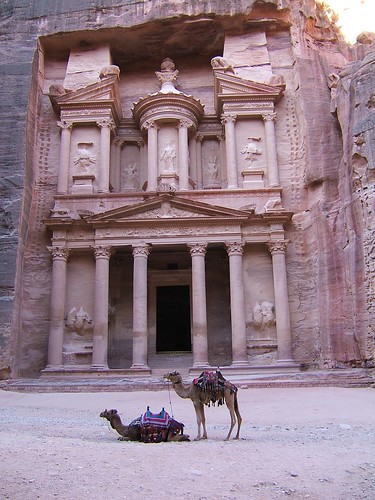
Petra rather captivated me. I got up at five this morning so that I could spend another two and a half hours in the city. Being early, I was able to photograph the Treasury without masses of tourists.

The Treasury, Petra.

Then we drove south, stopping for a couple of hours for a trip round the desert area of Wadi Rum in a 4x4. After that, we continued on to Aqaba. It's nice to see the Gulf of Aqaba but I don't think it's my kind of town. Tell you more when I can.

Pictures at Petra.
Trip from Petra to Aqaba.
Pictures around Wadi Rum.

Saturday, 21 March 2009

Petra

Saturday 21-Mar-2009

When my travel consultant at Wexas, Sindy said "You must go to Petra!", I agreed but I wasn't sure I'd quite share her enthusiam. Well, as has happened before, she was right. I've just spent the most exhilarating (if exhausting) day in the rock city of Petra.

My guide, Mamoon, met me at 9.00 a.m. but, as the entrance to the Petra site is only 50 yards from the Movenpick Hotel, we walked to the ticket office. Mamoon dealt with admission, local guide and horse ride fees. Having made sure I would be able to get myself back to the hotel, Mamoon handed me over to the local guide and said goodbye until next morning.

My new guide explained that there was a short horse ride, if I wished, as an alternative to a few hundred yards walk to the start of the entrance canyon. I took the ride but with the mount being led by the driver on foot it was fairly tame. However, it gave me the taste for more 'saddle-time' later. I met up with the local guide and we set off down As-Siq, the amazing canyon leading to the city. The Nabatean people who founded the city are thought to have come from Yemen but much of their history is still a matter for conjecture and archaeological surveys are still on progress. Around 106 a.d., Petra became a Roman province and the most spectacular buildings are Roman era.

As you near the end of the canyon, you catch a tantalising glimpse of the building often called the Treasury - an amazing Roman-style facade leading to a number of large chambers, all carved from the sandstone cliffs. Suddenly, the canyon opens into an open area and the true scale of the Treasury is revealed. The building gets the best light around 9.30 a.m. and there are hundreds of visitors jostling to take photographs and take a closer look at the Treasury. The ancient city comes alive again, not with traders from two thousand years ago but with visitors from all over the world. It seems strangely appropriate. There is a rather temporary looking cafe and there are souvenir sellers, donkey ride sellers and camel ride sellers. Very young children are involved in this retail business.

My guide explains that, later in the morning, we will climb to an even larger facade, Ad-Deir, called the Monastery. This involves climbing hundreds of steps and the guide recommends a donkey. The young donkey driver and I haggle but the Bedouin people are tough negotiators and I settle on an inflated price for ascending only. The guide and I have a walk of around 1 kilometre looking at carved tombs before the ascent so the guide takes the mobile number of the donkey driver so we can meet later. I find this most incongruous.

Beyond the Treasury, the canyon is much wider but still with rock walls allowing tomb chambers to have been hollowed out and facades provided for the wealthier residents. Near the end of the rock valley, we come to a 7,000 seat amphitheatre, again carved from solid rock. The terrain is now nearly flat and, even in its ruined state, the Colonnaded Street we're now in is pure Roman, from the well-built cambered, straight road to the columns on either side. At the end of the colonnading are the well-preserved remains of Roman buildings. On our right is the Crowne Plaza restaurant. Oddly, this doesn't grate with me too much. Beyond the restaurant, there's a decent museum showing artefacts and carved stonework found on the site.

After a mobile phone call, we meet the donkey driver and donkey near the restaurant. The local guide, who's been quite informative, uses this as a cue to say goodbye. They've provided a mounting block so I am soon in the saddle and we set off, initially with the driver leading the donkey but later he gives me the headrope and walks at the side, encouraging the animal - a three-year old male who seems quite surefooted and willing. There's a large ring at the front of the saddle so you can hand on with both hands and, of course, your feet are in stirrups. I find it surprisingly comfortable and we're soon tackling steps I'd have trouble with on foot. It's advisable for pedestrians to give you a wide berth because, once the animal has chosen a path, they tend to stick to it. One guy moves out of the way but forgets he's wearing a rucksack - my foot catches the rucksack and it's enough for him to topple over. Later, I realise that a hiss is quite effective at stopping a donkey. "Haram" (I think) means "go" and a clucking sound gives gentle encouragement. Occasionally, it's quite tough for the donkey on the steeper bits and the driver keeps asking if I'm alright, but I find I'm enjoying the experience, although it's hard to handle a camera. I negotiate a price for going down by donkey - the driver says it's more fun than walking and I think he may be right. Eventually we stop near one of many souvenir stalls manned by Bedouin where there's a shelter for the donkey.

The driver points to the continuing steps. "Five minutes to walk to Monastery, maybe twenty to look around. You back in half an hour. I wait here". It takes me six minutes and the climb makes me glad the donkey did the first bit. I take plenty of photographs, including a couple with the camera of an American who wanted his whole group of four in the picture. Then he returns the compliment by taking one of me with the Monastery in the background.

I set off downhill to find the donkey driver. Next to the souvenir stall, there's a small fire with a blackened kettle. The donkey driver, the girl running the stall (in jeans and modern dress) and an old woman with a mouthful of gold teeth traditionally dressed in black are sitting drinking tea. They invite me to join them and, of course, offer me tea. The donkey driver is the girl's boy friend and the old woman is her mother. I have a couple of cups of hot, sweet tea and it's a sublime moment. Four people, sitting on the bare earth, faces warmed by the noon sun, looking out across the seemingly eternal mountains in companiable silence. The girl jumps up on the few occasions that somebody approaches and makes her pitch in good English. She appears to be as feisty as a New York shopgirl. Inevitably, I have to make a purchase before mounting the donkey and waving goodbye but it was a marvellous interlude.

Going downhill is a bit harder for the rider, as I expected. You reach behind the saddle and there's a rope secured on the left. Holding that with your left hand and the ring at the front of the saddle with your right hand gives you a chance of staying on as the donkey lurches from step to step. I'm still enjoying it. By the time we get to the museum, we've negotiated a further fee to go on the flat bit through the colonnaded street and on to the treasury. The donkey driver collects another donkey by the museum which he rides whilst leading mine. Then he gives me the headrope and the donkey and I make an independent progress. The donkey's gait is not uncomfortable and I feel I could go on all day. Just short of the Treasury, I dismount, say goodbye and have another look at the Treasury now the area's not crowded. I'd originally intended to go back to the hotel but I don't feel too tired, so a decide to take the route to the High Place of Sacrifice which the local guide had outlined to me, starting near the Amphitheatre.

There are worn steps cut in the rock to follow but it's clearly going to be a demanding climb. Looking back and down, there are splendid views of some of the tombs in the valley and the ant-like people following the main, level track. Before long, I come across a well-cut chamber just off the path. I'm surprised to find a donkey patiently waiting inside where the air is pleasantly cool. A little further and there's another chamber. I'm less surprised to find another donkey waiting in this one. Soon, I come upon a Bedouin woman with her trinket stall. Not much passing trade today, I'm afraid. She points out a beautiful fern-like stain in the rock. I thank her and continue upwards. I pass a lot more souvenir stalls, but none of them is manned at present.

I'm now level with two obelisks carved from the rock on an adjacent plateau. Looking in the other direction, I'm now looking down on the Bedouin Village and a few more feet brings me to the High Sacrificial Place. There are a few tourists here, resting. The top of this mountain has been carved flat and hewn to provide bowls and water channels for the purifying water used in the ancient ceremonies. In each direction, the views are breathtaking. About fifty feet below the summit, there's a ramshackle cafe and I decide that I deserve a drink before descending. The cafe is being run by two Bedouin boys, one about eleven (going on 30), one about fifteen. Their English is excellent and they quiz me with the impertinent directness of the young. In my mellow state, I am happy to play the game for a while. I enquire about the alternative way down which passes other parts of Petra, They are certain that, without the guidance of a Bedouin, I shall never find the route. I'm sure I'll manage but it is going to take a while and I wonder if my stamina will hold out. Apparently by chance, another boy arrives, with a donkey. We all engage in verbal sparring for a while - it's all good-natured but, having enjoyed my donkey ride to the Monastery so much, I start to wonder about hiring the newcomer. This lad is about 21, fairly serious and is sure I've been overcharged in the morning. He's probably right.

We agree a deal, my shoulder bag is placed securely in the one pannier and we set off, with me initially on foot, because the route is via twisting, steep steps cut in the rock. Soon, I'm allowed to ride. It's now a mixture of downward slopes joining short runs of steps. We arrive at a water-filled cistern cut in the rock and I dismount whilst the donkey takes a drink. The water is teeming with tiny insects.

There's another stretch, past the famous (but rather eroded) lion carving where I walk whilst the donkey slowly finds a safe way down the steps. The views are amazing, with improbable wind-carved rock formations and each vertical rock face periodically pierced with chambers. The vivid colours in the rocks look like the work of some modernist artist - it's really hard to believe that it's all the work of nature. All the while, we are descending and we come to one of the larger rock tombs, with a colonnaded portico. There are more souvenir stalls here, but no sellers. I think we've only seen perhaps four or five tourists during our descent from the cafe.

I discover one advantage of the donkey at the larger tombs - they can be riden inside and used to explore, leaving hands free for photography. The donkeys of Petra seem very willing. I feel like one of those Victorian lady travellers who are always depicted as riding some animal or another. I'm still surprised that I'm finding the experience both comfortable and good fun. There are a number of fairly grand tombs then, as we descend further, we get marvellous views of the larger tombs on the plain, brilliantly lit in the afternoon sun. Looking back, there are lots of smaller tombs in the the hillside I've passed through. If I'd the energy, I could climb up and explore them. But, the day is finally taking its toll so, with great reluctance, I say goodbye to my young friend and his faithful donkey in the vicinity of the Amphitheatre and start to walk back towards the entrance.

Petra: Day 1 morning.
Petra: Day 1 afternoon.

Friday, 20 March 2009

Karak and Petra

Friday 20-Mar-2009

I slept very well and walk next door to the Obelisk Restaurant for buffet breakfast. With the stone floors and metal-legged chairs, it's rather like an upmarket cafeteria but it's not too crowded and the staff are helpful so I take my usual menu which should set me up for the day. It's very overcast and a bit of a wind but with a pullover on, I can sit in the open air section watching the Dead Sea. As the sun tries to break through, the mountains on the other side (Israel) are visible for a while, then disappear. With limited time and a lower sea temperature, I decide a dip in the Dead Sea is too ambitious, but I did swim twice yesterday.

Today, it's a ten o'clock check-out and Mr. Mamoon will take me by car to Petra.

Checkout and departure from the Resort is very efficient. Then we pass through the gates, back into the real world. Then it strikes me what an improbable location this is for a series of resort hotels. It's green along the margins but this is a rather bleak, rocky coastline. We continue south along the coast road on the east bank of the Dead Sea. The road was built about twenty years ago and more construction is going on to create even more resorts.

On the way, we visit the Crusader castle at Karak and another castle at Shawbak.

At Petra I'm to stay two nights at the Movenpick Resort Petra, allowing Saturday for a visit to the famous Red Rose City of Petra.

Pictures from Dead Sea to Karak.
Pictures of Karak Castle.
Pictures of Shawbak Castle.

Thursday, 19 March 2009

Amman, Jordan

Thursday 19-Mar-2009

It's just 8.00 a.m. as I start to write this: at nine I'm being picked up to head off by road.

Some statistics:-

Population of Jordan 6 million
Population of Amman: 2 million
Literacy level claimed: 90 per cent (makes the U.K. look very Third World, doesn't it).
Religion: 93 per cent Sunni Muslim. Mayority of the balance Roman Catholic.

I check out just before nine and the driver from last night, Mr. Mamoon, arrives after a few moments. Outside, the sun is bright but there's a distinct chill, so I put a long-sleeved jumper on over my T-shirt. We set off south, along the road we came in on last night. I can't get over how modern Amman looks. It's also very hilly, with frequent rock outcrops.

We take a right turn onto a smaller road heading for the town of Madaba. Now we're in more open, rolling country. It's very green and there are extensive olive groves. They've also discovered the dreaded 'polytunnels' for cultivating all kinds of vegetables.

[To be continued]

Wednesday, 18 March 2009

Leaving Abu Simbel

Wednesday 18-Mar-2009

After breakfast, I fly to Cairo and then to Amman.

Well, the Seti Abu Simbel was quite a success. It's a remarkably tranquil spot with wonderful views of a corner of Lake Nasser and lots of bird life. Hard to believe we're at a water reservoir that was desert fifty years ago. Buffet breakfast is served in the restaurant. There's quite a large French contingent at breakfast - the staff tend to address you in French if you look European. I check the water temperature of the swimming pools. There are three pools, Childrens, normal and a somewhat deeper one. Although there's bright sun, the wind off the lake keeps the temperature down so I'm afraid it's too chilly for me. Instead, I decide to have a look at the village-cum-city of Abu Simbel by taking the road the coaches use to get to and from the temples.

The pavements, where provided, aren't too good so most locals walk at the edge of the road, usually with their back to traffic. Vehicles give a little 'pip' on the horn as a warning as they're about to pass pedestrians. Just after nine o'clock a convoy of large, air conditioned coaches passes me. Over a few minutes, about twenty-five big coaches and half a dozen smaller coaches rumble past, returning from their visit to the temples.

There's a scrum of local men around one building. They're queueing (but not as we know it, Jim) to buy a supply of the round, bread-like cakes they eat. I'm intrigued that they carry stacks of six or more away in their bare hands. Nearby, a local café seems to be doing a roaring trade but I notice all the customers are men. Outside, on the pavement, a couple of young men are operating a shoeshine business. I make my way back to the hotel. There's lots of little boats (all with outboards) in the little creeks nearby and plenty of men preparing for a day 'messing about in boats'. It all seems very relaxed. In the distance, the artificial bulk of the two man-made mountains which house the two temples looms large - the source of wealth contributed by visitors. Each admission fee to the temples includes a tax levied by the local authority and, with at least 500 guest beds nearby, there are lots of local jobs created by the tourism. Pictures of Abu Simbel town.

I return to my hotel and get ready to leave. Mr. Ahmed and the young driver are there early and we are soon on the way to the airport. I am seated in the departure hall whilst Mr. Ahmed checks in my baggage and obtains my boarding pass. I'm amused to see the staff furiously re-arranging all the seating. Mr. Ahmed, returning with a large batch of documentation for other passengers he's facilitating, explains that they're preparing for an international flight. Despite its small size Abu Simbdel is, genuinely, an International Airport. Shortly afterwards, a Thomas Cook liveried aircraft lands - probably the International flight in question. I thank Mr. Ahmed for his help and make my way through security. After a more thorough X-ray examination of the hand baggage than usual, I board the bus and am soon on board the EgyptAir Boeing 737-500.

There are just eight seats in the 'C' class section. On the short leg to Aswan - less than forty minutes - they've only time to serve a very welcome drink. On the ground at Aswan, Cairo passengers stay on the aircraft whilst people de-board and board. We take off again with only two 'C' class passengers and the friendly cabin crew serve a very decent cold meal with a couple of cups of tea. I'm quite relaxed by the time we arrive in Cairo.

I'm expecting to get myself across from Domestic Arrivals to International Departures but, as I'm waiting to collect my case from the baggage carousel, the young man who saw me off on the 10th to Luxor appears. He gets a trolley for my bags and takes me across to departures, checks me in and sees me safely up to passport control. It was certainly faster than if I'd been on my own.

I make my way to the EgyptAir lounge. It's a bit of a rabbit-warren with themed rooms 'English Room', 'Italian Room', 'Business Room'. I settle for a neutral-themed space overlooking the apron that just looks like a cafeteria. The charming waiter explains that my Wi-Fi should work there and, on the third attempt after re-booting, the computer connects to a fairly fast connection, allowing me to answer a couple of e-mails. I also uploaded some blog text "I'd prepared earlier" using 'Word' when an Internet connection was not available. I could happily have stayed there longer but I thought I'd better pack up and find Gate 7 for my flight to Amman.

The Departure Lounge was heaving with passengers but, shortly after I arrived, they started getting people onto buses to go to the aircraft. This took some time because there was a final security check of passports actually at the door leading to the coaches by uniformed officers who seemed to be taking no chances.

Eventually, I got to the waiting A320. The 'C' class is five rows of four abreast and I make myself comfortable. It's another cold meal but with hot bread rolls and, to my surprise, I find I'm hungry again and woof most of it down. The flight to Amman is only about one hour twenty minutes so I've barely time to finish before we get ready to land.

Amman Airport boasts air bridges, so I'm off the aircraft and walking to immigration when I see a sign for "JAM FORD". The sign is held by Mr. Nasr Bani Nasr of Petra Travel and Tourism Company and yes, he's looking for me. He says he'll meet me in the baggage hall. While I'm waiting for the bag to arrive, Mr. Nasr pops off to check on two people going to Petra. When he returns, we go outside to find our car. There's a lot of building work going on so the access for cars isn't terribly good. Mr. Nasr explains that the airport is being expanded from its present capacity of 3 million passengers to 10 million.

It takes about 30 minutes to drive to the city, most of the time on a 3-lane each way motorway. We go to the Kempinski Hotel Amman. Like the Conrad Hotel in Cairo, the Kempinski has a couple of 'Executive Floors', in this case 7 and 8, together with a private Lounge for use by guests on those floors. I'm soon in a decent room on the seventh floor with good views over modern Amman - the city is nothing like I expected.

Tuesday, 17 March 2009

Abu Simbel

Tuesday 17-Mar-2009

After breakfast, I take a quick walk to look at Aswan railway station and take a few pictures. A railway station is always a good place to see life 'in the raw' as the locals experience it but I have an additional interest in how the Egyptians run their railway. Click here to see my (rather technical) pictures.

At ten o'clock, I disembark from 'Zahra' and leave my new friends as we each make our separate way. Mr. Ahmed transfers me to Aswan airport for the flight over Lake Nasser to Abu Simbel, where I am to stay at the Seti Abu Simbel for one night.

Everything goes well and, on the approach to Abu Simbel airport, I even manage to catch a couple of pictures of the huge figures outside the relocated temples. Another Mr. Ahmed meets me and whisks me to the Seti Abu Simbel Hotel. They're very laid back here but also friendly so the place soon grows on me. My room is a comfortable stone-built terraced cottage with a private balcony giving a view of Lake Nasser. It's very peaceful with just the singing of the birds audible. The peace is only rarely broken by the sound of an aircraft landing or taking off and I can cope with that. After all, my flight avoided a three-hour bus journey from Aswan.

I'd complained that Philae had lost the "Spirit of Place" through relocation so you'll not be surprised that I'm uneasy about moving the Temples of Abu Simbel. I think the political imperatives behind the building of the High Aswan Dam and the creation of a huge lake meant that the impact of the loss of so many antiquities was not initially a priority. But the international cultural world was aghast when the extent of the anticipated destruction was understood. For once, the United Nations, acting through UNESCO, acted and managed to raise the money to preserve the more important sites. Would that the United Nations were as effective in dealing with humanitarian threats.

Three schemes for the preservation were looked at: a transparent caisson around the area, jacking up the area until it was above the new water level and moving the temples sideways onto higher ground. The last idea was implemented but sawing a cliff into cubes, hauling it away and sticking the pieces together again with resins might be expected to lose something of the original. I accept that it's probably the best solution in the circumstances. I was originally inclined to title this bit 'The Abu Simbel Theme Park' as the result strikes me as something Walt Disney's 'Imagineers' might have come up with but perhaps that's a bit unkind so I'll settle for 'The Abu Simbel Experience', for it's certainly that. It's impressive enough but I found myself thinking about the logistic problems which had to be solved by twentieth century engineers rather than marvelling at how the original builders managed it at all.

A dual carriageway leads right up to the entrance, then visitors have to walk. As you enter the site, you're looking at the rear of two huge artificial hills looking like overgrown noise bunds. A ten minute walk takes you round to the front, to the tomb entrances guarded by the huge statues. It's impressive but, in the afternoon sunlight, not dramatic. Click here for pictures.

All Egyptian temples had a dual role - they were there for spiritual reasons but also as totems of power. Pharaohs asserted their legitimacy to wield power by suggesting their lineage extended back to the Gods. But at Abu Simbel Ramses had a specific message for the Nubian people of the south that his Egyptian armies were invincible. The huge statues faced Nubia and served as a permanent reminder of the power of the Pharaoh. Of course, today Nubia is part of modern Egypt and the statues now only survey the stone theatre-style seats provided for the 'Sound and Light' show.

Staying overnight at the Seti Abu Simbel Hotel gave me the opportunity to return in the evening for the 'Sound and Light' show, so Mr. Ahmed arranged to pick me up at 5.30 p.m. for the 6.00 p.m. show. I walked from the entrance to the seats to find around 100 mainly French visitors already seated. They were all in one half of the seats and I realised only half of the seats had jack points for headphones giving sound tracks in different languages. The seats in my half of the theatre had blanking plates where the jack points should be. So that meant the main show would be in English. A lot more people arrived after me until there were around two hundred people present when the show started.

The story briefly told the tale of the Nile over the ages and the way the Nile was finally tamed by the High Dam. There were lighting effects on the statues, obviously, but a lot was done by lasers projecting images, sometimes simply animated, onto the face of the cliffs.

One unintended effect amused me. As we waited for the show to start, two dogs wandered around. They stayed for the start of the show then purposefully moved away. The one re-appeared a little later in silhouette in the distance against the almost-dark sky and, for a while, punctuated the soundtrack with his howling. Two intentional effects I did like were:

At one point, the sun is supposed to shine directly into the entrance of the main tomb. Whilst waiting for the show to begin, I'd noticed they'd placed shiny metal doors in front of the tomb doors. At the time, I thought it was for overnight security but, in fact, it was to serve as a reflector so that, at the appropriate moment, the door glowed brilliant white, like a special effect from 'Raiders of the Lost Ark'.

The other effect I found impressive was when a number of white lasers mounted at the top of the main temple cliff sent a fan of light upwards into the dark sky to represent the sunrise.

When the presentation had finished, they left the lighting of the statues on, creating harsh light and shade effects which were quite dramatic. As we were all leaving, visitors for the second performance of the night were arriving and they all seemed to be Japanese. As Mr. Ahmed took me back to the hotel, he explained that they often have around 500 visitors a night. Pictures from the evening visit to Abu Simbel.

Monday, 16 March 2009

Aswan, again

Monday 16-Mar-2009

Today, there is an optional visit to Abu Simbel to see the temples. I'm travelling to Abu Simbel tomorrow, so I'm not going on the Optional visit. When Mr. Ahmed from the tour company comes to discuss the slightly-altered flight details for tomorrow, he offers to arrange the trip I have in mind. I want to go to Elephantine Island to see the Aswan Museum and the temple remains at the adjacent archaeological site. Since I enjoyed the felucca trip so much yesterday, I decline the offered motor boat and insist on a felucca. A price is agreed and, within an hour, Mr. Ahmed returns for me and a felucca is waiting near the stern of the 'Zahra'.

We board the felucca and the master and his young assistant move the craft out into the river. Two more Nile cruisers are moored abreast just behind 'Zahra' so extricating the felucca is not too straight forward, requiring the crew to balance on the gunwhales pulling and pushing whatever part of the adjacent vessel they can reach. Once in clear water, the massive sail is deployed and we are soon moving upstream at a good pace, past lines of Nile Cruisers moored along Aswan's Corniche. We first dock at a landing place nearer Aswan's 'Downtown'. Here, Mr. Ahmed gets off and an English-speaking guide boards and we carry on south along the east channel of the Nile between Aswan and Elephantine Island. Numerous motor ferries criss-cross to the island but we have left the Nile Cruisers behind - they cannot get this far upstream. As we approach the landing place for the Aswan Museum, the young man hauls on the rope controlling the outer end of the boom, pulling the boom vertical against the main mast and collapsing the sail. We are then controlled by the tiller alone until we nose into the angle between the concrete steps of the landing and a moored boat and come to a surprisingly gentle stop.

The guide and I climb the steps towards the museum, stopping at the fairly modern security building. Everywhere there is security, usually with armed guards. There's usually a metal detector arch you're required to walk through which generally makes a threatening noise when you pass but it doesn't seem to worry them. Bags and possessions pass through an X-ray machine. However, this time we're waved past security and enter the museum without checks. It was originally the house of the Englishman responsible for building the first Aswan Dam. It's rather down-at-heel but with lots of good exhibits and I love its faded charm. After giving me an introduction to the layout, my guide leaves me to wander round. From time to time I'm shadowed by (presumably) a member of staff and we exchange a few words.

Rejoining my guide, we move to the adjacent archaeological site where some of the temple buildings are being restored by courtesy, once again, of UNESCO. This was a major township and there are extensive remains of the dwellings in mud brick. Everywhere is littered with pottery shards. Finally, I look at the Nilometer (I think it's really a hydrometer but everyone calls them Nilometer). It's just a chamber connected to the river with markings to show the level. In this one, you can descend 90 steps to see the water, currently at low level, lapping the lower steps. The wall of the steps carries both ancient and modern level markings.

Then it's back to the waiting felucca and go downstram, dropping off the guide and then continuing back the the 'Zahra'. Although we're going with the current, a lot of tacking is necessary to make progress. It's hard work for the crew but very enjoyable for their passenger.

I'm back on the 'Zahra' for one o'clock, nice timing for lunch. I take it in the dining room with a few others. Later, I discover there are more people having lunch on the Sun Deck. As soon as the people who've been on the Abu Simbel trip return, a little after two, we cast off for what they call a 'joy sail', up and down the river, returning to our original moorings.

There's one more activity today. At five o'clock we're to go by motor boat to Mango Island for a demonstration of Nubian Folk Dancing before returning to the boat for dinner.

For some reason, the performance area was very poorly lit and it was hard to follow some of the frantic dances. A couple of electricians worked on the sidelines to improve matters. They did get a couple of spots to work, but they were positioned behind the performers rather than in front so it didn't help as much as it should have done.

Audience participation was then required and, being unable to come up with a suitable excuse, Jan was dragooned into the conga line. I expected things to go on a couple of minutes but there were a number of 'changes' involving couples, fours and larger rings accompanied by all sorts of movements and various whoops and shouts. It all lasted a lot longer than my legs did. The photographic evidence was kindly provided by my Friend Jean Findlay, who coined the soubriquet 'Dancing Queen' having watched my antics.

In the morning, we'll disembark from 'Zahra' and say goodbye to all our new friends.

Pictures of Felucca
Pictures of Museum & Temple Site.
Pictures of Mango Island.

Sunday, 15 March 2009

Nile Odessy

As the 'Zahra' cruises on the Nile, it's a fascinating opportunity to watch Egypt go by and get a little insight into the way of life of the people. In addition to the ancient simple ways, I'm interested in the impact of industrialisation and electrification, so some of the pictures may appear odd.

Click here for pictures.

Kom Ombo and Aswan

The Temple at Kom Ombo

At 6.45 a.m. the boat quietly slips away from the overnight mooring on Aswan's Corniche. We re-trace our steps, by sailing downstream about 30 km to Kom Ombo.

I take breakfast at 7.00 a.m. and decide to try the pool again. Although the pool water is pleasantly warmed, there's quite a cutting wind on the exposed sun deck. It's advisable to get in and out of the pool as rapidly as possible, although it's fine actually in the water.

Around three hours sailing gets us to the landing places on the east bank. There are a few cruisers already berthed, including one steamboat. Our guides have travelled from Aswan by road and are there to meet us. We are issued with tickets for the temple and disembark, being given a credit-card sized boarding pass. This is mainly so that the crew can easily do a 'body count' to see if stragglers have failed to return to the boat. They only issue these cards if the boat is scheduled to leave - they don't usually bother at an overnight stopping point.

The temple is only a few yards from the boat - a romantic-looking partially-ruined building in a superb location overlooking the river. It's smaller than many of the temples we've visited but, even in its incomplete state, I find it exquisite. The sun is warm, the wind has dropped and there aren't too many visitors about. I'm told that at night there can be rows of Nile cruisers moored, disgorging up to a thousand visitors!

After we board the 'Zahra', she departs upstream to return to Aswan. Today, I take lunch on the Sun Deck with some of my new friends - a couple from England, a couple from Australia and a couple from U.S.A. By the time we've finished eating and talking, we're almost back in Aswan. I watch the boat dock (at the same mooring we left this morning) and then quickly prepare for our afternoon visit to Aswan's Botanical Gardens. This time, we don't get in 'Sprinter' number 6 but board a felucca moored near the stern of the 'Zahra'.

'Felucca' is the name for the design of wooden sailing boat common on the Nile (and, I think, parts of the eastern Mediterranean). They come in various sizes - ours, the 'Sunshine' would probably carry around twenty passengers but today there's just the five members of our group, the guide and the two-man crew. They're a bit like a racing yacht, broad in the beam, large wooden rudder and a centreboard which appears to be steel. They can have one or two main masts. Ours has one, quite near the bow. They feature the 'Lateen' rig with a triangular sail suspended from a long yardarm aligned fore-and-aft. The yardarm is hoisted to the correct height with a rope and pulley system with the free end of the rope made-off at the bottom of the main mast and then the yard just lies against the main mast, The upper end of this yard arm is controlled by ropes and pulley blocks with the free rope end led down to the helmsman who sits on a small aft deck cradling the tiller. Well, that's one position. I've also seen the helmsman with his feet braced against the gunwhales and his back pushing the tiller hard over, leaving his hands free to 'trim' the sail. The bottom of the sail is controlled by a boom, horizontal when sailing, with the inner end just lying against the main mast and the outer end controlled by another rope taken to the helmsman to allow tacking. To prevent abrasion damage to the masts, there are patches of some sort of plastic material nailed to the main mast and yards in the areas which rub together. I guess that it's a recycled tyre, but the captain explains that it's cable insulation. When I check more carefully it is, indeed, the sheath off a 3 x 140 square millimetre cable!

The felucca is great fun. In a suitable wind, they have quite a turn of speed, because they carry quite a large sail area. By setting the ropes, the helmsman can get the sail to billow out like a spinnaker. The centreboard is very necessary to control the way the boat heels over when the wind is strong, but it has to be raised in shallow water or near the shore. When tacking, there's a metallic 'clang' from the centreboard each time the current changes to the other side. Soon, we're at our destination, the 'Island of Plants', Aswan's Botanical Gardens.

In gratitude for his military successes in the Sudan, Consul-General Kitchener was presented with this island, where he planted all sorts of exotic flora. This has now matured into a charming water-bounded oasis, full of birds and quite a few cats. Although the Gardens receive a lot of tourists, with a continuous procession of feluccas and motor boats coming and going, it was easy to find quieter, shaded spots and I enjoyed my visit.

Getting back into to our boat involved some undignified scrambling over other boats but we were soon under way. With a less-favourable wind, the return journey involved a lot of tacking, with the boom swinging to the other side to catch the wind. We were also required to join in a sing-song with the master playing a tambour, concluding with "She'll be coming round the mountain when she comes". Inexpensive necklaces and carvings were also displayed on the decking for our consideration. Every time the boat tacked, the deck heeled over and the souvenirs were scattered everywhere! I'd had a good time and was happy to purchase a necklace.

We arrived back at the 'Zahra' just after five o'clock, in nice time for afternoon tea in the Club Lounge, before retiring to our cabins to prepare for dinner. Dinner was rather more hurried than normal, as we had one more engagement in this busy day.

At 8.15 p.m. we were taken by our regular guide, 'bus and driver to the landing stage serving Philae Temple to attend the 'Sound and Light' show. A couple of motor boats transferred us to the temple island. The experience was quite different in the darkness and the re-located temple, which had rather disappointed on my first visit on Saturday, seemed to come alive at night. To my surprise, there were only about twenty people attending and we were just about outnumbered by the staff. The performance was very professionally produced, with well-known English actors doing the voices of various Gods and well-synchronised lighting changes. The story was vaguely a history of the temple from early times right up to the conservation of the temple by moving it to its present site - very poetic and sonorous. The first part of the performance involved walking round the temple whilst each scene played out. That was very effective. We then settled in the outdoor stone seats arranged theatre-style for the rest of the performance and, for me, this didn't work so well but I was impressed with the overall effect and enjoyed the trip back to the landing stage by motor boat. The 'bus then transferred us back to the boat at the end of a very satisfying day.

Pictures of Aswan.
Pictures of the Felucca trip.
Pictures of the Botanical Gardens.
Pictures of Philae Temple.

Saturday, 14 March 2009

Aswan, Egypt

On Saturday 14-Mar-2009, we set off upstream before 6.0 a.m., going further south to Aswan. It's a leisurely morning and I even find time to try out the open-air pool on the sun deck.

Safely berthed alongside Aswan's Corniche and fortified by an excellent luncheon, we go by our usual bus to visit the Aswan High Dam. The High Dam serves not only Egypt's electricity needs but allows export to three neighbouring countries.

Our bus then takes us to a boat dock where a fleet of motor boats ferries endless streams of tourists to visit the Philae Temple, situated on an island. Philae Temple was on an island which became submerged after the introduction of the Aswan High Dam, so the whole structure was dismantled and rebuilt on a nearby island which was not inundated. Sadly, most of my pictures of the dam and Philae Temple are presently unreadable. My Aswan pictures.

Back at the boat, tonight's evening meal is Indian style. To my surprise, I find I can eat most of it. The Chef had previously offered to do something special for me but, after so many splendid A La Carte meals, I felt honour bound to try his set Indian menu and I enjoyed it.

Friday, 13 March 2009

Cruising to Edfu

After the exertions of yesterday, Friday is more leisurely. Breakfast is taken whilst at our new mooring at the East-Mar Travel dock. We set off upstream at about 8.45 a.m., heading south for Esna, 54km from Luxor. Just north of Esna there is a Barrage which the British built in 1906 as part of a grand plan to manage the Nile. A lock was provided to allow boats to continue south. With the popularity of the Nile Cruise Ships (there are now almost 300, I believe), the single lock became a bottleneck so a second, parallel lock was installed a few years ago. We enter the new lock and are raised to the upstream level, passing another ship going downstream which is using the old lock. We then continue our journey to a second barrage incorporating hydro-electric generators, built in the 1990s by the Italians. A lock was also provided here for the cruise boats but the rather mangled gates are open today so that we can just squeeze through without stopping. Pictures of Esna Locks.

At Esna we pass from the Qena Governorate to the Aswan Governorate. During the afternoon, the boat cruises to our mooring for the night at Edfu.

In the evening, we visit the Temple of Horus at Edfu, said to be the best-preserved of the ancient temples. As at Dendara, this is a private visit for the passengers on 'Zahra'. I'm sure the number of staff on site exceeded the number of visitors. Visiting the darkened site, electrically illuminated in a variety of ways ranging from proper floodlighting luminaires to naked tungsten bulbs made a great impression on me. Perhaps Horus objected to my visit because the photographs I took are currently unreadable.

[Additions 16-Apr-2009]