Saturday, 5 January 2008

Battlefield Line Photographic Charter

'Linda' passes Shackerstone Box with a freight train

I've been involved on railway photographic charters on a number of occasions, but it's been some years since the Battlefield Line ran one. On 5th January 2008, 'Linda' and 'Sir Gomer' ran photographic charters for a party of photographers led by Russ Hillier. It was planned to be the last appearance of 'Linda' before her move to Chacewater, so, although I had no rostered duty, my friend John Archer and I decided to go and have a look.

After a failure some days earlier, 'Sir Gomer' was only able to perform after major efforts behind the scenes by volunteers to remedy the leaking boiler tube. 'Linda' had already gone down the line with a freight train coupled to the 2-car DMU to provide accommodation for the photographers.

Quite significant shunting operations at Shackerstone, involving both 'Sir Gomer' and a diesel mechanical shunter, were required after 'Linda' had departed. I was invited to assist by taking over as fireman on 'Sir Gomer'. The six-coach passenger train was shunted from Platform 2 to Platform 1 and 'Sir Gomer' was positioned at the South end of the second freight train, less brake van.

Later in the morning, the charter returned (with the DMU leading) and then made a second foray down the line. I managed to get some decent pictures as 'Linda' stormed away. When the charter returned, more shunting took place to transfer the brake van from the train hauled by 'Linda' to the second freight train. 'Sir Gomer' moved the second freight train to platform 2 and the DMU was attached at the rear.

After a brief pause to allow the photographers to get refreshments, they boarded the DMU and 'Sir Gomer' set off, bunker first, for Shenton. Here, more shunting was necessary to detach the DMU and run 'Sir Gomer' round, so that the steam locomotive could make a series of departures for the benefit of the cameras. The cavalcade moved on to Market Bosworth and the photographers disembarked once again to allow a series of run-pasts leaving the station. This process was repeated a number of times, progressively moving towards Shackerstone until it was agreed that we had 'lost' the light. The weather was generally kind and there had been bright sun for most of the day, giving the photographers some interesting opportunities. 'Sir Gomer' then made a final 'romp' back to Shackerstone, a satisfying conclusion to what was judged to be a successful day.

More pictures.

Thursday, 3 January 2008

My first visit to Taiwan

The Lungshan Temple in Taipei

In an earlier post (Working for the Big Boys) I described how, in the 1970s, my firm came to supply railway telecommunications equipment to GEC Telecommunications for use on the Trunk Line Electrification Project in Taiwan. During the commissioning of this equipment, I made three visits to Taiwan.

The first trip was also the first time I had travelled to the Far East or, indeed, outside Europe. To minimise the travel costs, GEC supplied the tickets (economy class, of course) which involved flying to Hong Kong, overnighting in a decent hotel and then flying on to Taipei, capital of Taiwan. GEC had their own travel company called Magnet Travel which made arrangements for all the GEC companies.

As you can imagine, it was all a bit of an adventure for me. I was not used to flying so even getting to Heathrow and checking in was a challenge. The flight to Hong Kong was long. In fact, it seemed interminable to me. But eventually, we broke through the low cloud on our final approach to the original Hong Kong airport, Kai Tak.

At the time, Kai Tak was regarded as one of the most dangerous airports in the world. It was very close to the mainland city centre and the runway had been extended out across the bay. Landing involved quite sharp manoevring at low altitude to miss the multistorey apartments. It used to be said that you could check out what people in the flats were having to eat as you approached. A missed approach was equally hazardous as the end of the runway faced a tall rock face and it was no mean feat to gain sufficient altitude to climb over the rock face in order to 'Go-around'. You may imagine that I was just a little anxious as we landed but we did so, safely.

I went through immigration, was re-united with my luggage and then noticed how amazingly hot and humid it was. I feared that I might collapse with the oppressive heat. Neither was I prepared for the noise and clamour - so many people, so much shouting! I think I managed to sort out a taxi to take me to the hotel, hardly believing that I was really there, in Hong Kong. The hotel was modern, large and comfortable but I was soon outside again, exploring, although it was already dark. My curiosity was stronger than my terror of this alien place. I was fascinating with the way life was conducted on the pavement - open shopfronts revealing an amazing variety of businesses which remained open very late, street vendors selling food I didn't even recognise from makeshift stalls and food being stir-fried virtually in the gutter and eaten nonchalently by diners balanced precariously on ramshackle seats at tiny tables. I'd never experienced anything like it and I was frightened and amazed in about equal measure. Nothing untoward happened to me but next morning, when I met up with well-travelled GEC staff, they did suggest that it was somewhat inadvisable to go wandering around Wan Chai alone at night.

I can't remember much about the onward flight to Taipei. It might have been a China Airlines flight. They had a rather poor safety record and I can certainly remember one flight in a superannuated 'Caravelle' which did little to instill confidence in the carrier but I'm not sure whether it was that flight. We landed very close to the city centre at Chiang Kai Shek Airport. Since then, international flights have been diverted to a new airport miles away but Chiang Kai Shek is still used by domestic flights. It didn't take long to get to our hotel in the centre of Taipei - the Flowers Hotel. I think GEC had a block booking on rooms here to cater for all the coming and going in connection with the Project but I'm afraid it was a rather run-down establishment.

GEC had offices within the headquarters building of the Taiwan Railways Administration and I was soon introduced to some of the senior Chinese from the railway who were managing the Project. I was impressed with the unfailing courtesy which which I was treated on all my visits to Taiwan by the Chinese railway managers. They could be demanding and they were sometimes displeased with progress but this was not used as an excuse for raised voices or unpleasantness or, at least, certainly not when I was present. However, the Chinese ways of business are quite different from what I was used to. These cultural differences were mainly dealt with by GEC's Chinese agents - Grand Engineering.

Most of my work was technical and practical, but I discovered a little about the recent history of Taiwan. When the supporters of Chiang Kai Shek were finally driven out of Mainland China by Mao Tse Tung and the Communists, they settled in the island province of Taiwan which became the Republic of China. The indiginous Taiwanese with their own dialects of Chinese had to absorb many upper-class Chinese, Mandarin-speaking, who assumed positions of power. The immigrants brought significant wealth and many historical artefacts with them. They considered themselves guardians of the true Chinese heritage. The U.S.A. provided support to Taiwan, as the last bastion against the Communists over-running South East Asia. Taiwan was technically at war with mainland China, the 'Peoples Republic of China' and armed police and military were everywhere. I didn't find this situation as intimidating as I expected because people seemed friendly but it was still worth remembering not to act in a way which could be construed as 'Spying for the Communists'.

I travelled extensively to various locations on the railway, accompanied by GEC staff who knew their way around, but when I received my own all-areas travel pass for the railway, I started travelling on my own in the evening or at weekends. I'd acquired only a tiny collection of Chinese phrases, like 'Good morning', 'Please', 'Thank you' but armed with my railway pass and rather laborious research to try to decode timetables in Chinese, I could travel anywhere and did. I never found out exactly what it said on my pass but I could expect salutes from security staff as I marched importantly through the ticket barrier. I remember standing on the open verandah at the rear of a passenger train one evening, enjoying the sunset and having a bit of struggle persuading the attentive guard that I didn't want him to throw passengers out of their reserved seats so that I could sit inside!

Around Taipei, services were either diesel multiple units or diesel locomotive hauled. Further South, I found a little steam but, sadly, I lacked the opportunity and, perhaps, the inclination to go in search of it. After all, I was being paid to work and there were plenty of problems to try to solve. I also regret that, at the time, I was not taking photographs, so I have some wonderful sights preserved only in my memory. Those of you who have trawled my digital photographs on the web will be aware that I'm trying to make up for those barren photographic years now.

Although the hotel in Taipei was a little basic, the GEC ex-patriates based in Taipei for the Project duration fared rather better with their rented houses and servants. I was frequently invited for a visit or meal to one of these rather grand places. When people have once worked overseas, they are often reluctant to return and work back home, because they usually cannot recapture the life-style they enjoyed abroad.

At the time, the main station in Taipei was a rather elderly and scruffy affair and the railway lines headed off North and South at ground level, intersecting dozens of important roads at a series of manned level crossings provided with ramshackle lifting barriers and almost-incessant electric warning bells. The most common road transport was the bicycle and I can still picture the mass start each time the barriers lifted and a hundred or more bicycles pedalled furiously away, clashing with the bicycles heading in the opposite direction and with the impatient motor vehicles threatening carnage as they forced their way through.

When I re-visited Taiwan in 2005, the railway through Taipei had been placed in a tunnel, the main station rebuilt, the most common road vehicle is now the motor scooter and the city has grown almost beyond recognition. Click for details of my subsequent trip to Taiwan in 2005.

Many other memories of my three early trips to Taiwan bubble up, particularly the third one, where I was accompanied by my Mother on her first trip to the Far East, but I'll save them for another time.

Railway Signalling: Mond Gas Company's Sidings

Click for larger version of the diagram

This signal box was on the Stour Valley Line from Birmingham to Wolverhampton. The next box towards Birmingham was Dudleyport (Click for more information) and Watery Lane (Click for more information) was on the Wolverhampton side. In clear weather, all three boxes were in sight of one another, so 'Short Section Working' applied.

Why the odd box name? Ludwig Mond (1839-1909) was born in Germany. He trained as a chemist and moved to England in 1862, helping to found the British chemical industry. He became interested in the manufacture of ammonia, and the Mond Producer Gas Process arose from this interest. In the early 1900s, the Mond Gas plant at Dudleyport was using 3 million tonnes of coal a year, so the private sidings were well justified. By the time I knew the signal box, only a few wagons a week were moving in and out. Shortly afterwards, the plant was demolished to make way for a new gas works making gas from oil. A new connection was laid at Watery Lane to take oil into the plant in bogie oil tankers. Then offshore natural gas was discovered so the gas-from-oil plant was redundant. The whole area is now covered by housing and no trace of the Mond Gas signal box remains.

Mond Gas box was a standard London and North Western Railway pattern, with a Webb frame on the side nearest the running lines. The block shelf carried four Fletcher combined 'Double Needle' instruments. The two in the middle were Absolute Block for the Main Lines and these were flanked by two 'Permissive' instruments (with mechanical reminder for the number of trains in the section) for the Goods Lines. An L.N.W. Block Switch (in a wooden case matching the design of the Block Instruments) was also provided on the block shelf to allow 'switching out'. Signals would be 'pulled off' for through movements on all four lines and the block section would extend from Dudleyport to Watery Lane.

When I knew the box, it was open 'As Required' for only a few hours a week, so I didn't have many opportunities to work the box. It was covered as a 'Porter-Signalman' job at Dudleyport in the day. Most of the time, the rostered man (invariably referred to as the 'Porter-Bobby') would be doing portering duties on Dudleyport Station. When required, he would walk along the line the few hundred yards to the Mond Gas box, open up and perform any required shunting. Then he would close and walk back to Dudleyport.

The box only controlled only one stop signal on each road, because of the proximity of the adjacent boxes. The signals were upper quadrant LMS bracket signals and distant arms were carried underneath the stop signal for the box in advance. Lever 6 was for the Down Goods, lever 3 for the Down Main. On the Up, lever 24 was for the Up Main and lever 21 for the Up Goods. Lever 25 worked distants for the Up Main only. This lever worked a weight bar on Watery Lane's Up Starting and Tipton's Up Starting. Both of these distants were 'slotted' so that the arm did not come off until the stop arm above was 'off'. There was also a further weight bar 'slotting' the distant on Watery Lane's Up Starting which was controlled from Dudleyport. Similarly, there was a further weight bar 'slotting' the distant on Tipton's Up Starting which was controlled from Dudleyport. For the Down Main, lever 2 worked a total of three successive distants on Dudleyport's Down Home 1 (this distant arm was motor operated because of the distance), Down Home 2 (the wooden LMS gantry: again, the distant arm was motor operated) and Down Starting (the LMS 5-arm bracket signal). These distant signals were slotted with the stop arms on the same post and also slotted so as to be controlled by Watery Lane. On the Down Goods, Dudleyport had a Down Starting signal which was 'slotted' by lever 5 at Mond Gas. This sort of signalling complication was common where boxes were close together.

A freight train wishing to attach or detach at Mond Gas would typically stop, draw forward either light or with the required wagons, propel into the sidings, attach or detach, rejoin the rest of its train and then depart. Trains on the Up Goods did not interfere with other movements and there were two connections with the works - crossover 15 or crossover 17. No signals were provided for setting back, so this was authorised by handsignal from the box. Ground disc signals were provided leaving the sidings, signals 16 and 18. Note that signal 16 had a yellow bar. This allowed the signal to be passed at danger for a movement into the Headshunt. Trains on the Down Goods could set back into the Headshunt via a running crossover (levers 12 and 14), blocking all running lines in the process. Trains on the Down Main could set back into the Headshunt via a running crossover (levers 12 and 13), blocking everything except the Down Goods. Again, handsignals were used to authorise the setting back but a 2-arm ground signal was provided for movements leaving the Headshunt - signal 10 read to Down Goods, signal 11 to Down Main.

The box had no track circuits and only one signal was controlled by the Block - signal 24 on the Up Main. It was typical to add Block Control in a piecemeal fashion, dealing with the greatest perceived hazards first. The electric lock on lever 24 could only be released if the Block Indicator from Dudleyport stood at 'Line Clear', minimising the risk of an Up train being allowed to approach Dudleyport in error when Dudleyport was turning a train out from the Dudley branch or from the Up Goods or when the Up Platform was occupied by a stationary train or vehicles.

Although the boxes at Dudleyport and Mond Gas have gone, Watery Lane remains as a shunting frame and there are still goods loops, now controlled remotely from a Power Signal Box. Running Lines are now track circuited throughout and signals are four-aspect colour lights.

'Linda'

I've commented earlier (see post about 'Henry' ) that the design of four-coupled industrials remained fairly static for a long period. 'Linda' is a Bagnall saddle tank (works number 2648), formerly 'Dunlop No. 6', which has been restored at Shackerstone. 'Linda' has strong family resemblances with many similar locomotives, like 'Henry'.

Pictures of 'Linda'

Tuesday, 1 January 2008

Battlefield Line Mince Pie Specials

I've talked about Santa Specials run by most preserved railways in December. As it becomes more common for the holiday to extend to New Year, many preserved railways have found it commercially worth while to operate a service between Christmas and New Year. Parents with children, particularly, may be seeking new ways of entertaining their offspring once the immediate appeal of Christmas presents has dimmed.

At the Battlefield Line, 'Mince Pie Specials' are run on a number of days and, although I had no rostered duty, my friend John Archer and I decided to go along to Shackerstone on the 1st January 2008 to start the New Year in style. We arrived to find that (not for the first time) the steam locomotive which was to work the trains, 'Sir Gomer', had failed with a leaking boiler tube. With quite a healthy number of passengers arriving, the only alternative was to run the trains diesel hauled. The Class 33 'Griffon' was available but the problem was to find a 'scratch' diesel crew at very short notice. Because no qualified diesel driver was available who could cover the whole day, it was eventually arranged that Adrian would drive the first round trip to Shenton, Simon the second and, by providing relief for John in the signal box, John would drive the last train. As a qualified steam and DMU driver, I was eligible to act as the required 'Secondman' on the diesel and so I found myself unexpectedly busy for the rest of the day. The most arduous task is 'hooking-off' and 'tieing-on' at each run-round, but these jobs were informally shared between the various drivers during the day and myself. Timings during the day were a little haphazard but the passengers seemed happy. As a consolation prize, two steam locomotives trundled around the station - the four-coupled Barclay saddle tank 'Linda' (not quite big enough to operate the service train herself and with rather limited water capacity) and the improbable but very attractive Aveling-Porter 'Blue Circle' (half traction engine, half locomotive). Both steam locomotives had very friendly crews so a number of the younger passengers were able to enjoy a close inspection of the motive power.

It was decided to give the writer some driving training on the 'Crompton', so I ran round after the first trip with Adrian and was then invited to take the second service up to Shenton. Simon brought the train back to Shackerstone and handed over to John who took the last train up to Shenton. Jan then ran round and brought the train back to Shackerstone under supervision. I always try to enjoy the unexpected, and it was a very educational day.

I've always been intrigued that, historically, once a driver was passed to drive steam locomotives, he was expected to drive any type, including classes he had never seen before. But diesel drivers were passed class-by-class, because of the need to be conversant with the particular control systems and fault-finding techniques. When I was a volunteer at Birmingham Railway Museum some years ago, in addition to being passed to drive all steam locomotives, I was passed to drive Class 08 and Class 47 diesel electrics.

I trust that readers will accept that I remain a committed steam enthusiast. Whilst I have, in facetious moments, referred to diesel traction as "The Dark Side", the more complex control systems of diesel locomotives have much of technical interest but, for me at least, never the romance of steam.

More shots of 33019

Monday, 31 December 2007

Santa Specials, 2007

After Santa has left the station: A rainy evening before Christmas at Shackerstone, this year with illuminations.

I think all preserved railways have some form of 'Santa Special' service in December aimed at parents with children. It's satisfying to see packed trains and a delight to see the exitement and awe of the younger visitors. Each railway has developed its own distinctive approach but the event is usually a mixture of a train ride, a present from Santa and mince pies for the grown-ups. So popular has the idea of visiting Father Christmas combined with a train ride become that it's common for preserved railways to take up to one third of their annual turnover in this one month. Handling these passenger numbers with largely volunteer staff puts a tremendous strain on organisations but it's become a vital source of revenue.

For Christmas 2007 I was rostered to do one day on the footplate at the Battlefield Line and a couple of days driving at Peak Rail. At the Battlefield Line, I found that 'Sir Gomer' had been failed and the service train was being handled by visiting B1 'Mayflower' with its own crew so, instead, I spent a pleasant day pottering around the station on 'Linda'.

On normal service days at Peak Rail, 'Royal Pioneer' (Click for pictures) works the service unaided, running round at each end of the line. However, 'Santa Specials' are run 'top and tailed', with a locomotive on each end. This year, because of heavy demand, the load was seven coaches with 'Royal Pioneer' at the Matlock end and a diesel at the Rowsley end. The diesel alternated between the Class 44 'Peak' and a Class 31. There's no 'hooking on' and 'hooking off' during the day and the fireman only has to provide his driver with steam in the 'Up' direction. However, steam heating seven coaches means that the fireman must pay attention to the fire continuously. With 'Royal Pioneer' on the south end of the train, the normal water tank at Rowsley is unavailable, so another tank wagon was positioned on the loop at Rowsley with a portable pump and hose so that the steam locomotive's saddle tank could be replenished during the day.

The turn at Peak Rail on the 2nd December passed without incident, but on the 9th December we discovered that the rostered Class 31 had been failed and so the 'Peak' deputised. During the day, the Class 31 was repaired and it was decided to attach the Class 31 outside the 'Peak' for the last round trip of the day from Rowsley. This meant that, on the last southbound ('Up') service, 'Royal Pioneer' had a gross load over 500 tons. Of course, the 'Up' between Rowsley and Matlock is mainly a gentle descent, with various level and uphill sections, so it wasn't much of a challenge but still produced quite a satisfying 'bark' as the train was got under way. The customary setting of regulator in full first valve linked up a couple of notches on the reverser was sufficient to maintain the scheduled timing.

Dalek Warning

I wrote a few months ago about Dalek activities in Manchester (Click here for the original report). I observed that Daleks now appear to vary in size, colouration and even design. Was this, I wondered, the result of inter-breeding or merely the effect of off-shoring manufacture to the Far East? Later in the year, during a visit to Japan, I uncovered disconcerting evidence that Dalek plans may be more advanced than I suspected. In a dark corner of the Edo Tokyo Museum, I found what purported to be an early public telephone and kiosk. Certainly, as the photograph shows, there was some sort of equipment within the structure but do they really expect us to believe that it's a telephone?

Well, I put my concerns to the back of my mind but, the very next day, as I explored the Yamate district of Yokohama, I came upon incontrovertible evidence of what is happening in Japan. There, in plain view on the street, was another of these so-called public telephones. I accept that it does not quite have the classic lines of the original Daleks but I'm sure you will agree that the sense of menace is unmistakeable. Are we so easily fooled by labelling them (in English, mark you) 'TELEPHONE'?

Somewhat shaken, I continued my holiday, but I was confronted a few days later with further evidence of the spread of the mutant Daleks when I chanced upon another example in Meiji-Mura.

You have been warned! By the way, I'm not too sure about Japanese developments in Post Boxes, either. What do you think?

Sunday, 30 December 2007

Review of the Year 2007

When I started to think back over the year, I was surprised at the variety of things I'd done. Alright, many people might not want to do these things but it works for me. As I've got older, I've become more aware of my own mortality (the various aches and pains provide a reminder) and there is, perhaps, an increasing desperation to cram in the experiences ("if not now, perhaps never"). If I had to pick one word to describe the most significant experience of the year, I think it would have to be 'Antarctica'. This was the highlight of my round-the-world holiday in February. I normally seek out warm places to escape to but, for various reasons, this trip included a very cold New York and a cruise to Antarctica. Manhattan viewed from the air

I started in New York and the cold there nearly finished me off. But there was so much to see I actually loved the place, criss-crossing the city on the Subway. Nonetheless, it was very pleasant to move on to Buenos Aires and be warm again. Despite my short stay, I did a lot of walking and tried out the 'Subte' (underground) and the commuter lines before flying down to Ushuaia, the port at the South end of Argentina. The town has a sort of 'Wild West' feel but I stopped at a splendid hotel a few miles out of town overlooking the Beagle Channel where I was very comfortable. After checking out the town and one of its Museums, I made contact with the tourist railway before joining the 'Antarctic Dream' for my trip to the Antarctic Peninsula.

'Antartic Dream' viewed from one of the 'Zodiac' inflatables

A rough crossing of the Drake Passage kept me bed-bound (along with the majority of the passengers) until we arrived in calmer waters but the experiences as we toured around the South Shetlands and the Antarctic Peninsula more than made up for it. We had many wonderful encounters with the wildlife but an afternoon whale-watching gave a positively spiritual experience as a couple of good-natured whales played a sort of 'tag' with our ship. Conditions in the Drake Passage were benign when we returned to Ushuaia and, following the last night aboard ship at the quayside, I went to the Ferro Carril Fin Del Mundo ('Railway at the end of the Earth') where I had a round trip on the footplate and made a number of new friends before flying North to Santiago.

I'd visited Chile once before so I took in some different sights before moving on again to Auckland. I explored by commuter rail, ferry and bus as well as visiting the National Museum before flying to Perth, Western Australa. Here, I spent time with my friend Keith who took me to various places of interest -Yarloop Industrial Museum, Hotham Valley Railway, Byford Nature Park, Whiteman Park, Bassendean Railway Museum and a barbeque hosted by the steam boat fraternity!

Jan imagines V1220 at Bassendean in steam.

Finally, I made my first visit to South Africa staying first in Johannesburg and then Capetown before returning home with an amazing collection of experiences.

Table Mountain, Cape Town from a helicopter

As usual, work took up a lot of my time but working from the Barn next to my home has made things much easier for me.

At the weekend, footplate work at Peak Rail, The Battlefield Line and The Museum of Science and Industry in Manchester kept me busy. In March, I was on hand when Peak Rail inaugurated two-train running. I was also involved in the 'Warring Forties' weekend later in the year. At the Battlefield Line, I had turns on Severn Valley's GWR saddletank 813, 'Gothenburg', 'Ivor' and (with mixed fortunes) the North British 'Thomas'. I also trained and passed-out on the Diesel Multiple Units. Now 'Lion' has returned to Liverpool, OLCO activities are restricted, but I was observer, once again, at 'Lionsmeet' which was held in July at Ashworth Park, Bristol.

813, 'Sir Gomer' and DMU at Shackerstone

In August, Keith Watson was in the U.K. and together we visited a number of locations, including Manchester's Museum of Science `and Industry, Shackerstone Family Festival, The Battlefield Line, Blists Hill Open Air Museum, Weston Park Railway and The Black Country Museum.

Keith Watson tries out the 'Planet' replica

In September, I made another trip, this time to Japan. I stayed in Tokyo, Nagoya, Kyoto and Miyajima returning with another wonderful collection of memories.

Zen Garden, Kyoto, Japan

This year has included some wonderful experiences. I'm very grateful for the opportunities I've been given and my reasonable health. I'm fortunate to have a wide circle of friends and, whilst I may not dilate at length in these posts on these friends, I appreciate their importance. Best wishes to you all for 2008.

Tuesday, 18 December 2007

Testing Class 395 Trainsets

Hitachi's Ashford Depot at night

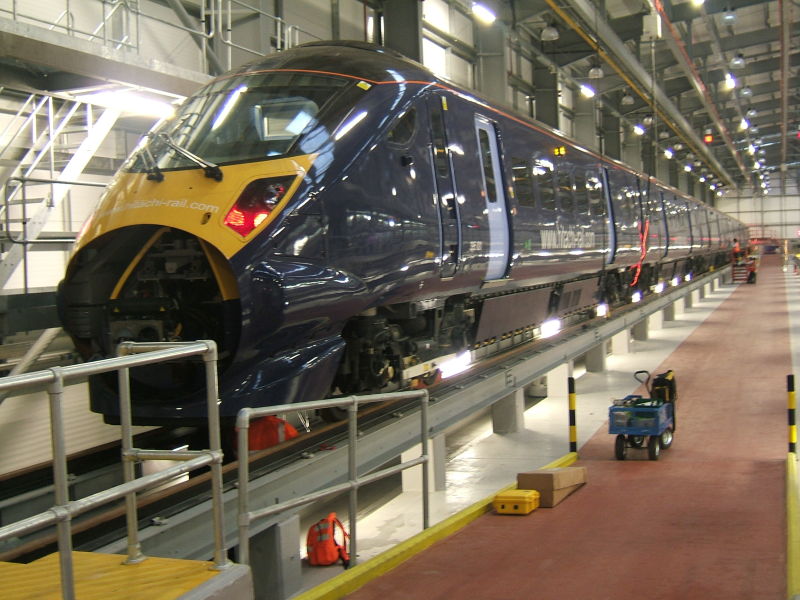
At the end of 2007, I was involved in systems testing on the first Class 395 unit. Testing is based on the new Hitachi Railway Maintenance Depot at Ashford shown in the night photograph. The depot has five covered roads. Outside, dead-end siding 'WL' on the extreme right is presumably storage for the wheel lathe. The next dead-end siding 'TT' is the test track. This is provided with both d.c. third-rail and 25kV a.c. overhead catenary. However, the a.c. facility was not available so arrangements had been made to drag 'Unit 1' to Dollands Moor (the E.W.S. freight depot at the English end of the Channel Tunnel) where we could carry out 25kV a.c. static tests overnight. Initial test work was carried out inside the depot, powering-up the trainset from a 750 volt d.c. shore supply. The supply is fed to two busbars in the roof adjacent to the train. A moveable trolley in the roof taps power from the busbars and delivers it, via a pendant cable, to a connector on the train.

The Class 60 being coupled to the Class 395

Class 60052 arrived to hook onto the Class 395. The Class 60 has a standard drawhook with screw coupling and British Rail standard 2-pipe air brake, whereas the Class 395 has a Scharfenberg automatic coupler and non-standard air brake. The Class 395 had already been rigged with a 'Translator' which has two air brake hoses for connection to the assistant locomotive and converts the pressures so as to apply the brake of the Class 395 in an appropriate manner. A Scharfenberg coupler head had been rigged to a framework fitting over a standard drawhook and, once in place on the Class 60, it was secured by clamp screws. The first attempt at coupling failed but, second time, the Class 60 'captured' the Class 395. The brake hoses on the Class 60 were then coupled to the Class 395 and a couple of plastic cable ties ensured that the translator hoses were held well above the railhead.

The Class 60 slowly drew the Class 395 through the yard and into the headshunt, where we had to wait for an EMU to attach at the rear of the Class 395. This took a little while but, eventually, the EMU dragged the whole consist back through the yard and into platform 6 at Ashford International station. Here, there was a short delay whilst the EMU was uncoupled and then the Class 60 dragged 395 001 out onto the main line heading for Dollands Moor. Speed under these conditions is limited to 35 m.p.h. but before long we had slowed to diverge into Dollands Moor and came to a stand on one of the loops electrified at 25kV a.c. where we would spend the night carrying out static a.c. testing.

On completion of the testing, there was just time for a few hours sleep at a hotel in Ashford before returning to the Ashford Depot to carry out further investigations. 395 001 was still at Dollands Moor but 395 002 (which had been at Dollands Moor) had been dragged back to the Ashford Depot.

Jan in the cab of 395 002 inside the depot at Ashford

Although a second night's testing had been planned for Unit 1 at Dolland's Moor, because of other commitments I returned home after a thoroughly exhausting, but educational, couple of days.


Related posts on this website

Class 395 Trainsets.

My pictures

Class 395: Testing.

[Related post ref added:10-Sep-2016]

Monday, 17 December 2007

Class 395 Trainsets

The first Class 395, shown in Hitachi's Ashford maintenance depot, is currently involved in pilot trials.

Hitachi have a long history of supplying railway equipment in Japan. Before entering the U.K. market, they converted redundant British Rail 25kV EMU vehicles to prove the suitability of the Hitachi traction package on the so-called 'V-train' (V for Verification). They are now supplying Class 395 'Javelin' trains intended to provide a fast service to the 2012 Olympiad and improve commuting in parts of the South East.

Class 395 trainsets (‘units’) are a high-speed variant of the family of 'A Trains' built by Hitachi in Japan. They are 6-coach (‘car’) Electric Multiple Units (EMU) numbered from 395001, the first unit, upwards. Each vehicle is carried on two four-wheel bogies provided with air suspension. There are two types of vehicle – ‘DPT’ (Driving Pantograph Trailer) and ‘MS’ (Motor Standard Class). The vehicles are individually numbered – in the first unit the numbers are 39011 (DPT1), 39012 (MS1), 39013 (MS2), 39014 (MS3), 39015 (MS4) and 39016 (DPT2). The vehicles for the second unit (395002) number from 39021. Thus, the vehicle number identifies both the set and the position in the set. The trainsets are designed to be used on 750 volts d.c. and, in the future, 25kV a.c. on Network Rail infrastructure. The trainsets will also be used on CTRL infrastructure at 25kV a.c.

The two DPT end vehicles have driving cabs with a full control, monitoring and signalling installation (including TVM/KVB cab control and TPWS). There is a retractable nose fairing, revealing a Scharfenberg auto-coupler from Voith-Turbo in Germany. Each DPT also has a Faiveley pantograph, 25kV a.c. distribution and an underbody mounted main transformer. A high tension (25kV a.c.) bus is carried on the roof along the length of the train to interconnect the two DPT cars. This bus is a standard feature on Japanese 'Shinkansen' trains. The standard method of operation is for the rear pantograph to be raised and in use, thus the main transformer in the leading DPT is powered via the high tension bus. An emergency mode allows the leading pantograph to be raised. Associated with each pantograph is a roof-mounted Vacuum Circuit Breaker (VCB) and High Voltage Potential Transformer (HPT). The VCB is controlled from an equipment panel adjacent to the TPWS Control Unit. The a.c. return is taken via earthing devices fitted to each axle of the DPT, comprising carbon brushes contacting a collector plate fitted to the end of the axle.

Two secondary windings on the main transformer in DPT1 feed (via twisted-pair cables) solid-state Auxiliary Power Supply (APS) units underbody mounted, one on MS1, one on MS2. Four further secondary windings on the main transformer in DPT1 feed (via twisted-pair cables) solid-state underbody mounted traction converters, one on MS1, one on MS2. Similarly, the main transformer in DPT2 feeds the APS units and traction converters in MS3 and MS4.

The DPT vehicles are also provided with Brecknell & Willis 750 volt d.c. shoegear which may be raised and lowered as required. The shoegear feeds the DC bus which runs the length of the unit and feeds the traction converters on each of the motor cars (MS1-MS4). All cables are taken between cars via bolt connections and jumper cables. The four intermediate vehicles have 750 volt d.c. shoegear, switchgear and earthing contactors. There is a shore power connector (allowing the set to be powered from the trolley system in the depot where third rail is not provided). The d.c. return is taken via radial earthing devices fitted to each axle on motor cars, comprising carbon brushes contacting the axle in between the wheels. Each axle is driven, via a gearbox, from a three-phase motor mounted adjacent to the axle.

Related posts on this website

Testing Class 395 Trainsets.

[Related post ref added:10-Sep-2016]

The Etiquette Bell

I hope it won't be regarded as a breach of taste if I digress briefly on Public Conveniences. Washrooms, Restrooms - the euphemisms are many and often less felicitous than the couple I mention. Specifically, my topic is public conveniences in South Korea. Now, the South Koreans appear to be very proud of the standards of their public facilities and, based on limited experience at Incheon International Airport recently, their pride is well-justified. But a couple of aspects rather spooked me at the time and I'd like to share them with you.

Over the last few years, dispensers for disposable paper toilet seat covers have become fairly commonplace. But the South Koreans have gone beyond this technology. When I entered the cubicle, I found the seat covered with a slightly-wrinkled clear plastic, almost as if the builder had forgotten to remove the protective packaging. A brief examination suggested that the seat was intended to be used in this state, but I was quite unprepared for what happened after use. In addition to the normal flushing, with a swishing noise the plastic encapsulating the seat moved around the periphery of the seat. Some motorised mechanism behind the pedestal appeared to be supplying fresh plastic, whilst the used seat cover was consumed by another mechanism. When the seat had a completly pristine, but equally wrinkled cover, the mechanism stopped. Questions about the practical difficulties of creating such a machine filled my mind, but I was far too surprised to make a more detailed study.

On another occasion, I discovered the 'Etiquette Bell'. This time, the partition wall of the cubicle mounted what looked like an intercom system - a rectangular plastic box bearing a pushbutton, loudspeaker and the tantalising name 'Etiquette Bell'. Being bewildered as to the intended function, I refrained from pushing the button in case it triggered a response from some 'International Rescue' organisation. Afterwards, a little research revealed that the actual purpose was slightly more prosaic. In order to maintain suitable modesty in circumstances where there may be inadvertent noises from users of the facilities, it had become common practice to flush prematurely. This meant that the sound of running water from the flushing would mask any more personal sounds. But as awareness of the effects mankind is having on the ecology of the Earth grew, it became less acceptable to waste water simply in order to save embarrassment. Electronics came to the rescue - instead of actually flushing, depressing the button on the 'Etiquette Bell' plays a recording of the sound of flushing for a few seconds. If necessary, this recording can be triggered repeatedly, without the guilt associated with needlessly flushing actual water. Practical experiment showed that the sound recording is completely indistinguishable from genuine flushing, although the busier facilities can become rather deafening at times!

I must admit that, coming from our rather vulgarian society, I found the consideration for others which prompted the invention of the 'Etiquette Bell' rather charming.

Monday, 12 November 2007

All Change!

Quite by chance, I discovered that London Midland were taking over the former Silverlink and Central Trains franchises on the 12th of November, when I intended to travel locally by train to a business meeting. I managed to snatch a couple of shots of 'Desiro' 350 106 in full 'London Midland' livery leaving Stafford, one of which appears above. My own journey on a 'London Midland' service was made by 170 635 in a completely 'unbranded' green livery. I presume the 'Central' has been removed and the 'London Midland' computer-cut self-adhesive signage not yet applied.

Incidentally, whilst 'London Midland' appears as two words with initial capitals when used in text (as we grumpy old people would consider appropriate to proper names), the company logo is 'londonmidland'. The 'midland' is in robust characters but the 'london' is in very spindly and hard-to-read characters. The dot over the 'i' is green, as are the seven smaller dots (one above the other) which are placed on the right of the logo. One wonders how much the brand consultants charged to come up with that one. Railway photographs from 12th November.

Sunday, 11 November 2007

Remembrance Day, 2007

Remembrance Day 2007 was particularly poignant. All over the globe, conflict, of one sort or another, is still flourishing. Hopes that the Cold War had ended were premature - it appears to be getting colder again. Servicemen and women serving in 'Hot Wars' in Iraq and Afghanistan are adding to the already appalling lists of injured and killed from earlier wars. This year, I visited Hiroshima. Despite the terrible evidence from Japan, the spectre of nuclear warfare remains omnipresent. It seems that Mankind is unable to learn from its errors.
On 11th November, with Ann and Dean, I visited the German Cemetery on Cannock Chase. Here, the deaths of 2,145 combatants from World War I and 2,786 combatants from World War II who died on British territory are commemorated. The details of the cemetery are a little different from the well-known pattern of war graves for British combatants but the effect is moving and deceptively peaceful.
The picture above shows the figure of a fallen soldier surrounded by the wreaths of former enemies placed that morning.

Saturday, 3 November 2007

Colours of Autumn

Autumn has been rather late this year. When I was in Japan in September, people were telling me how late the trees were changing colour and it's been the same in England. Beautiful as the Autumn colours are, I'm happy for Autumn to be late but, early November, it's definitely here now. The weather has remained reasonably mild but we may expect that to change.

The picture above (which you can click on to enlarge) was taken in the front garden at Brewood Hall. For more views of the garden through the seasons Click Here.

Friday, 2 November 2007

Railway operation in Japan

My recent visit to Japan gave me the opportunity to see how they run the railways in Japan. The answer appears to be 'very well', compared with the United Kingdom.

The English introduced railways to Japan, in the late 19th century. In view of the difficult terrain, a gauge of 3'6" (1067mm) was chosen, but with a generous loading gauge allowing quite large railway vehicles. At that time, speed was not seen as an issue and speeds did not exceed 100 k.p.h. A very extensive network of railways based on this formula still exists. All the major routes have been electrified at 1500 volts d.c. Japan Railways (JR) runs the majority of the routes, but there are also a number of private railways.

I was surprised to find that a lot of the infrastructure is fairly old, but it appears well-maintained and 'housekeeping' is excellent. In general, the private railways appear to have received more investment but all the trains I travelled on were punctual, clean and well-patronised.

Operational staff appear well-trained and diligent and I've commented elsewhere on the high standards of driving and the apparent discipline.

Signalling is mainly automatic block using a.c. track circuits and colour light signals. On normal routes, 3-aspect colour light signals are employed (GREEN - clear, YELLOW - caution, RED - stop). On high-density routes, 5-aspect signals are used (GREEN - clear, YELLOW OVER GREEN - reduced speed, YELLOW - caution, YELLOW OVER YELLOW - restricted speed, RED - stop). At junctions, route signalling is provided, usually with a separate signal head for each route.

Two bad accidents in the 1960s led to the installation of an Automatic Train Stop (ATS) system throughout Japan. There are various enhancements to the basic ATS system.

ATS-S uses a series of track inductors. An alarm sounds in the cab when approaching a red signal and failure to initiate braking within 5 seconds causes an automatic brake application. 'Absolute Stop' track inductors do not rely on driver acknowledgement and are used in stations and at starting signals.

ATS-P is a later system which does not rely on driver acknowledgement but which monitors train speed, based on a sequence of track inductors located 30m, 180m and 650m before the signal, all wired to a 'Code Processor' at the signal. Two passive track inductors are provided even further back from the signal. There is a 'continuous' version of ATS where information is fed along track circuits.

The Automatic Train Control System (ATC) also feeds information along track circuits. It was developed for use on the 'Shinkansen' lines and indicates maximum speed for each section.

Automatic Train Operation (ATO) is used on some subways to control departure, line speed and stopping point in stations.

More pictures of Japan's railways today.

Thursday, 1 November 2007

Off the Road

'Thomas' during the re-railing process.
Nothing brings a chill to a railwayman like the phrase "They're off the road" when there's been a derailment. Whatever the nature of the incident, dislocation of services is the inevitable result.
Saturday, 6th October 2007 started well enough. 'Coventry No. 1', posing as 'Thomas', was lit-up, examined and oiled ready for service. The engine was moved down to the shed outlet signal to await the signalman. The signalman arrived and, shortly after, the signal dropped to proceed. The engine gave a short whistle, as an acknowledgement to the signalman and a warning to people in the vicinity of the impending movement. The brake was released and the regulator eased open until the locomotive just started to move. Almost at once, there was a shouted warning so the regulator was shut and full brake applied. The signal had been replaced to danger! Worse, the trap point beyond the signal had been moved to the throw-off position. This meant that the rails on which the locomotive was running were no longer parallel but intentionally divergent so as to derail runaway vehicles. In slow motion, the first wheelset 'fell in' as the gauge widened and the locomotive lurched sideways. This lifted the last wheelset just clear of the rails and, as the locomotive came to a stand, the gauge widening caused the middle wheelset to 'fall in', causing the locomotive to lurch in the opposite direction. The locomotive stopped with all wheels off, at an angle of about 15 degrees.
First considerations are always safety. Thankfully, nobody had been injured in this very low speed derailment and the public were not involved. Despite the 'cant' of the engine, there was no danger of the locomotive tipping over. Handbrake on and cylinder drain cocks open made the engine as secure as possible. Both gauge glasses confirmed that there was plenty of water in the boiler to cover the firebox crown, despite the locomotive not being level. Next, the locomotive was examined looking for any damage caused by the derailment, paying particular attention to the boiler. No damage was found. 'Throwing out the fire' was considered but, with only a moderate fire, full water tanks and injectors working, it was decided to just let the fire burn down, maintaining the boiler water level using the injectors.
With all wheels off, re-railing the locomotive was going to be quite a task. If some wheels remain on the rails, it may be possible to pull the locomotive back on with a minimum of packing. Sometimes, a locomotive can drag itself back on under its own power. This was not the case here.
Every available volunteer reported to assist in the re-railing but the key is to have somebody in charge who knows what he's doing. Fortunately, Roy was available and, under his direction, jacks, wooden packing, heavy steel plates and short lengths of rail were collected from around the site. It took some hours to get the locomotive into a position where it might be dragged back onto the rails. At that stage the 'Jocko', a class 08 diesel electric shunter, was summoned and connected to the steam locomotive by chain. The towing operation was carried out 'dead slow', a few inches at a time. The 350 h.p. shunters are ideal for this sort of job. Each time we stopped, the handbrake was applied on the steam locomotive, whilst the position of the wheels was assessed before the next 'pull'. The steam locomotive returned to the rails without further incident. The next morning, the locomotive had a further inspection. One copper oil line had pulled out of its gland and after rectification, the locomotive returned to traffic.
In the subsequent enquiry, the driver was completely exonerated, but it didn't make me feel any better. What did make me feel better was deputising at short notice for the booked driver on 'Thomas' on Sunday 13th October. We had what seemed like one of the busiest 'Thomas' days I can remember. In the afternoon, the train was re-inforced to 6 coaches. With 'six on' running into Platform 2, you can't get the locomotive adjacent to the water crane without setting the whole train back, so we used Platform 1 instead. The locomotive worked well and the success of the day partly made up for the disaster of the previous weekend.

Afterword

I've chosen the O-Torii Gate on Miyajima as a single symbol of a wonderful trip.
I've been back in England for a few days now, but my impressions of Japan are still vivid. Japan has a complex history and it would take a long time to unravel all the forces still at work in Japanese society.
Japan is made up of around 6,800 islands, although the vast majority of the 127 million population live on the largest island, Honshu, which I visited. Three quarters of the land mass is forested mountains so development is concentrated in the coastal plain. The Southern plain from Tokyo to Osaka is one of the most densely-populated areas in the world.
Until the Meiji Restoration in the 19th century, Japan was closed off from the rest of the world and it remains ethnically homogeneous with only small numbers of Korean, Chinese and Western immigrants.
After centuries of rule by the various Shogun, power was handed back to Emperor Meiji in 1868 and he embarked on a period of modernisation where Western ways were imported into Japan and a modern infrastructure was developed.
The rise of the military during the Meiji period led to Japan's involvement in a number of military actions, culminating in Japan entering World War II. Conventional bombing by America had resulted in terrible losses but the use of experimental atomic weapons on Hiroshima and Nagasaki produced an immediate capitulation.
Following the surrender, America was able to direct Japan's path for a number of years but, by the 1960s, a more confident Japan was emerging as an industrial giant. A period of great prosperity followed, allowing major infrastructure projects to be undertaken.
The booming 1980s saw Japan becoming more international in its outlook, making major overseas acquisitions and also becoming the world's second largest donor of aid. This period of affluence later became known as the 'Bubble Economy' and by 1998 Japan was officially in recession. Redundancies, previously unthinkable, undermined confidence and suicide rates soared. A somewhat-chastened Japan is now creating a new long-term role on the World's stage.
Religious belief remains strong, based on Shinto, allied with Bhuddism and a little Christianity. Shinto is a form of animism, where deities are seen in the natural world who should be thanked for good things and prayed to for assistance. It has ritual but no scripture, so other beliefs can be accommodated readily. I was intrigued that some Shinto shrines have a special place where new cars can be purified. This seemed to exemplify a pragmatism which appears to underlie much of Japan's success.
History and religion have moulded the sociology of Japan. In the West, we sometimes find the politeness, exaggerated respect and avoidance of personal conflict associated with the Japanese mildly amusing. I found it refreshing - the consideration which I experienced in Japan highlighted how bad things have become in my own country.
Since I travelled within Japan by train, railways (both modern and preserved) formed a thread running through the trip which I found absorbing.
Japan affected me more than I expected and I certainly want to go back to learn more. The contrasts were very stimulating - the vibrant, sprawling city of Tokyo, Yokohama with its maritime past, Senzu nestling in the hills. Then on to Nagoya with its towering buildings, the charm of Inuyama and its hilltop castle, the seaside feel of Nagoyaka. Kyoto retains echoes of its Imperial past and offers an amazing collection of shrines and temples whilst, not far away, Himeji has perhaps the ultimate example of castle building. Hiroshima is now a thriving provincial city again but, inevitably, visits to the 'A-bomb Dome' and the Peace Museum provide a harrowing reminder of recent history. Finally, the special island of Miyajima is an odd amalgam of the 'touristy' and the spiritual which I found charming.
All in all, a wonderful trip.

Tuesday, 2 October 2007

Postcard from Incheon

Well, not literally a postcard, but I'll try to add a picture when I'm home. In transit through the clean, quiet, efficient airport at Incheon, for Seoul. Just about to go to the gate for the last leg of the journey. When I get back and sort myself out, I'll add postscripts on the trip. Bye for now.

So, here's the 'postcard'. Aseana have a very nice business lounge at Incheon. The internet section of the lounge is in a glazed bridge over the main corridor giving views of 'the passing crowd'. So, what's that on screen? Uh, you might have guessed.

Leaving Tokyo

The Park Hyatt is a very swish, modern hotel, although I think it's been open about 13 years now. It occupies a number of floors starting at the 41st and going up in the futuristic-looking three linked tower complex which houses a lot of commercial tenants. This is similar to the hotel in Nagoya. The Park Hyatt seems odd, though. As a pedestrian you go in on the ground floor, walk up one flight to a mini-reception with road access and, if you pass muster, you get taken up to another reception area on the 41st. From there you get taken to your room. Mine was just one flight up on the 42nd with impressive views of Shinjuku. After a shower and a light meal I lacked the energy to go out again so I had a long bath, re-organised my luggage and slept soundly in the king size bed.

Up at 5.00am, shower, check out, down to the 2nd floor reception to await my 6.00am car pickup. Didn't happen (I don't yet know why) but there was a Limousine Coach leaving for Narita, so I thought I'd better be on it. It's raining, very overcast with low cloud. I think that's been forecast all week, but I've only seen a few spots. The Japanese seem to take umbrellas everywhere, if not to keep the rain off, then to keep the sun off. Tokyo really is huge - it impressed me on the way in by night but in the day it seems equally improbable. There's plenty of traffic on the freeway but it keeps moving and we make good time to Narita.

I manage to get off at the right terminal and quickly locate the check in. The airport seems very quiet and it's a matter of moments before I'm checked in. All the staff are helpful and friendly and speak either good or very good English. Security and Passport Control is equally prompt. I invest in a couple of books for the journey (plus I've a Herald Tribune the hotel gave me - the 'Trib' really is a good read) and make my way to the ANA Lounge which Aseana use here (I think the flight may be a 'code share' with ANA). Quite a few business travellers about but it's a spacious, well-laid out lounge so that's no problem. I have a bit of breakfast to keep me going and then come to their internet lounge to post this.

My impression of Narita is very favourable based on my experience. Anything more different from the hell-hole called Heathrow would be hard to imagine. As I've commented, I'm equally impressed with the railways, not just the Shinkansen but all the public transport. And the people - you would expect people in hotels to be polite but it applies to everyone I've come across. You only have to stop to read a sign and a complete stranger will offer assistance.

Once again, I'm forced to re-evaluate my prior perceptions. It's very refreshing to be in a place where respect and consideration for others is not completely lacking. But people I talk to think England is wonderful because so much of their development is tied up with English ideas. It's embarrassing to say, well, things may have changed a little. However, the flight awaits so we must postpone the philosophising until later. I'm on my way back!

Monday, 1 October 2007

Miyajima then back to Tokyo

So, what about Sunday? I rose at 6.00am had a little walk exploring the park before breakfast at 7.30. I'd booked an English breakfast and, on arrival at the dining room, was shown to a table with my name on it, and everything put ready except the fried eggs and tea which arrived moments later. An oddity was two pieces of white bread under cling film next to a toaster actually on my table. It made perfect toast and I enjoyed the meal.

The park leads into Mount Mizen, one of the three peaks on the island. There are paths up to the top but there's also a two-stage 'ropeway' (that's what the Japanese call suspended cable railways). I walked up to the cable station for the first service at 9.00 am but there was already a good-natured crowd of about 20 waiting. Within a few minutes, I was away on the first stage - a continuous affair with cabins holding up to 8 which disengage from the haulage rope at each end for loading and unloading. It was a pretty spectacular trip. At the halfway house, you transfer onto what they call a reversible - two bigger cars which go up and back, alternating with the other car. That delivered us a little below the summit so a short walk took us to the peak at 530m, I think, with a view of the Inland Sea, with dozens of islands looming out of the mist. Not so warm but still OK just in tee-shirt and slacks. Then I decided to explore some of the other tracks and find some of the many shrines on this holy mountain. A number of deer, even at this height, but I didn't see any of the monkeys you're warned about, but I think I heard some cries.

Then I met up with a charming Japanese lady called Yuishi also walking alone. Normally, her husband would have been with her, but he had had to work. We decided to explore together. Some of the lesser-used paths I found hard going, but satisfying. I'd intended originally to walk down, but the direct path had been closed for maintenance. Although the mountain is covered with primeval forest, quite a bit of maintenance is required and typhoons always cause damage. The alternative route appeared to be about three times as long so I chickened out and Yuishi and I descended using the ropeway. Then we visited the main shrine of Itsukushima-jinja together. It's built on stilts in a little bay so it's over water when the tide is in. All shrines normally have a main gate but here the O-Torii is built out in the bay so that it, too, is in the water for part of the day. I think all this symbolises the significance of land and sea and reminds people that Japan is an island relying on the produce of the sea. Then we went to look at the excellent local museum, Miyajima History and Folklore Museum. A large, historic private house has been restored and extended to display the importance of Miyajima historically and show the way of life of the people. By now, it was time for Yuishi to return home to Hiroshima, so we walked together to the JR Ferry Terminal and said goodbye.

Back to my cottage at the Iwaso and another Japanese meal served in my room. The O-Torii Gate seems to have a strange appeal to people and I think I was feeling it, too. I'd discovered that there's a boat trip after dark to show you the floodlit Gate, and I booked on it. The tide was high so, after cruising around it whilst people took photographs, we passed through the gate as people made the usual ritual bows and claps. Then we passed out through the gate and returned to the dock. The hotel courtesy bus whisked me back home - it seemed like home - and I had another good nights sleep.

Well, its almost over, I'm afraid. I rose at 6.00 am this morning and went for a walk around parts of the town I'd not previously covered and looked at more shrines. The tide was out so I took the opportunity of passing through the Gate again, this time walking. Another good breakfast and all the staff seemed particularly friendly. I had booked the courtesy bus to take me to the ferry but, being ready earlier than expected, I decided to walk. The ferry was quite crowded with passengers going back to the mainland and when we arrived, there were even more people waiting to go out. Miyajima is supposed to be one of the three most beautiful places in Japan and I'm sure they're right. A short walk took me to the station where I caught the local train back to Hiroshima in plenty of time to catch the Shinkansen to Shin Kobe. Here, I joined another train for the long journey through to Tokyo. After the tranquility of Miyajima, Tokyo came as a real shock to the system - so big, so many people - I think Tokyo was the inspiration for the futuristic city in Blade Runner. This time, I'm staying one night in a modern hotel, the Park Hyatt. I had to make my way across town on the JR Chuo Line to Shinjuku, leaving me with a 15 minute walk to the hotel. All is well and early tomorrow I go to Narita Airport to make my way home. It's all been a wonderful experience, but I think part of me is left behind on Miyajima.

Pictures of Miyajima

Pictures of Japan's modern railways