Thursday, 3 January 2008
'Linda'
Tuesday, 1 January 2008
Battlefield Line Mince Pie Specials
I've talked about Santa Specials run by most preserved railways in December. As it becomes more common for the holiday to extend to New Year, many preserved railways have found it commercially worth while to operate a service between Christmas and New Year. Parents with children, particularly, may be seeking new ways of entertaining their offspring once the immediate appeal of Christmas presents has dimmed.
At the Battlefield Line, 'Mince Pie Specials' are run on a number of days and, although I had no rostered duty, my friend John Archer and I decided to go along to Shackerstone on the 1st January 2008 to start the New Year in style. We arrived to find that (not for the first time) the steam locomotive which was to work the trains, 'Sir Gomer', had failed with a leaking boiler tube. With quite a healthy number of passengers arriving, the only alternative was to run the trains diesel hauled. The Class 33 'Griffon' was available but the problem was to find a 'scratch' diesel crew at very short notice. Because no qualified diesel driver was available who could cover the whole day, it was eventually arranged that Adrian would drive the first round trip to Shenton, Simon the second and, by providing relief for John in the signal box, John would drive the last train. As a qualified steam and DMU driver, I was eligible to act as the required 'Secondman' on the diesel and so I found myself unexpectedly busy for the rest of the day. The most arduous task is 'hooking-off' and 'tieing-on' at each run-round, but these jobs were informally shared between the various drivers during the day and myself. Timings during the day were a little haphazard but the passengers seemed happy. As a consolation prize, two steam locomotives trundled around the station - the four-coupled Barclay saddle tank 'Linda' (not quite big enough to operate the service train herself and with rather limited water capacity) and the improbable but very attractive Aveling-Porter 'Blue Circle' (half traction engine, half locomotive). Both steam locomotives had very friendly crews so a number of the younger passengers were able to enjoy a close inspection of the motive power.
It was decided to give the writer some driving training on the 'Crompton', so I ran round after the first trip with Adrian and was then invited to take the second service up to Shenton. Simon brought the train back to Shackerstone and handed over to John who took the last train up to Shenton. Jan then ran round and brought the train back to Shackerstone under supervision. I always try to enjoy the unexpected, and it was a very educational day.
I've always been intrigued that, historically, once a driver was passed to drive steam locomotives, he was expected to drive any type, including classes he had never seen before. But diesel drivers were passed class-by-class, because of the need to be conversant with the particular control systems and fault-finding techniques. When I was a volunteer at Birmingham Railway Museum some years ago, in addition to being passed to drive all steam locomotives, I was passed to drive Class 08 and Class 47 diesel electrics.
I trust that readers will accept that I remain a committed steam enthusiast. Whilst I have, in facetious moments, referred to diesel traction as "The Dark Side", the more complex control systems of diesel locomotives have much of technical interest but, for me at least, never the romance of steam.
Monday, 31 December 2007
Santa Specials, 2007
I think all preserved railways have some form of 'Santa Special' service in December aimed at parents with children. It's satisfying to see packed trains and a delight to see the exitement and awe of the younger visitors. Each railway has developed its own distinctive approach but the event is usually a mixture of a train ride, a present from Santa and mince pies for the grown-ups. So popular has the idea of visiting Father Christmas combined with a train ride become that it's common for preserved railways to take up to one third of their annual turnover in this one month. Handling these passenger numbers with largely volunteer staff puts a tremendous strain on organisations but it's become a vital source of revenue.
For Christmas 2007 I was rostered to do one day on the footplate at the Battlefield Line and a couple of days driving at Peak Rail. At the Battlefield Line, I found that 'Sir Gomer' had been failed and the service train was being handled by visiting B1 'Mayflower' with its own crew so, instead, I spent a pleasant day pottering around the station on 'Linda'.
On normal service days at Peak Rail, 'Royal Pioneer' (Click for pictures) works the service unaided, running round at each end of the line. However, 'Santa Specials' are run 'top and tailed', with a locomotive on each end. This year, because of heavy demand, the load was seven coaches with 'Royal Pioneer' at the Matlock end and a diesel at the Rowsley end. The diesel alternated between the Class 44 'Peak' and a Class 31. There's no 'hooking on' and 'hooking off' during the day and the fireman only has to provide his driver with steam in the 'Up' direction. However, steam heating seven coaches means that the fireman must pay attention to the fire continuously. With 'Royal Pioneer' on the south end of the train, the normal water tank at Rowsley is unavailable, so another tank wagon was positioned on the loop at Rowsley with a portable pump and hose so that the steam locomotive's saddle tank could be replenished during the day.
The turn at Peak Rail on the 2nd December passed without incident, but on the 9th December we discovered that the rostered Class 31 had been failed and so the 'Peak' deputised. During the day, the Class 31 was repaired and it was decided to attach the Class 31 outside the 'Peak' for the last round trip of the day from Rowsley. This meant that, on the last southbound ('Up') service, 'Royal Pioneer' had a gross load over 500 tons. Of course, the 'Up' between Rowsley and Matlock is mainly a gentle descent, with various level and uphill sections, so it wasn't much of a challenge but still produced quite a satisfying 'bark' as the train was got under way. The customary setting of regulator in full first valve linked up a couple of notches on the reverser was sufficient to maintain the scheduled timing.
Dalek Warning
I wrote a few months ago about Dalek activities in Manchester
(Click here for the original report). I observed that Daleks now appear to vary in size, colouration and even design. Was this, I wondered, the result of inter-breeding or merely the effect of off-shoring manufacture to the Far East? Later in the year, during a visit to Japan, I uncovered disconcerting evidence that Dalek plans may be more advanced than I suspected. In a dark corner of the Edo Tokyo Museum, I found what purported to be an early public telephone and kiosk. Certainly, as the photograph shows, there was some sort of equipment within the structure but do they really expect us to believe that it's a telephone?Well, I put my concerns to the back of my mind but, the very next day, as I explored the Yamate district of Yokohama, I came upon incontrovertible evidence of what is happening in Japan. There, in plain view on the street, was another of these so-called public telephones. I accept that it does not quite have the classic lines of the original Daleks but I'm sure you will agree that the sense of menace is unmistakeable. Are we so easily fooled by labelling them (in English, mark you) 'TELEPHONE'?
Somewhat shaken, I continued my holiday, but I was confronted a few days later with further evidence of the spread of the mutant Daleks when I chanced upon another example in Meiji-Mura.
You have been warned! By the way, I'm not too sure about Japanese developments in Post Boxes, either. What do you think?
Sunday, 30 December 2007
Review of the Year 2007
I started in New York and the cold there nearly finished me off. But there was so much to see I actually loved the place, criss-crossing the city on the Subway. Nonetheless, it was very pleasant to move on to Buenos Aires and be warm again. Despite my short stay, I did a lot of walking and tried out the 'Subte' (underground) and the commuter lines before flying down to Ushuaia, the port at the South end of Argentina. The town has a sort of 'Wild West' feel but I stopped at a splendid hotel a few miles out of town overlooking the Beagle Channel where I was very comfortable. After checking out the town and one of its Museums, I made contact with the tourist railway before joining the 'Antarctic Dream' for my trip to the Antarctic Peninsula.
'Antartic Dream' viewed from one of the 'Zodiac' inflatables
A rough crossing of the Drake Passage kept me bed-bound (along with the majority of the passengers) until we arrived in calmer waters but the experiences as we toured around the South Shetlands and the Antarctic Peninsula more than made up for it. We had many wonderful encounters with the wildlife but an afternoon whale-watching gave a positively spiritual experience as a couple of good-natured whales played a sort of 'tag' with our ship. Conditions in the Drake Passage were benign when we returned to Ushuaia and, following the last night aboard ship at the quayside, I went to the Ferro Carril Fin Del Mundo ('Railway at the end of the Earth') where I had a round trip on the footplate and made a number of new friends before flying North to Santiago.
I'd visited Chile once before so I took in some different sights before moving on again to Auckland. I explored by commuter rail, ferry and bus as well as visiting the National Museum before flying to Perth, Western Australa. Here, I spent time with my friend Keith who took me to various places of interest -Yarloop Industrial Museum, Hotham Valley Railway, Byford Nature Park, Whiteman Park, Bassendean Railway Museum and a barbeque hosted by the steam boat fraternity!
Finally, I made my first visit to South Africa staying first in Johannesburg and then Capetown before returning home with an amazing collection of experiences.
As usual, work took up a lot of my time but working from the Barn next to my home has made things much easier for me.
In August, Keith Watson was in the U.K. and together we visited a number of locations, including Manchester's Museum of Science `and Industry, Shackerstone Family Festival, The Battlefield Line, Blists Hill Open Air Museum, Weston Park Railway and The Black Country Museum.
In September, I made another trip, this time to Japan. I stayed in Tokyo, Nagoya, Kyoto and Miyajima returning with another wonderful collection of memories.
This year has included some wonderful experiences. I'm very grateful for the opportunities I've been given and my reasonable health. I'm fortunate to have a wide circle of friends and, whilst I may not dilate at length in these posts on these friends, I appreciate their importance. Best wishes to you all for 2008.
Tuesday, 18 December 2007
Testing Class 395 Trainsets
Class 60052 arrived to hook onto the Class 395. The Class 60 has a standard drawhook with screw coupling and British Rail standard 2-pipe air brake, whereas the Class 395 has a Scharfenberg automatic coupler and non-standard air brake. The Class 395 had already been rigged with a 'Translator' which has two air brake hoses for connection to the assistant locomotive and converts the pressures so as to apply the brake of the Class 395 in an appropriate manner. A Scharfenberg coupler head had been rigged to a framework fitting over a standard drawhook and, once in place on the Class 60, it was secured by clamp screws. The first attempt at coupling failed but, second time, the Class 60 'captured' the Class 395. The brake hoses on the Class 60 were then coupled to the Class 395 and a couple of plastic cable ties ensured that the translator hoses were held well above the railhead.
Although a second night's testing had been planned for Unit 1 at Dolland's Moor, because of other commitments I returned home after a thoroughly exhausting, but educational, couple of days.
Related posts on this website
Class 395 Trainsets.
My pictures
Class 395: Testing.
[Related post ref added:10-Sep-2016]
Monday, 17 December 2007
Class 395 Trainsets
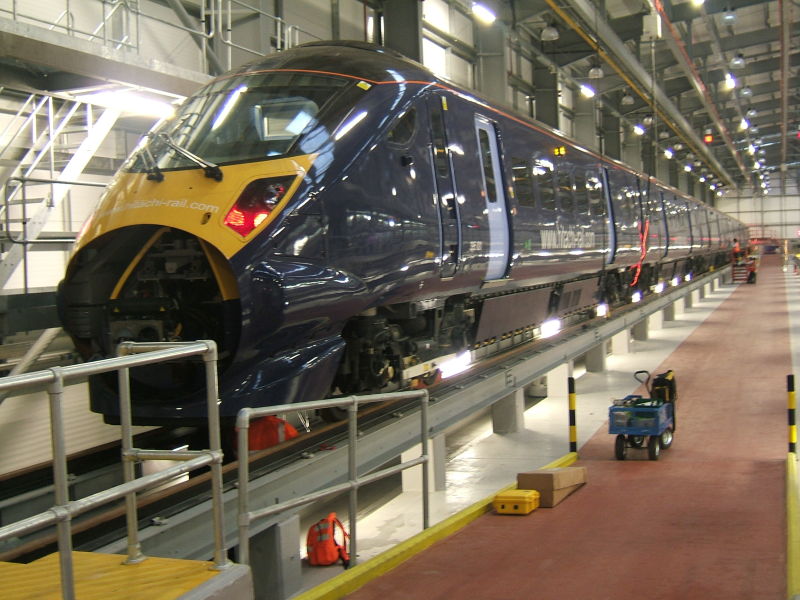
Hitachi have a long history of supplying railway equipment in Japan. Before entering the U.K. market, they converted redundant British Rail 25kV EMU vehicles to prove the suitability of the Hitachi traction package on the so-called 'V-train' (V for Verification). They are now supplying Class 395 'Javelin' trains intended to provide a fast service to the 2012 Olympiad and improve commuting in parts of the South East.
Class 395 trainsets (‘units’) are a high-speed variant of the family of 'A Trains' built by Hitachi in Japan. They are 6-coach (‘car’) Electric Multiple Units (EMU) numbered from 395001, the first unit, upwards. Each vehicle is carried on two four-wheel bogies provided with air suspension. There are two types of vehicle – ‘DPT’ (Driving Pantograph Trailer) and ‘MS’ (Motor Standard Class). The vehicles are individually numbered – in the first unit the numbers are 39011 (DPT1), 39012 (MS1), 39013 (MS2), 39014 (MS3), 39015 (MS4) and 39016 (DPT2). The vehicles for the second unit (395002) number from 39021. Thus, the vehicle number identifies both the set and the position in the set. The trainsets are designed to be used on 750 volts d.c. and, in the future, 25kV a.c. on Network Rail infrastructure. The trainsets will also be used on CTRL infrastructure at 25kV a.c.
The two DPT end vehicles have driving cabs with a full control, monitoring and signalling installation (including TVM/KVB cab control and TPWS). There is a retractable nose fairing, revealing a Scharfenberg auto-coupler from Voith-Turbo in Germany. Each DPT also has a Faiveley pantograph, 25kV a.c. distribution and an underbody mounted main transformer. A high tension (25kV a.c.) bus is carried on the roof along the length of the train to interconnect the two DPT cars. This bus is a standard feature on Japanese 'Shinkansen' trains. The standard method of operation is for the rear pantograph to be raised and in use, thus the main transformer in the leading DPT is powered via the high tension bus. An emergency mode allows the leading pantograph to be raised. Associated with each pantograph is a roof-mounted Vacuum Circuit Breaker (VCB) and High Voltage Potential Transformer (HPT). The VCB is controlled from an equipment panel adjacent to the TPWS Control Unit. The a.c. return is taken via earthing devices fitted to each axle of the DPT, comprising carbon brushes contacting a collector plate fitted to the end of the axle.
Two secondary windings on the main transformer in DPT1 feed (via twisted-pair cables) solid-state Auxiliary Power Supply (APS) units underbody mounted, one on MS1, one on MS2. Four further secondary windings on the main transformer in DPT1 feed (via twisted-pair cables) solid-state underbody mounted traction converters, one on MS1, one on MS2. Similarly, the main transformer in DPT2 feeds the APS units and traction converters in MS3 and MS4.
The DPT vehicles are also provided with Brecknell & Willis 750 volt d.c. shoegear which may be raised and lowered as required. The shoegear feeds the DC bus which runs the length of the unit and feeds the traction converters on each of the motor cars (MS1-MS4). All cables are taken between cars via bolt connections and jumper cables. The four intermediate vehicles have 750 volt d.c. shoegear, switchgear and earthing contactors. There is a shore power connector (allowing the set to be powered from the trolley system in the depot where third rail is not provided). The d.c. return is taken via radial earthing devices fitted to each axle on motor cars, comprising carbon brushes contacting the axle in between the wheels. Each axle is driven, via a gearbox, from a three-phase motor mounted adjacent to the axle.
Related posts on this website
Testing Class 395 Trainsets.
[Related post ref added:10-Sep-2016]
The Etiquette Bell
Over the last few years, dispensers for disposable paper toilet seat covers have become fairly commonplace. But the South Koreans have gone beyond this technology. When I entered the cubicle, I found the seat covered with a slightly-wrinkled clear plastic, almost as if the builder had forgotten to remove the protective packaging. A brief examination suggested that the seat was intended to be used in this state, but I was quite unprepared for what happened after use. In addition to the normal flushing, with a swishing noise the plastic encapsulating the seat moved around the periphery of the seat. Some motorised mechanism behind the pedestal appeared to be supplying fresh plastic, whilst the used seat cover was consumed by another mechanism. When the seat had a completly pristine, but equally wrinkled cover, the mechanism stopped. Questions about the practical difficulties of creating such a machine filled my mind, but I was far too surprised to make a more detailed study.
On another occasion, I discovered the 'Etiquette Bell'. This time, the partition wall of the cubicle mounted what looked like an intercom system - a rectangular plastic box bearing a pushbutton, loudspeaker and the tantalising name 'Etiquette Bell'. Being bewildered as to the intended function, I refrained from pushing the button in case it triggered a response from some 'International Rescue' organisation. Afterwards, a little research revealed that the actual purpose was slightly more prosaic. In order to maintain suitable modesty in circumstances where there may be inadvertent noises from users of the facilities, it had become common practice to flush prematurely. This meant that the sound of running water from the flushing would mask any more personal sounds. But as awareness of the effects mankind is having on the ecology of the Earth grew, it became less acceptable to waste water simply in order to save embarrassment. Electronics came to the rescue - instead of actually flushing, depressing the button on the 'Etiquette Bell' plays a recording of the sound of flushing for a few seconds. If necessary, this recording can be triggered repeatedly, without the guilt associated with needlessly flushing actual water. Practical experiment showed that the sound recording is completely indistinguishable from genuine flushing, although the busier facilities can become rather deafening at times!
I must admit that, coming from our rather vulgarian society, I found the consideration for others which prompted the invention of the 'Etiquette Bell' rather charming.
Monday, 12 November 2007
All Change!
Sunday, 11 November 2007
Remembrance Day, 2007
Saturday, 3 November 2007
Colours of Autumn
The picture above (which you can click on to enlarge) was taken in the front garden at Brewood Hall. For more views of the garden through the seasons Click Here.
Friday, 2 November 2007
Railway operation in Japan
Two bad accidents in the 1960s led to the installation of an Automatic Train Stop (ATS) system throughout Japan. There are various enhancements to the basic ATS system.
ATS-S uses a series of track inductors. An alarm sounds in the cab when approaching a red signal and failure to initiate braking within 5 seconds causes an automatic brake application. 'Absolute Stop' track inductors do not rely on driver acknowledgement and are used in stations and at starting signals.
ATS-P is a later system which does not rely on driver acknowledgement but which monitors train speed, based on a sequence of track inductors located 30m, 180m and 650m before the signal, all wired to a 'Code Processor' at the signal. Two passive track inductors are provided even further back from the signal. There is a 'continuous' version of ATS where information is fed along track circuits.
The Automatic Train Control System (ATC) also feeds information along track circuits. It was developed for use on the 'Shinkansen' lines and indicates maximum speed for each section.
Automatic Train Operation (ATO) is used on some subways to control departure, line speed and stopping point in stations.
More pictures of Japan's railways today.Thursday, 1 November 2007
Off the Road
Afterword
Tuesday, 2 October 2007
Postcard from Incheon
Leaving Tokyo
The Park Hyatt is a very swish, modern hotel, although I think it's been open about 13 years now. It occupies a number of floors starting at the 41st and going up in the futuristic-looking three linked tower complex which houses a lot of commercial tenants. This is similar to the hotel in Nagoya. The Park Hyatt seems odd, though. As a pedestrian you go in on the ground floor, walk up one flight to a mini-reception with road access and, if you pass muster, you get taken up to another reception area on the 41st. From there you get taken to your room. Mine was just one flight up on the 42nd with impressive views of Shinjuku. After a shower and a light meal I lacked the energy to go out again so I had a long bath, re-organised my luggage and slept soundly in the king size bed.
Up at 5.00am, shower, check out, down to the 2nd floor reception to await my 6.00am car pickup. Didn't happen (I don't yet know why) but there was a Limousine Coach leaving for Narita, so I thought I'd better be on it. It's raining, very overcast with low cloud. I think that's been forecast all week, but I've only seen a few spots. The Japanese seem to take umbrellas everywhere, if not to keep the rain off, then to keep the sun off. Tokyo really is huge - it impressed me on the way in by night but in the day it seems equally improbable. There's plenty of traffic on the freeway but it keeps moving and we make good time to Narita.
I manage to get off at the right terminal and quickly locate the check in. The airport seems very quiet and it's a matter of moments before I'm checked in. All the staff are helpful and friendly and speak either good or very good English. Security and Passport Control is equally prompt. I invest in a couple of books for the journey (plus I've a Herald Tribune the hotel gave me - the 'Trib' really is a good read) and make my way to the ANA Lounge which Aseana use here (I think the flight may be a 'code share' with ANA). Quite a few business travellers about but it's a spacious, well-laid out lounge so that's no problem. I have a bit of breakfast to keep me going and then come to their internet lounge to post this.
My impression of Narita is very favourable based on my experience. Anything more different from the hell-hole called Heathrow would be hard to imagine. As I've commented, I'm equally impressed with the railways, not just the Shinkansen but all the public transport. And the people - you would expect people in hotels to be polite but it applies to everyone I've come across. You only have to stop to read a sign and a complete stranger will offer assistance.
Once again, I'm forced to re-evaluate my prior perceptions. It's very refreshing to be in a place where respect and consideration for others is not completely lacking. But people I talk to think England is wonderful because so much of their development is tied up with English ideas. It's embarrassing to say, well, things may have changed a little. However, the flight awaits so we must postpone the philosophising until later. I'm on my way back!
Monday, 1 October 2007
Miyajima then back to Tokyo
The park leads into Mount Mizen, one of the three peaks on the island. There are paths up to the top but there's also a two-stage 'ropeway' (that's what the Japanese call suspended cable railways). I walked up to the cable station for the first service at 9.00 am but there was already a good-natured crowd of about 20 waiting. Within a few minutes, I was away on the first stage - a continuous affair with cabins holding up to 8 which disengage from the haulage rope at each end for loading and unloading. It was a pretty spectacular trip. At the halfway house, you transfer onto what they call a reversible - two bigger cars which go up and back, alternating with the other car. That delivered us a little below the summit so a short walk took us to the peak at 530m, I think, with a view of the Inland Sea, with dozens of islands looming out of the mist. Not so warm but still OK just in tee-shirt and slacks. Then I decided to explore some of the other tracks and find some of the many shrines on this holy mountain. A number of deer, even at this height, but I didn't see any of the monkeys you're warned about, but I think I heard some cries.
Then I met up with a charming Japanese lady called Yuishi also walking alone. Normally, her husband would have been with her, but he had had to work. We decided to explore together. Some of the lesser-used paths I found hard going, but satisfying. I'd intended originally to walk down, but the direct path had been closed for maintenance. Although the mountain is covered with primeval forest, quite a bit of maintenance is required and typhoons always cause damage. The alternative route appeared to be about three times as long so I chickened out and Yuishi and I descended using the ropeway. Then we visited the main shrine of Itsukushima-jinja together. It's built on stilts in a little bay so it's over water when the tide is in. All shrines normally have a main gate but here the O-Torii is built out in the bay so that it, too, is in the water for part of the day. I think all this symbolises the significance of land and sea and reminds people that Japan is an island relying on the produce of the sea. Then we went to look at the excellent local museum, Miyajima History and Folklore Museum. A large, historic private house has been restored and extended to display the importance of Miyajima historically and show the way of life of the people. By now, it was time for Yuishi to return home to Hiroshima, so we walked together to the JR Ferry Terminal and said goodbye. Back to my cottage at the Iwaso and another Japanese meal served in my room. The O-Torii Gate seems to have a strange appeal to people and I think I was feeling it, too. I'd discovered that there's a boat trip after dark to show you the floodlit Gate, and I booked on it. The tide was high so, after cruising around it whilst people took photographs, we passed through the gate as people made the usual ritual bows and claps. Then we passed out through the gate and returned to the dock. The hotel courtesy bus whisked me back home - it seemed like home - and I had another good nights sleep. Well, its almost over, I'm afraid. I rose at 6.00 am this morning and went for a walk around parts of the town I'd not previously covered and looked at more shrines. The tide was out so I took the opportunity of passing through the Gate again, this time walking. Another good breakfast and all the staff seemed particularly friendly. I had booked the courtesy bus to take me to the ferry but, being ready earlier than expected, I decided to walk. The ferry was quite crowded with passengers going back to the mainland and when we arrived, there were even more people waiting to go out. Miyajima is supposed to be one of the three most beautiful places in Japan and I'm sure they're right. A short walk took me to the station where I caught the local train back to Hiroshima in plenty of time to catch the Shinkansen to Shin Kobe. Here, I joined another train for the long journey through to Tokyo. After the tranquility of Miyajima, Tokyo came as a real shock to the system - so big, so many people - I think Tokyo was the inspiration for the futuristic city in Blade Runner. This time, I'm staying one night in a modern hotel, the Park Hyatt. I had to make my way across town on the JR Chuo Line to Shinjuku, leaving me with a 15 minute walk to the hotel. All is well and early tomorrow I go to Narita Airport to make my way home. It's all been a wonderful experience, but I think part of me is left behind on Miyajima.Sunday, 30 September 2007
Hiroshima and Miyajima
I caught the Shinkansen West from Kyoto and changed at Shin Kobe. The line pops out of a tunnel halfway up a wooded mountain, there's the station, then the line disappears into another tunnel. I'd just time to walk out of the station. What I could see was very modern. Then another train to Hiroshima. Hiroshima's got plenty of skyscrapers but it seems more regional in its feel - the shops aren't quite as swish. And the tram system has quite an old-time appearance. Although there are some new trams, there's a number of second-hand German trams in use. Of course, I went to the Peace Park first, to look at the famous domed building which partly survived the atomic bomb. Then I visited the museum. Quite harrowing, but a necessary pilgrimage. I caught the wrong tram, got off and walked through a crowded shopping mall, then picked up the right tram back to the station.
Next, a local electric train on the Sanyo Line West to Miyajima Guchi. This is where the Japan Rail ferry to the Island of Miyajima starts from. I got on a ferry straight away for the short, 10 minute crossing. On arrival, I picked up a tourist map and decided to find my hotel, the Iwaso Ryokan, for myself.
I like small islands. This one had lots of tourists, and lots of tourist shops but a good atmosphere. I didn't appreciate how important the island is to the Japanese - it has always been a holy place, so lots of shrines were in evidence. There's wild deer everywhere, the size of a large dog. They're not shy about stealing food or even paper - I saw one tourist lose the snack he'd just bought - he only managed to save the wrapping!
I found the hotel but I'm staying in one of the adjacent cottages. These are totally traditional Japanese houses, sliding doors, tatami floors, the lot. After the brief check in, a housekeeper in a kimono showed me to the cottage. It may not be what I'm used to, but I fell in love with it. The main windows look across a creek with a running stream in Momijidani Park. Hidden by the trees, I could see the tourists in the park but it such a beautiful environment, nature enhanced by man, that I didn't begrudge them at all. Most of the tourists return to the mainland at tea time so, although there are various hotels on the island, there aren't many people around later.
Dinner was served in my room by the housekeeper. It was "a simple meal intended to be served before a ceremonial tea". Just as well it was simple. After the appetiser and hors d'oevre came the raw fish then a grilled course, boiled course, a sukiyaki of duck, a deep-fried course then fresh fruit and green tea. Quite an experience, and I was amazed how much I ate. The maids came in to set up the futon on the tatami and I took a turn around the town before turning in. The air reverberated to the sound of Japanese drums - the Itsukushima-jinja shrine was staging a professional concert with modern lighting, sound reinforcement and a bank of temporary seating for the audience.
Saturday, 29 September 2007
Friday, 28 September 2007
Kyoto and Himeji
My last day in Kyoto. Early breakfast, out at 7.50am, walk to nearest subway station and go downtown to Kyoto station. This time, I look at the modern atrium of the station building which caused quite a stir in this conservative city. First task was to make 'Shinkansen' reservations for a trip to Himeji today (Friday) and Hiroshima (Saturday).
Then I took myself off to the JR suburban platforms to find a train to nearby Tambaguchi. Smoking is now only allowed in 'designated' areas and it appears that the end of the suburban platform is one of them. So there's a crowd of people congregating on the platform until just before departure, when they all threw themselves on the train. It's only a few minutes to the first station and I start walking towards Umekoji Park where the Steam Locomotive Museum is located. To get there, I pass the Central Wholesale Market which is huge and very active. Lots of battery electric trucks are buzzing around - modern versions of the old Lister truck - together with gas-powered fork lifts.
I get to the museum just before opening time, so I'm one of the first to be admitted. The old roundhouse has been turned into a museum and they've quite an assortment of large locomotives on display. One end of the shed is roped off. I think that's where they're actually doing work on locomotives and it looks like the original 'factory' end where maintenance would be done. The rest of the 'stalls' you can walk round and there's examples of all the standard Japanese types, as far as I can see. Although this is my first trip to Japan, I've seen a number of the types before because most of Thailand's locomotives were supplied from Japan. Outside, there's a demonstration line about 500m long. There's already a D51 'Mikado' in steam and hooked up to a couple of Emmett-looking semi-open coaches although the first trip is advertised for 11.0am. I can also see a 4-coupled shunter 'brewing up' in the roundhouse. First, I dash round the exhibits making photographs for later study. Despite the 3 foot 6 inch gauge, some of these locomotives are big.
Although some of the earlier locomotives on show have got backhead injectors, later ones have water pumps. You'd think from looking that the injectors were British, but they bear an unfamiliar maker's mark. I imagine they date from the period when Japan was quite good at copying things but hadn't discovered it was good at designing as well. It was very hot today, so I can easily imagine that injectors, with their tendency to 'knock off' when warm, were a real pain.
I was surprised to find one 3-cylinder type, with two sets of outside motion and the inner valve worked by a conjugated motion. Now I wonder where they got that idea from?
There were some large parties of excitable primary school children on site so the train started running on the demonstration line early, presumably to accommodate them all. I took a ride on the 11.0am service. The engine was a bit overkill for the load of two coaches! A little later, they brought the little 0-4-0 onto the electric turntable, span it round about three times, presumably for effect, then it dashed about and parked next to the D51 on the demonstration train. I left the museum and walked a different way back to the station, through a different part of the market, which was noticeably quieter this time - wholesale markets tend to start early and finish early. I took a local back to Kyoto and wandered round the environs of the station before joining the 'Shinkansen' West to Himeji.
Himeji is a bustling, modern city (like most places in Japan) but it has a very famous Japanese-style castle. The castle is only about 1km from the station and once you're inside the castle grounds, the centuries seem to fall away and you could be living in the time of the Shogun. It's a spectacular place and I'm sorry my pictures don't do the place justice. I'm afraid there's a lot of climbing, so I was fairly done-in by the end, but it was well worthwhile. I walked back to the station and dozed on my way back to Kyoto. Subway and walk to get to the hotel, shower and then an evening meal.
Tomorrow, I move to Hiroshima area which is as far West as I go. I'm not sure whether I'll be able to get to the internet, so don't be surprised if I go quiet. On Monday I travel back to Tokyo, then I have to get up early Tuesday to fly home.
My pictures of Kyoto
Pictures of Japan's modern railways
Pictures of Kyoto Steam Locomotive Museum
Pictures of Himeji Castle