skip to main |
skip to sidebar
The success of the 1931 project to electrify the Manchester South Junction & Altrincham railway (briefly described here) encouraged the L.N.E.R. to proceed with their plans for electrification of the main line between Manchester and Sheffied but World War II delayed completion of this project. After World War II, the long-planned scheme introduced main line overhead electrification at 1500 volts d.c. The majority of the electrified line was opened by 1954. Freight trains were single-headed or double-headed by one or two of the original class 'EM1' Bo-Bo locomotives (later TOPS classification was Class 76). Passenger trains were hauled by class 'EM2' Co-Co locomotives (later TOPS classification was Class 77).
I was a volunteer at the Science and Industry Museum in Manchester (MOSI) for many years (you can find all my posts about the Museum here). A complete cab from an 'EM1' locomotive was displayed in the Power Hall at MOSI. However, on my last visit to the museum in 2022 (described here), many exhibits, including 'Ariadne' were not viewable because of a 'multi-million-pound restoration programme' in progress.
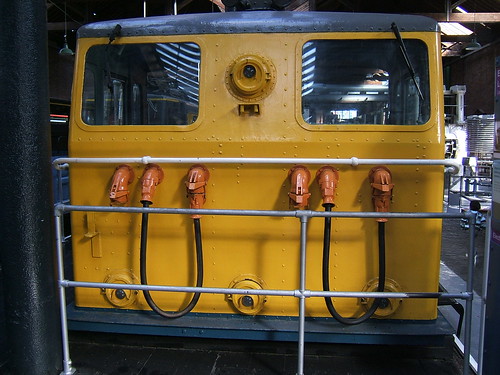
One cab of the ex-Manchester, Sheffield, Wath 'EM1' electric locomotive 76039 has been preserved in British Rail blue livery.

Ex-Manchester, Sheffield, Wath 'EM1' electric locomotive 76039 preserved cab in British Rail blue livery with later running number and worksplate

Driving desk of preserved cab. The reflections from the various surfaces produce a rather confused result, sorry.
The 'EM1' Bo-Bo locomotives had four 467 horse power Metropolitan Vickers d.c. motors. Pair of motors on each bogie were permanently in series. For starting, all four motors were in series with 15 starting resistors in series. 'Notching-up' progressively removed these resistors. The two pairs of motors were then placed in parallel with the starting resistors re-instated. Further 'notching-up' progressively removed the resistors. Final acceleration was achieved by weakening motor fields by switching-in a resistor. The drawing below includes the mechanical drawing, wiring drawing and control table.

Click for larger view
'EM1' Electric Locomotive (from 'Metro-Vick Locos 1954' in Railway Archive)
Related posts on other websites
British Rail Class 76 (Wikipedia).
The Electric Bo-Bo Class EM1 (BR Class 76) Locomotives (LNER Encyclopedia).
Related posts on this website
Class 'EM2' D.C. Electric
It is with great sadness that I report the death of John Brandrick on 22nd May 2023. Amongst his many interests he was Chairman of the Old Locomotive Committee and well-known as a railway enthusiast, railway historian and live-steam modeller.

John Brandrick at 'Lionsmeet', Worcester, 13th August 1922.
In 2021, the Trade Show 'Railtex' resumed resumed after the interruption caused by the Covid-19 Pandemic (there's a brief report here). The once every two years format continued so it was next staged in May 2023.
On Wednesday 10th May 2023 I attended the show at the National Exhibition Centre near Birmingham, together with one of my friends from Bath who travelled independently by train. We both alighted at Birmingham International station which is a short walk under cover from the Exhibition Centre.
Getting there from Bath
My friend had an interesting journey so I've added a few notes. Bath to Gloucester was by a GWR diesel multiple unit. According to the Railcam.UK 'app' (there's a brief introduction to this 'app' here), this was reporting number 2E53 from Warminster to Great Malvern, making 14 intermediate stops (including Bath), taking just under 2 hours for the whole journey. At Bristol Temple Meads, he was surprised to find 60007 'Sir Nigel Gresley' with its support coach standing on the siding adjacent to platform 3. Afterwards, we found out a little more about this steam working (see 'The Welsh Marches Express' below). On arrival at Gloucester he had a short wait before catching a Cross Country 'Voyager' - the 08:45 from Cardiff, reporting number 1M01, 09:49 Gloucester, due in Birmingham New Street at 10:45 before going forward to Nottingham (due 12:04). The final leg was another Cross Country 'Voyager' - the 09:25 from Manchester, reporting number 1O12 leaving Birmingham New Street at 11:05 and due at Birmingham International just seven minutes later.
Getting there from Wolverhampton
I took the bus from Brewood to Wolverhampton at 09:35 and walked to the railway station. I suppose I have given up expecting to see much progress on the tram extension to the railway station but it was notable that Railway Drive was not teeming with the usual orange-clad workers. In fact, railway drive had been cleared of construction debris and the flangeways of the track were clean. Near the station, the area had been paved over, making it much easier for pedestrians to reach the station buildings, and the double-track tramway now swept right before the lines converged on a headshunt provided with a rather basic platform with awning. A few workmen with plant were still present in the headshunt area. There was no evidence of any overhead electrification so I decided it would be premature to imagine that actual running trams were imminent.
My rail journey was simple as the 09:25 from Manchester was routed via Wolverhampton, due 10:39. Just before the train arrived, the platform was swopped from 2 to 3 (to allow a down train into platform 2) but since platforms 2 and 3 form an island, it was no great inconvenience to passengers. We had a signal stop in New Street North Tunnel for a couple of minutes, waiting for a platform. Passengers waiting to board, including my friend, found that the platform announced previously had suddeenly swopped but my friend and I met up for the short journey to Birminham International.
The Welsh Marches Express
I don't follow main line steam specials but a quick check with the Railcam.UK 'app' showed movement 5Z65 leaving Bishops Lydeard at 05:43 so I presumed the locomotive had been prepared on the West Somerset Railway and made its way with the Support Coach to Bristol.


60007 'Sir Nigel Gresley' and Support Coach at Bristol Temple Meads on 10th May 2023 prior to 'Welsh Marches Express' (Photo: S. Morris): Bristol Area Rail.
My friend found the piece in the 'Shropshire Star' detailing the Paignton-Shrewsbury and return 'Welsh Marches Express'. As 1Z65, this had left Paignton at 05:45, diesel hauled, picking up passengers at various stations to Bristol. With the steam locomotive taking over, 1Z65 was due to leave at 09:14, head north through Filton then joining the Great Western Main Line west at Patchway, through the Severn Tunnel and continuing almost to Newport where the train was to take the eastern leg of the Maindee Triangle to reach the route to Abergavenny and Hereford. The schedule allowed two hours to Hereford, where the train was to pause for 50 minutes (a 'water stop' I assume). Another hour was allowed to reach Shrewsbury, due 13:05.
The 'Shropshire Star' had helpfully added a link to the detailed timings on the RTT 'app' (a similar 'app' to Railcam.UK, also using Open Rail data provided by Network Rail) so I was able to look at how the journey to Shrewsbury turned out. The diesel-hauled train arrived in Bristol just 5 minutes late but by the time 60007 was attached and joining passengers boarded, departure was 15 minutes late. Arrival at the Maindee Triangle was only 7 minutes late but, since the steam special had been booked to pause at Maindee North Junction whilst a conflicting movement cleared, the steam special was 'right time' setting off on the Welsh Marches Line. However, the train had lost 20 minutes by Abergavenny, with no improvement by Hereford. Further time was lost during the stop at Hereford and departure was 41 minutes 'down'. By Craven Arms, the arrears had increased to 50 minutes and arrival at Shrewsbury was at 14:01, 56 minutes late. And, later that day, the return journey would operate! Nobody should imagine running main line steam specials is easy.
The Exhibition
'Railtex' and 'Infrarail' had resumed after the Covid-19 Panemic in 2022 and there's a brief post here on that event.
In 2023, security personnel were again positioned on the broad, covered overhead walkway connecting the railway station to the Exhibition Centre, checking bags and the indications from two metal detector portals. As both my friend and I were pre-registered, admission merely required do-it-yourself scanning of the pre-registration 'QR' code which immediately printed card visitor badge for attachment to a lanyard selected from an adjacent dump bin. A number of ladies in formal suits were on hand to provide assistance, if required.
'Railtex', bills itself as an 'international exhibition of railway equipment, systems and services' and the stands occupied around 3/4 of Hall 3 (which is around 121m x 90m). The term 'Infrarail' seems to have been discontinued. Stands covered the range of topics I expected although a number of familiar names were absent and there were many unfamiliar names, often from Europe. My friend and I spent a few hours touring the stands, taking in one of the presentations in the Conference Zone. As my friend had specific further meetings planned, we split-up and I returned home by train.
We both found the visit useful but there's not the air of excitement which once seemed to permeate these exhibitions (or am I just getting old?). One exhibitor commented that the previous day had been quiet but the day we attended, it was busy without being 'jammed'.
Getting back to Wolverhampton
From a rail and air point of view the National Exhibition Centre has an excellent location. A few minutes walk and you're at a main-line railway station. A few more minutes on the Air-Rail Link and you're at the International Airport. The Air-Rail Link is an automatic, cable-hauled people mover which replaced the original 'Maglev' system. There's a Wikipedia article on the Air-Rail Link here. The location is perhaps not quite so ideal from a road transport view, requiring large numbers of vehicles each with few passengers to have access to and from the location together with parking facilities.
When I got back to Birmingham Unternational station, information displays showed all sorts of trains (most with delays posted), but I couldn't discern a simple answer to the question "which is the best train to get me back to Wolverhampton?". There were lots of passengers around, but I couldn't see any staff. Without much confidence, I selected the 15:08 Holyhead service, off platform 5. I found a TfW class 158 (reporting number 1D15) standing at the platform and joined the few passengers aboard. As departure time neared, quite an influx of passengers boarded and we left, a few minutes late quite well-loaded.
At Birmingham New Street, we stood for a few minutes and, when a 'Pendolino' which had followed us ran in to an adjacent platform, I fully expected it to precede us to Wolverhampton before I realised it was terminating at New Street. I was surprised when a class 66 appeared from the Holliday Street tunnel with a long freight train and sedately made its way through the station and into New Street South Tunnel. Railcam.UK identified this working as 6E11 starting from Appleford at 11:07 routed via Didcot, Swindon, Gloucester, Birmingham and Derby ultimately reaching Milford Junction West, south of York. Further research later showed that Hanson Asphalt have a manufacturing site at Appleford which imports coarse aggregate by rail, so the train was probably 'empties' returning north.
We left Birmingham New Street with just one booked stop at Sandwell and Dudley before Wolverhampton but we were following the Walsall-Woverhampton 'all stations' reporting number 2W36 which slowed our progress, eventually bringing us to a brief standstill at Monmore Green. Once 2W36 had 'tucked himself' into bay platform 5, I expected us to move into the station, but we were held again at the final signal before the station (4271) whilst a 'Pendolino' running as Empty Coaching Stock (ECS) was crossed in front of us from platform 1 to the Up Main towards Birmingham. With platform 1 now available, my train was finally able to proceed into the station.
My local railway pictures
West Midland Railways.
Spring 2023 started on 20th March. Although we'd had some snow during the winter, we escaped bad snows where I am. But it had been cold by U.K. standards, made more painful by staggering recent increases in energy costs, so I was cheered by the prospect of better weather. The local birdsong also became more optimistic, encouraging me to make the first 'pilgrimage' of the year by train on the 24th March. I chose to visit Liverpool and the Wirral (a favourite destimation) and booked a First Class return ticket online.
In the past, I've often used the West Midland service which requires no changes and gives the shortest overall journey time although it makes a number of stops. But I decided to see how I fared with Avanti who have been getting heavily criticised for poor service and large numbers of cancellations at short notice. In general, I believe these criticisms are justified (as are the wider complaints about our expensive, pathetic railway services) but, on 24th March, all my Avanti trains were on time and provided a decent service.
The plan was to catch a Euston to Glasgow via Birmingham 'Pendolino' service as far as Crewe, waiting there for a Euston to Liverpool via the Trent Valley Line 'Pendolino' train. The first train arrived on time and I quickly found my reserved seat in coach J at the rear. With major engineering works around Carstairs, I discovered that the train would be terminating at Preston where onwards passengers would probably be decanted onto a Transpennine service to continue their journey north. During my half hour non-stop journey to Crewe (depart Wolverhampton 08:32, due Crewe 09:07) I was the only passenger in the coach so the friendly catering staff had time to serve a reasonable cooked English Breakfast with white toast, butter and jam, together with a mug of tea and a glass of orange juice. I was intrigued by the rather small oval plates but the food was good and at least the crockery was glazed pottery not plastic and the cutlery steel so I forgave the relative lack of refinement and alighted at Crewe platform 11, right time, in a good mood.

Merseyside in March: Breakfast on Avanti 'Pendolino' Wolverhampton-Crewe
I'd about 20 minutes to wait for my connection, also from platform 11 but before that was due, a single unit DMU from Chester arrived in platform 11 from the north, discharged its passengers, re-loaded and scuttled off back to Chester. Although Crewe station is now a shadow of its former days, I still enjoy looking at what remains. There's a short post about a visit I made in the 1950s here. Although the station buildings have been repeatedly modified over the years, some of the grandeur of the LNWR expansion of the station in 1907 remains, particularly in what's left of the overall roof. The post here talks about the station buildings. On time, my connecting service came snaking in through Crewe South Junction and I boarded coach J at the rear of the 'Pendolino'. This train, reporting number 1F12, had left Euston at 07:43 and on leaving Crewe at 09:26 had one stop at Runcorn with a scheduled arrival at Liverpool Lime Street at 10:04.

Merseyside in March: Liverpool-bound 'Pendolino' on Avanti service 1F12 arriving at Crewe platform 11.
Catering was once again promptly offered and I accepted white toast and an orange juice as we sped along the familiar route to make a 'right time' arrival at Liverpool, where the weather was dry with patchy sun. Disembarking, I paused to record another view of the elegant train sheds and then some details of a conveniently located 3-aspect colour light signal supplied by Unipart Dorman before purchasing an All Areas 'Saveaway' day ticket which would give me flexibility to change my plans during the day.

Merseyside in March: Train Sheds at Lime Street viewed from platform 9.
I made my way to the underground Merseyrail station, unsure of my initial destination. With four trains an hour currently to New Brighton, West Kirby and Chester, plus two trains an hour to Ellesmere Port, I knew I should have less than five minutes to wait for a train. The first train was for New Brighton and I was tempted to stay on it all the way but uncertainty over the weather made me alight at James Street with the aim of taking a Mersey Ferry Trip before the possible deterioration of the weather. At street level, the sun was encouraging but there was quite a breeze coming from the river. Guessing that the next ferry would still be at 11 o'clock, I decided that I'd time to call in at the Museum of Liverpool to check on the preserved locomotive 'Lion' before continuing to Pierhead. Well, the exhibit was safe, if a little dusty, but I was pleased to see that the associated audio-visual screens which had been out of order on my last visit were working again. There's a short post about the audio-visual systems as originally installed here.
A short walk took me from the Museum to the ferry booking office. I knew that Seacombe landing stage had re-opened after a recent lengthy refurbishment. There's a brief mention of this work in the post about my trip in August 2021 here. But I hadn't realised that Birkenhead Woodside landing stage had now closed for two years whilst it, too, was refurbished. In the past, I have used the ferry to Seacombe and walked to New Brighton (in 2016) or the reverse (in 2019). But walking seemed ambitious and bus did not appeal so I booked a round trip 'River Explorer' which involved a modest extra payment. I boarded the waiting 'Snowdrop' (still in its 'dazzle' livery which I hate) and took up my customary position on the outside upper deck towards the bow. With the tide coming in, we were moored facing the sea. A combination of wind and tide made the water surge between the landing stage and the hull, giving the ferry an unpredictable motion which fortunately subsided once we were under way.

Merseyside in March: View from 'Snowdrop' at Pierhead looking downstream. Bunkering vessel 'Mersey Endurance' at Cruise Terminal on the right.
As the electronic chimes of the Liver Building clock struck eleven, the usual group of late passengers rushed to board and we cast off. The ferry initially headed downstream while the recorded commentary described some of the notable features of Liverpool North Docks, then we turned across channel and headed for Seacombe Landing Stage, finally turning to approach facing downstream.
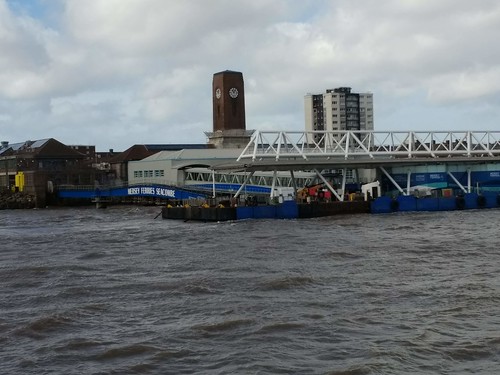
Merseyside in March: View from 'Snowdrop' approaching the re-opened Seacombe Landing Stage, showing one of the new linkspans connecting the pontoon to the land.
We moored and the new powered gangway was lowered to let passengers off and on. I've always been amazed that the previous counterbalanced, manually operated gangways (usually requiring quite strenuous attention) have survived so long.

Merseyside in March: View from 'Snowdrop' berthed at the refurbished Seacombe Landing Stage. Note the new, hydraulic gangways.
The original method of positioning the pontoon with multiple anchor chains at each end has been retained. The lively sea in the picture below suggests the skill needed by the ferry skippers dock repeatedly without incident.

Merseyside in March: View from 'Snowdrop' at the re-opened Seacombe Landing Stage, showing pontoon anchor chains.
'Snowdrop' moved away from the landing stage and performed a 180 degree turn to starboard to continue upstream. We passed the entrance to the Great Float and Birkenhead Docks and the unoccupied Twelve Quays landing stage, used principally by Stena 'Ro-Ro' vehicle and passenger ferries to Belfast. It was a new experience to continue past Birkenhead Woodside landing stage without stopping. The only river traffic we saw was a tug heading downstream near the Liverpool shore and a dredger. Dredgers, of various types, are a permanent feature. The action of the tide and river flow continually shifts massive amounts of sand and keeping marked channels to adequate depths means dredgers are always required.

Merseyside in March: View from 'Snowdrop' heading upriver in choppy conditions with the Liverpool Shore and Anglican Cathedral in background. Note tug going down river and dredger.
On the Birkenhead shore to starboard (our right) we then passed the Cammell Laird shipyard with its large Wet Basin and Dry Docks used for ship repair work. The picture below gives an idea of the layout.

Aerial view of Cammell Laird shipyard: River Mersey top left, Wet Basin top right, various dry docks in the centre (Photo: Cammell Laird Ltd)
One of the Royal Fleet Auxiliary 'Tide' class tankers, 'Tiderace' A137 was dry docked.

Merseyside in March: View from 'Snowdrop' of Cammell Laird docks showing Royal Fleet Auxiliary Tanker 'Tiderace' dry-docked.
'Ben My Chree' was in an adjacent dry dock. She is a 'Ro-Ro' vehicle and passenger ferry built 1998 (125m long, 40m beam) operated by Isle of Man Steam Packet Company, normally on the Heysham - Douglas route. The Company refer to her as a 'Ro-PAX' and cite her as a reliable performer.

Merseyside in March: View from 'Snowdrop' of Cammell Laird docks with 'Topaz Tangaroa' multi-purpose offshore vessel (background) and 'Ben My Chree' Ro-PAX ferry (foreground).
As 'Snowdrop' continued upstream, I had a better view of 'Topaz Tangaroa' in the Wet Basin. Her whole foredeck is enclosed to provide accommodation for 82 crew and blended into the bridge giving her a bullet-like appearance, somewhat diminisheded by the helicopter deck mounted above on columns. The rear of the ship is a flat workdeck, dominated by a massive side-mounted crane. Length is 98m, breadth is 20m. She was built in 2019 by Vard in Norway as a multi-purpose offshore vessel for Topaz Energy and Marine in Dubai. Registered in the Marshall Islands, she is operated by P&O Offshore Logistics, based in Dubai. There's brief information here.

Merseyside in March: View from 'Snowdrop' of Cammell Laird docks with 'Irish Sea Pioneer' drill ship (visible left) and 'Topaz Tangaroa' multi-purpose offshore vessel (centre).
But the award for the oddest-looking vessel went to 'Irish Sea Pioneer', also in the Wet Basin. Built in 1996 by Bollinger in the USA for Halliburton-BHP and 55m (or perhaps 47m) long with 24m beam, she's a type of Offshore Support Vessel variously termed a 'drillship', a 'giant liftboat' or a 'four legged jack-up boat'. There's a fascinating article here and more than you need to know about designing such a vessel in a Conference Paper here.

Merseyside in March: View from 'Snowdrop' of Cammell Laird docks with 'Irish Sea Pioneer' drill ship (left) and Topaz Tangaroa' multi-purpose offshore vessel (right).
Leaving Cammell Laird astern, we approached Tranmere Oil Terminal with its oil storage tanks one of which, I noticed, has acquired a partial geodesic-domed roof. As we turned across river towards the Liverpool shore, there were two oil tanker berthed at Tranmere, each attended by a tug. I assumed the tugs were there as fire precautions because all modern tugs have powerfull water pumps and and water monitors for firefighting. I was unable to identify any of the vessels visually. I've explained in the post Watching The Ships Go By how ships with Automatic Identification System (AIS) operating can be identified and tracked. The whole of the river area 'Snowdrop' had cruised can be displayed in real time here.

Merseyside in March: View from 'Snowdrop' of Tranmere Oil Terminal showing two unidentified, berthed oil tankers, each attended by a tug.
Now heading downstream, 'Snowdrop' passed the re-development of the former South Docks, the remarkable preserved area of Albert Dock, the offensive modern architecture of the Museum of Liverpool and berthed back at Pierhead in the shadow of the Three Graces as the iconic Custom House, Cunard Building and Liver Building are known. UNESCO awarded Liverpool World Heritage Status in 2004 for the “outstanding universal value” of its waterfront but this accolade was lost in 2021 because of “irreversible loss” to the historical value of its Victorian docks caused by insensitive redevelopment which continues with the construction of a new football stadium for Everton Football Club at the former Bramley-Moore Dock. I left the ferry after an interesting cruise, passing the long queue of passengers waiting on the landing stage to board the 12 noon cuise.
I walked back to James Street Merseyrail station, intending to catch a train to New Brighton. That didn't prove quite as straightforward as I hoped. The first train to arrive was for Chester, so I remained on the platform, looking at the artwork applied to the original patterned tiling on the normally-unused platform 2. I'm afraid I preferred the original, tiled decorations.

Merseyside in March: View of Merseyrail James Street station showing artwork on the normally-unused platform 2, looking towards Birkenhead.
The next arrival was for New Brighton train so I boarded. Like the Chester train, it was a Class 507, a 40-year old veteran, not one of the new Stadler Swiss-built Class 777 currently being introduced. We made the usual rather noisy progress under the river via the Mersey Tunnel and stopped at Birkenhead Hamilton Square. After a flurry of passenger activity, we set off, taking the flyunder to reach New Brighton/West Kirby line. We stopped at Conway Park, an unattractive, modern sub-surface construction in a deep 'station box', open to the sky. The doors opened. A few passengers alighted and boarded. The doors closed. Then nothing. Squinting through the window, I could just see reflected light from the colour light signal at the end of the platform. It was red. After a few minutes, the lady driver announced over the public address a delay because the traction current had been disconnected. No comment about reason (usually a fault or an accident) or likely delay so we all waited in silence. After a few more minutes, another announcement invited us to continue our journey by other means, if we wished and the doors were released. Nobody moved at first, then a trickle of passengers left the train which turned, lemming-like into a flood which I joined, pausing only for a picture of the stranded train and to note a poster saying that the Kirkby Line was the first to be operating Class 777 trains. I just managed to join an already-crammed lift to the surface.
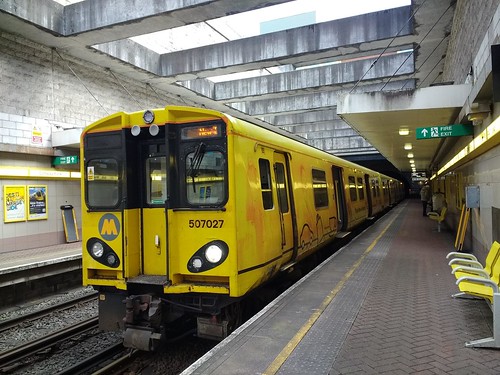
Merseyside in March: View of Merseyrail Conway Park station from platform, with my train stranded by an unexpected traction current interruption.
I started to form a plan to walk back to Hamilton Square station, where I hoped trains to other destinations would still be running. The local area map in the booking hall didn't give me a clear idea of the roads I needed to get to Hamilton Square and even Google Maps on my mobile phone had trouble giving me details, but after a while, I decided on a route to take. The Conway Park station is next to a roundabout on Europa Boulevard, a dual carriageway with a broad central reservation of well-established trees. The area is partially redeveloped but with little traffic. I followed the dual carriageway north to a rather abrupt T-junction with Price Street. Turning right, I came to a railway bridge over what had been two parallel, double-line railways, long disused. I realised this would have been the goods lines to Birkenhead Docks which formerly diverged from the main Chester - Birkenhead Woodside L.M.S. & G.W.R. joint line at Blackpool Street signal box. An earlier post here gives a little background on the railways around Birkenhead. I decided a photograph of the location would be useful and, whilst framing the shot, stumbled on an uneven pavement and crashed to the floor, falling painfully on my left arm. A concerned lady came over to see if I needed help but nothing appeared broken (although everything hurt). I dragged myself upright and assured the lady I would be fine, making sure I had taken the picture.

Long-disused Goods Lines to Birkenhead Docks at Price Street, Birkenhead.
I slowly continuing along Price Street to Hamilton Square itself where I rested on one of the seats in the gardens before continuing to nearby Hamilton Square station.

Hamilton Square Gardens, Birkenhead (Return to New Brighton)
I caught a train back toward Liverpool with thoughts of changing to the Northern Line and visiting Kirkdale (where the depot servicing the Kirkby Line is located) but when the public address announced that, after traversing the Liverpool Loop, the train was for New Brighton, I decided that I was happy to just stay on the train and be taken to my original destination. I felt a sense of deja vu, as my train left James Street, made a brief stop at Hamilton Square Station and arrived at Conway Park. This time, after a normal delay, we carried and called at Birkenhead Park.
On the way to the next station, Birkenhead North (where the New Brighton line diverges from the West Kirby line), my hope that I'd soon be in New Brighton was dashed by a announcement from the lady driver that the service would terminate at Birkenhead North. She explained that extreme late running caused by the earlier traction current disconnection meant that, in an attempt to get back to schedule, the train would return to Liverpool. At Birkenhead North, platform 3 filled with disappointed passengers decanted from my train. I noticed a loaded train in platform 1, which I assumed was about to leave for Liverpool but, after a couple of minutes, these passengers got off and used the overbridge to get to platform 3 and joined the train I'd just abandoned. I'd not previously noticed the trailing crossover and position light ground signal on the main line at the Liverpool end of platform 3. The ground signal came 'off' and my train set off through the reversed crossover to reach the correct line and scuttled off back to Liverpool. The passenger information screen (an orange scrolling LED display capable of detailing the next three departures) displayed some rather unlikely timings for a while but eventually settled down to show the next train for West Kirby with the second train for New Brighton. The West Kirby train arrived and departed and, eventually, the promised New Brighton arrived, allowing the waiting passengers to pile aboard for the ten minute journey to New Brighton, stopping at Wallasey Village the Wallasey Grove Road.
So, despite the delays and my fall, I made it to New Brighton. I turned left on leaving the station and made my way north down Atherton Street towards the Marine Promenade. Liverpool Businessman James Atherton (1770-1836) is credited with developing the North Wirral and New Brighton.

Looking north down Atherton Street from the station (Return to New Brighton)

James Atherton (Williamson Art Gallery and Museum)
I explored along the main road parallel to the promenade, King's Parade, as far as RNLI's New Brighton Lifeboat station but decided not to navigate the car parks and modern retail and hospitality developments to reach the sea wall itself, thinking I'd probably had enough excitement for one day and that I should focus on getting home. It was quite a stiff climb back up Atherton Street to the station and, when the train arrived, I was quite content to flop on board and wait for departure. The journey back to Liverpool Lime Street Low Level was without incident then escalators and walking took me to the main line concourse where I could select my return train.
At 15:33 there was a direct Birmingham service (a Class 350 'Desiro' reporting number 1G59) but I decided to see what the catering was like on Avanti's London service at 15:43 (reporting number 1A58) which meant at least a change at Crewe. The inbound Avanti 'Pendolino' arrived in platform 9, discharged its passengers and departing passengers immediately started to board so I trekked almost the length of the train to reach First Class. I was surprised at how many passengers had already boarded but I found a suitable table and almost immediately the attendant appeared although we were not due to leave for over ten minutes. I explained that I was only going to Crewe with them and studied the menu, ordering an orange juice and a Mushroom and Cheese Croque with Bechamel Sauce which I'd not tried before. The jolly attendant said he'd get the toasted sandwich started, to make sure I had plenty of time to enjoy it. In fact, the hot food and cold drink arrived before we set off up the 1 in 93 bank to Edge Hill and were excellent, ensuring a relaxing journey to Crewe. I monitored the journey on my mobile phone using the Railcam.UK 'app' (there's a brief introduction to this 'app' here). My express only stopped at Runcorn before Crewe whereas 1G59 which had left Liverpool just ten minutes ahead of us made stops at Liverpool South Parkway, Runcorn, Acton Bridge, Hartford and Winsford before Crewe.
Although the Working Timetable suggested that my train would not be 'baulked' by the preceding Class 350, watching the live display on Railcam.UK suggested that we were catching up and we were actually brought to a stand briefly before Winsford. The rest of the journey to Crewe was a bit subdued and we stopped again at signal 0144 outside Crewe. After a couple of minutes, the signal cleared and, as we moved away, I caught a glimpse of a Class 66 with a train of yellow-painted, loaded bogie stone wagons moving from the Up Slow to the Up Liverpool Independent and descending the gradient to enter the tunnel under Crewe North Junction before emerging in a cutting on the Down side of the station. In steam days, this cutting was always referred to as "The Muckhole" by the army of trainspotters always to be found around the footbridge used by enginemen between the station and Crewe North Shed. Railcam.UK identified the Stone train as 6K06, Shap to Basford Hall. As we stopped in platform 5, the train which had slowed our approach to Crewe, 1G59, was still in adjacent platform 6, awaiting the 'right away'.
I left the Avanti train (1A58 was next stop Milton Keynes then Euston) to look for a service stopping at Stafford and discovered another Avanti London service due in platform 1 in a few minutes with a Stafford call. The train arrived and, with only a 20 minute dash to Stafford, I was happy to join the Quiet Coach at the rear with just one other passenger.
At Stafford, I left the station and took a taxi home, very tired but pleased with the trip.
Previous similar Liverpool trips/strong>
Trip on 1st April 2022
Trip on 9th January 2016
My pictures from this trip
Merseyside in March
My first visit to Liverpool was over seventy years ago and my early experiences are described in the posts Liverpool (2008) and Liverpool (again) (2014). Since then, I've continued to publish posts about the area, grouped as Merseyside.
I only recently discovered the website Historic Liverpool) with old maps and a blog run by Martin Greaney and Sue Greaney. They offer framed maps and Martin's book 'Liverpool: A Landscape History'. In the blog, there's a post 'Postcards from Edwardian Liverpool' and two of these particularly interested me.

Liverpool: Edwardian postcard view of Princes Dock, looking north, showing in the foreground the pump house where 'Lion' was used to empty the Princes Graving Dock seen immediately behind the pumphouse (Photo: 'Historic Liverpool')

Liverpool: Edwardian postcard view of Princes Dock, looking north, showing 4-funnel liner at the Landing Stage and New Brighton Tower in the background (Photo: 'Historic Liverpool')
Apart from the general interest of any old photographs, I found three features of special note.
Princes Graving Dock Pumping House
The first postcard shows the Graving Dock emptied and with a cargo vessel receiving attention. In the foreground, the pumping house where 'Lion' was used to drive the chain pump used to empty the Graving Dock is visible. The details are not too clear but, by reference to the 1873 drawing below, the elaborate chimney associated with the Pumping House is definitely visible.

Liverpool: Drawing of Princes Graving Dock Pumping House circa 1873 (National Museums & Galleries on Merseyside)
It's assumed that, following electrification of the Graving Dock pumping in the 1920s and donation of 'Lion' to the Liverpool Engineering Society, this chimney was demolished. Certainly, it's gone in the 1961 colour image I included in the post 'Lion' Locomotive - the Lost Years, copied below.
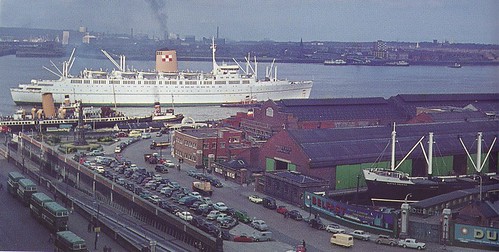
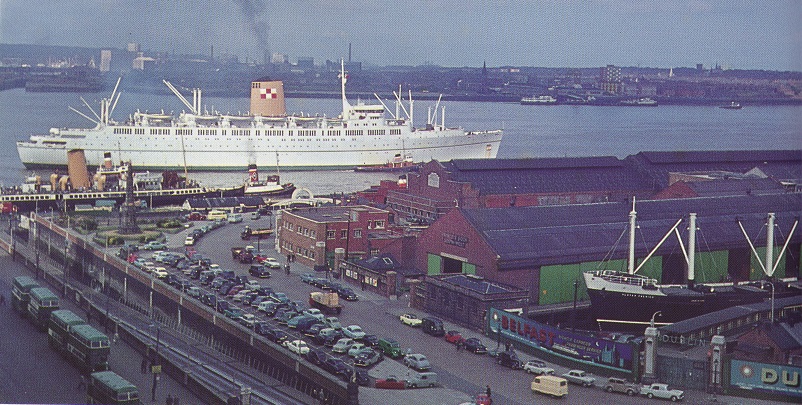
Liverpool Pierhead in 1961 with the 'Empress of Britain' dominating the scene. Of interest to rail enthusiasts is the rare view of the Pumphouse (to the left of the 'Belfast' hoarding) from where the locomotive 'Lion' was rescued (Photo: N.P.B. collection from 'Reflections on a River').
Click for larger view.
In 1992, National Museums & Galleries on Merseyside documented the remaining Pumping House in drawings and photographs prior to demolition. This information was published in 'Lionsheart', the newsletter of the Old Locomotive Committee (No. 29 April 1993, No. 31 Sep 1993 and No. 61 June 2005) and some of which is reproduced here. All issues of 'Lionsheart' are available online to Old Locomotive Committee members via the OLCO website here, which also includes membership application details.
Four funnel liner
The second postcard shows a four funnel steamship moored at Liverpool Landing Stage. I was intrigued about the identity of this ship and was surprised to discover that only 14 liners were ever built with 4 funnels.
Kaiser Wilhelm der Grosse (launched 1897, scuttled 1914)
Deutschland (launched 1900, scrapped 1925)
Kronprinz Wilhelm (launched 1901, scrapped 1923)
Kaiser Wilhelm II (launched 1902, siezed by USA 1917 finally scrapped 1940)
Lusitania (launched 1906, torpedoed 1915)
Mauritania (launched 1906, scrapped 1935)
Kronprinzessin Cecilie (launched 1906, siezed by USA 1917 finally scrapped 1940)
France (launched 1910, scrapped 1935)
Olympic (launched 1910, scrapped 1935-1937)
Titanic (launched 1911, sank 1912)
Aquitania (launched 1913, scrapped 1950)
Britannic (launched 1914, mined 1916)
Arundel Castle (launched 1919, scrapped 1959)
Windsor Castle (launched 1921, torpedoed 1943)
The above and much more can be found on the Maritime Quest website here which has a marvellous collection of historic photographs.
This was the period when transatlantic companies vied to provide enhanced facilities to their First Class clientele. Of course, it wasn't just the rich and famous who travelled on these luxurious leviathans. Liverpool was the port of departure for many emigrants seeking a better life in the United States, usually travelling more modestly in 'Steerage' as Third Class was often called.
New Brighton Tower
In both the aboce postcards, New Brighton Tower is visible in the distance on the other side of the river. This tower, outlined in a Wikipedia article here had a fairly short existence (1898-1921), defining the possible range for the date of the two original photographs.
Following the success of Blackpool Tower, opened in 1894, New Brighton acquired its own tower in 1898. The tower itself (like Blackpool) surmounted an impressive brick-built ballroom. The tower was closed during World War I during which maintenance stopped and, after the war, it was decided to demolish the tower and sell the low carbon steel used in its construction for scrap. The Tower Ballroom remained in use until destroyed by fire in 1969.

New Brighton Tower (Photo: Historic England Archive)
Related posts on other websites
Lion & The Old Locomotive Committee (OLCO website)
Four Funnel Liners (Maritime Quest)
New Brighton Tower (Wikipedia)
Related Pumping House posts on this website
'Lion' and the Pumphouse
'Lion' Locomotive - the Lost Years
To find all my posts about the Old Locomotive Committee and the locomotive 'Lion', click here or select 'OLCO' under 'Labels to select a blog topic'.
To find all my posts on Liverpool, The Wirral and Merseyside, click here.
Long before the Euston and Manchester Electrification Project brought 25 kV a.c. traction to the Manchester, the city was host to electrified railways introduced by the innovative Lancashire and Yorkshire Railway, which I hope to ruminate on in the future. Electrification was next introduced on the Manchester South Junction and Altrincham Railway. Manchester London road station (now renamed Manchester Piccadilly) was opened as a terminus in 1842 to serve two main line railways: the Manchester and Birmingham (from the south) and the Sheffield, Ashton-under Lyne and Manchester Railway (from the east, then opened as far as Godley). The need to link-up with other railways around Manchester, particularly the Liverpool and Manchester was recognised and the two companies promoted a line to the west of Manchester London Road on a brick viaduct linking up with the Liverpool and Manchester (known as the South Junction Line), together with a branch to Altrincham. The Manchester South Junction and Altrincham Railway (MSJ&A) originally opened in 1849 using steam traction, extending from new through platforms adjacent to Manchester London Road station, Oxford Road station and Knott Mill and Deansgate station, the line then splitting to serve Altrincham or join the Liverpool and Manchester Railway at Ordsall Lane.
Manchester South Junction and Altrincham Electrification
Following the 1923 Grouping, ownership and operation passed to the MSJ&A Railway Committee representing the L.M.S and L.N.E.R. The L.N.E,R. were keen on electrification; the L.M.S. perhaps less so. After a difficult period, an electric service using 1500 volts d.c. finally started operation in 1931, using standard 3-car electric trains of a design already in use on the L.M.S.

MSJ&A overhead electric unit at Altrincham circa 1930 (Public Domain)
In 1971, following conversion of the line to the British Rail standard of overhead 25 kV a.c. electrification, a modernised service was introduced on the line using Class 304 Electric Multiple Units. This class, introduced in 1960, was built in three batches as 4-car sets and were widely used. Maximum speed was 75 m.p.h. and I enjoyed some spirited runs travelling on this class, particularly after 1984 when refurbishment of the class reduced them to 3-car sets.

3-car Class 304 near Sale (Photo: Wikimedia Creative Commons)
This electric service continued until the end of 1991 when the line was closed to allow Manchester Metrolink to take over much of the line. Many of the existing overhead supports were retained as part of a new 750 volts d.c. scheme using modern trams. Towards Manchester, significant re-routing was made and the Metrolink trams now use part of the abandoned C.L.C. route, including the listed 'Birdcage' viaduct as far as the site of Manchester Central (whose arched train shed remains, converted into the G-MEX exhibition centre, forming part of the Manchester Central Convention Complex) before descending to street level through the centre of the city then passing through the Undercroft of Piccadilly Station. Piccadilly was the original terminus of Metrolink but the success of the project has led to a number of new extensions.

Manchester Metrolink: Deansgate-Castlefield with a 'double' unit arriving from St. Peter's Square direction.
Related posts on other websites
Manchester South Junction and Altrincham Railway (Wikipedia).
British Rail Class 505 (Wikipedia).
British Rail Class 304 (Wikipedia).
The Manchester South Junction & Altrincham (BR Class 505) Stock (LNER Encyclopedia).
Metrolink Altrincham Line (Wikipedia).
Usual disclaimer: the above links worked when this post was published but may cease to work in the future if the site owner makes changes.
Related posts on this website
To Altrincham via the former C.L.C.
Manchester by Rail
The Cheshire Lines Committee Routes Today
Book References
[1] ‘British Electric Trains’ by H. W. A. Linecar (Ian Allan) 2nd edition 1949.
[2] ‘DC Electric Trains and Locomotives in the British Isles’ by R. L. Vickers (David & Charles) ISBN 0-7153-8674-3.
My Pictures
Depending on the display device, the right hand edge of pictures included in this blog post may not display. To see an uncropped image, click on the picture. Alternately, you may find most images by following the links below which allow display or download in various resolutions.
Manchester Metrolink.
Manchester Area Rail.
Altrincham Station
An undetected text error resulted in this post claiming to describe the 'EM1' class for some months. I'm sorry.
The success of the 1931 project to electrify the Manchester South Junction & Altrincham railway (briefly described here) encouraged the L.N.E.R. to proceed with their plans for electrification of the main line between Manchester and Sheffied but World War II delayed completion of this project. After World War II, the long-planned scheme introduced main line overhead electrification at 1500 volts d.c. The majority of the electrified line was opened by 1954. Freight trains were single-headed or double-headed by one or two of the original class 'EM1' Bo-Bo locomotives (later TOPS classification was Class 76). Passenger trains were hauled by class 'EM2' Co-Co locomotives (later TOPS classification was Class 77).
A complete 'EM2' named 'Ariadne' is preserved at the Science and Industry Museum in Manchester (in addition to one at Midland Railway Centre and one at Utrecht Railway Museum). The Manchester locomotive is 27001 (later E27001) built at Gorton in 1953 which when withdrawn was sold to the Dutch railways, Nederlandse Spoorwegen (NS) in 1969 for further service in Holland. On withdrawal by NS, the locomotive returned to Manchester where it is displayed with its NS running number (1505) and in NS livery. However, on my last visit to the museum in 2022 (described here), many exhibits, including 'Ariadne' were not viewable because of a 'multi-million-pound restoration programme' in progress.

Ex-Manchester, Sheffield, Wath type 'EM2' electric locomotive 'Ariadne' in its NS (Dutch Railways) livery.
I was a volunteer at the Science and Industry Museum in Manchester for many years (you can find all my posts about the Museum here). On rare occasions, it was necessary to shunt 'Ariadne' from its normal location in the Power Hall for one reason or another by coupling the electric to another locomotive, either the battery electric shunter or a steam locomotive. I was involved a few times as Shunter or Driver. I never saw 'Ariadne' move under her own power.

Preserved Battery Electric locomotive: General view in Central Electricity Generating Board livery.
A few of the volunteers had made sure that all the auxiliaries, switchgear and the pantograph (the locomotive was parked under a short section of 'dead' overhead contact wire) were kept in working order so that everything could be exercised and 'driving' practised, without actually moving the locomotive. I was told that, before I became a member, an enterprising volunteer had rigged cables from the batteries in the site's battery electric shunter to 'Ariadne', coupled the two together and had driven the combination from Ariadne's cab up and down the site, to the consternation of The Powers That Be, who quickly put a stop to that sort of adventure. I can testify that in the 1990s the locomotive was complete and maintained by volunteers. One of my friends would periodically check the general functioning of the controls by exercising everything except actual motion, going through the start-up routine, accompanied by all sorts of mysterious sounds from the equipment room, the pantograph could be raised and the motor contactors energised. The sequence of 'notching-up' the motors could be carried out, followed by coasting, braking, shutting down and lowering the pantagaph, all without moving.
Just once, my friend let me "drive", without moving. I found it an eerie experience and the 'notching-up' so different from a steam locomotive. The locomotive had four 467 horse power Metropolitan Vickers d.c. motors. Pairs of motors on each bogie were permanently in series. For starting, all four motors were in series with 15 starting resistors in series. 'Notching-up' progressively removed these resistors. The two pairs of motors were then placed in parallel with the starting resistors re-instated. Further 'notching-up' progressively removed the resistors. Final acceleration was achieved by weakening motor fields by switching-in a resistor.
Related posts on other websites
British Rail Class 77 (Wikipedia).
The Electric Co-Co Class EM2 (BR Class 77) Locomotives (LNER Encyclopedia).
Related posts on this website
Class 'EM1' D.C. Electric
My photograph album
Where necessary, clicking on an image above will display an 'uncropped' view or, alternately, pictures may be selected, viewed or downloaded, in various sizes, from the albums listed:-
Museum of Science and Industry, Manchester.
.
[Class number corrected, EM1 data moved to separate post: 28-May-2023]
The attractive former Caledonian Railway preserved 0-4-4 tank engine running number 419 provided steam traction for the main 2022 season at the Battlefield Line. My only driving 'turn' on this interesting locomotive was on 18th June 2022 June when I was on a shared turn with Adrian L. Sadly, this was interrupted during the Footplate Experience Course which preceded the public services by the development of a serious steam leak on the locomotive. This resulted in my spending most of the day 'baby-sitting' the failed locomotive whilst a Class 33 diesel operated the passenger trains.

Preserved Caledonian Railway '439' Class No. 419 leaving Shackerstone with the Footplate Experience service. Note the pronounced steam leak at the front end.
Following a previous problem, a gasket in the main steam pipe had been replaced and this was initially suspected as the cause of the new problem. However, when the locomotive had cooled sufficiently to determine the source of the leak, we found that the front left cylinder cover was the culprit. Nothing further could be done then, so I completed the day as 'second-man' on the Class 33 performing the last passenger round trip of the day. I subsequently learnt that, once cold, the cylinder cover had been successfully tightened up and the locomotive restored to traffic. Apparently, this locomotive has a history of this problem reccurring periodically.
Limited access to the cylinders and valve chest front covers is via the hinged 'piano front' underneath the smokebox door. Accommodating two 18 inch diameter inside cylinders resulted in some of the front cover fixing studs being shared between the valve chest front cover and the adjacent cylinder front cover, as shown in the picture below.

Preserved Caledonian Railway 439 Class No. 419: View showing cylinder front covers, divided by the front cover for the vertical valve chest.
Design evolution of the 0-4-4T on the Caledonian Railway
Preserved locomotive 419 is the sole survivor of the Caledonian Class '439' 0-4-4T, introduced by McIntosh in 1900 and the standard suburban and branch line locomotive throughout the Caledonian Railway. But its origins go back to Dugald Drummond who had learned the importance of simple, rugged design through his experiences keeping locomotives running on the harsh routes within Scotland. For general use, a four-coupled tank engine with a bogie at the back appealed to him and, in 1884, Drummond had introduced the '171' class of 0-4-4T. Following rebuild, the last of these survived until 1944. Dugald Drummond's influence on subsequent Scottish locomotive design should not be underestimated. His successor, Lambie, saw fit to continue the design with some changes as the '19' class of condensing 0-4-4T and, in turn, when McIntosh took over in 1895, production of 0-4-4T carried on, first with the '92' class condensing 0-4-4T and then, in 1900, with the '439' class (very similar to the '92' class with boiler pressure raised by 10 p.s.i. and slightly better water capacity). Each of these classes used 5 foot 9 inch diamter coupled wheels but McIntosh also produced 12 locomotives with 5 foot 6 inch diameter coupled wheels giving better performance on the more demanding Cathcart Circle (Glasgow) and Balerno branch (Edinburgh) lines. So successful was the '439' class that production (with minor changes) continued from 1915 under Pickersgill with the final batch of ten emerging in 1925, with the majority of the class remaining in service until the 1960s.

Preserved Caledonian Railway '439' Class No. 419: Overall view during preparation outside Shackerstone Shed.
Braking
The Caledonian Railway was one of a number of UK railways which opted to fit the Westinghouse Air Brake System as the 'automatic brake', rather than the vacuum brake system used by many UK railways. Locomotive 419 retains its working steam-operated reciprocating air pump (mounted outside the cab on the fireman's (right) side. The pump charges an air receiver fixed below the bunker of the fireman's side. Via the Driver's Brake Application Valve in the cab, brake blocks on the coupled wheels are applied or released by air applied to the air brake cylinder. Flexible air brake hoses at each end of the locomotive allow the locomotive to be connected to an air brake system on suitably-equipped vehicles. After the Railway Grouping, the LMS additionally fitted a vacuum ejector, brake application valve and standard vacuum brake hoses to enable vacuum-braked trains to be controlled but the power brake on the locomotive remained air-operated. There is also a conventional handbrake, operated by a screw at the rear of the cab.

Preserved Caledonian Railway 439 Class No. 419: Westinghouse Air Pump immediately outside cab on fireman's side.

Preserved Caledonian Railway 439 Class No. 419: Driver's air brake application valve fixed to cab sheeting, left side.

Preserved Caledonian Railway 439 Class No. 419: Davies & Metcalfe Vacuum Ejector and Brake Valve in front left corner of cab. Just to the right, the vertical black tube with a white top is the mechanical control for the blower valve in the smokebox.
Locomotive Regulator
'Double-beat' or 'balanced' locomotive regulators are employed to reduce the effort required to open and close a steam valve against high pressure steam. The Wikipedia article here explains the principle, invented by John Hornblower around 1800. The arrangement was subsequently adapted for use as a locomotive regulator valve. There are a couple of posts in this blog about locomotive regulators - Part 1 talks about early type of regulators and Part 2 shows a modern type of locomotive 'double-beat' regulator. Whereas unbalanced regulators usually have one (or sometimes two) long handles so that the driver can produce sufficient leverage to adjust the valve, this shouldn't be needed with a 'balanced' design. Locomotive 419 is fitted with a 'balanced' regulator, controlled by a short, dual, red-painted handle.

Preserved Caledonian Railway '439' Class No. 419: View of boiler backhead showing red-painted regulator handle and other driving controls from fireman's side.
Cab layout
Because of the dual vacuum/air braking, there's a satisfying array of Bourdon gauges on the front spectacle plate inside the cab. The whistle is operated by a round plunger extending through the front spectacle plate, which produces the satisfying sound of a "Caley Hooter". The deep-toned, dignified sound of the "Caley Hooter"is my favourite whistle. When Stanier moved from Swindon to the LMS, he was asked to agree the whistle to be used on his new designs. A series of whistles were set up on a 'whistle bar' for demonstration and he chose the "Caley Hooter" so, brought up in LMS/GWR West Midlands, I became accustomed to the slightly mournful sound of Stanier engines. Many of my friends prefer 'chime whistles' but I always thought them rather 'foreign' (since I was not exposed to Gresley 'Pacifics' until later!).
More features of the cab layout can be gleaned from the collection of pictures here.

Preserved Caledonian Railway '439' Class No. 419: Gauges mounted on spectacle plate, L-R Train Pipe Vacuum, Boiler P{ressure, Duplex Air Brake, Carriage Warming. The round, polished steel plunger below is the whistle valve.
John Farquharson McIntosh
McIntosh was responsible for many Caledonian Railway designs. He was apprenticed at Arbroath in 1860 and, completing his apprenticeship in 1867, was appointed to Montrose Works where he spent 10 years. Returning to work following the loss of his right hand in an accident, he became Inspector of Lines from Greenhill to Aberdeen. In 1882 he became District Locomotive Superintendent at Aberdeen, taking a similar role at Carstairs in 1884. Next, he took charge of Polmadie running shed in 1886, next becoming Chief Inspector of the Caledonian Railway Locomotive Department at St. Rollox works in 1891 under Lambie. On Lambie's death in 1895, McIntosh became Locomotive, Carriage and Wagon Superintendent of the Caledonian Railway until 1914.

John Farquharson McIntosh
Locomotive, Carriage and Wagon
Superintendent Caledonian Railway
1895 - 1914
Book References
[1] ‘The McIntosh Locomotives of the Caledonian Railway 1895-1914’ by A. B. Macleod (Ian Allan 1948).
[2] 'An Illustrated History of L.M.S. Locomotives: Volume Three Absorbed Pre-Group Classes, Northern Division’ by Bob Essery and David Jenkinson (Oxford Publishing Co 1986) ISBN 0 86093 383 0.
Related articles on other websites
At the time of publication of this post, the following links were valid but, regrettably, with the passage of time, they may become 'broken'.
John F. McIntosh (Wikipedia)
John Farquharson McIntosh (Steamindex)
SRPS Collection Pages: 439 Class 419
No. 419 (55189)
Caledonian Railway 439 Class (Wikipedia)
There's a YouTube video of No. 419 at the Battlefield Line by Damien le Maistre Video here.
My pictures
Depending on the display device, the right hand edge of pictures included in this blog post may not display. To see an uncropped image, click on the picture. Alternately, you can find the image by following the link below which allows display or download in various resolutions.
Preserved Caledonian Railway 439 Class No. 419
The United Kingdom started 2022 no longer in mandatory lockdown because of the Covid 19 Pandemic but still with an odd combination 'special measures' either advised or imposed voluntarily which persisted throughout the year. The practice of working from home introduced during the Covid 19 pandemic has become standardised (now called simply 'WFH') resulting in lowered productivity and other problems. The Russian Federation decided to attempt to annexe adjacent democratic Ukraine in what it called a 'special military operation', which is being pressed with astonishing cruelty but resisted by the people of Ukraine. Overall annual inflation exceeds 10% but food price inflation varies from 15% to 50%. Because of the situation in Ukraine compounding a series of poor decisions by governments here, gas and electricity prices have increased by 300% or more. Since the economic crisis of 2008, bank borrowing costs had been artificially kept at 0.5%, encouraging imprudent borrowing but during 2022, following months of political instability in the United Kingdom (three prime ministers in as many months), borrowing costs have risen to 5 or 6% even for secured borrowing and unsecured borrowing costs are much higher. Covid has not gone away and influenza and other infections (like 'Strep A') are at high levels. The National Health Service (NHS) has been struggling for years and is currently experiencing strikes of nurses, midwives and ambulance workers. Taxes have been raised here to the highest level in about 70 years in an attempt to deal with the effects of the costs of furlough during the worst of the pandemic. Railway workers, Postal workers and some civil service workers are on strike at the end of 2022 and this is currently likely to continue into 2023.
This is the 17th annual review since I started this blog and the prospects for the year ahead the least optimistic. Also, my apologies that it's taking me longer than ever to produce and publish individual posts.
OVERSEAS TRAVEL
Although overseas travel is once again possible, my impaired mobility has discouraged me from trips in 2022. To find more about overseas visits I've made in earlier years, see:-
Jan Ford's Travels (2001 onwards).
Jan Ford's Travels - The early trips (before 2001).
Jan Ford's Travels: Around the World in pictures
(alphabetic list of countries with links to pictures).
Myanmar (Burma)
My last visit was in 2019 (described here), after which Covid 19 prevented travel. Democratic elections in Myanmar at the end of 2020 resulted in a landslide victory for the National League for Democracy (NLD) but, on February 1st 2021 the result was repudiated by the Myanmar army who seized power alleging voter corruption. This spawned a peaceful Civil Disobedience Movement (CDM) which was met with ruthless violence by the junta. Although Myanmar is a union of partially-devolved states representing different ethnic groups, there have always been Ethnic Armed Organisations (EAO) harrying central government for full independence. This has expanded to produce People's Defence Forces (PDF) or civilian militia in a number of areas to counter the agression of the junta. I would very much like to visit my friends in Myanmar (Burma) but this is not currently possible. For instance, Belmond's river cruise on the 'Road to Mandalay' ship is not currently in operation and Belmond's 'Governor's Residence' in Yangon is closed at present.
TRAVEL IN THE UK BY TRAIN
Railways the united kingdom are in a more perilous position than at any time since privatisation of government-owned British Rail was started in 1994. The deregulation of the industry was initiated in 1991 by EU Directive 91/440, which aimed to produce a more efficient rail network by creating greater competition. In my view, the result has been an unmitigated disaster, with poor service and high fares. In a normal year, I would expect to make a number of trips (mainly by rail) to various destinations in the UK. Despite most of the Pandemic restrictions being lifted, passenger numbers remained depressed, 'emergency' timetables seem commonplace, cancellations occur at short notice, and Trades Unions have regained an appetite for strikes. Rail travel remains unattractive but I persevered and made a few trips:-
Rail Travel in January 2022 posted 12-Feb-2022
New Brighton, again posted 18-Apr-2022
Return to Croydon posted 9-May-2022
Llandudno in April posted 9-Jun-2022
Retrieving my Camera posted 27-Jun-2022
Manchester by rail posted 6-Aug-2022
Old Locomotive Committee Annual General Meeting, 2022 posted 7-Aug-2022
Blackpool by rail, Fleetwood and Knott End posted 26-Aug-2022
Book-buying in Morecambe by Train posted 30-Aug-2022

New Brighton Beach: Fort Perch Rock, Lighthouse and Seatruck Ro-Ro ferry departing for Dublin (Return to New Brighton)

My visit to Croydon included a river trip on the RiverThames: The Houses of Parliament and Westminster Pier

Llandudno trip: The East Shore at Llandudno viewed from a descending Great Orme Tramway car

'A Quiet Afternoon in the Cloud Cuckoo Valley' by Rowland Emett: Science+Industry Museum, Manchester
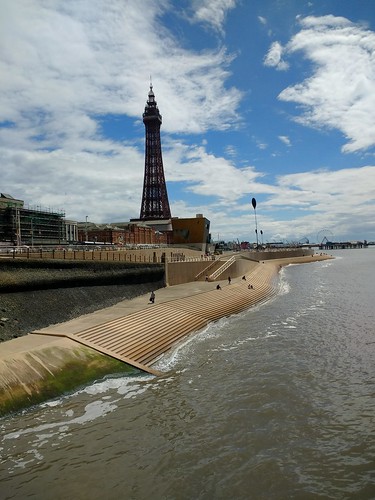
Blackpool Tower, viewed from North Pier (Trip to Blackpool)
RAILWAYS AND PRESERVATION
Preserved railways continued to be adversely affected during 2022. I continued as a member of the Old Locomotive Committee and remained a volunteer at The Battlefield Line although my activities were on a reduced scale.
The Old Locomotive Committee
The Old Locomotive Committee (OLCO) was able to orgainise the customary two events in 2022. The Annual General Meeting was held at the Museum of Liverpool where the locomotive 'Lion' is on public display on Saturday, 7th May 2022. There's s short post on my journey there here. A full report on the A.G.M. itself has been circulated to OLCO Members. The second event was 'Lionsmeet' where live-steam models of 'Lion' are run and members can meet up. In 2022, the event was hosted at the running track of Worcester and District Model Engineers, situated in Diglis, Worcester. There's a report here.

Four 'Lion' models steamed at 'Lionsmeet' 2022, Worcester. In the foreground, John Brandrick is a passenger as 'Thunderbolt' pauses, with Jon Swindlehurst waiting behind and A J Reynolds also stopped near the marquee. Meanwhile, John Dalton has the inner track to himself.
All my posts about the Old Locomotive Committee are here and you can find more information (including how to become a member) on OLCO's website here.
The Battlefield Line
New Year's Day found me on 'Foxcote Manor', carrying out the Mince Pie services. There's a report here. The next steam turn was not until June when I was on a shared turn with Adrian L, which was interrupted by a serious steam leak on the locomotive, resulting in my spending most of the day 'baby-sitting' the failed locomotive whilst a Class 33 operated the service. The full report is still in preparation but there are some pictures of the day here. Days operating the Diesel Multiple Unit are always enjoyable (and less strenuous than steam!) and I had turns on Wednesday, 10th August, Saturday 10th September and Wednesday 26th October. There are a few pictures of October working in the album here. I was supposed to operate a DMU 'Mince Pie Special' service on 30th December. Traction was changed to 'Foxcote Manor' still allocated to me but, to my immense disappointment, I succumbed to a nasty seasonal infection on Christmas Eve and was unable to perform the duty on 30th December.

'Foxcote Manor' on Mince Pie Specials (Photo: D. Mould)
Preserved Caledonian Railway 439 Class No. 419: Overall view during preparation outside Shackerstone Shed.

DMU turn, Battlefield Line, 26-Oct-2022: "Waiting for the Road" (Photo: G. Hopwood)
You can find all my posts about the Battlefield Line here.
Incidentally, you can find all my posts about Diesel Multiple Units here (or refer to the 'Index' here).
Myanma Railways
As explained in 'OVERSEAS TRAVEL' above, my last visit to Myanmar allowing study of the interesting railway system there was in 2019 and no new posts on the topic were added in 2022.
You can find all my earlier posts about Myanma Railways (in reverse date-of-posting order) here or refer to the 'Index' here.
BREWOOD HALL
Early in 2022, the organising committee (representing 2nd Brewood Scouts, Brewood Parish Church and the informal group Friends of Brewood Hall) met and agreed that we should, if possible, re-start the Annual Garden Party in 2022. I'm pleased to report that the event was held on 16th July 2022 and there's a report here.

Brewood Garden Party 2022
There's an album of pictures showing the 1-acre garden at Brewood Hall through the seasons in 2022 here with a separate album (covering a number of years) showing the fungi which appear annually here.
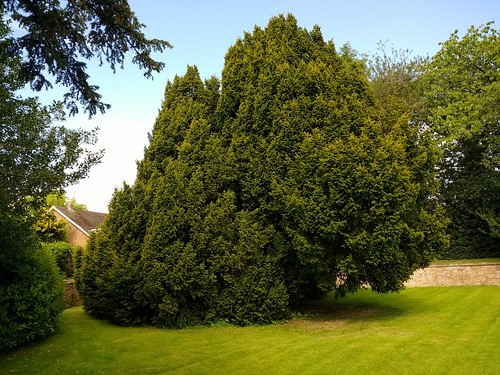
The Major Yew: Brewood Hall Garden 2022
During the year, as always, various repairs were carried out around the property. In 2022, permission was obtained from the Local Authority for tree maintenance which was carried out in July. There's an album of pictures showing the work here. Fairly extensive external repainting was carried out, repairs to the front doors and entrance porch, various roof and guttering work and some internal redecoration. You can find all my posts about Brewood Hall (in reverse date-of-posting order) here.
TY GWYN
Ty Gwyn is a small commercial woodland around 27 hectares in area near Corwen in Wales.
I made one visit in November 2022 with Dean to see the 're-spacing' work in progress. The weather was kind. There's a report here.

Ty Gwyn 2022: Looking east from the link road showing the 2016 planting
To see all my posts on Ty Gwyn, click here.
PREVIOUS ANNUAL REVIEWS
2021
2020
2019
2018
2017
2016
2015
2014
2013
2012
2011
2010
2009
2008
2007
2006