skip to main |
skip to sidebar
In early 2022, the United Kingdom was attempting to 'Live with Covid'. Pandemic restrictions imposed by law had been largely removed, although differing attitudes to social mixing existed amongst the population, according to their experiences over the previous two years. I decided to have a day out by rail. Since I was a child, Liverpool and New Brighton has been a favoured destination. My most recent visit had been in August 2021 (described here).
Events of Friday, 1st April 2022
March straddles the end of winter and the beginning of spring in the U.K. and the old adage has it that the month 'Comes in like a Lion, goes out like a Lamb'. But that didn't seem to work in 2022 when we experienced unusually balmy weather in the middle of the month which turned bitterly cold with snow in places at the end of the month. The last day of March struggled to raise the temperature much above freezing where I live, despite weak sunshine, and we experienced a number of snow showers. None-the-less, I determined to make a day trip to New Brighton the following day, despite the possible weather conditions. I booked a First Class railway ticket on-line, partly because the early booking offered useful discount compared with booking at the station, partly to discourage me from changing my mind and cancelling the trip.
It was a cold, frosty but dry morning on 1st April. With some reluctance, I arose early and caught the first bus from Brewood to Wolverhampton at 07:30. This gave me plenty of time to walk to the railway station where the huge, new building on platform 1 appalled me yet again before I made my way over the older of the two footbridges to platform 2 to wait for the 08:21 to Liverpool Lime Street.
I believe passenger figures nationwide are still only around 60 or 70 per cent of pre-pandemic levels so I was fairly surprised at the numbers waiting to board the train, formed of two 4-car Class 350 'Desiro' Electric Multiple Units (EMU). I made myself comfortable in the First Class section and we made an on-time journey to Liverpool.
To my delight, on arrival, sunlight was flooding in through the impressive train shed roof at Liverpool Lime Street so, as usual, I purchased a 1-day All Zones 'Saveaway' ticket from the booking office on the main concourse. Although Railcards are not valid for this ticket, at £5.65 for virtually unlimited travel by bus, train and Mersey Ferry within Merseyside, this is an attractive choice.

Liverpool Area Rail: Lime Street station Main Concourse in 2017
Armed with this ticket, I went down the escalator to the pedestrian passage leading under busy Lime Street to access the deep-level single Merseyrail platform situated on the Liverpool Loop via another escalator. I'd decided not to visit Liverpool Museum first, but to head straight to New Brighton. Services are still provided by elderly Class 507 and 508, built by British Rail Engineering Limited (BREL) at York, since refurbished but overdue to be replaced by Statler Class 777. For more information on all these electric trains, see 'Related posts on other websites' below. On previous journeys through Crewe and on my way to Liverpool that morning, I'd seen Class 777 at Crewe Traincare Depot but I've not yet seen these units in the Liverpool area, where test running with 'ghost trains' is supposed to be happening prior to introduction on public services later in 2022.

New Class 777 at Crewe Traincare Depot (Return to New Brighton)
I boarded the first train to arrive, a careworn but game Class 507/508 heading for West Kirby. I pondered whether to stay on this service to West Kirby but as we made our way under the River Mersey through the remarkable tunnel first opened in 1886 (described in a post here), I decided to alight at Birkenhead Park and wait for the next New Brighton Train.
Birkenhead Park now has just one island platform but was originally the interchange between the Mersey Railway and the Wirral Railway and must have once been a frantic place with trains from both directions terminating and steam locomotives running round. The LMS electrification of the Wirral Lines in the 1930s ended this activity and allowed trains to run through to Liverpool. I walked up the long, stepped ramp to the street to check out the undistinguished modern station building but decided not to walk to the famous park (which claims to be the first publicly-funded park in the world) giving the station its name but instead returned to the platform for the New Brighton Service and a speedy (if noisy) journey to my destination.
I always admire the simple, airy design of the booking hall at New Brighton station, but I'd not seen the piratical character swinging from the roof before, whose significance, other than to reinforce the maritime credentials of the location, eludes me.

Piratical figure hanging from the roof at New Brighton station (Return to New Brighton)
Immediately outside the station, the promenade is visible, about 400 yards away, looking north down Atherton street.

Looking north down Atherton Street from the station (Return to New Brighton)
I normally prefer to take the longer route east down Victoria Road, passing one of New Brighton's examples of modern public art (a series of mermaids). Bewilderingly, the figure near the staion is extensively tattooed and titled 'The Inked Siren of Black Rock'. The road leads past St. James Church (1856, Gothic Revival style by George Gilbert Scott) and Wallasey Post Office.
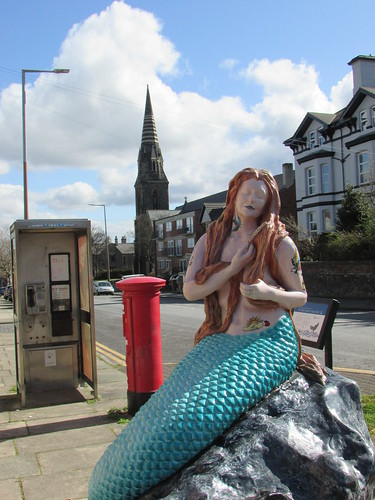
The Inked Siren of Black Rock (Return to New Brighton)
On my previous visit in August 2021, I saw my first knitted 'postbox topper' at Wallasey Post Office: I discovered it now showed a topical Easter theme.

Easter-themed 'postbox topper' at Wallasey Post Office (Return to New Brighton)
I continued on Victoria Parade to the promenade where it was near high tide but I still couldn't resist spending a few minutes on the small patch of golden sand remaining.

New Brighton Beach: Fort Perch Rock, Lighthouse and Seatruck Ro-Ro ferry departing for Dublin (Return to New Brighton)
This part of the beach provides views across the estuary of the River Mersey to Seaforth Docks just 1 mile away and the Liverpool 2 Deepwater Port where container ship MSC MANDY was berthed. Built in 1993 and Panama-flagged, this ship is 237m long and 32m wide with a DWT of 48,852. Afterwards, I learned she'd arrived late the previous evening and after a 2-day stay left for Portugal, Spain and Montreal.

MSC MANDY berthed at Liverpool 2 (Return to New Brighton)
Fort Perch Rock is still closed but a banner promises 'The Ultimate Live Action Escape Room Experience' once the website at 'escapethefort.com' is open. I made my way onto the north-facing beach to admire the lighthouse and then take in the less-admirable appearance of the Burbo Bank Offshore Wind Farm to the west. I still haven't identified the intriguing maintenance vessel in amongst the wind turbines.

New Brighton Lighthouse, decommissioned 1973 (Return to New Brighton)

Burbo Bank Offshore Wind Farm showing maintenance vessel with jack-up legs and crane (Return to New Brighton)
The pleasant weather had encouraged lots of people to take a stroll but the between-the-wars block of cafes and amusement arcades facing the Marine Lake remained firmly shuttered.

"... the between-the-wars block of cafes and amusement arcades facing the Marine Lake remained firmly shuttered." (Return to New Brighton)
I walked back to the station, pausing for an enjoyable English breakfast at the Smuggler's Cave cafe I'd used on my last visit. The timetable was showing four departures every hour to Liverpool but the next was shown as cancelled so, whilst waiting, I studied, with approval, the building repairs which have been completed.
The 3-car electric arrived and discharged quite a few passengers. By the time we left, there was a fair passenger loading and we returned, stopping at all stations, losing and gaining passengers at each stop. I got off at Birkenead Hamilton Square and took an electric lift to the surface. Originally, the lifts were hydraulically worked and the impressive tower housed the hydraulic accumulator.

Hamilton Square station, Birkenhead, viewed from Hamilton Square (Return to New Brighton)
Checking the time of the next ferry to Liverpool, I decided I'd time to first briefly re-visit nearby Hamilton Square which lends its name to the railway station.
The 63 elegant late-Georgian houses erected between 1825 and 1844 were designed by James Gillespie Graham and all are now listed Grade I. Even the parked cars, wheelie bins, rooftop television aerials and a myriad satellite dishes fail to destroy the impact of these well-proportioned buildings. The serried ranks of chimney pots atop the roof serve as a reminder of just how labour-intensive such dwellings were in the age of heating by coal fires, necessitating armies of servants.

Hamilton Square, Birkenhead (Return to New Brighton)
Satisfied with my short visit to Hamilton Square, I walked towards Woodside Ferry Terminal, passing Shore Road Pumping Station. This impressive building was built by James Brunlees and Charles Fox around 1886 to house two large Grasshopper Beam engine pumps supplied by Andrew Barclay needed to remove water from the Mersey Railway Tunnel. Following the installation of electric pumps in 1959, one of the original pumps was restored and, known as the 'Giant Grasshopper' the building was opened to the public as a museum. I was fortunate enough to visit once years ago and, despite being the only visitor, the attendant operated the pump mechanism for me (using compressed air rather than steam). Sadly, by 2014 public opening of the museum had ceased.

Shore Road Pumping Station, Birkenhead (Return to New Brighton)
I discovered that a number of wooden sheds had appeared adjacent to the Ferry Terminal at Birkenhead Woodside forming a retail initiative called 'Woodside Food & Market' and 'Woodside Makers Bakers & Creators Market'. It was closed on my visit but I believe opened over Easter (and, sorry, I think the organisers, Woodside Ferry Village, call the sheds 'chalets').

'Woodside Food & Market' and 'Woodside Makers Bakers & Creators Market' adjacent to the Ferry Terminal at Birkenhead Woodside (Return to New Brighton)
After a few minutes, the ferry 'Snowdrop' appeared, heading upstream towards the landing stage. Seacombe terminal remained closed so the ferry had come directly from Pier Head, taking a downstream loop so that passengers had had a view of some of the riverside features during the journey.

'Snowdrop' arriving at Birkenhead Woodside Landing Stage (Return to New Brighton)
On the ebb tide, the ferry came directly alongside (starboard side to the landing stage) and passengers quickly disembarked. Once on board, I took up my usual position on the upper foredeck ready to study the departure.

'Snowdrop' at Birkenhead Woodside Landing Stage (Return to New Brighton)
On the return journey, the ferry makes an upstream loop, whilst the pre-recorded commentary describes the riverside features. As we passed Monk's Ferry, I decided I really must plan a visit to the remains of Birkenhead Priory and St. Mary's Church. There's a detailed website here.

Monks' Ferry, Birkenhead with St. Mary's Church in background (Return to New Brighton)
There was the usual cluster of Royal Navy vessels at the Cammell Laird shipyard. In the Wet Dock, Replenishment Tanker A136 'Tidespring' was back. I'd seen it there on a 2019 visit (report here). Also in the Wet Dock was Type 45 Destroyer D33 'HMS Dauntess'. A second, unidentified Type 45 was in dry dock.

L-R: D33, A136, unidentified Type 45 at Cammell Laird, Birkenhead (Return to New Brighton)
The ferry continued past Tranmere, where EVA MAERSK was moored, with the usual attendant tug. Afterwards, I found that EVA MAERSK, a crude oil tanker, was built in 2017, registered in Denmark, 274m long, 50m beam. She'd arrived a couple of days before from Ingleside, Texas and departed later the day I saw her for Scapa Flow.

EVA MAERSK at Tranmere (Return to New Brighton)
The ferry then made a wide turn to port so as to cross to the Liverpool side of the river. A chill wind then hit the exposed deck and, within a minute or two, I was the only passenger left outside. Our turn offered a view of Seacombe Landing Stage with the new linkspan bridges fitted. Afterwards, I found pictures of the installation taking place in October 2021 in the 'Wirral Globe'. The heavy lift was carried out by Liverpool's resident floating crane, LARA 1 (mentioned in my earlier report here).

Seacombe Landing Stage, still closed but showing the new linkspan bridges installed in October 2021 (Return to New Brighton)
Tug/Fire Fighting Ship SVITZER AMAZONAS, going upriver, crossed behind us and I managed a reasonable picture. The Peel Ports website offered fairly comprehensive technical data here.

Tug SVITZER AMAZONAS, going upriver (Return to New Brighton)
Approaching the landing stage at Pier Head, I was surprised to see another naval vessel moored at the Liverpool Cruise Terminal. Although oddly anonymous and without flags, it still carried the identity A386 so, afterwards, it was a simple task to identify the vessel as the former Royal Fleet Auxiliary dry stores ship 'Fort Austin', decommissioned with sister ship 'Fort Rosalie' in 2021 and sold to the Egyptian Navy. I'd seen 'Fort Austin' in the Cammell Laird shipyard back in 2016 (see report here) and, previously in 2014, found 'Fort Rosalie' in the West Float at Birkenhead (see report here).

Former former Royal Fleet Auxiliary dry stores ship A386 'Fort Austin' at Liverpool Cruise Terminal, decommissioned and sold to Egypt (Return to New Brighton)
Because the tide was still ebbing, the ferry first went downstream of the landing stage and then turned to starboard so as to put the port side of the vessel against the landing stage. As we moored, I took (another) picture of the iconic Liver Building and noted that, once again, there seems to be a problem with the clock.

The Liver Building, Pierhead, Liverpool, with clockface facing river showing wrong time (Return to New Brighton)
Passing the statue of the 'Fab Four', I finally took my own picture showing the compulsion people seem to have to be photographed with the rather oversized figures of the Beatles.

Photograph with the Beatles, Pier Head, Liverpool (Return to New Brighton)
I made a quick visit to Liverpool Museum to check on the locomotive 'Lion' in the Great Port Gallery (discovering that not all the audio-visual presentations were working).

The Footplate of 'Lion' in the Museum of Liverpool (Return to New Brighton)
It was only a little after two o'clock and I pondered what to do next but, noting that my energy levels were falling rapidly, I decided that the sensible course would be to go to Lime Street and catch the 15:05 West Midland Trains back to Wolverhampton. It didn't take as long as I allowed to walk to James Street Merseyrail station, descend to the platforms by lift, catch the electric train to Liverpool Lime Street Low Level and take the escalators to the main station so I was back on the main concourse for about half past two with a while to wait for the planned 15:05 departure. The arrival of an Avanti 'Pendolino' prompted me to check its departure time (14:47) and stops (Runcorn, Crewe, Stafford). The second member of platform staff I asked confirmed my ticket was valid on Avanti (the first, although dealing with passenger enquiries didn't know) so I plodded down the platform towards the remote First Class section. I discovered Avanti now have a section of Standard Premium seating and, with legs aching, I decided that would do.

Avanti West Coast Standard Premium seating (Return to New Brighton)>
The journey to Stafford was comfortable and uneventful. I finally managed a reasonable picture of the now-decommissioned Fiddler's Ferry Power Station which could produce a staggering 1,989 MW of power from its four 500 MW alternators. Don't start me on the national self-harm caused by deliberately destroying proven plant like this before robust replacement solutions are in place.

Fiddler's Ferry decommissioned power station viewed from train approaching Runcorn
Apart from some expected wind chill on part of my ferry crossing, the weather had been grand but we arrived at Stafford on time in a heavy sleet storm. My intention had been to change at Stafford for a Wolverhampton train but I suddenly felt very cold so decided I'd take a taxi home. But it was not to be - there were no taxis - so I doubled-back into the station and located the platform for a Wolverhampton train in just a few minutes. At least there was no sleet on arrival at Wolverhampton and I gratefully climbed into a taxi for home having had a most enjoyable day.
Related posts on other websites
Class 507 (Wikipedia)
Class 508 (Wikipedia)
Class 777 (Wikipedia)
Birkenhead Priory
Svitzer Amazonas data.
Related posts on this website
A day trip to Liverpool (2021)
On foot around Liverpool Docks (2) (2014)
Merseyside in December (2016)
Birkenhead and New Brighton by train (Part 2)
To see all my Merseyside posts Click here or select label 'Merseyside'.
My pictures
Liverpool area rail Earlier pictures
Merseyrail Earlier pictures
Return to New BrightonPictures on this trip
Depending on the display device, the right hand edge of pictures may not display. To see an uncropped image, click on the picture. Alternately, you can find the image by following the 'My pictures' links and display or download the image in various resolutions.
When I was growing up after World War II, railways in Britain went through major changes. There's a very brief introduction to this period here.
British Rail started to electrify part of the network at 25kV a.c. using Electric Multiple Units (EMU) for generally shorter-distance passenger services but a series of 100 electric locomotives were initially produced in 1965-1966 for haulage of conventional passenger coaching stock and freight trains. Sixty locomotives were built by English Electric at the Vulcan Foundry in Newton-le-Willows and a further forty by British Rail at Doncaster. Originally designated 'AL6', they were re-classified Class 86 in 1968 with the introduction of the 'TOPS' fleet management system.
With the Privatisation of the railway network in 1994, operation of trains and track was split, with trains franchised to a miscellany of Train Operating Companies and the ill-starred Railtrack taking over the network. In January 1997 Virgin Trains acquired the Cross Country and Inter City West Coast franchises which it operated until November 2007. The Virgin CrossCountry franchise had 19 Class 86 locomotives in the fleet with the Virgin livery being applied from 1998. One locomotive-hauled electric service ran from Manchester Piccadilly to Birmingham International and the events described below were in this period. Later, in 2001, Class 220 'Voyager' and Class 221 'Super Voyager' diesel-electric multiple unit trainsets built by Bombardier started to displace the loco-hauled passenger services from Manchester and this changeover was complete by the end of 2002.
Only once have I had a 'hands-on' experience with a Class 86 electric locomotive. It happened like this. A few days before my Class 86 experience, I'd been driver at Peak Rail when we had a private charter for a group of railwaymen. Our motive power at the time was the customary 'Austerity' six-coupled saddle tank. In addition to the catering on the train, it had been arranged that a few of the group would be allowed to have the opportunity to drive under supervision. As far as I could tell, they were all serving or retired locomen. It was interesting to see how the younger drivers, without previous experience of steam traction, were fascinated by the techniques of managing a steam locomotive. It was quite a jolly occasion and I'd enjoyed meeting this group of professionals.
On the day of my own 'hands-on' experience, I intended to travel from Wolverhampton to Birmingham New Street for some long-forgotten but not-very-vital purpose and the first train to Birmingham was a Virgin CrossCountry Manchester to Birmingham service. As the train arrived with a Virgin-liveried Class 86 at the head, I was surprised to see the driver wave at me, so I walked to the leading cab by which time the driver was standing at the open cab door. I was amazed to find it was one of the drivers I'd met on the Peak Rail private charter. He apologised that we hadn't time to talk but explained that his destination was Birmingham International where he'd run round and, a little later, work back to Manchester. I decided to abandon my original plan and instead travel to Birmingham International so that we might have a chat. I jumped aboard the train and for most of the journey pondered the chances that the train I decided to catch was driven by somebody I'd met and that the driver had recognised me standing on the platform as I watched the train arrive.
When the train arrived at platform 2 at Birmingham International, I walked up to the cab and was welcomed inside. My friend explained that, once uncoupled by the resident shunter, he would run round to the north end of the stock and then have a break in the train's buffet car. I offered to meet him at the other end of the train after the run round but, instead, found myself ushered into the driving seat. I was given a rapid course in moving the locomotive. I recognised most of the controls and indications on the driver's desk but found the large six-position Main Controller Handle (Off/Run/Notch Down/Hold/Notch Up/Run) rather odd.

Click for larger view
Arrangement of Class 86 driver's desk (from Proceedings of B.R. Electrification Conference 1960)
Checking that the signal was 'off' for us to proceed, I followed the instructions and the locomotive moved ahead. I was happy with the speed for a shunting move, but my friend instructed me to 'notch up' to a higher speed saying "They don't like us to hang about on the main line carrying out shunting moves". I could see the point. My experience is generally on fairly short run-rounds on preserved lines but Birmingham International is designed with generous proportions and turnouts for quite high speed running. From the time the signalman set the route for us to move away from the train until the time we approached the other end of the train, the Down line remained unavailable for any other movements. We travelled forward about a quarter of a mile before we cleared the turnout which needed to switch to allow us to change direction and run past our coaches on an adjacent platform road. As well as clearing the turnout itself, we needed to move beyond the end of the track circuit protecting the turnout otherwise track circuit occupation would prevent the signalman from setting the route for us. The signalman was miles away from us at Birmingham New Street Power Signal Box and so relied entirely on the local interlocking to safeguard the moves and the remote indications presented to him to interpret the situation. Having successfully stopped in the right place using the 'Straight Air' brake, we then had to 'close the cab' and 'change ends' to the cab at the other end, walking along the passage through the equipment room past a mass of complex control equipment, deafened by the noise of the various blower motors and compressors.
I was placed in the new driving seat and given a series of instructions to 'open the cab', check the signal, get the locomotive moving and 'notch up' to the required speed. As we approached the station, the driver slipped back into the driving seat and I stood nearby, not hidden but clearly not driving. This subterfuge made me think of an unofficial footplate ride many years before on a steam locomotive approaching Crewe (described here) when I learnt that 'There's always somebody at Crewe on the look-out for trouble'. "Maybe Birmingham International too" I thought to myself. As we passed clear of the platform, we changed roles again and I was allowed to bring the locomotive to a stand clear of the signal which, when 'off', would allow us to move onto our train. We changed ends again, having travelled around three-quarters of a mile along the down line from where we first changed ends.
For the final time, I set us in motion but, again, as we approached the platform the driver resumed his seat and finished the move, braking gently and firmly buffering-up to the coaches, allowing the resident shunter to 'hook on' to the waiting train. Having checked that the locomotive was safe to be left the driver invited me to join him in the buffet car for a chat.
The buffet crew were very friendly and, as the driver and I talked, I was plied with various refreshments. After a very agreeable time, I decided I'd not outstay my warm welcome but take the next train back to Birmingham New Street and carry out my original planned leaving the driver to his break before he drove the train back to Manchester. A marvellous, unexpected experience and I was very grateful for the generosity of my driver friend.
I'm sorry, I can't confirm the date or the locomotive involved and there are no photographs. That was, I think, the third electrically-powered locomotive I'd driven (as distinct from diesel-electric power). The first was the Dick Kerr battery shunting locomotive at Manchester Museum of Science and Industry - a very useful machine with control gear similar to early electric trams. The second was not a conventional electric locomotive but a narrow-gauge prototype tram made by Parry People Movers. When in the station, a connection to an electric supply powered an electric motor connected to a large flywheel which absorbed energy by being spun at high speed. This stored energy was then used to drive the tram to the next station, where the flywheel was 'spun-up' again electrically. I'd also spent some time in the cab of Manchester-Sheffield-Wath Class EM2 at Manchester Museum of Science and Industry when all the auxiliaries and pantograph could be exercised and 'driving' practised, without actually moving the locomotive, so I don't count that (but there's a brief description in the post here.
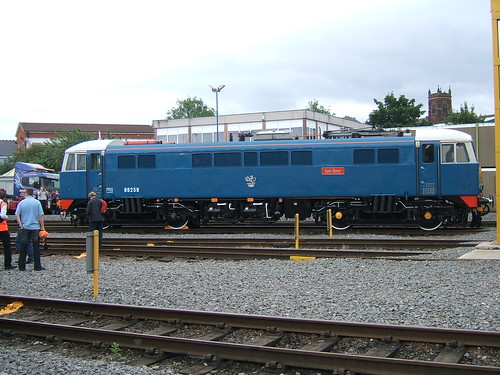
Privately-owned Class 86 electric 86259 'Les Ross' at 'Tyseley 100' in 2008.
Related posts on other websites
British Rail Class 86 (Wikipedia).
British Rail Class 86 Electric Locomotive (rail.co.uk site).
The Life and Times of Locomotive 86259
Related posts on this website
The Modernisation of British Railways
'Black 5' to Birmingham
Class 'EM2' D.C. Electric
[Links added: 22-Dec-2023]
At the end of 2021 the Battlefield Line secured 'Foxcote Manor' at short notice to work the Christmas season trains. My first turn on 'Foxcote Manor' was on 19th December 2021, as described in the post Battlefield Line 'Santa' Trains 2021 (which includes a brief introduction to the 'Manor' class).
Once the programme of 'Santa Specials' was complete there was a short break then a series of 'Mince Pie Specials' was operated, extending to the 3rd January 2022. I was rostered to drive on New Year's Day, with Stephen W. as fireman. I correctly anticipated that we'd still be running with a six coach train, limiting our opportunities for taking water, as explained in my post about my 19th December 2021 turn here. On New Year's Day, we were able to ensure that the tender was full before we moved out of the shed, as evidenced by water overflowing from various locations including the tender water gauge before the hose supply was turned off. Stephen had already set the fire and he was happy to share the oiling-round with me so we spent some time completing the examination and applying oil as required in companiable silence. By the time we'd completed this task, there was sufficient steam to move the locomotive just outside the shed in time to carry out some cleaning.
Until Nationalisation of railways in 1948, Great Britain's lines had been dominated by the 'Big Four' (LMS, GWR, LNER, SR), each with their own system for locomotive running numbers. British Railways integrated these numbers into a single series, generally by adding a 'fifth digit' representing the former owning railway in front of the old number. The Great Western had always used brass nameplates on the cab sides for the locomotive number so, in view of the cost of replacing these, former Great Western locomotives retained their original number. The other railways had normally used numbers painted on the cab sides, so they had to apply a prefix, ultimately a number but, for a time, the LMS used the prefix 'M' before the original number.

'Foxcote Manor' outside the shed at Shackerstone in British Railway's 'Mixed Traffic' livery of black (currently unlined) on New Year's Day 2022 (Battlefield Line)
In addition to the cabside numbers, most locomotives also carried the number at the front. The Great Western had always painted this, using yellow 'shaded' characters, on the front buffer beam, generally with a letter code indicating the 'home shed'. These painted identifications were removed and a cast iron numberplate was mounted on the smokebox door, in line with the other railways.
Motive Power Depots were also renumbered in a British Railways series which was an extension of the former LMS scheme (see Wikipedia article here) and a cast 'shedplate' was added. '84G', carried by 'Foxcote Manor', was Shrewsbury which provided motive power for the major passenger traffic on the Cambrian line.

'Foxcote Manor' outside the shed at Shackerstone showing smokebox door with cast number and cast shedplate
When the signalman opened the box, we shunted across to the train, nice and early, 'hooked-on' and started steam heating the stock. There was a little drizzle and we discussed rigging the 'storm sheet' between engine and tender but agreed not to do this unless the weather deteriorated. In fact, the drizzle stopped, the weather improved and it became a pleasant day although not very warm.
I'd assumed that the 1st of January would be a quiet day with people recovering from a late night on New Year's Eve but, in fact, there were already plenty of visitors around by the time we came off shed and it was very pleasant to be carrying good passenger numbers throughout the day. The 'normal' 4-round trip service was being operated, with departures from Shackerstone at 11:00, 12:30, 14:00 and 15:30. The usual timings applied, allowing a line speed of 25 m.p.h. except where lower limits were mandated.
We set off on our first run a little late, waiting for passengers to board, collected the single line staff at the signal box and proceeded up the bank to Barton Lane Bridge at the prescribed 10 mph. Beyond the bridge, we could gently accelerate to Line Speed. Tender first, the 3,500 gallon tender we were propelling allowed a much better view of the line than with the larger 4,000 gallon tender of a 'Hall' but it was also noticeable how exposed to wind the crew are travelling in this direction.
Market Bosworth station had re-opened to passengers and it was gratifying to see people alighting and boarding there. Shenton also had plenty of people around but Stephen and I were kept busy running round our train ready for our return journey.
On receipt of the 'right away' from the Guard, we made a gentle departure, complying with the 5 mph speed restriction because of the embankment 'slip' until clear of Ambion Lane bridge. Speed was then allowed to rise up Shenton Bank using full first valve on the regulator and adjusting the cut-off for best economy. The picture below shows the fireman's view looking ahead on Shenton Bank, with the Belpaire firebox cladding sheets pierced by four sunken washout plugs in a horizontal line with the domed cover of a fifth washout plug visible on the top front corner.

Fireman's view ahead on Shenton Bank (Photo: D. Mould)
We made our scheduled stop at Market Bosworth then continued to Shackerstone, where our arrival on platform 2 was watched (and photographed) by vistors on both platforms and the footpath leading to the engine shed.

'Foxcote Manor' arriving in platform 2 at Shackerstone on a Mince Pie Special (Photo: D. Mould)
With six coaches, we had to stop with the engine fouling the foot crossing to platform 1 so we quickly uncoupled and moved forward, allowing passengers to use the crossing. Once the passengers had finished crossing, we moved tender-first over the crossing into platform 1 where we stopped, to allow visitors the chance to photograph the engine.

'Foxcote Manor' poses for visitors outside the Victorian Tea Room at Shackerstone.
The cabside view below of 'Foxcote Manor' shows the 'Collett Cab' which was deeper (front to back) than Churchward's design. Both designs have a recess in the rear of the cab sheet, allowing the crew to lean out for better visibility but Collett's deeper cab had space for a brass-framed side window. The rearward extension of the cab roof is helpful, too (although less so when running tender first). The cab is narrow enough to accomodate a rather precarious footway outside, allowing enginemen to access the main foot-framing directly from the cab, assisted by an 'L'-shaped handrail provided near the side window. The cab side carries the painted route code circle in blue with the letter 'D' inscribed representing power classification (equivalent to British Rail 5 Mixed Traffic). The iconic GWR cast brass numberplate '7822' is mounted lower down the cab side.

Cabside view of 'Foxcote Manor' on Mince Pie Specials (Photo: D. Mould)
After the pause for photographs, we completed the run round, ready for the second round trip. The day continued very agreeably with our second, third and final round trips. Our engine steamed well and gave us no concerns, although it was clear that she'd put in significant mileage since the last heavy repair. Steve, in particular, had a tiring day with the firing and hooking on and off at each end of the line but we were both quite tired by the time disposal was complete.
A few days after my 'Mince Pie Special' driving turn, issue 289 of the magazine 'Heritage Railway' appeared with a picture of 'Foxcote Manor' at Shackerstone on the cover. Inside, a 6-page colour spread in their series 'PRESERVED LINE PROFILE' provided a good introduction to the Battlefield Line.

Heritage Railway Cover (Issue 289 Jan 21-Feb 18, 2022)
'Manor' Musings
This was my second turn on 'Foxcote Manor' during her short visit before returning to normal duties on the West Somerset Railway. Although sister engine 'Dinmore Manor' had previously visited the Battlefield Line, I hadn't had a driving opportunity so my previous experience of 'Manors' was many years earlier, limited to a delightful running-in and demonstration turn with 'Dinmore Manor' when the locomotive emerged from Tyseley Locomotive Works, plus a firing turn on 'Bradley Manor' at the West Somerset Railway. 'Foxcote Manor' had been hired-in at short notice to replace 'Wightwick Hall' which had been used during the 2021 season, so it was natural to compare 'Foxcote Manor' with 'Wightwick Hall'. After all, they're both Great Western 4-6-0 designs with two outside cylinders and, although both classes are credited to Collett, they remain firmly of Churchward lineage. There are technical differences between the classes, best understood by considering the third, intermediate design stage - the 'Grange' class.
Hall and Modified Hall class
The 'Hall' class is effectively a 'Saint' with smaller coupled wheels (six feet diameter rather than the 6 feet 8 and a half inch diameter of the 'Saint') but with the same boiler and cylinders (18-1/2 inch diameter with a 30 inch stroke).

Click for larger view
'Modified Hall' Class from British Locomotive Types 1946 (Railway Publishing Co. Ltd.)
No 'Saint' locomotive was preserved but there is now a reconstructed 'Saint' produced by converting a donor 'Hall' into 'Lady of Legend' by Didcot Railway Centre as described here.

Click for larger view
'Saint' Class from British Locomotive Types 1946 (Railway Publishing Co. Ltd.)
Grange class
Back in 1911, Churchward had introduced the '43XX' class of mixed traffic 'Moguls'. They were well-liked, very successful and with good route availability resulting in over 300 being built. By the mid-1930s, earlier '43XX' were in need of replacement and increasing loads suggested an increase in power was also desirable. Collett decided on a 4-6-0, rather than a 2-6-0, wheel arrangement which became the 'Grange' class, keeping the accountants happy by re-using the 5'8" diameter coupled wheels and motion from withdrawn '43XX'. The 'Grange' is based on a 'Hall' with smaller coupled wheels (5 feet 8 inch diameter rather than the 6 feet of the 'Hall') but with the same boiler and cylinders (18-1/2 inch diameter with a 30 inch stroke). No 'Grange' locomotive was preserved but there is a project nearing completion to reconstruct a 'Grange' (see the website here). The 'Grange' class was very popular with footplate crews. It's often called "the enginemen's engine". It had a particular reputation for being free-steaming (perhaps oddly, as it used the same boiler as the 'Hall) and for pulling-power (whilst it had the same-sized cylinders as the 'Hall', there were some differences in the steam passages and, of course, the smaller coupled wheels gave a tractive effort advantage over the 'Hall'). Although I remember seeing 'Granges' in traffic during my childhood, I'm afraid the technical niceties were rather lost on me then.
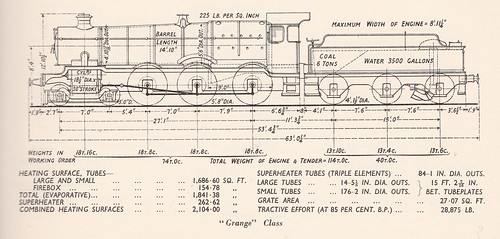
Click for larger view
'Grange' Class from British Locomotive Types 1946 (Railway Publishing Co. Ltd.)
Manor class
However, the increased weight of the 'Grange' compared with the '43XX' restricted the new class (like Collett's 'Halls') to 'Red Routes'. So Collett also designed a smaller 4-6-0 design which became the 'Manor' using a new 'lightweight' boiler (Swindon No. 14), the lower axle loading allowing use on 'Blue Routes' in the West Country and Wales. The 'Manor' had slightly smaller cylinders (18 inch diameter rather than the 18-1/2 inch diameter of the 'Grange', but with the same 30 inch stroke) together with other changes.

'Manor' Class from British Locomotive Types 1946 (Railway Publishing Co. Ltd.)
Click for larger view
Related posts on other websites
Foxcote Manor Society.
7800 'Manor' class introduction (The Great Western Archive).
GWR 7800 Class (Wikipedia).
'Betton Grange' 6880.
'Lady of Legend' 2999.
Related posts on this website
Battlefield Line 'Santa' Trains 2021.
All my Battlefield Line posts.
My photograph albums
Where necessary, clicking on an image above will display an 'uncropped' view or, alternately, pictures may be selected, viewed or downloaded, in various sizes, from the albums listed:-
'Foxcote Manor' at the Battlefield Line.
All my Battlefield Line pictures.
In January 2022, I had two business meetings in Wales, the first in Fflint, the second in Saint Asaph. In both cases, I travelled to the meeting by road but returned home using rail transport. It's the return journeys by rail which are described here. The North Wales railway line has fairly easy gradients as you can see from the gradient diagram below.

Gradient diagram Crewe - Holyhead
Click for larger view
In the age of Covid, travelling by rail is a rather changed experience. During the Coronavirus Pandemic, rail passenger numbers are around half of normal, with 'emergency timetables' in use and increased likelihood of train cancellation at short notice as staff 'self-isolate' following positive tests for Covid-19. Since Welsh Devolution, certain matters, including Public Health, are devolved to Cardiff so some laws in England and Wales differ, complicating running a UK-wide railway system.
Fflint 11th January
Following devolution the Welsh spelling 'Fflint' is normally used, rather than the English 'Flint'. Previously, I'd been through the town by road many times, once stopping to visit the ruined castle (Flint Castle). On many rail journeys into Wales I'd passed through the station, but this was to be the first time I'd boarded a train there. I'd previously looked up the 'emergency timetable' to determine the available services, depending on what time the business meeting finished. I was unlikely to finish in time to catch an Avanti 'Voyager' service from Holyhead to Crewe. Later services were Transport for Wales (TfW) Diesel Multiple Unit (DMU) and involved a change at Chester for either the DMU shuttle to Crewe or, alternatively, a TfW service via the former Great Western route through Wrexham and Shrewsbury. Some TfW services from Fflint didn't require a change at Chester as the train reversed direction at Chester, retracing the incoming route back to Saltney Junction before diverging onto the Wrexham route.
I was given a lift to Fflint station after the meeting. The 2-storey main station building on the Down side, next to the modern car park, looked interesting but, with the passenger displays showing '15:28' actual time and the 15:29 departure to Chester reported as 'On time', I decided to postpone both studying the architecture and purchasing a ticket. I hurried through the building onto the plaform and ascended the steps of the LNWR-pattern footbridge to reach the up platform, with its single-storey station building, as the 2-coach 'Sprinter' operating from Llandudno Junction to Manchester rolled to a stop.
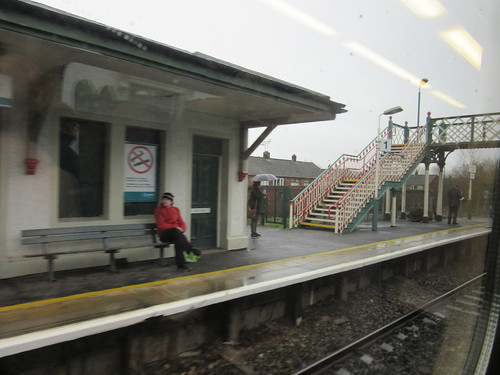
North Wales Line (Crewe - Llandudno): Up side station building and footbridge at Fflint in 2016.
I boarded the train which departed immediately, with one intermediate stop at Shotton Low Level, arriving at Chester 'right time' at 15:48 which left me six minutes to cross the footbridge to platform 1 where a TfW 'Supersprinter' provided the non-stop DMU shuttle to Crewe. We made another on-time arrival at 16:19 in platform 9 at Crewe. The next departure to Wolverhampton was not until 16:53 when the West Midland Trains Electric Multiple Unit (EMU) service from Liverpool Lime Street to Birmingham was due to make a stop. That gave me plenty of time to go to the modern 'gate line' on the overbridge and purchase a Fflint - Wolverhampton ticket from the three friendly ladies manning the ticket barrier.
The station was dark and rather cold so when I discovered a Liverpool-London Avanti 'Pendolino', due in a few minutes, called at Stafford, I decided to abandon platform 6 (for the Liverpool-Birmingham) and use the overbridge to reach platforms 1 to 5 to board this earlier train, alighting at Stafford to wait for the West Midland Trains service to catch up.
Walking along platform 5 from the overbridge, I just had time to record some scaffolding which had been erected around three of the cast-iron columns supporting trusses for the overall roof.
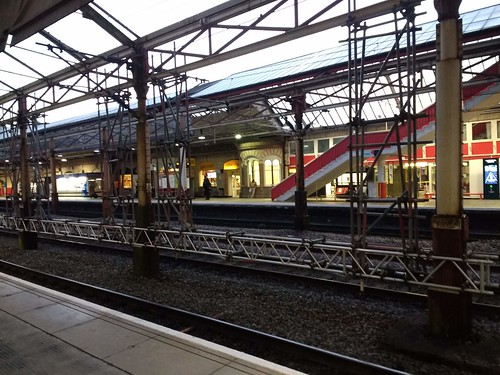
Crewe: Repairs to roof supports
I've always admired the complex overall roof at Crewe, which I've assumed dated from the major extensions to the station carried out by the LNWR around 1900, although now heavily modified. During electrification of the line, the cast columns supporting the roof were externally clad for strength and some of the columns were given a second role as anchor points for the Overhead Line Equipment, as shown in the picture below

In 2013, a Manchester-bound 'Pendolino' arrives in Platform 5 at Crewe. Note Overhead Line Equipment mounted on strengthened columns supporting the overall roof trusses.
I assumed that the scaffolding was in connection with further reinforcement for the cast colums but I hastened to platform 1 where the London-bound 'Pendolino' was quietly stopping.
One other passenger and I boarded the last coach, a 'Quiet' coach. We were the only occupants. The fast journey to Stafford, taking only 20 minutes, was very relaxing compared with the ambient noise in the two previous DMU trains. I changed my plans and decided to get a taxi home from Stafford, rather than Wolverhampton - a longer mileage but it would save time
Rhyl 27th January
After the meeting at Saint Asaph, I was given a lift to Rhyl station, with 30 minutes to wait for a train. Although I'd travelled through Rhyl many times, it had probably been half a century since I set foot there. The buildings have been renovated and I was able to purchase a ticket at the staffed ticket office before passing through the modern automatic ticket barrier onto the platform to wait for the 17:44 departure. The former importance of Rhyl as a tourist destination was apparent from the width of the platform and the extensive station buildings. The simplification of the once-complex track arrangements has left only two through platforms facing one another across the space where once non-stopping trains thundered past on 'fast' lines. The Down 'fast' remains but the Up 'fast' has been removed. Fully modernised signalling now extends through Rhyl, currently as far as Abergele, with partially-updated traditional methods beyond to Holyhead.

Rhyl station. Platform 1 looking towards Holyhead
The width of the steps leading to the footbridge again testified to the large numbers of holiday-makers once handled at this station.

The broad steps to the passenger footbridge at Rhyl station.
I couldn't resist ascending the steps to confirm the width of the passenger walkway. This is divided by a girder from a similar, parallel baggage bridge provided with lift towers on the two platforms installed to raise and lower the once-needed procession of trollies of passengers' luggage, parcels and post using electric lifts (elevators). I was amused by the short ladder installed to allow station staff to climb over the dividing girder to reach the upper door of the lift, remembering how often lifts of that period failed to respond to the call button because a manual lift gate had not been properly closed. I was also rather surprised that the ladder, as an obstruction to the free-flow of passengers on the bridge, had survived in our age of Health and Safety. Clearly, they're not now expecting the crowds of excited trippers I remember from my childhood excursions.

Footbridge at Rhyl station
It was already dark, so I heard my approaching train before I saw it. I was puzzled by the throaty rumble of a large diesel, rather than the sound of a DMU which I had expected. As the train slowly entered the platform I was surprised to see a Class 67 leading a short train of modern-looking coaches and what appeared to be a Driving Van Trailer (DVT) at the rear, all in the TfW livery and looking rather smart. I followed the group of passengers onto the train and, in the unfamiliar coaching stock, found myself in first class. A pleasant buffet car attendant shooed us all out of first class into the rest of the train and I settled in the Mark IV buffet car adjacent.
I started to remember that, following Welsh Devolution, some elected members of the Welsh Senedd which sits in Cardiff had complained of poor transport connections making it hard for them to travel to-and-from their constituencies, particularly in North Wales. A little later, Arriva Trains Wales had leased some Class 67 locomotives and passenger coaches (all decked out in Arriva Trains Wales blue livery) and a service had been started between Holyhead and Cardiff, routed via Chester, Crewe, Shrewsbury and Hereford. I'd occasionally seen signs of this innovation around Crewe. Later, Arriva Trains Wales had later added a Driving Van Trailer (DVT) to each trainset, allowing push-pull working. This allowed the routing to be changed to Holyhead-Chester(reverse)-Wrexham-Shrewsbury-Hereford-Cardiff. In October 2020, the Welsh Devolved Government had privatised the Wales and Borders rail franchise, following the adverse impact of the Coronavirus pandemic. What I'd not realised was that, in 2021, the Holyhead-Cardiff service, offered as 'TfW Premium Service' was re-vamped, using Mark IV coaching stock and DVT.
Since the buffet was open, I indulged in a sandwich which was made to order and delivered to my seat - a very old-fashioned touch. We stopped at Prestatyn and Fflint before arriving in platform 3 at Chester. As expected, we reversed direction here, now being driven from the DVT the two miles back to Saltney Junction where we diverged onto the former Great Western route, making stops at Wrexham General, Ruabon, Chirk and Gobowen before arriving at Shrewsbury at 19:21. I left the 'Premier Service' here for my final leg back to Wolverhampton, another TfW service provided by a DMU already waiting in platform 5, ready to leave at 19:32.
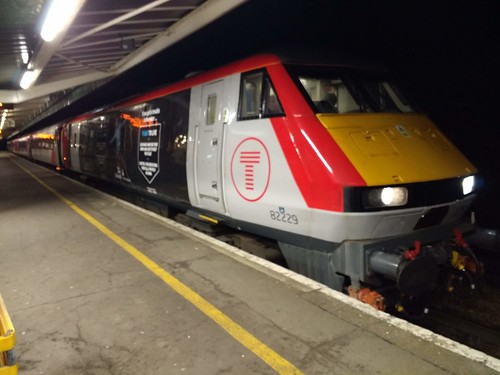
Mark 4 Driving Van Trailer of Transport for Wales 'Premier Service' from Holyhead to Cardiff at Shrewsbury
History Notes
When I was young, Great Britain (England, Scotland and Wales) operated as a relatively unified whole, although Scotland retains a different legal system and Scottish banks can issue their own banknotes still denominated in pounds Sterling. Northern Ireland's less-happy history resulted from various attempts at dealing with demands for Irish independence and it has its own parliament in uneasy liason with the Westminster parliament. England, Scotland, Wales and Northern Ireland together form the United Kingdom (UK). The UK joined the European Economic Community (EEC) in 1973 and this choice was confirmed in the 1975 Referendum. The Maastricht treaty, effective 1993, changed the EEC into the European Union (EU). In 1997, following Welsh and Scottish referendums, the UK Labour government devolved certain powers to separate parliaments in Cardiff and Edinburgh. The nature of the EU and its management was further changed by international treaties in Amsterdam (in force 1999), Nice (in force 2003) and Lisbon (in force 2009). This led to a further ill-tempered UK referendum in 2016 which voted to leave the European Union and this occured formally on 1st January 2021. The four constituents of the UK (England, Scotland, Wales and Northern Ireland) are nowadays sometimes referred to as the 'Home Nations'. Confusing, isn't it?
Related posts on other websites
Links to external sites are correct at time of publication but, with time, may become broken.
Flint Castle (Wikipedia)
Premier Service (Wikipedia)
Driving Van Trailer (Wikipedia)
TfW Premium Trains
br>
Related posts on this website
Railways at Crewe in the '50s
Crewe Station
My pictures
North Wales Line (Crewe - Llandudno, various dates
Crewe Area rail, various dates
Crewe Station Buildings: L&NWR
Shrewsbury area railways
[Minor edit 4-Mar-2022]
At the end of 2021 the Battlefield Line was able to operate a very successful service of 'Santa' trains despite government restrictions caused by the Covid-19 Pandemic. Having taken pre-bookings to fill all the advertised trains to capacity, the management was faced with a major setback at the end of October when 'Wightwick Hall', which had been planned to work all 'Santa' trains, was 'stopped' due to leaking boiler stays. The locomotive owners decided to take the engine away for repairs. With no suitable replacement on site, the railway faced the major task of hiring an alternative locomotive at short notice, triumphing in securing 7822 'Foxcote Manor' to cover the vital Christmas Season.
Origins of the 'Manor' class
In 1911, Churchward introduced the '43XX' class of mixed traffic 'Moguls'. They were well-liked, very successful and with good route availability resulting in over 300 being built. By the mid-1930s, earlier '43XX' were in need of replacement and increasing loads suggested an increase in power was required. Collett decided on a 4-6-0 which became the 'Grange' class, keeping the accountants happy by re-using the 5'8" diameter coupled wheels and motion from withdrawn '43XX'. However, the increased weight of the 'Grange' compared with the '43XX' restricted the new class (like Collett's 'Halls') to 'Red Routes'. So Collett also designed a smaller, lighter 4-6-0 design which became the 'Manor'. By 1939, 80 'Granges' and 20 'Manors' had been produced. In 1950, a further 10 'Manors' (including 7822 'Foxcote Manor') were built by British Railways at Swindon and the someimes indifferent steaming of the class was cured by a series of fairly simple modifications based on the work of S. O. Ell.
'Manor' Class from British Locomotive Types 1946 (Railway Publishing Co. Ltd.)
Click for larger view
The 2-cylinder 'Standard' designs of the Great Western have Stephenson Link motion with four eccentrics mounted on the driving axle between the frames to provide the necessary valve events. With outside cylinders and valves, as used on the 'Manors', rocking shafts are required to transmit the movement of the dieblocks between the frames (via the intermediate valve rod, rocking shaft, valve link and valve rod) to the piston valves outside the frames.
This is illustrated in the well-known diagram below, taken from the 'Handbook for Railway Steam Locomotive Enginemen', published by the British Transport Commission in 1957. Second-hand copies of the 1957 edition and the Ian Allan reprint edition of 2014 (ISBN: 9780711037946) can still be found second-hand.
 Click on the above diagram to enlarge.
Layout of valve gear.
'Foxcote Manor' is currently in unlined black livery with the original 'Lion Astride a Mangle Wheel' totem on the tender. British Railways used lined black livery for mixed traffic locomotives and, in the twilight of steam, I was used to seeing Great Western engines in lined black, although I always imagined that Great Western mixed traffic tender locomotives must have felt embarrassed at being deprived of their 'locomotive green' colour carried before nationalisation. Liveries of locomotives and rolling stock is a fascinating area in itself and of particular interest to modellers. For a very quick introduction, try GWR Liveries on the GWR Modelling site.

British Railways totem on Collett 3,500 gallon tender in unlined black ('Foxcote Manor' at the Battlefield Line).
Events of Sunday 19th December 2019
I was rostered driver on Sunday, 19th December 2021 with Joe O. as fireman and Jeremy as trainee fireman. Years ago, I'd driven 'Dinmore Manor' after a restoration at Tyseley and fired 'Bradley Manor' on a service train on the West Somerset Railway but this was my first turn on a 'Manor' for some time (when 'Dinmore Manor' had previously visited the Battlefield Line, I'd managed a footplate trip but not had a driving turn). Joe and Jeremy had signed-on on time at 7.00 a.m. but fog on my road journey made me a few minutes late.

'Foxcote Manor' during preparation in the shed at Shackerstone on the Battlefield Line. Note the 'NOT TO BE MOVED' sign fixed to the front lamp bracket.
On arrival, I checked with Joe that he was taking water from the shed supply. At Shackerstone, the shed supply is a wall-mounted tap via a long flexible hose but it's a fairly low capacity feed. Normally, if there's space in the tender water tank, this supply will be left on all night but Joe told me this hadn't happened the previous night, so we'd be coming 'off-shed' with less than the 3,500 gallon tender water capacity. The water in the tender tank is indicated on a float-type gauge which rises up out of the tender in a short, vertical, cast column provided with a cast brass plate marked with readings in both gallons and water depth in feet. A small, brass indicator connected to the tank float moves up and down in a slot to show remaining water. This type of gauge isn't bad but it's always wise to allow some safety margin for lack of accuracy. The simple test of the gauge is to push the brass indicator down by hand and check that the float causes the indicator to 'bob' back to the original reading.

View of tender from the footplate, showing driver's side toolbox with the cast column of the tender water gauge in front ('Foxcote Manor' at the Battlefield Line)
Oddly, about the best water gauge I've used is the rather crude 'walking stick' arrangement favoured by Gresley on some of his engines. At the front of the tender, readily accessible to the footplate crew, a vertical pipe, connected to the tender tank, extends the full height of the tender water space. This pipe is perforated by a row of small holes, normally closed by a smaller, inner concentric pipe. A handle allows the outer tube to be rotated until the holes align with (I presume) another set of holes in the concentric smaller tube, allowing water to escape onto the footplate from all the holes below the level of water in the tender. An adjacent series of painted figures allows the indicated gallonage to be read off. I never quite developed the technique of avoiding catching some of the spraying water, often with wet boots, sometimes a wet arm as the handle was pushed closed after making a reading.
Normally, locomotives are able to replenish their water tank rapidly from a water tower adjacent to a railway line or, at more important sites, from a large storage tank serving a number of 'water cranes' or 'water columns' in strategic locations. In this country, the final stage of water delivery is normally via a short length of slightly-flexible pipe referred to as the 'bag', originally of riveted leather construction, which allows for a small misalignment between the locomotive tank filler and the delivery pipe
At Shackerstone, a large water tank is set at the top of the embankment near the south end of platform 2 feeding a water column with a swivelling arm just beyond the platform ramp. Unfortunately, this facility was not available to us because our train comprised six coaches, stabled with the northern end of the stock just clear of the barrow crossing from platform 1 to platform 2 used by staff and passengers to access platform 2. This meant the southernmost coach extended beyond the platform ramp, preventing access to the water column (unless the whole train was shunted). Shunting the train is not encouraged so, should taking water be required, the approved method is to water when returning to Shackerstone with a northbound train. This is done by stopping at the signalbox, uncoupling the locomotive and drawing forward to the column, taking water and then returning to pick up the waiting train and complete the journey to the platform.
The engine had been in use the previous day and was still quite warm so Joe soon had a decent fire established. He offered to oil the axleboxes and inside motion and I gratefully accepted. I'm finding it increasingly difficult to clamber around in the inspection pit and haul myself up to perch on a coupled axle during preparation. I contented myself with going underneath afterwards for a quick inspection.

Jan emerges from the pit after inspection 'underneath' ('Foxcote Manor' at the Battlefield Line)
Jeremy assisted Joe with the oiling, in order to familiarise himself with the layout and method, which is generally similar to the 'Hall' class, which I described in the post here.
I started my own oiling by draining the previous-day's condensate from the sight-feed lubricator mounted on the boiler backhead in front of the driver and re-filling with cylinder oil.

Sight feed lubricator ('Foxcote Manor' at the Battlefield Line)
Then, I applied motion oil to the various oiling points on the outside motion and tender, examining each part for obvious damage or defect in the process.

Jan applies motion oil to the left-hand connecting rod little-end on 'Foxcote Manor' at the Battlefield Line
Finally, I walked around the foot-framing completing motion oiling 'on top', including filling the vacuum pump oil pot with an oil/paraffin mix.

Jan poses on the front framing of 'Foxcote Manor' at the Battlefield Line, having completed the oiling 'on top'.
By the time we'd finished this oiling-round, the boiler was 'brewing' nicely so we moved outside the shed to empty the ashpan and finish preparation. As you leave the shed, the track is inclined downwards and, if the brake is at all reluctant to 'bite', vigorous help from the fireman screwing down the tender handbrake handle may be needed to bring the locomotive to a stand. On this occasion, I had to place the reverser in 'back gear' and cautiously open the regulator to produce sufficient retardation to stop.
Burning coal in a locomotive firebox leaves ash and incombustible material which should drop through the firegrate into the ashpan below. The ashpan is provided with one or more hinged doors which are adjusted by the fireman to regulate the primary (or 'bottom') air. Daily (or sometimes more often) this ash has to be removed by opening the damper door and scraping out the residue with an ashpan rake. This work can be heavy and is certainly dirty. The amount of ash and incombustible clinker-forming material depends upon the source, and hence the chemical analysis, of the coal.
To somewhat reduce the amount of sheer physical effort involved, two features were introduced in 'modern' designs - the rocking grate and the hopper ashpan. The rocking grate arranges the firebars on a series of axles which can be rotated from the footplate. A slight to-and-fro shaking action can be used 'in traffic' to help break up the formation of clinker and encourage it to drop into the ashpan. Rotation through 90 degrees opens up broader spaces to 'dump' the whole fire into the ashpan. The hopper ashpan allows the fireman to open the bottom of the ashpan so that gravity will empty the contents.
Locomotives in preservation were built in different periods and some have these 'modern' features, some do not. Often, these features have been added by restoration teams to assist in locomotive management. Oddly, whereas 6989 'Wightwick Hall' had a hopper ashpan but no rocking grate, 7822 'Foxcote Manor' has a rocking grate but ashpans are scraped-out with a rake.
The fireman and I reviewed the water situation. The tender water gauge indicated 2350 gallons (capacity is 3500 gallons). We agreed that, even allowing for the extra water which would be consumed train heating, we should have enough for the three scheduled trips plus a safety margin. If we changed our view, we retained the option, on approaching Shackerstone on the second or third trip, of uncoupling the locomotive and drawing forward to the column, taking water and then returning to pick up the waiting train.
Once preparation was complete, we moved 'Foxcote Manor' onto the 6-coach 'Santa Special' train in platform 2 so that we could commence steam heating of the stock well before passengers were allowed onto the train. We were advised to not exceed 18 to 20 pounds per square inch steam heating pressure, to prevent causing leaks in the rather 'tired' coach heating installation.
Our diagram called for three round trips to Shenton during the day, leaving Shackerstone at 12:15, 14:00 and 15:45, running tender-first to Shenton and chimney-leading back to Shackerstone.

Jan, Jeremy and Joe on the footplate of 7822 ('Foxcote Manor' at the Battlefield Line)
As departure time approached, I opened the ejector steam cock to create vacuum in the train pipe. Whereas 'Wightwick Hall' had the very effective multi-cone ejector mounted on the outside of the firebox (used on larger Great Western passenger engines and described/illustrated here), the 'Manors' retain the earlier ejector (see post here), so I was expecting a delay as air was exhausted from our six-coach train. The Train Pipe indicated the correct 25 in/Hg with the Reservoir managing 23 in/Hg. I closed the ejector steam cock to check for leaks and noted that the Train Pipe held up fairly well but the Reservoir (only affecting the engine and tender) started to fall. This seemed to be in line with a verbal report I'd had so I decided to review the actual braking performance in traffic with a view to making an entry on the Inspection/Defect sheet. I re-opened the ejector steam cock so that the guard could perform his own brake test.
Station staff were still shepherding late arriving passengers to their reserved seats as departure time passed but eventually all doors were closed and I acknowledged the 'Right Away' from Martin, the guard, with a hand signal and a whistle. The handbrake was released, both the fireman and I checked that the line was clear and our signal was still 'off' and, in a cloud of steam from the open cylinder drain cocks, we gently set off tender-first. The Collett 3,500 gallon tender is not very tall so the driver's view running tender-first is superior to that with a Collett 4,000 gallon tender (which 'Wightwick Hall' had been paired with). After a few yards, I wound the reverser away from the 'full gear' I'd started in and closed the drain cocks so that I could visually check that the whole train was following and that there were no signs of alarm on the train or the platform.
Jeremy collected the single line train staff from the signalman and I stressed the importance of both driver and fireman checking every time that it is the correct staff for the section being entered. The cutting leading to Barton Lane bridge is limited to ten miles an hour, pending relaying, but even when our whole train had passed clear of the restriction, I kept the train running at about 10 m.p.h. During this outward journey to Shenton, Father Christmas and his helpers would work their way through the train, talking to children (and their families) and issuing presents so a very leisurely progress is appropriate. A message from the train confirmed that our speed met with approval.
But it's much harder running a train at low speed. Rolling resistance alweays seems more noticeable and axleboxes don't have the same opportunity to 'warm through'. At low speed, the vacuum pump may not maintain vacuum without assistance from the vacuum ejector. Small changes in gradient or curvature of the line can produce noticeable changes of speed which, in theory, can be compensated by lengthening or shortening the cut-off without adjusting the regulator setting but, in practice, may require alternating periods of 'steam', 'no steam' and even 'brake'. So I was concentrating fairly hard all the way but, facing the tender, I did notice how much colder it was on the exposed sections of the line even with the Collett design of cab.
Collett's deeper, windowed cab is an improvement on Churchward's skimpier cab. But originally locomotives had no cab at all and, when roofless spectacle plates were first instroduced, they were resisted by many drivers. I certainly feel a driver must be fully aware of the surroundings, listening out for all the noises a locomotive can make. Gresley and Bulleid large-engine cabs are a little too enclosed for my taste and I think Stanier's designs for the L.M.S. best handled the necessary compromises in cab design.

Collett's windowed cab, showing the boiler backhead viewed from the tender. The small, rectangular, white object dangling from the fireman's spectacle is the battery/control box for the LED lights strung along the boiler handrails for Christmas ('Foxcote Manor' at the Battlefield Line)
Although passengers were not able to join or alight at Market Bosworth, we were booked to stop so that staff in the leading coach could quickly replenish the following coaches as required. Braking involves the driver admitting air through the brake application valve to partially destroy the vacuum created by the ejector or pump. There's a delay, depending on the train length, as the level of vacuum adjusts. In early braking systems, air was introduced only through the driver's valve but improved coach designs, as in our train, added a Direct Admission valve ('DA' valve) to each vacuum brake cylinder to sense the train pipe vacuum and, as the vacuum fell, allow extra air to enter locally to reduce the delay in brake application towards the rear of the train. Travelling at low speeds with an unfamiliar locomotive and an unusual consist of coaches, it was harder to stop correctly with the leading coach in the platform and the back coach overhanging the platform at the rear, particularly with the driver on the non-platform side. With the fireman relaying the position of the first coach along the platform, we stopped as required and I selected a suitable lineside 'marker' to use on future stops.
After a few minutes of staff activity on the platform, the guard gave the 'Right Away' and we set off again, resuming our progress at about ten miles an hour. Eventually, we approached Shenton, where braking was needed to comply with the 5 m.p.h. speed restriction over the embankment slip beyond Ambion Lane bridge. Although the station platform was on the driver's side this time, I'd been told that a marker post had been erected beyond the station to assist in identifying the correct stopping point, allowing us to stop accurately. Quite a crowd of passengers appeared alongside to admire the locomotive, safely behind the fence, and both Father Christmas and The Grinch joined them as there was the usual flurry of activity. 'Foxcote Manor' was uncoupled, the Single Line Staff was transferred to Martin so that he could operate the ground frame at the north end of the station and we ran-round our train.
We were told that we could return to Shackerstone at Line Speed, which was pleasant, particularly with a tender engine chimney-leading. Of course, the initial departure from Shenton was quite gentle, complying with the 'five mile an hour slack' to Ambion Lane bridge but, once the whole train had cleared the restriction, I was able to tug the regulator to 'full first valve' and let the speed build. I'm afraid I rarely manage to justify the use of 'second valve' considering the moderate gradients, moderate loads and moderate speeds which apply at the Battlefield Line.
When I was a driver at Birmingham Railway Museum, we had a saying "Your haven't lived until you've had a 'King' in second valve" and, with a tractive effort of over 40,000 pounds and a demonstration line only a quarter of a mile long that was certainly quite an experience. Perhaps the steepest line I've driven was on 'Kaitangata' at the mining railway at Shantytown Heritage Park in New Zealand where sanding was essential to prevent slipping. Heaviest train is probably 12 broad gauge coaches (500-odd tons) with a Class 'WP' in India (brief mention here) and fastest speed around 50 m.p.h. on Pacific 'Piekna Helena' in Poland (brief mention here).
We bowled along fairly merrily, slowing to 10 m.p.h. for the 'slack' through Market Bosworth station without stopping. As expected we were routed into platform 2 at Shackerstone and I'd been told that another marker post had been erected beyond the platform end to assist in stopping correctly. The locomotive was fouling the barrow crossing used by passengers so we uncoupled and dropped forward to wait in the north end whilst passengers crossed the line. It was quite misty but everyone seemed in good spirits.

Passengers streaming off the train and back to the car park after the first 'Santa Special' of the day ('Foxcote Manor' at the Battlefield Line)
Boiler pressure had held up well during the round trip to Shenton and water consumption, as shown on the tender gauge, was as expected, suggesting we'd have enough in the tank to complete our working so we finished the run-round and continued steam heating in preparation for our second departure. Joe had agreed to let Jeremy do most of the firing on the second trip. We set off and, as before, I was concentrating fairly hard on maintaining a gentle progress towards Market Bosworth but every time I checked the other side of the cab, matters seemed as expected and Jeremy's 'shovel action' appeared good. Once again, we stopped for a while at Market Bosworth then plodded on to Shenton where we ran round.

Shenton station with The Grinch and Father Christmas walking back to the platform after greeting passengers ('Foxcote Manor' at the Battlefield Line)
Once again, return was authorised at Line Speed. On the way back, I was pondering whether it would be prudent to stop and take water before we entered Shackerstone station. Shackerstone's Down Home 1 (an upper quadrant lattice post design) was off as we approached under Barton Lane bridge at the prescribed 10 m.p.h. and I realised, with horror that the brakes were dragging on. A quick glance at the boiler pressure gauge revealed the reason. Pressure was down to 160 p.s.i. and the vacuum ejector could not maintain sufficient vacuum in the train pipe. It was certain we'd come to a halt but I let the locomotive try for a few more yards before accepting our fate.

Shackerstone's Down Home 1 'off' for the 'Santa Special' ('Foxcote Manor' at the Battlefield Line)
Joe pulled one of the heavy fire-irons out and plunged it into the red-hot mass in the firebox. A bit of probing revealed quite serious clinker in the firebed. It's always problematic - failure to open the firebed up to sufficient combustion air means the boiler pressure will never recover but too enthusiastic 'action' destroys a carefully-crafted layered firebed, which will take longer to get hot again. Joe broke-up a fair amount of clinker then I took the 'bar' off him to satisfy myself that we had sufficient viable firebed to pull our train as far a the platform, Boiler pressure started to recover, encouraged by judicious use of the 'blower' (a steam jet exhausted through the chimney to enhance the draft on the fire when stationary which I often remind firemen can be the "last refuge of the desperate" and should be used in moderation). After about ten minutes, we'd regained pressure to release the brakes and, exchanging signals with the guard, we rather shame-facedly limped to the platform, uncoupled and stood down the north end, in full view of our delayed passengers who didn't seem unhappy at all.

Passengers assembling on platform 1 at Shackerstone with 7822 at the north end about to run-round ('Foxcote Manor' at the Battlefield Line)
We ran-round and coupled up to our train in the gathering gloom. Joe and I attempted to clean the fire and rebuild the firebed ready for our final trip. According to the tender water gauge, we'd ample water for the final trip so I was more worried as to whether our fire-cleaning would be adequate. Our third departure was late but we made our usual slow progress to Market Bosworth and then Shenton without incident but in the dark.
It's a different experience driving a steam train at night on a preserved line as there's little to see and hearing becomes more important in orienting yourself. There's a short article about the railway at night here. Depending on the weather, the sky may be a deep purple, with black silhouettes of trees and other lineside objects and pinpoints of electric light from houses and other features. But our last 'Santa Special' train moved through an impenetrable inky blackness with few visual clues except in the vicinity of each station where a row of electric lights threw yellow pools of light onto the platform surface and shafts or pinpoints of light from nearby houses appear. The business of running round becomes a lot harder in the dark and staff moving around on the ground need to be especially alert to the dangers of slips, trips and falls.
With running-round safely completed, Joe prepared the fire for the final run back to Shackerstone. To preserve some night vision, I averted my eyes from the glare when the firehole door was open. Joe had lit a gauge lamp and fitted it to the gauge lamp bracket provided so that the all-important water level in the gauge glass could be seen. We set off with around three quarters of a glass of water. The boiler pressure gauge wasn't very visible my side in the scattered light from the gauge lamp but the insistent hissing from the safety valves indicated that we were close to blowing-off. After clearing the Ambion Lane bridge speed restriction, the increased regulator opening silenced the safety valve hissing. We had been asked to make a special stop at Market Bosworth station to allow volunteers off, but as we waited for the 'right away', Joe reported "There's no water!". The tender water gauge still read '500 gallons' but neither injector seemed to be picking up any water. This was a serious situation.
Conventional locomotive fireboxes ('Stephensonian' fireboxes) have a double-skin water jacket construction with an inner firebox usually copper, which holds the burning mass of fuel, heavily stayed inside a larger outer firebox, usually steel, with water in between inner and outer firebox. Heat from the burning gases in the inner firebox passes readily through the copper and converts the water to steam. The level of water in the jacket must be above the highest point or 'roof' of the inner firebox at all times since the temperature of the hot burning gases in the firebox can exceed the melting point of copper (around 2,000 degrees Farenheit). As a warning, fireboxes now have a one or more Fusible Plugs screwed into the 'roof', with a hole through the plug sealed with an metal alloy solid at normal working temperatures. The alloy melts upon a dangerous rise in temperature, allowing water and steam to discharge through the hole in the plug onto the firebed. The noise and steam when this happens should alert an inattentive crew to the urgency of the situation. Allowing this to happen is called "dropping the plug" and is one of the worst sins footplate crew can commit. It's sometimes claimed that "dropping the plug" will extinguish the fire but it is intended only as a warning: indeed, there have been a few instances where the crew have not immediately realised that they had "dropped the plug". This is the 'Achilles Heel' of the steam locomotive - If you can't maintain a safe water level in the firebox, the only choice is to remove the source of heat without delay. Normally, this is done by "paddling out" the fire with the Clinker Shovel ('Paddle') and tossing the burning mass onto the ground one shovelful at a time. A locomotive with a rocking grate can 'dump' its fire more quickly (but a large mass of active fire dumped into the ashpan is not helpful). Quick action in withdrawing the fire may prevent or minimise damage to the locomotive.
We'd well over half a glass of water showing in the gauge glass so the question was, would that be sufficient to haul our train back to Shackerstone, uncouple and go for water before the level became critical? The fireman and trainee were both adamant that it couldn't be done. The fireman correctly pointed out that we would first be going uphill, which would tend to slightly increase the water level in the firebox and then be slightly downhill to Shackerstone, tending to reduce the water level in the firebox. My crew were sure we'd not be able to make it. But a locomotive footplate is not a democracy: I quietly confirmed that my assessment was that we could safely work the train back and we would depart as soon as we had the 'right away' from the guard.
Safety is always the primary consideration when working on a railway but before deciding to take the train on to Shackerstone, I'd already reviewed gradient and other issues. Gradients certainly affect the level of water in different parts of the boiler but the Battlefield Line has moderate inclines (Britsh Railways was able to use the line as a diversionary route for the West Coast main line during electrification) and, to optimise boiler proportions, the Great Western was an early adopter of the taper boiler used on larger engines (including 'Manors') which also tends to reduce the water level change on gradients. Withdrawing the fire at Market Bosworth then creates the problem of a disabled train which, in our case, was fully loaded with passengers three miles from where they wanted to be. Seeking assistance involves complying with a safety protocol to ensure that one incident does not create the conditions for another.
There's a simplified introduction to the working of single line railways here.
On the Battlefield Line, Section C of the Operating Rule Book covers Single Line Working, including the procedures for providing assistance to a disabled train. After agreement betweeen the crew of the failed train and the controlling signalman, protection (a red flag or lamp as appropriate) must be set a quarter of a mile from the failed train which must not attempt to move. A member of the footplate crew must take the train staff to the end of the single line section and travel back with the crew of the assisting locomotive to the disabled train. After coupling together, the assisting driver takes responsibility for train working and carries the staff.
The rules set out that, having put protection in place, a 'member of the footplate crew' (usually the fireman) must take the train staff to the signalman by any available means which could involve a lengthy walk in the dark. Assuming a suitable relief locomotive and crew is available, the assistant engine is allowed into the already-occupied single line section, carrying the person from the failed train with the staff (these are the conditions under which "two in a section" are permitted). I was keen to avoid the delay this would incur if possible.
Although hopefully a less-likely problem, I wasn't too sure of the endurance of the electric carriage lighting system. As railways developed, gas was commonly used for the lighting of passenger areas in trains, giving rise to a number of predictable fires following accidents. The worst, at Quintinshill in 1915, involved 5 trains and resulted in 200 deaths. Electric lighting using filamentary lamps, powered from batteries of secondary cells carried in a battery box attached to each coach underframe, remains in use on preserved railways now. The batteries are charged by a dynamo on each coach belt-driven from one axle. A simple regulator (similar to that formerly used on motor cars) connects the dynamo to the battery when the dynamo output is above a charging threshold, which occurs at around 15 m.p.h. This meant that during the 'Santa Special' operations, most of the time, even when moving, the batteries were not being charged. I wasn't sure whether special arrangements had been put in place to 'keep the lights on'.
So we set off from Market Bosworth into the darkness. Keen as I was to get towards our source of water, I wanted to eke-out that precious half a glass of water, so I settled on a very modest speed with a little less than full first valve on the regulator with the 'cut-off' linked up to about 50% to extract, by expansion up to the point of exhaust, as much effort as possible from each admission of live steam to the cylinders. I hoped that this would prove an economical setting. Every time I snatched a quick glance sideways at the gauge glass, I was relieved to see the level creeping down quite slowly but the fireman was paying close attention to the level, periodically using the 'flashlight' function on his mobile 'phone to better illuminate both gauge glass and pressure gauge.
Passing Shackerstone's fixed distant signal, I started to brake, admitting only small amounts of air into the brake pipe and then allowing the action of the vacuum pump to release the brakes, keen to avoid using steam in the vacuum ejector for as long as possible. Approaching Barton Lane Bridge at the regulation 10 m.p.h., the use of the ejector was needed to augment the pump. The Home 1 signal was 'off', so we were able to drift towards the box as I asked the fireman to prepare for dismounting as soon as we stopped and making sure the guard had applied his handbrake before uncoupling the engine so that we could ease forward for water. The Home 2 ground disc signal was also off, allowing me to go towards the box so that I could explain our intentions to the signalman. I stopped with the rear of our tender still on the plain line approaching the facing points - it's bad enough uncoupling in the dark without the added complication of stumbling over facing point equipment in the 'four foot'.
Once uncoupled, I moved towards the water column, asking the fireman to 'set' me in the correct position to ease inserting the 'bag' of the water column into the tender water filler. When taking water, there's nothing more dispiriting than getting a soaking because of poor alignment, particularly at night near the end of a long shift.
Whilst we were preparing the take water, Adrian L. bounded onto the footplate out of the darkness and checked the boiler water indication in the gauge glass, where a sliver of water was still showing.
"Oh, that's alright", he commented before discussing the next moves. I explained that I'd intended to take water, set back onto our train and complete the planned working. Adrian explained that he had arranged for the Class 33 to be started-up and brought to the south end of platform 1, where it rumbled alongside us as we started to take water.

Boiler backhead with boiler pressure gauge (upper left), carriage warming pressure (lower left) and BR-type 'coupled' gauge glass and protector ('Foxcote Manor' at the Battlefield Line)
I opened the water valve on the driver's side injector and, as soon as I confirmed that water had started to issue from the overflow pipe under the cab, I opened the steam cock. The injector immediately 'picked-up', producing the distinctive, reassuring sound of a working injector. The injectors produced by the Great Western are particularly reliable which is presumably why Riddles chose that pattern for use on his British Railways standard steam classes.
Adrian had considered using the Class 33 to pick up our train and take it into platform 1 whilst we sorted ourselves out, although the stock really needed to be in platform 2 for the following day. Confirming how much water we'd taken-on by looking through the tender filler to visually check the level in the tank, we agreed that it would be a little quicker overall for the Class 33 to pick up the train and bring it into platform 2 after I'd taken my light engine through platform 2 to stand clear at the north end.
Having hauled the train into the platform, the Class 33 uncoupled and came behind us so that passengers could use the barrow crossing and walk past the 'Manor' returning to their cars. The locomotive had not been fired for a while so the boiler pressure had started to fall but the fireman and I agreed that we should have enough steam to get 'on shed' and completely fill the boiler. Despite the delayed, unusual final approach to Shackerstone, our passengers seemed happy, thanking us and exchanging season's greetings.

7822 standing at the north end at Shackerstone after the final, eventful, round trip on 19th December 2021 ('Foxcote Manor' at the Battlefield Line)
Finally, the Class 33 moved through platform 1 to stand on the DMU siding, allowing us to follow to the ground frame giving access to the shed. Allowing for our reduced boiler pressure, a short run at the gradient approaching the shed got us inside and careful braking stopped us in the position we'd started from that morning, to ensure that the crew next day had access to the pit at the front of the engine. The engine was 'tied down', scotches set under a coupled wheel and the boiler was completely filled.
An interesting, if rather tiring, day.
Related posts on other websites
Foxcote Manor Society.
Related posts on this website
All my Battlefield Line posts.
My photograph albums
Where necessary, clicking on an image above will display an 'uncropped' view or, alternately, pictures may be selected, viewed or downloaded, in various sizes, from the albums listed:-
'Foxcote Manor' at the Battlefield Line.
All my Battlefield Line pictures.


