skip to main |
skip to sidebar
On Saturday 14th March 2020, I made a brief trip to Liverpool by train, no doubt encouraged by using the internet a few days earlier for 'remote ship viewing' of the Mersey.
Remote Ship Viewing
I've talked about the possibilities for remote ship viewing in the post Watching The Ships Go By. Prior to my trip on 14th March, I'd looked at the webcams operated by 'www.wirralcam.org' and spotted an MSC container ship berthed at the deepwater quay 'Liverpool 1'. A few moments on the excellent ShipAIS site confirmed the ship's identity as 'MSC Santhya'. At the same time, I'd noted the ships which ShipAIS indicated at Cammell Laird's shipyard in Birkenhead - a couple of Royal Fleet Auxiliaries and RMS 'St. Helena'. The RMS 'St. Helena' was the vessel I'd sailed on in 2011 (my posts on this memorable voyage are here).
As I've explained in earlier posts, Liverpool has fascinated me since my first visit as a child, so periodically I'm drawn back. I usually visit the Museum of Liverpool to inspect 'Lion', the first locomotive I ever drove before she was finally 'stuffed and mounted', take a trip on the Mersey Ferry which still delights me, and look for changes on the railways to and around Liverpool.
Getting there
I caught the 09:22 from Wolverhampton to Liverpool Lime Street, armed with the Railcam.UK 'app' on my mobile phone (which is briefly described in my post Watching The Trains Go By) to provide live signalling information. West Midland Trains were operating the service with an 8-car train formed from two 4-car Electric Multiple Units, resulting in only the front four coaches being alongside the platform at certain stations, like Penkridge. Before arriving at these stations, the Guard (using the public address) advised passengers wishing to alight to move forward to the front four coaches and, of course, he selectively opened the doors. After our Stafford stop, we took the Fast Line to Crewe, where we arrived at platform 11. The very smart-looking 'Statesman Rail' set of coaches (all in Pullman-style livery with each coach named after a British mountain) stood in the adjacent platform 12, headed by an unidentified 'vintage main line diesel'. A few moments on the internet showed that this train was the 'SETTLE & CARLISLE LUNCHEON CIRCULAR'.
We left Crewe, routed on the Down Fast, made our scheduled stops at Winsford, Hartford, Acton Bridge, Runcorn and Liverpool South Parkway, and completed our journey, unusually, in platform 10 at Lime Street.
Around Liverpool
As usual, I purchased a 'Saveaway' day ticket and descended to the Merseyrail underground platform at Lime Street, taking the train to the next-but-one stop at James Street. When I emerged at street level, the weather was overcast with a fair breeze coming from the river but I enjoyed the walk to the Museum of Liverpool to check on their railway exhibit 'Lion', the exhibits relating to the long-defunct Liverpool Overhead Railway (which I travelled on as a child) and the new 'Liverpool on Wheels' exhibition.

'Lion'
I then walked to the modern Mersey Ferry building on the Waterfront, which vies in architectural awfulness with the nearby 'dented shoebox' design of the Museum of Liverpool. I obtained a 'boarding pass' to Birkenhead Woodside for the ferry with my 'Saveaway' and boarded 'Royal Iris of the Mersey'. This ferry, built in 1959, was originally 'Mountwood' but was rebuilt in 2001 with Wartsila twin diesel engines and renamed 'Royal Iris of the Mersey' to perpetuate the famous name of another Mersey Ferry named 'Royal Iris' now lying derelict on the Thames. Wikipedia has articles on both Royal Iris of the Mersey and Royal Iris.
The electronic chimes in the famous Liver Building struck noon, but I was disappointed to see that the huge, 25-foot diameter clock face visible from the river displayed the wrong time. There's a Wikipedia article on the Liver Building here.

The Liver Building, Liverpool, in 2017
After waiting for a few tardy passengers to join the ferry, the hydraulic gangway was raised and the mooring ropes released a few minutes late. The Mersey has a very wide tidal range and strong currents so good seamanship is needed by the ferry 'skipper'. With the tide coming in, the ferry had moored with the bow towards the sea. When the tide is going out, they moor bow upstream. Presumably, more positive rudder effect is obtained in this way. Certainly, the water between the hull and the pier pushed the bow out and, with black smoke from the hard-working engine, we powered towards the sea whilst the familiar recorded commentary outlined the various landmarks on the Liverpool side. We seemed to turn 'cross river' earlier than I remember - perhaps as well, since I normally prefer to travel on the open upper fore deck and the the wind was quite strong and only a few hardy souls were with me out of the 111 who had boarded. It also started to rain, but I continued to brave it out. Visibility was poor, so only the outlines of the huge Chinese-built container cranes at the deepwater quay called 'Liverpool 1' could be seen, with a moored container ship marked 'MSC' which I knew to be 'MSC Santhya', as described in 'Remote Ship Viewing' above. In the days after my trip, I checked the internet to note that 'MSC Santhya' left Liverpool two days after I saw her, bound for Antwerp.

View from Mersey Ferry in the rain, showing Liverpool 1 Quay with MSC 'Santhya' and container cranes (Return to Liverpool, 14-Mar-2020)
I watched our approach to Seacombe before noticing that chemical tanker 'Amethyst' had slipped past, on her way to the Irish Sea.

Unibaltic chemical tanker 'Amethyst' bound for Fawley heads towards the Irish Sea (Return to Liverpool, 14-Mar-2020)
We approached the Landing Stage at Seacombe from upstream, using power to move against the current and very delicately coming closer, slowly turning to port until the hull near the bow gently squeezed against the massive tractor tyres chained to the face of the landing stage, producing a squeal of protest as the tyres distorted. The crewman near the bow tossed a thin 'messenger line' to the shoreman, who picked up the end and hauled first the messenger line then, attached to it, a loop of the heavy mooring line which was slipped across a suitable bollard on the landing stage. The crewman on the ferry then tightened the loop of mooring line and made it fast, so that the ferry was pivoting on the mooring line. The 'skipper' then brought the stern towards the landing stage until a crewman at the stern was able to toss a similar line ashore so that the stern could be secured. The heavy, sliding gate in the gunwhale near the stern was slid open as the shoreman rotated the gangway to line-up with the aperture. The shoreman then used his bodyweight to tip the counterbalanced gangway from the 'upright' to the 'landing' position (there's no hydraulics at Seacombe or Woodside) and, within seconds, passengers were leaving the ferry, before 'joining' passengers were allowed onto the ferry. More exertions by the shoreman raised the gangway, the crewman at the stern closed the sliding door and retrieved the stern line. The shoreman moved along the landing stage to release the mooring line at the bow and, with a surge of power, the ferry moved away from the landing stage and executed a 180 degree turn to starboard until we were heading upriver, largely carried by the incoming tide.
'Royal Iris' passed the two berths at Twelve Quays, both unoccupied, but I noticed that, since my last visit a year earlier, the upriver berth had acquired a new, higher-level vehicle loading ramp served by a new access lane. Back home, a bit of research showed that this was to serve a new class of ferry, called 'E-Flex', introduced in 2020 by Swedish-operator Stena Line on the Belfast service. 'Stena Edda', built in China, is 215m long, 28m beam with a gross tonnage around 42,400. Capacity is 1,000 passengers, 120 cars and around 210 freight vehicles. More information can be found here, on the excellent site for ferry enthusiasts 'NI Ferry'.
The method of arriving at Birkenhead Woodside Landing Stage was similar to that adopted at Seacombe. We made a 180 degree starboard turn so that we faced the incoming tidal current and used power to creep towards the landing stage, finally mooring as described for Seacombe. Seeing a crowd of passengers waiting by the port side bow gate, I initially joined them, temporarily forgetting that unloading would be via the port side stern gate. We all had a brief scramble through the saloon following the realisation that passengers were already disembarking at the stern!
Fortunately, the rain had stopped, so I set off cheerfully on the walk past the remains of Birkenhead Woodside railway station on my left and the modern, windswept bus terminus on my right towards Hamilton Square underground station. My temptation is always to 'go to the seaside' at New Brighton but I decided, instead, on a shorter journey just two stops to Green Lane, to clarify the station construction. The railway is below ground level with a tunnel to the north leading towards Birkenhead Central and a short tunnel to the south, leading towards Rock Ferry. The station is set in a rectangular excavation which we'd now call a 'station box' but the retaining walls forming the 'box' are not concrete but beautifully-executed stonework. A series of plate girders span the station and the spaces between these girders are partially infilled by brick arcading but only above the southbound track, giving the station a rather 'lopsided' appearance. I presume this was to support features associated with the long-gone LNWR/GWR Joint Line from Chester to Birkenhead Woodside which ran slightly to one side of Green Lane above ground level. The track leading north, towards Birkenhead Central, is more exposed to the weather so a practical, but ugly, modern canopy has been erected on that platform only.

Green Lane station, Merseyrail, showing footbridge and tunnel towards Birkenhead Central.

Green Lane station, Merseyrail, showing stonework, overhead plate girders, partially infilled by brick arcading, and short tunnel at south end towards Rock Ferry.
I didn't spend long at Green Lane because I'd decided to return to Woodside Ferry Landing Stage in time to catch the next ferry back to Liverpool. Leaving Woodside for Pierhead offers reasonable views of the vessels in the dry docks and wet basins at the Cammell Laird shipyard on the Birkenhead side.
I took the next train back to Hamilton Square, travelled back to the surface in one of the huge electric lifts and walked back to Woodside Landing Stage. As I neared the Ferry Terminal, I noticed a tug 'hovering' nearby and wondered if it was about to begin a 'towage job' . I was curious because tugs I'd seen at Liverpool were normally black-hulled with cream superstructure, but this one was red-hulled with white superstructure. Once on the landing stage, I saw that a Chemical/Oil Tanker had emerged from the docks on the Liverpool side and the waiting tug moved quickly to assist in the manoeuvring. After my visit, a little detective work revealed that the red-hulled tug was the 'Donau'. The off-centre name on the stern gave the clue that she had previously been the 'Smit Donau' and that led to the realisation that the the red and white livery is that of the Boluda Towage Group. Their interesting 'Heritage' page here charts the various amalgamations back to the Alexandra Towing Company formed in 1887, with a picture of a steam tug of the pattern I remember from childhood. Alexandra Towing had been acquired by Adstream and became part of Smit in 2010. Smit joined with Kotug in 2016 and, as recently as August 2019, Kotug Smit Towage became part of Boluda Towage Europe.

Having emerged from Liverpool Docks, Chemical/Oil Tanker 'Habip Bayrack' is assisted by a tug before setting off for Rotterdam (Return to Liverpool, 14-Mar-2020)
'Royal Iris of the Mersey' approached from Seacombe, making a 180 degree starboard turn and using power against the current to move towards the landing stage.

After executing a rapid 180 degree to starboard. 'Royal Iris' powers towards Woodside Landing Stage against the tide (Return to Liverpool, 14-Mar-2020)
The familiar routine saw the ferry dock, the gangway lowered, passengers disembark, joining passengers (including the writer) board and in minutes the ferry was on its way, turning to starboard again to head briefly up-river and our closest approach to the Cammell Laird shipyard.
Cammell Laird shipyard
The picture below gives an idea of the present extent of this famous shipyard.

Aerial view of dry docks and wet basin at Birkenhead (Photo: Cammell Laird Ltd)
Two of the Royal Fleet Auxiliary 'Tide' class tankers, 'Tidesurge' A138 and 'Tiderace' A137, were in the wet basin, together with floating crane 'Lara 1' (which I'd previously seen in Canada Branch Dock No. 3 in Liverpool socks. There's a little about 'Lara 1' in the post here).

Two of the four 'Tide' class Royal Fleet Auxiliary tankers in Cammell Laird's wet basin, left 'Tidesurge' A138, right 'Tiderace' A137, with (Return to Liverpool, 14-Mar-2020)
The following picture is rather cluttered (but there are similar views in the album here taken from other angles as the ferry made its crossing to Pierhead). On the left is the grey-painted bulk of RFA 'Tiderace' with the raised jib of floating crane 'Lara 1' just to the right. In front are the twin red-painted funnels of a Caledonian McBrayne Ro-Ro ferry which from its configuration appears to be the Polish-built MV 'Finlaggan', formerly operating the service to Islay (but the AIS return claims to be the 'Hebrides'). Next is the distinctive, yellow funnel of RMS St. Helena. After decommissioning from its role as the lifeline to the island of St. Helena, the ship (less its 'RMS' prefix which denoted a Royal Mail Ship) served for a time as a Vessel Based Armoury (VBA) supporting anti-piracy activity in the Gulf of Oman before being sold and appearing in London for the launch of 'Extreme E', a new 'electric SUV' concept for motor racing. The Extreme E website has links to their Facebook and Twitter pages, but I didn't find confirmation that the work at Cammell Laird is in support of the proposed use of 'St. Helena' as a 'mobile race headquarters'. There's a Wikipedia article on the ship here. Dominating the scene is the massive superstructure of the new polar research vessel 'Sir David Attenborough' still being fitted-out. Wikipedia have an article here about this ship.

Cammell-Laird shipyard, L-R: RFA 'Tiderace', MV 'Finlaggan', RMS 'St. Helena', RRS 'Sir David Attenborough' (Return to Liverpool, 14-Mar-2020)
A little further upstream, at Tranmere Oil Terminal, the shuttle tanker 'Karen Knutsen' was berthed. Following my previous visit to Liverpool in March 2019 (see report here), I'd found out a little about Knutsen NYK Offshore Tankers. There were three tugs were 'nudged' against the tanker's port side, so I assumed she was about to sail, empty, to collect another consignment of offshore oil. Incidentally, all three tugs were still in the 'old' livery of the former Smit fleet - black hull and cream superstructure. I discovered that the ship's destination was the Jubilee Offshore Field in Ghana. There's a map of this field here.

Shuttle Tanker 'Karen Knutsen' at Tranmere Oil Terminal with 3 tugs in attendance to assist her departure for the Jubilee Offshore Oilfield in Ghana (Return to Liverpool, 14-Mar-2020)
The ferry crossed towards the Liverpool shore and sailed downstream towards Pierhead landing stage as Chemical/Oil Tanker 'Amur Star' overtook us heading downstream from Stanlow at the start of its next journey to Antwerp.
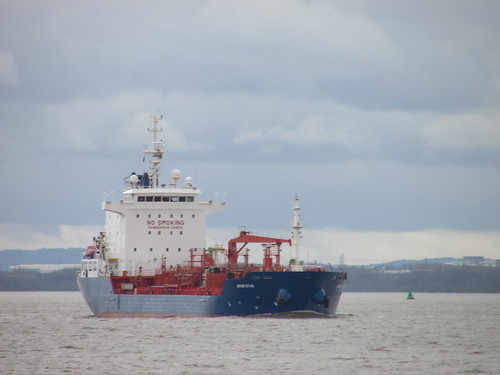
Chemical/Oil Tanker 'Amur Star' heads downstream from Stanlow at the start of its next journey to Antwerp (Return to Liverpool, 14-Mar-2020)
Happy with what I'd seen, I walked to James Street Merseyrail Station and descended to the platform. Two stops took me to Lime Street Station, where I took the next service back to Wolverhampton after a short, but enjoyable, trip.
Related Posts on this Website
There's a 'Label' to find everything I've written relating to Merseyside (there are over 40 posts at the time of writing). Your can display all these posts, in reverse date-of-posting order, by selecting Label 'Merseyside' (or click here).
The following post describes my most recent prior visit:-
New Brighton by Rail.
My pictures
Where necessary, clicking on an image above will display an 'uncropped' view or, alternately, pictures may be selected, viewed or downloaded, in various sizes, from the albums below:-
In making my (often quite poor) pictures available on the internet, I have divided them into various albums each covering a roughly-defined geographical area. Within each album, photographs are normally arranged by date taken. Thus, by searching through the appropriate album, you can find changes through time. So, this trip to Liverpool added pictures to a number of albums as I moved through various areas.
The journey:
West Midland Railways (Wolverhampton).
Stafford Area rail.
Crewe Area rail.
Liverpool area rail.
Merseyrail.
The destination:
Museum of Liverpool.
Liverpool.
The Wirral (pictures from previous visits).
This is the 12th post describing an 'Expedition Cruise' with Noble Caledonia in 2020 under the title 'Across the Tropic of Capricorn'.
Friday 21st February 2020 - Thursday 27th February 2020
On Friday morning, we had made a very pleasant visit to Ureparapara (as described here) but we were back on board in time for lunch.
With all our planned landings to various destinations in the Solomon Islands cancelled because of emergency measures to prevent the spread of the coronavirus infection, we were now faced with over five days at sea to cover the 1,000 nautical miles to reach our intended destination at Rabaul in Papua New Guinea.
Whilst we enjoyed lunch on board, the ship started the long journey in very calm sea conditions, making around 13.5 knots. At 5 p.m. guest lecturer Roy Clare gave another well-received lecture talking about some of the historical explorers who sailed these waters before another splendid dinner.
During Saturday 22nd, the expedition team laid on a variety of ship-board entertainments with lectures, yoga and whisky-tasting on offer. Various islands of the Solomon Islands chain were a hazy presence a few miles away on the starboard side. The picture below is the best image I managed to snatch of the Solomon Islands!
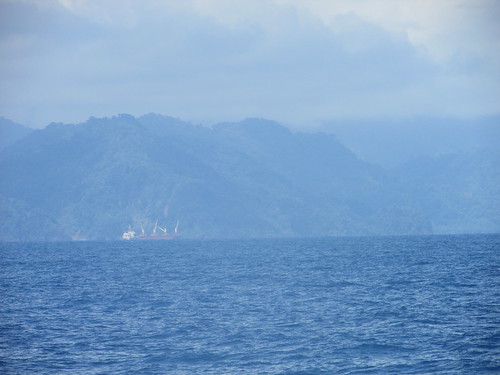
View of the Solomon Islands, and unidentified ship, from 'Caledonian Sky' (Crossing the Solomon Sea)
The in-cabin entertainment provided further distractions, when required. My cabin (or 'suite' as Noble Caledonia not unreasonably prefer) had a large, wall mounted flat-screen television facing the two armchairs. In addition to a handful of satellite television channels, the live 'Ship Channels' offered a view ahead of the ship, commentary and slides when lectures were being delivered and a ship position display, derived from the ship's Electronic Chart Display and Information Systems (ECDIS). ECDIS integrates electronic charts, radar, ship position derived from GPS, the Automatic Identification System (AIS) and other ship systems. There's a post with a description of the use of AIS and ECDIS here. The ship position channel was a favourite of mine, allowing me to monitor our progress. It became apparent that our this part of the Solomon Sea was used by a fair amount of shipping, as shown by the picture below with our ship (red icon) heading more-or-less north west towards the green island on the left called New Britain and our intended destination Rabaul. Two ships on similar tracks were, to port, 'Nol Genesis' and, to starboard, 'Sunrise Serenity' whilst heading south east was 'Sevilla Knutsen'.

In-cabin ship position display showing 'Caledonian Sky' (red icon) heading 308 degrees at 13.4 knots, with 'Nol Genesis', 'Sevilla Knutsen' and 'Sunrise Serenity' in the vicinity (Crossing the Solomon Sea)
Click for larger view
'Sevilla Knutsen' was close enough for me to attempt a picture through my cabin portholes and, after the trip, I confirmed the details of this Liquefied Natural Gas (LNG) tanker.

'Sevilla Knutsen' LNG tanker of Knutsen OAS: 290m by 45.8m 97730 DWT built DSME (Daewoo, S. Korea) in 2010 (Crossing the Solomon Sea)
Because our course was roughly north-west, at 2.0 a.m. on Sunday 23rd the Ship's Clocks moved back another hour and, during the day, in addition to Holy Communion by the Reverend Sarah Clare, more lectures and entertainments were available. The Captain, Ulf Peter Lindstrom, invited all passengers to a Cocktail Party at 6.30 p.m. followed by the Captain's Dinner in the Restaurant on deck 2.
Monday 24th followed the now-familiar pattern but with the anticipation that we should arrive in Rabaul Harbour around 6.0 p.m., so passengers were encouraged to congregate on deck to watch our entrance to Karavia Bay, with its Bee Hives island rock formations and surrounded by currently-dormant volcanoes.

Approaching Rabaul, Papua New Guineau, from the sea. The Bee Hives island rock formations are just visible far left.
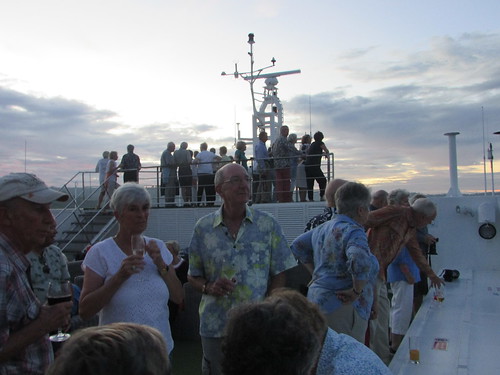
Passengers expectantly watch our approach to Rabaul, Papua New Guineau.
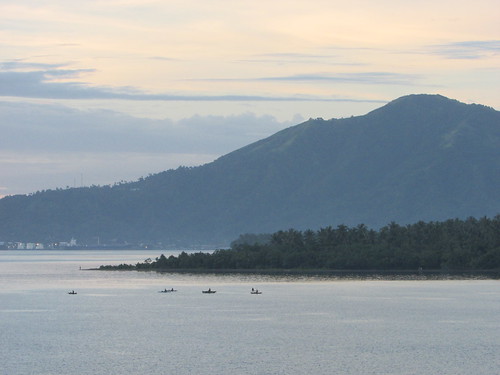
Rabaul, Papua New Guineau, from 'Caledonian Sky', at sunset as 1- and 2-man canoes fish.
The ship remained in Karavia Bay awaiting clearance to dock whilst the passengers went to dinner, held in the open air on the Lido Deck as the 'Caledonian Sky BBQ' with a wide range of food on offer buffet-style.

Caledonian Sky BBQ, 2020: the amazing buffet table.

Caledonian Sky BBQ, 2020
After the splendid meal, some of the staff demonstrated their singing talents and then the tables on which the buffet food had been laid-out were cleared away to leave a dance floor for the guests to use.

Caledonian Sky BBQ, 2020: Staff demonstrate their vocal talent.

Caledonian Sky BBQ, 2020: Passengers enjoying dancing.
Sadly, we were not welcomed by the Provincial Authorities in Rabaul and, after some hours of wrangling, at 11.30 p.m. the Captain decided that we would leave Rabaul and sail for another two and a half days to the capital of Papua New Guinea, Port Moresby. So we remained at sea on Tuesday 25th and Wednesday 26th, finally arriving at Port Moresby on a warm, sunny morning on Thursday 27th February 2020.
Related posts on this website
This post is in the series labelled 'Tropic of Capricorn’. The first post is here.
Clicking on the 'Next report' link will display the post describing the next events. In this way, you may read about the trip in sequence.
Next report
Alternately, clicking on the 'All my Tropic of Capricorn reports' link displays all the posts on this trip in reverse date-of-posting order.
All my Tropic of Capricorn reports
My pictures
Crossing the Solomon Sea
Rabaul, Papua New Guinea, from the sea in 2020
'Caledonian Sky' 2020
'Caledonian Sky' Bridge 2020
Lectures aboard 'Caledonian Sky' 2020
[Text added & pictures embedded 29-Mar-2020]
This is the eleventh of a group of posts describing an 'Expedition Cruise' with Noble Caledonia in 2020 under the title 'Across the Tropic of Capricorn'.
Events of Friday 21st February 2020
The visit to Ureparapara was added to the programme only two days previously, when Noble Caledonia decided that the planned visits to the Solomon Islands were no longer viable. Overnight, the ship had sailed from our previous mooring off Ambryn Island around 170 nautical miles to Ureparapara.
The island is a large, volcanic caldera which has collapsed on one side, allowing the surrounding sea to flood the cone, producing a horse-shoe shaped island. Deception Island in Antarctica (which I’ve visited a couple of times in 2007 and then 2016) has similar origins.
Many of the passengers were on deck as the ship made its entrance to the caldera at Ureparapara.

View from 'Caledonian Sky' as we approach the flooded caldera: Ureparapara, Vanuatu.
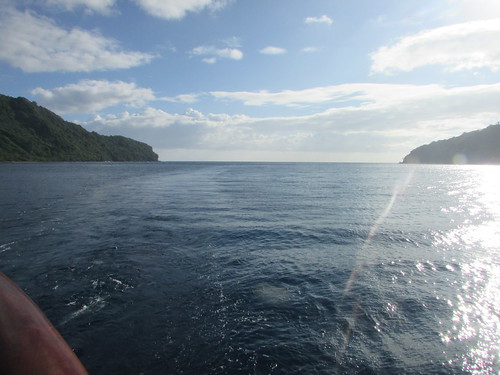
View of open sea from 'Caledonian Sky', inside the flooded caldera: Ureparapara, Vanuatu.
At 08:45, the ship started taking passengers ashore by Zodiac for a wet landing into the shallows of a narrow beach area of black, sticky mud-like volcanic sand.

View from Zodiac as we go ashore at Ureparapara, Vanuatu.
A group of impressive male dancers welcomed us, moving to the beat of a hand-held percussion bamboo instrument. All the men were painted all over in black with white rings around torso, arms and legs. They wore grass skirts and large clusters of sea shells around each ankle, producing a distinctive accompaniment as they stamped the ground. Young children from the village nearby watched the proceedings with interest.

Male dancers painted all over in black with white rings around torso, arms and legs on Ureparapara, Vanuatu.

A group of children on Ureparapara, Vanuatu.
Nearby, a group of more modern musicians were playing and singing. There was one bongo drummer, three acoustic guitars and one small 4-string banjo-like locally-made instrument. Like almost all the men, they were dressed in colourful tee-shirts with shorts but the musicians were also adorned with headbands carrying hibiscus flowers.
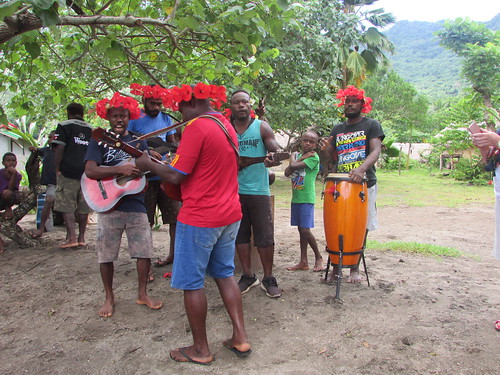
A group of modern musicians playing and singing on Ureparapara, Vanuatu.
There had been a ‘USAID’ project here for a large sign carried the project title ‘Land and Vegetation Cover and Improving Food Security for Building Resilience to a Changing Climate in Pacific Island Communities’. The rest of the sign was in Bismala, the Pidjin language widely understood in Vanuatu. There's a list of English-based Pidjins on Wikipedia here and Bislama is discussed in the interesting Wikipedia article here.
We walked towards the village, where the most buildings were timber framed, with woven bamboo walls and thatched roofs, either erected on a small plinth of flat stones or lifted a few inches above the ground.

House under construction, Ureparapara, Vanuatu

Ureparapara, Vanuatu.
The church of Saint Barnabas was a slightly more substantial construction with a sawn timber frame and corrugated sheet roof but still retaining woven bamboo panels for the walls. A large gas cylinder standing vertically nearby served as the church bell.
A group of kneeling young boys in grass skirts were playing a pebble-tossing game in a small, square area marked-out by four straight poles.
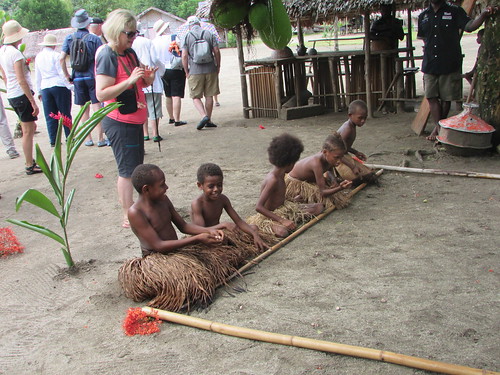
Young boys playing a pebble-tossing game on Ureparapara, Vanuatu.
All the visitors were seated in wooden stands around a performance area. The end bench seat quite near me suddenly collapsed as people tried to sit.

Collapse of bench seat, Ureparapara, Vanuatu.
Various locally-made benches and chairs quickly appeared and everybody was successfully seated. I couldn't resist the suspicion that this minor incident was symptomatic of a laid-back approach to life by the hospitable islanders.
First, a group of nine ladies in grass skirts danced for us.

Female dancers, Ureparapara, Vanuatu
Next, three men formed a percussion band. The hand-held bamboo instrument we’d seen as we arrived was now fixed between two waist-high poles and supplemented by two other musicians - one with what looked like some sort of gourd with seeds inside which was shaken and the other with a long pole held upright and struck against a baseplate laid on the ground. In the meantime, the ladies had each armed themselves with bamboo staffs.

Lady dancers chat as three musicians prepare: Ureparapara, Vanuatu.
Ten male dancers then performed, all wearing grass skirts with a thin cloak made from long plant fronds and with clusters of sea shells around each ankle. Each wore distinctive headgear, representing different aspects of life on the island.

Ten male dancers, each with headgear representing different aspects of life on Ureparapara, Vanuatu.
The ship's passengers then continued to explore the village. Another band started to play. The musicians were in modern dress but plus the thin cloak made from plant fronds. The line-up was drummer, two men each playing a sort of Pan-Pipe with four notes and four men each playing an instrument similar to a xylophone comprising ten bamboo pipes, each a different length, assembled together on an inclined frame. The note was struck by striking the open top of the desired bamboo pipe with a paddle. The overall effect was splendid.
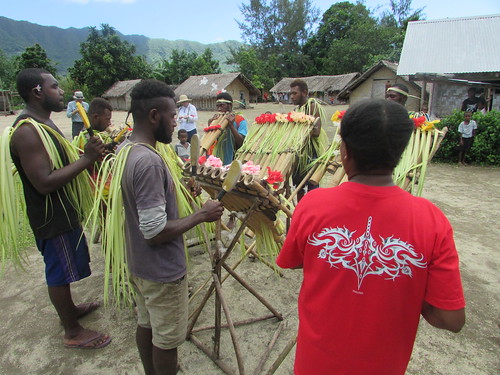
The Band: Drum, Pan Pipes and four bamboo xylophones: Ureparapara, Vanuatu.
At a shelter next to the band, fruit and fresh coconut milk was offered to the visitors. A couple with a child, all in traditional dress, prepared a local dish, inevitably involving coconut, which was then offered to the ship’s passengers.

A couple with a child offered local food to the visitors: Ureparapara, Vanuatu.
Near the sea, an elaborate diagrammatic map of the village had been created with pebbles set in clean sand, decorated with hibiscus and other blooms. I presume the 'Store' is what the the english call a 'Shop'. The 'Nakamal' is the men's hut where men relax and drink Kava. I assume 'Keeping House' refers to a store house.
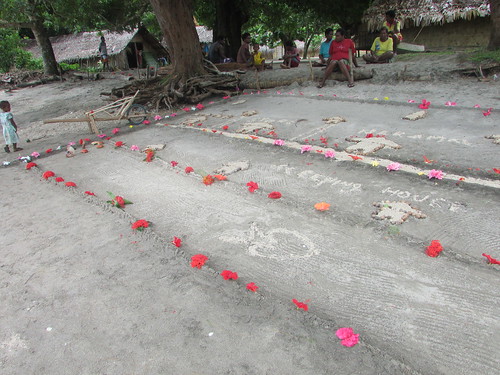
A diagrammatic map of the village had been created with pebbles set in raked sand: Ureparapara, Vanuatu.
It was a very friendly, relaxed visit and we spent some time just chatting to the villagers and listening to the live music. Eventually we moved towards the Zodiac landing place and, by noon, we had transferred back to the ship after a very enjoyable visit to Ureparapara.
Related posts on this website
This post is in the series labelled 'Tropic of Capricorn’. The first post is here.
Clicking on the 'Next report' link will display the post describing the next events. In this way, you may read about the trip in sequence.
Next report
Alternately, clicking on the 'All my Tropic of Capricorn reports' link displays all the posts on this trip in reverse date-of-posting order.
All my Tropic of Capricorn reports
My pictures
This blog post was first published on the ship via a satellite link with limited capacity so the link to my pictures was added later.
Ureparapara, Vanuatu
[Link to pictures added 11-Mar-2020: Pictures embedded 31-Mar-2020]
This is the tenth of a group of posts describing an 'Expedition Cruise' with Noble Caledonia in 2020 under the title 'Across the Tropic of Capricorn'.
Events of Thursday 20th February 2020
The visit to Ambrym Island was added to the programme only on the previous day, when Noble Caledonia decided that the planned visits to the Solomon Islands were no longer viable. Overnight, the ship sailed to Ambrym and moored off the island at around 07:00.
At 08:30, after breakfast, Zodiacs started to ferry guests ashore for a wet landing onto a beach of black sand. Two parallel rows of long-stemmed flowers had been set in the sand by local ladies who presented us with beautifully-made leaf necklaces and directed us along a track to a performance area surrounded by fairly rickety bench seating where we were to witness the traditional and highly symbolic Rom or ‘Masked’ Dance.
There was one grave in the performance area, I believe that of a former Chief, bestrewn with flower petals. The present Chiefs, dressed in the traditional 'namba' (a penis sheath) formally greeted the Ship’s Captain, the Expedition Leader and the Local Tour Company Staff who had organized the event.

The Ship's Captain is welcomed by the local Headman: Ambrym, Vanuatu.
Then, the male dancers, all dressed in traditional 'namba' stamped and moved mystically for some time at a distance from the audience to the beat of a hand-held percussion instrument carried by the elderly chief.
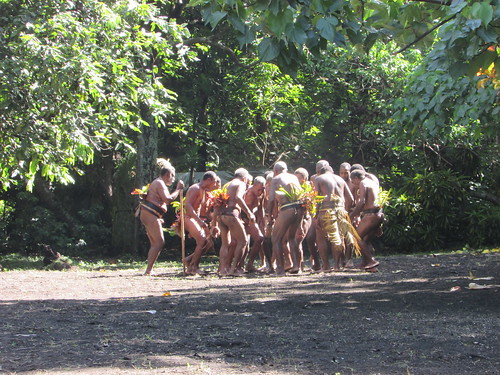
The male dancers stamped and moved mystically: Ambrym, Vanuatu.
Then, the dancers were surrounded by elaborately-masked ‘devils’ in voluminous cloaks of banana leaves who twirled around the dancers, beating the ground with symbolic long staves. The whole group moved towards the centre and the ritual continued until the male dancers retired, leaving the ‘devils’ to pirouette alone.

Elaborately-masked ‘devils’ in the Rom Dance: Ambrym, Vanuatu.

Male dancers being surrounded by elaborately-masked ‘devils’: Ambrym, Vanuatu.

Male dancers completely surrounded by ‘devils’: Ambrym, Vanuatu.
Finally, the ‘devils’ retired and the male dancers, rather unexpectedly, quietly lined up for photographs.
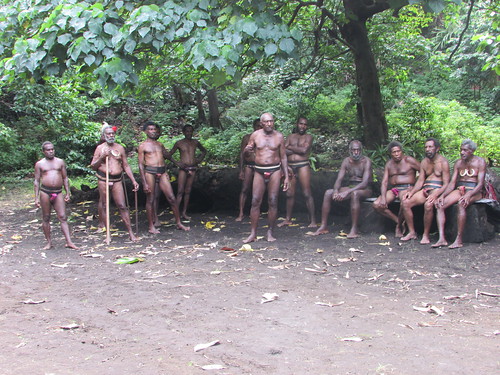
Male dancers relax after the Rom Dance: Ambrym, Vanuatu.
One chief then performed a sombre melody on a long bamboo flute with a series of holes to allow different notes to be played.
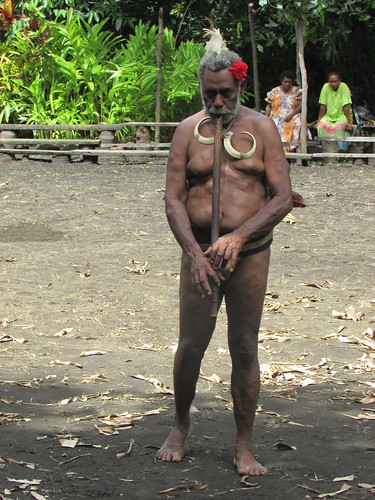
A sombre melody on a long bamboo flute: Ambrym, Vanuatu
To demonstrate the Ambrym tradition of sand drawing, assistants then spread sand on one area near the grave and a second spot in the performance area. Two of the male dancers we'd watched then showed their skill at sand drawing, each smoothing the sand to their satisfaction before swiftly scribing a stylized image of remarkable complexity.

Sand Drawing: Ambrym, Vanuatu
The final item was a demonstration of 'magic'. Two men with woven baskets faced one another. The first showed that his basket held six large nuts, whilst other basket held none. The first man then pretended to throw an imaginary nut from his basket to the second man who caught it in his basket. This continued until six imaginary nuts had been transferred. The first man inverted his basket to show that his basket was now empty then the second man showed that his basket now contained six large nuts!
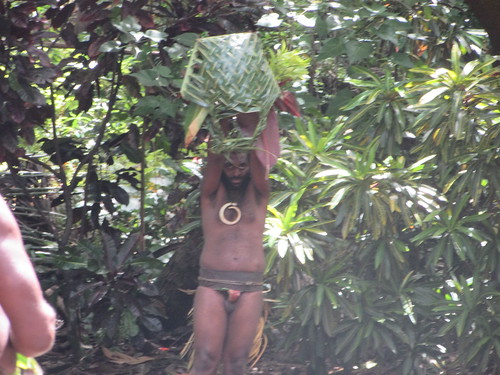
The first magician displays his now 'empty' woven basket: Ambrym, Vanuatu.
The whole performance had been quite impressive, if inscrutable. Seeking more understanding on my return, I found that the Vanuatu Tourism Office offers the exact programme we saw as "A sacred event associated with magic believed to influence harvests. You will watch hypnotic costumed dances and listen to beautiful and haunting bamboo flute music. You will witness a small display of mysterious ‘Black Magic’ only performed by special sorcerers – ‘the man blong blak majik’".
We then walked to the quiet village which showed a wide variety of building styles. Some houses had a wooden frame made from sawn timber, lifting the floor a few feet off the ground. The walls were woven bamboo topped by a thatched roof. Other dwellings of similar construction placed the floor at ground level. Elderly store houses had stone walls and corrugated sheet roofing but there was also one large, timber framed store with corrugated sheet roof. There were some stone plinths, presumably the relics of older buildings and at least one abandoned cement-lined stone cistern. The village seemed to have lots of derelict buildings. One more modern section of an abandoned building had a formed concrete foundation, with blockwork above, stabilized by vertical reinforcing bar with concrete poured into the spaces through the blocks.

Large house overlooking the sea - traditional but elevated on reinforced concrete piles: Ambrym, Vanuatu.
Lonbato Co-operative Society shop was quite modern and we went inside to study the wide range of stock held. There was a large array of solar panels outside.

Expedition Leader Craig Ward surveys the stock in Lonbato Cooperative Society shop: Ambrym, Vanuatu.
The Church was a large, modern building near Lonbato Co-op. Inside, on a large blackboard, the forthcoming programme of events and the draft budget had been chalked up. Behind this building I found what was apparently the original church building, now disused. A simple wooden frame still suspended a large gas cylinder, struck to call the faithful.

Ambrym, Vanuatu, showing old church, new church and church bell.
A loud thump behind me made me spin round. A large, heavy, ripe breadfruit had just fallen to the ground, uncomfortably close to me.

A ripe breadfruit falling from a tree just missed me.
Unharmed, I returned to our point of landing where a selection of beautiful polished hardwood carvings were on sale. After a fascinating morning, our Zodiacs returned us to the ship to be presented with yet another comprehensive and tempting lunch menu.

Jan, on return to ship with beautifully-made leaf necklace from Ambrym.
As we lunched, the ship repositioned off the village of Ranvetlam. The first Zodiac departures took swimmers and snorkelers ashore then the other Zodiacs Zodiacs offered the remaining passengers a one hour cruise looking at features along the coastline.

Zodiac Cruise, Ambrym
Along this part of the coast, there was no beach and the land met the sea at a 15 foot rock cliff. A stream tumbled over this cliff in a waterfall. Village women had completed washing clothes in this stream and had spread out the items on the rocks to dry in the sun, allowing a group of young children to splash around happily in the stream.

Village children watch their visitors: Zodiac Cruise, Ambrym.
Further along, the cliff was pierced by a series of shallow caves and the Zodiacs carefully nudged inside. Shortly afterwards, the Zodiac I was in suffered a fuel blockage. Having confirmed the plastic fuel tank in the locker in the bow had plenty of fuel, our driver tried hand priming by squeezing the fuel bulb a number of times but without success. Seeking fault-finding tips over the radio, our driver was told to try stamping firmly on the fuel bulb a few times and this technique was successful.
A shoal of tuna was spotted in a feeding frenzy, members leaping out of the water in their excitement. By then, it was time to return to the ship after an interesting interlude. With everybody safely back on board, and the Zodiacs stowed by about 17:30, the Captain was able to start our overnight journey to Ureparapara, third largest Island of the Banks Island chain in Vanuatu.
Related posts on this website
This post is in the series labelled 'Tropic of Capricorn’. The first post is here.
Clicking on the 'Next report' link will display the post describing the next events. In this way, you may read about the trip in sequence.
Next report
Alternately, clicking on the 'All my Tropic of Capricorn reports' link displays all the posts on this trip in reverse date-of-posting order.
All my Tropic of Capricorn reports
My pictures
This blog post was first published on the ship via a satellite link with limited capacity so the links to my pictures were added later.
Ambrym, Vanuatu
Zodiac Cruise, Ambrym, Vanuatu
[Links to pictures added 11-Mar-2020: Pictures embedded 01-Apr-2020]


