Thursday, 12 December 2013

Santa at Shackerstone

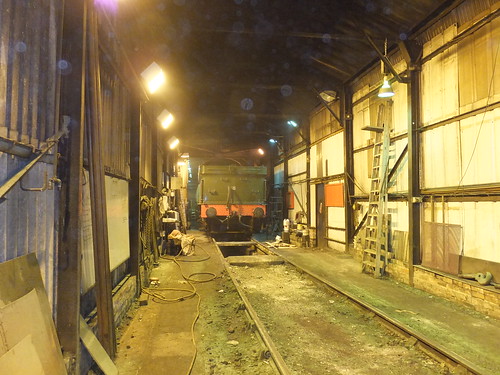
The Battlefield Line started its well-supported programme of 'Santa Specials' for 2013 on Saturday, 30th November. I was the booked driver the following day. This necessitated getting up at 4.20 a.m. in order to 'sign on' at Shackerstone a little after six. It was still dark but it didn't seem too cold. Dave, the fireman, was already in the engine shed emptying the ashpans on our locomotive - Great Western 3803. The engine was well-inside the shed, making it easier to admire the recently-installed additional lighting which has improved working conditions significantly.

3803 in the shed at Shackerstone.

Dave and I worked together preparing the locomotive. He did the inside oiling for me and I fetched coal forward - only a few hundredweight remained in the tender, perched on top of the tender tank right at the back so coaling was going to be essential. Later, Jason arrived to carry on with re-painting a coach which was sitting in platform 1. Jason fired up a diesel shunter to propel the coach from platform 1 towards the DMU Siding, leaving the line clear for Dave and I to move 3803 through platform 1 to the coaling point in the North End sidings. Jason started the Bucket Loader and coaled our engine. I moved the engine across to platform 2 and Dave coupled us on to the head of our five coach 'Santa' train.

As stewards helped arriving passengers to their correct seats, we started to steam heat the train. Dave explained that they'd had a problem the previous day - the flexible hose under the footplate carrying steam for carriage warming from the locomotive to the tender was leaking and an additional jubilee clip had been fitted as a remedy. It was apparent that the problem was not completely cured, as clouds of steam swirled around the cab.
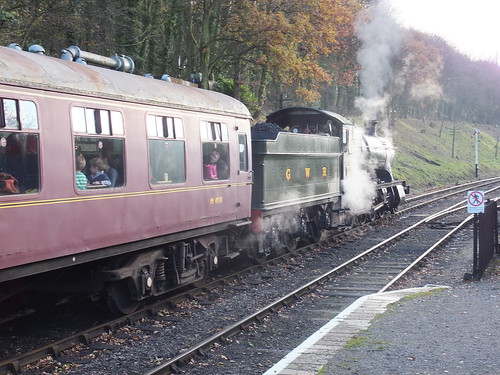
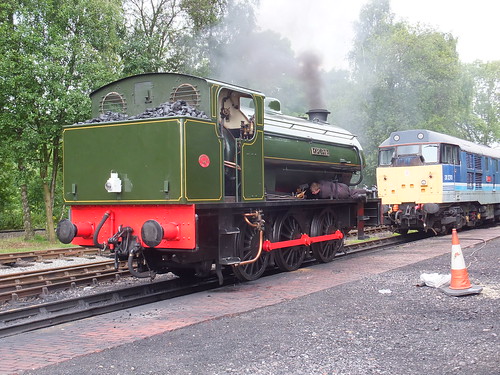
3803 at the head of the 10:00 'Santa' train.

Eventually, all our passengers were boarded and, rather late, we set off on the first of four trips. The steam heating leak wasn't too bad but forward visibility through the cab spectacles was impaired. I had to lean well out of the cab to keep a lookout ahead. The situation seemed to improve later in the day probably because, as the air temperature increased, the drifting steam didn't immediately condense to form a thick fog. We had an uneventful run to Market Bosworth station. We were booked to stand here until Santa had worked his way down the train, speaking to all the boys and girls and giving them presents. The train was well-loaded, so we stood for twenty minutes or so.
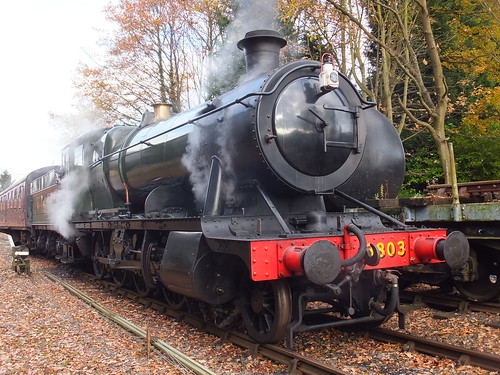
The unmistakeable Great Western lines of 3803, waiting at Market Bosworth.

Eventually Martin, the Guard, gave us the 'Right Away' and we continued our journey to Shenton. I 'eased up' to slacken the coupling between the tender and the first coach and Dave 'hooked off', allowing us to run round our train, ready for the tender-first run back to Shackerstone.

I'm afraid we continued to run late throughout the day. We were able to make up a little time on the journey but each departure was a little late and, of course, the important thing was to allow Santa time with all our young passengers. The final departure from Shackerstone was the 16:00. We were still a little late away but this train was not filled to capacity.
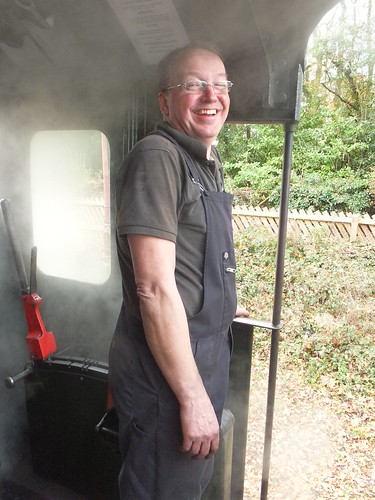

Dave, in a cheerful mood.

Dave was suffering from an infection and had coped manfully with the heavy day but Jason had agreed to join us and fire the last trip. It was becoming dark as we left Shackerstone with trees and bridges silhouetted against a deep blue sky. People are often surprised that, in the age of steam in Britain, a steam locomotive driver had no view ahead at night. The lamps carried on the engine were purely for identification and the driver largely had to rely on sounds to know his location. In other countries, attempts were made to give the driver some visibility ahead (I always think of the classic American 4-4-0 bearing a huge oil searchlight in front of the diamond stack). Of course, on Network Rail all trains, including those hauled by steam locomotives, now have a high-intensity headlamp but preserved railways continue the tradition of 'running in the dark'.

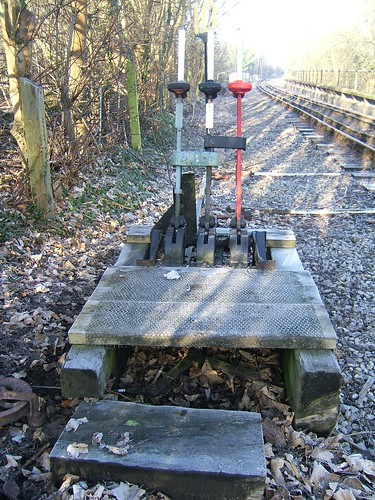
On arrival at Shenton, we ran-round for the last time and were soon on our return journey to Shackerstone. By this time, it was properly dark. The driver is always on the look-out for signals and, traditionally, semaphore signals were lit by paraffin lamps. There's a little about the lighting of signals here. On preserved lines, signals are often converted to being electrically lit, for convenience. Approaching Shackerstone, the first lit signal is the outer home, which was showing a cheerful 'Green' (there is a preceding fixed distant signal, but this is not lit). We dropped down the bank towards the signal box, complying with the 10 m.p.h. speed restriction and observing the two red lights of the inner home (a two disc ground signal - there's a daytime picture of this signal here). As we approached, the lower red light turned to green, beckoning us into platform 2. With a 5-coach train, we had to stop with the engine fouling the barrow crossing to platform 1. Since the footbridge is still closed, all our passengers had to wait for Dave and I to unhook the engine and draw forward over the hand points at the north end, where we waited until everybody had made their way across to platform 1. Once the foot crossing was clear, we headed for the shed and quickly completed our disposal after an enjoyable, if tiring, day.

Related posts in this Blog

Santa Specials.
Locomotive 3803.
Railway Signalling in Britain: Part 4 - Semaphore Signal Aspects by Night.

My Pictures

Santa at Shackerstone 2013
3803

Tuesday, 10 December 2013

Jan Ford's Travels - The early trips

My post Jan Ford's Travels lists the 'Grand Tours' I embarked upon starting in 2001 but I'd had a number of trips abroad before then. I've now listed most of these earlier trips although details are rather vague, I'm afraid. Even dates are approximate until I find other evidence. I haven't all my old passports (one passport was stolen while current in Centraal Station Amsterdam).

If there's already a blog post, I've provided a link and, if I've found any photographs for the trip, they are also usually linked. There's also a post Jan Ford's Travels: Around the World in pictures.

Alternately, if there are sets of photographs, you can go directly to the list of all my collections here, where collections for each country visited are listed in alphabetical order (followed by 'special interest' collections on railways, charitable initiatives and similar).

France (1951)

My first overseas trip was a day trip to Boulogne with my mother around 1951. There's a short report here.

Republic of Ireland (1972-1973)

In 1972, my firm, Ford Electronics, undertook a railway project for Westinghouse Brake and Signal in Eire. Various staff from Ford Electronics, including the writer, made a number of trips to Eire during the installation and commissioning phases. It was an interesting time which I've not yet described and, at the moment, there are no pictures.

Germany (1976)

In 1976, Ford Electronics started design work on the Trunk Line Electrification Project in Taiwan for G.E.C. I made a couple of visits to Frankfurt, visiting the German consultants on the project. No report or pictures at present.

Holland (1977)

I made my first visit to Amsterdam with my mother. No report or pictures at present.

Taiwan (1977-1978)

In 1977 and 1978, I made three trips to Taiwan in connection with telecommunications equipment we supplied to G.E.C. for the Trunk Line Electrigfication Project. There's a short report here. No pictures at present.

Holland (1980)

In 1980, I became a weekly commuter for some months when carrying out consultancy work for Philips, briefly described here. Later, I visited a couple of times with my partner Daemon. No pictures at present.

Italy (1980)

My first trip to Italy was a visit to Milan in connection with consultancy work for Philips. Later, I made a trip to Venice. No report or pictures at present.

Korea (1980)

I visited Seoul with a team from Philips when they were engaged in tendering for a project in Iraq. There's a short post here. No pictures at present. I've only transited through Incheon since (on my Trip to Japan here).

Poland (November 1981)

The Soviet Empire was shaken in 1980 by the emergence of an independent trade union in Poland - 'Solidarity'. My mother was keen to visit and she and I spent a few (rather tense) days in Warsaw. The following month, Martial Law was declared. There's no report or pictures yet.

Paris (1982)

My firm was involved with an American computer company Dynabyte. A trip to Paris for a Dynabyte seminar gave me a little time to explore the city. No report or pictures at present.

Thailand (1988-1989)

I made 5 trips to Thailand in 1988-1989 in connection with the commissioning of the Train Despatcher Project for G.E.C. On the last of these visits, I took part in the 'Train Despatcher Project I & C Seminar' described here, with pictures here. No other report or pictures at present.

Switzerland (1989)

I visited the International Telecommunications exhibition in Geneva when it was known as the CCITT exhibition (from the French Comité Consultatif International Téléphonique et Télégraphique). In 1993, CCITT became ITU-T (for International Telegraph Union Telecommunication Standardization Sector). After visiting the show, I extended my stay to spend a couple of days dashing round the country by train, with a side trip to Italy through the Simplon Tunnel. Sorry, no report as yet and no pictures.

Thailand (1990)

I made a further trip to Thailand to assist in the opening of the Bangkok Railway Museum, described here.

India (1992)

My first visit to India was in connection with the commissioning of telecommunications equipment for the Delhi Ring Railway. I flew to Delhi in May 1992, returning almost seven weeks later. There's a post here, with a link to a continuation post here. The continuation post has a series of links to railway and travel photographs.

[Link to Jan Ford's Travels: Around the World in pictures added 12-Nov-2015]

Monday, 9 December 2013

British Railway Architecture

An American correspondent recently wrote to me, describing a visit to Surbiton railway station, which he found "remarkable", although his preference would be for a rather earlier architectural style. I completely agree with those sentiments. I'm not usually a fan of Art Deco but the 1937 building designed by the Southern Railway Architects' Department under J. R. Scott is impressive, fully justifying its Grade II Listing.

Surbiton Station (Photo: Ok2010 (Own work) [CC-BY-SA-3.0 (http://creativecommons.org/licenses/by-sa/3.0)], via Wikimedia Commons.

The (rather terse) description of the building in 'Architect Speak' is:-
Reinforced concrete, painted. Flat roof. 4 bay central tall single storeyed booking hall, flanked by low, narrow bays containing kiosks, curvng backwards to meet long, low wings. Continuous cantilevered canopy of concrete to centre and wings, with moulded edge. Clock tower to left with strong, but narrow cornice and horizontal strings to upper, set back part. Long square headed windows with narrow closely spaced mullions to booking hall. Original wood and bronze doors below, with triple bronze bars in front of long narrow windows. Central facia to canopy with "Surbiton" in sans serif capitals. Marble lined booking hall. Two long single storeyed buildings remain on platforms; also reinforced concrete, with rounded ends and horizontal glazing bars to windows. Built to contain offices, lavatories and waiting rooms.
Similar ideas were employed in a number of suburban stations on the extensive electrified network, neatly reinforcing the impression that the Southern was a modern, forward-looking railway. Buildings with rounded ends (mentioned above) were a recurrent motif, being frequently applied to signal boxes of the period.

Former Wimbledon 'A' signal box on the right. The area is now controlled from Woking.

Railway architecture is one of my interests and my collection of pictures Railways (UK) includes a number of photographs of buildings, bridges and other constructions (now termed 'the built environment'). Having introduced one outstanding Southern Railway building above, I thought I'd make reference to a few other Southern Railway buildings. The Southern Railway was formed by the amalgamation of the London and South Western Railway, the London, Brighton and South Coast Railway, the South Eastern and Chatham Railway and other minor companies in the 1923 'Grouping'.

I've written about the L.S.W.R. terminus at Waterloo here and my pictures are here

Victoria Station is two stations, side-by-side, one for the L.B.S.C.R., one for the S.E.C.R., as described in my post here. My pictures of Victoria are here.

Clapham Junction is a combination of L.S.W.R. and L.B.S.C.R. routes, described here with my pictures here.

There are also pictures of railway buildings in the set London: former 'Southern' lines, in the set London's Railways (although not all the buildings in this set are former Southern Railway) and in the set London Bridge Station.

Related articles on other sites

Surbiton Railway Station (Wikipedia).
Subiton Station.
The Southern Railway (Wikipedia).
British Listed Buildings.

I hope to return to this theme in the future.

Friday, 29 November 2013

Happy Birthday 'Planet'!


The 'Planet' replica at MOSI is 21 this year. The exact date depends upon which particular event you choose as the 'birthday'. I normally use the official launch by the Lord Mayor of Manchester on 2nd October 1992.

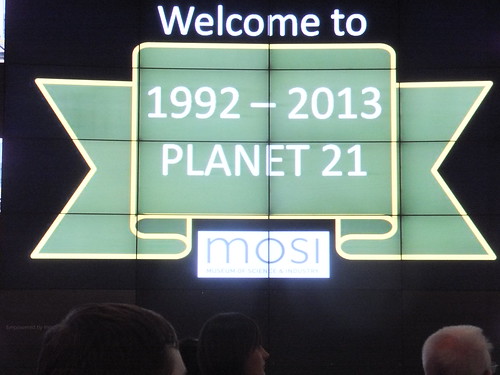
The birthday party celebrating 21 years of operation was held at MOSI on 27th November. The guests were Volunteers, Friends of the Museum and people who were involved in the 'Planet' Project and the previous Director of the Museum, Steve Davies - quite a gathering.

Of course, 'Planet' was in steam giving rides. Even at 5.00 p.m. it was already dark.

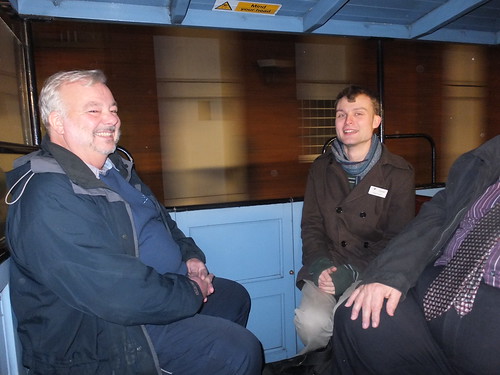
Vince and Duncan enjoy a ride behind 'Planet' in the dark.

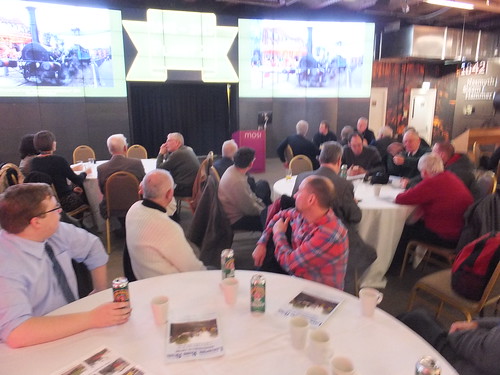
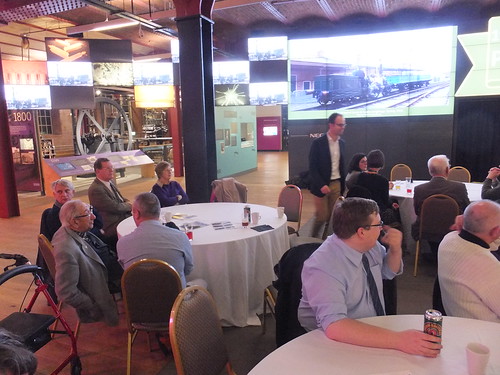
When everyone had admired 'Planet', taken a ride or just enjoyed chatting, the guests moved into the main building. A number of large round tables with chairs had been set up on the ground floor in front of a modern multi-screen video display comprising a central panel of 3 x 3 screens flanked on either side by panels of 4 x 4 screens together with a series of smaller screens forming 'wings'. Beverages were served initially and then a long queue formed where the guests were quickly served a delicious Lancashire Hot Pot.

In the Dining Area, the 'Big Screens' showed duplicated video images of 'Planet'.

Another view of the Dining Area showing one of the 'Big Screens' and one 'wing' of smaller screens.

Matthew Jackson has been Railway Officer for six years but, sadly, is shortly leaving. Mike Ward made a presentation to Matthew on behalf of his many friends. The Chairman of the Museum Friends, Mike Crawley, then gave a short address about 'Planet' and the threat to the future of the railway posed by the Ordsall Chord Project (there's more about the Ordsall Chord in my post Another Saturday in Manchester).

The main speaker of the evening was Michael Bailey but, unfortunately, the writer and other guests with long distances to travel were unable to stay for the remainder of the celebrations.

This event concluded 21 years of successful operation of 'Planet'. For more information about 'Planet', see my 'Planet' Loco-profile here which includes a number of 'related post' links to articles describing the original 'Planet' locomotives together with the building and operation of the 'Planet' replica.

My pictures

My rather poor pictures of the'birthday party' are here.

Tuesday, 26 November 2013

The Buxton Branch

On the 18th November 2013 I travelled by rail to Dove Holes on the Stockport to Buxton branch. The usual Cross-Country 'Voyager' took me from Wolverhampton to a very wet Stockport where there was just time for a brief foray outside the station before catching the train to Dove Holes.

Stockport

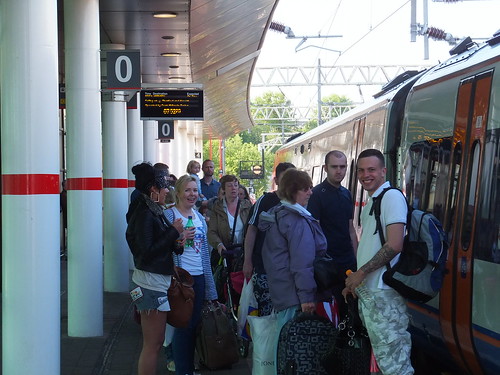
Stockport area is interesting in that it has retained five signalboxes on the main line to Piccadilly. From the north, Heaton Norris Jn. (controlling the branch to Guide Bridge), Stockport No. 2, Stockport No. 1, Edgeley Jn. No. 2 (controlling the branch to Northeenden Jn. and Altrincham) and Edgeley Jn. No. 1 (controlling the double track branch to Buxton). Stockport Station has another claim to fame - it has a Platform 0.

Platform 0 at Stockport.

I mentioned Stockport's Platform 0 in the earlier post Platform Numbering Revisited. At the time, Cardiff and Haymarket also had a Platform 0. I added that I'd been 'reliably informed' that the new platform at King's Cross would become Platform Y, rather than Platform 0. So much for 'reliable informants' - the new platform at the rebuilt King's Cross subsequently became Britain's fourth Platform 0!

Platform 0 at King's Cross.

DMU to Dove Holes

My train to Dove Holes was a Northern Rail service from Manchester Piccadilly to Buxton, operated by a 2-car Class 156 which arrived about three minutes late. Colour light signals beckoned us onto the Buxton Branch and we made brief stops at Davenport (where I caught a glimpse of the L&NWR access steps leading down from an L&NWR station building) and Woodsmoor, before arriving at Hazel Grove.

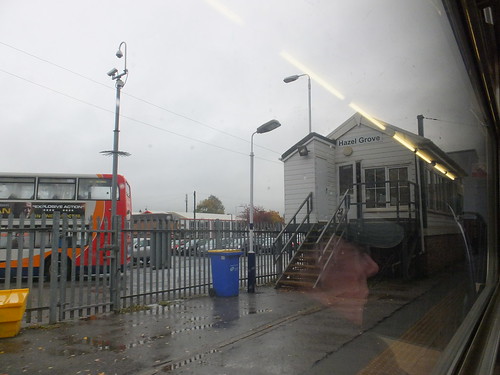
The line is electrified at 25 kV a.c. as far as Hazel Grove so the DMU service to and from Buxton is augmented by EMUs which terminate here. Fairly modern station buildings are provided, but I was more interested in the L&NWR signal box on the Up platform, thoroughly modernised with uPVC double glazed window units replacing the original (draughty) L&NWR casements.

Hazel Grove Signal Box.

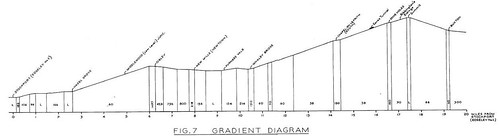
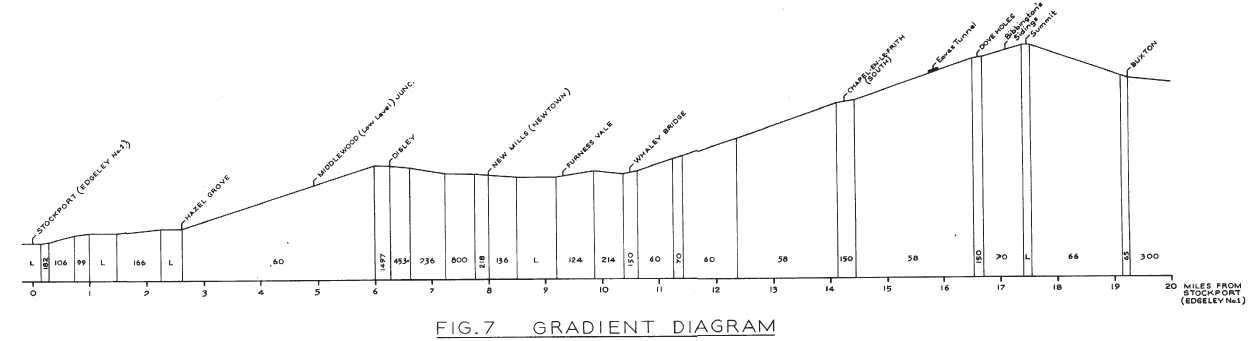
The box controls two stock sidings and two crossovers allowing electric trains to arrive and depart from either through platform. Beyond the station, the single line Hazel Grove Chord gives access to the former Midland Hope Valley Line to Sheffield. Our double track route now started a climb into the hills at 1 in 60 and the noise from the underfloor engines became quite loud.

Gradient Diagram: Stockport - Buxton (HMSO).
Click here for larger view.

Colour light signals were now left behind - I think the first semaphores were a distant and home protecting the level crossing at Norbury Hollow where there's a charming Gate Box.

I was surprised that we didn't stop at Middlewood station. Although there's one train an hour each way to Buxton, I discovered later that alternate trains don't stop at Middlewood (or Dove Holes). In the pouring rain, we stopped at Disley where the gradient became downhill through New Mills Newtown (so called to distinguish it from New Mills Central on the former Midland line which was just visible through the rain across the valley).

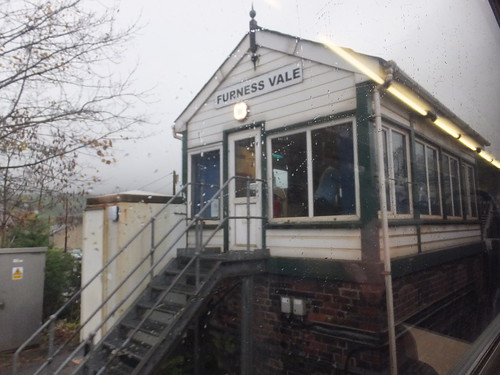
Furness Vale retains its L&NWR signal box (modernised, of course) and controls a level crossing with four lifting barriers.

Furness Vale Signal Box.

Entering the next station, Whaley Bridge, I spotted the Jodrell Arms Hotel which I visited some years ago when The Old Locomotive Committee held an A.G.M. there. The gradient became 1 in 60 to Chapel-en-le-Frith, easing to 1 in 150 through the platforms (steep gradients are avoided wherever possible through platforms). where the station name boards make the twin claims of being "The Home of Ferodo" and "The Capital of the Peak".

The Chapel-en-le-Frith Accident

Chapel-en-le-Frith was the site of the very tragic accident in 1957 when a Class 8 suffered a brake failure caused by a steam pipe joint giving way, filling the cab with scalding steam. The train careered downhill with its train, colliding with a previous freight train at Chapel-en-le-Frith. The driver and fireman were commended for their bravery. Driver John Axon remained on the locomotive and was killed in the collision, being posthumously awarded the George Cross. The Railway Archive has a summary of the accident and the subsequent accident report is available here. In 1958, the BBC produced 'The Ballad of John Axon', in an innovative fusing of Ewan MacColl's ballads with location recordings including interviews with real railwaymen, briefly described here. I still find 'The Ballad of John Axon' very moving - it's available in various forms like CD, mp3 and printed word.

DMU to Dove Holes (continued)

Leaving Chapel-en-le-Frith, we passed the BR standard design signal box on the Down side - a permanent reminder of the 1957 accident which demolished the original L&NWR signal box on the Up side. The gradient reverted to 1 in 58 to my destination, Dove Holes. Again, there was an easing to 1 in 150 through the platforms. In the pouring rain, I alighted and watched the DMU depart for Buxton, climbing at 1 in 70 to the summit.

DMU back to Stockport

When I was ready to start my return journey, I discovered that a Stockport train was due through Dove Holes fairly soon. Unfortunately, it was one of the trains not booked to stop. My friends kindly took me by road to Chapel-en the-Frith where I was able to pick up the train, rather than wait over an hour for the next train stopping at Dove Holes. The weather had improved and the journey back to Stockport was uneventful. With unexpected good luck, on arrival at Stockport I just had time to hurry through the subway to platform 2 and board a waiting Cross Country 'Voyager' back to Wolverhampton.

Chapel-en-le-Frith station, looking towards Buxton, showing the site of the 1957 collision. The replacement signal box built after the collision is on the right.

Railway Maps

You can find detailed signal box diagrams for the route back in steam days in the excellent series of publications from the Signalling Record Society 'British Railways Layout Plans of the 1950's' - 'Volume 15: ex-LNWR lines Crewe (excl) to Manchester & Leeds, and branches' (ISBN: 1 873228 11 2).


If you want to see what remains of the route, refer to 'Railway Track Diagrams Book 4: Midlands & North West', Second Edition (or later), published by Trackmaps (ISBN: 1-9549866-0-1).

My photographs

Buxton Branch.
Manchester Area Rail.

Thursday, 14 November 2013

Bagan Medical Clinic: October 2013

This report is based on information from Doctor Hla Tun, who also supplied the photographs.

The Bagan Clinic treated 3,647 patients in October 2013, bringing the total number of treatments since the Clinic opened on 6th August 2011 to 83,702. Since some patients require more than one treatment, the total number of patients seen at the Clinic is somewhat less than the number of treatments.

Treatment Summary

The table below summarises the number of treatments per month and the total number of treatments since the clinic started.

Month Patients treated Total treatments
August 2011 355 355
September 2011 784 1,139
October 2011 1,434 2,573
November 2011 1,723 4,296
December 2011 2,013 6,309
January 2012 1,605 7,889
February 2012 2,464 10,353
March 2012 4,603 14,956
April 2012 2,043 16,999
May 2012 - Jan 2013 To be added To be added
February 2013 2,713 49,850
March 2013 2,713 49,850
April 2013 2,061 54,924
May 2013 3,303 58,227
June 2013 5,586 63,813
July 2013 6,079 69,892
August 2013 5,337 75,229
September 2013 4,826 80,055
October 2013 3,647 83,702

Monthly notes

On 19th October, a group of six people travelled around 320 kilometres from Nunt San town in Shan State to visit the Clinic. Two older people travelled by bus, the other four travelled on two motor bikes, including a 39 year old lady suffering from rheumatic fever with multiple joint pain. On the journey the road through KaLaw town zig-zags and is very up and down, resulting in one motor bike falling over, leaving the patient with abrasions on both knees and superimposed joint pain.

39-year old lady with rheumatic fever.

Another lady patient works in the fields to earn a day wage but she suffered an allergic reaction to the grasses, resulting in contact dermatitis.

Patient with contact dermatitis.

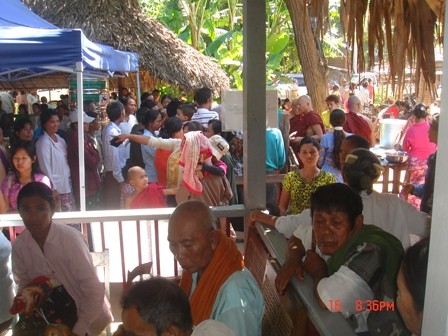
The picture below shows how, as their appointment number approaches, patients queue in front of the Clinic, whilst (in the background) other patients line-up for a free lunch from the Monks.

Patients waiting at the Clinic.

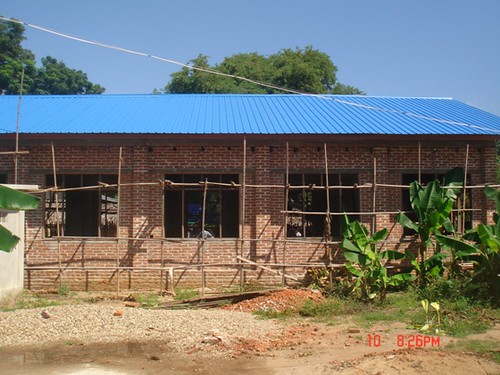
The new clinic building is progressing and should be finished in a few weeks.

The new clinic building under construction.

There are a number of posts on medical support in Myanmar provided by the RTM Social Contribution with help from donors around the world. You can find them all here.

Wednesday, 13 November 2013

Loco-profile 6: 'Planet' replica

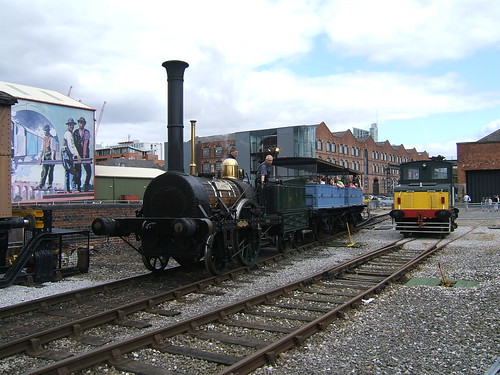
The 1830s saw a remarkable and rapid development of the steam locomotive engine. In 1829, at the Rainhill Trials, 'Rocket' triumphantly proved the feasibility of hauling passenger trains using locomotives. Within a year, Robert Stephenson and Co. had built 'Planet', which offered significant technical advances. Various working replicas of 'Rocket' have been built but 'Planet' was unrepresented until Michael Bailey and the Planet Team, working at Manchester Museum of Science and Industry (now MOSI) designed the 'Planet' replica. On 2nd October 1992 the Museum brought its 'Planet' replica into service. The replica has just completed 21 years of service at the Museum and other railway sites. The articles listed in 'Related posts' below give more information about the genesis of both the original and the replica locomotive.

'Planet' replica (with earlier taller chimney) and replica train.

Related posts in this blog

Early Locomotive Design.
The Planet Replica.
'Planet' at MOSI - The First 21 Years.
'Planet' in Perspective
'Planet Locomotive in Operation.

My Photographs

'Planet'.
Planet Drawings.

Tuesday, 12 November 2013

'Planet' in Perspective

A little background

When the Liverpool and Manchester Railway was being built following authorisation by the Parliamentary Act of 1826, the decision regarding propulsion had not been made. The options were cable haulage, using a series of stationary steam engines along the line, or the use of self-propelled 'locomotive engines'. The Directors of the Liverpool and Manchester Railway decided upon a competition, with a £500 prize to the winner, to find the best steam locomotive design before finally deciding upon the method of traction for their line. In 1929, the Rainhill Trials were held, amid massive public interest, and 'Rocket' was the winner. There's a brief description of this period in the post Early Locomotive Design.


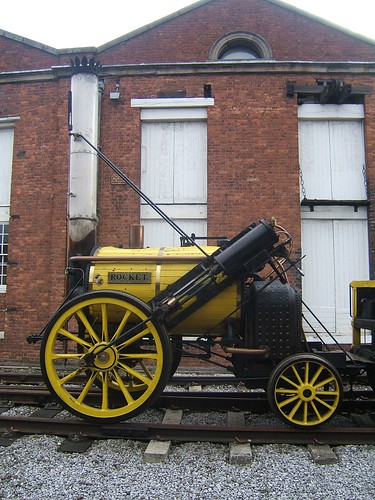
The National Railway Museum 'Rocket' replica.

For the opening of the Liverpool and Manchester Railway, a number of locomotives fairly similar to 'Rocket' were built by the Robert Stephenson works.

Experience with the 'Rocket' class suggested a number of technical improvements which were incorporated in the very successful 'Planet' class. The Stephenson works produced four 'Planet' class locomotives by the end of 1830, with a further four in 1831, supplemented by two very similar locomotives manufactured by Fenton, Murray and Company. The design of the 'Planet' class was so successful that, for a number of years, locomotives were essentially derivatives or enlarged versions of 'Planet'.

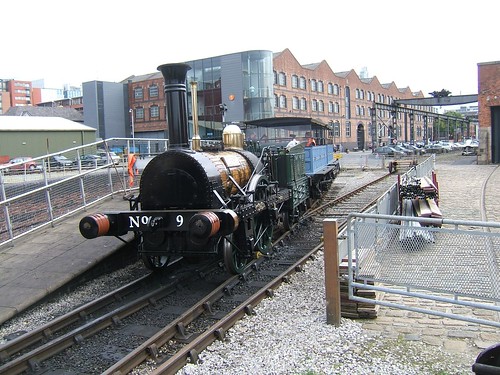
The 'Planet' replica (with shortened chimney).

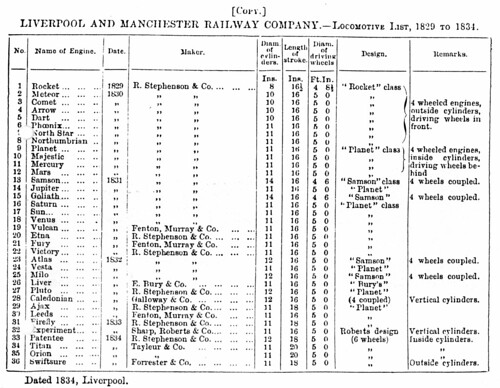
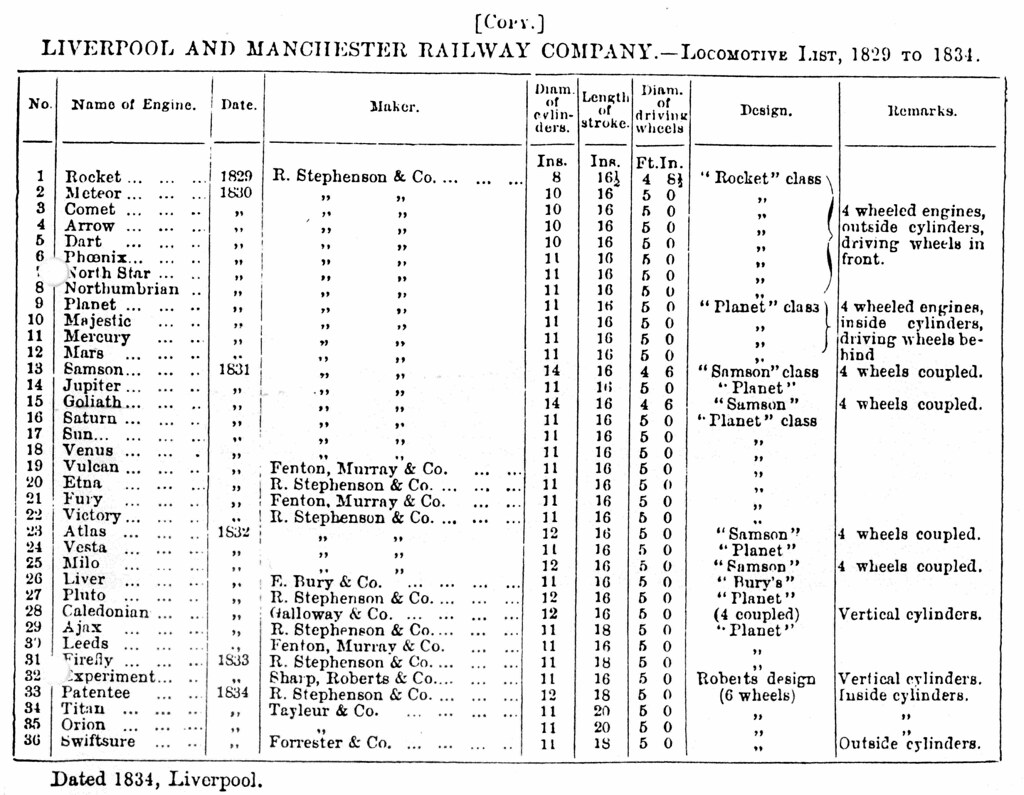
Liverpool & Manchester Railway company - Locomotive List, 1829-1834

Click here for larger view.

The above list, produced after a few years operation of the Liverpool and Manchester Railway, is worth studying in detail. It is taken from the book by Clement E. Stretton [reference 1]. The success of the railway is clear from the fact that no less than 36 locomotives appear on the list, headed by No. 1 'Rocket', built in 1929.

The 'Rocket' class

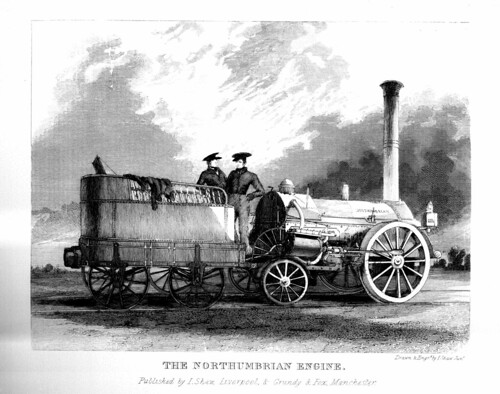
The cylinders on 'Rocket' were 8 inches in diameter, with a 16.5 inch stroke and the driving wheels were 4 feet 8.5 inches diameter. A further seven locomotives (No. 2 - No. 8) were built in 1830 to inaugurate the service. Although the list shows them as 'Rocket' class, there were a number of changes Compared with 'Rocket', the cylinder diameter was increased to 10 inches (on the first four locomotives) and again to 11 inches (on the final three locomotives). There was a small reduction in stroke to 16 inches and the driving wheel diameter was increased to 5 feet. The first four locomotives had a larger number of smaller diameter smoke tubes and a chimney similar to 'Rocket', swelled at the base to join onto the front of the boiler but, thereafter, the chimney was carried on a recognisable 'smokebox'. Note that the cylinders have been lowered from the steeply-inclined position of the original 'Rocket' to an almost-horizontal position to reduce impact on the track. 'Rocket' itself had the same cylinder position modification at some stage. On the last of the 'Rocket' class, No 8 'Northumbrian', illustrated in the Shaw print below, the mature form of the 'Stephensonian' boiler appears with a larger water-jacket firebox integrated with the boiler (which now has 132 smoke tubes of 1 and 5/8 inch diameter).

Shaw: Plate IV The Northumbrian Engine.

The 'Planet' class

The 'Planet' class quickly followed and the Robert Stephenson and Company works produced the first four class members in 1830 - 'Planet', 'Majestic', 'Mercury' and 'Mars' (No. 9 to No. 12). The 11 inch by 16 inch cylinders of the later 'Rocket' class engines were retained, as were the 5 foot diameter driving wheels but the configuration of the class was completely revised from an 0-2-2 to a 2-2-0, as described in the post The Planet Replica.

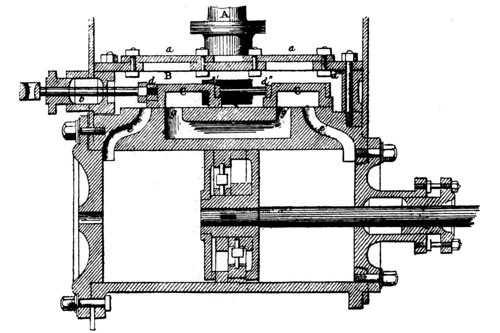
The diagram below shows the design of the cylinders for the 'Planet' class. Note that both front and rear covers were cast separately from the cylinder. Also note that the steam valve was split into two sections. This arrangement created extra wear and was not perpetuated.

Diagram of 'Planet' class cylinder (from Ahrons book [reference 2], drawing originally published in "The Engineer").

In 1831 the Stephenson works turned out another six 'Planet' engines - 'Jupiter', 'Saturn', 'Sun', 'Venus', 'Etna' and 'Victory'. In the same year Fenton, Murray and Company produced two 'Planet' class locomotives on the recommendation of Robert Stephenson & Co. (using Stephenson drawings), which were given the names 'Vulcan' and 'Fury'. Robert Stephenson & Co. also produced the first 4-coupled engines of the 'Samson' class, described below.

In 1832, another six 'Planet' locomotives were acquired by the Liverpool and Manchester Railway. Robert Stephenson & Co. produced 'Atlas', 'Vesta', Milo, Pluto and 'Ajax', whilst Fenton, Murray and Company built 'Leeds'. Of these six locomotives, only 'Vesta' and 'Leeds' had 11 inch by 16 inch cylinders - 'Atlas', 'Milo' and 'Pluto' had 12 inch by 16 inch cylinders and 'Ajax' was equipped wit 11 inch by 18 inch cylinders! In the same year 'Liver' was supplied by Bury and Galloway & Co. provided 'Caledonian' - something of a 'throwback' with vertical cylinders.

In 1833, Robert Stephenson & Co. supplied another 'Planet' class, 'Firefly', with the 11 inch by 18 inch cylinders which had first appeared on 'Ajax'. But more significant was the supply of a 2-2-2 locomotive - 'Patentee', the first of a new class, described below.

The 'Samson' class

A significant development in 1831 was the emergence of a 4-coupled version of 'Planet', intended for goods and banking duties. Cylinder size was enlarged to 12 x 16 inches. By having four equal-sized wheels and coupling them together, all the weight of the locomotive became adhesive. The crank pins on the trailing wheels were ball joints, to provide flexibility (like 'Rocket') whereas the crank pins on the leading wheels were parallel-sided. The drawing below shows the arrangement. Note that the elevation shows the front of the locomotive to the right, whereas on the plan, the front of the locomotive was on the left.

Elevation and Plan of 'Samson' class (from Ahrons book [reference 2], drawing originally published in "The Engineer").

The 'Patentee' class

Partly to improve riding and partly to facilitate the design of ever-larger locomotives, Robert Stephenson & Co. added a pair of carrying wheels at the rear of the locomotive. In a single-driver (like the 'Planet' class), this produced a 2-2-2, in a four-coupled design (like the 'Samson' class), this produced an 0-4-2. Cylinder size was enlarged to 12 x 18 inches. The design flexibility that this change offered meant that, for some years, locomotive design could be based on 'ringing the changes' on the 'Patentee' configuration.

Related posts in this blog

Early Locomotive Design.
The Planet Replica.
'Planet' at MOSI - The First 21 Years.

Book References

[1] 'The Development of the Locomotive - A Popular History 1803 - 1896' by Clement E. Stretton.
[2] 'The British Steam Railway Locomotive 1825 - 1925' by E. L. Ahrons, reprinted Bracken Books 1987 (ISBN 1 85170 103 6).
[3] 'A Century of Locomotive Building by Robert Stephenson & Co. 1823 - 1923' by J. G. H. Warren, reprinted David & Charles (7153 4378 5).
Winter Timetable at Peak Rail

I was rostered as driver at Peak Rail on Saturday 2nd November 2013, with Dave as fireman. On arrival at Rowsley, I found that our locomotive, 'Lord Phil', had been turned and the chimney was at the north end, presumably to introduce some variety. I briefly wondered whether I'd remember the proper 'stop' marks at the different stations for the engine this way round. I think the last time I'd had 'Lord Phil' facing north was on the Peak Rail 1940s Weekend earlier in the year, but on that occasion we were running to Matlock (Town) and top-and-tailing.

'Lord Phil' being prepared on the outside pit at Rowsley for the 1940s Weekend earlier in the year.

The 2nd November was the first day of the Winter Timetable and trains were running only as far as Matlock Riverside. In a further change, we were not 'Top and Tailing' but would work the train unaided, requiring us to run-round the train each time we arrived at both Matlock Riverside and Rowsley stations. For many years, running round was part of the standard operation but since the extension of our line to Matlock (Town) in 2011, described here, we've rather got out of practice and Dave and I were to find it hard work. We were quite grateful that the timetable only called for four round trips in the day, rather than the five we operate in the Summer timetable. The weather can most kindly be described as 'mixed'. There was sunshine during the day but it also rained heavily periodically. To add to our woes, the grey water tank at the north end of the platform at Rowsley, which we had expected to use to replenish the locomotive saddle tank during the day, was unserviceable. We had to use the brown water tank at the south end of the station. The arrangement here is, ahem, less than ideal, involving dragging a long length of firehose to the engine and manhandling it onto the top of the saddle tank each time we took water. However, there were plenty of passengers during the day and, at the finish after disposal, Dave and I agreed we'd had an enjoyable, although tiring, day.

Former arrangements at Matlock Riverside

Previously, the operation of the points when running round at Matlock Riverside was carried out by the engine crew. The points at the Darley Dale end of the station were operated by the Fireman from a 3-lever ground frame released by the Single Line Staff.


The 3-lever Ground Frame at the Darley Dale end of Matlock Riverside before the Matlock Riverside Re-signalling Project.

The points at the other end of the run-round loop, near the A6, were operated from a hand lever.


The hand points near the A6 Matlock Riverside before the Matlock Riverside Re-signalling Project.

Matlock Riverside Re-signalling Project

Since the running line was extended to Matlock (Town), a new signal box has been built at Matlock Riverside to control the run round and the connection to the extension to Matlock (Town).

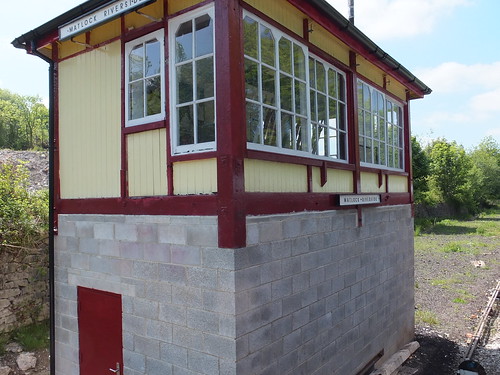
Work on this ambitious signalling project is almost complete so it had been arranged that, with the start of the winter timetable, Signal & Telegraph Department staff would be in attendance to operate the points from the signal box, under the supervision of Dominic. The various new fixed signals remain fitted with a white 'X' indicating that they are not yet in use and all movements took place under the authority of Hand Signals (red and yellow flags). This arrangement also provided an opportunity for Signalmen to receive training in the operation of the new signal box before commissioning takes place.

The new signal box at Matlock Riverside.

Winter Camp

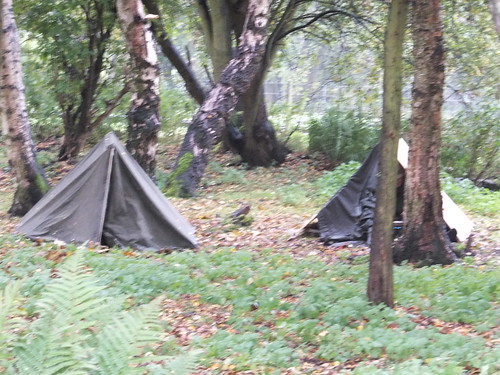
The Peak Rail 1940s Weekend is held in August and I described this year's event in the post here. But there's also a smaller event under the title 'Winter Camp' which this year was on the 2nd and 3rd November. There were a few tents pitched in the woods at Rowsley but the re-enactors need to be dedicated to camp out in November.

Peak Rail: 2nd/3rd November 2013: 'Winter Camp' commemorating the Battle of the Bulge.

My pictures

Resignalling at Matlock Riverside.
'Lord Phil'.

Thursday, 7 November 2013

Jan Ford's Travels

After my partner, Daemon, passed away in 1999 I decided it was time I saw a little more of the world, before age, infirmity or poverty precluded such jaunts.

I've finally got around to listing these overseas trips in date order, with links to the blog posts which give a little more detail. Generally, each blog post has links to sets of photographs relevant to that post.

Earlier trips overseas are listed in a separate post Jan Ford's Travels - The early trips.

There's also a post Jan Ford's Travels: Around the World in pictures with a list of counties visited and links to a list of collections of pictures for each country.

As an alternative, you can also find photographs of my trips by going to the list of collections here, where collections for each country visited are listed in alphabetical order (followed by 'special interest' collections on railways, charitable initiatives and similar).

Round the World 1 (December 2001)

Thailand (Bangkok), Australia (Sydney), New Zealand (Auckland), Fiji (Nadi), United States (San Francisco). There's a short report here.

Republic of Ireland (2002)

I visited Galway to spend some time with my friend Rita who was examining students.

China (2002)

I visited Beijing, Xian, Chungking, then took a Yangtse Cruise. There's an incomplete report here.

Germany, Poland (September 2003)

I made a trip Wolsztyn with my friend Mike Edwards (now, alas, passed on) to take the Wolsztyn locomotive driving experience. We spent a fascinating day in Berlin on the way. There's a short report here. My pictures are here.

Hong Kong, China, Macau (2004)

I made a trip to Hong Kong in late 2004, meeting up with my friend Rita who was examining students. We managed a day trip to Macau and a day trip to Guangzhou in southern China. There's a short post here. My pictures are here.

Canada (July 2004)

My trip to Canada (Toronto) is described here.

Round the World 2 (January 2005)

Brazil (Rio de Janeiro), Peru (Cuzco, Machu Picchu, Lima), United States (Los Angeles, Hawaii), New Zealand (Christchurch, Greymouth, Franz Josef), Singapore (Raffles Hotel), Egypt (Giza). There's a report here.

Far East 1 (June 2005)

Vietnam (Ho Chi Min City and Mekong Delta), Cambodia (Siem Reap, Angkor Wat), Thailand (Bangkok, Ayutthaya), Taiwan (Tai Pei, Hualien, Taroko Gorge). One report here describes this trip.

Ukraine (2005)

In late 2005, I joined Mike again for another steam driving experience at Kolomiya. There's a short report here.

Round the World 3 (February 2006)

Mexico (Mexico City, Tlaxcala), Ecuador (Quito, Galapagos), Chile (Santiago), French Polanesia (Papeete), Australia (Melbourne, Perth), Hong Kong, India (Delhi, Udaipur, Shimla). There's a more detailed report here.

Round the World 4 (February 2007)

United States (New York), Argentina (Buenos Aires, Ushuaia), Antarctic Peninsula ('Antarctic Dream' cruise), Chile (Santiago), New Zealand (Auckland), Australia (Perth), South Africa (Johannesburg, Cape Town). A total of 31 reports describe this trip. Click here to select them all.

Japan (September 2007)

Japan (Tokyo, Nagoya, Kyoto, Miyajima). A total of 16 reports describe this trip. Click here to select them all.

Round the World 5 (March 2008)

Union of Myanmar (Yangon,'Road to Mandalay'), Thailand (Bangkok), United States (Las Vegas), Mexico (Chichen Itza), Cuba (Havana, Trinidad), Panama (Panama City) A total of 29 reports describe this trip. Click here to select them all.

Far East 2 (September 2008)

Thailand (Bangkok, Golden Triangle), Myanmar (Yangon, Mandalay, Inle Lake, Kakku), Laos (Luang Say Cruise, Luang Prabang, Vientiane), Dubai (Al Maha). A total of 22 reports describe this trip. Click here to select them all.

Germany (2009)

I visited Frankfurt and Mannheim in January 2009. My pictures are here.

Middle East 1 (March 2009)

Egypt (Cairo, 'Zahra' Nile cruise, Abu Simbel), Jordan (Amman, Dead Sea, Petra, Aqaba). A total of 21 reports describe this trip. Click here to select them all.

Far East 3 (August 2009)

Thailand via Mumbai (Bangkok), Myanmar (Yangon, 'Road to Mandalay' cruise), India (Kolkata), Bhutan (Thimphu, Gangtey, Punakha, Paro). A total of 27 reports describe this trip. Click here to select them all.

Far East 4 (March 2010)

Indonesia, Java (Borobudur, Yogjakarta), Indonesia, Bali (Sanur), Malaysia, Sarawak (Kuching, 'Orient Pandaw' cruise), Malaysia, Sabah (Kota Kinabalu), Malaysia (Kuala Lumpur). A total of 25 reports describe this trip. Click here to select them all.

Norway and the Arctic (August 2010)

Norway ('Prince Albert II' cruise). A total of 13 reports describe this trip. Click here to select them all.

Far East 5 (August 2010)

Myanmar ('Road to Mandalay' Bhamo cruise, Yangon), Thailand (Bangkok). A total of 12 reports describe this trip. Click here to select them all.

Trip to St. Helena (April 2011)

South Africa (Capetown), cruise to St. Helena, cruise to Ascension. A total of 7 reports describe this trip. Click here to select them all.

Trip to Russia (July 2011)

Russia ('AMA Katerina' Moscow - St. Petersburg cruise). A total of 19 reports describe this trip. Click here to select them all.

Trip to Burma (October 2011)

Myanmar (Yangon, Mount Popa, 'Road to Mandalay' cruise), Thailand (Bangkok). A total of 11 reports describe this trip. Click here to select them all.

Safari (February 2012)

South Africa (Johannesburg), Zambia (Livingstone), Zimbabwe, Botswana, Namibia ('Zambesi Queen' cruise), Botswana (Duba Plains, Savuti, King's Pool, Vumbura Plains, Maun). A total of 28 reports describe this trip. Click here to select them all.

Trans-Siberian (July 2012)

Mongolia (Ulaan Baatar), Russia ('Golden Eagle' private train). A total of 17 reports describe this trip. Click here to select them all.

Burma (September 2012)

Myanmar (Yangon, Mawlamyine, Pa-An, Mount Popa, 'Road to Mandalay' Bhamo cruise), Thailand (Bangkok). A total of 21 reports describe this trip. Click here to select them all.

Malta (November 2012)

Malta (Radisson BLU Resort & Spa, Golden Sands). A total of 8 reports describe this trip. Click here to select them all.

Far East 6 (January 2013)

Vietnam (Ho Chi Min City Airport, Hoi An, Hue, Hanoi, 'Indochina Sails' Halong Bay cruise), Australia (Perth), Thailand (Bangkok Airport), Myanmar (Yangon, Old Bagan, Mandalay, Naypyidaw). A total of 25 reports describe this trip. Click here to select them all.

China and Tibet (July 2013)

China (Xining, QingHai-Tibet Railway, Lhasa, Shigatse, Gyangtse, Shanghai). A total of 17 reports describe this trip. Click here to select them all.

Trip to Burma (April-May 2014)

Burma (Yangon, Mawlamyine, Ko Dut, Bagan, Mandalay, Mrauk U)
Qatar (Doha)
A total of 21 reports describe this trip. Click here to select them all.

Trip to Vienna (November 2014)

Austria (Vienna)
Four reports describe this trip. The first report is here, with links to subsequent reports.

Trip to Singapore, Papua New Guinea, Indonesia, Malaysia (January-February 2015)

A cruise on 'Caledonian Sky' "from the Coral Sea to the South China Sea". A total of 22 reports describe this trip. Click here to select them all.

Trip to Burma (April-May 2015)

Burma (Yangon, Mawlamyine, Ko Dut, Setse Beach, Bagan, Mandalay, Putao)
A total of 20 reports describe this trip. Click here to select them all.

South Atlantic Voyage (February-March 2016)

Argentina (Buenos Aires, Ushuaia), Falklands (Steeple Jason Island, West Point Island,East Falkland), South Georgia, Tristan da Cunha (Tristan, Nightingale Island), South Africa (Cape Town, Robben Island).
A total of 19 reports describe this trip. Click here to select them all.

Trip to Burma (April-May 2016)

Burma (Yangon, Mawlamyine, Ko Dut, Bagan, Thazi, Kalaw, Kawthaung, Mergui Archipelago)
A total of 25 reports describe this trip. Click here to select them all.

Chilean Fjords and Antarctic Peninsula Cruise (November-December 2016)

Chile (Santiago, Valparaiso, Valdivia, Punta Arenas, Cape Horn, Antarctica (South Shetland Islands, Antarctic Peninsula), Argentina (Ushuaia, Buenos Aires), Brazil (Iguazzu).
A total of 22 reports describe this trip. Click here to select them all.

Burma and Australia (April-May 2017)

Burma (Yangon, Dawei, Ko-Dut, Mawlamyine, Bagan Medical Clinic, Loikaw, Kalaw, Inle Lake)
A total of 24 reports describe this trip. Click here to select them all.

Australia (Perth, Melbourne, Hobart) A total of 10 reports describe this trip. Click here to select them all.

Burma (September-October 2017)

Burma (Yangon, Myitkyina, Lonton, Mandalay, 'Road to Mandalay')
A total of 20 reports describe this trip. Click here to select them all.

Burma and Nepal (April-May 2018)

Burma (Yangon, Ko-Dut, Mawlamyine, Bagan Medical Clinic, Sel-Taw-Oo Monastery, Rith Lake, Kalay, Pyin Oo Lwin)
A total of 23 reports describe this trip. Click here to select them all.

Nepal (Kathmandu, Pokhara)
A total of 6 reports describe this trip. Click here to select them all.

Caspian Odyssey (September 2018)

Armenia (Yerevan, Geogard, Garni, Lake Sevan, Dilijan), Georgia (Tbilisi, Kakheti, Signagi, Gori, Uplistsikhe,Mtskheta), Azerbaijan (Baku) by train
A total of 11 reports describe this trip. Click here to select them all.

Turkey (September 2018)

Istanbul
A total of 4 reports describe this trip. Click here to select them all.

Burma (May 2019)

Burma (Yangon, Mon State, Kayin State, Bagan, Kayah State, Shan State, Mandalay, Pyin Oo Lwin)
A total of 16 reports describe this trip. Click here to select them all.

Tropic of Capricorn (February 2020)

New Zealand, Norfolk Island, Vanuatu, Papua New Guinea, Australia
A total of 17 reports describe this trip. Click here to select them all.

[Additional trips added 10-Dec-2013: Trips in 2014 added 26-Dec-2014: Trips in 2015 and link to 'Around the world in pictures' post added 12-Oct-2015: 2016 Trips added 16-Jan-2017: 2017 trips added 28-Nov-2017: Burma-2018 and Nepal added 19-Jun-2018: Caspian Odyssey and Istanbul trips added 19-Jan-2020: Tropic of Capricorn added 30-Decc-2020]

Tuesday, 29 October 2013

The Prayer Wheel

Some Buddhist sects use the Prayer Wheel. It's often described as a physical means of sending a supplicant's prayers to Heaven, but I understand that's an over-simplification of the beliefs.

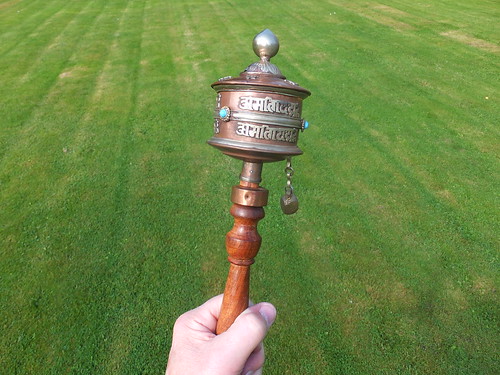
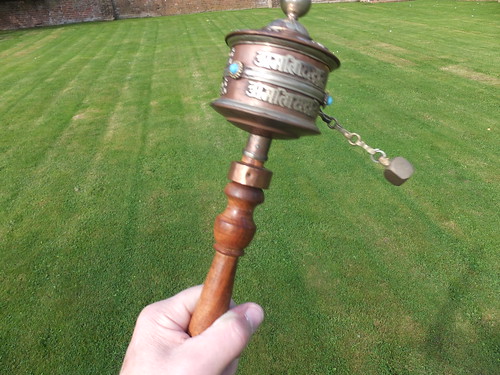
The picture above shows a hand-held Tibetan Prayer Wheel (which I actually purchased in Toronto during my visit in 2004 described here). The metal drum houses prayers inscribed on a coil of paper.

A weight attached to a chain assists the supplicant in rotating the drum continuously, always in a clockwise direction, by repeated movement of the wrist.

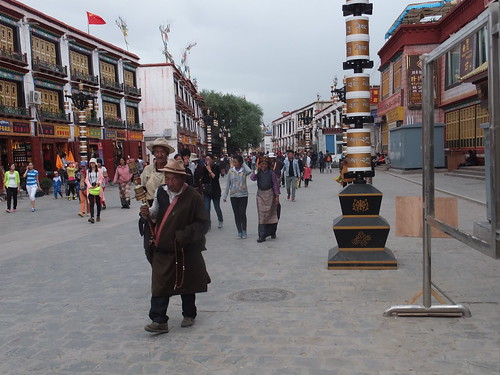
In Tibet, I've seen larger versions of the hand held prayer wheel, where the supplicant wears a leather shoulder strap with a pouch at the bottom to locate the end of the wooden handle, rather like a Standard Bearer might use.

Perambulating clockwise around the outside of the Jokhang Temple in Lhasa, the Tibetan gentleman in the foreground has a larger prayer wheel.

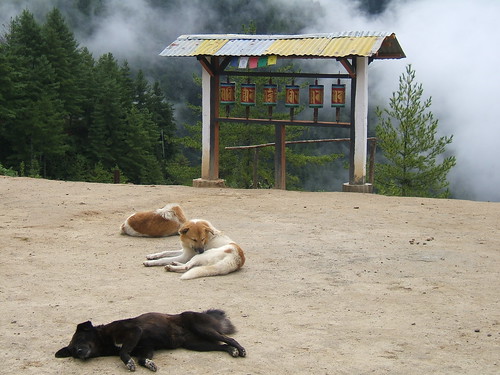
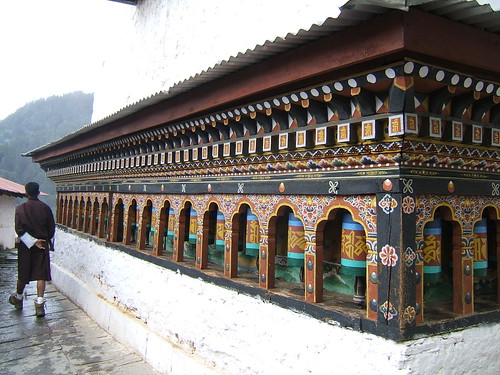
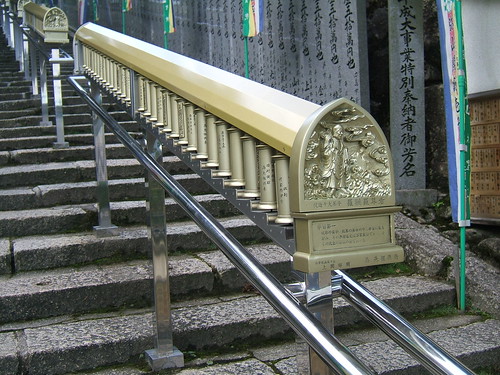
Sometimes, the rotating drum of the Prayer Wheel is mounted in a fixed supporting frame, and examples may be found singly or in groups.

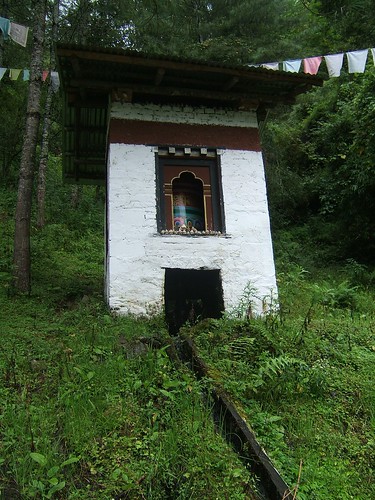
A group of six Prayer Wheels on the way to the Tiger's Nest Monastery, Bhutan.

A large group of Prayer Wheels, Cheri Goemba, Bhutan.

Prayer Wheels on temple steps, Miyajima, Japan.

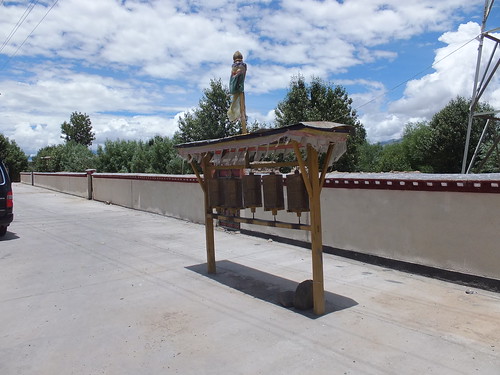
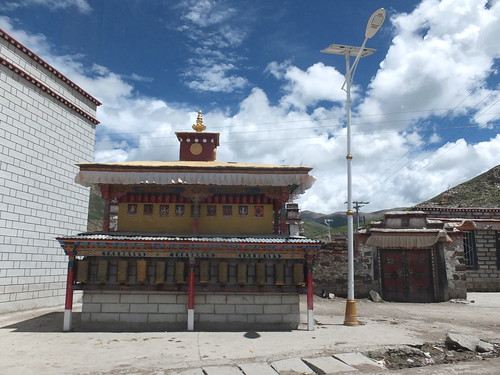
Roadside Prayer Wheels on Lhasa - Shigatse Road, Tibet.

Roadside Prayer Wheels, Nangartse, Tibet.

Once the rotating drum of the Prayer Wheel is mounted in a fixed supporting frame, the drum can become much larger, turned by handles or ropes attached to the drum.

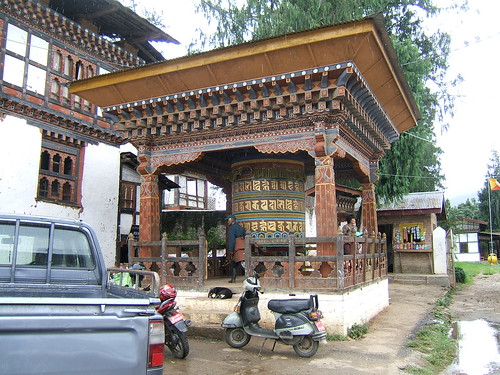
A LARGE Prayer Wheel in the town of Whangdue Phodrang, Bhutan.

The Water Powered Prayer Wheel

In Tibet and Bhutan there are water-powered Prayer Wheels, where a stream is arranged to turn a wooden paddle wheel. The rotating drum often carries an arm which strikes a small bell on each revolution, producing a tinkling sound.


A Water-Powered Prayer Wheel, Bhutan.

The Solar Powered Prayer Wheel

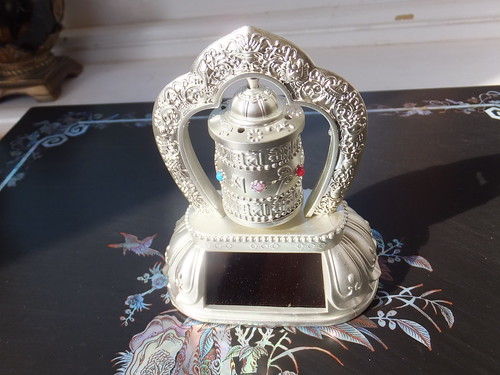
I think I first saw the solar powered prayer wheel in Mongolia (described in the post Leaving Ulaan Baatar - The Reality). Deposited on a cairn of stones (called an 'Ovoo') was a miniature prayer wheel happily spinning on its own, electrically-driven from a small photo-voltaic panel in the base. Later, I saw the same thing mounted on the dashboard of cars. I was intrigued by the conjunction of ancient belief and modern technology. My visit to Tibet in 2013 described here finally gave me the opportunity to purchase an example. The shop in Lhasa had dozens of different sizes, colours and decorative styles on offer. The very inexpensive models were not solar powered but required a battery to spin the miniature prayer wheel.

A solar-powered Prayer Wheel.

Other types of Prayer Wheel

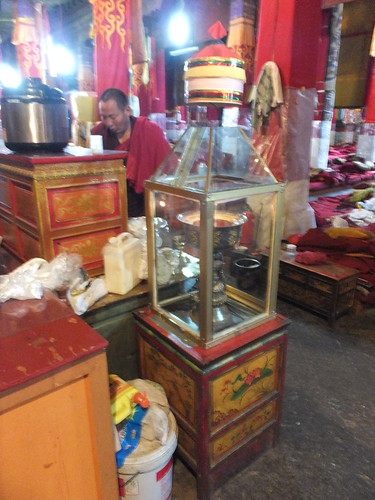
I've only spotted one butter lamp powered Prayer Wheel. This was at the Drepung Monastery in Lhasa. A small butter lamp is placed under a glass case and the rising warm air turns a fan attached to a lightweight prayer wheel suspended above.


Butter lamp powered Prayer Wheel, Drepung Monastery, Lhasa, Tibet.

I believe there are wind powered Prayer Wheels but I've not spotted one, I'm afraid.

My pictures

The Prayer Wheel

Stationery Distribution in Pauk Myaing Village

Inwa (also called Ava) is an ancient city, situated on the east bank of the Ayeyarwaddy River, around 11 miles south of Mandalay. Pauk Myaing Village is about four miles from Ava. Most of the villagers in Pauk Myaing keep cattle to produce cow's milk. Maize grows well and supports both the villagers and their cattle.

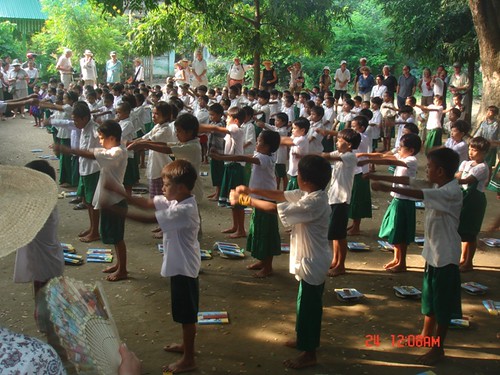
The Primary school in Pauk Myaing has 187 students and, on 15th October 2013, Dr. Hla Tun visited the school with a party of Guests from the 'Road to Mandalay' to donate stationery.

Students demonstrating physical exercises in the school compound.

Each student received 3 exercise books, 6 pencils and a ruler. In addition, 30 dozen ball pens, one and half dozen note books, 2 dozen pencil sharpeners and 25 dozen crayons were donated to the Headmaster. Each of the eight teachers was given a green longyi, which forms the teachers' 'uniform'.

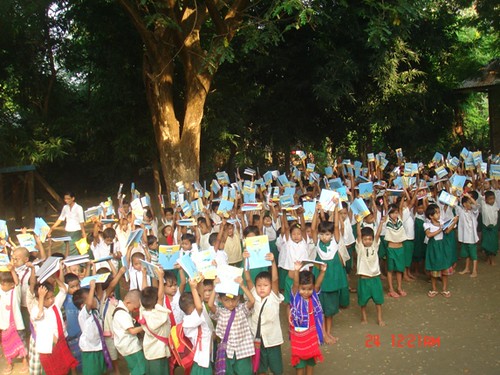
Students displaying their donated stationery.

Finally, one of the 'Road to Mandalay Guests donated funds to allow the Headmaster to replace the old school roof. Roofing typically lasts for 25 years.

Bagan Medical Clinic: September 2013

This report is based on information from Doctor Hla Tun, who also supplied the photographs.

The Bagan Clinic treated 4,826 patients in September 2013, bringing the total number of treatments since the Clinic opened on 6th August 2011 to 80,055.

Treatment Summary

The table below summarises the number of treatments per month and the total number of treatments since the clinic started.

Month Patients treated Total treatments
August 2011 355 355
September 2011 784 1,139
October 2011 1,434 2,573
November 2011 1,723 4,296
December 2011 2,013 6,309
January 2012 1,605 7,889
February 2012 2,464 10,353
March 2012 4,603 14,956
April 2012 2,043 16,999
May 2012 - Jan 2013 To be added To be added
February 2013 2,713 49,850
March 2013 2,713 49,850
April 2013 2,061 54,924
May 2013 3,303 58,227
June 2013 5,586 63,813
July 2013 6,079 69,892
August 2013 5,337 75,229
September 2013 4,826 80,055

Monthly notes

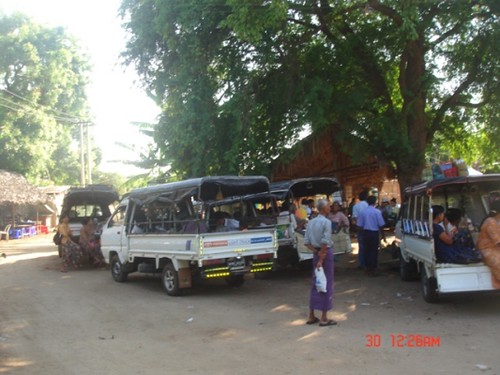
The picture below shows between 8 and 12 white trucks waiting in front of the clinic. Patients from longer distances reduce travel costs to the clinic by sharing the cost of hiring a truck. They bring food in a lunch box together with pillows, mats, cups, blankets and extra cloths in a basket, knowing that they will have to sleep in the Monastery compound for 1 or even 2 nights.

White trucks which have transported patients long distances to reach the clinic.

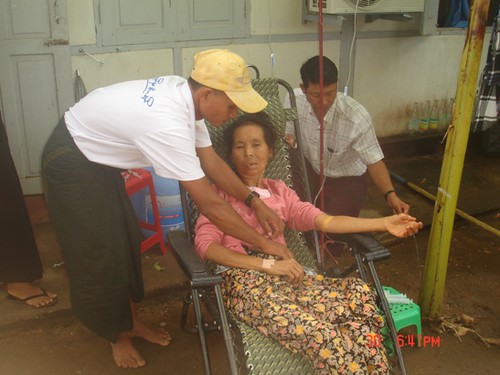
A sad story: On 21st September, a 68-year old lady, with her husband and son, travelled to the clinic from PaDung Village which is situated between MinBu Town and Unn Town in Magwe Division, Rakhine State - a distance of 250 km from the Bagan Clinic! The husband had been suffering hemiplegia for a month and the wife also hoped to receive treatment for her hypertension so they booked transport with a light truck which they found out collected patients from MinBu Town (about 32 km from their home village) on 21st September. During the five and a half hour journey from MinBu, the lady suffered a right-sided hemiplegia following a cerebral haemorrhage. The transport arrived at Bagan about 18:30 but, for some reason, the husband, wife and son failed to make contact with clinic staff, although the clinic remained open until 23:40 dealing with the large number of patients. As soon as clinic staff were aware of the situation when the clinic opened at 07:45 on the following day (22nd September), the lady was immediately admitted for treatment. The photograph below shows the son (in a yellow cap) with his mother. The son is now sad and depressed because both his parents suffer from hemiplegia and need care but he is an only child.

The lady who suffered hemiplegia on the way from Rakhine State.

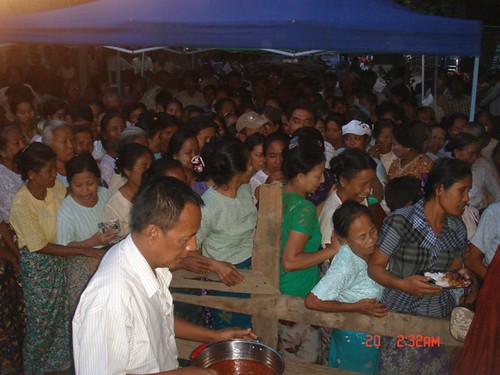
A free lunch is served to waiting patients on clinic days (Friday, Saturday, Sunday). Sometimes, a free dinner is also served, as shown in the photograph below.

A free dinner being served at around 18:15 on 11th October 2013.

Clinic photographs in 2013

Bagan Medical Clinic (2013).

Related posts in this blog

You can find all the posts about the Bagan Medical Clinic here.

Donations to Schools at Katha and Naba

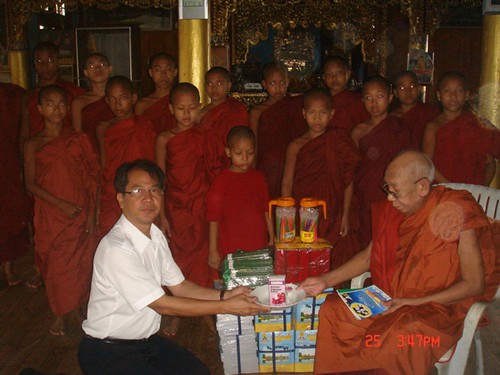
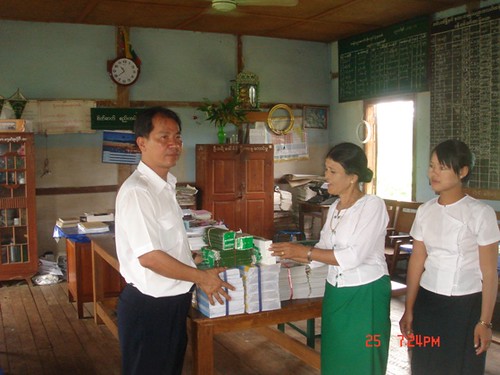
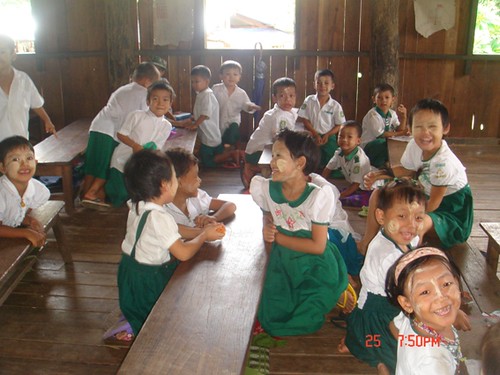
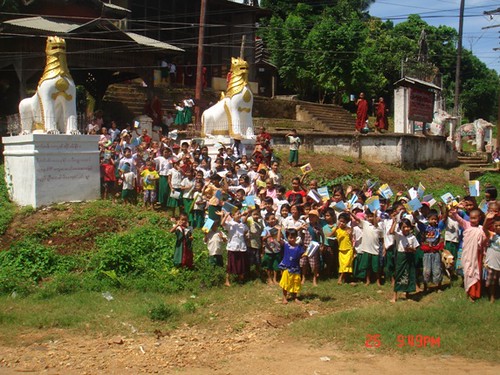
The following brief report is based on information from Doctor Hla Tun, who also supplied the photographs.

One of the attractions during the 'Road to Mandalay' Bhamo cruises is normally a trip by private train from Katha to Naba. In 2013, cruises 1 and 2 made the train journey on the Sabbath day, when schools were closed. But on cruise 3, the train journey took place on Tuesday, 17th September, allowing donations to students at the Monastic Secondary School in Katha where there are 352 students and the High School in Naba which has 703 students.

Donation of stationery to the 80 year old abbot who is a founder of the Monastic Secondary School. He has to provide the teachers’ salary himself but, for the first time this year, the Government are providing around 60% of the cost.

Donation of stationery to the headmistress of NaBa High School

Smiling Grade 1 students in their classroom at Naba High School.

Grateful primary students from the Monastic Secondary school in Katha wave their donated stationery to the passing private train as it passes the Monastery compound on the return journey to Katha.

I first travelled on the private train myself in 2010, riding in the locomotive cab, and that journey is described here (with links to pictures and more technical descrptions of the journey). I made the trip again in 2012 and that trip is described here.