skip to main |
skip to sidebar
Events of Sunday, 20th November (Afternoon)
After lunch, I worked on the computer for a while before going to the Panorama Lounge for afternoon tea. Another Trivia Quiz was in progress but since the subjects were ‘Prehistoric Animals’ and ‘Food around the World’, I didn’t feel that I could contribute anything. However, the quiz rather ended in disarray following an announcement over the Public Address that Orca whales had been spotted to starboard and encouraging all passengers to come out on deck. There was a mass exodus towards the observation decks, fore and aft. Many of the passengers, including me, were only in indoor clothes but it was a warm afternoon with no wind in the sheltered waters so it was very enjoyable.
On an expedition ship like ‘Silver Explorer’, it’s not unusual for plans to change at short notice so I was not surprised when the ship abandoned its original course and turned to place us nearer the location of the sighting. An extraordinary period of half an hour or so followed as the guests gasped in amazement each time the massive creatures appeared at the surface.
There was a pod of at least four whales, identified by the Expedition Team as South Atlantic Orcas, probably sub-type A. We were told that it’s unusual to find them this far north. To avoid disturbing the whales, the ship did not attempt too close an approach but our sighting as rated as ‘very good’ by our field experts. Certainly the whales made no attempt to move away, although they would certainly have been aware of the ship. Eventually, the whales were seen to be slowly moving northwards so the sighting was terminated and the ship resumed its southern route. I'm afraid I didn't have my camera with me to record the scene but, in any case, neither my camera nor its owner are very well suited for nature photography.
The Orca sighting had overlapped the planned start of the five o’clock lecture, which was duly deferred to 5.15 p.m., when we were entertained by an informative and amusing lecture by Peter Damisch, the historian on the expedition team, entitled ‘Search for the Unknown Antarctic Continent’. A little later, the usual ‘Recap and Briefing’ took place in the theatre, where the programme for the next day was laid out (we were to have another ‘day at sea’ as we continued to Punta Arenas). There was then discussion and questions regarding the whale sighting and the birds observed to which a number of members of the Expedition Team contributed.
Another splendid evening meal followed which I enjoyed with a couple originally from England but now retired to Australia. During the meal, we passed a small cargo ship with three self-unloading cranes going north but I failed to identify it. This was the first ship I’d noticed since we came through English Narrows.

Aboard 'Silver Explorer': View from the restaurant as we pass a northbound cargo ship.
This was not quite the end of the evening. The friendly and attentive restaurant staff urged my companions and I to go the Panorama Lounge at ten o’clock where three members of the restaurant staff forming ‘The Crew Band’ were to sing for the guests to the music of the resident pianist. It was a jolly end to the evening before retiring to bed.
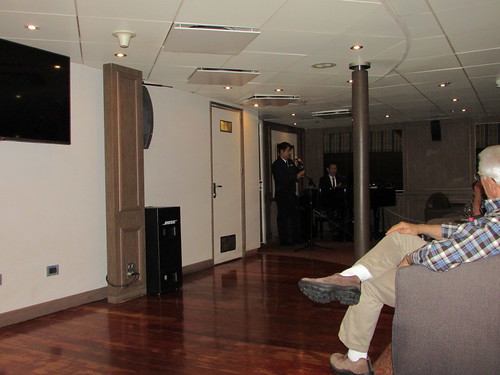
Aboard 'Silver Explorer': Vocals by members of the waiting staff in the Panorama Lounge.
Related Posts
Next post describing this trip: Cruising to Punta Arenas.
All posts describing this trip: Chilean Fjords.
My pictures
Where necessary, clicking on an image above will display an 'uncropped' view or, alternately, my pictures from this (and earlier) trips may be selected, viewed or downloaded, in various sizes, from the albums listed:-
Pictures aboard 'Silver Explorer' are here.
All my pictures of Chile can be found in the collection Chile.
[Events date and Orca type corrected: 24-Nov-2016. Link to pictures added, picturers added: 25-Jan-2017]
Events of Sunday, 20th November (Morning)
I awoke to a glorious sunny morning at our anchorage a mile or so short of the glacier face of the Pio XI glacier, originally called the Bruggen Glacier. This glacier is the largest outflow to the west from the Southern Patagonian Ice Field.
Glacier theory
Glaciers are produced in land areas where annual snowfall exceeds the rate of annual melting. Over a long period, as the thickness of snow increases, gravity crushes the lower layers of snow, expelling entrained air bubbles and creating dense, clear ice under pressure. Gravity also causes the dense ice mass to slowly slide towards lower ground at a speed determined by the topography and the frictional resistance to the ice movement presented by the underlying rock. This rock becomes fractured and ground by the ice and carried along with the glacial movement, often as a dark-coloured ‘moraine’. Where a glacier meets a fjord, pressure from the glacier further ‘upstream’ on the unsupported ice causes fracturing and the creation of an exposed glacier front. As pressure is relieved within the ice, the glacier face continues to fracture and ice breaks away in a process called ‘calving’.
The location
Pio XI is the longest glacier in the southern hemisphere outside Antarctica at about 64 km long. Whilst most glaciers are currently ‘in retreat’, between 1945 and 1976, this glacier advanced by around 5 km. The glacier face is 4.5 km wide but gives the impression of being smaller because, viewed from the fjord, there is little to give a sense of scale. In the case of Pio XI, the glacier is set between green, wooded hills and the proximity of mature trees offers some hint as to the true size of the glacier but it is difficult to avoid underestimating the scale of such an unfamiliar object.
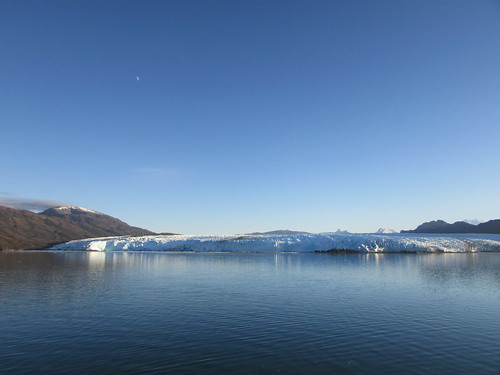
Pio XI Glacier.
The Zodiac Cruise
Conditions were ideal for a Zodiac Cruise. Since it was planned that we would be on the water for 1.5 hours, we were warned to wear sufficient clothing to remain warm whilst sedentary. I made sure that I had a substantial breakfast and was ready in good time for when my group was called by public address to deck 3 for boarding the Zodiacs.
The first Zodiac away from the ship was driven by botanist Hans Peter in one of the larger Zodiacs. I was in the second Zodiac, driven by Luke and, with just 8 passengers, we had plenty of room. We sailed towards the glacier face which rose like a cliff from a ‘beach’ of ground-up rock of moraine materials.The glacier face was heavily fissured as pressures within the glacier had been relieved by cracking. Quite frequently, a loud rumbling like thunder could be heard as the glacial ice ‘re-arranged’ itself and, on a few occasions during our Zodiac cruise, this was accompanied by a visible fall of ice producing a white spray as the internal pressure produced an explosive release of material. The internal pressure had also resulted in crevasses in the top surface of the glacier leaving a very uneven appearance.
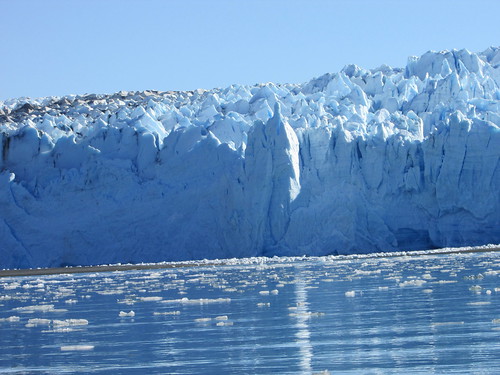
Pio XI Glacier Zodiac Cruise: Cliff-like glacier face and heavily-crevassed top surface.
As we came a little closer, the sea was littered with ice ranging from a few inches to a few feet across which had fallen from the glacier front. Sometimes the shape of the ice suggested a shard which had broken away from the glacier face, but often partial thawing and re-freezing had produced a strangely-shaped object, like some example of modern art. Only around 10% of each lump of ice is visible above the surface so care is needed when passing through ice debris called ‘brash ice’ and ‘bergy bits’.
Luke identified two types of ice. The first type has a white appearance, like frozen snow. The colour is produced by small air bubbles trapped in the ice. The second type is translucent without bubbles where pressures within the glacier have expelled the trapped air, leaving frozen water. This type of ice, in a large piece, takes on a bluish tinge because of the differential light absorption of water and water/air.
Luke also demonstrated the effect of holding a small, flat piece of ice containing air bubbles between both palms. As the body heat warms the ice, release of trapped air produces a series of audible ‘pops’, each accompanied by a slight vibration which can be felt. The air may have been imprisoned for thousands of years and laboratory tests now exist for releasing the air from samples of ice and analysing it to determine changes in the earth’s atmosphere.
Hans Peter, the botanist, presented our Zodiac with a piece of Kelp he’d found floating. Kelp grows rapidly as a series of broad leaves a couple of metres long, interconnected by flexible stems with air bladders. Each leaf is green, slightly corrugated and covered with a thin layer of mucous material. Normally, one end of the plant would be anchored to rock but wind and tide can break the stem, as had happened to the sample we examined.
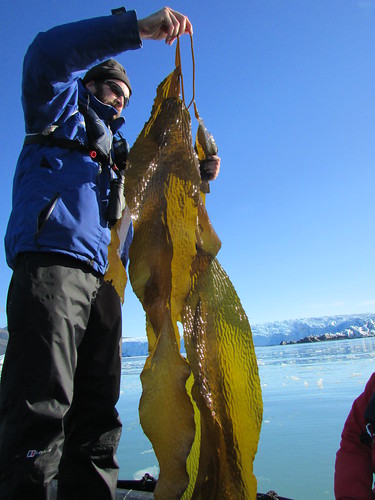
Pio XI Glacier Zodiac Cruise: Luke displays the kelp presented by Hans Peter.
We spent some time cruising across the face of the glacier but keeping a respectful distance and examining the floating ice. At one location, the ice contained moraine material and was dark coloured. As the sun melted the ice, the crushed rock was released as sediment.
Crew Safety Drill
We had been advised that the ship’s crew were carrying out a safety drill whilst we were on the Zodiac Cruise but we didn’t know the details so, looking back at the ship, it was a surprise to see that one of the lifeboats had been launched. At the same time, a strange noise alerted us to the fact that we were being filmed by Ray from his drone hovering above us! I was delighted when we headed towards the lifeboat as I had not seen one in the water, only stowed on the davits.
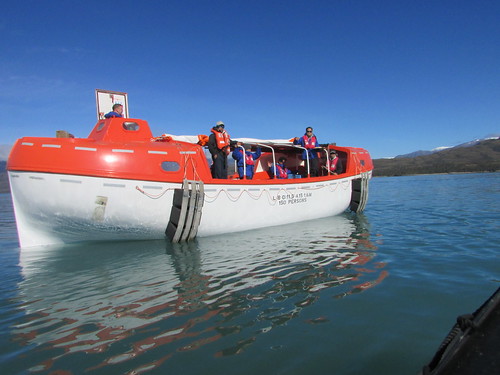
Pio XI Glacier Zodiac Cruise: One lifeboat had been launched in a Crew Safety Drill.
Silver Explorer has two motorised lifeboats, each capable of holding 150 people. We drew alongside the lifeboat and I was amazed to see various members of the restaurant staff on board who presented us with a glass of champagne, cake and a variety of sweetmeats. The captain had agreed to let an essential training exercise serve a second, delightful purpose.
Our Zodiac then returned us to the ship after a wonderful cruise. Noticing that the lifeboat was about to be recovered, I hurried to the observation deck in time to see the electric winch lift the lifeboat out of the water and swing the davit arms and lifeboat into the ‘stowed’ position.

Aboard 'Silver Explorer': Following the Crew Safety Drill, the lifeboat is returned to the davits.
Once all the passengers were back on board and the Zodiacs recovered, we set off south again, this time on a ‘leg’ of 447 miles to Punta Arenas which would take more than one day. Meanwhile, I had a little time to work on the computer before lunch and a programme of lectures was offered during the afternoon.
Related Posts
Next post describing this trip: On to the Strait of Magellan.
All posts describing this trip: Chilean Fjords.
My pictures
Where necessary, clicking on an image above will display an 'uncropped' view or, alternately, my pictures from this (and earlier) trips may be selected, viewed or downloaded, in various sizes, from the albums listed:-
Pictures on the Pio XI Zodiac Cruise are here.
Pictures aboard 'Silver Explorer' are here.
All my pictures of Chile can be found in the collection Chile.
[Pictures added 13-Jan-2017]
Events of Saturday, 19th November
Saturday was to be a day on the ship as we continued south. The previous evening, the ship had emerged from behind the protection of the chain of islands to cross an area of open sea called ‘The Gulf of Pain’ because of the poor sea conditions which can exist. Fortunately, the area failed to live up to its name and, by the time I took breakfast on Saturday, the ship was already entering more sheltered water and cruising towards the Iceberg Fjord.
There were two illustrated lectures in the theatre during the morning and I attended both. At 09:45 Luke Kenny gave a fascinating talk on salmon, which has become the mainstay of the Chilean aquaculture industry. At 11:15 Claire Allum described the indigenous people of Patagonia and Tierra del Fuego and the impact of European immigrants. Her interesting talk included short clips of motion picture film and still photographs from the 1920s illustrating a way of life which has disappeared.
Whilst I was enjoying lunch in the restaurant, we entered Iceberg Fjord so once I’d finished my meal, I wrapped up warmly to watch proceedings from one of the open decks.
Iceberg Fjord
Correctly, the term ‘Fjord’ is applied to a location where “current or past glaciation extended below sea level before retreating, to leave a characteristic U-shaped narrow, steep-sided inlet filled with sea water”. Although we could see snow on the distant mountains, the sides of the Iceberg Fjord were a mixture of rock, grass and trees. However, there is a glacier called Tempanos at the landward end of the fjord, supposedly because of the noises created by the glacial ice cracking. The ship travelled to within a mile or so of the glacier front at the end of the fjord. The observation decks were crowded with guests taking pictures of the glacier but I elected to observe from the foredeck on level 4, where the anchor winches are located, because this area of deck is only available to passengers occasionally and it is usually less windy than the higher decks.
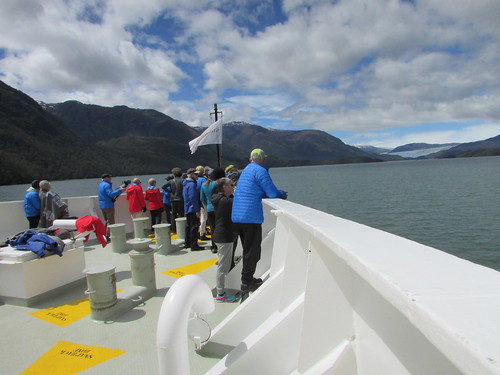
Cruising Chilean Fjords: Iceberg Fjord.
Zodiac Cruise
Suddenly, to the delight of guests, the public address announced that an unscheduled Zodiac cruise would take place, allowing closer views of the glacier front. Before long, I was boarding one of the Zodiacs. I discovered that not all the guests had decided to take the unexpected cruise. With dry weather, a temperature of about ten degrees Celsius and intermittent appearance of an unexpectedly warm sun, the cruise closer to the glacier front was very enjoyable.
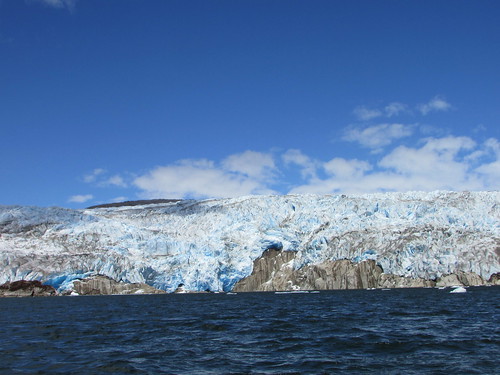
Zodiac cruise in Iceberg Fjord: The glacial ice advancing over the underlying rock at Tempanos Glacier.
We saw one fall of ice from the ice front as the tremendous pressures in the ice were relieved by cracking. At another time, we heard one loud explosion, like a single crack of thunder, as glacial ice cracked.
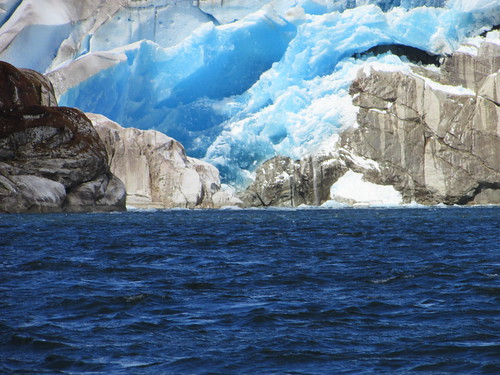
Zodiac cruise in Iceberg Fjord: Vivid blue colours in the Tempanos Glacier.
After a 45-minute cruise, we returned to ‘Silversea Explorer’, in time for me to take afternoon tea in the Panorama Lounge whilst the ship turned and cruised back along Iceberg Fjord.
Shipwreck
Following afternoon tea, I wrapped-up again and went to the forward outside observation deck in time to watch the ship leave Iceberg Fjord and turn towards English Narrows.
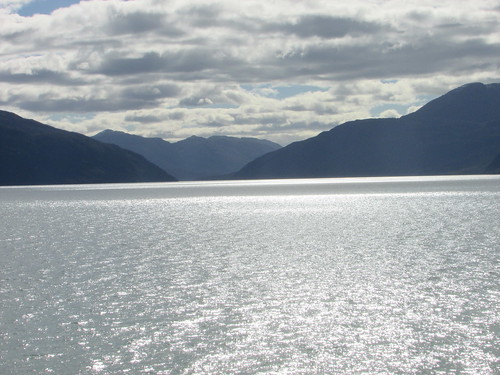
Leaving Iceberg Fjord and rejoining the broad channel leading to English Narrows.
At around 6.15 p.m. we passed the grounded shipwreck of the ‘Captain Leonides’ lost when carrying cargo of sugar. Investigation established that the loss was, in fact, an insurance fraud and the captain at the time had his “Master’s Ticket” cancelled.
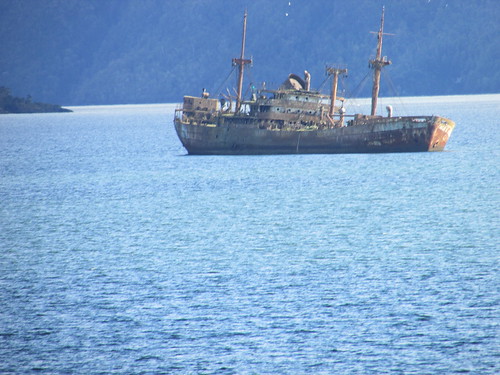
Grounded shipwreck of the ‘Captain Leonides’.
English Narrows
‘English Narrows’ is the name of an ‘S’-shaped narrow channel with strong currents between a cluster of islands. Ships cannot pass in the channel, so a one way system is in operation and the channel is only used in daylight. Two Chilean Pilots with extensive experience in the waters we were traversing were aboard to assist the Captain in locations like English Narrows. Our transit was due to start at 7.00 p.m. but this was slightly delayed, waiting for a small Chilean cargo ship heading north to clear the channel (northbound traffic has right-of-way).
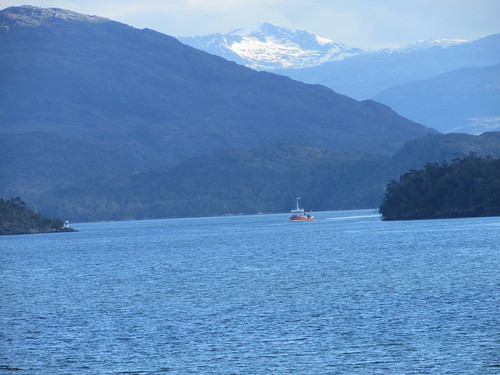
Through English Narrows: Awaiting our turn to enter the narrow channel.
As it passed, I was able to identify it as ‘Seivag’ before we threaded our way through the twisting channel. Apart from the expected channel markers, there were three statues of the Madonna protecting travellers but I only saw one of them.
Having successfully negotiated English Narrows, it was time for our evening meal. There was always a ‘set’ menu, often offering a ‘Flavours of Chile’ collection of dishes but I usually found myself selecting from the wide ‘A la carte’ range. The ship continued south during the night so as to reach an anchorage off the Pio XI Glacier early on Sunday morning.
Related Posts
Next post describing this trip: Pio XI Glacier.
All posts describing this trip: Chilean Fjords.
My pictures
Where necessary, clicking on an image above will display an 'uncropped' view or, alternately, my pictures from this (and earlier) trips may be selected, viewed or downloaded, in various sizes, from the albums listed:-
Pictures Cruising Chilean Fjords are here.
Pictures of the Zodiac Cruise in Iceberg Fjord are here.
Pictures of our passage Through English Narrows are here.
Pictures aboard 'Silver Explorer' are here.
All my pictures of Chile can be found in the collection Chile.
[Pictures added 13-Jan-2017]
Events of Friday, 18th November (continued)
In the earlier post here, I described our journey from the ship to the Aiken del Sur Nature Park. The information issued in the ship’s daily programme of events ‘Chronicles’ waxed quite lyrical about the attractions of the nature park we were to visit:-
The natural beauty of the Aiken del Sur includes Riesco Lake, waterfalls, indigenous perennial forests, caducifoliae, humid variety ferns, moss and litchen; prairies of myrtle and turf mingled with wild fuschia and calafate shrubbery; as well as macal and mallines or swamps. Breath-taking views of the lake, hills and nearby mountains as well as the chance to spot some of the local birds such as the “chucao” and “hueta” are also amongst the attractions.
According to a local information board, the 250-hectare Aiken del Sur Nature Park and the Hotel Loberias in Puerto Chacabuco are privately owned by Detroit Chile S.A. who state that they are committed to “respect the ecological guidelines and legistlation concerning the Park’s existence, as well as to take any steps required to reforest damaged areas for the joy of future generations.”
The size of the groups meant that we set off in a long crocodile which was less than ideal when our guide was trying to make explanations but it was, nonetheless, a very pleasant walk. The rain held off, the area was (unlike the ship) protected from the wind and later in the morning a warming sun appeared.
Almost immediately, our trail led us over a broad stream, the Estero El Salto, via a substantial steel bridge. We then continued on a circuitous gravel path threaded through the larger trees heading generally north-west, staying fairly near to the east bank of the stream.
One of the most prolific plants was the Giant Rhubarb, with leaves up to one metre across. The stem is edible but better in the younger plant, otherwise the oxalic acid content increases.
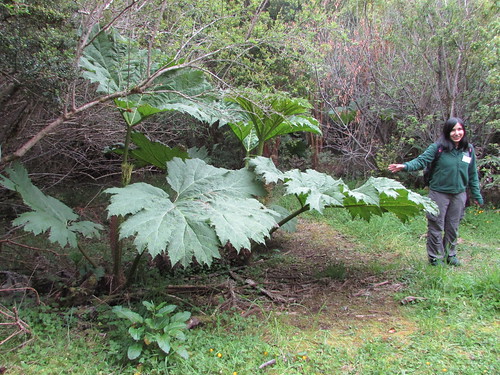
Aiken del Sur Nature Park: Giant Rhubarb dwarfs our charming guide.
In places there were large bushes of Chilco (Fuchsia magellanica), with bright red flowers dangling and some striking examples of the Firebush tree, with myriad bright red flowers.
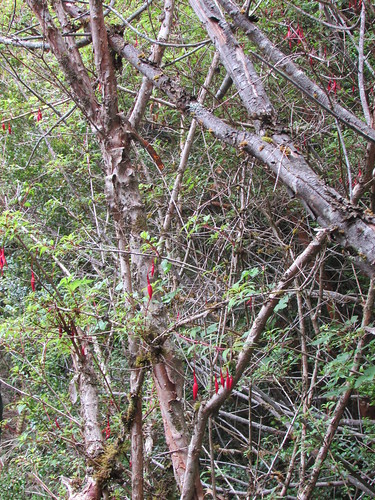
Aiken del Sur Nature Park: Chilco (Fuchsia magellanica).
The largest tree in the forest was the Tepa, with a trunk two or three feet diameter in mature specimens. The most distinctive tree was the Arrayan (Luma apiculata). This develops multiple trunks with a smooth brown bark often rubbed away to show a grey, almost white trunk.

Aiken del Sur Nature Park: Arrayan (Luma apiculata).
Eventually we crossed back to the west bank of the Estero El Salto by another steel bridge just below an impressive waterfall, 22 m high, provided with two viewing platforms near the base of the falls.
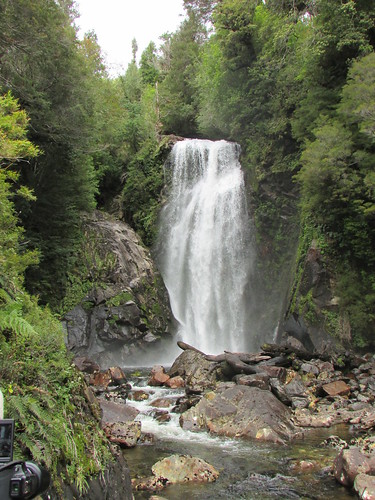
Aiken del Sur Nature Park: Salto Barba del Viejo, 22m high waterfall.
Our trail finished at a large, modern, wood-built assembly hall called a ‘Quincho’ where there were drinks and a snack to the accompaniment of “local folkloric music”. A number of whole sides of lamb, hung vertically, were being slowly cooked above a wood-fuelled firepit in the centre of the building. Large windows gave panoramic views of the mountains and Lake Riesco.
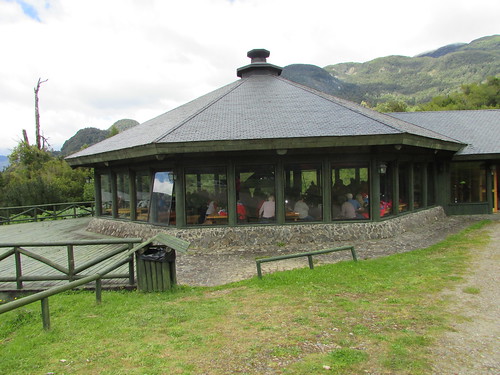
Aiken del Sur Nature Park: 'Silver Explorer' Guests enjoying “local folkloric music” at the 'Quincho'.
I decided to follow the zig-zag path to the lakeside which involved a large number of wooden steps but the peace and tranquillity made the effort worthwhile.
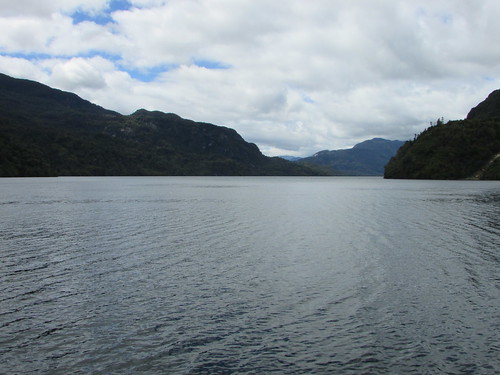
Aiken del Sur Nature Park: Lake Riesco.
I returned to the ‘Quincho’ in time to watch Ray, the “Videogrpher”, demonstrating his photographic drone but he had to cut the flight short because of low battery on the drone. Then it was time to board the waiting tour bus for our return to the passenger terminal at Puerto Chacabuco.
As we boarded the Zodiac for the return to our ships, I noticed a large new Chilean Navy Rigid Inflatable Boat mounted on an 8-wheel trailer. Moored at the dock was an odd-looking vessel ‘Biomasa IX’ whose function I couldn’t readily discern. Another puzzle was what looked like some sort of a bulk materials handling conveyor which seemed to discharge into a large flexible hose which disappeared underwater near a pontoon with a small machinery house and what may have been the other end of the large flexible hose. I suspect all these curiosities may be related to handling wood chips for energy generation (once ‘flavour of the month’ for sustainable generation but now going out of fashion).
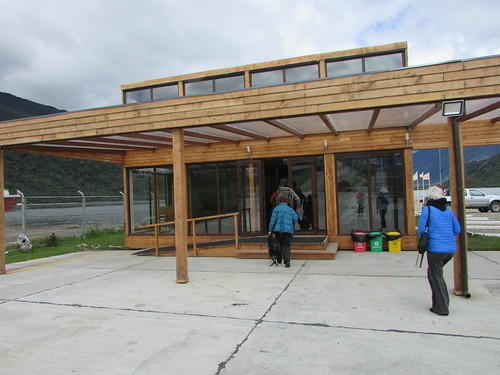
Puerto Chacabuco: Arriving back at the attractive passenger terminal to return to our ship.
Back on board
The morning’s activity had left me with a healthy appetite for buffet lunch in the restaurant. There were two lectures during the afternoon but, instead, I tried to record my impressions of the morning whilst the memory was fresh. But I found time for civilised afternoon tea in the Panorama Lounge where there was also a rather odd trivia quiz on ‘Beards’. At 18:45, there was the usual Expedition Team Recap and Briefing in the theatre. Then I joined Graham and Julie from Australia and two American guests for an enjoyable dinner.
Related Posts
Next post describing this trip: Cruising Chilean Fjords.
All posts describing this trip: Chilean Fjords.
My pictures
Where necessary, clicking on an image above will display an 'uncropped' view or, alternately, my pictures from this (and earlier) trips may be selected, viewed or downloaded, in various sizes, from the albums listed:-
Pictures of Aiken del Sur Nature Park are here.
Pictures of Puerto Chacabuco are here.
All my pictures of Chile can be found in the collection Chile.
[Pictures added: 13-Jan-2017]
Events of Friday, 18th November
The land of South America, of course, tapers as you go south. Chile occupies a relatively narrow ‘sliver’ of territory extending inland from the West Coast into the Andes mountains which run through South America like a backbone. Argentina occupies the land from the Andes mountains to the east coast.
After our visit to Chiloe Island on the 17th November, my ship, ‘Silversea Explorer’, continued south. There is a complex string of islands off the west coast, which allowed us to cruise down the channels between the islands and the mainland, enjoying much smoother water. The coast of the mainland is perforated by the estuaries of various rivers which descend from the mountains, called fjords, in a similar manner to the coast of Norway.
We sailed south throughout the night and anchored at the head of the Aysen Fjord a little before 8.00 a.m., as I was finishing breakfast in the restaurant. We were overlooking a port area called Puerto Chacabuco. Until 1960, the port for this area was 15 kilometres north-east at the important town of Puerto Aysen. The Chilean earthquake that year destroyed much of the port facilities and town. The town was rebuilt but permanent changes in levels resulting from the earthquake made it impractical to reconstruct the port on the original site. A new port was constructed at Puerto Chacabuco, connected to Puerto Aysen by a decent road.
From the windswept observation deck, I surveyed the bay we'd anchored in. Off to our left, the elegant lines of the rusting remains of a substantial beached steamship – the ‘Vina’- were visible. Otherwise, the vessels, port facilities and associated buildings were modern. To our left large passenger ferry in a striking livery of orange, white and blue operated by Havier Austral lay at anchor. Also to our left was a large, modern steel-framed building I took to be engineering workshops marked ‘Oxxean’ (probably the port operators and presumably pronounced ‘OCEAN’). On the hard standing next to this building or moored at the adjacent quay were a number of smaller vessels. In the background, there was an extensive tank farm.
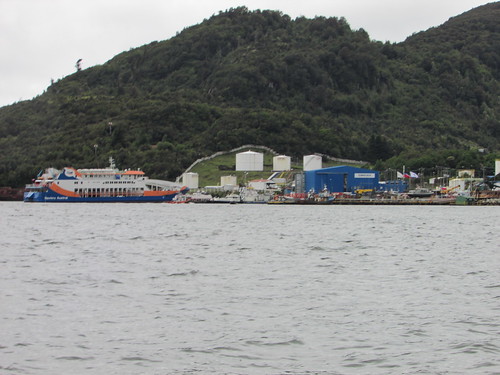
Puerto Chacabuco.
In front of us was a large, modern passenger and vehicle ferry in the red and white livery of Navimag. I’d spotted the Navimag ship in the distance the previous afternoon when, like us, it was heading south.
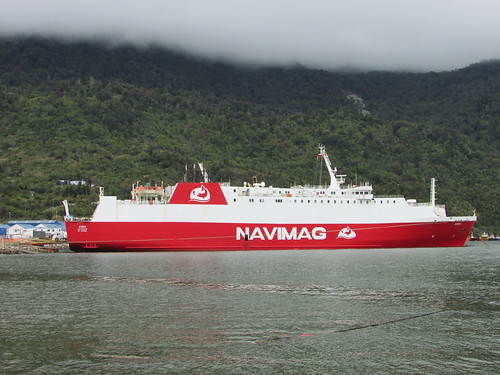
Puerto Chacabuco, Chile: NAVIMAG passenger and vehicle ferry 'Eden'.
At the dock to our right lay a cargo vessel with two large self-loading/unloading cranes. Further round the bay was a group of smaller launches, vehicle ferries and unidentified craft. In addition, close to our anchorage was a medium-size container ship, 'Copihue', also at anchor. Off on the far right I could also see a fish farm, probably producing Atlantic Salmon. All-in-all, quite an impressive port. At about 8.30 a.m., Zodiacs started to take guests from the ship ashore.
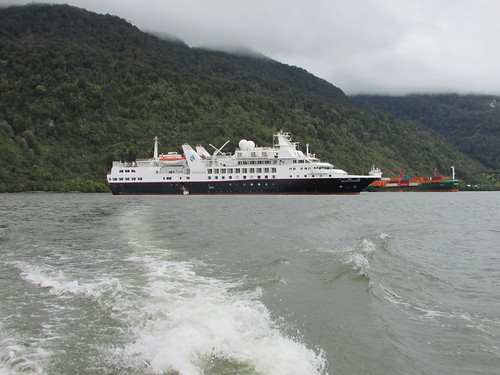
Puerto Chacabuco, Chile: 'Silver Explorer' and, in the background, cargo ship 'Copihue' at anchor, viewed from the 'Zodiac' taking us ashore.
We landed at a modern, floating steel landing stage (covered with anti-slip matting) which led to a new and attractive wooden terminal building marked ‘OXXEAN’. Backpacks were subject to X-ray and inspection by the Agricultural and Livestock Service within the terminal building but I only had my camera with me, which was waved through. Three tour buses were lined up outside the terminal to take us to the Aiken del Sur Nature Park.
We drove away from the port in convoy past an industrial area, a school, a Fire Station and an area of housing.

Leaving Puerto Chacabuco by coach.
The coaches took the road towards Puerto Aysen but, after 4 km, we turned right onto an unmetalled road which we carefully bumped along for 5.5 km to reach the entrance to the Aiken del Sur Nature Park. The coaches parked at the Visitor Centre at the starting point of our nature trail. We were offered the choice of a “moderate” or “more challenging” trail. Almost everyone opted for the latter, at around 2 km in length and 2 hours duration. We were divided into two groups of around 30 for the longer trail and a third group for the short trail, each with a guide from the Nature Park and members of the ship’s expedition crew.
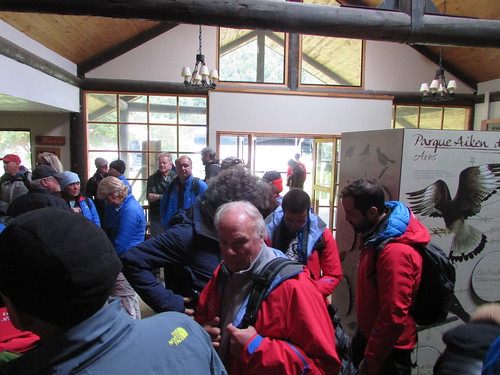
Aiken del Sur Nature Park Visitor Centre.
Related Posts
Next post describing this trip: Aiken del Sur Nature Park.
All posts describing this trip: Chilean Fjords.
My pictures
Where necessary, clicking on an image above will display an 'uncropped' view or, alternately, my pictures from this (and earlier) trips may be selected, viewed or downloaded, in various sizes, from the albums listed:-
Pictures of Puerto Chacabuco are here.
Pictures of Aiken del Sur Nature Park are here.
Pictures aboard 'Silver Explorer' are here.
All my pictures of Chile can be found in the collection Chile.
Events of Thursday, 17th November
By sailing south, leaving the coast of Chile on our left, we reached Chiloe (pronounced ‘CHILL-O-WAY’) Island around 7.30 a.m.in the morning. Having reached a suitable anchorage just off the small port of Achao, the ship dropped anchor whilst the guests enjoyed breakfast. Achao is located on a smaller island called Isla Quinchao which lies to the east of the much larger island Chiloe.
Chile takes the protection of the land, forests and animals from the accidental introduction of foreign species or disease very seriously. The Agricultural and Livestock Service examines any baggage landed from ships or aircraft. At Niebla the previous day, Chilean officials had come aboard to examine passenger’s rucksacks before we left the ship but at Achao the Agricultural and Livestock Service had set up a tent on the jetty so the Zodiacs were able to start ferrying passengers ashore for the ‘Chiloe Highlights Tour’.
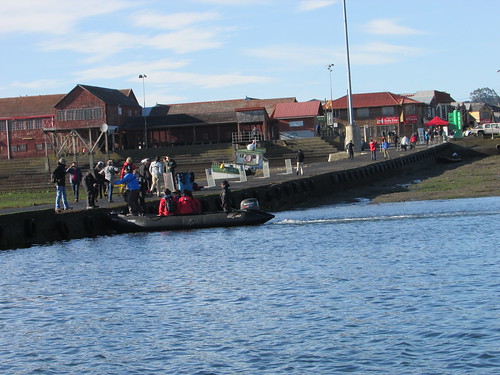
Passengers from 'Silver Explorer' landing by 'Zodiac' at Achao.
At Achao (population around 2,500), the simple jetty inclined down from the road across the beach and into the sea supports a total of nine ferry services which use small passenger ferries to link the town to outlying islands. According to the importance of the destination, the service frequency varies from daily to four days in a week. As I disembarked from the Zodiac, a motor launch on one of the ferry routes arrived at the jetty and disembarked around 16 local passengers.
The Silversea guests were met by a local guide with excellent English who suggested walking a few hundred yards through the town to Achao Church. Built in 1730, this is the oldest surviving wooden building in Chile and a World Heritage Site. Local boat builders adapted their construction techniques to produce a durable church completely out of wood for the Jesuit missionaries. Local houses were built using similar methods and were clad in wooden shingles where each family developed its own distinctive shape for the shingle.
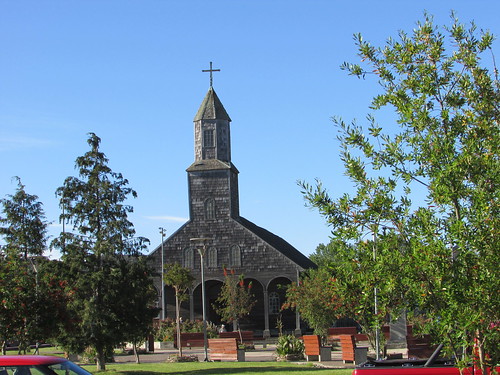
Achao: Wooden church.
There is a second wooden church in the town which we were unable to visit as it was temporarily closed for termite eradication.
We then boarded one of three tour buses to see more of the island. We drove north west through a relatively-prosperous landscape which offered tantalising views of the sea and, again, was reminiscent of Cornwall. Eventually we descended a steep hill and came to an abrupt stop with the channel dividing us from Chiloe Island in front of us. A car ferry which crosses the channel was loading but there was insufficient space for us. Within a few minutes, another ferry arrived but this one was smaller and provided with a loading ramp at one end only. The smaller ferry unloaded and refilled with waiting cars and pick-up trucks which all had to reverse up the ramp onto the ferry.
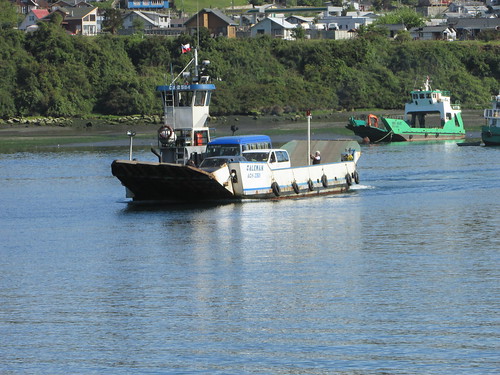
Dalcahue, Chile: One of the vehicle ferries connecting Chiloe and Isla Quinchao.
After another short wait, a larger ferry with two loading ramps appeared allowing our coach (with all passengers remaining on board) to drive forward onto the ferry and, after a crossing of about ten minutes, to continue forward, leaving by the second ramp. We were immediately in the small town of Dalcahue on Chiloe. Our tour bus dropped us at a large market building crammed with locally-made craft products.
Dalcahue also has a wooden church which is a World Heritage Site but this building had required some restoration recently. The nave had a simple barrel-vault ceiling supported by a series of wooden posts which had been clad and painted to represent the arcading and marble columns of a stone building.
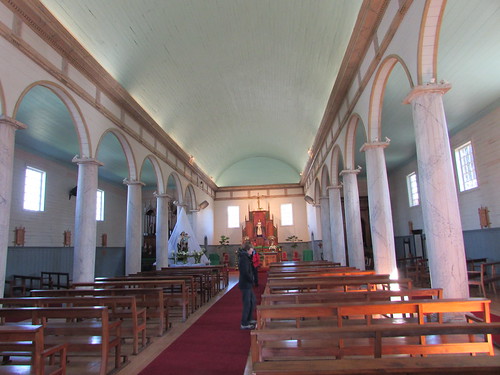
Dalcahue, Chile: Wooden church.
Our bus then drove us to the main city of Castro, using Route 5 which forms part of the Pan-American Highway. Arriving in Castro, our coach paused at a viewpoint overlooking the series of 'stilt houses' built out over the water on tall posts called the Palafitos of Gamboa.

Castro, Chile: The Palafitos of Gamboa.
After a short drive, we left the coach and walked to a local restaurant also built on posts over the water (although the state of the tide meant that there was no water during our visit). Here we enjoyed “a snack and typical local music”. Outside, considerable interest was created by Ray, the “Ship’s Videographer” who was using his radio-controlled drone to collect aerial pictures.
In the shallows, a number of locals were collecting seaweed – the ‘green’ variety is used as a fertiliser and the ‘white’ is used as a source for Agar Jelly, widely used for culture-growing in laboratories.
During the morning, we’d travelled many miles by coach from Achao to Castro. Rather than requiring us to drive back to Achao to re-join the ship, in an innovation carried out for the first time on our trip the ship had sailed from Achao to Castro and, as we watched the seaweed collectors, ‘Silver Explorer’ appeared round the headland and slowly moved to an anchorage only a few hundred yards from Castro’s jetty. The ship lowered a number of Zodiacs into the water in order to collect the guests from the shore.
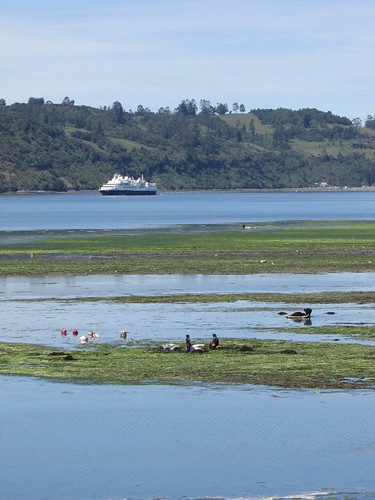
Castro, Chile: Workers collecting seaweed as 'Silver Explorer' arrives to pick up passengers from the ‘Chiloe Highlights Tour’.
Tour buses were on hand to take guests from the local restaurant to the jetty, with the option of instead walking to the jetty. Since the sun was shining brightly and the distance was only a few hundred yards, I and a number of the guests decided to walk. After passing a row of houses, we came to a large covered dry goods market incorporating a fresh fish market. Having spent a few minutes touring the market, I examined three incomplete ‘portable engines’ on display outside in an incomplete state.
A portable engine is similar to a traction engine except that it is not self-propelled. It has to be towed into position, when its steam engine can be connected by belt drive to a piece of unpowered machinery like a threshing machine or a sawbench. Two of the portable engines were made by Ransomes in England but the manufacturer of the third was unclear.
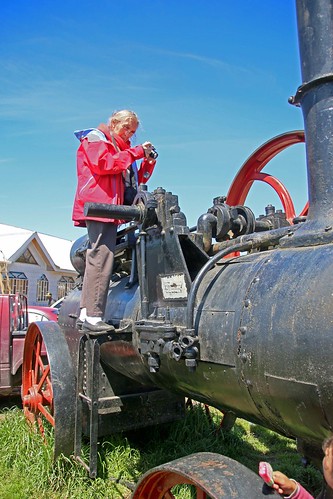
Castro, Chile: Jan examining a Portable Engine (Photo: Peter Fraenkel).
A further short walk took me to the small Castro Terminal Building. Once through the building, I was on the jetty, with a few other guests from the ship. We took the last Zodiac back to the ship and were back on board a few minutes after one o’clock.
I found I was ready for lunch in the restaurant after the exertions of the morning. There were two lectures during the afternoon but I worked on the computer instead. Just after four o’clock, I took afternoon tea in the Panorama Lounge with two new friends from Australia before continuing on the computer until the Expedition Team Recap and Briefing, which reviewed the day’s outing and outlined the plans for the following day. Then it was time for a leisurely dinner with another new friend before retiring.
Related Posts
Next post describing this trip: Puerto Chacabuco.
All posts describing this trip: Chilean Fjords.
My pictures
Where necessary, clicking on an image above will display an 'uncropped' view or, alternately, my pictures from this (and earlier) trips may be selected, viewed or downloaded, in various sizes, from the albums listed:-
Pictures of Achao and Castro are here.
Pictures aboard 'Silver Explorer' are here.
All my pictures of Chile can be found in the collection Chile.
[Pictures added 11-Jan-2017]
Events of Wednesday, 16th November
Around 7.30 a.m. we dropped anchor in a broad estuary with the town of Corral to our right and Niebla hidden round a bend to our left. Wooded hills reached down to the water on both sides, reminding me of some of the Cornish estuaries. A large bulk carrier ship was moored to buoys on the shore to the right, suggesting mining activity I couldn’t identify, but the left shore appeared undeveloped.
The ninety-odd passengers on the ship had been allocated to one of four groups for going ashore by Zodiac inflatable boat. I was in Group 1 which would be the first group to go ashore to Niebla but on the next landing Group 2 would land first and the order of Groups would rotate throughout the trip. Landing was planned to start at 8.00 a.m. but there was a slight delay waiting for the coaches to arrive at the landing site.
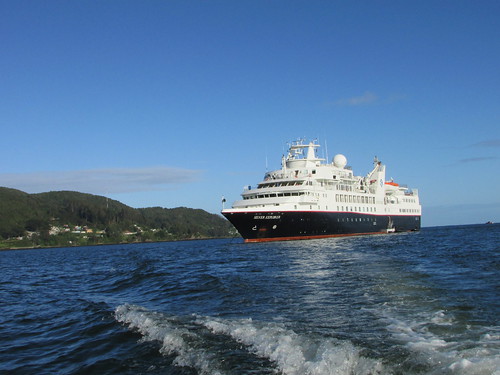
'Silver Explorer' anchored off Niebla, viewed from the 'Zodiac' taking me ashore.
Our anchorage was at the confluence of a number of rivers so the Zodiacs navigated by channel markers for the Valdivia River, the river on our left, and carried on for a few hundred yards to reach the public jetties at Niebla, provided with a concrete ramp for the vehicle ferries and two floating landing stages for small passenger ferries. We overtook one of the vehicle ferries ‘Cullamo’ which was heading for Niebla, I think from Corral. We landed at one of the passenger landing stages, stepping directly onto the landing stage (a ‘dry landing’). By the time I’d walked up the gangway from the landing stage, a passenger ferry had arrived at the adjacent landing stage and ‘Cullamo’ was preparing to unload vehicles. Niebla town may be small, but Niebla Terminal is a busy place.
Three modern tourist buses were waiting in the car park for the arrival of the ‘Silver Explorer’ passengers for the ‘Highlights of Valdivia Tour’. We had a local guide plus members of the ship’s Expedition Crew. The journey to Valdivia, we were told, would take about half an hour. The road continually curved this way and that, following the left bank of the Valdivia River upstream. The setting was very beautiful, again reminiscent of Cornwall.
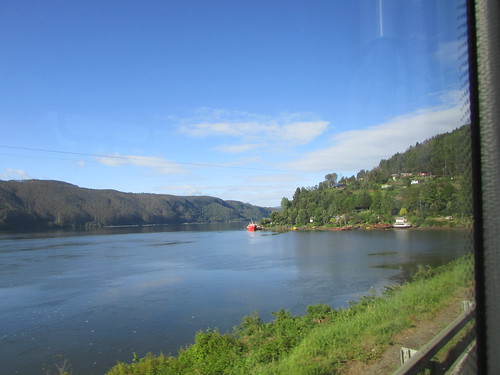
The river between Valdivia and Niebla, looking downstream.
At first, the houses were spread apart. They appeared to be mainly wooden framed, clad with chipboard and then with a clapboard or other outer layer. But as we came nearer to Valdivia, there were four-storey apartment blocks and gated communities of detached houses generally in an ‘Alpine’ style.
A little background
The Spanish conquistador Pedro de Valvidia founded the city in 1552, making it an important location in Spain’s South American colony. But the takeover was not accepted by the indigenous Mapuche Indian population and in 1598 it was abandoned by the Spanish, to be occupied in 1643 by the Dutch as a base for attacks on the Spanish Empire. The Dutch, too, left Valvidia following conflicts with the Mapuche. Later, the Spanish re-occupied Valvidia, this time protecting the area by the construction of a number of fortifications, holding the area until 1820 when, during the fight for Chilean Independence, the Englishman Lord Thomas Cochrane (admiral of the Chilean navy at the time) overwhelmed the Spanish by a stealth attack.
More recently, in 1960 this area of Chile was the epicentre of the strongest earthquake recorded to date and much of Valvidia was destroyed. The movement of the sub-sea floor created a tsunami which spread across the Pacific. As a result, most of Valvidia now comprises fairly new building.
In 2007, Valvidia was made the administrative capital of the newly-created Los Rios Region. The population is now around 155,000 and it is home to three major universities (plus smaller private foundations).
My Visit
Our tour bus first parked in the grounds of the Historical and Anthropological Museum, situated on the Cultural Campus of the University. During the 19th century, Germany developed industry and influence in the area and the present museum building dates from that period. Although it suffered some damage during the 1960 earthquake, the building represents a time capsule of that period, crammed with artefacts of gracious living in the downstairs rooms whilst Mapuche artefacts and jewellery can be seen in the upstairs displays. Steps at the front of the house lead down to the west bank of the Valdivia River, with the modern city on the east bank.
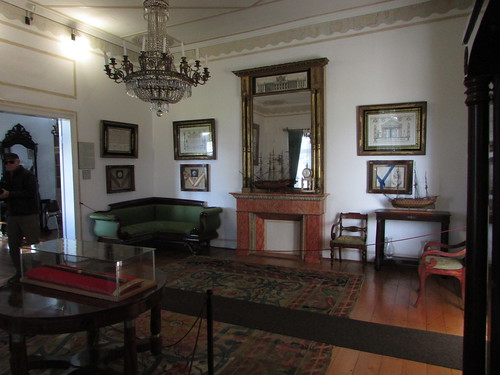
Valdivia Historical & Archaeological Museum.
We rejoined the tour bus to explore a little of the city, crossing the river using the Puente Pedro de Valdivia bridge (a 1940s concrete and steel affair) which survived the earthquake. The Plaza de la Republica is regarded as the centre of the city, with trees, flower beds, broad walkways and a magnificent bandstand. Nearby, a man operating a shoe-shine business was patiently waiting for trade. We walked past the post-earthquake cathedral to reach the river bank, made into a wide promenade and serving as the loading point for the numerous trip boats which offer river cruises to tourists.
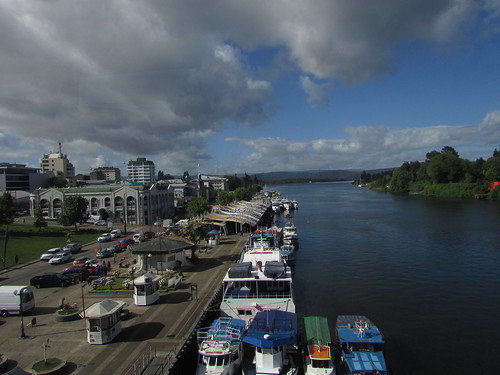
Valdivia, Chile.
Towards one end of the promenade, a modern, tall tower provided by the Centre for Scientific Studies at the University featured a Foucault’s Pendulum, topped with a navigation light. Nearby signage gave brief information on the pendulum and the Fresnel Lens used in most navigation lights, together with a map showing the location of ‘Chilean Glaciers in Antarctica’.
A little further along the river, a rather abandoned-looking submarine was moored, but I didn’t discover more at the time. Intrigued at finding a submarine in what seemed, to me, an unlikely spot on my return Wikipedia informed me that the vessel was the Chilean Navy 'Oberon' class submarine S22 O'Brien, built by Scott-Lithgow, commissioned in 1976 and de-commissioned sometime between 2000 and 20010. Then I was further intrigued by the Irish-sounding name. John Thomond O'Brien (1786–1861) fought in the Army of the Andes, helping Chile obtain its independence from Spain, gaining fame as did the Chilean hero Bernardo O'Higgins.
Along the promenade near the bridge we’d crossed, I visited the fish and vegetable market. Here, fish are gutted on concrete preparation benches next to the river, encouraging birds to perch on the railings awaiting discarded pieces of fish. Numerous bird species were represented, including pelicans. Even more improbable was the group of South American sealions, either relaxing in the sun on a nearby floating pontoon or actually on the concrete floor of the fish market, squeezed between the railings and unused gutting benches.
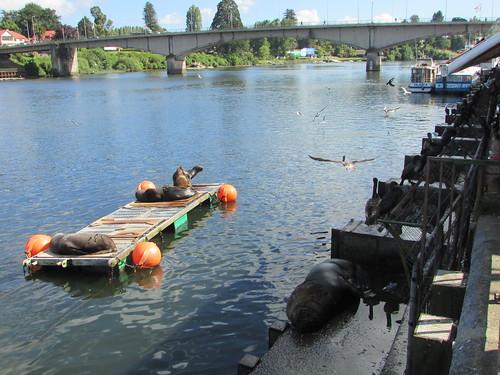
Valdivia, Chile: South American Sea lions and birds awaiting scraps at the fish market.
On the recommendation of our Chilean guide, a group of us crossed the road to look inside the modern municipal market, which seemed to house two or three cafes and numerous stalls selling tourist souvenirs.
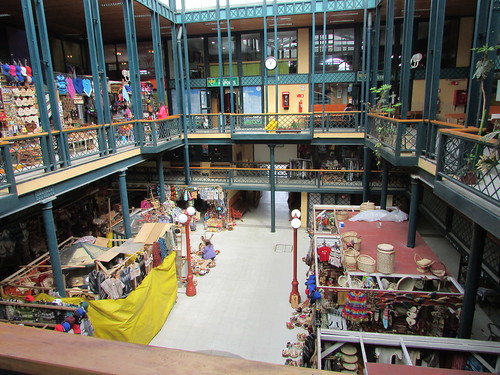
Valdivia Municipal Market.
Meeting up with our guide, we walked along the river bank, under the road bridge and past a modern floating restaurant under restoration. Next to the restaurant, an attractive steam launch was moored. A little further along the river bank, what appeared to be an abandoned wooden landing stage was occupied by around eight sealions, basking in the sun, watched attentively from the bank by two dogs. We then crossed the road to reach a sea food restaurant where we enjoyed a buffet lunch.
After our meal, our tour bus picked us up and returned us to Niebla Terminal. As I walked to the landing stage, vehicle ferry ‘Pitipulla’ was loading the last vehicle, which reversed up the loading ramp and reached the main deck with a loud ‘clang’. Within minutes, the ferry departed, as yet another vehicle approached the concrete ramp with another full load of vehicles including a huge lorry with the load space sheeted-over.
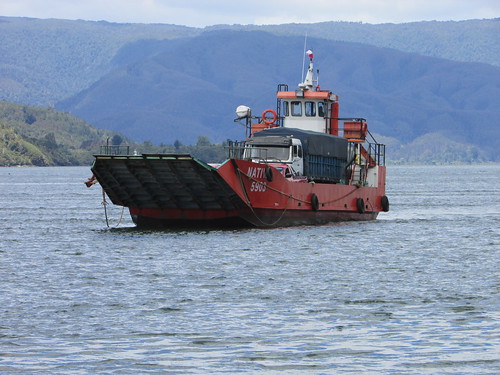
Niebla, Chile: Vehicle ferry approaching the busy public jetty.
Once aboard the Zodiac, I enjoyed a high speed ride of about one mile back to ‘Silver Explorer’. As soon as everyone was back on board and the Zodiacs had been lifted aboard, we got under way for our next destination, Chiloe Island.
Related Posts
Next post describing this trip: Achao and Castro.
All posts describing this trip: Chilean Fjords.
My pictures
Where necessary, clicking on an image above will display an 'uncropped' view or, alternately, my pictures from this (and earlier) trips may be selected, viewed or downloaded, in various sizes, from the albums listed:-
Pictures of Niebla and Valdivia are here.
Pictures of Valdivia Historical & Archaeological Museum are here.
Pictures aboard 'Silver Explorer' are here.
All my pictures of Chile can be found in the collection Chile.
[Pictures added, notes on submarine added 10-Jan-2017]
Events of Tuesday, 15th November
Our first port-of-call was to be at Niebla, almost 500 miles south of Valparaiso so Tuesday was a day at sea. Three lectures were on offer during the day in the well-equipped theatre.
Weather conditions were good with some sea swell. I was unaffected by the movement of the ship but a surprising number of guests felt unwell.
I spent some time wrestling with an unco-operative laptop computer. My Hewlett-Packard had performed well in Santiago but it had apparently performed an automatic Windows 10 Update during the session and when I tried to connect to the ship’s satellite internet system, I discovered that those nice people at Microsoft had made all sorts of changes to the operation of my computer including swopping my default browser from Chrome to Microsoft Edge. I finally managed to collect my e-mail but then Google complained that I was using an ‘unsupported browser’. Because of the other Microsoft ‘improvements’ I couldn’t find how to change my default browser back to what I wanted and had to enlist the support of the ship’s resident I.T. expert who, after a bit of experimenting managed to get things back (almost) as I wanted.
I did a blog update but didn’t manage to attend any of the lectures. Then, at 5.00 p.m., there was a Mandatory Zodiac Briefing and Destination Briefing in the theatre. It was back to the theatre at 7.00 p.m. to meet the Captain at her ‘Welcome Cocktail Party’. This was followed by dinner in the restaurant and interesting conversations with other guests at my table which went on quite late. We were almost the last table to finish!
The following morning, we were due to anchor off Niebla where we would go ashore.
My connection to the internet on the voyage is by satellite which is relatively slow so, at present, my pictures are being stored on the hard disk of my laptop (with a backup on a plug-in hard drive). I’ll upload them to ‘Flickr’ when I can and provide illustrations on the blog, but it may be a while.
Related Posts
Next post describing this trip: Niebla and Valdivia.
All posts describing this trip: Chilean Fjords.
My pictures
Where necessary, clicking on an image above will display an 'uncropped' view or, alternately, pictures may be selected, viewed or downloaded, in various sizes, as below:-
Pictures aboard 'Silver Explorer' are here.
All my pictures of Chile, taken on this and earlier trips, can be found in the collection Chile.
More events of Monday, 14th November
I boarded ‘Silver Explorer’ a little after two in the afternoon and boarding formalities were quickly completed. I was told that lunch was still being served in the Restaurant so, peckish after the morning’s exertions, I enjoyed an excellent chicken soup before finding my cabin – 314 on the port side. By about 3.30 p.m. all passengers had boarded and at four there was a mandatory lifeboat drill.
At five o’clock, I watched our departure from deck 6. The initial movement away from the quay was controlled by our lady Captain, Maggi Ettlin, from the starboard wing bridge using the remote control panel.
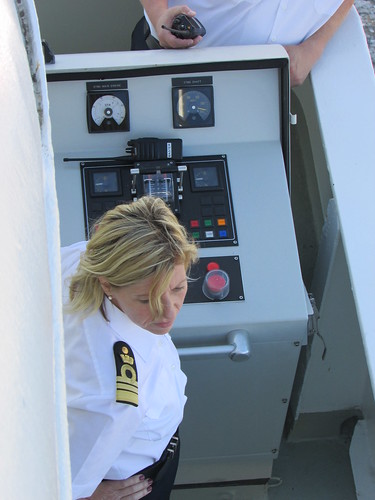
'Silver Explorer' Captain, Maggi Ettlin.
The ship and the various shore parties managing the mooring lines remained in touch using hand portable radios. The Harbour Pilot was also on our bridge and the Valparaiso pilot boat ‘Zeus 1’ remained close by monitoring our progress, as did the powerful-looking ocean-going tug ‘Huairavo’, equipped with two fire-fighting monitors. We slowly manoeuvred out into the channel and, once we were clear of the stern of the massive Hapag-Lloyd container ship ‘Santa Teresa’ loading at the container terminal, the pilot boat came alongside on our port side towards the stern and we ‘dropped the pilot’.
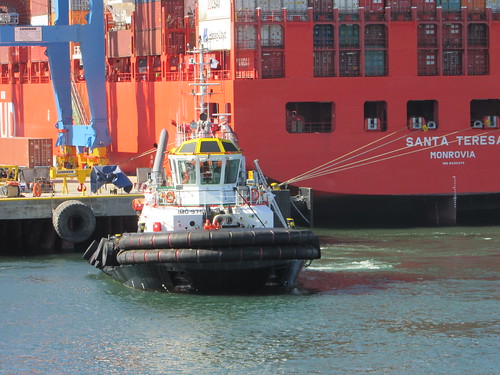
Valparaiso: Ocean-going tug ‘Huairavo’ observes our departure as we pass the stern of the Hapag-Lloyd container ship ‘Santa Teresa’.
We made our way outside the protection of the harbour mole and past a number of moored ships giving us wonderful views of Valparaiso as the sun set. The appearance of the cascades of buildings set on the hills facing the sea made me think of a child who’d just emptied all his building blocks onto the floor.
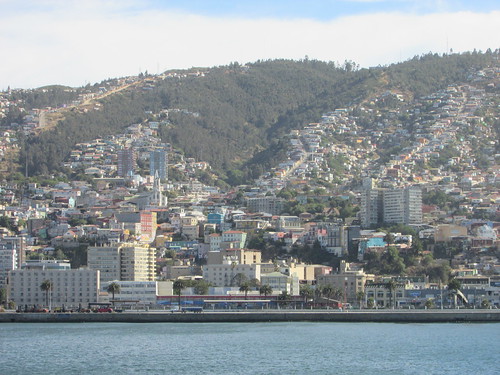
Valparaiso, viewed from the sea at sunset.
Having watched our departure, I briefly joined the ‘Sail Away’ cocktail party on deck 6 aft. At 6.30 p.m. passengers gathered in the Theatre where Kara Weller, the Expedition Leader, carried out ‘Staff Introductions’ covering the managers who look after the ‘hotel’ side of the ship and the 9-strong Expedition Team.
Immediately after the introductions, it was time for the first of our evening meals on board. Seating is unallocated but the staff are always happy to suggest a table so I stayed in the dining room quite late talking with new friends from the United States, Australia, Spain and the U.K. (a young man working in Dubai whose family home was just 12 miles from where I live!
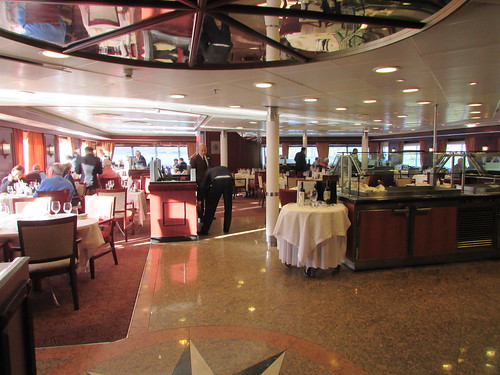
Aboard 'Silver Explorer': Entrance to the Restaurant.
I slept soundly as the ship made its way south along the Chilean coast.
Related Posts
Next post describing this trip: 'Day at Sea'.
All posts describing this trip: Chilean Fjords.
My pictures
Where necessary, clicking on an image above will display an 'uncropped' view or, alternately, pictures may be selected, viewed or downloaded, in various sizes, as below:-
Pictures of Embarcation and leaving Valparaiso are here.
Pictures aboard 'Silver Explorer' are here.
All my pictures of Chile, taken on this and earlier trips, can be found in the collection Chile.
[Pictures added: 5-Jan-2017]
Events of Monday, 14th November
I took breakfast in the pleasant restaurant at my hotel before rushing around completing my packing ready for an eight o’clock pick-up. My guide and driver arrived on time and were soon threading our way through the narrow streets of Barrio Lastarria to reach the main road west. Being a working day, the traffic was much heavier than the previous day and our progress was slow. Eventually, we passed Estacion Central, where a huge stylised Christmas Tree (basically a decorated cone) had already been erected. We then traversed Alameda, a rather down-at-heel area which gave way to a series of huge multi-storey modern apartment blocks still under construction. Finally, we left the city behind and climbed into the hills, heading for Valparaiso.
The hills were arid and sandy, covered with trees and shrubs, rising to frequent peaks, each peak topped with a cluster of red and white painted radio masts. In one area, palls of smoke were rising where a hillside was burning but no flames were visible as we sped by on the dual carriageway. In a number of places on downhill sections emergency lanes were provided, terminated in a steep upwards ramp to slow vehicles having difficulty braking. Periodically, we passed broad toll stations which manually collected tolls although a few automatic lanes had been added to one side. Our route took us through two 2-bore road tunnels which allow easier gradients.
After passing through the first mountain section, we emerged into a broad, fertile valley, filled with fruit farms. We stopped at a roadside café which specialises in selling the local sweet pastries so that my guide could take breakfast then continued into the area specialising in olives and grapes. Chile has developed a successful and well-regarded wine making industry and we passed a number of wineries.
Another mountain section led to a modern industrialised area before we entered Valparaiso. I was told the population was around 400,000 and the city certainly appeared larger than I remembered from my earlier visit some years ago. There was plenty of nondescript property but also attractive buildings in classical style dating from the late nineteenth and early twentieth century. Until the Panama Canal opened, Valparaiso was an important port on the sea route from the east to the west coasts of the United States, helping to bring prosperity to Chile’s main port.
Although Valparaiso provided a safe harbour, the location was less than ideal for a city, as numerous steep hills tumble onto a narrow foreshore. Once the foreshore was colonised, further development extended into the hills, resulting in a complex pattern of winding, narrow streets with houses perched on improbable sites, linked together by a series of daunting pedestrian stairways.
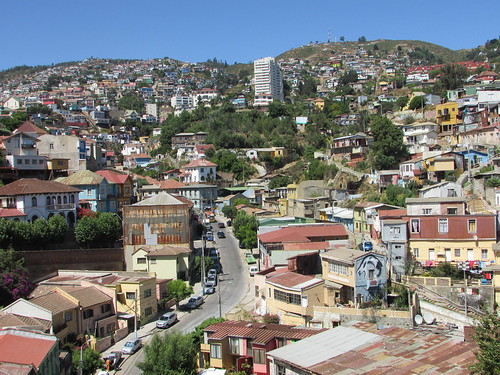
Valparaiso, Chile.
This topography resulted in a number of funicular railways (‘Ascensor’) being constructed around the town, linking the foreshore area with the summits of the various hills. At one time, I believe there were around 16 separate funicular railways in the city but a number have fallen into disuse. On my last visit, I found a number of the Ascensor to be in a poor state of maintenance and now, I was told, they are operated by the Government. Unforunately, my present visit coincided with the third week of a strike of Government workers affecting Valparaiso. One consequence of this strike was the piles of uncollected rubbish dumped on every street corner: another was that the Ascensors were not operating so my activities were confined to taking a few photographs. I’m sure I’ll return to this topic in the future.
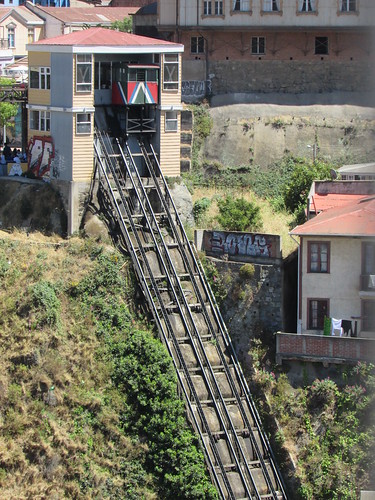
The Ascensors of Valparaiso.
It was a warm, sunny day in Valparaiso. By car and by walking, my guide showed me more of the city. The older area is now a World Heritage Site and there is a thriving artistic community. Tourism has developed and the good port facilities encourage large cruise ships to call but (as I was able to confirm from one of the viewpoints we stopped at high above the harbour) ‘Silver Explorer’ was the only passenger ship visiting at the time. Some of the old buildings on the hillsides have been converted into hotels to cater for tourists but, of course, Valparaiso can be readily reached by day trip from Santiago. We passed a number of well-patronised walking tours as we made our way around the old town.
With land at a premium, gardens are virtually unknown but every spare space is filled with trees, bushes and planters. The top of one hill is occupied by two Catholic cemeteries (called, prosaically, ‘Cementerio 1’ and ‘Cementerio 2’). Freedom of worship arrived relatively late so the third, non-Catholic cemetery is called, rather uncharitably I thought, the Dissidents’ Cemetery (‘Cementerio Disidente’). The entrance to each of the Catholic cemeteries is graced by a tall, columned arch in classical style, still imposing but now showing signs of age.

Cemeterio No. 1, Valparaiso.
In contrast, the Dissidents’ Cemetery makes do with a simple iron gate set in a white-painted wall. The actual monuments in the various graveyards are of a similar range of styles.
Although there are conventionally-built properties in the old town, a common technique was to use timber framing with corrugated iron sheets for the exterior walls and roof. Occasionally, walls were clapboard. With walls painted in various muted (or, perhaps, faded) colours, the overall effect is pleasing and rather English-looking. This is not accidental as a number of the early settlers in Valparaiso we of English origin. In general, the narrow streets were cobbled, sometimes with two parallel rows of larger stone flags, presumably to aid the movement of wagons and carts.

Valparaiso, Chile.
After a fascinating morning in Valparaiso, the car descended to the foreshore and took the road around the bay as far as the area known as Baron (offering fleeting glimpses of the Baron Ascensor) before entering the Dock Estate Gates. After a cursory, friendly security check, we headed back in the direction we’d arrived from, but now inside the dock walls. A second brief security check allowed us past the Valparaiso Cruise Terminal, a modern steel-framed warehouse, to a parking area near a small building which appeared to contain baggage X-ray equipment. A desk had been set up in the sun where joining passengers’ names were being checked against a series of lists and baggage separated for separate transfer to the ship by lorry. I said ‘good bye’ to my guide and driver and, within moments, I was being walked through the empty barn of the Cruise Terminal (intended for handling two or three thousand passengers at a time off the cruise ships) back outside. Here, I waited with a small group of passengers for a couple of minutes whilst a modern tour bus marked ‘Shuttle’ was prepared by the driver before being driven further into the docks to stop on the quay alongside ‘Silver Explorer’, my home for the next few days.

'Silver Explorer' at Valparaiso.
Related Posts
Next post describing this trip: 'Silver Explorer'.
All posts describing this trip: Chilean Fjords.
My pictures
Where necessary, clicking on an image above will display an 'uncropped' view or, alternately, pictures may be selected, viewed or downloaded, in various sizes, as below:-
Pictures of Valparaiso are here.
Pictures embarking at Valparaiso are here.
All my pictures of Chile, taken on this and earlier trips, can be found in the collection Chile.
Pictures of the railways in Chile including the Metros in Santiago and Valparaiso, taken on this and earlier trips, are here.
[Pictures added: 28-Dec-2016]
I've commenced another travel adventure and will, as possible, write about the trip. I set off from home on a rainy Saturday in November.
Events of Saturday, 12th November 2016
It rained and was fairly cold first thing but by the time John J. picked me up to take me to Birmingham Airport, the rain had stopped although it remained very overcast. The first leg of my journey was an Air France flight to Paris, Charles de Gaulle. I understood that the flight was actually to be operated by Flybe under a 'Code Share' arrangement but the departure board directed me to Air France check-in desks in the remotest part of the terminal from the entrance. By the time I'd manoeuvred my luggage through the aimless crowds in the terminal, my mood had dropped a couple of notches. It was partly restored by the prompt and friendly attention of the English lady at the quiet check-in desk. She gave me directions to the 'Aspire' business lounge but first I had to run the gauntlet of Security. This now seems to comprise the major part of passing through airports and it is normally carried out apparently as a form of ritual humiliation for passengers. Each airport appears to have slightly differing procedures which passengers have to grapple to understand. I emerged from the process duly approved but (once again) wondering if foreign travel was now a mistake.
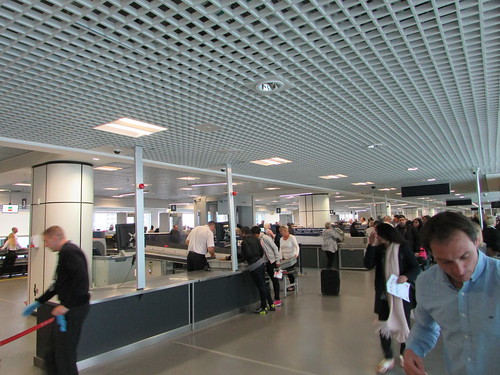
Birmingham Airport: Security
This pessimistic thought was compounded by having to pass through the brightly-lit and noisy 'Duty Free' area where the only way through zig-zags back and forth to maximise the distance walked from entrance to exit. Only then could I search for signs to the lounge area.
I've visited some excellent business lounges around the world. The 'Aspire' lounge at Birmingham is not one of them. I guess the name is intended to suggest its suitability for 'aspirational' people but I grumpily thought "this aspires to be a relaxing experience and fails". I was quite happy to leave the lounge early and report to the gate for boarding.
Again, the staff at the gate were efficient and welcoming and on boarding the aircraft was surprised to find that not only was it an (admittedly elderly) Air France A320 but it had an Air France crew. But it was a 'Code Share' with Flybe and at least one other airline.
I'd not been able to book a window seat but, as I took my assigned place, the friendly Purser invited me to move to an empty group of three seats on the port side, so I ended up with a window seat after all. With passengers loaded, the air bridge was moved away and the pushback tug propelled us onto the taxiway and pulled us some distance forward before the tug was disconnected and moved away, showing the Captain that the 'Pin' had been removed, meaning that the aircraft had regained control of the nosewheel steering.
We taxied to the threshold of Runway 33 and accelerated to take-off speed, climbing steeply into the low cloud and making a right turn as rain trickled across the windows. In the hour it took to reach Paris, the attentive crew served quite a reasonable meal so we touched down at Charles de Gaulle Airport (on runway 08 Right which I noticed was equipped for Category I and II landings) with my humour much improved.
It's some time since I'd last been to Paris by air so either I'd forgotten how big it was or it had grown (probably both). It was not very crowded so the only immediate problem was the long distances walking with hand luggage. The facilities seemed modern without offending me and when I stopped at the Air France Transfer Desk to confirm the gate for my onward flight, the French lady was charming, explaining that I had to go down one floor and pass through security to reach a lounge where (because of my insistence that I'd didn't wish to go via Heathrow) I had some hours to wait before my Air France connection to Santiago, Chile.
On the way to security, a very presentable young French man with excellent English gave me a lovely smile as he directed me to the security, where the usual rigmarole prevailed, not helped by the school mistress style of the security officer who gave instructions in accented English I had some trouble following.
However, having negotiated that hurdle, it was all smiles again, from the girl in the currency exchange who sold me Chilean Pesos to the business lounge staff who were delightful. From earlier visits, I had remembered the French as rather reluctant to converse in a foreign language and certainly not given to beaming at English speakers. With a shock, I realised that the most likely reason for this change was due to me, not them. What people now see is an old, sometimes baffled, woman and allowance is very likely being accorded to my age. Well, kindness is kindness but I don't always find it easy coming to terms with people's changed perceptions.
I'd at least seven hours to wait but I'd plenty of reading material so I found a fairly quiet spot with a view over some of the major access roads through the airport and settled in. Usually, I would have been attempting to blog at this stage but, after a tiring week, I decided I'd stick to a less demanding task. Finally, at 10:45 p.m. a rather bleary-eyed Jan proceeded to Gate L53 and boarded Air France Flight AF0406 for Santiago - this time 'Code Shared' with six other airlines! The aircraft was a Boeing 757-300 (I think). Business class was laid out 2-3-2. I had seat 2A but the seat next to me was already occupied. We were due to depart at 23:40 but we were at least half an hour into Sunday before we pushed-back.

Paris: Terminal 2, Charles de Gaulle airport: Boarding Santiago flight.
Events of Sunday, 13th November 2016
Our delay was largely because, at a late stage, we boarded what appeared to be a small family group of economy passengers then, a little later, de-planed them. No explanation was given but, having de-planed them, we then had to wait whilst the baggage loaders located and abstracted their luggage. You may appreciate that, by the time we took off, I was not the most acute of observers. It's over 7,000 miles from Paris to Santiago and that was set to take over 13 hours. They offered dinner after take-off. I slept a little but not well and watched a couple of films and three NCIS episodes. Eventually, after a reasonable breakfast, we landed at Santiago, only to suffer the indignity of having to wait on a taxiway until our 'stand' was ready. Apologies for the amount of 'whinging' in this post - I try to report honestly but hopefully I will have a more positive view of the world from here on.
It must have been after 11:00 local time by the time I'd passed through immigration, retrieved my checked bag, passed through customs, had all my baggage X-rayed again and met up with my lady guide and male driver for the journey into Santiago and my hotel for one night, the Lastarria Boutique Hotel in the area near the centre of Santiago known as Barrio Lastarria.

Lastarria Boutique Hotel, Santiago.
Although check-in was officially not until 3.00 pm, they gave me a room immediately, allowing me to take a shower, which revived me significantly, encouraging me to take a walk in the sunshine north-west through Parque Forestal, past the Belles Artes Museum as far as Plaza de Armas.
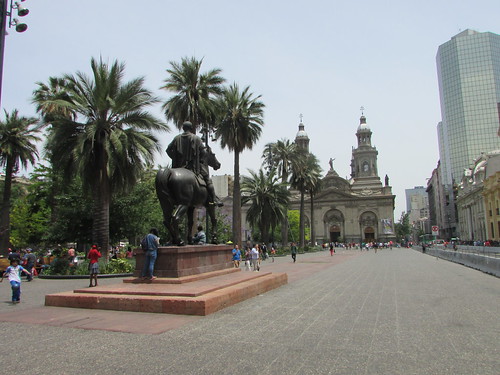
Santiago: Plaza de Armas.
There, I bought a Metro ticket to travel two stations south-east on Line 5 to the interchange station of Baquedano. I'd liked Santiago on my first two visits and I'm happy to report that it still works its magic on me. I resisted the temptation to travel further on the Metro, for instance, by changing to Line 1 but instead walked back to my hotel, ready for a late lunch. After a fairly tiring couple of days, I decided to remain in the hotel for the rest of the day.
Previous visits to Santiago
My first visit was part of my Round the World Three trip described here (one post describes the whole trip!). My second visit was part of my Round the World Four trip. This time, there's a separate post on Santiago here.
Related Posts
Next post describing this trip: Valparaiso.
All posts describing this trip: Chilean Fjords.
My pictures
Where necessary, clicking on an image above will display an 'uncropped' view or, alternately, my pictures from this (and earlier) trips may be selected, viewed or downloaded, in various sizes, from the albums listed:-
Pictures of Birmingham Airport, taken on this and earlier trips, are here.
Pictures of Paris CDG Airport are here.
Pictures of Lastarria Boutique Hotel are here.
Pictures of Chile, taken on this and earlier trips, are in the collection Chile.
Pictures of the railways in Chile including the Metros in Santiago and Valparaiso are here.
[Pictures added: 27-Dec-2016]

