skip to main |
skip to sidebar
Kyee Myin Daing (which, in earlier times, the British called 'Kemmendine') has a substantial railway station situated on Yangon's Circle Line in Myanmar.
Background
I first saw this station in 2008 when I made a round trip on the Circle Line (described in the post The Circle Line, Yangon). Leaving Yangon Central station in a clockwise direction, after calling at small stations at Pha Yar Lan, Lanmadaw, Pyay Road, Shan Road, Ahlone Road and Pann Hlaing, the train paused at Kyee Myin Daing where there was a large two-storey station building, three platform faces and extensive sidings. I was immediately intrigued not only by the size of the station but by the fact that the area was controlled by two elderly mechanical signal boxes with mechanical operation of points. Although colour light signals were in use on the main running lines, a variety of lower-quadrant semaphore signals survived in the sidings. Unfortunately, none of the pictures I took on this round trip show Kyee Myin Daing.
In 2012 I travelled on part of the Circle Line (report here) but didn't pass through Kyee Myin Daing.
The following year, on 14th February 2013, I passed through the station on my way to and from the junction at Da Nyn Gone, producing pictures here and the post Yangon Area Railways.
On the 25th April 2014, I made a cab ride around the Circle line (see post Cab Ride around the Circle Line), adding a few more pictures of Kyee Myin Daing.
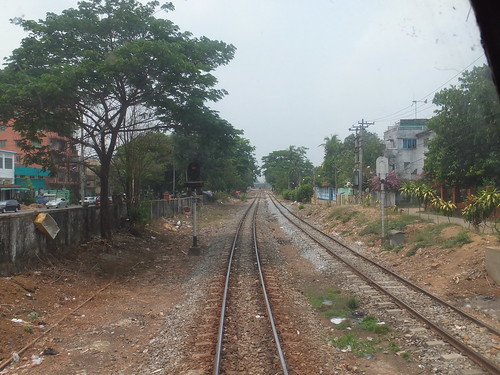
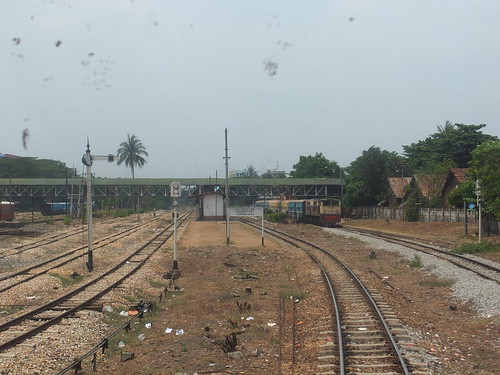 View of Kyee Myin Daing station from the cab of an Circle Line Train in 2014. Note the mixture of colour light and semaphore signals. DF1268 on right, heading for Yangon with a Down Train.
By 2015, the 'New' Diesel Multiple Units were being introduced and, on 4th May 2015, I went around the Circle line on one of these collecting more views in album The Circle Line by DMU.
Another 'New' Diesel Multiple Unit provided the motive power on 22nd April 2016 when I made another clockwise trip of the Circle Line with my young friend Aung (pictures here).
Origins of Kyee Myin Daing Station
Rail transport was first introduced in Myanmar in May 1877, when Lower Burma was a British colony, with the opening of the 163-mile (262 km) Yangon to Pyay line by The Irrawaddy Valley State Railway. At Yangon, the line terminated at Kyee Myin Daing, later being extended to what is now Yangon Central Station. I understand that, even today, some trains from Yangon to Pyay start at Kyee Myin Daing rather than Yangon Central Station.
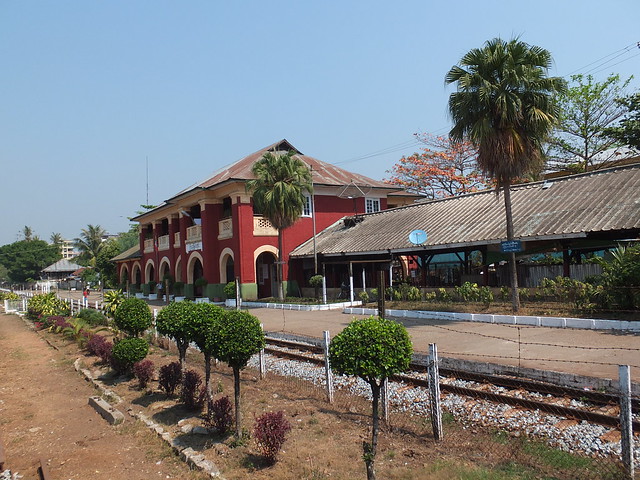 The impressive station building at Kyee Myin Daing.
The Docks Branch
The British developed extensive docks on the north shore of the Yangon River which at one time carried heavy freight traffic. A single line still runs along the public side of the dock estate enclosing wall (parallel to Strand Road) with sidings, now reduced, leading into the docks at strategic locations. General goods depots are maintained at War Dan (on the river side of the line) and Botataung (on the landward side of the line). I'd walked along the eastern part of the dock line in 2014 (report here with pictures along the dock branch here), when I discovered that part of the branch had be re-laid as dual-gauge (metre/standard gauge). It was much later that I realised the standard gauge was for Yangon's embryonic tram system, which I visited on 21st April 2016 (report here, pictures here).
This single dock line connects to the main railway network at each end.
In the west, from War Dan the line turns inland, heading north to run parallel with the main line from Pann Hlaing, finally joining at the south end of Kyee Myin Daing. In between Pann Hlaing and a point south of Kyee Myin Daing, I'd noticed a 'third rail' on the dock branch in 2015. However, I dismissed it as evidence of rail replacement, as this rail didn't appear to have rail fastenings. I'm afraid that it's only recently that checking the relevant pictures confirms the presence of dual-gauge concrete sleepers and a third rail laid in position and fishplated but, for the most part, not fastened down. I do not know whether this incomplete dual gauge extends to War Dan, thus linking up with the dual gauge observed along Strand Road referred to above.
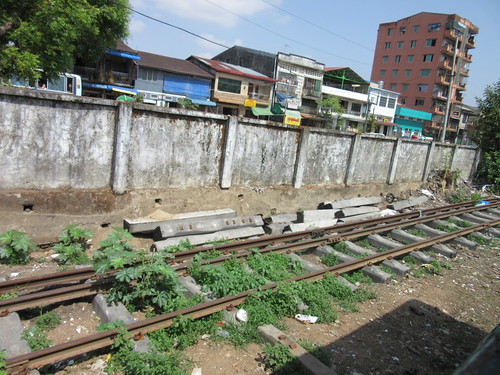 The Circle Line by DMU in 2015: South of Kyee Myin Daing the docks branch is now dual-gauge, here with rail fastenings.
At the eastern end of the docks, the line turns north to make a junction with the main lines near Pazundaung, giving access to the major marshalling yard at Mahlwagon (discussed in the post here.
Kyee Myin Daing North and South Signal Cabins
Since I was young, I've had an interest in railway signalling and mechanical signal boxes (see the post Visiting Signalboxes) so the two part-mechanical signal cabins at Kyee Myin Daing North and South, as the only surviving mechanical cabins on the Circle Line, fascinate me. I was further intrigued because in the post Yangon Area Railways, I reported that Burma Railways placed an order in January 1946 with the Westinghouse Brake and Signal Company for two Style 'L' miniature lever frames for Burma Railways, intended for 'Rangoon' and 'Kemmendine'. The 'Kemmendine' lever frame order called for 47 levers made up of 12 point levers, 28 signal levers, 6 spare levers and 1 spare space. The 'Rangoon' miniature lever frame was installed at Yangon Central and remains in use (as described here) but what became of the other frame order is currently a mystery.
The main line through Kyee Myin Daing is double track and is flanked to the north and south by 'Automatic Block' areas with colour-light signals, where the occupation of an electrical track circuit by a passing train replaces each signal to 'danger', reverting to 'proceed' for a following train when the first train has passed clear of the track circuit. There is no manual block working and, in theory, trains arrive in accordance with the timetable.
Mechanical operation of points has been retained, with facing points provided with facing point locks and locking bars as was standard British Practice in the mechanical era. There's a brief description of the arrangement in the post Railway Signalling in Britain: Part 6 - Mechanical Operation of Points.
My visit on 6th May, 2016
I travelled on the Circle Line from Yangon Central Station to Insein and back, breaking my journey on the outward leg at Kyee Myin Daing to allow me to explore on foot. All my pictures from this trip are in the album Yangon to Insein by Train but my pictures in and around the station at Kyee Myin Daing, taken on this trip and on other occasions are in the album here.
Recent Developments
The sidings at Kyee Myin Daing, presumably originally busy with freight to and from the docks, have been fairly quiet in recent times but my latest visit revealed new activity which seems to be a rail-handling facility in connection with the introduction of long welded rails. An expensive-looking Plasser and Theurer APT500C containerised flash-butt welding machine, mounted on a Myanmar Railways bogie flat car, was operating periodically.
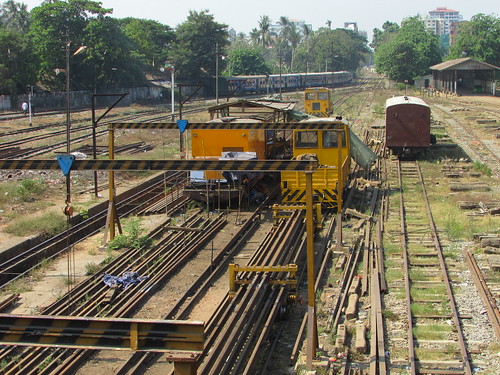 Circle Line, Yangon: The Rail Welding Yard at Kyee Myin Daing. In the background, Bo-Bo-Bo DF 1263 leaves the station with a Down train for Yangon.
Kyee Myin Daing South Signal Cabin
During my perambulation on 6th May 2016, I was fortunate enough to be invited into Kyee Myin Daing South Signal Cabin, revealing additional information and producing the album Kyee Myin Daing South Signal Cabin.
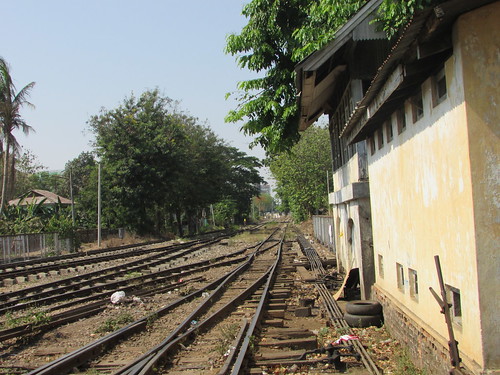 Kyee Myin Daing South Signal Cabin, with the Relay Room in the foreground, looking towards Yangon Central. The running lines are (L-R) Down, Up, Dock Branch.
The low base structure forming the locking room is brick with arched panels cemented over for protection. The operating floor has windows on three sides and a corrugated iron roof, lined on the inside. Access is via a short wooden flight of steps to the rear. Footwear is not worn inside the cabin. The operating floor has a 48-lever mechanical frame fitted so that the signalmen face the tracks to operate the frame which is marked 'W B & S S Co Ltd' for Westinghouse Brake and Saxby Signal Company Limited. This is the name adopted in 1920 when Westinghouse absorbed a number of signal companies, including Saxby and Farmer India. Lever colours are generally as British practice:-
Points: Black
Facing Point Locks and Locking Bars: Blue
Stop Signals: Red
Spare: White
All levers have an identifications plate with the lever number, function and 'pulls' painted on in English. However, they were not all legible.
I discovered that there is electro-mechanical Control between the two signal cabins at Kyee Myin Daing on the five through roads (Down, Up, Reversible Loop and two Reversible Goods Loops). At Kyee Myin Daing South Signal Cabin, levers 1 to 5 are painted Yellow and are used as 'Acceptance Levers', in conjunction with electric lever locks and circuit controllers at both the South Cabin and North Cabin to provide the necessary control.
A substantial framework made from U-section steel is fitted behind the frame and this carries electric lever locks and circuit controllers.
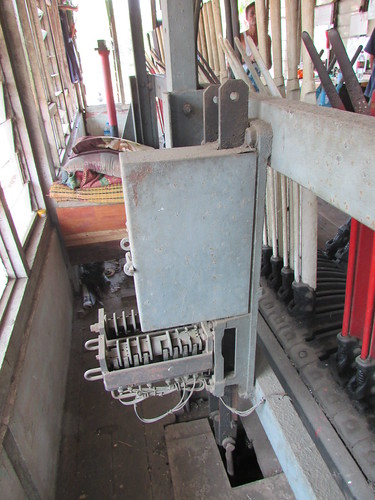
The U-section frame carries Lever Locks and Circuit Controllers.
The cabin controls five colour light signals on the Down, Up and Reversible Loop lines. These signals, and the status of the associated (mechanically operated) points are shown on an illuminated track diagram of the mosaic pattern. The illuminated track diagram does not show the semaphore signals on the goods lines but these are detailed on an old-fashioned framed signal box diagram in Burmese. The colour light Up Home signal controls 4 routes (L-R: Goods Line 6, Goods Line 5, Reversible Loop Line 4, Up Line 3). The signal has an unusual route indicator comprising five stencil indicators mounted together to form a horizontal bar which displays an (Arabic) numberal for the line number. In the signal box, four indicator units mounted on a column behind the frame confirm the line number displated to the signalman.
 The colour light Up Home signal controls 4 routes (L-R: Goods Line 6, Goods Line 5, Reversible Loop Line 4, Up Line 3) displayed by an unusual route indicator comprising five stencil indicators mounted together to form a horizontal bar.
The adjacent single storey building is divided into a messroom and a locked section, assumed to be the relay room.
Note that the Down Main is designated Line 1 and the adjacent Up Main Line 3. There is space for a through line 2, not provided, but I've not determined whether it was removed or never installed. Certainly, there are Spare (White) levers in the frame which could have been associated with a through line.
Related posts in this blog
The Circle Line, Yangon (2008).
Exploring Yangon's railways.
Railway Signalling in Burma - Part 1: Semaphore Signals.
Railway Signalling in Burma - Part 2: Colour Light Signals & Motor Points.
Railway Signalling in Burma - Part 3: Control of Trains.
Railway Signalling in Burma - Part 4: Manual Control of Points and Interlocking.
Railway Signalling in Burma - Part 5: Signal Boxes with Interlocking Frames.
Railway Signalling in Burma - Part 6: Signal Boxes with Electrical Interlocking.
Yangon Area Railways
All my Myanma Railways posts.
My Pictures
Kyee Myin Daing.
Kyee Myin Daing South Signal Cabin.
Yangon to Insein by Train.
Cab Ride on the Circle Line (2014).
The Circle Line, Yangon (2013).
Circle Line Revisited (2012).
The Circle Line by DMU.
The Circle Line, Yangon, Myanmar (2009).
Burma: Colour Light Signals & Motor Points.
Yangon Central Station.
Railways in Myanmar (2008).
All my Myanma Railways Pictures.
Introduction
It has to be admitted that Myanmar's railways, whilst having a certain charm, are very run-down by western standards - slow, dirty, unreliable. This is true of much of the infrastructure in a country which was, until recently, regarded as a 'pariah state'.
This situation is starting to change - for instance, the Japan International Co-operation Agency (JICA) is heavily involved in the necessary modernisation of the railway system. The JICA website, referring to work in Myanmar, says "a proposed multi-million dollar project will upgrade the maintenance and safety of railroad infrastructure, most of it dating from the pre-World War 11 British colonial era".
In May 2014, JICA held seminars in both Yangon and Naypyidaw to present the proposed Yangon Urban Transport Master Plan. The JICA report on the seminars is here.
Development of Railways in Myanmar
Rail transport was first introduced in Myanmar in May 1877 (when Lower Burma was a British colony) with the opening of the 163-mile (262 km) Yangon to Pyay line by The Irrawaddy Valley State Railway. At Yangon, it terminated at a station at Kyee Myin Daing, now a through station on the Circle Line.
The impressive station building at Kyee Myin Daing.
In 1884, the Sittang Valley State Railway opened a 166-mile (267 km) line from Yangon via Bago along the Sittaung River to the town of Taungoo. The Third Anglo-Burmese War of 1885 resulted in the annexation of Upper Burma and by 1889 the British had extended the Taungoo line to the former capital of Upper Burma, Mandalay.
Next, the Mu Valley State Railway began construction of a line from Sagaing (near Mandalay) to Myitkyina, in the north. Mandalay was connected to Shwebo in 1891, to Wuntho in 1893, to Katha in 1895 and to Myitkyina in 1898.
In 1896, the three companies were combined into a state owned public undertaking called the Burma Railway Company (from 1928 called Burma Railways and, in 1989, the name 'Myanma Railways' was adopted.
The railway served the Taninthayi coast in the south from 1907 with the opening of the Bago-Mottama line. Then, passengers had to take a ferry over the Thanlwin River (Salween River) to reach Mawlamyine but a bridge is now provided.
Myanma Railways has planned an ambitious programme to significantly expand the network, as outlined in their presentation here.
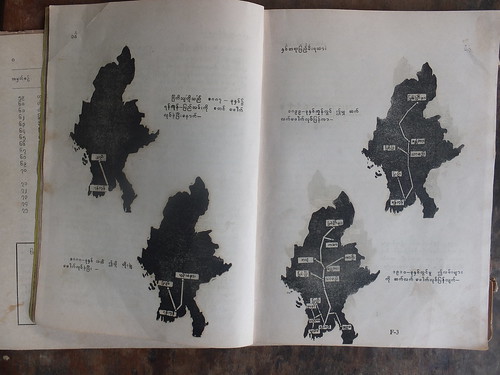 Stages in network development (from book reference [1]).
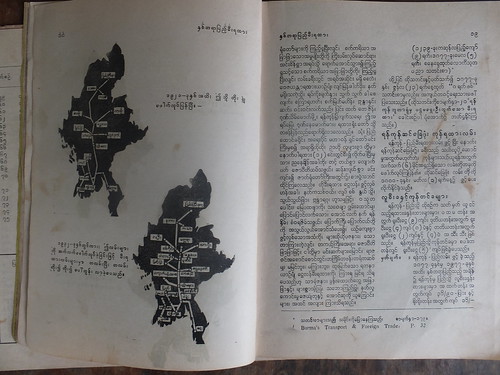 More stages in network development (from book reference [1]).
Yangon and the Circle Line
Yangon, although no longer the capital of Myanmar (that honour now reposes with Naypyidaw), remains the transport hub of Myanmar. There's no Metro system around Yangon (although an 8 km tram route has opened, as I report here, so public travel around the sprawling city area with its population in excess of 5 million currently relies on battered buses or, until recently, fairly battered and rather slow trains on the busy 30-mile long Circle Line and a network of suburban branches. Refurbished second-hand diesel multiple units cascaded from Japan have now been introduced which provide a significant increase in comfort and, with driver-controlled power-operated doors, enhance safety.

A refurbished second-hand Japanese-built Diesel Multiple Unit on a Circle Line service in 2016.
Yangon Central Station, as its name implies, has a prime location in the city and is always a good place to observe railway operations. The station is on the 30-mile long double track circular railway, logically called the Circle Line. During the day, trains depart from regularly from Yangon Central, making a 3-hour clockwise trip around the Circle Line back to Yangon Central. There is also a regular anti-clockwise service. The Japanese Diesel Multiple Units mentioned above now seem to be operating most of these trains. Other trains only make a partial circuit before returning to Yangon, for instance the Yangon - Insein service which, in 2016 was still locomotive-hauled.
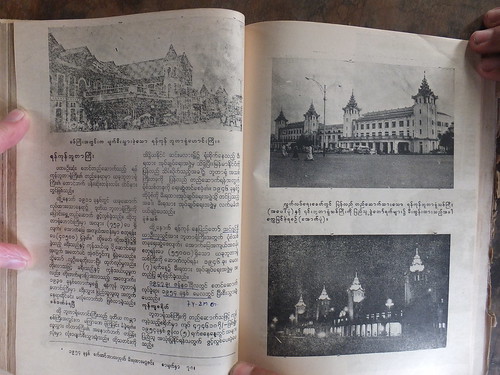 Left: The original station buildings at Yangon Central Station, damaged in WWII. Right upper: The post-war station in 'Burmese style'. Right lower: The post-war station at night (all from book reference [1]).
Book references
[1] '100 years of Burma Railways 1877 - 1977' (in Burmese) published by Burma Railways 1977.
Related posts on this site
All my Myanma Railways posts.
Related posts on other sites
Myanma Railways presentation.
Myanmar Railways (Wikipedia).
My Pictures
All my Myanma Railways Pictures.
Events of Friday, 6th May 2016
One advantage of the Park Royal is that it's only about ten minutes walk from Yangon Central Railway Station. I'd hoped it might be possible to go on the suburban line towards Thilawa but the hotel didn't think that would be possible because of the sparse service, which I suspected might be the case, so instead I decided to take the Circle Line clockwise as far as Kyee Myin Daing (which was the terminus of the first railway in Burma) and do some railway exploring. Then, if not too tired, I would proceed further clockwise to Insein for more exploring before returning to Yangon by an anti-clockwise Circle Line train.
I left the hotel at about 8.00 a.m. and made the trips and explorations as planned. With my interest in railway signalling, the high point of an enjoyable (but hot) morning was managing to get invited into Kyee Myin Daing South Signal Cabin, with its elderly Westinghouse mechanical lever frame. There's a post about my visit to Kyee Myin Daing here.
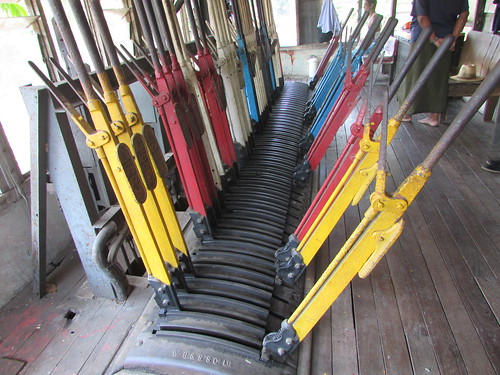 Mechanical lever frame at Kyee Myin Daing South Signal Cabin.
It wasn't just about railways - travelling on the train in Myanmar is an splendid was of 'people watching' and learning a little about the lives of Myanmar people.
It was around 1.00 p.m. when I returned to the hotel and, in view of the long journey back to England which would start early the following day, I decided to stay in the hotel for the rest of Friday, using the internet.
Related posts
This is currently the last post describing this trip.
All my posts on this trip can be found here.
My pictures
Yangon to Insein by Train (mainly railway technical pictures but with some 'general' shots).
Kyee Myin Daing South Signal Cabin.
There are also pictures of this trip here.
More pictures will be posted as soon as possible.
[Link to pictures 'Yangon to Insein by Train' added 7-May-2016]
Events of Thursday, 5th May 2016
Kalaw Hill Lodge offer various 'Activities' around their extensive site and I went on the Nature Walk starting at 7.30 a.m. It was just me and a pleasant young lady from their 'Operations Department'. We walked down steps, went through their organic garden to the lowest point of their estate, with an attractive brown stream running through. We came to a small field where a buffalo and its handler were demonstrating harrowing. We then climbed the hill at the rear of the site where there was a 'tame village' of two or three typical houses where the occupants live in traditional ways. I normally disapprove of this sort of slightly 'synthetic' experience but it was well done and I enjoyed the activity.
In the cowshed, the farmer demonstrated hand milking a cow but, despite carefully observing the farmer's technique my own attempt at milking was an abject failure.
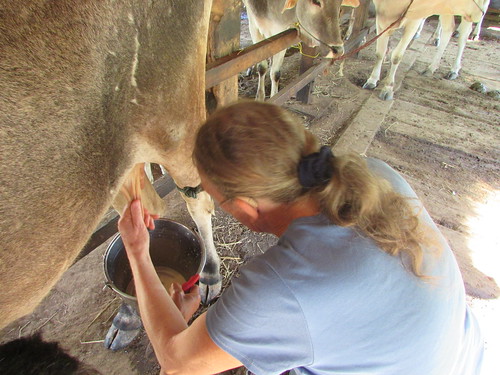 Jan's attempt at milking was an abject failure.
We were then offered a cup of 'Organic Milk', served hot presumably to pasteurise it. Then it was a gentle walk back to the main building where my breakfast was promptly served. Finally, I enjoyed a 15-minute ride in a traditional ox cart, looping out of the lodge grounds and back in again.
 The ox cart ride.
By the time I'd finished my packing, it was 10 o'clock and Sai Kyaw Kyaw had arrived with the car to show me around Kalaw before taking me to Heho airport for an afternoon flight back to Yangon, where I was booked into the Park Royal Hotel for my last two nights in Myanmar.
Related posts
Next post describing this trip.
All my posts on this trip can be found here.
My pictures
Activities at Kalaw Hill Lodge.
There are also pictures of this trip here.
More pictures will be posted as soon as possible.
Thazi is an important station on the Yangon to Mandalay main line which is now mainly (if not completely) double track with left-hand running. With few constraints on space when built, the track layout is spacious and five through platforms, plus a bay facing south, are provided. The main station building is on the west side, adjacent to platform 1.
Thazi is the junction for the steeply-grade branch to Kalaw and Yaksauk which includes two zig-zag sections so it was logical to provide motive power for this branch from a locomotive depot at Thazi. Originally, of course, this was a steam shed and home to some of Burma Railways massive Beyer Garratts. What is now a Diesel Locomotive Depot is just north of the station on the west side. I found one of the Beyer Garratts (running number GC833, Beyer Peacock works number 7128 of 1943) set aside at Thazi, externally complete cosmetically and repainted (16.07.2006) but with quite a lot missing. There was also an outside cylinder six-coupled side tank, carrying running number S.1, plinthed on the approach to the depot.
I wasn’t able to check the diesel shed itself but I could see at least four Bo-Bo-Bo diesel electric locomotives (including DF.2013) variously built in either France or China plus an unidentified light railcar. Near the station. I passed Railway Gang Cars ED/RGC-62 and ED(M) RGC.29.
A relic of steam days was the two massive round water tanks mounted on steel-framed towers, at the south of the station on the west side near a covered shed where carriage maintenance was being carried out. Two out-of-use water columns for steam locomotives survive.
Overhead water supplies are found at many stations on Myanma Railways for replenishing lavatory tanks of passenger coaches. At Thazi, these were provided on a number of platforms but delivery nozzles were only fitted on platform 1.
Another commonly-found feature was the fence between platform 1 line and platform 2 line, to prevent too indiscrimate crossing of the lines by passengers. Crossing the line is still the norm and, as usual, the fence was provided with an opening opposite the entrance from the main station building which most passengers choose to use, although Thazi also has a substantial steel footbridge linking the three platform groups [1], [2, 3 and Bay], [4,5]. No fencing was provided across the other tracks so people, dogs and goats were free to cross the lines anywhere. My railway training forced me to look both ways before crossing any line, but I’ve seen scant evidence that local people give any thought to the possibility of moving trains when crossing railway lines.
Just to the north of the elderly footbridge, there was a more modern reinforced concrete bridge structure, carrying a group of buildings topped by what was presumably the signal box with outward-leaning windows like the control tower of an airfield.
The signalling at Thazi is all-electric, with two aspect running signals and, in most cases, a subsidiary aspect of two diagonal white lights is provided. Where ground level shunting signals are provided, these have three lights providing two aspects. I didn’t identify the point machines but, in places, tubular point rodding allows one machine to operate two switches. At strategic locations, small Location Cases are provided for equipment. Track bonding, as you would expect, suggests continuous track circuiting in the station area. The installation was generally similar to those found in the Mandalay area. I was amused that, in each direction on the main line, fixed distant signals are provided but they are semaphore signals without lighting of the rather crude (and variable) pattern found everywhere in Myanmar.
Immediately south of the station, the main road through Thazi crosses the railway at a conventional level crossing, manned by a Crossing Keeper operating manual gates.
Whilst I was taking pictures, I saw Shunting locomotive DD.510 (built by Kawasaki) shut down just north of the station on platform 5 road, carefully placed in the shade of a large tree between the running lines. After a few minutes, the crew got on, started the engine and shunted light engine, disappearing (I think) to the Locomotive Shed. There's a little more information on this class of 500 h.p. diesel hydraulic locomotives in the post
Diesel Traction in Burma.
To the east of the station there were a number of parallel stabling tracks, accessible from both ends, with a variety of goods rolling stock. Two roads were provided with pits and a roof over part of their length, I imagine for passenger coach examinations but there were only petrol tank wagons there at the time of my visit.
The station building on platform 2-3 was a rather British-looking affair, brick built with a tiled roof. Amongst other offices, there was a Station Supervisors Office and a Radio Room. Beyond the building, substantial steel-framed umbrella roofing was provided.
To be continued ...
Related Posts
You can find all my posts on Myanma Railways here.
My pictures
Thazi Locomotive Depot
Thazi Station
All my pictures of Railways in Burma are here.
Introduction
I stayed the night of 3rd May 2016 in Thazi because I wanted to travel on the morning train from Thazi to Kalaw (did I mention my interest in railways?).
The line was built by the British to improve communication with the town of Kalaw, high in the mountains of Shan State and beyond.
As in India, the British found summer heat in the cities on the plains insufferable and they established 'Hill Stations' up in the mountains where temperatures were lower and the climate rather more like England. Probably the best known of the Indian Hill Stations is Shimla, which I visited in 2006 as part of my Round The World Three trip.
The Bitish developed two locations in Burma - Maymyo (now called Pyin-Oo-Lwin) and Kalaw.
I first visited Maymyo in 2009 (described in the post Day trip to Maymyo). The British built a railway linking Mandalay, very little above sea level with Maymyo at an elevation of around 3,506 feet. To allow steam locomotives to work the line, a variety of civil engineering techniques had to be adopted, most unusual of which was the 'Zig Zag' where the train shuffles forwards and backwards over a 'Z' shaped route, gaining height all the time. I travelled on the line to Maymyo in 2013 (there's a non technical report of the trip here or a more technical post here.
Building the branch from Thazi to Kalaw involved similar engineering problems - the line had to rise from Thazi's modest elevation of 700 feet to 4,297 feet at Kalaw and its design incorporated two 'Zig Zags'. Once upon a time huge British-built steam locomotives blasted their way up to Kalaw and beyond but the present-day trains are hauled by a mixture of French- and Chinese-built 2,000 h.p. diesel electric locomotives.
Events of Wednesday, 4th May 2016
The proprietor of the Moon Light Guest House took me by car to the station, where we had a simple breakfast at the inevitable tea shop, purchased the train ticket and installed me in the correct place on the romantic-sounding 7.00 a.m. Mail Train. The actual train was a little more commonplace but, to my surprise, it left at exactly 7.00 a.m. and, in a little under six hours, delivered me safely to Kalaw. I've started to describe this journey in more detail here but I'm afraid this article includes quite a bit of railway technical stuff.
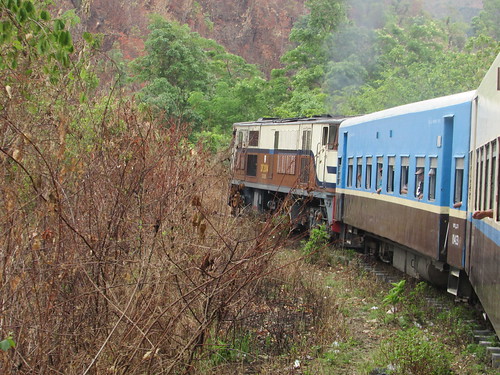 On the Mail Train to Kalaw.
At Kalaw, I was immediately recognised by my guide, Sai Kyaw Kyaw (there weren't many elderly female foreigners on the train) who took me by car to Kalaw Hill Lodge, a little way out of the town, where I was to spend one night. I was charmed by the resort, opened only seven months previously by its Nepalese owner with a number of thatched villas in Nepalese style and a central building with reception, restaurant and bar facilities on a landscaped site of some 30 acres with magnificent views of the hills which frame Kalaw. I managed some internet work in the lobby then had a meal and retired to my comfortable cottage. The cottage appeared semi-detached but the building actually had four rooms, two on an upper floor approached from the other side of the block. But, being low season, I only glimpsed two other guests in the whole of my stay, although there were always a number of staff close by anxious to help. There was a fairly spectacular display of thunder and lightning in the evening, but the rain that followed was fairly light and I had already retired to my room for the night.
I enjoyed an excellent night's sleep.
 Kalaw Hill Lodge viewed from the extensive grounds.
Related posts
Next post describing this trip.
All my posts on this trip can be found here.
My pictures
My pictures of the train journey from Thazi to Kalaw are here. They are mainly railway technical shots but there are also 'general' pictures.
All my pictures taken on my trip to Burma in 2016 are in the collection Burma, 2016.
Events of Tuesday, 3rd May 2016
I had breakfast at the Aye Yar Resort and checked-out at 8.00 a.m. The monastery car picked me up with the usual driver, together with one of my other young friens from Clinic. We drove via the Anawratha Road to a pagoda famous for its wall paintings, Gu-Byauk-gyi, I think. Although the souvenir sellers were starting to set up their wares, it was still quiet. My friend said most guides take their clients to Nyaung Oo market first and that it would become busy later. We continued to Nyaung Oo and took the familiar road out of town, past the airport turn, then the railway station turn. I think Nyaung Oo is unique in having an airport nearer the town than the railway station. We carried on along the main road we’d used the day before, through Taung Zin.
The crumpled caldera of volcanic Mount Popa was visible through the haze on the left. Our route started to rise out of the plain so that we were travelling through wooded mountains. The area appeared to be the source of rock, with large piles of graded sizes which I assumed were for roadbuilding. There were also two new electricity transmission routes, one low voltage, one medium voltage, being erected. We passed a number of areas where minor improvemnts were being carried out to the road. As is usual, most of the labourers were women. Barrels of tar were being prepared for use by having a fire set under them but I also spotted a couple of ancient, wheeled tar boilers. We passed through a series of fairly small one-street villages, with a variety of stalls on both sides of the road and, of course, a profusion of tea shops.
We then entered a fairly major town with proper shops, rather than stalls, and a couple of impressive-looking modern bank buildings. There were at least two sets of modern traffic lights with countdown-timers. Providing the contrast at which Myanmar excels, there were also oxen grazing on the patches of sparse grass. As we threaded our way onto our road, I noted not just the number of teashops but also their large size.
We passed through another area of farmed land populated by pairs of oxen ploughing or hauling carts before we entered another fairly large town, Meiktila with its lake. We parked near the bridge which takes the road across an arm of the lake. I walked along a rather rickety bridge thrust into the lake leading to a very small pagoda.
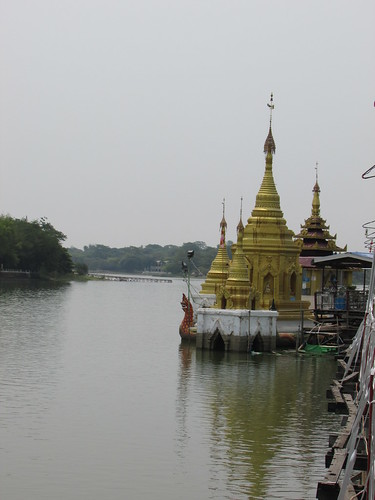
Meiktila Lake Pagoda.
The lake water was clear and lots of fish, carp I think, could be seen. Walking back to the car, I spotted a wooden pumphouse extracting water from the lake. As we drove over the road bridge, we passed a huge, gilded ‘concrete barge’ with a bird's head at the edge of the lake, apparently another temple.
On our way out of town, we passed a massive, walled factory with a least 20 large sheds. A sign in English as well as Burmese revealed that this was Meiktila textile works.
Before long, we were running into Thazi, with one main road running through and a network of generally unmetalled side-streets. We easily located the Moon Light Guest House and I was made very welcome by the proprietors.
My friends who had delivered me safely to Thazi agreed to act as interpreters at the Diesel Locomotive Depot, where I had been given two Inspectors names as contacts. Unfortunately, they were both absent that day, but I was allowed to take a few pictures before we left. Having returned me to my hotel, my friends declined hospitality and set off back to Bagan.
Although it was rather hot, I decided to go for a walk along the main road to see a little more of the town, which I believe has a population of around 30,000. I passed a rather smart modern fire station with four appliances near the Police Station for Thazi Township. Both KBZ Bank and CB Bank had impressive modern buildings. Having got used to seeing pairs of oxen doing the ploughing and pulling, I was surprised to see two modern farm tractors pass along the main road. I found it reassuring, somehow, that most of the 'taxis' were horse-drawn 2-wheeled 'hackney cabs'. After exploring the main road, I took the side road leading to the station to make a photographic survey. By the time I was back at the Guest House, I was thoroughly exhausted but a cold drink followed by a nap restored me sufficiently to prepare this report.
Then I broke off for an evening meal, which was prepared exactly to my preferences and was excellent.
Related posts
There's a report on my visit to Thazi Locomotive Depot and Station here.
Next post describing this trip.
All my posts on this trip can be found here.
My pictures
There are a few pictures of this trip here.
Pictures at Meiktila Lake are here.
More pictures will be posted as soon as possible.
Events of Sunday, 1st May 2016
On Sunday, I walked to the Clinic just after 8.00 a.m. The Doctor had already started work and he hold me that there had been 60 registrations at that time.
I'll describe my morning observing Dr. Hla Tun's consultations in a separate post.
A startling storm
There was a vicious thunderstorm around lunchtime and the electricity went off. The rain was very heavy for a while. The Clinic have some sort of standby generator (I didn't discover details) but they didn't use it - they just carried on using battery lighting until power was restored, after around an hour. The temperature was much more comfortable after the rain, most of which dried up quickly. I took the opportunity to leave the clinic and walk to the hotel with a view to exploring on foot. But the temperature was rapidly rising again, so when a middle-aged guy on a motor cycle offered a boat ride, I entered into negotiations.
A relaxing cruise on the Ayeyarwaddy
Briefly, we made a deal and I had a splendid cruise lasting one hour on his longtail boat with a roof which could have carried a couple of dozen tourists rather than one. We went up river almost to the Swezigon Pagoda before returning to the shore close to my hotel (I say 'shore' because there's no actual jetty but if you're lucky - I was - you keep your feet dry. It was late afternoon when we returned - a good time to watch the activities of the local people, many carrying out ablutions and clothes washing.
Related posts
Next post describing this trip.
All my posts on this trip can be found here.
My pictures
There are a few pictures of this trip here.
More pictures will be posted as soon as possible.
Disclaimer
Judged by Western standards, my reporting at the Clinic may seem intrusive, with access to the Doctor's Consulting Room during diagnosis and procedures and with photographs made freely available. But ideas of personal privacy have not developed in the same way in Burma and Dr. Hla Tun believes that those interested in the work should understand the problems of medical care in Myanmar, in general so different from the Western world.
In my observations, I try to better understand the working of Myanmar Society, developed over centuries, and give others a small insight into the lives of these admirable people who moved me to try to make some small attempt at offering support. Misinterpretations of what I see may occur and are, of course, my responsibility.
General
Myanmar is a large country with, by Western standards, relatively poor internal communications (although the growth of internal air transport over the last few years has been impressive). Although the Bagan Clinic was conceived as a local clinic, the reputation it has earned means that it now attracts patients from a wide area, despite the problems of travelling long distances.This also introduces problems of language, because people from Myanmar are highly diverse, as discussed in 'Ethnic groups in Myanmar' below.
The Clinic now charges a flat fee of 10,000 Kyat (around 10 U.S. Dollars) for a consulation but this is frequently waived because of the widespread poverty of patients. The fee includes all medication supplied and, where required, blood tests and E.C.G. carried out by the Clinic's laboratory.
Patient Notes
As is customary in Myanmar, patient notes are entered in a specially-produced notebook with the clinic details printed on the cover and the patient's name and address written in spaces provided for the purpose. These notebooks become the patient's property and are taken away by the patient, with any relevant test results or E.C.G. printouts tucked inside. It's fairly common for patients to bring similar patient notes issued by other clinics consulted previously. Orthopaedic patients often bring X-rays taken at other clinics. All of this patient history will be carefully studied by the Doctor during the consultation.
Medication
Details of medicines prescribed are entered in the patient notes. Some drugs are taken from a stock in Doctor Hla Tun's consulting room but, more generally, the patient will take their notes to the Dispensary which forms part of the original clinic building where the prescribed medication will be issued.
Doctor Hla Tun's consulting room
There is little privacy in the Doctor's consulting room - it is more like a general ward. Three examination couches are permanently occupied and the Doctor moves between them. If he prescribes various injections, these are generally administered by his two female assistants and, in the meantime, the Doctor will move to the next patient or update patient notes. In addition, mothers with young children are frequently seated adjacent to the Doctor's desk, making a fourth patient, and patients with just-completed tests will also wait at the Doctor's desk for him to review the results. Many patients also have a friend or relative with them in the consulting room so, together with Clinic staff frequently entering with information or questions for the Doctor, it can be quite crowded at times. Somehow, Doctor Hla Tun keeps track of all this activity, radiating quiet confidence.
Individual stories
On Saturday, there was a party of 9 patients from Shan State. They spoke a different dialect so the Doctor needed to use somebody with knowledge of standard Myanmar language and Shan dialect as an interpreter. The group had set-off by road in a hired pick-up at 6.00 p.m. Friday and arrived at the Clinic compound at 3.00 a.m. Saturday morning. The Driver of the pick-up charged each of them the equivalent of 35 U.S. Dollars.
One of these Shan patients was a large man from the Shan Hills with poor mobility following a stroke. It required two strong young men to help him to the examination couch whereas before he would regularly walk 14 miles to the nearest town. The Doctor aspirated fluid from the knee joints and gave a number of injections for pain relief. He also suggested a number of exercises to help strengthen weakened muscles.
I'll outline some other cases later.
Ethnic groups in Myanmar
The Myanmar Government recognises 135 distinct ethnic groups of which the major groupings are:-
Bamar
Chin
Kachin
Kayin
Kayar
Mon
Rakhine
Shan
For more information, refer to the Wikipedia Article.
Related posts
All my posts on this trip can be found here.
My pictures
There are a few pictures of this trip here.
More pictures will be posted as soon as possible.
Events of Saturday, 30th April 2016
I was booked into the Aye Yar River View Resort for our four days in Bagan. For me, this location has two particular attractions. Firstly, the 'River View Rooms' are literally that. They are built on the east bank of the Ayeyarwaddy River (but at a higher level) with only a narrow strip, a hedge and asandy track between the base of the hotel building and the river with a variety of moored boats visible. It can be noisy at times - most of the smaller 'longtail' boats are propelled by raucous Chinese-built single-cylinder diesel engines which kick up quite a racket and the powerful tug-boats which power the barge traffic have large, loud marine diesels. But if, like me, you're an incurable romantic, it gives a connection with "The beating Heart of Burma" and, I noticed this time, the hotel provides disposable ear plugs. The second attraction is that the hotel is within walking distance of the Bagan Medical Clinic via a network of dusty, unsealed roads quite busy with pedestrian and motor cycle traffic. The walk takes ten or twenty minutes, depending how fast you walk and how impervious to sun you are (I'm not very good on either count any longer). However, Doctor Hla Tun usually insists on my using the monastery car for the commute.
The car picked me up, as arranged, at 8.30 a.m. and by the time I arrived at the Clinic, Doctor Hla Tun had already started consulations. The Clinic was noticeably busier than the previous day and I think the total patient registrations for the day exceeded 200.
Doctor Hla Tun introduced me to the lady opthalmologist who now conducts eye tests at the Clinic on a every other Saturday and I was able to watch her at work. Later I discovered that in the week, she works in Chaulk Hospital.
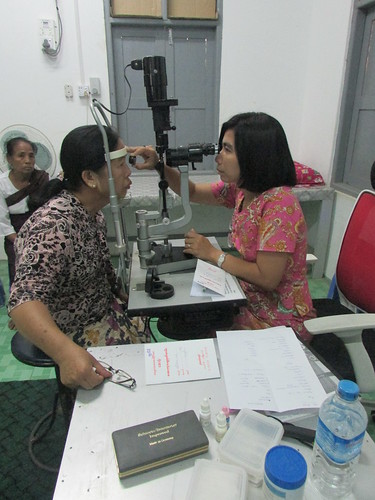
The lady Opthalmologist at Bagan Medical Clinic.
I'll describe my morning observing Dr. Hla Tun's consultations in a separate post.
Doctor Hla Tun asked if I had visited the famous monastery at Salay (sometimes transliterated as 'Sale'). As I had not, he arranged what turned out to be a fascinating trip for the afternoon. We set off in the monastery car with the young monk in the front passenger seat and the lady opthamologist and I in the rear.
We left Bagan heading south, passing first through the village of Myinkaba and then through a rather modern area called 'New Bagan'. We kept going firstly through the familiar landscape of the Bagan Plain but then becoming very undulating and, to my surprise, I spotted a number of four-legged steel oil derricks dotted around.
Chaulk Oilfield
I knew that Burma was an early producer of mineral oils but I had no idea that the Chaulk Oilfield (the name is sometimes transliterated with an 'l', sometimes without)was on our route, still less that it still produced useful amounts of oil.
The first derricks we saw were exactly as you see in old pictures but later we encountered a much simpler design which appeared to comprise a tripod of three wooden poles with simple wooden horizontal bracing. Where derricks were close to the road, I saw traditional 'nodding donkey' oil well pumps lazily extracting 'black gold' from the bore hole and delivering the oil through a flexible pipe to some unseen collection point. A network of overhead electric distribution systems, some appearing quite elderly, criss-crossed the skyline, carrying power to the numerous electric well pumps. I saw a reference to Well number 1118! Myanmar Oil and Gas Enterprise (MOGE) lists the Chauk Oilfield as having been discovered in 1902 and still producing. There's an MOGE slideshow here and a Wikipedia article here
Near Chaulk town I saw a large farm of oil storage tanks and, further south, a single pipeline apparently lying on the ground ran parallel to the road. After a few miles, we came to an industrial complex which I assumed (principally from a series of 'flare stacks') was an elderly and relatively small-scale oil refinery.
Salay
The town of Salay is famous for its 'Yoke-Sone-Kyaung' monastery with its spectacular woodcarvings now in the care of the Department of Archaeology & National Museum. Built entirely of wood, and crammed with various artefacts, I found it a fascinating place. As I explored the gloomy rooms, thunder and lightning was followed by torrential tropical rain, sending the attendants scurrying to close the top-hinged 'doors' which formed the sides of the building. The storm was short-lived and it was dry as I returned to the monastery car.
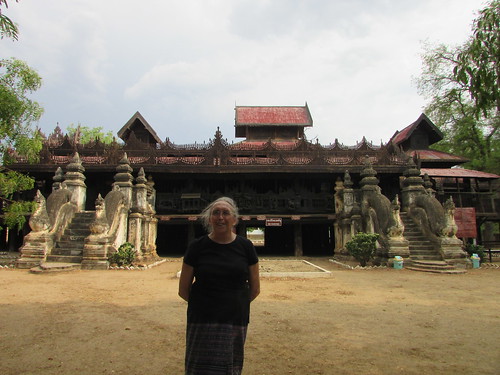 Jan at Salay Monastery.
Sarkjouhla Pagoda
We then drove a few miles to the venerated temple of Sarkjouhla, dating back to 1191 A.D. Having explored the various elements of the complex, we headed back north.
Back to Bagan
We dropped the Opthalmolgist at her home in Chaulk before completing the journey back to Bagan Medical Clinic. Tired by the journey, it wasn't long before I accepted the offer of a car to my hotel. Doctor Hla Tun and his staff were working until midnight to finish treating the patients that day.
Related posts
Next post in this series.
All my posts on this trip can be found here.
My pictures
There are a few pictures of this trip here.
More pictures will be posted as soon as possible.
Introduction
I first visited Bagan in 2008, as just one destination on the trip Round the World Five.
The dusty Plain of Bagan has the remains of 2,000 pagodas, many over 1,000 years old. In the heyday of the city there were reputedly over 20,000 pagodas. The area never fails to impress even the most cynical. Ruination does not deter the local people from veneration of the sites and modern donors achieve Merit by 'restoring' the structures, using techniques which appall archaeolgists.
In the Afterword post to 'Round the World Five' I wrote "I was impressed with the charitable initiatives that the 'Road to Mandalay' ship is involved in covering education and medicine ... Kipling wrote "Burma is different from anywhere you have ever seen" and in his poem 'Road to Mandalay' he describes how the country draws you back. He was right - I intend to return to Myanmar". An accurate forecast, but I didn't realise how important a place of 'pilgrimage' the country would become to me - this is my tenth visit. Following later visits, I made contributions to various school projects (for instance, see the post about the opening of a new school building at Htee Pu here. Incidentally, 'Htee Pu' is rendered as 'Ti Pu' in early posts - the Romanisation of Burmese words is a very variable feast which leads to endless confusion.
The Doctor and the Abbot of Bagan Monastery had the ambition to build a small medical clinic at Bagan to serve the local population and, later, I also joined in this project. The opening ceremony in 2011 is described here but the growth in demand since has exceeded all expectations. There are a number of posts chronicling this growth here.
Events of Friday, 29th April 2016
Dr. Hla Tun is the Chief medical Officer of the Bagan Medical Centre, so is normally there on the clinic opening days of Friday, Saturday and Sunday each week. Since he was in Yangon on the previous day, this involved an early start so as to catch the 6.00 a.m. flight from Yangon to Nyaung Oo (Bagan), where the Monastery Car transferred him to the Clinic.
 Yangon Airport - 6.00 a.m.
An already-exhausted Jan accompanied him. We arrived at the Clinic around 8.00 a.m. and were soon met by the elderly, smiling Abbott who (like everyone else in Myanmar) always presses food upon me. We share not one word of each others language but seem to communicate well enough (with occasional outside help). I have great respect for this community leader who always seems concerned for the welfare of the local people.
After breakfast (I enjoyed a special rice congee but declined the chicken and fish), one of the Monks who has been involved with the daily running of the Clinic since its opening then showed the Doctor and I the building work in progress on the fourth, and largest, clinic building.
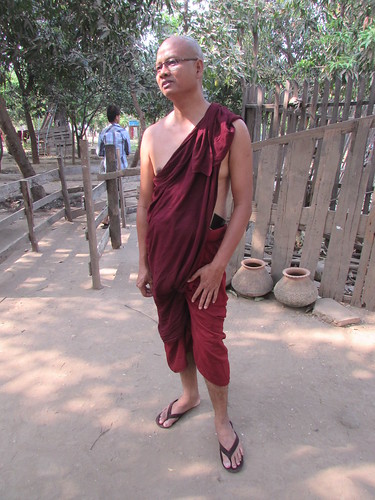
This young monk has been involved with the Clinic since its opening.
The latest building is of reinforced concrete construction provided with two floors and a flat roof accessible by stairs around which the builders were installing balustrading. The necessary sacks of cement were being carried up to the roof level balanced on the heads of three lady labourers who were also mixing the cement using long-handled shovels.
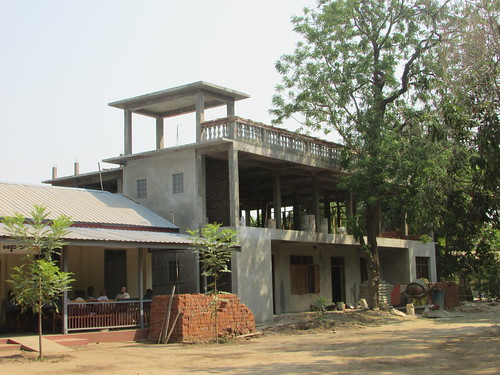 The 2-storey Clinic Building under construction at Bagan Medical Clinic.
It was a quiet day - only 80 patients had registered when Doctor Hla Tun started seeing patients at 9.00 a.m. Three other Doctors were also on duty - two young Doctors from Yangon on a Stanford programme who form part of a rota system and one regular, locally-based doctor. Howevever, by the time Doctor Hla Tun stopped for lunch at 2.00 p.m., the total number of patients has risen to 130, ensuring the customary late finish for Doctor Hla Tun who carries out all the more complicated procedures and diagnoses. I've described my observations in Dr. Hla Tun's consultation room in a separate post The Work of Bagan Medical Centre.
In the afternoon the Doctor had arranged the monastery car to take me to visit the Jetawun Monastic Education Center (their spelling) in Nyaung Oo.
Jetawun Monastic Education Centre
I'd known of this monastic school for some time, but this was my first visit. My friends at the Royal Burma Society in Great Britain have provided donations to the school and they suggested that I should try to visit during this trip
Because my visit coincided with the summer school holiday period in Myanmar, the school was not open but the monk who runs the school, Baddanta Ar Deik Sa, received me and showed me some of the extensive facilities.
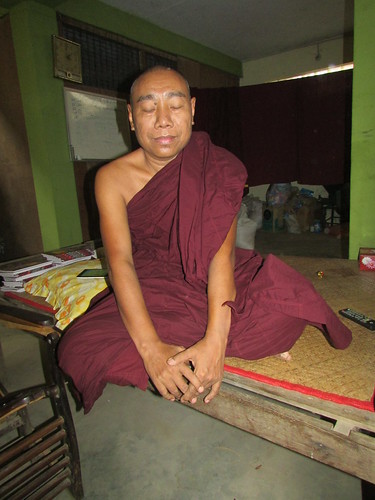
Baddanta Ar Delk Sa of the Jetawun Monastic Education Center, Nyaung Oo.
The Education Center was founded in 2006 and the growth in student numbers since then is notable:-
| Academic Year |
Number of Students |
| 2006-2007 |
46 |
| 2007-2008 |
120 |
| 2008-2009 |
203 |
| 2009-2010 |
270 |
| 2010-2011 |
330 |
| 2011-2012 |
370 |
| 2012-2013 |
375 |
| 2013-2014 |
380 |
| 2014-2015 |
376 |
| 2015-2016 |
380 |
Related posts
Next post in this series.
All my posts on this trip can be found here.
My pictures
Bagan Medical Clinic (day 1).
Bagan Medical Clinic: Construction of 2-storey Building.
Jetawun Monastic Education Center.
Thursday, 28th April 2016
Just a quick note to confirm I'm safely back in Yangon after an amazing six days touring a few of the Mergui Archipelago's 800 islands in the sailing vessel 'Meta IV' with six other passengers and four crew.
Length: 23.75 m
Breadth: 5.7 m
Draught: 2.85 m
Net tonnage: 35
Gross tonnage: 58
Fitted with a 195 kW Cummins diesel and single, reversible screw.
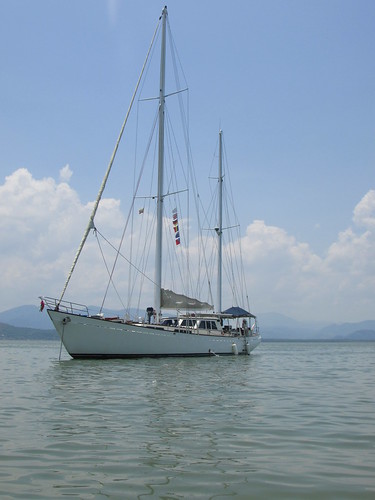
My home for six days - 'Meta IV'.
We sailed from Kawthaung on Saturday, 23rd April and anchored the first night off Ba Wel Island (along with a number of commercial fishing vessels).
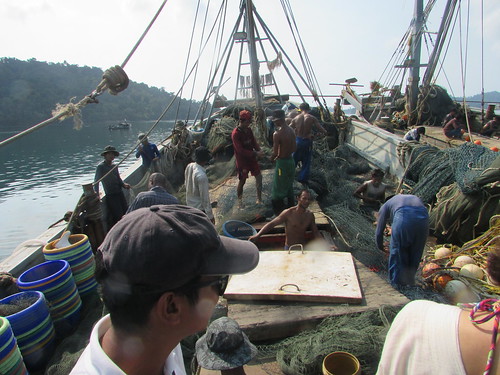 On board a moored fishing vessel at Ba Wel Island, Mergui Archipelago.
On Sunday, 24th April we visited the village on Nyaung Wee Island, went ashore at a small island (115) and anchored for the night off Nyaung Wee Island.
On Monday, 25th April we made visits to Lampi South River with its rich mangrove forests, small island (60) and anchored off Ko Phaar Island.
On Tuesday, 26th April we visited Kyunn Philar East, where we replenished the two fresh water tanks, anchoring off Kyunn Philar East.
On Wednesday, 27th April we visited Oh Way Island before anchoring off Ba Wel Island for our last night at sea.
Finally, on Thursday, 28th April, 'Meta IV' returned to Kawthaung.
Another early start tomorrow, as I fly north with the Doctor to Bagan. Whilst there, I hope I can write a little more.
Related posts
Next post describing this trip.
All my posts on this trip can be found here.
My pictures
There are some pictures around Kawthaung here.
Pictures leaving Kawthaung and sailing to Ba Wel Island on Saturday 23rd April are here.
There are a few pictures of the early part of this trip here.
More pictures will be posted as soon as possible.
[Links to pictures added 7-May-2016]
In the article Rangoon Tramways, I posted a brief introduction to the electric tram system which once served Rangoon.
Electric trams are once again running in Rangoon, now called Yangon, and on Thursday, 21st April 2016 I made my first trip on the new system. The line runs along Strand Road from War Dan (to the West, where the Depot is located) with stops at Maw Tin, Sint Ohe Dan, Pagoda Road, Pan So Dan, Bo Ta Htaung, terminating at Lansdown.
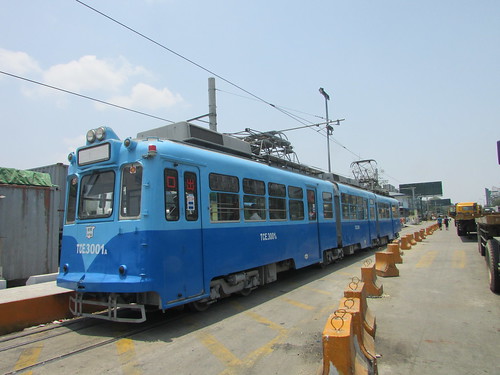
Tram TCE 3001 at the Lansdown (Eastern) terminus).
A modern overhead conductor system has been provided, apparently fed from a single sub-station at War Dan. An insulated feeder carried on the concrete supports allows the bare conductor to be parallel-fed at intervals.
The tramway is standard gauge, running on a single dual-gauge track which it shares with the metre-gauge line serving the goods depots along Strand Road. There are a few interesting dual gauge turnouts.
I took lots of pictures which you can find here. I'll add information on the rolling stockas soon as possible.
[Post time revised to place in sequence 1-May-2016: Link to pictures added 7-May-2016]
Events of Wednesday, 20th April 2016
In earlier posts, I've described three hectic days in Mon State. At the end of the third day, we took the overnight bus back to Yangon, where I again stayed at the Doctor's house.
Events of Thursday, 21st April 2016
The Doctor prescribed a day of recovery for me (it has been awfully hot) and, for once, I was happy to comply. But I did manage to try out Yangon's new electric tram - there's a brief report here.
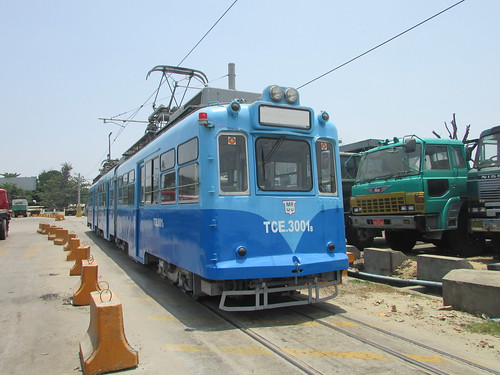 Tram TCE 3001 at the Lansdown (Eastern) terminus).
Events of Friday, 22nd April 2016
Early on Friday, Doctor Hla Tun left early to fly to Bagan Medical Clinic for the usual three days of consultations. On this occasion, I did not accompany him as the following day, I had arranged to spend a few days on a sailing boat. However, we had discovered that Aung Ko Latt (from Ko Dut in Mon State) had travelled to Yangon, so the Doctor had arranged for him to meet me.
Aung and I made a clockwise trip on the Circle Line together. No doubt a technical review will appear at some stage - The technical review can be found here.
The second-hand, Japanese-built Diesel Multiple Unit on which Aung and I made our Circle Line Trip.
On the way back to the Doctor's house, we made a stop at the Taw Winn Shopping Centre so that I could indulge my taste for reprinted old books about Burma written by the English.
I said 'good-bye' to Aung and prepared for another early start the following day, Saturday, 23rd April, when I was to fly south to Kawthaung to see a little of the far south of Burma.
Related posts
Next post describing this trip.
All my posts on this trip can be found here.
My pictures
Pictures of Yangon's new tram system are here.
Pictures of my trip on the Circle Line with Aung are here.
All my pictures on this trip are here.
[Link to Circle Line Pictures added 7-May-2016: Link to tram pictures added 11-May-2016: Link to technical review added 29-May-2016]
Events of Wednesday, 20th April 2016
Once again, we were up early and, having said goodbye to some of the young Ko Dut D.I.C. staff, we drove into the village with the D.I.C. manager for breakfast featuring rice noodles at a small lean-to roadside restaurant built outside the front wall of the owner's house. In the front yard of the house, a young girl was producing fresh noodles by squeezing the hot, cooked rice paste through a perforated plate, using a large set of 'pliers'. The Burmese value reliable, fresh sources of food. Fortified by breakfast, we said our final "good byes", left Ko Dut and headed back north. The Doctor had allowed time for us to visit the important pagoda built in the sea at Khaikhami Yele Paya since Myint and Mi Mi had not previously visited. I was once again reminded of my good fortune in having much better opportunities to see the country than most Burmese, since it was my fourth visit (I'd visited before in 2012 as described here and with Dr. Hla Tun in 2014 (as described in Last day in Mon State) and in 2015 (Visit to Mon State, Myanmar (Part 4). Although, as a non-Buddhist, it does not have the same resonance for me as for the many pilgrims I saw there, I never tire of being at this very special place.
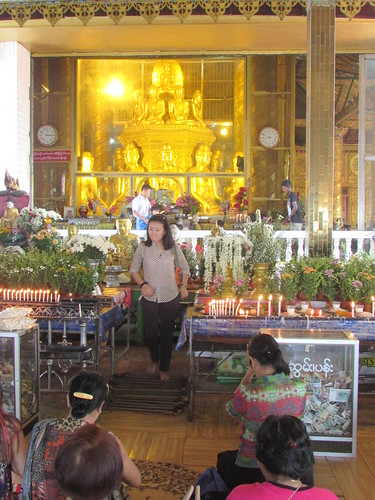
Mi Mi at Khaikhami Yele Paya.
We then continued north to Mawlamyine and the Drop In Centre at Hlaing, situated in a crowded and poor area just outside the centre of Mawlamyine. A number of collapsible shelters had been erected outside the D.I.C. building and over 300 children were seated under these shelters, waiting for us (there are over 400 children 'on the books' but there are various reasons why they are rarely all present at one time).
The 'Sky Net' television news team (cameraman and female presenter) were there and I was asked to do a short piece to camera in English. I doubt if it was used. But they then conducted an interview of over 5 minutes with Dr. Hla Tun and a similar interview with the Centre Manager.
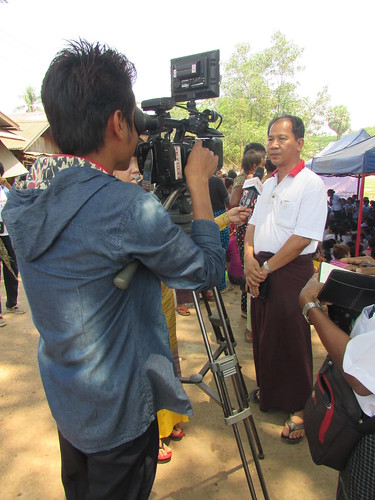
We know that these interviews were transmitted because, back in Yangon and by chance, we saw the latter part of the programme they'd made on national television.
At Hlaing, I also saw two newspaper journalists making copious notes and taking photographs. All the school uniforms and stationery had been put ready in the new school bags, year-by-year and separately for boys and girls. There were plenty of helpers to organise everything, so I found myself handing out the bags at high speed, wittering away in English, in the hope that it helped relax the children, some of whom were clearly over-awed by the occasion. The Doctor carried out the last 20 or so distributions as, by that time, I was perspiring freely.
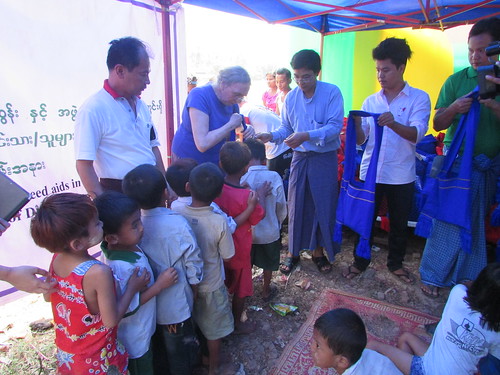 Jan helping with the distribution at Hlaing D.I.C.
The children changed into their uniforms inside the D.I.C., some of the younger ones with help from the staff, and then, back outside under the shelters, the Doctor made a speech of encouragement. Some of the shelters were removed to make it easier to made a 'Group Shot' before the children left.
Hlaing D.I.C. - The 'Group Shot'.
Back inside the D.I.C., the Doctor made some specific financial awards to support deserving children and a number of the D.I.C. volunteers. There are so many stories of dedication and determination. We were moved by the story of one young woman with excellent language skills who had given up her full-time job with 'Care' and now undertakes part-time work so that she can look after eleven orphans.
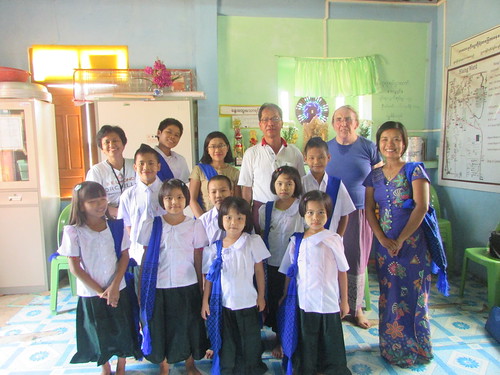 The young woman on the right now looks after 11 orphans in Mawlamyine.
After lunch at a cafe in Mawlamyine, we had one more distribution at the smaller centre of 'Future Generation', also in Hlaing.
Then it was back to the Care Centre in Malamyine we'd stopped at (briefly, on our first arrival) where there was time to 'shower' (Burmese-style) before another meal in Mawlamyine. Since it was a bit of a walk, I was offered a lift on a motor-cycle (pillion, side=-saddle) which included the southern end of Strand Road I'd not seen before. After the meal, I managed to walk to the Care Centre where the car took The Doctor, Myint, Mi Mi and the writer to the Bus Station so that we could catch the 8.30 p.m. bus back to Yangon.
Related posts
Next post describing this trip.
All my posts on this trip can be found here.
My pictures
Burma-2016.
More pictures will be posted as soon as possible.
[Post date amended to place in sequence: 1-May-2016]
Events of Tuesday, 19th April 2016
I was a little restored by morning but I knew it would be a tiring day making presentations to the children attending Ko Dut DIC. Children were supposed to arrive at 8.00 a.m. but by 6.30 a.m. we could hear the excited chatter of early arrivals.Once we let the children in, the ground floor was soon crowded and the Doctor and I started distributing snacks, a school bag, exercise books, pencils, a short plastic ruler and pens, together with new school uniforms for the coming year.
The event, to which the children always look forward, was made extra special by a visit from the fairly young head monk from the local Buddhist monastery. He made a short speech of encouragement to the children and, after chatting with me in excellent English, left to carry out other appointments.
Presently, we all moved outside for the now traditional 'Group Shot' before the children returned to their homes using a variety of means (pedal bicycle, motor cycle driven by adult, motor rickshaw, pick-up or walking), all proudly carrying the items they'd received.
 Ko Dut D.I.C. - The Group Shot.
The Doctor then had a meeting with the mainly female teachers and volunteers who run Ko Dut DIC.
We then drove to the smaller DIC at Lamine and repeated the performance. It might have been smaller, but our welcome was no less rousing and, as is customary, drinks, fruit and snacks were provided for the visitors. In addition to the distribution of school-related items, the Doctor made specific cash disbursements to alleviate hardship. It's sobering to note that a qualified teacher with up to 50 students may receive a salary of only 15 U.S. Dollars a month.
We drove to our last distribution of the day at another small DIC in the area. The benefits to these fairly remote country communities of the Drop In Centres should not be underestimated.
With the official business of the day complete, we drove to a large pagoda which Myint and Mi Mi had not previously visited. I'd visited the previous year so I could note progress, particularly on the large reclining Buddha image. I'm very conscious that I enjoy much better opportunities to travel around Myanmar that most local people.
Ko Dut is only a short drive from West-facing beach so another recent tradition is the celebratory evening meal on the beach to say "Thank You" to the dedicated staff and volunteers after admiring the sunset. Since the tide was out, it was possible to take motor cycles across the beach to a small monastery. Myint and Mi Mi were taken on one machine and Aung Ko Latt took me as pillion passenger on another. As I was wearing a traditional longyi, this involved riding 'side saddle', which I find great fun.
Finally, we all returned to Ko Dut in a good-natured convoy of a car and about ten Honda 'Wave' motor cycles. Once again, it was a night on the floor with another early start the following day.
Related posts
Next post describing this trip.
All my posts on this trip can be found here.
My pictures
Burma-2016.
More pictures will be posted as soon as possible.
On Sunday 17th April 2016 I wrote "I may be out of touch for a time whilst travelling in Mon State, Myanmar, but despatches will resume as soon as possible". Well, I had a wonderful (if exhausting) three days in Mon State with Doctor Hla Tun, Myint and Mi Mi visiting initiatives of the Orphans and Vulnerable Children (OVC) Project.
Background
This was my fourth visit to Mon State and my third visit looking at OVC initiatives. The first, purely sightseeing, visit was part of my trip to Myanmar in 2012. You can find all in posts on this trip here. Then, in 2014, I accompanied Doctor HlaTun on his annual tour of inspection of projects which he part supports. My posts on this trip are here. I returned with the Doctor in 2015, as described in my posts here.
Travelling to Mon State
>On Sunday 17th April 2016, Doctor Hla Tun, Myint, Mi Mi and the writer left Yangon after 9.30 p.m. on one of the many 'Overnight Coaches' widely used to travel around the country.
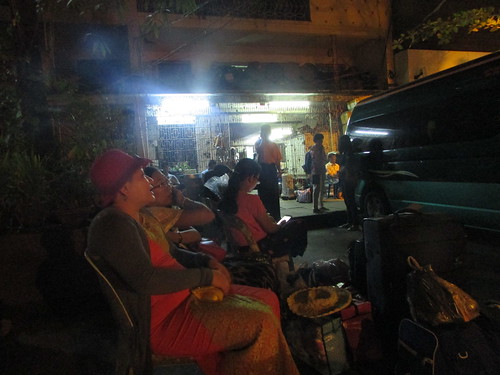 Waiting for the bus outside the travel office in Yangon.
The reclining seats on the bus were in rows of 2 on left of gangway, 1 on right, pre-allocated. I discovered that, in almost every case, the latch on the seat back was defective so that seats were permanently reclined.
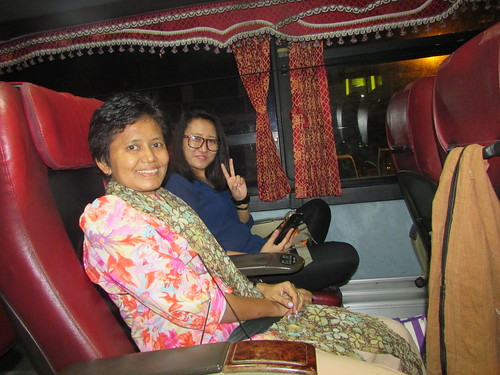 Myint and Mi Mi before we leave Yangon.
I had been puzzled by the tiny plastic moulded chairs carried on the bus. Once people were seated in the reclining seats, additional passengers were accommodated in the gangway on the small chairs.
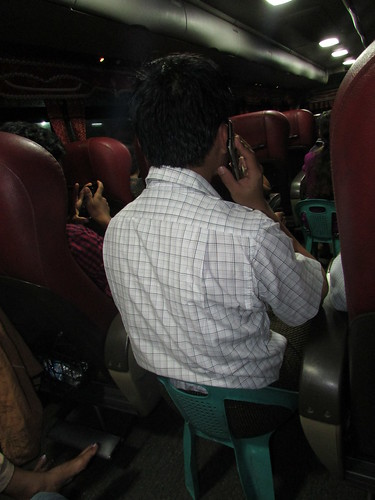
Seating 2 + 1 + plastic seat in gangway.
Events of Monday, 18th April 2016
On arrival at Mawlamyine Bus Terminal, we were met by a car and driver which took us to the 'CARE' charity administrative offices where it had been arranged we could wash and briefly relax before setting off again by car to travel further south. I'm afraid it was 'brief' as it was around 5.00 a.m. when we arrived and the Doctor wanted to set off at about 6.00 a.m.!
Once on the road, the Doctor made a stop at a typical tea house for a snack with the sweet, milky tea the Burmese (and I) enjoy. Then, we stopped at the Win Sein Taw Ya Pagoda, housing the World's Largest Reclining Buddha. It was my fourth visit, but I believe the first for Myint and Mi Mi. Shortly after my third visit a year ago, the elderly monk responsible for the project passed away and there is now a hall of remembrance in his honour. Further building work was also apparent on both the original and second reclining Buddha figures.
By about 8.00 a.m. we had reached Kot Kha Pon - the first of the Drop In Centres ('DIC') we were to visit. Quite a few of the children who attend the centre were unable to be present on that date so distribution of school-related gifts was fairly quickly completed, the balance being left with the staff.
Our next visit was to Ka Mar Wet DIC, Where, as usual, we were made very welcome. After the presentations, the traditional group photographs were taken outside the DIC, with the children wearing their new, just received, uniforms.
To reach Ko Dut, where we would spend the night, our route took us through Thanbyuzayat on the main road. This was the location where the Death Railway, built by prisoners of the Japanese in 1942-1943, joined the Burmese main railway line south from Mawlamyine. For some time, one of the Japanese steam locomotives which was used on the Death Railway has been 'plinthed' at this location but what I'd not seen before was a modern museum building labelled 'THE DEATH RAILWAY MUSEUM' which opened earlier in 2016 and was packed with visitors. The Doctor purchased admission tickets (the 'Foreigner' pays an enhanced rate) and we looked around. The centre piece of the ground floor was a large 'trompe d'oeil' painting extending across the floor which attempted (fairly successfully) to give the impression of standing on a wooden trestle trestle bridge on the line. I was disappointed that lots of visitors were taking the opportunity to take that elusive "This is me standing on the Death Railway" picture. The other display material was, I thought, rather thin but appeared better researched. I left the museum with mixed feelings. I believe we must confront the evil in our past but I wasn't convinced that a 'Disneyworld' approach was appropriate. Afterwards, I found I piece from the 'Daily Telegraph' at here which appeared to share my reaction.
We stopped to visit the large pagoda on our route to Ko Dut and also looked at the Mon Ethnic School, where further building work was in hand. The new building replaced the now-abandoned wooden temporary
shelter, now suffering termite attack. More startling, immediately behind the temporary shelter, a tall, shining triangular-section cellular radio transmission tower has appeared, complete with equipment cabinets and a large, sloping framework to support solar panels.
We were invited for an evening meal at the home of the manager of Ko Dut DIC. By this time, I was very tired so, on arrival at the DIC itself (where Myint, Mi Mi and I were to sleep on the naturally-ventilated upper floor) I was just keen to set up the thin sleeping mats and the mosquito nets and collapse.
Related posts
Next post describing this trip.
All my posts on this trip can be found here.
My pictures
Travelling to and from Mon State.
Win Sein Taw Ya Pagoda.
there are other pictures at Burma-2016. More pictures will be posted as soon as possible.
[Additional material added 21-Apr-2016: Link to pictures added 7-May-2016: Pictures and notes added 29-May-2016]
"Would you like to go with my wife and I to the Shwedagon on Sunday morning?" asked the Doctor "We will leave at 4.00 a.m." The Shwedagon is, I'm sure, the most revered religious site in Burma and the chance to visit on an Auspicious Date (New Year's Day) was very attractive, even if it meant a rather early start.
History
Wikipedia gives a brief outline of the Shwedagon here. Historians believe it is no more than 1,500 years old but legend has its origins over 2,600 years ago. You can find quite a lot on the internet - I liked a copy of an English report from 1586 on the 'Sacred Sites' website here.
Events of Sunday, 17th April 2016
We made the brief trip from the Doctor's home to the Shwedagon by car, suffering a traffic jam in the last few hundred yards. Can you imagine - a traffic jam leading to a place of worship at ten past four in the morning? It was still completely dark but the whole area was brightly lit by electric lights. On foot, we passed between two large ceremonial lion statues - Chinthe - and climbed Singuttara Hill by one of four sets of covered steps leading to the elevated pagoda platform. Already, there were thousands of pilgrims kneeling in worship or simply promenading between the different features and there was a great sense of peace and goodwill. I was, once again, impressed by the sheer power of the ideas embodied in Buddhism to inspire the actions of its followers.
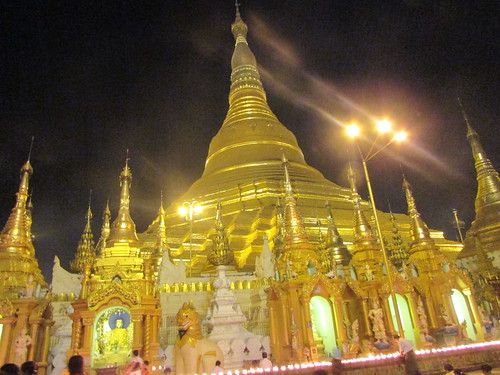 The Shwedagon on New Year's morning.
The central golden Shwedagon Pagoda, rising 325 feet above the platform and floodlit, dominated the view but there were also lesser pagodas and, I would estimate, at least fifty Prayer Halls, each with multiple Buddha images. The broad marble platform linking all these constructions was thankfully cool to my bare feet - I'd found an earlier visit in 2008 on a hot afternoon quite painful! That earlier visit was part of 'Round the World 5' and there are some pictures of the Shwedagon I took on that trip here.
On a visit to the Shwedagon, it's easy to see why the site is so evocative to the Burmese. When the military regime decided to build a new capital city at Napyidaw, they equipped it with a copy of the Shwedagon called the Uppatasanti Pagoda. I visited this 'pretender' in 2013 and was, despite my low expectations, quite impressed. Although the design was based on the revered Shwedagon in Yangon, as I commented in my post An Evening in Napyidaw "at least this young Pagoda has the good grace to be a few inches shorter".
After an inspiring early morning visit, I was given breakfast at the Doctor's home before leaving by car to the nearby lake, as on the previous day. This time, I sat on one of the concrete seats overlooking the lake whilst the Doctor and his wife did their accustomed out-and-back walk. Then, we drove to the covered market, still not fully open but with plenty of shoppers.
As we drove back to the Doctor's home, I noticed that a number of the Water Stations had been at least partially dismantled - the Water Festival was over for another year. Although it was only about 7.30 a.m., I could hardly keep awake but a couple of hours sleep refreshed me.
Tonight, we will take the overnight bus to Mawlamyine in Mon State to visit various Orphans and Vulnerable Children initiatives. I made this journey by bus in 2014, as described in the post By Bus to Mawlamyine, with links to subsequent posts. We repeated the journey in 2015, this time travelling by car, as described in the post here with links to later posts. Unfortunately, that trip was ultimately ill-starred as the car was seriously damaged in a Road Traffic Accident on the way back but, thankfully, without anyone being injured.
Related posts
Next post describing this trip.
All my posts on this trip can be found here.
My pictures
New Year's Morning at the Shwedagon
There are also some pictures at Burma-2016. More pictures will be posted as soon as possible.
[Link to pictures added 7-May-2016]
Events of Saturday, 16th April 2016
The Doctor invited me to join him and his wife on an early morning constitutional. We left, by car, just before 6.00 a.m. and drove to a nearby lake where we found lots of people, many middle-aged couples, walking or otherwise exercising along the path bordering the water. After an out-and-back walk of about 30 minutes, we drove to the market. This was not fully open but the stalls that were trading seemed to be doing excellent business. At one stall, in the short time it took for the Doctor to complete his purchase, two assistants clashed three times trying to simultaneously use the single, rather battered scales to check the weight! I did notice that the scales used proper cast weights presumably in the traditional Burmese units of ‘Vliss’, rather than (as I have seen in many places) dry batteries.
After breakfast at the Doctor’s home, the Doctor drove to his wife to Yangon International Airport, where they have a shop. The development of the airport terminal since my first visit in 2008 is remarkable. New Domestic and International Terminals are currently under construction.
The traffic was very heavy and the lines of pick-up trucks trying to get to the major Water Stations seemed completely jammed so the Doctor returned via a different route, stopping for dairy products at the ‘Milk Bar’ we’d visited the year before (described in the post Yangon (Part 4)).
The Doctor had decided to show me one final, very special and popular Water Station. The road in front of City Hall had been blocked by an elaborate stage comprising the usual row of hose-wielding water-throwers set below a large performance area flanked by two large colour screens. There was room for a single line of vehicles to pass in front of the hoses with crowds of onlookers opposite forming an audience for the performers. Two ‘Sky’ Electronic News Gathering vehicles with satellite dishes were nearby, suggesting that at least part of the event was being broadcast. Certainly, the two large screens were showing a ‘mixed’ output from a number of cameras.
To ensure that the onlookers entered into the spirit of the festivity, a series of hoses on tall posts were watering the crowds. In addition, two manually-operated high-capacity ‘monitors’ set on either side of the crowd were continuously ‘raking’ the onlookers with water. A number of onlookers had taken the precaution of equipping themselves with umbrellas but I’m not sure that this was terribly effective. Certainly, I became quite wet.
We returned to the Doctor’s home along part of Strand Road, where I had my first sight of the modern overhead catenary installed for the recently-introduced trams. I didn’t see a tram, though.
Related posts
Next post on this trip.
All my posts on this trip can be found here.
My pictures
Burma-2016.
More pictures will be posted as soon as possible.