skip to main |
skip to sidebar
Overall description
Myanma Railways are committed to a number of projects to build new railways to improve communications in Myanmar. One of these projects is providing a railway line from Katha (on the west bank of the Ayeyarwaddy River) to Bhamo (further north, on the east bank of the Ayeyarwaddy River).
Katha is already served by an existing branch line from the junction at Naba with the line from Mandalay to Myitkyina in Kachin State.
The line from Katha to Bhamo was started in May, 2007. The work is divided into three sections: Katha-Kyautkyi (length 37.06 miles), Kyautkyi-Simkhan (28.26 miles) and Simkhan-Bhamo (29.56 miles), giving a total length of 94.88 miles.
Section 1. Katha - Kyautkyi: The line from Katha to Moe Tar Kyi line opened on 20th October 2010 and from Moe Tar Kyi to Kyautkyi line on 7th February 2014. There are 141 bridges in this section. 132 bridges have a span of less than 40 feet, 8 bridges have a span between 40 and 180 feet and one bridge has a span exceeding 180 feet.
The line is controlled by the following Block Stations: Katha, Paw Ma Myaing, Min Le, Moe Tar Kyi, Choung Wa and Kyautkyi. These stations are provided with fixed distant signals and working Outer Signals. Block Working uses paper 'Line Clear' forms.
A regular passenger service is now operated on this section by diesel railcars type RBE (brief details in the post Diesel Railcars in Burma). The Line Speed Limit is currently 15 miles/hour. The line from Katha to Choung Wa is in Sagaing Division: beyond Choung Wa, the line is in Kachin State.
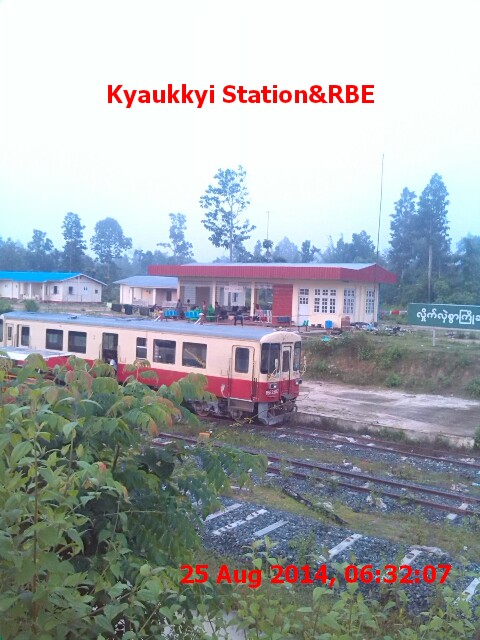
Kyaukkyi Station, Myanmar (Photo: Htein Lin)
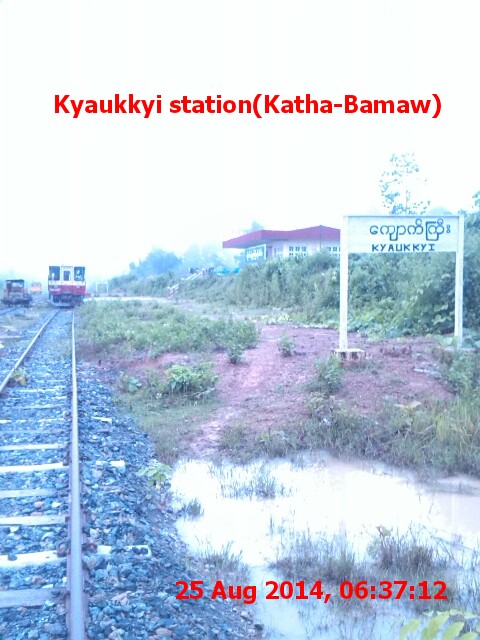
Kyaukkyi Station, Myanmar (Photo: Htein Lin)
Section 2. Kyautkyi - Simkhan: This section has 129 bridges, all completed. This section will have Block Stations at Myo Kone and Simkhan. Stations and signals will be similar to section 1.
Section 3. At Simkhan, a major road/rail bridge across the Ayeyarwaddy River has been built. The remainder of section 3 to Bhamo is under construction.
The new junctions at Katha
I've made two round trips from Katha to Naba, both times on special trains operated in connection with 'Road to Mandalay' river cruises. The first railway trip was in 2010 (when I travelled in the locomotive cab) and those journeys are described in the (technical) posts Cab Ride from Katha and Cab Ride back to Katha. Two years later, I repeated the trip, described in the post By Train to Naba. Each of these posts has links to the associated photographs.
On the first railway trip in 2010, I was intrigued to discover an unexpected triangular railway junction about 3.5 km from the terminus at Katha.
The photograph below was taken from the locomotive cab on the return journey from Naba to Katha in 2010 shows the new line to Bhamo trailing off to the left. There is a handsignalman, the usual single lever to operate the junction points which are then secured with a point clip. 'Stop' signals are provided but were not operated - the handsignalman giving a Green Flag as authority to proceed. The bamboo shelter at the junction appears to be for the handsignalman's use.
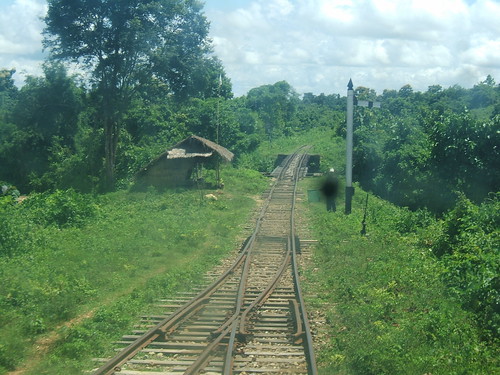 The new junction viewed from a train on the Naba to Katha line, looking towards Katha showing the new line to Bhamo trailing off to the left.
The photograph below, taken from the train on the Naba to Katha line in 2012, shows the new line to Bhamo curving away to the right. Note the single point lever controlling 'trap' points which, when open as in the picture, will derail any vehicles approaching the junction from the new line, providing 'flank' protection to a train on the Naba to Katha Line. A 'Stop' signal is also provided.
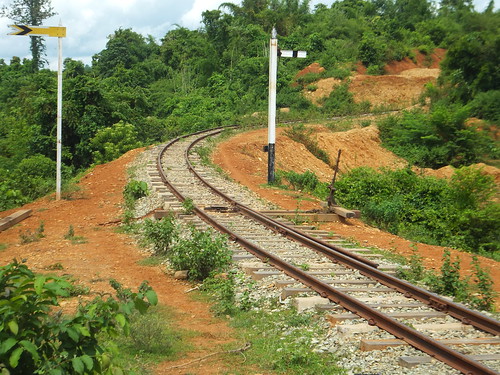 The new line to Bhamo curving away to the right, viewed from a train on the Naba to Katha line.
The photograph below, taken from the train on the Naba to Katha line in 2012, shows the 'third side' of the triangle, which would allow a train from Naba to divert towards Bhamo, rather than proceeding to Katha. Note mix of timber and concrete sleepers. The undergrowth between the rails testifies to the line not being in regular use.
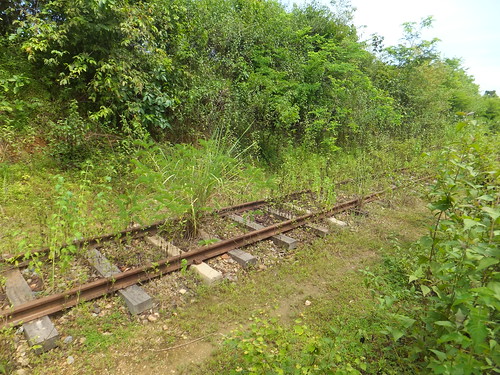 The 'third side' of the triangle, viewed from a train on the Naba to Katha line.
The new bridge at Simkhan
In 2012, I visited Bhamo on the 'Road to Mandalay' cruise ship and I took the photographs below of the Simkhan bridge, commenting:-
"We passed under the New Bridge which appears almost complete. There are eight steel truss spans but only the one we used was marked for river traffic. There were 'traffic lights' on the bridge piers but they were not lit. The bridge carried a lane for road traffic (equipped with lighting standards), a single track metre gauge railway and a pedestrian lane. On either side of the bridge spans, there are reinforced concrete approach viaducts. I was told that the railway track on the west bank will be connected to the triangular junction at Katha and will be extended to Bhamo on the east bank."
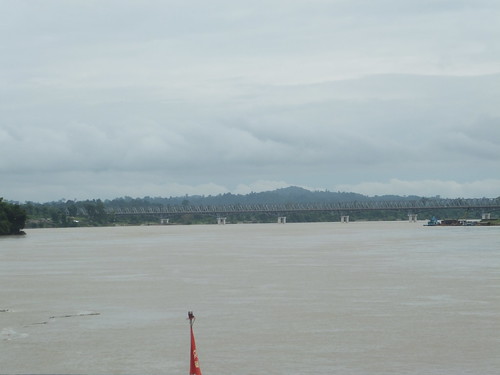 The Simkhan Road/Rail Bridge, Ayeyarwaddy River.
 West bank of the Ayeyarwaddy River, showing the Simkhan Road/Rail Bridge.
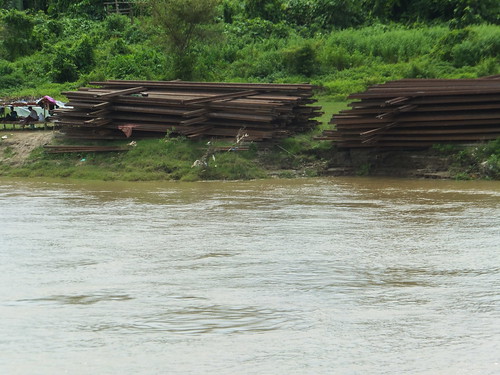 Rails stockpiled, awaiting use: Simkhan Road/Rail Bridge, Ayeyarwaddy River.
Acknowledgments
I am grateful to Myanma Railways staff for providing much of the information in this post but any errors are my own.
Related posts on this website
I've made two visits to Bhamo by river (on the 'Road to Mandalay' cruise ship) in 2010 and again in 2012. There are a number of (non-technical) posts on these trips - those for 2010 are here and those for 2012 are here. These posts have links to photograph albums where there are more pictures of the railways and river bridge.
India is a huge country with an important and extensive railway system largely inherited from the British. On my three visits to India to date, I've seen only a tiny part of the railway system.
1992 trip
My first visit in 1992 was a business trip in connection with the commissioning of telecommunications equipment around Delhi for the railways. There's a very brief outline of the amazing seven weeks I spent in India here. I eventually added to that report here, but it's still rather sketchy. Railway highlights were a visit to the National Railway Museum, set up by Mike Satow, and 'hands on' both metre gauge and broad gauge steam locomotives.
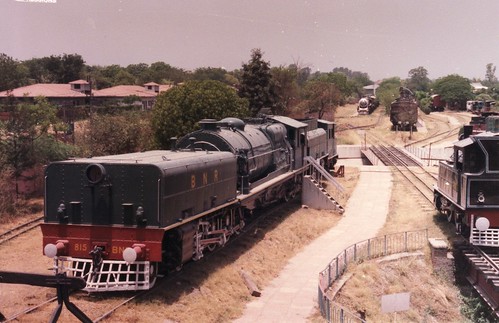 Manchester-built Beyer-Garratt (works number 6594/1930) in Delhi Railway Museum.
 On a 'WP' from Delhi: applying the vacuum brake as we approach a red signal.
Railway Photographs from the 1992 trip
There are a number of albums of photographs, all scanned from prints taken by a pre-digital ('wet film') Canon EOS.
National Railway Museum, Delhi (1992)
Broad Gauge around Delhi.
Shahdara Junction, Delhi.
Metre Gauge around Delhi.
Driving a 'WP' in India.
2006 trip
My second visit was a very short affair, crammed into my third 'Round the World' Trip. There's a very brief and non-technical description in the post Round The World Three. On Saturday 25th February 2006, I made my second visit to Delhi Railway Museum.
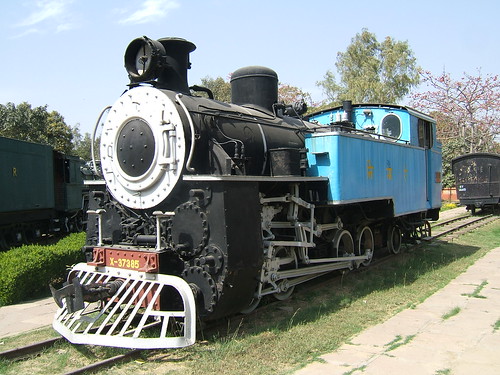 A remarkable 4-cylinder narrow gauge mountain railway locomotive in Delhi Railway Museum.
The following day, I took the 'Shatabdi' broad gauge electric to Kalka, changing there to the 2ft 6in gauge train to Shimla. There's a Wikipedia article on the Kalka - Shimla Railway here.
 The Kalka - Shimla Railway.
Railway Photographs from the 2006 trip
Once again, there are a number of albums of my railway pictures:-
National Railway Museum, Delhi (2006).
Northern Railways, India.
Kalka-Shimla Railway.
2009 trip
In 2009, I was back in India, this time staying in Kolkata (formerly Calcutta) just one night on my way to Bhutan. There's a short post on Kolkata here. In a rather hectic day of sightseeing, I made a visit to the famous Howrah Railway Station and, close by, Kolkata Rail Museum.
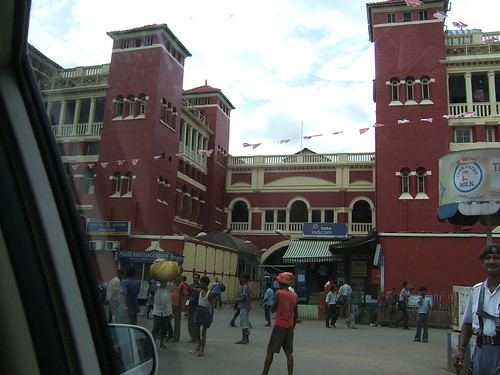 The imposing facade of Howrah Station Building.
 Kolkata Rail Museum.
Railway Photographs from the 2009 trip
Howrah Station, Kolkata.
Kolkata Rail Museum.
Books
For an excellent introduction to the variety of railway locomotives which have served India over the years, see Hugh Hughes 4-part work 'Indian Locomotives', which is briefly outlined here.
In March 2008, I made my first visit to Myanmar (formerly Burma) and made my first trip on Yangon's Circle Line, described here. The comments I made at the time about the trackwork were not very kind, I'm afraid.
"Whilst the track isn't too bad near the main station with a fair amount of concrete sleepers and modern rail fastenings, it deteriorates further out. Here, rails are frequently spiked to elderly wooden sleepers which are quite widely spaced and with indifferent ballasting. Rail gaps are very variable (sometimes with a short piece of rail plugging the gap) and with frequent missing fishbolts, as my photographs show. I'm afraid these standards are typical of the infrastructure in Myanmar, which has suffered from years of neglect."
I'm happy to report that matters have improved somewhat since 2008 but the condition of trackwork is still an issue. I've not seen modern equipment for tamping and lining which may be a factor.
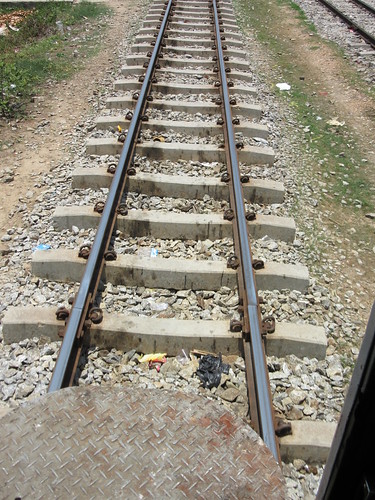
DMU Cab Ride on the Circle Line: View of concrete sleepered track and shallow ballast.
Burma can source various hardwoods for sleepers. Traditionally, Pyingado was used, described as "one of the most valuable Burmese timbers, second only to teak. It produces very large trees, 100 to 120 feet in height and 8 to 12 feet in girth. At their best the boles are straight and fairly cylindrical. These trees grow in association with teak. The trees occur in the lower hill forests in Burma up to about 2,500 feet".
On pointwork, wooden crossing timbers are still used but, on plain track, concrete sleepers are used. These are produced at a number of locations in Myanmar:-
Khin U (Division 2)*
Myitnge (Division 3)*
Mohaung (Division 3)
Pa Kok Ku (Division 11)
Shwe Nyaung (South Shan State)
Motetamma (near Mawlamyine)*
Oo Shit Pin (near Pyi)
Pyon Tan Sar (on main line)
Total: 8 locations. The three sites marked with an asterisk are the principal production areas.
My pictures
A selection of Permanent Way pictures in Myanmar.
[Brief details of Pyingado added 3-Jul-2015]
In Part 3 of Hugh Hughes excellent guide to railway locomotives in India (introduced here), there is the following brief information about the Madaya Light Railway in Burma (now Myanmar).
The Madaya Light Railway was a 2 ft 6 in (762 mm) narrow gauge railway that terminated in Mandalay, Burma. The first section to Toungbyon, 8 miles long, opened in 1912. The railway was extended a further 8 miles to Madaya in 1917. The company operating the line went into liquidation in 1919, and the railway was taken over by the Government. The line was closed in 1927 when it was replaced by a metre gauge line
The first four locomotives for the line were obtained second hand from the Thaton – Duyinzaik Railway.
Locomotives 1 & 2 were 0-4-2 Saddle Tanks built 1882 by Barr, Morrison and Company.
Locomotive 3 was a 6-coupled well tank built 1885 by Dick Kerr and Company.
Locomotive 4 was another 6-coupled locomotive built in 1901 by Dick Kerr and Company.
Statistics for March 1921 listed seven locomotives but no information is available about the additional three locomotives.
Further details of the first four locomotives are given in the post Thaton – Duyinzaik Railway.
Myanma Railways still operate a passenger service on the metre gauge line from Mandalay to Madaya.
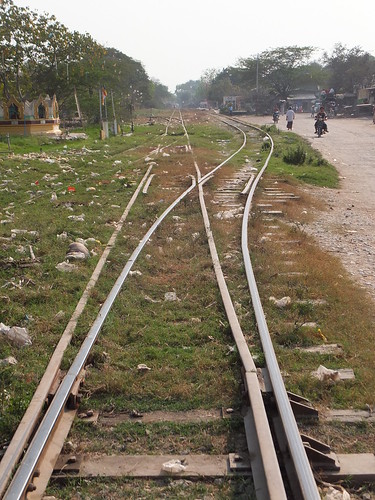
Owe Boe station on the metre gauge Madaya line looking towards Mandalay in 2013.
Pictures of Owe Boe station
Owe Boe Station, Mandalay.
In Part 3 of Hugh Hughes excellent guide to railway locomotives in India (introduced here), there is the following brief information about the long-gone Thaton – Duyinzaik line in Burma (now called Myanmar).
The Thaton – Duyinzaik Railway was a 2ft 6in (762 mm) narrow gauge railway opened in 1885 built and worked by Mr. George Dawson of Rangoon. From Thaton, the railway extended 8 miles east alongside a public road through jungle to Duyinzaik, connecting with a daily launch service also operated by Mr. Dawson to Moulmein.
In 1895 the inspecting officer reported:-
"Trains are not worked by any of the systems prescribed for railways. The Manager who lives at Duyinzaik controls the traffic and gives instructions directly to the drivers or by telephone to the station master at Thaton."
Locomotives 1 & 2 were built in 1883 and were 0-4-2 Saddle Tanks with two 7 x 12 inch cylinders, 22 inch diameter coupled wheels and 15 inch diameter trailing wheels with radial axleboxes. The wheelbase was 4 foot + 4 foot, overall length 15ft 6ins and weight was 8 tons. These are believed to have been built by Barr, Morrison and Company at Kilmarnock for W. B. Dick and Company and were described as ‘Flying Car’ type.
Locomotive 3 was a 6-coupled well tank with 8 x 16 inch cylinders built by Dick Kerr and Company, Preston in 1885, weighing 13 tons.
Locomotive 4 was also a 6-coupled locomotive built by Dick Kerr in 1901, weighing 10.75 tons.
In 1900 the Irrawaddy Flotilla Company took over the line until closure in 1907 when the metre gauge Burma Railways line reached Thaton. After closure, all four locomotives were transferred to the Madaya Light Railway.
Of course, Rangoon is now called Yangon, Moulmein is now called Mawlamyine and 'Duyinzaik' can be Romanised as 'Duyinzeik'. There's a brief post about the Madaya Light Railway here.
Seeking more information about the manufacturers of the first four locomotives, I turned to the internet resource Grace's Guide. This splendid site was started by Andrew Tweedie in 2007 with the exemplary Mission Statement "To be the premier on-line library of information regarding the Companies, People, Places and Products of the Industrial History of the UK and to preserve that information by making it freely available for all to use without restriction".
James Barr was certainly producing various types of machinery in Kilmarnock around that period.

1888 advert for James Barr (Source: Grace's Guide).
W. B. Dick and Company set up in Glasgow in 1854 and expanded to become 'oil refiners, merchants and factors, railway and tramcar builders'. John Kerr became a senior employee of W. B. Dick and Company and, in 1883, Dick, Kerr and Company was set up to take over the railway and tramway activities at Kilmarnock and later at Preston, continuing to build locomotives (including Locomotives 3 and 4 for the Thaton – Duyinzaik Railway) and also electrical equipment.
Although steam locomotive manufacture did not survive at Dick, Kerr and Company, the firm became well-known for their electrical equipment for railways and tramways. For instance, there are pictures here of the preserved Liverpool Overhead Railway Driving/Motor Car using Dick, Kerr electrical equipment. The English Electric Company Limited became successors of Dick, Kerr and, as late as 1944, the works plate on the battery electric shunting locomotive now preserved at the Museum of Science and Industry in Manchester reads "The English Electric Company Ltd. London, No. 1378 1944, Dick Kerr Works, Preston, England". My pictures of this shunter are here.
I later found a short article on the Thaton – Duyinzaik Railway here, on the interesting Families In British India Society (FIBIS) site.
[Link to FIBIS site added 27-Mar-2020]
Hugh Hughes produced an excellent guide to railway locomotives in India called simply 'Indian Locomotives'. This was published as a four-volume set of books with 'limp' covers by The Continental Railway Circle.

Brief details of these volumes are given below:-
Part 1 - BROAD GAUGE 1851-1940: First published 1990 (ISBN 0 9503469 8 5)
Part 2 - METRE GAUGE 1872-1940: First published 1992 (ISBN 0 9503469 9 3)
Part 3 - NARROW GAUGE 1863-1940: First published 1994 (ISBN 0 9521655 0 3)
Part 4 - 1941- 1990: First published 1996 (ISBN 0 9521655 1 1)
This comprehensive work gives dimensions, statistics and includes industrial locomotives. Part 2 includes Burma, part 3 includes minor railways in Burma and part 4 has sections on Bangladesh, Burma, Pakistan and Sri Lanka. All-in-all, an essential reference.
These books are available directly from The Continental Railway Circle. For further information go to their internet site here.
My own, rather modest, exploits to see Indian Locomotives on my three visits to India are outlined in a post here.
After a long interval, another in the series of 'occasional sessions' was held at Brewood on Thursday, 21st May 2015. For the first time, we welcomed professional railwayman and enthusiast Nick but, unfortunately, Keith was unable to be there.
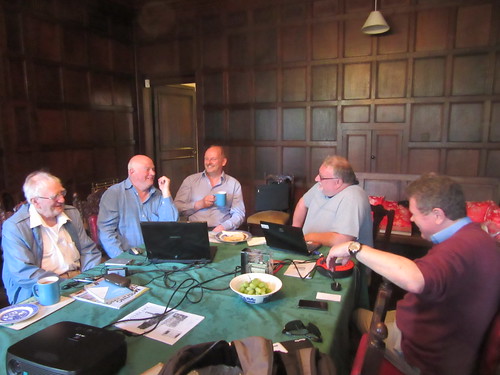 L-R: John, Ian, Nick, Phil, Mike.
Ian showed us some remarkable photographs and plans he's unearthed which created a lot of discussion.
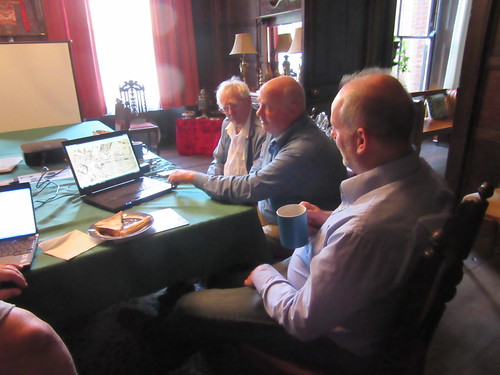 Ian talks about one of his interesting old maps.
Ian's data is now spread over two portable hard drives. Later, we looked at some of Mike's data on his portable hard drive. Most of this information concerned the South Stafford line or the West Midlands. Nick had brought some of his wonderful drawings of signal box layouts, particularly on the former North Stafford. Having recently returned from Burma, Jan showed a few pictures of the metre gauge railways there.
Previous meetings have been held:
Sunday, 14 February 2010
Tuesday, 27 September 2011
Monday, 6 February 2012
Wednesday, 12 June 2013
A few pictures from these meetings can be found here.
My first trip on the Circle Line in Yangon, back in 2008 (described in the post The Circle Line, Yangon) allowed me to identify the main locomotive works of Myanma Railways at Insein, a few miles north of downtown Yangon.
It was not until 20th September 2012 that I discovered that there was a second locomotive works at Ywa Taung (not too far from Mandalay). I'd been with the Doctor to make donations to the Monastic School at Taung Be Lar (described in the post Mandalay) and we took a different route returning which took us past Ywa Taung Station. We stopped and I took a number of pictures which are in the album here (together with additions from later visits).
The Rangoon Guide Map of 1930 (published under the direction of Brigadier R. H. Thomas D.S.O., Surveyor General of India) shows the Works, to the west of Insein railway station.
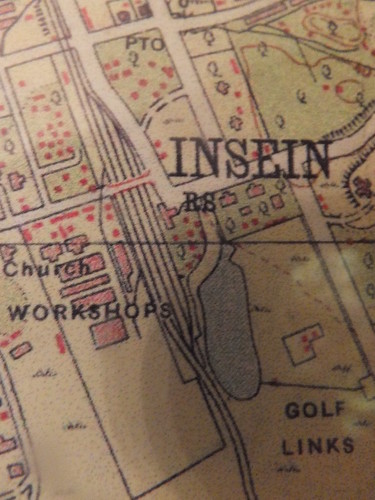
1930 Map of Insein area (more pictures of the 1930 map are here).
On subsequent Circle Line Trips I'd looked 'over the wall' at Insein Works but it was not until my friend, the Doctor, obtained permission for a visit on the 6th May 2015 that I was able to gather more information.
Visit to Insein Locomotive Works
We reported to the Time Office at the Main Gate and were welcomed by the Works Manager before one of his staff took us on a tour of the Works. Despite the urban environment, we first passed through a pleasant landscaped area with a concrete sports ground on our left.
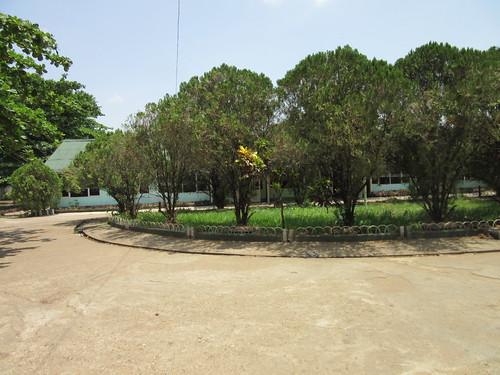 The landscaped area near the main gate.
However, we quickly passed into a more unkempt but attractive wooded area with a number of diesel locomotives either awaiting 'shopping' or cannibalisation for spare parts.
 DF.1318 (and others) slumber beneath the trees in Insein Works Yard.
Nearby, I found the remains of a number of cut-up steam locomotives. As a dyed-in-the-wool steam enthusiast, I regret the loss of any steam locomotive but it has to be said that there is great educational value in being able to see the internal construction of these machines.
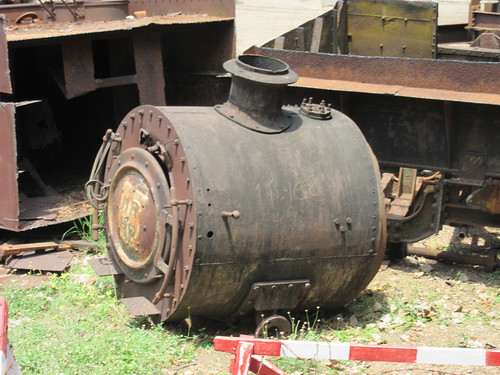 Insein Works: Cut-up steam locomotives.
Overlooking this scene of destruction was a plinthed outside-cylinder 0-6-0 oil-burning saddle tank, running number SL3 and gaily-painted.
 Plinthed SL3 at Insein Works.
The principal business of Insein Works is carrying out heavy repairs on the fleet of diesel electric and diesel hydraulic locomotives. This task is shared with Ywa Taung Locomotive Works. Insein also carries out re-engining and rebuilding as necessary. The main works at Insein comprises two large, parallel, interconnected bays: the Machine Shop and the Erecting Shop.
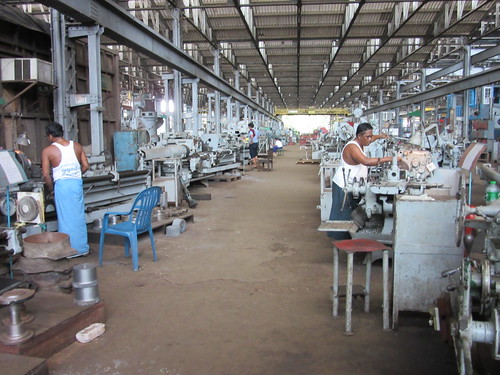 The Machine Shop.
Most of the machines are British and date from the immediate post-World War II period. Burma Railways emerged from the war in a particularly weakened condition and, although Britain initially provided assistance, the coup which led to military rule had the effect of largely isolating Burma from foreign aid until recently.
 Part of the Erecting Shop, looking north.
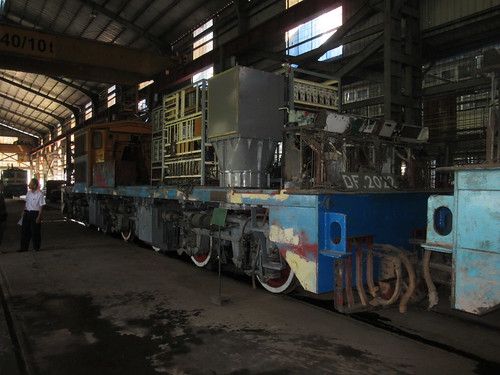 DF.2022, showing racks of electronics.
A number of the locomotive classes I'm familiar with were visible, in various states of 'undress', but my attention was drawn to a locomotive with a very large cab. This was a rebuild by Insein of a Japanese class DD-51.
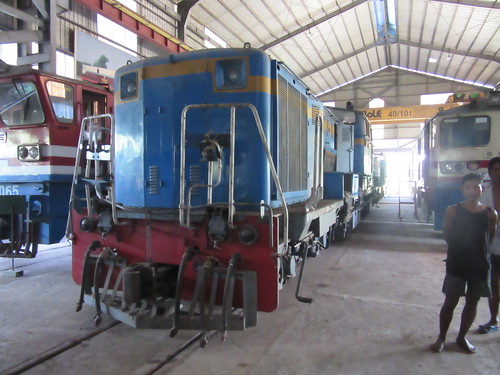 Part of the Erecting Shop, looking south, showing rebuilt Japanese DD-51 locomotive.
In its original form, this diesel hydraulic locomotive class had two 1100 h.p. engines and was carried on six axles with the two axles under the cab unpowered (B-2-B), giving an overall length of 18 metres! Designed for freight and passenger use, I believe the large cab originally accommodated a steam boiler for train heating. There's a Wikipedia article here.

DD-51 as originally built (By ja:User:出々 吾壱, via Wikimedia Commons).
I wasn't able to make a detailed study, but Insein appear to have removed one engine and power bogie, producing an 1100 h.p. variant.
I was delighted to find one steam locomotive under active restoration with, apparently, another to follow. I was told that they had already 'outshopped' one restored steam locomotive which is now available for tourist trains in the Bagan area.
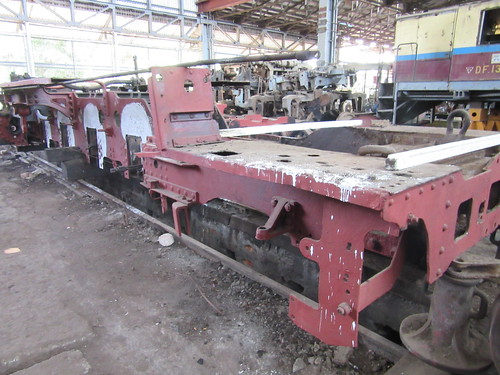 The frames of a 2-8-2 being aligned, using traditional methods.
I made a rapid tour of the Scrap Line outside, recording what I could.
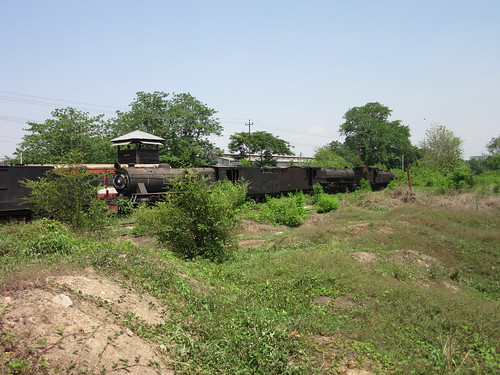 Part of the Scrap Line at Insein.
I reluctantly concluded my tour, impressed by the ingenuity, professionalism and friendliness of the staff. Before I left, the Works Manager gave me a copy of a booklet 'Brief Information of Insein Locomotive Workshop', updated to April 2015.
My pictures
Insein Locomotive Works, Yangon.
Insein Locomotive Works: Machine Shop.
Insein Works: Cut-up steam locomotives.
Insein Works Scrap Line.
Restoring steam locomotives at Insein.
Plinthed SL3 at Insein Works.
[Text, pictures and 1930 map added 25-May-2015]
My first trip on the Circle Line in Yangon, back in 2008 (described in the post The Circle Line, Yangon) gave me a tantalising glimpse of the extensive sidings in the Mahlwagon Area (just north of downtown Yangon).
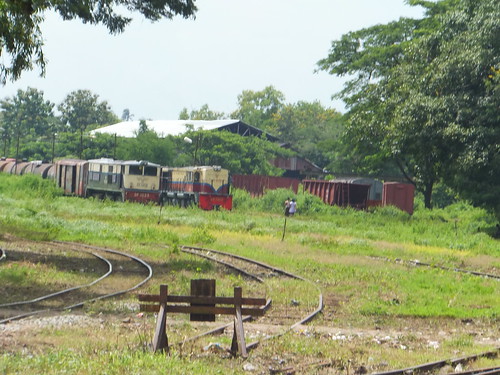 The northern end of Mahlwagon Marshalling Yard, viewed from a Circle Line Train in 2012.
Studying the satellite photographs on Google confirmed the complexity of the infrastructure and revealed a large roundhouse. Later, I found the Rangoon Guide Map of 1930 (published under the direction of Brigadier R. H. Thomas D.S.O., Surveyor General of India) which gave more detail of the facilities and suggested that the yard was probably once far busier serving the extensive docks than at present.
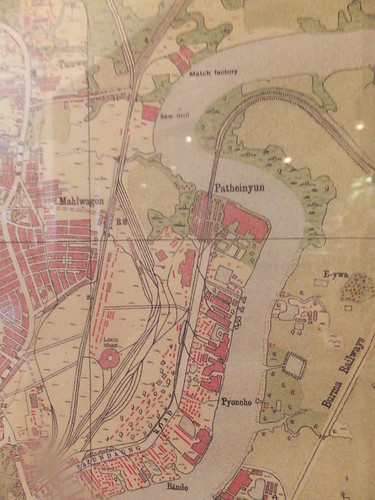
1930 Map of Mahlwagon area (more pictures of the 1930 map are here).
Road access to the area appeared limited and my various explorations of Yangon on foot failed to reach as far as this interesting district. But my friend, the Doctor, obtained permission for us to visit what is still a Restricted Area on the 6th May 2015.
Visit to Mahlwagon Marshalling Yard
We reported to the Yardmaster's Office, where we were made welcome by the Yardmaster and his staff.
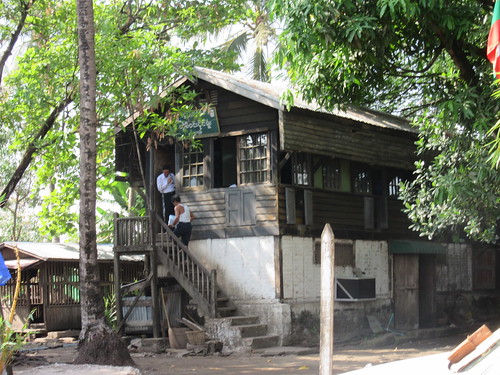 The Yardmasters Office.
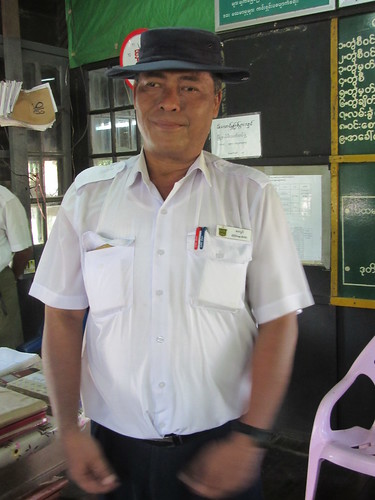
The Yardmaster.
My attention was immediately drawn to a large, painted diagram of the yard.
 Down Yard with main lines (top) and Locomotive Shed (top middle).
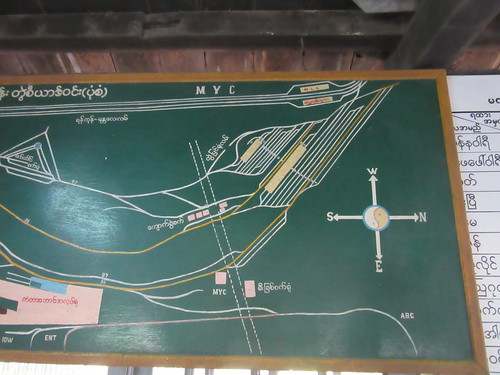 Up Yard with main lines (top) and Mahlwagon Station (top right).
The access road crossed a number of lines in between the Down and Up Yards on the level and DD.521 was shunting at the south end of the Up Yard so, every time the locomotive drew out a raft of wagons, the access road was blocked.
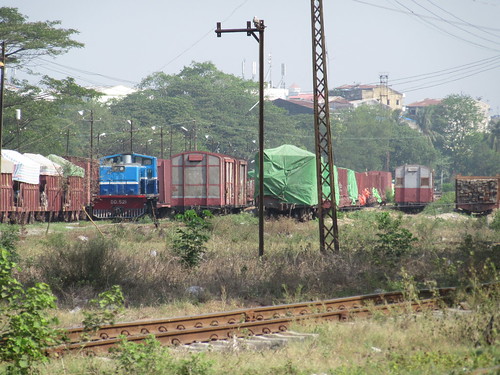 View from the access road looking north, with DD.521 shunting the Up Yard.
Once over the lines, there was a large pool on the left, then a housing colony of what I presumed were railway workers. In addition to the houses, we passed a railway medical clinic before we arrived at the gate of the diesel shed.
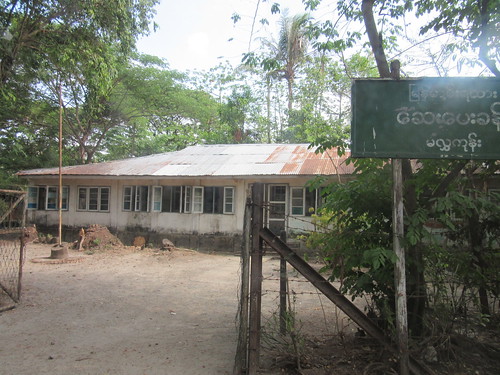 Mahlwagon Marshalling Yard: The Railway Clinic.
Visit to Mahlwagon Diesel Locomotive Shed
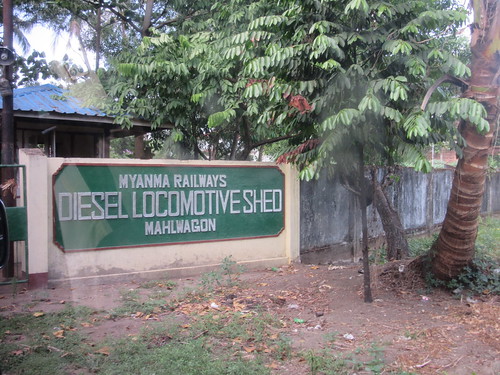 The entrance to the Diesel Locomotive Shed.
We entered the yard and followed the road through the trees. On the right, I spotted the plinthed saddle tank steam locomotive I'd seen on my first ride on the Circle Line, on 7th March 2008. On our left, we passed a number of the 1100 h.p. Chinese locomotives in green livery, looking as if they'd been laid aside. DD.1112 and DD.1128 were amongst them. We parked near railcar RBE.30.01 which I'd seen around Yangon. The man from the Yardmaster's office who'd accompanied us made introductions to the Shed Foreman who took us into the shed and immediately started a tour. We were in a 2-track extension to the roundhouse which appeared to serve as the arrival and departure area. Outside, the two tracks gave access to the goods lines at Pazundaung and Yangon Central station. A structure between the two tracks supported a header tank with flexible discharge hoses. On one side, there was a large silver-painted tank farm, presumably for fuel, behind a wall or bund. Two portable compressors could be seen.
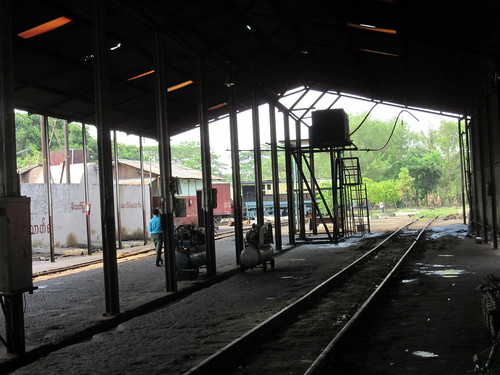 The 2-track extension.
A large sign in Burmese and English read "I WILL BE ALWAYS SURE". We entered the roundhouse itself, a large structure with the roof supported by elaborate steel trusses and a single, curved wall on the outside with regular large, glazed windows. The roof was split into two pitched sections joined by a vertical, glazed section. In a roundhouse, of course, the individual roads radiate from a turntable which was visible outside. Within the roundhouse, each road was provided with an inspection pit. In most cases, the pit was wider than the track gauge and the rails were supported on a series of steel and concrete pillars giving good access for maintenance but, on some roads, the pit was of the traditional pattern, with the width limited by the track gauge. Some roads were provided with a permanent access platform with steps, allowing staff to work at running plate level. Each road terminated in a rail-built stop.
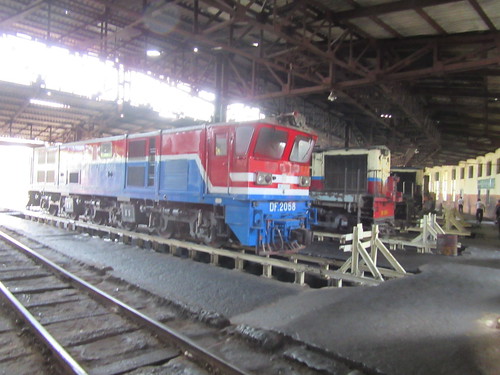 Mahlwagon Roundhouse, looking anti-clockwise from the arrival/departure roads.
 Mahlwagon Roundhouse, looking clockwise from the arrival/departure roads.
We walked anti-clockwise from the arrival/departure roads and I made a note of the roads and the stabled locomotives:-
DF.2058, DF.1348, DF.1637, DF.1358, DF.1339, DF.1347, (empty), DF.2017, DF.1239, DF.2066, DF.1200.02, DF.1317, DF.2061, (empty), DF.1349, (empty), DF.1201, (empty), DD.517.
We then moved outside the shed, where the attraction was two steam locomotives laid aside - a coal-burning 'Pacific' (pictures here) and ST772, a 2-6-4 tank engine arranged for oil burning (pictures here). I'll describe these locomotive classes later.
We walked back through the shed to reach the turntable, a 120-ton 'Mundt' type supplied in 1946 by Ransomes and Rapier Limited, Ipswich. It appears to be 65 feet diameter. Although the turntable is electric, various problems mean that it presently has to be hand-operated. In a roundhouse, every locomotive arriving or departing has to be turned on the turntable to access the required road so the lack of electric operation is very inconvenient.
We watched DF.1637 on and off the turntable. This locomotive was uprated to 2000 h.p. when an MOI 16V170 engine was fitted by Insein in 2013. Wärtsilä and Cummins had a short-lived joint venture which I believe originally produced the 16V170.
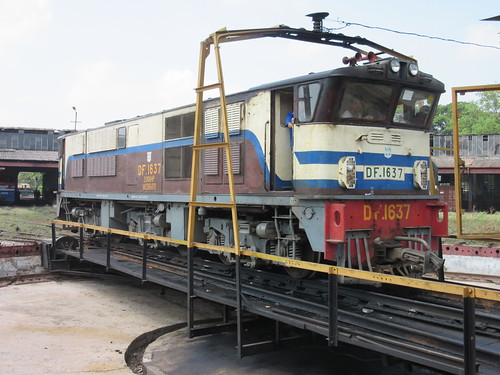 DF.1637 on the turntable at Mahlwagon.
We briefly looked at a building under construction with a high roof served by a single siding not radiating from the turntable. The structure was fitted with overhead travelling crane rails so I presumed that this was intended to give the shed improved lifting facilities in the future.
 New building awaiting fitting-out.
Our attention then turned to the 'clockwise' part of the shed which appeared to be involved in more major repairs. Outside the shed we found an Engineer's Rail Gang Car numbered ED/RGC.100, DF.1345 (an Alco-designed locomotive purchased second-hand from India fully refurbished), DD.1114 and DD.1119, both in Green livery, allocated to Mandalay and looking rather sorry for themselves.
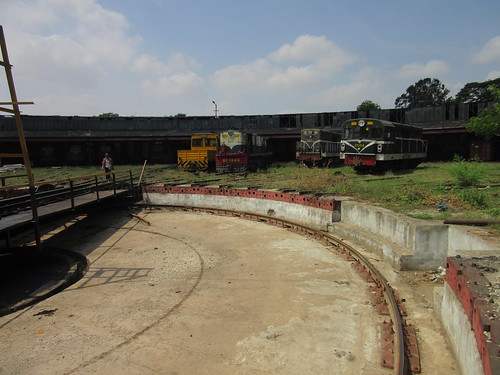 Mahlwagon Shed viewed from the turntable.
Another 1100 h.p. locomotive was half inside the shed. On the adjacent road, DF.2026 was positioned on four 'GEDI' lifting jacks, presumably for exchanging bogies. GEDI (Gebr. Dickertmann) was founded in Bielefeld, Germany, in 1843 and was acquired by NEUERO Technology GmbH in 1990 forming a world-wide supplier of equipment for the maintenance of railway vehicles. Nearby, DF.1322 was parked. There was a modern Test Bench for JZ6 and JZ7 air brake parts (Chinese designs).
 Test Bench for air brake parts.
Outside the shed, we found an Orton McCulloch Diesel Crane, running number 45.T.DC.9892. The crane was carried on two six-wheel bogies with the jib supported on a bogie flat wagon. 'ABC' couplers were provided.
We then made our way back through the shed towards the Arrival Roads, where DF.1330 had just come 'On Shed'. As we watched, a second light engine, DF.1351, was just arriving behind DF.1330. Nearby, the Shed Foreman was anxious to show us one of the Japanese one-car railcars, RBE.30.01, externally looking very smart in a mainly-red with cream livery.
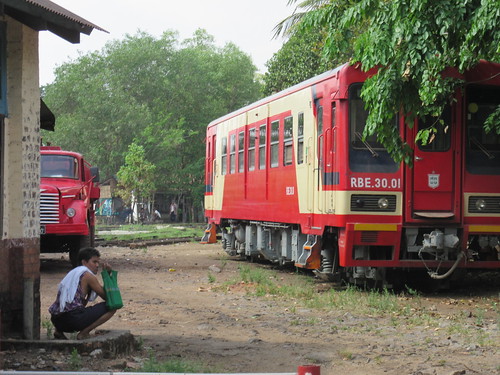 Railcar RBE.30.01 outside the shed at Mahlwagon.
The Shedmaster had offered to meet us after our tour, so we were taken to his office and chatted for a while. One of the topics which was raised was their turntable, and the problems associated with currently having to operate it manually. I was invited to express an opinion and, despite making it plain that I had only limited knowledge of turntables, I found myself being led back to the turntable in order to clamber down into the pit and have a closer look at the mechanism. I'll put the details of my rather informal survey in a separate report.
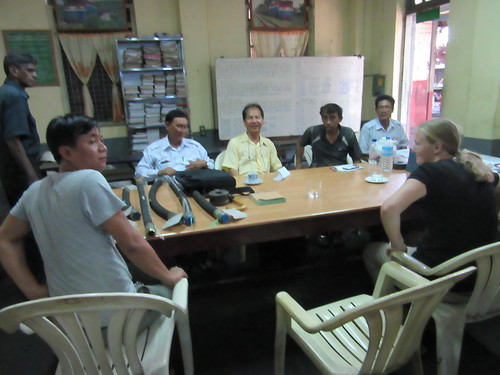 The meeting in the Shedmaster's Office.
We then expressed our thanks for a fascinating visit and said our 'goodbyes'. I had just one more task before we drove away - to photograph the diminuitive saddle tank plinthed just inside the shed boundary wall which I'd first spotted on 7-Mar-2008 (that picture is here). Fortunately, the locomotive still carried its Kerr-Stuart worksplate (No. 1284 of 1914) so, on my return to England, I was able to find a little more.
To find out what happened next on this trip, go to the post Yangon (Part 4).
All my posts describing Myanma Railways can be found here.
My pictures
The following albums (on Flickr) contain pictures relevant to this post:-
Mahlwagon Marshalling Yard, Yangon.
Mahlwagon Diesel Locomotive Shed.
Mahlwagon Diesel Shed Turntable.
'Pacific' at Mahlwagon.
Tank Engine at Mahlwagon.
Plinthed Kerr-Stuart at Mahlwagon.
All my pictures showing Myanma Railways can be found here.
[Text and pictures added 1-Jun-2015, 6-Jul-2015]


