skip to main |
skip to sidebar
Bagan Medical Clinic opens on Friday, Saturday and Sunday each week. On my trip to Myanmar in 2015, I was travelling with the founder and senior clinician Doctor Hla Tun, so I was able to get a non-medical impression of the activities over a complete three-day "Weekend".
In Part 1, I briefly described the Clinic and the activities on Friday 24th April 2015.
In Part 2, I described what I saw on Saturday 25th April 2015.
It might be worth pointing out some of the differences between Burmese and Western cultures. Some readers will be surprised that I have been able to publish pictures of patients receiving treatment. What about patient confidentiality? What about personal privacy? I was appalled myself at first, but these concepts don't seem to exist as Westerners might understand them in Myanmar (and, indeed, many other countries). Secondly, when charitable donations are made, they are frequently recorded in photographs. Even if photographs are not made, contributions may be otherwise recorded. For instance, many pagodas display a list of recent donations and buildings which have been donated frequently carry marble tablets naming the donor.
Sunday 26th April 2015
Once again, Emily and I were picked up around 08:00 by car and taken to the Clinic. On arrival, we discovered that, despite Dr. Hla Tun and his staff working until 02:10 on Sunday morning, 28 patients from his Saturday list had been 'held over' and he started seeing them at about 09:00. In addition, about 200 more patients had registered. Since Sunday is the last day of the 3-day clinic opening each week, it's not possible to 'carry over' untreated patients and so the Doctor may 'close' his list earlier on Sunday to ensure that everyone is seen.
The newly-qualified doctors mentioned in Part 2 once again practiced their diagnostic skills on Sunday.
 The 'group shot'.
The cases which Dr. Hla Tun deals with frequently involve various simultaneous problems. Poverty often leads to poor diet and the body's immune system becomes weakened and less able to deal with diseases. Mobility problems are widespread and joint pains can prevent people from working and earning a living. As appropriate, different strategies are used by Doctor Hla Tun but aspirating fluid from joints followed by various injections for pain relief and to improve the body's immunity is a common approach. Sometimes dietary supplements in powder form are provided for the patient to take. In more serious cases, an infusion of amino acids may be made at the clinic. The rigours of travelling long distances in Myanmar to reach the Bagan Clinic may add to the problems.
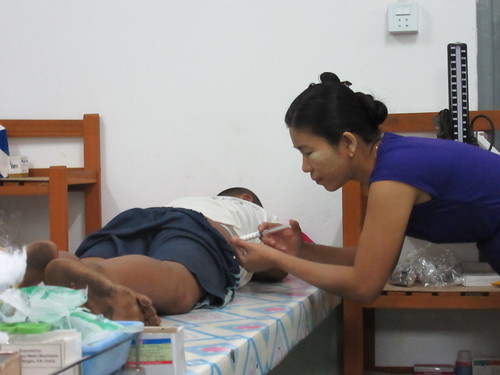 A patient receiving an intra-muscular injection.
Lunch
The physical well-being of waiting patients is taken very seriously and there are various dormitories which can be used by waiting patients plus toilets with washing facilities. On each clinic day, a hot lunch is provided for waiting patients and accompanying relatives at around 11:30. During the morning, a number of monastery people had been involved in the preparation of those meals.

The Head Monk overseeing vegetable preparation for the patient lunches.
At about 11:30 a queue of waiting patients formed and, as usual, the Head Monk started the distribution himself but, on Sunday, he then invited me to take over and, within a few minutes, around 220 meals had been distributed. The business of making an offering has great cultural significance in Myanmar, with its Buddhist traditions. On some clinic days, an evening meal is provided as well.
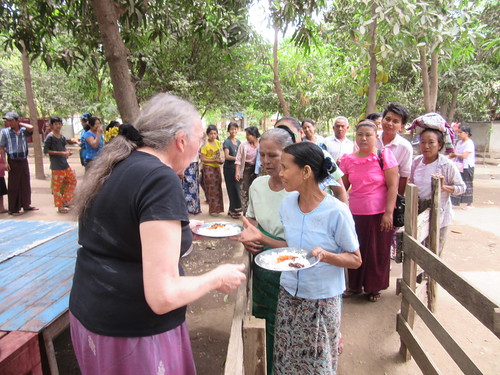 Distribution of hot lunches.
After the patient lunches, the Doctor continued consultations until about 13:30, then there was a break, allowing some of the medical staff to take lunch in the monastery, as on previous days.
Additional Tests
From time to time during the day, Dr. Hla Tun referred patients to the laboratory for specific tests on blood/urine or for E.C.G. tests. Remarkably quickly, patients would return, clutching the completed results sheet or the E.C.G. plot.
The benefits of these in-house facilities are enormous, in facilitating timely confirmation of a diagnosis. It is not practical to recall patients, many of whom have travelled long distances to the clinic, so treatment must be completed in a single visit.
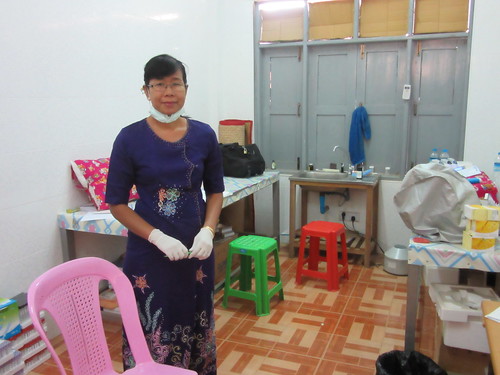 The laboratory technician and well-equipped laboratory.
The Afternoon Clinic
The afternoon clinic continued in a similar manner with a lot of help given to improve mobility and various other problems.
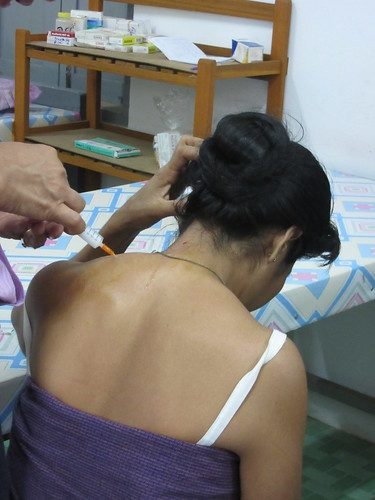
A patient receives an injection.
A woman from Mandalay suffering from cirrhosis of the liver had been treated in the morning and given an infusion of amino acids. She had travelled with her mother by train from Mandalay (fairly cheap but not a journey to undertake lightly). She seemed little improved in the afternoon but the Bagan Clinic could not provide further treatment so the Doctor made a cash donation towards hospitalisation and transportation costs.
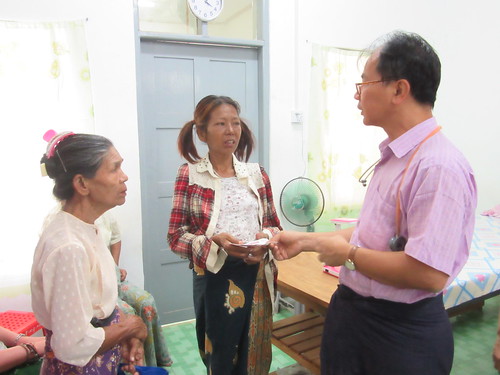 Dr. Hla Tun giving a donation towards cost of hospitalisation.
I'm afraid I left the Doctor at 16:30 and returned to the comfort of my hotel - the Bagan Thiripyitsaya Sanctuary Resort.
Next?
The plan for the following day was to re-visit two schools in the Bagan area with Doctor Hla Tun. These schools are supported by the RTM Social Contribution. Later in the afternoon, we were due to fly back to Yangon.
Go to next post on this trip.
All my posts on the Bagan Medical Clinic can be found here.
All my posts describing this trip to Myanmar can be found here.
My pictures
The internet in the Bagan area seemed much improved, but was not suitable for uploading all my pictures. I finally made them available after my return to England. The following albums (on Flickr) are relevant to this post:-
Bagan Clinic, Sunday, 26th April 2015.
Bagan Thiripyitsaya Sanctuary Resort.
All my albums for this trip can be found here.
[Text amended, pictures added 11th June 2015]
In Part 1, I briefly described the Clinic and the activities on Friday 24th April 2015.
Saturday 25th April 2015
After a good night's sleep at the Bagan Thiripyitsaya Sanctuary Resort, I took breakfast before exploring more of the hotel grounds. Adjacent to the hotel access road, I'd seen a restored temple and I examined this more carefully. A sign informed me that the site was the Kaladha Koun monastic complex, dating from the 13th century. Some parts remained only as ruined brick walls but the one temple had been restored. A marble tablet commemorated the completion of this work, sponsored by the hotel on 2nd May, 1998.
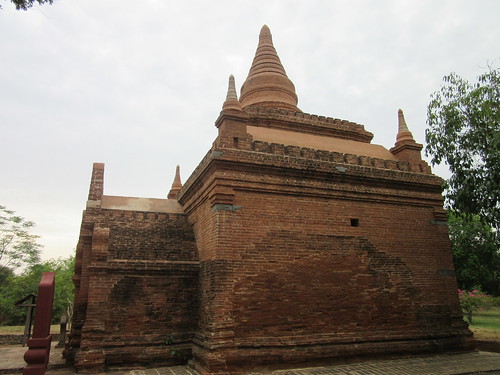 The restored temple in the hotel grounds.
A little after 08:00, a car arrived to pick me up. We drove to Emily's hotel to collect her and we were then taken to the Bagan Clinic. When we arrived, about 150 patients had registered but when I enquired later in the day, that number had already risen to 250 and the 'List' had not been closed so the final total for the day may have been higher.
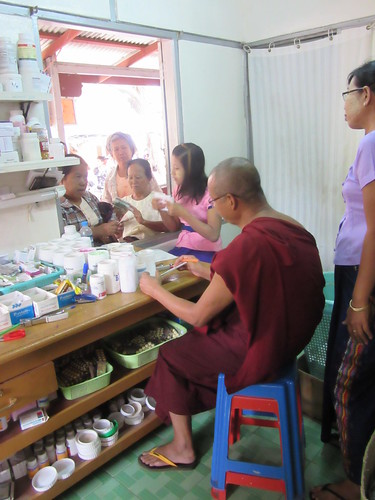
Patient registration.
The newly-qualified Burmese doctor we'd met the previous day was joined by a newly-qualified Chinese-American Doctor and they were allowed to practice their diagnostic skills. Of course, this meant that Dr. Hla Tun was frequently interrupted to confirm the correct diagnosis and treatment.
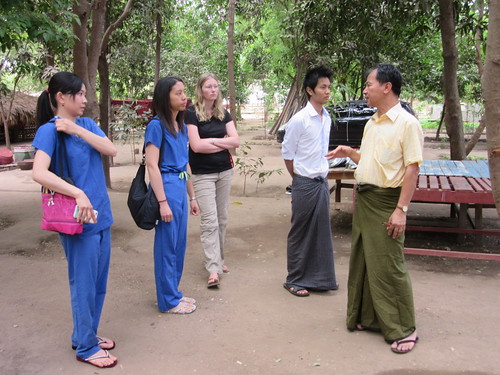 The two newly-qualified doctors (in blue 'scrubs') are briefed by Dr. Hla Tun.
On initial registration, each new patient is issued with a record book with basic information. This is handed to the doctor giving treatment and completed to show the details of treatment. This book is then retained by the patient and, should further treatment be required, the record book is brought back by the patient when registering.
Dr. Hla Tun's Treatment Room
Dr. Hla Tun is assisted by two dedicated members of staff whom he has trained and give him high-quality support.
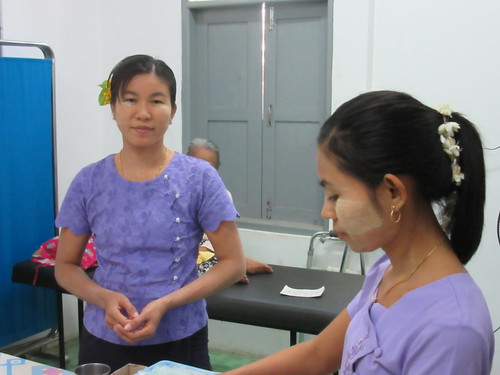 Dr. Hla Tun's assistants.
The treatment room in which they work has three examination couches and various racks holding commonly-used items. A remarkable number of injections are required and the assistants will pre-prepare a small number of various injections to reduce the treatment time.
 Pre-prepared injections.
When a patient is 'referred' to Doctor Hla Tun by one of the clinic doctors, the patient's record book is placed in order on a pile in the treatment room. As each patient's treatment is completed, Dr. Hla Tun writes up their record book which is returned to the patient. The next record book on the pile identifies the patient to be called in from the covered waiting area immediately outside the treatment room. This is done by one of the assistants who measures blood pressure and obtains details of the problem whilst Dr. Hla Tun is attending the patient on the third examination couch. There is thus no wasted time as one patient leaves and the next enters.
As necessary, Dr. Hla Hun will carry out checks with a stethescope, check the pulse and carry out simple diagnostic tests. He will ask the patient additional questions, and this occasionally brings problems. Because patients often travel long distances from other parts of Myanmar to reach the clinic, they may speak in an unfamiliar dialect with the possibilities for misunderstanding.
Additional Tests
Through the generosity of donors, it has been possible to add a well-equipped laboratory and various blood and urine tests are produced as required. An electro-cardiograph machine allows heart performance to be monitored and ultra-sound facilities are being added. A standard lab report form is completed by the Doctor indicating the required tests and the patient takes this to the laboratory, returning later with the results added to the same form by the technician.
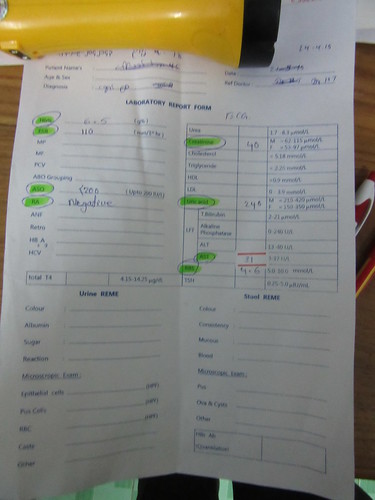
A completed lab report form.
Additional Facilities
Many patients display impaired mobility and joint pain from a variety of causes. The availability of a well-equipped physiotherapy unit at the clinic offers the possibility of helping patients to improve their situation.
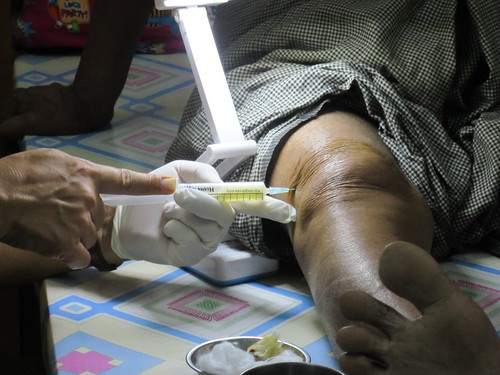 Treating knee problems.
Lunch and beyond
Once again, the Doctor broke-off at 11:30 to show his visitors the distribution of the free lunch. This time, the Head Monk and Emily shared the handing out of the plates of food whilst I, with help from the jolly Monk who calls patients for their initial assessment, handed out the pressed metal spoons.
 Distribution of free lunch.
The Doctor had hoped to break for his own lunch at about one o'clock but some tricky cases (one requiring an infusion) meant it was after 14:20 before his morning surgery was finished. Once again, we were treated to lunch in the monastery.
 Lunch in the monastery.
At the start of Dr. Hla Tun's afternoon surgery, three patients were brought in initially but, thereafter, as one patient left, another was admitted whilst the doctor was treating one of the other two patients. Each patient may require a number of injections but if the injections are straightforward, they may be carried out by one of the Doctor's assistants. The aim is to reduce lost time so that, as far as practical, the doctor and his two assistants are each working with a different patient.
 Back treatment.
Physical Records
Doctor Hla Tun has always insisted on comprehensive records. In addition to the patient's record book, written records are maintained at the clinic about treatments given. There is not a computer in sight but the Doctor can extract statistics in various ways. A surprising statistic is that, although the original concept was to provide health services to the Bagan area, now 90% of patients are from outside the Bagan area. Neither the Head Monk nor Dr. Hla Tun have any reservations about the involuntary expansion of services. They continue to aim to offer the best service possible.
I feel privileged to be able to report on this inspirational project but note that all errors are my own.
An Interlude
During the afternoon, I decided to explore the local area a little more. The monastery compound which houses the clinic is on a sandy cliff overlooking the Ayeyarwaddy River. Steep concrete-faced steps led down to the river, with a tablet acknowledging the donor:-
"The renovation of the stair case, its steps and railings is meant for the welfare and wholesomeness of the children at Taungbi Le Yar village and for the safety of staff who sail with the "Road to Mandalay" Supported by MICHAEL PERRY The Chef Road to Mandalay 1999 - 2003."
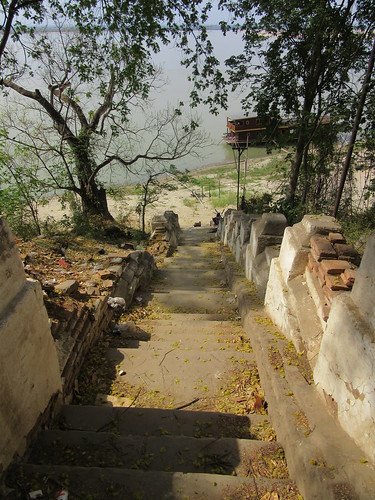
Steep steps leading to the river.
In a couple of places, electric pumps connected to long pipes were provided to lift water directly from the river to storage arrangements in the monastery compound.
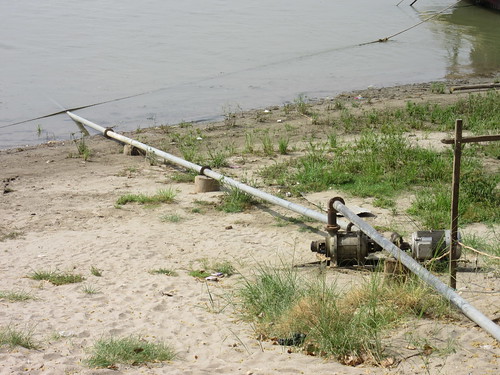 One of the electric pumps on the river bank.
But my eye was drawn to a moored ship, probably little more than a hulk but with paddle boxes either side, conjuring visions of the 'Irrawaddy Flotilla' and Kipling's words "Can't you 'ear their paddles clunkin' from Rangoon to Mandalay?". There's more about Kipling's Burma and his famous poem here.
 "Can't you 'ear their paddles clunkin' from Rangoon to Mandalay?".
Part of the fascination of the Bagan area is the sheer number of surviving pagodas - some large, some small, some in deteriorating condition, some carefully restored and built in differing architectural styles, according to their age. Within a few hundred yards of the Medical Clinic, I was able to explore a number of pagodas.
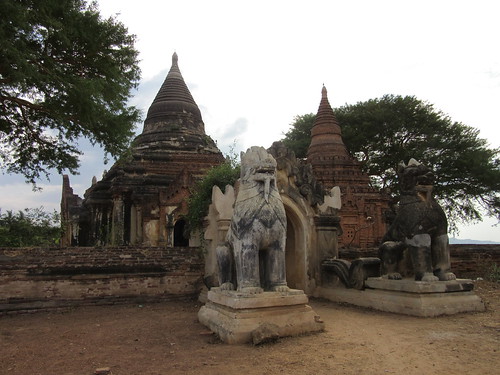 Pagodas protected by a pair of mythical Burmese lions (Chinthe).

A pagoda in a different style.

Yet another style of pagoda.
Exhausted by my explorations, I returned to the Bagan Medical Clinic but, after observing treatments for a while, Emily and I were taken by car to our respective hotels for a relaxing evening. The next morning, we would have a chance to observe the final day of clinic opening for that week.
Go to next post on this trip.
All my posts on the Bagan Medical Clinic can be found here.
All my posts on this trip to Myanmar can be found here.
My pictures
The following albums (on Flickr) hold pictures relevant to this post:-
Bagan Clinic, Saturday 25th April 2015.
Bagan Thiripyitsaya Sanctuary Resort.
Around Bagan, 2015.
All my albums for this trip (except purely 'technical' ones) can be found here.
[Text revised, pictures added 10th and 22nd June 2015]
In my last post Visit to Mon State, (Part 6), I described our return to Yangon. After an all-to-brief night's sleep at Dr. Hla Tun's house, we were to fly to Bagan where Dr. Hla Tun would spend the weekend seeing patients at the Bagan Medical Clinic.
Outline of the facilities at Bagan Medical Clinic
The Abbott at Bagan Monastery and Dr. Hla Tun have been the driving force behind this remarkable medical centre which provides virtually free medical care. Since August 2011, when the clinic first opened, it has seen rapid growth in facilities due to its popularity, thanks to the support of local and international donors including Belmond.
The first Clinic Building (opened in 2011 - see post here) remains in use as Patient Reception, Dispensary and Consulting Rooms. This has been supplemented by a larger building used for consultations, E.C.G., Laboratory and physiotherapy. That building had been open on my last visit, but it has since acquired an impressive array of second-hand gym equipment and specialist machines for heat treatment and remedial therapy and been divided to provide a consulting room, E.C.G. and Laboratory. A third building, slightly larger than the original building, was under construction on my last visit and is now fully commissioned. A central entrance area is flanked by a general consulting room one side and the consulting room used by Dr. Hla Tun on the other.
The original aim had been to provide care for the people of Bagan but the lack of affordable care in Myanmar has meant that patients are willing to travel long distances to receive treatment. Patients arrive from all parts of Myanmar using bus, train, boat and road vehicles (most commonly the passenger-carrying pick-up trucks but sometimes ancient heavy goods vehicles) and motorcycles. It's not uncommon for patients to have been travelling for two days to reach the clinic and the journey may aggravate the underlying problem. Patients from the new capital Naypyidaw, Yangon, Chin State and as far away as Magwe Division are common. To keep travel costs down, a group of patients from the same area will often club-together to hire transport and they must be prepared for a round trip lasting up to five days.
This means that looking after the welfare of waiting patients becomes a significant task. A number of shelters have been provided for waiting patients together with male and female toilet blocks. The Monastery provide a free hot lunch at around 11:30 on each clinic day and sometimes a meal is offered later in the day as well. A team of people prepare the nourishing meals which are distributed in just a few minutes to hundreds of waiting patients and their families. In addition, a number of privately-operated businesses have sprung up providing snacks and general goods.
Some of the monks are closely involved in the running of the clinic and the Abbot himself is a frequent sight around the clinic.
The Clinic is open on Friday, Saturday and Sunday each week but patients start to arrive from Wednesday. There are usually three doctors on duty, including Dr. Hla Tun. They are supported by physiotherapists and laboratory technicians. There is then a staff to assist the doctors, dispense the medication and manage the patients. Much of this work is carried out by volunteers.
Events of Friday 24th April
On Friday, 24th April 2015, I flew with Dr. Hla Tun, his son and Emily (a medical student from Ohio in the U.S.A.) on the 07:20 Air Bagan flight from Yangon Domestic Terminal to Nyaung Oo.

Nyaung Oo Airport, now polluted by huge western-style hoardings.
We were collected by the Bagan Station Manager for the luxury tour company Belmond (formerly Orient Express) who provide support for the Medical Clinic which is situated in the Monastery Compound at Old Bagan. The nearby Belmond Station at Bagan serves as the landing point for the Belmond river cruises by both 'Road to Mandalay' (which I've described in numerous earlier posts) and the new ship 'Orceila' (which I've yet to try).
When we arrived at the Monastery, we were immediately greeted by the elderly Head Monk who had arranged breakfast for us in the monastery.
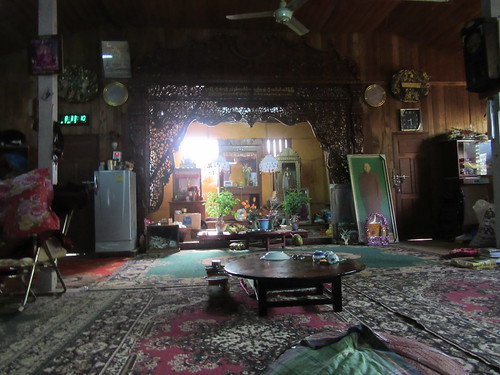 We had breakfast in the monastery.
After our breakfast, Dr. Hla Tun took us on a conducted tour of the centre.
 Dr. Hla Tun and Emily outside the first clinic building.
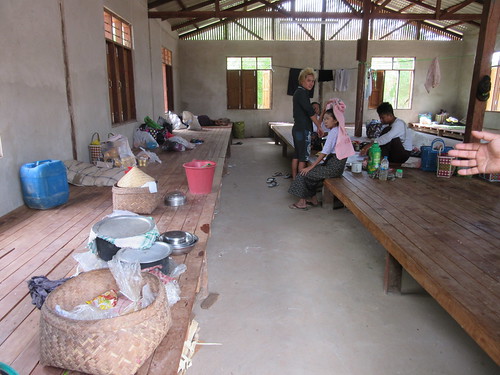 The most recent of the patient shelter buildings is of durable construction.
Patient numbers are unpredictable and tend to vary with the seasons. Friday was a "quiet" day. When we arrived, 180 patients had registered and a further twenty arrived later in the morning. Auxiliaries take the blood pressure of each case before they are seen by one of two doctors.
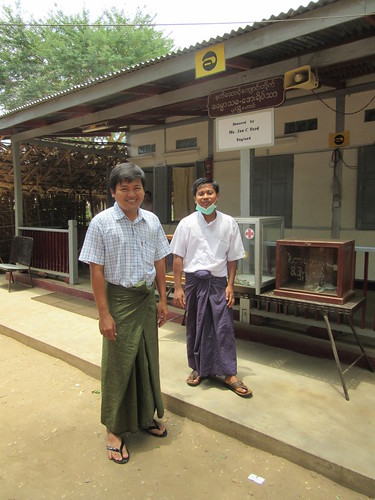
The two doctors who work with Dr. Hla Tun at the clinic.
More complex cases are referred to Dr. Hla Tun and these tend to take longer so his caseload was around 45 out of the 200 but, of course, he remains 'on call' to all the staff so there are frequent interruptions.
At 11:30, Dr. Hla Tun broke off briefly to show his visitors the offering of the free lunch. The kitchen team furiously made up the individual meals on a series of metal plates as the patients lined up to receive them.
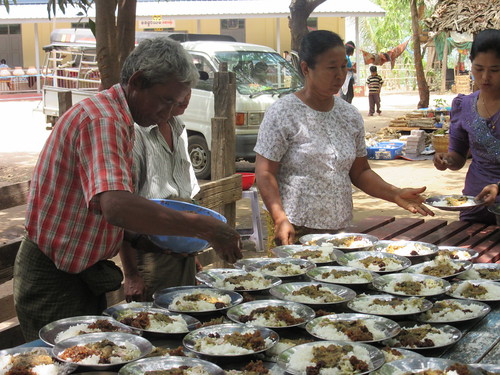 The kitchen team serving lunches.
At first, the Head Monk offered meals to each member of the queue, next Emily was invited to make the offerings and then the writer took over. Dr. Hla Tun, together with a newly-qualified lady doctor from Myanmar who trained in the U.S.A., Emily and the writer were then invited to the Monastery for our lunch where the Head Monk kept a watchful eye to ensure we all ate enough.
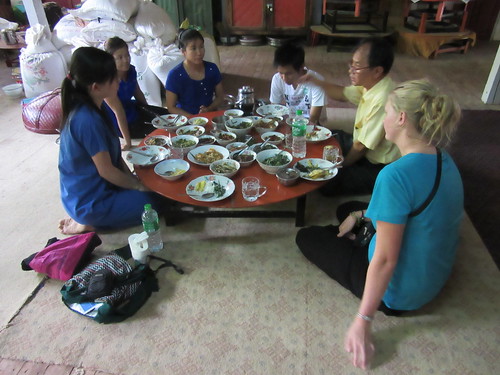 Lunch in the monastery.
After taking lunch, consultations then continued in the afternoon.
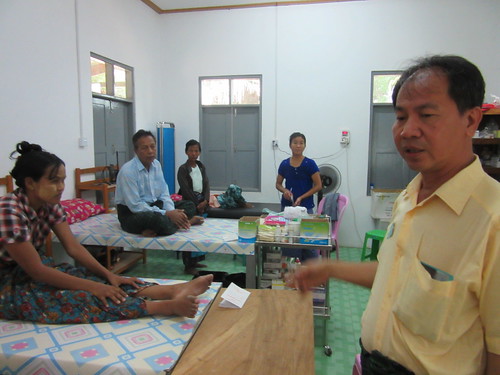 Dr. Hla Tun's consulting room has three examination couches.
Emily and I left the Clinic and were taken to our respective hotels at about 17:30. This time, I was booked into the Bagan Thiripyitsaya Sanctuary Resort.
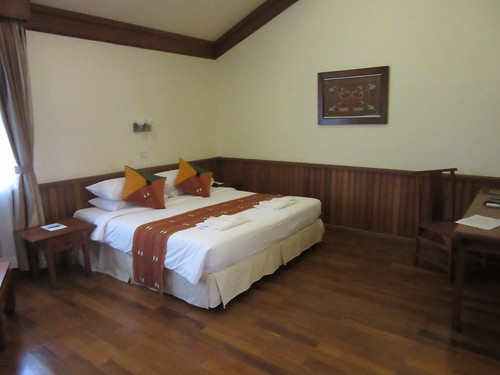 My comfortable accommodation at the Bagan Thiripyitsaya Sanctuary Resort.
After a shower, I took a light meal at the hotel's open-air restaurant, offering views across the Ayeyarwaddy River. As it grew dusk, a young lady played traditional music on a Burmese Harp called a Saung.
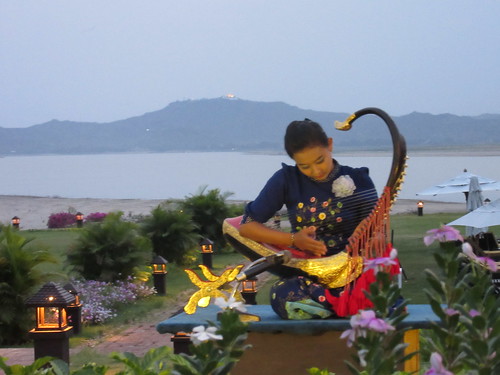 View from my hotel's open-air restaurant.
I'm afraid Dr. Hla Tun did not expect to finish his consultations until around midnight. He admitted the following morning that, in fact, he didn't finish until a quarter to one in the morning. Stamina is needed to work at the Bagan Medical Clinic!
Go to next post on this trip.
All my posts on the Bagan Medical Clinic can be found here.
All my posts describing this trip to Myanmar can be found here.
My pictures
The following albums (on Flickr) hold pictures relevant to this post:-
Bagan Clinic, Friday 24th April 2015
Bagan Thiripyitsaya Sanctuary Resort.
All my albums for this trip (except purely 'technical' ones) can be found here.
[Text revised, pictures added 10th June 2015. Text revision 20-June-2015]
In Part 5, I described our activities in Mawlamyine before we checked in at the Cinderella Hotel for our last night in Mon state.
Thursday 23rd April April 2015
On Thursday morning, we enjoyed an excellent breakfast at the Cinderella Hotel before setting off by car to return to Yangon. The Doctor had allowed for more sightseeing on the way so we first stopped at the Win Sein Taw Ya Pagoda which houses the ‘World’s Largest Reclining Buddha’. This was my third visit to the site - I'd first visited in 2012 (described in the post South of Mawlamyine, Burma). The following year, Doctor Hla Tun had carried out distributions to children from Mudon Township at the Win Sein Taw Ya Pagoda and this is reported in the post Orphans and Vulnerable Children Project in Myanmar. During my Burma trip in 2014, the Doctor and I made another visit (briefly described in the post South from Mawlamyine by Car).
The straight road leading to the pagoda has an impressive line of full-size painted concrete statues of monks, each carrying an offering bowl. As you get nearer to the reclining Buddha, the line of statues traverses an arch over the approach road and continues into the monastery grounds.
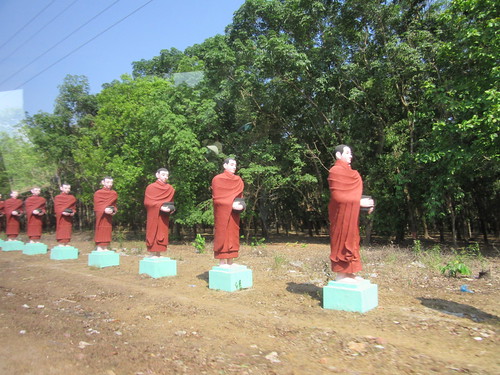 The line of full-size painted concrete statues of monks.
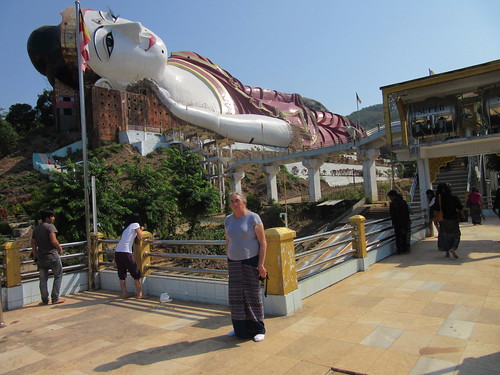 Jan at the at the Win Sein Taw Ya Pagoda in on this trip.
After the necessary photographs had been taken, we continued north. The Doctor had intended that we would visit the famous 'Golden Rock' at Kyaikto, but Fate intervened.
I had dozed off as we drove north when it happened. There was a loud explosion and I thought "That's not a dream!" I opened my eyes in time to see both front air bags inflating. Our driver held the car in a straight line whilst braking as an acrid smell and clouds of dust filled the cabin. I had no idea what had happened but, as soon as we came to a stop, I deemed it prudent to exit the car promptly. Nobody seemed hurt although we were all rather shaken. Looking at the vehicle, the left front wheel had twisted 90 degrees from its usual fore-and-aft position and the tyre was shredded so the car had slumped down at an unusual angle.
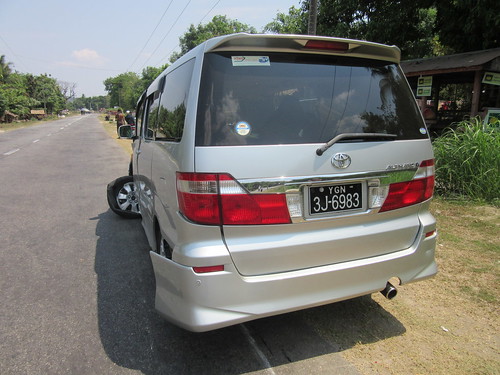 Our car was severely damaged.
I was told that a car travelling in the opposite direction had 'side-swiped' our car then continued along the road before turning on its side and coming to a stop, after which the driver ran off. We'd stopped in a village near a roadside shelter where Emily and I waited while the others came up with a plan. Of course, all the local people came to inspect the damage. After a while, a policeman arrived on a small motor bike.
 "... all the local people came to inspect the damage ..."
We were invited to wait in the house of a local resident just opposite. Emily and I were made comfortable and electric fans were brought, since the day was very hot. I'd been asleep before the accident and, perhaps because of the shock, I found it difficult to take much notice of what was going on around me but eventually I understood that a car had been summoned from Yangon to rescue us but it would be at least four hours before it arrived. Doctor Hla Tun decided that we would take lunch while we waited, so a three-wheel motor cycle taxi was summoned and we all piled aboard for a journey of a mile or two back the way we had come to a roadside cafe. We were shown to a private dining room attached to the cafe where we enjoyed a relaxing, leisurely lunch. I felt much revived after the meal. Eventually, the motor cycle taxi took us back to our sorry-looking car which still held our heavy luggage and our 'relief car' arrived from Yangon.
 Our sorry-looking Toyota after the accident.
Luggage was transferred to the 'relief car' and we set off for Yangon, with two of our party remaining behind to arrange the 'ferrying' of the badly-damaged car to Yangon for repairs. Our trip to the 'Golden Rock' was, of course, cancelled and we drove through Kyaikto on the main road without stopping. It was dark by the time we arrived at the junction with the dual carriageway near Bago and it was decided to stop for a snack before the final 'leg' of our journey back to Yangon, where Emily and I were to stay at Doctor Hla Tun's house.
It was my first visit to the Services here. Although there were a number of long-distance buses in the car park, the large cafe wasn't very busy.
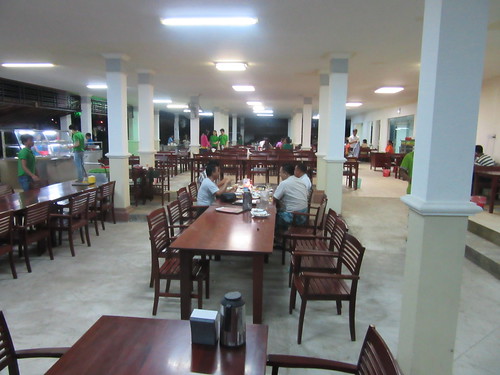 The bright, airy cafe at the Services.
The Services were very 'western' in style and the only reminder that we were in Myanmar came when I visited the toilets. Western-style toilets had been provided, rather than the ground-level 'squat' toilets more common in Asia. A simple graphic was displayed reminding users that attempting to 'squat' on western-style toilet bowls may lead to injury.
 A graphic reminder of the pitfalls of misunderstanding the use of 'western' toilets.
Late evening, tired but fortunately unhurt, we arrived at Doctor Hla Tun's house. I was keen to get to bed because, the following morning, we were to catch the 07:20 domestic flight from Yangon to Nyaung Oo where we would transfer by road to the Bagan Medical Clinic.
Go to next post.
All my posts on the 2015 trip to Myanmar can be found here.
My pictures
The World's Largest Reclining Buddha, Myanmar
(includes pictures from 2012 and 2015).
By road to and from Mon State.
[Actually first posted 9th June 2015, but timestamp amended to place posts in event order]
In Part 4, I described our journey to Setse Beach, where we stayed at the curiously-named 21 Paradise Hotel.
Wednesday 22nd April 2015
After a refreshing night's sleep, we had a good breakfast in the hotel restaurant, overlooking the beach.
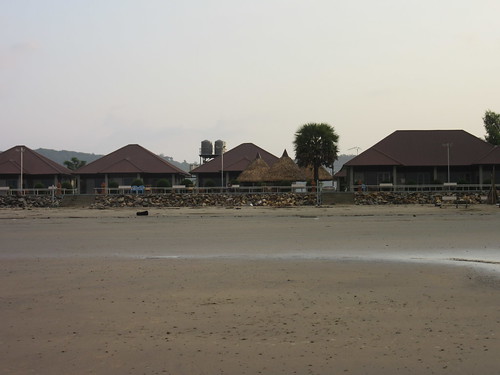 View of our hotel from the beach.
Setse has a broad, sandy beach, flanked at each end by small headlands. The rooms of our modern hotel, grouped as a series of separate 'cottages' extended for some distance along the beach. Further along the beach, we could see bamboo houses and temples. There were already a number of people enjoying the beach, including one motor cycle being driven in a surprisingly restrained manner and a horse with its keeper apparently selling beach rides. The horse seemed to be enjoying the morning as much as the father and young son riding. A group of three dogs were also checking out the interesting scent trails on the sands. At the water's margin, small waves were breaking and, just offshore, a number of small fishing vessels were gathered.
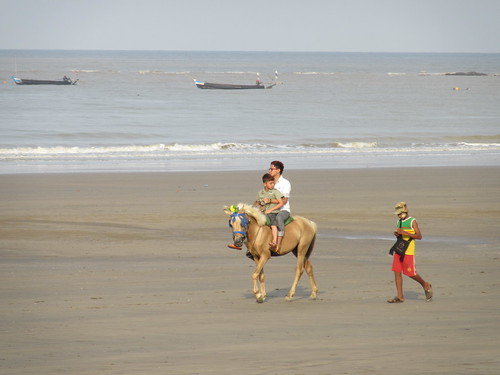 Setse Beach.
We checked out of the 21 Paradise Hotel, loaded up the car and set off for Mawlamyine. At Mawlamyine, two Distributions were planned - the first at the large Drop In Centre at Hlaing, the second at the smaller Centre called 'Future Generation'. I'd been to both locations before in 2014 (described here).
During my visit in 2014, the Drop In Centre at Hlaing had been bursting at the seams with over 400 children attending for the Distribution. This time, to better accommodate the numbers at the ceremony, a large covered area had been temporarily erected in the field outside the permanent building, comprising a series of collapsible, steel-framed canopies supplemented by bamboo-framed extensions. The school uniforms and stationery had already been made up into labelled 'kits' in school bags by the Centre's volunteers and placed on a low 'stage'. At the rear of this 'stage' a large banner, in English and Burmese, declared "7th Donation Ceremony for the students who need aids in 2015-2016 academic year at Hlaing area by the support of Dr. Hla Tun and Group".
All the children were patiently waiting in the temporary covered area, seated on the ground which had been covered with a series of mats. To one side, a table with a range of refreshments had been set up in front of a row of chairs intended for Doctor Hla Tun and his team.
 A view of part of the temporary covered area at Hlaing, viewed from the permanent building.
First, in the Drop In Centre, Doctor Hla Tun made donations of financial support towards the education costs of five senior girl students.
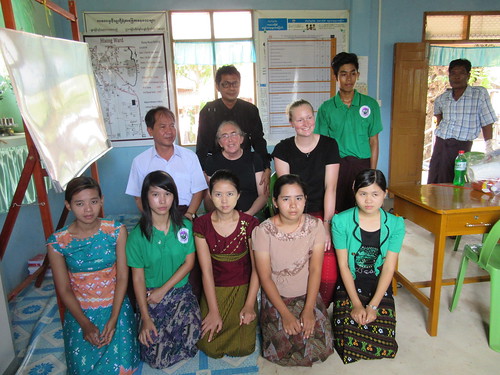 The five senior girl students who received assistance.
A television news team from the local Sky Net station's 'Up to Date' programme were recording the event and conducting interviews, as they had on my previous visit.
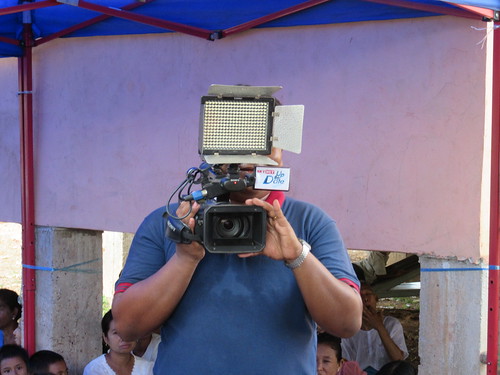 The Sky Net cameraman at work.
Then followed the usual fairly frantic period when the visitors presented the gifts to the children, with volunteers from the Centre ensuring that each child received the right 'kit' appropriate to the age and sex of the recipient. The children then changed into their new school uniforms for the 'group shot'.
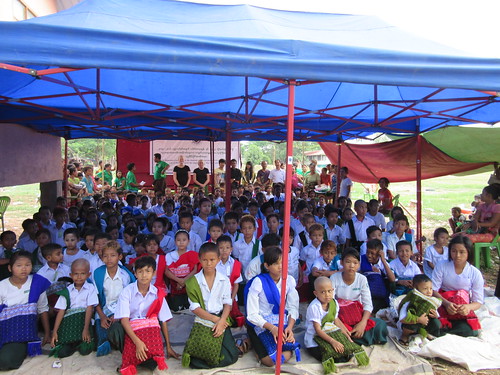 The smartly-attired children display their new school bags.
It was decided to take more informal pictures of the group in the field so we all lined up again whilst pictures were taken on numerous cameras to adequately record this important annual event.
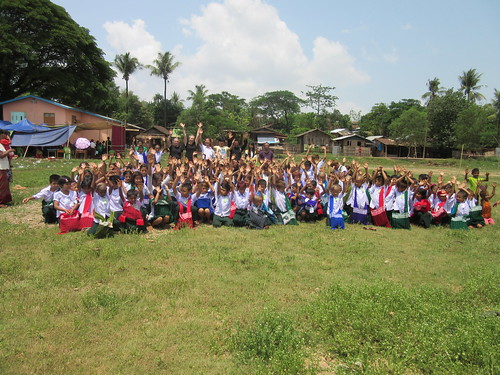 "Everybody wave": The Drop In Centre (and the temporary covered area) can be seen in the background on the left.
The work of the Drop In Centres is only made possible by volunteer staff and Doctor Hla Tun made donations to support these volunteers.
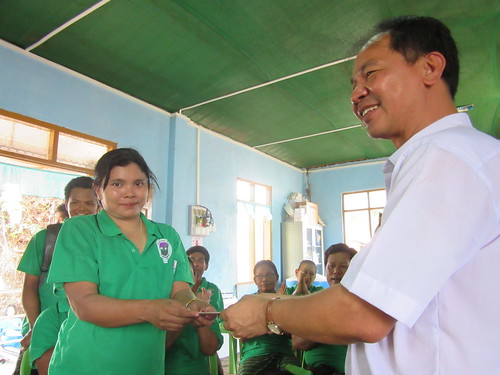 Donations to volunteers at Hlaing D.I.C.
Hlaing Ward, with a population of around 20,000 is one of the poorer Wards in the Township of Mawlamyine. To gain a better idea of conditions in the area, we went on a walk around the Ward, calling at a number of 'O.V.C. Houses' which provide accommodation for some of the children who are without families. Once again, Doctor Hla Tun made donations to support this work.
 An O.V.C. House. The young boy is proudly showing off his new school uniform and school bag, presented to him earlier at the Drop In Centre.
We then returned to the centre of Mawlamyine where we stopped at a large, busy cafe to take lunch. All the waiters were boys, some looking very young. Young, male waiters seem very common in Burma, as is a tendency for them to shout instructions across the cafe at the top of their voices.
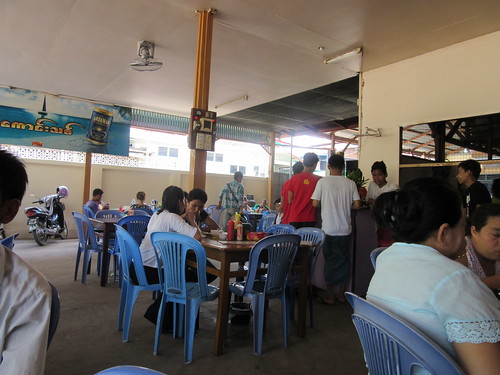 Lunch in Mawlamyine.
Our car then look us to the 'Future Generation' Drop In Centre. Once again, we were made very welcome and, for me, it was a chance to see once again staff I'd met the year before.
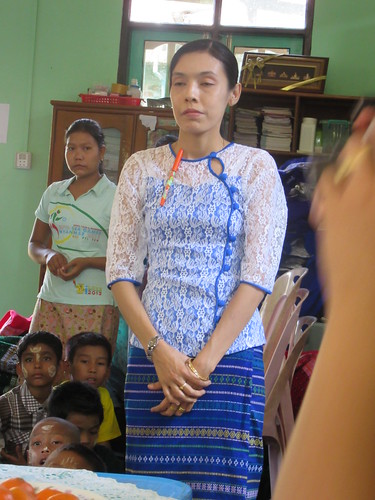
The Manager of 'Future Generation'.
The Distribution proceeded with the usual air of joyful chaos, as the children changed into their new uniforms for the obligatory group photograph.
 After the distribution, the children pose with their school bags wearing their new uniforms.
Not far from the 'Future Generation' Drop In Centre, we made a visit to another O.V.C. House where Doctor Hla Tun also made donations. I believe it's thought that the problems of HIV/AIDS particularly affecting Mon State are due to the area's proximity to Thailand, which has experienced major problems with HIV/AIDS. Even where children themselves do not carry HIV, the incapacity or death of parents can have a devastating effect on the life of children, hence the importance of O.V.C. Houses and the availability of Drop In Centres. In the 'Future Generation' D.I.C. I'd notice a poster, largely in Burmese, but framed in English "Where there is Care, there is Hope". The 'Road to Mandalay' Social Contribution and Doctor Hla Tun became involved in Mon State to help to provide this care. I discussed some of the background to this in the post 'Road to Mandalay' co-operation with other organisations.
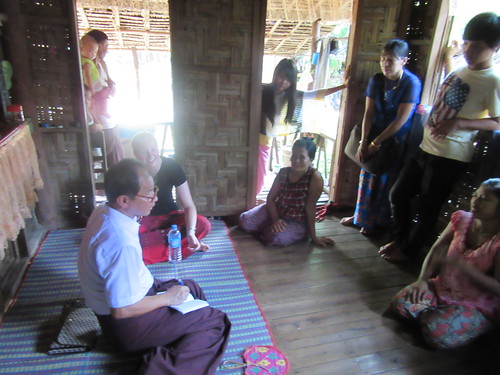 Visiting an O.V.C. House near 'Future Generation'.
Doctor Hla Tun had arranged another hotel for the night so we drove to the centre of Mawlamyine and checked into the rather oddly-named 'Cinderella Hotel'. The staff were very friendly, the facilities quite good and the prices modest. After we'd settled in, we went by car to Strand Road, overlooking the water, for dinner. Strand Road (as I commented last year in my post last year here) "takes on a holiday atmosphere at sunset" and there were lots of people around, strolling and relaxing. Along one section, there was a very broad pavement which accommodated a series of open-air cafes where we look our evening meal. Some aspects of Western 'civilisation' being introduced into Myanmar are not appreciated by the writer. Looming over our pavement cafe was a huge advertising hoarding - a wide, tall steel tube supporting a massive large-screen T.V. which bathed our meal in flickering light whilst we were deafened by the insistent sound track. The food, however, was good. After our meal, we drove along Strand Road where, in the twilight, I spotted a ship moored just offshore involved in some sort of dredging operation.
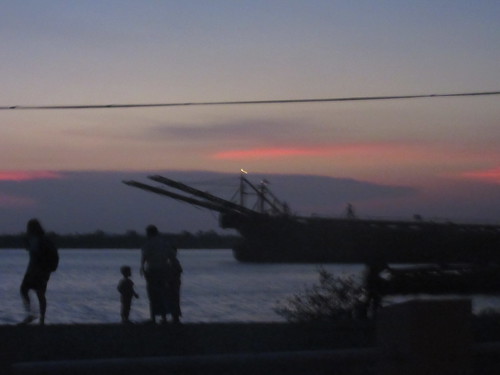 Strand Road at sunset, looking west.
Then, it was back to the Cinderella Hotel and bed. On the following day, we were to head back north to Yangon.
Go to next post.
All my posts describing this trip to Myanmar can be found here.
My pictures
The following albums (on Flickr) include pictures relevant to this post:-
Setse Beach.
Hlaing Drop In Centre, Mawlamyine.
Around Hlaing Ward.
Around Mawlamyine 2015.
'Future Generation' D.I.C..
All my albums for this trip (except purely 'technical' ones) can be found here.
[Actually first posted 8th June 2015, but timestamp amended to place posts in event order. Text and pictures added 19-June-2015]

