skip to main |
skip to sidebar
Sandakan, Sabah, Malaysia: Tuesday, 10th February 2015
After our visit to the Agnes Keith House and lunch at the English Tea House and Restaurant (described in Part 21), the coaches took us to the Bornean Sun Bear Conservation Centre and Sepilok Orangutan Rehabilitation Centre. These two important conservation locations are side-by-site near Sepilok, about fourteen miles from Sandakan town.
We first toured the Bornean Sun Bear Conservation Centre (BSBCC). This was set up by biologist Wong Siew Te in 2008 to rescue and rehabilitate Sun Bears kept in unhealthy captivity in Sabah with support from the Sabah Wildlife Department, the Sabah Forestry Department and Land Empowerment Animals People. In 2008, the Centre started with 7 Sun Bears and by 2013, 28 Sun Bears were being cared for. We passed through the rather smart reception building and climbed steps to an extensive overhead viewing area, looking down on a large area of forest which had been fenced off for the Sun Bears. We watched a number of the small, attractive Sun Bears snuffling around the undergrowth. The bears share the space with a number of monkeys who kept us amused with their acrobatics.
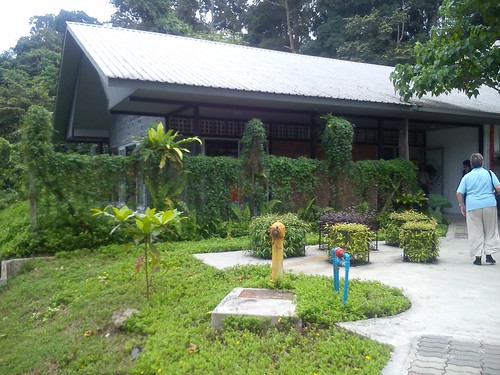 The Entrance to BSBCC.
 One of the Bornean Sun Bears.
There's a Wikipedia article on Sun Bears here.
Leaving BSBCC, a short walk took us to Sepilok Orang Utan Rehabilitation Centre. This was founded in 1964 in a 43 square kilometre reserve to look after orphan Orangutans. There are now up to 80 Orangutans living free in the reserve. A boardwalk for visitors circles around part of the forest with a large viewing area overlooking the feeding platform. Basic food is delivered to the feeding platform twice a day. It's a deliberately boring diet to encourage the orangutans to forage for their own food in the extensive forest so there's no guarantee orangutans will appear at the feeding platform. Our visit had been timed to co-incide with the afternoon feeding so the viewing area was already crowded with visitors when we arrived. We'd watched at least one orangutan performing gymnastics high in the trees before one of the staff delivered a basketful of food to the Feeding Platform. A couple of orangutans arrived, sat down and slowly munched their way through the food. They seemed happy to let monkeys steal some of the food.

The Entrance to Sepilok Orangutan Rehabilitation Centre
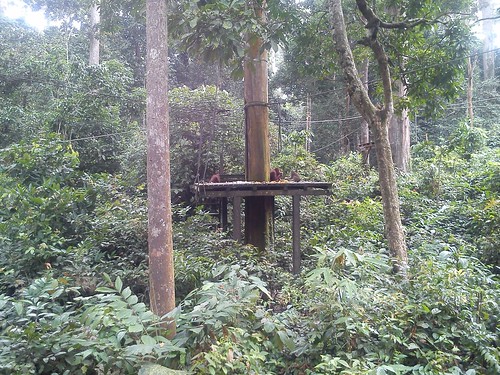 Two orangutan (and the inevitable monkey) at the feeding platform.
There's more about Sepilok on the U.K. Appeals site here.
After watching the orangutans, we made our way back to the entrance. Some of our group watched a video presentation in the air-conditioned theatre, some visited the shop, others did a spot of bird watching. We then re-joined our coaches for the drive back to Sandakan after a fascinating, if tiring, day. We drove to the Four Points by Sheraton hotel at Sandakan Harbour Square, where check-in was very promptly carried out. Issued with a room access card (which also was needed to make the lift work), I was soon in my room on the 21st Floor, with my luggage waiting for me. The views of the town and the bay were stunning.
Later, we enjoyed a buffet dinner in the modern dining room. After the meal, I was tempted to retire but, remembering the maxim "I may never pass this way again", decided I should make the effort to have a walk around the town. Although now dark, there was plenty of artificial lighting. I joined two of my fellow-passengers and we made our way along the shore line which featured a number of bars and cafes overlooking the Bay. I declined their offer to join them for a drink at one of the open-air bars and pressed on, passing the bus station thronged with local people, and then the Navy Base. Beyond the Navy Base, there was a long promenade which seemed to attract a number of young couples enjoying the warm evening. The sea wall had been built from pre-cast concrete sections and each one had been used as a canvas where locals had added graffiti on various topics. There were the usual declarations of love but I was fascinated by a rather crude depiction of a Malaysian Airways aircraft crashing which I took to be a commemoration of the loss of Flight 370 or Flight 17 (or both). By now quite tired, I returned to the hotel and slept soundly in the large bed.
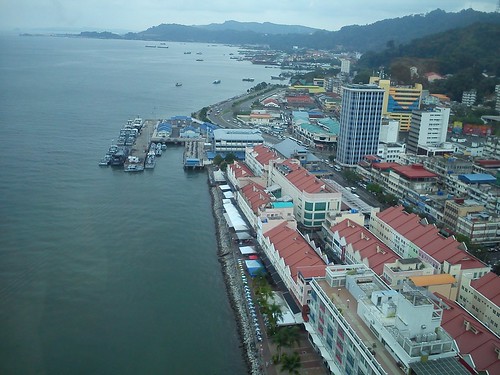 View of Sandakan from the Four Points by Sheraton hotel. The dock we arrived at is on the extreme left of the promentary in the distance.
Sandakan, Sabah, Malaysia: Wednesday, 11th February 2015
I took a fairly light breakfast and determined to make one final foray into the town before leaving by coach for the airport. First, I walked around Sandakan Central Market - a modern building offering anything you can imagine, including a large fish market with many unfamiliar species on display. I continued walking along the main road near to the shore as far as the base of the Marine Police, with its large covered slipway. I then retraced my steps and took the direction of the previous evening, passing the bus station and Navy Base. The road next to the sea wall had lost its young couples - these had been replaced by a long row of white 'minibuses' about the size of a small van, waiting for business. Beyond the next rounabout lay a pleasant, wooded park overlooking the bay. A building in the corner of the park is the Dewan Masyarakat Sandakan, which is shown as an 'Event Space and Convention Center'. At the far end of the park, I had a good view of the first of a number of jetties serving fishing vessels. A few boats were still returning, presumably after a night fishing. I decided I'd better turn round and return to the hotel in order to catch the coach transfer to Sandakan Airport. On the way back, I completed an artistic photo-essay of Sandakan (using my mobile 'phone, as my Fuji camera had failed much earlier in the trip), which I'm sure you would have enjoyed, had I not left the telephone on the table in the hotel reception in the rush to board the buses. I discovered the loss as soon as we arrived at the airport and alerted the agents, who contacted the hotel. Alas, 'phone and pictures were never discovered.
Sandakan has a fairly small airport. We enjoyed the usual hanging-around whilst waiting for check-in to commence. Most of the passengers off the ship were travelling on the same flight to Kuala Lumpur together. There, the majority would transit to a British Airways London flight, after a fairly long wait. After an even longer wait, I was booked on an Emirates flight to Dubai, changing there for a Birmingham flight. And so my cruise from the Coral Sea to the South China Sea came safely to an end, leaving me with memories of exotic locations and friendly people.
You can find all the posts on this trip here.
My pictures
Sandakan, Sabah, Malaysia.
Bornean Sun Bear Conservation Centre.
Sepilok Orang Utan Rehabilitation Centre.
Four Points by Sheraton, Sandakan.
THE JOURNEY, THURSDAY, 26th MARCH 2015
I'd been invited to the Irlam Station Launch that day by Hamilton Davies Trust and the joining instructions gave details of car parking arrangements adding "But wouldn't it be great to arrive at the station launch by train?". I replied (somewhat indignantly) "CAR? No, I intended to entrust myself to the tender mercies of Northern Rail in any case." Northern Rail had kindly provided some complimentary tickets from Manchester or Liverpool to Irlam and one of these was issued to me.
The simplest route would probably have been Wolverhampton to Warrington Bank Quay, walk to Warrington Central then two stops along the former Cheshire Lines Committee route to Irlam. However, to give me the opportunity of further research on Edge Hill Cutting, I decided to travel on the 11:20 'London Midland' service from Wolverhampton to Liverpool Lime Street and then on the 12:55 'Northern Rail' service as far as Irlam.
The Wolverhampton to Stafford line is in the process of being re-signalled, prior to control being transferred to the West Midlands Signalling Centre. Network Rail are committed to centralising signalling control at a small number of Integrated Electronic Control Centres (IECC) covering large areas. There's a brief description in 'Wikipedia' here. The picture below (snatched from a passing train on an earlier journey on the Derby Line) shows the West Midlands Signalling Centre at Saltley, Birmingham, which is progressively taking over control of the the railways in the West Midlands.
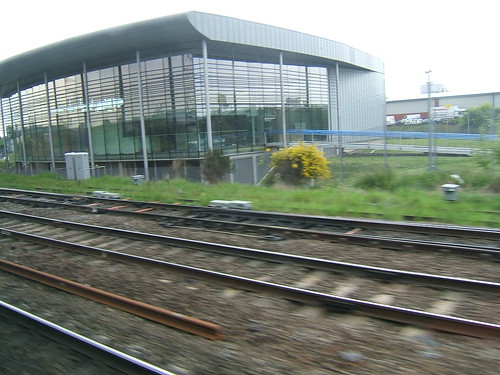 The futuristic West Midlands Signalling Centre at Saltley, Birmingham.
On the way to Stafford, we passed a number of small gangs of men working on signalling . Some replacement signals were already in use, others were lying flat, awaiting installation. At present, the next signal box to Wolverhampton Power Signal Box is Stafford Number 4, south of Stafford station and then Stafford Number 5, north of Stafford station. We made our scheduled stop at Stafford and then made good time on the Down Fast to Crewe. The signalling on the line from Stafford to Crewe was modernised some years ago and is now controlled from Stoke-on-Trent. However, approaching Crewe, control passes first to Basford Hall Junction (a much-modernised LNWR box) and then to Crewe Signalling Centre which is situated on the site of the former Crewe North Motive Power Depot (and which I always think looks like a B & Q warehouse). We arrived in platform 11, where quite a few passengers got off or boarded. I didn't find out the significance of the 'bear' wearing a High Visibility jacket who was trying to embarrass the member of station staff 'seeing us away'.
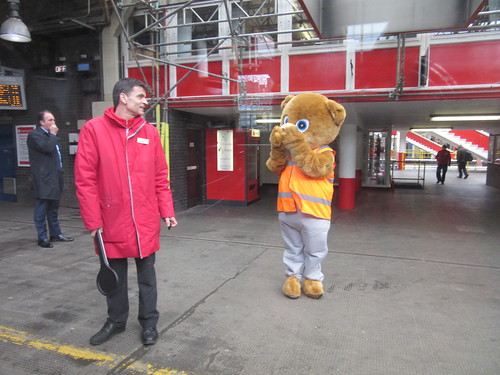 The 'bear' in the High Visibility jacket at Crewe station.
Crewe Signalling Centre only controls the immediate station area (it was a 'temporary' arrangement, some years ago) so the next signal box is the A.R.P. box at Crewe Coal Yard. From Crewe, we ran on the Down Slow, so I was not surprised when we slowed to a standstill just short of Winsford where the four running lines (Down Slow, Down Fast, Up Fast, Up Slow) reduced to two. I correctly guessed that we were about to be overtaken. Sure enough, I noticed the overhead line over the Down Fast start to oscillate slowly up and down and a few seconds later a 'Pendolino' swept by us. The pressure wave caused my train to lean away briefly on its air suspension. The overhead line over the Down Fast continued to oscillate after the train had passed. Very soon, our signal cleared and we carried on to our booked stop at Winsford station. The next box to Crewe Coal Yard is Winsford (another much-modernised LNWR box) which controls the line to and including Weaver Junction, interfacing with Halton Junction (on the Liverpool Line) and Warrington Power Signal Box (on the West Coast Main Line). We made further booked stops at Hartford and Acton Bridge before taking the Liverpool line at Weaver Junction. The previous signal box at Weaver Junction still stands on the up side with its operating floor boarded-up. It had a small 'NX' panel put in when the West Coast Main Line was first electrified.
Next, on our left, Halton Junction signal box is another LNWR survivor, heavily modified. The former double track spur to Frodsham has been singled and made uni-directional, allowing traffic from Frodsham to Halton Junction but not the other way. We then passed through the sandstone cutting to Runcorn station, which retains its A.R.P. signal box. After a brief stop at the character-less modern station, we crossed the River Mersey on the spans of the lattice-girder Runcorn Railway Bridge (with its Grade II* listing) and then traversed the sweeping Ditton Viaduct.
The station at Ditton Junction is long closed but one LNWR signal box hangs on, called simply 'Ditton'. There are four running lines (paired by use) from here to Wavertree. There are Exchange sidings on our left serving the car plant at Halewood then another surviving LNWR signal box, Speke Junction, controlling one junction of the triangular connection serving the Freightliner depot adjacent to Garston Dock. Freightliner call this Depot 'Liverpool', to distinguish it from their 'Seaforth' depot. There's an outline of their Port and Terminal Network here. The second junction to Garston is controlled by the next signal box - Allerton Junction, which also controls the junction with the Hunt's Cross Chord which allows trains from Lime Street to join the former Cheshire Lines Committe route to Manchester. We stopped at the modern station of Liverpool South Parkway (formerly Allerton) so I could have changed here for the Northern Rail service to Irlam but, as I mentioned above, I'd decided to use the trip to look again at the Lime Street Cutting. My train carried on to Edge Hill (where there's an 'NX' signal box) then down through the cutting to Lime Street, still controlled by a Westinghouse Style 'L' 'All Electric' power frame in the A.R.P. design signal box dating from the 1940s.
I knew that video from inside a train with no opening windows, double-glazing and bright lights wouldn't be very good, but there's a video from Edge Hill to Lime Street here.
My train arrived at its usual platform 8, leaving me plenty of time to make my way across to the 'local' platforms (1 to 6). The original Liverpool and Manchester Line had been recently electrified at 25 kV a.c. and I was able to get a picture of one of the "new" Northern Rail electric multiple units. Four-car set 319 363 was standing in platform 1 looking quite smart in its blue livery labelled 'Northern Electrics'. Of course, the Class 319 were introduced between 1987 and 1990 and have seen heavy use in the London area. There's a Wikipedia article here. Early in 2015, the first of 20 sets of the 25-year old trains cascaded from the London area entered service following 'overhaul'. Northern Rail wax quite lyrical about the new seats and paint job here. Of course, under our crazy rail privatisation, trains are actually owned by one of the 'ROSCOs' - Rolling Stock Companies, in this case Porterbrook and their sales catalogue for Class 319 here makes interesting reading.
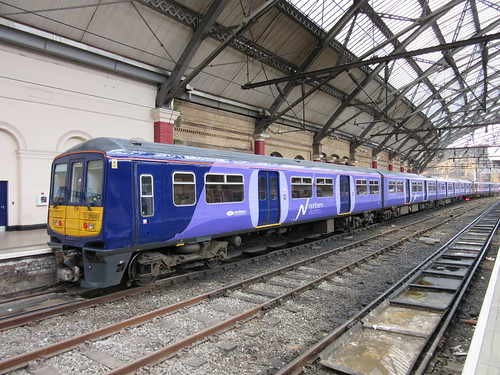 Class 319 electric at Liverpool Lime Street.
The big departure board on the concourse gave platform 6 for the 'Northern Rail' train to Manchester Oxford Road I was to catch. I was 'foxed' for a minute because the Passenger Information Display at the entrance to the platform only showed a Norwich service. Then, I realised that the 2-coach Class 156 on the buffer stops was my train and the other coaches formed the East Midlands Trains service to Norwich. We set off on the same route as the Norwich train, but we were booked to stop at most stations. Up the bank on the Up Fast to a brief stop at Edge Hill station, then we passed Edge Hill Power Signal Box and diverged to the right onto the Crewe line stopping at Mossley Hill, West Allerton and Liverpool South Parkway. Allerton Junction signal box turned us onto the Hunt's Cross Chord. As we passed Northern Rail's Allerton Train Maintenance Depot, I spotted another of the "new" electrics.
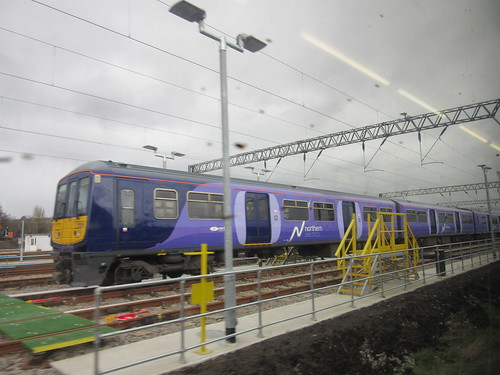 Class 319 electric at Allerton Train Maintenance Depot.
Our next stop was Hunts Cross where most of the people on the platform were waiting for the Merseyrail electric train (there's a brief description of an earlier visit to Hunts Cross in More Merseyrail. Setting off again, we passed the rather bleak modern signal box then stopping at Halewood, Hough Green and Widnes. As I mentioned in the the section 'THE CLC ROUTES TODAY' forming part of the post The Cheshire Lines Committee, 'Widnes' station was orignally named Farnworth but when the loop through Widnes was abandoned and the original Widnes station lost, the name was transferred to Farnworth. I doubt if many people were fooled by this sleight-of-hand. Then we stopped at Sankey for Penketh and Warrington Central. At platform level, this station, with its polychromatic brickwork and glazed canopies supported on cast columns has been quite attractively restored. The structure of the classical main station building on the up side survives (let out to small businesses, I believe) but access from the street is now via the usual miserable British Railways 'modern' building. Warrington Central retains its British Rail Standard signal box on the down side. My train was not booked to stop at the next station, Padgate and after pausing at Birchwood (modern brick brutalism, I'm afraid) we didn't stop at Glazebrook either, but other services do stop at both Padgate and Glazebrook. The triangular connection to the G.C.R. line to Wigan west of Glazebrook station is long gone, together with the signal boxes at Dam Lane Junction and Glazebrook West Junction but I did spot a redundant road overbridge over the former branch from Glazebrook West Junction. Glazebrook East Junction (another British Rail Standard signal box) survives, although the branch to Stockport and the Exchange Sidings with the Manchester Ship Canal have gone. The box now talks to Warrington Central signal box and Manchester Piccadilly Signalling Centre and controls a Down Passenger Loop and a crossover between the main lines. The next stop was Irlam where I left the train and I received my first sight of the Irlam station building I'd come to visit. My train departed, to shortly cross over the Manchester Ship Canal.
When the Cheshire Lines Committee built the line from Liverpool Central to Manchester, they placed the main station building at each intermediate station, including Irlam, on the Down side of the track. Later, when the Manchester Ship Canal was built, it intersected the railway just east of Irlam station. So that a bridge could be used to carry the railway over the canal, inclines were necessary in the railway on either side of the bridge and the railway was deviated to the south. This required a new station to be built to the west of the first station. After the deviation and new station were introduced, Irlam became the only intermediate station on the line where the main station building was on the Up side of the line!
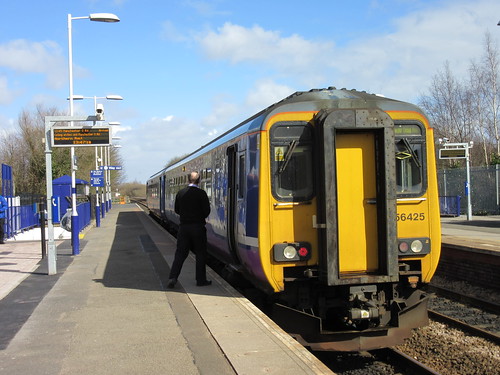 Irlam Station: The train which had brought me from Liverpool about to leave.
For a description of the 'launch' itself, see Irlam Station Launch.
SIGNALLING FROM WOLVERHAMPTON TO LIVERPOOL
Wolverhampton Power Signal Box in 2013

Click here for other sizes.
Stafford No. 4 in 2013
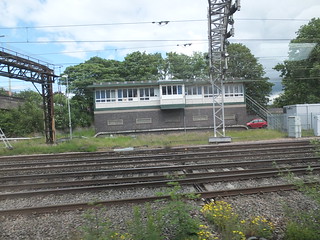
Click here for other sizes.
Stafford No. 5 in 2013
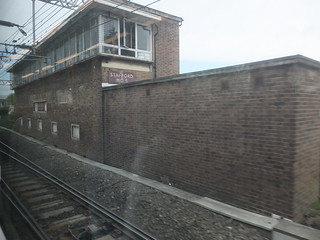
Click here for other sizes.
Stoke-on-Trent Signal Control Centre
Sorry, no suitable illustration at present.
Basford Hall Junction in 2013

Oh dear - not very good.
Crewe Signal Control Centre in 2014

Click here for other sizes.
Crewe Coal Yard in 2015
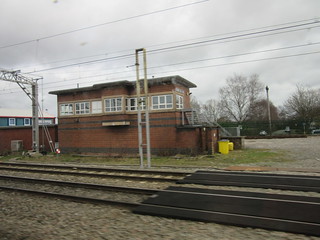
Click here for other sizes.
Winsford in 2015
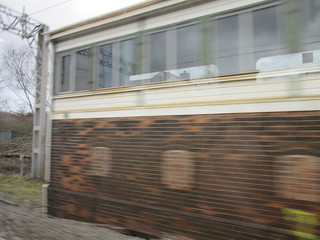
Click here for other sizes.
Halton Junction
Sorry, no suitable illustration at present. I found a picture of the box on sale here.
Runcorn in 2010
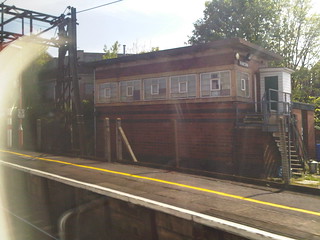
Click here for other sizes.
Ditton
Sorry, no suitable illustration at present.
Speke Junction, 2012
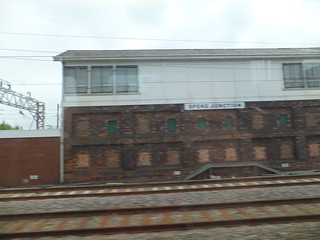
Click here for other sizes.
Allerton Junction in 2015

Click here for other sizes.
Edge Hill Power Signal Box in 2010
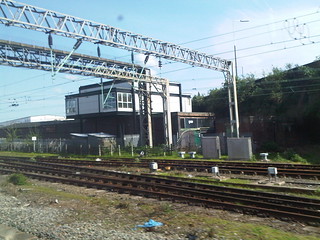
Click here for other sizes.
Liverpool Lime Street Power Signal Box in 2012
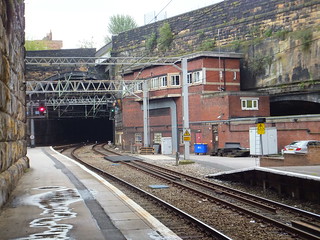
Click here for other sizes.
Related articles on other sites
Stations and Junctions (around Irlam).
The Industries of Irlam and Cadishead.
Related posts on my site
Day Trip to Liverpool (2010: Brief).
Liverpool by Train (2012).
Liverpool Lime Street.
The Cheshire Lines Committee.
The Cheshire Lines Committee Routes Today.
Signalling on the former Cheshire Lines Committee in the 1950s
Irlam Station Launch.
My pictures
West Midland Railways.
Stafford Area rail.
Crewe Area rail.
Liverpool area rail.
CLC Manchester - Liverpool.
Irlam Station Launch.
Sandakan, Sabah, Malaysia: Tuesday, 10th February 2015
Early on Tuesday morning, we had our first sightings of our destination - Sandakan. This was originally part of British North Borneo which is now called Sabah and is part of Malaysia. We passed the massive bulk of Pulau Berhala on our starboard side and entered the large natural harbour which allowed Sandakan to develop as an important port.
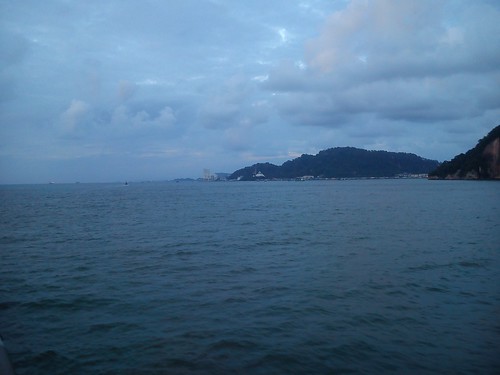 Approaching Sandakan, with a large mosque and beyond the multi-storey bulk of the 'Four Points by Sheraton' visible. Notice the number of ships dotted around the natural harbour.
For the last time on this trip, I watched a Pilot climb aboard to assist the Captain in the final approach to our quay.

The Sandakan Pilot climbs aboard.
At about 7.00 a.m. Tuesday, we berthed alongside the quay, facing a rather bleak-looking transit shed. It appeared that our quay was more used to handling freight rather than people. A number of large, bulk material conveyor units stood ready for use at one end of the quay and a massive mobile harbour crane with a rubber-tyred chassis and outriggers stood at the other end of the quay. The crane was labelled 'Gottwald' but these cranes now seem to be marketed as Terex Gottwald Port Solutions. An adjacent quay appeared to deal with smaller passenger ferries which I think go to the Phillipines.
 'Caledonian Sky' gently approaches the quay at Sandakan.
An open lorry drew up next to the ship and the crew started to take our luggage ashore, setting it out next to the lorry. A group of musicians appeared and set up outside the transit shed, playing for seven dancers in traditional costume, watched by the passengers from various decks on the ship. A group of dock employees appeared and enjoyed the free entertainment.
 Traditional dancers welcome the ship.
Saying our 'goodbyes' to the crew (many of whom were being relieved at Sandakan by fresh crew), the passengers disembarked for the last time, identified their luggage which was then loaded onto the lorry and boarded the three coaches which had appeared. We were to spend the day around Sandakan, before being reunited with our luggage (hopefully) at the 'Four Points by Sheraton' hotel. The coaches moved off through the dock area to join the main road to Sandakan town, about five miles away. The contrast with some of the rural places we'd visited was very striking. Everything is modern - the Japanese occupation during World War II and the subsequent Allied bombing reduced the town to rubble. Now, there are dual carriageways and frequent housing developments up to four stories tall. We didn't initially drive into the town centre but turned inland, eventually arriving at what was clearly a fairly 'upmarket' area of apartments with some detached houses. The coaches parked at the side of the road and we disembarked to enter the Sandakan Memorial Park. A dignified sign explained:-
"The Government of the State of Sabah has set aside this site as a memorial to those prisoners of war who suffered and died here, on the Death Marches and at Ranau. The memorial also commemorates the suffering and sacrifice of the local people."
The wooded gardens were in immaculate condition and radiated a great sense of peace, in jarring contrast with how the area would have been during the Japanese occupation during World War II.
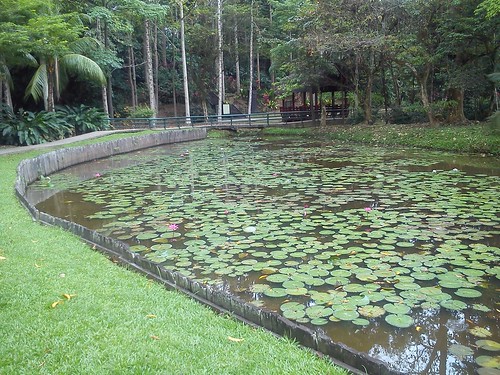 The immaculate gardens at Sandakan Memorial Park.
In 1942, 1500 Australian Prisoners of War were brought here to construct a military airfield for the Japanese. The following year, around 700 British and a further 500 Australian Prisoners of War arrived. Late in 1943, the prisoners were force-marched 260 km to Ranau in three 'Death Marches'. The only recorded survivors of these marches were six escapees. A Wikipedia article on this tragic era is here.
In the Sandakan Memorial Park, a wooden Commemorative Pavilion houses information displays and photographs. Nearby, there are a few reminders of the wartime camp - concrete water tanks, the remains of an ancient vertical boiler, an electric generator and a British 'Ruston Bucyrus' excavator. The excavator was commandeered by the Japanese but later sabotaged by an Australian prisoner. There is an engraved black marble monolith as the focus of the memorial park, and we were invited by our guide to observe a one minute silence here before three of the group placed wreathes.
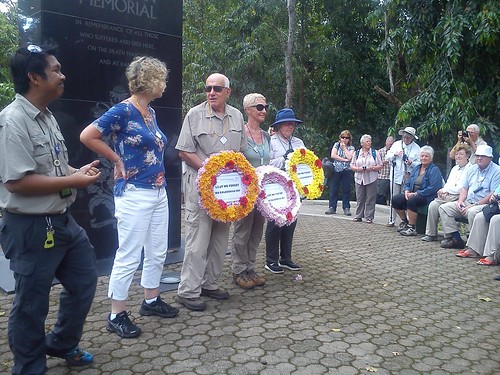 The Memorial Monolith.
After this thought-provoking interlude, we returned to our coaches and continued our tour of modern Sandakan. Building is still proceeding - Sandakan is the second largest town in Sabah with a population of around 400,000. Only Kota Kinabulu (formerly called Jesselton) is larger. There are still fairly basic wooden houses on stilts but there is a policy to remove these, transferring the occupants to modern (if rather barrack-like) apartments.
 Modern apartments in Sandakan.
As we neared the centre of the town, we turned up into the hills overlooking the sea. Here we visited St. Michael's and All Angels Church, a granite building dating from the early twentieth century, next to the large St. Michael's school.
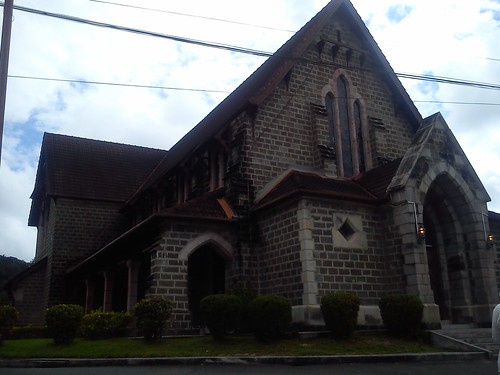 St. Michael's and All Angels Church.
We re-joined our coaches for a short ride to the English Tea House and Restaurant which has the proper appearance of a colonial bungalow, with its own croquet lawn. Its hilltop location offers wonderful views of the natural harbour of Sandakan.
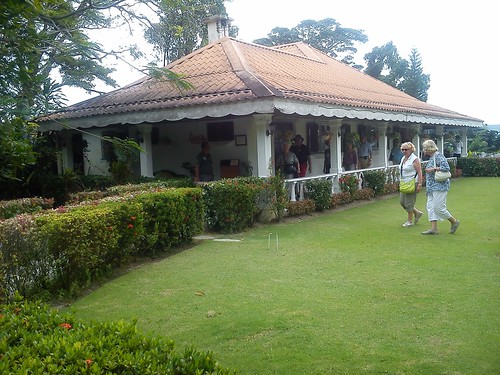 The English Tea House and Restaurant, Sandakan.
However, before we enjoyed luncheon at the English Tea House, we visited 'The Agnes Keith House' just next door. I'm afraid I'd not heard of Agnes Keith, but I was charmed by her house. Before World War II, she lived at the house with her husband who was Conservator of Forests and Director of Agriculture for the government of North Borneo. She wrote a book of her experiences called 'Land Below the Wind' which was prize-winning and has become a classic. During the War, the family were interned by the Japanese and that grim time is recounted in her book 'Three Came Home'. Upon release at the end of the War, they found that the house had been destroyed, but they rebuilt it on the same site and spent about five more years there, giving rise to another book 'White Man Returns', before moving first to the Phillipines and then Libya. The house in Sandakan became derelict before being restored by Sabah Museum and becoming an important visitor attraction.
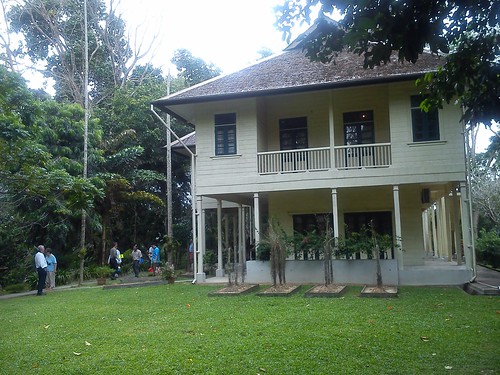 The restored Agnes Keith House.
We then returned to the English Tea House for a very enjoyable buffet lunch. I was then drawn back to the Agnes Keith House for a final walk around the well-kept garden before boarding our waiting buses. Our next journey took us inland. After some of our recent visits to rather smaller communities, I was still having trouble getting used to the scale of developments around Sandakan - such as the aptly-named 'Giant' Hypermarket, part of the Malaysian 'Giant' chain.
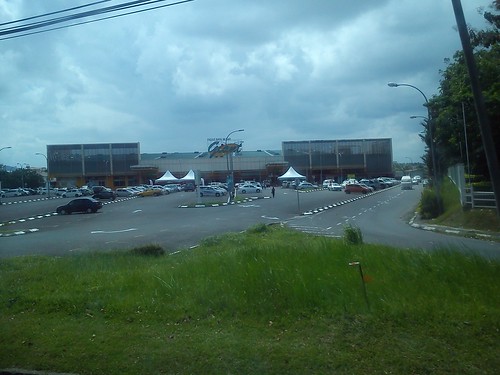 The 'Giant' Hypermarket, Sandakan.
We were heading broadly west on Malaysia Federal Route 22. Around 14 miles from Sandakan, we left the main road to reach Sepilok, where we were to visit the Bornean Sun Bear Conservation Centre and Sepilok Orang Utan Rehabilitation Centre. I'll describe these visits in Part 22.
You can find all the posts on this trip here.
My pictures
Arriving at Sandakan, Sabah, Malaysia.
Sandakan, Sabah, Malaysia.
Sandakan Memorial Park, Sabah.
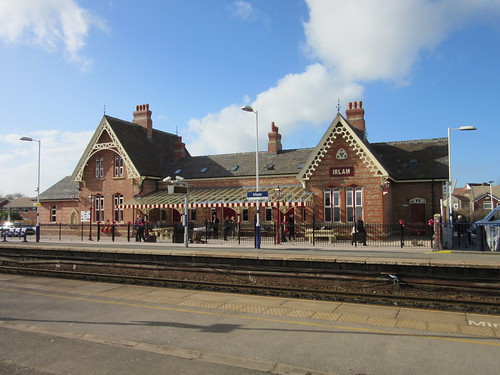 The restored building viewed from the Down platform.
The refurbished station house at Irlam was officially opened on Thursday, 26th March 2015, exactly 122 years after the station first opened to passengers.
The long-term project to bring the derelict building back into use was masterminded by the Hamilton Davies Trust, a registered charity founded in 2004 by Neil McArthur MBE who is the Chairman of the Trustees (see Our Story).
Hamilton Davies Trust brought together a number of partners: Salford City Council, NC Developments, Transport for Greater Manchester, Network Rail, Northern Rail, Irlam and Cadishead History Society and the Friends of Irlam Station in order to bring about the successful completion of this ambitious scheme. The work has been carried out to a high standard, with careful attention to detail, resulting in a facility which is now a major asset to the local community.
Around 200 invited guests attended the event, many making use of the new car park, but some including the writer travelled by train (Northern Rail had kindly provided complimentary tickets from either Manchester or Liverpool).
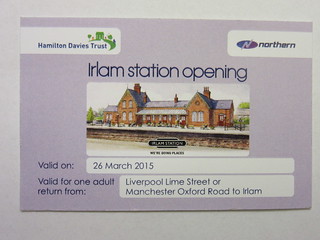
Special ticket issued by Northern Rail.
There was a very friendly, party spirit as guests arrived. Wine, hot and cold drinks and light refreshments were provided.
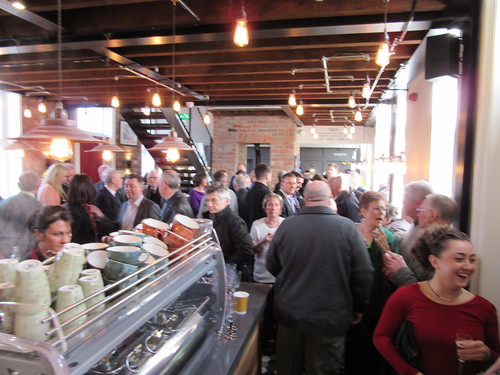 The main area viewed from near the refreshment counter. Note the stairs to the upper floor.
At around two thirty, as many people as possible crowded into the main area for a series of introductory speeches, including addresses by Councillor Christine Hudson, Ceremonial Mayor of Salford and Ian Stewart, City Mayor of Salford. After the speeches, the guests were entertained by Cadishead Public Band (who are sponsored by Hamilton Davies Trust).
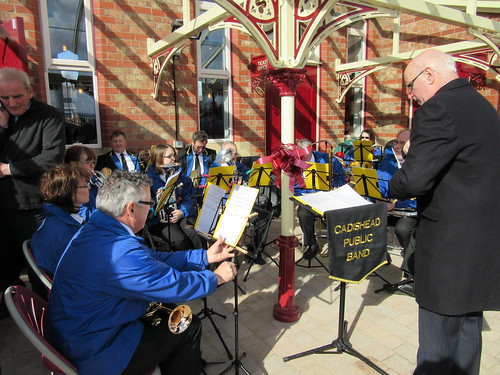 Cadishead Public Band prepares to entertain the visitors.
The ribbon-cutting ceremony then took place outside on the terrace.
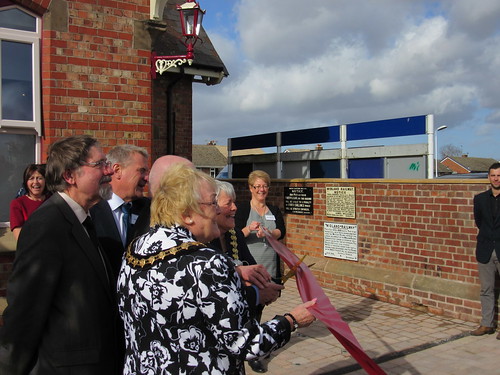 The ribbon-cutting moment arrives.
Irlam Station now has a comfortable waiting room, complete with a cafe/bistro, toilet facilities, free Wi-Fi and facilities for meetings. The new car park accommodates 60 vehicles with motorcycle bays, a 'Cycle Hub', dedicated pedestrian walking routes, better lighting and closed-circuit television for improved security. Future developments include the provision of step-free access to the Liverpool-bound platform and landscaping.
The people I spoke to judged the project a triumph and I endorse that view. Hamilton Davies Trust and all their partners are to be congratulated on their hard work and determination in making this project happen.
On the Hamilton Davies website, there's a report An Historic Day for Irlam Station!. The Salford Online Local Community Website has a report here. Manchester Evening News has an on-line article here.
My pictures
Irlam Station Launch.
My first two driving turns in January 2015 were cancelled. I was supposed to be on the '38' at Shackerstone on Sunday, 4th January but the locomotive broke another spring the previous day and was unavailable for service on the Sunday. Then, I was supposed to be at Peak Rail on Sunday 18th January but 'Lord Phil' suffered injector problems the previous day and, again, my turn was cancelled. So the first turn I had was 'Lord Phil' at Peak Rail on Sunday, 22nd February with Dave Rimmer (Fireman) and Jacob Short (Cleaner).
Peak Rail, Sunday, 22nd February 2015
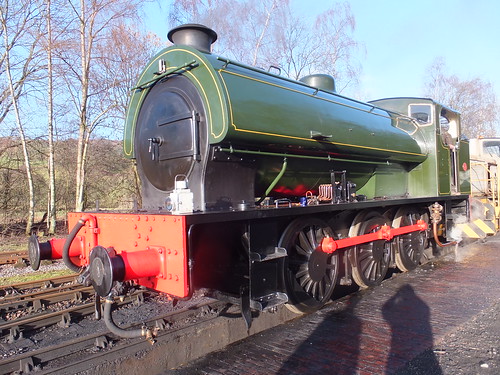 'Lord Phil' being prepared for duty on the outside pit at Rowsley.
The Peak Rail Winter Timetable features four round trips from Rowsley to Matlock Riverside (our original Matlock terminus before the extension to Matlock Town was opened). Matlock Riverside is provided with run-round facilities so, rather than top-and-tail as we currently operate when working to Matlock Town, one steam locomotive runs the service, running round at each end. This keeps the engine crew busy but I prefer this arrangement as more faithful to traditional steam railway working.
Originally, the points at Matlock Riverside were operated by the train crew but, since Matlock Riverside Signal Box was built, a signalman is required to operate the points at each end of the station. However, the Signal Box has not been formally commissioned yet so the signals are not in use. This means that movements are authorised by a Yellow Flag displayed from the signal box. I've previously talked about these arrangements firstly in the post Winter Timetable at Peak Rail and later in the post Peak Rail in early 2014.
The plan for Sunday, 22nd January had called for a Driving Experience Course on the line between Rowsley and Church Lane prior to the first passenger train at 11:15 a.m. but, unfortunately, the lady who had booked the Course had broken her wrist (cycling in Cambodia), necessitating that her course be deferred until a later date. However, as a 'consolation prize', it had been arranged that she would turn up and have a trip on the footplate as an observer on the first passenger train of the day.
The weather forecast for the day had not been very encouraging but when I arrived on site it had been cold but dry. Since steam locomotives at Peak Rail are prepared in the open, it's always better if you can carry out oiling and examination in dry weather: you can quickly get quite wet (and miserable) when the weather doesn't co-operate.
Our lady driving candidate arrived with Peak Rail Fireman Mike Shelton as we were completing preparation. Once I'd obtained the Train Staff, now an Electric Token, for the Rowsley - Church Lane single line (which we needed to operate the crossover at the south end of Rowsley Station), we made our way across to our five-coach train waiting in the platform. Under the watchful eye of Ken, the Guard, the Trainee Guard called us on to the stock and we 'tied-on'. There was time for a welcome bacon bap and cup of tea before departure.
The day proceeded as scheduled (and as described in the reports linked above). We had rather mixed but tolerable weather so by the time we'd returned to shed and disposed of 'Lord Phil' Dave, Jacob and I were tired but in good spirits
Peak Rail, Sunday, 1st March 2015
Just 7 days later, I was back at Peak Rail for the first day of the 'Main Season' timetable so there were changes - five round trips during the day running to Matlock Town (not Matlock Riverside) and top-and-tailing with 'Penyghent' on the north end. This time, Phil Mason was the Fireman and Jacob was, once again, our Cleaner.
Before the passenger service commenced, we'd a two hour Driving Experience Course but under new arrangements introduced this year. I've described the typical format of Driving Experience Courses at Peak Rail in a post here. Since writing that post, there have been a number of changes but picking up the trainee at Darley Dale and operating on the single line from Darley Dale to Matlock Riverside have remained the same. But under the new arrangements, the trainee is picked up at the platform at Rowsley and the single line from Rowsley to Church Lane is used for operations. In addition, the Trainee can now pick up a Brake Van and carry out limited shunting movements around Rowsley. A Plough Brake Van (used by Engineers to spread ballast) had been left on the Loading Dock for us. When the plough at either end of the vehicle has been raised, the Plough Brake can be used like any other sort of goods brake van. A Plough Brake is often referred to as a 'SHARK', because that was a common telegraph code for the vehicle.
 The vehicle in the foreground is a Plough Brake.
Once we'd joined up with our driving trainee, I explained the driving controls and, light engine, he took us to Church Lane and back a couple of times, displaying good judgement. We then spent some time with the Plough Brake, using all three ground frames at Rowsley (South End, North End, Traps at north end of Loop), giving our trainee experience of operating ground frames as well. He also did some firing with Phil explaining the principles of Boiler Management on a steam locomotive. All too soon, we had to move across to our train and, once called on by the guard, couple up and start carriage warming. We had to replenish our saddle tank with water from the 'brown tank wagon'.
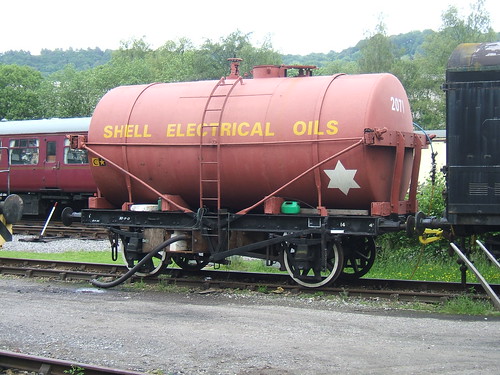
 The 'brown tank wagon' used as a water tank at the south end of Rowsley station.
Up until then, the weather had been cold but dry. As soon as we got the "Right Away" from the Guard, it started to rain fairly hard. Although the front of the cab has two 'spectacles' - hinged, glazed windows - for forward visibility, with rain driving against them, they rapidly become useless. Windscreen wipers, of course, are not provided. You can rotate the window and wipe the outside clear but with heavy rain, they become obscured again in seconds. You can partially open the window and try to keep a lookout through the opening but the effect is often to channel wind and rain straight into the driver's face. So I normally end up leaning out of the side of the cab in any case, as I tend to do in good weather, getting a good soaking in the process.
Some steam locomotives had a narrow, hinged brass frame carrying a toughened glass 'sidescreen' on each side of the cab which could be hinged outwards to deflect the worst of the weather when required (and hinged flat in places of limited clearance. I remember many years ago reading a Local Instruction about retracting sidescreens in Berkswell Tunnel).
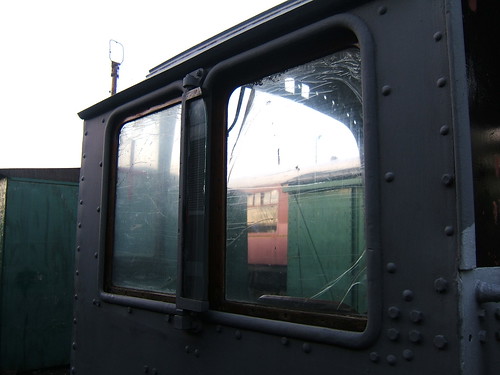 The Stanier cab from 48624 during restoration. In between the two side windows (front fixed window on the left, sliding rear window on the right) the vertical sidescreen is folded flat against the cab side.
I was reminded of a similar trip in poor weather at the Battlefield Line in 2014 (described in the post Another Busy Week) and one of my sayings: "Anyone can work on the footplate in good weather. It takes an engineman to do it in bad weather."
But the rain didn't continue - before long, it had changed to sleet which seemed even more chilling. However, once we arrived at Matlock Town, we would be dragged back to Rowsley by 'Penyghent' so it was possible to 'thaw out' by the boiler backhead for a while. However, the driver is not relieved from checking signals and keeping a lookout. Once arrived at Rowsley, we deemed it prudent to take water. Particularly when steam heating is being provided for the train, water (and, of course, coal) consumption is increased. It's desirable to not run the locomotive water tank too low, as this tends to encourage drawing debris from the tank into the injector, where even small pieces of foreign matter can cause problems, as briefly described in the post The Clack Valve.
For variety, the sleet then turned to snow which didn't seem much of an improvement. At track level, the snow wasn't 'sticking' but the surrounding hills were slowly turning white. We carried on plodding between Rowsley and Matlock Town as called for by the timetable, taking water as required at Rowsley. The snow turned back to penetrating rain but by the time we returned to Rowsley on our last round trip, the rain had more-or-less stopped. It was still cold, so I was glad of my heavy woollen overcoat.
We took the locomotive across to the outside pit and carried out disposal. With three of us to share the work, it didn't take us too long to clear the firegrate, rake out the ashpan, empty the smokebox, wash off the dust, return the tools to the store, fill the boiler, stable the locomotive on Number 2 Road (next to 'Penyghent'), shut down the various footplate fittings, isolate the gauge frames and complete the required report sheet.
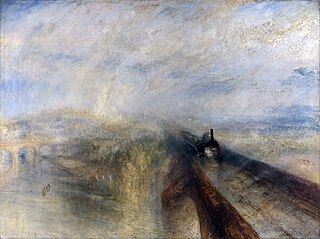
Rain, Steam and Speed
The title of this report was inspired by the famous painting 'Rain, Steam and Speed' by J.M.W. Turner (currently achieving renewed celebrity because of a recent film Mr. Turner). Locomotives of that period, like 'Lion' and 'Planet', lacked cabs or, at most, simply had a vertical spectacle plate at the front of the footplate. Oddly enough, when rather rudimentary cabs were introduced, many drivers objected to the change!

'Rain, Steam and Speed – The Great Western Railway' painted by J.M.W. Turner in 1844.
The cutting between Liverpool Lime Street and Edge Hill became known to many railway enthusiasts through the work of the remarkable clergyman and photographer Eric Treacy MBE (1907-1978). From 1932 to 1936 he was a Church of England Deacon at Liverpool, then 1936-1940 Vicar of Edge Hill. In that time, he produced some iconic shots around Merseyside, such as the one below, from the book 'Great Railway Photographs by Eric Treacy' [reference 1]
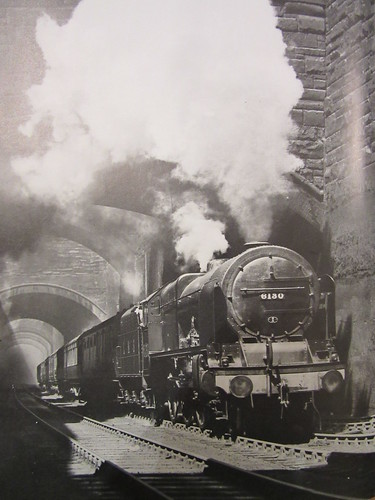
'Royal Scot' class 6130 'The West Yorkshire Regiment' leaving Liverpool Lime Street through Edge Hill Cutting (Photo: Eric Treacy).
The aerial view from 1938 below shows the city end of Edge Hill Cutting. The size reproduced below is licensed for non-commercial use but larger versions may be purchased from the website shown at the bottom of the picture.
 Liverpool, 1938: St. Georges' Hall is near the centre of the picture, with the curving trainsheds of Lime Street Station upper right leading to Edge Hill cutting top right.
According to a Liverpool Museums publication, the geology of Merseyside is largely dominated by sandstones and mudstones of the Triassic age, with the sandstones forming the higher ground at the northern end of the Wirral and Liverpool.
In the post Edge Hill, Liverpool I described the coming of the railway to Liverpool in 1830 with the passenger terminus at Crown Street and Wapping Tunnel cut through sandstone to Park Lane Depot near the docks. Because of the success of the railway, by 1837 a new passenger terminus had been constructed at Lime Street, connected by a double-track, cable-worked tunnel to Edge Hill. The original Crown Street site was retained as a goods depot. Increased demand at the Port of Liverpool led to the building of new docks further north (downstream) and the Waterloo double-track tunnel from Edge Hill to serve them. In 1879, locomotive working replaced the cable-haulage through the Lime Street Tunnel. By 1881, the Lime Street Tunnel was being opened-out into a deep rock cutting providing four running lines. The complex web of streets above the Lime Street tunnel required the construction of numerous bridges to carry the various streets over the new cutting.
The following photographs from around 1881 are from the Crewe Works photographic department collection and give an amazing insight into the work involved in creating the 4-track deep rock cutting. The size reproduced below is licensed for non-commercial use (copyright National Railway Museum and SSPL) but larger versions may be purchased from the website here.

Plate 1: The bowler-hatted gentlemen (one apparently with a furled umbrella) are remarkable, as is the worker about to cross a narrow plank. Notice the excellent workmanship on the stone facings to the bridge: the arch itself is made from multiple rows of bricks. The single track on the left is presumably temporary - the original double track tunnel is still buried under the rock on the right. Note the manually-operated Scotch Derrick crane.

Plate 2: The original double-track tunnel is presumably below the temporary sidings on the left. Notice the lean-to buildings, with chimneys, far left. An overhead travelling crane bridging the cutting is visible in the background.

Plate 3: Probably the same location as the previous picture, but looking in the opposite direction. A six-coupled goods locomotive stands on a train of spoil wagons. There appears to be a rail-mounted steam crane in the background. The overhead travelling crane is clearer in this picture. It is steam powered and mounted on a composite beam - wooden with an iron truss for stiffness. In the foreground are a couple of rectangular skips, wooden but iron bound, presumably used by the travelling crane.

Plate 4: Here, a temporary track has been laid in a narrow cutting excavated to the final level. The original double track tunnel will be in the rock on the right. A wooden chute is visible, leading from street level above the tunnel, presumably for loading spoil into railway wagons.

Plate 5: This is almost the same location as the last picture, but apparently on a later date. Some of the rock entombing the original double-track tunnel has been removed and temporary wooden bracing has been fitted. There are spoil wagons in the tunnel in the background and a crane is visible top right.

Plate 6: This might be the location in Plate 5 from the opposite direction, but probably on an earlier date. There's a good view of a rail-mounted steam crane at street level on the right.

Plate 7: An interesting picture, but puzzling.

Plate 8: Workmen proudly posing for the photographer.

Plate 9: This shows a network of temporary sidings. Note the excellent quality of the stepped retaining wall on the right.

Plate 10: A relatively early stage of the excavations, just about level with the base of the arches of the new bridges. The deep cutting on the right is presumably to facilitate carrying out the spoil. Visible through the bridge arches is probably a crane.

Plate 11: This may be the same location as Plates 4 and 5 but an earlier stage. In addition to the chute from street level, there's a diagonal chute from the area where rock is being removed. In the background on the right, there's evidence of partial building demolition. We may surmise that the railway have bought sufficient land for the width of cutting and demolished the part of the terrace in that area, leaving the remaining houses standing.

Plate 12: Excavations have now revealed the brick lining of the original 2-track tunnel.

Plate 13: Workmen, operating in groups, have started to demolish the brick lining of the original tunnel.

Plate 14: The tunnel lining has been collapsed.

Plate 15: Another section of the original tunnel exposed.

Plate 16: Most of the rock has been removed. The arrangement of tunnels (1-2-1) may identify the location as immediately west of Tunnel Road, Edge Hill.

Plate 17: This picture clearly shows the exposed original double-track tunnel lining (supported by curved timbers) and the remaining rock the right, with the 4-track retaining walls and bridges complete.

Plate 18: A similar view to Plate 17.

Plate 19: Another location with most of the rock removed. This view now stands comparison with the Eric Treacy photograph at the head of this article.

Plate 20: This is probably the same location as Plate 19, but the work is now almost complete.
There are other rocks cuttings around Merseyside, such as:-
Olive Mount Cutting was constructed in 1830 to accommodate two tracks but was later expanded for four tracks.
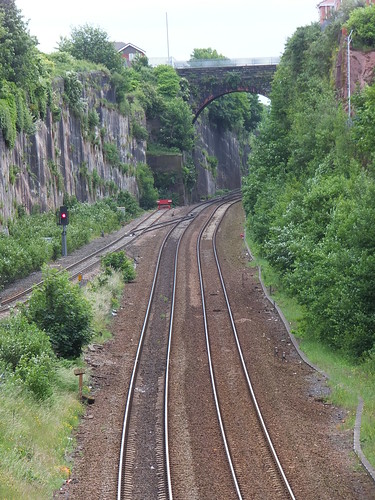
Olive Mount Cutting in 2013, viewed from Rathbone Road.
The line between Runcorn and Halton Junction is partly in a rock cutting.
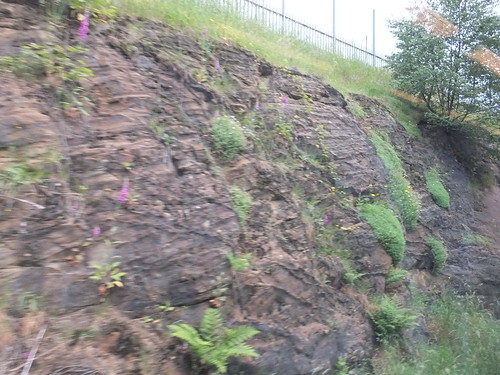 The rock cutting between Runcorn and Halton Junction (Up side).
I've also spotted rock outcrops on the line from Hooton to Ellesmere Port.
In addition to the railway tunnels around Edge Hill, there is a curious set of tunnels called the Williamson Tunnels, constructed by the eccentric philanthropist Joseph Williamson (1769-1840). For details of public access to these tunnels, see the Williamson Tunnels Heritage Centre site.
Book references
[reference 1] 'Great Railway Photographs by Eric Treacy' compiled G. Freeman Allen, editor P. B. Whitehouse, introduction Dr. J. A. Coiley, edition published 1997 by Chancellor Press (ISBN: 978-0-753708-72-9).
Related posts in this blog
Edge Hill, Liverpool.
Railways around Edge Hill in 2013.
Liverpool Lime Street Station.
'Black 5' to Birmingham.
My pictures
Liverpool area rail.