Tuesday, 7 August 2012

The Completion of the Trans-Siberian Railway

The first public railway in Russia was the Tsarskoye Selo Railway which ran a modest 27 km from Saint Petersburg to Pavlovsk. It opened in 1837 using a mixture of steam locomotives built in England (Stephenson 'Patentee' class) and Belgium. See the Wikipedia article.

The sheer size of the Russian Empire meant that travel from the centres of power in Moscow and St. Petersburg to remote lands like Siberia was difficult and time-consuming in the 19th century. The construction of railways to link these remote areas seemed essential and, in 1891, work on the 9,000 km long Trans-Siberian Railway linking Moscow and Vladivostok was authorised by Tsar Alexander III. The heir to the throne, Nikolai Alexandrovich, inaugurated the project in Vladivostok and building proceeded simultaneously at both ends of the line. Over 66,000 men were employed on the herculanean task.

In 1898 the first train arrived in Irkutsk, having travelled around 5,000 km from Moscow. However, beyond Irkutsk, the area around Lake Baikal presented a problem. One possible route from Irkutsk to the southern side of Lake Baikal and the line to Vladivostok would require a climbing route averaging a gradient of 1 in 75 for 30 km. This was regarded as beyond the capabilities of the available locomotives. The second possible route followed the west bank of the Angara River upsteam to the Lake, then continued south west, hugging the shoreline of Lake Baikal to reach the southern side of Lake Baikal and the line to Vladivostok.

The second of these routes, called the 'Circum-Baikal Railway' was adopted. The line from Irkutsk to the Lake near the village of Baikal was completed without much difficulty but the 90 km of construction along the shoreline of the Lake caused significant delays because of the large number of tunnels, galleries and bridges required. In order to commence through services, it was decided to bring trains from Irkutsk to the temporary terminus at Baikal and use ferries to tranship passengers and cargo to the southern shore of the Lake at Mysovaya.

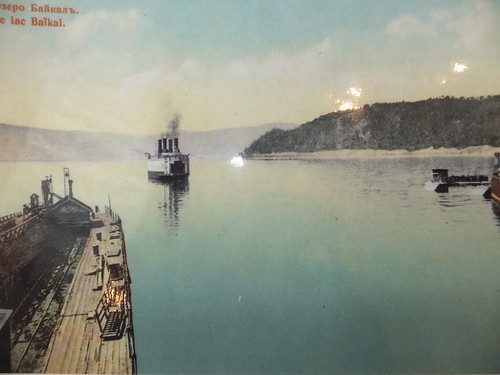
Two icebreaking ferries were ordered from Armstrong Whitworth in England. They arrived part-built and were commissioned in Russia. The first, 'Baikal', was a train ferry, that is to say passenger and freight cars could be run onto special tracks on her deck and transported intact across the Lake to the other section of the Trans-Siberian Railway.

An old postcard showing the Train Ferry 'Baikal'.

The second ferry, 'Angara', was a passenger and cargo ferry without the facility for carrying railway wagons. To accommodate these vessels, special docks were built, largely in wood, on either side of the Lake at Baikal (which became Port Baikal) on the northern shore and Mysovaya (now called Tankhoy) on the southern shore. These services commenced in 1900.

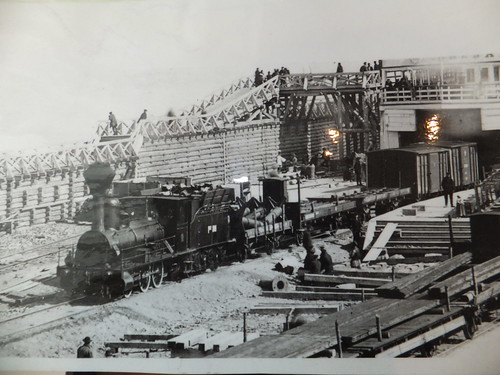
Old photograph showing wagons being shunted on and off the 'Baikal' at Port Baikal.

Lake Baikal is almost 400 miles long, up to 50 miles wide, prone to sudden storms and freezing in winter so the ferries were no soft option. Both ships had specially-shaped hulls which could bear down on ice and crack it, allowing the ship through. When the ice became too thick for the ferries, the expedient of laying a temporary railway track across the ice was tried but with only limited success. At least one locomotive is supposed to have disappeared through the ice.

Meanwhile, construction of the first track of the Circum-Baikal Railway forged ahead. Originally scheduled for completion in 1905, the railway was operational by September 1904 because of the Japanese threats which preceded the Russo-Japanese War of 1905. Completion of 'the Golden Buckle of the Russian Steel Belt' (as the Circum-Baikal Railway has been poetically described) gave an important advantage in moving men and materiel. To increase the capacity of the railway, work continued on adding a second track which was brought into service in October 1915.

Once the Circum-Baikal Railway was complete, the ferries were withdrawn. However, 'Angara' made a new career as a general ferry criss-crossing between the various small ports around the Lake, surviving long enough to be taken into preservation.

Between 1947 to 1949 a new railway was built broadly on the climbing route between Irkusk and the southern side of Lake Baikal which was originally rejected. Much more powerful locomotives were available and the new line is electrified at 25 kV a.c. and now carries all the through traffic on the East Siberian Railway section of the Trans-Siberian route.

Another project in 1956 provided hydro-electric power to the Irkutsk region by damming the Angara River between Lake Baikal and Irkutsk. This resulted in the original railway line between Irkutsk and Port Baikal being flooded, breaking the original 'Golden Buckle'. The remaining part of the Circum-Baikal Railway from Port Baikal to the southern side of Lake Baikal has been singled and retained, providing a spectacular tourist route.

The remaining part of the Circum-Baikal Railway gives spectacular views.

Photographs:-

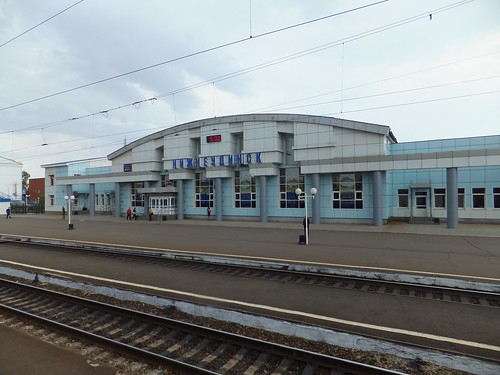
Slyudianka Station, East Siberian Railway.
The Circum-Baikal Railway.
Port Baikal.
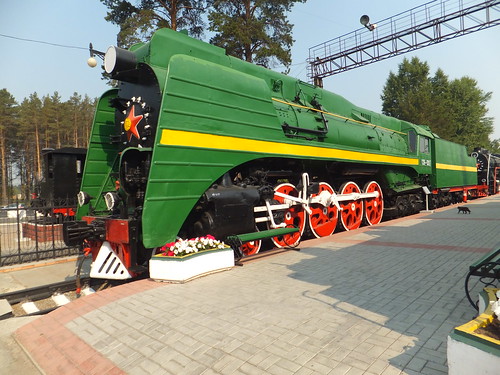
Circum-Baikal Railway Museum, Port Baikal.

References:-

'The Circum-Baikal Railway: A Concise Guide Book (3rd edition)' by A.K. Chertilov translated Ye. Luganskaya (Artizdat, Irkutsk) ISBN 978-5-93765-044-3.

Saturday, 4 August 2012

Moscow

Saturday, 21st July 2012

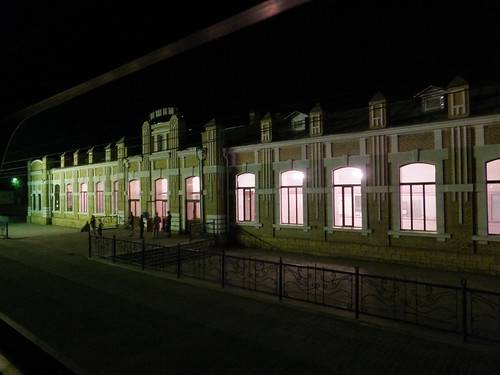
Vekovka station building.

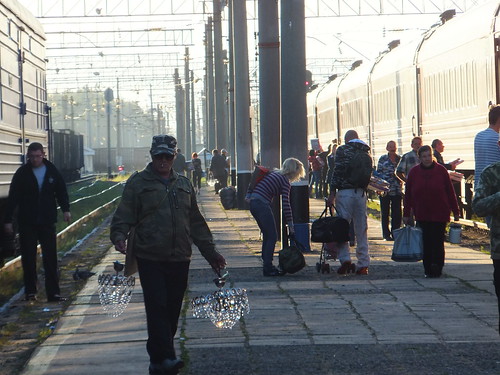
Early on Saturday morning, we arrived at Vekovka, where we paused for a couple of hours. I noticed a flock of birds wheeling over the station in the early morning sun. While we waited, various other trains came and went, served by a number of station sellers offering passengers a last chance to buy presents. I found it very curious that a vendor would be hawking chandeliers on a railway station at six o'clock in the morning.

Vekovka Station, early morning. Anyone want to buy a chandelier?

At Vekovka, we left the Gorky Railway with its 25 kV a.c. electrification and made our final dash for Moscow via the Moscow Railway with its earlier electrification system operating at 3.3 kV d.c. As we neared Moscow, we passed a multitude of junctions and other railways criss-crossed. Around 'right time' we pulled into Kandinskiy Street Station at the end of our marathon rail journey from Mongolia.

The end of our rail journey from Ulaan Baatar - Kazanskiy Street Station, Moscow.

Most of the 'Golden Eagle' guests were going on a City Tour of Moscow but Tatiana had arranged a taxi to take me to the Moscow Railway Museum. The museum in its present form only opened at the beginning of 2012. It's in a modern building set in quiet, manicured gardens contrasting with the hubbub of Richskiy Station next door. To add to the chaos, major civil engineering work is under way in Rizhskaya Square in front of the station.

I spent a pleasant hour pottering around the museum taking pictures (I'd bought a photographic permit) then had a quick look at Richskiy Station. I met up with my taxi driver who took me to the restaurant where my fellow-travellers were taking lunch after their morning city tour before departing in various directions. After a final meal together, it was time to say 'goodbye' to my new friends, then my taxi driver delivered me to Sheremetyevo Airport in plenty of time for my flight to Schiphol, then home to Birmingham Airport.

General Photographs:-

The 'Golden Eagle' train.
Moscow (2012 pictures added to 2011 set).

Railway Photographs:-

Vekovka - Moscow Kazanskiy Street.
Kazanskiy Street Station.
Moscow Railway Museum.
Richskiy Station, Moscow.
Sheremetyevo Airport Line, Moscow.

References:-

'Moscow Railway Map' (The Quail Map Company) ISBN: 1 898319 28 6.

Friday, 3 August 2012

Kazan

Friday 20th July 2012

The Trans-Siberian is not one route, but many. When trains first ran from Yekaterinburg to Moscow, they did so via Yaroslavl which had been connected to Moscow by railway in 1870. I visited Yaroslavl in 2011 (during a river and canal cruise) and there's a description with pictures here. Later, a cut-off branched from the Yaroslavl route at Kotelnich directly to Moscow, avoiding Yaroslavl. But when our train left Yekaterinburg, we took yet another route which would take us to Moscow via Tartarstan.

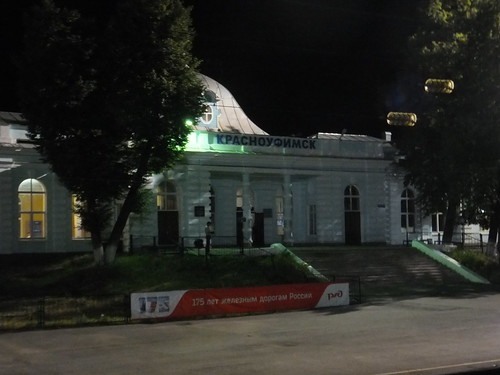
Tartarstan (often spelt Tatarstan) is an Independent Republic forming part of the Russian Federation so there were no immigration formalities as we entered the territory. However, I did wake up briefly in the night when we made our scheduled stop at Krasnoufimsk. Here, we left the 3.3 kV d.c. electrification of the Sverdlovsk Railway and entered the 25 kV a.c. system of the Gorky Railway (I assume named after the Russian author Maxim Gorky).

Krasnoufimsk station by night.

I was awake again fairly early when we made our brief stop at Agriz but it was another five hours of travelling before we arrived at the capital of Tartarstan, Kazan. The main railway station is currently closed for reconstruction so our train arrived at a new station in the suburbs called Vosstaniye. Tartarstan has established itself as a host for various events and I think the rebuilding we encountered was part of the preparations for the world university games.

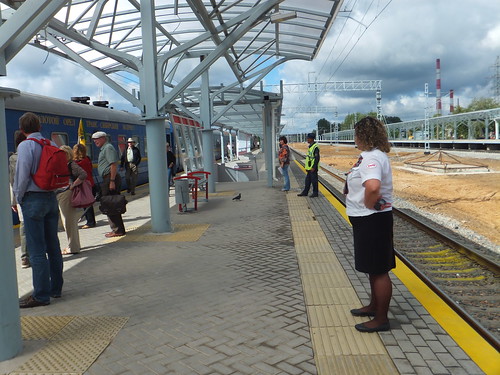
'Golden Eagle' passengers assemble near the guide's yellow flag at the not-quite-complete station at Vosstaniye, under the watchful eye of station staff.

No expense has been spared in this new station to present a modern image but, unfortunately, the work is not yet finished and there were builders and building materials everywhere. Nonetheless, with typical Russian pragmatism, the station is in use so we carefully picked our way through the various hazards and the streams of bewildered Russian passengers to board a very modern coach waiting for us outside the station.

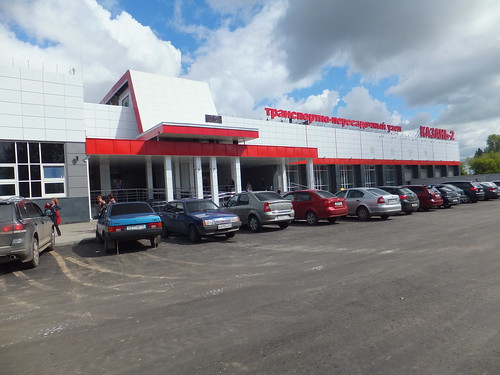
The new station at Kazan (Vosstaniye) viewed from the road side. The signage suggests it will become known as 'Kazan 2'.

Of course, a new station needs a new approach road and, whilst there were proper tarmac parking areas immediately outside the station buildings, the new road to get to the existing road network was still in the hands of the roadbuilders and their machines. We lurched through the potholes and threaded our way through various road building machines to finally emerge on a wide dual carriageway flanked by large blocks of flats. As we neared the city centre, large blocks of offices and luxury apartments reared up and my heart sank – not another modern city of soul-less buildings?

Modern architecture in Kazan.

But then we came to the older part of the town and the architecture changed. Some of the buildings were not that old but they were constructed along classical lines or in the French style so they were easier on the eye. Then we arrived at the Kremlin where the walls and watchtowers are genuinely old and, like the Kremlin in Moscow, the buildings within the walls are impressive. We disembarked from the coach just outside the main gate of the Kremlin. A girl in a local costume presented us with the traditional food of greeting – a Tartarstan version of honey-coated ‘Sugar Puffs’ you eat with your fingers.

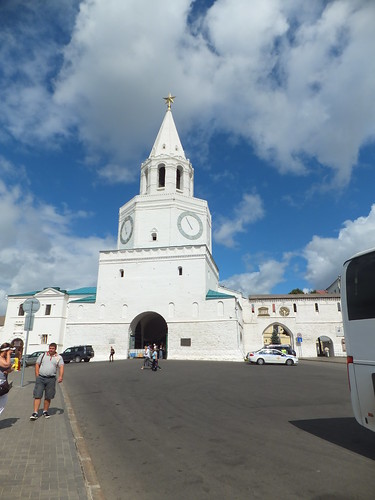
The Spassky Tower - entrance to the Kremlin in Kazan.

The Kremlin was built in a defensible position on high ground overlooking the river. Entering the main gate, we started to walk along the wide, cobbled main thoroughfare with Government Offices, University Departments and Museums occupying the buildings on either side. We turned down a side road leading to another gatehouse then turned to our right to enter a large plaza tiled in the colours of the Tartarstan flag.

Facing us was a towering, modern mosque. Tartarstan has a sizeable Moslem community which has similar rights to Orthodox Christians and unbelievers alike. The construction of this impressive mosque a few years ago within the Kremlin not far from its Orthodox counterpart was intended to signal this tolerance.

The modern Kul-Sharif Mosque within the Kremlin at Kazan symbolises religious tolerance in Tartarstan.

To my surprise, the mosque featured a visitors gallery, reached by 74 steps from the ground floor. From this lofty position, we could look down on the women’s gallery (bordered by pierced screens allowing women to watch the prayers below without being seen) and the carpeted ground floor used by men. There was a small, raised ‘pulpit’, presumably for the Iman, and markers to show the direction of Mecca.

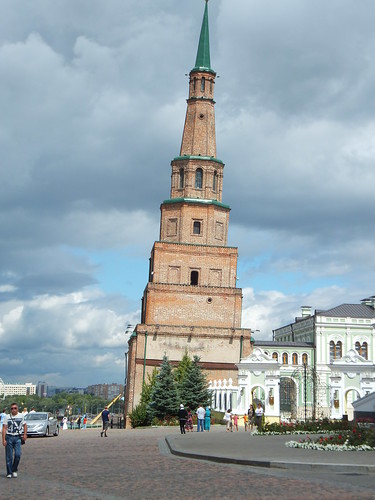
Next, we walked to look at the outside of the ‘Leaning Tower of Kazan’, a brick-built tower which has subsided to be 1.92m out of true at the top.

The 'Leaning Tower of Kazan' (within the Kremlin) is 1.92 m out of true at the top.

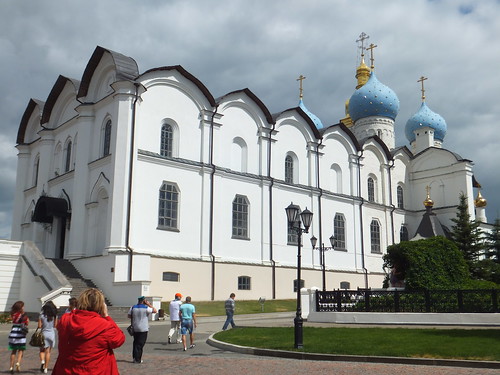
Finally, we visited the impressive Russian Orthodox Annunciation Cathedral. In all Russian Orthodox Churches, the congregation stand and singing is unaccompanied by musical instruments (A cappella). Whilst women cover their heads in church, men go bare-headed. Photography is not allowed.

The Russian Orthodox Annunciation Cathedral within the Kremlin at Kazan.

We then slowly walked back to the main gate and waited in the gardens outside for our bus to return. The bus ferried us to a hotel in the city where we had a relaxing lunch in a large restaurant decorated in Islamic style. The hotel was situated on a long pedestrian street and, after the meal, we were given some free time to wander around on our own. We were to meet up by the old brick bell tower next to the Chaliapin Hotel.

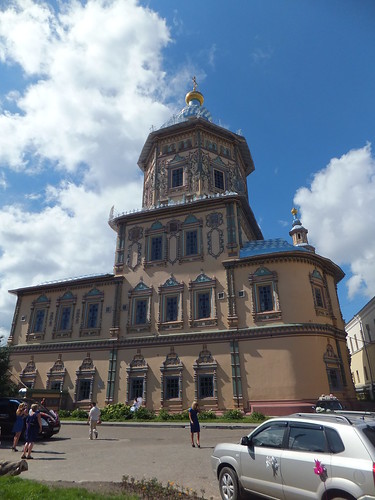
I had a brisk walk around a few blocks of the city, taking pictures of examples of the varied architecture.

A city-centre church in rather exuberant style. A bride is posed against the church for photographs, explaining the car decorations.

Near the end of Pedestrian Bauman Street, I came across a 'Kentucky Fried Chicken' with builders in occupation. I suppose the delights of 'KFC' are shortly to be offered to the impatiently-waiting Tartars. Across the busy street, I was puzzled by a large ring suspended above the building frontage. It was only afterwards I discovered that the 'Ring' is an entertainment complex incorporating a Multiplex Cinema, Restaurants and the like. A pedestrian underpass carried a 'Metro' sign, so I descended into a bewildering array of underground passages, shops and kiosks. However, I couldn't find any sign for a Metro Station. It took a bit of wandering around before I realised that an anonymous set of doors which could have been to a Department Store in fact led, via a long passage, to a Ticket Hall.

Hidden behind the magnificent Bell Tower in Pedestrian Bauman Street is the white-painted Bell Tower Church of the Epiphany.

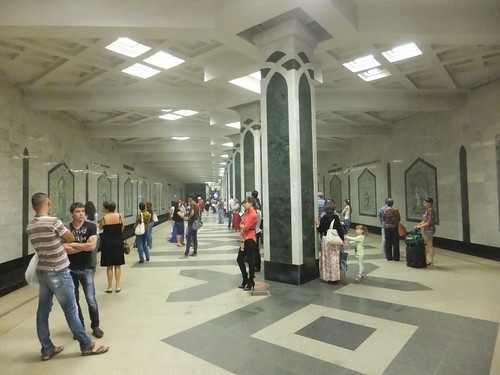
I purchased a token without incident and (with a bit of assistance from the lady manning the automatic barrier) successfully negotiated the barrier and made my way onto the island platform. Although there were plenty of passengers waiting for trains in both directions, minutes passed without a train and I reluctantly concluded that I wouldn't have time to travel to an adjacent station and back in time to meet up at the Chaliapin Hotel. So, contenting myself with taking a few pictures of the station and the modern trains which finally arrived, I left the station.

Kazan Metro.

I took a picture of the statue of Mullanur Vakhitov and afterwards discovered that he was a Tartar Revolutionary active at the time of the Russian Revolution. In the defence of Kazan against the Czech forces in 1918, he was captured and hung. According to the Wikipedia Article, his name is also Romanised as 'Waxitov'.

Another statue stands outside the Chaliapin Hotel. This, of course, is of Fyodor Ivanovitch Chaliapin, the opera singer and perhaps Kazan's most famous son, born 1873 and died in 1938 (of leukemia, in Paris). For a brief biography, see the Wikipedia Article.

This statue of Chaliapin stands outside the Chaliapin Hotel in Kazan.

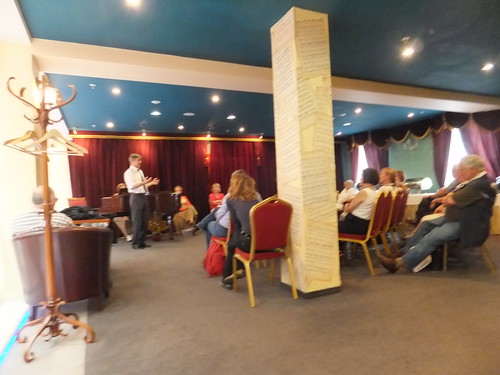
A private concert had been arranged for guests from the 'Golden Eagle'. The hotel restaurant is situated in the atrium of the hotel and, at one side, there was an area of seating facing a grand piano. The soloist was a bass singer in the Russian tradition. I was impressed with his rendering - with twinkling eyes and a mouth set in an almost perpetual smile he reminded me very much of pictures I've seen of Chaliapin. I also like his 'no nonsense' shirtsleeves appearance. I'm ashamed to say that, for the first part of the concert, I divided my attention between the singing and the hotel's Wi-Fi which allowed me to dash off a few e-mails but, once that was done, I concentrated fully on the concert.

A private concert for guests from the 'Golden Eagle' in the Chaliapin Hotel, Kazan.

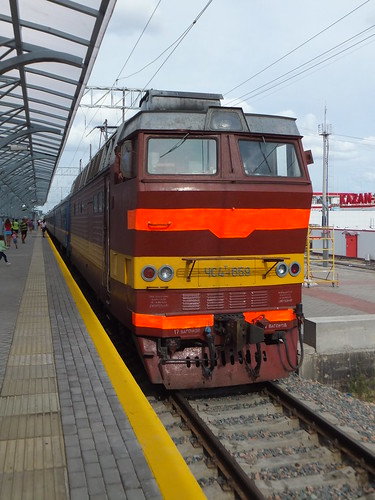
After the concert, we re-joined our coach and were taken back to our waiting train at Vosstaniye, once again running the gauntlet of the builders constructing the station approach road. By common consent, our time in Kazan was regarded as a great success. At about 7.25 p.m. our train departed with (I think) the same locomotive which brought us in - Class ChS4T Co-Co number 659 in brown livery.

Our locomotive (Class ChS4T Co-Co number 659) ready to leave Kazan (Vosstaniye).

This was our last evening on board so we had our Farewell Dinner at 8.00 p.m., followed by various entertainments in the Bar Car. The impromptu choir I was in gave their first (and certainly last) public performance of 'Kalinka' in Russian and then various other guests were persuaded to do their 'party pieces'.

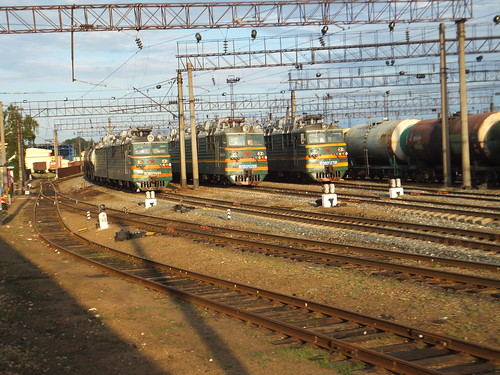
Of course, I was somewhat distracted by the passing railway infrastructure. I was very impressed by large marshalling yards we passed (at Kanash, I think).

Westbound freight trains awaiting their turn in the late evening sun at the large marshalling yards we passed (Kanash?).

I eventually retired to my cabin to complete my re-packing and get some sleep as our train inexorably continued towards Moscow.

General Photographs:-

The 'Golden Eagle' train.
Kazan.
Concert in Kazan.

Railway Photographs:-

Yekaterinburg - Kazan.
Kazan Metro.
Leaving Kazan

References:-

'Russian and English Kazan' published 2011 (full colour bi-lingual guide book available within the Kremlin at Kazan).

[First published on 22nd July 2012, revisions 3rd August 2012 and 15th August 2012]

Yekaterinburg

Thursday, 19th July 2012

Ishtim Station by night.

We stopped at Ishim in the middle of the night and I woke up long enough to take a picture of the attractive station building before going back to sleep until morning. By now the early morning pattern of arise, let the cabin attendant fold away the bed and order morning tea (which always came with an assortment of Russian biscuits) was well-established.

Large groups of sidings appeared on both sides of the route and we eventually arrived at Tyumen'. We were still on railway electrified at 3.3 kV d.c., but we had now left the West Siberian Railway and were on the Sverdlovsk Railway.

The modern station building at Tyumen'.

After about twenty minutes, during which the coach water tanks were once again refilled, we set off again, passing extensive sidings which, after some minutes, gave way to more rural views.

We had another 300 km to travel before we reached Yekaterinburg, leaving time for a leisurely breakfast followed by the showing of a documentary film about Tsar Nicholas II which I skipped. Lunch was at 12.30 p.m. which unfortunately clashed with our passing the lengthy sidings and increasingly industrial panorama which heralded our arrival in Yekaterinburg. We came to a stand whilst lunch was still in progress but, by skipping dessert and my usual cup of tea, I was able to leave the train and prowl up and down the platform taking photographs before we all met up at two o'clock for our coach tour of the city.

The station frontage at Yekaterinburg. Although it had rained en route, by the time we disembarked at Ekaterinburg, the sun was out.

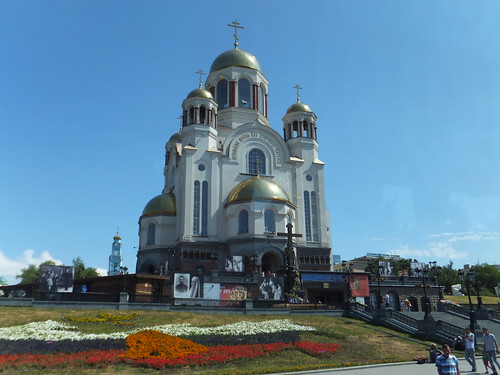
We set off through the largely modern, high-rise city to make our first stop at the Church on the Blood. Like many of the Orthodox Churches in Russia, this building is modern although built in a traditional style. The Soviet era made a pretty thorough job of either demolishing religious buildings or converting them for some non-religious purpose. Yekaterinburg's claim to fame seems to be that it's the city where the last Tsar and his family were killed (although, by that time, the Tsar had abdicated. The house where the Romanov family were killed has gone but the Church on the Blood has been erected on the site, making it an important place of pilgrimage for worshippers. In the gloomy crypt, there is a re-creation of the room where the Romanovs were killed, bathed in red light to emphasise the deeds. The floor above is laid out as a conventional Orthodox Church and, in contrast with the crypt, light floods in through the large windows. Outside the church, there is a statue depicting the Romanov family.

The Church on the Blood, Yekaterinburg.

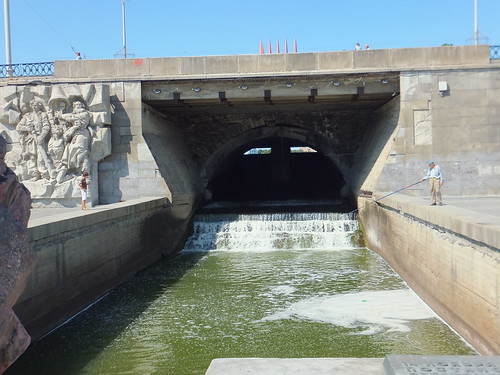
From the church we walked through fairly quiet streets to reach the River Iset and its attractive lake. We walked along the broad promenade bordering the lakeside, together with happy crowds of mainly local people enjoying the warm afternoon sunshine. Yekaterinburg's second claim to fame is that former Premier Boris Yeltsin was brought up here and was Mayor for some time. His house on the opposite side of the lake was carefully pointed out to us. The River Iset continues from the lake by passing under a major street and cascading over a small dam into a channel which passes through formal gardens.

The dam on the Iset.

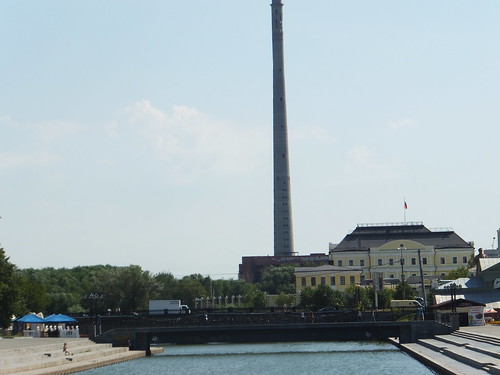
The view of the formal gardens is dominated by a concrete television tower at the far end. The city made the mistake of planning the tower to be taller than the Moscow Television Tower. When Central Government became aware of this, they forced a halt to the work and it has never been restarted, leaving the city with a useless eyesore.

The River Iset and the incomplete television tower.

The guests from the 'Golden Eagle' then split into one group which would visit the Europe/Asia border west of the city and a second group who would be taken to the country for a bicycle ride. Bearing in mind my role as Honourary Secretary of the Bagan Cycling Club (earlier reports here and here), I joined the group who were to bicycle.

We drove to the outskirts of the city and turned off the main road onto a minor road which wound through pine forest before arriving at a large clearing with a number of modern buildings forming a resort for outdoor pursuits. Here, we were allocated to a number of smart mountain bikes. Although provided with 'Shimano' Derailleur Gears, the frame was proudly marked (in English) 'Engineered and Produced in Russia'. After a bit of saddle adjustment and practising, we set off on a mainly tarmac track uphill into the forest. I had the usual problem finding a gear ratio which was generally suitable and then matters proceeded rather better, particularly since I was persuaded to walk up the stiffer sections - a sensible compromise. The day remained sunny and warm but the mature trees provided welcome shade. The air was scented with pine sap and the ride was most enjoyable (particularly the downhill bits). I think we'd done about 5 km by the time we were back at the resort where Tatiana treated us to a fruit drink in the cafe.

Jan, during a short 'breather'.

We then all piled back into the People Carrier for the journey back to the city and the railway station. We were all back on the train in time for Dinner at 7.30 p.m. and our train departed at 9.12 p.m.

General Photographs:-

The 'Golden Eagle' train.
Yekaterinburg.
Bike Ride in Yekaterinburg.

Railway Photographs:-

Omsk - Yekaterinburg.
Yekaterinburg Station.

[Revised 13th August 2012, 15th August 2012]

Thursday, 2 August 2012

Novosibirsk

Wednesday, 18th July 2012

During the night, our train had carried us from Krasnoyarsk to Novosibirsk, a distance of 762 km. En route, we'd been booked to stop at Bogotol and Mariinsk but I didn't wake for either stop. At Mariinsk, we left the Krasnoyarsk Railway and entered the West Siberian Railway. We also left the 25 kV a.c. electrified area because the earlier date of the electrification of the West Siberian Railway means that it operates at 3.3 kV d.c. I started the day with an early morning cup of tea in my cabin followed by my usual breakfast in the Restaurant Car. We rolled into the huge station at Novosibirsk a little before 9.00 a.m. and our group met up on the platform for our sightseeing trip.

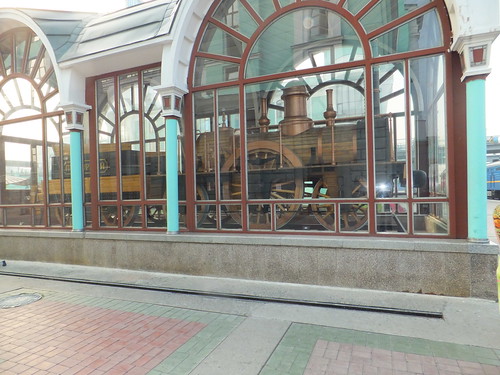
On the platform, we found an interesting building with windows all round displaying a full-size wooden replica of an early steam locomotive built in 1836 and used in Russia. It was clearly a Stephenson 'Patentee' 2-2-2 (although the Russians count axles, not wheels, so they call it a '1-1-1'). The model was very nicely executed and was in close accord with known drawings of 'Patentees', except that this one was presumably for 5 foot gauge.

Wooden model of a Stephenson locomotive displayed on Novosibirsk Station.

Outside the station, we were then divided into two groups - a coach would take one group around the city and visit the famous Opera and Ballet House whilst a smaller vehicle would take three of us with our charming lady guide around the city and then to the railway museum. I would have loved to have visited the Opera and Ballet House but, of course, there was too much to learn at the West Siberian Railway Rolling Stock Museum.

Novosibirsk, which was only founded in 1893 with the building of the Trans-Siberian Railway, is the fourth largest city in Russia with a population now exceeding 1.6 million, so you may not be surprised that I found much of the city nondescript, although I was surprised to find some log cabins near the centre.

Novosibirsk City.

The nine spans of the original railway bridge across the River Ob have been replaced but one of the nineteenth century spans has been preserved in a small park on the river bank, just to the south of the bridge. We stopped to have a look at this before carrying on to the Railway Rolling Stock Museum.

The preserved span from the original railway bridge over the River Ob at Novosibirsk. The present bridge is in the background.

Next, we took the dual carriageway south towards Akademgorodok. This is the university and scientific centre set up in the 1950s to ensure that the Soviet Union developed the resources of Siberia and stayed ahead in the arms race. I was sorry that we didn't have time to visit Akademgorodok which I gather is not quite so elite now, but still a pleasant area. Certainly, the urban handscape gave way to wooden houses and then pine forest. We passed the entrance to Young Pioneer Camps, set in the forest, which aimed to provide summer holidays for young people. In the Soviet era, the costs were often sponsored by the State because of the parents' employment but our guide suggested that today they were just expensive.

Our destination lay just to one side of the dual carriageway near Seyatel Railway Station. The West Siberian Railway Rolling Stock Museum is an open-air museum so we were fortunate that the day was warm and sunny. The exhibits were displayed on a series of parallel sidings with wide, concrete footpaths between the tracks. The contrast with the abandoned appearance of the Ulaan Baatar museum (described here) was complete. Our lady guide said we'd less than an hour at the museum, for we'd a fair journey back to the city and our train was due to leave at 12.12 p.m. I knew I'd not be able to do a photographic survey of all the exhibits in that time but I set off on my own, at the trot, to do the best I could.

P36 0097: The Connecting Rods and Eccentric Rods have been removed. Note the museum cat.

My aim was to get information 'in the can' (a bit of a misnomer in these days of digital photography) for study later. Just under an hour later, we met up and made our way back to our waiting vehicle, pausing only for me to purchase the limited information on offer at the ticket office.

Our driver made a splendid run back to the city. Traffic speeds in Russia are not very high (the condition of many roads does not permit it) and legal limits of 80 km/h may be posted on even the better roads. We parked for a few minutes for photographs in Lenin Square, near the Opera House and the famous statues, including one of Lenin with coat tails flying in the Siberian winds.

Lenin Square, showing the rear view of the statues. The building in the left background is on fire, smoke is visible and a number of fire appliances are in attendance. Note the wedding party on the right.

The driver had to change his planned route back to the station because one main street had been closed near a building on fire. It looked serious and I counted five fire appliances as we made our way to the station.

Here's the conventional 'pretty' view of the Opera and Ballet House.

Despite the detour, we arrived at the station in good time and made our way to the 'Golden Eagle' after a fairly packed morning. Soon, our train was moving out of the city. We crossed the wide River Ob, where we could see the preserved span of the old bridge which we'd visited earlier in the day and continued we continued west as lunch was served. After lunch, George gave a lecture on the Russian Orthodox Church.

When we stopped at Barabinsk in the late afternoon we were allowed off the train, so I scooted round making my usual photographic record.

Co-Co locomotive EP2K - 071 at the head of our train in Barabinsk.

On the move again, I carried on taking photographs for a while before joining the Russian Class in the Bar Car to learn a Russian Song. At 7.30 p.m., we enjoyed another Dinner in the Restaurant Car. As we came nearer to Omsk, there seemed to be interesting things outside, so I kept taking pictures, right up to our arrival in Omsk.

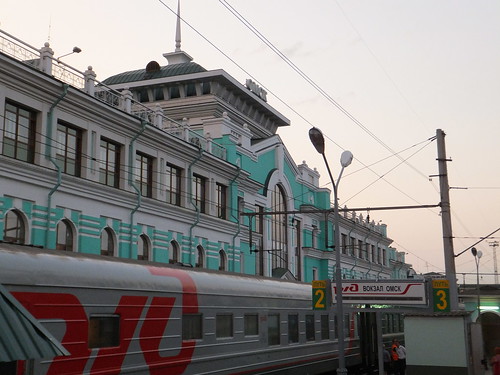
The impressive station building at Omsk.

After a brief stop at Omsk for water, we were off again but, this time, I'd had enough (anyhow, there wasn't enough light for photographs) so I went to bed.

Photographs:-

The 'Golden Eagle' train.
Novosibirsk Station.
Novosibirsk City.
Rolling Stock Museum, Novosibirsk.
Barabinsk Station.
Barabinsk - Omsk.

References:-

'West Siberian Railway Rolling Stock Museum' (colour pamphlet in English).
Set of 30 colour postcards of exhibits at the West Siberian Railway Rolling Stock Museum (text in Russian).
(The pamphlet and postcards are available at the Rolling Stock Museum).

Wednesday, 1 August 2012

Travelling West

Tuesday, 17th July 2012

We spent the whole day travelling with only limited opportunity to 'stretch our legs' at the various 'technical stops' which the train made for crew change, locomotive change or re-filling the water tanks in each coach.

We had plenty of time to take a leisurely breakfast before our brief stop at Nizhneudinsk.

The modern station building at Nizhneudinsk.

Once we were on the move again, George Munro gave a lecture on 'Transport in Russia' before Tatiana offered a Russian class. Then it was time for lunch. We made a brief, unscheduled stop at Tayshet before continuing to our booked stop at Ilanskaya.

This view from the station footbridge at Ilanskaya shows the multiple loops for waiting freight trains heading east. The weird structures over the tracks (suggesting huge, alien insects) allow locomotives to replenish their supplies of sand used to improve adhesion where necessary.

By mid-afternoon we were on the move again and George delivered a talk on 'The Opening of Siberia' followed by 'Golden Eagle Teatime' in the Bar Car. Later, the train's resident pianist, Natalia, performed on the electronic Yamaha grand piano, also in the Bar Car. Our final opportunity to get off the train came at the major industrial city of Krasnoyarsk.

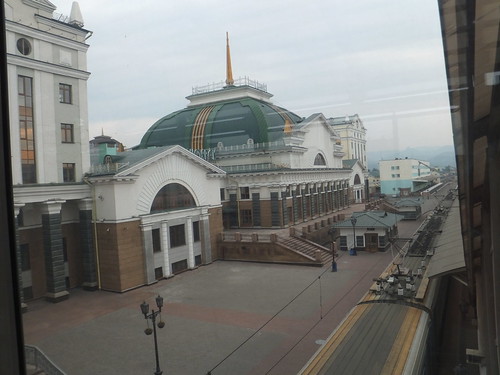
The rather grand station buildings at Krasnoyarsk hint at the importance of this industrial city.

Our departure from Krasnoyarsk was the cue to make our way to the Restaurant Car for the special 'Golden Eagle Caviar Dinner'.

Of course, throughout the day I was also trying to make some sort of record of the passing railway scene.

Railway Photographs:-

The 'Golden Eagle' train.
Irkutsk - Nizhneudinsk.
Nizhneudinsk - Tayshet.
Tayshet - Kraznoyarsk.
Kraznoyarsk.

References:-

'Soviet Locomotive Types - The Union Legacy' by A J Heywood & I D C Button (Frank Stenvalls Forlag) ISBN 0-9525202-0-6.
'Trans-Siberian Handbook Sixth Edition' by Bryn Thomas (Trailblazer Publications) ISBN 1-873756-70-4.
'The Trans-Siberian Railway - A Traveller's Anthology' Edited by Deborah Manley (Century Hutchinson) ISBN 0-7216-2255-1.

Friday, 20 July 2012

Irkutsk

Monday, 16th July 2012

During Sunday night we’d arrived back at Slyudyanka station around 2.30 a.m. This time, I woke up briefly but soon went back to sleep until about six, when my ‘Blackberry’ awoke me (I’d not paid for radio coverage but I used it as an alarm clock on this trip). Once again, we’d the handsome stone station building on one side and the sidings with waiting freight trains on the other side but this time it was raining.

A wet Monday morning in Slyudyanka.

Perhaps because this was a working weekday there was more railway activity than the previous day and, every few minutes, one or other of the waiting freight trains would move off, either towards Irkutsk or in the opposite direction, to be replaced shortly by another freight which would stop to wait its turn. Whilst we waited for our departure time, a couple of Electric Multiple Units going in the opposite direction paused briefly at the station – the first an elderly design with a rather dated-looking round ‘nose’, the second with a modern wedge-shaped ‘nose’.

With an electric locomotive on the front, we set off around 6.50 a.m. for the remaining 126 km to Irkutsk. This ‘new’ line was built just after the Second World War (the ‘Patriotic War of 1941-1945’ in Russia) and has the steepest gradient on the Trans-Siberian. We were told to look out for the 7 km Angasolka Loop which is supposed to be very beautiful. Unfortunately, the weather was foul and we saw very little. We descended this gradient, losing 400 metres in elevation in 30 km. This presents few problems to electric traction, but I noted that the overhead catenary had double conductor wires, presumably because of the high power demand made by ascending trains.

We arrived at Irkutsk about ‘right time’ (10:22) and our electric locomotive was quickly uncoupled and drawn ahead to await the signal.

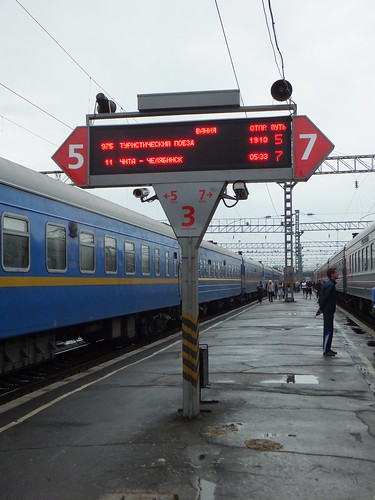
The 'Golden Eagle' on arrival at Platform 3, Track 5 in Irkutsk. The rather inelegant Passenger Information Display carries two Public Address loudspeakers and two surveillance CCTV cameras.

All the guests were gathered-up for a day in Irkutsk with Anna from the train as our guide. Outside the station, I took a quick picture of the elegant station frontage which was restored in 2011 for the 350th anniversary of the founding of the city. Then it was onto the bus for a city tour.

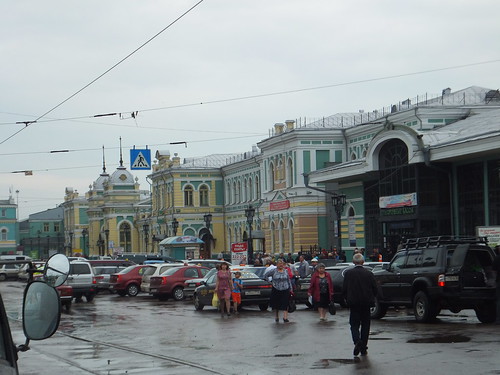
The restored frontage of Irkutsk railway station.

Both Anna and Tatiana, the Tour Manager, were brought up in Irkutsk and went to college in the city. We were told that the three consonants at the end of ‘Irkutsk’ should each be properly enunciated – something like ‘ear-coots-c’ (with the final ‘c’ as in ‘cat’). 

Irkutsk has been called ‘the Paris of Siberia’ because of the elegant design of many of the older buildings in brick and stucco. It’s still an impressive city  but most of the older buildings are a little down-at-heel now. The city has a large number of traditional wooden buildings, many run-down but in use and some beyond repair. Some buildings are being moved to an open-air museum in the city and restored. 

We parked near the river Angara which flows out of Lake Baikal to look at the war memorial with its Eternal Flame, the promenade alongside the river and the various restored churches, brought back into use quite recently having previously been converted for non-religious purposes during the Soviet period. I visited the Russian Orthodox Church of Our Saviour (which had been used as an Observatory but has been restored, including the impressive external murals, and re-consecrated in 2006).


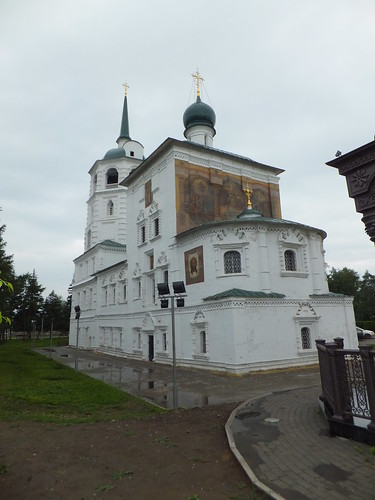
The recently re-consecrated Church of Our Saviour, showing the restored external murals.

We looked at the monument to Tsar Alexander III, commemorating his authorisation of the building of the Trans-Siberian Railway. This monument didn’t last long – it was destroyed in the Soviet era but re-created in its original form in 2003, in time to commemorate the centenary of the railway. 

I declined the chance to visit the local museum. It dates from 1782 when I think it was called the East Siberian Branch of the Emperor’s Russian Geographical Society. A fire in 1879 destroyed the museum and its collection. The present brick building dates from 1882. I skipped the museum for a walk around the area looking at the other buildings. We met up outside the museum and our bus took us to a street of shops to visit a supermarket (some of the guests wanted to buy vodka). I had a quick look in the supermarket (prices seemed comparable to England, generally) then took another walk looking at buildings. I could see why the city was compared to Paris.

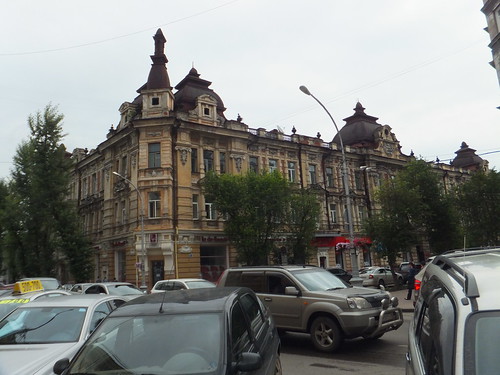
Buildings like this earned Irkutsk the title ‘the Paris of Siberia’.

The bus took us to a different part of town for a very good lunch at 'The Old Café'. The free Wi-Fi worked, too, once we had the password. The limited toilet accommodation caused a few problems after the long morning. We then split into a party who would go by coach to visit an apartment dwelling and the museum of wooden houses and a second group who would go (in a people carrier and car) to visit a preserved icebreaker and the same apartment dwelling.

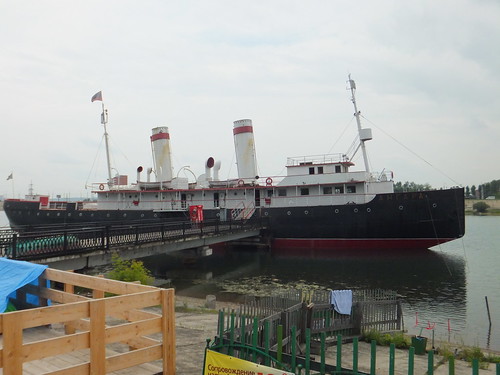
Of course, I was in the icebreaker group and it was an amazing visit. We were able to explore the engine and boiler rooms and even climb to the Crow's Nest. The vessel, the ‘Angara’, was built by Armstrong Whitworth in Newcastle-upon-Tyne and shipped in pieces to Russia where it was finally commissioned in 1899.  Before the Trans-Siberian railway was completed, the ‘Angara’ was one of two passenger vessels which joined the two halves of the railway by providing a ferry service across Lake Baikal. I've written about this period in the article The Completion of the Trans-Siberian Railway.

The 'Angara' is now a floating museum.

We then moved back to the city centre to visit a private apartment. The approach to the apartment block was not very cheerful and maintenance was clearly required. But, once we stepped through the heavy steel door to the apartment (steel doors are very common in Russia), we entered a colourful world of eclectic taste. The owner, a widow, was clearly very proud of her home and we were invited to look everywhere. Her two daughters were working away, so she was looking after her teenage grandson and granddaughter. We were invited to table for an enjoyable afternoon tea, after which we extended our thanks and made our way downstairs (there was no lift) to our waiting transport. Rather different from the house in the 'Old Believers' village we'd visited just two days previously (see article 'Into Russia'.

The unpreposessing approach to the apartment block.

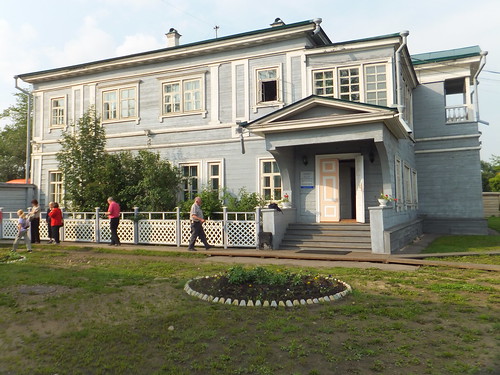
In complete contrast, our next stop was at the house of Prince Volkonsky, now preserved as a museum. The house had closed for the day but re-opened for a private visit by the 'Golden Eagle' guests. The house was an elegant, wooden villa, re-decorated internally in the appropriate style and, where possible, furnished with original items.

Prince Volkonsky was part of the 'Decembrist Revolution'. Yes, I was very hazy about the details. In December 1825, a group of officers and men of the Russian army protested Nicholas I's assumption of the throne. The revolt was crushed by the Tsar and five leaders of the revolt were hanged. Others were exiled to Siberia, including Prince Volkonsky. Prince Volkonsky's wife, Maria, followed her husband into exile and they appear to have led a fairly agreeable life, having quite a civilising effect upon Siberia. There's more information in the Wikipedia article.

The Mansion of Prince Volkonsky.

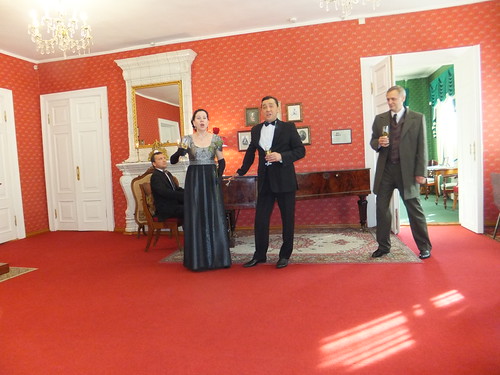
After looking around the principal rooms of the house, we gathered in the Music Room for a private concert with a professional pianist, a female vocalist and teaching professional, a professional male vocalist and a Master of Ceremonies who's a professional actor. At the end of the concert, the performers toasted us with champagne, and we returned the compliment.

Pianist, female vocalist, male vocalist and Master of Ceremonies toast their audience.

Our final stop, after an exhausting programme, was at the modern Marriott Courtyard Hotel for dinner. Oddly enough, it was probably the poorest meal of the whole trip but at least the Wi-Fi worked! Finally, our coach returned us to the 'Golden Eagle' train.

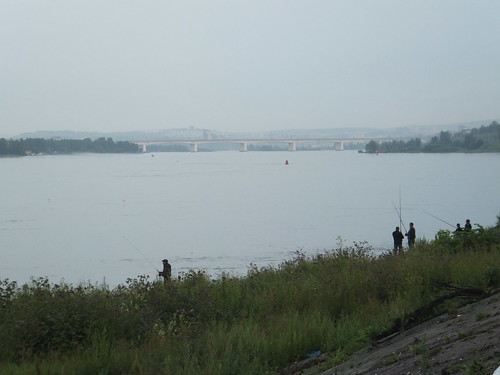
During the day, our train had been moved to the 'Tourist Platform', a siding next to the river bank with a wide tarmac promenade. No locomotive had been attached to our coaches so we had a little time, in the quiet of the evening, to walk, watch the river and ponder all the experiences of the day.

Late evening view of the Angara River at Irkutsk from the Tourist Platform at the railway station. Notice the fishermen.

Photographs:-

The 'Golden Eagle' train.
Slyudyanka Station, East Siberian Railway, Russia.
Irkutsk, East Siberian Railway.
Irkutsk, Russia.
Icebreaker 'Angara', Irkutsk.
An Apartment in Irkutsk.
The Mansion of Prince Volkonsky.

[Material added 9th August 2012.]

Monday, 16 July 2012

Lake Baikal

Sunday, 15th July 2012

My initial, very brief post, was made on 16th July 2012:-

During Saturday night we’d arrived at Slyudyanka station where we’d remained until morning. So I awoke to find a rather handsome stone built station building on one side and four or five sidings with waiting freight trains on the other side. A diesel locomotive had replaced the electric traction which had brought us from Ulan Ude.

Well, there's a lot more to tell you, and a lot of pictures to post but that will have to wait.

Incidentally, I'm posting this from a restaurant in Irkutsk.

That's all I had time for but I'll try to expand a little now. The 'handsome stone built station building' at Slyudyanka should have alerted me to the importance of this area in the history of the Trans-Siberian Railway but I'm afraid I was completely ignorant of the significance of the Lake Baikal area.

The handsome station building, in pink and white marble, at Slyudyanka.

Lake Baikal is the oldest lake in the world (over 25 million years old), the deepest (5,387 feet) and one of the clearest. It's 395 miles long and 49 miles wide at its widest. It holds 20% of the world's unfrozen fresh water. It's rich in plantlife and animals, many of which are only found around Lake Baikal and is a World Heritage Site. In addition to a Wikipedia article here, there's an interesting site here and UNESCO's site here. Whilst over 330 rivers and streams flow into Lake Baikal, it is drained only by the Angara River which flows north through Irkutsk. In the 1960s, this river was dammed to provide hydro-electric power to the Irkutsk area.

It was only on my return that I learned a little about the construction of this part of the Trans-Siberian, known as the 'Circum-Baikal Railway'. I've written a brief description in The Completion of the Trans-Siberian Railway.

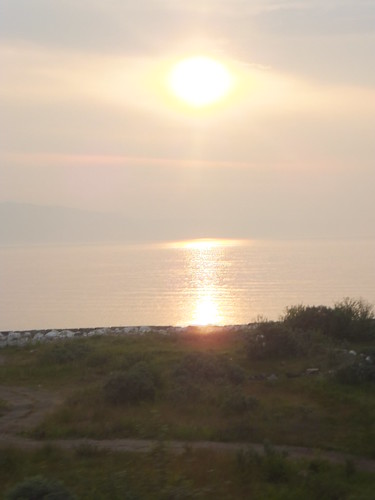
Around 7.00 a.m. our diesel locomotive set off from Slyudyanka with the the ten coaches of the 'Golden Eagle'. We proceeded along the main line past more sidings to Kultuk, where we diverged onto the 'Circum-Baikal Railway' for our journey of around 90 km to what is now the end of the line at Port Baikal. The sun was just rising above Lake Baikal on our right.

Sunrise over Lake Baikal.

Signs of industry fell behind us and we passed through attractive 'Alpine' scenery - pine trees, steep, rocky hillsides on our left and the placid waters of the Lake extending as far as we could see to our right.

Most of the time, the train was snaking on a rocky outcrop raised above the shore. From time to time, our route would take us slightly inland, leaving space for attractive wooden buildings next to the shore. One group of buildings at Sharyzhalgai was neatly painted in brown and yellow and labelled as a 'Resort House for the East Siberian Railway'. Near the buildings, there were usually a number of people, seriously attired for country pursuits. The shores of Lake Baikal are becoming popular with campers and holidaymakers. The variety of wild flowers we could spot from our train confirmed the richness of the flora around the Lake.

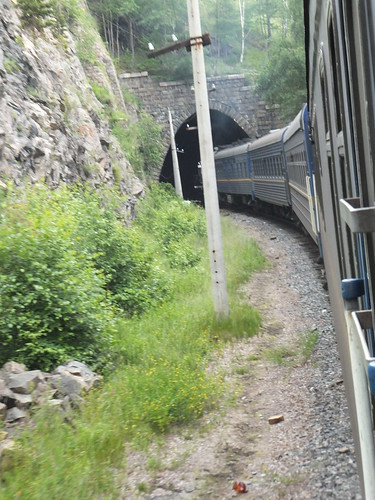
There are 39 tunnels on the way to Port Baikal, Galleries and numerous bridges either stone, steel girder or, inplaces, concrete. A variety of designs of tunnel portal are used, all in stone, and tunnel linings are also stone. I believe Italian stonemasons were recruited for this work.

The 'Golden Eagle' entering one of the tunnels.

After we'd been travelling for around two and a half hours, we passed through a very short tunnel (Number 13, 29.8 m), crossed a broad river and came to a stop near a small village, Polovina (sometimes written Polovinny). The only 'platform' was a short section of pre-cast concrete and the train had halted with the front door of passenger coach 1 aligned with this 'platform'. We were only allowed off by walking through the train and exiting at this door.

As soon as we came to a stand, I spotted a member of the train staff jumping off the train with a fishing rod. Later, I saw him return to the train, carrying a decent-sized fish. I don't know what it was, but Lake Baikal is famous for its Omul fish.

As we'd arrived, we'd passed a preserved 'Ea' class locomotive standing on what would have been the second track, before the line was singled. My first task was to survey this. This was one of the American-built locomotives supplied to Russia.

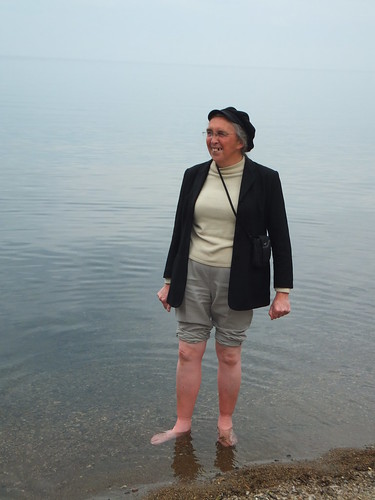
To reach the small beach, we had to cross the line in front of our locomotive. It had been suggested that we might wish to swim at this location but a simple test of the water temperature meant that I immediately abandoned this idea, although a few of the younger passengers did brave the waters. They did confirm that it was very, very cold. Not to be completely thwarted, I paddled in the Lake, and was joined by a couple of our passengers. The water was incredibly clear and, for some hours afterwards, I had a pleasant 'tingling' sensation in my feet.

Jan braves the waters of Lake Baikal.

When we first stopped, I'd spotted a woman emerging from a 'bender' tent on the beach. There was something very business-like about her, so I was not surprised to see that she had set up a little souvenir stall next to the train. This is where I purchased the excellent guide book on the Circum-Baikal Railway referenced below.

There was still time for me to take a walk through the village - very quiet except for the clucking of a number of hens running free. The track led down to the bank of the Polovinnaya River we'd crossed on our arrival. On my way back, I exchanged greetings with an elderly man walking through the village.

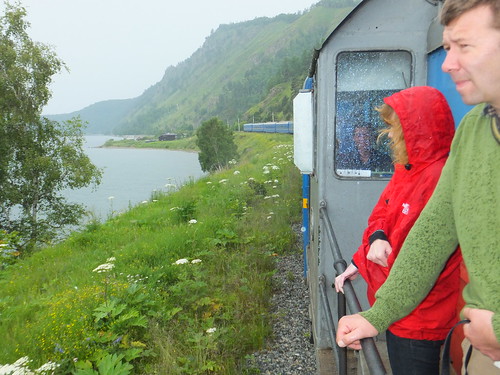
It was now time to leave Polovina and continue to Port Baikal. With the 'switcher' design of locomotive, there's a catwalk, provided with a handrail, either side of the engine compartment. Interested guests were to be allowed to ride on the catwalk facing the Lake for a short while. We all clambered up enthusiastically and the train set off. As soon as we left Polovina, the train entered tunnel number 12. At 778.4 m in length, this is the longest tunnel on the line and, unusually, it is completely straight. Although it was rather noisy next to the engine compartment, I found it delightful with unobstructed views of the Lake. I wasn't worried when it started to rain but, all too soon, the train came to a stop and we were invited to rejoin the passenger coaches. A fascinating interlude.

Looking back along the train from our vantage point on the locomotive.

Next, we took lunch in the Restaurant Car and, after another enjoyable meal, we arrived at Port Baikal about half past one, where we had a little free time to explore. I was pleased to find a preserved water crane (from the era of steam traction), complete with its lamp housing which indicated to an approaching train when the crane had been swung so as to obstruct the line. There was also a preserved 'L' class 2-10-0 locomotive. But I had to rush back to the restored station building for an opportunity to look inside the Circum-Baikal Railway Museum. I would have happily spent longer in this small museum but Tatiana was anxious to get us all to the chartered ferry which would take us to Listvyanka at 2.30 p.m.

A model of Port Baikal around 1900, on display in the Circum-Baikal Railway Museum at Port Baikal. The Train Ferry 'Baikal' is in the foreground and the funnels of 'Angara' can just be seen behind.

Just a short walk from the restored station building, a sturdy-looking blue and white ferry was tied-up at the quay. Once the 'Golden Eagle' guests were all on board, the ferry headed out of the harbour. Almost all the wood of the original construction has gone, but the general layout of the jetties remains as built for the 'Baikal' and the 'Angara'. Our destination, Listvyana, lay on the other side of the broad Angara River but we cruised the long way round. As the shore receded and the swell increased, it was difficult to remember that we were on a lake, not the sea. As we approached our destination, we passed a Kometa 15 Hydrofoil (but not moving fast enough to left up properly on the 'Foils'). I gather this is a service between Irkutsk and Lake Baikal. BaikalNature have placed a video showing this craft here. Regular readers may remember that on my trip to Saint Petersburg last year, I became quite used to travelling around on Russian hydrofoils (my posts on that trip are here).

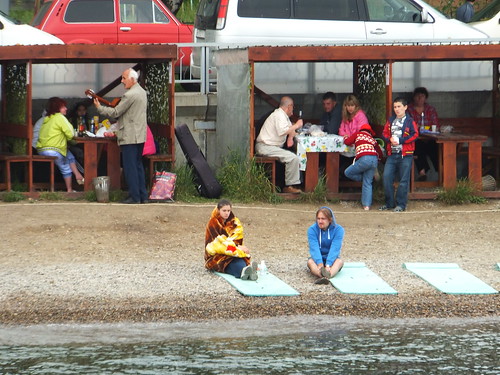
As we approached the quay, it seemed clear that Listvyanka is a resort destination and there were quite a few people around. There was a cafe on the shingle beach, a wandering singer playing the guitar and one young couple, well wrapped up against the wind off the Lake, determing to set on the shingle.

Listvyanka Beach.

A coach was waiting for us and we were soon taken to the nearby Lake Baikal Museum. Anna took us round the exhibits and explained just how special Lake Baikal is. There was also a large aquarium and captive Baikal freshwater seals which I'm no longer happy with. I realise such places are the only opportunity for most people to see these creatures but, nonetheless, it worries me.

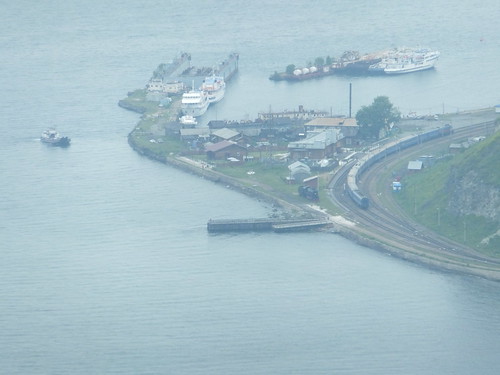
The 'Golden Eagle' guests then split into two groups - one visited the open-air Museum of Wooden Architecture but, despite my interest in architecture, I went with the smaller group for a short hike up Chersky Mount. It was an easy hike and, although we couldn't see long distances, we had a splendid view of Port Baikal and our waiting train.

Port Baikal, viewed from Chersky Mount, on the opposite bank of the Angara River.

Although, being summer, there was no snow, the ski-lift was nevertheless running so most of us decided, for variety, to descend using the ski-lift. By the time we were back in our People Carrier, it had started to rain so we were not sure what would happen to the advertised Barbeque Dinner.

The location was a resort village in wooded country quite near the Angara River. Although food, including the local Omul fish, was being cooked outside, we ate in a large wooden conservatory with a long table and benches to sit on. The Omul, related to salmon, is only found in Lake Baikal and I found its delicate flavour preferable to salmon.

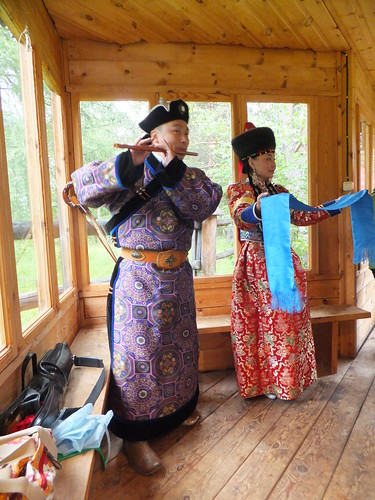
It was a very jolly meal but Tatiana had one more surprise for us. On our last evening in Mongolia we had missed the advertised folk performance in Ulaan Baatar through being stuck in a traffic jam. So she had engaged a Buryat man and woman in traditional dress to sing and play for us. Both artists were good but I think the versatility of the man (pipe, fiddle, jaw's harp and 'mouth music') 'blew us away'.

The musical concert at Listvyanka finished a splendid meal.

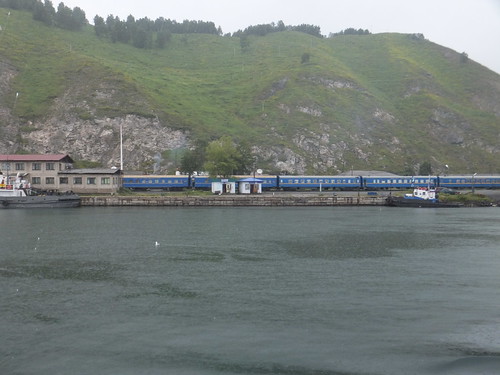
In a very mellow mood, we rejoined the road transport for the short journey to the nearest ferry jetty, where our ferry was waiting to take us back to Port Baikal. As we approached the quay, we had the welcome sight of the familiar blue coaches of the 'Golden Eagle'.

Port Baikal, with the 'Golden Eagle' waiting to take us back along the Circum-Baikal Line to Slyudyanka.

As I re-joined our train, I noticed a modern diesel multiple unit waiting on the adjacent line, presumably part of the limited tourist service along this very special line. During the night, our train returned us to Slyudyanka after a very special day around Lake Baikal.

Photographs:-

The 'Golden Eagle' train.
Slyudianka Station, East Siberian Railway.
The Circum-Baikal Railway.
Plinthed 'Ea' Class at Polovina.
Port Baikal.
Circum-Baikal Railway Museum, Port Baikal.
Listvyanka, Lake Baikal.
Concert in Listvyanka.

References:-

'The Circum-Baikal Railway: A Concise Guide Book (3rd edition)' by A.K. Chertilov translated Ye. Luganskaya (Artizdat, Irkutsk) ISBN 978-5-93765-044-3.

[Additional material added 1st August 2012, 8th August 2012].