Thursday, 1 March 2012

Savuti (3)

Saturday, 25th February 2012

The writer, the couple from Holland and our guide Lets took a simple breakfast before setting off a little after 6.00 a.m. for what would be my last Game Drive at Savuti.

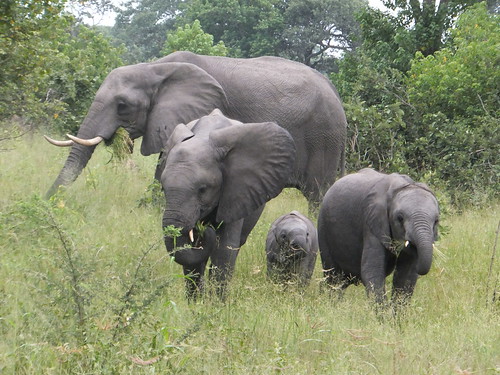
We soon came upon Giraffe, already browsing amongst the trees, and Elephants, munching grass. This time, there seemed to be large numbers of elephant and they didn't appear worried by our presence, despite the herd having a number of young.

"...they didn't appear worried by our presence, despite the herd including a number of young."

The herd was moving, in an unhurried way, towards the water so Lets drove to a position where we could watch the elephants as they arrived at the water's edge. After a while, the elephants started to emerge from the trees and assemble on the river margin. They'd chosen to do this at the exact spot where there were a number of hippopotamus almost submerged in the water. The two species watched each other in silence for some time and I wondered what would happen next.

Elephants and Hippopotamus watching each other in silence.

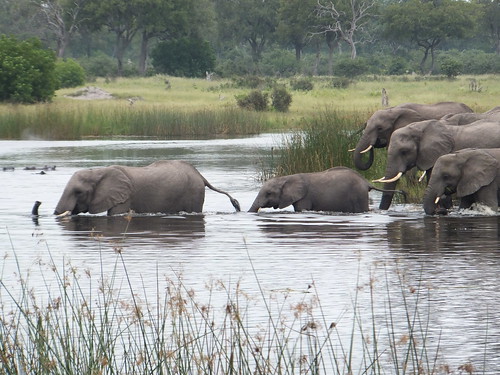
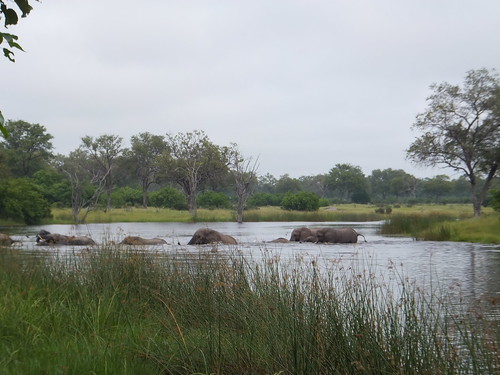
After a while, the Hippopotamus slowly turned away and moved further along the Channel, where they re-grouped and continued to study the elephants from their customary, mainly submerged, positions. The elephants started to cross the river in single-file adopting their normal, stately gait.

Elephants starting to cross the river, watched by Hippopotamus.

Once the initial group of elephants emerged from the water, more started to cross, the smaller ones barely visible above the water. As they crossed, other elephants emerged from the trees and gathered at the water's edge.

More elephants cross the river.

Elephants need vast amounts of water to avoid dehydration. Some of the elephants paused to take on water before crossing the river. Elephants can suck up a few litres of water at a time with the trunk which is then discharged into the mouth.

A young elephant taking on water before crossing the river.

I never managed a proper count of the elephants but there must have been a couple of dozen. I was sorry when we left our riverbank location and this marvellous elephant experience to continue our game drive.

As we drove, we saw numerous birds like the Ground Hornbill and the Woodland Kingfisher. We had the inevitable sighting of a group of Impala before stopping at one of the many Pans for morning tea. Pans are waterholes created by generations of elephants, digging with their feet to create holes which fill with rainwater. Over a long period of time, these excavations can grow into large, often round, pools which can hold rainwater for some time before evaporation eventually dries them out.

We stopped at this typical Pan for morning tea.

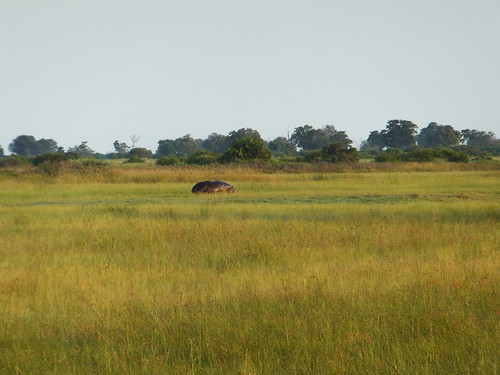
When we arrived, there were a number of birds around the litchen-covered water of the pan but I almost missed a single hippopotamus, almost totally submerged. Once the hippo came up for air, there was no mistaking his huge bulk before he re-submerged. Following refreshments, it just remained for us to complete our journey back to the Camp, in good time for Brunch after which I readied myself for transfer to my next Safari Camp.

I'd booked to go to Savuti-Under-Canvas next but, on my arrival at Savuti, the camp management had informed me that the airstrip at Savuti-Under-Canvas was flooded and temporarily out of use. Rather than face a four hour journey by road to reach Savuti-Under-Canvas, they had made arrangements for me to visit King's Pool instead. King's Pool, they pointed out, was a Premier (rather than a Classic) Safari Camp and the change thus represented an upgrade, at no cost to me. So I readied myself for the trip to King's Pool, which I'll tell you about next time.

Pictures of Savuti Safari Camp are here.

Pictures of the final Game Drive at Savuti are here.

Savuti (2)

Friday, 24th February 2012

I set my travel alarm for just before 5.00 a.m. so, by the time I heard the "Hello" called from outside by a member of the Camp staff, I was already pottering about. At 5.30 a.m. I was collected by a guy with an L.E.D. torch (like Duba Plains, guests are chaperoned by a member of staff when it's dark because animals are free to wander through the Camps) and taken to the dining area where I had a simple breakfast with the couple who live in Holland, our guide Lets and some of the Camp Management.

In the grey, pre-dawn light we set off on the track away from the Camp in one of the Land Rovers. We stopped short of an Owl sitting in the middle of the road. After a moment, he flew off and we continued towards the airstrip. The South African couple I'd met at dinner the previous evening had departed on safari a few minutes before us and their driver/guide came on the two-way radio to say they'd spotted a leopard heading our way. We turned around, headed back towards the Camp and stopped again at the location where our guide, Lets, judged that the leopard could be seen. After a minute or two, a shadowy figure appeared around a bend in the road and plodded off into the bush. Lets then turned around again and continued on the main track before turning onto a track down a firebreak cut into the bush. This time, we had a rather better, if brief, view as the leopard appeared out of the bush, plodded across the firebreak and disappeared again. It was a large animal which Lets recognised as a local female. From the distended lower body, we concluded that she was pregnant. An amazing sighting!

Since it's difficult to track animals in the heavy vegetation of the bush, we concluded the sighting of the leopard and continued with the original scheme for the drive. We passed a large giraffe happily grazing from the trees but any other animals were effectively hidden by the closely-spaced trees and bushes. There were a number of permanent tracks made by animals moving around and various small pools. Occasionally, we passed muddy depressions which elephants used for their ablutions.

We had various bird sightings - there's an immense variety of colourful species. Our guide forced the Land Rover through dense bush to reach the Savuti Channel. This is a semi-permanent river currently flowing but liable to dry up every few years. It was a delightful place to stop for tea and biscuits and there were numerous birds to be seen.

Morning tea by the Savuti Channel.

After our break, we continued along the river margin (often with our left hand wheels in the water causing the vehicle to tilt in a rather alarming manner!). Shortly after our track turned inland, we sustained a problem. After an ominous 'bang' from underneath, our guide found that the left front wheel wasn't steering and we stopped. Cursory inspection underneath suggested that the substantial steering rod to the left front wheel had snapped like a breadstick! Our guide contacted the Camp by radio and a rescue was arranged. We were allowed to walk a few yards from the vehicle during our wait but, if there were any animals around, they kept quiet and kept hidden. After about an hour, the sound of a vehicle could be heard and a Land Rover appeared behind us with two guys from the Camp. A few minutes later, another Land Rover pulled up, with a man and a well-built lady in stained overalls who, I correctly concluded, was a mechanic. We were to continue our journey in the second Land Rover, leaving behind four people to fit the replacement steering rod they'd brought and get the repaired vehicle and the mechanics' vehicle back to camp.

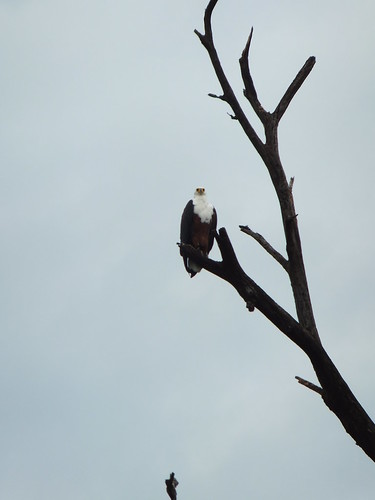
As we carried on, we found more interesting birds and, in a river creek, a single hippopotamus adopting the characteristic pose - submerged except for eyes, ears and the top of the head. There were a number of weaver birds' nests, each woven at the end of a tree branch and we passed a baby crocodile, a couple of Water Monitors and more than one African Fish Eagle.

An African Fish Eagle surveys the water from a dead tree.

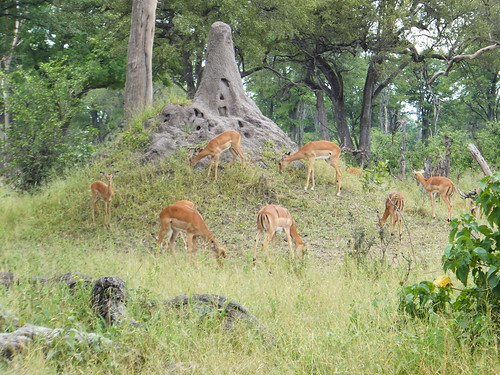
Once again, our track turned away from the water and the bush became less dense, with patches of open grass. Now we began to meet small groups of Impala. This must be the most handsome of the antelopes and I believe it's the most successful. But I've a soft spot for the Red Lechwe I saw at Duba Plains since their movement, often conducted in a series of massive leaps, gives the appearance of sheer exuberance. At one location, we found a group of about eight impala happily grazing on the vegetation of a cone-shaped mound which was topped by a huge, grey termite hill. The termite hill was pierced by numerous openings looking like doors and windows, giving the appearance of some mythical castle.

Impala grazing at the 'mythical castle'.

We stopped to watch a rather timid group of elephants who quietly passed us keeping their distance, quickly becoming hidden in the foliage of the surrounding trees. Then we found the engine wouldn't restart. I'd assumed we'd received a 'spare' vehicle because the driver's door was held shut (not very effectively) by a piece of wire, the plastic on the air intake was broken and the odometer didn't register speed. However, our guide assured me it was a 'regular' vehicle normally used by another guide. Lets managed to get the Hazard lights on and the windscreen wiper motor worked (although there were no wiper blades because the windscreen is normally hinged flat, out of the way). Eventually, after a bit of fiddling with the Remote Locking Key, the starter motor turned over and the engine immediately fired. We completed our return to Savuti Camp in time for Brunch without further excitement.

Pictures of the Game Drive are here.

In the late afternoon, Lets took the couple from Holland and Jan for a pleasant boat trip on the Savuti Channel. From the water, it was possible to get a better idea of the layout of the camp with guest rooms spread along the river bank on either side of the central group of buildings with the landing stage for the boats.

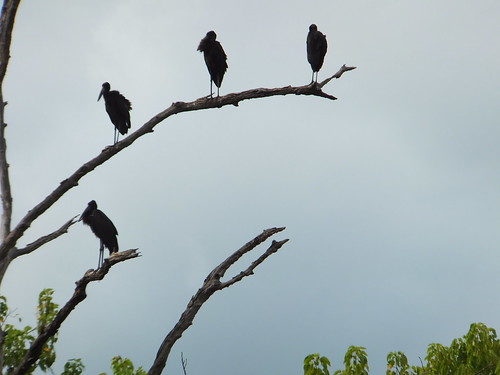
A group of Openbilled Stork solemnly watch our passage from a dead tree on the riverbank.

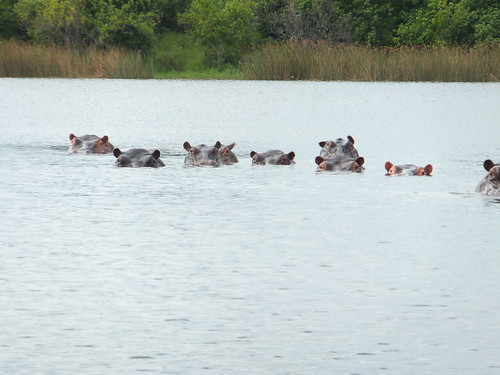
Near the limit of our trip, the channel broadened and we were observed by a pod of hippotamus. Their quiet, unmoving gaze was strangely hypnotic.

Hippopotamus observe our boat.

On the return journey, we moored at a wooden viewing platform built on the riverbank which offered good views across the river. This was the location for the tradition of a 'Sundowner' - a drink on the way back to Camp prior to the evening meal. Around 6.00 p.m., we clambered back into the boat for a gentle cruise back to the landing stage at the Camp.

Pictures of the boat trip are here.

Savuti

Thursday, 23rd February 2012

We landed safely at Chobe Airstrip a little before 2.00 p.m. and taxied to the unloading area. I was surprised to see a rather smart Pilatus aircraft tied-down there. I later discovered it was the PC-12 NG, a high-performance single-engined turbo-prop from the Swiss manufacturers (more information on their website here).

The Pilatus PC-12 NG at Chobe Airstrip.

The Cessna pilot let me off the aircraft and quickly found my luggage. There were two Land Rovers parked-up behind the Pilatus. One, with just a Botswanan driver, had apparently come to meet me. The other Land Rover disgorged a party of guests and their luggage who were clearly about to leave on the aircraft which had brought me in. As my driver and I left the airstrip, the pilot of my aircraft was still loading his new passengers and their baggage.

My destination was Savuti Safari Camp, a drive of perhaps 50 minutes from Chobe Airstrip. Around the airstrip, the area seemed notably drier than Duba Plains. The track we were following was, as usual, sand but dry, powdery sand which threatened to halt our progress as we swayed from side to side in the deep ruts. It was not a very comfortable journey but, eventually, we arrived at the camp itself.

I'd some idea now what to expect from the Safari Camps so I was not surprised to see three members of the Camp Management (a bearded South African and two young ladies) waiting to greet me before leading me to the lounge area, a large, open-sided building with a massive thatched roof.

The thatched lounge area at Savuti Safari Camp.

I was presented with a Welcome Drink and the usual broad Indemnity to sign. In this part of Africa, it appears that no business is prepared to do business with you unless you absolve them from any responsibility for the various problems which might arise.

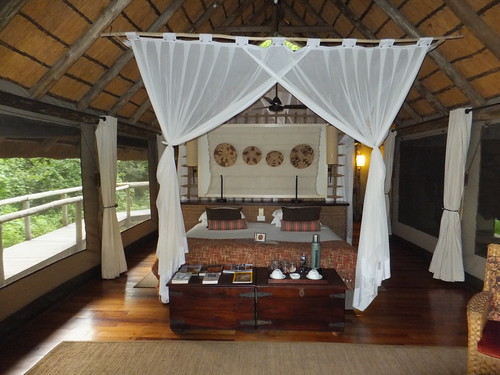
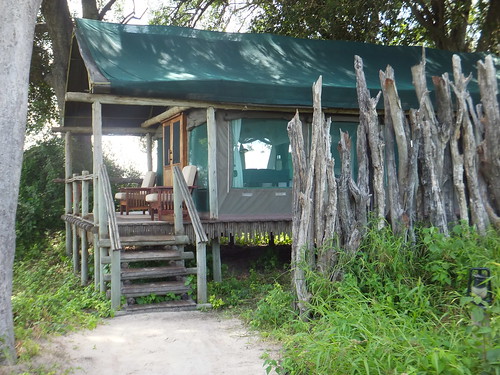
One of the young ladies then conducted me along a boardwalk connecting the central complex of buildings to my room so that I could prepare for Afternoon Tea and the late afternoon Game Drive. The accommodation was very satisfactory and, at Savuti, the customary verandah overlooked a stretch of tranquil water - a loop in the Savuti Channel. Although, like Duba Plains, the 'room' was canvas sided, this time the roof was a very substantial thatched affair.

The large and comfortable bed in my room.

When I returned to the central lounge area for Afternoon Tea, I met a friendly, boisterous group of guests who, I discovered, had arrived in the Pilatus aircraft I'd admired at Chobe Airstrip. The party was well-known at Savuti and this appeared to be a regular visit to have fun. As far as I could make out (their high spirits made coherent conversation difficult), the leader had once been employed by Wilderness Safaris before setting up his own business in South Africa supplying 'high-end' safaris using the aircraft I'd seen. All the members of the group were involved in this business. The leader appeared to be a Guide in his own right, so the Camp merely provided a 4 x 4 vehicle and, after refreshments, the group piled into the waiting Land Rover and took off into the bush.

My own afternoon game drive was with a pleasant couple living in southern Holland - a Dutch lady and her English partner. Our guide was a Botswanan called Lets. We saw various birds and then encountered a group of Carmine Bee-eaters. These birds seemed interested in 'buzzing' our 4 x 4 and a number followed us for some distance, circling the moving vehicle and apparently delighting in their ability to repeatedly swoop in front of the Land Rover and emerge safely.

One of the birds performing aerobatics around our Land Rover.

We came across a number of groups of elephants although some seemed rather shy. This is most common when a female has a youngster when they follow the principle of "discretion is the better part of valour" and they will unhurridly move into the cover of the bush. Elephants are fastidious creatures and, when away from water, will indulge in 'dust bathing' where they use their multi-purpose trunks to cover their backs with scooped-up dust.

The dust settles on the back of this elephant.

There were also Impala, usually just standing and watching us as we passed, an adult Warthog and a couple of Giraffe. With their long necks, Giraffes always appear rather supercilious and their unhurried movements when browsing give them a certain serenity.

We returned to the Camp in good time for Dinner. A South African couple I'd not previously seen joined the couple from Holland and myself for dinner, as did some of the camp management. The jovial group with their own aircraft had dinner at a separate table and, I understand, carried on late into the night with their high jinx but I retired to bed immediately after the enjoyable meal.

Photographs:

By Cessna to Chobe Airstrip.
Savuti Safari Camp.
Savuti: Game Drive 1.

Duba Plains (4)

Thursday, 23rd February 2012

I'd had such wonderful sightings at Duba Plains, I was sorry that Thursday morning's Game Drive would be the last at this Camp. Once again, I was the only customer for Spike's vehicle so the two of us set off just as it started to get light. The journey started with a number of bird sightings including an Openbilled Stork and a small flock of Sacred Ibis. Just before 7.00 a.m. we saw a single hippo still on land. Hippos forage on land during the night but spend all day in water since I gather they can easily suffer from sunstroke.

A single hippopotamus still foraging on land.

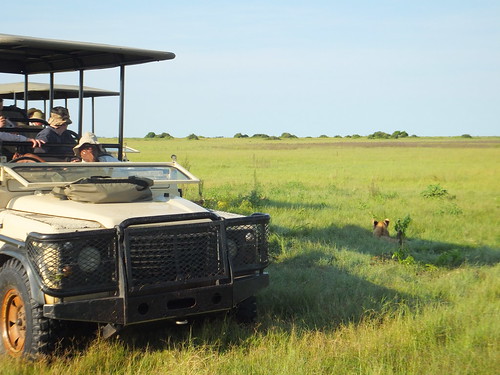
Spike located the buffalo herd and then the lioness with the young lions we'd seen the previous day. At twenty past seven in the morning, the lioness was still yawning and had not yet entered the hunting phase.

"... the lioness was still yawning ..."

A nearby single kudu was completely ignored by the lions. We found the adult male who appeared similarly tired. There were two other parties from the Camp out in 4 x 4 and they met up with us to admire the lions.

Two other 4 x 4 joined us to admire the lions.

The adult male made a token effort at mounting the lioness but, losing interest, he wandered off then lay down again watching one of the cubs which was rolling on its back. After nuzzling the female, the adult lion stood over the lioness a second time but, again, seemed to find it all too much trouble so they both wandered off separately. Soon, the lions seemed to be relaxing again in the warm sun.

"The adult male made a token effort at mounting the lioness."

At around 9.00 a.m., there seemed to be some sense of activity in the buffalo herd and a small group of bulls were heading towards our area and the bush with the relaxing lions. The buffalo must have smelled the lions because they suddenly broke into a run - to my surprise, towards the bush with the lions. It appeared that the hunter had suddenly become the hunted. The lions we could see took off at a run away from the buffaloes and more lions we'd not been able to see came tumbling out of the bush. All told, there were about eight of them. The small group of buffaloes gave chase for about 200 yards and then, satisfield with the result, stopped.

"The small group of buffaloes gave chase for about 200 yards and then, satisfield with the result, stopped."

This diversion had given the main herd just the opportunity it needed and, at a trot, the main herd moved to their chosen destination - a large area of plain with fresh grass. Quickly, the buffalo herd settled down again so we went to find the lions again.

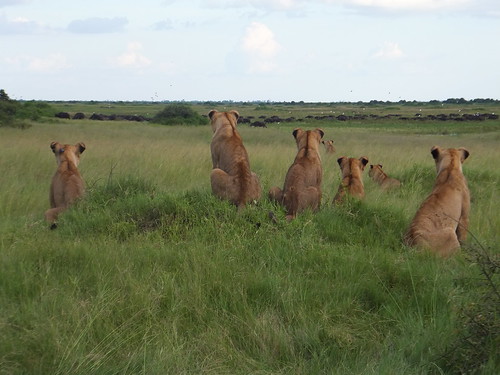
We didn't see the adult male again but the lioness and six younger lions regrouped and started watching the buffalo herd again. The lioness decided to move across a marshy patch of land to a location which would give a better view of the herd. In single file, the lions set off along an animal track through the tall grass to the edge of the marshy ground.

"In single file, the lions set off along an animal track through the tall grass to the edge of the marshy ground."

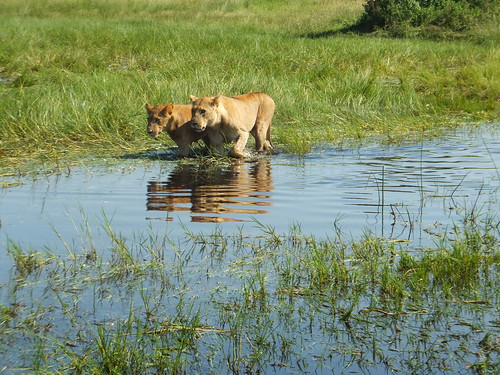
After some hesitation, the lions crossed the water, each lion choosing its own path across the water. The lions then resumed either watching the re-located buffalo herd or just relaxing in the long grass. It was an amazing experience!

Two of the lions delicately find a path through the water.

It was time to return to Camp. We saw a herd of at least 18 elephants in the distance, passed the still-intact buffalo herd and made various other sightings on the journey back.

All my pictures of this Game Drive are here.

I was very sad to leave Duba Plains and all my new friends. After warm goodbyes, Spike drove me back to the airstrip and the vivacious masseuse came along for the ride. One of the larger Cessna aircraft was already at the airstrip, delivering weekly supplies I believe. It took off trailing a cloud of dust. A few minutes later, a smaller Cessna 206 (registration A2-AIV) landed to pick up me and my modest luggage. There was one passenger already aboard - a Wilderness Safaris' member of staff being transported to Savuti - so I clambered in the back for the 40-minute flight to Chobe Airstrip.

My pictures at Duba Plains Airstrip and on my flight to Chobe Airstrip are here.

Duba Plains (3)

Wednesday, 22nd February 2012

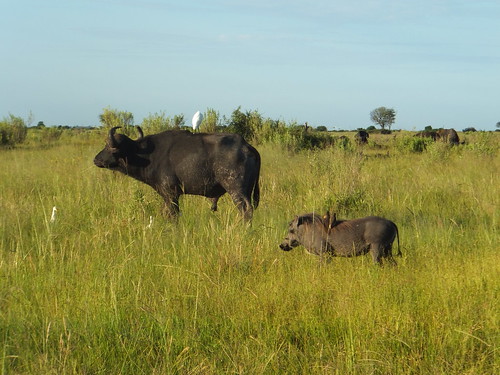
In the morning, we set off before sunrise to take the main track from the Camp into the bush. As the sun came up we found a solitary elephant and then a whole group, including a baby. All the elephants seemed unconcerned at having us in close proximity. The elephants had clearly been in the water recently because the lower half of their massive bodies appeared darker where the hide had not yet dried out. We found a solitary buffalo, with a warthog in attendance. Both animals were carrying birds on their backs but the warthog found the birds irritating after a while and dislodged his passengers by spinning very quickly through 360 degrees!

"We found a solitary buffalo, with a warthog in attendance ..."

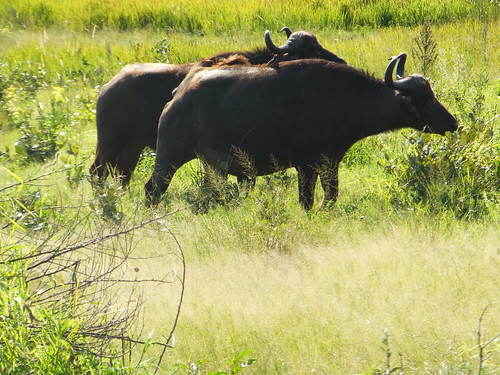
We soon located the rest of the buffalo herd spread out across the broad, grassy plain. We followed their activities for some time, studying the buffalo from different positions. Individuals would slowly wander from one area of lush grass to another, munching slowly. Many would be lying down, huddled together with other herd members in groups of ten or more. But, most often, we saw buffalo just standing motionless in the sun almost as if they'd forgotten what they wanted to do next.

"... most often, we saw buffalo just standing motionless in the sun ..."

Buffalo herds are always accompanied by large numbers of birds of various species either on the ground or riding on the backs of the animals. There didn't seem to be any general movement of the herd nor did we see any lions on this occasion. With the weather still hot, we returned to Camp in time for Brunch.

More pictures on the morning game drive are here.

I'd not previously seen Vervet Monkeys around the camp but, this time (perhaps being a little more observant), I discovered that the huge tree which overhung my tent had lots of them. Unlike the mischievous Vervets I'd encountered around the Royal Livingstone some days before, the Duba Plains Vervets seemed very timid. They would balance high in the tree looking down on you, with an amusing habit of moving their head from side to side in a jerking motion, as if to better see you.

Vervet monkeys, mother and baby, watching from high in the branches overhanging my tent.

In the afternoon I had a fabulous Game Drive with Spike. This time, I was the only guest. We saw lots of the brightly-coloured birds of the area and a solitary buffalo. Males frequently leave the herd temporarily to build up their strength in isolation before returning to challenge the Dominant Male. We spotted a single elephant but soon he joined up with a small group of elephants nearby.

A mature, male elephant.

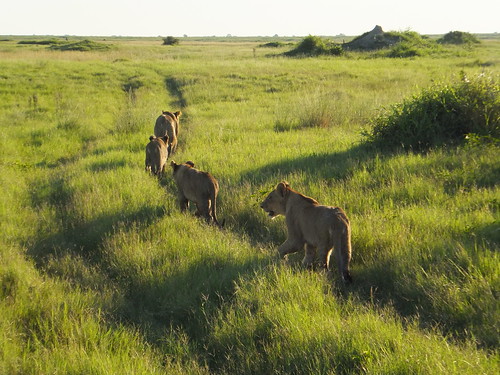
Then, Spike located a lioness accompanied by a younger lion trotting along a well-beaten track in the long grass. Two more young lions appeared and, in single file, all four animals continued along the track until they found a suitable vantage point where they fanned out to observe the buffalo herd, a couple of hundred yards away.

Four lions in single file.

Spike then found an adult male lion, with full mane, lying in the grass in the shade of a large bush. He was sitting up but so relaxed that he didn't even glance round at us as we approached from behind. We drove round to the other side of the bush so that I could try to photograph his face and found the lioness and cubs lying near the bush on that side.

It's around 6.00 p.m. but still too warm for this adult lion to do other than relax.

It was a very peaceful scene. The lioness scratched behind her ear with a paw and one of the young lions rolled on its back with its legs in the air. It was hard to remember that these animals are determined killers when hunting food. Well pleased with what I'd seen, we made our way back to Camp, passing a family group of elephants, male, female and young.

On the way back it became dark. Quite near the camp, we met a group of baboons who scampered for the nearby trees, a couple of Kudu and, undulating from the track to a convenient bush and visible only for a few moments, a Genet. I didn't know what a Genet was and had to look it up in Duncan Butchart's book 'Wildlife of the Okavango' (ISBN: 978-1-86872-538-0) but the ever-useful Wikipedia has an article here.

My pictures of the afternoon game drive are here.

Duba Plains (2)

Tuesday, 21st February 2012

We set off around 6.00 a.m. and followed our previous track away from the camp, initially over the watery sections, eventually coming to one of the islands, dry at the time of my visit, where there are wide-open savannah-like grasslands dotted with bushes, stands of trees and tall palm trees.

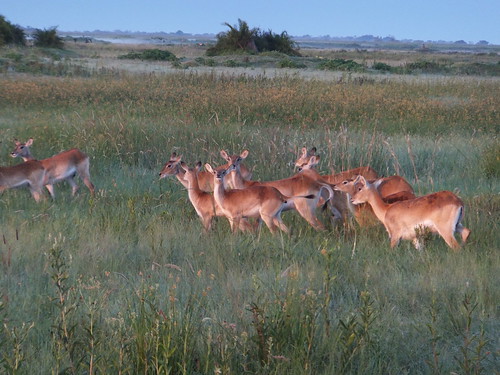
There were frequent Red Lechwe to be seen, antelopes who can perform amazing leaps when running (which is particularly helpful in the often-waterlogged Delta). These handsome creatures were sometimes alone, sometimes in small groups but we also found groups of more than thirty.

A group of Red Lechwe.

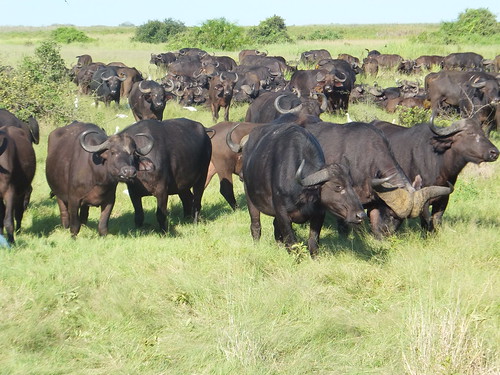
Spike spotted the buffalo herd in the distance but navigated downwind to an area where he expected lions. We came up behind a couple of young lions, lying in the long grass but intently watching the movements of the buffalo. I was amazed that the lions didn't even turn to see what was approaching, but remained intent on their task. Leaving the lions to their vigil, we moved away to find other animals passing a group of elephants, a number of red lechwe and finally closing in on the buffalo themselves, with their attendant army of birds.

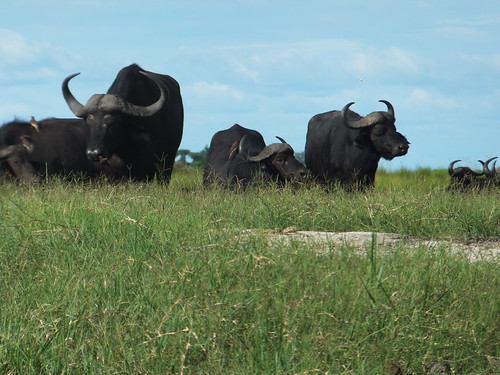
Part of the large herd of Buffalo.

After studying the buffalo for some time - a very peaceful scene when they are not on the move or threatened by lions - we moved back to the elephants. The group included a number of young.

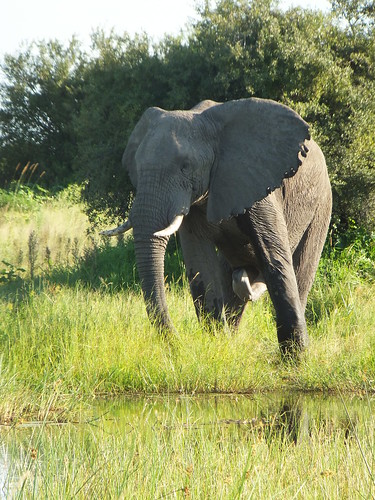
Elephants quietly grazing.

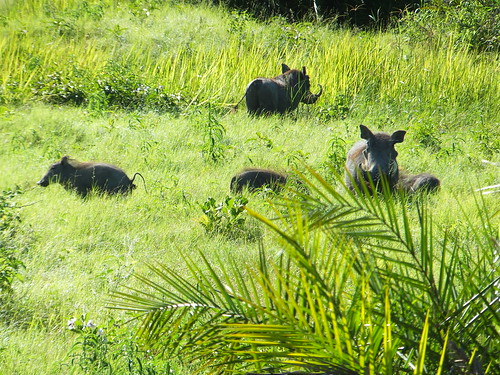
Warthogs make a rather curious sight, but I find them appealing. They move with a high-stepping gait like a rather enthusiastic, oversized dog. We found a group of three adults with two young. Like all the animals we'd seen, they appeared untroubled by our proximity.

A group of Warthogs.

We decided to go back to the lions, passing a solitary tsessebe on the way. This time, we found a large female lion stretched out on her back, legs in the air, enjoying the warmth but shaded from the direct sun by the shadow of a large bush. Presently, the female went for a short walk before returning to lie down with the young cubs who seemed very sleepy. There appeared little prospect of lion activity for a while so we left them to it.

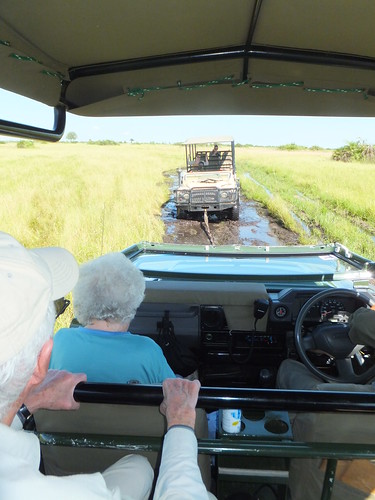
I saw two warthogs scampering through the grass, tails held high - a warthog peculiarity when running. We successfully came through a deeply waterlogged section of track but a radio message informed us that the Land Rover following us on the same route had become stuck. We turned around and returned to the waterlogged section to help the other vehicle. Spike stopped facing the Land Rover, connected a towing strap to the front of his vehicle and passed the free end to the driver of the Land Rover. Once attached, Spike did a powerful reverse and, on the second attempt at a 'snatch' pull, the Land Rover moved and was soon clear of the waterlogged section.

Our vehicle tows the Land Rover out of the waterlogged section.

In the afternoon, we went for a boat trip. A wooden pier next to the outside dining area had two aluminium speedboats moored. A narrow creek led to the main channel a few hundred yards away. Once afloat, we found the whole area criss-crossed with waterways, some broad channels, some narrow passages where the reeds brushed against the sides of the boat.

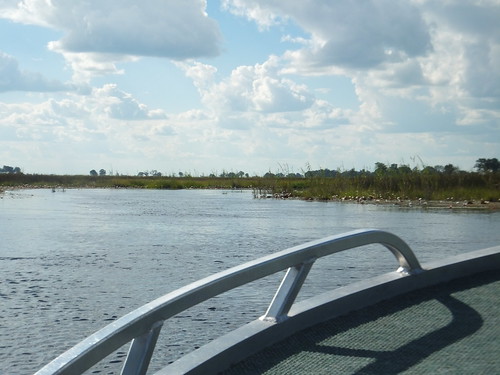
Our boat in one of the broad channels.

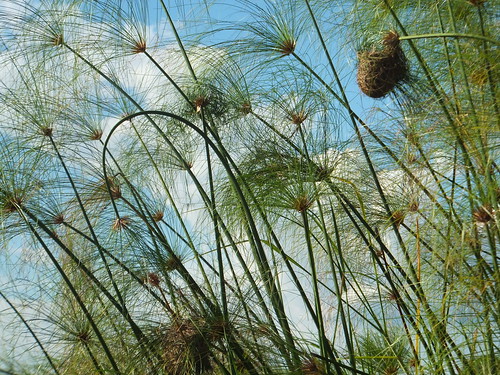
In some places, Peter the boat driver accelerated, throwing the boat from side to side as he expertly zig-zagged through the available spaces. As far as possible, he avoided the water lilies which grow freely but tend to foul the propellors of boats. A form of papyrus grows widely here, tall spines terminated at the top in a delicate fan of pale fronds. The papyrus is popular with the weaver birds and we found a number of the tall spines arced over with the weight of the carefully-woven nest.

A stand of Papyrus, some carrying Weaver Bird nests.

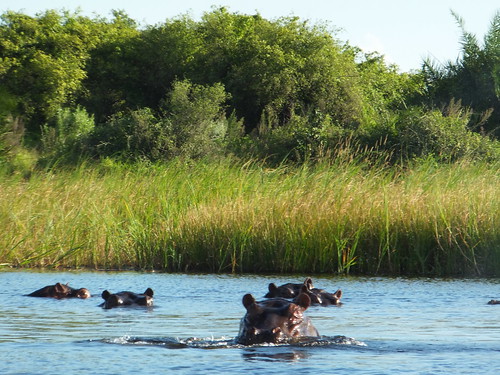
We saw a lone buffalo on the bank who watched us incuriously for a few moments before lumbering off into the bush. Then, we passed a pod (yes, that's the Collective Noun, I learned) of hippopotamus, almost submerged but with all members carefully watching us as we passed, occasionally sinking and re-emerging in a surge of water. After cruising for a few more minutes, we came to another junction of waterways and found another pod of hippos waiting in ambush, or so it appeared. Peter manoevred the boat into the reeds and we waited to see whether the hippos would move away but they seemed quite content to just stare at us.

"...the hippos ... seemed quite content to just stare at us".

Eventually, Peter gunned the engine and took the boat around the impassive hippos at high speed and back towards the camp, passing a buffalo and a pair of elephants foraging. By now it was becoming dusk but, as we approached another junction in the waterways, we could see yet another pod of hippos. This time it was easier to quietly slip past the hippos and complete our journey back to the Camp, tired but happy.

Pictures of the morning game drive are here.
Pictures of the boat trip are here.

Duba Plains

Monday, 20th February 2012

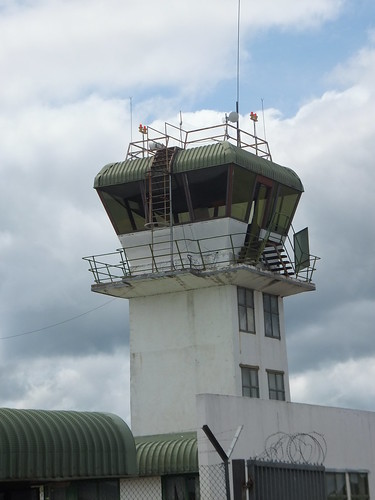
The Control Tower at Kasane Airport, Botswana.

I was sitting in the terminal at Kasane Airport happily working on my blog. One or two light aircraft had come and gone and I'd heard a helicopter. There was no view of the apron from the terminal so I restrained my curiosity until another aircraft arrived producing a tremendous racket. Judging by the 'white noise' audio spectrum which, even in the terminal, was quite painful I first thought it was a pure jet. But, as I became used to the deafening sound, I could make out the lower frequency spectrum of propellor blades 'chopping' the air. I temporarily abandoned my blogging to go outside and find a spot where I could see what was producing the dreadful noise. It was a military transport with four noisy turbo-props, very similar to the ubiquitous 'Hercules' but, I was told, the Spanish version (actually, whilst Botswana operate a couple of CASA C-212 and CN-235, they're only twin engined so it may have been a C-130 'Hercules' after all, of which Botswana have three).

After this interruption, I went back to my editing and then, shortly after midday, one of the check-in guys approached and said they were ready, so I had to hastily finish off and meet the young pilot, Geert. He said he had just two other passengers and I met the two young American ladies before we all went through security together and out to the aircraft.

Our 'plane was a single-engine Cessna high-wing monoplane (206, I think) with a tricyle undercarriage, registration A2-JKL. I was given the right-hand front seat and the Americans the middle row seats. The rear seats were used for my hand luggage. The pilot started the engine and obtained taxi clearance to the runway in use. As we taxied, the noisy military aircraft departed before us, demonstrating impressive STOL (Short Take-Off and Landing) capability. We passed three other military aircraft parked up - a helicopter and a couple of Britten-Norman products ('Islander' I think). We waited clear of the runway until another small aircraft landed then we were given take-off clearance. There's a single tarmac runway of reasonable length but work was going on at either end to lengthen it, presumably to accommodate more tourists in larger aircraft.

'Zambezi Queen' on the Chobe River.

At fairly low altitude, we turned left over Kasane town, and headed roughly south-west, overlooking the Chobe River which I'd just left. I took a reasonable picture of the 'Zambezi Queen' at her mooring before we passed over the herd of buffalo on the island I'd previously seen from the river level. We flew over the area of the Chobe National Park we'd explored by 4 x 4 before climbing to our en-route altitude for our 75 minute flight to Duba Plains Airstrip. On arrival, we overflew the dirt runway so that the pilot could check the runway for obstructions and perhaps check surface wind direction from the airsock (the only 'aid' these simple airstrips seem to have) before making a beautiful landing and taxiing to an area near a waiting Toyota 'Land Cruiser'. Spike, the driver of the 'Land Cruiser' and guide for my Game Drives introduced himself and transferred my luggage. I said goodbye to the pilot and the two American girls (who were continuing in the aircraft to a different camp) and Spike took me via a sandy track a short distance to Duba Plains Camp.

The airstrip at Duba Plains, in the wilderness of the Okavango Delta.

More pictures of my journey from 'Zambezi Queen' to Duba Plains are here.

At Duba Plains Safari Camp, I was welcomed by the Camp Managers, Lizzy and Martin. After a 'Welcome Drink', I had lunch whilst Lizzy explained some of the arrangements. Then Lizzy took me along a sandy path which extended from the central group of buildings to serve each of the six double 'tents'. I was in Number 6, requiring the longest walk.

"It's Camping, Jim, but not as we know it."

My luxurious quarters at Duba Plains.

Large areas around the camp are subject to seasonal flooding and there was a lot of water at the time of my visit. So they start by building a wooden platform on wooden piles. A large tent is then built on the platform. Window areas are just covered with a flexible insect mesh allowing a cooling breeze to flow through the tent. There are roll-down covers on the outside of the windows which are closed at night. There's a wooden framework around the tent supporting a tubular steel framed outer roof of canvas or similar. This roof extends over a generous verandah at the front with splendid views across the delta. The front of the tent has double wooden doors onto the verandah whilst the rear has a single door connected to an elevated wooden platform extending to an outdoor shower facility. This is screened on the 'landward' side but completely open on the swampland side.

There are more pictures of Duba Plains Safari Camp here.

At 4.00 p.m., I made my way to the central area for what they described as 'High Tea'. At 4.30, I went on my first game drive. Spike was our guide and driver and we used the 'Land Cruiser'. I was with John and Eve, an elderly couple from the Scottish Borders and Patricia, a charming lady from Canada. Other guests, including two young ladies from Australia, preceded us in a Land Rover. We'd only been travelling for a few minutes when we came across a group of baboons, relaxing in the shade of large trees and completely blocking our path. About 75 yards ahead, we could see a large elephant standing immobile. We slowly eased forward and, reluctantly it seemed, the baboons let us pass.

Baboons and an Elephant near the Camp.

By the time we'd passed the baboons and crossed over a wooden bridge across one of the many channels, the elephant was lumbering off into the trees. I also saw my first Kudu. This is a large, browsing antelope with vertical white stripes in the grey hide, almost like 'marbling'. There was a second long wooden bridge to navigate but after this, the vehicles had to demonstrate their ability to drive through water.

My visit was in February and all the trees were green and there was luxuriant grass (Duba Plains is in the Southern Hemisphere). What looks like solid grassland is often actually flooded. The tracks used by the vehicles are clear of grass so the 'road' appears as one broad (or sometimes two narrow) ribbons of water, sometimes as deep as the diameter of the wheels. We continued our trip, sometimes on dry land, sometimes on a muddy track, sometimes in water. One particularly bumpy section had been provided with two rows of sandbags, presumably because the natural bottom was too soft to support the vehicles.

Dotted around the landscape were a number of conical termite mounds and these offered a good vantage point to birds. But birds were often standing motionless beside the ribbon of water we needed to traverse. They would patiently wait for opportunities to catch water life so,like the gibbons, they would only move at the last possible moment. This is where I saw my first Hamerkop. The name of this bird refers to the hammer-like shape of the head. There were so many different and colourful species that I quickly became confused (doesn't take much).

Another type of antelope commonly seen is the Reedbuck - a handsome animal. We watched a group of elephants for some time. The group, which included a young elephant, were happily grazing and seemed unconcerned at our presence. There are a number of birds of the bee-eater family. I think the first I saw was a Carmine Bee-eater. Another antelope found in large numbers is the Red Lechwe. There's also the oddly-named Tsessebe. With rear-facing horns and a pronounced hump in its back, it looks odd, too. But it's supposed to be the fastest of all the antelope and I saw examples displaying an impressive turn of speed.

A Tsessebe pauses for a photograph with a Buffalo and an Egret in the background.

There was one large herd of Buffalo moving round the area and our guide used his tracking skills to find them. There are normally a number of Cattle Egrets near the buffalo since the movements of the Buffalo stir up the insects for the birds to catch. There are often Egrets or smaller birds like the Oxpecker riding on the back of buffalo. They can be helpful in removing ticks from the animal's hide but on a number of occasions I saw buffalo irritably shake the birds off. We found a number of Red Lechwe and at least one Tsessebe around the buffalo as well.

Where there are buffalo, you'll often find lions. Within a few hundred yards of the buffalo, our guide found a group of lions. Their attention was completely on the buffalo herd so we were able to drive up behind the lions without disturbing them. We watched the lions for some time as they stalked the buffalo herd and slowly moved closer. But there was to be no attack on that evening, I'm relieved to report. We left the lions, left the buffalo and started to make our lengthy journey back to the Camp. Traversing the long grass, we passed within a few feet of a jackal, curled up like a dog. He didn't stir as we drove carefully on.

Seven lions monitor the large herd of buffalo.

More pictures of my first Game Drive at Duba Plains are here.

We retraced our route to the camp as it became dark and enjoyed an evening meal in the semi-open dining area. Some people moved on to an outside seating area with chairs arranged in a circle around a fire but I was tired from my travels and retired to bed.
The Story Resumes

Thursday, 1st March 2012

Apologies for the break in transmissions caused by my location in the Okavango region of Botswana. I've emerged safely from my adventures in various luxury Safari Camps and will try to describe a little of what I saw in subsequent postshttp://www.blogger.com/img/blank.gif. I've now started the long journey back home and, if nothing goes wrong, I'll be back as scheduled.
I've my Notebook Computer with me so I've tried to write as I go but I'm days behind with my recollections. There are lots of wildlife (and other) photographs taken with my new F500EXR Fujifilm camera but it will take some time after my return to upload them to the Net.

The next bit of the story is my light aircraft flight to Duba Plains Safari Camp and that continues here.

Monday, 20 February 2012

Kasane

Monday, 20th February 2012

Greetings from Kasane, Botswana! Because of technical difficulties finding internet connections, my posts are a bit erratic. Some of them were initially posted as e-mails, so they'll have strange punctuation embedded until I can get around to fixing them. I spent three days on the 'Zambesi Queen' and that segment of the trip is now finished.
All the passengers would leave the 'Zambezi Queen' on Monday morning, but at different times, according to their onward travel arrangements. After a decent breakfast, a group of passengers, including Jan, boarded one of the posh aluminium boats and we went along the river to the by-now-familiar immigration office where we officially left Namibia. We boarded the boat again and continued along the river to the immigration office at Kasane. Once re-admitted to Botswana, we said our goodbyes and went our separate ways. With two other passengers, I was taken to Kasane Airport by car. This only took a few minutes but check-in for the light aircraft operated by Wilderness Air was a leisurely affair, taking about 25 minutes. Then I discovered that I'd two hours to wait before my flight to Duba Plains. The airport facilities were fairly modest but, to my amazement, there was an unsecured Wi-Fi that worked well, which allowed me to post this update.
I signed off with "I'll update you as soon as I can but it's possible I'll go silent for a while. It's all a bit of an adventure!". Well, that was true. It wasn't until I arrived at Maun some days later that I was able to make my next post, although I tried to write 'off-line' text whilst I was 'off the air'.

Chobe National Park viewed from the River

Sunday, 19th February 2012

In the late afternoon, we set off once again by small boat and headed towards the Chobe National Park. Passing the island, we had good views of the buffalo herd and hippopotamus.

Buffalo on the island.

Once again, we were to cruise along the river margin of the game park but, this time, in the opposite direction. First, we briefly docked at what turned out to be another Immigration Office but only Vincent went ashore, to obtain permission for us to cruise in Botswanan waters until 6 p.m. With this permission, we were able to go close inshore to watch the animals and birds.

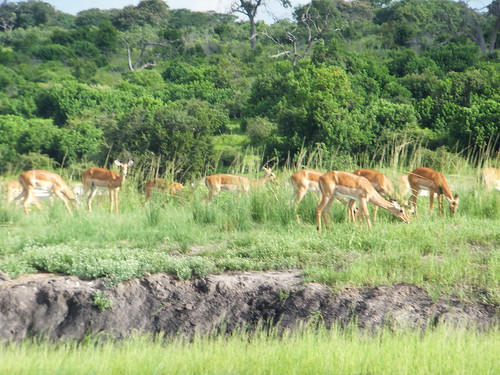
"Impala in Abundance".

We saw Impala in abundance before cruising past the Chobe Safari Lodge. The various buildings of the Lodge were interconnected with high-level wooden walkways. There also appeared to be an electric fench, with its live wires intentionally set high to discourage only the larger animals, like elephant, from wandering too near the buildings.

Elephants in Chobe National Park.

It became very overcast and we thought we were in for a dousing but we returned to the 'Zambesi Queen' safely, passing a group of elephant walking near the shoreline before turning inland and disappearing into the trees.

There are more pictures of our cruise here.

Visit to a Namibian Village

Sunday, 19th February 2012

After the usual enjoyable breakfast on the 'Zambezi Queen' we took to the small boats. This time, our journey took us to a village on the Namibian shore. A few men were near the shore, possibly working on fishing tackle or the canoes which were in evidence, but there was no great sign of industry. A sandy path lead to higher ground where the village itself was situated.

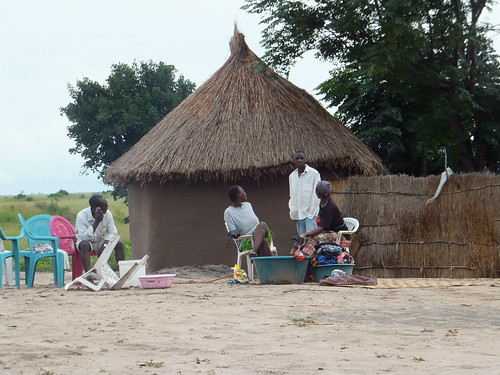
A variety of building styles were in evidence, all fairly primitive. The most common technique appeared to be a wooden framework (of completely unprepared and twisted branches) covered with a liberal application of mud. Some buildings were round with a conical, thatched roof but the majority were rectangular with a corrugated iron roof. Openings in the walls served as windows and doors.

A village lady chats to two men whilst doing washing. On the left, Vincent (from 'Zambezi Queen') makes a call.

There were a number of people around, mainly women and children. They acknowledged us as our guides invited us to go inside the huts. I always feel embarrassed at poking around inside peoples' homes but in much of the world, people don't seem to have our well-developed sense of privacy. Acrid smoke was emerging from one hut. Inside, a large cooking pot was set on a metal trivet above an open wood fire and the smoke was filling the hut before lazily drifting out through the doorway.

At one hut, I spotted two small solar arrays lying on the roof, connected to a car battery. Inside the hut there was what a took to be an inverter next to a table loaded with a dusty music centre and a number of small speaker units. This hut also served as the village shop - the customer area was separated by two primitive counters from the stock which was distributed on a partially-collapsed set of shelves or hung from string running across the hut at roof level. An important section comprised cartons of Castle Lager, Carling Black Label, Coca Cola and Sprite. I was reminded of the well-stocked liquor store I'd seen in Langa Township, Capetown.

The Village Shop.

Modernisation was represented by two modern, metal toilet buildings. I spotted a couple of bicycles and, at what I assumed was the Head Man's house, a television aerial on a wooden pole and a satellite dish. Some of the land had a healthy-looking maize crop.

A series of moulded plastic chairs had been laid out for us in an open space next to an ancient tree in the centre of the village so it appeared that we were about to have a concert. There was also an array of souvenirs for purchase, mainly raffia work with some carved wood, together with a cash box for donations to the village community fund. But the high pressure-selling which is present in so many of the world's tourist destinations was completely absent.

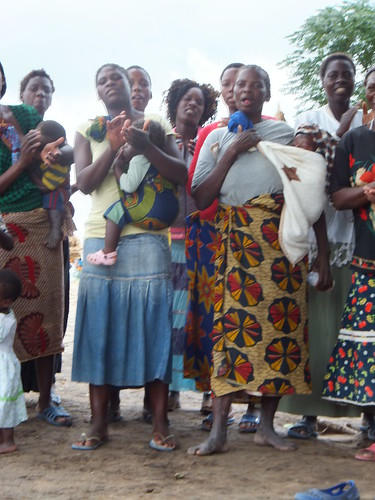
A group of wonen and a few men had gathered and we were treated to a number of songs, all sung with great enthusiasm and considerable talent. Eventually three drums appeared to set the beat but, before that, stamping provided an effective alternative. Some of the women danced, including a couple with young children bound to them with a cotton sling. The dances were pretty lively, so it can't have been very comfortable for the babies (particularly the one attempting to breast feed while this was going on!).

Ladies from the Village sing for their visitors.

It was now time for us to return to our boats and travel back to the comfort of the 'Zambezi Queen' - quite a change from the lifestyle we'd witnessed at the village where we'd been made to feel welcome.

More pictures of the Village here.