Wednesday, 20 July 2011

Yaroslavl, Russia

Tuesday 19th July 2011

Around 7.0 a.m. we arrived at Yaroslavl and berthed at a modern terminal with one other river cruiser already moored astern of us. After an early breakfast, I decided to go for a walk on my own since the arranged City Tour was not until nine o’clock. The river embankment has been improved and provides an attractive place to watch the river traffic. I walked as far as the modern road bridge over the river and then turned inland. Building work was in progress on various sites creating good quality multi-storey apartments. But the majority of apartments were old and in poor maintenance. Each sheet-steel street door gave access to a number of apartments. Ground floor windows were invariably heavily shuttered. Quite a few people were about, making their way to work. I saw trolley buses, many with lady drivers, and battle-scarred local buses. Most of the traffic was private cars, comprising, it seemed to me, rather more battered specimens than I’d seen around Moscow.

Yaroslavl is situated at the confluence of the Kotorosi River and the Volga. It became an important manufacturing town in the nineteenth century and was joined to Moscow by railway in 1870. In the Soviet era, manufacturing was further developed featuring vehicle and tyre production. More information can be found on Wikipedia.

Our coach trip took us first to the recently-rebuilt park flanked by the two rivers, neatly laid out with manicured gardens. The war memorial here has an Eternal Flame and two huge carved blocks of stone – one commemorating the contribution of servicemen, the other acknowledging the contribution of those left behind who managed to keep industry and home life going. Within the park, we then visited the huge Assumption Cathedral in traditional style with five large gilded domes. It was actually a completely new creation, opened last year!
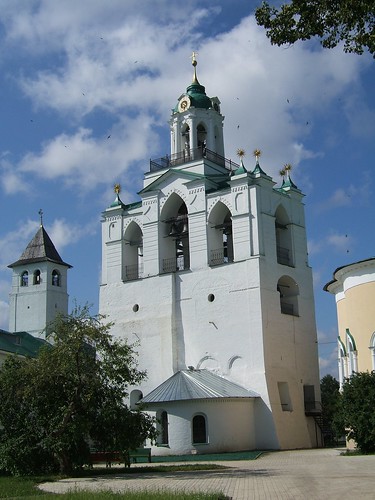
The Bell Tower at the Transfiguration Monastery.

The 12th century Transfiguration Monastery right in the centre of Yaroslavl is an ancient, walled enclosure with an interesting collection of buildings. This was our next detination. It’s principally a museum with numerous souvenir shops and cafes. You can also pay to see a captive bear (I didn’t). The bear has a nice enclosure and I’m sure is well looked after but I can’t approve of animals in captivity. The bear has been the symbol of Yaroslavl for a thousand years since Prince Yaroslav impressed the local tribes by wrestling and killing a bear they’d set upon him. However, I was able to enjoy a display of bell ringing. A number of bells, the largest about two feet tall, had been set up on a portable stand. A piece of string was attached to each clapper and the remote ends of the strings were tied together. The bell ringer stood holding the bundle of strings and by deftly twisting his wrist and plucking strings individually with his other hand, he was able to produce remarkable tunes.

On leaving the monastery, the Market and the ATM machines were pointed out to us and we were given almost an hour ‘free time’ to shop or explore. The population of Yaroslavl is around 600,000 and it was interesting to watch people going about their business. With manufacturing industry currently in a depressed state in Russia, tourism is particularly important and they are keen to encourage both Russian and foreign visitors. I wandered round a few city blocks, through the dry goods market and the (very clean) food market. I ended up in a square flanked by a modern building also containing a small, restored 19th century chapel. The large fountain was popular but I wasn’t sure about the tall tower in the centre of the fountain with three working television screens.
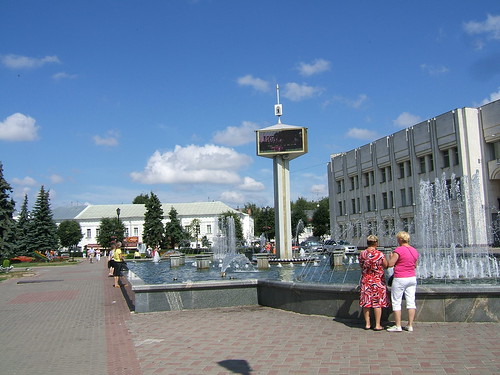
Fountains with Television, Yaroslavl

The gardens appeared to be hosting some sort of light-hearted gardening competition, for numbered areas contained, for example, a rather cartoon-style deer and a car. I think you needed to be Russian.

We then drove to the former residence of the Governor of Yaroslavl. This was an agreeable 18th century building overlooking the river. The former Governor was an art collector so the building has now become the Yaroslavl Museum of Russian Art. There's a website (in Russian) here but you can click on 'English' for a translation. With an imaginative flair, the female guides are in period dresses and claim to be daughters of the Governor. We were shown through a number of rooms with pictures on display. Works by ‘Anonymous’ and ‘Unknown’ were common but I was delighted to see one painting of the Moscow Kremlin by my new hero Vereshchagin. The Governor’s office was very well laid out with his desk and artefacts and it offered wonderful views across the river. In the ballroom, we were treated to a glass of sparkling wine whilst we listened to a trio in period dress (piano, violin and viola) play. Two of the Governor’s 'daughters' then danced for us, before each selected a surprised male partner from the visitors for a lively dance.
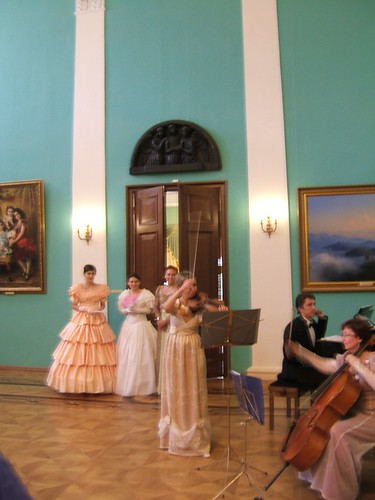
The former Residence of the Governor of Yaroslavl.

The coaches returned us to the ship by 1.45 p.m. and at two o’clock, the ship slipped away from the quay to continue our journey. I’ve not said much about life on the ship but the meals have proved varied and enjoyable. In addition to food, there are also lots of shipboard activities, most of which I’ve not taken. For instance, after we left Yaroslavl, the following was on offer during the remainder of the day:-

- Talk on Russian Vodka (with tasting)
- Demonstration of cooking Blinys (Russian pancakes – also with tasting)
- Lecture on ‘Russia in the last 25 years’ (I attended this)
- Live piano music in the Melody Bar
- Lecture on ‘Russian Costumes’
- Balalaika Concert

In addition, the satellite television in each cabin had 11 channels, with occasional special-interest videos like ‘Catherine the Great’. All-in-all, we were kept fairly busy.

My pictures of Yaroslavl are here.

Uglich, Russia

Monday 18th July 2011

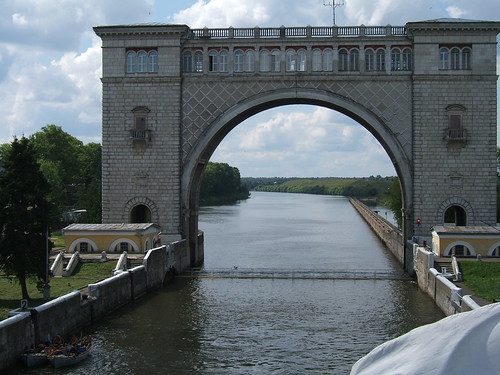
With no hint of the rain we’d had in Moscow, Monday was sunny and warmed up to 30 degrees Celsius. Approaching Uglich, we were lowered another 11 metres by a further lock. Here, a Triumphal Arch across the canal had been provided at the upper entrance. I gather this had been built by German prisoners. As we entered the lock, we were followed by two small boats which tied up on the opposite lock wall to us and ‘locked through’ with us. Each had about eight men in some sort of naval uniform. I rather imagine they were cadets.

The Triumphal Arch at the entrance to Uglich Lock. The upper gate is being raised. The two rowing boats can be seen bottom left.

Shortly after leaving the lock, we made a broad, sweeping turn to the right to approach the town of Uglich (population around 35,000). We moored at a pontoon near a modern white building which turned out to be an ‘Intourist’ hotel. From our mooring, we could clearly see the hydro-electric installation near the lock which uses the Volga to generate electricity. By this time, the small boats had caught up with us, six oarsmen in each boat producing a fine sight. I didn’t see where they went.

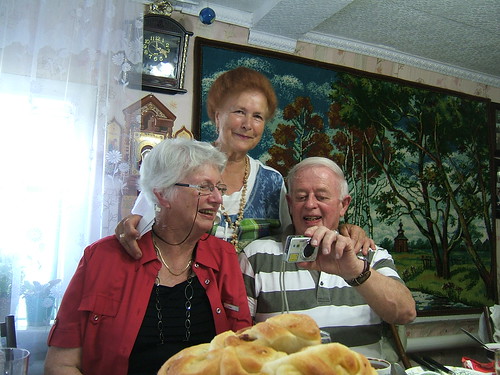
We were to be divided into lunch groups of about 12 to have lunch in a typical Russian home, deliberately with no interpreter present to make it more interesting. A series of 20-seat local minibuses had been chartered to deliver us to our hosts. With around 190 passengers to be moved, this was quite a logistical problem and required each bus to make two trips from the landing stage. A very bumpy journey of about ten minutes took my lunch group and one other past derelict-looking factories and fairly basic four-storey apartment blocks to a lane with a number of traditional wooden houses. We were then divided between two houses participating in this interesting experience. We met our charming, mature red-headed hostess who spoke not a word of English and she invited us into her home. Her husband (also rather red-headed) was there to meet us but, duty done, he very quickly absented himself. There was a short, narrow staircase to negotiate to reach the living area. A long table (or, more likely, two or three tables) had been laid for a party of twelve with an assortment of chairs and a settee. Once we were seated we were plied with an alcoholic drink. We were unsure whether it was a home-made produce or not but everybody agreed it was very strong. The meal started with a delicious cabbage soup using home-grown vegetables. The main course featured a plentiful supply of large boiled potatoes supported by a range of vegetables, meat and a sardine-like fish. Sweet buns filled with jam formed the dessert. Our hostess for lunch with two of her guests. Note the large tapestry on the wall.

It was a merry occasion and our hostess proudly showed us around her garden which produced all the vegetables until suddenly, realising the time, she shooed us back to the waiting minibus for the bone-shaking ride back to the town centre.

In the town square, we sorted ourselves back into our accustomed groups (Red, Yellow, Green etc.) for our walking tour. Back in Moscow, I had chosen the Yellow Group which was for Active Walkers. We were introduced to our local guide and set off for a walking tour of Uglich’s Kremlin, a peaceful, partly wooded area with a number of historical buildings adjacent to the river. The town’s name is derived from the Russian word ‘ugol’ meaning ‘angle’, because of the sharp turn made by the Volga River here.

It’s a historic place. Ivan the Terrible gave the town to his two year old son Dmitry. On Ivan’s death Tsar Fyodor banished his stepbrother Dmitry and his mother to Uglich. Seven years later, in 1591, Dmitry was murdered here, it was believed by Fyodor’s henchman Boris Godunov. A church was built at the site of the murder and we visited the present church built in 1692 called the Church of Prince Dmitry-on-the-Blood.

The Church of Prince Dmitry on the Blood, Uglich

Next, we visited the Palace of the Princes of Uglich built in 1480 and now the town museum.

Finally, we were seated in a building which doubles as a concert hall and art gallery where five local singers calling themselves ‘Koucheg’ sang a capella, supported by a marvellous bass singer.

We were then on ‘free time’ until 5.45 p.m. so I was able to explore the charming town on foot, photographing churches and other buildings.

Whilst we were on our town tour, two more river cruisers had tied-up at a small jetty adjacent to our mooring. As we left Uglich, just after 6 p.m., another river cruiser was arriving to moor in our place. Tourism is clearly very important but, of course, many of the tourists are from the Russian Federation itself.

Later that night, we entered the man-made Rybinsk Reservoir. This was created by damming the Volga to raise its level and allow the construction of hydro-electric installations which provide power to the surrounding area. We continued sailing through the night, in order to reach our next stopping point, Yaroslavl early the next morning.

Pictures:
Uglich Lock
Uglich Town

Tuesday, 19 July 2011

Navigating the Moscow Canal

Sunday 17th July 2011

Around 2.30 p.m. we started our journey of over 1300 km. to Saint Petersburg, during which numerous locks would lower our vessel from the 162 metre elevation of the Moscow Northern River Station to almost sea level.

Leaving the Moscow Northern River Station

On our right, we passed a long quay equipped with a forest of electric grab cranes. On the landward side of the cranes, there was a range of ‘mountains’ of sand and gravel. Although a Sunday afternoon, a couple of cranes were at work. Most of these construction materials are brought to Moscow in large, unpowered Dumb Barges which are propelled by sturdy tugs. The tugs have a specially-designed bow to allow a barge to be close-coupled. The barges have a complementary arrangement which includes a substantial coupling so that the two vessels may be locked together. On our way north, we were to see many of these sand barges, feeding the seemingly insatiable appetite of Moscow’s construction projects. Occasionally, we saw tugs propelling two barges. We also saw a number of sand carriers which were conventional, self-powered barges.

I was surprised to see a former warship tied up. Obviously de-commissioned, she still carried her fleet number ‘754’. Gun turrets were still in place, but the gun barrels had been removed. Various radar antenna were visible.

Our ship has three rather squat funnels – it was clear why when we passed under a road bridge with 14 metres clearance - our funnels cleared the underside of the bridge with perhaps 1 metre to spare.

We were now in the Moscow Canal in a much less urban setting and small forests lined the banks in places. The canal was built in the Stalin era using convict labour and the buildings associated with the canal have many classical affectations. Passing through a wooded section of the canal, we passed a colonnaded building carrying graffiti. Wide steps led down to the water and a number of youngsters found it a convenient bathing station. As our journey continued, we found many more places being used by groups for bathing. There were also fishermen, often with small tents.

A well-patronised bathing place on the Moscow Canal

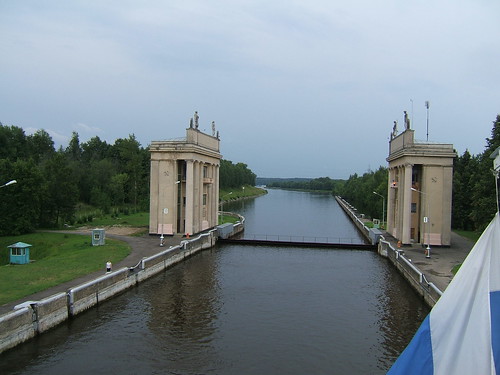
With rather poor timing, the Captain had scheduled his welcome party for 6.45 p.m., as we were approaching the first of six locks on the Moscow Canal. The Captain briefly introduced his officers and staff to the passengers and then disappeared back to the Bridge. Shortly afterwards, I excused myself as it’s always fascinating to watch locks in operation, particularly with larger vessels. The upper lock entrance was flanked on both sides by a colonnaded building, each carrying two statues on top. After we’d entered the lock, the upper gate was closed behind us. At each lock, the upper gate was a single gate which rotated out of the floor of the lock chamber to rise up above the surface.

Having entered Lock 6, the upper gate is raised behind the ship to allow the lock chamber to be emptied.

Water was then discharged from the lock chamber, lowering the ship by about 8 metres. The massive double hinged gates at the bottom of the lock were then swung open, fitting into recesses in the lock walls. The lower lock entrance was flanked by two collonaded buildings, just like the upper lock entrance.

We passed through another three similar locks during the evening. The buildings at each lock had a different style. The buildings at the fourth lock had pillared rotundas crowning the buildings at the upper end and bronze statues of a sailing ship under full sail at the lower end. During the night, we passed through two more locks but I didn’t wake, although one of the passengers told me next morning that there was quite a bump in one of the locks. Since leaving Moscow, the ship had been lowered 49 metres to the level of Rybinsk Reservoir on the Volga River.

My pictures of our transit of the Moscow Canal are here.

Monday, 18 July 2011

Inside the Kremlin

Sunday 17th July 2011

On Sunday morning, the weather was dull and it was starting to rain. By the time our coaches had taken us to central Moscow, the rain was sluicing down. The raincoat I’d packed in England as an afterthought worked very well, but I soon discovered that my leather shoes were not quite as watertight as I’d believed. We walked through the gardens in the shadow of the Kremlin wall to reach the tower through which we were going to enter. A lengthy queue was already waiting.

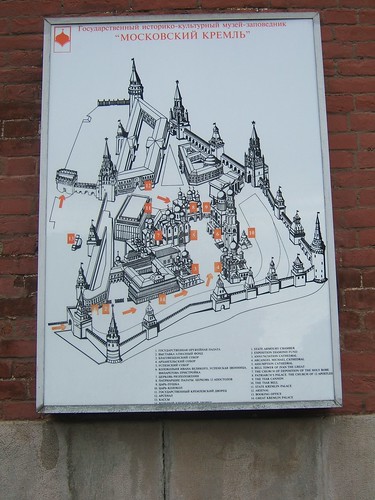
After a few minutes, people started to be admitted and it wasn’t too long before we were inside one of the buildings within the Kremlin, in the dry. The word ‘Kremlin’ refers to any fortified area within a town, rather similar to an English castle. The Moscow Kremlin wall is two kilometres long, enclosing a substantial area with room for armouries, palaces and cathedrals. The part of the building we’d been admitted to was a rather gloomy affair with a cloakroom and shop. Washrooms were nearby. When our flock had been collected together, we moved outside (remaining within the Kremlin grounds), walked a few yards along a pavement and re-entered by another door leading to the State Armoury Chamber. A sign on this door clarified that the museum has four opening sessions during the day (rather charmingly referred to as ‘seances’ on the notice on the deoor). The sessions were 10:00 – 11:30, 12:00 – 13:30, 14:30 – 16:00 and 16:30 – 18:00. We were clearly part of the 10 o’clock contingent.

We started on the upper floor passing through a series of high-ceilinged exhibition rooms each containing huge glazed display cabinets. Each cabinet held myriad artefacts representing Russia’s history. Gold, silver and porcelain pieces, armour and weapons – soon the mind was reeling. On the lower level, we found costumes and dresses displayed and a collection of carriages. Viewing conditions were not ideal, because there seemed to be a few hundred visitors vying for the limited space. Unfortunately, photography is not permitted inside the museum.

It was raining quite hard as we emerged from the Armoury Building and followed the pavement leading uphill. The imposing Great Kremlin Palace lay on our left and, because we were on the high ground, on our right we could see over the Kremlin wall and view the grey waters of the Moscow River and the classically-styled buildings on the opposite bank. As continued our walk in the rain, we passed the Annunciation Cathedral on our left, white-painted and its multiple golden domes, each carrying an elaborate cross. We turned left, to head for the central square, placing the Annunciation Cathedral on our left and the Archangel Michael Cathedral on our right. Ahead of us lay the Assumption Cathedral, white-painted and with gilded domes topped with crosses but also decorated with scaffolding because of restoration work.

We visited the Archangel Michael Cathedral, the small Church of the Deposition of the Holy Robe and the Assumption Cathedral. We made a brief tour of the special exhibition of the work of Karl Faberge and similar craftsmen.

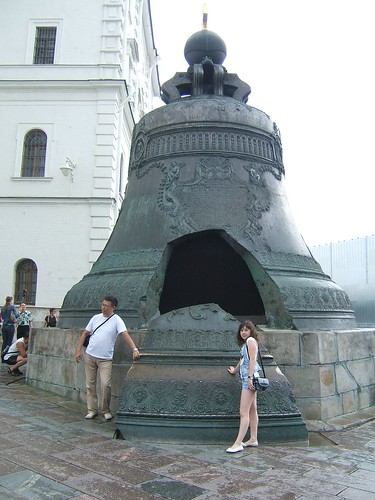
It was still raining when we looked at the Tsar Bell which, at over 200 tons, claims to be the largest in the world, displayed together with the 11-ton broken piece. This allows Burma to claim that the Mingun Bell is the largest 'uncracked bell' in the world (see my article 'Back to Mandalay'). In Moscow, the huge clapper for the cracked bell is on display. Russians call the clapper the bell's 'tongue'. We also looked at the huge Tsar Cannon, built to show the abilities of the Russian ironfounders. On our way to the gate, we paused at the modern State Kremlin Palace. This was built in the Khrushchev era, using a concrete and aluminium construction technique which did not become established. This massive building, seating 6,000, is now in occasional use as a concert hall. Just before we left the Kremlin, a range of buildings on the left, surmounted by a curious church, was identified as the part of the Kremlin where Stalin lived. After a few more minutes walk in the rain we rejoined the coaches for the journey back to the ship, wet but after a fascinating experience. After a shower and a change of damp clothes, I took lunch at 1.30 p.m.

Click for my pictures 'Inside the Kremlin'.

Moscow by Night

Saturday 16th July 2011

A little after 9.30 p.m. we set off by coach for the optional ‘Moscow by Night’ tour. It was just starting to get dark and still very warm – I took a jacket with me but never used it.

Our first stop was at ‘Victory Park’. This is one of a number of large public parks in the city. ‘Victory Park’ is dominated by a tall obelisk in the form of a bayonet commemorating the second world war. Two classical figures, one winged with a wreath, the other playing a pipe emerge mysteriously near the top of the bayonet. At the base another classical figure represents Saint George on horseback. Nearby, there’s a large, low building arranged in an arc. For a modern concrete building I found the effect quite pleasant. But Russians don’t seem to do minimalism so there are two more Saint George on horseback figures on the roof and also a dome structure behind, with a slender spire. There were still plenty of people around the park, including a number of young people on in-line skates. As we waited for our coach, there was another wedding party, in obvious high spirits, just arriving by car.

By now, it was dark but still warm. We stopped at the New Maiden’s Convent for photographs. The convent looks more like a castle than a convent, surrounded by a high, crenellated wall but painted white and floodlighted and with a reflecting pool in front, it made a pretty subject. In the last few years, it has become a working convent once again with, I understand, ten nuns and ten novices.

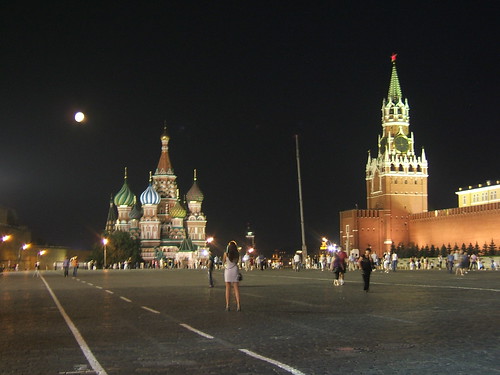
Another trip by coach and we were dropped off at the usual spot for Red Square. There were plenty of people about, all good natured. This time, we were allowed to explore on our own so I made my way through Red Square, past St. Basil’s Cathedral and had time to discover that the ‘bungee jumping car’ was a ‘Top Gear Live’ stunt.

It gave me a strange feeling, walking through Red Square just before midnight. I’m old enough to remember television coverage of the huge military parades in Red Square demonstrating the strength of the Soviet Union. Back then, nuclear conflict seemed inevitable and the fear of perishing “All suffused in an incandescent glow” (as Tom Lehrer’s lyric has it) was very real. I remember the politicians standing on top of Lenin’s Tomb and the ranks of lower level functionaries on the marble seating flanking the tomb. The Kremlin, Lenin’s Tomb and St. Basil’s Cathedral are all floodlit and the effect is quite powerful. A little while ago, ‘GUM’ was outlined in lights for a special event but the effect (almost like a talented child’s drawing, it seemed to me) was so popular that it has been retained permanently. In Red Square at night, it’s easy to see why the place is so symbolic to the whole world. Earlier, one of our guides had pointed out a distinction in perception – whereas foreign television journalists always seek to have the distinctive outline of St. Basil’s Cathedral in the background, Russian journalists use the adjacent Kremlin tower with its huge striking clock as the symbol of ‘Mother Russia’.

My tour party met up at the equestrian statue of Marshal Zukov at ten to midnight, as arranged and, tired but happy, we clambered back on our coach. I noticed that the digital clock in the coach read ’00:00’ - ‘Midnight in Moscow’.

Pictures of my 'Midnight in Moscow'.

Sunday, 17 July 2011

Moscow City Tour

Saturday 16th July 2011

I got up at 6.00 a.m. and went for a buffet breakfast at about 6.50 a.m. I was surprised that the Opera Restaurant was already crowded. Later, there was the usual messing about trying to get my Notebook Computer to talk to the ship’s Wi-Fi but eventually, with the help of the reception staff, I succeeded and checked e-mail before disembarking at 8.30 am for our Moscow City Tour. A number of modern coaches were lined up on the promenade. Sorting everybody out took some time but we set off about 8.45 a.m.

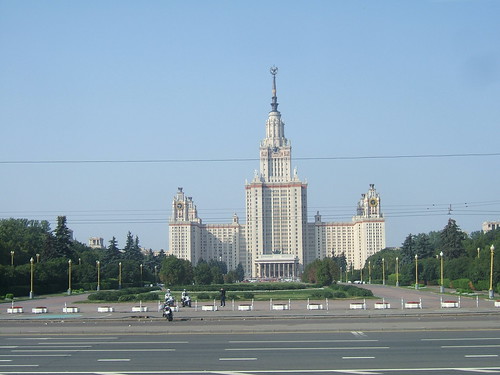
Moscow University.

Our first stop was at an Observation Point, high on one of the Seven Hills of Moscow (I thought that was Rome!) overlooking a curve in the Moscow River and with the Stalin-era Moscow University building behind us. There were already a number of tourist buses there and the broad promenade sported a large number of souvenir stalls. Having observed the view and taken a few photographs, we piled back on the bus and drove towards the centre of the city. The coach dropped us off on the main street, within a few hundred yards of Red Square. Just outside the entrance gate leading to Red Square we stopped to look at the ‘Zero Kilometre’ marker, a brass plate set in the cobbles from which all distances in Russia are measured. A short uphill section of cobbles led us into the huge expanse of Red Square, with Lenin’s Tomb and the forbidding walls of the Kremlin on the right, the GUM store on the left and, at the far end of the square with its multi-coloured domes shining in the morning sun, the fairy-tale bulk of St. Basil’s cathedral.

Our guide took us into the famous 'GUM' Store. It’s now divided into a series of separate up-market shops representing all the designer labels you’ve ever heard of. Visually, it’s quite attractive with (I think) three parallel glass-roofed arcades each with shops on a number of galleries reminiscent of, say, Milan. There are numerous opportunities to sit and drink (no doubt expensive) coffee. There was a window display I rather like with a collection of twentieth century radio and television sets, wind-up gramophone, slide projector and a movie projector. We checked out the Rest Rooms before returning the Red Square.

Next to St. Basil's I could see a large mobile crane. As we came closer, a loop of cable dangling from a platform held aloft by the crane suggested a bungee jump, but the platform held a small car. Our guide expressed the view that Red Square was too important to the Russian people to be used for such trivial purposes. As we walked away, the car was launched from the platform to bounce up and down on what was, indeed, a bungee rope. It was only much later in the day that I was able to examine the area closely, discovering that the set-up was a stunt for 'Top Gear Live', at which point I decided that I shared our guide's disapproval.

We left Red Square by retracing out steps, pausing to make a brief visit to the Russian Orthodox Church near the gateway. Returning to the coach, we carried on through the streets of Moscow. Since it was a Saturday, there was very little congestion. We passed the headquarters of what was formerly the K.G.B. The building looked more suitable for the headquarters of a rather conservative bank than a feared organ of the State.

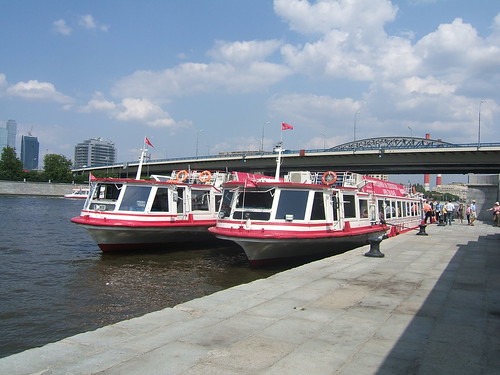
The coach stopped under a railway bridge crossing the Moscow River. We got off the coach and a short walk led to a promenade with steps leading down to a quay where a fairly large trip boat was waiting for us. The downstairs cabin was laid out with a series of 8-seat tables and chairs for taking lunch and a well-stocked buffet bar. I didn’t have to queue for long before I was able to assemble a simple meal, but some of the passengers boarding behind me had a fair wait.

As soon as everyone was aboard, we set off at a fair speed along the curving river through the wooded hills we’d looked down on during our first stop that morning. The bank on our right was a public park and we could see lots of Muscovites enjoying a sunny Saturday morning. We passed what appeared to be a River Police station and another quay with ferry boats frequently coming and going. The ski jump was not in use but the associated chair lift seemed to be giving rides.

One bridge over the river appeared to be an abandoned railway bridge, now serving as a pedestrian river crossing. A massive glazed roof had been erected over the top, so it was a curious-looking affair. Another improbable sight appeared on the river bank – a Soviet Union Space Shuttle. Although there are significant design differences, at first sight you would be certain that you were looking at an American Space Shuttle. Just a coincidence, I’m sure. We then passed a fun-fair which appeared to be closed. All the rides were modern – a pirate swing boat, Ferris Wheel and a number of variants of steel roller-coaster. I was puzzled by a tall vertical pylon (which presumably shoots its passengers straight up) which had been carefully decorated at the top to resemble the familiar London landmark always called ‘Big Ben’ (properly, only the name of the large bell).

By this time, I’d completed my lunch and made my way to the open, upper deck. This was about the limit of our tour and, having waited for various trip boats to pass, the boat turned around and started to make it’s way back. I noticed a large pleasure boat moored which had an elaborate covered deck at the stern and a large illuminated sign reading (in Russian) ‘KAPAOKE’. I don’t think I need to translate that.

There was a large floating crane moored together with a tug. The deck of the crane carried various grab buckets. It appeared that continuous dredging of the Moscow River is necessary – dredging was actually in progress just opposite the quay where we boarded our trip boat.

A huge, fantastical statue now reared up on the starboard side. Situated on its own little island, with a pedestrian access bridge and pumps gushing water from all around the base so that it looked afloat, it seemed to represent a number of wooden ships hulls piled on top of one another, reminiscent of a car scrap-yard, surmounted by a much largest sailing ship with three sails on a single mast complete with all the rigging. The heroic figure of a man held the ship’s wheel with his left hand whilst his right hand brandished a scroll. I believe the figure represents Peter the Great and it was erected as recently as 1997. I was going to say it was ‘Disney-esque’ but, on reflection, I think ‘Only in Russia’ would be a better comment.

Of course, the various massive Stalin-era Government Buildings (like Moscow University) are themselves pretty improbable in appearance. I was intrigued by the unlikely architectural treatment that Power Stations around the city have been given, being made to look vaguely like upper-class apartments. We passed one such power station near the river which now additionally sports a huge television screen used for advertisements.

Quite near to the Kremlin, a large site was being redeveloped and massive temporary walls about 40 feet tall shielded activities from view. Not to waste this wall space, the wall carried advertising for Lenovo computers, extolling the fact that there is ‘Intel Inside’. Passing under a road bridge, we had a brief view towards St. Basil’s Cathedral and Red Square, before sailing past the part of the Kremlin wall which faces the river. We continued past the park, around the bend in the river and docked at our starting point after a pleasant interlude.

Our coach took us back to central Moscow and we disembarked within sight of the Kremlin at a pedestrian bridge over a drainage canal which is popular with newly-wed couples as a site for picture-taking. There’s a small, modern statue and I tried to capture a romantic shot of one couple but although the bride was posing decorously around the statue in her fluffy white wedding dress, her morning-suited groom was rather ostentatiously turned away and engrossed on his mobile telephone. I give it six months.

From the bridge, a short walk took us to the State Tretyakov Art Gallery. Pavel Tretyakov was a private collector who assembled a major collection of purely Russian artworks from the 12th to early 20th century. The gallery opened in 1856 to make Russian art accessible to everybody and, although now state-owned, the gallery preserves the founder’s intentions. I imagine the icon collection is unsurpassed and, moving from one famous icon to the next, I started to understand the appeal of icons. I didn’t expect to appreciate the 19th century works but, again, there are a number of famous paintings.

I found a new hero in the works of Vasily Vereshchagin, whose works have an almost photographic realism. He was involved in a number of foreign military campaigns and recorded the horrors of warfare in a compelling manner. Although involved in numerous acts of personal bravery, he refused all honours. You can see one of his more famous works 'The Apotheosis of War' here.

Emerging from the gallery, we returned to the pedestrian bridge, still crowded with sight-seers and wedding parties. The bridge carries a number of ‘trees’ made out of metal. The branches are covered with specially-made and engraved padlocks, placed by couples to ‘lock-in’ their happiness. I hope it works.

Our coach then delivered us to Smolenskaya Metro Station for a short trip on Moscow’s main public transport system. This underground system opened in 1935 and is famous for the grandeur of some of the stations. Descending 70 metres by escalator, we travelled one station to examine the different architecture and then we travelled one further station, so that we’d seen three different styles. With trains running every 90 seconds, it was a simple matter to return two stations to Smolenskaya. From here, we walked to Albert Street, a pedestrianised area popular with tourists, and then to the Stalin-style Foreign ministry building where we re-boarded the coaches to return to the boat.

Pictures of our 'Moscow City Tour'.

But I was not yet finshed for the day because, after dinner on the boat, I’d booked for the optional ‘Moscow by Night’ tour.

Transfer from Airport to Ship

Friday, 15th July 2011

The two-hour transfer from Moscow Airport to the boat gave ample opportunity for studying the environs of Moscow. Some things I learned I could have confidently predicted but many things came as a surprise. Our coach was late arriving at the airport to pick us up because of heavy traffic. Then, our journey time to reach the ship was extended because of heavy traffic. I knew that car ownership had expanded in recent years, but I hadn't realised by how much. All the world's manufacturer's were represented, not just Russian designs, but I gather Russia likes to see foreign models assembled in the country. Many of the commercial vehicles were also of foreign origin.

We initially travelled (on the right, with left-hand drive) on Western-looking motorways, five lanes each way. The lanes heading towards the airport were at a stand for miles but we travelled at a good speed for the first few miles until we turned onto another route at a major junction, when we were reduced to walking pace. These major routes are provided with overhead gantries with remotely-controlled speed restrictions displayed over each lane. The displays seem to be used in a similar fashion to those in the U.K., showing a maximum speed of '100' (km/h) when the traffic is already crawling. Every few miles, we'd pass a police post with officers visible but not appearing very involved.

More frequently, we'd pass pedestrian overbridges. The Russians have something of a reputation for solid but unimaginative engineering and rather fixed ideas on 'design'. These bridges seemed to fully comply with the prejudice. Admittedly, the bridge beams usually had to span ten lanes of traffic but where the West would use pre-stressed concrete or welded steel, these constructions used riveted steel construction which would have looked at home on a battleship. The walkways were all fully covered - perhaps necessary considering the hard winters Russia experiences - with clear plastic or polycarbonate panels attached to a substantial ribbing. It appeared that there had been extensive graffiti which had been removed, leaving large milky patches in the clear sheets. The carriageways were lit by regular steel columns erected in the central reservation, each supporting (usually) two curved branches, each terminatied in a luminaire. I liked the thoroughgoing approach to identification of these lighting standards: two rectangular metal labels were attached to each column (one for each direction) in which the 3-digit number was punched, to appear in silhouette.

Flying into Moscow, I'd spotted at least one large coal-fired power station. On our way to the ship, we passed frequent not very large power stations. However, I couldn't see any coal-handling facilities and I confirmed afterwards that a lot of power stations are oil- or gas-fired, producing hot water for district heating schemes in addition to electricity.

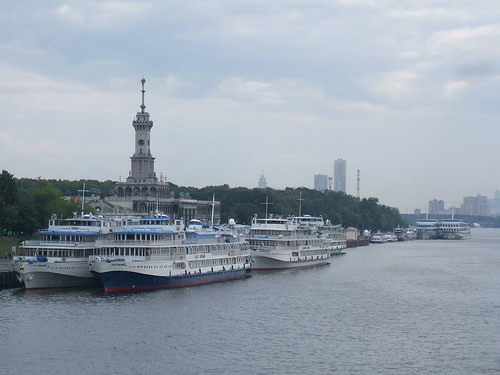
Eventually we came to the built-up suburbs of northern Moscow and the coach turned off the main road into a park. This park led to the Moscow Northern River Terminal where we parked on a wide promenade next to the Moscow Canal where a number of large river ships were moored. There were hundreds of people walking, bicycling or in-line skating along the promenade at the start of the weekend. We were directed through a security tent containing a baggage X-ray machine onto our home for the next few days, the 'AMA Katerina'. As is often the case in Russia, things aren't quite that simple. Apparently, the official name of the vessel, as testified by the large Cyrillic letters attached to the side of the ship, is 'Mstislav Rostropovitch' (the famous cellist and conductor - see Wikipedia article). The ship is jointly operated (in some no doubt complex way) by Ama Waterways and Vodohod Cruise and Travel.

Tired and hot (it was now about 9 p.m.) my only concern was to get to a cabin and see if the dining room was still serving. The cabin seemed fine and I ate a decent dinner but rather than make my usual detailed examination of the ship, its facilities and layout, I went to bed because Saturday was planned to be a fairly strenuous day.

Saturday, 16 July 2011

Brewood to Moscow

Friday, 15th July 2011

It's been a funny sort of day. I set my alarm for 3.30 a.m. so that I could walk my dog, Tai. He was quite unfazed at going out so early and chose an old favourite route, along part of the canal towpath and back through the village. My friend Marion was to collect him later. When I have a holiday, Tai moves to his 'second home' with Marion. I was ready for 5.00 a.m. when Alan picked me up for the transfer to Birmingham Airport.

Check-in for my Lufthamsa flight to Frankfurt was mainly do-it-yourself followed by Bag Drop, but there was one Business/First conventional check-in counter. Unfortunately, the previous customer took over ten minutes to check in. The gentleman appeared to be moving home, taking his wife, his young son, a baby stroller, a carry cot and three of the largest suitcases I've ever seen. I imagine the kitchen sink was in one of them. My own check-in was completed in seconds. The friendly lady confided that the previous passenger wasn't even travelling business class but the bag-drop desks, seeing what a complex check-in it was going to be, referred him to the experienced lady on the business check-in!

Servisair are the handling agents for Lufthansa at Birmingham and there was time to pop into the Servisair lounge for an orange juice before making my way to the departure gate. The flight was being operated by BMI with a fairly-presentable A320. As we taxied out to runway 33, I looked across at the original terminal and thought about my early flying experiences departing from that tiny terminal.

The flight was uneventful and a satisfactory breakfast was served. Approaching from the air, you get a good idea of just how huge Frankfurt is. We landed and taxied to our stand some distance away from the terminal. I took the waiting transfer 'bus but we hadn't gone far before we came to the end of a traffic jam on the airport road. To serve these remote stands, they've put an airport road across the apron, parallel to the taxiway and runway. But every aircraft crossing to or from stands attached to the terminal by airbridges has to cross the airport road, repeatedly holding up the road traffic. Eventually, the 'bus arrived at the terminal and joined a queue of vehicles setting down passengers. After a few more minutes, I was inside the terminal but things were no better. The area was heaving with passengers who were only very slowly making their way around the corner and, in the dimly-lit area, I couldn't see any signage for transfers. As I shuffled past an unlabelled lift, the doors opened and a very quietly-spoken airport girl said "Transfers - take the lift". I was lucky to get that clue! Emerging from the lift, I identified the departure gate and located a nearby Lufthansa Executive Lounge. I only had about 15 minutes in here but, being one of Lufthansa's major airports, the range of food and drink here rather put the Birmingham affair in the shade.

The flight to Moscow was a proper Lufthansa flight, accessible by airbridge from the terminal. It was operated by an A321 with a charming, mainly male, cabin crew. Unfortunately, six passengers had gone missing after checking-in hold baggage, so we had to sit on the ground while the baggage handlers extracted their bags from the hold. We must have been about half an hour late departing. They served a very acceptable lunch which occupied a lot of the flight time.

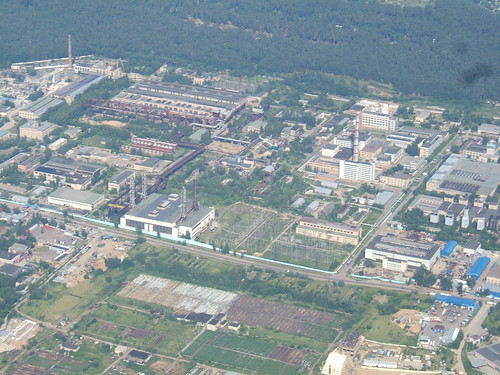
Industrial landscape on the approach to Moscow

Unfortunately, there were air traffic delays arriving at Moscow so we had to stooge around for a while before landing. Heavy braking allowed us to take the high speed turnout and we were soon attached to the airbridge and walking through fairly deserted corridors until we came to immigration. That's where all the people were! Why is immigration always in an airless, windowless, low-ceilinged room with only half of the immigrations desks staffed? Three quarters of an hour later, I was through immigration and into baggage reclaim, where my checked bag had been patiently waiting for me for some time. Into the arrival hall, with the usual crowd of meeters and greeters, most displaying signs of variable readability. The girl from AMA Katerina (the boat I'm joining) had a large professional sign so I was soon part of the small flock of passengers she'd collected.

Arrivals Hall, Domodedovo Airport, Moscow.

We had to wait around for the remaining passengers and then she conducted us outside the terminal to wait for the coach. We all had to maul our own luggage and then had to wait around in the hot sun for our coach to arrive, which did little for our health and temper.

After ten minutes or so, the coach arrived and we were allowed to load our own luggage into the hold, whilst the driver looked on, disdainfully. We were then warned that, because of traffic congestion, our trip to the 'water station' (as they rather nicely termed the ship's mooring) would take around two hours.

All my Moscow pictures are here.

Sunday, 10 July 2011

Track Sketch: Totnes

Sketches done on site are often hard to follow. Normally, I'd make a fair copy when I returned home but, in this case, I haven't found a later copy, so here is the original version from 1st September 1964.

(Click on the sketch to enlarge)

DOSS - Diamond with outside slip
CR - 'Catch Rail' (Trap points with switch in outer rail)
GW FB - Great Western Footbridge
WC - Water column

The splendid running-in board read 'TOTNES FOR KINGSBRIDGE & SALCOMBE'. Totnes station remains in operation.

For details of what remained in 2005, refer to 'Railway Track Diagrams' Book 3: Western', Fourth Edition, published by Trackmaps (ISBN: 0-9549866-1-X). The First Edition of this book was published by Quail in 1989.

Track Sketch: Watchet

Sketches done on site are often hard to follow. Normally, I'd make a fair copy when I returned home but I haven't found a later copy, so here is the original version from 1964. Watchet Harbour (on the left of the sketch) once generated significant traffic for the railway, hence the fairly generous goods sidings.

(Click on the sketch to enlarge)

FB - Footbridge
LG - Loading Gauge
GS - Goods Shed

Watchet station remains open, as part of the West Somerset Railway. When I made this sketch, I never imagined I'd one day fire steam trains on this route!

For details of the station in 2005, refer to 'Railway Track Diagrams' Book 3: Western', Fourth Edition, published by Trackmaps (ISBN: 0-9549866-1-X). The First Edition of this book was published by Quail in 1989.

Friday, 8 July 2011

Track Sketch: Truro

Sketches done on site are often hard to follow. Normally, I'd make a fair copy when I returned home but, in this case, I haven't found a later copy, so here is the original version from 2nd September 1964.

(Click on the sketch to enlarge)

T - Tubular post
F - Fixed (distant)
D - Doll (small Goods arm)
DT - Doll Tubular
W - Wooden post
CR - 'Catch Rail' (Trap points with switch in outer rail)
GW FB - Great Western Footbridge
WC - Water column
LG - Loading Gauge

Truro station remains in operation.

For details of what remained in 2005, refer to 'Railway Track Diagrams' Book 3: Western', Fourth Edition, published by Trackmaps (ISBN: 0-9549866-1-X). The First Edition of this book was published by Quail in 1989.

Thursday, 7 July 2011

Track Diagram: Stourport-on-Severn

(View from footbridge. Photo: 'Unlocking Stourport's Past')

In the earlier post 'Visiting Signalboxes', I described being invited into the signal box at Stourport-on-Severn. The diagram below is a very simplified version of the signal box diagram.

(Click on the sketch to enlarge)

(View from platform. Photo: 'Unlocking Stourport's Past')

Track Sketch: Stourbridge Junction

(Photo: David Wynne Jones Collection)

Sketches done on site are often hard to follow. Normally, I'd make a fair copy when I returned home but, in this case, I haven't found a later copy, so here is the original version from 1955.

(Click on the sketch to enlarge)

F - Fixed (distant)
W - Wooden post
D - Doll (Goods arm)
S - Subsidiary arm
CO - Calling-on arm

The diverging track top left is the short branch to Stourbridge Town Station, at the time served by a '1400' with a single 'auto' coach, as shown in the heading photograph.

For details of what remained in 2005, refer to 'Railway Track Diagrams' Book 3: Western', Fourth Edition, published by Trackmaps (ISBN: 0-9549866-1-X). The First Edition of this book was published by Quail in 1989.

Track Sketch: Penzance

Sketches done on site are often hard to follow. Normally, I'd make a fair copy when I returned home but, in this case, I haven't found a later copy, so here is the original version from 2nd September 1964.

(Click on the sketch to enlarge)

T - Tubular post
W - Wooden post

Penzance station remains in operation.

For details of what remained in 2005, refer to 'Railway Track Diagrams' Book 3: Western', Fourth Edition, published by Trackmaps (ISBN: 0-9549866-1-X). The First Edition of this book was published by Quail in 1989.

Track Sketch: Newquay, Cornwall

Sketches done on site are often hard to follow. Normally, I'd make a fair copy when I returned home but, in this case, I haven't found a later copy, so here is the original version, believed to date from 1964.

(Click on the sketch to enlarge)

T - Tubular post
W - Wooden post
D - Small arm (Goods line)
CR - Crane
GS - Goods Shed

At the time, there were seven departures during the day to Par, including the 8.10 p.m. On a Summer Saturday there were 16 departures, to destinations as remote as Liverpool.

For details of what remained of this branch in 2005 (at Newquay, simply a single line running into platform 2 with no sidings), refer to 'Railway Track Diagrams' Book 3: Western', Fourth Edition, published by Trackmaps (ISBN: 0-9549866-1-X). The First Edition of this book was published by Quail in 1989.

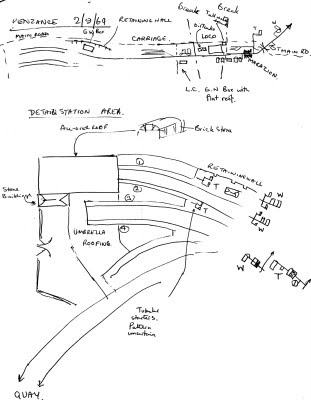
Track Sketch: Falmouth

Sketches done on site are often hard to follow. Normally, I'd make a fair copy when I returned home. So far, I've not found a better copy, so here is the original version, believed to date from 1964.

(Click on sketch to enlarge)

T - Tubular post
W - Wooden post
GS - Goods Shed

Note the Tablet Catcher opposite the signal box. There was a steeply-inclined branch leading down to the docks. The main platform was provided with an umbrella roof. Note the Camping Coach in the siding next to the station. The branch seemed to be worked by 3-car Diesel Multiple Units.

For details of what remained in 2005, refer to 'Railway Track Diagrams' Book 3: Western', Fourth Edition, published by Trackmaps (ISBN: 0-9549866-1-X). The First Edition of this book was published by Quail in 1989.

Track Sketch: Looe

(Click on sketch to enlarge)

On 1st September 1964 I visited Looe and sketched the layout. Stations don't come any simpler! Amazingly, the line to Looe survives.

'Lion Shoot'

No, not a wildlife safari but a morning filming session with John Hawley at the 'Lion Tavern' in Liverpool on 6th July 2011. Centre Screen Productions are making an audio-visual presentation to interpret 'Lion' in her new home in the Museum of Liverpool and Jan and John had been invited to participate. The 'Lion Tavern' is a traditional Public House situated on the corner of Moorfields and Tithe Barn Street.

I was particularly impressed with the view of the restored facade of Liverpool Exchange station from the bar of the 'Lion Tavern'. The location is now 'Mercury Court' and the interior of the building has been completely re-modelled. There is still a station here - the subterranean 'Moorfields' accessed via the usual nondescript modern British Rail buildings.

John and I were finished shortly after 1.00 p.m. and the weather was good, so we decided to treat ourselves to a round trip on the Mersey Ferry before returning south.

Pictures:

'Lionshoot'
Exchange Station (and elsewhere)
Liverpool (from the Mersey Ferry).

Wednesday, 6 July 2011

Track Sketch: Bude

Sketches done on site are often hard to follow. Normally, I'd make a fair copy when I returned home but, in this case, I don't believe there is a better copy, so here is the original version, believed to date from the 1960s.

(Click on the sketch to enlarge)

TP - 'Tubular Peculiar' Tubular post of a different pattern
W - Wooden post
LG - Loading Gauge
WT - Water Tank
WC - Water Column
CS - 'Catch Rails' (Trap points with a switch in both rails)
GS - Goods Shed
Y - Yellow ground signal (may be passed 'on' for movements towards the goods shed).

Hard to believe this has all been swept away. A note suggests that the platform could accommodate at least six coaches. Note that the goods yard had a Side Dock, an End Dock and a Cattle Dock. It appears that there was a '50' speed limit sign adjacent to the bracket signal carrying the Up Signals. A 'Standard' tank, 80042, was seen here with a 2-coach set.

Tuesday, 5 July 2011

Track Sketch: Fleetwood

Fleetwood Station in B.R. days.

Fleetwood station buildings were of typically Lancashire and Yorkshire railway grandeur - I attempted a very simple sketch of the facade but the picture below may give a better idea.

Sketches done on site are often hard to follow. Normally, I'd make a fair copy when I returned home but, in this case, I don't believe there is a better copy. The first sketch shows the terminal station at Fleetwood, the second shows the first station out from the terminus at Wyre Dock.


(Click on either sketch to enlarge)

D - Doll (reduced-size goods line arm)
DW - Doll (reduced-size goods line arm) on wooden post
DT - Doll (reduced-size goods line arm) on tubular post
T - Tubular post
TP - 'Tubular Peculiar' Tubular post of a different pattern
W - Wooden post
L - Lattice post
WT - Water Tank (parachute tank)
FB - Footbridge

The cryptic note 'As BN - 7 at base' I think means that the large Lancashire and Yorkshire pattern signal box at Fleetwood was similar to that at Blackpool North, with a brick base of seven bays. When I made the sketches, a number of signal arms had already been removed (arm shown dotted on the sketches), indicating a process of "rationalisation" which ultimately resulted in the total loss of railway facilities at Fleetwood.

You can find more detailed track and signalling diagrams of the area in the excellent series of publications from the Signalling Record Society 'British Railways Layout Plans of the 1950's'. Fleetwood area is included in 'Volume 5: ex-Lancashire & Yorkshire Railway Lines in West Lancashire' (ISBN: 1 873228 04 X). This publication gives the date of closure of Fleetwood signal box as 17th April 1966, after which a service was retained to Wyre Dock station (renamed 'Fleetwood') until 1970.