Friday, 22 January 2010

Review of the Year - 2009

The year just finished seems to have scrambled past with undue haste. I've been lucky, once again, to have accumulated a stock of new experiences.

What stands out?

Modern Railways

Rail journeys in the U.K. usually bring out the worst in me and, in January, I was grizzling in 'Brave New Railway'. The picture shows a Virgin 'Pendolino' at Euston. I'd return to this theme later in the year in 'Brave New Railway (again)'. Just to be scrupulously fair, I must point out that, on one occasion during the year, we left on time and arrived in Euston on time. I was quite excited until my return later in the day - twenty minutes late into Wolverhampton.

Germany

At the end of January, a business trip took me to Frankfurt and Mannheim. We flew from Birmingham to Frankfurt and then took the train to Mannheim. The picture shows a statue of Goethe in Frankfurt. I like Germany and was impressed by the trains we travelled on - see High Speed Trains. Having taken a number of pictures of the station at Mannheim and 'snatched' pictures of a number of signals on the journey back to Frankfurt, I was inspired to write a piece about German Railway Signalling. Whilst Britain developed 'Route Signalling' which tells the driver the line he is to travel on, Continental practice uses 'Speed Signalling' where the driver is given a maximum safe speed but the actual line is not identified.

Egypt

March saw me on another river cruise - this time on the Nile aboard the luxurious 'Zahra'. Impressed with the antiquities I had seen on an earlier visit to Egypt as part of my 'Round the World Two' trip (see entry for 9-Feb-2005 in my report here), I'd determined to return to look at some of the temples on the Nile. They did not disappoint. I didn't make any rail journeys but the visit was not completely devoid of railways and a short visit to Aswan station at breakfast time one day was particularly enjoyable.

Jordan

After Egypt, I spent a week travelling through Jordan by car from Amman down to Aquaba. I achieved a childhood ambition by swimming in the Dead Sea which is extremely buoyant because of the high salt levels. High point of Jordan was my visits to the Red Rose City of Petra. This ancient city of the Nabateans features a number of amazing buildings carved into the living rock. I was so impressed by my first full-day visit that I returned early the next day for a morning visit. You can find all my posts on this holiday to Egypt and Jordan (with links to my photographs) here.

Restored '8F'

The long-awaited debut of the '8F' locomotive restored at Peak Rail took place on Saturday 23rd May and I was fortunate to be on the footplate for part of the day. The day was not without drama. I prepared the locomotive at Darley Dale and travelled light to Rowsley (coupled to 'Royal Pioneer') but the Traction and Train Crew Officer decided to drive the first trip carrying members of the '8F' Society. When the train returned to Rowsley, it had developed a hot big end, so I took over a 'sick' engine which was repaired in record time by the '8F' Society restoration team. Belatedly, the '8F' triumphantly entered revenue service. There's a report here linked to pictures.

New Platform at MOSI

On Saturday, 27th June, I was the driver on the 'Planet' replica when the new platform was inaugurated at the Museum of Science and Industry in Manchester. When I wrote a report on this development, I was reminded that I've been a volunteer here for over 21 years. The 'New' platform is, more or less, back where the original platform was when I became a working member of the Friends, although the platform now serves the next line across as the original line has been 'lost' to car parking space.

Lionsmeet 2009

'Lionsmeet' at York on 1st August hit bad weather this year but our hosts made up for it with their hospitality. Once again, Jan was 'volunteered' to act as official observer, taking the results from the Dynamometer Car. The site is next to the East Coast Main Line so it was odd to see main-line electrics and diesels passing, as I commented in my report.

Peak Rail War Weekend

The day after 'Lionsmeet 2009', I was on the footplate of 'Royal Pioneer' at Peak Rail for the War Weekend. Fortunately, the weather was much better than at 'Lionsmeet'. There were lots of military exhibits and re-enactors around and the kind weather encouraged large numbers of visitors. There's a brief report here.

Transport Festival

Later in the month, the Museum of Science and Industry in Manchester hosted a very successful 'Transport Festival', with an emphasis on the locomotives of Manchester-based Beyer Peacock and their distinctive 'Beyer-Garrett' articulated types. The Festival lasted over a week and I was on the footplate on a couple of days. On certain days, Bus Trips had been organised to the former Beyer Peacock works in Gorton, where the Boiler Shop survives. I was fortunate enough to be able to join one of these trips. Click here for more details.

Trip to Far East

On the 23rd August, I started another adventure in the Far East. I wrote quite a bit about this trip which took in Bangkok, Burma, East Bengal (well, Kolkata) and the magical kingdom of Bhutan - you can find all my posts here. It was good to return to Burma and join the 'Maiden Voyage' of the 'Road to Mandalay' after extensive repairs and refitting necessitated by Cyclone Nargis. I was able to meet all my friends from earlier trips (and make some new ones) and find out more about the educational and medical work sponsored by Orient Express staff. Moving on to Bhutan, I saw a little of what I think is the most improbable country I've visited - part internet generation, part medieval.

Brewood Hall Tour

Although Brewood Hall is a private house, we occasionally have visits from interested groups. There have been a couple of visits by the Civic Society and, on the 19th September, as part of their Heritage Month, Staffordshire Libraries organised a walking tour of interesting sights around Brewood Village led by Dave Evans. The tour ended with a visit to Brewood Hall where Jan Ford outlined some of the history of the Hall as the visitors were taken round the principal rooms. There's a brief report here.

Corporate Day

Sometimes, commercial organisations (particularly those operating in the railway industry) organise functions for selected clients at preserved railways. This year, Peak Rail hosted a corporate day for STRail on 7th October. I was on the footplate of the '8F' with Derek and we took turns driving and firing. After a formal session at the Whitworth, the delegates were able to enjoy lunch on the train before alighting at Rowsley for an opportunity to study the STRail level crossing products on display. The maroon '8F' was much admired and a couple of managers were given a footplate ride. This was an unusual and enjoyable day - report here.

Thomas and Friends

Once again, Shackerstone hosted 'Thomas and Friends' on a number of weekends in the year. The 'Thomas' franchise is very strictly controlled by Hit International and events are frequently audited by their staff.

In June, I had one day driving 'Daisy' the DMU. In October, I had two days on 'Thomas' and one day on 'Daisy'. It's always good fun to see how fascinated the children are by steam, even if the loco crew occasionally get wet in one of the 'Water Games'. My report is here.

Scouts at Brewood Hall

Brewood has an active Scout group and one of the Scout Leaders suggested that a visit would be of interest to the young people. I readily agreed so, one evening in November, it was the turn of Brewood Scouts to have a short conducted tour of the principal rooms at Brewood Hall, followed by biscuits and orange juice. There's a short report with a link to a few more pictures here. There were lots of questions and it was quite a jolly event. It would be good to repeat the tour in summertime, with the benefit of light evenings.

Santa Specials

The 'Santa Specials' at Peak Rail handled record numbers in 2009. Santa Claus was in attendance, as usual, assisted by lots of helpers to make sure that all the children received presents. At many preserved railways, a disproportionate amount of the annual turnover is earned in the period leading up to Christmas, so it does get a bit frantic and volunteers are usually in short supply to cover all the extra tasks.

Peak Rail ran a maximum-length 7-coach train which was top-and-tailed by two steam locomotives this year. I had one day driving 'Royal Pioneer' and one day on the '8F' - see report here.

Mince Pie Specials

Christmas itself was fairly quiet this year, but I enjoyed to opportunity to 'collapse'. But by the 31st December, despite the cold, I was happy to venture out. What better way to spend the last day of the year than a gentle 'turn' driving the DMU 'Mince Pie Specials' at Shackerstone? The sun was shining and, although it was cold outside, the heaters on the DMU were working. There's a short report here.

Work

Work took up a fair bit of my time, but I don't usually write extensively about this area of my life. Amongst other jobs, we were kept busy with a Tunnel Telephone System for the East London Line (now to be part of the 'London Overground') and Enhancements to a Tunnel Telephone system we supplied a few years ago for the Northern City Line from Finsbury Park down to Moorgate. I spend most weekdays in our converted-barn offices at Brewood but I do get out on site from time to time. Visits to King's Cross in connection with the Northern City Line project were the trigger for various posts involving King's Cross, such as this one.

Nor have I written about the friends and relatives who have passed on during the year. As you get older, you tend to go to more funerals than weddings or Christenings. Whilst all these events are important to me, I usually choose not to feature them here.

Looking back over the year, I really do think I've been very fortunate. Who knows what 2010 will bring, good or ill? Best wishes to all of you!

Sunday, 3 January 2010

Battlefield Line Mince Pie Specials 2009

The DMU ready to depart from Shackerstone

On 31st December 2009, I was the driver when the Battlefield Line ran three round trips from Shackerstone to Shenton with the 2-car diesel railcar. The weather was very cold but bright. I allowed plenty of time for preparation because the weather had been very frosty but Ritchie had charged the batteries a couple of days earlier and made sure that the heaters were serviceable so there were no difficulties. One engine was a bit reluctant to start but once running gave no problems, leaving time to do a Line Inspection trip (and drop off some materials for the new restaurant being installed in the Ticket Office building at Market Bosworth) before starting the service.

These passengers have 'bagged' seats giving a panoramic view of the Leicestershire countryside

There were a surprising number of passengers for the first train and although the remaining two trips were not heavily-loaded, I think everybody enjoyed the journey and the warm mince pies. A pleasant and not too strenuous end to the year! The DMU railcars are operated by the Shackerstone DMU Group. For an earlier post (with a link to more photographs) click here.

Friday, 1 January 2010

Loco-profile 1: "Lion"

'Lion' when on display at the Museum of Science & Industry in Manchester

The first locomotive I drove was the 1838 "Lion", star of the Ealing Film 'The Titfield Thunderbolt'. I sometimes say that every other engine since has been a bit of an anticlimax, but that's an exaggeration.

The last steaming of "Lion" was at Birmingham Railway Museum, Tyseley in 1988. She was stored there for some time before moving to Dinting for a while in anticipation of bringing her back to steam. Unfortunately, Liverpool Museums decided that "Lion" will not steam again and she was moved to Dorothea Restorations at Whaley Bridge for cosmetic restoration. I was able to 'drive' "Lion" one last time on a 'rolling road' at Dorothea using air, not steam. At that time, there was no suitable space to display "Lion" in Liverpool so she spent some years on display in the Museum of Science and Industry in Manchester. "Lion" is now stored in Liverpool, in anticipation of static display in the remarkable new museum being completed in Liverpool.

I've written a few posts about "Lion", her history and her supporters club (The Old Locomotive Committee or simply 'OLCO'). To see all these posts, Click here.

Wednesday, 30 December 2009

Peak Rail Santa Specials 2009

It seems amazing that a year has passed since my report on the 2008 'Santa Specials' at Peak Rail. Once again, I had a couple of turns on the footplate. The format of four round trips during the day with a 7-coach train 'top-and-tailed' was retained. 'Royal Pioneer' was at the south end but, this year, the north end was graced by '8624', the only known maroon '8F' in captivity.

Sunday, 6th December

On Sunday, 6th December I was on 'Royal Pioneer'. 'Royal Pioneer' is still stabled at Darley Dale but, for the 'Santa Specials' this year, both 'Royal Pioneer' and the '8F' were prepared on the long outside pit at Rowsley. Fortunately, the weather wasn't bad for December but, of course, it does gets dark early.

Seven coaches plus the weight of the '8F' gave 'Royal Pioneer' a decent load but she's perfectly equal to the task - she'll move 1,000 tons on the flat, just not very quickly. Speed isn't a requirement for 'Santa Specials'. There are a lot of people moving around on the train - Santa, all his helpers, the entertainers - so smoothness is what's required. On this Sunday, 71 diners were being given Christmas Luncheon so that's another reason to avoid jerking. Steam heating of the train was being left to the '8F' so the fireman on 'Royal Pioneer' could concentrate on providing the steam to get from Rowsley to Matlock and then look forward to a rest whilst the '8F' took us back to Rowsley.

Temporary watering facilities had been provided for 'Royal Pioneer' at the south end of Rowsley. The arrangements comprised a tank wagon, provided with a small-capacity connection to the mains water supply to replenish the tank wagon, connected to a portable water pump powered by a petrol engine. A fire hose was normally stowed on the ballast parallel to the tracks which was dragged across to the tank filler of the adjacent locomotive as required.

Saturday, 12th December

On Saturday, 12th December I saw the 'other end' of the operation because I was on the '8F'. With outside Walschaerts motion, the '8F' is easy to oil round, apart from the necessity to attend to the axlebox underkeeps which requires the use of the pit (an earlier post describes preparation in a little more detail). Around 10.00 a.m., we came 'Off Shed', coupled onto the stock and started steam heating.

During the day, we made four round trips, with 'Royal Pioneer' hauling the train to Matlock and the '8F' returning the train to Rowsley. The '8F' performed flawlessly and it was, as usual, a pleasure to be on the footplate of a Stanier engine. Stanier, of course, was at Swindon for a number of years before being 'head-hunted' by the L.M.S. His designs added his own flair to the 'Wiltshire Wisdom' he brought with him from the G.W.R.

Apparently, the 2009 Santa trains produced a Santa revenue record for Peak Rail. This result is due to the hard work and dedication of lots of volunteers to whom thanks are due.

There are a few pictures here.

Tuesday, 8 December 2009

Redevelopment at King's Cross Station

October 2009: Two diesel and two electric services operated by National Express, a few days before the franchise was turned over to East Coast.

It's nearly two years since I first wrote about King's Cross Station (click to read original story) so perhaps a brief update is in order. The 1852 station was designed by Lewis Cubitt for the Great Northern Railway and, according to Network Rail, was based on the design of "the riding school of the Czars of Moscow".

It seems I was not alone in being aggrieved by what I called "thoughtless modern adaptations and extensions" presently giving passenger access to the main platforms. Apparently, this structure was intended to be 'temporary' when erected by British Rail in 1972. The good news is that, forty years on, it is due to be removed so that the original appearance of the facade of the trainsheds can be revealed. To achieve this, a new station building is being built on the west side of the station. This should improve passenger flows, particularly to and from the adjacent St. Pancras International.

Footbridge view in 2008

In 2008, I was pleased to note the retention of the footbridge shown in the picture above. Alas, this has now succumbed as part of the rebuilding and the picture below shows some of the forlorn remains of the bridge.

Remains of footbridge view in 2009

King's Cross doesn't seem to be having any better luck with its main line train operating franchisees. GNER were awarded the franchise in 1996, successfully renewed the franchise but were then invited to surrender their franchise in December 2006. GNER continued to run the service under a 'management contract' for a year. In December 2007, National Express East Coast took over, only for their parent National Express to withdraw support in July 2009. With maximum acrimony, National Express have recently been replaced by East Coast. 'East Coast' is a private company wholly owned by the Government (not to be confused with a 'nationalised railway' - New Labour dumped Clause 4 some years ago).

Now with 'East Coast' markings, a re-badged Class 43 passes King's Cross Power Box.

Part of the rebuilding at Kings Cross involves the creation of a new terminal platform. The picture below shows the major civil engineering work in progress to drive the new track on the extreme East Side, next to the present Platform 1.

Preparations for the new platform at King's Cross

It was only when I saw this view that I was reminded that, until 1976, King's Cross had two through platforms. Up suburban trains stopped at a platform called King's Cross York Road before diving underground on what was called the York Road Curve, joining the 'Widened Lines' and terminating at Moorgate. In the opposite direction, trains from Moorgate left the 'Widened Lines' on the Hotel Curve, surfaced on the west side of King's Cross at Platform 16 and continued northwards. In 1976, these suburban services were diverted to reach Moorgate via the Northern City Line (previously operated by London Underground) and King's Cross lost its through platforms.

It looks from the picture above as if the East Side Offices at King's Cross were built to accommodate access at ground level. Was this for a carriage road? Can anybody confirm? The new construction appears to be taking advantage of this facility. I'm told the new platform is to be called 'Y' (to which I replied 'Why?' but I suppose it could be 'Y' for 'York Road').

There's a rather prosaic Network Rail Site and a useful Wikipedia article.

My (extended) collection of pictures is here.

Ty Gwyn ships out Timber

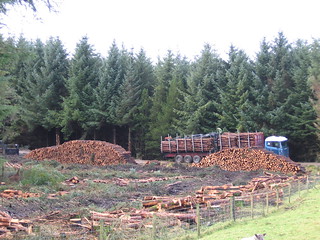
Since my earlier report, the Ponsee 'Ergo' Harvester has been joined by a Ponsee Forwarder and timber is currently being shipped from the site.

The Harvester at work (Photo: R MacCurrach)

The Harvester or 'Processor' is crucial to the efficiency of any logging operations and the Ponsee 'Ergo' working at Ty Gwyn is an example of one of the leading machines. Finland has had well-managed forests for a long time, so I was not surprised to discover that Ponsee is a Finnish company. Einari Vidren was a farmer's son who became a forestry worker. Dissatisfied with the forestry machines available in the 1960s, he built his own and the success of his own designs led him to found Ponsee in 1970. 'Ponsee' is apparently a crossbreed dog found in Finland. This firm now has over 800 workers and is active in 40 countries. It describes itself as "A logger's best friend". For more information on the firm and its products, go to their website.

The two methods of logging are 'tree length' where the main trunk is brought out in one piece and 'cut to length' where each trunk is accurately cut to sections of the required length as part of the felling. The second method makes heavy demands on the harvester technology, leading to increased capital cost, but offers benefits each time the timber is handled after felling.

The forwarder loading cut timber (Photo: R MacCurrach)

The Ponsee Forwarder has the same rough-terrain design and telescopic crane as the Harvester. Its task is to grapple the cut logs into its load space and transfer them to the loading area adjacent to a forest road for loading onto a timber truck for long-distance transfer on public roads.


Timber truck at a loading point (Photo: R MacCurrach)

According to the requirements of the end user, the timber may be graded into two or more types. This depends principally upon the diameter of the trunk and this is measured automatically by the harvester head as part of the cut-to-length operation. Timber trucks have their own vehicle-mounted crane so that they can self-load and self-unload.

With modern computer and communication technology, it is now possible for all the machines and trucks involved to be linked to the receiving mill and planning office for best overall efficiency. The Ponsee software systems are briefly described here.

My pictures of this stage of harvesting are here.

[Ponsee links updated 25-Jul-2014]

Wednesday, 2 December 2009

Platform Numbering Revisited

In an earlier post I talked about the Japanese mastery of 'Platform 0'. I'm indebted to a correspondent in Japan for introducing me to 'Kaleidescope World' which has a comprehensive list of 'Platform 0' with photographic evidence.

I should have credited the U.K. with three 'Platform 0' - one in England (Stockport), one in Wales (Cardiff) and one in Scotland (Haymarket). Europe musters five 'Platform 0' and Japan remains the undisputed leader with 40 remaining 'Platform 0'. Years ago, Japan had 100 stations with a 'Platform 0'!

In my earlier post, I illustrated the entrance to 'Platform 9-3/4' at Kings Cross as being England's attempt at unusual platform numbering.

On a recent visit, I was surprised to find the portal had magically moved itself to a new location.

I can only assume that whatever magical spirits dwell around the portal have been disturbed by all the building work going on at Kings Cross and have thus relocated to a slightly more congenial area.

Part of the rebuilding at Kings Cross involves the creation of a new platform. The picture below shows the major civil engineering work in progress to drive the new track on the extreme East Side, next to the present Platform 1.

You might imagine that a new platform next to Platform 1 would logically be given the title 'Platform 0'. But, of course, Network Rail laughs in the face of such conformist logic. I am reliably informed that the new platform will be designated 'Platform Y'. Why? The suggestion is that some of the existing signalling or information systems are unable to handle a 'Null'.

Sunday, 15 November 2009

Pontcysyllte Aqueduct

This famous aqueduct crosses the valley of the Dee near Llangollen, carrying the canal 127 feet above the river on 18 stone pillars. It has been a feature of the landscape since 1805, when it was completed by Thomas Telford and William Jessop. The canal is carried in an iron trough 11'10" wide, 5'3" deep and 1007 feet in length.

Somehow, I'd never actually visited the aqueduct until today, when Carol took a side road off the A5 so that I could photograph a rainbow. The clouds had shifted by the time I took the shot, so I didn't get the effect I was after but, having stopped, we decided to walk across the aqueduct. The sun had come out and it was quite mild so quite a number of visitors were walking along the footway across the aqueduct.

Telford's novel approach to canal building showed what was possible and his methods were later used by the railways where cuttings, embankments, bridges and viaducts were similarly required. In fact, looking down the valley from the aqueduct, you get a good view of the viaduct built to carry the Shrewsbury - Wrexham line of the Great Western Railway.

I was also intrigued by a hydraulically-operated lifting bridge across the canal. This bridge is rather younger, built by British Waterways in 1990.

My pictures

I took a number of other pictures which are currently missing, as explained here. I'm sorry.

Wednesday, 11 November 2009

Harvesting at Ty Gwyn

Harvesting in progress (Photo: R. MacCurrach)

I've written about the small commercial woodland at Ty Gwyn in an earlier post. This year, Ty Gwyn became a 'Certified Woodland' as the management has been certified to the Sustainability Criteria of the Forest Stewardship Council.

The commercial spruce from about half of the woodland at Ty Gwyn is being harvested in late 2009. The timber has been sold as "standing trees" and so the purchaser is responsible for felling and carrying away.

Harvesting in modern woodlands is largely automated and the 'Harvester' is central to the operation. This tracked or partially-tracked vehicle can work in difficult terrain. The jib is a little like that on a 'JCB' but instead of a bucket, there is a complex harvester head which splits so as to pass around the trunk of the tree to be felled. The head then firmly grasps the trunk and a built-in chain-saw cuts through the trunk. The felled tree is then lowered to a horizontal position so that minor branches can be automatically stripped as the trunk is passed through the harvester head. Finally, the trunk is chain-sawed into preset lengths which are laid on the ground to await collection by the Forwarder.

The Forwarder is another vehicle adapted for harsh conditions, usually with some sort of 'Hiab' crane for lifting logs into the load space. Forwarders are often articulated with large tractor-type wheels. Their job is to transfer logs to a suitable loading point with road access where conventional timber lorries can take away the logs.

More pictures.

Friday, 6 November 2009

Brewood Scouts visit Brewood Hall

Brewood Scouts made an evening visit to Brewood Hall on Friday, 6th November 2009. Jan Ford talked briefly about the history of the Hall before taking the group on a conducted tour of the principal rooms. There were plenty of questions from the young people about the Hall itself and the artefacts on display.

The visit concluded with orange juice and biscuits in the dining room. The Scouts impressed both with their keen interest in everything they saw and their excellent discipline. This was certainly the first visit by the Scouts to the Hall in over 40 years.

More pictures.

Thursday, 29 October 2009

Day out with Thomas: 2009

Children help the Conductor to fill buckets of 'Special Water' for 'Thomas's' side tanks as Sam stands ready.

The Battlefield Line normally run 'Thomas and Friends' events on a number of weekends during the year. I've written about these before and you can find all the posts (including this one) here.

June 'Thomas' events

In June 2009, 'Thomas' appeared on the 6th, 7th, 13th and 14th. I wasn't rostered on a steam locomotive on these dates but I did get a footplate ride on 'Thomas'(a Butterley 'Jinty' on this occasion). I did have a day "Driving Miss Daisy", the 2-car DMU (pictures). The 'Thomas and Daisy Shuttles' where 'Thomas' is attached to 'Daisy' for a short trip up the running line have become very popular, so most of the DMU trips were like this, with 'Daisy' providing power from Shackerstone to Headley's Crossing and 'Thomas' bringing the train back. One entry fee lets the public take advantage of all the attractions and a ride with 'Thomas' is always appreciated. Since 'Thomas' spends a lot of the day in the station taking part in races, playlets or simply being admired, another locomotive hauls most of the service trains to Shenton. This year, that's the immaculate 'Mayflower' (pictures).

The 'Thomas and Daisy Shuttles' give everybody a chance to have a short ride behind 'Thomas' and make best use of the railway infrastructure. 'Daisy' and 'Thomas' are coupled together in Platform 1 and load passengers so that, as soon as 'Mayflower' arrives in Platform 2 with the service train from Shenton, they can depart into the recently-vacated single line section for a journey of about a mile. Any other locomotives have to move out of platform 1 so that 'Mayflower' can run round, ready for the next Shenton departure. By the time 'Thomas' has brought the 'Thomas and Daisy Shuttle' back to Shackerstone, 'Mayflower' should have run round, leaving Platform 1 clear for the arriving shuttle. The departure of 'Mayflower' is intentionally delayed to give time for passengers from the 'Thomas and Daisy Shuttle' to cross over the bridge and join the train for Shenton. 'Thomas' uncouples from 'Daisy' and is ready for more fun and games in the station whilst 'Daisy' shunts into the DMU siding to await the next shuttle service. All this requires smart working from the operating staff involved.

Working the Shuttle

'Thomas' is vacuum-braked for working passenger trains and the 'Modernisation' DMU were also fitted with vacuum brakes, so it's possible to work 'Thomas' coupled to the DMU with braking controlled from the leading vehicle. The DMU were designed for intensive stopping services with frequent station stops, so they are provided with a special 'high speed' vacuum brake where a second pipe runs down the train to enable vacuum to be re-created quickly, even when a number of units are being worked in multiple. When coupling 'Daisy' to 'Thomas', the shunter has to remember that the vacuum hose on the DMU with the red-painted coupling is the vacuum brake which is coupled to 'Thomas'. The other (blue) coupling remains on the stopper.

When 'Daisy' is leading, the driver on 'Thomas' shuts off the steam supply to the vacuum ejector and the brake application valve is placed in the 'Running' position so that 'Daisy's' driver has control of the brakes. 'Daisy' is driven normally, with the vacuum created by the exhausters, and 'Thomas' is just 'tail traffic'.

At Headley's Crossing, 'Daisy's' driver shuts down the cab and moves to the other end of the train. The cab next to 'Thomas' is opened up and the vacuum brake application valve is placed in the 'Lap' position. The DMU driver also needs to activate the 'Deadmans' device, otherwise 'Thomas' is unable to create vacuum. The DMU is normally placed in 4th gear with the engines left idling. 'Thomas' is then able to haul the DMU back to Shackerstone as if it were hauling normal coaches.

October 'Thomas' events

In October 2009, 'Thomas' appeared on the 10th, 11th, 17th, 18th and 19th. I was on 'Thomas' on the first two days, then on 'Daisy' on the third day. This time, 'Thomas' was the 'Hunslet' we'd used in 2008 (pictures). Since then, 'Thomas' has had his wheels re-tyred and now makes a faint 'whirring' when in motion, like a small electric motor. The engine steams well and pulls well. In addition to the normal 'Thomas and Daisy Shuttles', the races (against a diesel electric) and the playlets, 'Thomas' took the first and last service trains to Shenton. The last train is 'Tea with Thomas' and a childrens' meal is served on the journey, so 'Thomas' has to be on his best behaviour not to jerk the train whilst the children are enjoying their teatime. 'Fergus' was also in steam, pottering around the station at Shackerstone (pictures). There were lots of other activities including Face Painting, Model Railways, Balloon Modelling and a Children's Entertainer. The weather was generally kind, attendance was quite good and I think everybody had a good time. A few pictures of the October event are here.

Wednesday, 7 October 2009

STRail Corporate Day at Peak Rail

STRail are a manufacturer of sectional, moulded panels used to provide a road surface at level crossings. Production is in Germany but the system is actively marketed in the U.K. (see U.K. Website). STRail held one of their Workshops at Peak Rail on 7-Oct-2009.

Derek and Jan were rostered as the '8F' loco crew and since the engine was required for 9:00 a.m. this meant an early start. After attaching the stock, we went 'Empty Stock' to Matlock Riverside and ran round, ready to pick up those STRail guests who'd travelled to Matlock by train from Derby. These passengers alighted at Darley Dale for the short walk to the Whitworth Centre for presentations by STRail. The '8F' carried on to Rowsley and ran round again, ready for the next trip.

Returning to Darley Dale, we picked up all the delegates who were then served lunch as the train moved through the Derbyshire Countryside. After two round trips of the line, the guests were suitably 'fed and watered' and alighted at Rowsley.

At the north end of the loop line, STRail had set up demonstration panels of the various level crossing solutions they manufacture so that the delegates could receive practical instruction in installing the equipment.

Two impressive SRS Rail System road/rail work vehicles were also in attendance near the STRail demonstration panels. Swedish Rail Systems (SRS) produced their first design in 1976 and the U.K. website gives details of the current range.

The delegates then returned to the train for coffee and biscuits while Derek and I moved the '8F' to the south end of the train for our final trip. At Darley Dale, delegates with cars left us and we carried on to Matlock Riverside where the remaining delegates left us to catch the diesel service to Derby. A final run round and a romp up the bank brought us back to Rowsley. We uncoupled from the stock and took the locomotive back to the outside pit for disposal. The weather had been kind, the locomotive had performed flawlessly and I think the day was judged a success by everybody involved.

I took a few pictures - they are here. I also took 'technical' shots of the '8F' which I've added to the collection here.

Saturday, 19 September 2009

Staffordshire Libraries visit to Brewood Hall

As part of their Heritage Month in 2009, Staffordshire Libraries organised a walking tour of Brewood Village led by David Evans. The tour ended with a visit to Brewood Hall. Arrangements were made by Vanessa and Sharon from the library service and they provided light refreshments in the dining room at Brewood Hall. The visitors were divided into two groups for the tour of the principal rooms led by Jan. Everybody seemed to enjoy the event.

Pictures of the visit.

Monday, 14 September 2009

From Bhutan to Brewood

Leaving Bhutan

On Sunday morning, 13th September, I left the Amankora Paro Lodge for the final trip with Tashi and Karma to Paro Airport, only a few miles away, with mixed feelings. I was delighted with all the experiences I'd collected on my trip but sad that it was coming to an end and that I'd be leaving my companions behind.

At the airport, check-in and formalities were quickly carried out and I found myself in one of the smallest Business Class Lounges I've been in anywhere. As boarding time approached, all the available seats filled and we were joined by a small party of VIPs. I noticed the extra attention the man in the VIP party obtained from the staff and after a few minutes the airport Head of Security arrived to pay his respects. I reasoned that at least departure was likely to be on time and, indeed, it was so. We climbed out of Bhutan across the mountains for our short flight to Kolkata.

Kolkata Airport

Immigration at Kolkata was only slightly delayed by medical teams interrogating arriving passengers and checking their temperature (with modern electronic thermometers). It look a little longer for the luggage to arrive but, re-united with my large case, I passed into the arrivals hall and was pleased to spot my guide waiting for me. The plan had been to spend a few hours seeing more of the city before checking-in for an internal Jet-Air flight to Mumbai where I was to connect with a Jet-Air international flight back to the U.K.

Unknown to me, a labour dispute had arisen between Jet-Air and a group of their pilots and the services had been disrupted for some days. Although an agreement had been made the previous day, the schedules were still suffering delays and cancellations. Accordingly, I readily agreed with my guide that we would walk to the adjacent Domestic Terminal and make enquiries at the ticket office. It transpired that my international flight was expected to operate, but there was doubt about my connecting flight. It was agreed that the safest alternative would be to shorten my stay in Kolkata and catch an earlier flight than intended to Mumbai. As you might expect, after a number of days of delay and cancellation, all seats were at a premium and the Ticket Office was unable to find a seat but they did arrange for me to visit the Station Manager's Office.

A young man was delegated to take me across to the office. He led me across a crowded terminal hall to the row of Jet-Air Check-in Desks. You must have noticed how there is often a baggage conveyor behind the check-in desks to carry checked baggage away and that this conveyor is provided with pedestrian bridges to allow staff to get 'behind the scenes'. Well, my young man headed straight across one of these bridges, with me following. We emerged in the 'back-office' area and gloomy corridors led us to the Station Manager's Office. This comprised a general office about 20 feer square with a couple of private offices partitioned off. Each of a dozen or so computer terminals were attended by a man or woman and, in addition, people were entering and leaving all the time, talking in loud voices on the phone or to one another. The atmosphere was rather frenetic and my heart sank. My young man spoke to one lady who shook her head and pointed to the girl at another terminal. Here, I was invited to sit whilst the operator conducted an extensive dialogue with her computer. Eventually, she gave a smile and wrote some flight details on a scrap of paper. It appeared she'd found me a seat on an earlier flight! Relieved, I thanked her and the young man conducted me back to the Ticket Office with the precious details on the scrap of paper. After a few minutes, I was in possession of an endorsed ticket for an earlier flight so my guide and I then went with the luggage to the car. There was still enough time to go into Kolkata, see a little more and return for my altered connection to Mumbai.

Preparations for Durga Puja

"Potters' Lane", Kolkata

My guide said that we would take a walking tour in "Potters' Lane" because in just two weeks it was the Festival of Durga Puja. I didn't finally work out the significance of this until later but here's a simple explanation. In Bengal, the most important Hindu deity is the Mother Goddess, Kali. Every October, Bengal celebrates the coming of Durga (Kali's maternal incarnation) in the five-day festival of Durga Puja.

Preparations start much earlier for around 300 families of artisans in the Kumartuli district of northern Kolkata known as "Potters' Lane". Representations of the deity and her family are sculpted using fresh monsoon clay applied to bamboo armatures. We walked through a rabbit warren of narrow lanes where every building was a workshop hard at work completing the figures, painting them in a most life-like fashion and dressing them in suitable highly-decorated clothing. Around one million of these statues are prepared each year and sold to homes and various community groups. Meanwhile, the community groups vie with one another to construct elaborate temporarary buildings all over the city, each using a bamboo structure which is then covered with gaily-coloured cloth forming a short-lived temple to house the statues. I was amazed both by the number and quality of statues on show and by the architectural ambition of the bamboo structures we saw around the city. At the time of my visit, whilst there were plenty of the bamboo structures, cladding the structure to make a 'tent' (the word seems very inadequate) was only just starting.

Over this period, the whole city goes a little mad and during the five days of the festival itself there is a great celebration. At the end of the festival, most of the city goes in procession to the river with the statues which, decorated with floral garlands and candles, are cast upon the waters to be carried out to sea.

Kolkata and the Jain Temple

Parasnath Jain Temple, Kolkata

As we crossed the city by car, I saw more of the preparations for the festival in addition to the contrasts of everyday life which are glimpsed in my pictures. My guide was anxious to show me the famous Parasnath Jain Temple but, when we arrived, we discovered it would not open for around 15 minutes, so I went off on my own on foot to explore the adjacent immigrant area. There are many refugees from neighbouring Banglasdesh, some living in tents alongside one on the canals. A lone European on foot attracts attention but the reaction is just friendliness. The common call is "Where you from?" and nobody was begging. I returned to the Jain Temple just as it was opening. Quite a number of Indian tourists were also making a visit. The temple was built in 1867 and the main structure is highly decorated with Venetian glass, mirrors, and painted panels depicting scenes from the Jain mythology. All very interesting but, too soon, it was time to return to the airport for my altered flight to Mumbai.

Jet-Air to London

At the Domestic Terminal, I said goodbye to my guide and driver and checked in. The terminal was heaving with passengers but it didn't seem that much larger that the adjacent International Terminal. I'd got an invitation to the lounge but, mistaking the directions, I first went through security in error. I then had a couple of tricky minutes trying to persuade the security staff to let me back out so that I could try again. When I finally found the lounge, it was a fairly modest affair but still a welcome oasis from the hurley-burley outside.

The leg to Mumbai was on time and uneventful. Mumbai Airport is a substantial affair (more what I'd expected at Kolkata) and, like so many airports, currently undergoing a major building programme. My bag had been checked through to London, so I just had to get myself across to the International Terminal. I caught the free transfer bus and was surprised that it set out across the apron for some distance before going through an airport gate to get onto the public road. The public road took us to International Departures where I alighted, tired but happy.

I don't remember much of the last leg but the Jet-Air flight was comfortable and the staff friendly. It was the 23rd August when I left Heathrow. Now, 14th September, I was arriving back there having had some wonderful experiences and seen some incredible sights. I think myself very fortunate. As arranged, Alan met me at the airport and safety brought me back to Brewood.

A few aerial pictures approaching Kolkata.
My earlier pictures of Kolkata.
More pictures of Kolkata.
Pictures of the preparations for Durga Puja.

Saturday, 12 September 2009

Paro, Bhutan

After the magnificent visit to the Tiger's Nest Monastery, we returned to the luxurious surroundings of the Amankora Paro Lodge (Pictures). It didn't take long for me to be ready for the next, somewhat less physical, experience.

We drove to the elegantly-proportioned Dzong in Paro. The security guard here insisted that I wear a full-sleeved jacket before he'd let me in. We looked around the secular, 'town-hall' part of the Dzong. A plan in English showed how to find the correct department. The modern-sounding list of sections (Engineering, Education, Culture, Census, Planning, Human Resources, Administration, Forestry, Agriculture, Environment...) seemed odd, accommodated in a medieval building full of ancient timbers gaily decorated with traditional painted designs.

Equally incongruous, the other half of the fortress is a monastery with temples, schoolrooms, kitchens and toilets. A sign in Bhutanese and English outside one toilet warned "ORDER - OTHER THAN DRATSHANG, NO BODY IS ALLOWED TO USE DRATSHANG'S TOILET". Oddly, it was perfectly acceptable for us to enter the schoolrooms and watch the young monks at study. The hillside site of the Dzong gives commanding views of the river below, spanned by a traditional bridge leading to the town of Paro. Pictures of Paro Dzong

With some reluctance, I left the serenity of the Dzong and we walked down the hill, crossed the pedestrian bridge and explored the town. The traditional Bhutanese buildings contrasted with roof-mounted satellite dishes and the nearby mobile radio tower. Wooded hills lay in the background and a rainbow seemed to promise good fortune. One shop had a television set, surrounded by a crowd of people with more people watching from the pavement through the open windows. The programme avidly being followed was live coverage of the National Archery Contest being held in Thimphu. We completed our tour of the town (including a visit to an antiques shop) and then drove back to the Amankora Paro Lodge. Pictures in and around Paro.

There was one more excursion I wanted to make before relaxing on my last evening in Bhutan. There's a ruined Dzong not far from the Lodge which I wanted to have a look at. Tashi thought the Caretaker probably closed the site to visitors at 5:00 p.m. but, nonetheless we went up there by car with Karma.

There was nobody at the Caretaker's cottage, so we walked up the path leading to the wooden entrance gate in the outer wall of the Dzong. The gate was open and Tashi said he'd wait by the gate while I explored inside - he was clearly concerned that the Caretaker would suddenly appear and lock the gate for the night! I clambered around ruined walls and, more than any other Dzong, its defensive importance was apparent. It felt just like some of the English Medieval Castles I've visited. When I returned to Tashi, he was talking to two young girls playing cheerfully with a ball. He explained that the Caretaker was away and the girls had been made responsible for locking the gate but they were a little late attending to their task. So I was very lucky to have gained access at all. The Caretaker, it appeared, had gone to Thimphu to watch the National Archery Contest. Pictures of the ruined Dzong.

Soon, we were back at the Lodge. It was time for me to bid farewell to this remarkable, improbable country and prepare myself for the long journey back home on the next day.

The Tiger's Nest Monastery, Paro, Bhutan

Saturday 12th September 2009

On Saturday, I was to attempt the hike to the famous Tiger’s Nest Monastery which clings to the cliffs in an improbable fashion 800 metres above the surrounding plain. All Bhutanese are expected to make a pilgrimage here at least once in their life – it is a very special place. The ascent typically takes two to two and a half hours – the descent is about half an hour quicker. It is possible to take a horse most of the way up but I thought I’d risk it on foot. Tashi had, very sensibly, suggested we set off a 7.00 a.m. whilst it was still cool and this proved excellent advice. Karma drove us to the car park near the collection of houses at the bottom of the track, passing a number of horses on their way to wait for customers. Tashi and I began the ascent at 7.20 a.m. The start of the track was quite easy – steps had been provided using small round wood as ‘risers’. The track climbed steadily through a wooded area, passing three water prayer wheels. Emerging from the trees, the track was harder to follow and I was glad that it was still cool. After 20 minutes, I stopped for a five-minute ‘breather’. I’d intended to carry on like this, with a ‘breather’ every so often, but as I continued I found I could keep moving at a steady pace without resting.

After about an hour of climbing, we came to a flat area with a single, large prayer wheel and a group of six small prayer wheels. There were a number of Bhutanese sitting around the large prayer-wheel – these were the first people we’d seen on the mountain. Even in this remote location, there were about five dogs lying around. From this clearing, we had our first, intermittent views of the monastery since starting the climb as the mist swirled aound the mountain top. Tashi pointed out a short path to the right leading to a cafeteria offering good views of the Monastery. Tashi said that a number of foreigners are happy to stop at the cafeteria and then descend again. Needless to say, your observer is made of sterner stuff and I set off again at a reasonable pace.

The track was undoubtedly steep in places and the footing uncertain but I found I was quite happy to keep going. Beyond the prayer wheels we were joined by a number of the dogs who either showed the way, investigated the interesting scents or tagged along behind. Climbing steadily, we entered another wooded area. Here, because of the higher elevation, Spanish Moss hung from the tree branches. This delicate, rootless plant looks very attractive, if a bit ‘other-worldly’. We came to a large cleft in an exposed rock decorated with hundreds of the pottery ‘miniature stupas’ placed by pilgrims. Tashi said that this was one of the places used for meditation. Still climbing, we came to a more exposed place where the path was near a sheer drop. Strings of prayer flags festooned the area. A small spring bubbled up right in the middle of the track and then drained off down the mountain. Next, we came to a small building, presumably built on the opening of a cave where a sign in English and Bhutanese identified the location as the birthplace of H. H. Khenpo Jeshey Guenden Rinchen. We arrived at a viewpoint which was actually higher than the monastery. There was quite a gathering of dogs here, some already there, some who had travelled up with us. A small house was nearby and two old ladies appeared from within the house to give the dogs some scraps, which caused some excitement amongst the animals.

The last challenge was now clear. To reach the monastery, there are first over 400 steps to descend so as to cross a bridge over a gorge and then as many steps to climb to reach the monastery on the other side of the gorge. Part way down the steps, there was a small building where pilgrims can light butter lamps. At the lowest point, there’s a short bridge at the base of an impressive waterfall where everything gets quite wet. Beyond the bridge, there’s another meditation lodge wedged against the rocks. Finally, at the top of the steps, there’s an unfriendly looking security check manned by staff in military camoflage dress, but with 108-bead Buddhist rosaries. Apparently, we were the first visitors of the day. You have to leave all your possessions at the security check (including, of course, cameras) before being allowed to proceed.

At last, we entered the monastery and the caretaker unlocked the main temple which has a door to a famous cave now opened only one day a year. Prostration to the altar was required, after which the caretaker administered the Holy Water blessing and we gave the required small donation. We then went up stone steps to a second temple where a different, perpetually smiling caretaker explained that visiting monks had recently started a special ritual which would last 15 days. There were about a dozen monks in the small temple, chanting from a text, accompanied by trumpets, cymbals and drums. The effect was electrifying. Because this temple has a chair for the lama, prostration to this chair is required before honouring the altar.

Pictures of the Tiger's Nest Monastery.

Moving on to Paro

Friday 11th September 2009

I left the Punakha lodge at 9.00 a.m. and we made the three hour drive back to Thimphu. Land slips are quite common and at one point the road was completely blocked by an excavator shifting away fallen rocks. We were only delayed a few minutes. A little further on, a series of lorries blocked the road. They appeared to be being loaded with the fallen rock. After a short delay, we moved on.

Then, we came upon what appeared to be an accident between a red car going one way and a large lorry going the other way. There was just room for a single line of traffic to pass the accident by driving on the unsurfaced verge. Next to this accident, there was a Pelyab Transport Service bus in trouble. As far as I could make out, the bus had got past the accident by driving on the soft verge but, in so doing, had managed to get a large piece of wood stuck between the tyres of one of its double back wheels. The bus was easing backwards and forwards while two men tried to lever out the timber. We carried on a few minutes and came across a minor land slip where the edge of the road nearest the lower slope had fallen away. A crude wooden fence had been rigged to draw attention to this hazard.

As we came nearer Thimphu, the apple harvest was still in full throw then we were stopped by a queue of thirty cars waiting for an excavator to clear the road. This was the same worksite which had delayed us on the way east a few days before but this time the delay was 25 minutes. When we did move off, a narrow track had been cleared through sandy soil about three feet deep.

We reached Thimphu without further incident and drove to the Amankora Lodge Thimphu where I'd stayed on my arrival in Bhutan. Here, I took lunch before we carried on west to Paro, where I was to spend my last two nights in Bhutan at my fourth Amankora Lodge.

Pictures on the road from Punakha to Paro.

When we arrived in Paro, rather than proceed directly to the Lodge, we turned off the main road and took a winding, country route which eventually climbed to the National Museum, set on a hill overlooking the Rinpung Dzong. The museum is in an ancient tower which once served as a watchtower protecting the Dzong. Some say it’s conche-shaped: it’s certainly not just round. The exhibits are spread over a number of floors and the visit provided a useful insight into Bhutanese traditions and history. On leaving the museum, there were superb views of Paro and the surrounding district.

Pictures outside the Museum.

As we descended from the museum by car, the road was blocked by a T.V. Film Crew. A famous Bhutanese director was coaching a group of young male and female dancers in modern dress in a lively song-and-dance routine. He was attempting an ‘arty’ against-the-light take facing the setting sun. Along with a number of schoolchildren we watched for a while before returning to the Lodge.

Pictures of Paro and the Film Crew.

Friday, 11 September 2009

Exploring Punakha

Thursday 10th September 2009

I slept well and woke early to a warm, sunny day. The attraction of the Amankora Punakha is that the main building is about 50 years old and built in the Bhutanese farmhouse style. The royal family own a lot of land in the beautiful Punakha Valley and this building was originally owned by the royals. After a pleasant breakfast, I took plenty of photographs to illustrate the layout and construction. Pictures of the Amankora Punakha.

I met Tashi at 9.00 a.m. and we followed the usual routine - buggy to the bridge, cross the bridge, meet Karma and the 4 x 4 on the other side. We drove a few kilometres south and stopped at a small village. Leaving Karma with the car, Tashi and I walked through the village to the rice fields behind. They usually get two plantings of rice in this area. The first planting was turning yellow and ready for harvesting, this second was green and still immature. Our path led us across the narrow dyke separating two rice paddies, past a chorten with prayer wheels and uphill through another group of houses.

At the summit of the low hill we came to our destination, the temple associated with fertility. Women who have difficulty conceiving are advised to visit this temple for the prescribed ritual and tales abound of pregnancies following. Whatever other properties the site has, it's a very beautiful spot, looking down on the river and the mountains beyond and festooned with dozens of poles supporting prayer flags. I was also interested in the new building being erected in Bhutanese style and the radio transmission equipment which included a large satellite dish. In a classroom next to the temple young monks - children really - were engaged in their studies.

We retraced our steps down the hill, thnrough the rice fields and back to the village on the main road. The local bus was waiting and sounded his horn to chivvy late passengers. I hoped that the bus company name was not prophetic - 'BUMPA TRANSPORT SERVICE'. Pictures on the trip to the Fertility Temple.

We travelled back north through Kruruthang - the 'New Punakha' - and made a photographic stop just before arriving at Punakha Dzong, which some say is the most beautiful of the Dzongs. We parked adjacent to the Dzong but on the other side of the river and reached the Dzong by a modern pedestrian bridge in the traditional 'cantilever' style provided by Germany. The Dzong is certainly impressive internally and the administrative courtyard features a chorten and a now-mature tree donated by the Prime Minister of India. By the time we emerged from the Dzong, Karma had somehow moved the car across the river. All was revealed as we set off north, because we came to a Bailey Bridge over the river which led us back to our original road and the Punakha Lodge for lunch. Pictures of Punakha Dzong.

After lunch we had one more trip planned. Karma drove us north a couple of kilometres, turning right by the houses where we'd paused on the bike ride and then driving downhill to the river bank. Another pedestrian suspension bridge let Tashi and I cross the river. We made our way to the impressive bulk of a wooded hill surmounted by an elaborate chorten, the Khamsum Yulley Namgyal Chorten, often just called the 'Royal Chorten' for simplicity. In the hot sun, it took just over half an hour to follow the track up to the large chorten. If I understand its significance correctly, it was erected by the former queen to make the future of her son more auspicious. Although it's referred to as a 'chorten', internally it's laid out as temples on various levels. At the top of the building, there's an outside viewing gallery giving stunning views of the river valley. Pictures of the 'Royal Chorten'.

By now the afternoon was cooler and it was a pleasant walk down the hill and across the bridge to get back to the car. A short drive took us back to the Lodge in plenty of time for dinner.

Gangtey to Punakha

Wednesday 9th September 2009

We left my new friends at the Gangtey Lodge about 9.00 a.m. but we’d arranged one more visit before leaving the district. We parked by Beyta Community School (where yesterday’s horse ride had finished) since a visit had been arranged to see the work of the school. The school covered grade 1 to 5 but the headmaster (who oversaw the building of the school a few years ago) hoped to extend to grade 6 when an agreed building programme is complete. A wide syllabus is taught, much of it in English. The children looked smart in approved national dress and were well behaved. Each child had textbooks, exercise books and a set of pencils and coloured crayons, all provided by the Government. I looked at the maths textbook (a Bhutan – Canadian co-production in English) and found innovative modelling techniques to help young people master the manipulation of numbers and problems which I’m sure would daunt children of a similar age in my own country. Pictures of Beyta School.

We drove back along the road we'd used to get to Gangtey part of the way towards Thimphu. At the highest point (elevation 3,600 metres) we stopped to look at the chorten and take some pictures. Mist was swirling around us. We were then back to the series of hairpins leading us to lower levels. At one point, the bushes held a troop of monkeys unconcernedly munching berries.

At a couple of villages we passed through, families produce woven bamboo as a material for fences, temporary shelters or house walls. To ease the effort of slicing the bamboo longitudinally, they lay out bamboo along the road and let the traffic run over it for a while. Periodically, there were local people selling produce. If they can sell it at the roadside, it saves the cost and time of transporting it to the nearest market. Every few kilometres, we’d pass people working on the road, keeping the gutters clear and cutting back the luxuriant vegetation. We crossed a major river on a substantial girder bridge apparently provided by the Japanese. Oddly, the girders were unpainted and were brown with rust.

Bhutan has no conventional railways but it does have one ‘ropeway’ serving the remote hilltop village of Tashila. We stopped at the bottom of the ropeway to observe the operation. The main function is to take supplies up to the village, bringing back produce like potatoes and timber. When we arrived, the ropeway was working and we decided to wait for the load to arrive. The ropeway ‘driver’ (and possibly proprietor) seemed quite happy with me poking around but, with amazing self-restraint, I’ll not give you the technical details just now. The load which arrived was a substantial tree log with a number of sacks of potatoes strapped on top. This load was lowered to the ground and the return load of bundles of sacks (presumably for more potatoes) was lashed to the ‘carrier’. I was puzzled when one of the men who had helped to lash the bundles of sacks in place fixed a piece of cargo netting hammock-style above the load. I was amazed when he jumped into this ‘hammock’ and was dispatched without ceremony by the ‘driver’ on the half-hour journey to the summit. Pictures of Tashila Ropeway.

As we approached Whangdue Phodrang, the massive white bulk of the Dzong, sitting high on the cliffs overlooking the confluence of two rivers looked more like a medieval fortress than the monastery and seat of civil government it has become. The impression of a defensible place is maintained inside in some of the dark, windowless stone passageways connecting different parts of the Dzong. There are a number of ‘arrow slit’ windows as well. But the courtyards, surrounded by wooden galleries of intricate design and gaily painted are places of light, celebration and ceremony. The architecture is impressive but it’s difficult to distinguish between the genuinely ancient and the recent renovations. Perhaps it doesn’t matter. The effect is timeless and magnificent. Pictures of Whangdue Phodrang Dzong.

The town of Whangdue Phodrang lies just outside the Dzong, sharing with the Dzong its cliff-top location. There’s a huge prayer-wheel, taller than a man, in a decorated wooden pavilion. This is no mere picturesque relic – all day people come and go, giving the heavy cylinder one or more spins. The town is a wonderful, cramped place with no pavements and a host of tiny shops selling anything you could wish for. Mobile phone or DVD player needs repair? No problem. It’s messy, very human and, no doubt, dangerous with pedestrians and traffic vying for space so, inevitably, a new town is taking shape a few kilometres away. Pictures of Whangdue Phodrang Town.

We crossed the river, easing past the solitary cow which had taken up station on the bridge and continued along the Thimphu road, before turning right onto the road to Punakha. Punakha has already been blessed with a new town. It may be very convenient for the residents but it struck me as being as unattractive as most other new towns I’ve seen. A few kilometres further on, we came to what some regard as the most beautiful of Bhutan's collection of twenty Dzong, the Dzong at Punakha, which we visited the following day. The car carried on up a beautiful river valley with wooded hills on either side. The lower elevation gives a much warmer, sub-tropical climate making this a desirable spot to winter for royalty and those who can afford it alike. Tashi pointed out the roof of a traditional Bhutanese villa part-hidden in the trees on the opposite ride of the river. This was the main building of our destination, the Amankora Punakha Lodge. We parked near the riverbank by a modern suspension bridge which I realised was pedestrian only. We were greeted by staff from the Lodge who collected my luggage and hoisted it onto their shoulders. We set off single-file across the bridge over the fast-flowing river. I was presented with a short tape bearing a number of coloured prayer flags. I had to tie this to the wire cable handrail of the bridge, joining the hundreds already there, fluttering in the warm breeze. Reaching the other side of the river safely, a walk of a few yards took us to a waiting ‘golf buggy’. But this was an internal-combustion buggy which a later learned was one of two specially converted for the job by Amankora from a small Maruti van. A steep winding track took us to the building I’d seen on our arrival and the hotel manager and other staff were on hand to welcome me.

I had a shower and a light lunch in the outside courtyard and met Tashi for a bike ride. I think he was a bit worried as to how I’d get on, so he suggested we drove to a suitable place with the bikes and then rode back. We travelled in the golf buggy to the suspension bridge, walked across the bridge to the car park and there was Karma with the 4 x 4. I wondered how they’d get two mountain bikes in the back of the 4 x 4 and then I realised, with some horror, that they wouldn’t. One of the staff from the Lodge was there with a van containing two bikes and the two vehicles set off north on the public road. We travelled for about twenty minutes with me thinking we were going an awful long way and stopped. I’d expected that we’d be going on some sort of nature trail but Tashi said “Do you think you can ride back to the Lodge from here?” Suppressing the answer which sprang to mind ("No chance") I meekly said I didn’t know. Tashi was full of warnings about how bad the driving was and the animals on the road and the likelihood of plunging off the road altogether. After a perfunctory check that there were some sort of brakes and a bit of experimenting with the two gear levers, I wobbled off on my own. Once I’d got the machine in a sensible sort of mid-gear I realised that the road was predominantly downhill and started to enjoy myself. You needed to steer away from the major potholes and avoid the edge of the tarmac but it wasn’t bad. Approaching animals or pedestrians, I slowed down and sounded the bell. The locals were amused by the elderly foreigner on a bike but returned my wave and smiled. After a while, Karma passed me on the other bike and we carried on, sometimes with me in the lead, sometimes him. I managed to keep going on the uphill parts without selecting a lower gear. From time to time I could just hear the two vehicles trailing me and there were a few other vehicles on the road. I realised then I would have no difficulty getting back to the Lodge. I afterwards discovered it was only about a 6 km journey. When Karma pulled in near some houses level with the ‘Royal Chorton’ on a hill on the opposite bank, I stopped as well and we took a picture.

I set off again, this time with Tashi riding the second bike, and I was quite sorry when I pulled into the car park by the bridge to the Lodge. A few pictures on the Bike Ride.

For the first night, I had the place to myself (five more guests were to arrive on the following day). It was raining so dinner for one was moved into the charming Tea House. I enjoyed a leisurely meal as a musician played Bhutanese music using alternately a lyre and flute. I went to bed tired but happy.